

Introduction
Since the mid-twentieth century, archaeological investigations have emphasised the importance of the Zagros Mountains in early domestication. Beginning with the work of Robert Reference BraidwoodBraidwood (1961) around Kermanshah in the late 1950s, archaeologists have sought the earliest evidence of Neolithic villages, and of animal and plant domestication, with important discoveries at the sites of Guran (Meldgaard et al. 1963) and Ganj Darreh (Reference Smith and BagherzadehSmith 1976) in Central Zagros, and at Ali Kosh (Hole et al. 1969) and Chogha Safid (Reference HoleHole 1977) in the lowland Deh Luran.
Over the last decade, discoveries in the Central and Southern Zagros Mountains have provided new evidence of early experiments with animal and plant domestication by the Neolithic societies of the region, profoundly enhancing the significance of this region in the wider neolithisation of the Near East (e.g. Riehl et al. 2013). The three sites of Chogha Golan (Zeidi et al. 2012), Sheikh-I Abad (Matthews et al. 2013) and East Chia Sabz (Darabi et al. 2011), in different niches of the Central Zagros and its western foothills, have revealed evidence of early Neolithic villages whose inhabitants had been intensively involved with the exploitation of wild animal and plant species during the early Holocene.
The site
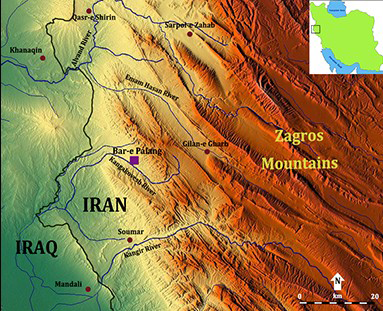
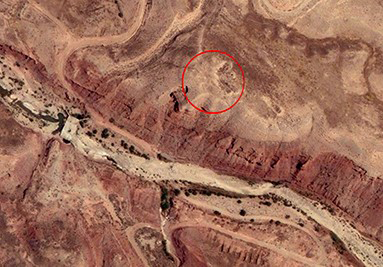
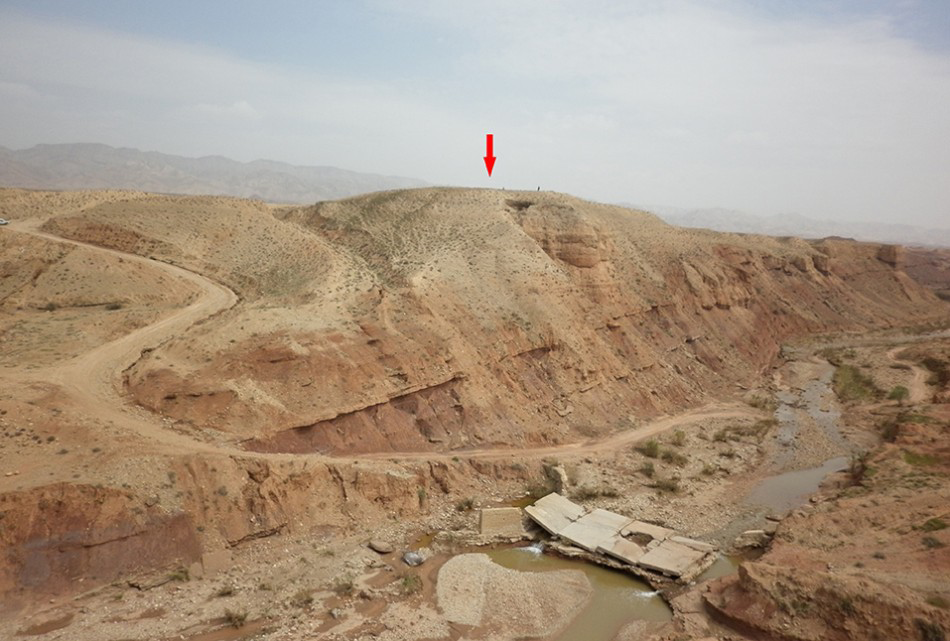
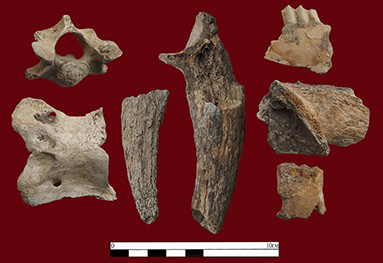
The site of Bar-e Palang (‘Leopard Cliff’ in Kurdi dialect) is situated about 30km west of the town of Gilan-e Gharb, in Kermanshah Province, just 10km from the Iran-Iraq border (Figure 1). The site nests in a rolling landscape that characterises the western foothills of the Zagros Mountains (Figure 2). Bar-e Palang is located on a river terrace overlooking a small stream running by its southern side. The site stands some 23m above the stream bed (Figure 3). The southern and western edges of the site drop steeply to the river bed and a gully; its northern edge shows a moderate slope, while from the east, the site merges with the flat territory beyond. The western edge of the site has been damaged during the Iran-Iraq War, exposing an almost 5m-high profile. This reveals multiple archaeological layers containing a gypsum-plastered floor, domestic ashy deposits, charcoal, animal bones (Figure 4), stone artefacts and the remains of stone architecture.
Map of Iran showing the location of Bar-e Palang in the Zagros Mountains.

Satellite image of the site (Google Earth).

A long-distance view of Bar-e Palang and the nearby stream.

A selection of animal bones recovered from the damaged part of the site.

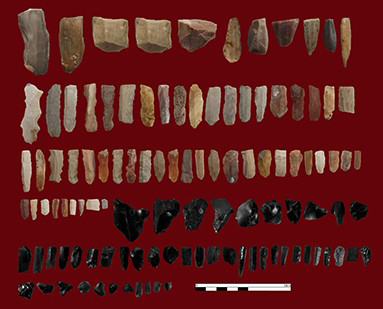
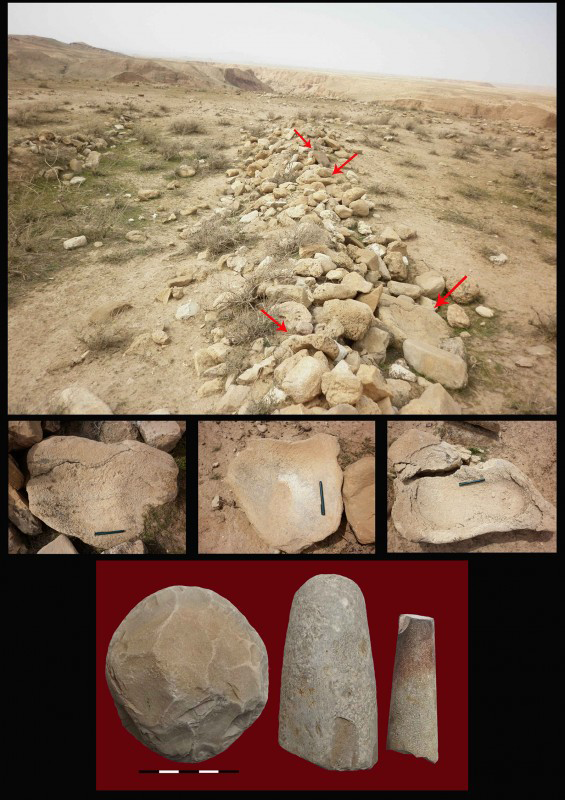
The surface of the site is littered with various types of chipped stone, especially bladelets, flakes and cores (Figure 5). The raw material for this chipped stone is fine-grained siliceous rock, mainly chert and flint, but there is also a notable amount of obsidian: an exotic material that must have reached the site from the well-known eastern Anatolian sources. Large, heavy, stone artefacts, including grindstones, mallets and mortars, mostly of limestone, are scattered on the surface, indicating grain-processing by the site’s inhabitants (Figure 6). No ceramic material was found on the surface.
Chipped-stone artefacts of Bar-e Palang.

Various heavy stone artefacts heaped on the site’s surface by local people.

Conclusion
Bar-e Palang represents an Aceramic Neolithic settlement with a high potential to contribute to questions about early villages and domestication in the foothills of the Zagros Mountains. The depth of archaeological deposits—5m, and possibly more—make this site ideal for a long-term, diachronic study of the development of animal and plant domestication. Bar-e Palang, along with the newly investigated sites of Chogha Gholan, Sheikh-I Abad, Jani, Chia Sabz and Kelek Asad Morad (Moradi et al. 2016), attest to the early efforts of human societies in the Zagros Mountains to take control of local wild species. The distribution of these sites indicates that the western part of the Central Zagros was the focal point for early domestication and sedentism on the Iranian Plateau.
Acknowledgements
We would like to thank Abbas Motarjem of Bouali University, and also Kourosh Roustaei of the Iranian Centre for Archaeological Research for his comments, support and encouragement.