


Introduction
Industrial-organizational (I-O) psychology focuses on improving worker performance and well-being within organizations (Conte & Landy, Reference Conte and Landy2019; Rogelberg, Reference Rogelberg2004). Although the term “human” is not always included in the field’s definition (though it appears in the Society for Industrial-Organizational Psychology’s mission statement), most I-O research exclusively studies human workers. For example, Hollingworth and Poffenberger (Reference Hollingworth and Poffenberger1923) wrote, “We shall consider the field of applied psychology to be every situation in which human behavior is involved and where [the] economy of human energy is of practical importance” (p. 10). Viteles defined industrial psychology as “the study of human behavior, with the view of guarding against such [industrial] waste” (Viteles, Reference Viteles1932, p. 4). Using a keyword search (i.e., “animals” “animal”) of articles published in the Journal of Applied Psychology throughout its history identifies only one study that included animals as participants (Blaisdell, Reference Blaisdell1963). There are instances of I-O psychologists understanding contexts where humans work alongside animals (e.g., animal shelters, Rogelberg et al., Reference Rogelberg, DiGiacomo, Reeve, Spitzmüller, Clark, Teeter, Walker, Carter and Starling2007). However, practically no I-O research acknowledges the mental experiences and considerations of animals as workers with independent and separable needs, the way human workers would be examined.Footnote 1
This absence of seeking to understand animals within their discipline’s context makes I-O psychology extremely unusual relative to the rest of psychology. Typically, psychology is defined as the scientific study of mind and behavior (American Psychological Association, 2018). The APA further writes, “Research in psychology involves observation, experimentation, testing, and analysis to explore the biological, cognitive, emotional, personal, and social processes or stimuli underlying human and animal behavior.” In a review of 233 introductory psychology textbook definitions of psychology, only 4% of definitions limit our field to humans specifically. Additionally, the restriction to only humans has steadily decreased over time, signifying a growing interspecies inclusiveness in defining psychology (Henley et al., Reference Henley, Johnson, Jones and Herzog1989).
Throughout the history of psychology, psychologists have often researched animals as surrogates for humans, with the goal of better understanding the animal brain to expand our knowledge of human affect, cognition, and behavior. John Watson (Reference Watson1913), in his famous manifesto, Psychology as the Behaviorist Views It, argued that animal research was a key aspect to psychology. Psychologists, though, had been studying animals since the beginning of the field itself. For example, in 1899, Kline published an article detailing methods in animal psychology and reviewing research in areas of hunger, sex, and discomfort in solitude (Kline, Reference Kline1899). Textbooks and monographs in animal psychology and animal intelligence were also published during the early beginnings of psychology (e.g., Mills, Reference Mills and Mills1898; Thorndike, Reference Thorndike1898; Washburn, Reference Washburn1926). In fact, the field “comparative psychology” was an important discipline within the field of psychology that eventually became part of what is now APA Division 6, Society for Behavioral Neuroscience and Comparative Psychology (see Dewsbury, Reference Dewsbury2000, and Snowdon, Reference Snowdon2021, for a review of comparative psychology).
Early on in the history of psychology, researchers such as Wundt (Reference Wundt1901) grappled with the issue of whether animals should be studied for their own sake or just as a way to learn more about humans. Over the years, some psychological researchers have viewed animals as a convenient alternative to learn about humans. For example, Gosling and Vazire (Reference Gosling and Vazire2002) discuss how studying personality in nonhuman animals could help address personality questions that are difficult or impossible to address with human studies alone (e.g., heritability of personality). Santos and Rosati (Reference Santos and Rosati2015) argue that primate studies on decision making that find similar heuristics and biases to ones identified in humans (e.g., framing effects, peak-end effects, counterfactual thinking) help illustrate the evolutionary origins of our social cognitive processes. Others have viewed understanding animal psychology as important in its own right, treating animals as separate cultures. Whiten (Reference Whiten2021) reviews various animal traditions that are specific to certain animals (e.g., hunting strategies, teaching approaches, tool usage, accessorization). Rather than being comparative, this research emphasizes understanding the uniqueness and individual differences found across different societies. Finally, some psychologists have studied them as individuals we interact with in society (Sevillano & Fiske, Reference Sevillano and Fiske2019) or as unique types of relationships whose interactions affect each other reciprocally (Amiot & Bastian, Reference Amiot and Bastian2015).
These perspectives—comparative, individual, and dynamic systems—are all relevant to psychological research because they address different aspects of how the mind and behavior function within the context of each subdiscipline of psychology. Social psychology focuses on situational and interpersonal contexts and often seeks to understand animals in the same social contexts as humans, such as those related to helping (Barnes et al., Reference Barnes, Hill, Langer, Martinez and Santos2008), and fairness evaluation (McAuliffe & Santos, Reference McAuliffe, Santos, Gray and Graham2018). Cognitive psychology focuses on mental processes and often studies how animals conceptualize or mentally represent the world, such as whether faces or shapes are compared to class prototypes (Sigala et al., Reference Sigala, Gabbiani and Logothetis2002). Personality psychology focuses on individual differences in a variety of behavioral, cognitive, and emotional tendencies and often seeks to study what those tendencies are within nonhuman animals (Gosling, Reference Gosling2001). Building on this foundation, it follows that the mental experiences of animals in the primary context of I-O psychology, work settings, similarly fall within the scope of I-O psychology. This article argues that the work performed by nonhuman animals can also be analyzed using I-O psychology principles.
We call on I-O psychologists to apply their frameworks and insights to better understand the roles and mental states of working animals in a way that is consistent with how they would evaluate any worker. The first third of the paper is dedicated to arguing that animals are workers based on established domains and industries that I-O psychologists already recognize as work. To support this argument, we highlight that many tasks performed by animals are similar to those done by humans, where I-O psychologists already apply their expertise. The next third of this paper presents a more general framework for defining what workers are relevant to I-O, even if the work is nontraditional or not formally recognized. This framework considers work in terms of dimensions, with each dimension having specific I-O topic areas that are relevant to it. Applying this framework to animals, we show how animal labor fits established definitions of “work” in four key ways: (a) Animals perform tasks that benefit society, (b) they are chosen for tasks based on their abilities and limitations, (c) they receive rewards or penalties based on their performance, and (d) they experience mental states, such as emotions and thoughts, during the work process. Therefore, I-O psychology can be applied to any situation where these features of work are present, regardless of whether the workers are human or nonhuman. The last third of this paper discusses what an animal-inclusive I-O psychology looks like. We offer examples of how teaching, research, and advocacy are broadened and benefits that those changes offer.
We start with the following section, which describes the history of animal work within human society, to ease the reader into animals being just as much workers as humans, if I-O psychologists already recognize certain human tasks and contexts as “work.” Animals, with their own knowledge, skills, abilities, and other characteristics (KSAOs), have actively contributed to shared goals and fulfilled roles comparable to those of human workers. Their physical and psychological attributes are leveraged to support human industries in ways that mirror tasks performed by human laborers. Humans often cultivate animals specifically for those KSAOs. Moreover, their roles often influence human work and have even laid the groundwork for many occupational phenomena observed in humans. For these reasons, animals should be recognized as workers who collaborate with humans to achieve common objectives and occupy roles that align with the core principles of I-O psychology.
History of nonhuman animal work in human society
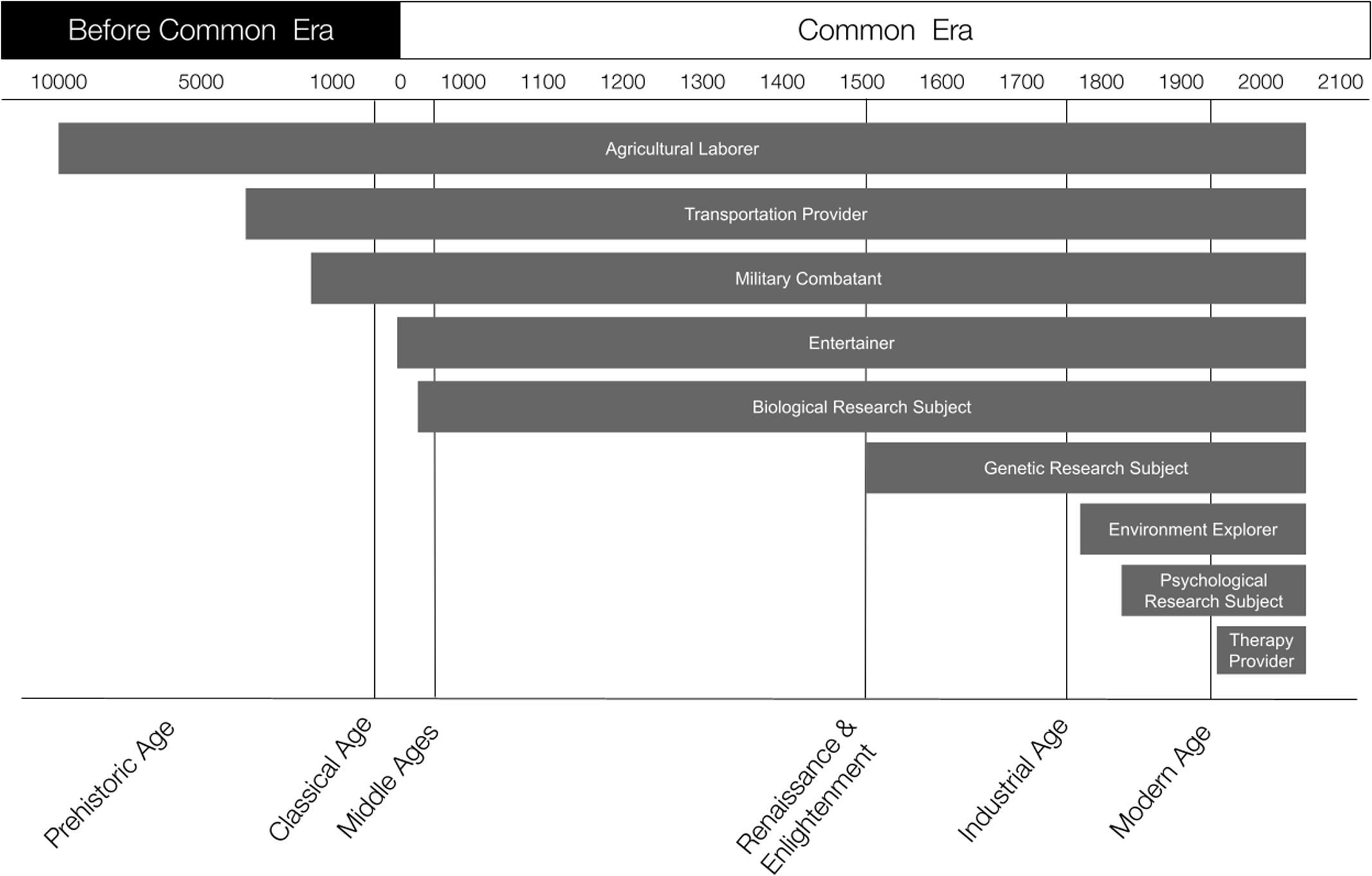
The history of animals in the workplace illustrates the expanding roles animals have had alongside humans across different eras. These roles are inseparable from the challenges and dilemmas humans encountered in their own lives, meaning that historical socio-economic trends cannot be fully understood without considering the role of nonhuman animals. In the Prehistoric Age (10,000–500 BCE), human society shifted from hunter-gatherer to agriculturalists—as this conferred economic and social benefits such as more stable towns and greater coordination among resources to complete more complex tasks. Supporting this societal shift, animals were domesticated for agriculture, transportation, and warfare (Fagan, Reference Fagan2015). These animals included the horse (5500 BCE), cow (8000 BCE), sheep (10000 BCE), and pigs (8000 BCE), which are still largely in agricultural roles to this day. These roles were mainly ones that involved exploiting animals for their unique attributes relative to humans, be it speed, power, or bodily functions. Thus, this job-specific, attribute cultivation could be considered one of the earliest forms of job analysis. In contrast, subsequent eras saw humans exploit the cognitive and physiological similarities between animals and humans. The Classical Age (500 BCE–500 CE) is characterized by the confluence of cultures within the Mediterranean region and similarly saw greater societal integration of animals (Black, Reference Black2009). Greco-Roman society assigned animals work that permitted them more independence, solving tasks with their own judgments such as serving in advanced military tactics, and racing and fighting like humans in entertainment events such as circuses (Christesen & Kyle, Reference Christesen and Kyle2014). Their anatomical similarity to humans meant that humans assigned them to be research subjects in early medical research (Eichberg, Reference Eichberg2011) due to bans on human dissection.
The following eras saw a melding of animal work with human technological developments. Across the world, during the Middle Ages (500–1500 CE), animals continued the type of work performed since early domestication, but a greater array of animals began being commonly used, and even further specialization was found in their KSAOs. Camel caravans facilitated trade across challenging terrains along the Silk Road. Oxen, mules, and diversified horses (e.g., warhorses, riding horses, pack horses) worked in transportation and agricultural roles. These roles were aided by technological advancements like more efficient types of harnesses (Langdon, Reference Langdon2002; Leibundgut & Kohn, Reference Leibundgut and Kohn2014). The Renaissance and Enlightenment eras (1500–17500 CE) formally introduced selective breeding to enhance desired traits. The word “race” is hypothesized to derive from the French word “haras” or a herd of horses (Contini, Reference Contini1959; Kean & Howell, Reference Kean and Howell2019). By this point in human history, animals and humans occupied closer and closer proximity in work settings, which also led to a greater spread of zoonotic diseases. A rinderpest epidemic affecting the cattle at the time led to the development of veterinary science as an academic field, emphasizing animal care and well-being (Pugh, Reference Pugh1967). This field, which specifically addresses transmittable diseases that originate in animals, continues to be an essential area of study in a postpandemic society.
In the Industrial (1750–1900 CE) and Modern (1900 CE–) age, animals’ roles in the workforce expanded and specialized significantly. Largely, these roles relied on the similarity between animals and humans further, having them act as human analogues in the dangerous and unknown environments that novel technology granted access. Examples included search and rescue (SAR) dogs (Gorrell, Reference Gorrell2003) and message carrier animals (e.g., pony express; carrier pigeons; Brooker-Gross, Reference Brooker-Gross1981) in the 19th century. In the 20th century, animals served in various military capacities during World Wars I and II, such as messenger pigeons, detection dogs, and even as enlisted soldiers with official ranks like Sergeant Stubby (Boston terrier) and Corporal Wojtek (Syrian brown bear; Bausum, Reference Bausum2014; Cummins, Reference Cummins2013; Orr, Reference Orr2010). Animals became prevalent research subjects within scientific research on human psychology and medicine (Franco, Reference Franco2013). They also worked to facilitate space exploration as proxies for humans (Burgess & Dubbs, Reference Burgess and Dubbs2007). Additionally, although the earliest eras emphasized physical or reflexive KSAOs of animals in their work, and increasingly their reasoning capability in later eras, this modern era leveraged their emotional capacities to have them in relational or psychological supportive contexts. Animal-assisted therapy gained acceptance, and animals became more integrated into workplace environments to enhance employee well-being and satisfaction (Walsh, Reference Walsh2009). This historical progression underscores the complex and evolving relationship between humans and animals in the context of work, reflecting changes in societal values, technological advancements, and ethical considerations.
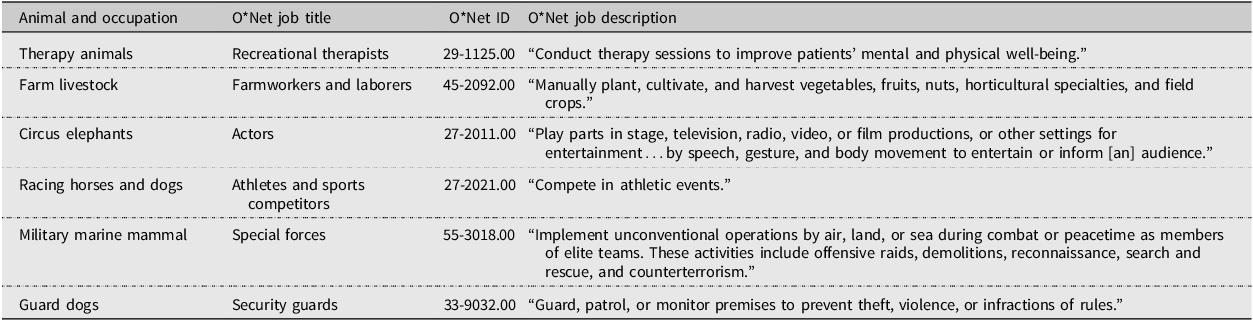
We argue that based on this summary, animals work in highly similar domains to humans and often perform the same exact jobs as their human counterparts. Just as humans serve in agriculture, transportation, combat, entertainment, research, exploration, and therapy roles, we also saw animals perform roles with similar functions within these industries (Figure 1). To further illustrate parallels between human and animal work, we provide several examples of specific occupations animals have in contemporary society, and their equivalent O*Net title along with a high-level job description from that job (Table 1).
Timeline of the History of Nonhuman Animal Worker Roles.
Note. The beginning of each role corresponds to when usage in that role was first documented. The continuation of the role into modern society reflects the variety of industrialization stages of different countries rather than animal worker representation within a single country or region.

Examples of How Nonhuman Animals, in the 21st Century Economy, Still Perform a Wide Variety of Labor and Fill Similar Industrial Roles to Humans

Note. Each row represents a job within human society assigned to a type of nonhuman animal and how it is meant to perform the same general objectives that humans do in that job. Next to each working nonhuman animal is a related human job and the description of that job from O*NET. The job description from O*Net of the human job is shown to demonstrate the equivalence of the primary job objectives between human and nonhuman animals.
This connection between animal occupations and human occupations highlights how animal work roles are similar to jobs that I-O psychologists already accept as a part of the labor force. It also demonstrates that I-O psychologists already have a language to characterize animal labor. Job analysis is foundational to the field, serving as the precursor to many other areas of I-O psychology (Wilson, Reference Wilson and Koppes2007). Our review highlights a spectrum of KSAOs, duties, and tasks performed by animals, showing that the components are there for I-Os to align conceptualizations of animal work with our existing conceptual frameworks.
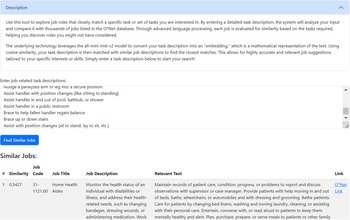
I-O psychologists may still hesitate to label animal tasks as similar to human jobs, despite our review. They may consider these judgments mere confirmation bias or subjective, making them unreproducible. We propose that natural language processing can address these hesitations and facilitate identifying meaningful links between animal and human work without imposing subjective judgments. To facilitate these comparisons, we offer a website that enables researchers to compare animal or human task descriptions with human job titles, highlighting objective parallels.Footnote 2 See Supplemental Material 1 for a description of the development of the application. For example, disability service dogs perform tasks like retrieving items or aiding mobility, closely aligning with the role of a home health aide in facilitating independence and addressing ambulatory challenges (Figure 2). Although not identical, the tasks share core themes, demonstrating isomorphism and underscoring that animals perform structured, task-based work akin to human roles, warranting inclusion in I-O psychology if those human roles are already included. However, task-based comparisons may exclude animals whose work lacks direct human equivalents. The next section proposes a broader framework to assess the relevance of nontraditional jobs, expanding the discipline to recognize overlooked worker populations. Recognizing work beyond immediate parallels deepens our understanding of who “workers” are and expands the discipline to include overlooked populations.
App That Identifies Relevant Jobs Based on Task Similarity.
Note: The above screenshot shows an application developed for the manuscript, which allows researchers to identify jobs on O*Net that share similar tasks a to the tasks a user inputs. This app allows researchers to identify comparable work to many animal work domains, such as how a disability service animal fulfills similar tasks to home health aides. The app can be found at https://computationaloutreach.com/similarjobs.

Determining who is considered a “worker”
We argue that I-O psychologists should extend their consideration to all workers, including animals. But in becoming more inclusive, how can we as a field determine who should and should not be classified as a “worker” in terms of “who can I-O psychology discuss and benefit”? In the previous section, we highlighted that many animals perform tasks alongside and similar to humans whose work in those industries is already recognized. This transitive argument offers a sufficient condition for deeming an individual a worker, so long as there are work parallels. However, many roles performed by animals within society seem quite distinct from traditional occupations studied by I-O psychology. The jobs may lack high skill requirements, structure, and pay. Examples of these nontraditional jobs are animals that are cultivated for their bodily products (e.g., eggs, milk, fur). Interestingly, the lack of skill, structure, and pay elements does not preclude them from being jobs in an analogical sense either. These tasks also have human parallels that are often regionally localized, so they may not be as salient to the general public. This work at the margins of society include plasma sellers (legally allowed by commercial entities only in Austria, the Czech Republic, Germany, Hungary, and the USA), “wet nurses” (i.e., human milk sellers, commonly employed in China, Indonesia, and the Philippines), hair sellers (where 93% of all human hair is exported from India), and gestational carriers (commercially allowed primarily in non-European Union countries of the Eastern European bloc, and nine states in the United States). The localization of these jobs is in part due to social stigmas as well as the potentially exploitative nature of the work (Long, Reference Long2022). For example, Article 3 of the Charter of Fundamental Rights of the European Union has a “prohibition on making the human body and its parts as such a source of financial gain” and the Oviedo Convention, ratified by 30 countries, also states in Article 21 “The human body and its parts shall not, as such, give rise to financial gain.” Exploitive work elements are a critical area of I-O psychology, and many I-O psychologists have discussed such contexts (often involving low skill), as highlighting the need for I-O psychologists to consider these contexts (Griggs et al., Reference Griggs, Eby, Maupin, Conley, Williamson, Griek and Clauson2016; Saxena, Reference Saxena2017). Certainly, classic I-O domains such as worker safety, consent, compensation, vocational interests, and KSAOs are relevant in those domains as well to optimize the worker experience. Additionally, individuals performing these stigmatized activities often create a sense of worth by construing the demands of biolaboring as a form of work (Kretzmann, Reference Kretzmann1992). Labeling these activities as work can help legitimize the deservingness of the benefits that I-O psychologists offer.
We recognize that these nontraditional directed task activities fall outside of normative expectations of what is classified as work while also recognizing that I-O psychologists can improve these workers’ conditions in many cases through their expertise. Some animals or humans may engage in work activities that have no extant parallel. Therefore, it is important to have a clear sense of when activities are “work” in ways that benefit from I-O psychology insights.
Thus, when we say “Who is a worker?” we do not mean, “Who is engaging in a moral and acceptable effort exchange within society?” Many of those human workers we listed are oppressed, coerced, and exploited vulnerable individuals. Rather, we simply mean a “worker” in this paper’s context is “someone whose life experiences can be affected by I-O psychologists’ framework.” I-O psychologists have a specific repertoire of insights, functions, and skills, which can certainly expand (e.g., neuropsychology of work) and be reconceptualized (e.g., machine learning as a selection method) but always map onto specific work dimensions. Therefore, another way to express our answer to “Who is a worker?” from an I-O lens is “any individual whose life experiences align with at least some of the universally accepted dimensions of work” as those individuals can benefit from I-O consideration. This means that, for example, we do not see animals that toil for humans as a fair exchange or ethically acceptable. Rather, we see their condition’s ethical acceptability as amenable to discussion through a lens provided by I-O. We do not see child labor as ethical, but rather, by recognizing their tasks as a form of work, we are able to discuss specifically why their treatment is harmful, unjust, and illegal by applying theories of occupational health psychology, organizational justice, labor standards, and many others, which are theories that only apply to work settings. Just as an I-O lens can be useful understanding society’s obligations to humans, we see it as a lens that also makes arguments clearer on how to be consistent with our obligations to nonhuman animals by aligning the reasons why we argue for human concerns in industrial settings (i.e., based on work characteristics and mental experiences) with the reasons we should argue for animal concerns in industrial settings.
In the subsequent section, we present a framework that can help I-O psychologists understand when individuals (such as animals and humans in nontraditional jobs) are also deserving of I-O consideration. This framework suggests using a dimensional consideration of work elements to more clearly describe why jobs at the margin may not conform fully to all I-O insights but also in what areas insights are still relevant. This framework provides a principled approach to why animal work is amenable to I-O expertise, across the many forms it takes. Additionally, it allows I-O psychologists to anticipate/recognize other domains that may be similarly relevant but overlooked.
A framework for what I-O psychologists consider as “work” and “workers”
Work is not a single dimension construct. It has many different defining characteristics, and I-O psychology speaks to each of those characteristics using different approaches. Therefore, we define a “worker” in our field as someone whose activities are I-O relevant, and to know if an individuals’ activities are I-O relevant, I-O psychologists should first consider the ways that those activities conform to the dimensions underlying the definition of work.
I-O psychologists should consider the dimensions of “work” to determine who is a “worker”
Organizational researchers have developed taxonomies to simplify the landscape of animal labor. Kandel and colleagues (2023) as well as Quan and colleagues (Reference Quan, Lam, Schabram and Yam2024) independently suggest that animal work can be categorized into animals as “coworkers,” “commodities,” and “clients” and that they also play organizational roles as “companions,” and “acquaintances.” Kandel et al. (2023) highlight the differences between categories in terms of how much focus those categories lead to human work and how much agency the animals in those roles are afforded. Quan et al. (Reference Quan, Lam, Schabram and Yam2024) highlight the differences in human worker characteristics (e.g., gender, self-integration) that distinguish these categories. These typologies are extremely useful for understanding the involvement of humans and whether certain social dynamics are relevant. For instance, all these categories were linked to emotional exhaustion in humans, as they involve job demands related to animal distress (Dlouhy et al., Reference Dlouhy, Schmitt and Kandel2024). Moreover, stronger human–animal bonds within these categories were associated with higher human work engagement. This makes the typologies particularly useful for examining how animals influence humans, as they account for varying levels of animal independence and human involvement. However, for the purpose of knowing whether and how I-O psychologists can extend their insights, they may be less effective as a unified framework for identifying commonalities across work contexts or determining where specific I-O interventions and work theories are applicable.
In contrast, one could consider the animal perspective and the nature of their work tasks more directly. I-O psychologists tend to focus their skillset on specific aspects of the job rather than the job category as a whole. By identifying the primary characteristics of one’s work, I-O psychologists would more immediately know how to translate their skills or expertise to the plethora of types of jobs performed. It would also be useful to have a framework that can be applied more generally to any job that researchers believe could benefit from I-O perspectives. Therefore, we sought to use a framework that can define work more from the perspective of the laboring individual and the tasks they do.
One comprehensive deconstruction of the structure of work was performed by Ruiz-Quintanilla and England (Reference Ruiz-Quintanilla and England1996). They provided 14 statements of work derived from literature reviews of prior definitions of work (e.g., “An activity is working if you do it in a working place,” “An activity is working if it is mentally strenuous”) to 18,673 respondents from 10 different countries (Bulgaria, the Czech Republic, Hungary, Poland, Slovakia, China, Belgium, Germany, Japan, the USA) and found that those statements fell into four different categories: (a) burden/control, (b) contextual constraint, (c) responsibility and exchange, and (d) social contribution. Additionally, the categories were endorsed at similar levels across all countries, with “responsibility and exchange” and “social contribution” being more emphasized than “burden/control” and “constraint.” Thus, these dimensions offer a cross-culturally stable and robust way to characterize different facets of work the way members of society define it. We also argue that this definition does not need to be accepted as the sole definition of work but will at least offer a useful framework for neatly identifying where specific areas of I-O are relevant, thus making it clear which activity domains can benefit from I-O expertise and for what aspects.
Traditional POSH (Professional, Office-based, Safe from harm, in High-income countries) work that I-O tends to examine generally maximizes all four dimensions of work, with the exception of perhaps burden, though burden is still relevant. However, we can see that the marginal jobs I-O psychologists have recently discussed tend to be missing one or more of those elements. Researchers like Bergman and Jean (Reference Bergman and Jean2016) and Myers (Reference Myers2016) highlight how I-O psychology has missed nonprofessional, informal, and poorer paying jobs that are often dangerous or burdensome. Volunteering and “calling” jobs (i.e., jobs that arise from a strong urge toward a particular way of life, belief, or ideal) can lack the burden and exchange elements but have supervisor-mandated constraints and contribute socially (Faletehan et al., Reference Faletehan, van Burg, Thompson and Wempe2021; Thompson & Bunderson, Reference Thompson and Bunderson2019). Gig work is often traditional jobs that are redesigned to lack the constraint elements (Campion, Reference Campion2019; Cropanzano et al., Reference Cropanzano, Keplinger, Lambert, Caza and Ashford2023). Child and elder caregivers can lack exchange elements (Daniels, Reference Daniels1987). Despite the absence of those elements, I-O psychologists have found use in applying their expertise to the remaining elements (Clancy et al., Reference Clancy, Fisher, Daigle, Henle, McCarthy and Fruhauf2020; Cogswell & Boudreaux, Reference Cogswell and Boudreaux2023; Kuhn, Reference Kuhn2016; Thompson et al., Reference Thompson, Beauvais, Allen, Pitt-Catsouphes, Kossek and Sweet2006).
Applying SIOP’s categorization of I-O psychology domains to specific work dimensions
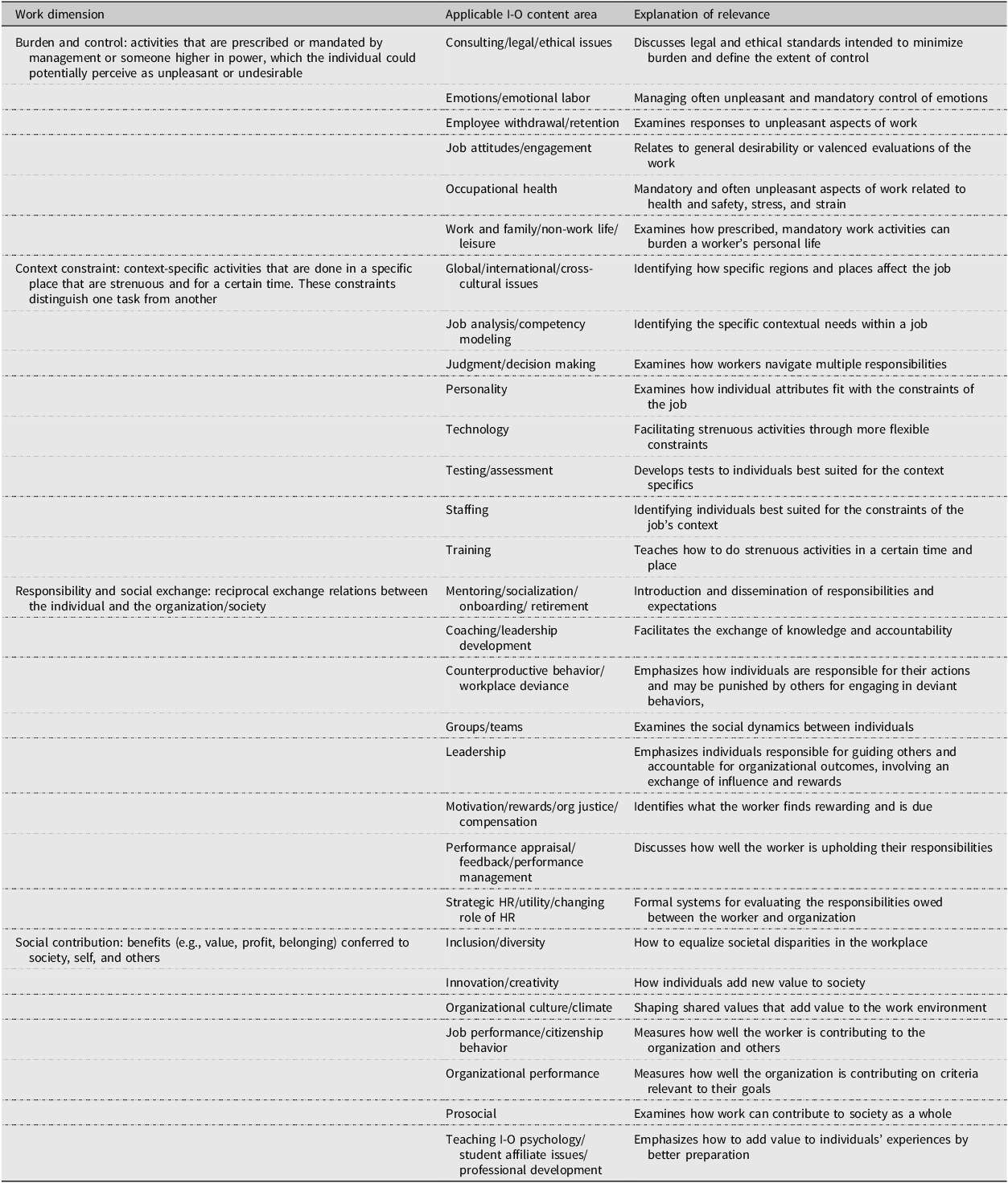
To illustrate how I-O psychologists can identify what is I-O relevant work, we draw from the dimensional definition of work and align the content areas of I-O psychology to each of them. These content areas are taken from the categories that the Society of Industrial Organizational Psychology uses to categorize conference submissions, which aim to provide a comprehensive overview of the different areas of work where I-O psychologists commonly provide their expertise. Next to each content area mapping, we provide an explanation of its relevance to the field. Content areas can often apply to multiple dimensions, so we do not intend the table to be comprehensive but rather a minimum. Also note that we have chosen to exclude the two content areas of “measurement” and “research methods” because those areas permeate across all of the work dimensions (Table 2). We acknowledge the ubiquity of these two content areas in the subsequent sections, highlighting them as a focal area to emphasize in the transition to being animal inclusive.
Identifying I-O Relevant Work by Mapping of Work Domains to I-O Relevant Areas

Note. The different applicable I-O content areas are not just restricted to the listed dimension, but could also be relevant to multiple dimensions. “Research methods” and “Measurement” are applicable across all dimensions because they translate the construct to an operable form. At minimum, each I-O content area is relevant to at least one dimension, highlighting how one can identify I-O areas relevant for discussion and consideration, based on the level of a work dimension within one’s tasks and activities.
In adopting this framework, I-O psychologists can better determine (a) whether an individual’s directed activities are I-O relevant and (b) what I-O areas of expertise are relevant for that work. This framework provides a principled way to justify why certain societal roles have been highlighted as I-O psychology relevant recently and offers a clear answer to why animal workers should be part of that discussion.
The relevance of different work dimensions is not uniform across animal work. For example, some roles, like those of veal calves, circus elephants, or space exploration animals, involve high levels of “burden and control” and significant “constraint” over the animal. In contrast, other roles, such as field-grazing goats or animal online influencers, may be less burdensome and constrained. Even within the same taxonomic categories, such as “commodity animals” or “animals as coworkers,” there is considerable variation in which I-O psychology domains are applicable, highlighting how this framework reveals unique worker needs that can be served by I-O psychologists.
This nuance highlights the value of the framework for I-O psychologists, as it categorizes work based on the needs of the worker and how I-O psychology can address those needs. From this framework, not all dimensions must be highly present in the task to give consideration and assistance. As seen with roles like volunteering, gig work, and informal jobs, work that lacks certain primary dimensions can still fall within the purview of I-O psychology if even one dimension remains relevant. We argue that all work dimensions have some relevance to animal roles, reinforcing the idea that animals are indeed workers whose roles can and should be analyzed through I-O psychology frameworks.
Why animals are workers that are relevant to I-O psychology based on the job-dimensions framework
To illustrate how this framework is useful for determining how specific content areas of I-O can inform the discussion, we more fully define each work dimension and apply it to specific animal work. We also discuss situations where the work dimension could be low for a particular dimension. Because all dimensions are prominent for at least some animal, we argue that the discussion of animal work can be enriched by incorporating an I-O lens, as there are specific content areas in the field that align naturally with those. Again, we emphasize that the purpose of the framework is merely to know whether an I-O lens is applicable to the discussion and what typical I-O questions that would commonly be raised in those areas should be raised in that discussion. In practice, determining the presence of these dimensions requires considering the individual’s activities from the mental perspective of that ostensible worker as best as possible and the perceived context where the individual’s activities are embedded. Thus, sentience and mental states are an extremely important precursor to these discussions.
Animal work contains burden and control
Burden and control refer to the level of prescription or mandate in activities as well as their unpleasantness or undesirability. Many animals engage in tasks with high levels of these. Service dogs, for example, are trained to assist individuals with disabilities by performing specific tasks like guiding the blind or alerting to medical emergencies. These tasks are not optional; the dogs must perform them whenever needed and will be relinquished otherwise from the occupation. Similarly, police K9s are conditioned to detect narcotics or explosives and to apprehend suspects, often placing themselves in dangerous situations. Knight and Sang (Reference Knight and Sang2020) highlighted that police dogs no longer deemed able to perform their tasks are commonly euthanized, demonstrating the amount of control the organization has on one’s life. Race horses undergo rigorous training and are compelled to compete in races, enduring stress and potential injury. Coconut-picking macaques harvest coconuts while being stung by hornets, in hot outdoor environments, and at risk of falling from trees. All of these animal work roles have levels of burden and/or control, such that the work can be subjectively unpleasant and with low volitional opportunities. That means that questions about consent and emotional/attitudinal experiences are highly relevant from an I-O lens. In contrast, passive work such as a wild animal who is surreptitiously recorded for social media or documentaries have little burden and control. Within the context of their activities, it does not make sense to discuss questions of emotional labor or satisfaction with regard to passive labor because no prescription is imposed on the individual. It is important to also consider the perspective of the individual, as seemingly passive tasks, may in fact be perceived as burdensome, such as veal crates, where male dairy cows are kept in a close-confinement system to minimize movement, or cows who are allowed to graze freely, but have been separated from their children who are taken to become veal or dairy calves themselves.
Animal work contains contextual constraints
Working animals often operate in specific places for set periods, performing strenuous tasks that require set attributes/skills. Service dogs navigate crowded streets or workplaces alongside their handlers, maintaining focus for extended durations. Race horses run on racetracks, exerting themselves physically during scheduled races and training sessions. Knight and Sang (Reference Knight and Sang2020), through the focal example of police dogs, drew attention to the parallels in the work lifecycle of these animals (e.g., recruitment, selection and training, retirement) and the KSAOs required for the work culture (e.g., loyalty, courage, keen judgment) that closely mirrored those of their police coworkers and imply clear constraints required by the work. Dairy cows are confined to barns or pastures and are milked at regular intervals, requiring them to be present at specific times. Truffle-hunting pigs spend hours in truffle-rich forests, guided by their handlers. Coconut-picking macaques labor in plantations, repeatedly climbing trees throughout the workday. These work contexts have different tasks and needs, and therefore, I-O questions based on task differentiation, such as job analysis, vocational interests, and training, are highly relevant to consider. Low contextual constraints among animals would be akin to anything where the nature of the animal is irrelevant to the task. This is rare because generally animals are incorporated into occupations for a human-serving purpose. Similarly, humans are rarely performing tasks where there is not some specific need of attributes determined by the context. However, the Quan et al. (Reference Quan, Lam, Schabram and Yam2024) and Kandel et al. (2023) typologies account for this in the categories of animals as acquaintances and companions. These activities exist alongside human work via mere presence in a human’s work environment.
Animal work contains responsibility and social exchange
Within work environments involving an organization or clients, there is some type of obligation of services and rewards exchanged. Similarly, animals and humans can have forms of exchange, of varying degrees of symmetry. Service dogs receive care, shelter, and food in exchange for their assistance, enabling their handlers to live more independently. Race horses are provided with stabling, grooming, and veterinary care; their performance benefits their owners financially, creating mutual reliance. Police K9s form strong bonds with their handlers and receive comprehensive care and training in return for their service in law enforcement. Dairy cows are fed and housed by farmers and, in return, produce milk for consumption and sale. Truffle-hunting pigs are looked after by their owners, who depend on them to find valuable truffles. Coconut-picking macaques are trained and fed, and their labor contributes directly to their handlers’ livelihoods. These examples are not to suggest that the responsibilities are adhered to or that the exchange is appropriate. Rather, the exchange of either services or rewards makes a variety of I-O questions relevant in these domains. The presence of any part of that exchange invokes an I-O discussion related to compensation, rewards, and the need for overseeing their equitable distribution. Exchange can occur laterally, highlighting the role of interpersonal and group dynamics. Thus, animal and human activities with no obligation to others and done in solitude, such as self-play, hobbies, or independent volunteering, are less relevant to I-O discussion that emphasizes these exchange areas. For those types of tasks, there are no requests or leader dynamics to consider. These activities can still be I-O relevant for other reasons, such as improving enjoyment, identifying context constraints, and optimizing performance.
Animal work offers social contribution
Social contribution describes the benefit conferred to the self and others by a worker’s activities. The work performed by animals often offers significant value to society, individuals, and industries. Service dogs enhance the quality of life for people with disabilities, promoting greater independence and social participation. Police K9s play a crucial role in maintaining public safety, aiding in crime prevention and detection. Truffle-hunting pigs enable the harvest of truffles, a delicacy that supports culinary arts and related businesses. Coconut-picking macaques assist in producing coconuts used in numerous products, contributing to both local and global economies. This dimension, like burden and control, is highly subjective and depends on the construal of both the individual and society. Nearly all areas of social contribution are ones that I-O psychologists seek to optimize. Once a contribution has been construed, I-O psychologists are able to discuss ways to further that contribution.
Translating I-O constructs to animal work
In the previous section, we discussed how I-O psychologists can recognize work that applies to their content domains. This high-level approach focuses on general classes of workplace concerns that I-O psychologists generally address. The alignment between the problem expertise of I-O and animal work dimensions raises a subsequent question: “What constructs are applicable within those problems?” We argue that I-O psychology’s current constructs are still applicable to animal work and any work entailed within those four work dimensions. Although the constructs can be the same, how those constructs are measured will likely be different depending on the nature of work and its workers.
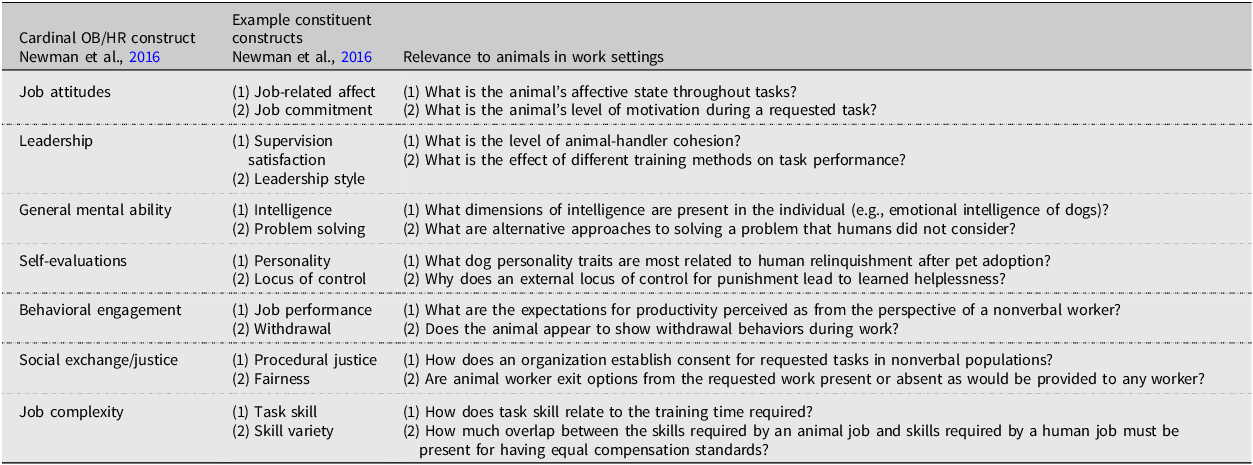
To illustrate how animal work is amenable to not only the major problems I-O psychology addresses but also the variables it studies, we will discuss how the primary constructs within the field can map on to animal-related work issues. Newman et al. (Reference Newman, Harrison, Carpenter and Rariden2016), in a survey of organizational behavior/human resources (OB/HR) researchers and major journals, identified seven constructs that comprise the majority of OB/HR work. These cardinal constructs are second-order factors that encompass shared characteristics from all of the first-order constituent constructs within OB/HR. Just as with human labor, each of those seven cardinal dimensions is readily applicable to animal work concerns across any type of job they perform (Table 3).
How the Seven Cardinal Constructs of OB/HR Are Relevant to Working Animals

Note. The example constituent constructs are a sample of the first-order constructs that Newman et al. (Reference Newman, Harrison, Carpenter and Rariden2016) proposed are commonly measured by the second-order, cardinal construct.
For example, animals display (a) “job attitudes” through emotions/excitement expressed during their labor, as well as and their (lack of) commitment to tasks via escape attempts. (b) Leadership is immediately relevant to animal workers, given that trainers, handlers, and guardians regularly impose instructions, which influence the animal workers’ responsiveness and performance. In the prior summary of animal labor history, we noted how animal jobs expanded as their (c) general mental ability and problem-solving skills became recognized, as well as the suitability of their (d) self-concepts and self-evaluations to socially oriented roles. Additionally, animal jobs increasingly allowed for greater autonomy, which also means variability in levels of (e) behavioral engagement. This engagement manifests in their productivity and signs of withdrawal or avoidance behaviors. This lack of engagement can lead to questions of what is appropriate (f) justice in terms of fairness and exchange. Fairness considerations are also made relative to the work context. A maxim commonly expressed by I-O psychologists is “equal pay for equal work.” Therefore, it is important to understand the job complexity (e.g., required task skills and variety), which the history of animal work highlights the variability and relevance. Therefore, all of the current cardinal domains of OB/HR can not only apply to animal work but also offer an interrelated, unifying perspective for a principled discussion of this type of work. From an I-O lens, animal work, regardless of whether it occurs in a farm, office, or a home, is not a distinct, separable process from human labor, as it has the same constructs for consideration.
What does an animal-inclusive I-O psychology look like?
In this section, we provide recommendations and suggestions on what an animal-inclusive I-O psychology might look like. The following section describes these proposed changes as opportunities, highlighting the potential benefits those opportunities offer. We summarize these recommendations in Table 4.
Summary of Recommendations for an Animal Inclusive I-O Psychology

Changes to research
The previous sections highlight how, in animal-inclusive I-O psychology, there must be room to consider that the canonical I-O constructs (e.g., job satisfaction, job performance, organizational commitment) can be attempted to be measured within animal workers. Although we described the conceptual alignment for how I-O constructs could translate to animals, work in measurement and methodology underscores how to implement those translations. Granted, constructs may need to be assessed with different techniques, but I-O psychologists can be open to the broad applicability of these concepts as either a producer or consumer of research. I-O researchers interested in exploring these questions will likely require greater collaboration especially with colleagues from other disciplines, methodological development, and openness from journals.
Greater importance of technology to bridge measurement challenges
Because I-O psychology is typically centered within the worker experience, specializes in measurement, and has a large canon of existing scales, we anticipate that a main area of emphasis will be focused on identifying how to adapt existing measures to the experiences of animal workers. Because these populations lack translators, there is a greater emphasis on indirect or behavioral signals. Researchers applying I-O psychological perspectives to animals may benefit from incorporating biological markers, such as cortisol levels, eye gaze, and nonverbal behavior by collaborating with specialists trained in these methods. This type of measurement is often specialized in fields that work with nonverbal populations such as developmental psychology or fields that work at the biological level, like cognitive neuroscience. Thus, new fields have a direct avenue for contributing their perspectives and enhancing our science.
One major interdisciplinary area that can aid in translating across human-animal contexts is artificial intelligence. Artificial intelligence in the form of deep neural network transformer models, such as contextual language models (e.g., BERT, DeBERTa) or generative models (e.g., GPT, Llama, Claude), allows for drawing quantitative inferences from open-ended text. These technologies could facilitate translating open-ended descriptions of behaviors and tasks into scores along different I-O relevant constructs, in comparable ways across different populations. We provide a concrete demonstration of what this looks like in practice. For example, I-O psychologists may need to infer job attributes in a more inclusive way for jobs that might lack the ability for incumbents to score (e.g., animal workers). We developed an online application that allows researchers to enter task descriptions and estimate the level of skill required for that task.Footnote 3 See Supplemental Material 2 for a description of the development and validation of the application. This novel tool allows answering questions about the nature of animal work and where vulnerabilities may exist. Jobs with specific skill requirements may be more harmful, such as those observed within the human labor force (Griggs et al., Reference Griggs, Eby, Maupin, Conley, Williamson, Griek and Clauson2016; McGrath et al., Reference McGrath, Walker, Nilsson and Phillips2013). Therefore, an animal-inclusive I-O psychology means that different areas not typically integrated within the I-O literature now play an important role in bridging theories between disciplines.
Reconceptualizing the core outcomes: well-being and performance
Although the cardinal constructs remain unchanged, an animal-inclusive I-O psychology might reconceptualize them to focus on extremes not often encountered in the majority of I-O research—dealing with highly extreme and life-altering manifestations of those outcomes. Dependent variables in organizational psychology often emphasize worker well-being (Nord, Reference Nord1977). In the context of humans, well-being can encompass job satisfaction, stress, burnout, and purpose (Tay et al., Reference Tay, Batz-Barbarich, Yang and Wiese2023). However, in the context of animals, well-being is likely to be conceptualized using variables outside the range of consideration in most human work. Specifically, well-being experienced by animal workers can include death, euthanasia, hospitalization, and child separation-induced grief (Edwards et al., Reference Edwards, Scott, Gonyeau, Howard, Parker and Hall2021; Hatch, Reference Hatch2007; McGrath et al., Reference McGrath, Walker, Nilsson and Phillips2013; Neave et al., Reference Neave, Rault, Bateson, Hvidtfeldt Jensen and Bak Jensen2024), as well as human worker reactions to these events (Merenda et al., Reference Merenda, de Oliveira, Lopez-Soriano, Arruda, Robbins and Pairis-Garcia2023; Rogelberg et al., Reference Rogelberg, DiGiacomo, Reeve, Spitzmüller, Clark, Teeter, Walker, Carter and Starling2007; Slade & Alleyne, Reference Slade and Alleyne2023; White & Shawhan, Reference White and Shawhan1996). These reconceptualized outcomes have positive implications for the field, expanding the social impact and relevance of I-O psychology. Numerous commentaries have highlighted the challenge I-O psychologists have in making demonstrable changes (Kulikowski, Reference Kulikowski2022; Rogelberg et al., Reference Rogelberg, King and Alonso2022). Considering this population, and addressing these extreme outcomes faced by animal workers, means that I-O psychologists have greater opportunities to be lifesavers and rescuers of those facing imminent death. Animal-centered work concerns are easily translatable to concrete benchmarks of lives saved or families retained. Even minor improvements to the model (e.g., predicting animal shelter adoption compatibility, optimizing technological/robotic-based alternatives to hazardous environment exploration) may mean an additional day of life an animal receives.
Consideration of animals as workers also changes how I-O psychologists conceptualize performance, as well as its associations with well-being. As previously mentioned, for animals whose bodies are used for the production of food, knowledge, and other service goods, measures of well-being could include death. In this way, low well-being (i.e., death) may be associated with high output. In modern I-O psychology, however, humans are rarely placed in roles where their well-being, as typically conceptually, is diametrically opposed to their output. Therefore, discussions of organizational performance are not necessarily positive outcomes, and so a central challenge for I-O psychologists may be aligning the two or highlighting the prioritization of well-being.
The relationship between well-being and performance becomes increasingly complex and necessary of consideration when the two are intertwined in unforeseen ways. For example, after the September 11th attacks, SAR teams consisting of SAR dogs and handlers were dispatched to discover remains within Ground Zero. New agencies originally noted that SAR dogs became depressed during this traumatic search. It was originally believed that the existential toll of searching for deceased individuals was affecting the dogs’ well-being (Lynn, Reference Lynn2021). Penn State researchers conducted further analysis and found that what was occurring was that the SAR dogs who were trained/rewarded to discover were developing frustration at not finding anything (Bahr, Reference Bahr2021). Further, the SAR dogs can intuit the handlers’ stress, internalize the negative affect, causing additional stress to the handlers. This cross-lagged relationship between handler and dog states persisted for years after the initial search (Hunt et al., Reference Hunt, Otto, Serpell and Alvarez2012). Therefore, in this situation, well-being could not be understood without accounting for the interactive and dynamic mental states of humans and animals (Wojtaś et al., Reference Wojtaś, Karpiński and Czyżowski2020).
Journal identification and receptivity to universal work concerns
We recognize that readers may question the extent to which animal-inclusive research is publishable within existing I-O journals. However, we argue that because I-O journals are typically oriented toward a specific topic, rather than a specific population, the current options of journals remain sufficient. To facilitate the process of identifying the appropriate I-O journal for an animal-inclusive study, we developed a website that uses the semantic information found within an abstract, which is typically a high-level focus on the major thematic areas.Footnote 4 See Supplemental Material 3 for a description of the development and validation of the application. that, when given a project abstract, can identify which I-O journals are most relevant.
Although the journals do not necessarily need to change topics, it is important for journal editors to become comfortable with the idea that workers can look and think in different ways than the norm. The seeming alienness of a population has never been reason to exclude them from research or designate them to only a specific journal. Rather, we implore editors to see this research as connecting to broader society, which is largely integrated and whose theories are ideally broadly generalizable.
Changes to education
Adopting an animal-inclusive perspective in I-O psychology in an internally consistent way means also adapting the training and education of I-O students. Because there is great variability across programs in their training goals, changes in curriculum should not be uniform. Rather, we argue that these changes exist along a continuum of high-level (broad inclusiveness in discussion) versus low-level (specific findings and training) emphasis. Where I-O programs find themselves on the continuum corresponds to the degree that students are trained to interface with workplaces that include animals.
At minimum, programs should adopt the abstract level inclusion of animal work within their core classes, which entails a broadened perspective of what constitutes a “worker.” Within introductory courses, students should be exposed to readings and discussions that expand our definition of workers, as well as highlight various overlooked working populations, including the history of animal work and the importance of their psychosocial concerns. This change is the bare minimum because, regardless of students’ career trajectory, there should be an awareness of the populations that their theories and skill sets can apply to and help.
Additionally, some programs may decide to offer courses that emphasize I-O training within certain work contexts where animals are commonly present (e.g., offices with animal-assisted therapy programs, tasks assisted by disability service animals, employees who work remotely from home with pets). These programs may seek to include literature within their advanced seminars on the effects of animal-based interventions to improve human worker well-being and performance.
Last, at the most specific level of emphasis, I-O students may express interest in working directly with animals as workers in and of themselves, just as an I-O would opt to work with human participants. This interest in animal-facing work is not exclusive to research but can also include consulting and advocacy. Animals as workers is not the current paradigm within I-O, and therefore, faculty are unlikely to specialize in this area. Programs can, however, offer their students the opportunity to expand their knowledge into these specific domains by allowing for greater theoretical flexibility in preliminary exams, theses, and dissertations, as well as journal expectations. Importantly, programs should be open to allowing course replacement for students interested in registering for courses from other departments, such as agriculture, animal science, and veterinary sciences, to name a few. Additionally, to facilitate this transition, we provide a collection of articles that can be incorporated into an Introduction to Industrial-Organizational Psychology graduate seminar syllabus. The reading list is organized by topics within I-O (e.g., occupational health, personality, inclusion) that can complement traditional readings found in introductory seminars.Footnote 5 For each article, we provide an explanation for why that reading could offer greater depth or breadth to I-O students’ education, which will allow the instructor to connect the reading with training goals (Supplemental Material 4).
A large part of this shift in education is openness to alternative perspectives. Landers and colleagues (Reference Landers2018) argued that interdisciplinary collaboration offers many advantages and is an essential part of the scientific process. Spelt et al. (Reference Spelt, Biemans, Tobi, Luning and Mulder2009) and Jones (Reference Jones2009) emphasize that interdisciplinary education enriches students’ knowledge and skills, enhancing critical thinking and problem-solving abilities across different scientific domains. Particular fields that might be useful collaborators include veterinary science, biology, and zoology. In addition to those animal-interactive fields, more recently, humanities fields have taken up similar causes of discussing the working conditions of animals, relating them to sociological effects on neighboring communities (Fitzgerald et al., Reference Fitzgerald, Kalof and Dietz2009), environmental conservation (Paquet & Darimont, Reference Paquet and Darimont2010), and feminist challenges (Taylor, Reference Taylor2024). Collectively, we advocate for broadening the inclusivity taught within courses by relying on insights from fields that speak to the mental, societal, and ethical considerations of animals in the workplace.
New opportunities for policy implementation
I-O psychologists have often engaged in legal advocacy for workers and offered guidance on best practices. Recent examples include Nancy Tippins’s testimony to the US Equal Employment Opportunity Commission during the hearing on artificial intelligence and algorithmic fairness (Tippins, Reference Tippins2023) and Mark Smith’s testimony to the House Committee on Education & the Workforce on the importance of skills-based hiring (Smith, Reference Smith2023). These activities demonstrate how I-O psychologists translate their research into actionable recommendations.
Incorporating animals as workers within I-O psychology opens opportunities for further legal advocacy. Treating animals as workers who deserve workplace study consideration means a commitment to allowing their conditions to be observed and publicly discussed. As scientist–practitioners, I-O psychologists specifically recognize the value of recording data for providing insights into the experiences of workers. Currently, six US states (Alabama, Arkansas, Iowa, Missouri, Montana, and North Dakota) have “ag-gag” laws prohibiting the recording of the agricultural conditions of animals. These laws criminalize undercover filming or photography of activity on farms without the consent of their owner. I-O psychologists have long studied and advocated for whistleblower protection (Miceli & Near, Reference Miceli and Near1992; Near & Miceli, Reference Near and Miceli1986). SIOP as well takes a proactive stance writing,
A Whistleblower is defined for the purposes of this policy an employee, volunteer, or member of SIOP who reports an activity that he/she in good faith believes to be unethical, illegal, dishonest, or fraudulent….SIOP encourages complaints, reports, or inquiries about illegal practices or serious violations of SIOP’s policies and illegal, improper, dishonest, or fraudulent conduct by its leadership, elected or appointed officials, employee, or others acting officially on its behalf.
Thus, I-O psychologists may consider ag-gag laws a domain where their concern and experience with protecting whistleblowing can lead to socially impactful changes. These changes affect not only the working animals but also humans, as every viral pandemic from the 1900s has been the result of spillover from close contact of animal to human (Pike et al., Reference Pike, Saylors, Fair, LeBreton, Tamoufe, Djoko, Rimoin and Wolfe2010). Related to ag-gag laws, agricultural drivers are associated with greater than 50% of zoonotic infectious diseases that emerged in humans (Rohr et al., Reference Rohr, Barrett, Civitello, Craft, Delius, DeLeo, Hudson, Jouanard, Nguyen, Ostfeld, Remais, Riveau, Sokolow and Tilman2019). Thus, greater advocacy for animal workers can also save human lives.
Another actionable recommendation is to adhere to the concept of equal pay for equal work (or more broadly “equal rights for equal work”). I-O psychologists have used this maxim frequently in their calls. Notably, this maxim is independent of race, gender, or origin by design, as it speaks to a fundamental definition of fairness based only on effort considerations. To uphold this maxim requires defining work in a way that is comparable across entities, and for those tasks, identify the minimum rights, protection, and treatment expected. This taxonomy creation of work characteristics is directly within the I-O psychologists’ toolkit and utilizes the unique combination of strengths that I-O psychologists have. We summarize all of our recommendations within Table 4.
Challenges
Although being more inclusive to animals as workers creates many more opportunities, there are challenges introduced, which are necessary to address. Note that these challenges are hallmark challenges that I-O psychologists have needed to contend with throughout the field.
Anticipated challenges
Anthropocentric/ingroup biases
Some I-O psychologists may be hesitant to consider the needs of independently minded animals the same way they would consider the needs of humans because of a perceived superiority they designate to human needs (or whomever they consider to be their ingroup). This perspective is formally known as “speciesism,” where it places human-like entities at the top of a well-being concern hierarchy (Ryder, Reference Ryder1970). Generally, there are four common arguments, accounting for 91% of explanations used to defend speciesism (the 4 Ns; Piazza et al., Reference Piazza, Cooper and Slater-Johnson2020): Having human concerns supersede any of those of sentient animals is (a) necessary for the maintenance of a stable society where it is not considered practical to extend equivalent considerations, (b) tradition or has historical precedent and is therefore normal, (c) the way nature or some higher power intended and is therefore natural, and (d) the most hedonically maximizing option for humans and therefore feels personally nice.
Although first described in the context of animal treatment (Joy, 2020), these justifications also generally underpin arguments made against the inclusion of other social groups (Marsh, Reference Marsh2021). Thus, we do not feel that it is a straw person argument to raise these concerns given their prevalence in attempting to rebut considerations of marginalized groups. Further, perspectives of speciesism are generally challenging to counter, not on logical grounds, but on personal grounds, as they can be tied to cultural or religious values. The lack of consideration deserved by animals is embedded within others’ identities, and thus cognitive dissonance reduction, such a resistance to attitudinal change, is expected.
If confronted with anthropocentric challenges, researchers should question what measurable/observable aspects of animals make them less worthy of equivalent I-O consideration. Perhaps anthropocentrists highlight their smaller size, simplicity of sensations, docility, dependence on others, or lower cognitive ability. Whatever the attribute that is suggested for the basis of their lower importance, researchers should understand that those discounting attributes can also be found at varying levels within the diverse spectrum of potential human workers as well. It seems unlikely that any psychologist would give less importance to the needs of a human individual based on their specific standing on any of those attributes as long as the individual had a capacity for sentience (i.e., was not dead or lacking agency). Thus, there is no principled way to discriminate importance consistently against animals that does not also justify some form of oppression against consideration of some less “attributed” humans, other than purely using species/ingroup membership (i.e., humans are especially important because they are “humans/us”) as the delineating rule (Bryant, Reference Bryant2005). This species cutoff though is arbitrary, leading to tautologies, and also seems to ignore any experiential harm/fairness considerations that underlie ethical systems.
Challenges of maintaining global perspectives
This paper often emphasizes European and American examples of the history of animal labor to connect with the population of I-O psychologists. However, this is not a fully comprehensive portrayal of the span of labor. In the Kayabukiya Tavern in Japan, macaques serve patrons as waiters. In Thailand, monkeys pick 99% of the coconuts sold for coconut milk around the world (Barclay, Reference Barclay2015). In India, the Elephant Festival in Jaipur requires elephants to be trained to serve as entertainment. In Spain, bulls are required to combat a matador during bullfighting matches. In Dubai, the camel race is among the wealthiest races in the world, offering the winning team more than $21 million USD. All of these examples have animals performing the exact same acts that their human servers, farmers, fighters, and track athlete counterparts do. However, much like I-O psychology has focused on professional workers because of convenience, there will undeniably be a bias toward considering more western, industrialized, rich, and democratic populations of animal workers, as these populations are more convenient to study. We encourage I-O psychologists to consider not only domestic animal work issues but also how these issues may manifest internationally. For example, child labor tends not to be distributed uniformly but is concentrated in certain regions. I-Os have highlighted how these issues are still pertinent to consider (Fletcher, Reference Fletcher2024).
Challenges of organizational hesitance
One significant challenge in studying the working conditions of animals is the potential for organizational pushback. These animals typically lack recognized rights within society, and efforts to improve their conditions can be viewed by some people/organizations as diverting attention or resources away from human concerns (Schmahmann & Polacheck, Reference Schmahmann and Polacheck1995). This perception can create resistance from those who prioritize human welfare and economic efficiency over animal welfare (Machan, Reference Machan2004). Organizations might argue that implementing changes to enhance the welfare of working animals could result in increased operational costs or reduced productivity, leading to reluctance in acknowledging or addressing the issues faced by these animals. Consequently, this resistance can hinder research and reforms aimed at improving conditions for workers, maintaining a status quo where animal needs and well-being are often overlooked. This challenge of overcoming organizational concerns for the benefit of workers and the organization itself is one I-O psychologists have struggled with since the field’s inception (Baritz, Reference Baritz and Baritz1960)
Conclusion
The people who work closely with animals already see them as thinking and feeling individuals who experience very real consequences in their work. Nearly 50 years after working with cosmonaut dog Laika (Лáйка), 79-year-old Oleg Gazenko, a leading scientist during the Soviet animals-in-space program, expressed during a press conference, “Work with animals is a source of suffering to all of us. We treat them like babies who cannot speak. The more time passes, the more I’m sorry about it. We shouldn’t have done it…We did not learn enough from this mission to justify the death of the dog.” (Hankins, Reference Hankins2004). The reactions of human workers toward their animal coworkers can be psychologically analogous to the ones they have for their human companions. They reflect a desire for those who design these workplaces to consider the capacity for these workers to suffer and consider what allows them to prosper. We call on I-O psychologists to do the same.
We present this article not as a lecture but as a way to identify an unrealized opportunity. Compared to the rest of psychology, I-O psychology does not currently include animals in its domain. Modern I-O psychology has already demonstrated its commitment to including the concerns of populations that have been historically overlooked by research (Zickar, Reference Zickar2014). The absence of certain populations in I-O psychology literature does not mean these groups cannot or should not be studied. Re-evaluation and expansion of focus are always possible. The central criteria for inclusivity should be whether the contexts and the topics within those are applicable.
I-O psychologists have already drawn attention to several underrepresented populations that deserve more consideration because of work-like contexts or because of the potential benefits. For instance, Kuhn (Reference Kuhn2016) highlighted gig workers, who operate outside traditional office settings and often have less formal pay structures. Bergman and Jean (Reference Bergman and Jean2016) brought to attention the underrepresentation of lower-skilled, low-wage workers, despite their status as the largest segment of the workforce. Binggeli et al. (2015) discussed how legal citizenship is used as a discriminatory standard, emphasizing the lack of immigrant representation in I-O research. Undocumented workers, in particular, face heightened psychological risks due to their vulnerable, unprotected status (Gleeson, Reference Gleeson2010). French and Fletcher (Reference French and Fletcher2022) argued that domestic issues and welfare are also within the scope of I-O psychology, as the workplace is deeply connected to broader social life. These examples demonstrate that excluding certain populations from research often hinders I-O psychology’s overarching goal of understanding workplaces and workers. To truly fulfill its mission, the field must strive to provide insights and support for marginalized workers, contributing to more equitable and inclusive outcomes. Bergman and Jean (2015) comment on the tendency of I-O psychology to normalize dominant/hegemonic populations,
As a result, the phenomenology of managers, professionals, and executives becomes “normal"; the use of any other type of sample has to be justified; and the use of managers, professionals, and executives as samples is unquestioned. There is little critical examination—at the level of the science or at the level of individual articles—regarding why these samples of managers, professionals, and executives were used. If results from worker samples differ from those of previous studies on managers, professionals, and executives, then workers will be (a) “othered” (i.e., treated as different or alien) and (b) pathologized.
Therefore, the natural tendency of critics, when asked to expand I-O consideration, may be to feel that the proposed individuals are too alien or mentally abnormal. However, instead of focusing on perceived differences, the criteria for inclusion should center on whether individuals—human or otherwise—have mental states and whether their tasks contain any components that are characteristic of the different dimensions of work where I-O psychologists apply their skills. By this standard, animals meet the criteria for consideration. This framework also provides a roadmap for identifying other overlooked populations that look and think differently than the traditional I-O respondent, but the field’s lessons and perspectives can apply.
Taking a more inclusive perspective to workers opens greater opportunities to address organizational and worker well-being through greater opportunities for research. These opportunities include greater cross-disciplinary theoretical integration and collaboration, new methodologies, and greater influence in public policy. We are optimistic that this paradigm shift expands the role of I-O psychology and offers currently absent considerations that I-O psychologists are oriented to provide.
Supplementary material
The supplementary material for this article can be found at https://doi.org/10.1017/iop.2025.10014.



 Open access

