

Introduction
Response to public health threats, in terms of obligations and rights, is regulated by the International Health Regulations (2005).1 Two decades ago, implementing a system for rapid response globally comprising 4 core elements was necessary. These 4 significant elements are crisis detection and a defined mechanism to trigger an adequate response, administrative strategy, structure to predetermine the rapid response team members, and a continuous evaluation system to improve the hospital’s response to future challenges.Reference DeVita, Bellomo and Hillman2 Establishing rapid response teams (RRTs) and Field Epidemiology Training Programs (FETP) will further improve and strengthen disciplines, including risk assessment, surveillance, and the whole public health system.3 The FETP in KSA was established in 1989. It is 2-year program that was the first in the Middle East and is now training residents from other regional countries.4
RRTs are critical for mobilizing resources, conducting assessments, and implementing containment measures to prevent public health crises from being larger threats locally or crossing borders.Reference Agodi, Valenti and Galletta5 Their success in various countries has significantly reduced hospital mortality by about 40%Reference Gong, Zhou and Wang6 and encourages the establishment of RRTs in other countries like KSA.
In the global context, the establishment of RRTs has gained increasing prominence due to the growing threats posed by emerging infectious diseases, natural disasters, and other public health emergencies such as the COVID-19 pandemic and Ebola outbreaks. Moreover, the interconnected nature of modern society means that outbreaks in one region can quickly escalate into global pandemics, highlighting the need for internationally coordinated response mechanisms, including RRTs.7 Response to the COVID-19 pandemic showed a need for adapted material specific to a country’s context. In addition, there are gaps in implementing multidisciplinary RRTs according to the standards to mobilize at the district, provincial, and national levels to respond to public health threats. Also, better coordination of specialists and increasing their capacity to detect and respond to epidemics was another main recommendation.Reference Araj, Odatallah, Mofleh, Samy, Ben Alaya and Alqasrawi8
In the Eastern Mediterranean Region (EMR), RRTs were initiated, targeting 32 trainees from 9 EMR countries. It was designed to improve the knowledge and skills required by the RRT members in July 2012.Reference Araj, Odatallah, Mofleh, Samy, Ben Alaya and Alqasrawi8 KSA’s strategic location, large population, diverse health care landscape, and role as a center for Hajj and regional commerce make it susceptible to health threats. Establishing robust RRTs is essential for early detection, rapid containment, and effective management of public health emergencies.Reference Almalki, Fitzgerald and Clark9 Ultimately, the Ministry of Health (MOH) in KSA established RRTs, comprising 120 health specialists, to address the Middle East Respiratory Syndrome Coronavirus (MERS-CoV) and other infectious disease outbreaks.10
The WHO Regional Office for the Eastern Mediterranean’s memorandum letter in 2022 selected KSA to pilot test the new WHO RRT training program.11 MOH, represented by the Deputyship for Public Health, responded to the letter by disseminating an official request to all MOH’s directorates of health affairs around the Kingdom to nominate members with multidisciplinary health backgrounds as RRTs to be trained in technical and soft skills sessions. So, the overall aim is to establish an all-hazards, one-health, interdisciplinary program for staffing and rostering the nominated members.
However, the history and process of establishing the RRT in KSA have not been documented. Therefore, this study documents the history and process of establishing RRTs in KSA, utilizing interviews with specialists involved in emergency responses to public health threats. It explores the main reasons and challenges for KSA and the MOH in establishing RRTs. Special attention was given to understanding the cultural and contextual factors that influence the historical implementation of RRTs in KSA. This study critically evaluates the existing policies and regulations for RRTs in KSA to identify essential areas that warrant further documentation and analysis.
Methods
Study Design
The study employed a cross-sectional qualitative research approach, utilizing in-depth interviews and document analysis to explore the historical process of establishing RRTs in KSA and the challenges and barriers encountered. Qualitative methods were deemed appropriate for capturing perspective and contextual intricacies inherent in implementing RRTs.
Saturation refers to the point at which no new information or themes are observed in qualitative data. Saturation was achieved after the 9 interviews, serving as the stopping criterion once no new themes emerged.
Participants
Participants included government health officials directly involved in policy formulation, senior policymakers who have overseen health emergency responses, and health care professionals, including doctors and nurses, who have first-hand experience with RRT operations during public health emergencies. This diverse participant pool allowed for a multifaceted exploration of the establishment processes. All participants were implicated in outbreaks around the Kingdom, particularly MERS-CoV. Purposive sampling, specifically snowball sampling, was employed to facilitate access to individuals with pertinent knowledge or experiences related to RRT establishment in KSA. Recruiting participants was conducted through emails and sometimes resorted to sending WhatsApp messages since it is the preferred channel of communication in the KSA. Initial participants were selected based on their relevance to the research topic, and subsequent participants were identified based on recommendations obtained from the initial participants. The final sample size was 9.
Ethical Approval
Before commencement, the Ethics Committee of the General Department of Research and Studies—Saudi Ministry of Health granted ethical approval for this study (IRB log No: 24-32 M). This ensured the study adhered to ethical principles and guidelines for research involving human participants. The approval process involved a comprehensive assessment of the study’s objectives, methodology, participant recruitment procedures, data collection methods, and measures to ensure participant confidentiality and privacy.
Informed Consent
All participants gave informed verbal consent before participating in the study. They were provided with detailed information about the study’s purpose, procedures, potential risks and benefits, voluntary nature of participation, and confidentiality measures. They were also assured that their participation was voluntary and that they had the right to withdraw from the study without repercussions.
Confidentiality and Anonymity
All collected data were anonymized and stored securely to ensure confidentiality, with access restricted to authorized research team members. Personal identifiers were removed from transcripts and other documents to maintain participant anonymity. Only aggregate data without individual identifiers were reported in the final research findings to preserve participant confidentiality.
Data Collection
In-depth interviews were conducted with participants using semi-structured discussion guides, allowing for flexibility in exploring key themes and topics. The interviews were conducted by WHOCC Imperial, MOH, and Itkan representatives and were recorded using Zoom, Teams, and Google Meets. Additionally, document analysis was performed on policies, guidelines, and relevant reports issued by the MOH and other appropriate authorities. The questions during the interview centered around the background and context, historical process and challenges, policies and regulations, evolution, and stakeholder perspectives, as well as recommendations for future directions of RRTs.
Data Analysis
Thematic analysis was employed to identify recurring patterns and themes across the qualitative data collected from interviews and document analysis. Data analysis was facilitated using software tools, including NVivo and Excel, allowing for systematic organization and interpretation of findings. Transcription was formulated using Microsoft Word and translated when needed using Google Translate. All translated transcripts were reviewed, word by word, by two researchers (Arabic and English speakers) and revised accordingly. Interviewee quotes were constructed and categorized according to the main themes of the research. The credibility of the extracted data was guaranteed by recording and careful transcription, and both were compared. Furthermore, two researchers from the team reviewed the data, and finally, all the training proceeded with a needs assessment based on a deep literature review of peer-reviewed published articles from Saudi Arabia. Data collected during the study were stored securely in compliance with data protection regulations. Data were retained for the duration specified by the ethics approval and then securely disposed of by established protocols to protect participant confidentiality.
Results
The general themes and subthemes based on the interview answers and literature review are illustrated in Figure 1.
Themes and subthemes identified from the 9 interviews and analyzed documents.

Theme 1: Background
Despite sporadic public health threats and responses, all interviewed specialists agreed that the RRT concept and application were formally introduced and applied following the initiation of FETP in KSA in 1989. However, its primary implementation was initiated after the MERS-CoV challenge in 2012 and 2014. MERS-CoV was the main issue, along with multiple outbreaks in health care institutions. After 2016, the RRTs’ mandate expanded from infection control-related activities to wider public health response. The trainings were mentioned to initially focus on infection control practices, particularly respiratory protection, involving more than 4000 health care professionals.
This evolution was reflected by participants who described the early response as being driven by health care-associated outbreaks before expanding into a broader public health mandate:
“MERS was the main issue then, with multiple outbreaks in healthcare institutions, and that was the main thing. So it’s healthcare institutions rather than community as we had it in COVID-19 later.” (Participant)
Participants also described how the scope of response broadened over time:
“After that, the rapid response teams were distributed and officially registered…not only for epidemics but also for other crises.” (Participant)
Themes 2 and 3: Challenges and Recommendations
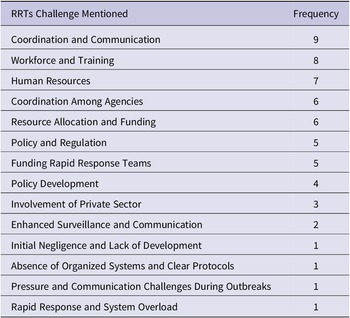
The most frequently mentioned challenge was “Coordination and Communication,” highlighted in 9 interviews (Table 1), with the recommendation to enhance coordination and rapid reporting (Table 2). This was closely followed by “Workforce and Training,” cited in 8 interviews, which called for continuous training and development to maintain readiness. “Human Resources,” mentioned 7 times, was linked to the need for training and capacity building, particularly for veterinarians. The challenge of “Resource Allocation and Funding,” discussed in 6 interviews, was associated with securing dedicated funding for RRTs. “Coordination Among Agencies,” also noted in 6 interviews, emphasized the importance of interagency collaboration and clear communication channels.
The frequency of the RRT challenges in KSA mentioned by the participants (N = 9)

The frequency of the recommendations for RRT in KSA mentioned by the participants (N = 9)

Participants explicitly described coordination and communication as persistent operational challenges:
“Communication gap at different levels… communication platform with lab platform with infection control platform with public health platform.” (Participant)
Workforce readiness and the erosion of skills between outbreaks were repeatedly emphasized:
“The biggest challenge is the time between outbreaks… the team either forgot the training or left the team itself.” (Participant)
“Policy and Regulation” challenges in 5 interviews pointed toward the necessity for ongoing policy development and dynamic adaptation to evolving needs. The “Involvement of Private Sector” was mentioned 3 times, with recommendations for continuous engagement to enhance preparedness and response capabilities. Specific operational challenges, such as “Initial Negligence and Lack of Development” and “Absence of Organized Systems and Clear Protocols,” were tied to the need for continuous training and the establishment of Standard Operating Procedures (SOPs), respectively.
Participants noted that written policies existed but were not always effectively implemented during real-world events:
“As written policies yes there is… but the time of implementation is when it happens… the written policy is different.” (Participant)
Moreover, “Pressure and Communication Challenges During Outbreaks” were addressed by enhancing communication strategies, while “Rapid Response and System Overload” highlighted the importance of improved accessibility and structured response protocols. The analysis underscores the critical interplay between identified challenges and tailored recommendations, advocating for a holistic approach to fortifying RRTs in Saudi Arabia through strategic coordination, proper governance, robust training, and dynamic policy frameworks.
Participants highlighted the importance of continuous training and system learning to prevent response fatigue and overload:
“If you don’t use it a lot, you start losing it… there is what you call public health lapse.” (Participant)
Discussion
As mentioned by the interviewees, the establishment of RRTs in KSA formally commenced after MERS-CoV in 2014. RRT initiation time in KSA was comparable to the Eastern Mediterranean Region (EMR) and when the Ebola outbreak in West Africa occurred.12 However, delays occurred in response to the MERS-CoV outbreak in 2014, which could be due to the rejection of MOH RRT intervention early in the outbreak.Reference Bushra, Al-Mohsen and Alqahtani13
All the participants included in this study came from diverse backgrounds and had previous field experience with outbreaks in Saudi Arabia. This allowed for a comprehensive exploration of the establishment processes. The participants identified various challenges they faced, with communication gaps being the most prominent, particularly in establishing, positioning, and managing effective responses by RRTs. In fact, effective communication is a non-technical skill that should be emphasized to enhance RRT responses.Reference Chalwin and Flabouris14, Reference Pereira, Almeida and Silva15 Despite frequently mentioning communication and teamwork as necessary skills, no straightforward educational approach can fill these skills gaps. One of the successful strategies is viewing relationship theories and applying them in relative safety simulation training on off-site team sessions.Reference Cziraki, Lucas, Chang and Rahim16 Additionally, pre-disaster preparation needs effective tabletop exercises and a standard and secure platform to share data rather than relying on WhatsApp and other social media channels, which is common in some areas of the world, especially Arab countries.
Human resources or trained workforce were also introduced as a significant challenge in establishing RRT in KSA. A shortage of trained personnel in KSA was one of the obstacles, especially in the number of veterinarians. Zoonotic emerging diseases need well-trained people with diverse backgrounds in all components of the One Health concept: human, animal, and environment. This was emphasized by studies that referred to the different backgrounds of RRT members, such as physicians, nurses, or pharmacists, especially those who have enough knowledge to deal with antimicrobial-resistant strains during outbreaks.Reference Alsowaida, Thabit and Almangour17, Reference Cranmer and Biddinger18 In addition, there is difficulty in keeping a consistent roster since some RRT members leave the team, which necessitates the need to train new members. This agrees with a study from Papua New Guinea in 2022 that showed developing a roaster is a critical challenge.Reference Marsh, Baragamu and Thomas19 Furthermore, when applying standard operating procedures (SOPs), several elements should be available, including human resources.Reference Greiner, Conner and Petersen20 The participants emphasized frequent use and applying that training in the field. This agrees with international studies that revealed that to be effectively deployed, it was essential to employ a phase training program, select the appropriate trainees, and adopt adult learning principles.Reference Marsh, Baragamu and Thomas19
Coordination with stakeholders was frequently presented as a challenge, which is unsurprising and agrees with international studies. COVID-19, the multisectoral pandemic, identified an imbalance in response among stakeholders, referring to the MOH as the most significant participant. Issues such as accountability, hierarchy, and trust were challenging stakeholders’ engagement. Additionally, gaps were identified in policy and stakeholder mandates in managing response to biological threats.Reference Mohamadian, Nasiri and Bahadori21–Reference Katz, Graeden and Abe23
Availability of resources was depicted as another challenge from the specialists’ experience, although they mentioned that it was due to governance rather than availability. The newly established intermediate authority and unidentified positioning of RRT created delays in allocating the required resources. This is slightly different from many other nations in that the shortage of resources was a critical factor in exacerbating the outbreaks.Reference Fuentes, Abi Hanna and Véliz24 The participants also mentioned the ability to integrate technology and apply it, especially regarding surveillance, to be proactive rather than reactive. There is a global need to develop a surveillance system that proactively captures threats. China, for example, developed Sentinel Community-Based Surveillance, which actively tracks COVID-19 cases to manage the outbreaks effectively.Reference Liu, Xu and Ma25
Finally, rapid changes in governance in the last few years in KSA could make RRT’s vision slightly blurry regarding responsibility, funding, communication, and resource allocation. This was a noticeable concern for the participants during the health sector transformation in the coming years.
There are significant limitations to consider when conducting this qualitative study. Firstly, the small sample size may make it difficult to generalize the study’s conclusions. However, qualitative studies primarily emphasize saturation, which is acceptable at this stage. It’s possible that bias could arise due to the snowball sampling method, leading to homogeneity and close perspectives. Nevertheless, we mitigated this by employing multiple transcription and validation reviewers for the collected data.
The participants frequently recommended clearer governance, especially considering the transformation happening in the MOH. This requires clear communication ports between the departments, with clear job descriptions that map out responsibilities transparently, giving room for RRT members’ compensation for the extra work they do while doing their regular jobs. They also recommend having a sustainable training program within the Public Health Authority, where they can send their team members when they identify gaps in knowledge or skills. They also called for a proactive surveillance system that can be accessed and analyzed by all RRT members. Finally, they recommend having clear, dedicated funding routes within the MOH for their work and efforts in responding to and preparing for public health emergencies.
Conclusion
The RRT in KSA establishment is estimated to have started with the initiation of the FETP in KSA and responded to deadly outbreaks such as Rift Valley Fever in 2000 and MERS-CoV in 2014. The challenges encountered, both internationally shared and culturally specific, provide valuable lessons for future emergency responses. This study indicated that it is crucial to provide comprehensive professional and soft-skills training to guide the actions of the RRT in the field effectively. It is imperative to establish clear governance that prioritizes the implementation of proper communication channels, well-defined job descriptions, and secure funding routes to underscore the vital role played by RRTs.
Data Availability statement
Any additional data can be provided if needed for validation.
Acknowledgments
We thank all the participants and rapid response team members who have been interviewed. We would also like to thank the MOH for supporting and guiding the process.
Author contribution
AA, CT, ZA, AK, MA, SR, and SS conceptualized the study, supervised the work, and reviewed the manuscript. CT and ZA wrote the paper, including conducting data analysis, data validation, transcription, and translation. LA, AH, SA, HA, AB, and GS participated in manuscript review. All authors read and approved the final manuscript.
Funding statement
The Ministry of Health funded the authors to conduct an unbiased study on establishing rapid response teams. The MOH was not involved in this study’s methodology and data analysis to reduce bias.
Competing interests
Some authors declare a conflict of interest as members of the Public Health Operations Centre in the MOH. These authors were not involved in the methodology and data analysis to reduce bias.
Ethics
The Ethics Committee of the General Department of Research and Studies—Saudi Ministry of Health granted ethical approval for this study (IRB log No: 24-32 M).



 Open access

