





August 4, 2020, started like a normal day in Beirut amid the “new normal” lockdown period of COVID-19. At 6:07 pm, a fire broke out at the port, causing 2,750 tons of ammonium nitrate—stored without proper safety conditions—to explode a few seconds later. The disaster left hundreds of casualties and thousands of people homeless. Whereas the response of governmental agencies and international agencies was slow, local family businesses rushed in to provide crisis relief, despite their financial constraints due to the preceding banking crisis. As a witness, I observed phenomenal philanthropic and entrepreneurial efforts by family businesses in the disaster response and subsequent recovery. A few years later, the centrally damaged area is reviving thanks to community members and the private sector—mainly family businesses—in co-creating civic wealth through their philanthropy.
While philanthropy routinely assists in disaster response, research on disaster philanthropy is limited and narrow in scope, focusing on high-income countries, international agencies, and multinational corporations (Leat et al., Reference Leat, Phillips, Williamson, Williamson, Leat and Phillips2023; McKnight & Linnenluecke, Reference McKnight and Linnenluecke2016). The role of corporations in disaster response is rarely differentiated among business types (Gautier & Pache, Reference Gautier and Pache2015) and is often seen as “a strategic tool in service of the firm” (Moran et al., Reference Moran, Dwyer, Seibert, Williamson, Leat and Phillips2024, p. 92), driven by market-oriented and self-serving motives such as enhancing firm reputation, offloading excess inventory, or pursuing new business opportunities (Müller, Reference Müller2023; Sandoval et al., Reference Sandoval, Gonzalez-Muzzio, Villalobos, Sarmiento and Hoberman2020). In contrast to a private, purely commercial firm that is expected to put shareholders and profits first, a “family business” entails family ownership, governance, and stewardship of a commercial enterprise with an intention that it is sustainable across generations of the controlling family (Chua et al., Reference Chua, Chrisman and Sharma1999; Sharma, Reference Sharma2004). While their financial resources may be limited, family businesses possess an adaptive capacity that enables them to adjust resources to promote business continuity while protecting family values and supporting community resilience during crises (Danes et al., Reference Danes, Lee, Amarapurkar, Stafford, Haynes and Brewton2009; Dos Santos & Llanos-Contreras, Reference Alonso-Dos-Santos and Llanos-Contreras2019). We argue that this adaptive capacity, particularly during crises, results from the successful integration of firm-, family-, and community-centric institutional logics that is at the core of family businesses’ organizational behavior.
Whereas firm-centric factors may strengthen the resiliency of the business, the interplay with family-centric factors and community ties creates what Müller (Reference Müller2023) calls “thick” engagement in disaster response. Such engagement can build human capital and a sense of shared purpose during immediate relief and the longer-term recovery stages when the first responders and multinational corporations have exited (Ballesteros et al., Reference Ballesteros, Useem and Wry2017). With sustained community engagement over the long run, family businesses contribute to “civic wealth creation,” defined as the social, economic, and cultural assets and capacities that enable a community to thrive (Kennedy, Reference Kennedy2021; Lumpkin & Bacq, Reference Lumpkin and Bacq2022). While the factors that facilitate family business continuity during disasters have been examined in some depth (Moran et al., Reference Moran, Dwyer, Seibert, Williamson, Leat and Phillips2024; Prasad & Roy, Reference Prasad and Roy2024; Zhang et al., Reference Zhang, Lindell and Prater2009), we know little about the factors that shape their philanthropy. This paper aims to provide a nuanced understanding of disaster philanthropy by family businesses, using an institutional logics framework, and to better explain the seeming paradox: their ability to make significant contributions to relief and recovery despite limited financial capacities.
The paper unfolds in two parts. We first identify the distinctive hybrid institutional logics of family businesses and the factors that predict their philanthropic responses to disaster. Philanthropic disaster response involves the use of private (individual, family or business) resources in the form of time, treasure, talent, and things and ties to “respond to, recover from, prepare for and prevent any kind of disaster” (Leat et al., Reference Leat, Phillips, Williamson, Williamson, Leat and Phillips2023: 1). We then apply this conceptual framework to the disaster philanthropy of family businesses in Lebanon where family business and philanthropy differ from Western, high-income countries and where a series of crises have tested their resilience. Responses are examined over time via interviews with family business leaders for 6 months, 1 year and 3 years after the Beirut explosion. Although approaches to civic engagement in Lebanon (AbouAssi, Reference AbouAssi2006) and to disaster management following the Beirut explosion (Haddad, Reference Haddad2022) have been examined in some depth, the contribution of this paper lies in advancing a framework for family business disaster philanthropy, rather than disaster management, with application to Lebanon and beyond. The conclusion sets the stage for future research and suggests implications relevant to scholarship and practice.
The institutional logics of family business
No matter how philanthropy is approached in “normal” times, it is disrupted in a disaster. Disasters occur in different forms (financial, health, conflict, environmental), across different geographies (global, regional, or local), by different causes (natural, human-made, or both) with differing severities. Philanthropic support for disaster relief and recovery is shaped by both the characteristics and capacities of the responders and by the context in which these organizations operate (Williamson et al., Reference Williamson, Leat, Phillips, Williamson, Leat and Phillips2024). An institutional logics perspective connects organizational characteristics and goals with the contextual level to explain behavior. Institutional logics are “the socially constructed, historical patterns of material practices, assumptions, values, beliefs, and rules” that provide meaning, set norms, and guide organizational behavior across differing situations (Miller et al., Reference Miller, Le Breton-MIller and Lester2011; Thornton & Ocasio, Reference Thornton and Ocasio1999). Logics enable people to “choreograph their practices with each other in ways that demonstrably account for and reflect their social context” (Lounsbury et al., Reference Lounsbury, Steel, Wange and Toubiana2021). Three main features of logics create institutional cohesion and shape action: 1) collective identities, including shared values, interests, motivations, and goals of participants (Thornton & Ocasio, Reference Thornton, Ocasio, Greenwood, Oliver, Saddaby and Sahlin-Andersson2008; Voronov & Weber, Reference Voronov and Weber2017); 2) organizational resources (Thornton et al., Reference Thornton, Ocasio and Lounsbury2012); and 3) governance practices, as led by different sets and coalitions of actors (Aparicio et al., Reference Aparicio, Basco, Iturralde and Maseda2017; Thornton et al., Reference Thornton, Ocasio and Lounsbury2012). The relationship of individual actors and institutional logics is reciprocal, described as one of “embedded agency” (Friedland & Alford, Reference Friedland, Alford, Powell and DiMaggio1991; Thornton & Ocasio, Reference Thornton and Ocasio1999): while individuals make strategic and potentially transformative choices, they are simultaneously influenced by the institutional logics that shape their beliefs, norms, and actions. These logics are influenced at a higher level by the institutional “field,” comprising similar, collaborating, and competing organizations (Thornton & Ocasio, Reference Thornton, Ocasio, Greenwood, Oliver, Saddaby and Sahlin-Andersson2008), and by the social and cultural context specific to time and place that establishes a broader set of values, norms, and expectations (Friedland & Alford, Reference Friedland, Alford, Powell and DiMaggio1991; Lounsbury et al., Reference Lounsbury, Steel, Wange and Toubiana2021; Ponte & Pesci, Reference Ponte and Pesci2022).
Most organizations operate with multiple logics that, when manifested and managed as compatible or harmonized, make them more durable and adaptable (Besharov & Smith, Reference Besharov and Smith2014; Busco et al., Reference Busco, Giovannoni and Riccaboni2017; Skelcher & Smith, Reference Skelcher and Smith2015). Family businesses embody two central institutional logics in intersecting and overlapping ways—business and family—which need to be integrated and managed for compatibility (Hernández-Perlines et al., Reference Hernández-Perlines, Covin and Ribeiro-Soriano2021). Whereas the business logic focuses on meeting customer needs and economic and financial performance and growth, the family logic involves concerns for the family unit, managing family dynamics, sustaining the pride of the family, and preparing for future generations (Aparicio et al., Reference Aparicio, Basco, Iturralde and Maseda2017). These are complemented by a community logic that centers on relationships with and reputations among stakeholders and other organizations in ways that create trust bonds of social capital (Feliu & Labaki, Reference Feliu, Labaki, Howorth and Discua Cruz2024; Reina et al., Reference Reina, Barber and Villar2023; Salvato et al., Reference Salvato, Sargiacomo, Daniele Amore and Minichilli2020). The combination of logics has distinctive implications for disaster response, which include instrumental goals (advantages for the business), moral objectives (sense of “doing the right thing” and protecting family), and relational concerns (for family, employees, stakeholders, and the broader community) (Aguilera et al., Reference Aguilera, Rupp, Williams and Ganapathi2007; Alony et al., Reference Alony, Haski-Leventhal and Mehra2023). During disasters, all three logics are heightened, with a community logic becoming more central or pronounced than normal due to the need for community relationships to sustain both business continuity and family and to enable the business to aid in local recovery.
Our research questions probe the three main components of this institutional logic to better understand their interaction and integration in philanthropic responses to disaster. Specifically, we examine how collective identities and goals, resources, and governing practices affect disaster response, as applied to the Beirut explosion. In the following section, we develop propositions about the implications of these three logic features for disaster philanthropy over time and then consider the specific institutional context of Lebanon.
Collective identities
The dualism of business and family-related logics gives rise to two defining features of business families: the motivation to preserve and enhance “socioemotional wealth” (SEW) and the dynamics of intergenerational families. Unlike financial wealth, SEW involves the affective rewards for the family, including identity, social ties, influence and prestige, emotional attachment among members, and maintenance of dynastic control (Alonso-Dos-Santos & Llanos-Contreras, Reference Alonso-Dos-Santos and Llanos-Contreras2019; Berrone et al., Reference Berrone, Cruz and Gomez-Mejia2012; Gomez-Mejia et al., Reference Gomez-Mejia, Haynes, Núñez-Nickel, Jacobson and Moyano-Fuentes2007; Hernández-Perlines et al., Reference Hernández-Perlines, Covin and Ribeiro-Soriano2021). Indeed, family businesses have been described as double-edged as they will accept some risk related to governance and performance of the business to safeguard their SEW (Berrone et al., Reference Berrone, Cruz and Gomez-Mejia2012; Gómez-Mejía et al., Reference Gomez-Mejia, Haynes, Núñez-Nickel, Jacobson and Moyano-Fuentes2007; Husef et al., Reference Husef, de Massis and Gomez-Mejia2023). SEW has been shown to extend beyond the family to the community level because it serves as a building block for community socioemotional and civic wealth, which seeks to promote the way of life and well-being of the community (Bailey & Lumpkin, Reference Bailey and Lumpkin2023; Kurland & McCaffrey, Reference Kurland and McCaffrey2020; Limpkin & Bacq, Reference Lumpkin and Bacq2022). This relationship is reciprocal. A family’s efforts to prioritize SEW lead to increased engagement with the community, which then generates greater community embeddedness—its ties with, reliance upon, and commitment to its community (Lumpkin & Bacq, Reference Lumpkin and Bacq2022). As Kurland and McCaffrey (Reference Kurland and McCaffrey2020) demonstrate, the embeddedness of a family firm’s leadership in the community increases the likelihood of pursuing strategies for the benefit of the community, even if these are to the detriment of the financial value of the firm.
The involvement and succession of the family over time play an important part in family and community SEW and in philanthropy. The degree of family ownership and control affects the intensity of community engagement and of giving: the more involved family members are, the higher levels of community engagement (Litz & Stewart, Reference Litz and Stewart2000; Lumpkin & Bacq, Reference Lumpkin and Bacq2022) and the more philanthropic the family business (Campopiano et al., Reference Campopiano, de Massis and Chirico2014; Dou et al., Reference Dou, Zhang and Su2014). Conversely, when family involvement and control are not strong, family businesses have fewer incentives to engage in firm philanthropy that nurtures community relationships (Campopiano et al., Reference Campopiano, de Massis and Chirico2014). The leadership role of a founder who has a reputation for “social good” in the community and is still a major influence over the identity and governance of both family and business puts an emphasis on family roles in the business (Harrington & Strike, Reference Harrington and Strike2018) and reinforces efforts toward maintaining a positive philanthropic image and good relations with stakeholders (Bettinelli et al., Reference Bettinelli, Lissana, Bergamaschi and de Massis2022; Calabrò et al., Reference Calabrò, Frank, Minichilli and Suess-Reyes2021). Subsequent leadership generations tend to abandon the integration of competing logics and practices, so the firm is treated as an extension of family relations to the neglect of commercial aspects, thus becoming less entrepreneurial over time (Harrington & Strike, Reference Harrington and Strike2018; Jaskiewicz et al., Reference Jaskiewicz, Heinrichs, Rau and Reay2016; Miller et al., Reference Miller, Le Breton-MIller and Lester2011). Research from several countries, including studies conducted in Spain by Arrondo-Garcia et al. (2020) and in China by Liang et al. (Reference Liang, Huang, Xu and Wang2023), reports that multi-generational businesses typically take fewer risks and those with strong family control over generations tend to adopt more conservative strategies. Whether this makes them more resilient (Canovi et al., Reference Canovi, Succi, Labaki and Calabro2023) or subject to inertia (Yan & Yu, Reference Yan and Yu2023) is contested in different country contexts.
In routine times, the philanthropy of family businesses tends to be motivated by their SEW goals, as well as inherent values, faith, or other moral obligations (Astrachan et al., Reference Astrachan, Binz Astrachan, Campopiano and Baù2020), and donations are usually linked to a cause that is local and personal to the family (e.g., education or health), rather than broad community-building or systems change. In disaster response, however, the identity of the business family is particularly important (Bettinelli et al., Reference Bettinelli, Lissana, Bergamaschi and de Massis2022; Dieleman, Reference Dieleman, Howorth and Cruz2024), which affects its treatment of SEW. As Mahto et al. (Reference Mahto, Llanos-Contreras and Hebles2022) observe in a study of small Chilean family businesses following a major earthquake, identity as a family, including family welfare, continuity, and prominence (regarding reputation and social ties with the surrounding community), was as important as economic motivations in their responses. Although SEW may have a double-edged effect on business performance, it is likely to have a positive influence on disaster philanthropy in the immediate post-disaster stage when community support, family reputation, and economic survival are closely linked. We thus expect that the family logic, expressed through the extent of ownership and involvement in the business, affects philanthropic responses in disasters, as indicated in Fig. 1:
Proposition 1a: The greater the involvement of the family in the business, the stronger the philanthropic response.
Proposition 1b: The active presence of the founder is associated with a stronger philanthropic response.
The institutionals logics of family business philanthropic responses to disasters.

Fig. 1. Long description
The diagram is nested within two outer frames labeled Context and Institutional Field. The flow moves from left to right across four main columns.
1. Integrated Institutional Logics I L. A Venn diagram showing three overlapping circles labeled Family, Business, and Community. A bracket connects this diagram to the next column.
2. Key I L Factors. Three boxes branching from the bracket: Identities or Motivations, Resources, and Philanthropy Governance.
3. Components. Each factor branches into specific sub-components connected by double-headed vertical arrows.
* Identities or Motivations leads to S E Wealth and Family or Founder Involvement.
* Resources leads to Financial and Non-Financial.
* Philanthropy Governance leads to Family, Business, and Professional.
4. Propositions: Philanthropic Responses to Disaster. Large arrows point from the components to three text boxes.
* Top box: Involvement of founder plus family in the business leads to philanthropic response. Embeddedness in community leads to philanthropic response.
* Middle box: Reliance on financial resources in short term. Reliance on non-financial resources over time.
* Bottom box: Combination of governance strategies leads to stronger philanthropic response.
A large gray arrow at the bottom right points right, labeled Disaster Stages evolving.
Resources
The financial capacity and resources of family businesses vary enormously, ranging from those of small, local to multi-locale and national enterprises, which affects the relative weight of business, family, and community considerations in their combined institutional logics and influences their disaster responses over time. Capacity can be split into financial capital (e.g., family money and business assets) and non-financial capital (e.g., human, social, and network capital and expertise). While financial capacity influences the extent to which family businesses can be resilient and support philanthropic responses (Daspit et al., Reference Daspit, Chrisman, Ashton and Evangelopoulos2021), non-financial resources are equally important. Motivations interact with resource capabilities, drawing on different capacities in the response versus recovery stage, thus allowing family businesses to be adaptive over time (Mahto et al., Reference Mahto, Llanos-Contreras and Hebles2022).
In contrast to philanthropy of normal times, disaster response and recovery require a “whole of community” action that involves collaboration, knowledge sharing, and mutual trust among diverse stakeholders (Haddad & Sakr, Reference Haddad and Sakr2023). When a disaster occurs, family businesses tend to leverage both financial and non-financial capital. They draw on their non-financial resources—their human capital (e.g., employees), social capital, trust, and local and international networks—due to the scarcity of financial resources in the short term. Despite the perception (or reality) of limited resources, deployment of non-financial forms of capital enables them to achieve more than financial contributions alone (Alony et al., Reference Alony, Haski-Leventhal and Mehra2023). For example, their social and network capital encourages other businesses and families to give and volunteer (Grube & Storr, Reference Grube and Storr2018; Hwang & Joo, Reference Hwang and Joo2021; Moran et al., Reference Moran, Dwyer, Seibert, Williamson, Leat and Phillips2024). In a study of how German organizations helped mitigate the impact of the large influx of refugees in 2015, Müller’s (Reference Müller2023) differentiates “thin” engagement (demonstrated by non-German multinational corporations) from “thick,” context-specific engagement (by German family businesses with deep community roots).
Ultimately, family businesses continue to use all their capacities in the recovery phase and beyond, which then supports firm-centric financial goals and new business opportunities as well as serving family- and community-centric values. Because family businesses tend to view economic and societal impact through a local lens, know the local community well, and engage with diverse types of stakeholders, they can better pool resources for disaster recovery, mitigation, and prevention; leverage their social capital; and deploy a variety of other resources for rebuilding (Grube & Storr, Reference Grube and Storr2018; Moran et al., Reference Moran, Dwyer, Seibert, Williamson, Leat and Phillips2024). Shared community values and enduring ties become part of the narrative and basis for recovery, transforming into collective civic values for community building. Over the long run, this contributes to collective community strength or what Lumpkin & Bacq (Reference Lumpkin and Bacq2019, Reference Lumpkin and Bacq2022) refer to as “civic wealth creation.”
We propose that, during a disaster, non-financial capacities of business and family become as important as financial assets in their philanthropy:
Proposition 2a: In the early response to disaster, the family business relies mainly on financial resources and on kinship and close stakeholder relationships, with wider networks involved at later stages.
Proposition 2b: In later stages, financial and non-financial capacities remain important and mutually supportive.
Proposition 2c: The more embedded the family business in the community, the stronger and more sustained its philanthropic response is.
Governing practices for philanthropy
Just as the governance of family and of business affects disaster philanthropy, so too does the routine, pre-disaster governance of philanthropy. Breeze (Reference Breeze2009) argues that informality is the “rule” for family business philanthropy. However, this discounts the diversity of approaches that run the gamut from entirely opportunistic and ad hoc efforts to highly structured and formalized ones. These governing approaches can be categorized by whether the family, the business, or an independent, professionalized foundation has primary direction over philanthropy. In a “pure family model” (Feliu & Botero, Reference Feliu and Botero2016), the decisions over what, when, who to support, and how to do so are taken directly by the family, often reflecting their personal preferences and values, even if contributions flow through the business. Donations may be made directly to charities, often on an informal basis, or through a family-controlled vehicle such as a “family association” or a waqf (AbouAssi, Reference AbouAssi2006; AbouAssi et al., Reference AbouAssi, Bowman, Johnston, Tran and Bauer2017), both of which are widely used in Lebanon.
Alternatively, philanthropy may be almost entirely the domain of and funded through the business, operating with a business logic in mind. This prompts alignment with strategic business opportunities, corporate social responsibility, and management of the firm’s reputation. A professional model involves the creation of a separate foundation, whether its assets derive from the family or the business, in which professional staff play a significant role in determining philanthropic programing. Internationally, the governance of family business philanthropy has become more organized and structured over time, with a rise in popularity of family- and corporate-controlled foundations (Rey-Garcia & Puig-Raposo, Reference Rey-Garcia and Puig-Raposo2013). Luneau and Ward (Reference Luneau and Ward2012) report that foundations with less family involvement and those with multiple generations of the family enterprise on the board are more diversified in their grant making, supporting a broader range of causes. Younger family foundations and those with fewer “outsiders” on the board focus their grant making, which may make it easier to prioritize disaster response.
These models are not mutually exclusive: business families and their firms often use multiple approaches, both formal and informal, to manage their philanthropy. They contribute not only capital but also products and services. Additionally, through their peer networks and linkages with a diversity of organizations, family businesses raise funds from other sources throughout all stages of a disaster. We argue that the routine management of philanthropy influences the adaptability of philanthropy in disaster response. Highly informal or highly formalized single vehicles (whether controlled by the family or business), we suggest, will be constrained in their ability to provide agile, effective approaches. While informal family responses likely lack a sufficient knowledge base to pivot quickly from routine to disaster philanthropy, a professionalized family foundation may find it difficult to disengage from existing priorities and programs to embrace new ones in a volatile context. The existence of multiple vehicles that draw upon stakeholder relations of the family and the business will facilitate faster and more extensive disaster philanthropy. We thus hypothesize that:
Proposition 3a: A combination of governance strategies of family and business philanthropy is associated with a stronger philanthropic response.
The institutional context
An institutional logics perspective emphasizes that organizations are influenced by the environments in which they are situated, which involves both the ecosystem or field of similar, supportive, and competing organizations and the broader cultural and societal context that shapes values and norms at a macro level. The family business field in Lebanon is dense, as family businesses represent over 80 percent of the private sector and employ more than two-thirds of the labor force (Fahed-Sreih & Pistrui, Reference Fahed-Sreih, Pistrui and Burger-Helmchen2012). The prominence of business families in Lebanese society and economy, which is often accompanied by political influence (Welsh & Raven, Reference Welsh and Raven2006), creates high expectations that they will be active and visible participants in civic and community matters. Given a weak and failing state with high levels of corruption, particularly since the end of the civil war in 1990, associations emerged as the primary providers of a wide range of social welfare services. This increased demands on business families for support, and, due to the lack of trust in government, donors channeled their assistance through associations (Haddad, Reference Haddad2022). International humanitarian organizations have played important roles in disaster relief in Lebanon, but, as in most disasters, they exit quickly. As a result, the most active organizations post-explosion were local associations, although coordination among them was lacking (Haddad, Reference Haddad2022; Haddad & Sakr, Reference Haddad and Sakr2023).
Alongside kinship, religion has a major influence on social values and on philanthropy in Lebanon because charity is considered a religious imperative and a moral obligation (Ridge et al., Reference Ridge, Kippels, Bruce, Ridge and Terway2019). Religious associations constitute about 80 percent of the voluntary sector, and charitable giving is high, with over 70 percent of the population donating (whether money or in-kind) (AbouAssi, Reference AbouAssi2006). Lebanon also stands at the crossroads of ancient and modern civilizations, cultures, and geopolitical and geoeconomic tensions. Education, religion, and armed conflicts have always been central in shaping individual, social, and national Lebanese identities. Because multiculturalism enriches the national social fabric, a homogenous national cultural identity is absent, and philanthropy is diverse in its goals and structure (Akl, Reference Akl, Sultana and Buhagiar2021). Social inequality is relatively high, and social elites further widen the resource gap. Even within the same religion, disparities in economic power and resources impact the philanthropic practices of family businesses. Consequently, philanthropic efforts in Lebanon are not exclusively focused on reducing the short-term consequences of social problems, such as poverty, hunger, unemployment, or disease, but also embrace long-term programs to alleviate deeper causes of inequality (such as the lack of education or skills). At the same time, due to the recurring crises and exogenous shocks that have shaped the recent history of Lebanon, philanthropists have had to be concerned with immediate responses that meet the basic needs of people as compared to spending time and money on their traditional or preferred causes.
The remainder of the paper analyzes how the combined family, business, and community logics of family businesses in Lebanon affected their philanthropic responses to the explosion, beginning with a description of the methodology.
Methodology
The Beirut port explosion is an “exemplar” case (Yin, Reference Yin2018) to explain disaster philanthropy in a crisis context for two reasons. First, the severity of the disaster triggered an immediate and intense philanthropic response by Lebanese family businesses. Second, as time passed, the repercussions of the disaster, and in parallel with the evolution of the philanthropic responses, facilitate analysis of the interplay of the key features of institutional logics. In addition, as Maalouf & Mouawad (Reference Al Maalouf and Mouawad2025) observe in their study on the impact of the Beirut port explosion on Lebanese supply chain management and seaport infrastructure, this catastrophe formed a critical point in Lebanese history. While it exposed economic infrastructure vulnerabilities and the urgency of better crisis management practices, it also demonstrates the significant recovery efforts of the Lebanese private sector, which could serve as the basis for a dynamic resilience model for recurring calamities. In policy terms, the case reinforces the value of integrated interorganizational disaster management across public and private sector institutions that promotes social cohesion, preparedness, and resilience in ongoing crises across developing contexts such as the Middle East region (Haddad & Sakr, Reference Haddad and Sakr2023).
The data on family businesses’ philanthropy following the explosion were collected across three phases by the first author through semi-structured interviews with a total of 24 members of 9 Lebanese family businesses who have a philanthropic legacy. Interviews were conducted 6 months after the blast (January/February 2021) and 1 year after the blast (July to October 2021). The sample focused on family enterprises that: have annual revenues between $USD 3 and 17 million, which are classified as small to medium-sized (SMEs) by the Ministry of Economy and Trade (2014); employ on average 50 employees; and are representative of key economic subsectors. In addition, all had to have a good market reputation with no bankruptcy history or involvement in fraud, and the sample also sought variation in the involvement of family members across generations. Requests for interviews were emailed to 15 family businesses, resulting in 9 acceptances—a response rate of 60% that is broadly representative of subsectors. The participants included family owners, family members not directly involved in the business, and non-family employees.
The first round obtained insights on the meaning of community and initial philanthropic approaches through interviews with 10 family business owners, of which 4 were conducted in person and 6 virtually (due to the large-scale infrastructure damages caused by the explosion and Covid-19 measures). The second round added an additional 14 (virtual) interviews for a total of 24. The first-round data were content analyzed using Nvivo and second round were hand coded, categorizing respondents by position and type of business (Reay, Reference Reay2014; Saldaña, Reference Saldaña2013). A third phase in May 2023 involved five in-depth interviews with three family businesses from the initial study that focus on philanthropy for educational purposes, a common philanthropic cause related to reducing inequality (Sidani, Reference Sidani2025). These data were also hand-coded and analyzed for themes identified in the previous rounds.
The nine family businesses shown in Table 1 vary in sector, history, and size within the SME category. They represent deeply rooted family businesses with some established in the 1920s and 1930s, and most have moderate to high levels of involvement by the family.
Description of the selected nine Lebanese family businesses

Table 1. Long description
The table consists of six columns: Case number, Business line, Founding date, Annual revenue in millions of dollars, Involvement of family members, and Number of employees.
* Case 1: Automobile sector, founded in the 1920s, 10 million dollars revenue, moderate family involvement, greater than 100 employees.
* Case 2: Electronics sector, founded in the 1930s, 7 million dollars revenue, high family involvement, 10 to 50 employees.
* Case 3: Transport sector, founded in the 1940s, 3 million dollars revenue, high family involvement, greater than 100 employees.
* Case 4: Coating material sector, founded in the 1950s, 10 million dollars revenue, low family involvement, 10 to 50 employees.
* Case 5: Construction material sector, founded in the 1960s, 2 to 10 million dollars revenue, moderate family involvement, 10 to 50 employees.
* Case 6: Construction and Real Estate sector, founded in the 1960s, 5 million dollars revenue, low family involvement, less than 10 employees.
* Case 7: Telecommunications sector, founded in the 1970s, 5 million dollars revenue, high family involvement, 10 to 50 employees.
* Case 8: Audit sector, founded in the 1970s, 2 to 10 million dollars revenue, moderate family involvement, 10 to 50 employees.
* Case 9: Automobile sector, founded in the 1980s, 22 million dollars revenue, high family involvement, 10 to 50 employees.
Findings
Our main findings are threefold. First, we highlight the way Lebanese family businesses address the resource-impact paradox. During the disaster and given scarce financial resources in most cases, there was greater reliance on non-financial than financial resources, although responses varied among the cases and over time. Second, we find evidence that the presence of the founder and governance of business and philanthropy, as well as socioemotional factors, affect the nature and magnitude of the philanthropic initiatives. However, these also differ over time. Third, and perhaps most important, we find that family businesses relied on integrating institutional logics to better govern their philanthropic response to the Beirut Port disaster, with collective identities, resources, governing practices, and community embeddedness as central factors.
Collective identities and motivations
Most informants indicated that before the crisis, core values, including faith, were strong motivations for philanthropy: families valued helping less fortunate individuals, and they dedicated ample time to philanthropy.
We don’t need a motive to practice philanthropy; the motive is always there, regardless of the current situation; it’s always been on the philanthropic side. (Manager, Shipping Company)
In the initial disaster response stage, pragmatic interests of achieving short-term relief dominate decision-making. However, these were coupled with a view to more enduring family legacies and longer-term social impact. In addition, philanthropic practices emphasize not only giving money but also deploying time, talent, other assets, and community ties:
We believe in [our philanthropic legacy] and the social impact of our project. When you see its results and how much you can help people around you on different levels, this is already motivation for you to continue in the current situation when everything is deteriorating … How can you stop something if you think there is a need for it and the need [for relief efforts] is increasing? (Operations Manager, Owner (sister), Telecom)
About half of the interviewees reported that their motivations and goals evolved somewhat over time, although all indicated that trust remained central and that they prioritized stakeholder and community relationships. In the ongoing recovery phases, there is consensus on two primary motivations: supporting SEW and making transformational change as a result of the disaster. The need for collaborative efforts to rebuild and make the community ecosystem sustainable was mentioned frequently. For many families, faith is an important determinant of community and philanthropy, although it may serve to be insulating rather than inclusive. When asked about religion, one interviewee noted that sectarianism might play a role in amplifying or sustaining their giving during recovery, in contrast to earlier stages when humanity and solidarity values prevailed. However, support based on shared faith could also narrow the view of “community”:
Each region is related to a certain family or party or sect, so I think, yes, why not [focus our caregiving on] our region. (Assistant to General Manager, Automobile)
I’m thinking, now, primarily, survival of my immediate community [of the same faith as the interviewee’s]. (Owner, mother, 2nd Gen, Transport)
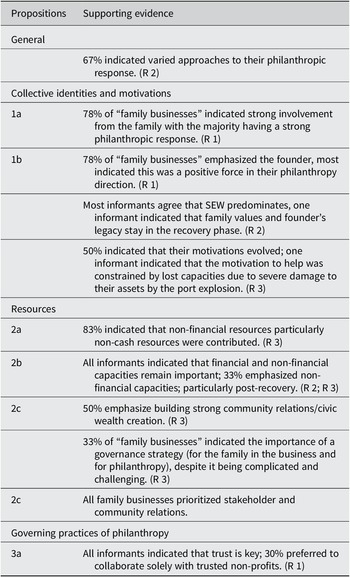
As shown in Table 2, founder and family involvement in the business are, as predicted (Proposition 1a and 1b), positively associated with stronger philanthropic responses to disaster: 78% of respondents indicated strong involvement by the family and/or founder.
Summary of findings

Table 2. Long description
The table is organized into two columns: Propositions and Supporting evidence.
* General: 67 percent indicated varied approaches to their philanthropic response (R 2).
* Collective identities and motivations:
- 1a: 78 percent of family businesses indicated strong involvement from the family with the majority having a strong philanthropic response (R 1).
- 1b: 78 percent of family businesses emphasized the founder, most indicated this was a positive force in their philanthropy direction (R 1).
- Most informants agree that S E W predominates; one informant indicated that family values and founder’s legacy stay in the recovery phase (R 2).
- 50 percent indicated that their motivations evolved; one informant indicated that the motivation to help was constrained by lost capacities due to severe damage to their assets by the port explosion (R 3).
* Resources:
- 2a: 83 percent indicated that non-financial resources particularly non-cash resources were contributed (R 3).
- 2b: All informants indicated that financial and non-financial capacities remain important; 33 percent emphasized non-financial capacities; particularly post-recovery (R 2; R 3).
- 2c: 50 percent emphasize building strong community relations/civic wealth creation (R 3).
- 33 percent of family businesses indicated the importance of a governance strategy for the family in the business and for philanthropy, despite it being complicated and challenging (R 3).
- 2c: All family businesses prioritized stakeholder and community relations.
* Governing practices of philanthropy:
- 3a: All informants indicated that trust is key; 30 percent preferred to collaborate solely with trusted non-profits (R 1).
Note: R refers to the round of interviews.
Note: R, round of interviews.
Philanthropic initiatives following the explosion cannot be understood by motivations and collective identities alone, however. Rather, the interviewees emphasize how capacities, community relations, and governing practices influence the expression of underlying motives.
Capacities
Business capacity affects philanthropy’s resilience. The family business’s access to resources depends, in large part, on community pressures and its survivability capacity as a business, both of which are under significant stress following a disaster. Most owners agree that a fundamental resource challenge is financial and it has persisted since the banking crisis of 2019. Because the survivability capital provided by external actors, notably by government, is weak, unreliable, or non-existent, family businesses are left to fend for themselves. Despite limited cash reserves, financial contributions are an early response, as noted in most interviews, supporting Proposition 2a. However, the community needs to contribute to an increasing scarcity of financial resources, as noted in interviews from the three firms conducted in May 2023. As one owner explained, the survivability of her vocational school during the crisis was due to financial resources provided by the family business, but its continuity is threatened by external factors such as social stereotypes and governmental incompetence.
A key theme is the need to provide support by means other than direct income or other financial resources: 83% indicated that both financial and non-financial resources remained important (Proposition 2b) and are mutually supportive, leading to new opportunities:
My sister [who is also a family business owner] volunteers in the supermarket … employed families also who grow veggies in their garden and from that she started the catering business [which now serves as key philanthropic vehicle within the family business]. (Chairman/Owner, Telecom)
As the family owner of a Telecom business observes, when their own business capacities were affected by the explosion, the owners found innovative ways to assist:
Our usual activities do not serve the aftermath of the Beirut Port Explosion directly: many organizations collected clothes, medicine, etc. Maybe they went beyond their normal philanthropic activities, we did not do that. Honestly, what we did, especially my brother, was a big fundraising (Telethon) campaign partly because of our values and partly because we lost all our offices in the damaged area.
Another business owner reported how they reworked employee tasks and created jobs for employees who were in less dynamic departments, initially because of COVID-19. In general, post-crisis patterns reveal the value of time over money, particularly dedicated to recovery and rebuilding community relations and civic wealth (Proposition 2c).
Time is always an important resource … it’s not embedded in calculating the value of philanthropy, … it is putting the time of credible and educated people into the process of rebuilding a nation. (Owner 1, Automobile)
In the post-recovery period, attention turned to fostering stronger community relations and solidarity, with families looking to family legacy through their philanthropy. For example, the owners of the vocational school suggested that, in the long run, they would consider turning their vocational school into a public library to honor their founders, thus leveraging SEW and non-financial resources for civic wealth, rather than relying on financial resources to help students as they did in the relief stage:
If there is one service [that we as family business owners are involved with] … becoming obsolete, then we might turn it into a public library [additional philanthropic engagement by the family business and as part of the founders’ philanthropic legacy] … Until now, we feel that education is a type of service that is still needed. People pay and value that … Some people cannot pay; it’s our role to see how to help them. It’s not only helping students but also helping teachers.
Because our vision has changed, we are now looking at it as a legacy, and we want to keep it (only) if it is needed.
At this stage, family owners tend to attribute the survivability of their programs to internal resources and community capacity as compared to externally provided capital.
This sense of belonging may have helped amplify giving on an individual basis. Other than just dealing with the traditional charitable organizations, it helped many people psychologically, even though now some people still come to us [seeking financial assistance] even after the blast. (Assistant Manager to the General Manager, Automobile)
Governing practices
Philanthropic governance, whether through the family, the business, or a foundation, is a factor in disaster philanthropy and is influenced by a family’s attachment to SEW. As the owner of a telecom company noted, “[Philanthropy] is a three-circle model (the family, the business, and the ownership).” The interviewees stress the collective aspect of governance rather than individual leadership, while respecting the founder’s personal legacy and acknowledging the importance of involving future generations. One respondent notes the importance of intergenerational SEW and sharing governance of their philanthropy:
Everybody in the whole family is involved to a certain extent. They all know XYZ Day Care, they participate with their own resources (mainly time). Even in the company, it is the whole internal system because we have shared services [the family business] is contributing all the resources it has. The job description of the accountant, [includes performing] the accounting for XYZ. (Operations Manager, Owner & Board member (sister), Telecom)
The more the business family is embedded in its local community, the more philanthropic aid is expected and is provided pre-, during, and post-crisis. A consistent theme is that philanthropy through the family is difficult to distinguish from that through the business, no matter which is making the contributions:
Because it is a family firm, sometimes giving to the community at the personal level cannot be distinguished from giving to the community at the business level. (Owner, Managing Partner 2, Audit)
The family has always been a family of giving; the house is always open to the community. A small family, so friends of the family are the closest or nuclear part of the family, so you can consider this the first level of the community, then, goes the neighbors, then, the street, then, the community grows beyond the district. (Managing Director (brother), Transport)
While immediate family and business circles are a key focus in early responses, the broader community becomes more engaged later, although this varies across the cases.
When you see the work [of a small group] paying off, and others see their work, the circle will grow more and keep growing… What we need is to combine all these people or families together and introduce them to each other… you need to augment all these people who are in [engaged] philanthropy [pre, during, and post disaster relief] so that their collective teamwork will shine on the society that we are living in just like the sun. (Founder/Owner, Construction material)
The limitation of an integrated family-business-community logic is that many families overlooked—or were resistant to—the value of hiring professionals to provide independent expertise and guidance because both business and philanthropy feel personal. They have been slow to change, even when current models are no longer sustainable.
A lot of our philanthropic activities are personal initiatives, either inherited or created informally. When we formalize, we will create sustainability and longevity for these activities … Now we must talk with the family to formalize all our philanthropic activities. (Owner/Chairman (brother), Telecom)
We could do better in terms of governance … As a family, we need to take a more passive role, hire some professionals, and empower them with the ability to make decisions without losing the family and philanthropic aspects … You cannot have family logic overcome the business logic … because we care so much about our family harmony, our family relations, our family legacy, that sometimes we postpone (or don’t make) decisions. (Noninvolved Shareholder, Audit)
Although the participants generally view their programs as resilient due to the elements of SEW, some business families struggle with longer term resilience and the successful integration of logics:
We have a standard family business type of logic [based on] family legacy. Currently, it does not operate on any survivable business logic. Logics compete…in our case, it really is family and perhaps a religious logic, this is where most of the family values come from. Family logic is overriding institutional logic. (Noninvolved Shareholder, Audit)
In a more radical approach, one business owner suggested that in the severe and continuing crisis context of Lebanon, resilience is overrated; rather socioeconomic resistance must take its place:
Resistance [means] acting on something that is negative to you; to change it … sometimes resilience, adapting, keeping faith, and being positive are not enough. (Owner/Chairman (Brother), Telecom)
In sum, the governing practices for philanthropy of the family and the business varied considerably, generally relying upon a mix of family and business models (Proposition 3a), with many resisting external advice and a more professional model.
Family businesses are vital actors following disasters, in part, because they are locally embedded. They sense a dual responsibility for business survival and community sustainability in whatever ways they define “community.” Hence, they might carry a heavier burden than non-profits or multinational for-profits in recovery stages of a disaster.
Discussion
An institutional logics perspective facilitates insight into the compatibility of differing sets of identities, goals, resources, and governance practices within family businesses and serves as a conduit for connecting these organizational characteristics with broader social and cultural contexts. The notion of “logics” is also intuitive to owners of family businesses, as indicated by their spontaneous reference to logics in the interviews. Most research on institutional logics in family businesses has focused on the relationships of family and business logics (Fathallah et al., Reference Fathallah, Sidani and Khalil2020; Ponte & Pesci, Reference Ponte and Pesci2022), whereas we argue that a community logic must be added to this mix, particularly in disaster contexts in which community well-being becomes pronounced. The interplay of these logics also needs to be considered in the specific context of time and place, which in the case of Lebanon in 2020 requires an appreciation of ingrained systems of kinship, centrality of religion, the economic and social importance of family businesses, and mistrust of a weak and failing state. In our study, this context is reflected in the centrality of the family logic and a strong commitment to community building, although this may be divided along religious and cultural lines.
The findings highlight the importance of non-financial contributions in addition to financial donations in disaster philanthropy. Family businesses were inventive in mobilizing various non-financial assets distinctive to their business, including supporting employees by restructuring work tasks, applying their telecom expertise to hosting fundraising telethons, and turning private assets, such as vocational schools, into public ones over time. The integration of family and business logics, knowledge of and embeddedness in community, and creative use of non-financial capital resolve the paradox of how local family businesses respond effectively to disasters with seemingly limited financial resources. The role of SEW as a building block in the creation of civic wealth appears to be a key factor in explaining the resilience and enduring engagement of family businesses in later stages of disasters after international agencies have long departed.
The findings point to several concerns for philanthropic responses to future disasters in Lebanon and beyond. First, the governing practices for philanthropy, whether contributions are made through the family or the business, tend to be very personal and reactive. Interviewees noted that there was a struggle to find the appropriate balance between a personal, family-hold on philanthropy and a more professionalized approach to management and delivery, often with a resistance to obtaining external expertise. While philanthropy is always to some extent personal, the lack of professionalization may make it difficult to plan strategically about disaster response. Second, faced with a weak and unreliable state, sometimes obstructionist during a disaster, family businesses stress that they work primarily with known and trusted partners. While such community embeddedness strengthens the ability of a family business to create civic wealth following disasters, it is also highly dependent upon pre-existing trust, which may be constrained along lines of faith, culture, or locale, thereby limiting the availability of partners for more collaborative, whole of community efforts in disasters. Knowledge sharing and the cultivation of bridging social capital—ties that bring together different societal factions and a diversity of organizations—could create wider circles of potential partners in future disasters. Third, the participants spoke about the challenge of being resilient in the face of recurring crises. Resilience relies on capacities drawn from both family and business but can also be strengthened by coordination and planning among civil society actors, a task made difficult without government as a supporting actor.
Limitations
The application of institutional logics in this study has a variety of limitations. The context of Lebanon is distinctive and has faced a series of different kinds of crises—civil war, financial, health, and urban destruction—over a relatively short period. The logics framework focuses on three key factors but does not address other dimensions of family businesses, such as business sector and size (Daspit et al., Reference Daspit, Chrisman, Ashton and Evangelopoulos2021; Howorth & Discua-Cruz, Reference Howorth, Discua-Cruz, Howorth and Cruz2024), the number of generations involved (Canovi et al., Reference Canovi, Succi, Labaki and Calabro2023), family religion and values (Islam et al., Reference Islam, Wahab and Abdul Latiff2023), and how family dynamics affect governance of the business (Arrondo-Garca et al., Reference Arrondo-García, Fernández-Méndez and Menéndez-Requejo2016; Brenes et al., Reference Brenes, Madrigal and Requena2011). While the study covers a range of subsectors of family businesses, the small number of interviews does not permit differentiation by nature of the business or generational size of the family. Further research is needed to study the impact of other factors on disaster philanthropy. Despite the numerous studies on the continuity of family businesses, more research is needed on the implications of the interplay of family, business, and community logics and on the sustainability of philanthropic responses to external shocks over time.
Conclusion
This paper integrates an institutional logics perspective with literatures on family business and disaster philanthropy to develop an applied approach to assessing family business involvement in disaster contexts. Studying family business philanthropy during crises is important for two reasons. First, it highlights community strengths and vulnerabilities, given the fragile nature of the social safety net in many countries, which becomes more fragile during disasters. Second, in a world increasingly prone to disasters, researchers and practitioners could benefit from a better understanding of the role that family businesses, as unique types of private sector actors, can play in mobilizing philanthropy during disasters and in longer-term community building. Research tends to aggregate private sector contributions as “corporate philanthropy,” hindering a nuanced assessment of differences within the private sector. This study shows how family businesses are a distinct type that merits deeper examination in disaster contexts.
The conceptual basis rests on the interplay of the logics of family, business, and community, which are connected through the pursuit of socioemotional and civic wealth. The approaches to disaster philanthropy are examined by analyzing the evolution of collective identities, resources, and governing practices for philanthropy over the stages of a disaster. Family businesses can be early, consistent, and effective actors in disaster involvement—a seeming paradox because most are SMEs with limited financial resources. The effectiveness of family businesses manifests in their ability to draw upon a mix of non-financial resources, including their social and business networks, knowledge of and embeddedness in community, and other trusted relationships. Over time, family businesses take on transformational roles in creating civic wealth. The study suggests that business families could pay greater attention to the governance and management of their philanthropy. While the intertwined logic serves as a strong motivator for disaster response, they present challenges for the implementation of philanthropy. With a richer understanding of the unique aspects of family business philanthropy, public policy could better engage with and incorporate family businesses into disaster planning and management.
Funding statement
This paper represents one of the essays of a PhD research project funded by the Vrije Universiteit Brussel on University Scholarship basis provided to the first author during her PhD trajectory. No other funding was received for this study.
Competing interests
The authors have no competing interests to declare.



 Open access

