


1. Introduction
Knowledge of the distribution of Cenozoic shortening in the Zagros collision in Iran is critical to better understand how the Arabian plate motion was accommodated during the collision with the overriding Eurasian plate. Combined with the precise timing of deformational events, it is key in linking the kinematic development of the Zagros Folded Belt to the growth of the Iranian plateau.
A significant number of publications have brought new insights on the current and Quaternary tectonics of the Zagros mountain belt (Nilforoushan et al. Reference Nilforoushan, Masson, Vernant, Vigny, Martinod, Abbassi, Nankali, Hatzfeld, Bayer, Tavakoli, Ashtiani, Doerflinger, Daignières, Collard and Chéry2003; Masson et al. Reference Masson, Chéry, Hatzfeld, Martinod, Vernant, Tavakoli and Ghafory-Ashtiani2005; Vernant et al. Reference Vernant, Nilforoushan, Hatzfeld, Abbassi, Vigny, Masson, Nankali, Martinod, Ashtiani, Bayer, Tavakoli and ckaet2004; Walpersdorf et al. Reference Walpersdorf, Hatzfeld, Nankali, Tavakoli, Nilforoushan, Tatar, Vernant, Chery and Masson2006; Oveisi et al. Reference Oveisi, Lavé, Van Der Beek, Carcaillet, Benedetti and Aubourg2009) and on the deep geophysical settings beneath the Iranian plateau and the Zagros belt (Hatzfeld et al. Reference Hatzfeld, Tatar, Priestley and Ghafori-Ashtiany2003; Maggi & Priestley, Reference Maggi and Priestley2005; Paul et al. Reference Paul, Kaviani, Hatzfeld, Vergne and Mokhtari2006; Kaviani et al. Reference Kaviani, Hatzfeld, Paul, Tatar and Priestley2009; Hatzfeld & Molnar, Reference Hatzfeld and Molnar2010). Allen, Jackson & Walker (Reference Allen, Jackson and Walker2004) pointed out that major reorganization of the Arabia–Eurasia collision has occurred in the past 5 ± 2 Ma to account for the rates of motion along major active faults. However, thermochronometric data (Fig. 1) from the Zagros foreland sediments argued for acceleration of denudation c. 25 Ma (Homke et al. Reference Homke, Vergès, Van Der Beek, Fernandez, Saura, Barbero, Badics and Labrin2010; S. Khadivi, unpub. Ph.D. thesis, Univ. Pierre et Marie Curie, 2010), and thrusting/folding activity in the northern Zagros belt seems to have been mostly initiated in Early–Middle Miocene time (Gavillot et al. Reference Gavillot, Axen, Stockli, Horton and Fakhari2010; Khadivi et al. Reference Khadivi, Mouthereau, Larrasoaña, Vergés, Lacombe, Khademi, Beamud, Melinte-Dobrinescu and Suc2010). Overall, constraints from the Zagros are rather in agreement with the stable northward drift of the Arabian plate since 22 Ma (ArRajehi et al. Reference ArRajehi, McClusky, Reilinger, Daoud, Alchalbi, Ergintav, Gomez, Sholan, Bou-Rabee, Ogubazghi, Haileab, Fisseha, Asfaw, Mahmoud, Rayan, Bendik and Kogan2010).
(Colour online) (a) Geodynamic setting of the Arabia–Eurasia collision and the distribution of long-term shortening and (b) ages of the most recent exhumational events according to the thermochronometer used (AFT – apatite fission-track; AHe – (U–Th)/He dating on apatite; ZHe – (U–Th)/He dating on zircon). Main topographic and tectonic features of the Arabia–Eurasia convergence are also shown. White lines correspond to the location of balanced cross-sections from which amounts of shortening have been estimated. Black lines display major active faults. The current Arabian–Eurasian plate convergence is shown as a grey (blue) arrow after Vernant et al. (Reference Vernant, Nilforoushan, Hatzfeld, Abbassi, Vigny, Masson, Nankali, Martinod, Ashtiani, Bayer, Tavakoli and ckaet2004). Abbreviations are Zagros Folded Belt (ZFB), High Zagros (HZ), Main Zagros Thrust (MZT), Sanandaj–Sirjan Zone (SSZ), Urumieh–Dokhtar Magmatic Arc (UDMA), Apsheron–Balkan Sill (ABS).

The deep structure (Fig. 2) shows a 45 km thick Arabian crust beneath the Zagros Folded Belt and the High Zagros (Paul et al. Reference Paul, Kaviani, Hatzfeld, Vergne and Mokhtari2006, Reference Paul, Hatzfeld, Kaviani, Tatar, Pequegnat, Leturmy and Robin2010). The good agreement with the unthickened portion of the Arabian margin (Gök et al. Reference Gök, Mahdi, Al-Shukri and Rodgers2008) indicates that the crust has not yet been significantly thickened beneath the Zagros Folded Belt. By contrast, the deepening of the Moho to a depth of 70 km beneath the Sanandaj–Sirjan Metamorphic Belt illustrates the significant underthrusting of the Arabian margin and the focused accretion by underplating beneath the upper Iranian plate (Fig. 2). The thickening of the lithosphere is supported by seismological evidence indicating that there is a thick lithosphere ‘core’ beneath the Zagros (Priestley & McKenzie, Reference Priestley and McKenzie2006). North of the Sanandaj–Sirjan Zone, the Iranian continental block displays a crustal thickness of ~ 50 km and a warm upper mantle lithosphere down to a depth of 100 km. This anomalously thin lithosphere might be caused by the partial delamination of a continental lithosphere following the thickening of the continent during the protracted plate convergence (Maggi & Priestley, Reference Maggi and Priestley2005; Hatzfeld & Molnar, Reference Hatzfeld and Molnar2010). But a more accurate velocity estimate does not support mantle delamination (Kaviani et al. Reference Kaviani, Paul, Bourova, Hatzfeld, Pedersen and Mokhtari2007), and more generally there is no definitive evidence supporting the convective removal of lithosphere beneath the plateau. On the other hand, upwelling of asthenospheric mantle controlled by slab retreat may provide an explanation for such thin lithosphere as suggested by several geological constraints (Vincent et al. Reference Vincent, Allen, Ismail-Zadeh, Flecker, Foland and Simmons2005; Verdel et al. Reference Verdel, Wernicke, Ramezani, Hassanzadeh, Renne and Spell2007; Morley et al. Reference Morley, Kongwung, Julapour, Abdolghafourian, Hajian, Waples, Warren, Otterdoom, Srisuriyon and Kazemi2009).
(Colour online) Distribution of shortening across the Zagros belt and outward migration of plateau uplift. The balanced cross-section of the Zagros in the Fars region is after Mouthereau et al. (Reference Mouthereau, Tensi, Bellahsen, Lacombe, De Boisgrollier and Kargar2007). See Figure 1 for location and abbreviations.
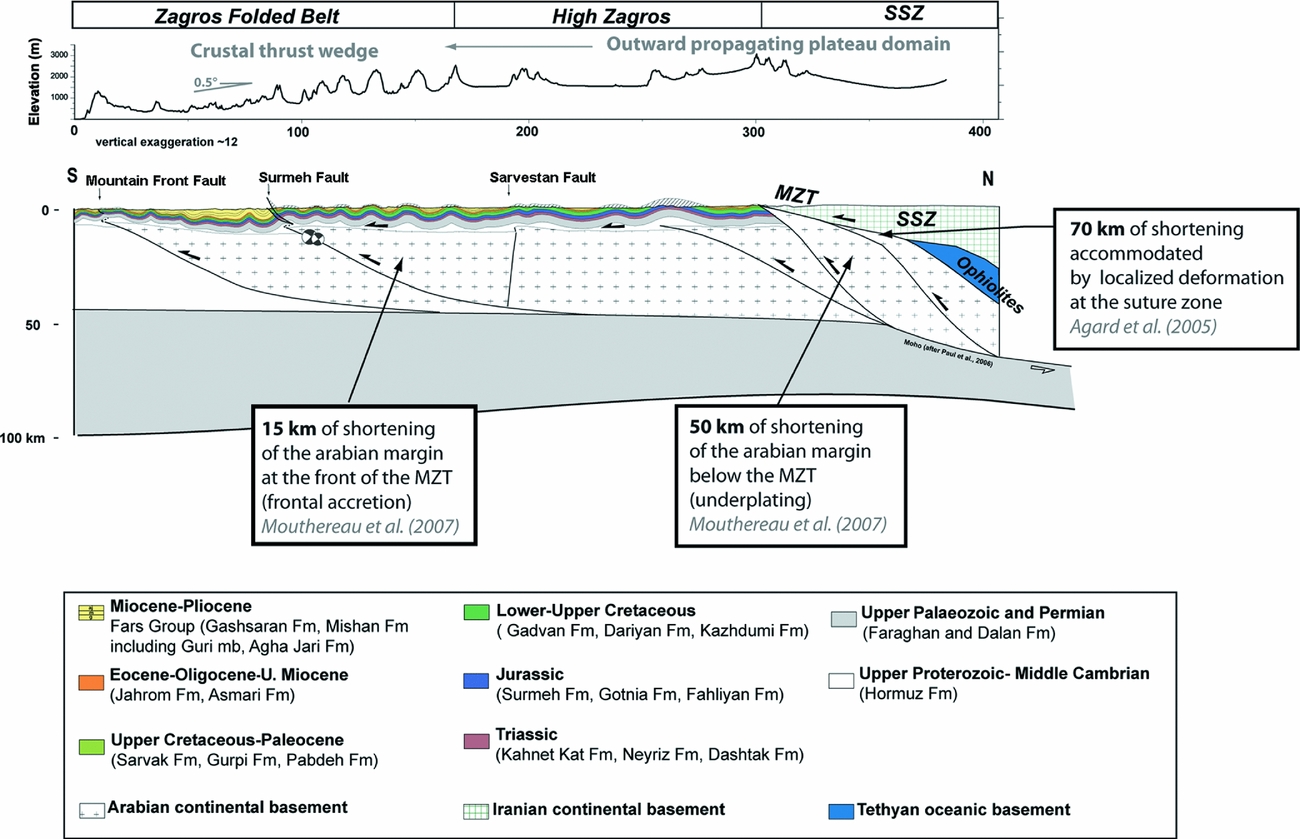
A kinematic link between the recent tectonic evolution of the Zagros Folded Belt and the Iranian plateau growth can be suggested based on several lines of evidence. The southern edge of the Iranian plateau is coincident, in the Fars region of Iran, with the northern edge of the Zagros Mountains outlined by a cumulative topographic step and structural elevation of ~ 2 km (Figs 2, 3). Such a morphology indicates that the regional Zagros topography was built by basement thrust units, the most active ones being spaced ~ 80 km apart (Mouthereau, Lacombe & Meyer, Reference Mouthereau, Lacombe and Meyer2006; Mouthereau et al. Reference Mouthereau, Tensi, Bellahsen, Lacombe, De Boisgrollier and Kargar2007). Combined with evidence of widespread seismicity over the length of the outer Zagros Folded Belt, this supports a model in which the topography is balanced by a crustal-scale critically tapering orogenic wedge.
(Colour online) Topographic map of the Fars area (SRTM 90 m digital elevation data; http://srtm.csi.cgiar.org) showing the location of the area studied for magnetostratigraphy and thermochronometry (Derak anticline) by Khadivi et al. (Reference Khadivi, Mouthereau, Larrasoaña, Vergés, Lacombe, Khademi, Beamud, Melinte-Dobrinescu and Suc2010) and S. Khadivi (unpub. Ph.D. thesis, Univ. Pierre et Marie Curie, 2010). The Neyriz Ophiolitic Complex is currently exposed as klippen above the deformed sedimentary units of the High Zagros (HZ). The metamorphic belt of the Sanandaj–Sirjan Zone (SSZ), the Urumieh–Dokhtar Magmatic Arc (UDMA), the Zagros Folded Belt (ZFB) and Main Zagros Thrust (MZT) are also labelled.

By contrast, the High Zagros region forms an elevated low-relief area that is morphologically not distinguishable from the southern edge of the Iranian plateau (Figs 2, 3). This suggests that part of the Zagros collision belt has been uplifted owing to its incorporation into the Iranian plateau. This relationship implies that the growth history of the plateau cannot be understood outside the context of the kinematic history of the Zagros Folded Belt.
In this short paper, by providing a review of the recent advances on the temporal evolution and spatial distribution of shortening and exhumation in the Zagros belt and other compressional domains surrounding the Arabia–Eurasia collision, I aim at highlighting the timing and mechanisms of Iranian plateau growth. Specifically, I focus on the distribution of shortening over the past 22 Ma, a period during which the northward motion of Arabia was stable.
2. Regional geological background
The NW–SE-trending Zagros orogeny, which is part of the much larger Alpine–Himalayan orogenic system, extends some 2000 km from the East Anatolian fault in eastern Turkey to the Makran subduction in southern Iran (Fig. 1). A GPS-derived velocity model shows present-day convergence rates between Arabia and Eurasia of 19–26 mm yr−1 (McClusky et al. Reference McClusky, Reilinger, Mahmoud, Ben Sari and Tealeb2003; Vernant et al. Reference Vernant, Nilforoushan, Hatzfeld, Abbassi, Vigny, Masson, Nankali, Martinod, Ashtiani, Bayer, Tavakoli and ckaet2004). In the next Sections, I briefly present the main geological features of the Zagros collision including the Zagros belt, the Sanandaj–Sirjan belt and the Urumieh–Dokhtar volcanic arc.
2.a. Zagros Folded Belt (ZFB)
The Zagros Folded Belt makes up the currently active accretionary wedge of the Zagros collision. It is characterized by remarkably regular, long and large-wavelength NW-trending concentric folds (Figs 2, 3). They have probably resulted from buckling and subsequent detachment folding of a 12 km thick sediment cover enabled by the detachment in the Cambrian Hormuz salt (Lacombe et al. Reference Lacombe, Amrouch, Mouthereau and Dissez2007; Mouthereau et al. Reference Mouthereau, Tensi, Bellahsen, Lacombe, De Boisgrollier and Kargar2007). Active faulting is rare but does occur in the competent cover as argued from recent seismological studies (Adams et al. Reference Adams, Brazier, Nyblade, Rodgers and Al-Amri2009; Nissen et al. Reference Nissen, Yamini-Fard, Tatar, Gholamzadeh, Bergman, Elliott, Jackson and Parsons2010; Roustaei et al. Reference Roustaei, Nissen, Abassi, Gholamzadeh, Ghorashi, Tatar, Yamini-Fard, Bergman, Jackson and Parsons2010). The pre-Cambrian basement of the Arabian margin is also actively deforming, as indicated by a number of morphotectonic observations in the Fars (Molinaro et al. Reference Molinaro, Guezou, Leturmy, Eshraghi and Frizon de Lamotte2004; Lacombe et al. Reference Lacombe, Mouthereau, Kargar and Meyer2006; Mouthereau et al. Reference Mouthereau, Tensi, Bellahsen, Lacombe, De Boisgrollier and Kargar2007) and seismicity (Talebian & Jackson, Reference Talebian and Jackson2004). Basement-involved shortening is also mechanically required to maintain the regional topography (e.g. Mouthereau, Lacombe & Meyer, Reference Mouthereau, Lacombe and Meyer2006) and it is confirmed by the most recent analysis of individual earthquakes revealing active reverse faulting at depths of 10–30 km (Roustaei et al. Reference Roustaei, Nissen, Abassi, Gholamzadeh, Ghorashi, Tatar, Yamini-Fard, Bergman, Jackson and Parsons2010).
The external Zagros can be divided in two sub-structural domains. The first one is the High Zagros (HZ) belt characterized, in the Fars region, by Mesozoic carbonates overthrust by the radiolaritic series and ultramafic bodies of the Neyriz ophiolitic complex, considered allochthonous fragments of the western Neo-Tethyan ocean (Figs 2, 3) (Stocklin, Reference Stocklin1968; Golonka, Reference Golonka2004). The second is the Zagros Folded Belt (ZFB) sensu stricto, also called the Zagros Simply Folded Belt (ZSFB), with folded Miocene to Pliocene synorogenic strata (Fig. 2).
2.b. Sanandaj–Sirjan Zone (SSZ)
The Sanandaj–Sirjan Zone, located to the north of the Main Zagros Thrust (MZT), represents the internal tectonomagmatic and metamorphic part of the Zagros belt (Figs 1–3).It is made of sedimentary and metamorphic (HP/LT and HT/LP facies) Palaeozoic to Cretaceous rocks formed in an accretionary prism located to the south of the Iranian microcontinent separated from Gondwanaland during Late Jurassic time (Berberian & Berberian, Reference Berberian, Berberian, Gupta and Delany1981; Golonka, Reference Golonka2004). Alternative interpretations consider it to be the metamorphic core of a larger Zagros accretionary complex built by the thickening of distal crustal portions of the Arabian margin (Shafaii Moghadam, Stern & Rahgoshay, Reference Shafaii Moghadam, Stern and Rahgoshay2010). During the second half of the Mesozoic (Middle Jurassic–Early Cretaceous), part of the Sanandaj–Sirjan Zone was an active Andean-like margin characterized by calc-alkaline magmatic activity in which mainly andesitic and gabbroic intrusions were emplaced (Berberian & Berberian, Reference Berberian, Berberian, Gupta and Delany1981). Magmatism resumed in Paleocene–Eocene time, as evidenced by gabbroic intrusions (Leterrier, Reference Leterrier1985; Mazhari et al. Reference Mazhari, Bea, Amini, Ghalamghash, Molina, Montero, Scarrow and Williams2009) or granitic intrusions of this age (Rachidnejad-Omran et al. Reference Rachidnejad-Omran, Emami, Sabzehei, Rastad, Bellon and Piqué2002).
2.c. Urumieh–Dokhtar Magmatic Arc (UDMA)
The Urumieh–Dokhtar Magmatic Arc (UDMA; Fig. 1) is interpreted as a subduction-related arc that has been active from Late Jurassic time to the present (Berberian & King, Reference Berberian and King1981; Berberian et al. Reference Berberian, Muir, Pankhurst and Berberian1982). The climax of magmatic activity can be dated to Middle Eocene time (Berberian & King, Reference Berberian and King1981). The volcanic rocks of the Urumieh–Dokhtar Magmatic Arc are composed of voluminous tholeiitic, calc-alkaline and K-rich alkaline magmatic rocks with associated pyroclastic and volcanoclastic successions. Magmatism resumed in Pliocene time and the Quaternary as indicated by lavas and pyroclastic rocks associated with the volcanic cones of alkaline and calc-alkaline nature (Berberian & Berberian, Reference Berberian, Berberian, Gupta and Delany1981). The Plio-Quaternary volcanism was suggested to result from the modification of geothermal gradients that was tentatively related to lithosphere delamination beneath the Iranian plateau (Hatzfeld & Molnar, Reference Hatzfeld and Molnar2010) or slab break-off (Omrani et al. Reference Omrani, Agard, Whitechurch, Benoit, Prouteau and Jolivet2008).
3. Timing of shortening, collision and uplift in the Zagros belt
3.a. Short-term, long-term shortening and the Arabia–Eurasia convergence
Comparison between a recent synthesis of GPS data (ArRajehi et al. Reference ArRajehi, McClusky, Reilinger, Daoud, Alchalbi, Ergintav, Gomez, Sholan, Bou-Rabee, Ogubazghi, Haileab, Fisseha, Asfaw, Mahmoud, Rayan, Bendik and Kogan2010) and reconstruction of past plate motions (McQuarrie et al. Reference McQuarrie, Stock, Verdel and Wernicke2003) shows that the Arabia–Eurasia convergence occurred at a rate of ~ 20 km Ma−1 (Tatar et al. Reference Tatar, Hatzfeld, Martinod, Walpersdorf, Ghafori-Ashtiany and Chéry2002; Hatzfeld et al. Reference Hatzfeld, Tatar, Priestley and Ghafori-Ashtiany2003; Nilforoushan et al. Reference Nilforoushan, Masson, Vernant, Vigny, Martinod, Abbassi, Nankali, Hatzfeld, Bayer, Tavakoli, Ashtiani, Doerflinger, Daignières, Collard and Chéry2003; Vernant et al. Reference Vernant, Nilforoushan, Hatzfeld, Abbassi, Vigny, Masson, Nankali, Martinod, Ashtiani, Bayer, Tavakoli and ckaet2004) since at least 22 Ma, following the separation of Arabia from Africa (Nubia), the onset of rifting in the Red Sea and the Aden Gulf and the increase in plate coupling in the Zagros collision (e.g. Mouthereau et al. Reference Mouthereau, Tensi, Bellahsen, Lacombe, De Boisgrollier and Kargar2007).
A total convergence of 440 km should have been accommodated by distributed collisional shortening and subduction (i.e. underthrusting of the continental lithosphere) in the surrounding collision belts since 22 Ma including the Zagros to the south, the Alborz and the Kopet-Dagh to the north, and by N–S shortening accommodated by reverse and/or strike-slip faulting in Central Iran (e.g. Allen et al. Reference Allen, Kheirkhah, Emami and Jones2011 and references therein).
For the Zagros alone, geodetic measurements argue for current shortening rates of 7–10 mm yr−1 (Tatar et al. Reference Tatar, Hatzfeld, Martinod, Walpersdorf, Ghafori-Ashtiany and Chéry2002; Nilforoushan et al. Reference Nilforoushan, Masson, Vernant, Vigny, Martinod, Abbassi, Nankali, Hatzfeld, Bayer, Tavakoli, Ashtiani, Doerflinger, Daignières, Collard and Chéry2003; Vernant et al. Reference Vernant, Nilforoushan, Hatzfeld, Abbassi, Vigny, Masson, Nankali, Martinod, Ashtiani, Bayer, Tavakoli and ckaet2004), with most of the current shortening accumulating within the lower elevation parts of the Zagros Folded Belt (Walpersdorf et al. Reference Walpersdorf, Hatzfeld, Nankali, Tavakoli, Nilforoushan, Tatar, Vernant, Chery and Masson2006) in agreement with geomorphological observations (Oveisi et al. Reference Oveisi, Lavé, Van Der Beek, Carcaillet, Benedetti and Aubourg2009), thus fitting the seismicity distribution well. By comparison, all published balanced cross-sections, irrespective of differences in structural interpretations (Blanc et al. Reference Blanc, Allen, Inger and Hassani2003; McQuarrie, Reference McQuarrie2004; Sherkati & Letouzey, Reference Sherkati and Letouzey2004; Molinaro et al. Reference Molinaro, Leturmy, Guezou, Frizon de Lamotte and Eshraghi2005; Mouthereau et al. Reference Mouthereau, Tensi, Bellahsen, Lacombe, De Boisgrollier and Kargar2007), account for as much as 50–70 km of shortening. By assuming that the initiation of shortening dates back to 22 Ma, such a shortening accounts for less than half the current shortening rates. On the other hand, a finite shortening of 70 km would be achieved in ~ 7 Ma to be consistent with the current shortening rates. Based on these geodetic data, Allen, Jackson & Walker (Reference Allen, Jackson and Walker2004) therefore inferred that the main episode of crustal thickening in the Zagros should be more recent than 7 Ma. However, because of the stability of the Arabian plate motion since 22 Ma (McQuarrie et al. Reference McQuarrie, Stock, Verdel and Wernicke2003; ArRajehi et al. Reference ArRajehi, McClusky, Reilinger, Daoud, Alchalbi, Ergintav, Gomez, Sholan, Bou-Rabee, Ogubazghi, Haileab, Fisseha, Asfaw, Mahmoud, Rayan, Bendik and Kogan2010), forces related to the assumed changes at ~ 5 Ma must have been limited because they did not alter the slab pull forces acting on the Arabian plate motion. In this context, the timing of development of the High Zagros hence appears key in constraining the Late Cenozoic distribution of shortening in the Arabian–Eurasian plate convergence and the mechanism of Iranian plateau growth. In the next Sections, I specifically explore constraints on the collision onset, the timing of deformation in the Zagros belt and the temporal evolution of exhumation in the High Zagros.
3.b. Initiation of Arabia–Eurasia collision
The Arabian and Eurasian plates started to collide along the Bitlis thrust zone in Early Miocene time (c. 20 Ma) following the consumption of the last remaining oceanic lithosphere (Okay, Zattin & Cavazza, Reference Okay, Zattin and Cavazza2010). Along the Zagros suture zone, the stratigraphic/structural relationships also argue for final closure of the Neo-Tethyan ocean by Early Miocene time c. 20 Ma (e.g. Agard et al. Reference Agard, Omrani, Jolivet and Mouthereau2005). This is in line with evidence supporting the coeval onset of foreland subsidence (Mouthereau et al. Reference Mouthereau, Tensi, Bellahsen, Lacombe, De Boisgrollier and Kargar2007) and stress build-up in the Arabian platform (Ahmadhadi, Lacombe & Daniel, Reference Ahmadhadi, Lacombe, Daniel, Lacombe, Lavé, Roure and Vergés2007). Consistently, the recent re-evaluation of the stratigraphy of the coarse-grained facies in the Zagros foreland basin shows that the onset of coarsening-upward sedimentation linked to the exhumation of the hangingwall of the Main Zagros Thrust occurred during Late Oligocene–Early Miocene time (Fakhari et al. Reference Fakhari, Axen, Horton, Hassanzadeh and Amini2008). This is also indicated by the finding of Mesozoic to Eocene detrital apatite fission-track (AFT) cooling ages in Miocene foreland sediments compatible with the Sanandaj–Sirjan Zone cooling history (S. Khadivi, unpub. Ph.D. thesis, Univ. Pierre et Marie Curie, 2010; see also Fig. 6). On the other hand, the decrease in or end of magmatism in Central Iran supports that initial collision of Arabia occurred in Late Eocene time (e.g. Vincent et al. Reference Vincent, Allen, Ismail-Zadeh, Flecker, Foland and Simmons2005; Allen & Armstrong, Reference Allen and Armstrong2008). On the Arabian margin, a Middle Eocene–Late Oligocene or Late Eocene–Early Miocene unconformity recognized in the carbonaceous sediment succession of the Zagros (James & Wynd, Reference James and Wynd1965; Berberian & King, Reference Berberian and King1981) and the erosional or non-depositional hiatus described to the NW, in the Lorestan area, in the Middle–Late Eocene interval (Homke et al. Reference Homke, Verges, Serra-Kiel, Bernaola, Sharp, Garces, Montero-Verdu, Karpuz and Goodarzi2009) indirectly support this timing. In summary, constraints on the timing of Neo-Tethyan ocean consumption, Zagros sediment provenance and arc magmatism in the Iranian microplate support initiation of the Arabia–Eurasia collision between 35 and 20 Ma.
3.c. Timing of deformation in the Zagros Folded Belt
The unambiguous dating of deformation in the fold–thrust belt requires the preservation of tectonic/stratigraphic relationships such as synfolding sediments and associated geometries like growth strata. This is only possible in regions where regional subsidence and sedimentation supplied by exhuming mountain ranges are high enough to allow wedge-top basins to develop. Such geometries are observed in some parts of the Zagros and when combined with magnetostratigraphy allow accurate determination of the age of deformation as presented in recent papers (Homke et al. Reference Homke, Vergés, Garcés, Emami and Karpuz2004; Khadivi et al. Reference Khadivi, Mouthereau, Larrasoaña, Vergés, Lacombe, Khademi, Beamud, Melinte-Dobrinescu and Suc2010).
Hereafter, I focus on the dating of the first synorogenic deposits in the northern Zagros. The studied sections are located (Fig. 4) on the northern flank of the Chahar–Makan syncline at an altitude of ~ 2500 m, 20 km to the NW of Shiraz, in the Fars province of Iran. The lowest strata, 500 m thick, are sediments deposited in a coastal sabkha environment and correspond to the Razak Formation, the base of which is dated to 19.7 Ma. Above are the 400 m thick deltaic sandstones of the Agha Jari Formation dated to 16.6 Ma in agreement with the finding of the nannoplankton association that indicates the NN4 biozone. Above, the lowest Bakhtyari 1 unit is made of alluvial conglomerates deposited close to sea-level, as revealed by the underlying marine Agha Jari sediments and by marine incursions in the Oligocene–Miocene Bakhtyari conglomerates deposited in the High Zagros (Fakhari et al. Reference Fakhari, Axen, Horton, Hassanzadeh and Amini2008; Gavillot et al. Reference Gavillot, Axen, Stockli, Horton and Fakhari2010). Growth strata found on the northern flank of the Derak anticline confirms that the Bakhtyari conglomerates were deposited during folding, therefore providing a minimum age of 14.8 Ma for the onset of folding in the northern Zagros belt (Fig. 5). However, this stage of deformation does not represent the main stage of folding as the Razak Fm, Agha Jari Fm and the Bakhtyari 1 Fm have been tilted by the subsequent growth of the Derak fold and are currently cropping out in the Chahar–Makan and Qalat synclines. This second folding is outlined by a major angular unconformity between the flat-lying or slightly N-dipping conglomeratic layers of the Bakhtyari 2 Formation and underlying Bakhtyari 1 Formation. By considering the total cropping-out thickness of Bakhtyari 1 conglomerates and extrapolating with accumulation rates derived from magnetostratigraphy, I obtained a maximum age of 12.4 Ma for the second major stage of folding. Taking into account age uncertainties on the unconformity, this age appears not significantly different from other magnetostratigraphic constraints obtained for folding initiation at the mountain front dated at 7.6 Ma in the Lorestan area (Homke et al. Reference Homke, Vergés, Garcés, Emami and Karpuz2004) or from the inner Zagros belt where folding is dated to 11 Ma (H. Emami, unpub. Ph.D. thesis, Univ. de Barcelona, 2008). In the hangingwall of the Dinar thrust (High Zagros), detrital apatite (U–Th)/He ages of 11.6–8.8 Ma on folded Bakhtyari conglomerates (Gavillot et al. Reference Gavillot, Axen, Stockli, Horton and Fakhari2010) provide indirect constraints on the age of deformation. Overall, stratigraphic constraints reveal that shortening was initially accumulated in the northern Zagros in Early Miocene time, close to the suture zone, and subsequently propagated southward during latest Miocene time.
(Colour online) Position of magnetostratigraphic sections measured in the northern flank of the Chahar–Makan syncline and age of the main formation boundaries obtained after Khadivi et al. (Reference Khadivi, Mouthereau, Larrasoaña, Vergés, Lacombe, Khademi, Beamud, Melinte-Dobrinescu and Suc2010). On the left, sections are shown on 3D satellite view of the studied area (See Fig. 3 for location). On the right, the total sedimentary section 2.5 km thick is shown with age constraints. The age of the youngest Bakhtyari 1 conglomerate is derived from the accumulation rates obtained from magnetostratigraphy (modified after Khadivi et al. Reference Khadivi, Mouthereau, Larrasoaña, Vergés, Lacombe, Khademi, Beamud, Melinte-Dobrinescu and Suc2010).

(Colour online) (a) Structural relationships between Bakhtyari 2 (Bk2) and Bakhtyari 1 (Bk1) conglomerates and (b) growth strata geometry on the northern flank of the Derak anticline. Interpretation of these geometries in terms of the sequence of folding is given on the right-hand side.

3.d. Uplift and exhumation in the Zagros Folded Belt and the High Zagros
In addition to dating deformation in the Zagros, it is equally important to track the elevation changes back in time. Based on the youngest marine sediments dated in Iran, it is beyond doubt that both the Zagros and the Iranian plateau were still below sea-level until Early Miocene time (Schuster & Wielandt, Reference Schuster and Wielandt1999; Harzhauser et al. Reference Harzhauser, Kroh, Mandic, Piller, Gohlich, Reuter and Berning2007), and one can also be confident that until ~ 15 Ma the northern Zagros Folded Belt was close to sea-level (Khadivi et al. Reference Khadivi, Mouthereau, Larrasoaña, Vergés, Lacombe, Khademi, Beamud, Melinte-Dobrinescu and Suc2010).
Helium dating on detrital apatites from the Bakhtyari conglomerates deposited in the High Zagros and an age-elevation profile of the Lajin thrust (Fig. 1b) tells us that rapid cooling took place in Early Miocene time from 19 Ma to 15 Ma (Gavillot et al. Reference Gavillot, Axen, Stockli, Horton and Fakhari2010). Furthermore, the pre-collisional zircon (U–Th)/He ages presented in the same study indicate that the maximum exhumation in the High Zagros was limited to 7–9 km, which is consistent with the average thickness of the Meso-Cenozoic sediment cover and the scarcity of Palaeozoic rocks cropping out in the High Zagros. They deduced from the hangingwall of High Zagros thrusts local exhumation rates of the order of 0.3–0.4 km Ma−1.
Low-temperature AFT thermochronology carried out on older Miocene foreland sediments of the Zagros Folded Belt (Figs 1b, 6) indicates that rapid cooling occurred between 27 Ma (depositional age of the Razak Fm is 19.7 Ma in the Chahar–Makan syncline) and 22 Ma (depositional age of the Lower Agha Jari Fm is 12.8 Ma in the Zarrinabad syncline) in the High Zagros (Homke et al. Reference Homke, Vergès, Van Der Beek, Fernandez, Saura, Barbero, Badics and Labrin2010; S. Khadivi, unpub. Ph.D. thesis, Univ. Pierre et Marie Curie, 2010). Taking into account a closure temperature of 110 °C and a geotherm of 15–24 °C km−1 (Mouthereau, Lacombe & Meyer, Reference Mouthereau, Lacombe and Meyer2006; Gavillot et al. Reference Gavillot, Axen, Stockli, Horton and Fakhari2010; Homke et al. Reference Homke, Vergès, Van Der Beek, Fernandez, Saura, Barbero, Badics and Labrin2010), one estimates that 4.5–7 km were exhumed during Early Miocene time.
(Colour online) Probability density distribution of fission-track ages obtained on detrital apatites (N is the number of grains) from the Miocene sediments of the Chahar–Makan section presented in Figure 4 (modified after S. Khadivi, unpub. Ph.D. thesis, Univ. Pierre et Marie Curie, 2010) and dated by Khadivi et al. (Reference Khadivi, Mouthereau, Larrasoaña, Vergés, Lacombe, Khademi, Beamud, Melinte-Dobrinescu and Suc2010). All grain-age populations are interpreted as cooling ages and as such indicate exhumational events. The age at 27 Ma is interpreted to be related to the rapid exhumation owing to thickening associated with the Zagros collision. Eocene and Mesozoic ages correspond to grains cooled in the Sanandaj–Sirjan Metamorphic Belt and deposited into the Miocene foreland basin, thus revealing the suturing along the Main Zagros Thrust and the onset of the Zagros collision.

The preservation of unreset Mesozoic, Eocene or Early Miocene grain-age populations limits the exhumation in the Chahar–Makan syncline to 2.5 km, which is the thickness of the synorogenic Miocene sediments (Fig. 6). Since folding started later than 12.4 Ma, one can derive a minimum exhumation rate of 0.2 km Ma−1, comparable to the sedimentary accumulation rates of ~ 0.2–0.3 km Ma−1 in the 12–3 Ma distal foreland basin succession at the mountain front (Homke et al. Reference Homke, Vergés, Garcés, Emami and Karpuz2004) and rates of 0.2–0.6 km Ma−1 in the 20–14 Ma proximal foreland sediments (Khadivi et al. Reference Khadivi, Mouthereau, Larrasoaña, Vergés, Lacombe, Khademi, Beamud, Melinte-Dobrinescu and Suc2010). Taking into consideration the fact that accumulation rates are underestimated because decompaction is not accounted for, I see no significant difference between erosion and sedimentation rates during the Miocene.
To summarize, thermochronologic data from Miocene sediments show rapid exhumation near the suture zone after 25 Ma (Figs 1b, 6). As a consequence this region was actively uplifting above sea-level owing to the thickening of the Arabian crust. Further evidence of exhumation at this time in the Sanandaj–Sirjan Zone is provided by the occurrence of detrital zircons derived from the overriding Iranian microplate and deposited in the Upper Oligocene conglomerates (Horton et al. Reference Horton, Hassanzadeh, Stockli, Axen, Gillis, Guest, Amini, Fakhari, Zamanzadeh and Grove2008). Such exhumation is also suggested by one AFT grain-age population of 27 Ma reported from a gneiss sample of the Dorud metamorphic complex of the Sanandaj–Sirjan Zone (Homke et al. Reference Homke, Vergès, Van Der Beek, Fernandez, Saura, Barbero, Badics and Labrin2010). Propagation of shortening in the Zagros Folded Belt and uplift associated with basement-involved thrusting did not occur before 12.4 Ma in the Fars region, thus placing constraints on the timing of plateau uplift.
4. Distribution of shortening and uplift in the Zagros, Iranian plateau and the Alborz
4.a. Distribution of shortening, underthrusting and underplating in the Zagros
The shortening within the Zagros belt appears highly inhomogeneously distributed between the Zagros Folded Belt to the south and the north where it is accommodated below the Sanandaj–Sirjan Zone (Figs 1a, 2). Among the total shortening accommodated in the Zagros belt, only 5% (15 km) is taken up in the Zagros Folded Belt (Mouthereau et al. Reference Mouthereau, Tensi, Bellahsen, Lacombe, De Boisgrollier and Kargar2007). Next, I verify whether this value, obtained in the Fars province, is acceptable in the light of geophysical data and observed topography. Provided that the initial crustal thickness Hc is known and the amount of shortening (a − b), where a and b are the initial and the final lengths of the studied geological section, respectively, can be derived, the resulting Airy-compensated topography h is given by

where Δρ = ρm − ρc with ρc = 2800 kg/m3 and ρm = 3330 kg/m3.
In the first case, by assuming conservation of mass and in-plane deformation, and the fact that the related topographic load wavelength (i.e. 100 km) is too small with respect to the elastic thickness of the Arabian plate (Te = 50 km; Snyder & Barazangi, Reference Snyder and Barazangi1986) to be compensated by a crustal root (Paul et al. Reference Paul, Kaviani, Hatzfeld, Vergne and Mokhtari2006, Reference Paul, Hatzfeld, Kaviani, Tatar, Pequegnat, Leturmy and Robin2010), the predicted topographic elevation of 2.25 km is simply obtained by equating initial and final crustal areas with Hc = 45 km. Even though a better result (i.e. elevation of 1.6 km) can be obtained for a lower shortening of 3% (10 km), this calculation shows that only a small amount of shortening can account for the Zagros Folded Belt topography. In contrast, any greater shortening estimates would have resulted in unrealistic topographic elevations.
Northward, beneath the Sanandaj–Sirjan Zone, the shortening of the Arabian crust is seen to increase up to 37% (50 km) and is thought to result from duplexing (Mouthereau et al. Reference Mouthereau, Tensi, Bellahsen, Lacombe, De Boisgrollier and Kargar2007). Prior to accretion of Arabian material below the Sanandaj–Sirjan Zone, during the early stages of the collision, the thinner and more distal portion of the Arabian margin was underthrusted. This is attested by receiver functions in the NW Zagros, revealing that the underthrusting of the Arabian crust below the obducted ophiolitic complex and Sanandaj–Sirjan Zone might have been as large as 250 km (Paul et al. Reference Paul, Hatzfeld, Kaviani, Tatar, Pequegnat, Leturmy and Robin2010). However, only a part of it has been accommodated after Miocene time and hence can be considered in our calculation. Moreover, in the NW Zagros, Agard et al. (Reference Agard, Omrani, Jolivet and Mouthereau2005) showed that 50–70 km of Miocene shortening was taken up in the vicinity of, or at, the suture zone mainly within the ophiolitic sheets and thrust slices of the southern Sanandaj–Sirjan belt. These 50–70 km can represent 20–30% of the total amount of shortening absorbed during the underthrusting of the Arabian margin as inferred from geophysics. As a result, they are not equivalent to the 37% (50 km) of Mouthereau et al. (Reference Mouthereau, Tensi, Bellahsen, Lacombe, De Boisgrollier and Kargar2007) accommodated by duplexing below the Main Zagros Thrust and instead must be added to them. One deduces that a total shortening of 135 km occurred near the suture zone and has likely been distributed as follows: 15 km in the Zagros Folded Belt (post-12.4 Ma), 50 km by duplexing (post-25 Ma) and up to 70 km by underthrusting (post-25 Ma) below the suture zone.
To explain this distribution I propose that the initial crustal configuration at 25 Ma, just before the initiation of thickening of the Arabian crust and its exhumation, resulted from the vertical stacking of three main units: (1) the thinned and flexed Arabian continental crust underthrusted below Central Iran by 50–70 km, (2) the overriding Neyriz ophiolitic complex made up of the oceanic lithospheric mantle emplaced in Late Cretaceous time and (3) the southern distal margin of the Eurasian continental crust corresponding to the Sanandaj–Sirjan Zone, which was essentially thickened during Jurassic and Early Cretaceous time.
To maintain a constant elevation of 2 km between the uncompensated Zagros Folded Belt and the adjacent domain of the suture zone exhibiting a crustal thickness of ~ 70 km and shortening of 37%, one should infer a denser crust (ρ c = 3000 kg/m3), likely related to the obducted mantle sheet. The predicted initial crustal thickness is of the order of 40–45 km, equivalent to the unthickened part of the Arabian margin (Gök et al. Reference Gök, Mahdi, Al-Shukri and Rodgers2008). One can infer from these calculations that a simple assumption of inhomogeneously distributed in-plane shortening can explain the observed 25 km Moho deepening beneath the suture zone and the observed topography.
4.b. Thickening of the Iranian plateau
To the north of the Sanandaj–Sirjan Zone, the mean Iranian plateau elevation is 1500 m according to Hatzfeld & Molnar (Reference Hatzfeld and Molnar2010). Assuming that shortening occurred through Airy compensation, these authors estimated using the same equation in the previous Section that the crustal root would be 10–12 km to maintain the current topography. They derive an initial crustal thickness of 35–40 km. In an alternative view, they considered that the topography is not fully compensated by a buoyant crustal root but that at least 500 m could be accounted for by mantle delamination beneath the Iranian plateau.
One available estimate of shortening in Central Iran, north of the Urumieh–Dokhtar Magmatic Arc, is 38 km (29%) and is thought to have occurred since 10 Ma (Morley et al. Reference Morley, Kongwung, Julapour, Abdolghafourian, Hajian, Waples, Warren, Otterdoom, Srisuriyon and Kazemi2009). The current crustal thickness beneath Central Iran, also called Central Domain (CD) in Paul et al. (Reference Paul, Hatzfeld, Kaviani, Tatar, Pequegnat, Leturmy and Robin2010), is ~ 42 km or 48 km close to Alborz according to Radjaee et al. (Reference Radjaee, Rham, Mokhtari, Tatar, Priestley and Hatzfeld2010). Assuming Airy compensation, the ~ 1 km elevation implies a crustal root of only 5 km, thus suggesting limited crustal shortening of only 14%, which is significantly smaller than the value obtained from the balanced cross-section. Reconciling the observed shortening with the current crustal thickness and elevation requires increasing the average density of the Iranian crust to ρ c = 3000 kg/m3. This could be justified if the average composition of the Iranian crust has been substantially modified by magmatic underplating or by Eocene magmatic intrusions well described in the region (e.g. Allen & Armstrong, Reference Allen and Armstrong2008). An average initial thickness of 32 ± 2 km is obtained. The geological meaning of the crustal thinning is probably two-fold. First, the development of Eocene deep-water basins to the north of the Urumieh–Dokhtar volcanic arc has been already noticed (Vincent et al. Reference Vincent, Allen, Ismail-Zadeh, Flecker, Foland and Simmons2005 and references therein) and might be related to the regional back-arc extension episode (Vincent et al. Reference Vincent, Allen, Ismail-Zadeh, Flecker, Foland and Simmons2005; Verdel et al. Reference Verdel, Wernicke, Ramezani, Hassanzadeh, Renne and Spell2007; Morley et al. Reference Morley, Kongwung, Julapour, Abdolghafourian, Hajian, Waples, Warren, Otterdoom, Srisuriyon and Kazemi2009). Second, a renewed episode of extension during Late Miocene time of unclear geodynamic origin (Morley et al. Reference Morley, Kongwung, Julapour, Abdolghafourian, Hajian, Waples, Warren, Otterdoom, Srisuriyon and Kazemi2009) surely contributed to the crustal thinning. Finally, given the proposed 29% of shortening over the entire length of the Iranian plateau (300–450 km), a shortening of ~ 120–180 km is obtained to build the current crustal thickness.
4.c. Timing and amount of shortening in the Alborz and the Caspian Sea
Shortening across the Alborz is estimated to range between 30 and 56 km (Allen et al. Reference Allen, Ghassemi, Shahrabi and Qorashi2003; Guest et al. Reference Guest, Axen, Lam and Hassanzadeh2006a) and probably began between ~ 17 Ma, if one considers the increase in accumulation rates (Ballato et al. Reference Ballato, Nowaczyk, Landgraf, Strecker, Friedrich and Tabatabaei2008, Reference Ballato, Uba, Landgraf, Strecker, Sudo, Stockli, Friedrich and Tabatabaei2011), and 12 Ma ago (Guest et al. Reference Guest, Stockli, Grove, Axen, Lam and Hassanzadeh2006b) in the Western Alborz or 6–4 Ma in the Central Alborz (Axen et al. Reference Axen, Lam, Grove, Stockli and Hassanzadeh2001) if rapid exhumation is taken into account (Fig. 1b). Shortening associated with the subduction of the Caspian Sea to the north beneath the Apsheron Sill is constrained by the depths of earthquakes of at least 80 km (Jackson et al. Reference Jackson, Priestley, Allen and Berberian2002). Considering uncertainties in the timing of subduction initiation, I consider a value of ~ 75 km to be accommodated within this region, thus satisfying both the data and the total convergence of 440 km (Fig. 1a, b).
5. Discussion and conclusions
The absence of change in Arabian plate motion since 22 Ma (ArRajehi et al. Reference ArRajehi, McClusky, Reilinger, Daoud, Alchalbi, Ergintav, Gomez, Sholan, Bou-Rabee, Ogubazghi, Haileab, Fisseha, Asfaw, Mahmoud, Rayan, Bendik and Kogan2010) just after the decrease from 3 to 2 cm yr−1 caused by the initiation of crustal thickening in the Zagros implies 440 km of Arabia–Eurasia convergence. This was accommodated since Miocene time across the Zagros belt, Central Iran, the Alborz and the Caspian Sea but not necessarily at the same rate. By taking into consideration the published amounts of long-term shortening and their timing, I suggest that it is possible to reproduce the total convergence predicted by geodetic and plate reconstruction (Fig. 7). If one refers to Figure 2, which is based on the balanced cross-section by Mouthereau et al. (Reference Mouthereau, Tensi, Bellahsen, Lacombe, De Boisgrollier and Kargar2007) of the Fars arc region and on the study by Agard et al. (Reference Agard, Omrani, Jolivet and Mouthereau2005) to the north of the Lorestan arc region, about 135 km of convergence has been accommodated by frontal accretion in the Zagros Folded Belt (15 km), by duplexing (underplating) of Arabian crust below the Sanandaj–Sirjan Zone (~ 50 km) and by underthrusting (~ 70 km) localized across the Main Zagros Thrust. A maximum shortening of 180 km is obtained if in-plane shortening of 29% is assumed to have occurred throughout Central Iran; 50 km were accommodated across the Alborz and 75 km were taken up by subduction of the Caspian Sea.
(a) Present-day topography and location of main tectonic belts in the Arabia–Eurasia collision for reference. (b) Distribution of shortening within orogenic belts and the Iranian plateau illustrating how the Arabian–Eurasian plate convergence was accommodated during the last 22 Ma. Note the progressive migration of shortening towards the north and in areas originally at low elevation. Abbreviations: SSZ – Sanandaj–Sirjan Zone; UDMA – Urumieh–Dokhtar Magmatic Arc; ABS – Apsheron–Balkan Sill; MZT – Main Zagros Thrust.

Thermochronologic data and age constraints on the initiation of the siliciclastic sedimentation in the foreland basins reveal that deformation initially concentrated in the Zagros c. 20 Ma (Homke et al. Reference Homke, Verges, Serra-Kiel, Bernaola, Sharp, Garces, Montero-Verdu, Karpuz and Goodarzi2009; Gavillot et al. Reference Gavillot, Axen, Stockli, Horton and Fakhari2010; Khadivi et al. Reference Khadivi, Mouthereau, Larrasoaña, Vergés, Lacombe, Khademi, Beamud, Melinte-Dobrinescu and Suc2010; S. Khadivi, unpub. Ph.D. thesis, Univ. Pierre et Marie Curie, 2010) and in the Alborz approximately at the same time 20–17.5 Ma ago (Ballato et al. Reference Ballato, Nowaczyk, Landgraf, Strecker, Friedrich and Tabatabaei2008, Reference Ballato, Uba, Landgraf, Strecker, Sudo, Stockli, Friedrich and Tabatabaei2011) (Figs 1b, 7).
This stage was followed by propagation of shortening in the Zagros Folded Belt (Khadivi et al. Reference Khadivi, Mouthereau, Larrasoaña, Vergés, Lacombe, Khademi, Beamud, Melinte-Dobrinescu and Suc2010) and uplift in the Zagros after ~ 12.4 Ma (Figs 1, 7). This timing is concordant with the acceleration of deformation in the Alborz (Guest et al. Reference Guest, Stockli, Grove, Axen, Lam and Hassanzadeh2006b), in the Kopet-Dagh and is coeval with the initiation of subduction of the south Caspian Sea (Hollingsworth et al. Reference Hollingsworth, Fattahi, Walker, Talebian, Bahroudi, Bolourchi, Jackson and Copley2010) and deformation in Central Iran (Morley et al. Reference Morley, Kongwung, Julapour, Abdolghafourian, Hajian, Waples, Warren, Otterdoom, Srisuriyon and Kazemi2009). Rapid exhumation in the Central Alborz at ~ 5 Ma (Axen et al. Reference Axen, Lam, Grove, Stockli and Hassanzadeh2001) and coeval onset of increasing accumulation rates in the south Caspian Sea at 5.5 Ma (Allen et al. Reference Allen, Jones, Ismail-Zadeh, Simmons and Anderson2002), though possibly suggesting a younger subduction, also support the regional changes at 15–5 Ma (Figs 1b, 7).
I propose that during the past 22 Ma stable motion of Arabia, a shift of localized deformation occurred in Late Miocene–Pliocene times toward the Zagros or the Alborz that were uplifting (Fig. 7). A concomitant decrease of shortening rates in the Iranian plateau occurred to compensate for constant boundary velocity. The insignificant change in Arabian plate motion makes the distribution of crustal shortening and underthrusting during the Arabia/Eurasia convergence the main driver of Zagros mountain and Iranian plateau uplift over the past 20 Ma. Slab detachment, which is suspected to be responsible for Miocene–Pliocene magmatic pulses, should therefore be considered with caution if we are to evaluate its contribution to the uplift of the whole Zagros region. I have herein proposed that the current topography of Central Iran can be explained by differences in the initial (i.e. before 20 Ma) thickness of the continental crust. This thinning of Central Iran is thought to be at least partly caused by a back-arc extensional regime related to the Neo-Tethyan slab rollback during Eocene time (Vincent et al. Reference Vincent, Allen, Ismail-Zadeh, Flecker, Foland and Simmons2005; Moritz, Ghazban & Singer, Reference Moritz, Ghazban and Singer2006; Verdel et al. Reference Verdel, Wernicke, Ramezani, Hassanzadeh, Renne and Spell2007; Morley et al. Reference Morley, Kongwung, Julapour, Abdolghafourian, Hajian, Waples, Warren, Otterdoom, Srisuriyon and Kazemi2009; Ballato et al. Reference Ballato, Uba, Landgraf, Strecker, Sudo, Stockli, Friedrich and Tabatabaei2011). The Iranian lithosphere was consequently relatively weak and hence shortened at low deviatoric stresses causing the inversion of extensional basins during Early Miocene time until its crust attained its present-day thickness. Because the crust of Central Iran became progressively thicker, the forces necessary to balance the increase of potential energy associated with plateau growth led to the reactivation of surrounding orogenic domains i.e. the Alborz and the Zagros after 12 Ma.
Acknowledgements
Most of the work presented in this paper has benefited from the thesis work of S. Khadivi. I am greatly indebted to G. Simpson and M. Allen for their insightful reviews and the guest editor O. Lacombe for his additional comments that greatly improved the manuscript.



