

1. INTRODUCTION
With an earnest look, SitiFootnote 1 followed the handshake between her father and her groom. She had not seen her father for ages, but here he was, as her guardian, stating that he agreed to marry off his daughter for a dower (mahr) of 2 grams of gold, her wedding ring. Wawan, her groom, replied—without stammering, she noticed—that he accepted this offer and the core of their religious marriage (ijab kabul) was over. The assistant marriage registrar (amil) led in prayer and then it was her turn, after her husband, to sign the papers. Her guardian and the two witnesses signed too and both Wawan and she received their marriage certificates. The ring! Yes, she smiled, 17, married …!Footnote 2
Marrying at a tender age has long been common in many parts of the world. With increasing life expectancy, prolonged adolescence became an option and marriage age changed. Today, marrying before 18 is defined by international organizations as “child marriage,” which should preferably end within a generation.Footnote 3 Child marriage is considered a global problem that cuts across countries, cultures, religions, and ethnicities.Footnote 4 In the developing world, one in three girls is now a child bride and the actual numbers are rising with population growth.Footnote 5 It is considered both a developmental problem and a question of human rights.
This article addresses the dilemmas and compromises in legal practices around the issue of child marriage in Indonesia, where the minimum age for marriage under state law is 16 for girls and 19 for boys.Footnote 6 This means that, in Indonesia, there is a category of married girls aged 16 or 17—like Siti—that, according to international conventions, is “child marriage” but, in Indonesian law, is still considered as a standard marriage.Footnote 7 The Indonesian government is actively involved in international conventions and has set development goals that include the aim to end child marriage and to comply with human rights standards, but at the same time it faces social resistance and a complex reality.
The methods we use are analysis of legal texts and their historical conception, analysis of the structure of legal institutions, interviews, and case analysis at religious courts, and ethnographic research in a village in West Java. Our main findings are: (1) law-making in family law is a negotiation process between progressive and conservative ideas, leading to compromises; (2) consequently there is friction within current family law and laws related to human rights; (3) judges use their discretion to achieve compromises between state laws and local norms; and (4) legal implementation is creatively applied at village level by key actors.
This article contributes to socio-legal studies on Indonesian family law. While there is significant knowledge on the issues of divorce,Footnote 8 polygamy and mixed-marriage cases,Footnote 9 and disputes over inheritance,Footnote 10 child marriage remains an underexplored area of study. There is a growing body of academic work on child marriage elsewhere, such as in Honduras, Uganda, Nigeria, and Iran.Footnote 11 But there is still a void in the literature on child marriage in Indonesia. Reports of international and local organizationsFootnote 12 on child marriage in Indonesia commonly present such marriage as a harmful practice, but we maintain some distance from this global development/human rights framework, allowing us to reveal the tensions arising from the religious concerns of conservative Muslims regarding adolescent sexuality in a rapidly modernizing society.
Following this introduction, Section 2 analyses state policies and law-making concerning child marriage. This analysis shows that, while trying to achieve its development goals, the Indonesian government faces dilemmas because of the need to accommodate religious concerns around child marriage. In Section 3, we explain the legal practices of child marriage: first the role of institutions in the registration of marriage, then marriage-registration practices at the state courts’ level. We then present the diversity of child-marriage practices at village level in Section 4. Section 5 addresses illegal underage marriage, including procedures and reasons, and the role of intermediary figures that facilitate such practices. In the concluding remarks, we explain how child marriage is sustained by conflicting values and resistance at all these levels, notwithstanding the legal efforts to curb it.
2. STATE POLICIES AND LAW-MAKING CONCERNING CHILD MARRIAGE: DILEMMAS, COMPROMISE, AND CONTRADICTIONS
Indonesia ranks seventh in the global top ten with the highest absolute numbers of child marriage.Footnote 13 UNICEF Indonesia reports that, in 2012, roughly 1,349,000 girls married before the age of 18. Some 300,000 of them married before turning 16. Surprisingly, after decades of steady decrease, the average child-marriage rate plateaued at around 25% between 2010 and 2013.Footnote 14
In global discourse, child marriage is considered a harmful tradition that violates human rights.Footnote 15 The main negative consequences for girls are reduced education opportunities, reproductive health hazards (difficult deliveries and a higher risk of HIV/AIDS; premature babies with disabilities), and increased risk of mother and child mortality. Child marriage is also a source of psychological trauma as well as domestic and sexual violence. In its worst form, it leads to exploitation of child brides as domestic servants or as victims of sex trafficking, either within their marriage or after, when they are left divorced or abandoned.Footnote 16 Child brides in Indonesia struggle with these phenomena too.Footnote 17
Besides the problems for individuals, there are also negative consequences of child marriage for society. Maternal mortality, low levels of education, and high divorce rates have a negative impact on people’s livelihood. Child marriage gives rise to intergenerational poverty.Footnote 18 Indonesia has a large young population but, to realize their economic potential, the younger generations must have access to quality education, adequate nutrition, and health care (including sexual and reproductive health). This is where child marriage comes in as a disturbing factor. Child marriage in Indonesia caused a loss of at least 1.7% of GDP in 2014.Footnote 19 This explains the urgency of ending child marriage from an economic developmental perspective.
The Indonesian government acknowledges the damaging impact of child marriage and it supports the new Sustainable Development Goals for the period 2015–30. Ending child marriage is one of the targets. SDG 5.3 reads: “Eliminate all harmful practices, such as child, early, and forced marriage and female genital mutilation.”Footnote 20 The Indonesian government is also actively involved in international conventions, having ratified the Convention on the Elimination of All Forms of Discrimination against Women (CEDAW) in 1984 and the Convention on the Rights of the Child (CRC) in 1990.
President Joko Widodo’s government recently got praise for its national strategy to eliminate violence against children, including innovative endeavours to alleviate poverty through social protection schemes.Footnote 21 The Smart Indonesia Card subsidizes primary and secondary students from lower socioeconomic backgrounds, supporting the policy target of 12-year compulsory education instead of the present nine years. A new national health insurance scheme has been introduced to improve health care for all. These are important steps that also help prevent child marriage. Behind the scenes, a programme to eliminate child marriage is already included in the Government Work Plan 2017–18.Footnote 22 The president also requested the Ministry of Empowerment for Women and Protection of Children to prepare a proposal for a Perppu (Government Regulation In lieu of Law) on the elimination of child marriage, which was drafted in 2016 in co-operation with civil society organizations.Footnote 23 So, in principle, the government supports measures to prevent child marriage in line with the SDGs. One of the instruments to achieve this goal is law.
In the quest for legal unification in Indonesia, there have been constant struggles to accommodate diverse ideologies and norms, often resulting in dilemmas, compromises, and contradictions. The Marriage Law 1974Footnote 24 is a good illustration of such a compromise. In this section, we first discuss the controversy arising out of the enactment of the Marriage Law and then introduce some state laws on the definition of children and the minimum age for marriage.
When, in 1973, the government submitted the draft Bill of the Marriage Law to the Parliament, one of its intentions was to enhance women’s rights in marriage.Footnote 25 However, some Muslim organizations and the Islamist party PPP (Partai Persatuan Pembangunan) strongly opposed the Bill, arguing that it was too “modern.” They staged walk-outs from parliamentary sessions, which led the government to conclude that the potential cost of pushing through its proposal would be too high.Footnote 26 The government understood that the law needed to accommodate the diversity in marriage practices and the normative notions underlying them.Footnote 27 As a result, the government changed several articles in the draft, including the article on marriageable age. The initial draft proposed the minimum marriageable age to be 18 for women and 21 for men.Footnote 28 However, after facing strong opposition from conservative Muslims, the government lowered the age to 16 for girls and 19 for boys.
A recent judicial review of the 1974 Marriage Law at the Constitutional Court, instigated by women’s and youth organizations, in order to raise the minimum age for marriage, was rejected. During the hearings, all major religious organizations’ opinions were presented. The judges seemed to ignore the views of moderate Islam and non-Muslim experts on the negative consequences of child marriage for girls and referred only to the Muslim standard of akil baligh (mental and physical maturity) as a measure of marriageability.Footnote 29 The only dissenting opinion amongst nine judges, which was referring to human rights and development, came from the sole female judge (and non-Muslim), Maria Farida Indrati.Footnote 30 Diverging opinions are also present within Islamic organizations. A particular example is the recent congress of female Islamic clerics: their edicts support raising the marriageable age to 18, calling child marriage “harmful” and prevention of it mandatory.Footnote 31
Although Article 7(1) of the Marriage Law limits marriage to 16 for girls and 19 for boys, technically anyone can marry below that age if the court gives its consent, as Article 7(2) allows the parents of underage parties to petition for a dispensation to the court. The Law on Human Rights of 1999Footnote 32 defines children as all unmarried persons under the age of 18, which makes all married children, regardless of their age, fall outside its scope of protection. Consequently, they lose their rights ensured by the Law on Human Rights, such as rights to education, information, to rest, and to mix with children of their own age. This problematic definition also clashes with the Child Protection Law of 2002,Footnote 33 which defines a child differently, namely as a person of less than 18 years of age, including unborn children.
3. LEGAL PRACTICES OF CHILD MARRIAGE: MARRIAGE REGISTRATION AND MARRIAGE DISPENSATION
In registering marriages in Indonesia, several institutions play their roles: the civil court holds jurisdiction over marriage and divorce of non-Muslims, while the religious court has jurisdiction over Muslim marriage and divorce.Footnote 34 To register marriages and divorces, couples also go to different offices at their subdistrict: non-Muslims to the Civil Registration Office (KCS, Kantor Catatan Sipil) and Muslims to the Office of Religious Affairs (KUA, Kantor Urusan Agama).
Both religious and civil courts can authorize underage marriages by granting marriage dispensation. When granted dispensation, the letter from the court allows petitioners to register their marriages even when the marrying spouse is under the official minimum age for marriage (16 for girls, 19 for boys).Footnote 35 As our research area is a Muslim-majority area, we focus on religious courts and KUA.
Article 2 of the Regulation on Marriage Registration issued by the Ministry of Religious AffairsFootnote 36 clarifies the role of marriage registrars (PPN, Pegawai Pencacat Nikah) as the employees of KUA, the Office of Religious Affairs, who examine the requirements as well as monitor and record Muslim marriage and divorce. In Article 15, the regulation indicates that, in case the requirements to marry are not fulfilled, PPN are forbidden to register such marriages.Footnote 37 The Civil Registration Law No. 23 of 2006 further sets various penalties for fraud or failure to register a marriage.Footnote 38 Nurlaelawati describes the KUA as placed at the intermediary level between “ulama” (traditional religious clerics) and the religious courts, and finds KUA officials considering themselves more as guardians of the shari’a and of the interpretations of the ulama than as state officials.Footnote 39 She further emphasizes KUA’s insight into marital problems because KUA officials themselves are firmly rooted in local society.Footnote 40
Besides KUA staff at the Office of Religious Affairs, local leaders such as the village head (kepala desa) and amil play an important role in preparing marriage registration. The amil is an assistant marriage registrar at village level (P3N, Pembantu Pegawai Pencacat Nikah), who supports the PPN at subdistrict level. In practice, they register marriages at KUA in co-operation with PPN, so that people in the village almost never need to go to KUA and leave all the dealings to their amil. The detailed practice will be explained later in this article.
As explained earlier, Article 7(2) of the Marriage Law 1974 allows marriage dispensation to be issued by courts. As the article does not set any condition or requirement for judges to grant dispensation, it gives significant discretion to judges. Both Horii’s research on religious courts in West Java (including our research area) and a report from Plan International found that more than 90% of the marriage-dispensation cases brought to courts are approved.Footnote 41 Horii’s analysis on court decisions indicates that fear for zinah (the sin of pre-marital sexual relations) is the most influential factor for judges to grant dispensations, and that they do so to protect girls from social stigma if they may have already engaged in sexual intercourse.Footnote 42 Thus, judges seek to protect girls through granting marriage to allow them to escape the emotional stress resulting from social pressure, as well as to protect their unborn children who might otherwise be labelled as illegitimate.Footnote 43 Her analysis of the court decisions also mentioned that judges cite Islamic laws based on Quran and Sunnah Footnote 44 as often as state laws, while they never applied any aspect of the Indonesian Child Protection Law, or referred to international human rights.
So, judges at religious courts facilitate legal underage marriages. However, dispensations are roughly estimated to account for only 8% of child-marriage cases.Footnote 45 What happens with the other cases?
4. HETEROGENEITY OF CHILD MARRIAGE AT VILLAGE LEVEL
To understand why the court is not more often involved in cases of underage marriage, we use the findings of an ethnographic study at village level, in the northern part of the Sukabumi district in West Java. The roughly 8,000 inhabitants are originally migrants from other regions of West Java, attracted over a century by the large tea plantation that dominated the local economy until about 20 years ago. Most households have a modest income: around 40% of the population is considered poor according to local standards. Sundanese culture and Islam are the shared elements in this village, but there is a range of Islamic orientations, from traditionalist syncretism, Islamic modernism, to a Persis group from Bandung and a puritan Salafist community.Footnote 46
This heterogeneity is reflected in the different types of child marriage that we found during our fieldwork. The two main types are love matches of young people choosing their own partners and marriages inspired by orthodox beliefs that encourage early matrimony.Footnote 47 The driving force behind most child marriage is the fear of zinah. Marriage is the only accepted solution in cases of teenage pregnancy, as abortion is forbidden by law and access to contraception is very limited for unmarried couples. But marriage is also used as a defence to pernicious slander when a dating couple is considered getting too intimate. Aulia was pushed to marry at 15. “It took my mother a month to persuade me to get married,” Aulia says. “She kept saying: ‘Don’t embarrass me’.” They had just started dating and had certainly no marriage in mind. But “There was all this shaming,” her husband recalls. “I hadn’t actually kissed her and everybody gossiped about her being pregnant.”Footnote 48
In general, girls today have more agencyFootnote 49 in the choice of a partner than their mothers. This is helped by increased mobility: education outside the village and mobile phones.Footnote 50 However, refusing a marriage proposal is considered to bring bad luck to the girl. So girls must keep their dates out of sight of their parents if they are not ready to marry them. Parents, on the other hand, still have a big say in the timing of the marriage. When gossip about zinah gets unbearable, instant marriage is arranged to secure the honour of the girl and her family.Footnote 51 Aulia is a good example. But sometimes adolescents use the zinah argument themselves to push unwilling parents into arranging a marriage for them.
The minimum age for marriage here is not counted in years. People refer to the Muslim concept of akil baligh (mental and physical maturity) as a sign of marriageability. For boys, “kuat gawe” (able to work) is a local benchmark.Footnote 52 For girls, the onset of puberty means they are ready for marriage, since they are in the first place destined to become mothers and (house) wives. Teenage marriage is widely accepted, although there is a simultaneous trend towards later marriages.
Child marriage is not necessarily considered bad. On the one hand, there are outcomes that are appreciated by adolescents, such as the preservation of their honour, the right to sexual relationships, and their increased status as adults, which give them a say in community life. On the other hand, there is regret. Girls are deprived of further education; they miss their old friends and live in social isolation, with heavy domestic work and responsibility for their husband and children. It is said that 50% of child marriages end in divorce after one or two yearsFootnote 53 because of incompatibility and the struggle to run a household together. In Siti’s case, love evaporated faster than it took to flourish. They divorced after Wawan lost his job. Girls who have children will remain responsible for them and, if they left their parental home upon marriage, often return to live with their parents.Footnote 54
To establish the local prevalence of child marriage, we conducted a survey amongst all families with sons and daughters aged 20–24 years old. Table 1 shows that teenagers already marry at age 14 or 15. From the age of 17, the frequency of marriage jumps for women in this age-group, followed by the men at age 19.Footnote 55
Distribution of age at first marriage for men and women aged 20–24 years of age
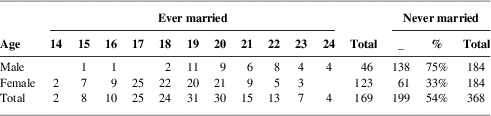
Source: 2014 survey in village.
We found that, amongst ever-married women in our survey, 35% experienced a child marriage (<18). For men, it was 4.3%. Nine girls (7.3%) reported underage marriage (<16), as did four boys (8.7% <19). These figures are higher than the average in this district. But, when analyzing qualitative case-studies of early marriages, we discovered that there was even more hidden underage marriage. There actually appeared to be a whole repertoire of illegal practices.
5. ILLEGAL PRACTICES OF UNDERAGE MARRIAGE: FACILITATORS, PROCEDURES, AND REASONS
When people in the village need a solution for unwanted situations, they do not go to court for marriage dispensation, but turn to local solutions. A court case is assumed to be costlyFootnote 56 and scary (some associating the court with criminal cases).Footnote 57 The community prefers the safest, fastest, affordable way, which is outside the state legal scheme.
Marriage starts with a religious ceremony, ijab kabul being the core for Muslims.Footnote 58 This is a sufficient step for solving problems of dishonour caused by unwanted pregnancy or too-intimate dating. But, without registration, such a marriage is not legal per state law; also, it means no access for the new household to welfare support from the state.Footnote 59 And any children born from the couple will only be registered in the name of the mother (bringing the shame of being considered an illegitimate child and loss of inheritance rights).Footnote 60
The trick thus is how and when to register underage religious marriage to make it legal. Depending on the reasons behind a child marriage, there are three local proceduresFootnote 61 :
1. Raising the age of the bride or groom by changing the birth date in the required documents, thereby enabling them to receive their official marriage certificates right after the religious ceremony. This is facilitated by the village head (or lower staff) and the amil. It is a fast solution for girls who are already pregnant and want to protect their honour and that of their unborn child. But it is also used to let the bride “jump” to 17, the minimum age for an identity and family card,Footnote 62 which opens doors to factory work and welfare support. When Nenen was going to get married at 15, her father just went to the amil with IDR 50,000 (€ 3.50), as her mom said, “from her heart.” The amil accepted this and came to their house to marry them. In her marriage certificate, Nenen found herself 17 years old.Footnote 63
2. Isbath nikah, or having a marriage recognized retroactively by the court, is quite a common and pragmatic procedure.Footnote 64 But, in the case of an underage child, parents cannot arrange isbath nikah at court, because it is at the same court that they should have applied for dispensation first. So they resort to a local version of isbath nikah. This often happens when adolescents are pressured to get married early for moral reasons. They will not register their marriage for a while, so that they may split up again easily if the relationship does not work out well. If a pregnancy follows, the marriage can still be registered via the local isbath nikah route. Bedner and van Huis observe that this “allows adolescents in rural areas more sexual liberty than they would otherwise be likely to enjoy.”Footnote 65
The amil deals with two variants of backdating, depending on his attendance at the religious ceremony. If he attends, he will not issue a marriage certificate, but he just notes the marriage in his register, without assigning an official number yet. Only when the couple has reached the proper age will they go to KUA, pretending it is a new wedding. Their marriage will be registered with an official number in the archives of the KUA and they will receive their backdated marriage certificate. This is a cheaper procedure, because it involves only the amil, so there are fewer people who need a “gift” for their services.
The second option for backdating a wedding date is more complicated. The religious ceremony would have only been attended by a religious leader, so it takes the amil extra effort to get such a marriage registered via a backdoor route. Some young girls from an orthodox background marry, divorce, and re-marry quite quickly and only apply to register their second or third marriage, when the relationship seems more stable and the couple seriously plans a family.
3. Arranging a so-called “secret” religious marriage (nikah siri) that will remain unregistered. Nikah siri is not very common. It is only facilitated by some conservative religious leaders in a private setting, with no involvement of the amil or any other authority. The cases we encountered were of girls that were handpicked at ages below 15 by religious leaders from outside the village who took them as second or third wives. This way, their husbands avoid asking a permission letter from the first wife, a legal obligation for polygamy. The girls and their children have no inheritance rights, nor do the girls have the right of female-petitioned divorce.
The do-it-yourself approach to underage marriage at the village level is a solution for (parents of) couples that experience pre-marital pregnancy or are accused of too-intimate dating. In general, brides-to-be are not told what marriage entails and they are usually also ignorant about the illegal preparations behind underage marriage. If marital problems arise, parents or other relatives arrange divorceFootnote 66 by settling the issue between the two families or with help of village bureaucrats. But the system offers little protection in cases of forced or violent unregistered child marriages. If the wife does not dare to complain about the violence or assumes that violence is a husband’s right, it is difficult for her to escape.
The amil and the village head (or lower village bureaucrats) are central actorsFootnote 67 : they not only arrange underage child marriage, but are often also involved in mediating the divorces that regularly happen after child marriage, handing out divorce papers, arranging “customized” birth certificates, and smoothing cases of adultery. The amil can help people marry, even when they come to him to ask for a wedding on the next day (instead of waiting for the legally prescribed ten days). The creative solutions for circumventing procedural rules on underage marriage lead to a chain of other violations of rules. In a recent case of rape, the young victim was forced by her father to marry her violator to prevent loss of honour. She missed her final (elementary!) school exam and had to move in with her husband. When her mother, who worked as a domestic helper in Jakarta, heard about this, she implored the school teachers and the amil to find another solution. In the end, the marriage was annulled, the girl was declared “never-married” and allowed to sit for her final exams,Footnote 68 so that her mother could take her to school in Jakarta.
The local community, in particular fathers as legal guardians of their girls together with the village bureaucracy, The amil and KUA create their own support system to solve legal issues, which resonate with local cultural and religious norms and values. At the KUA, marriages need to be registered, but most weddings are still held at home, officiated by the penghulu. When the penghulus are too busy to officiate all weddings in the various villages of their district, the amils are asked to stand in at weddings in their own village. Amils as assistant marriage registrars and penghulus (marriage registrars) work closely together on the registration of marriages: they have monthly meetings, where penghulus sign the official letters to register marriages that the amils prepared already in their village, in co-operation with the village staff. In other words, the penghulu, as an official of KUA, simply registers cases prepared by the amil and relies on his role as assistant to deal with all the work in his village. This division of roles between amil and penghulu allows villagers just to deal with their own amil without ever having to go to the KUA. So, at the KUA, all documents are considered “clean” and the employees do not need to fear sanctions.
As an intermediary between the state institution and the people, the amil is in a difficult position. He understands why people need underage marriage as a solution for shameful situations, and considers the rules of the society. He faces a dilemma—state law cannot always meet people’s needs, so he must be flexible. There is great pressure from the community on the amil to perform according to their expectations. The amil told us, grinningly: “The village head is aware of this. If the community is not being served maybe this house and the village office would be attacked.”Footnote 69 On top of that, the amil is the only unpaid officialFootnote 70 : he is not on the payroll of the KUA, nor of the village administration, but depends on the proceeds of his own land, the gifts of people who come for his help,Footnote 71 and his share of the payments for marriages that he officiated.
Penghulus are in a similar dilemma—they might be aware of the negative impact of underage marriage on girls, but they feel they cannot do much because traditional norms are still very strong and they will meet serious opposition from the community. According to one of the penghulus, law in the village is a combination of religious, cultural, and state values that regulate the community.Footnote 72 Religious law in villages is interpreted and explained by local religious leaders who each teach their version of Islamic theology and laws, including the legal validity of Islam. Penghulus, as state representatives, are themselves religious authorities and are more influenced by local norms than by their superiors, because they are part of the community and share the same values.
6. CONCLUSION
Our findings indicate that child marriage is sustained based on conservative Muslim interpretations of how to deal with adolescent sexuality, which is to control immorality through marriage. Although the Indonesian government officially agrees with international goals and policies aiming at elimination of child marriage, and despite the efforts of human rights bodies and civil society organizations, national discourse on this issue is dominated by a conservative Islamic perspective. Moderate religious voices, including female clerics and women and children’s rights practitioners, are currently not powerful enough to shift the dominant discourse. The recent judicial review (mentioned in Section 2) is a good example of the strong political power of conservative Islamic discourse in Indonesia.
The tension between how the Indonesian government presents itself and this dominant discourse is visible in both the law-making process and existing laws. The initial drafters of the Marriage Law 1974 had to compromise because of resistance from an Islamist party. Within existing state laws, such as the Marriage Law 1974, the Law on Human Rights of 1999, and the Child Protection Law of 2002, contradictions come to the fore. Judges, within their discretion given by a set of state laws, at times reach judicial decisions to permit underage marriages. They do so by referring to both state laws and Islamic laws.
At the local level, village bureaucrats create their semi-autonomous social field, which sustains customs, rules, and symbols internally but is also vulnerable to rules and decisions from outside the field.Footnote 73 They use their unofficial support system to solve legal issues in accordance with local cultural and religious norms and values. Such a system is created to meet the needs of their local community. Villagers almost always resort to this unofficial system without any involvement of state institutions.
Child marriage is a common phenomenon throughout Indonesia. Practices such as covering the shame of extra-marital sexual relations, manipulating age and wedding dates, marriage dispensation, as well as handling teenage pregnancy by arranging child marriage are found elsewhere in Indonesia, including in non-Muslim areas. The main differences with West Java are related to customs around kinship (bilineal in Java versus patri- or matrilineal in other areas) and the impact of dower or bride prices (which are relatively modest in our research area).Footnote 74
We consider the dilemmas and compromises seen at each level of society as the results of continuous struggles with the diversity of values on marriage, family, and adolescent sexuality. The question is whether law is effective in supporting the government’s developmental policy that aims to end child marriage. On the one hand, formal law can create an “enabling environment”Footnote 75 and strengthen those who seek the elimination of child marriage. But, for those who are against a fixed marriage age (whether it is 16 or 18), it will only stimulate underground practices of child marriage. The solution proposed by the Girls Not Brides civil society platform is “not to condemn all traditions, but to work with communities to change traditions from within.”Footnote 76 Not an easy solution, but unavoidable, as we have seen.
To protect women’s and children’s rights, the government could focus more on supporting laws and policies on gender equality, on education, and on sexual and reproductive health rights. But, in the end, it is unavoidable for the government, to achieve its human rights and development goals, to also deal with cultural and religious concerns on adolescent sexuality.



