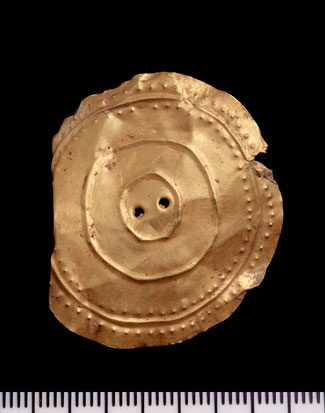


The gold disc was discovered on 16 October 2002, during an archaeological excavation of a Roman and early medieval lead bole smelting site at Banc Tynddol, Cwmystwyth, directed by Simon Timberlake (Early Mines Research Group). This small, circular, repoussé decorated and perforated gold-foil disc was found at a depth of only 15cm below the remains of a medieval hearth. Following its examination at the National Museum and Gallery of Wales, Cardiff this was identified on typological grounds as being an example of a Copper Age to Early Bronze Age 'sun-disc'; an object belonging to the Primary Bell Beaker Goldwork Tradition with a probable date of manufacture somewhere between 2500-2100 BC (Timberlake, Gwilt & Davis forthcoming). No further associated grave goods were found.
The burial of the disc and its context
At the time of its discovery, it seemed uncertain as to whether the gold object had ever been intentionally deposited; no earlier archaeological features were at that time identified, whilst its shallow find-spot suggested that it had been disturbed and re-deposited some distance downslope from its original burial context. However, the object was at that time identified and reported to HM Coroner for Ceredigion as a Treasure find on 30 October 2002, whilst further study of the find continued, and a follow-up investigation of the find spot was planned. Given concerns over the possibility of further artefacts remaining within the ground by virtue of association with the disc, also potential treasure, re-excavation of the site took place in March 2003, with funding from the National Museums and Galleries of Wales.
The Banc Tynddol gold disc - view of upper surface. © National Museum of Wales.

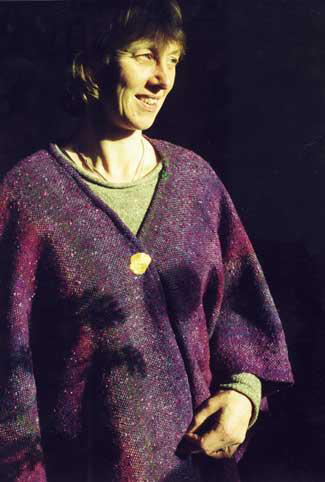
The disc being worn - showing possible means of attachment to tunic or other garment. © S. Timberlake 2003

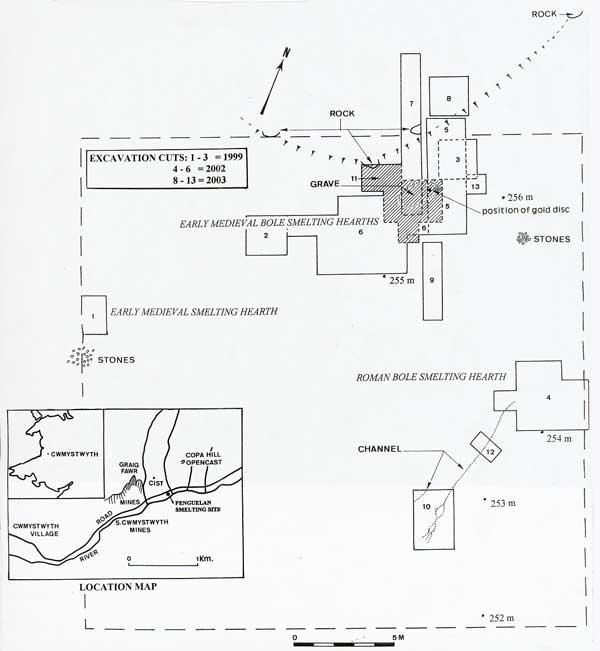
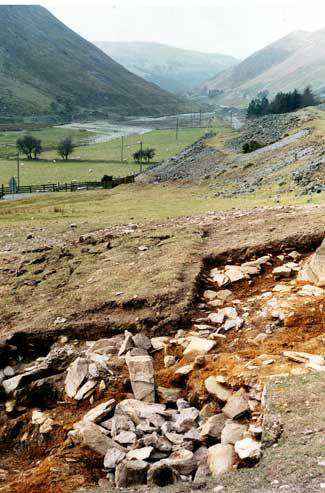
An oval-shaped 1.75m long shallow-cut grave was identified lying almost directly beneath the find-spot of the disc. Overlying and partly concealing the cut was a thin spread of small boulders originally thought by the excavators to have been gravel moraine (this has been re-interpreted as the remains of a denuded and collapsed bank cairn). At least part of the interior of the grave seems to have been robbed or quarried away, an action contemporary with or perhaps pre-dating the Roman and early medieval smelting activity. In addition, extensive animal burrowing and poor conditions for the preservation of bone meant that almost nothing of the skeleton had survived except for a thin film of tiny fragments. Interestingly, the location of the disc towards the top of the grave fill places this almost directly above what may have been the upper torso or chest area of the buried individual, assuming that the body was laid out in a partly flexed position, with the head looking south-west directly down valley. Moreover, the cut of the grave seems to have been carefully aligned on the narrow V-cut end to the valley and the horizon beyond.
Samples of soil containing degraded bone fragments were collected for dating along with charcoal from in and around the grave. Insufficient collagen survived to provide any sort of reliable date from the bone, whilst the three samples of charcoal recovered from the grave fill proved to be intrusive; one suggesting Mesolithic activity associated with the pre-burial land surface (OxA-12983: 8850+/-40 [8210-7760 CalBC]), another a Late Roman date for the ground surface covering the edge of the grave (OxA-12955: 1675+/-28 [320-430 Cal AD]), whilst the third consisted of a single piece of oak charcoal derived from the Early Medieval smelting horizon above (OxA-12956: 1264+/-27 [670-840 Cal AD]). Whilst not providing us with any clear answer, these results do at least support the possibility of a prehistoric burial.
The object and the metal
An examination of the gold foil disc (38.9mm diameter;<0.1mm thick, weight 2.51gm) was carried out by Adam Gwilt and Mary Davis.
The upper surface of the object appears to have been hammered and polished, whilst the dots and linear circular design of the repoussé decoration appear to have been pressed into the metal from the underside onto a yielding medium such as leather probably using a fine bone awl. The central perforations, however, pierce the foil from the decorated side, suggesting that the disc was worn attached to a garment. The lack of any visible signs of wear upon its upper surface might imply that the object was made specifically for burial.
Metallurgical analysis of the disc (approx. 93.5 per cent gold, 6.5 per cent silver and no detectable copper) revealed a composition fairly typical of a native unalloyed source - a type common to much Copper Age/Early Bronze Age goldwork. Whilst we cannot yet ascribe an exact source for the metal, the composition of this appears consistent with that for Irish, Scottish and Welsh alluvial gold.
Location map of Cwmystwyth Mines and Banc Tynndol (Penguelan) smelting site with plan of excavation cuts, hearths, grave and disc find spot. Illustration by S.Timberlake & B. Craddock, 2003.

View of partly backfilled grave (marked by stone infill) with thin spread of boulders behind, taken during the excavations of March 2003. The alignment of the grave is along the valley to the western horizon (towards the south-west). Cwmystwyth Mines can be seen on the right hand side of the valley. Photo: S.Timberlake 2003.

Gold discs and basket-earrings
Most known examples of this class of 'sun-disc' have been found in Ireland (21), with smaller numbers from Scotland (6), England (5) and similar examples from France. This is the first example to be found in Wales and probably the earliest gold artefact from Wales, the Llanllyfni lunula probably belonging to the slightly later established Beaker phase (c. 2000 BC).
The Banc Tynddol disc most closely resembles an unprovenanced example from Ireland with 2-4 linear circles in repoussé and 2 central perforations, a similar style with repoussé dots is to be found in an example from Kirk Andreas, Isle of Man. In Brittany, gold discs with similar dot and linear decoration have been discovered in Neolithic tombs and appear to be associated with early Beaker (Chalcolithic) abandonment deposits. In Britain, three examples have been found associated with two Beaker burials (one as a pair, and one as a single find) at Mere and Farleigh Wick in Wiltshire.
The similarities in style and decorative technique between the Banc Tynddol disc and 'basket earrings' or gold hair tress ornaments associated with rich Beaker burials (such as the 'Amesbury Archer') is also particularly striking. Indeed the example from Kirkhaugh, Northumberland had been similarly tooled on the surface as a means of enhancing the repoussé lines applied to the back, a detail precisely matched on the Banc Tynddol disc. The Kirkhaugh basket earring and others from burials at Chibolton (Hants.), Barrow Hills (Oxon.), and Boltby Scar (Yorkshire) can all be dated to the period between 2500-1900 BC.
Beaker/ Early Bronze Age mining and prospecting on Copa Hill, Cwmystwyth
Some 200 metres north of Banc Tynddol lies the site of an Early Bronze Age copper mine on Copa Hill, the subject of archaeological investigations by the Early Mines Research Group since 1986. Recent excavations confirm that the earliest prospecting activity here dates from 2100 BC or before. Could the influence of Beaker metallurgists here in Central Wales (as has already been shown at Ross Island, Killarney) therefore have some bearing on the early dates for mining? If so, the presence here of a contemporary and important burial may not be so much of a coincidence after all.
There is little that we can be certain about, except that conjecture such as this will probably continue to fuel the debate as to the origins of metallurgy in Britain for years to come.
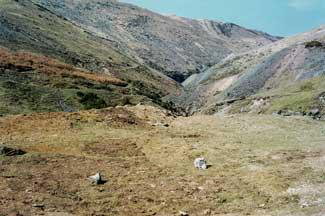
The position of the grave (marked by two boulders) and smelting site on Banc Tynddol. Looking north towards Copa Hill (behind). The Early Bronze Age copper mine lies some 200m above this, overlooking the site. Photo: S.Timberlake 2003.

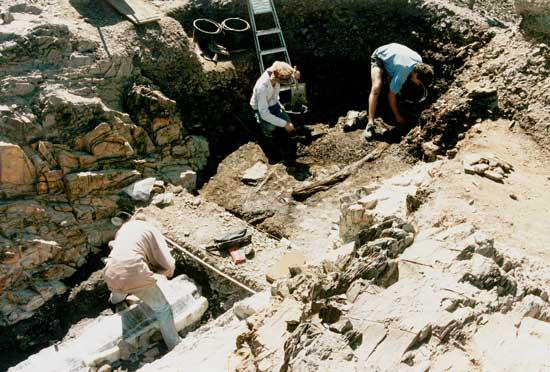
Excavations in progress at the Early Bronze Age copper mine within the Comet Lode Opencast, Copa Hill in June 1995. Sections some 4-5m deep within these infilling deposits revealed thousands of cobble stone tools, antler picks, fragments of rope and basketry, plus several oak and alder drainage launders. One such hollowed-out log launder (dated to c.2000 BC) is being removed here for conservation at the NMGW, Cardiff. Photo: S.Timberlake 1995.

Acknowledgments:
Work at Banc Tynddol was grant-aided by the National Museums & Galleries of Wales, the Cambrian Archaeological Association and the Board of Celtic Studies. CADW and Mrs. Raw, Ty Llwyd Farm granted permissions to excavate.