

Introduction
I dedicate this short piece to my late husband, Thurstan Shaw http://antiquity.ac.uk/tributes/shaw.html, who was very fond of Miles Burkitt.
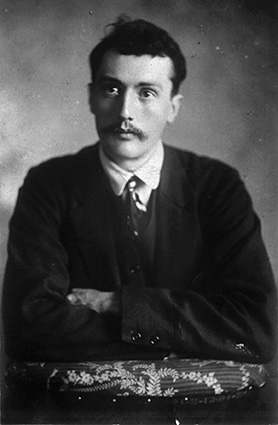
Miles Crawford Burkitt (1890–1971) as a young man in Spain (reproduced courtesy of Cambridge University Library).

There is a present and vibrant debate among historians as to why and how scientific knowledge 'travels' across geographical cultures and between scientific communities. David Reference LivingstoneLivingstone (2003) argues that well-drilled personal agents are one of the most effective channels for the reproduction and dissemination of an academic agenda to new audiences. A brief case study of an early-twentieth-century British archaeologist, Miles Burkitt (Figure 1), and his training abroad will illustrate Livingstone's point that faithful disciples may facilitate the transfer of archaeological knowledge from local to international settings.
Burkitt was admitted to the University of Cambridge in 1909 and by 1912 had met l'Abbé Henri Breuil, then considered to be the greatest living authority on prehistory. Within weeks of meeting they were roaming Spain, joining the acclaimed European archaeologist Hugo Obermaier at the excavation of the great cave of Castillo in 1913. Letters home (as detailed in Reference SmithSmith 2009) reveal that Burkitt was proud to become 'Breuil's pupil'; he often referred to Breuil and Obermaier as his honoured 'teachers'. After a season of excavation at Castillo, the men toured 'les Grottes ornées' of north-western Spain and then hiked to the cave of Gargas in the Hautes-Pyrénées, where Breuil had recently discovered a new gallery. During their wanderings, Breuil explained to Burkitt the phases of evolution which cave paintings and engravings followed. Fourteen years later, Burkitt used exactly Breuil's reasoning to suggest chronologies for the South African rock art which he viewed and admired during his tour of South Africa. In South Africa's past in stone and paint (1928), Burkitt imported Breuil's methods and analyses when he synthesised John Goodwin's local material and sites.
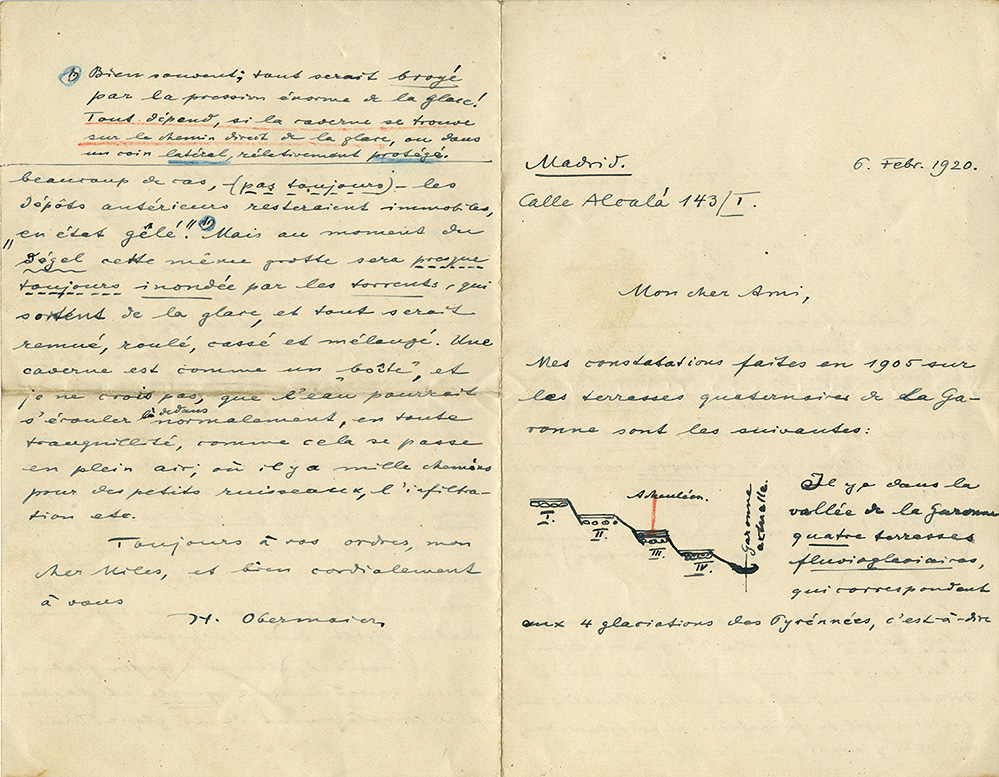
Obermaier's letter, 1920 (reproduced courtesy of Cambridge University Library).
Breuil and Obermaier also introduced Burkitt to the ideas of the accomplished Continental archaeologists, Émile Cartailhac and Count Napoléon Henri Bégouën. These scholars agreed that mural cave paintings and mobiliary art were expressions of totemism and magical beliefs. Burkitt later repeated these ideas, unchanged, throughout decades of ensuing publications read by generations of British undergraduate students.
Upon Burkitt's return to Cambridge, Breuil, Obermaier and Cartailhac contributed extensively to his first archaeological textbook, Prehistory (1921). Breuil, Obermaier and Cartailhac willingly sent Burkitt detailed notes explaining their geological and archaeological views, as seen in Figure 2. Unabridged and uncritical use of Breuil's and Obermaier's research and teachings is found throughout Prehistory. This book, and Burkitt's The Old Stone Age (1933), became the standard texts for generations of Cambridge students who carried these books with them to their positions throughout the British Empire.
It should be remembered that, during the 1910s and early '20s, Burkitt's main mission would not have been to produce original research, but instead to disseminate faithfully his mentors' interpretations in a self-professed amateur manner. In 1915, the PhD degree and other post-graduate research degrees had not yet been instituted at Cambridge. Thus, Burkitt's conception of himself as a pupil and, later, as a university lecturer did not require that he produce an original contribution to knowledge. Instead, intellectual and personal faithfulness were manifest in his books when he repeated his mentors' material verbatim. In fact, in his devotion to a few representatives of Continental thought, Burkitt ignored competing theories and local knowledge.
Because of this, Burkitt seriously underplayed the breadth of geological and archaeological debates which raged at the time in the UK. Interpretations of the number and chronology of British glaciations and their relationship to archaeological remains were hotly debated in the early 1920s. Importantly, under Burkitt's instruction, generations of students were introduced to the four-stage glacial sequence—the 'Günz, Mindel, Riss, Würm' mantra—with little appreciation for how controversial that sequence really was. British reviewers of Prehistory noted this simplified approach, blaming Breuil's influence (Reference ReadRead 1922).
In Burkitt's case, being an example of Livingstone's well-drilled agent, ideas travelled because Burkitt was proud to communicate the knowledge learned as a young pupil of l'Abbé Breuil. As Burkitt began to teach, his firm desire was to communicate his feeling of devotion to those scholars he met as a young man in Spain. By faithfully reproducing archaeological knowledge, and by not producing original material, Burkitt ensured Breuil's and Obermaier's influence on generations of students such as Louis Leakey, Desmond Clark and Thurstan Shaw as they carried textbooks and European thought to the British Empire.
Acknowledgements
I thank Miles Burkitt's family for their care over many years. All quotes are from Burkitt's letters kept in the Cambridge University Library Manuscripts Room (Add 7959).