


Studies in Chicago (Reference Faris and DunhamFaris & Dunham, 1939; Reference Levy and RowitzLevy & Rowitz, 1971), Bristol (Hare, Reference Hare1956a ,Reference Hare b ), Nottingham (Reference GiggsGiggs, 1986) and Mannheim (Reference Häfner and ReimannHäfner & Reimann, 1970) all concurred in finding that the incidence of schizophrenia was associated with various neighbourhood measures of deprivation and of demographic composition. Data that are grouped according to neighbourhood are, in statistical terms, part of a multi-level structure, with level-1 units (individuals) being clustered into level-2 units (neighbourhoods). The usual approach to the analysis of schizophrenia incidence and neighbourhood-level variables is to calculate the incidence separately for each neighbourhood. In the present investigation, more appropriate and recent multi-level modelling techniques (Reference GoldsteinGoldstein, 1987) were used to examine the relationship between schizophrenia incidence and neighbourhood-level and individual-level variables. The following issues were addressed:
-
(a) Do neighbourhoods differ in terms of schizophrenia incidence?
-
(b) Are neighbourhood-level measures of deprivation associated with schizophrenia incidence after adjustment for individual-level variables such as age, gender and marital status?
-
(c) Is there any evidence of interaction between individual-level and neighbourhood-level variables such as single marital status (Hare, Reference Hare1956a ,Reference Hare b )?
METHOD
The Maastricht Mental Health Case Register (MHCR) (Reference Driessen, Gunther and Van OsDriessen et al, 1998b ) has since 1981 cumulatively collected data on all mental health contacts: psychiatric hospital, community mental health centre (CMHC), psychiatric department of university hospital, community psychiatric emergency outreach team, psychogeriatric nursing homes, sheltered housing, child psychiatric services, services for the mentally impaired, alcohol and drug misuse services; as well as demographic and diagnostic data, for a region of around 200 000 population (city of Maastricht: 120 000; surrounding areas: 80 000). For the present study, registered contacts with child psychiatric services, alcohol and drug misuse services (which are separate from general psychiatric services in The Netherlands and for which data were incomplete over the period of investigation), and services for the mentally impaired and for patients with dementia were excluded.
Maastricht is a relatively small city (population 120 000), located in the extreme south of The Netherlands in the province of Limburg. There are strong local traditions and Limburg has its own, officially recognised, dialect. The neighbourhoods of Maastricht represent traditional and sociologically meaningful entities, not arbitrary administrative subdivisions. Compared with the densely populated and more industrialised areas of the north-west of the country, levels of immigration of foreign nationals over the past decades have been low. A national insurance scheme covers mental health services and referral by a general practitioner is not necessary for attending the CMHC. Access to mental health services does not depend on the neighbourhood level of deprivation.
The period of investigation for the present study was 1981-1997. The case sample was defined by four criteria: (a) age 15-64 years; (b) having been coded as living in the city of Maastricht; (c) and ICD-9 diagnosis of schizophrenia and related disorders (ICD-295.x and 297.x; World Health Organization, 1978), recorded at least once during a psychiatric career; (d) in order to skew the sample towards true incident cases of schizophrenia, subjects registered in the first five years of the register (many of whom would have been prevalent cases who were in treatment when the register opened) were excluded, leaving subjects registered during the period 1986-1997. By confining the analyses to the city of Maastricht, and excluding the surrounding villages, any effect of distance to psychiatric services was minimised, as within the city of Maastricht all distances to mental health services can easily be covered by bicycle.
Individual-level variables and their neighbourhood-level equivalents
The register routinely collects information on age, gender, marital status and neighbourhood. Four-dimensional population data in the age range 15-64 years (age, gender, marital status and neighbourhood) for this period were obtained from the municipal authorities for each of the years of the period under investigation, allowing us to express the variables age, gender and marital status of the population aged 15-64 years at the neighbourhood level. Thus, for each neighbourhood we calculated, for the period 1986-1997, the proportion of men, the proportion who were single, divorced and widowed (if these three are known, the proportion of married persons can be derived, therefore the proportion of married persons was not analysed separately) the proportion aged under 25 years and the proportion aged 55 years and older (Table 1).
Neighbourhood-level variables used in the analyses

| Neighbourhood-level variables | Mean proportion (s.d.) | |
|---|---|---|
| With individual-level equivalent | Male | 49.3 (1.7) |
| Aged <25 years | 22.3 (4.5) | |
| Aged >55 years | 15.9 (5.0) | |
| Single | 38.4 (11.2) | |
| Divorced | 6.9 (2.1) | |
| Widowed | 2.3 (0.6) | |
| Without individual-level equivalent | Rental support | 8.9 (4.2) |
| Non-voters | 40.1 (6.3) | |
| Welfare-dependent | 8.7 (4.2) | |
| Foreign-born | 3.9 (1.6) | |
| Unemployed | 8.2 (2.7) | |
| Mutations | 25.7 (25.0) | |
| New housing (since 1945) | 28.0 (13.2) |
Neighbourhood-level measures of deprivation (Table 1)
In order to classify neighbourhood according to level of deprivation, we requested from the municipal authority information on seven socio-economic variables to characterise the neighbourhoods of Maastricht over the period 1981-1997. Over this period, the mean values were calculated for:
-
(a) number of persons dependent on unemployment benefit per 1000 population in the age range of the economically active;
-
(b) number of persons dependent on social welfare benefit per 1000 population in the age range of the economically active;
-
(c) number of non-voters (i.e. eligible voters who do not vote) per 1000 population in the voting age range;
-
(d) number of foreign-born persons per 1000 population;
-
(e) rate of mutations (moving in and moving out) per 1000 population;
-
(f) number receiving rental support per 1000 population; and
-
(g) number of new houses built since the Second World War per 1000 population.
Very small neighbourhoods or neighbourhoods consisting mainly of industrial compounds (n=6) were excluded, leaving 35 neighbourhoods with a median yearly total population size of 2804 over the period of investigation (interquartile range: 1718-4383).
Analyses
For descriptive purposes, adjusted incidence rates were calculated for each neighbourhood over the period 1986-1997, using the ISTDIZE procedure in the STATA statistical program (StataCorp, 1999). Indirect standardisation was used to adjust for age (10-year age groups), gender and marital status (married, single, divorced, widowed). The standardisation used the stratum-specific rates of the standard population (the total population over the period 1986-1997) to calculate the expected number of cases in the study populations, which were then used to calculate adjusted rates. The standardised incidence ratio (SIR) is the ratio of the observed over the expected number of cases in the study populations.
Two types of neighbourhood effects were examined: (a) the neighbourhood random effect relates to the question: are neighbourhoods different with regard to schizophrenia incidence? (b) Neighbourhood fixed effects relate to the question: what makes neighbourhoods different (i.e. do certain neighbourhood characteristics, such as the proportion of unemployed or proportion of single persons have an effect on schizophrenia incidence)? Individual-level variables in this study all represent fixed effects. The effect of individual-level and neighbourhood-level characteristics was estimated using the multi-level Poisson regression procedure of the MLwiN program (Reference Goldstein, Rasbash and PlewisGoldstein et al, 1998). In this analysis, the coefficient of any explanatory variable may be random at the two levels of the hierarchy. Further, at each level, the random coefficients may have any pattern of variances and covariances. Count variables (in this case the incidence of schizophrenia) do not have a normal distribution. Because of this, using ordinary least squares regression with a count as the dependent variable is not appropriate. We used the log of the counts and estimated the regression parameters using the Poisson maximum-likelihood algorithm, adjusting for person-years of observation. Effect sizes for fixed effects were expressed as incidence rate ratios (RR). In view of gender differences in the effect of age and marital status on the incidence rate of schizophrenia (Reference Riecher Rossler, Fatkenheuer and LofflerRiecher Rossler et al, 1992; Tien & Eaton, 19992; Reference Jablensky and ColeJablensky & Cole, 1997) interaction terms for gender-by-age and gender-by-marital-status were fitted into the models.
RESULTS
Sample
The total number of cases was 220. The mean age at first contact was 35.5 years (s.d.=13.0) (men 33.5 years, women 38.6 years), and men constituted 61% of the total sample. The majority were single (64%), followed by married (23%), divorced (11%) and widowed (2%). The total population at risk (aged 15-64 years) over the 12-year period of investigation was 988 086, giving a crude overall rate of 22.3 per 100 000 person-years.
Random neighbourhood effect
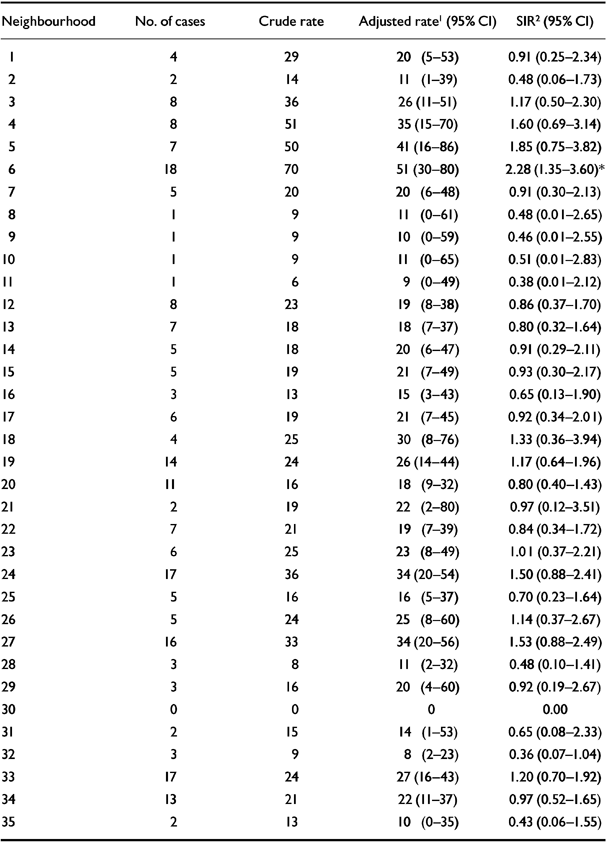
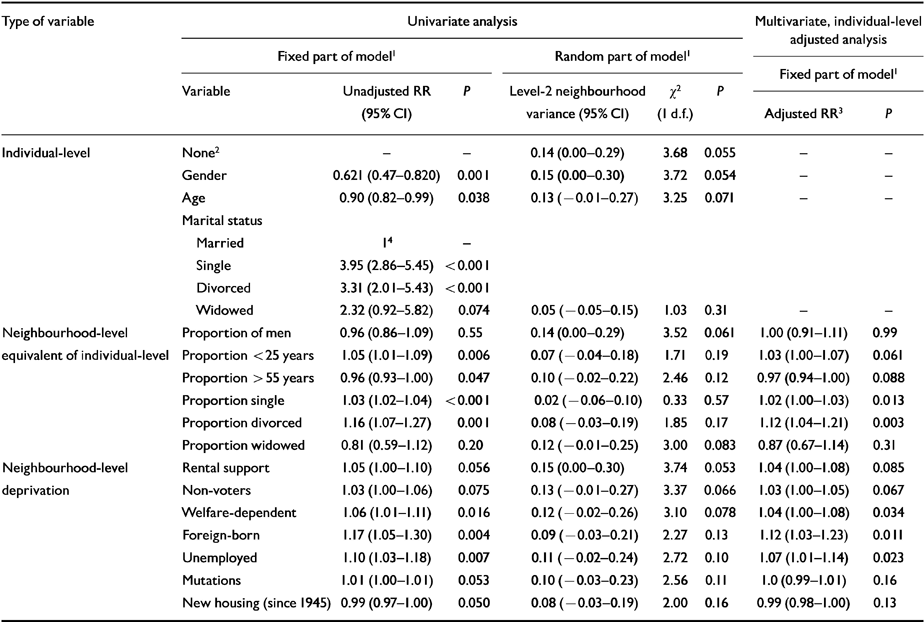
The incidence, standardised with respect to age, gender and marital status, varied from 0 to 51 per 100 000 person-years in different neighbourhoods. There was wide variation in the SIR, but only in one neighbourhood was it significantly higher than the rate for the standard population (Table 2). The multi-level model without any fixed-effect explanatory variable (Table 3) showed a level-2 variance (representing the random neighbourhood effect) of 0.14 (95% CI 0.00-0.29; P=0.055), constituting 12% of the total variance (0.14/{1+0.14}).
Neighbourhood standardised incidence rates (SIRs) of schizophrenia, Maastricht, 1986-1997
| Neighbourhood | No. of cases | Crude rate | Adjusted rate1 (95% CI) | SIR2 (95% CI) |
|---|---|---|---|---|
| 1 | 4 | 29 | 20 (5-53) | 0.91 (0.25-2.34) |
| 2 | 2 | 14 | 11 (1-39) | 0.48 (0.06-1.73) |
| 3 | 8 | 36 | 26 (11-51) | 1.17 (0.50-2.30) |
| 4 | 8 | 51 | 35 (15-70) | 1.60 (0.69-3.14) |
| 5 | 7 | 50 | 41 (16-86) | 1.85 (0.75-3.82) |
| 6 | 18 | 70 | 51 (30-80) | 2.28 (1.35-3.60)* |
| 7 | 5 | 20 | 20 (6-48) | 0.91 (0.30-2.13) |
| 8 | 1 | 9 | 11 (0-61) | 0.48 (0.01-2.65) |
| 9 | 1 | 9 | 10 (0-59) | 0.46 (0.01-2.55) |
| 10 | 1 | 9 | 11 (0-65) | 0.51 (0.01-2.83) |
| 11 | 1 | 6 | 9 (0-49) | 0.38 (0.01-2.12) |
| 12 | 8 | 23 | 19 (8-38) | 0.86 (0.37-1.70) |
| 13 | 7 | 18 | 18 (7-37) | 0.80 (0.32-1.64) |
| 14 | 5 | 18 | 20 (6-47) | 0.91 (0.29-2.11) |
| 15 | 5 | 19 | 21 (7-49) | 0.93 (0.30-2.17) |
| 16 | 3 | 13 | 15 (3-43) | 0.65 (0.13-1.90) |
| 17 | 6 | 19 | 21 (7-45) | 0.92 (0.34-2.01) |
| 18 | 4 | 25 | 30 (8-76) | 1.33 (0.36-3.94) |
| 19 | 14 | 24 | 26 (14-44) | 1.17 (0.64-1.96) |
| 20 | 11 | 16 | 18 (9-32) | 0.80 (0.40-1.43) |
| 21 | 2 | 19 | 22 (2-80) | 0.97 (0.12-3.51) |
| 22 | 7 | 21 | 19 (7-39) | 0.84 (0.34-1.72) |
| 23 | 6 | 25 | 23 (8-49) | 1.01 (0.37-2.21) |
| 24 | 17 | 36 | 34 (20-54) | 1.50 (0.88-2.41) |
| 25 | 5 | 16 | 16 (5-37) | 0.70 (0.23-1.64) |
| 26 | 5 | 24 | 25 (8-60) | 1.14 (0.37-2.67) |
| 27 | 16 | 33 | 34 (20-56) | 1.53 (0.88-2.49) |
| 28 | 3 | 8 | 11 (2-32) | 0.48 (0.10-1.41) |
| 29 | 3 | 16 | 20 (4-60) | 0.92 (0.19-2.67) |
| 30 | 0 | 0 | 0 | 0.00 |
| 31 | 2 | 15 | 14 (1-53) | 0.65 (0.08-2.33) |
| 32 | 3 | 9 | 8 (2-23) | 0.36 (0.07-1.04) |
| 33 | 17 | 24 | 27 (16-43) | 1.20 (0.70-1.92) |
| 34 | 13 | 21 | 22 (11-37) | 0.97 (0.52-1.65) |
| 35 | 2 | 13 | 10 (0-35) | 0.43 (0.06-1.55) |
Effect of individual- and neighbourhood-level variables on incidence of schizophrenia and neighbourhood differences in incidence
| Type of variable | Univariate analysis | Multivariate, individual-level adjusted analysis | ||||||
|---|---|---|---|---|---|---|---|---|
| Fixed part of model1 | Random part of model1 | Fixed part of model1 | ||||||
| Variable | Unadjusted RR (95% CI) | P | Level-2 neighbourhood variance (95% CI) | χ2 (1 d.f.) | P | Adjusted RR3 | P | |
| Individual-level | None2 | - | - | 0.14 (0.00-0.29) | 3.68 | 0.055 | - | - |
| Gender | 0.621 (0.47-0.820) | 0.001 | 0.15 (0.00-0.30) | 3.72 | 0.054 | - | - | |
| Age | 0.90 (0.82-0.99) | 0.038 | 0.13 (-0.01-0.27) | 3.25 | 0.071 | - | - | |
| Marital status | ||||||||
| Married | 14 | - | ||||||
| Single | 3.95 (2.86-5.45) | <0.001 | ||||||
| Divorced | 3.31 (2.01-5.43) | <0.001 | ||||||
| Widowed | 2.32 (0.92-5.82) | 0.074 | 0.05 (-0.05-0.15) | 1.03 | 0.31 | - | - | |
| Neighbourhood-level equivalent of individual-level | Proportion of men | 0.96 (0.86-1.09) | 0.55 | 0.14 (0.00-0.29) | 3.52 | 0.061 | 1.00 (0.91-1.11) | 0.99 |
| Proportion <25 years | 1.05 (1.01-1.09) | 0.006 | 0.07 (-0.04-0.18) | 1.71 | 0.19 | 1.03 (1.00-1.07) | 0.061 | |
| Proportion >55 years | 0.96 (0.93-1.00) | 0.047 | 0.10 (-0.02-0.22) | 2.46 | 0.12 | 0.97 (0.94-1.00) | 0.088 | |
| Proportion single | 1.03 (1.02-1.04) | <0.001 | 0.02 (-0.06-0.10) | 0.33 | 0.57 | 1.02 (1.00-1.03) | 0.013 | |
| Proportion divorced | 1.16 (1.07-1.27) | 0.001 | 0.08 (-0.03-0.19) | 1.85 | 0.17 | 1.12 (1.04-1.21) | 0.003 | |
| Proportion widowed | 0.81 (0.59-1.12) | 0.20 | 0.12 (-0.01-0.25) | 3.00 | 0.083 | 0.87 (0.67-1.14) | 0.31 | |
| Neighbourhood-level deprivation | Rental support | 1.05 (1.00-1.10) | 0.056 | 0.15 (0.00-0.30) | 3.74 | 0.053 | 1.04 (1.00-1.08) | 0.085 |
| Non-voters | 1.03 (1.00-1.06) | 0.075 | 0.13 (-0.01-0.27) | 3.37 | 0.066 | 1.03 (1.00-1.05) | 0.067 | |
| Welfare-dependent | 1.06 (1.01-1.11) | 0.016 | 0.12 (-0.02-0.26) | 3.10 | 0.078 | 1.04 (1.00-1.08) | 0.034 | |
| Foreign-born | 1.17 (1.05-1.30) | 0.004 | 0.09 (-0.03-0.21) | 2.27 | 0.13 | 1.12 (1.03-1.23) | 0.011 | |
| Unemployed | 1.10 (1.03-1.18) | 0.007 | 0.11 (-0.02-0.24) | 2.72 | 0.10 | 1.07 (1.01-1.14) | 0.023 | |
| Mutations | 1.01 (1.00-1.01) | 0.053 | 0.10 (-0.03-0.23) | 2.56 | 0.11 | 1.0 (0.99-1.01) | 0.16 | |
| New housing (since 1945) | 0.99 (0.97-1.00) | 0.050 | 0.08 (-0.03-0.19) | 2.00 | 0.16 | 0.99 (0.98-1.00) | 0.13 | |
Individual-level variables and their neighbourhood-level equivalents
The level-2 variance was minimally, or not at all, reduced after adjustment for individual-level age and gender, even though these factors had a significant effect on rates. Thus, for women (RR=0.62; 95% CI 0.47-0.82; P=0.001) and older people (RR=0.90; 95% CI 0.82-0.99; P=0.038) the rates were lower. The level-2 variance was reduced by more than 60% after adjustment for individual-level marital status (Table 3). Single persons (RR=3.95, 95% CI 2.86-5.45), and divorced persons (RR=3.31, 95% CI 2.01-5.43) were at greater risk than married persons. There was a strong interaction between age and gender (P=0.008), in that schizophrenia was associated with younger age in men (RR=0.80, 95% CI 0.70-0.91, P=0.001) but not in women (RR=1.05, 95% CI 0.90-1.22, P=0.57). There was also an interaction between gender and single marital status (P=0.001), such that the size of the effect of being single was greater in men (RR=6.54, 95% CI 4.09-10.46, P<0.001) than in women (RR=2.04, 95% CI 1.27-3.28, P=0.003). Marital status expressed at the neighbourhood level (but not age and gender) also affected the incidence of schizophrenia in the same direction as the individual-level variable, even after adjustment for the individual-level variables and their interactions (Table 3). Thus, after adjustment for individual-level age, gender, marital status and the gender-by-age and gender-by-marital-status interactions, the risk of schizophrenia was increased with the proportion of divorced persons (RR=1.12 per 1% increase, 95% CI 1.04-1.21, P=0.003) and the proportion of single persons (RR=1.02 per 1% increase, 95% CI 1.00-1.03, P=0.013).
Neighbourhood-level deprivation variables
The effect of the seven neighbourhood-level deprivation variables was in the direction of increased incidence of schizophrenia; with the exception of number of new houses built since the Second World War, which had a protective effect (Table 3). The effect of most variables was statistically significant. After adjustment for individual-level age, gender, marital status and the age-by-gender and gender-by-marital-status interactions, only the effects of being foreign-born, unemployed and dependent on welfare remained significant (Table 3).
Independence of neighbourhood-level variables
In order to assess their independence of each other, the proportion of persons who were divorced, foreign-born, unemployed and on welfare were entered simultaneously in the unadjusted model. The effects of the proportion of single (RR=1.02, 95% CI 1.01-1.04, P=0.005) and the proportion of divorced persons (RR=1.15, 95% CI 1.01-1.32, P=0.040) remained, but not the effects of the proportion of unemployed (RR=1.00, 95% CI 0.80-1.24, P=0.98), the proportion on welfare (RR=0.94, 95% CI 0.79-1.11, P=0.48), and the proportion foreign-born (RR=1.13, 95% CI 0.93-1.39, P=0.22).
Interaction between neighbourhood-level variables and individual-level equivalents
The independent effect of the proportion of persons living alone was modified by its individual-level equivalent (single marital status) in the model adjusted for individual-level age, gender, marital status and the age-by-gender and gender-by-marital-status interactions (P<0.001). Thus, in neighbourhoods where the proportion of persons living alone was below the Maastricht mean (Table 1), the effect of single marital status in the adjusted model was more than twice as large (RR=10.33, 95% CI 5.56-19.20, P<0.001) as the effect in neighbourhoods with values above the mean (RR=4.22, 95% CI 1.92-9.30, P<0.001). There was no interaction between the proportion of divorced persons and individual-level divorced marital status (P=0.81).
DISCUSSION
Main findings
Around 12% of the variance in the incidence of schizophrenia was associated with neighbourhood-related variation (random neighbourhood effect). There were neighbourhood-level fixed effects of the proportion of single and the proportion of divorced persons, independent of individual-level variables and indicators of neighbourhood deprivation. Any effect of indicators of neighbourhood deprivation was strongly reduced after adjustment for individual-level age, gender and marital status and their neighbourhood-level equivalents. There was an interaction between individual-level single marital status and its neighbourhood-level equivalent, the proportion of single individuals, in that the effect of single marital status was larger in neighbourhoods with fewer single individuals.
Methodological issues
Schizophrenia is a rare disease, and although inspection of the rates in Table 2 suggests substantial neighbourhood-related variation, the statistical power was relatively low with regard to the random neighbourhood effect. We can nevertheless be 94.5% confident that the level-2 variance representing the random neighbourhood effect was not merely a chance finding. The random neighbourhood effect suggests that neighbourhoods are different, and therefore provides strong support for the use of multi-level modelling in the analysis of data clustered at the neighbourhood level.
We were not able to match all neighbourhood-level variables with their individual-level equivalents. This would have required very detailed population data, which are not available in European countries. However, age, gender and marital status are all very relevant with regard to the incidence of schizophrenia, and, as far as we are aware, this is the first study combining their individual-level and neighbourhood-level effects. Similarly, this is the first study to examine the effect of neighbourhood deprivation variables after adjustment for individual-level age, gender and marital status in the appropriate multi-level model.
Single individuals and individuals living in more deprived neighbourhoods may have a poorer prognosis, remain in the system of mental health services for a longer period of time, and therefore have a greater likelihood of eventually receiving a lifetime diagnosis of schizophrenia later in the course of their illness. However, in a previous study using these case-register data, we showed that associations with neighbourhood deprivation and signle marital status were similar in cases aged 16-93 years who received an early diagnosis of schizophrenia, as compared with those who received the diagnosis later in the course of their illness (Reference Driessen, Gunther and BakDriessen et al, 1998a ).
Some individuals may have moved from one neighbourhood to another in the prodromal stages. However, this could only have biased our findings if one assumes that: (a) single individuals in the prodromal stages would have drifted selectively to neighbourhoods with fewer single individuals; and (b) a sufficient amount of such prodromal drift had taken place to cause an interaction between individual-level marital status and its neighbourhood-level equivalent.
In general, individual marital status is not quite the individual-level equivalent of the population-level proportion of single individuals, as population-level single individuals include some single individuals who share the same household. This type of misclassification, however, would in fact have made our neighbourhood-level exposure more ‘diluted’, making it more difficult to find an effect, rather than leading to a spurious one.
Not all cases of schizophrenia are treated within the mental health system. However, the reported incidence of 22.3 per 100 000 is within the normal range and does not suggest that many cases were missed. The mean age at first contact was 35.5 years. In Camberwell between 1965 and 1991, the mean age at first contact in incident schizophrenia patients younger than 65 years was 31.3 years, and in Dumfries and Galloway it was 35.3 years between 1979 and 1998 (R. McCreadie, personal communication, 1999).
The effects of neighbourhood-level variables appeared small because effects were expressed as the risk associated with a 1% increase in the exposure. For example, the relative risk associated with a 1% increase in the proportion of single persons was 1.02. Given the fact that the Maastricht mean was 38.4%, with a standard deviation of 11.2% a difference of one standard deviation between neighbourhoods would mean a relative risk of 1.0211.2=1.25, or a 25% excess risk for schizophrenia; a difference of two standard deviations would result in an excess risk of 56%. Similarly, a difference of one standard deviation in the proportion of divorced persons would result in an excess risk of 27% (1.122.1).
Neighbourhood-level effects over and above individual-level equivalents
The effects of individual-level younger age, male gender, being single, being divorced and their interactions were all in the expected direction (Reference Riecher Rossler, Fatkenheuer and LofflerRiecher Rossler et al, 1992; Reference Tien and EatonTien & Eaton, 1992; Reference Jablensky and ColeJablensky & Cole, 1997). The risk-increasing effect of single marital status may be an indicator of premorbid social impairment in individuals at risk of developing schizophrenia (Reference Van Os, Takei and CastleVan Os et al, 1995), or a reflection of social isolation in the interpersonal sense, as a risk factor for psychosis (Reference WilkinsonWilkinson, 1975). We found that the neighbourhood-level proportions of single and of divorced persons also increased the risk, even after adjustment for their individual-level equivalents. This suggests that there may be a true environmental neighbourhood effect associated with the proportions of single and of divorced persons. There are two possible caveats with regard to such an interpretation. The first is that the proportion of single or of divorced persons in a neighbourhood may in fact be proxies for some other relevant neighbourhood-level indicator (Reference Geronimus and BoundGeronimus & Bound, 1998). However, we were able to show that the effect of the proportion of single and the proportion of divorced persons persisted even after inclusion of a range of neighbourhood characteristics in the model (unemployment, foreign-born, mutations, etc.), suggesting an effect truly associated with these variables. For example, the proportion of single persons could be a mere proxy for a greater proportion of young, mobile, and unemployed persons. Had this been the case, however, we would have expected the effect of the proportion of single persons to disappear after adjustment for the proportion of young individuals, total mutations and the proportion of unemployed, whereas the opposite occurred. The second caveat is that the proportion of single or of divorced persons in a neighbourhood may be a proxy for some individual-level variable other than marital status, for which we failed to adjust (Reference MorgensternMorgenstern, 1998). Although this possibility cannot be discarded, recent work has provided evidence for the existence of true neighbourhood-level effects on a range of health-related outcomes (Reference Lillie Blanton, Anthony and SchusterLillie Blanton et al, 1993; Reference Diez Roux, Nieto and MuntanerDiez Roux et al, 1997; Reference Sampson, Raudenbush and EarlsSampson et al, 1997; Reference Driessen, Gunther and Van OsDriessen et al, 1998b ).
Interpretation
Faris & Dunham (Reference Faris and Dunham1939) suggested that a high proportion of persons living alone was indicative of ‘social isolation’, which they in turn suggested had a causal influence on the development of psychotic symptoms. Although the ecological validity of the presumed relationship between the neighbourhood proportion of single persons and neighbourhood social isolation remains to be established, on the face of it, it has some validity. Hare (Reference Hare1956b ) found a correlation of 0.63 between the age- and gender-standardised incidence of schizophrenia and the proportion of single-person households in Bristol. He suggested that neighbourhood differences in the incidence of schizophrenia were not so much the result of differences in terms of population density or material deprivation, but of differences in the proportion of people living alone. The findings of the present investigation agree with this suggestion. None of the neighbourhood-level indicators of deprivation had significant effects after adjustment for individual-level age, gender and marital status, or after adjustment for the neighbourhood-level proportion of single and proportion of divorced persons. Hare (Reference Hare1956b ) concluded that the risk associated with the proportion of single persons could have an individual-level explanation (such as segregation of vulnerable (single) individuals) or a macro-environmental explanation (such as high levels of social isolation in areas with a high proportion of single households). In addition, he stated that “these two hypotheses are by no means incompatible and both factors may be operative”. The current results indeed suggest that the two factors may be interactive, and additionally suggest that the proportion of divorced persons also independently contributes to the increase in risk. The interaction was such that the individual-level effect of single marital status was higher in area with fewer single individuals. This parallels the findings reported for unemployment and suicide, for example. Suicide is associated with unemployment at the individual level. However, the risk for individual-level unemployment is higher in areas where the proportion of unemployed is low (Reference PlattPlatt, 1986). It has been suggested that the cognitive impact of unemployment is worse if most other individuals in the environment are not unemployed, so that those without work stand out as isolated exceptions (Reference NeelemanNeeleman, 1997). Similarly, single marital status may more easily give rise to perceived isolation if most other individuals are living with a partner. Thus, premorbid vulnerability resulting in single marital status may be more likely to progress to overt disease in an environment with a higher perceived level of social isolation. Uncovering such person-environment interactions remains essential for the elucidation of causal mechanisms in schizophrenia.
Clinical Implications and Limitations
CLINICAL IMPLICATIONS
-
▪ Premorbid vulnerability resulting in single marital status may be more likely to progress to psychosis in an environment with a higher perceived level of social isolation.
-
▪ The reported effect of neighbourhood indices of deprivation on incidence of psychosis may in part be due to confounding by individual-level age, gender and marital status.
LIMITATIONS
-
▪ Case register data lack diagnostic precision and only provide information about persons in contact with mental health services.
-
▪ Only a proportion of neighbourhood-level variables could be matched with their individual-level equivalents.
-
▪ The proportion of single persons in a neighbourhood may be a proxy for some individual-level variable other than marital status, for which we may have failed to adjust.




eLetters
No eLetters have been published for this article.