
Skip to main content Accessibility help
×
  • Cited by 29
    • Show more authors
    • You may already have access via personal or institutional login
    • Select format
    • Publisher:
      Cambridge University Press
      Publication date:
      14 May 2020
      28 May 2020
      ISBN:
      9781108764063
      9781108488501
      9781108726467
      Dimensions:
      (228 x 152 mm)
      Weight & Pages:
      0.64kg, 372 Pages
      Dimensions:
      (229 x 152 mm)
      Weight & Pages:
      0.54kg, 374 Pages
    You may already have access via personal or institutional login
  • Selected: Digital
    Add to cart View cart Buy from Cambridge.org

    Book description

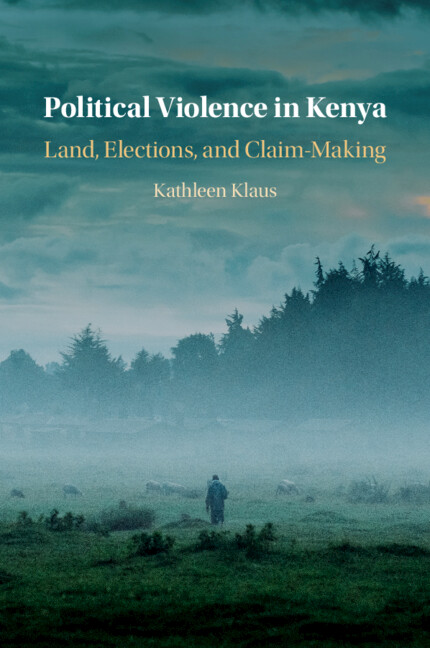
    Examining a key puzzle in the study of electoral violence, this study asks how elites organize violence and why ordinary citizens participate. While existing theories of electoral violence emphasize weak institutions, ethnic cleavages, and the strategic use of violence, few specify how the political incentives of elites interact with the interests of ordinary citizens. Providing a new theory of electoral violence, Kathleen F. Klaus analyzes violence as a process of mobilization that requires coordination between elites and ordinary citizens. Drawing on fifteen months of fieldwork in Kenya, including hundreds of interviews and an original survey, Political Violence in Kenya argues that where land shapes livelihood and identity, and tenure institutions are weak, land, and narratives around land, serve as a key device around which elites and citizens coordinate the use of violence. By examining local-level variation during Kenya's 2007–8 post-election violence, Klaus demonstrates how land struggles structure the dynamics of contentious politics and violence.

    Reviews

    ‘This book provides a powerful analysis of collective land narratives, and connects these narratives to elite and citizen coordination of electoral violence. This insightful and compelling research connects institutional factors that shape land access and security to the construction of narratives, which ultimately reflects on the relationship between democratization, political violence, and post-conflict politics.'

    Rachel Beatty Riedl - Cornell University, New York

    ‘Why do elections turn violent in some local contexts but not in others? Based on comparisons of communities, interviews, and a novel survey in Kenya, Klaus finds that it is the interplay of contentious land narratives, land inequality and politicians acting as land patrons that allows elites to mobilize citizens for violence – and citizens to follow. With its thorough argument and rich empirical approach, Klaus takes us to a new level of understanding of a phenomenon that plagues democracies around the world.'

    Ana Arjona - Northwestern University, Illinois

    ‘Klaus tackles a question central to the success of fragile democracies – when will ordinary people use violence during and after elections? Land, as the resource that most shapes identity and economic well-being, is central to her argument. Klaus's multifaceted empirical strategy is impressive. Her extensive qualitative evidence yields unique insights into how people understand land inequality and the process by which conflict escalates. A remarkable contribution to our understanding of electoral violence.'

    Kimuli Kasara - Columbia University, New York

    ‘… the book offers a remarkable contribution to understanding the microfoundations of electoral violence. Scholars interested in the micro-level analysis of political violence would benefit most from reading this book.’

    Christine Olukhanda Source: Democratization

    ‘This is an excellent book that scholars of political violence, identity, elections and land politics should read.’

    Alex Dyzenhaus Source: The Journal of Development Studies

    Refine List

    Actions for selected content:

    Select all | Deselect all
    • View selected items
    • Export citations
    • Download PDF (zip)
    • Save to Kindle
    • Save to Dropbox
    • Save to Google Drive

    Save Search

    You can save your searches here and later view and run them again in "My saved searches".

    Please provide a title, maximum of 40 characters.
    ×

    Contents

    Metrics

    Altmetric attention score

    Full text views

    Total number of HTML views: 0
    Total number of PDF views: 0 *
    Loading metrics...

    Book summary page views

    Total views: 0 *
    Loading metrics...

    * Views captured on Cambridge Core between #date#. This data will be updated every 24 hours.

    Usage data cannot currently be displayed.

    Accessibility standard: Unknown

    Why this information is here

    This section outlines the accessibility features of this content - including support for screen readers, full keyboard navigation and high-contrast display options. This may not be relevant for you.

    Accessibility Information

    Accessibility compliance for the HTML of this book is currently unknown and may be updated in the future.
