

Introduction
Cognitive theory conceptualises persecutory delusions as inaccurate threat beliefs about harm from other people (Freeman, Reference Freeman2016; Freeman et al., Reference Freeman, Isham and Waite2025). The perceived threat leads to anxiety and an attempt to obtain safety through preventative action. Avoidance is the most common preventative action (e.g. avoiding places where it is difficult to escape). When this is not possible, within-situation strategies such as keeping a low profile or rushing through tasks, are used to reduce risk. In the face of a true threat, safety-seeking behaviours would be adaptive, but when fears are a misperception, as is the case with persecutory delusions, these behaviours prevent the receipt and processing of contradictory information. The non-occurrence of harm is misattributed to the use of the safety-seeking behaviours and thus the threat belief is maintained. In our paranoia treatment we have called these unhelpful safety-seeking behaviours ‘defences’, because the term provides a helpful metaphor for the blocking of new learning and we wish to avoid confusion when truly discovering safety is a clear goal of cognitive therapy, for example, the Feeling Safe programme, a highly efficacious cognitive therapy for persecutory delusions (Freeman et al., Reference Freeman, Emsley, Diamond, Collett, Bold, Chadwick, Isham, Bird, Edwards, Kingdon, Fitzpatrick, Kabir and Waite2021a). In this paper we report the development of the first self-report assessment of paranoia-related defences.
The key role of safety-seeking behaviours in the maintenance of unfounded threat beliefs was first conceptualised thirty years ago in relation to panic disorder (Salkovskis, Reference Salkovskis1991). Several experimental manipulation studies across different anxiety disorders have demonstrated that dropping safety-seeking behaviours during a brief exposure leads to greater reductions in the threat belief and anxiety compared with exposure alone (McManus et al., Reference McManus, Clark, Grey, Wild, Hirsch, Fennell and Manley2009; Salkovskis et al., Reference Salkovskis, Clark, Hackmann and Gelder1999; Salkovskis et al., Reference Salkovskis, Thorpe, Wahl, Wroe and Forrester2003). Reducing the use of safety-seeking behaviours to allow new learning has since become a central mechanism in cognitive treatments for panic disorder and agoraphobia (Clark and Salkovskis, Reference Clark and Salkovskis2009), post-traumatic stress disorder (Ehlers and Clark, Reference Ehlers and Clark2000), obsessive compulsive disorder (Salkovskis, Reference Salkovskis1999) and social anxiety (Clark and Wells, Reference Clark, Wells, Heimberg, Liebowitz, Hope and Schneier1995). The concept was subsequently applied to persecutory delusions (Freeman et al., Reference Freeman, Garety and Kuipers2001; Freeman et al., Reference Freeman, Lister, Waite, Galal, Yu, Lambe, Beckley, Bold, Jenner, Diamond, Kirkham, Twivey, Causier, Carr, Saidel, Day, Beacco, Rovira, Ivins, Nah, Slater, Clark and Rosebrock2023). The widespread use of such behaviours by patients with persecutory delusions was established (Freeman et al., Reference Freeman, Garety, Kuipers, Fowler, Bebbington and Dunn2007), and an experimental manipulation study showed that dropping defences leads to large reductions in persecutory delusions (Freeman et al., Reference Freeman, Bradley, Antley, Bourke, DeWeever, Evans, Černis, Sheaves, Waite, Dunn and Clark2016).
The most widely used measure of defences in relation to persecutory delusions is a semi-structured interview, the Safety Behaviours Questionnaire – Persecutory Beliefs (SBQ) (Freeman et al., Reference Freeman, Garety and Kuipers2001). The SBQ assesses defence behaviours across several categories, including avoidance, in-situation, escape, compliance, help-seeking, and aggression. An interview method offers depth, captures idiosyncratic behaviours, and judgement of whether a response is a safety-seeking behaviour or a more adaptive coping strategy. However, interviewer assessments can be more burdensome to administer and are more likely to be influenced by the skill of the interviewer. In contrast, self-report measures can be quicker, easier to use, and ensure a greater degree of standardisation. They are more likely to be used in larger-scale research. Self-report measures of safety-seeking behaviours are widely used in the research and treatment of anxiety disorders, with specific measures for obsessive compulsive disorders (Foa et al., Reference Foa, Huppert, Leiberg, Langner, Kichic, Hajcak and Salkovskis2002), panic disorder (Clark and Salkovskis, Reference Clark and Salkovskis2009), agoraphobia (Chambless et al., Reference Chambless, Caputo, Jasin, Gracely and Williams1985; Chambless et al., Reference Chambless, Sharpless, Rodriguez, McCarthy, Milrod, Khalsa and Barber2011), social anxiety (Clark, Reference Clark2005; Cuming et al., Reference Cuming, Rapee, Kemp, Abbott, Peters and Gaston2009), and post-traumatic stress disorder (Dunmore et al., Reference Dunmore, Clark and Ehlers2001). Tully and colleagues (Reference Tully, Wells, Pyle, Hudson, Gumley, Kingdon, Schwannauer, Turkington and Morrison2017) developed a scale of common cognitive and behavioural responses to psychosis, of which a 5-item subscale measured defence behaviours. To the best of our knowledge there is no self-report measure of paranoia-related defence behaviours. This study aimed to address this gap by developing such a measure. To ensure the measure was grounded in patient experience we used a comprehensive item pool generated from patient interviews using the SBQ. The final measure was developed through classical test theory analysis in a separate, larger sample.
Method
Participants
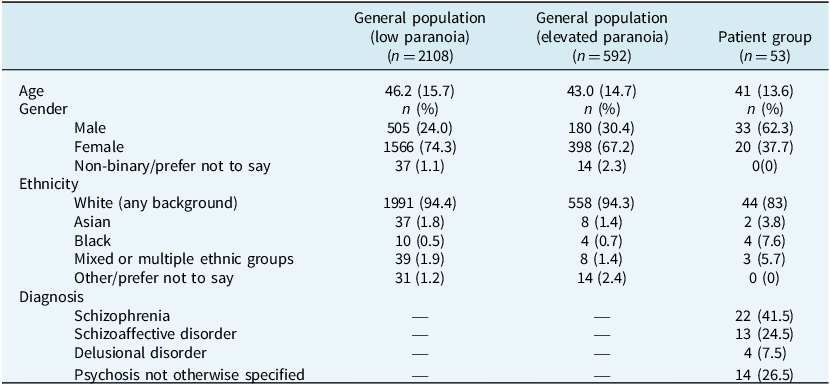
We recruited a total of 2753 participants across the full range of severity of paranoia. There were three groups: patients with persecutory delusions who were attending mental health secondary care services, individuals in the general population with elevated paranoia, and individuals in the general populations with low paranoia. See Table 1 for a summary of demographic and clinical information about the participants.
Demographic and clinical characteristics

Patients with persecutory delusions were participants in the THRIVE Trial (Freeman et al., Reference Freeman, Lister, Waite, Galal, Yu, Lambe, Beckley, Bold, Jenner, Diamond, Kirkham, Twivey, Causier, Carr, Saidel, Day, Beacco, Rovira, Ivins, Nah, Slater, Clark and Rosebrock2023), a randomised controlled trial of an automated VR therapy. The patients completed the item pool for the new scale at the end of treatment follow-up assessment (8 weeks). The main inclusion criteria for the THRIVE trial were (i) aged 16 years or older, (ii) a diagnosis of schizophrenia or related conditions (e.g. non-affective psychosis), (iii) persistent (at least 3 months) persecutory delusion (as defined by Freeman and Garety, Reference Freeman and Garety2000) held with at least 50% conviction, and (iv) who verbally reported feeling threatened when with other people. Participants from the general population were recruited online using social media advertisements. The inclusion criteria were: (i) aged 18 years or older and (ii) resident in the UK. To evaluate test–retest reliability, 343 participants from the general population repeated the questionnaire after a fortnight. The general population group was divided into those with elevated paranoia (n=592) and those with low paranoia (n=2108) using an established cut-off (6 or above) on the Revised Green et al. Paranoid Thoughts Scale – Part B (R-GPTS-B) (Freeman et al., Reference Freeman, Loe, Kingdon, Startup, Molodynski, Rosebrock, Brown, Sheaves, Waite and Bird2021b).
Assessments
Item pool for the Oxford Paranoia Defence Behaviours Questionnaire (O-PDQ)
The initial O-PDQ item pool was generated from an analysis of SBQ interview data from the first 106 participants in the Feeling Safe trial (Freeman et al., Reference Freeman, Emsley, Diamond, Collett, Bold, Chadwick, Isham, Bird, Edwards, Kingdon, Fitzpatrick, Kabir and Waite2021a). The interviews provided 777 unique descriptions of defence behaviours, which were analysed using inductive content analysis (ICA; Elo and Kyngas, Reference Elo and Kyngas2007). Behaviours with the same meaning were grouped together (e.g. ‘Rushing through tasks’ and ‘I’d do things as quickly as I can’; see Supplementary material, S2). The goal was to produce a potentially exhaustive list of avoidance and in-situation defence behaviours used in response to persecutory beliefs. ICA was carried out independently by two researchers (S.M. and S.L.) and discrepancies were discussed with another member of the research team (F.W.). ICA identified 22 avoided situations and 48 different in-situation defence behaviours. These were reviewed by five people with lived experience of psychosis for readability, ease of understanding, and completeness. The item pool was also reviewed by our team (F.W., J.B. and D.F.) to ensure face validity and completeness. Six in-situation behaviours (e.g. praying, listening to music) were excluded as they could be helpful coping behaviours rather than defence behaviours (e.g. one may be praying for the strength to face their fears whilst someone else may be praying so god will stop others harming them), which would be difficult to distinguish in a self-report assessment.
The final O-PDQ item pool had two separate scales: Avoidance and In-situation defences. These were introduced as strategies that may be used when people feel under threat of harm from others. The avoidance scale item pool included 22 everyday situations. Participants were asked to rate on a scale from 0 (never) to 3 (always) how much over the past two weeks they avoided each situation to prevent themselves being harmed by others. Higher scores indicated greater avoidance. The in-situation defences scale item pool included 42 in-situation behaviours. Participants were asked to rate on a scale from 0 (never) to 3 (always) how often over the past two weeks they had used each of these strategies to try to prevent themselves being harmed by others. Higher scores indicated greater use of in-situation defence behaviours. See Supplementary material (S1) for initial item pool.
Safety Behaviours Questionnaire – Persecutory Beliefs (SBQ)
The SBQ (Freeman et al., Reference Freeman, Garety and Kuipers2001) is a semi-structured interview that assesses defence behaviours used in response to persecutory beliefs. It is administered by an interviewer who assesses if a behaviour is being used to prevent harm by others. It assesses seven categories of behaviour: (a) avoidance of situations considered dangerous, (b) in-situation behaviours carried out when threat feels imminent, (c) escape from situations where danger is deemed imminent, (d) compliance with the demands of wishes of the persecutor, (e) getting help from others to reduce the threat, (f) aggression in response to threat and (g) delusional actions which are behaviours aimed at reducing the threat but where there is no logical relation to the achievement of this aim. After a safety behaviour has been elicited, the participant is asked to rate its frequency over the last month on a 4-point scale (1, behaviour definitely occurred on at least one occasion; 2, occurred more than once but not frequently, e.g. not more than five or more times; 3, occurred frequently, e.g. at least five times; 4, present more or less continuously, at least every day). Scores are then summed for each of the subscales. A distinction is made between avoidance, which can be considered a negative behaviour (SBQ avoidance score) and a combined score of the other six subscales, which reflects active attempts to reduce the threat, i.e. a positive behaviour (SBQ in situation defences).
Revised Green et al. Paranoid Thoughts Scale (R-GPTS)
The R-GPTS (Freeman et al., Reference Freeman, Loe, Kingdon, Startup, Molodynski, Rosebrock, Brown, Sheaves, Waite and Bird2021b) is a self-report measure assessing paranoid thinking. In the THRIVE trial it was used to assess paranoia over the last fortnight. The R-GPTS contains two separate scales assessing ideas of reference, R-GPTS-A (8 items), and ideas of persecution, R-GPTS-B (10 items). Items are rated on scale from 0 (not at all) to 4 (totally), with higher scores indicating higher levels of paranoid thinking. The score ranges for the ideas of persecution scale are: average (0–5); elevated (6–10); moderately severe (11–17); severe (18–27); and very severe (28+). The Cronbach’s alpha was 0.93 (n=1907) for ideas of reference and was 0.95 (n=1859) for ideas of persecution.
Measure of Common Responses to Psychosis (MCRP)
The MCRP (Tully et al., Reference Tully, Wells, Pyle, Hudson, Gumley, Kingdon, Schwannauer, Turkington and Morrison2017) is a 15-item self-report measure of cognitive and behavioural responses to psychosis. It has three subscales, each containing five items: conscious self-regulation, threat monitoring and avoidance, and social control and reassurance seeking. Respondents rate how much they engage in each behaviour in response to psychosis on a scale from 1 (never) to 4 (always). Higher scores indicate greater use of behavioural responses to psychosis. Cronbach’s alpha was 0.85 (n=1774) for conscious self-regulation, 0.83 (n=1774) for threat monitoring and avoidance, and 0.77 (n=1780) for social control and reassurance seeking.
Agoraphobia Mobility Inventory (AMI)
The AMI (Chambless et al., Reference Chambless, Caputo, Jasin, Gracely and Williams1985) consists of 26 items assessing avoidance of situations due to anxiety (i.e. agoraphobia). Items ask about avoidance of places (e.g. theatres, department stores, museums), transport (e.g. aeroplanes, buses, cars), specific situations (e.g. being home alone, standing in queues), and spaces (e.g. enclosed spaces, high places, open spaces). Items are coded on a 1 (never avoid) to 5 (always avoid) scale. There is also an option to select ‘not applicable’; as a result, mean item scores are calculated. Higher mean scores indicate higher levels of agoraphobia. The Cronbach’s alpha for the AMI was 0.96 (n=1777).
Brief Fear of Negative Evaluation Scale (BFNE)
The BFNE (Leary, Reference Leary1983) is a 12-item self-report scale measuring fears of negative evaluation, especially in social settings. Items are rated on a 5-point scale ranging from 0 (not at all characteristic of me) to 4 (extremely characteristic of me). Higher scores indicate a greater fear of being negatively evaluated by others. The Cronbach’s alpha for the BFNE was 0.74 (n=1719).
Patient Health Questionnaire-9 (PHQ-9)
The PHQ-9 (Kroenke et al., Reference Kroenke, Spitzer and Williams2001) consists of nine items assessing symptoms of depression over the past two weeks. Items are rated on a 0 (not at all) to 3 (nearly every day) scale. Higher scores indicate higher levels of depression. The Cronbach’s alpha for the PHQ-9 was 0.93 (n=1731).
Generalised Anxiety Disorder-7 (GAD-7)
The GAD-7 (Spitzer et al., Reference Spitzer, Kroenke, Williams and Löwe2006) is a 7-item scale assessing symptoms of generalised anxiety over the past two weeks. Response options range from 0 (not at all) to 3 (nearly every day). Higher scores indicate higher levels of generalised anxiety. The Cronbach’s alpha for the GAD-7 was 0.94 (n=1920).
Oxford Agoraphobic Avoidance Scale (O-AS)
The O-AS (Lambe et al., Reference Lambe, Bird, Loe, Rosebrock, Kabir, Petit, Mulhall, Jenner, Aynsworth, Murphy, Jones, Powling, Chapman, Dudley, Morrison, Regan, Yu, Clark, Waite and Freeman2023) is an 8-item self-report measure of agoraphobic avoidance of everyday activities. Respondents are asked to rate whether they could complete the activity: 0 (yes – I can do this now) or 1 (no – I would get too anxious); and how anxious they would feel doing the task, ranging from 0 (no distress) to 10 (extreme distress). Higher avoidance and distress scores indicate higher levels of agoraphobia symptoms. The Cronbach’s alpha for O-AS avoidance was 0.83 (n=1980), and 0.94 (n=1614) for O-AS distress.
Procedure
All participants completed the O-PDQ item pool and the R-GPTS. Patients within the THRIVE trial also completed SBQ administered by a research assistant. Participants in the general population also completed the MCRP, AMI, PHQ-9, GAD-7 and BFNE.
Statistical analysis
All analyses were conducted in R, version 3.6.1 (R Core Team, 2013). Only participants with complete O-PDQ item pool responses were included. Factor analysis was appropriate for the derivation sample for both the avoidance scale and in-situation defences scales, as Bartlett’s test of sphericity was significant (avoidance: χ2=5794.0, d.f.=231, p<0.001; in-situation defences: χ2=9213.007, d.f.=741, p<0.001) and the Kaiser-Meyer-Olkin (KMO) test of sampling adequacy was excellent (avoidance: KMO=0.94; in-situation defences: KMO=0.94).
Deriving the O-PDQ
A combined paranoia sample was formed with the participants from the general population with elevated paranoia and the patients with persecutory delusions (n=645). A randomly selected 80% of this combined paranoia group was used as a derivation sample (n=516) to extract items. This ensured that items selection and model development was conducted with the intended users (i.e. those with paranoia) of the measure. A confirmatory sample (n=2237) was then formed from the remaining 20% of the combined paranoia group and the participants from the general population with low paranoia.
Exploratory factor analysis (EFA) was conducted with the derivation sample (n=516) in the ‘psych’ package (Revelle, Reference Revelle2020). Items that were highly correlated with other items (r≥0.8) were deleted prior to the EFA to avoid issues of multi-collinearity. EFA was estimated using principal axis factoring to account for non-normality in the data (Costello and Osborne, Reference Costello and Osborne2005) and oblique rotation. Parallel analysis and inspection of scree plots were used to determine the number of factors to extract. Items were deleted if they were theoretically inconsistent or redundant, did not load onto any factor, or had cross-loadings above 0.30 on multiple factors.
The model fit of the final set of items was examined using confirmatory factor analysis (CFA) in the confirmation sample (n=2237). CFA was conducted in the ‘lavaan’ package (Rosseel, Reference Rosseel2012) using the robust maximum likelihood (MLR) estimator due to non-normality in the data. Good model fit was determined using recommended thresholds of 0.90 (good) and 0.95 (excellent) on the comparative fit index (CFI) and the Tucker-Lewis index (TLI), and <0.10 and <0.06 on the root mean square error of approximation (RMSEA) and the standardised root mean square residual (SRMR), respectively (Bentler and Bonett, Reference Bentler and Bonett1980).
Test properties
The internal reliability of the avoidance scale and the in-situation defences scale was determined using Cronbach’s alpha. To examine test–retest reliability, a two-way, mixed effects, absolute agreement interclass correlation coefficient (ICC) was conducted. Validity was examined using simple correlations. Construct validity (convergent and divergent) was assessed in several ways. Convergent validity was tested using the MCRP threat monitoring and avoidance scale, as this scale measures similar defence behaviours in psychosis. The avoidance scale was validated against established measures of avoidance – the AMI and O-AS avoidance scale – while the in-situation defence behaviours scale was examined in relation to the O-AS distress score, as higher situational distress would likely be associated with increased use of in-situation defence behaviours. In the patient group the O-PDQ was compared with the gold standard for measuring defence behaviours in paranoia, the SBQ. The avoidance scale was compared with the number and frequency of avoided places and the distress scale was compared with both the number and frequency of defence behaviours identified by the SBQ. Construct validity was further examined by testing the O-PDQ’s relationship with paranoia severity using the R-GPTS ideas of reference and persecution scales, as the cognitive model suggests safety behaviours are a response to paranoid thinking.
An analysis of variance (ANOVA) was used to assess differences in O-PDQ scores across the different groups (general population-low paranoia; general population-elevated paranoia, and patients with persecutory delusions). Discriminant validity was tested using the MCRP seeking social support/reassurance scale and self-regulation scale to test whether the O-PDQ differentiates between defence behaviours and other behavioural responses to psychosis. The BFNE was used to demonstrate that the O-PDQ captures paranoia-specific responses rather than general social anxiety-related behaviours. Relationships with GAD-7 and PHQ-9 were examined as anxiety and depression frequently co-occur with paranoia and negative affect in relation to paranoia often drives the use of defence behaviours (Freeman et al., Reference Freeman, Garety, Kuipers, Fowler, Bebbington and Dunn2007).The ability of the O-PDQ to detect defence behaviours was assessed against the SBQ by descriptively comparing both the number of defence behaviours endorsed on the in-situation defence behaviour scale with the number of defence behaviours identified through interview on the SBQ. The number of places avoided identified on the O-PDQ was also compared with the number of places avoided in the avoidance section of the SBQ.
Results
Deriving the O-PDQ
Avoidance
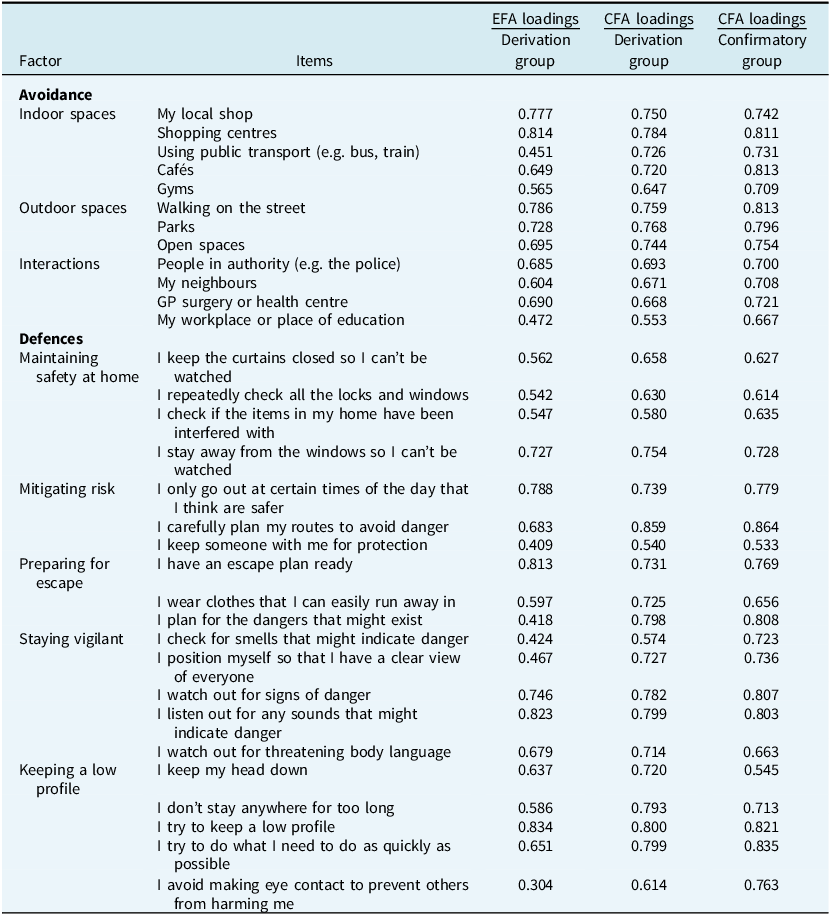
During EFA, 10 of the original 22 avoidance items were removed, including two items with low communalities (<0.3) (Staying at home alone; Staying at home with others), two items with extremely high loadings (>0.96) (Busy places; Restaurants), three items that did not load on any factor (>0.3) (Staying at home alone; Enclosed spaces; Unfamiliar places), one item that was cross-loading (Meeting people or social gatherings), and two items that were deleted for theoretical reasons or redundant content (Supermarkets; Being far from home). With the remaining 12 items, a three-factor structure consisting of indoor public spaces (5 items), outdoor spaces (4 items), and interactions (3 items) explained 51% of the variance (see Table 2 for factor loadings). Correlations between the factors were r=0.78 (indoor and outdoor spaces), r=0.70 (indoor spaces and interactions), and r=0.54 (outdoor spaces and interactions).
EFA factor loadings for O-PDQ avoidance and in-situation defences scale

CFA in the derivation sample (n=516) showed the three-factor model had an excellent model fit (χ2 =102.97, d.f.=51, p<0.001, CFI=0.97, TLI=0.97, RMSEA=0.037, SRMR=0.031). Similarly, in the confirmatory sample (n=2237), CFA demonstrated an excellent model fit (χ2=355.83, d.f.=51, p<0.001, CFI=0.98, TLI=0.97, RMSEA=0.04, SRMR=0.027).
In-situation defences
From the 42-item pool, two items were deleted due to high correlations (r>0.80) (I scan the area around me for any disturbances; I scan faces for signs of danger). During the EFA, nine items were deleted due to low communalities (<0.30) (I do not answer the front door; I call the police and legal professionals so that they can stop people targeting me; I keep track of suspicious things and events by taking pictures, videos, and audio recordings; I only eat or drink things I have prepared or opened myself, in case it has been interfered with; I wear things that hide my face, e.g. sunglasses, a cap; I carry something that I can use to protect myself; I make sure to avoid any cameras so they can’t track me; I confront others before they can attack me; I try to be nice and agreeable to prevent others from harming me); three items were deleted due to not loading on any factor (I try to alter my physical appearance so I’m less of a target; I avoid doing things that make me feel vulnerable to attack (e.g. showering, sleeping); I try to be unpredictable so I can’t be followed); two items were deleted as they loaded with another item on a two-item factor (I try to look tough to discourage people from attacking me; I avoid using technological devices in case they have been bugged or interfered with); one item was deleted due to cross loading (I position myself near an exit or escape route); and five items were deleted for theoretical reasons such as high endorsement by both elevated and low paranoia groups, not clearly a defence behaviour, duplication of another item, or long and poorly worded (I do not answer the phone; I repeatedly check, update, and/or review the security; I try to be ready for a fight; If I see any sign of danger I quickly leave the situation, even if I have not finished what I was doing; I make sure I’m visible so others can protect me). With the remaining 20 items, a 5-factor structure was identified that explained 54% of the variance: safety at home, mitigating risk, preparing for escape, staying vigilant, and keeping a low profile. Correlations between the factors were r=0.43–0.66.
CFA in the derivation sample (n=516) showed the five-factor model had a good model fit (χ2=355.59, d.f.=160, p<0.001, CFI=0.95, TLI=0.94, RMSEA=0.049, SRMR=0.048). Similarly, in the confirmatory sample (n=2237), CFA demonstrated a good model fit (χ2=160.05, d.f.=160, p<0.001, CFI=0.95, TLI=0.94, RMSEA=0.046, SRMR=0.039).
Scale reliability
Internal consistency was excellent for both the avoidance scale (α=0.92, n=2753), and in-situation defences scale (α=0.94, n=2753). A total score can be calculated for the avoidance scale by summing all 12 items. The avoidance scale has one ‘n/a’ option for item 12 (‘My workplace or place of education’). If selected, this item is scored with the mean item score, calculated from the other 11 items (item 12 = sum of items 1–11 divided by 11). Similarly, a total score can be calculated for the in-situation scale by summing all 20 items. Test–retest reliability after two weeks in the 343 participants from the general population was good for both avoidance (ICC=0.81, 95% CI=0.77–0.85) and in-situation defences (ICC=0.89, 95% CI=0.86–0.91).
Scale validity
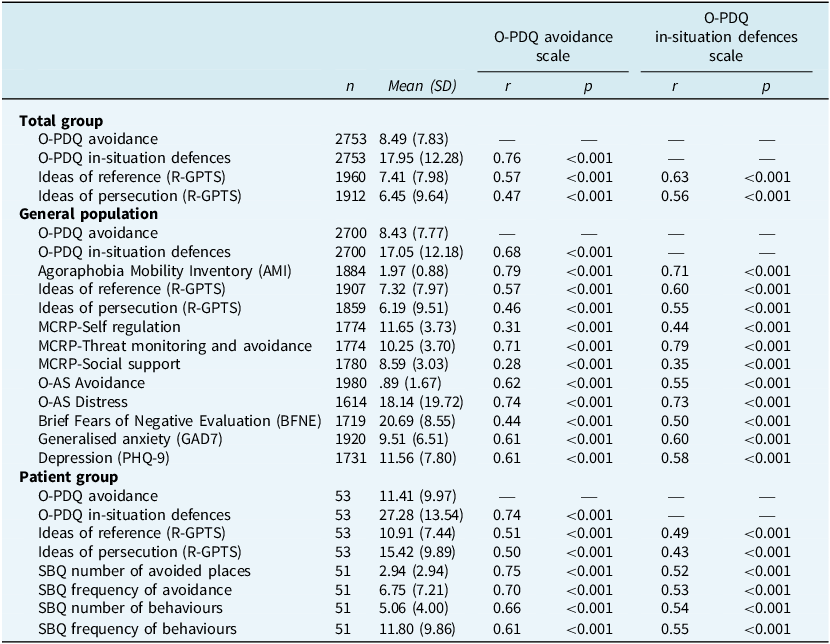
Mean scores and correlations between the O-PDQ avoidance and in-situation defences scales and measures of responses to psychosis, agoraphobic avoidance, paranoia, depression, and generalised anxiety are shown in Table 3.
Descriptive statistics and bivariate correlations between the O-PDQ scales and other measures in the general population and patient group

The O-PDQ showed good construct validity. In terms of convergent validity, both scales showed strong correlations with the MCRP threat monitoring and avoidance scale. Both O-PDQ scales showed moderate to strong correlations with established avoidance measures (AMI and O-AS avoidance scale), with the avoidance scale showing slightly stronger correlations compared with the in-situation defences scale. Both scales were strongly correlated with the O-AS distress scale. In the patient group, the O-PDQ avoidance scale showed a strong correlation with the both the number of avoided places and the frequency of avoidance reported on the SBQ. The distress scale showed a moderate correlation with both the number of defence behaviours reported and the frequency of defence behaviours reported on the SBQ. Supporting the theoretical relationship with paranoia, both O-PDQ scales showed moderate correlations with the R-GPTS ideas of reference and ideas of persecution scales. Further supporting construct validity, there was a main effect of group on both the avoidance scale (F 2,2750=138.8, p<.001, η2=0.09, 95% CI [.07, .11]) and the in-situation defences scale (F 2,2750=247.4, p<.001, η²=0.15, 95% CI [.13, .18]). Games-Howell post-hoc comparisons showed that the general population-low paranoia group (in-situation defences M=14.6, SD=10.9; avoidance M=7.2, SD=7.2) scored significantly lower on both scales compared with both the general population-elevated paranoia group (in-situation defences: M= 25.8, SD=12.4, p<0.001; avoidance: M=12.9, SD=8.1; p<0.001) and the patient group (in-situation defences: M=27.3, SD=13.5, p<0.001; avoidance: M=11.5, SD=10.0, p<0.01). The general population-elevated paranoia and patient group did not significantly differ on the in-situation defences (p=0.72) or avoidance (p=.586) scales. To examine this further, paranoia levels across the three groups were compared. Again, there was a significant main effect of group on paranoia (F 2,1909=1696.5, p<0.001, η²=.61, 95% CI [.58, .63]). Games-Howell post-hoc comparisons showed that the general population-low paranoia group (M=0.9; SD=1.4) scored significantly lower than both the general population-elevated paranoia group (M=17.4; SD=9.8; p<0.001) and the patient group (M=15.4; SD=9.9; p<0.001). As with the O-PDQ scales, the general population-elevated paranoia and patient groups did not significantly differ (p=0.34).
The discriminant validity of both O-PDQ scales was supported by weak correlations with other behavioural responses to psychosis (MCRP social support/reassurance and self-regulation scales). While correlations with the BFNE were moderate, they were slightly weaker than with paranoia. Moderate correlations with generalised anxiety and depression were observed.
Fifty-one patients with persecutory delusions completed both the O-PDQ and SBQ. The average number of defence behaviours endorsed to any degree on the O-PDQ was 14.1 (SD=4.8) and endorsed as often or always was 8.7 (SD=5.8) compared with an average of 2.16 (SD=1.8) defence behaviours identified using the SBQ. The average number of places avoided to any degree on the O-PDQ was 5.7 (SD=4.3) and avoided often or always was 3.6 (SD=3.6) compared with an average of 2.9 (SD=2.9) identified by the SBQ.
Discussion
In this study we aimed to develop the first self-report measure of defence behaviours used in response to paranoia. Items were derived from interviews with over 100 patients with persecutory delusions and tested with over 2700 people across the spectrum of paranoia. The resulting Oxford Paranoia Defence Behaviours Questionnaire (O-PDQ) has an excellent model fit, test–retest reliability, and construct validity. Good convergent validity was evidenced through high correlations with established measures of in-situation defences and avoidance. Both scales showed a moderate correlation with paranoia. The moderate, rather than strong, correlation with paranoid thinking reflects the distinct but related nature of these constructs. While defence behaviours are employed in response to paranoid thoughts, individuals may employ other strategies such as seeking support or using adaptive coping techniques. Discriminant validity was evidenced through minimal correlations with other behavioural responses to psychosis and a slightly weaker correlation with social anxiety compared with paranoia. Stronger correlations with anxiety and depression were found compared with paranoia, a pattern previously reported by Tully and colleagues (Reference Tully, Wells, Pyle, Hudson, Gumley, Kingdon, Schwannauer, Turkington and Morrison2017). This supports a close link between defence behaviours and emotional distress. Further validation of the measure comes from a study with a representative sample of 10,000 UK adults that tested 22 cognitive and social factors potentially associated with paranoia: use of in-situation defence behaviours as assessed by the O-PDQ was the factor most strongly associated with paranoia (Freeman and Loe, Reference Freeman and Loe2023).
The factor structure of the O-PDQ provides a framework for understanding avoidance and in-situation defence behaviours in paranoia. The avoidance scale has a three-factor structure – (i) avoidance of indoor or enclosed spaces, (ii) avoidance of outdoor or exposed spaces, and (iii) avoidance of interactions, which cuts across indoor and outdoor spaces and instead relates to the people that might be present and the expectation for proximity and interaction (e.g. a workplace or a GP appointment). The in-situation defence behaviour scale had a five-factor structure: (a) securing the home from danger, (b) mitigating the risk, for example by having someone with you or taking a safer route, (c) staying vigilant for signs of threat, (d) preparing for escape in response to signs of threat, and (e) keeping a low profile when out so not to come to the attention of the persecutors. This framework helps conceptualise the different types of avoidance and in-situation defence behaviours.
The avoidance and in-situation behaviours measured by the O-PDQ may maintain paranoia through multiple mechanisms. The non-occurrence of harm may be misattributed to the use of the safety-seeking behaviours (e.g. I wasn’t attacked because I had someone with me) and they prevent opportunities for positive restorative experiences that would allow the development of new more helpful beliefs (e.g. avoiding eye contact and rushing reduces the chances of having a positive interaction with a stranger and strengthening of the belief ‘most people are friendly and helpful’). Defences (e.g. hypervigilance) also shift attentional resources to signs of threat, hampering the receipt and processing of new information or the identification of true signs of safety. Hypervigilance can also increase the processing of cues that activate fears and confirm misinterpretations. Furthermore, acting like a belief is real may make it feel real, possibly through the activation of a fear response or creation of corroborating memories, similar to the concept of fantasy elaboration in grandiose delusions described by Isham et al. (Reference Isham, Griffith, Boylan, Hicks, Wilson, Byrne, Sheaves, Bentall and Freeman2021). For example, having the memory of running home, terrified, because you perceived someone following you, would provide powerful reinforcement for the belief that you are in danger. In addition to directly maintaining paranoia, avoidance and in-situation defences serve to limit and isolate patients with deleterious effects on mental wellbeing. This may also partly account for the moderate correlation between defences and depression found in this study.
It is therefore not surprising that elimination, or at least reduction, of defence behaviours is a key feature of CBT for psychosis approaches (Freeman et al., Reference Freeman, Emsley, Diamond, Collett, Bold, Chadwick, Isham, Bird, Edwards, Kingdon, Fitzpatrick, Kabir and Waite2021a; Morrison, Reference Morrison2017). Clinicians need to be able to identify defence behaviours and distinguish them from adaptive coping behaviours. The O-PDQ identifies a number of subtle behaviours (e.g. wearing clothes that one can easily run away in; listening out for any sounds that might indicate danger) that may be easily overlooked in therapy. A long-acknowledged challenge is distinguishing coping and safety-seeking behaviours, particularly when they can be topographically similar (Salkovskis, Reference Salkovskis1991). In other words, a behaviour may be a defence behaviour in one case (praying for god to prevent you being harmed) but be a positive coping behaviour in another (praying because your faith gives you the strength to face your fears). This requires an assessment of both the intention of the behaviour (e.g. having someone with you to prevent you being attacked versus to provide distraction from voices) and the context it is used in (e.g. only going out at certain times of the day might be appropriate if you live in a dangerous area with high levels of crime). Self-report measures offer less flexibility, compared with interview, in assessing the functions of behaviours and wider context in which they occur. However, the O-PDQ can be a helpful clinical tool prompting a more detailed discussion around the behaviours identified and the reasons for their use. In addition, it can help frame these behaviours as a normal and understandable response to persecutory beliefs. Defence behaviours are often habitual and occur without much conscious awareness. The O-PDQ provides prompts to help people identify their defences; in contrast to interview measures, which depend more on the skill of the interviewer and the interviewee’s awareness, recognition, and recall.
There are a number of limitations. The general population group was recruited online and will not have been representative of the general population. Socio-economic status was not assessed, so it is unclear whether individuals from lower socio-economic backgrounds were represented. This may have influenced responses to avoidance items related to resource-dependent activities (e.g. gym use). Both the clinical and general population group were predominantly white and therefore the measure would benefit from further validation with ethnic minority groups. The clinical group in this study is relatively small and test–retest reliability was only assessed in the general population group. Although paranoid ideation occurs on a spectrum in the general population (Bebbington et al., Reference Bebbington, McBride, Steel, Kuipers, Radovanovic, Brugha, Jenkins, Meltzer and Freeman2013), the O-PDQ would benefit from further testing in a larger clinical group. Furthermore, an assessment of sensitivity to clinically important change, which was not assessed in the current study, would increase its utility for monitoring progress in therapy. Nevertheless, the O-PDQ demonstrates robust psychometric properties and fills an important gap in the measurement of paranoia-related defence behaviours. The standardised format and ease of administration may facilitate greater attention on defensive behaviours – the key maintaining factor in paranoia – across both research and clinical settings.
Supplementary material
To view supplementary material for this article, please visit https://doi.org/10.1017/S1352465825100994
Data availability statement
Data are available upon reasonable request. Deidentified participant data will be available in anonymised form from the corresponding author (SL) on reasonable request (including a study outline), subject to university approval.
Acknowledgements
We would like to thank the participants who took part in this study and the lived experience advisory group. We would also like to thank the three NHS trusts that participated: Oxford Health NHS Foundation Trust, Berkshire Healthcare Foundation Trust NHS, and Central and North West London NHS Foundation Trust.
Author contributions
Sinead Lambe: Conceptualization (lead), Formal analysis (lead), Methodology (lead), Writing - original draft (lead); Sophie Mulhall: Conceptualization (supporting), Formal analysis (supporting), Writing - review & editing (equal); Jessica Bird: Formal analysis (equal), Methodology (equal), Writing - review & editing (equal); Kira Williams: Data curation (supporting), Investigation (supporting), Writing - review & editing (equal); Joanna Mitchell: Data curation (equal), Investigation (equal), Writing - review & editing (equal); Mollie Roddan: Investigation (equal), Writing - review & editing (equal); Glory Sokunle: Investigation (equal), Writing - review & editing (equal); Laina Rosebrock: Conceptualization (equal), Investigation (equal), Methodology (equal), Writing - review & editing (equal); Daniel Freeman: Conceptualization (equal), Formal analysis (equal), Funding acquisition (equal), Methodology (equal), Supervision (equal), Writing - original draft (equal); Felicity Waite: Conceptualization (equal), Methodology (equal), Supervision (equal), Validation (equal), Writing - review & editing (equal).
Financial support
The project was supported by a grant from the Medical Research Council Developmental Pathway Funding Scheme (MR/P02629X/1), an NIHR Senior Investigator (NIHR204013) award to D.F., and the NIHR Oxford Health Biomedical Research Centre. S.L. is supported by an NIHR Doctoral Fellowship (NIHR301483). F.W. is supported by a Wellcome Trust Doctoral Fellowship (102176/B/13/Z). D.F. is an NIHR Senior Investigator. The views expressed are those of the authors and not necessarily those of the NIHR or the Department of Health and Social Care.
Competing interests
The authors declare none.
Ethical standards
All participants provided informed consent. Ethical approval was obtained from the Medical Sciences Inter-Divisional Research Ethics Committee at the University of Oxford for the general population group and the NHS Health Research Authority (HRA) South Central – Oxford B Research Ethics Committee (REC reference: 18/SC/0316) for the patient group.


 Open access


Comments
No Comments have been published for this article.