

“Machismo”—the Latin American cult of virility that so often overpowers sweet reasonableness in moments of high passion
—Los Angeles Times, July 20, 1969On November 13, 1969, television stations across the United States aired a new episode of Ironside, starring Raymond Burr as the eponymous chief detective. Known for delivering hard-hitting, timely dramatizations of controversial themes, Ironside tracked into uncharted territory with this installment, entitled “The Machismo Bag.” The episode’s reliance on stereotype—the wise, paternalistic constancy of Burr’s character, contrasted with the belligerent, juvenile volatility of the Chicano dissidents under investigation—would have constituted familiar terrain for viewers. Yet the titular term machismo lay at something of a crossroads in terms of usage and recognizability.Footnote 1 Over the course of a decade, this word had trickled into English popular usage, but it remained unfamiliar enough that scriptwriters felt compelled to define it. Referring to the Chicano militants’ dangerous “machismo bag,” the junior, younger, debatably hip Detective Brown explains to his mystified boss: “Machismo. It’s a word often heard among Spanish-speaking people. Especially those raised in the old-country tradition. It means ‘manhood.’” “The Machismo Bag” thus introduced machismo (word and concept) as an exotic, ethnicized hypermasculinity that fueled the pathology and violence of the plot. In the episode, a Chicano youth rages against his father’s failed masculinity and consequently turns to rebellion, delinquency, and terrorism, going so far as to announce, in a standoff, “I’m the macho here!”
While we cannot know how viewers received this blunt message in 1969, the use of machismo in the show’s title, its painstaking definition in the script, and its application to contemporary problems furnish insight into the ways in which machismo was emerging as an anglophone word and set of concepts. The word has a relatively short history in Spanish and an even shorter history in English; yet, as I contend here, the latter history has enabled and governed the global, multilingual purchase of the term.Footnote 2 In this essay I trace that critical anglophone emergence. First, and most broadly, I argue that insight into machismo’s ascendancy in English—examination of where and how the word attained its current primacy—is necessary to break an endless cycle of scholarly wrestling with the significance, validity, and utility of machismo as a concept. Second, I show that machismo made its greatest gains as a term of English-language scholarship in the 1950s and 1960s. Presuming its own empirical superiority vis-à-vis supposed machismo, this scholarship inevitably fulfilled researchers’ expectations, and in doing so produced the term for authoritative entrée in popular lexicons thereafter. Third, in excavating the history of the word and the ideas it evokes, I argue that machismo, as it has been deployed since the mid-twentieth century, emerged in English as an ethnicized construction of hypermasculinity, forged and maintained at the nexus of social science, popular culture, racism, and empire. I explain this deployment—and machismo’s rise as a global epithet—as the result of social scientific, and later popular, anxieties about immigration, overpopulation, security, race, and public health.
If machismo flowed uneasily and awkwardly from scriptwriters’ pens and across US television screens in 1969, it has come a long way since then. Academicians played no small part in this, from the 1940s onward. Manifold studies of machismo, in several disciplines and countless Latin American communities, have made the word a focal point for gender study in the region. Beyond Latin America, moreover, research on masculinity has adopted machismo as a foundational paradigm.Footnote 3 I do not mean to cast summary judgment on gender studies in Latin America; indeed, a venerable tradition of historicizing gender has taken much more nuanced, contextualized approaches to patriarchy, honor, shame, masculinity, and other critical categories of analysis.Footnote 4 Yet machismo does inhabit a niche in the broader universe of scholarship on gender in Latin America; even those who seek to downplay or critique it seem obliged at least to address it. In a sense, research on machismo seems self-replicating. Over the course of the last four decades, scholars have investigated machismo as stigma; its realities and unrealities; its relationships with race and sexuality; its role among immigrants to the United States; its effects on Latin American women and, later, men themselves; and its function in religious settings, among different classes, and in various age groups.Footnote 5 A singular machismo has become various machismos, difficult to define and nearly impossible to delimit. Conceptually, machismo grows richer and more complex with each new investigation of it.
Machismo, however, is not simply a complex, critical element of gender systems in some Latin American communities. English speakers now use the word commonly, in a seemingly infinite menagerie of references to masculinity. Defined by Mexican dictionaries, as late as 1959, as something of an obscenity (vulgarismo grosero), the word has made its way into the New York Times, the Oxford English Dictionary, Joan Jett and the Blackhearts’ “Machismo,” and the expressions of countless popular and scholarly pundits (Reference SantamariaSantamaria 1959, 677). Sociologist Alfredo Mirandé (Reference Mirandé1997, 66) noted such broad appropriation twenty years ago in his landmark Hombres y Machos: “while traditionally … associated with Mexican or Latino culture, the word has recently been incorporated into American popular culture, so much so that it is now widely used to describe everything from rock stars … to burritos.” Certainly the 1990s saw machismo used in just the ways Mirandé indicates, but how “recent” could this incorporation have been in 1997, decades after machismo first appeared in such popular forums? Popular magazines had used the word as early as 1963, and the Washington Post a decade before that. What do we learn from those earlier usages? How did the word reach the heights of English vogue it has achieved today? The timing and the more general provenance of machismo as an English word remains unknown and generally unmentioned. How, when, and for what reasons did machismo enter English vocabularies?
Answering these questions is essential to understanding how the word developed its historical significance and contemporary prevalence. As I demonstrate below, in the two decades before “The Machismo Bag” aired, anglophone scholars propagated the term; following their lead, US popular sources picked up machismo and laid the foundations for its commonplace usage in years to come.Footnote 6 In the 1940s, 1950s, and 1960s, social scientists and public health authorities in the United States pathologized machismo as the source of problems within Latin America. Their scholarship also constructed machismo as a more hemispheric, geopolitical threat—one that transcended Latin America itself because Latin Americans, by dint of their supposed machismo, were (as a matter of course) putatively ill-equipped to resolve perceived threats of overpopulation and political precariousness. English-language scholarship drew vaguely on the work of Mexican essayists like Samuel Ramos and Octavio Paz—neither of whom, remarkably, used the word machismo in his early work. US scholars also encountered machismo in the putative expertise of fellow English-speakers who had spent time in Latin America (invariably referred to as “observers” of “Latin” society and “mentality”). Trailing in the wake of these academics, popular sources replicated and expanded the ethnicization of hypermasculinity. In the 1970s, popular media (like “The Machismo Bag”) increasingly used the word to register anxieties about the politics of race, immigration, youth, and radicalism. In other words, machismo gained purchase as an anglophone social science term, used to describe a variably imagined gender system that posed problems for Latin Americans themselves as well as for hemispheric (Cold War) security and development. US popular sources then took up the thread, adopting machismo often with direct reference to the scholarly sources, and as a moniker for dangerously emotive, alien, youthful, and/or immigrant masculinity—a destabilizing force that would generate dysfunction, rebellion, and disorder within Latin America and among the susceptible (by virtue of race, class, or age) on the US home front.
This article recuperates this lost history of machismo, both conceptually and linguistically. Combining manual consultation with optical character recognition, I have scoured English-language sources—books, scholarly articles, journals, newspapers, and magazines—to determine the time line and quantity of the word’s first detectable English usages. I used academic databases, digitized archives of individual periodicals, digital and print editions of books, broader databases covering many newspapers and magazines (particularly Google News), and paper editions of periodicals.Footnote 7 Part of this work relied on digital searching for the words macho and machismo—an invaluable tool, but one which then entailed a secondary, painstaking search through the individual sources to verify the existence and nature of digitally recognized occurrences. I also manually traced references in footnotes and parenthetical attributions. Based on this research, I detail the two related stages of anglophone adoption mentioned above, dating the term’s ascendancy in English—and its transformation into an epithet—to the scholarship of the 1950s and 1960s and the popular culture that followed on its heels.
My reading of these texts suggests that machismo emerged in English at this particular moment for several reasons. Among academics, use of the term reflected a frenzy of anxious social-science interest in two of the United States’ problematically near neighbors—Mexico and Puerto Rico. Linked anxieties about overpopulation, poverty, communist subversion, and increased immigration lent urgency to sociological, public health, and psychological research on these places and on associated communities. Propagating the academic use of the term machismo, such studies assumed and concurrently reinstantiated the term’s validity. Presuming, in contradictory fashion, their own empiricism, they found what they set out to find: not whether Latin Americans’ gender systems were problematic, but how they were. The resultant social science did not firmly ground machismo’s meaning but it did grant the word traction as a means of stigmatizing and pathologizing Latin American masculinities. In fact, a community of scholars, traceable from the 1950s until today, perpetuated stereotypes about Latin American gender, social organization, and national and regional viability. In a certain sense, academics, from María Bermúdez and Gustave Gilbert in the 1950s to revisionists in the 1990s, took part in a process that has produced the university student of today, who comes to class ready to understand machismo as an organic shorthand for hyperpatriarchal gender systems in the Americas and beyond.Footnote 8 This has occurred despite valiant intellectual countercurrents pioneered in the 1970s and 1980s by Chicana feminists and scholars like Mirandé, Miguel Montiel, and Maxine Baca Zinn.Footnote 9
When US popular sources adopted machismo, they followed the lead of those pathologizing academic forerunners, such that by 1970s, the word had become an English brand for any kind of negative masculinity. This development, too, reflected ambient anxieties about security, public health, and immigration. Like the scholarship it cited, popular use of the word reaffirmed neocolonial presumptions that “Latins” represented a racialized liability in the gambit for development and stability. Framed by the Cold War, machismo served as a way of talking about fears of susceptibility to Communism in Latin America. More important for the term’s English-language longevity, it became shorthand for anxieties about young people, race, radicalism, and security on the home front.
“Psychology of the Mexican”: Pelados, Machos, Pachucos, and Academics
Anglophone use of machismo first emerged in the work of researchers bent on answering questions about Latin American (particularly Mexican, Mexican American, and Puerto Rican) reproduction and families. In the 1950s and 1960s, a phalanx of US-trained psychiatrists, psychologists, sociologists, anthropologists, social workers, and vague “observers” set out to map the presumed problems of Latin Americans abroad and at home. Hitting upon machismo, these analysts precipitously, even heedlessly, propagated it as a kind of sobriquet for those problems. Drawing on national characterology (a species of hand-wringing, macro-level psychoanalysis then in vogue) and seeking new understanding of what anthropologist Oscar Lewis would dub the “culture of poverty,” US scholars loosely followed the lead of Mexican intellectuals Samuel Ramos, Octavio Paz, and a few others. It is important to note that Paz and Ramos, like Lewis himself, laid the groundwork for mythologizing Mexican hypermasculinity. In so doing, they highlighted previously naturalized gender experiences, enabling later critical frameworks. Nevertheless, the Mexican essayists’ characterologies, however pathologizing, racist, and classist, did not use the word machismo. Even the less exotic macho gained only a tenuous foothold here: Ramos’s Profile of Man and Culture in Mexico (Reference Ramos1934), often cited as the fountainhead of academic analysis of machismo, used macho but twice and carefully explained the word as a reference to “the male animal” (not a familiar, hypermasculine and human figure). Paz’s The Labyrinth of Solitude (Reference Paz1950), endlessly invoked as the source of knowledge-seeking on machista and machismo, scattered fourteen mentions of macho across a small excerpt, and put quotation marks around thirteen of those instances, indicating the word’s relative unfamiliarity even in Mexican Spanish of the time.
Still, many (if not most) scholars, in the mid-twentieth century and since, have mistakenly attributed the term machismo to these two sources. This trend reflects the disconnect between diffuse, early attempts to diagnose Mexican patriarchal masculinity, and US social scientists’ subsequent crystallization of machismo. Most strikingly, where Ramos and Paz had ruminated on a connection between manhood, inferiority, and national neuroses, US scholars sought to systematize that connection. Confident in the validity and superiority of their own empiricism, these scholars eagerly applied modern social science methodologies to the perceived problems of Latin America. They adopted the word machismo, imbued it with scientific sanction, and thus produced a self-fulfilling, lasting pathologization of the region’s gender, sexual, and reproductive cultures. Spurred on by the rise of Cold War area studies, the resultant explosion of scholarship scrutinized “Latin” character via gender and sexuality—notably through the masculinity of those Latin Americans closest to home: Mexicans and Puerto Ricans. Oscar Lewis exemplified the tendency to emphasize a “cult” of authoritarian patriarchy as an ethnically peculiar phenomenon, beginning with his work on the small community of Tepoztlán, Mexico. Lewis’s extremely influential oeuvre would attribute violent hypermasculinity to Mexican and Puerto Rican gender arrangements across national borders, rural-urban divides, and generations.Footnote 10 In the 1950s, this genre of scholarship proliferated; articles on Puerto Rican, Mexican, and Mexican American families and sexualities filled periodicals like the Journal of Comparative Family Studies, the International Journal of Social Psychiatry, the American Journal of Sociology, and American Sociologist. Such scholarship likewise generated tellingly titled books: Chicanos: Social and Psychological Perspectives; Across the Tracks; Psychology of the Mexican: Culture and Personality, to name a few. These and other publications went beyond Lewis and even further beyond Paz and Ramos, making machismo a code word for sick, degenerative masculinity. Poignantly illustrating this valence, the word appeared in Eugenics Quarterly as early as 1956 (Reference KiserKiser 1956, 58).
A critique of such research emerged in the 1970s, influenced by Chicano and black rights movements and by reaction to the Moynihan Report’s “tangle of pathology” model. Championed by the likes of Mirandé (Reference Mirandé1977), Montiel (Reference Montiel1970), Baca Zinn (Reference Baca Zinn1982), and Cromwell (Reference Cromwell and RuizCromwell and Ruiz 1979), this critique rang with insight and outrage. It identified and sought to depart from the rote pathologizations and the “pejorative view” of 1950s and 1960s social scientists (Reference MirandéMirandé 1977, 748). The critique itself was both timely and necessary. Still, it was couched in terms limited to Chicanos and to family studies, and wedded to self-proclaimed empiricism as an academic cure-all. Mirandé and his righteous comrades did not—indeed, could not—investigate much of what was salient about masculinity and the appearance of the term machismo in this context. Little attention was paid, then or later, to the ways in which the word served to stigmatize not just Chicanos but other Latin Americans and ultimately broader collectivities defined by masculine alterity; or to the reasons for this literature’s emergence and the lasting impact of its path to anglophone usage.
This critique, in other words, made signal contributions on several fronts and admirably resisted the pathologization of Chicano families. That resistance, however, must be broadened by seeking the underlying causes of pathologization and examining the centrality to it of machismo as a fascinating, new concept.Footnote 11 The wave of corrective research, though well-intentioned and methodologically thorough, continues to be limited by its very point of departure. Such research remains mired in the notion of machismo as a phenomenon more organic than constructed, one that must be addressed as a peculiarly Latin American (or more specifically Mexican) gender formation that can, in some way, be empirically measured, if only to disprove its negative connotations. Equally insightful and well-meaning studies of more recent vintage have acknowledged machismo’s racism but tend to fall back on ethnographic investigation of its current usage among stigmatized populations, thus reiterating the limited, empiricist critique that Latin American and Latino men do not always conform to machismo. Such critiques can be strengthened and broadened by asking essential questions about how machismo came to hold the academic and linguistic sway that it did and does—how, that is, researchers came to expect “Latin” men to conform to, or be perpetually measurable against and answerable to, the putative standard of machismo.Footnote 12
Let us turn, then, to the midcentury, anglophone social science I have mentioned. Why and how did it introduce machismo in this fashion? Why did the scholarly books and articles of the mid-twentieth century insist, virtually a priori, that a “cult of machismo” separated Latin Americans from Anglo-Americans, and that this cult generated gross distortions of personality among the former? Anthropologist Julian H. Steward, for example, explained in The People of Puerto Rico that “the male’s life is pervaded by a cult of machismo…. Even as an infant the male child is praised for being macho …, which really means ‘male animal’ rather than ‘man.’” (For the benefit of his presumably incredulous readership, Steward reiterated that “macho … ‘male animal’ … is thus used in a complimentary sense.”)Footnote 13 Such takes on Latin American masculinities reflected not only the presumed superiority of Anglo-American family and gender patterns—something that Mirandé, Montiel, Baca Zinn, and Cromwell would rightly have identified here—but also the zeal of English-language scholars to address “problems” in Latin America with the rationalized, technocratic eye of the modern social scientist. The questions of these scholars, then, tended to be shaped by forces evident in the work of Steward and many like-minded researchers. These forces included the self-assured presumption of the empirical problem solver, combined with US area-studies scholars’ penchant for seeking out weaknesses in Latin America’s security and development outlook.
North American scholars found those weaknesses, empirically or no. Secure in their own empiricism’s power to disentangle any potential pathologies, these scholars failed to interrogate the idea of that empiricism; so, in fact, did Mirandé and his fellow critics. To none of these researchers did it seem possible that empiricism itself—like, ironically, machismo—might prove chimerical, or at the very least variable and impossible to ensure. By placing the empirical approach of the North American academy on a pedestal, the academics who introduced machismo to English speakers sanctioned their own prejudices and stereotypes—sanctioned, that is, with the confidence of science, the idea that faulty masculinity lay at the heart of Latin America’s problems. Thus Mirandé’s and Montiel’s critique, however worthwhile, must ultimately go further; rather than pointing out that inherent, inescapable biases are at work in such study, Mirandé and Montiel argue that their predecessors simply did not approach machismo empirically enough. The critique, in other words, gets bogged down in a circular “more-empirical-than-thou,” in lieu of a challenge to the framework that generated English adoption of machismo, or to the idea that scientific approaches can seamlessly unlock categories like machismo, defusing inherent ethnocentrism.
Gordon Hewes’s 1954 essay in the American Journal of Economics and Sociology exemplifies the tendentious empiricism of midcentury Latin Americanist social scientists. Introducing himself as a representative of “modern anthropological thinking” and thus neither racially nor “ethnocentrically biased,” Hewes noted the surge in “national characterology” studies, sparked by the “exigencies of war and cold war.” Latin America, Hewes contended, needed these studies, performed by the “modern” social scientists who had but recently begun to “affect” the field. Despite late “advances” toward legitimate social science, he lamented, “the study of Mexican national character remains primarily in the hands of philosophers and essayists,” like Ramos and Paz. Thankfully, some “influence of psychoanalysis and the social sciences” had now arrived and this should “yield very valuable results.” These results not yet forthcoming, however, Hewes drew on a smattering of Mexican intellectuals (Ramos, Carlos M. Velasco Gil, José E. Iturriaga, Xavier Tavera Alfaro, Leopoldo Zea) and North American anthropologists (notably Oscar Lewis) to paint a picture of “the Mexican” as a pelado or macho, “irrational,” dependent on “the fiction of his enormous virility,” characterized by “phallic obsession” and “extravagant obscenity.” Using the word machismo—which neither Ramos nor Paz’s Laberinto had used—Hewes concluded that alcoholism, poverty, and overpopulation were the harvest reaped from this characteristic: “Wracked by doubts of his personal worth, and under the constant strain of defending his hypermasculinity or machismo, he finds solace in tequila, mescal, rum, or if he can afford it, whiskey.” Hewes added that further “scientific description … should improve our understanding of the Mexican people,” a key step in such dubious times, as “the Mexicans are not only the permanent southern neighbors of the United States, but are a significant ethnic minority within our boundaries” (Reference Hewes1954, 209, 218–222, 223).
“Scientific description,” then, would bring the benefit of empiricism to the study of Latin America (and Latin Americans)—and yet Hewes had already outlined the conclusions of such descriptions. Preoccupied with the effect of Latin America’s presumed pathologies on the United States, and explicitly acknowledging concern about the region’s Cold War security, scientists like Hewes endeavored to find out not whether Latin Americans were pathologically irrational, macho, and phallic/alcoholic/prolific, but why (or how) they were. Hence sociologist Nathan Whetten, in his 1948 Rural Mexico, put forth the unqualified assertion that corruption and political disarray—indeed, “crisis,” according to Whetten—stemmed from “authentic Mexican machismo (masculinity)” (Reference Whetten[1948] 1969, 544–545). Like Whetten, Orrin E. Klapp made conclusions about machismo and Mexican instability based on informal interviews and a dalliance in Mexican literature, all the while insisting that in so doing he was empirically avoiding “inaccuracy” and “stereotype.” Mexicans, he wrote, “stereotype Americans as gringos … but they have more realistic concepts of other Mexicans.” Klapp spoke with Mexicans; hence, he concluded, his findings would accurately “reflect national character.” That character, he found, was bound up in “types,” the foremost of which was “a man who is muy macho (strong, virile, valiente, stubborn, fuerte), a man’s man.” To Klapp’s eye, “the macho theme” lent Mexicans a predilection for “rash things,” “rebeldía,” and “revolutionaries and Communists.” While he acknowledged the speculative nature of his assertion that “perhaps our own [US] … attachment to capitalism is a little stronger,” Klapp nevertheless did not question his conclusions about Mexican character. “One [could] hardly look at salient types,” he averred, without concluding that “emphasis on courage and virility (macho) and contempt for the sissy (marica)” defined the “Mexican ethos” (Reference Klapp1964: 404–405, 411).
A sort of vicious-circular logic was at work here: setting out with questions about what was “wrong” with Latin America, these scholars reflected the need to answer such questions “empirically,” in the same culturally and academically imperialistic terms that justified their collective project. This need generated research that insisted on empiricism even as it habitually relied on the predetermined impressions of Klapp, Hewes, and Whetten or—shakier still—on the prognostications of an ill-defined cadre of “observers” of all things Latin. Indeed, though Klapp and some like-minded researchers sought to limit their interlocutors to denizens of the subject country, nonnative “observers” quickly came to form a backbone of information on machismo, male sexuality, and national character. Economist Raymond Vernon’s 1963 classic The Dilemma of Mexico’s Development, for example, affirmed the ongoing presence of retrograde caciquismo and machismo in Mexico by citing “seasoned observers of Mexican culture.” Continuing to insist on machismo’s centrality, Vernon appeared frustrated with the incalculability of his subject—a dizzying morass for even the most methodical of empiricists—which forced him to acknowledge that “Mexicans, like any other people, are made up of a wide range of temperaments, outlooks, and subcultures.” Yet the ever-ready observers provided an escape valve from this complexity: “Still,” he added, “considerable emphasis is placed by most observers on the role of machismo in Mexican culture.” Vernon proceeded to affirm the self-centered machismo of the “Mexican adult character”—something that made Mexicans generally unreliable, not only personally but politically and macroeconomically. (“Short-run planning,” he explained, “demands machismo more than it demands mathematics.”) Mexico might save itself “if machismo diminishes and the rational approach becomes ascendant” (Reference Vernon1963, 159–160, 168).
J. Mayone Stycos, the late and distinguished sociologist, furnished further evidence of this reliance on “observers” among the self-described empiricists who propagated machismo in English. In the early 1950s, Stycos set out to investigate Puerto Rico’s putative overpopulation crisis. His accounts typified a school of research in which raced, classed, and sexualized North American anxieties colored social science on Latin America. Much of this anxiety coalesced around theories of “overpopulation,” in which high birth rates and low death rates in Latin America inhibited the population control thought central to public health and anticommunist development. Neo-Malthusian fears of a “population explosion” or “population bomb” proliferated among North American academics in the 1950s and 1960s, and Stycos joined the researchers scrambling to address the ersatz apocalypse (Reference Desrochers and HoffbauerDesrochers and Hoffbauer 2009). As Laura Briggs (Reference Briggs2002, 119–121) has expertly articulated, Stycos’s caricatures of Puerto Ricans as oversexed “grotesques” wrote neocolonial social science across women’s bodies, justifying US intervention in the name of Cold War “development through democracy.”
Yet much of what Stycos and like-minded colleagues had to say dealt essentially with men’s bodies and sexualities and stemmed from vague “observation” of Latin American subjects. Stycos, followed by a cadre of anthropologists, medical professionals, and sociologists, concluded that machismo predetermined dangerous instability in Puerto Rican society. Men, unable to control their machista drive to father as many children as possible, had overpopulated the island, multiplying the undernourished, undereducated, unsupportable, and politically vulnerable masses. Reflecting the presumptions of empiricism we saw in Hewes and Klapp, Stycos insisted on the importance of machismo—despite evidence to the contrary in his own research. Using “modern” methodology, Stycos queried one hundred men, asking “How does machismo manifest itself?” Only 5.8 percent of respondents answered that “procreando hijos” (siring children) demonstrated machismo—a sharp contrast from the 14 percent who responded that machismo meant “virtudes cívicas (trabajando duro, siendo fiel cumplidor del deber en el trabajo y en la casa)” (civic virtues: working hard, faithfully fulfilling duty at work and at home), or the 18.2 percent who saw machismo in “siendo honrado y digno de confianza” (being honorable and worthy of trust). Nevertheless, Stycos continued to blame rampant reproduction on “the tendency, on the part of men, to identify a big family with ‘machismo’” and on the idea of siring children as the “proof sine qua non of manliness.” Stycos’s intransigence stemmed, at least in part, from dependence on “observers,” so much so that—as he admitted in a footnote on the importance of machismo in child rearing—“Since observational techniques were not part of the present project, the reports of other observers must be relied upon here” (Reference Stycos1958, 42n6). In a separate, coauthored article, Stycos acknowledged that “there has been much disagreement on the meaning of the term [machismo] among the [Puerto Rican] population,” and that there was some evidence for other factors in reproductive decisions (Reference Back, Hill and StycosBack, Hill, and Stycos 1960, 570). Yet he and his collaborators still concluded that machismo was the key to overpopulation. “Expressions of machismo,” they wrote, “are noticeable enough to catch the attention of observers”—demonstrating, the article implied, machismo’s primacy even in the face of evidence to the contrary.
The “observer” phenomenon extended beyond Stycos to other key anglophone students of machismo. Beatrice Griffith, credited with the earliest English-language use of machismo, was in fact something of an observer herself. A Los Angeles social worker, Griffith worked with Mexican American youth in the 1930s and 1940s, then published her impressions (Reference GriffithGriffith 1947). Her 1948 book American Me attempted to recuperate a “lost generation” of pachucos, whose “confused ideas about American democracy” Griffith found downright alarming (Reference Griffith[1948] 1973, 50). Machismo, according to Griffith, explained the rampant delinquency and violent behavior of her male subjects. Griffith would thenceforward appear in endless citations as (to quote one later researcher) “a sensitive observer of social conflict”; her ruminations on machismo among her clients would become foundational to the study of machismo more generally (Reference Madrid BarelaMadrid Barela 1973, 38). Likewise, Evelyn Stevens, a political scientist whose 1970s work on machismo and marianismo is now canonical, went so far as to define machismo in terms of the “postulations” of observers. Machismo’s importance was presumptive, even obvious, she implied, as “foreign observers call it the ‘cult of virility’ and almost anyone who has lived for some time in Latin America includes its many manifestations in a list of distinguishing characteristics of the region.” Critiquing the notion of machismo as a classed, limited phenomenon, she retorted that “a chorus of observers … sees ramifications in every social class and in every country of Latin America” (Reference StevensStevens 1965; Reference Stevens and Pescatello1973, 91).
Justifiably troubled by this “observer” phenomenon, Alfredo Mirandé astutely denounces it as a reliance on “outsider” views. As Mirandé points out, research on machismo in the last quarter of the twentieth century followed the patterns laid out in work like that of Stycos, Vernon, Griffith, and Stevens. The solution proposed in Hombres y Machos—reliance on “insider” perspectives like that of Mirandé himself—responds with understandable ire to the pathologizations and the observer-laden prognostications of the early literature; yet such a solution merely exchanges one group of observers for another and cannot begin to destabilize the empiricist presumptions that facilitated that literature (Reference MirandéMirandé 1997, 6).Footnote 14
“The male animal in these regions is worse than the baboon”: Academic Machismo Makes the Leap to US Popular Media
When it came to English-language usage of machismo, and the importance of that usage for epitomizing stereotypes and subsuming anxieties about Latin American gender systems, popular sources soon quite literally followed academicians, drawing both the word and its authoritativeness from the scholarship outlined above.Footnote 15 If Mirandé noted machismo’s ascendancy in US popular lexicons in the 1990s, the crucial years of its entry process occurred decades earlier, in the late 1960s and early 1970s. Machismo’s novelty in this period lent it unwieldiness, and its transition into English can be followed by tracing the facility (or lack thereof) with which popular sources used it. These were years when machismo appeared in printed English with widely varying levels of familiarity (evidenced by italics, quotes, apostrophe or lack thereof); when some journalists began using machismo as a global referent for masculinities, while the Los Angeles Times readers’ quiz could, in 1969, still ask: “What is the meaning of the Latin expression ‘machismo’?”Footnote 16 One Chicago writer, for example, though she did not italicize or apostrophize the word in her title—“Machismo comes to Chicago”—did provide a small pronunciation guide next to the headline (“mah-CHEESE-moe”).Footnote 17
Television followed suit with programs that sought to capitalize on the word’s vogue. Ironside, as we have seen, surrounded its reference with heavy-handed dialogue; but mention of machismo also surfaced in television journalism. First Tuesday, NBC’s answer to Sixty Minutes, aired a special on machismo on December 2, 1969. The broadcaster’s synopsis demonstrated a desire both to introduce machismo to the uninitiated and to brand it the purview of Latin American men. The show would cover “‘machismo,’ the lusty, robust life style of Latin American men. Literally translated, the word means ‘he-goat.’ The program was filmed in Mexico, where the macho life style is strongest today, and includes interviews with three of Pancho Villa’s widows. Villa had more than a dozen wives without a single divorce. Around here that’s not known as machismo but bigamy.”Footnote 18
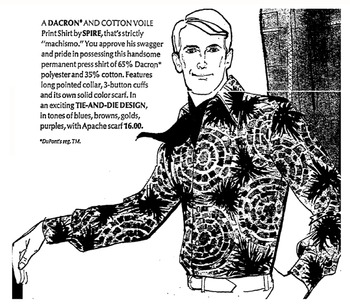
Advertisers, too, got into the act, acknowledging that the word had some cachet. A 1969 advertisement invited women to “approve his swagger and pride” by purchasing “him” a patterned polyester shirt “that’s strictly ‘machismo.’” The ad (Figure 1) reflected the hesitant use of machismo at this early point in its English-language history. Writers put the word in quotes, modified its syntax, and applied it to a drawing of a white, blond man. Yet they referred to the “swagger and pride” that machismo connoted—a possible, if uncertain, reference to Latin American derivation.
Advertisement, Los Angeles Times, December 15, 1969, p. 6.

For all the uncertainty and variable familiarity that these popular sources demonstrated vis-à-vis machismo, however, newspaper and popular magazine articles drew on academic usage of the term. The spread of machismo in academic parlance enabled its entrance into popular vocabularies. Introducing machismo to potentially unfamiliar readers, journalists cited the school of social scientists described above: anthropologists, psychologists, medical professionals, and sociologists who had already made the term a byword for the putative pathologies of Latin American men. Indeed, in the earliest example I could find of machismo’s use in a major newspaper, the Washington Post printed a 1957 article covering sociologists’ work on “what the Pachucos mean by ‘making machismo.’” This oblique reference to Beatrice Griffith accompanied explicit mentions of the American Sociological Association and police sociologists Arthur Neiderhoffer and Herbert A. Bloch—indeed, their putative expertise in combating machismo (and thus delinquency) was the focus of the article and the reason for the word’s appearance in the newspaper.Footnote 19 Later articles would more directly transfer the academic pathologizations described above. Time first used the word in 1963, drawing on sociology for definition and provenance and intimating the hemispheric proportions of machismo’s potential liability. The article, “The Americas: The High Cost of Manliness,” described machismo’s harvest of political and personal instability among Latin Americans: “Whether involved with a mistress, a mishap or an election, the Latin American male is constantly forced to prove his aggressive masculinity by a compelling phenomenon called machismo…. It turns arguments into blood feuds, business dealings into tests of strength, and heroic revolutionaries into ruthless tyrants…. Sociologists contend that machismo is a hangover from the days [of] bloodthirsty Spanish conquistadors.”Footnote 20
Sociologists, however, did not get sole credit for discovering machismo. Popular sources drew on a variety of social-scientific experts and replicated their ideas about manhood, political instability, poverty, and overpopulation. A 1968 Washington Post dispatch from Mexico City, for example, defined machismo and its effects “according to a leading psychologist here.” Paraphrasing this anonymous psychologist, the Post blamed machismo for “the Mexican’s love for guns” and concluded that “this ‘machismo’ seems to reach a peak when a Mexican’s pride is hurt, his heart betrayed, or his stomach full of alcohol.” Likewise, a New York Times article alleging that “cultural, migration and poverty problems” had led to widespread neuroses among Puerto Ricans in New York—“male anxieties about masculinity or ‘machismo’”—cited the work of sociologist Joseph P. Fitzpatrick and psychiatrist Robert E. Gould.Footnote 21
Predictably, given this link to academic sources, anxieties about masculinity aggravating Latin America’s political liabilities and its alleged overpopulation problem (sensationalized by Paul Ehrlich’s 1968 Population Bomb) made the leap to popular media. Newspapers and magazines presented reproductive patterns in Latin America—the supposed cause of destabilizing population explosions—as a pathological symptom of machismo. Time’s early mentions of machismo conjured fathers with a “he-man obsession” who felt masculinity “is to beget children, not support them” (1963); or a Latin American “complex” in which “a man who has fathered only five or six children may be regarded … as something of a laggard, if not bordering on impotence” (1965).Footnote 22 Similar mentions in the Los Angeles Times, the New York Times, and the Washington Post showed journalists replicating the academic linkage between machismo and overpopulation. The Los Angeles Times, for example, defined machismo as “the attitude that a man is weak or impotent unless his wife is almost constantly pregnant.”Footnote 23 The Post, in turn, quoted a US Senate Foreign Relations Committee report that defined “the ‘machismo’ complex … as excessive preoccupation with establishing masculinity,” which inhibited birth control methods promoted by the United States. Such inhibition, the report and the article intimated, would further predispose the region to “domination from Moscow, Havana, or Peking.” Indeed, the Post subtitle made this connection in no uncertain terms: “Senate Unit Warns on Red Influence.”Footnote 24 Other newspapers, too, linked machismo and subversion, often drawing directly on the scholarship. One 1969 article cited (unnamed) sociologists to blame “‘machismo’ and ‘Don Juanismo’” for “fueling extremist political agitation” in the Dominican Republic.Footnote 25 Machismo, in other words, caused the proliferation of Latin Americans, generating multitudes who could be expected neither to support themselves nor to resist the lures of the East.
“Machismo über alles”: Machismo and Communism in Popular Media
The popular association of machismo with subversion, like the academic work on which it drew, transcended anxieties about overpopulation. English-language press further pathologized the “he-man obsession” as an inherently destabilizing force that would predispose Latin American men—irrational as they were thought to be—to communism. The tone of the overpopulation-related articles above reveals the familiar Cold War perception of Latin America as a protocommunist powder keg; machismo undergirded this perception in a variety of ways. Time magazine’s “The High Cost of Manliness,” for example, contended that Castro’s machismo—“the whiskery look of virility”—had catapulted him to power in Cuba; and furthermore that Cubans’ machismo—the “compulsion to follow a macho leader” and the inability of anti-Castro Cubans to cooperate—granted Fidel’s regime its longevity.Footnote 26 Suggestion that Latin American (especially Cuban) machista volatility would cause faulty political judgment cropped up so often as to become a regular theme of the word’s English-language debut. In 1967, the Post’s John Goshko wrote that Latin American machismo explained what he called the “emotional appeal” of Ché Guevara: “In a part of the world that places a high premium on ‘machismo’ (manliness), the beards, fatigue uniforms, and other trappings of guerrilla warfare strike a responsive chord.”Footnote 27 The New York Times, meanwhile, acknowledged that the Cuban Revolution’s gender equality policies belied machismo, but quoted a Cuban film director to affirm that “it is, after all, the machista spirit that creates revolutionaries.”Footnote 28 In Los Angeles, Time magazine surmised that populist mayor Sam Yorty gained Mexican American votes because he “appeals to the Latin sense of machismo (masculine independence).”Footnote 29
Other journalists applied this thinking region-wide, locating machismo at the root of Cold War vulnerability throughout Latin America. In this they once again reflected the dubious conclusions of academics who, to echo Orrin Klapp, saw machismo as a source of “revolutionaries and Communists.” The New York Times’ Malcolm Browne wrote in 1968 that machismo had foiled US attempts to curb “the Latin military syndrome.” The region would remain susceptible to right-wing authoritarianism—and to left-wing subversion—so long as “the peculiarly Latin ideal of ‘machismo’ has … a special effect on military tradition.”Footnote 30 A year later, the Washington Post blamed “Machismo über alles … of which Latins are so inordinately proud” for hemispheric anti-Americanism, and for a “truculent super-nationalism à la Fidel Castro” that threatened U.S. interests across Latin America.Footnote 31 In an ironic twist, Los Angeles Times contributor David Belnap urged more political rights for Latin American women—because, according to Belnap’s reasoning, women might temper machismo-fueled Cold War liabilities. In “Some Gains, Sí, but You’ve Still Got a Long Way to Go, Señorita,” Belnap cast women (from Christian Democrats to pro-coup agitators) as centrist ballast that saved Latin American men from the “extreme left” tendencies facilitated by machismo.Footnote 32 The journalistic propensity to link machismo and dangerous revolutionism in Latin America ran so deep that one New York Times writer, in an article titled “How One Pleasant, Scholarly Young Man from Brazil Became a Kidnapping, Gun-Toting, Bombing Revolutionary,” expressed surprise that a member of the Brazilian guerrilla group Vanguarda Popular Revolucionária was not a quintessential macho.Footnote 33
“A Family Fight”: Machismo and Revolutionism on the Home Front
Major newspapers and magazines thus plucked machismo from academic sources and used it to indicate susceptibility to subversion within Latin America; but US popular media brought the word further into the mainstream as an idiom for understanding youth radicalism at home. Just as Ironside suggested that machismo underlay political militancy and gang activity, other popular sources unerringly linked youth radicalism—particularly Puerto Rican and Mexican—with machismo. This continued the trend of limning machismo as irrational, childlike, and liable to subversion, but also raised the stakes by bringing macho radicalism home and making it a particular threat to young people. Notably, this included expanding the scope of machismo by applying it to young, non-Latinx radicals.
Chronicling the founding years of the Mexican American Youth Organization (MAYO), the Post’s William Greider wrote that the group’s anti-imperialist and even anti-American attitudes were bound up with “the Chicano’s machismo.” In his description of MAYO leaders, Greider went beyond any movement-based claims of protest masculinity, suggesting that the Chicano cause had originated organically in members’ “sense of manhood…. Machismo is to take on the gringo.”Footnote 34 A 1970 review article in the New York Times likewise tied political militancy to machismo. Nearly echoing Ironside, the article pointed to Chicano militants’ “kinship … to black separatist movements” and the ways that “cultural chauvinism (machismo)” had spawned “paramilitary cadres (El Tigre, the Brown Berets).” The reviewer did differentiate types of Mexican–American resistance—only to confirm that the distinction between the pacifist César Chávez and “La Raza’s violent chauvinism” was, in fact, machismo itself.Footnote 35 Several Times articles sought to explain the role of machismo among New York City’s Young Lords. “Right On with the Young Lords,” for example, noted the militants’ opposition to “capitalism … and the American military” and their commitment to socialism under the slogan “‘always until victory,’ the phrase Ché Guevara used.” All this, the Times suggested, was an outgrowth not only of the zeitgeist but of “the mores and traditions of Puerto Ricans,” including “so unequalitarian a tradition as machismo.” Author José Yglesias quoted the Lords’ own proclamation that “machismo must be revolutionary and not oppressive,” tempering its pathological implications for sex relations while reaffirming its potential for rebellion and militancy.Footnote 36
Such takes might have resembled the appropriation of machismo by Chicano activists themselves; but machismo, in the estimation of US journalists, did not apply only to Latin American or Latinx radicals. US popular media extended this reading beyond even black militancy, connecting dots between machismo, radicalism, and white, middle-class youth. Strikingly, this use of machismo engendered early English-language uses of the word without explicit reference to Latin America or Latinos. A 1970 article on antiwar activism referred generically to “the violent machismo posture of the radical left,” but other sources were more specific on a putative link between machismo, revolution, and violence. The New York Times’ Peter Babcox implied that clashes with police at Columbia University and the 1968 Democratic Party Convention could be traced to demonstrators’ rebellious machismo. Writing of the New Left and particularly of Students for a Democratic Society, Babcox denigrated “the wantonness of The Movement’s male chauvinism—greatly enhanced by the machismo mystique that inevitably flowed from the Columbia and Chicago confrontations.”Footnote 37 Time, meanwhile, suspected the Weathermen of consciously trying to use “machismo” to recruit fresh militants: “The Weathermen desperately try to act tough in ways that supposedly appeal to street kids.”Footnote 38
Even media outlets of more liberal disposition shared this vision of macho posturing as an explanation for revolutionism, or at least for the promotion or performance of it. The Village Voice saw the antics of rock band MC-5, particularly their empty “revolutionary rhetoric,” as “an expression of machismo,” part of a broader trend of “male chauvinism” in bad-boy pop music.Footnote 39 Feminist Susan Brownmiller, though sympathetic to revolutionary youth, wrote in 1970 that machismo had motivated the white men of these movements. In Brownmiller’s account, the Latin American origins of machismo remained clear and had here inspired the hot-headed activism of New Left men. “The white male radical’s eager embrace of machismo,” she wrote, “appeared to include those backward aspects of male supremacy in the Latin culture from which the word machismo is derived.”Footnote 40
By the late 1960s and early 1970s, then, machismo had moved beyond Latin Americanist social scientists and emerged as a journalistic epithet for madcap masculine susceptibility to revolution not only in Latin America, but also among young white men in the United States. Even Malcolm Boyd, who shared Brownmiller’s and the Voice’s tempered sympathy for youthful protest, condemned “machismo” as the marker of fruitless, destructive revolutionism. While Boyd favored “humanistic revolution,” he denounced the supposed macho showiness of young activists. “Self-styled heroes … in the movement,” he wrote, “must desist from exploiting the cult of personality, allowing machismo to be quiet heroism in ordinary life situations instead of bravado performance on well-lit stages.” Here Boyd cited the example of “an urban commune whose members were former students, all whites, from families that were upper-middle-class” and who threatened, via “machismo,” to devolve into violence or self-destruction.Footnote 41 As Boyd and Brownmiller make clear, machismo had become an idiom, even for those of more leftist persuasions, for talking about undesirable elements of revolution—nihilism and the frightening derailment of the young, white, best, and brightest.
Conclusion: “You Can Overcome It”
Fascination with machismo continues, in some ways, to determine its ethnicized applications in research; indeed, volumes of recent research, much of it rightly seeking to demonstrate complexity and mitigate stereotype, have focused on how men and women of Mexican, Latin American and/or Latinx descent respond to or conceptualize machismo.Footnote 42 The term machismo, then, has come full circle—from a word assumed (by “observers”) to be used by Mexicans and/or Mexican–Americans to describe an endemic gender construct, to an in-vogue academic and later popular loanword designed to connote hypermasculinity generally (albeit always vaguely a lo latino), to, today, a term presumed to have inherent significance to people of Mexican descent, whom researchers (fatalistically, inevitably) confront with the word. One present-day researcher’s question—“Are there still machos?”—neatly articulates the presupposition that there once were machos, essentialized hypermasculine types whose presence or lack organically haunts Latin American and Latinx masculinity. The presupposition posits these machos as part of an illusory, primordial cultural formation generated in pristine conditions, outside the matrix of transnational and transcultural scrutiny and stereotype (scholarly as well as popular) that I have illustrated here. Lost in translation, so to speak, is the way that that presumed significance—both to the subjects and to the social scientists—was built across decades, by racialized and pathologizing usage of a term that as late as 1930s did not have much traction, in either language, as a way of describing Mexican, Latin American, or Latinx masculinity.
I do not mean to dismiss any and all scholarship that takes up machismo; in fact, I deeply admire and have long been inspired by much of the research done on the subject. Nor do I mean to suggest that machismo, word and concept, has only been wielded in ways we might categorize as imperial. If nothing else, the Chicana feminists discussed above are evidence of alternate uses of machismo, as is the “protest masculinity” of the Young Lords. Likewise, I realize that many scholars (from the humanities, arts, and social sciences) will justly protest that they interact with people in Latin America who use the word machismo. I do not say that this is wrong or chauvinistic; nor do I wish to imply that these scholars are mistaken or that their experiences are anomalous. Rather, I am suggesting that the word’s prevalence, in Latin America and beyond, does not reflect a timeless reality of gender structure or (much less) the fault lines between different cultures’ gender structures, but that it may, instead, reflect the impoverished language that we use to delimit those categories. The decades-old struggle (and failure) to define machismo demonstrates, as much as anything else, that this construct obscures too many divergences and complexities to allow it any lasting coherence. Machismo cannot bracket a Latin American gender essence; rather, the word continues to confound attempts to make it stand for such an essence. (This is something several excellent ethnographies have documented, in work that takes seriously the widely varying responses to the question, “What is machismo?”)Footnote 43 Instead, many people, with variable relationships to Latinity, both in Latin America and far beyond, deploy the word machismo based in a history I have tried to outline here.
As indicated by much of the material above, by 1970 machismo had begun to blossom into a known English-language referent for negative masculinities everywhere. While one journalist tried to find an Arabic counterpart for “what the Latins call machismo,” many others applied this or similar phrases (“latinesque machismo”) to various corners of the world.Footnote 44 Thus machismo, in English, simultaneously gained global significance and remained distinctively Latin American. The Wall Street Journal neatly summed this up in 1970: “I suppose we all have some of the Latin American machismo inside us, but it’s anti-intellectual and you can overcome it.”Footnote 45 (Appropriately enough, the writer warned of overpopulation in the United States and blamed masculinity in this case, too.) Machismo, then, even when applied to white men in the United States, be they reluctant vasectomy patients or machista demonstrators, connoted pathology and unreason, putatively shared with those nonwhite and/or non-US subjects whom the term’s loanword status evoked. Directly citing social scientists who had introduced machismo to English media, popular forums took up the word, making it a vehicle for mid to late twentieth-century anxieties and linking manliness, public order, and racialized pathology. The word’s salience, throughout its ascent to English-language vogue, correlated directly with its conceptualization, by “experts” and dilettantes alike, as a liability in the race for security and development.
Presumptions of machismo’s categorical validity have proved shockingly persistent. Scholars, even in conscientiously conceived attempts to investigate the term, continue to treat machismo as a legitimate, self-sustaining, empirically measurable unit of analysis.Footnote 46 A much-cited 2008 psychological study, for example, blithely defines machismo as “a standard of behavior exhibited by men in Mexican culture,” then earnestly seeks the essence of machismo via a “full, representative sample of Mexican male behaviors” (Reference Arciniega, Anderson, Tovar-Blank and TraceyArciniega et al. 2008, 19). A similar 2010 article cites “speculation” that Latino men “endorse more traditionally masculine gender roles than European American men” (Reference Saez, Casado and WadeSaez, Casado, and Wade 2010, 117). Again, the presumption is that machismo is a Mexican and/or Latinx phenomenon, pertaining especially and inextricably to men of these cultures, and that it can be both quantified and qualified by empirical study of those men’s perceptions and behaviors. Such study may (and often does) nobly aim to problematize the meanings of machismo and/or demonstrate that not all Mexican, Mexican–American, Puerto Rican, or Latino men conform to the rubric(s) of the word. Yet the premise itself reaffirms the notion that this word originates with and applies to these men. Indeed, the authors of the 2008 paper, following a time-honored trend, conclude that machismo does define a peculiar, Mexican hypermasculinity, but that there is also a positive side of Mexican manhood, which should be referred to as “caballerismo.” Machismo thus exists in sociological, psychological, and pathological space as a category to be regarded, examined, and—in ongoing presumptions of its validity—reproduced as a natural, sensible, and autonomous analytical tool. All this, despite Américo Paredes’s half-century-old contentions that machismo and hypermasculinity were “almost universal” and certainly not “peculiar to the Mexican” (Reference Paredes1967, 82), and despite David Gilmore’s tantalizing suggestion that “the machismo version of manhood” pertains to a global pattern of hypermasculinity (Reference Gilmore1990, 99).
Machismo, word and concept, is not autonomous or self-contained. It sustains a web of pathologizing racisms that created it less than a century ago. If recent research, however well-meaning and thorough, remains wedded to the construct of machismo as a genuinely Latin American behavior pattern, subject to empirical measurement, it continues a tradition of scholarly attention to and reification of the term. As we have seen, this tradition dates back to the 1940s, when English-language scholars used the word to ethnicize and pathologize perceived problems rooted in Latin America but threatening to spill beyond its borders. Most researchers have turned away from the shadowy “observers” who granted the term twentieth-century purchase, relying instead on current social science methodologies; yet references to Paz and Ramos as godfatherly sources of the terminology remain staples of the literature. The anxieties that generated midcentury scholarly and then popular deployments of the term have shifted, but what these deployments produced remains constant. I close by offering a definition that is part of that product: Machismo is a conceptualization of hypermasculinity presumed to be derived from an Iberian or Latin American cultural essence, and applied by anglophone scholars and popular authorities since the 1950s to flag, admonish, or deride hypermasculinities of variable forms. Today, these hypermasculinities can be non-Latin in origin and scope but are associated simultaneously with retrograde patriarchy and unarticulated stereotypes of Latinity by the word itself, now used as a generic shorthand for negative masculinity.
Acknowledgements
I am deeply indebted to many people for their help with this research. My thanks to Mir Yarfitz and Nicole Guidotti-Hernández, as well as Laura Briggs and Micol Seigel, for their generous readings. I also would like to extend special thanks to the anonymous readers who did such a conscientious job of providing feedback.

 Open access

