


1. Introduction and motivation
The engineering of the future is increasingly characterized by the formalization and integration of knowledge across disciplines. As a fundamental capability, modeling content from different engineering perspectives is becoming indispensable. At the same time, digitalization – enabled by advanced software tools – gains significance, acting both as a driver and a consequence of this transformation, as summarized in the INCOSE Vision 2035 under the term digital engineering (INCOSE, 2021). In this context, systems engineering (SE) and model-based systems engineering (MBSE) provide a foundation for managing complexity, formalizing knowledge, and enabling interdisciplinary collaboration (Reference FriedenthalFriedenthal, 2012).
The Future of Jobs Report identifies systems thinking, creativity, leadership, flexibility, technological literacy, and artificial intelligence (AI) proficiency as key competencies for tomorrow’s workforce (World Economic Forum, 2025). Engineering education must therefore reflect this evolving landscape – within universities as well as in industry, and for both students and experienced professionals.
To realize these ambitions, engineering practice must apply consistent modeling approaches and integrate them across the entire system lifecycle through digital threads, thereby creating lifecycle-wide value. However, making the benefits of end-to-end digitalization tangible requires practice-oriented training and upskilling strategies that closely interconnect scientific research, academic education, and industrial application. The industrial education ecosystem described by Reference Bitzer and MichelsBitzer and Michels (2024) exemplifies such an approach by systematically transferring engineering methodologies and industrial insights into academia. Within this framework, knowledge flows bidirectionally: graduates transfer state-of-the-art competencies to industry, while industrial challenges inform academic research and teaching. This reciprocal exchange establishes a self-reinforcing feedback loop that continuously advances engineering innovation (Acatech, 2022).
Building on these foundations, this paper explores the state of the art in engineering education (Chapter 2) and introduces an implemented end-to-end engineering environment (Chapter 3), including its didactical approaches (Chapter 4), knowledge transfer mechanisms and engineering outcomes (Chapter 5), and its distinction from existing approaches (Chapter 6). The contribution follows a practice-oriented design education perspective and presents a reference implementation of an interdisciplinary, lifecycle-oriented learning environment. It provides a qualitative description of the underlying design rationale of the proposed concepts, their structural elements and educational objectives.
2. State of science, technology, and education
This section outlines the state of the art in engineering education and its related technological foundations. The ongoing digitalization of engineering and the emergence of digital engineering approaches fundamentally transform how systems are conceived, developed, utilized, and maintained. Creating modern systems requires lifecycle-wide data integration and the formal representation of knowledge through interconnected engineering models. Despite these developments, such concepts remain only partially embedded in university programs and research initiatives (Acatech, 2022). A persistent gap therefore exists between theoretical understanding and practical implementation in industrial environments. Bridging this gap requires aligning educational frameworks, research agendas, and industrial applications around a shared understanding of digital and model-based engineering.
The following subsections structure key dimensions of this state of the art, while Chapter 6 positions the proposed approach in relation to established educational and research paradigms.
2.1. Systems engineering in education
SE provides a structured and interdisciplinary framework for developing complex systems and managing lifecycle interactions (Reference FriedenthalFriedenthal, 2012). With the transition from document-based to model-based engineering through MBSE, formal modeling becomes a central communication and integration platform across disciplines. Digital continuity between methods, models, and tools further enhances efficiency and quality in engineering processes (Reference Bajzek, Fritz, Hick, Maletz, Faustmann, Stieglbauer, Hick, Küpper and SorgerBajzek et al., 2021a).
Although SE is well established in industry, its systematic integration into university curricula remains limited (Acatech, 2022). The growing demand for systems engineers contrasts with the small number of programs explicitly teaching SE principles and applications (INCOSE, 2021). This underrepresentation constrains the development of interdisciplinary competencies required for the future engineering workforce (World Economic Forum, 2025). Educational institutions must therefore embed SE and MBSE more consistently and promote cross-domain collaboration from the early stages of education.
2.2. Knowledge and technology transfer
Effective knowledge transfer between academia and industry is essential for innovation and competitiveness. However, transfer mechanisms in higher education often remain underdeveloped and largely unidirectional – flowing from academia to industry without structured feedback loops.
In digital engineering contexts, sustainable innovation requires long-term, bidirectional collaboration between universities and industrial partners. The joint development of engineering methods and digital infrastructures ensures that research outcomes remain applicable to practice, while industrial challenges inform academic teaching and research (Acatech, 2022).
2.3. Cross-disciplinary collaboration
Traditional engineering environments are frequently characterized by disciplinary silos (Reference Fischer, Vorbach, Hick, Bajzek, Hick, Küpper and SorgerFischer et al., 2021). As systems grow in complexity and interconnectivity, interdisciplinary understanding becomes essential. SE inherently promotes such collaboration, and it is therefore critical for designing reliable and resilient systems (INCOSE, 2021). Nevertheless, most engineering curricula remain discipline-centered. Foundational courses focus on single domains such as mechanics, electronics, or software engineering. Future master’s programs must therefore integrate interdisciplinary SE training – particularly through collaborative, project-based learning formats (INCOSE, 2021). Such projects often provide the primary opportunity for students to experience interdisciplinary engineering practice.
2.4. Educating for lifecycle
A key limitation of traditional engineering education is the insufficient integration of lifecycle perspectives – from requirements and design to production, operation, and recycling (Reference Thürer, Tomašević, Stevenson, Qu and HuisinghThürer et al., 2017; Reference Crawley, Jianzhong, Malmqvist and BrodeurCrawley et al., 2008). Engineering education must evolve toward lifecycle-oriented thinking supported by interconnected engineering models that represent multiple system perspectives consistently.
While some initiatives address the integration of development and production phases – such as incorporating production planning into early design (Reference SinnwellSinnwell, 2020) – continuous model chains and feedback loops across all lifecycle phases remain limited. Embedding these principles into education is essential for preparing engineers to manage system creation from concept to end-of-life.
3. The Digital Lifecycle Lab
In response to the educational gaps outlined in Chapter 2 – limited interdisciplinary collaboration, underrepresented knowledge transfer, and insufficient lifecycle integration – the Digital Lifecycle Lab (DLL) at Graz University of Technology (TU Graz) provides an implemented reference environment. While the DLL constitutes a fully equipped engineering infrastructure, it is primarily conceived as a didactical concept grounded in lifecycle-oriented and interdisciplinary principles. It bridges academia and industry and enables the holistic integration of education, research, and technological transfer (Siemens Digital Industries Software, n.d.). As illustrated in Figure 1, the DLL operates as both a physical and digital platform in which knowledge transfer, collaborative engineering, and SE methodologies are implemented and continuously refined through joint research and educational activities. This setup allows participants not only to observe engineering processes but also to actively engage in their design and improvement.
Top view of the DLL (Antemia GmbH, n.d.)

Figure 1 Long description
A diagram of a digital lifecycle lab showing various engineering disciplines and their interconnections. The lab is divided into two main sections: discipline-specific engineering and engineering management. The discipline-specific engineering section includes software engineering, electrical engineering, mechanical engineering, simulation, and prototyping. The engineering management section includes systems engineering, product lifecycle engineering, and process engineering. Arrows indicate the flow and interconnection between these disciplines, highlighting the integration and collaboration required in modern engineering practices.
The Lab was established through a collaborative partnership between TU Graz and Antemia GmbH, with Siemens Digital Industries providing industrial software. Within this setting, students, researchers, and industry professionals design systems across their lifecycle – from development to production and recycling. The DLL comprises role-specific workstations representing typical engineering functions within interdisciplinary teams, each equipped with industrial-grade tools. These workstations are interconnected via a centralized product lifecycle management (PLM) system, ensuring data continuity and traceability. This setup enables learners to experience a realistic industrial environment while understanding how discipline-specific activities contribute to a coherent, lifecycle-spanning engineering process.
4. Didactical approaches within the DLL
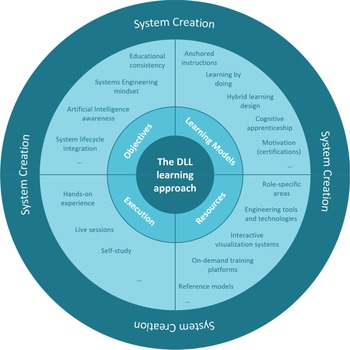
This section outlines the didactical principles implemented within the DLL and explains how they are realized for both university training and industrial upskilling. Figure 2 illustrates the didactical circle of the DLL, visualizing the interconnection of learning models, resources, execution, and objectives. The following subsections highlight central elements of this framework; detailed educational implementation examples are provided in Chapter 5.
Didactical circle of the DLL

4.1. Hybrid learning design and educational consistency
University courses associated with the DLL follow a hybrid learning design combining in-person sessions with on-demand content. This structure links theoretical foundations with hands-on engineering practice. During on-site sessions, students design, implement, and verify interconnected engineering models across the digital engineering spectrum – from requirements to design and system verification.
Digital platforms such as mindary and Siemens’ Xcelerator Academy provide methodological SE foundations and structured tool training, complementing the physical lab environment and reinforcing the link between conceptual understanding and applied system development.
Didactically, the DLL addresses all cognitive levels of Bloom and Engelhart’s Taxonomy (Reference Bloom, Engelhart, Furst, Hill and KrathwohlBloom et al., 1956). While traditional formats often emphasize remembering and understanding, the project-based and lifecycle-oriented structure (see Chapter 4.6) promotes analysis, evaluation, and creation in realistic engineering contexts. Interdisciplinary team projects (see Chapter 5.2) and end-to-end system realization strengthen system thinking, problem-solving competence, and reflective understanding.
The design further aligns with Self-Determination Theory (Reference Ryan and DeciRyan & Deci, 2000): intrinsic motivation is fostered when autonomy, competence, and relatedness are addressed. The DLL promotes autonomy through responsibility in open and end-to-end project structures, competence through interaction with industrial-grade software tools and multidisciplinary systems, and relatedness through interdisciplinary teamwork and continuous exchange with peers, supervisors, and industrial stakeholders. The DLL is explicitly designed to reflect these motivational dimensions.
4.2. Role-specific areas
As illustrated in Figure 1, the DLL provides dedicated workstations representing distinct engineering roles within interdisciplinary teams. Students actively assume these roles to gain both discipline-specific and cross-functional insights. The DLL comprises two interconnected areas: a discipline-oriented space for detailed design in mechanical, electrical, software, and simulation engineering, and a management area coordinating systems and process activities across disciplines. This structure mirrors contemporary engineering organizations and highlights the interdependence of specialized expertise and system-level orchestration.
4.3. Engineering tools and technologies
To support its didactical objectives, the DLL integrates a connected landscape of industrial software tools (see Figure 3). The PLM system Siemens Teamcenter serves as a central data backbone, managing engineering and organizational data while providing seamless interfaces to authoring tools. This setup acts as a foundation for creating traceable digital twins and for the consistent mapping of design decisions to requirements across development, verification, and production phases, thereby ensuring comprehensive consistency. Beyond its technical function, this tool integration has didactical significance: it makes dependencies between methods, processes, and tools transparent, allowing learners to experience SE, MBSE, and PLM both conceptually and operationally.
Excerpt of software tool portfolio implemented within the DLL (Antemia GmbH, n.d.)

Figure 3 Long description
A diagram of the software tool portfolio implemented within the DLL. The diagram illustrates the flow and interaction of various tools and processes. Key components include Teamcenter Polarion for use cases and requirements, System Modeling Workbench for system modeling artifacts, Capital System Architect for E/E architecture, Siemens NX for mechanical design, and Teamcenter for change management. The diagram also shows the integration of artifacts management, verification and validation processes, production planning, testing, release management, and lifecycle assessment. The flow of information and artifacts is depicted through arrows indicating the direction of processes and interactions between different tools and stages.
4.4. Systems Engineering mindset
A core objective of the DLL is to cultivate a SE mindset. SE provides a methodological foundation for collaborative, interdisciplinary work and fosters a shared understanding across disciplines. Through the comprehensive interlinking of people, processes, methods, and tools, the DLL enables participants to apply SE principles in practice and to recognize their value in achieving consistency and quality throughout all stages of system creation (Reference Bajzek, Fritz, Hick, Hick, Küpper and SorgerBajzek et al., 2021b). This mindset is essential for fostering collaboration, problem-solving, and system-oriented thinking.
4.5. Interactive visualization systems
Given the complexity of modern technical systems and their interconnected engineering models, the DLL incorporates interactive visualization systems to enhance shared understanding, transparency, and collaboration. Users can dynamically navigate between structural, behavioral, and requirements perspectives across multiple screens. The Model Cube method (Reference Hick, Bajzek and FaustmannHick et al., 2019) exemplifies this approach: a three-dimensional representation categorizing digital models by discipline, hierarchy level, and technical domain (see Figure 5). Implemented within the DLL, this visualization improves the accessibility of complex engineering data and strengthens interdisciplinary communication by clearly revealing interfaces, gaps, and overlapping or redundant information.
4.6. System lifecycle integration
Lifecycle consistency is essential to align development decisions with downstream requirements from production, operation, and recycling phases. Within the DLL, several initiatives aim to strengthen this integration – such as the embedding of production planning and manufacturing aspects into early design phases. In a collaboration between the DLL and Smartfactory at TU Graz (n.d.), a continuous PLM-based data backbone linking development and production has been established. This digital continuity provides a foundation for lifecycle-spanning feedback and improvement. Additionally, Reference Hemmeter, Bitzer, Goetz and WartzackHemmeter et al. (2025) introduced a model-based tolerance management approach within MBSE and PLM environments such as the DLL, interconnecting geometric variational models, domain-specific simulations, and manufacturing constraints. This enables multi-criteria tolerance optimization and reinforces the systematic coupling between engineering and production processes, exemplifying deeper lifecycle integration.
4.7. AI mindset
AI-supported systems increasingly shape engineering practice. As AI capabilities expand – illustrated by the global scaling of necessary data center infrastructure (Reference Noffsinger, Patel, Sachdeva, Bhan, Chang and GoodpasterNoffsinger et al., 2025) – engineers must be prepared for their responsible and effective application.
The semantically and uniformly structured PLM backbone of the DLL provides favorable conditions for AI integration, encompassing processes, methods, roles, and software tools (Reference ShilovitskyShilovitsky, 2025). Ongoing doctoral projects in the DLL investigate the integration of AI agents within existing toolchains and generate practical use cases for AI in system creation phases. Together with initiatives such as AI4SE (Reference MillerMiller, 2019) and related research (Acatech, 2022), these activities enable the systematic integration of AI technologies into the DLL. Following these developments, which are introduced in educational formats, the DLL fosters an AI-ready mindset that combines technological competence with reflective awareness of AI’s role in future engineering.
5. Transfer between academia and industry
This section examines knowledge and technology transfer and describes how the didactical principles outlined in Chapter 4 are embedded within the master’s curriculum in mechanical engineering at TU Graz.
A defining characteristic of the DLL is its continuous, bidirectional exchange between academic and industrial institutions. The transfer model is structured around three pillars – industry workshops, university training, and scientific research and technical solutions – as described by Reference Kollegger, Schalk, Bitzer, Burchardt and HickKollegger et al. (2025). In the following, this model is further elaborated with a particular focus on university education and course design. Together, these pillars form a feedback loop that connects knowledge generation, application, refinement, and reintegration across academic and industrial contexts, thereby fostering methodological advancement and innovation.
5.1. Workshops for industry
The first pillar focuses on professional development and upskilling for industry practitioners. Antemia GmbH offers on-demand training courses via the mindary platform and conducts workshops within the DLL. Participants apply digital engineering methods – with an emphasis on MBSE and PLM – within their organizational contexts. Workshops focus on collaborative development of digital transformation strategies, engineering environments, structured lifecycle data architectures, and project-specific processes. This co-creation approach supports the planning and execution of digital transformation initiatives together with key stakeholders. As a result, value analyses are conducted, leading to the definition of concrete implementation strategies.
Simultaneously, industrial trends, challenges, and needs are systematically captured and transferred back into academia, informing courses, theses, and research projects. This reciprocal exchange supports innovation and strengthens the continuous transfer between education, research, and industrial practice.
5.2. University training and courses
The second pillar focuses on interdisciplinary, SE-oriented projects within university education. At TU Graz, the master’s specialization in Product Development of Mechatronic Systems translates bachelor-level disciplinary knowledge into an interdisciplinary, project-based approach that promotes the stepwise development of SE competencies. The curriculum follows Bloom and Engelhart’s Taxonomy, combining hybrid and practice-oriented learning formats, including in-person sessions, on-demand content, supervisor meetings, group work, and stakeholder presentations.
The specialization begins with the course Product Development of Mechatronic Systems – sharing its name with the specialization – which introduces students to system development methodologies, systems thinking, model-based working principles, and the foundations of SE, MBSE, and PLM.
Building on this foundation, subsequent courses provide both theoretical and hands-on experience in PLM systems and system modeling, enabling students to utilize PLM systems and apply modeling methodologies within different tools to describe systems in terms of structure and behavior.
In the final course – Project of Mechatronic Systems (PMS) – students independently design, implement, and validate a mechatronic system physically, digitally, and methodically within an interdisciplinary team. Over one semester, comprising 150 hours per student, they assume various engineering roles and apply their bachelor-level disciplinary knowledge in the practice-oriented DLL environment. Although weekly meetings with a supervisor provide guidance, students are deliberately given few implementation constraints to foster creativity, problem-solving competence, and ownership. At the end of the semester, the team presents and defends its work before academic staff and professors. The project includes a range of deliverables:
-
• A PLM data structure model
-
• A system model
-
• Mechanical geometry, electrical schematics, and control software models
-
• A variant management concept
-
• Comprehensive project documentation, including a report as well as time and cost management
The following presents the results of the PMS team in 2025, which developed a crane logistics system illustrated in Figure 4. The course concept has proven highly effective, as reflected in consistently positive student feedback and results that exceed expectations and requirements. For example, the final crane system included energy chains for efficient cable management, a custom-designed circuit board, and smartphone-based control, demonstrating a high level of technical maturity and reliability.
From the authors’ perspective, this didactic strategy – which grants students autonomy and creative freedom, fosters interdisciplinary collaboration, and allows them to witness a system evolving from concept to implementation – leads to outstanding learning outcomes and strong intrinsic motivation, consistent with the principles of Self-Determination Theory. Furthermore, the systems developed within these projects are later used as demonstrators and discussion material in industry workshops and courses, creating a direct link between academic and industrial exchange.
Excerpt of models generated by the project group PMS in 2025

5.3. Scientific works and technical solutions
The third pillar comprises scientific research and the development of technical solutions that directly support industrial applications. These activities are primarily driven by industrial challenges and use cases identified in collaboration with industry partners, as outlined in Chapter 5.1.
Current research projects within the DLL investigate the automation of engineering activities across the system lifecycle within the context of SE. Key research topics include:
-
• Increasing reliability and confidence in engineering automation
-
• Integrating production planning and tolerance management into early development phases
-
• Systematically embedding AI into system creation processes
-
• Advancing engineering education and improving user acceptance
-
• Enhancing traceability of design decisions across lifecycle stages
-
• Establishing centralized engineering data structures within PLM systems
-
• Enabling automated industry-tool interaction within existing software landscapes
The overarching objective is to develop validated methods and practice-oriented use cases that create measurable value for engineering practice under realistic technical and organizational conditions.
One example is an ongoing doctoral project on a multirotor drone system. Within this project, interconnected engineering models, method modeling, traceability structures, and AI-supported automation are systematically examined. The digital representations of this drone system are visualized using the Model Cube method (see Figure 5), illustrating how engineering models are interconnected across disciplines, domains, and hierarchy levels.
The drone system’s scope and capabilities are continuously expanded through parallel research projects, allowing it to function as a coherent and evolving reference use case. In line with the principle of bidirectional knowledge transfer, research findings are integrated into industry workshops and university training, ensuring that academic research informs industrial practice – and vice versa.
Digital drone engineering models within the Model Cube visualization method

Figure 5 Long description
Panel A: A 3D model of a drone labeled MCAD-Model. Panel B: Diagrams and schematics labeled System Simulation and E/E-Schematics. Panel C: Code snippets labeled SW-Code. Panel D: A system model diagram. Panel E: A specific simulation image of a drone. Panel F: A requirements text box. Panel G: A production model image of a drone.
6. Discussion
The presented DLL, together with its technical and didactical principles, can be positioned within several established research streams in engineering education, while advancing them through a stronger integration of lifecycle-oriented digital engineering infrastructures and knowledge transfer interfaces.
Inductive and project-based learning approaches are widely recognized for fostering problem-solving competence and collaborative skills in engineering contexts (Reference Prince and FelderPrince & Felder, 2006). However, their focus primarily lies on didactic design rather than on the systematic implementation of lifecycle-wide digital continuity. The DLL builds upon project-based learning principles but extends them by embedding student projects into a persistent MBSE and PLM backbone, thereby operationalizing traceability, model integration, and structured data governance as integral learning components.
Similarly, the CDIO framework promotes lifecycle-oriented education structured around conceiving, designing, implementing, and operating systems (Reference Crawley, Malmqvist, Östlund and BrodeurCrawley et al., 2007). While CDIO provides a strong curricular and competency-oriented foundation, the DLL advances this perspective by technically instantiating lifecycle integration through interconnected models, industrial-grade toolchains, and role-based collaboration. Lifecycle thinking is thus not only a didactic principle but is also structurally embedded within the DLL.
Learning Factory and Teaching Factory paradigms emphasize industry-academia collaboration, particularly within manufacturing and production contexts (Reference Abele, Metternich, Tisch, Chryssolouris, Sihn, Elmaraghy and HummelAbele et al., 2015; Reference Chryssolouris, Mavrikios and RentzosChryssolouris et al., 2016). In contrast, the DLL adopts a broader system-oriented perspective by integrating system development, manufacturing, and lifecycle considerations driven by industrial needs. This shifts the focus from individual stages toward lifecycle-wide integration supported by strong and continuous academia-industry collaboration.
Existing SE and MBSE reference curricula conceptualize engineering education primarily in terms of curriculum architectures and course-based program structures (Reference FerrisFerris, 2012). The DLL complements this perspective by structurally embedding MBSE and PLM elements within a persistent lab architecture that integrates roles, toolchains, lifecycle traceability, and industry-academia collaboration across educational activities.
7. Summary and outlook
This paper has presented the DLL as a practice-oriented reference implementation for lifecycle-oriented SE education, developed through a long-standing collaboration between TU Graz, Antemia GmbH, and Siemens Digital Industries. By integrating hybrid learning formats, interdisciplinary system realization, MBSE methodologies, connected PLM infrastructures, and academia-industry transfer interfaces, the DLL establishes a state-of-the-art concept for digitally integrated system development (Siemens Digital Industries Software, n.d.).
Addressing the key competencies for future engineers identified in Chapter 1, the DLL operationalizes systems thinking through lifecycle-wide modeling and traceability, leadership and flexibility through interdisciplinary project work, and AI proficiency as well as technological literacy through data modeling and interaction with industrial-grade engineering tools. In this way, the DLL contributes to preparing engineers for complex, digitally interconnected development processes.
From a technical perspective, the DLL continues to evolve, particularly through the enhanced integration of production planning and tolerance management into system development, as well as the systematic incorporation of AI technologies into MBSE processes. Future research will investigate the scalability and contextual adaptability of the DLL concept, including the identification of generalizable elements, context-specific requirements, organizational effort, resource implications, and the empirical assessment of learner motivation and learning outcomes.
In conclusion, the DLL consolidates its unique position among contemporary educational and research initiatives, serving as a bridge between academia and industry and as a catalyst for the digital transformation of engineering practice.



 Open access

