

1. Introduction
Gwynne Skinner dedicated her life to the defence of human rights – as a lawyer and a scholar. Her recent book offers a clear picture of one of the thorniest problems that the business and human rights movement and scholarship try to tackle: barriers to the realisation of the right to remedy for abuses of human rights committed directly and indirectly by transnational corporations, notably in developing and less developed countries.Footnote 1 Being published at about the same time as the United Nations Guiding Principles on Business and Human Rights celebrates ten years,Footnote 2 the book provides an opportunity to reflect on how to address this and other problems of similar intricacy. Which approach should one take to the analysis of a topic such as this, which involves many layers of complexity and affects different levels of governance? I call for an interdisciplinary approach which draws on international law, inequality and energy justice studies.
Skinner's argument is straightforward. Transnational corporations benefit from their operations in the least developed and in developing countries,Footnote 3 while local vulnerable communities bear the costs associated with the respective economic activities.Footnote 4 In so far as these victims cannot secure remedy in the host countries,Footnote 5 they should have a right to remedy in the home countries of the corporations, or where the corporations are present.Footnote 6 Skinner argues that their right to remedy arises under international human rights law.Footnote 7 Nevertheless, also in the home countries there are barriers to holding transnational corporations legally accountable for human rights violations.Footnote 8 Skinner recommends, inter alia, that new legislation be introduced in western countries to make corporations liable for violations of ‘international human rights law’ committed by subsidiaries abroad,Footnote 9 to establish ‘causes of action for extraterritorial claims for violations of international human rights’,Footnote 10 to establish a general jurisdiction over corporations ‘doing business’ in the regions,Footnote 11 to make it clear that corporations can violate international human rights law.Footnote 12 The focus is placed on the United States, Canada and Europe – which, Skinner notes, are home to the majority of transnational corporations.Footnote 13 Although Skinner draws from corporate, international and comparative law, she approaches the topic from a domestic law perspective.
Skinner gives us an impressive mapping of the barriers and offers percipient suggestions to address them. In Section 2, I explain her argument in more detail; but her monograph leaves us with some questions – and the following have struck me with more force. First, would the argument have benefited from a deeper and more critical analysis of international law? As I explain in Section 3, I believe that it would, notably in what concerns the topics of the responsibility of corporations, individual right to remedy and (extraterritorial) jurisdiction. A more detailed analysis would have helped in taking stock of the state of the debate about these topics, avoiding an overly optimistic expectation about what international law offers, and strengthening the rationale that supports the recommendations. Second, should a decision about expanding extraterritorial jurisdiction be left to the unilateral discretion of states in these regions, or should it be reached through more inclusive multilateral negotiations? My analysis, especially in the second part of the essay, supports the latter case – but it also affirms the legitimacy and importance of the effort to have states finding solutions, even if unilaterally. Third, from an interdisciplinary viewpoint, is international law a good starting point for a call for realising the individual right to remedy? As I explain in Sections 4 and 5, I believe it is not. Fourth, Skinner does not deny – but rather openly acknowledges – that the book is centred on the experience of the United States and, secondarily, of Canada and Europe, and her justification for this choice makes sense.Footnote 14 However, the argument is very western-centred and develops in a rather uncritical manner, and the reader is left with a more fundamental question: would the expanding of extraterritorial jurisdiction in these countries, notably for the reasons that Skinner draws, really provide redress for victims? As Section 6 shows, I am sceptical about this. I conclude, in Section 7, by reaffirming the call for the realisation of the right to remedy for the victims of corporate abuses of human rights in host, home and third countries. However, I ground this call on different dimensions of justice and on the need to tackle inequality – and by affirming that, although expanding the bases of extraterritorial jurisdiction should come about through multilateral negotiation, Skinner's book reminds us that there is urgency, and that there are limits to how long victims can wait until states manage to reach agreement in multilateral negotiations.
I approach the topic from the perspective of a Latin American international scholar and lawyer, who both believes that international human rights law has a crucial role to play in taming the power of transnational corporations and cannot but feel sceptical about the real prospects of this legal field fulfilling such a daunting role. My approach is interdisciplinary as it draws on critiques of international law,Footnote 15 as well as inequality and energy justice studies.Footnote 16 I adopt the JUST Framework, which defines justice in different dimensions – distributive, procedural, recognition, cosmopolitan and restorative – with due regard to time and space.Footnote 17
2. Understanding Skinner's Argument
Early in the book Skinner notes that transnational corporations ‘gain enormous financial benefits by operating globally’ and particularly in countries with weak human rights and environmental regulation,Footnote 18 asserting that the benefits that parent companies receive from subsidiaries and affiliates are ‘immense’.Footnote 19 She notes that these corporations are located in the United States, Canada and Europe, and underlines the main sectors of operation: from finance and insurance to the mining sector.Footnote 20 Skinner then brings our attention to the vulnerable communities who ‘absorb the harm’ of the activities of these corporations.Footnote 21 She timely notes that developing countries have actively ‘campaigned to attract transnational business’,Footnote 22 weakening regulations to attain this objective. The economic growth that these investments bring is accompanied by costs in terms of human rights of vulnerable populations. ‘Frequently’, Skinner tells us, ‘there are lax regulations or few laws that protect such populations, and when laws do exist, they are often not enforced by the host government’.Footnote 23 An important question is raised: why are the victims entitled to remedy?Footnote 24
The answer is, briefly, because ‘there is now a principle of international law that every violation of international law should be accompanied by the provision of a remedy’.Footnote 25 What follows is the substantiation of this assertion through a semi-systematic discussion that brings together the horizontal application of human rights, the responsibility of corporations under international human rights law, the individual right to effective remedy, and the principle that states are responsible for denial of justice. The discussion draws from international soft and hard law instruments and the practice of international organisations,Footnote 26 as well as US practice, notably under the Alien Tort Claims Act.Footnote 27 In brief, for Skinner, ‘[t]he basis for remediation for human rights violations committed by TNCs is therefore strong and well supported at the international level’.Footnote 28
After describing the situation in which the victims of human rights abuses cannot find redress in their own countries – because of weak or corrupt local institutions, the unavailability of legal assistance, or lack of resources – she makes the case for the home countries of the corporations, or a country in which they conduct business, to exercise jurisdiction to hear such cases.Footnote 29 Skinner defines the main barriers to holding corporations liable in such countries: limits on subject-matter jurisdiction over international human rights law, limited liability of parent corporations, and lack of in personam jurisdiction of corporations and their affiliates.Footnote 30 In a nutshell, Skinner proposes that new legislation be introduced in the United States, Canada and in Europe to make parent corporations ‘strictly liable for any harm resulting from the extraterritorial acts of majority-owned subsidiaries and other affiliate they control which breach international human rights law’;Footnote 31 to ‘provide causes of action for extraterritorial claims for violations of international human rights … to allow victims to bring claims … for torts in violation of CIL’;Footnote 32 and to establish a ‘general personal jurisdiction over a TNC whenever it does business in that country, including through a subsidiary’.Footnote 33
3. A Critical International Law Dialogue with Skinner's Argument
I am concerned with what I deem to be an overly optimistic view of what international human rights law, and particularly customary international human rights law, has to offer in terms of the theoretical and legal grounding for the proposals for expanding the bases of jurisdiction. I turn my attention to the arguments, which I find insufficient, that are articulated in support of what are, in effect, two theses that emerge in the discussion. The first thesis is that corporations can violate international human rights law;Footnote 34 in other words, that extant international human rights law binds transnational corporations. This first thesis is gaining support by the day, but it is far from being settled.Footnote 35 Shaw, for instance, in briefly explaining the Guiding Principles, concludes that ‘[t]he realm is that of “soft law”, of expectations, of anticipation, not of binding international (as opposed to national) legal regulation’.Footnote 36 My objective is not to deny that transnational corporations have the responsibility to observe international human rights law – at the very least it is arguable that they are not free to ignore international human rights law,Footnote 37 notably those of a fundamental character – but only to underline that the question, about the legal character of the responsibility, is not settled.
The crux of the matter is whether international law directly creates obligations upon corporations, or only indirectly establishes responsibilities, by creating different obligations on states, which then must address the behaviour of private actors, including corporations. As Knox explains, the distinctions to be made are not a question of mere semantics:Footnote 38
The language of international law must be taken seriously, however. A legal obligation that international law directly places on an individual differs from one that it imposes indirectly, through a duty on governments. In the first case, the international community as a whole exercises prescriptive jurisdiction over individuals in a way that makes them directly subject to international law apart from the mediating intervention of domestic law. In the second, domestic jurisdiction over individuals is left intact.
Likewise, Ruggie acknowledges:Footnote 39
[T]he country analyses that were conducted for the mandate, coupled with the responses to my state survey, parallel the recent secondary literature in finding insufficient evidence at this time to establish direct corporate responsibilities under customary international law.
Not only is an opportunity lost to take stock of the current state of the debate on the topic and put forward a more robust theory, but this also creates an issue for the development of the argument, as I explain below.
The second thesis is that international law grants to individuals a right to remedy against transnational corporations, which right can be exercised in the host country (where the violations occur), in the home countries or in countries where the corporations are present. Evidently, international human rights law provides for a right to effective remedy against violations of this body of laws committed by states,Footnote 40 and in applicable cases also against violations committed by private parties.Footnote 41 In the latter case, consistently with the above discussion, international law creates for states the obligation to provide access to effective remedy for the victims of abuses committed by private parties. In other words, where the state has the obligation to address private abuses of human rights, it also has the obligation to provide for the victims of the abuses access to effective remedy.
Yet, what Skinner appears to suggest is different: she argues that international law, and customary international law, already comport an individual right to remedy against corporations. On this basis, Skinner seems to suggest that states have some sort of responsibility to provide judicial remedy even for abuses occurring outside their territories, even in cases with no or minimal links with the forum state – in other words, to exercise extraterritorial jurisdiction over what has been called ‘foreign cubed’ cases, that is, cases with no real links with the forum state.Footnote 42 I address the second point (extraterritorial jurisdiction) below. On the first point (individual right to remedy), as Ruggie clarifies,Footnote 43
[t]his state obligation to provide access to remedy is distinct from the individual right to remedy recognized in a number of international and regional human rights conventions. While the state obligation applies to corporate abuse of all applicable human rights, it is unclear how far the individual right to remedy extends to non-state abuses.
Unavoidably, later in the book Skinner feels compelled to come back to the basics – to acknowledge that ‘whether businesses (as opposed to individuals) can be liable for violations of CIL is still not completely settled’.Footnote 44 This is, in fact, an understatement,Footnote 45 and its implications for the second thesis are not discussed. Skinner now describes how the courts in the United States are divided over the topic and how international courts have not exercised jurisdiction over corporations, before welcoming some decisions by courts in the Netherlands and France.Footnote 46 By now, however, the discussion is no longer about ‘international human rights law’; it is a discussion about certain human rights, the violation of which constitutes international crimes,Footnote 47 a rather different discussion.Footnote 48 Skinner looks into vicarious liability, in similar terms, before suggesting that new legislation be introduced at the domestic level ‘to state that corporations, as legal persons, are capable of violating international law’.Footnote 49
The reader is excused for thinking about the scope of this ‘international law’: is Skinner referring to the whole range of human rights, or is she referring to the category that has customary law standing,Footnote 50 or to the smaller category the violation of which constitutes crimes? Chapter 2 suggests that what Skinner has in mind is the US experience under the Alien Tort Claims Act; this is an experience that is rather limited in terms of the range of rights that it covers,Footnote 51 and rather unstable in terms of the development of the case law under the Act.Footnote 52 Given the limited range of rights, and the instability of the case law under the Act, the reader cannot but continue to ask, as the reading of the book progresses and as so much depends on these fundamental theses,Footnote 53 about the real existence today of an individual right to remedy, as Skinner suggests.
Turning to the discussion about jurisdiction – and extraterritorial jurisdiction, in particular – Skinner recommends that new legislation be introduced in the regions under study, inter alia, to make corporations liable for violations of ‘international human rights law’ committed by subsidiaries,Footnote 54 and to establish a general jurisdiction over corporations conducting business in the regions.Footnote 55 To the extent that the proposals address cases with genuine links with the forum state – on the bases of territoriality and nationality, for instance – they do not interest me. I am concerned with the implications of the proposals in terms of expanding the bases of extraterritorial jurisdiction – and the proposals become relevant because they, ultimately, enable courts to hear cases with no clear connection with the forum state. The proposal for a universal type of jurisdiction that reaches corporations with ‘ongoing business’ in the forum country is an example. In plain terms, should the proposal be implemented, a case like Kiobel would be within reach of courts in the United States.Footnote 56
Universal jurisdiction can be defined as:Footnote 57
[jurisdiction] over offenses committed abroad by persons who, at the time of the commission, are non-resident aliens, where such offences are not deemed to constitute threats to the fundamental interests of the prescribing state or, in appropriate cases, to give rise to effects within its territory.
Much has been written on the subject. In what concerns us, there is no agreement over the scope of universal jurisdiction in international law.Footnote 58 I adopt the position, to use Young's phrasing,Footnote 59 of a ‘sober advocate’.Footnote 60 When states assert universal jurisdiction, typically they do so in respect of criminal matters – the United States constitutes an exception in asserting universal civil jurisdiction.Footnote 61 By the turn of the century, universal criminal jurisdiction had gained momentum as a western instrument to hold aliens responsible for international crimes committed abroad.Footnote 62 While the exercise of universal jurisdiction does not require, by definition, the existence of links with the forum state, there has been a strong backlash against that incipient and apparently aborted state practice of exercising universal criminal jurisdiction in cases without a clear link with the forum state.Footnote 63
As for the assumption of universal jurisdiction by the courts in the United States under the Alien Tort Claims Act, criticism is significantFootnote 64 and caution is also advised.Footnote 65 The criticism is higher in respect of assertions of jurisdiction over ‘foreign cubed’ cases. States tend to protest against this type of assertion by US courts, as Kiobel illustrates: for instance, the United Kingdom and the Netherlands have emphatically opposed the assumption of jurisdiction in the case.Footnote 66 In brief, in asserting the presumption against extraterritoriality, Kiobel certainly frustrates the expectations of the business and human rights community, but it is unquestionably in line with recent developments of tightening the bases for the exercise of jurisdiction (in respect of both universal criminal and civil jurisdiction) and the mainstream scholarly opinion that requires the presence of a genuine link with the forum state.Footnote 67 This places a heavy burden on any proponent of new domestic laws to expand universal civil and criminal jurisdiction to cover cases with only flimsy links with the forum state.
To put it differently, the barriers that Skinner identifies are the domestic reverberations of the idiosyncrasies that mark the enforcement of international law – and of the difficulties arising therefrom. Ultimately, these idiosyncrasies and difficulties derive from an international system that is generally understood as an association of sovereign states based on order rather than on justice, in which sovereignty continues to play a crucial role.Footnote 68 These idiosyncrasies and difficulties become clearer when we turn our attention to a specific type of corporation – the state-owned enterprise – the presence of which in the international sphere has increased dramatically as China and,Footnote 69 to a lesser extent, some developing economies become economic powerhouses.Footnote 70 That the Guiding Principles require this type of corporation to respect international human rights law is undisputed.Footnote 71 In what concerns us here, the exercise of jurisdiction by the courts of the host state (thus, on clearly valid bases of jurisdiction) over enterprises owned by other states is already problematic.Footnote 72 To remain on one aspect that both illustrates and explains the point, even when courts in the United States affirm jurisdiction to hear cases against Chinese state-owned corporations, the same courts refuse enforcement of their decisions on grounds of state immunity.Footnote 73 Should courts in states where such corporations conduct business try to exercise jurisdiction over abuses committed elsewhere, the challenges are likely to increase. Order among sovereigns, and not justice for victims of human rights abuses, prevails in international law.
In view of the discussion so far, with a more cautious weighting of the current state of international law we arrive at the conclusion that international law offers no clear grounds for a right to remedy and for assertions of extraterritorial jurisdiction over ‘foreign cubed’ cases, as Skinner proposes. If the objective is to ensure that victims have redress for corporate abuses of human rights, and to this end to ensure that courts in western states can hear cases even when they have no strong links with the forum state, why ground the whole discussion mostly if not exclusively on a postulated right to remedy in international law, and on a postulated responsibility to exercise such an expanded extraterritorial jurisdiction? The answer apparently has to do with the optimistic view of international law that Skinner has. To clarify my point, it is not a question of which side of the discussion one is, either on the side that affirms or the side that denies the existence of a right to remedy or the lawfulness of the proposed extraterritorial jurisdiction. Rather, it is a question of looking at the whole academic debate, and international practice, from a critical perspective. We should then be asking whether a non-problematized discussion about corporate obligations, the right to remedy and jurisdiction in international law – and customary international law, in particular – offers an appropriate theoretical grounding for a proposal for new legislation, in countries where corporations are present, which grants jurisdiction for their respective courts over human rights abuses caused in the spectrum of economic activities of transnational corporations in other regions.
The call for the right to remedy and for expanding the bases of jurisdiction, to ensure that corporations are held liable for violations of human rights law, could have benefited from a more critical view of international human rights law. Acknowledging the shortcomings of extant international human rights law allows us to expand the horizon of the theory and, for instance, pay attention to the efforts of scholars in other fields, such as international investment law, to ensure that corporations are held liable for violations of human rights. Sornarajah, for instance, argues that home countries incur international responsibility if they facilitate the commission of abuses of human rights by transnational corporations (such as through lax legislation) and then deny victims of those abuses the opportunity to seek remedies against such corporations.Footnote 74 This helps in strengthening the theoretical groundings of the proposal by placing responsibility on the home state, which must ensure that its corporations are held liable for abuses of human rights. This may also further the argument: instead of protesting against US courts asserting jurisdiction to hear a case such a Kiobel,Footnote 75 the Netherlands and the UK should either assert jurisdiction themselves or accept US jurisdiction. In other words, to make a legitimate protest they would need to show that they are acting to hold corporations domiciled in their territories accountable for abuses that are imputed to those corporations.
Also, a more realistic approach that takes into consideration the state of international law allows us to account for other developments – notably, for a trend which, in my view, is slightly more promising than assertions of universal jurisdiction to ensure that corporations are made liable for violations of human rights abroad.Footnote 76 Courts in the United Kingdom and in the Netherlands lead in finding that they have jurisdiction over the parent company in their territory and over the subsidiary in other countries, in respect of events occurring in these other countries, and in applying to the dispute not (their interpretation of) customary international law but the law of such countries.Footnote 77 This is more promising because it avoids the theoretical, doctrinal and practical vicissitudes of assuming jurisdiction over corporations under a universal or quasi-universal basis. It also shows that part of the narrative that Skinner articulates – that the laws in developing countries are not sufficient to prevent harm – is not entirely correct.Footnote 78 However, the same concern against the assumption of jurisdiction in cases without clear links with the forum state is present in these decisions. In other words, this trend encapsulates an important way forward, but it is not a panacea.
As for expanding the bases of extraterritorial jurisdiction, a critical approach helps us in looking for other ways of attaining this and addressing the problems that often arise with unilateral assertions of extraterritorial jurisdiction. Notably, this can – and should – be attained through negotiations that lead to the signing of multilateral treaties. There are myriad treaties establishing a type of quasi-universal jurisdiction by means of the extradition or prosecution clause,Footnote 79 which shows that this pathway is feasible. What is more, there are ongoing discussions in the Working Group about a multilateral treaty that would also address the topic of jurisdiction. Why should western countries introduce domestic legislation addressing the topic before such negotiations are completed? The domestic approach to the topic, with states introducing new legislation, adds to the fragmentation of the topic. Even if the same draft legislation is introduced for discussion in different parliaments, nothing guarantees that the pieces of legislation that leave the parliaments will not be very different one from the other. This domestic approach adds to the trend of treating ‘jurisdiction as an aspect of the substantive topic that is regulated’ and, as Staker explains, ‘if this trend persists the principles of jurisdiction may fragment’ and exercise of jurisdiction may be expanded.Footnote 80 This may have unforeseen consequences. Thus, a critical view of international law provides a different framing for the discussion. It is only because Skinner adopts an essentially domestic law perspective that it is possible for her to affirm that ‘comity and foreign relations are not substantial impediments’.Footnote 81
4. An Interdisciplinary Dialogue with Business and Human Rights
My analysis so far suggests that a more careful, critical approach to international law results in a less optimistic view about the individual right to remedy and unilateral assumptions of extraterritorial jurisdiction. In turn, this allows us to pay more attention to other developments in terms of scholarship, case law and treaty law. In this section I engage in a more interdisciplinary dialogue, and continue to address these points.
Studies on inequality have been looking into the topics of importance for the present discussion – and these studies can provide a better theoretical framework to ground the call for the introduction of new legislation to provide for a right to remedy for human rights abuses committed by corporations. Piketty explains how regimes perpetuate what he calls ‘neo-proprietarianism’, ideologies that rely on ‘grand narratives and solid institutions’ to circumvent democratic decision making for the protection of the rights of those who already occupy the pinnacle of the wealth and income pyramids.Footnote 82 On my reading, regimes – including international law regimes, which include the international human rights law regime – solidify corporate entitlements. We should remind ourselves that international human rights law is international law, and international law is part of the problem when it comes to shielding corporations from responsibility for their wrongs – not only in human rights but also environmental terms.
There is not a human rights treaty that establishes obligations on corporations or affirms the right to remedy in the terms proposed by Skinner, or enjoins states to exercise jurisdiction over such cases as described in the book. Lege ferenda, the discussions (especially about jurisdiction) within the Working Group are not very promising. Should the language in the present Third Revised Draft prevail, the future treaty will apply to business enterprises, but it will be for the state to impose through legislation the obligations on businesses,Footnote 83 and to provide effective remedy for the victims. Scepticism about draft Article 9 on adjudicative jurisdictionFootnote 84 is high. Reacting to the prior draft, Brazil argues that ‘Articles 8.7 and Article 9 read together, continue to seem to hamper the identification of the natural judge for the action, which could promote the phenomenon of “forum shopping”’.Footnote 85 The United Kingdom has clearly affirmed that ‘the provisions on adjudicative jurisdiction appear to breach key principles of sovereignty and due process’.Footnote 86
Article 9 requires the courts of a given State party to hear claims against businesses for abuses, acts or omissions on the State's territory, even if there is another jurisdiction which is more convenient or in which parallel proceedings are underway. Most egregiously, this provision requires the courts of a State party to hear a claim under this treaty against a business even if the State where the business is domiciled is not a party to the treaty.Footnote 87
What emerges from these critiques from countries in both the global south and global north is the view that order between sovereigns, rather than justice for the victims, is what is important. Moreover, how soon will negotiations close and agreement be reached? How many states will really join such a treaty? Will the United States, which resists binding itself under human rights treaties but where so many transnationals are present, join it?
If we turn to customary international law the view is even less optimistic. Essentially, ascertaining rules of custom depends on the approach to the topic and the methods that one adopts. On approaches and methods, some decades ago, in the pages of this journal, Walden described a complex state of affairs, notably in respect of the subjective element, which persists to the present day.Footnote 88 In (yet another) attempt to reign in on the confusion, the UN International Law Commission very recently has firmly clarified that rules of custom require both elements: state practice, and state belief that the practice reflects what is commanded by international law.Footnote 89 The ‘barrier’ that Skinner identifies, in the form of ‘not completely settled’ customary international law, should be read as very inconsistent, if existent at all, state practice, and not clear state belief, in holding corporations liable for violations of international human rights law, especially beyond the realm of international crimes. An exception is Nevsun,Footnote 90 a recent decision of the Supreme Court of Canada which clearly supports Skinner's argument. The decision affirms the human rights obligations of corporations in international law and it could count as evidence of practice and opinio juris (I leave the issue of double counting as one or the other out of the discussion). Still, this is very incipient. It is also weak: this is a sharply divided decision, and the majority affirmation of the existence of customary international rules binding corporations is supported on a poor rationale that is seriously and rightly criticised by the minority on very convincing grounds.Footnote 91
Even if one emphasises opinio juris, as possibly reflected in resolutions of international organisations, and de-emphasises practice, to the demise of the clear articulation of the need for both elements in the work of the International Law Commission and the case law of the International Court of Justice,Footnote 92 the recent discussions within the Working Group (for instance, around the words ‘abuse’ and ‘violation’)Footnote 93 and the amici submitted in Kiobel,Footnote 94 to stay with a very small sample, suggest that there is no general opinio juris that supports the thesis that today corporations can violate international human rights law, and that states have the responsibility to exercise universal jurisdiction over ‘foreign cubed’ cases. In fact, the argument that Skinner makes – that countries in Europe and North America should exercise jurisdiction over ‘foreign cubed’ cases because this is where most corporations are and conduct business – can be turned on its head under the ‘specially affected states’ rule: without states in this region supporting customary international law rules that bind corporations and grant a right to individual remedy, how could these rules exist?Footnote 95
Now, the renewed and strengthened requirement for the two elements is a form of keeping the leashes on the development of the law, of reminding everyone that the existence of rules of custom depends on states, which are more concerned with order than with justice. The International Law Commission is very clear about how it sees both non-governmental organisations (NGOs),Footnote 96 which have been pushing for more responsibility on transnational corporations, and resolutions of international organisations,Footnote 97 which are crucial in the present debate (to start with, it was by means of a resolution that the UN Human Rights Council endorsed the Guiding Principles). The way in which the International Law Commission approaches both constitutes a reaffirmation of the state as lawmaker. Western countries either reject the possibility that corporations can violate international law, or the possibility of asserting jurisdiction over ‘foreign cubed’ cases, or both.Footnote 98 As most of the corporations are either domiciled or carrying on business in these countries, as Skinner rightly notes, can customary international law really develop in this area without their consistent practice and opinio juris?
Even more paradigmatic, without clearly establishing obligations on transnational corporations or providing for an obligation on states to exercise universal jurisdiction over corporate human rights abuses, international law establishes rights for corporations as standards of protection for investors in international investment law, and provides corporations with the right to seek arbitration to enforce their rights against states.Footnote 99 Indeed, corporations have brought cases against states which had introduced new legislation for the protection of human rights, on grounds that such legislation affected their rights.Footnote 100 Although there are important developments in international investment law – one of the most significant being the decision in Urbaser v Argentina, which suggests (albeit very timidly) that corporations may have certain responsibilities in international lawFootnote 101 – these developments are far from clearly affirming the obligations of corporations under international human rights law.
From all the above, the unavoidable conclusion is that extant international law perpetuates the entitlements that corporations enjoy and jeopardises the imposition of obligations on them. These entitlements are solidified through economic theories and ground practices that find their way through to international law. Crucial is the narrative around economic growth. Stiglitz demonstrates that trickle-down economics, the belief that economic growth reverts into development for all, is a fallacy that in fact helps to promote inequality by allowing transnational corporations to capture the economic benefits of their activities while externalising and socialising the respective costs.Footnote 102 However, trickle-down economics is exactly what the United States, Canada and Europe fiercely promoted onto Latin America and other developing and less developed regions, notably in the 1980s and 1990s, with the narrative that protection of foreign investors was necessary for attracting foreign investment, which would lead to economic growth and, by implication, development for all. Skinner mentions that developing and less developed states lift red tape regulation to attract investors, but fails to tell the whole story.Footnote 103 Linarelli, Salomon and Sornarajah demonstrate how this narrative frames international law: not only obvious fields such as international economic law, which promote free trade and investment,Footnote 104 but also international human rights law, the realisation of which is generally believed to depend on economic growth.Footnote 105 Moreover, a more comprehensive understanding of this point leads us to the realisation that the socialisation of costs in host countries may promote inequality not only in the host state but also in the home countries, as corporations become richer and increase the wealth gap in their home countries. This important literature has much to offer in terms of providing the theoretical grounds for the call for a robust right to remedy in international law and for expanded bases of jurisdiction. Indeed, socialisation of the costs of private economic activities occurs everywhere, and it may have cross-border effects, including in the developed world. It affects the fundaments of democracy.Footnote 106 This strengthens the call for more justice for victims everywhere and, a fortiori, also the call for more justice for victims in developing and less developed nations.
Skinner's call for judicial remedy can be easily defined as a call for justice. It is a call for remedial, and thus redistributive justice, evidently, but it could also have been a call for the other dimensions of justice, as I hope to make clear. It would be better not to depend on international law as a grounding theoretical force. Least of all, it would be better not to picture international law as offering the solution for the barriers to the right to judicial remedy. It would be better to define international law as part of the problem – as a barrier in the path of realising a robust right to remedy, which should derive before anything else from elementary considerations of justice – in so far as international law is too slow in reaching corporations, in so far as it is essentially dependent on the behaviour and attitude of states.
This critical view of international law also puts in question my own conclusion about the preferability of multilateral negotiations and treaties in strengthening extraterritorial jurisdiction. This is an interesting and important point. Given the slowness of international law to impose clear obligations on corporations and define the scope of the jurisdiction of domestic courts, is it really feasible to ask – and wait! – for treaty negotiations to end before strengthening the jurisdictional power of courts in the developed world over corporate abuses, including over ‘foreign cubed’ cases? This discussion has not escaped the attention of the literature.Footnote 107 Based on the critique that I have developed in this section, I would be inclined to concur with Skinner and affirm the urgent need for domestic legislation, as Skinner proposes, to be introduced; even more, I would be inclined to affirm the need that, absent such legislation, courts in the developed world should assert jurisdiction and deliver decisions such as the Supreme Court of Canada did in Nevsun.Footnote 108 I would affirm both if it were not for the reasons that I articulate below and bring to a close in the next section.
5. An Energy Justice Dialogue with Business and Human Rights
My proposal is to ground the call for judicial remedy within a call for justice – to be clear, not within a call for justice in international law, but within a call for justice, full stop. Placing emphasis on distributive justice, Linarelli, Salomon and Sornarajah show how difficult it is to demand justice in an international system that is pervasively understood in terms of liberal nationalism: an association of states based on order; an association that stands in contrast with the political domain of the states; one that affirms the market in exclusionary terms: human rights, the environment, for instance, being externalities.Footnote 109 Not even international human rights law escapes being captured by this view, in so far as economic growth is assumed to be a requirement for the realisation of human rights.Footnote 110 According to this view, justice is possible inside the state – but not at the international level.Footnote 111 This account reinforces my own definition of international law as part of the problem, but it also raises the question about the feasibility of inserting the right to remedy within a call for justice in international law.
Linarelli, Salomon and Sornarajah point the way forward by proposing what I believe to amount to a change in paradigm in Kuhnian terms.Footnote 112 The authors call for justice, and particularly distributive justice, in the form of some fundamental principles,Footnote 113 to apply to international law; but they also call for international law to move towards predistributive justice: because failures of ‘priorities, rules and their application, systems and structures’ lead to the need of redistribution, what is really necessary is ‘ex ante action – making international law just in a structural sense’.Footnote 114 There are two aspects to this discussion. On the one hand, it would not be difficult to ground Skinner's call for judicial remedy on such principles of justice, and to understand that Skinner's call does not go far enough in terms of predistributive justice, a point to which I revert below when I deal with restorative justice. On the other hand, it seems clear enough that the realisation of these principles of justice depends on a change of paradigm in international law, which has not yet materialised – and which, in my opinion, is difficult to materialise. So, it would be insufficient to ground Skinner's proposals on a call for justice in international law.
It is necessary that we move beyond international law and adopt a true interdisciplinary approach to the topic. I bring the growing literature on energy justice and on the JUST Framework, in particular, which has much to offer.Footnote 115 Let me start by noting two other aspects in the work of Linarelli, Salomon and Sornarajah. First, they avoid being prescriptive;Footnote 116 thus, they do not provide a practical roadmap for realising predistribution. Second, after defining cosmopolitanism in contradistinction to national liberalism,Footnote 117 they resist adopting a strong cosmopolitan approach to justice.Footnote 118 Energy justice contributes to both aspects: it articulates a theory of justice that is applicable to real-life situations. So, for instance, while the theory articulated by Linarelli, Salomon and Sornarajah has been criticised on grounds of materialising an external view of economic law, without much chance of changing economic lawyers’ view of the field,Footnote 119 so, with small chances of performing a paradigm change on the ground, energy justice emerges from within energy studies and has the potential to change things on the ground. Besides, energy justice, especially in the JUST Framework,Footnote 120 redefines cosmopolitanism in the context of climate change. Justice must apply to all human beings because we all share the same planet, which is under serious stress and where the actions of some people in some countries affect other peoples in other countries. In this sense the JUST Framework encompasses cosmopolitan justice in a clear and robust manner. These three aspects – interdisciplinarity, real-life application and a redefinition of cosmopolitanism – ensure that energy justice succeeds in providing a solid ground, and framing, for the right to remedy as well as for expanded grounds of jurisdiction.
The JUST Framework
Source: Qurbani, Heffron and Rifano (n 17) 357.
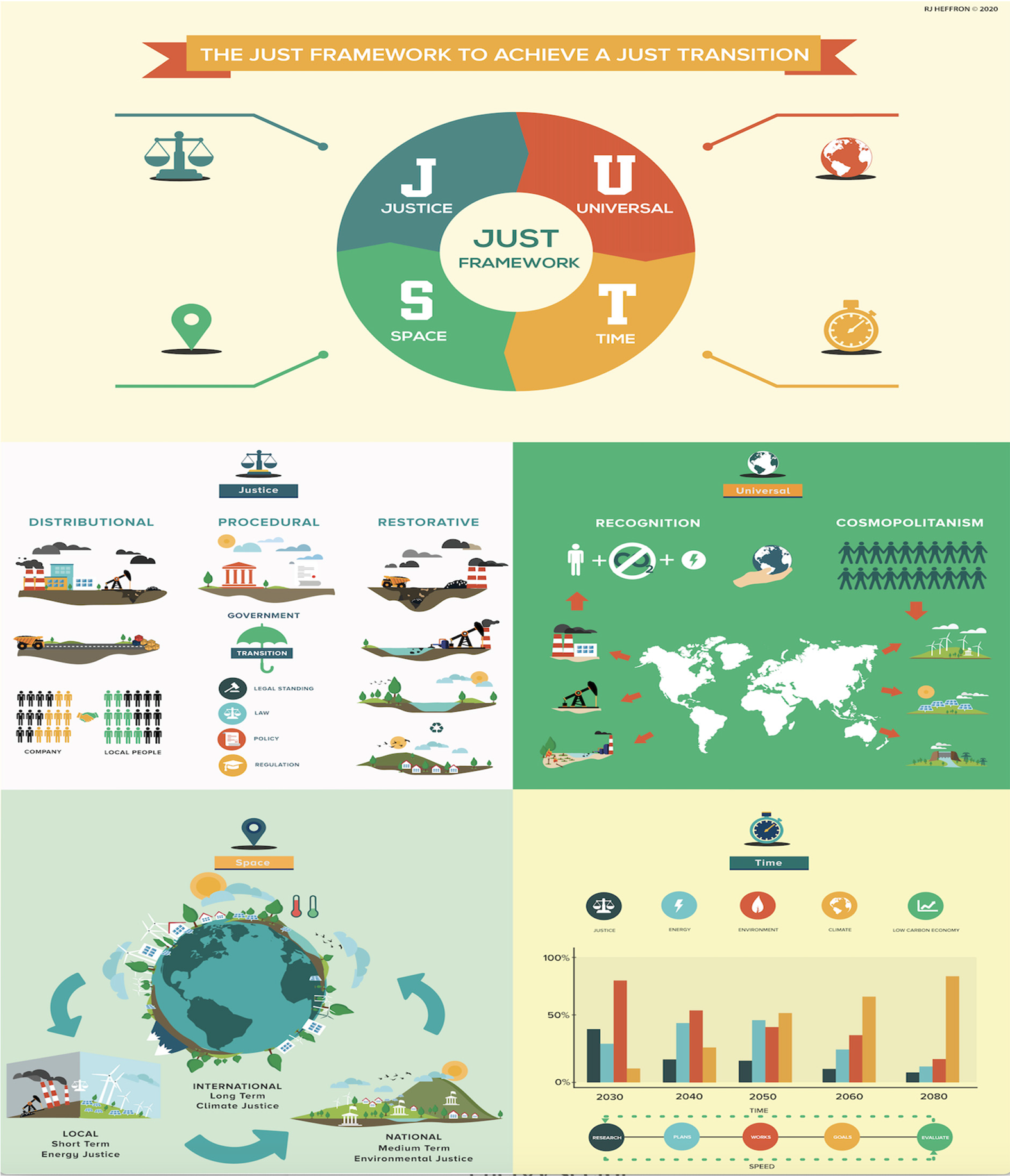
The energy justice literature developed roughly in parallel with the literature on business and human rights – and it is striking that the two branches have not been in dialogue more closely, given their common objectives.Footnote 121 Similar to what has happened in business and human rights, energy justice has drawn force from the work of activists and lawyers to become a true scholarship concerned with (also) tackling human rights abuses that occur throughout the stages of energy projects. The literature on energy justice is relevant not only because mining and the energy sectors more generally have always been important economic activities in which transnational corporations engage, notably in the developing and the least developed world, but also because the energy sector is characteristically centred around risk and displays a very traumatic history of human rights abuses.Footnote 122
What the JUST Framework has to offer is a substantial and feasible change in paradigm, which is amenable to support the call for a robust right to remedy and strengthened adjudicative jurisdiction as a call for more justice. It calls for justice at every stage of the energy project, for respect for human rights and environmental law throughout the energy life cycle (extraction, production, operation and supply, consumption).Footnote 123 The JUST Framework offers a rationale for a call for action by clarifying the dimensions of justice (which could strengthen the principles offered by Linarelli, Salomon and Sornarajah):Footnote 124
• procedural, with the affirmation of equality, non-discrimination, due process, at all levels of governance;
• recognition, with the reaffirmation of the rights of different and especially vulnerable groups on their own terms, throughout the life cycle of a project;
• distributive, with the reaffirmation of the need to tackle the unequal distribution of revenues and costs of a project;
• cosmopolitan, with the affirmation of the need to tackle the cross-border effects of energy projects; and
• restorative, which redefines restorative justice to emphasise that actors involved with the realisation of energy projects must understand, prevent and remediate the impact of the project on populations.
It is clear that this framework may be applicable beyond the energy field. The JUST Framework contributes a stronger grounding for the realisation of the call for the right to remedy because the framework strengthens the need for justice to be brought to victims of corporate human rights abuses irrespective of where the victims are.
For instance, the JUST Framework informs us that we are all living on the same planet and that what is done in one place affects other regions and eventually other countries.Footnote 125 Violations of human rights, notably when also involving pollution and the destruction of ecosystems, may have serious implications for neighbouring regions, as the District Court of The Hague affirms,Footnote 126 but depending on the extension of violations, they may have an impact on more far away regions and eventually the whole globe.Footnote 127 Here, there is another reason that may justify the exercise of extraterritorial jurisdiction in certain cases if it helps with the identification of genuine links with the forum state. Besides, energy justice requires us to recognise the victims on their own termsFootnote 128 rather than in terms of the majority, and to realise that development should be understood also in the manner that the victims (for instance, indigenous communities) understand development.Footnote 129 This goes beyond the usual framing of recognition in the international law literature by placing a burden on corporations to exercise caution when investing in certain territories occupied by indigenous and other vulnerable communities (who see development through other lenses) not to distress their ways of life. The JUST Framework requires that procedures – at all levels of governance – be respected, which lends support for our call for parent corporations to ensure that subsidiaries respect local regulations. What is more important, however, the JUST Framework redefines restorative justice,Footnote 130 emphasises the preventative, problem-solving principle,Footnote 131 and creates a burden on all actors to understand, account for and assume responsibility for the impact of their activities on vulnerable communities and on the environment, no matter where this impact materialises, before injustice occurs and after it materialises. This latter point reinforces the principle of predistribution as described by Linarelli, Salomon and Sornarajah. In so far as the corporation fails in preventing harm from occurring, especially by ignoring applicable procedures and disregarding vulnerable communities, the corporation has a greater burden to repair the damage. However, reparation, within a restorative framework, has a different role, which is that of restoring the social fabric of trust among all stakeholders, without which fabric the project itself is likely to fail.
This framework provides an important theoretical ground for the call for a fuller realisation of the right to judicial remedy. It also offers a better dialogue with all pillars of the Guiding Principles and the soft law instruments that address the topic, in so far as the framing of the problem in terms of justice – rather than law – takes some of the weight off hard international law and places it on soft law instruments, freeing the discussion of the limitations of the dogmatism.
Summarising the discussion, I would argue that the call for a right to remedy against corporations, as well as the call for expanding the bases of jurisdiction, could be better grounded if founded also on a more robust interdisciplinary, cosmopolitan call to promote justice, in all its dimensions, to tackle inequality globally and locally. International law should be better defined as part of the problem in so far as it creates more barriers than solutions and in so far as it perpetuates liberal national narratives that limit its own potential to change. I suggest that a change in paradigm, in Kuhnian terms, is needed, to justify a right to remedy as a call for justice. One question remains: is the expansion of extraterritorial jurisdiction the way forward – and is the narrative that supports the call for it appropriate?
6. Changing the Narrative
An interdisciplinary approach, which understands justice in all its dimensions, also allows us to reflect on an important part of the narrative used to justify the need for extraterritorial jurisdiction. Note that Skinner proposes that courts in the United States, Canada and Europe need to intervene and deliver what courts in developing countries fail to deliver. I am now concerned with some of the reasons that Skinner brings to explain this failure (which I call the weakness-corruption argument):Footnote 132
Weak rule of law, political instability, and corruption also play an important role in limiting the ability to seek remedy in the host state. In such context, it can be almost impossible to hold powerful actors accountable, particularly those that bring infrastructure to the country … if victims are not able to seek a remedy in the country of domicile … then they ought to be able to seek and obtain a remedy in any country where the TNC does significant business.
The above narrative – that is, alien institutions need to intervene because of corruption and weak institutions in the host country – is very similar to that articulated in support of the minimum standard of treatment in the past, and today, of investor-state arbitration:Footnote 133
The bulk of the cases arise out of a denial of justice in the matter of procedure, some gross deficiency in the vindication and enforcement of alien rights. A corrupt administration of justice, judicial or administrative, which is now more common than in the nineteenth century, gives rise to responsibility, regardless of the question whether nationals must submit to the same corruption. A perversion of justice by judges carrying out a national policy and not applying impartially the rules of law, is especially reprehensible and excuses the resort to or exhaustion of local remedies. Bad faith cannot be tested by national standards; it invites a more general criterion which international tribunals have not hesitated to invoke.
Also:Footnote 134
In the absence of an agreement to the contrary, an investment dispute between a state and a foreign investor would normally have to be settled by the host state's courts … From the investor's perspective, this is not an attractive solution. Rightly or wrongly, the investor will fear a lack of impartiality from the courts of the state against which it wishes to pursue its claim. In many countries, an independent judiciary cannot be taken for granted and executive intervention in court proceedings or a sense of judicial loyalty to the forum state are likely to influence the outcome … At times, domestic courts may be the perpetrators of the alleged violation of investor rights … In all these situations domestic courts cannot offer an effective remedy to foreign investors.
Both narratives share some common aspects: supported in anecdotal evidence, they articulate a negative image of the generality of courts outside the western world, and they too easily attribute issues with the administration of justice by local courts, in very complex cases, to corruption and weak institutions.Footnote 135 One might well see neocolonialistic traces in both of these narratives, but a clarification is necessary: one of the narratives (justifying investors’ rights) is articulated with the purpose of protecting the entitlements of corporations,Footnote 136 while the other (Skinner's) is articulated with the objective of doing exactly the opposite and protecting victims of abuses. They are very different. However, contrasting them helps in understanding a different point: how both use a negative image of courts in general to strengthen certain economic or political actors. As Sornarajah shows, the second narrative (investment law) serves for the strengthening of transnational corporations;Footnote 137 but I argue that the first narrative also plays a role in strengthening an economic and political actor – the western state.
Indeed, the first narrative plays into what Marks calls the romantic narrative of human rights, in which the ‘victim of human rights is a largely passive identity, defined by suffering, and waiting for vindication through the heroic agency of the international human rights system’.Footnote 138 More to the point, the romantic narrative is also one that assumes that the empowerment of the individual decreases the power of the states; however, the reality is very different, as Marks explains, ‘rights empower right-holders, but they also empower states to order and control the social environment in which right-holding arises and becomes consequential’.Footnote 139 By contrasting the two narratives, notably against the background laid down in the previous section, it is possible to understand that the first narrative solidifies a type of entitlement. By promoting a negative image of courts in developing countries, the first narrative uncritically strengthens the powers of the courts in developed countries, which need to intervene heroically to vindicate the victims of human rights abuses in faraway, uncivilised lands marked by weakness and corruption. However, these heroic courts sit in the countries that created and fiercely promoted the conditions that facilitated the emergence and multiplication of transnational corporations as powerful beasts capable of affecting all countries, as well as the conditions for the commission of abuses of human rights by these beasts all over the world, and especially in developing and less developed countries.
Justice is not only about remedial, redistributive justice, and should not be reduced to that. Recall the five dimensions of justice presented in the previous section. Because it focuses on remedial justice through judicial adjudication – and ignores the other dimensions of justice, which allow the prevention of harm notably through respect for applicable laws and regulations, non-discrimination at all levels of business activity, recognition of vulnerable groups affected by such activity, and attention to the implications of decisions in other regions – the narrative in Skinner's book makes it more difficult to recognise that the countries, the courts of which it seeks to strengthen, are the main culprits in enabling corporate abuses of human rights.Footnote 140 The lack of effective judicial remedy is only another instance of lack of justice – lack of justice in its different dimensions. On this ground I would suggest dropping the weakness-corruption narrative and understanding the specific circumstances that may lead to justice being better served before the courts of western countries.
Let us see how the Supreme Court of the United Kingdom approached the issue in a recent case:Footnote 141
95. … But the judge did not address this question by way of a comparison between litigation in England and in Zambia. His enquiry was directed to the question whether the unavoidable scale and complexity of this case (wherever litigated) could be undertaken at all with the limited funding and legal resources which the evidence led him to conclude were available within Zambia …
96. Finally, the judge's analysis positively demonstrates that he had due regard to considerations of comity and the requirement for cogent evidence … He identified the evidence which he found persuasive and quoted from some of it. Cogent evidence does not mean unchallenged evidence.
97. It is also evident that the judge was conscious of the need to exercise restraint on grounds of comity … he said this: ‘I am conscious that some of the foregoing paragraphs could be seen as a criticism of the Zambian legal system. I might even be accused of colonial condescension. But that is not the intention or purpose of this part of the judgment. I am not being asked to review the Zambian legal system. I simply have to reach a conclusion on a specific issue, based on the evidence before me. And it seems to me that, doing my best to assess that evidence, I am bound to conclude … that the claimants would almost certainly not get access to justice if these claims were pursued in Zambia.
The careful approach to the evidence before them, which both the judge and the Supreme Court adopt, in a case where the assumption of jurisdiction occurs with the application of the Zambian laws (this is a classic example of a case in private international law) emerges in sharp contrast with the possibility of western courts assuming jurisdiction, based on the weakness-corruption argument, over ‘foreign cubed’ cases, to apply their interpretation of international human rights law.
Another aspect that supports abandoning the weakness-corruption argument is that it may work for the benefit of the corporation. If western courts should interfere to correct the weakness and corruption of courts in developing countries for the protection of victims of corporate abuse, what exactly stops western courts from doing the same for the protection of transnational corporations? The weakness-corruption argument, if used in one direction for the protection of victims, could very well be used in the other direction for the protection of corporations. Indeed, should a decision in the host country, which holds a corporation responsible for human rights abuse, be assumed to be tainted by corruption, the corporation then becomes a victim, but of the actions of the host state. This is exactly the situation that in the past led to diplomatic protection and today leads to investor-state arbitration.
So, one would be justified in fearing that a new window may open before western courts for corporations to use the weakness-corruption argument for their benefit. However, in fact, the window has already opened. Close to the end of the book, Skinner briefly discusses the problem of retaliatory lawsuits, and exemplifies this with the Chevron case.Footnote 142 This case, however, deserves more attention. Chevron successfully claimed before courts in the United States, under the so-called Racketeer Influenced and Corrupt Organizations Act (RICO),Footnote 143 that judicial proceedings in Ecuador, which had held the company liable for environmental and other wrongs, were tainted by corruption, and thus unenforceable in the US.Footnote 144 Analyses of this case highlight that ‘the court transformed RICO, a federal statute once meant to combat widespread crime within the United States, into a corporate tool to combat unfavourable judgments abroad’.Footnote 145 Contrary to the window that was once open under the Alien Tort Claims Act with Filártiga, and which is closed with Kiobel, the window under the RICO continues to be open. So, it makes sense for Ecuador to propose, within the Working Group and in respect of Article 9 of the Second Revised Draft, the inclusion of a paragraph providing for the enforcement of judicial decisions of one state in another state party to the future treaty, and another providing for the impossibility of a court in one state party deciding again a case already decided in another state party.Footnote 146
One could conclude that the weakness-corruption argument should be dropped, and that an assertion of extraterritorial jurisdiction be made only on the condition that strong evidence exists of the institutional limitations in the host country to deal with the case in hand. Even then, my scepticism endures. Cases that are brought before western courts very often are complex, requiring the assessment of difficult legal and factual questions, and sometimes involving a high number of claimants.Footnote 147 Obviously, such cases are challenging – also for courts in western states. Justice Turner has valid reasons to assert that he is ‘entirely unpersuaded that proceedings in England would be more promptly concluded than would proceedings in Brazil’.Footnote 148 To be clear, Justice Turner ‘accept[s] the subjective concerns of the witnesses’ including about receiving ‘full or timely redress’ in Brazil,Footnote 149 but he is ‘entirely satisfied that their confidence that anything of value is to be achieved in England is illusory’.Footnote 150 Scepticism about courts providing timely redress is pervasive in Brazilian society.Footnote 151 However, receiving timely redress before western courts, in cases of such complexity, should also be a concern. Indeed, the Shell Cases are the ‘first foreign direct liability case[s] to result in an enforceable decision on merits, in favour of the claimants’,Footnote 152 but they ‘took so long – 16 years since the first spill, 11 years since the litigation started – that several initial claimants passed away before this decision was issued, and litigation was continued by their next of kin’.Footnote 153
Moreover, considering that western lawyers and NGOs may actively seek cases of corporate abuse in the developing and less developed world, nothing would stop western countries from becoming a huge litigation supermarket, especially if potential claimants find it opportune to engage in forum shopping.Footnote 154 In this respect one should attend to the fact that the potential claimants are very different. Mariana exemplifies this with its very eclectic group of claimants: from indigenous peoples to churches to municipalities (Mariana is the name of the relevant municipality) to large businesses to utility companies.Footnote 155 Finally, at a deeper level, it is worth keeping in mind the real record of human rights protection that the United States, Canada and Europe have.Footnote 156 From an arms-length distance from the topic, these regions are affected by the same problems that affect many of their developing counterparts and, like their counterparts, they struggle to resolve these problems. Examples abound.Footnote 157
From this perspective it seems that the proper way forward is through multilateral negotiations at the international level, rather than through unilateral acts of domestic parliaments. Multilateral negotiations allow for more worldviews to be expressed and for a more inclusive debate to occur. More discussion and more studies are necessary to identify as precisely as possible the circumstances which make a court in another country – developed or not – more appropriate to deliver justice to victims of corporate abuses of human rights.
7. Concluding Remarks
My objective with the above is not to question the quality of Skinner's monograph; on the contrary, this is an important work that will prove extremely valuable for students, academics and practitioners. It may be particularly important for practitioners, who should pursue the avenues available and seek new avenues to hold corporations liable for the abuses that they commit directly or indirectly notably against vulnerable groups. As a lawyer, I would clearly pursue the case of my clients in the home countries, should this be available.
As an academic, however, I suggest that we reflect on the questions above. I see no reason to ground the call for a right to remedy in public international law. I suggest that we do not shy away from defining international law as part of the problem, as an institution that shields corporations from responsibility and cements inequalities. I suggest that we insert the call for judicial remedy in a more holistic theoretical framework and ground it on the need to promote justice and tackle inequalities. This call for justice must be a call for all dimensions of justice: distributive, procedural, recognition, cosmopolitan and restorative. All these dimensions help to strengthen the call for judicial remedy.
While all dimensions of justice are important and mutually reinforcing, the call for judicial remedy in host and home countries, and eventually in third countries, is strengthened by:
(a) cosmopolitanism, defined within the context of climate change: we are all living on the same planet, and the actions of some of us in some countries affect many others in other countries;
(b) recognition, which forces us to see vulnerable communities as they see themselves and create a burden for corporations and states to adopt proper procedures not to disrupt their development as they define development; and
(c) restorative justice, which creates a burden on corporations and governments to prevent harm from occurring and, if it occurs, to restore the social fabric of trust among stakeholders.
Judicial remedy – in home, host and eventually third countries – arises in new colours: it becomes an important mechanism for ensuring cosmopolitan justice, recognition justice and restorative justice. It becomes a crucial mechanism for restoring the social fabric of trust among all involved.
I continue to be sceptical about the effectiveness of courts in developed states exercising jurisdiction over ‘foreign cubed’ cases. Studies that clearly explain the situations in which this would promote justice are necessary. This having been said, I see no reason why the call for strengthened adjudicative jurisdiction (in home and third states) should be grounded on an idiosyncratic and quite unfair negative image of the courts in developing countries. The effect that this image has on law enforcers who work hard to strengthen their institutions and who are not weak and have never had anything to do with corruption – which is the majority rather than the minority – may well be one of frustration. It is also unfair as it indirectly pictures courts in the United States, Canada and Europe as perfectly capable of dealing with complex cases of human rights abuse, while these latter courts have been having problems of their own. It is also unfair as it pictures developed countries as saviours when they have created and promoted the conditions, the international law rules, procedures and narratives that shield corporations from responsibility.
Two main points arise from the discussion. First, it is necessary to investigate the presence of genuine links, bearing in mind our scientific knowledge today, remaining in only three examples: (i) gross abuses of human rights, when accompanied by destruction of the environment, have implications beyond borders; likewise, (ii) activities that seriously affect the way of life of indigenous communities, who know better how to care for the environment, have implications across borders; and (iii) failure to hold corporations accountable for their acts increases inequality gaps in different regions. Studies are necessary to understand these and other links. I suspect that the list of genuine links may increase in the future. Second, it is necessary to investigate the circumstances in which an assertion of jurisdiction by courts in developed countries over ‘foreign cubed’ cases can really lead to justice for the victims. Expanding the bases of jurisdictions should be supported on strong reasons and evidence; but, here, the way forward does not seem to be through the unilateral expansion of jurisdiction by these countries with the passing of new legislation, as Skinner proposes, but through multilateral discussions at the international level in which developing countries can also state their views based on their experiences. In this manner, the Working Group, rather than domestic parliaments, seems to constitute a better forum. It is an even better forum as non-state actors are present.
This having been said, it is also clear that the world cannot wait for too long for a multilateral solution to be found. Time – another dimension of the JUST Framework – is upon us. This is a topic for another essay, but we need urgent action to reign in on corporate abuse of human rights, especially when coupled with the destruction of the environment. In this perspective the work of lawyers and academics, and the work of a lawyer and academic such as Skinner, is crucial in raising awareness of the problem and increasing pressure for a solution.


 Open access

