




History was holy because the nation was holy.
Pierre NoraFootnote 1Arnold van Gennep's most famous work, Les Rites de passage,Footnote 2 appeared in 1909 and caused, apparently, not a ripple on the serene surface of ecclesiastical history. The Church moved through time, and history was, most simply, the account of that procession. If its history were more positively conceived, then history was an intellectual relic that made the Church's past present. History was sacred because it made the vital connection between the holiness of the past and the actuality of what Christians were doing day by day. The churches looked to their histories as prologue, genealogy guaranteeing origins and (when seen aright) a roughly linear continuity from the clear moment of origin to the present. Within this well-defined narrative, the anthropologists’ abstractions based on folk religion and non-Christian cults had seemingly little to offer. By contrast, van Gennep saw religious practices as expressions of the particularities of groups seen in their folklore – he saw himself as an expert in French folklore and, by extension, ethnography – and it was this historically shaped endeavour that would reveal more universal truths about humans and their beliefs.
Given that this volume takes its theme explicitly from van Gennep's classic work, it is worthwhile to see how reading it again can form a basis for historiographical self-reflection on how the discipline of ecclesiastical history has changed over the last century, both in its fundamental assumptions and within the larger subject area of theology and Christian studies. What I seek to offer is not a history of history, much less an overview of key developments during the last century, but rather an examination of some of the ways in which van Gennep utilized Christian historical evidence in his work and a comparison of that with historians’ practice then and now. My aim is to show that not only has the framework of rites of passage entered our work as historians, but also that we now share some of van Gennep's most basic assumptions about religious movements.
Context 1: Anthropology
The decades preceding the First World War can be seen as the heroic age of anthropology: the territories of the world were now open to both colonization and study. Scholars turned their attention to the exotic peoples and their customs that were to be met in their colonies with a fascination that was rooted not only in the assumption that they were curiously different ‘from us’ but also in a conviction that they were ‘us’ as we used to be. The anthropologist was working in a living museum and might there discover elemental truths about humanity. The apparent ‘rawness’ (crudité) of the cultures encountered by anthropologists showed a human condition without the occluding effect of layers of civilization with its inchoate note of artifice and inauthenticity. Typical of this movement was the now famous 1907 exhibition of African art at the Trocadéro Museum in Paris. It was there that Picasso ‘discovered’ African masks and what he wrote about this event – in explicitly religious, indeed liturgical, terms – captures the larger atmosphere:
Men had made those masks and other objects for a sacred purpose, a magic purpose, as a kind of mediation between themselves and the unknown hostile forces that surrounded them, in order to overcome their fear and horror by giving it a form and an image. At that moment I realized that this was what painting was all about. Painting isn't an aesthetic operation; it's a form of magic designed as mediation between this strange, hostile world and us, a way of seizing power by giving form to our terrors as well as our desires. When I came to that realization, I knew I had found my way.Footnote 3
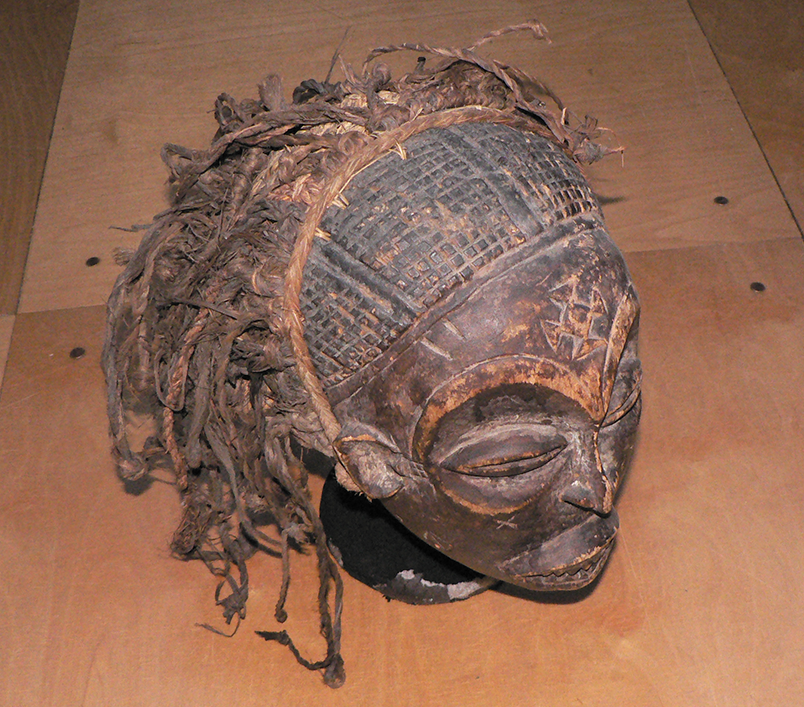
Whether it was from objects taken from colonized peoples or in recognizing the untutored peasant mind that produced a Breton calvary or a Bavarian votive painting, there was a truth to be uncovered from the time before modernity. The turn to anthropological evidence appeared to offer a direct route to fundamental human understanding. A Chokwe mask (Figure 1), for example, was an encounter with a ritual object that spurred comparative studies of ritual between ‘primitive’ cultures and those of Europeans. That there could be common features – over a long time span and crossing cultures that were supposed to be in isolation from one another – allowed writers such as van Gennep to see themselves as anthropologists in the strict sense: they were investigating a fundamental aspect of what it is to be human.
A late nineteenth- or early twentieth-century Chokwe mask, a Pwo, from Angola, used in female initiation rites. The cross-like tattoos probably derive from crosses distributed by seventeenth-century Portuguese Franciscan missionaries. © The author.
This anthropological turn was already to be found in Britain in the work of Sir James Frazer. His Golden Bough first appeared in 1890 in two volumes with the subtitle: ‘a study in comparative religion’; then again in 1900 in three volumes, now subtitled: ‘a study in magic and religion’; and yet again over a span of nine years (1906–15) in twelve volumes, quite apart from a very popular one-volume abridgement (first published in 1922) which avoided frightening its wider readership by omitting many comparisons involving Christian origins. Van Gennep was aware of Frazer's work and not only cites him in Rites of Passage as a quarry for material, but also declares him to be the founder of a school of investigation. By this act of classification, he distanced his own methodology from Frazer's.Footnote 4
Another monument to British scholarship spanning this period is the Encyclopaedia of Religion and Ethics, whose thirteen volumes were produced under the editorship of James Hastings, an inveterate organizer of reference works, between 1908 and 1926.Footnote 5 While focused on religion as universal human category, the choice of topics and the methods employed by very many of its contributors reflected the new interest in anthropology within religious studies, while the work as a whole with its diligent gathering of diverse evidence exhibited the new attention to empiricism that was common to both anthropologists and historians. Hastings, despite his own very explicit biblical and theological interests, showed an appreciation of the value of anthropology, both by treating equally other living religions alongside Christianity and in his desire to attend to religions globally. The detail of popular religion which the Encyclopaedia embraces was expansive and included what previous generations would have dismissed as ‘magic’ and ‘superstition’: each phenomenon was to be valued as part of the overall description of homo religiosus. It is probably this implicit anthropological dimension that has ensured that nearly a century after its production the Encyclopaedia of Religion and Ethics can still be useful to scholars today.
Although published after Rites of Passage, a work from 1912 is probably the best indicator of the new confidence in the value of anthropology in religion: Émile Durkheim's Les Formes élémentaires de la vie religieuse which (unlike van Gennep's work, which took over fifty years to find an English translator) appeared in English in 1915.Footnote 6 We tend to think of this work in terms of the philosophy of religion – and it engaged with all the great themes of Western philosophy of the period – or the sociology of religion, but it is also a work of anthropology using historical research as a central investigative tool. While in English it is subtitled ‘A Study in Religious Sociology’, we should note that its original subtitle links it directly with the themes of anthropology: ‘Le Système totémique en Australie’.
So, while church historians may not yet have been taking the insights of anthropology into the core of their research, among anthropologists the history of the practices of the Christian churches was now being studied afresh and being brought into the centre of an expanding discourse.
Context 2: Church History
While technically the later long nineteenth century saw a transformation of the landscape of church history – one need but recall the advent of new and more accessible sources, whether in the form of inrush of papyrus fragments or the steady progress of Monumenta Germaniae Historica Footnote 7 – conceptually very little happened with regard to its place within Christian studies: de facto, it remained a subdiscipline within theology mainly concerned with the training of ministers. However, we should begin by noting some voices that anticipate a later time. In 1908 W. C. Bishop, in a review article prompted by the publication of F. E. Brightman's Liturgies Eastern and Western, wrote:
The tendency to approach the consideration of liturgical questions from a hard-and-fast dogmatic standpoint has too often been a stumbling block in the way of historical truth and a right understanding of the problem presented. In order to obtain fruitful results from any investigation of this kind it is an essential condition that we should begin by investigating the historical facts, putting on one side for the purposes of the investigation whatever dogmatic prepossessions or beliefs we may hold, and treating them as non-existent for the moment.Footnote 8
Bishop did not draw out the point that implicit in this epoché was the possibility that historical fact might not align with subsequent doctrinal certainty as to the ubiquity, clarity and consistency of the tradition. However, one who did was George Tyrrell. In his 1903 book Lex Orandi and its 1906 sequel Lex Credendi, he explicitly appealed to the historical practice of different groups of Christians – be that differing formal practices or popular customs and beliefs – as part of the Christian inheritance.Footnote 9 But such writers were marginal voices: the debate on the eucharist to which Bishop contributed rumbled on until the 1980s without his insight being taken seriously,Footnote 10 while the approach of Tyrrell came almost to a complete stop when he was excommunicated by the Roman Catholic Church; the relationship of the so-called lex orandi and the lex credendi is still not a settled matter in that church.Footnote 11
For most church historians, their work was that of fleshing out in practical detail a grand plan whose essentials were doctrinal certainties: there was one single and largely unambiguous past.Footnote 12 While the past might be fiercely contested by each group claiming it as their specific inheritance, the common ground was that anyone who would look at it with sufficient dispassion would come to a singular conclusion: the difficulties lay in the observers, compounded by technical obscurities which were gradually being overcome, rather than in the past itself. As such, the past was ‘the secure judge’ and an appeal to it was a route to a certainty that would empirically underpin, and perhaps confirm, the known doctrinal certainties. This objective quality of history was pithily expressed by the leading French military historian of the time: ‘History alone leads us to solid conclusions which nothing can shake, and whence convictions spring. Therefore, in order to rough out a sketch of military science we shall have recourse to the historical method.’Footnote 13 We could substitute ‘theology’ for ‘military science’, because the practitioners of both shared a confidence that this method would deliver certain, externally verifiable results that would be beyond sectarian prejudices.Footnote 14 There was a single revealed datum within the historical record that industry and care could reveal.Footnote 15 This was the very opposite of those more vague generalizations found among anthropologists, with their sometimes eclectic combinations of evidence from different cultures and periods.Footnote 16
Turning to histories of those Christian ritual events that can be seen as falling within the bounds of ‘rites of passage’ – baptism, marriage and ordination – the emphasis is on the history of the doctrine of which the actual ritual is but a visible manifestation. When a ritual variation is noted, it is as an item within the larger wrapping that might reflect a commitment to this or that approach to the doctrine.Footnote 17 Religious practice is pared down to a legally understood minimum because this alone had a reality that was greater than the transient wrapping of ceremony. Similarly, the Church is understood as the collection of assenting believers rather than a cultic community with a community's needs for cultic expression. Where practice was important was in providing precedents for issues disputed later. Did they (i.e., some group of Christians in the past) at that time in the past baptize infants? Was that baptism performed by immersion or sprinkling? Was marriage considered a sacrament or not? Did that past group of Christians imagine a specific ‘power’ conferred in ordination and were there further qualifications on the transmission of that power? Since church historians were asking of earlier evidence a set of precise questions whose existence was a function of a later paradigm, these investigations were rarely conclusive; it could hardly be otherwise. In the face of inconclusive evidence, while some took refuge from the difficulty in ‘black box’ solutions such as that put forward by John Henry Newman that the evidence was there but in a form that could not yet be seen, most scholars redoubled their efforts to understand the evidence, as witnessed by the constant stream of new and better editions of historical texts.
Accompanying the search for justifying evidence – in the manner of a lawyer seeking out precedents – was the notion that doctrine had primacy in Christian revelation and was, subsequently, manifested in rites. Consequently, specialists in liturgical history aside, any attention given to ritual evidence was not from interest in the ritual itself and what that manifested about those engaged in it as a primary human reality, but concerned with how that ritual gave expression in a material manner to the doctrine which was the object of faith. While van Gennep and the anthropologists pursued rites for what their actuality told them about societies, Christian historians pursued them as symptoms of doctrines assented to by individuals. Hence there was a belief that beneath the apparent diversity of historical phenomena and conflicting opinions – heresies – there was an original unity: as logically diversity follows unity, so historically the original moment of perfect uniformity in unity, when there was ‘one Lord, one faith, one baptism’ (Eph. 4: 5), was the starting point. Just as no one doubted that one could, though skill and patience, return to the New Testament in the ‘original Greek’, so too no one doubted that it was possible to return to the original practice and understanding.Footnote 18 The main difficulty was the toll that time and vandalism had taken on the evidence, but the surviving fragments were coherent and mutually coherent, provided one could interpolate the lost material, and it was this act of ‘filling the gaps’ so that the jigsaw fitted that constituted scholarly brilliance.Footnote 19 Such vaults of imagination were made possible by the tacit assumption that the same frameworks of understanding being used by the historians were those of the people or institutions being examined: the present reached back into the past in such a way that the past manifested itself in the present.Footnote 20 Since there was confidence in the sequence that rites followed practices which manifested doctrine, many assumed that if one could get the theology rightly understood and agreed upon, then the other problems in practice between Christians could be resolved or eliminated. Thus history was more than a tool in apologetics, but held the promise of resolving disputes by discovering the golden moment underlying differences. In this return ad fontes there was the vision also of renewal, and perhaps even of a perfect liturgy.Footnote 21 Since there had once been a perfect moment, could there not be one again?
Van Gennep and Baptism
Reading Rites of Passage as a text from the first decade of the twentieth century presents us with a world that is the polar opposite of that historians’ idyll. This radical divergence in approach is captured in the book's opening sentence: ‘Each larger society contains within it several distinctly separate social groupings. As we move from higher to lower levels of civilization, the differences among these groups become accentuated and their autonomy increases.’Footnote 22 Van Gennep assumes that diversity is at the heart of human society and that rituals not only reflect this, but that diversification and separation into distinct groupings is what we should expect. While we baulk today at his casual assumption that there is a ‘scale of civilizations’, a notion he introduces at the very beginning of the book and employs throughout it,Footnote 23 it is clear that history is more than sources. Rather, it is a study of distinct societies that differ both from one another and from the society of the researcher: only the subjects’ humanity is common.
It is directly from this approach to ritual as an essential part of a social group's cohesiveness that van Gennep first mentions baptism, which he sees as an accessible example of a rite of passage familiar to his francophone readership in 1908: ‘Being born, giving birth, and hunting, to cite but a few examples, are all acts whose major aspects fall within the sacred sphere. Social groups in such societies likewise have magico-religious foundations, and a passage from group to group takes on that special quality found in our rites of baptism and ordination.’Footnote 24 In this passage baptism is neither an ‘outward sign of inward grace’, nor an external expression of a doctrinal revelation, but a fact in its own right. Baptism is not taken aside into a special sphere as a Christian sacrament, but is studied among a set of human phenomena characterized collectively as ‘magico-religious’ acts. It is this action placed within a social network involving many individuals in one collective endeavour – baptizing and being baptized – that brings about its ‘effect’ for the participants and it is to be understood as part of their collective story. Baptism does indeed ‘effect what it signifies’ for the group in that individuals pass from one state to another, they are changed by effecting the ritual, and they move on into the future as new people. We shall note again later that van Gennep starts with the ritual and then looks at what this experience means in its effects among the group, not in terms of a rational abstraction of ‘meaning’.
Baptism is next looked upon as one of a sequence of actions by a specific group – Christian Bulgarian women in this case – as they move through a rite of passage: through it they come to terms with the disruption in individual, family and group life that goes hand in hand with childbirth.
From St Ignatius’ day until the calends (Kolièda) the expectant mother must neither wash her hair, clean her clothes, nor comb her hair until after nightfall; she must not leave her house during the ninth month. She must not remove for a whole week the clothing she wears at the time of delivery. A fire is kept burning until the christening [jusqu'au baptême] and the bed is surrounded with a rope. The cakes are baked; the young mother must eat the first piece and share the rest with her relatives; not a single crumb may leave the house. The relatives bring gifts and all spit on the mother and child (obvious rites of incorporation). They come to see her throughout the first week. On the eighth day the baptism takes place. On the fifteenth day the young mother bakes cakes and invites her neighbours and the women of her acquaintance to come and eat; all of them bring flour.Footnote 25
This account seems hardly remarkable, in that in a historically Christian country like Bulgaria in the late nineteenth century we should expect that the formal ceremony of baptism would be one of the key events after childbirth. This looks like an ethnographic account of the secular customs of a people into which a Christian sacrament has been interwoven, but such a reading would not do justice to van Gennep's cultural hermeneutic in Rites of Passage.
Van Gennep's account is a single whole: he has described a complete and unitary community process, and splitting it into moments, such as secular / religious or sacramental / non-sacramental, would miss his essential point. Through this process, this rite of passage, the community comes to terms with its new member; the mother relates to the community, her own experience and her baby; and the newborn is properly prepared to know that she / he is a fully accepted member of the group. Where does the ‘magico-religious’ – a favourite term of van Gennep – act begin or end? We have a description of a long series of distinct actions, all in a known sequence which is a datum within the community, leading to a known, desired result. The meaning – if the perspective of the investigator is allowed to intrude – of this ritual lies in the awareness of those involved of doing what is needed: their experience is fundamental. This is completely opposite to a focus on the parents bringing the infant to the church to be baptized, and a set of rituals in which they have minimal engagement, where they are told by the minister from out of his study of an academic tradition of theology not only what the experience is ‘really about’ or means, but also, indeed, what the infant is experiencing.Footnote 26 Instead, experience – and this is always a social and bodily reality of common memory as is seen in the precise details van Gennep believes we, the readers, must note – is the basis for understanding. Any extrinsic ‘explanation’ would be simply one more moment in the process and one additional mythic (albeit in this case verbal) element in the group's reality. In adopting this perpective, van Gennep anticipates several movements in twentieth-century scholarship, all of which have a bearing on the work of church historians. In its focus on community memory, I believe that van Gennep's approach anticipates the work of Maurice Halbwachs (1877–1945) and more recently Pierre Nora, both of whom have impacted on the historical work of New Testament scholars. In his attention to process, he was directly the inspiration for Victor Turner (1920–83), whose work (in my view) increasingly affects the study of the history of liturgy as it moves away from being simply the archaeology of texts. The concern with the intrinsic experience of reality, as distinct from its extrinsic determination, mirrors the theological concerns of Maurice Blondel (1861–1949) and the historical turn of Henri de Lubac (1896–1991) in historical theology, and the incarnational turn of those theologians who engage with the significance of the historical Jesus within theology, such as Edward Schillebeeckx (1914–2009).
Rites of Passage mentions baptism, and the link between baptism and naming, on several occasions, but the next extended reference to it is when the importance of giving a name, or a new name, is examined:
The rites of naming would merit a monograph to themselves. Though frequently studied, I think they have never been considered in full detail or in their true light. When a child is named, he is both individualized and incorporated into society.
…
It will be noted that in Gabon the rite of naming coexists with a rite which is strikingly analogous to baptism. Baptism has most often been regarded as a lustration, a purging and purifying rite, i.e., a final rite of separation from the previous world, whether it be a secular world or one that is actually impure. This rite must be evaluated with care, however, for it may also signify incorporation when it is performed with consecrated rather than with ordinary water. In that case the person baptized not only loses an attribute but also gains one. This consideration leads us to examine a new set of ceremonies, ordinarily known as initiation rites.Footnote 27
Here, once more, we see the characteristic elements of van Gennep's approach: begin with the actual ritual and ‘read’ this within society: the social group remains the primary locus of interpretation and meaning. But this passage also draws us into another theme of modern historical research in that, after the mention of baptism, van Gennep places a footnote indicating that ‘for baptism as a rite of initiation’ the reader should turn to a work of Lewis Richard Farnell (1856–1934).Footnote 28 Farnell is now known almost exclusively as a Greek scholar and a classicist, but his 1905 work, subtitled ‘an anthropology of religion’, puts him among those anglophone anthropologists who influenced van Gennep and stand also in our own background as church historians. Farnell's work appeared in the Crown Theological Library alongside volumes dedicated to bringing historical-critical scholarship to bear on both biblical studies and the historical issues in theology. It is perhaps best studied on the assumption that its readers are historians of Christian practices and beliefs. On baptism, Farnell wrote:
… we should probably find, if we followed out the history and origin of infant baptism, that the pre-Christian tradition was a strong efficient force for the settlement of the question: there were reasons why the rite should soon have come to be maintained by the early Church, for analogous rites whereby the new-born child was consecrated to the divinity were probably part of the hereditary tradition of most of the converted races.Footnote 29
Religions exist within cultures for Farnell and to imagine them simply as functions of their formal theology does not enter his landscape. The act of investigating a ritual is much less a theological question than an engagement with a cultural tradition and its needs. The ritual has its own integrity as part of a group's cultural heritage: it is shaped by the group and it reveals the group to the investigator. This becomes clearer in Farnell's more detailed comments on baptism, in which he rejects rationalist explanations of rituals, such as Aristotle's explanation of plunging babies into water as a ‘hardening up’ process, in favour of a human need to engage with mystery. Thus the baptism of the adult is a ‘mystic service’ that simulates both death and being born anew, and the historical questions are to be pursued in the light of this observation.Footnote 30 Anthropology is here pressed into the service of historical investigation; while theology, conceived of as ‘primary ideas and essential beliefs’, is to be understood not on its own claims but as subsequent to the activities of a community engaging in rituals.Footnote 31 Farnell, who acknowledged his debt to historians of liturgy such as Louis Duchesne (1843–1922), saw a clear sequence of investigation: one begins with an anthropological study, then proceeds to examine the diverse historical evidence, then looks at the explanations offered in liturgy and catechetics; only then can one appreciate how interpretation is ‘regarded’ by theology.Footnote 32 His method prepares for that used by van Gennep; indeed, Farnell is arguably the originator both of the notion of ‘rites of passage’ and of the approach that views baptism as ‘initiation’. He thus stands at the origin of the movement that has been so enormously influential in Christian liturgy since the 1950s.
My last example of how van Gennep looked at baptism is taken from his chapter on initiation rites:
Then came the transitional period: the catechumen, just like those initiated into the lesser mysteries, was permitted to attend religious assemblies and had a special place in the church, but he was required to withdraw before the beginning of the true mysteries (the Mass). He was periodically submitted to exorcism and thus separated more and more from the non-Christian world; he was gradually instructed; his ‘ears were opened.’ After a last exorcism came the effeta: the priest moistened his finger with saliva and touched the top of each catechumen's upper lip; the candidates undressed, and their backs and chests were anointed with consecrated oil; they renounced Satan; swore to ally themselves with Christ; and recited the Credo.
…
It was followed by rites of the incorporation proper. … [T]he catechumen … hence became regeneratus, or conceived again according to the very terms of the prayer pronounced during the rite which followed.Footnote 33
We have already met many of the themes of this passage, such as attention to the ritual itself and the emphasis on sequence and process, but its manner of reference to the liturgical details is noteworthy. Such attention to detail was the preserve of rubricians and those who studied ritual from the standpoint of antiquarians: details to be enjoyed, marvelled at or revived in their reconstruction of an ideal past. Here, without any interest in making a theological point, liturgy is part of human inheritance and this ritual is firmly in the social sphere. Liturgy is examined as a complete unity in experience rather than as ritual gestures tied to formulae – liturgy is no longer a book – and in this van Gennep anticipates the key difference between modern liturgical investigators and the approach, dominant in most Western churches until the 1960s, which was centred in written texts. Here, explicitly, those texts – ‘and recited in the Credo’ – follow the actual events that initiate and transform. In making this study van Gennep references the work of Duchesne. Duchesne's own engagement with the liturgical past was that of a critical historian rather than the nostalgic gathering of the jewels of an enchanted past in the face of a bitter modernity that characterized so many of Duchesne's contemporaries working in French, such as Fernand Cabrol (1855–1937) or Henri Leclercq (1869–1945).
Because van Gennep took the Christian liturgy so seriously, viewing it as embedded in the human person who in turn was embedded in society, what he wrote was immediately accessible to those theological scholars who interpreted his work in the light of their theological anthropology, and so it could speak seamlessly to their ecclesiology and become manifest in their liturgical reforms. However, while this influence of van Gennep was significant, we should also note that it occurred without fanfare and was very uneven across the Christian churches. This article has given a certain priority to francophone scholarship in deference to van Gennep, but the patchiness of his reception is perhaps best seen in English-language scholarship. For example, it is often remarked that the churches of the anglophone world were least aware of the movements for liturgical reform that swept France and Germany from the 1920s. We see this in the complaint by the Anglican scholar Peter Hammond in 1960 that the work of the continental Liturgical Movement was virtually unknown in Britain.Footnote 34 Similarly, Roman Catholics from across the English-speaking world, who might be expected to have a greater awareness of developments in France, Germany and Italy, seem to have been taken by surprise by the liturgical discussions of the Second Vatican Council (1962–5). The English-speaking liturgical churches, as a whole, appear to have begun to engage with the liturgical movement only from the late 1960s.Footnote 35 Perhaps this time lag is to be explained, partly, by the fact that van Gennep was only translated into English in 1960.Footnote 36
The Turn to Plurality
One of the most characteristic features of historical writing today across the disciplines falling under the heading of ‘religion’ is the awareness of plurality. We speak of the diversity of Judaisms that were to be found in the period before the destruction of the temple in 70 CE. We speak of the churches rather than ‘the church’ and of early Christianities rather than assuming there was a single organizational or doctrinal edifice. We have become suspicious of the ancient heresiologists and are aware that the development of ‘orthodoxy’ or the canon of the New Testament are as much events in the evolution of the Christian movement as the variations we find in rituals in different places. While this plurality is often not grasped or welcomed as a reality by elements within each church, it is now the assumed norm within the mainstream academy.
However, this interest in plurality has an even deeper foundation. Probably from as early as the second century, one of the unquestioned assumptions of much Christian scholarship has been that there was a moment when all was perfectly one, harmonious and singular. The work of Walter Bauer (1877–1960) in the 1930s (once again, note the time lag before this appeared in English in 1971) shattered that cosy illusion once for all.Footnote 37 Bauer showed that consistent and explicit doctrines are subsequent to a variety of teaching and a range of acceptable formulae. More recently, Epp and Parker have shown that the quest for the single original form of those texts, such as the gospels, which later achieved canonical status is not only not possible but fails to take account of the diversity inherent in their being ‘living texts’.Footnote 38 In the actual life of the early churches, the texts were continually being varied – deliberately and not as a result of faulty transmission – as the situations in which they were being used varied. For over a century, exegetes had sought out the ecclesial Sitz im Leben as a guide to understanding the formation of the tradition, but the challenge now is to speculate on the whole range of situations in which this text, or one like it, was being used. Likewise, when it comes to practices of the churches, the quest for the original action or pattern has given way to an acknowledgment that diversity preceded uniformity.Footnote 39 The uniformity of a common ‘shape’ (to use Gregory Dix's term) was the result of liturgies seeking to borrow from one another and pattern themselves on one another in response to an earlier diversity, rather than the remnants of an original form progressively diversified by corruption and idiosyncratic development.Footnote 40
The turn to plurality implies a second shift in perspective: a radical acceptance of the incompleteness of our evidence. When, for example, Westcott and Hort set out in detail their method,Footnote 41 they were as aware as we are of the fragmentary nature of the evidence. They believed that by careful labour they might eventually glimpse the original whole and it inspired their labour: even a partial access to that wondrous moment was their reward. We have no basis for such confidence. We simply know that there were situations earlier than our earliest extant evidence, for it was those situations that produced our fragments.
I began this article by noting that I would not attempt to trace specific influences of the anthropologists of van Gennep's time upon church historians (the academic pursuit of ‘spot the source’); nor would I try to write a history of history (a foolhardy endeavour in an article even if I were competent to undertake it). Rather, I wanted to examine van Gennep's assumptions and ways of working in order to facilitate our reflection upon our own situation, for the pursuit of history is always about us and is far more reflective in nature than we often care to acknowledge. Writing of an earlier French historiography, Pierre Nora has remarked that ‘[t]hrough the past we venerated above all ourselves’;Footnote 42 he might have been describing the ecclesiastical history of the early twentieth century. The challenge facing us is far more complex. We can no longer imagine ourselves like detectives who assemble the evidence, aiming eventually ‘to close the case’. As historical investigators of past religious phenomena our work is akin to that of anthropologists who live with the incompleteness that is a result of human variation. It is enough to understand something of the past's religiosity; veneration is best left to others.


 Open access

