

Introduction
Mortality salience refers to the heightened awareness of one's own mortality in contexts intimately connected to death and dying, and can trigger a range of psychological responses, including anxiety, fear, and an intensified sense of meaning and purpose in life (Greenberg et al. Reference Greenberg, Pyszczynski, Solomon and Baumeister1986). Originating primarily from psychological and sociological studies, the concept of mortality salience has been extensively examined within modern cultural contexts (Ma-Kellams & Blascovich Reference Ma-Kellams and Blascovich2012; Tjew-A-Sin & Koole Reference Tjew-A-Sin and Koole2018; Vail et al. Reference Vail, Juhl, Arndt, Vess, Routledge and Rutjens2012). Although these studies offer valuable insights, the application of mortality salience theory to archaeology represents a novel endeavour. This interdisciplinary approach requires careful consideration of cultural variations and theoretical adaptations, as already demonstrated in studies of modern societies (e.g. Ma-Kellams & Blascovich Reference Ma-Kellams and Blascovich2012; Tjew-A-Sin & Koole Reference Tjew-A-Sin and Koole2018). Nonetheless, its integration into archaeological research opens new avenues for examining how ancient cultures confronted and conceptualized mortality.
A growing body of research (Becker Reference Becker1973; Fransen et al. Reference Fransen, Fennis, Pruyn and Das2008; Gailliot et al. Reference Gailliot, Stillman, Schmeichel, Maner and Plant2008; Rosenblatt et al. Reference Rosenblatt, Greenberg, Solomon, Pyszczynski and Lyon1989, 681–2) indicates that mortality salience significantly influences human behaviour, particularly in contexts where questions of death and human mortality are prevalent, such as cemeteries, religious spaces and ritualistic settings (Greenberg et al. Reference Greenberg, Pyszczynski, Solomon and Baumeister1986). According to Terror Management Theory (TMT) (Greenberg et al. Reference Greenberg, Pyszczynski, Solomon and Baumeister1986; Solomon et al. Reference Solomon, Greenberg and Pyszczynski1991), mortality salience can drive individuals to seek and uphold cultural values and beliefs providing a sense of symbolic immortality or transcending death for the ‘postself’ (Dechesne et al. Reference Dechesne, Pyszczynski and Arndt2003; Florian & Mikulincer Reference Florian and Mikulincer1998; Routledge & Arndt Reference Routledge and Arndt2008; Wojtkowiak & Rutjens Reference Wojtkowiak and Rutjens2011).Footnote 1 This may involve adherence to cultural traditions, religious practices, and the pursuit of cultural norms and expectations (Baldwin & Wesley Reference Baldwin and Wesley1996; Dechesne et al. Reference Dechesne, Pyszczynski and Arndt2003; Landau et al. Reference Landau, Solomon and Greenberg2004; Rosenblatt et al. Reference Rosenblatt, Greenberg, Solomon, Pyszczynski and Lyon1989; Wisman & Koole Reference Wisman and Koole2003). However, mortality salience can also prompt individuals to question and modify their existing beliefs and behaviours, especially when they perceive their current social frameworks as inadequate in the face of mortality (Gailliot et al. Reference Gailliot, Stillman, Schmeichel, Maner and Plant2008). As a result, they may seek out new beliefs, behaviours or practices that align better with their altered sense of purpose.
Archaeological studies of mortuary practices offer a unique perspective into how individuals across cultures and historical periods responded to death, and thus, mortality salience, and sought to create a sense of meaning and purpose in life. This endeavour involved the establishment of organized practices, referred to as ‘proximal defences’, as well as the development of overarching concepts and beliefs, termed ‘distal defences’ (Greenberg et al. Reference Greenberg, Pyszczynski, Solomon and Baumeister1986; Hayes et al. Reference Hayes, Schimel, Arndt and Faucher2010; Pyszczynski et al. Reference Pyszczynski, Greenberg and Solomon1999; Solomon et al. Reference Solomon, Greenberg and Pyszczynski1991).
Proximal defences involve immediate, pragmatic responses to the awareness of death, such as rituals or burial customs, which serve to manage anxiety at the conscious level. In contrast, distal defences operate at a symbolic or ideological level, providing frameworks of meaning—such as religious or cosmological beliefs—that transcend the individual and offer a sense of immortality or continuity. This distinction highlights the interplay between practical and ideological strategies in human efforts to confront mortality, underscoring the need for explicit consideration of both dimensions in archaeological interpretations. The investigation of both responses can lead research beyond questions of agency in the adoption or abandonment of mortuary practices, to the fundamental inquiry concerning why specific mortuary practices emerge in the first place and what social needs their adoption fulfils for each community.
The primary objective of this paper is to examine how individuals and their social groups in the study area utilised mortuary practices as a means of collectively constructing a shared sense of meaning and purpose in life, from the MH to the end of the LH period. The research focuses specifically on why practices involving the manipulation of the dead and their disarticulated skeletal remains (e.g. removal, repositioning, or grouping) were introduced as proximal defences, to address the terror of mortality and establish a symbolic connection between the living and their dead.
Mortality salience
Previous studies on the relationship between mortality salience and behaviour during death and death-related practices suggest that mortality salience can heighten the perceived significance of one's values and increase the likelihood of choosing behaviours consistent with those values (Arndt et al. Reference Arndt, Schimel and Goldenberg2003; Baldwin & Wesley Reference Baldwin and Wesley1996; Dechesne et al. Reference Dechesne, Pyszczynski and Arndt2003; Gailliot et al. Reference Gailliot, Stillman, Schmeichel, Maner and Plant2008, 1001; Greenberg et al. Reference Greenberg, Solomon, Pyszczynski and Zanna1997; Landau et al. Reference Landau, Solomon and Greenberg2004; Rosenblatt et al. Reference Rosenblatt, Greenberg, Solomon, Pyszczynski and Lyon1989; Wisman & Koole Reference Wisman and Koole2003). This behaviour stems from the fundamental fear of one's own mortality, generating anxiety when confronted with the awareness of death, as well as human desire for survival and transcendence (Greenberg et al. Reference Greenberg, Pyszczynski, Solomon and Baumeister1986).
This phenomenon can be attributed to a combination of factors. The central driver is the innate fear individuals harbour about their own mortality, triggered by the acknowledgment of the finality and inevitability of life (Becker Reference Becker1973; Florian & Kravetz Reference Florian and Kravetz1983; Shneidman Reference Shneidman1973, 62). This fear acts as a powerful motivator, compelling individuals to seek coping mechanisms that offer a sense of security and meaning in the face of existential threats (Rosenblatt et al. Reference Rosenblatt, Greenberg, Solomon, Pyszczynski and Lyon1989). The desire for survival, deeply embedded in human nature, and awakened by the recognition of the finite nature of human existence, prompts individuals to ensure their survival, not only biologically but also psychologically.Footnote 2 This desire for survival encompasses the preservation of one's identity, values and the broader meaning attributed to life (Moore & Williamson Reference Moore and Williamson2003).
Moreover, the concept of transcendence plays a crucial role in expanding our understanding of this phenomenon even further. Transcendence refers to the human aspiration to go beyond the limitations of mortality and achieve something enduring or meaningful (Pyszczynski Reference Pyszczynski, Shackelford and Zeigler-Hill2019). The anxiety induced by the awareness of death prompts individuals to seek avenues for transcendence, be it through preserving a cultural worldview, establishing a legacy, or adhering to deeply held values (Pyszczynski Reference Pyszczynski, Shackelford and Zeigler-Hill2019). In doing so, individuals aim to surpass the temporal constraints of their mortal existence and contribute to something that extends beyond their own lifespan.
Proximal and distal defences serve to mitigate these anxieties induced by activated heightened salience in mortuary contexts, manifesting itself as conscious thoughts of death (Pyszczynski et al. Reference Pyszczynski, Greenberg and Solomon1999). These defences enable individuals to divert attention from such thoughts by focusing on alternative matters, such as the hands-on management of the dead, thus diminishing attention to thoughts of their own deaths (Arndt et al. Reference Arndt, Cook, Routledge, Greenberg, Koole and Pyszczynski2004; Pyszczynski et al. Reference Pyszczynski, Greenberg and Solomon1999). Distal defences augment this support by establishing a nexus that involves cultural systems and internalized cultural worldviews (e.g. religious beliefs), forming a symbolic defence construct (Arndt et al. Reference Arndt, Schimel and Goldenberg2003; Greenberg et al. Reference Greenberg, Pyszczynski, Solomon and Baumeister1986; Reference Greenberg, Arndt, Simon, Pyszczynski and Solomon2000; Pyszczynski et al. Reference Pyszczynski, Greenberg and Solomon1999). This construct, reliant on validation from others, is enacted through mortuary practices, aiming to introduce specific constraints and a structured framework into the processes of death and burial, with variations depending on the identity of the dead individual and of the partakers in these practices. This frame of action is integral to maintaining the shared ‘worldview’ among community members, often resulting in what is observed in archaeological studies as the ‘conservatism’ of mortuary practices (Binford Reference Binford and Brown1971).
Nevertheless, despite the community's need to sustain the form of these practices and, consequently, their shared worldview, changes do emerge, leading to the question of why they occur. To elucidate the agency driving these changes, Piaget (Reference Piaget and Mussen1970; Reference Piaget, Overton and Gallagher1977) proposed that when information that cannot be integrated within the existing worldview poses a threat to its existence, individuals experience a sense of dissonance. This dissonance becomes an agent of change, leading either to what is termed ‘assimilation’, which is the process of adapting and processing new information within a pre-existing cognitive framework (Piaget Reference Piaget and Mussen1970, 706), or full accommodation, which is the entire reconstruction of the salient norms around this new information (Piaget Reference Piaget and Mussen1970, 708). The more removed and different the new concepts and ideas are from salient social norms, the more likely assimilation becomes the preferred strategy, as the changes it instigates affect ‘peripheral constructs … which can be altered without serious modification to the core structure’ (Kelly Reference Kelly1955, 483). This results in the adjustment of only peripheral elements of the shared practices, a process considerably less disruptive than the modification of the core structure of a set of beliefs and the reshaping of the existing cognitive framework. In this way, the community can address the dissonance and integrate new information without undergoing a radical transformation in their fundamental worldview.
In mortuary research, the concept of assimilation can be reflected in gradual, incremental changes to mortuary practices. On the other hand, accommodation is more conspicuous in sudden and marked alterations attributed to external factors that forcefully disrupt the belief system of a community. Identifying the latter is relatively straightforward when examining the practices of a community in comparison to a broader geographical and chronological context. Conversely, identifying assimilation necessitates meticulous documentation of practices over the extended use of a cemetery and a deep understanding of the context in which these changes emerge.Footnote 3
The imperative for developing death-centred practices as proximal defences against the anxiety of mortality salience arises from the active agency within the community. This need is intricately linked to the deeper cultural and social context, shaping the shared worldview of individuals. To clarify, accommodation involves an abrupt reform of current mortuary practices to alleviate mortality salience promptly, replacing the existing mortuary belief system with a stronger one. On the other hand, assimilation requires community consent to embrace subtle changes, slowly influencing and altering the distal defences of the communities. These gradual shifts ultimately lead to the reformation of beliefs that constitute the core values of the worldview that initially shaped these practices (Hayes et al. Reference Hayes, Schimel, Williams, Howard, Webber and Faucher2015). The cognitive dissonance of essentially dismantling the core values that served as a defence against mortality salience results in a delicate balancing act between the need for change and the desire for stability. Each community navigates this process differently, aiming to preserve the symbolic defence construct while adapting to new information and circumstances.
Nonetheless, while this cognitive approach offers an intriguing framework for understanding these dynamics, its application within an archaeological context demands further justification. Foundational anthropological and sociological contributions to the study of attitudes toward death are crucial in understanding how mortuary practices are shaped by cultural and social factors (e.g. Durkheim [1912] Reference Durkheim1965; Hertz [1907] Reference Hertz1960; Turner Reference Turner1969). Durkheim ([1912] Reference Durkheim1965) posited that mortuary practices provide an opportunity for the living to process their grief, serving as rituals through which individuals reaffirm their connection to the group and their core beliefs—referred to in his work as ‘collective representations’. Hertz ([1907] Reference Hertz1960, 27) emphasized that death is not just a personal event, but a social and a moral one, through which society expresses its values and beliefs. He also noted that death is a process, rather than an instantaneous event, with many societies using ritual sequences to transition the deceased from the realm of the living to the world of the dead (Hertz [1907] Reference Hertz1960, 48).
Van Gennep's (Reference Van Gennep1960) insights into these ritualistic and transitional aspects of death illustrated how societies navigate the liminality of death and mortality, either through symbolic practices that reintegrate the deceased into the social order (e.g. concepts of ancestorhood and symbolic continuation), or through the construction of a series of proximal defences that address the immediate impacts of mortality salience. Becker's (Reference Becker1973) work deepened this understanding by framing these rituals as part of a larger cultural defence system that mitigates the existential anxiety stemming from death awareness. Becker (Reference Becker1973) also emphasized that such practices are not merely about honouring the dead, but are deeply tied to the living's need to reaffirm their cultural worldviews and secure their psychological survival, while Elias (Reference Elias1985) explored how societies, both modern and historical, managed the experience of dying through shifting their social frameworks.
The concept of death-centred practices thus has been crucial in the understanding of how societies, as aggregates, use rituals to navigate the emotional and psychological effects of mortality salience. These practices are not merely functional or mechanical responses to death; they are embedded within broader cultural systems that serve to reinforce the collective worldview, offering comfort and reassurance to the living. The rituals surrounding death, burial and memorialization are, therefore, fundamental to maintaining social cohesion, as they both address the existential anxiety of individuals and reaffirm the continuity of their cultural and social systems (Durkheim [1912] Reference Durkheim1965).
The transformation or disruption of mortuary practices—whether gradual or abrupt—carries profound implications. Sudden disruptions, often instigated by external forces, can challenge established symbolic frameworks, while gradual shifts may reflect the subtle integration of new ideas, which, over time, can prompt a more fundamental re-evaluation of the symbolic structures underpinning a community's worldview (Crellin Reference Crellin2017). The interplay between stability and change in mortuary practices underscores not only the resilience of cultural traditions, but also the strategies societies employ to confront and adapt to the universal challenge of mortality. Examining this tension is crucial for understanding how communities balance their need for symbolic continuity with the inevitable evolution of their cultural beliefs.
In applying this framework to archaeological contexts, the challenge lies in interpreting the evidence of such gradual and sudden changes in mortuary practices. Archaeologists must consider not only the material culture left behind by past societies, but also the social and cognitive processes that underpinned these practices. By incorporating insights from sociological, psychological and anthropological theories, researchers can gain a deeper understanding of the roles these rituals played in both the individual and collective coping strategies for mortality salience. This integrative approach allows for a more nuanced interpretation of the archaeological record, shedding light on the complex interplay between death, culture and the human need for transcendence.
Death and dying in archaeological theory
The role of the societal context, as emphasized in Terror Management Theory (TMT) (Greenberg et al. Reference Greenberg, Pyszczynski, Solomon and Baumeister1986), is pivotal in shaping how individuals and groups perceive and navigate their emotional experiences related to mortality (Barbalet Reference Barbalet2002; Frost & Hoggett Reference Frost and Hoggett2008). Despite this foundational understanding holding a central position in the fields of social and evolutionary psychology, unveiling the intricate influence of social factors on diverse death practices and responses, the fields of sociology of death, anthropology and archaeology have persistently resisted its implementation in death-related studies.
In the realm of archaeological mortuary research, Durkheim's ([1912] Reference Durkheim1965) insight into the collective force of belief in social organization significantly heavily influenced Binford's analysis of mortuary practices. Binford (Reference Binford and Brown1971, 17) contended that mortuary practices reflect ‘the composite of the social identities maintained in life and recognised as appropriate for consideration at death’, emphasizing the necessity for social groups to fulfil specific ‘status responsibilities’ to the deceased. Despite Binford's analysis potentially attributing an exaggerated value to the significance of social complexity, he astutely acknowledged that the salient practices of the social group, particularly their acceptance in the community, drive individuals to shape mortuary practices accordingly. Nevertheless, little to no attention was given to the impetus behind this phenomenon, therefore omitting the underlying motivations and drivers that propel individuals and communities to engage in such practices in the first place. The reluctance to explore the impetus behind mortuary practices represents a notable gap in understanding the deeper psychological, cultural and societal factors that contribute to the formation and evolution of these rituals. By neglecting this crucial aspect, Binford's research failed to grasp fully the intricate interplay between the human psyche, societal norms and the existential challenges posed by mortality.
Building upon this omission, Hodder (Reference Hodder, Rahtz, Dickinson and Watts1980) criticized Binford's approach, highlighting that social relations can be distorted in mortuary contexts, through symbolization. Nevertheless this approach neglected to acknowledge that symbolization is a product of social relations. In fact, and in light of mortality salience studies, symbolization becomes a conceptual construct aiming to anchor mortality salience defences within a community's worldview (Greenberg et al. Reference Greenberg, Pyszczynski, Solomon and Baumeister1986; Reference Greenberg, Arndt, Simon, Pyszczynski and Solomon2000; Pyszczynski et al. Reference Pyszczynski, Greenberg and Solomon1999). Similarly, Parker Pearson (Reference Parker Pearson and Hodder1982) emphasized the role of ideology in concealing power relations within social groups and posited that the dead were often manipulated and politicized for the interests of the living, in critique of Binford's direct reflection of social relations in the mortuary sphere. Nevertheless, in this assessment, Parker Pearson overlooked the fundamental utility of mortuary practices, which is addressing existential fears, whether in life or death, and promoting transcendence and the preservation of one's identity, values and social group.
The teetering foundation of both Hodder's (Reference Hodder, Rahtz, Dickinson and Watts1980) and Parker Pearson's (Reference Parker Pearson and Hodder1982) critiques of Durkheim ([1912] Reference Durkheim1965), however, is rooted in a similar scope. Despite their endeavour to highlight the dynamics of the social group and correlate them with the emergence and formation of mortuary practices, they not only approached death, dying and mortuary practices predominantly from an individual's perspective, but also sought to interpret social structures and mortuary structures in an isomorphic manner, rather than a causative manner. This oversight constrained their interpretation and overlooked how influential social dynamics and social psychology are in shaping worldviews that not only reflect the composition of communities, but are also deeply rooted in the evolutionary needs that guide human behaviour (Mobbs et al. Reference Mobbs, Hagan, Dalgleish, Silston and Prévost2015).
Post-processual theorists, inspired by Giddens (Reference Giddens1979; Reference Giddens1984) and Bourdieu (Reference Bourdieu1977), attempted to move beyond these limitations by emphasizing agency, intentionality and meaning in mortuary practices. They reframed these practices as active agents in shaping social dynamics rather than passive reflections of social structures (e.g. Barrett Reference Barrett1994; Dobres & Robb Reference Dobres and Robb2000). However, post-processual frameworks often neglected the existential dimensions of mortuary practices, focusing instead on the performative aspects of identity within specific social contexts. While this shift addressed reductionism in earlier models, it downplayed the role of mortality salience in driving the creation and maintenance of symbolic frameworks that manage existential anxiety.
Parker Pearson (Reference Parker Pearson1999) expanded the analytical scope by addressing questions about human skeletal remains, burial practices and cemetery organization, and incorporated the social functions of death as a rite of passage (Van Gennep Reference Van Gennep1960), most importantly, the broader ‘human experience’ of death. These inquiries introduced multivariate analyses addressing burial patterns, memory mechanisms, embodiment, performativity, individuality and social identity (e.g. Meskell Reference Meskell1996; Meskell & Joyce Reference Meskell and Joyce2003). These concepts enriched analyses and challenged the passivity of individuals in processualist approaches (Back Danielsson Reference Back Danielsson and Jones2008; Fowler Reference Fowler2004; Meskell Reference Meskell and Hodder2001; Thomas Reference Thomas2002).
The Giddens (Reference Giddens1979) ‘knowledgeable social actor’, who was seemingly freed from social determinism and actively shaped their social performance, was soon criticized as portraying a ‘dehumanized’ approach (Gero Reference Gero, Dobres and Robb2000; Voutsaki Reference Voutsaki2010, 67). A series of studies focusing on the human experience, emotion and intentionality questioned the nature of personhood and agency and introduced the concept of the individual, grounded within their cultural, historical and social context (Barrett Reference Barrett, Dobres and Robb2000; Hodder Reference Hodder, Dobres and Robb2000; Jones Reference Jones2005; Meskell Reference Meskell1996; Reference Meskell1998; Reference Meskell1999; Meskell & Joyce Reference Meskell and Joyce2003; Tarlow Reference Tarlow1999; Thomas Reference Thomas2002). These studies shifted the focus from macro-social structures to the micro-level experiences of individuals and small social groups, placing mortuary practices within personal and communal narratives that reflected diverse expressions of identity and emotion within mortuary contexts.
Social practices were thus increasingly also understood as adaptive responses to emotional challenges, such as grief and fear, with rituals serving as central defences against death (Cannon Reference Cannon1989; Cannon & Cook Reference Cannon and Cook2015; Joyce Reference Joyce and Chesson2001, 21; Tarlow Reference Tarlow1999, 27; Reference Tarlow2000, 718–19). This perspective highlighted the roles of collective memory, ritual and symbolic practices, not only as reflections of social norms but also as active mechanisms that constructed and sustained social cohesion and identity (Assmann Reference Assmann2006; Reference Assmann2011). As such, this shift marked a deeper understanding of death practices as complex, multifaceted phenomena, intricately connected to psychological, emotional and social dynamics (Tarlow Reference Tarlow1999, 140).
Contemporary approaches to archaeology increasingly emphasize the cognitive, sensory and emotional dimensions of practices (e.g. Chesson Reference Chesson, Fleisher and Norman2016; Harris Reference Harris, Fleisher and Norman2016; Harris & Sørensen Reference Harris and Sørensen2010; Hill Reference Hill, Tarlow and Nilsson Stutz2013; Mitrović Reference Mitrović2024; Nilsson Stutz Reference Nilsson Stutz, Fleisher and Norman2016; Reference Nilsson Stutz, Skeates and Day2019; Pettitt Reference Pettitt, Henley, Rossano and Kardas2019), examining how individuals and communities negotiate the profound challenges of loss while maintaining social bonds through practices. These studies also explore the ways in which ritual practices continued to evolve in long-term social narratives, adapting to archaeological contexts and reflecting ongoing negotiations between identity, memory, and even the emotional landscape of grief (e.g. Mitrović Reference Mitrović2024).
Despite these advancements, however, the integration of psychological frameworks like Terror Management Theory (TMT) and mortality salience (Greenberg et al. Reference Greenberg, Pyszczynski, Solomon and Baumeister1986) remain underexplored in archaeological contexts. While the aforementioned analyses emphasized the socio-cultural dimensions of mortuary practices, they often overlooked the existential motivations that underpin such rituals. In this analysis, TMT provides an interpretive lens that situates mortuary practices as not merely social or performative acts but also as responses to mortality salience. By anchoring individuals and communities within a shared worldview, mortuary practices serve to mitigate the anxiety provoked by the awareness of death, enabling the preservation or renegotiation of identity, meaning and continuity.
As archaeological research continues to expand its analytical scope, integrating TMT into the study of mortuary practices offers a promising avenue for understanding the psychological, cultural and existential dimensions of death. By exploring how burial rituals, grave goods and commemorative practices serve to manage mortality salience, archaeologists can uncover new insights into the interplay between individual agency, collective identity and the shared human experience of confronting mortality. Such an approach will not only deepen our understanding of ancient mortuary practices, but also connect them to universal themes that continue to resonate in contemporary society.
Messenia: a case study
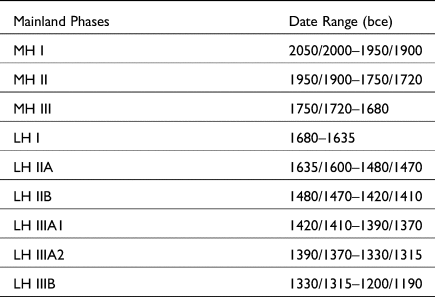
The selection of Messenia as the geographical focus for this study is based on its rich archaeological significance and the unique insights it can provide into Middle Helladic (MH) and Late Helladic (LH) mortuary practices (Table 1).
Mainland chronological phases and their date range (after Rutter Reference Rutter, Wiersma and Voutsaki2017, 17, table 2.1 and Manning Reference Manning and Cline2010, 23, table 2.2)
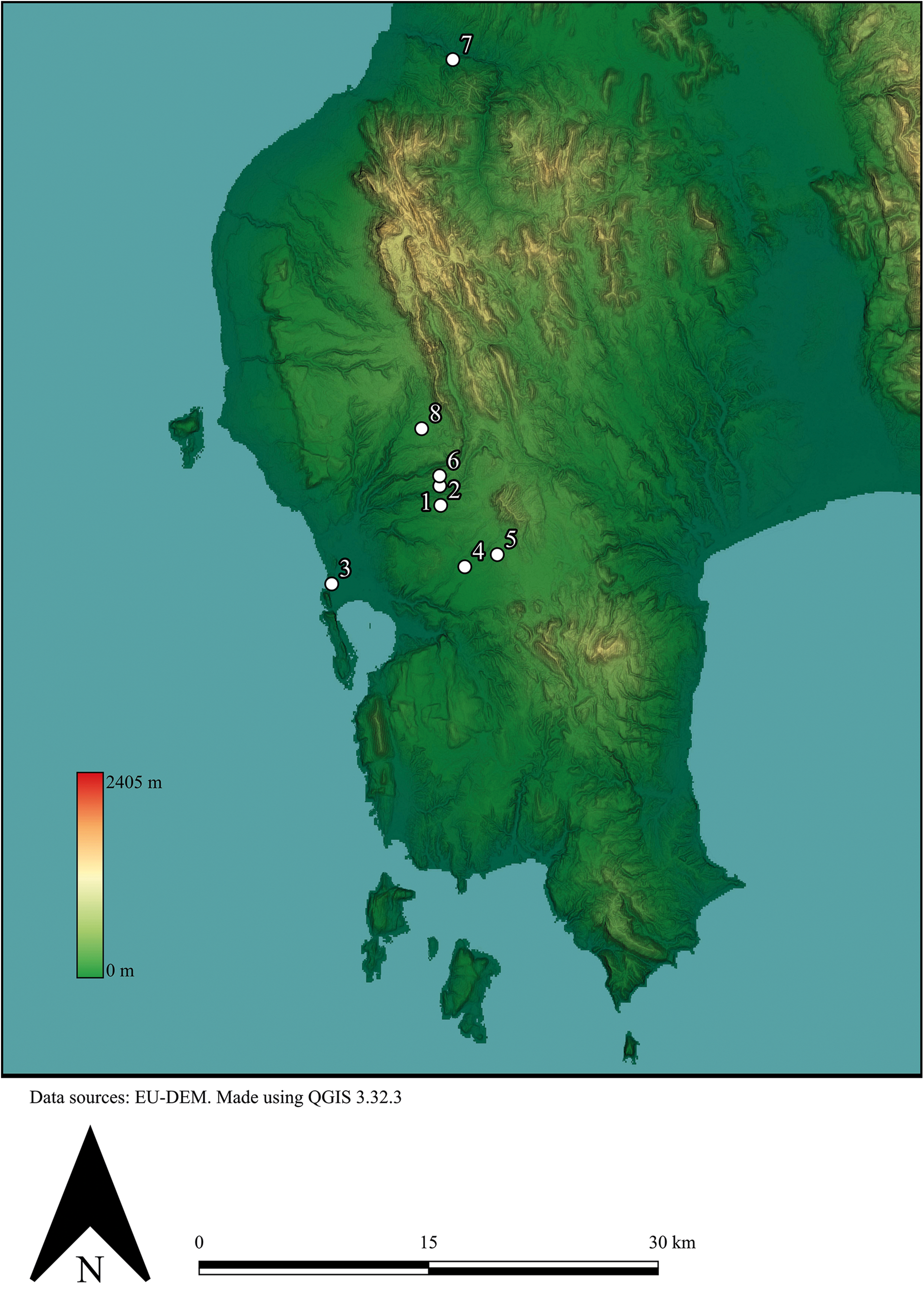
The eight Messenian cemeteries selected for this analysis (Kalogeropoulos Mound, Agios Ioannis Papoulia, Voidokoilia, Kaminia, Koukounara Gouvalari, Routsi, Peristeria, Volimidia) serve as an ideal lens through which to examine how ancient communities navigated the complexities of mortality salience. The deliberate choice of this specific geographic location and the associated cemeteries (Fig. 1) is strategic, guided by the diversity of burial sites and practices, and the potential for revealing nuanced shifts in mortuary behaviours over time within this particular area.
Map indicating the cemeteries included in the analysis: (1) Kalogeropoulos Mound; (2) Agios Ioannis Papoulia; (3) Voidokoilia; (4) Koukounara Gouvalari; (5) Kaminia; (6) Routsi; (7) Peristeria; (8) Volimidia.
In the cemeteries under study, a discernible transformation of mortuary practices unfolds from the MH to the LH II period, encompassing significant changes in burial architecture and the strategic placement of these cemeteries in the landscape (Boyd Reference Boyd2002; Nuttall & Zikidi Reference Nuttall and Zikidi2023), the manipulation of the dead in primary depositions (Boyd Reference Boyd2002; Wright Reference Wright, Gallou, Georgiadis and Muskett2008; Zikidi Reference Zikidi2023), as well as variations in the implementation or omission of secondary treatment of skeletal remains (Cavanagh & Mee Reference Cavanagh and Mee1998; Lewartowski Reference Lewartowski, Laffineur and Niemeier1995; Zikidi Reference Zikidi2023).Footnote 4 Furthermore, shifts are also evident in the nature of rituals taking place in the cemeteries (Boyd Reference Boyd2002) and in the presence or absence of grave goods (Boyd Reference Boyd2002; Howell Reference Howell, McDonald and Wilkie1992; Korres Reference Korres1975; Petrakis Reference Petrakis, Eder and Zavadil2021). Traditionally, scholars attributed these changes primarily to socio-political shifts (Cavanagh & Mee Reference Cavanagh and Mee1984; Voutsaki Reference Voutsaki and Branigan1998), which became particularly pronounced from the LH II period onwards with the emergence of central authorities (palaces). However, a comprehensive understanding of the agency behind these changes necessitates delving beyond the socio-political sphere and considering the influence of anthropocentric factors, such as mortality salience.
Delving into some of the specifics of these changes, the burial architecture and manner of primary deposition underwent noticeable modifications over time, reflecting shifts in cultural and societal practices. The most prominent Messenian MH practice was burial in a pithos—a large ceramic vessel—placed within a circular tumulus (Bennet & Galanakis Reference Bennet, Galanakis, Dakouri-Hild and Sherratt2005; Müller Reference Müller1989; Voutsaki Reference Voutsaki and Branigan1998; Zavadil Reference Zavadil1995). The tumuli were typically constructed by a retaining wall that delineated the mortuary space and material was amassed to create a low mound (Bennet & Galanakis Reference Bennet, Galanakis, Dakouri-Hild and Sherratt2005; Cavanagh & Mee Reference Cavanagh and Mee1998; Korres Reference Korres, Zerner, Zerner and Winder1993; Reference Korres, Borgna and Müller Celka2012). The pithos burial jars were placed on top of that mound, following the circular circumference of the tumulus, and the mouths of the vessels were orientated towards its perimeter. The bodies of the individuals were pushed inside the vessel resulting in a highly flexed position and their heads were placed towards the bottom of the vessel and thus, the centre of the mound (Boyd Reference Boyd2002; Korres Reference Korres, Borgna and Müller Celka2012). The individuals were interred with few to no grave goods and usually not disturbed, even after skeletonization.
Tholos tombs, on the other hand, were circular, stone-built, vaulted tombs that emerged in clusters during the MH III/LH I period (Bennet & Galanakis Reference Bennet, Galanakis, Dakouri-Hild and Sherratt2005; Boyd Reference Boyd2002; Cavanagh & Mee Reference Cavanagh and Mee1998; Dickinson Reference Dickinson1977; Korres Reference Korres, Zerner, Zerner and Winder1993; Reference Korres, Borgna and Müller Celka2012). Their emergence has been a much-debated topic (Cavanagh & Mee Reference Cavanagh and Mee1998; Dakouri-Hild Reference Dakouri-Hild1998; Dickinson Reference Dickinson1977; Pelon Reference Pelon1976; Petrakis Reference Petrakis, Eder and Zavadil2021; Voutsaki Reference Voutsaki and Branigan1998); however, their adoption and dispersal in Messenia was swift. Korres (Reference Korres1996; Reference Korres, Borgna and Müller Celka2012) proposed that the design of the tholos tomb evolved from the shape of the tumulus. A notable example supporting this idea was the discovery of four pithoi at the centre of the tholos tomb cemetery at Kaminia, which was constructed into a mound. In this interpretation, the tholos tombs at Kaminia took over the role of the pithoi atop the mound. However, at Kaminia, the pithoi were retained within the mound alongside the tholoi. This practice may reflect the community's desire to preserve a traditional MH funerary element while simultaneously adopting a new practice that aligned with their evolving funerary rituals (cf. Cavanagh & Mee Reference Cavanagh and Mee1998). In contrast, Boyd (Reference Boyd2002) suggested that the form of the tholos tombs was more likely influenced by pre-existing apsidal structures placed at the centre of tumuli during the MH period. These structures, Boyd argued, were later adapted to meet the need for additional burial space within a mound, resulting in variations in the design and form of the tholoi over time, as the practice was standardized (see also Papadimitriou Reference Papadimitriou2001).Footnote 5
The primary deposition and secondary treatment practices in earlier (MH III/LHI) and later (LH II/III) tholos tombs varied greatly (Zikidi Reference Zikidi2023). In earlier tholos tombs, the treatment of the dead did not differ from the practice noted in pithos burials, with one exception: the introduction of secondary treatment of skeletal remains (Boyd Reference Boyd2002; Reference Boyd, Renfrew, Boyd and Morley2016; Cavanagh Reference Cavanagh1978; Zikidi Reference Zikidi2023).Footnote 6 This exception became highly systematized in later tholos tombs, while primary depositions were staged to be the central focus of the mortuary space (Zikidi Reference Zikidi2023). This practice varied from cemetery to cemetery, with some (e.g. Koukounara Gouvalari and Kamina) opting for more understated displays of the dead and their grave goods, others (e.g. Peristeria, Routsi) opting for the instrumentalization of their dead, through the display of an exaggerated political and social identity through the strategic placement of grave goods on the extended bodies (Boyd Reference Boyd2002; Zikidi Reference Zikidi2023).
Chamber tombs, also introduced in Messenia during the LH period, were perceived as a local adaptation of tholoi (Cavanagh & Mee Reference Cavanagh and Mee1998; Dickinson Reference Dickinson1983). Their architectural plan, as seen in the cemetery of Volimidia, is an almost circular chamber with side chambers and niches opening to the sides of the corridor (dromos) leading to the main chamber (Kontorli-Papadopoulou Reference Kontorli-Papadopoulou and Laffineur1987). In a similar manner to later tholos tomb practices, the primary depositions at the cemetery of Volimidia were placed in an extended position; however, very little evidence of adornment is recorded, with most primary depositions accompanied by few funerary offerings (Cavanagh & Mee Reference Cavanagh and Mee1998; Köpcke Reference Köpcke, Laffineur and Niemeier1995), while secondary treatment was even more systematized (Zikidi Reference Zikidi2023).
These changes unveil a series of insights into the prevailing attitudes towards the deceased within the community. For example, the application or omission, of secondary treatment of skeletal remains highlights that aspects of funerary practices were also potentially influenced by psychological considerations, belief systems and societal attitudes towards mortality, death and the dead. This analysis offers an alternative perspective on the ways in which individuals in south and west Messenia grappled with such existential concerns and adapted their proximal and distal defences through distinct mortuary practices. Naturally, given the intricate nature of the mortuary context, it is important to clarify that this study does not aim to provide an exhaustive analysis of how mortality salience influenced the formation and evolution of mortuary practices. Instead, it represents a focused exploration, concentrating on how individuals in south and west Messenia addressed existential concerns through the management of their dead.
Tumuli
Initially associated with preserving remains and memories of destroyed or abandoned settlements or buildings, MH tumuli, with their commemorative nature already established in ritual practices, eventually served as burial sites that accommodated large pithos vessels, within which primary depositions were placed to disintegrate (Forsén Reference Forsén1992, 31; Nuttall & Zikidi Reference Nuttall and Zikidi2023; Weiberg Reference Weiberg2007, 183; Zikidi Reference Zikidi2023). Through this transformation, tumuli became more than burial sites. They transformed into conceptual anchors for communities (Hutchins Reference Hutchins2005), providing a specific space to settle their past and act as a reference point for their present (Nuttall & Zikidi Reference Nuttall and Zikidi2023). Within the context of Messenia, tumuli assumed a dual symbolic significance, embodying both ‘mortality and immortality’ (Zikidi Reference Zikidi2023, 294). As depositional spaces, they functioned as constant reminders of the transient nature of human existence. Simultaneously, however, they served as markers of enduring memory (Galanakis Reference Galanakis2012, 220), immortalizing the collective destiny of the community among their ancestors (Zikidi Reference Zikidi2023, 296).
To enter into this significant space, individuals adhered to social and mortuary standards set by the collective, demonstrating a genuine acceptance of the circulating values and norms within their social groups (Zikidi Reference Zikidi2023, 291). Notably, the placement of pithoi and individuals within the tumulus was uniform, with both oriented towards the centre of the tumulus; and the individuals, devoid of their need for a constructed postself, were interred with few to no grave goods (Bennet & Galanakis Reference Bennet, Galanakis, Dakouri-Hild and Sherratt2005; Boyd Reference Boyd2002, 113; Cavanagh & Mee Reference Cavanagh and Mee1998, 30; Korres Reference Korres, Borgna and Müller Celka2012; Petrakis Reference Petrakis, Eder and Zavadil2021, 300). These practices underscored the pivotal focus of every mortuary procession, which was the integration of individuals into the collective memory, rather than the separation of the dead from their community or the projection of their social identities (Zikidi Reference Zikidi2023, 291). Individuals were reminded of their mortal nature through the tumuli's function as deposition spaces (proximal defence), while they simultaneously served as monuments of memory, immortalizing individuals among ancestors (distal defence) and providing a symbolic means for individuals to transcend their mortality (Zikidi Reference Zikidi2023). This dual function not only acknowledged the transient nature of life, but also sought to establish a lasting connection between the living and the deceased within the broader context of communal identity and remembrance, creating a symbolic continuum that linked past, present and future generations within the framework of communal memory and cultural identity.
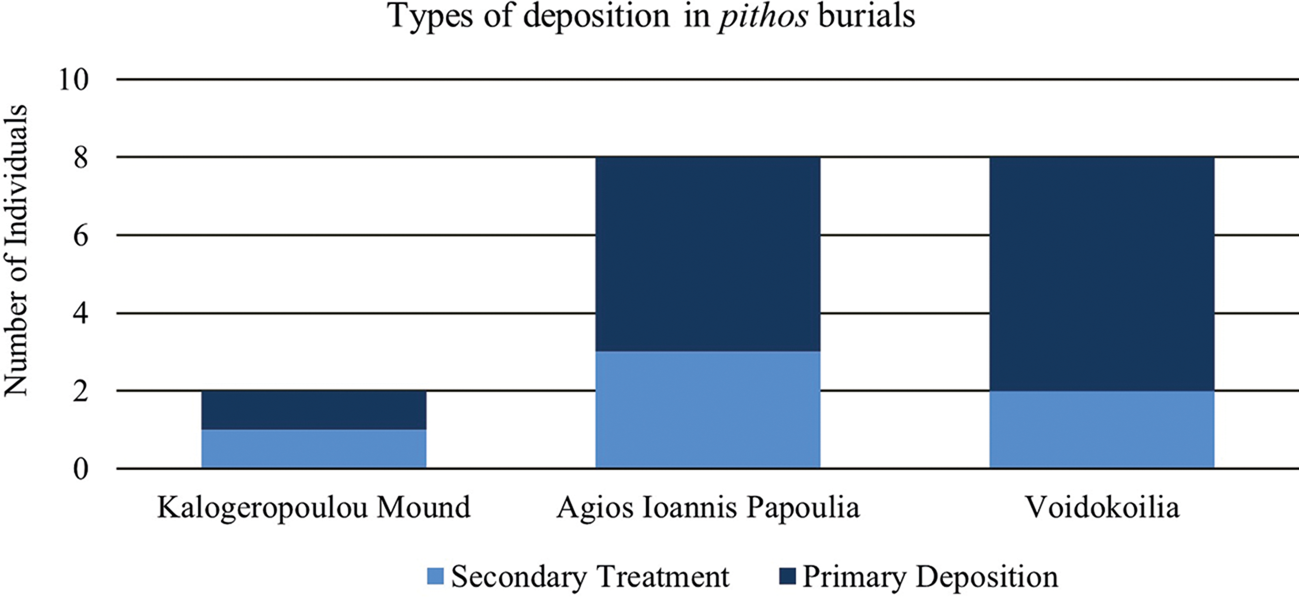
In the same frame, the disarticulation of individuals appears to be considered subordinate, signifying the culmination of their individuality, with their identities fully merged into the collective. Skeletal evidence suggests that the intensive manipulation of disarticulated remains was not a customary process (Fig. 2) (Zikidi Reference Zikidi2023). Instead, it appeared to be a necessity, possibly employed to conserve space on the tumuli or to accommodate burials of kin or individuals within the same age group (e.g. Pithos 23 at Agios Ioannis Papoulia contained the remains of two subadults) (Zikidi Reference Zikidi2023). As a result, the decomposition process was predominantly concealed within the pithos vessel. Primary burials accounted for approximately 52 per cent of the total number of depositions studied (=18), and only three of them were left totally undisturbed. In a few instances (=21 per cent), fully, or more often partially, disarticulated remains of preceding individuals were rearranged to accommodate a second deposition in the same vessel (e.g. cranium of non-adult positioned near the knees of the primary deposition of a young adult female in Pithos 5 in Agios Ioannis Papoulia: see Korres Reference Korres1980, 141), representing a delayed response to mortality, employed only in cases where it was deemed essential (Zikidi Reference Zikidi2023). This approach underscores a concerted effort to maintain a certain order and continuity in mortuary practice, suggesting a cultural strategy to address existential concerns by emphasizing the significance of the initial deposition within the communal memory and symbolic framework, and simultaneously undermining, or even entirely ignoring unless necessary, the process of decomposition. This intentional choice reflects a cultural narrative that places greater emphasis on the enduring symbolism of the initial act of deposition, thereby downplaying the visibility of the decomposition process and redirecting focus towards the communal significance of the mortuary practices.
Number of individuals in primary depositions and secondary treatment from the Kalogeropoulou Mound and the tumuli of Agios Ioannis Papoulia and Voidokoilia (MNI = 18).
Such a strategy ensured the swift incorporation of individuals into the communal memory space immediately following the primary deposition. The lack of elaborate treatment after disarticulation and the concealment of the decomposition process indicated that the communities’ distal defences were not fully distinct from their proximal defences, and both were enmeshed and served each other during primary deposition. Conversely, there was a limited effort to cultivate a symbolic order that transcended the immediate biological reality of decomposition as seen in disarticulated remains. The blending of proximal and distal defence elements suggested an approach where practical considerations intertwined with symbolic aspects in the mortuary practices of Messenian tumuli. This fusion reflects a nuanced cultural response to existential concerns, acknowledging the interplay between immediate, tangible needs and the broader symbolic framework surrounding mortality within these communities.
The mortuary practices noted as the proximal defences of MH communities provided a tangible way for individuals to confront and manage the anxiety related to mortality.Footnote 7 As those practices evolved and expanded, tumuli became conceptual anchors, serving as both burial sites and symbolic references, and their dual role reflected the distal defences of the communities, where individuals sought symbolic immortality by creating a lasting connection with their ancestors. The decision to modify and renegotiate these well-established practices from the MH II onwards was a collective endeavour, a process of assimilation, resulting in subtle structural changes in the composition and character of social groups and their circulating values. However, a predominant value stood as the cornerstone of Messenian communities: the aspiration to strengthen collectivity.
Tholos tombs
The introduction of the tholos tomb in the MH III to LH I period may have been partially influenced by the re-use and monumentalization of some larger pithoi, or even the apsidal structures placed in the centre of some of the tumuli (Korres Reference Korres1975; Boyd Reference Boyd2002; Zikidi Reference Zikidi2023, 172). The use of tholoi was essential for addressing practical requirements, as well as catering to a strengthened communal ethos. It served both as a strategy to cope with the anxiety associated with the increased awareness of mortality and as a means to involve a broader spectrum of participants in rituals while accommodating an increased number of individuals to be buried (Boyd Reference Boyd2002; Korres Reference Korres1975). However, this adjustment also presented new challenges that required resolution.
Mortuary evidence from early tholoi, such as Voidokoilia and the East Group of Kaminia (Korres Reference Korres1972), indicates an early departure from the individualization seen in pithos burials. Instead, the deceased were laid directly on the floor of the tholos chamber, signifying a communal resting place (Dickinson Reference Dickinson1977, 59). The chambers witnessed a continual influx of new burials, resulting in a diverse assembly of bodies in various stages of decomposition and multiple individuals in secondary treatment and re-depositions (Fig. 3) (Zikidi Reference Zikidi2023, 295). Unlike pithos burials, the living likely moved among the remains of the deceased regularly in tholos tombs, suggesting the cultivation of a certain familiarization with death and, foremost, decay. This practice contrasted with pithos burials, where disintegrating bodies remained concealed within the ceramic vessel until they underwent skeletonization, and reflects a communal approach to mortality, emphasizing these shared spaces as a collective acknowledgment of the inevitable processes of death and decay.
Distribution of types of deposition from the tholos tombs of Voidokoilia, Kaminia, Koukounara Gouvalari, Routsi and Peristeria (MNI: 195/No. of tholos tombs: 21).
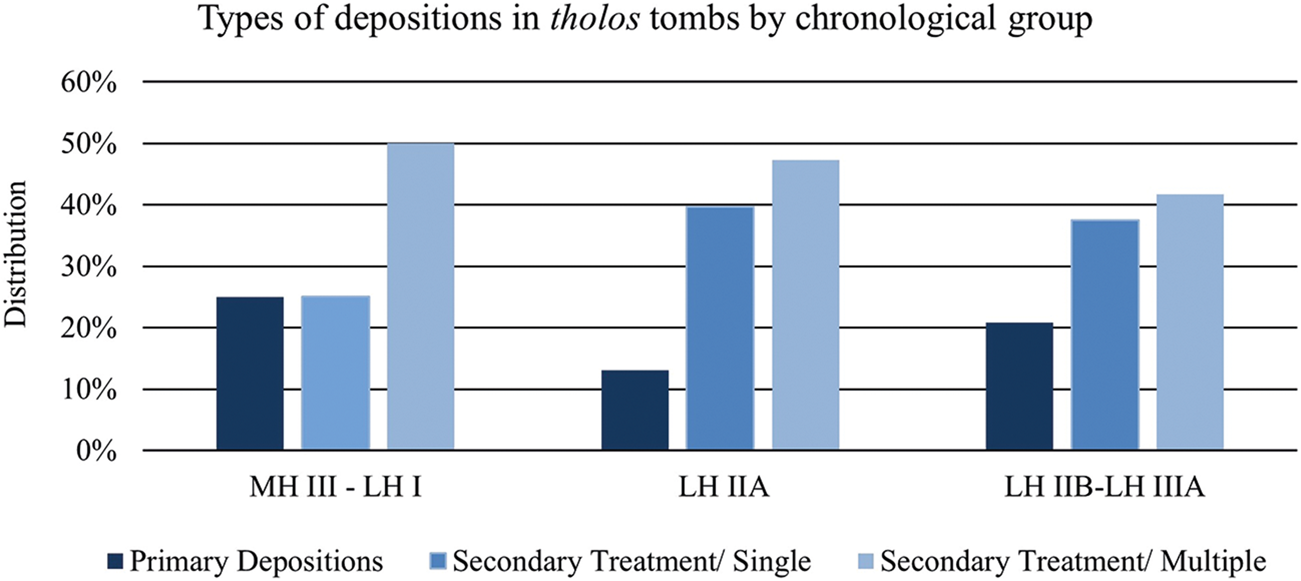
Evidently, the conceptual barrier of distal defences had shifted the focus of the participants to the communal significance of the secondary depositions. This shift served to protect individuals from the direct impact of mortality salience and the terror of decomposition, compelling them to rely on symbolic and communal frameworks for solace and coping mechanisms (Rosenblatt et al. Reference Rosenblatt, Greenberg, Solomon, Pyszczynski and Lyon1989, 689). The transformation in the conceptual barrier of distal defences highlights the deliberate collective effort of these communities to construct meaning and ritualize the treatment of the dead, even post disarticulation. In doing so, the community may have sought to transcend and prevail upon the stark reality of individual mortality and the terror of decomposition (Morin Reference Morin1976, 42), forging a collective narrative that mitigated this terror, facing the inevitable decay of the physical body.
Furthermore, skeletal evidence suggests that from LH IIA, the secondary treatment often occurred in two stages (Fig. 3). In the initial stage, all long bones and the cranium of each individual were collected and placed in unique, separate groups (secondary treatment/single). In the second and final stage, the re-deposition of the remains was undertaken, preserving solely the cranium, leading to the total dissolution of individuality, as it was placed in groups with the crania of multiple other individuals. Both of these episodes served as a reminder of the awareness of common lineage, manifesting through the skeletal remains of the deceased, and acted as both proximal and distal defences against mortality salience. This transition in the perception of death post disarticulation suggests that the initial tholoi may have functioned as indicators of a fortified collective identity (Zikidi Reference Zikidi2023, 296). Individuals, by willingly entrusting their deceased to this communal fate, demonstrated a profound trust in the prevailing social values and salient norms of their community (Zikidi Reference Zikidi2023, 296). This familiarity with death, evidenced by the adoption of death-centred rituals and the introduction of supplementary secondary practices as proximal defences, marked the initiation of the process of ‘taming’ death-centric thoughts within the community.
In time, the deposition practices in tholos tombs became progressively more diverse. In later practices, and specifically the ones emerging from LH IIA onwards, the introduction of cists and pits for primary burials (e.g. Routsi, Peristeria South Tholos, Koukounara Gouvalari Tombs 1, 4 and 6) highlighted the evolving emphasis on identifying the individual within the collective (Bennet Reference Bennet1999; Bennet & Davis Reference Bennet, Davis and Laffineur1999; Boyd Reference Boyd2002; Cavanagh & Mee Reference Cavanagh and Mee1998; Zikidi Reference Zikidi2023). Additionally, the centrality of primary burials became increasingly important (e.g. Peristeria South Tholos, Routsi Tholos 2), while individual grave goods and drinking or libation practices during funerary depositions became increasingly more common, indicating a shift in the weight of funerary practices, to honour and ‘display’ the deceased during primary deposition, as well as to emphasize their social identity (Zikidi Reference Zikidi2023, 279, 283).
These changes may signify a concerted effort to break from the historical burden that permeated every facet of the mortuary space in early tholoi. Over time, the communities under study initiated a gradual process of emancipation from longstanding obligations to their ancient ancestors. This shift redirected their focus from the ancestral past to a more immediate connection with both their deceased predecessors and their current socio-political environment (Zikidi Reference Zikidi2023, 287). By dismantling the historical burden associated with the previous mortuary practices, the communities may have sought a new narrative that better aligned with their evolving cultural and social dynamics. Individuals within these communities were no longer exclusively bound by kinship and shared bloodlines; instead, they forged connections based on common goals or shared political affiliations, against the backdrop of a generalized political reconfiguration of the Peloponnese, with the emergence of centralized authorities.
This transformation in mortuary practices reflected a broader societal shift, suggesting that the communities were actively shaping their identity and relationships beyond the constraints of traditional or ancestral ties. This pattern is notably evident in the Routsi cemetery, and particularly in Tholos 2 (Zikidi Reference Zikidi2023, 213, 263). The conspicuous shift in mortuary practice, particularly the portrayal of individuals interred in the centre of the chamber as active participants in a shared politicized ethos, suggests a deliberate alignment, or at least an attempt to align, with the emerging political landscape (Fox Reference Fox, Cavanagh, Cavanagh and Roy2011, 78; Zikidi Reference Zikidi2023, 212). This departure from both past social paradigms and contemporaneous, and notably more politically reserved (e.g. Koukounara Gouvalari) mortuary attitudes, raises the question of whether it could be interpreted as a comprehensive accommodation strategy, designed to confront and alleviate the existential fears and uncertainties faced by certain social groups, such as the Routsi community (Zikidi Reference Zikidi2023).
This phenomenon may have been rooted in the emergence of central authorities that impacted the socio-political trajectory of these communities (Murphy Reference Murphy, Eder and Zavadil2021; Zavadil Reference Zavadil2012). Their impact was translated in the mortuary sphere in two ways: either through the introduction of practices emphasizing individuality, which gradually heightened both intra- and inter-group competition, or, as was the case in the communities of Routsi and Peristeria, the full accommodation of these practices, to establish themselves as the moral and political successors of the region (Zikidi Reference Zikidi2023, 298). The latter suggests that the socio-political character of the landscape was considered a fertile field for the intrusion of new political forces that aimed to control, renegotiate and redefine social memory, in this case. through the mortuary sphere (Nuttall & Zikidi Reference Nuttall and Zikidi2023; Zikidi Reference Zikidi2023).
This transformative trajectory towards the politicization of the mortuary space implies a stark departure from the previous emphasis on concepts such as securing a place in the elite afterlife of their ancestors or the collective realm of the deceased. In fact, it suggests a shift towards the pursuit of social and political acceptance, indicating a redefined set of priorities and social values within these evolving mortuary practices.
Chamber tombs
Concurrent with the latest phase of the tholos tombs in LH II, distinct practices emerged at the chamber tomb cemetery of Volimidia.Footnote 8 Examination of the tombs revealed that their strategic placement and organization into small units also suggested the convergence of smaller social groups within a shared funerary location (Vlachopoulos Reference Vlachopoulos, Eder and Zavadil2021, 233). This convergence resulted in diverse patterns of mortuary inclusion for various subgroups, with distinct treatment for the dead observed within each tomb group (Zikidi Reference Zikidi2023, 227–241). In the Aggelopoulos group, males generally outnumbered females, except in Tomb 5, with a few subadults found in several of the tombs. The Voria group exhibited male dominance in most tombs but included female-only and subadult-only burials in Tombs 7 and 2, respectively. Similarly, at the Koroniou tombs, male burials outnumbered female ones, and no subadults were recorded. Despite these differences, cohesion was maintained in the cemetery, through the regulation of grave goods (Cavanagh & Mee Reference Cavanagh and Mee1998, 54–5; Zikidi Reference Zikidi2023, 281–2), as well as the projection of a common subtext of social values defining appropriate practices within all the tombs. In this evolving context, two significant shifts occurred in the prevailing values of this community, marking an ideological departure from the practices observed in the tholos social groups (Zikidi Reference Zikidi2023).
The first notable shift was a perceptual one, concerning death and funerary practices. Despite the ostensible similarities with tholos tombs, practices in the chamber tombs of Volimidia returned to viewing mortuary practice as a means to establish a link with ancestors and pay tribute to the deceased. This was opposed to the previous role of mortuary practice, which functioned as a platform for expressing societal identities for socio-political reasons (Zikidi Reference Zikidi2023, 300). This shift becomes evident through the complete disintegration of individual identities in secondary practices (Voutsaki Reference Voutsaki2010; Zikidi Reference Zikidi2023), with the crania of the individuals transitioned to collective groupsFootnote 9 and the significant restriction of single re-depositions with multiple skeletal elements (Fig. 4). Individual transition was of minor importance, and the dead, after their disarticulation, were moved to the collective, represented only by their crania.
Distribution of types of deposition at Volimidia (MNI: 368/No. of Chamber tombs: 24).
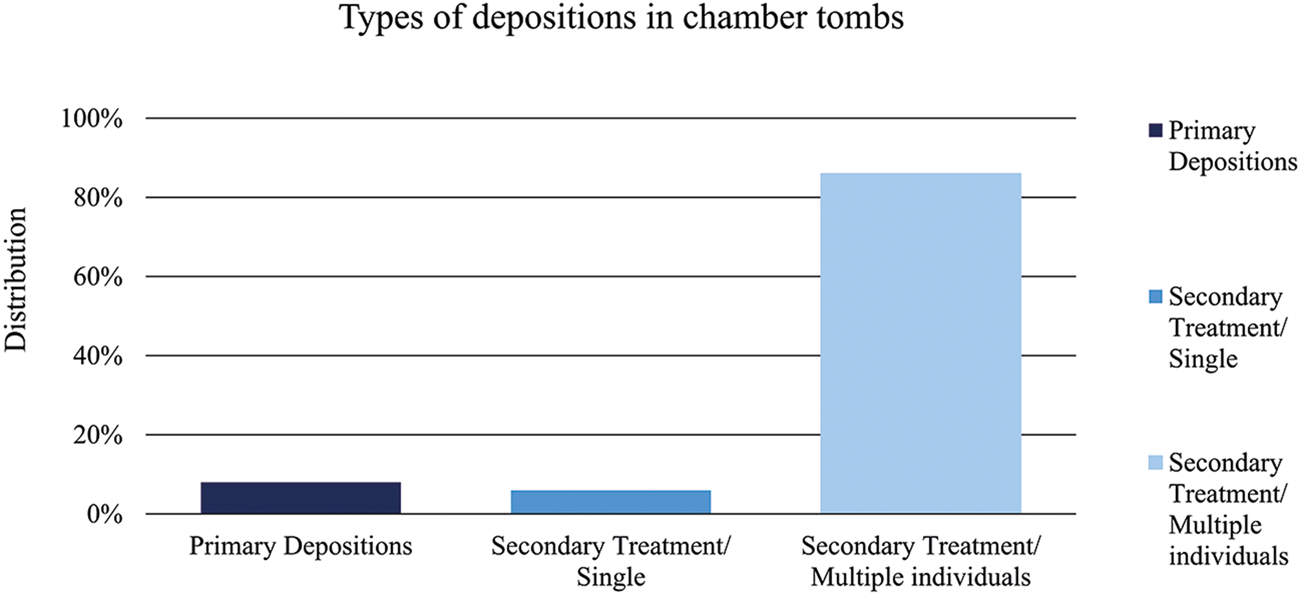
The observed change in the perception of death and funerary practices can be attributed to a confluence of cultural and social factors that shaped the evolution of the society in south and west Messenia during the LH period. One potential catalyst for this shift may have been the transformative cultural Zeitgeist of the emergent palaces, where prevailing attitudes toward mortality underwent a re-evaluation in light of the shifts in social structure and power dynamics within the communities (Murphy 2014; Zavadil Reference Zavadil, Eder and Zavadil2021). As stated above, the funerary practices noted also at some tholos tombs, such as Routsi and Peristeria, were closely tied to the expression of social identities for socio-political purposes (Zikidi Reference Zikidi2023). This recalibration of societal values due to the emergence of a central authority could also have prompted a re-evaluation of the role of death rituals within the community of Volimidia.
Changes in practice were also observed in primary depositions, with a more reserved expression of individuality, possibly aimed at distinguishing ‘who the individuals were’ rather than highlighting ‘why or how they were different from the rest of the group’ (Zikidi Reference Zikidi2023, 300). The majority of undisturbed primary depositions were accompanied by one or no personal grave goods (e.g. tools and weapons) and one or two pottery vessels, signifying the continuation of the practice recorded in Messenian tumuli, and in contrast to the pattern noted at tholos tombs such as Routsi and Peristeria.Footnote 10 ‘Politically charged’ elements of declared identities in life were silenced, and the worldview of the dead was predominantly tacitly conveyed, becoming only visible through nuanced choices, such as the funerary landscape (Nuttall & Zikidi Reference Nuttall and Zikidi2023), or the manner of deposition for each social subgroup (Zikidi Reference Zikidi2023, 300). This shift denotes that the space of deposition was probably not individually politicized, and that the dead were placed in the tombs bearing only their personal identity, a stark difference to the heavy politicization noted in their contemporary tholos tombs.
The second noteworthy set of practices involved the assimilation and eventual standardization in the handling of skeletal remains. In contrast to social groups associated with tumuli, which interacted with skeletal remains sporadically, this particular group developed a more frequent engagement with such practices, similar to those observed in tholos tombs, although less intensive (Zikidi Reference Zikidi2023). The increasing standardization of secondary burial practices, evident from the large number of individuals in secondary groups, reflected a need for more structured rituals that led to a more organized mortuary space. This handling of skeletal remains likely marked a shift toward more formalized rites, emphasizing continuity with ancestral connections and reinforcing social hierarchies within the community. This accustomedness to manipulating skeletal remains served to shift individuals’ concerns about decomposition toward the immediate task at hand (proximal defence).
However, within this cemetery, the approach to addressing this anxiety was grounded in the transformative potential of converting it into ‘awe and reverence’ (distal defence) (Zikidi Reference Zikidi2023, 300). This was accomplished by positioning the ancestors’ remains in the tomb to oversee each primary deposition (Zikidi Reference Zikidi2023, 300). This practice functioned as a constructive distal defence, establishing a novel and enduring cognitive framework (Keltner & Haidt Reference Keltner and Haidt1999; Reference Keltner and Haidt2003; Piff et al. Reference Piff, Dietze, Feinberg, Stancato and Keltner2015). This framework sought to challenge the mental portrayal of the inevitability of death and, consequently, decomposition, guiding participants in the funeral process toward a ‘prosocial behaviour by conforming to the salient social norms of revering the dead’ (Zikidi Reference Zikidi2023, 301).Footnote 11
Conclusion
The transformation of mortuary practices in south and west Messenia was significantly influenced by the adoption and intensification of rituals for the management of the dead (Fig. 5). This underscores that the handling of collective awareness of mortality was not a secondary process in the mortuary realm, following socio-political shifts. Instead, it served as a method to address communal anxieties arising from these changes, making it essential for both proximal and distal defences to be employed to address mortality salience.
Changes in mortuary practices and attitudes towards death through time.
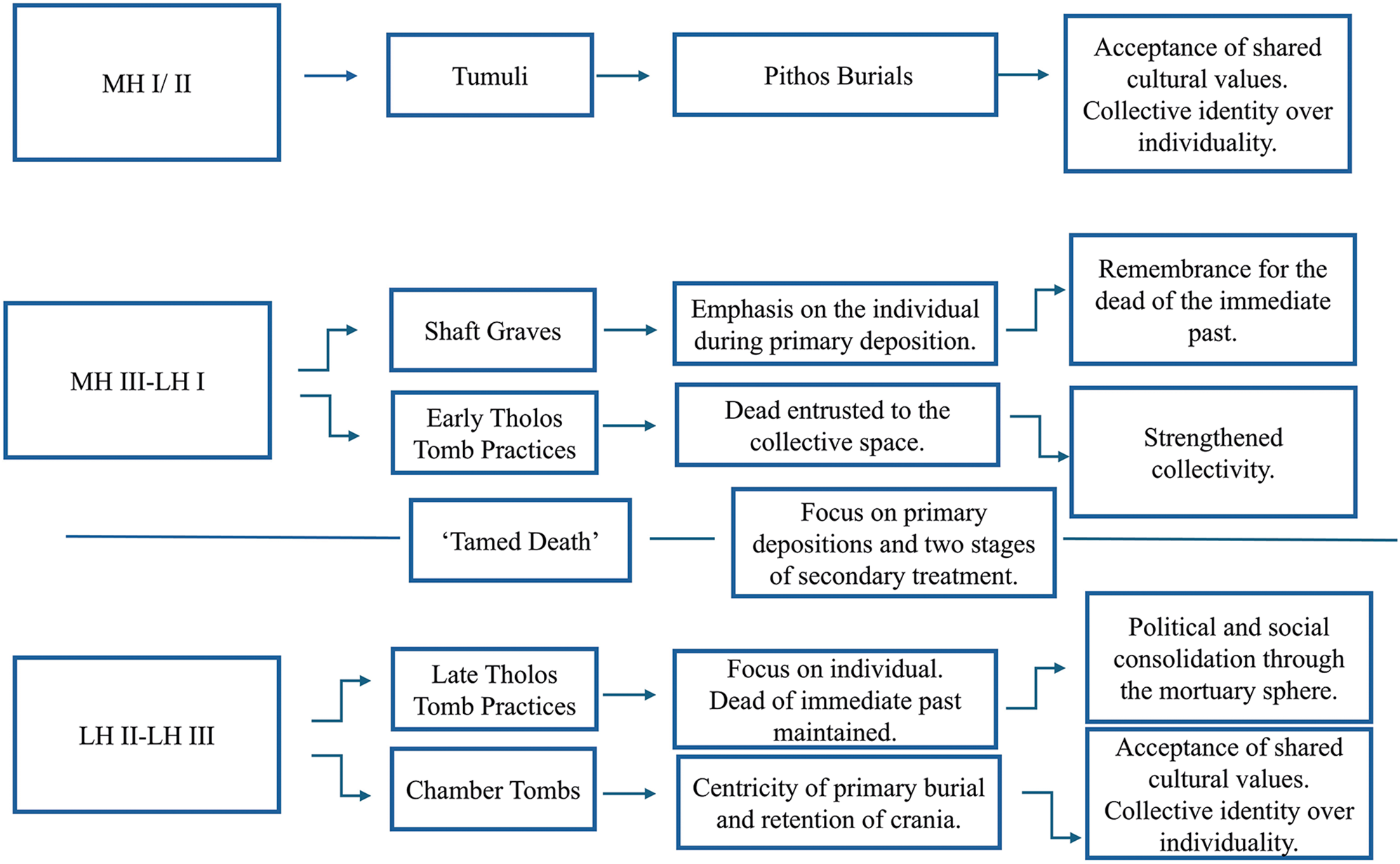
The MH societies of Messenia, characterized by communal traditions, sought for markers of unity. For Messenian tumuli communities, continuity and transcendence to an immortal and timeless identity were paramount (Zikidi Reference Zikidi2023). Therefore, individuals viewed death as an opportunity to affirm their participation in their groups. During the LH I period, Messenian communities that utilized tholos tombs prioritized social coherence, continuity and the strengthening of communal bonds, in a similar manner to tumuli communities. Nevertheless, faced with the terror of decomposition taking over these spaces of deposition and the visible disintegration of the post-self, tholos tomb practices gradually evolved towards the projection of a heightened personal social identity, crucial for identifying oneself within the groups in the face of change. This resulted in a radical reorientation of social values during the LH II period that birthed the need for the self to emerge even further, prompting a limited number of individuals also to assert and display the political identities of their dead, in response to emerging structures of governance and societal organization that threatened their identities in life (Zikidi Reference Zikidi2023).
In some communities (e.g. Kaminia, Koukounara Gouvalari) this reorientation signified the discrete assimilation of some proximal defences (e.g. burial centricity, intricate grave goods, delineation of depositions) and the maintenance of their main worldview (distal defences, e.g. communal bonding), while in others (e.g. Routsi), the full accommodation of extraneous distal defences (e.g. Mycenaean ethos) resulted in significant changes in practice (e.g. extravagant display of the dead, multiple grave goods). In an entirely different trajectory, possibly indicative of their unique composition, the social groups utilizing the chamber tombs of Volimidia perceived the dead as an anchor, guiding the communities forward, together, in both death and life, suggesting that the weight of their existential defences had shifted to cultivating prosocial behaviours that fostered their collective spirit. This return to collectivity was accompanied by the revival of the notion of a collective, timeless identity beyond death, aiming to mitigate the fear of death and provide solace and social unity even further (Zikidi Reference Zikidi2023).
In summary, the examination of mortuary practices in south and west Messenia offered profound insights into how communities grappled with the awareness of mortality over centuries. It underscored the adaptability and resilience of human societies in addressing existential fears and reshaping practices to find meaning in the face of mortality. The analysis of proximal and distal defences in mortuary practice in particular provides a valuable framework for understanding these transformations and the role of mortuary practices in shaping cultural values and beliefs.


 Open access

