




Introduction
Agricultural extension includes services and activities that share agronomic knowledge and research developments to drive agricultural improvement (Agri-Food Innovation Council 2017; Baffoe-Bonnie et al. Reference Baffoe-Bonnie, Martin and Mrema2021). Modern extension programmes value bidirectional communication between researchers and producers to ensure research efforts respond to producers’ needs (Zall Kusek and Rist Reference Zall Kusek and Rist2004; Izukanne Reference Izukanne2014; Agri-Food Innovation Council 2017). Recent changes to the agricultural extension system in Alberta, Canada, draw attention to the need to understand extension gaps and opportunities for improvement (Knapp Reference Knapp2021; Results Driven Agriculture Research 2022b). Increased privatisation and loss of provincial extension services have resulted in crop commodity associations and industry groups taking a leading role in supporting knowledge transfer activities (Agri-Food Innovation Council 2017; Laforge et al. Reference Laforge, Corkal and Cosbey2021; Brewin et al. Reference Brewin, Chowdhury and Kittilsen2022; Agricultural Service Boards 2023). The provincial government’s current role is primarily policy and public-good projects, whereas industry leaders promote agricultural extension efforts (Agri-Food Innovation Council 2017; Kantar et al. Reference Kantar, Wang, Hale, Pratt, Jensen and Lewenstein2023). Unlike in other North American jurisdictions, involvement of post-secondary institutions in agricultural extension in Alberta is at the discretion of individual researchers and, in most cases, is not part of the mandate of their research positions (Agri-Food Innovation Council 2017; Brewin et al. Reference Brewin, Chowdhury and Kittilsen2022).
Other prairie provinces employ public agrologists to provide advice and extension services to producers without a fee for service. Although Saskatchewan has closed many local rural extension offices, much like Alberta has (Gosselin Reference Gosselin2009), extension professionals (n = 53) based out of regional offices (n = 10) still provide extension at a regional level. Extension is part of the mandate of the Saskatchewan Ministry of Agriculture and is facilitated by collaboration with industry partners, Agriculture and Agri-Food Canada, and post-secondary institutions with agriculture programming (Saskatchewan Ministry of Agriculture 2023). Producers in Saskatchewan access advice from a range of extension specialists through a toll-free telephone line, at in-person events, and through government-produced publications (Saskatchewan Ministry of Agriculture 2023). Public agrologists work onsite with Saskatchewan farmers to address crop management issues, environmental considerations, technology transfer, business support, and new challenges such as insect outbreaks (Gosselin Reference Gosselin2009). The success and impact of agricultural extension efforts in Saskatchewan are tracked to find opportunities for improvement (Hurlbert and Pittman Reference Hurlbert and Pittman2014). Over the past decade, Manitoba has consolidated some provincial extension services after the closure of many regional offices, and although some level of regional office field support remains, the Manitoba Department of Agriculture has undergone a shift towards providing more online and telephone extension services (Wichers Reference Wichers2021). Private sector actors, such as crop commissions, suppliers, and consultants, provide agronomic advice to many farmers in Manitoba; however, provincial extension agents are valued and considered important sources of unbiased information (Manitoba Agriculture, Food and Rural Initiatives 2012; Government of Manitoba 2016). Collaboration between the provincial entomologist and post-secondary institutions is common and includes research projects, guest lectures, and extension events (J. Gavloski, Manitoba Agriculture, Food and Rural Initiatives, personal communication, December 2023). The government-directed agricultural extension strategies used in Saskatchewan and Manitoba distribute resources to all parts of the industry and innovation hierarchy (Agri-Food Innovation Council 2017). In contrast, the more heavily privatised extension model in Alberta is likely driven by profitable investments and commodities.
The US Cooperative Extension System (based in Washington, D.C.) in the United States of America involves state-owned extension providers that partner with land-grant universities and the United States Department of Agriculture to deliver publicly supported agricultural extension (Milburn et al. Reference Milburn, Mulley and Kline2010; Brewin et al. Reference Brewin, Chowdhury and Kittilsen2022; Williams Reference Williamsno date). Development and administration of agricultural extension programmes is based at universities. Extension educators also operate out of local offices in agricultural communities, allowing them to build trust, respond to local needs, and get input from producers. In other countries, most universities with agricultural programming have limited engagement with producers, but the unique US Cooperative Extension System has successfully supported an ever-evolving agricultural sector for more than a century (Milburn et al. Reference Milburn, Mulley and Kline2010; Brewin et al. Reference Brewin, Chowdhury and Kittilsen2022; Williams Reference Williamsno date). Land-grant university budgets for extension, however, have decreased in recent years (Krell et al. Reference Krell, Fisher and Steffey2016; Norton and Alwang Reference Norton and Alwang2020), and the system has become more privatised (Brewin et al. Reference Brewin, Chowdhury and Kittilsen2022). Most states now charge fees for a portion of their extension services (Norton and Alwang Reference Norton and Alwang2020), and most extension workers report regular partnering with industry on extension efforts (Krell et al. Reference Krell, Fisher and Steffey2016).
The extension system in the United States of America has a legal base for coordination, whereas in Canada, education is a provincial responsibility. No explicit legislation regarding extension education and knowledge exchange of research information exists at the federal government level in Canada (Gill Reference Gill1996). As a result, each province has a distinct agricultural extension system.
Government-supported extension efforts in North America have switched much of their focus to blanket-level extension for public-good efforts, such as climate change mitigation and resource management (Anderson and Feder Reference Anderson, Feder, Evenson and Pingali2007; Milburn et al. Reference Milburn, Mulley and Kline2010; Krell et al. Reference Krell, Fisher and Steffey2016; Rollins et al. Reference Rollins, Simpson and Boxall2018; Norton and Alwang Reference Norton and Alwang2020), whereas private agricultural industry groups now provide the majority of more customised information and advice related to farm profitability and productivity, tailored to the needs of individual farmers (Warsame Reference Warsame2015; Krell et al. Reference Krell, Fisher and Steffey2016; Davis Reference Davis, Davis, Babu and Ragasa2020; Brewin et al. Reference Brewin, Chowdhury and Kittilsen2022; Leger Marketing Inc. 2022). The competitive nature of private extension systems promotes accountability to producers and improvement of small-scale operations through coordination of management. However, private extension programmes have fewer links with research and lose the economy of scale in training activities (Anderson and Feder Reference Anderson, Feder, Evenson and Pingali2007; Gosselin Reference Gosselin2009). As the structure of extension programmes changes, evaluation and refinement of programmes is necessary so that extension providers remain relevant and keep up with modern agricultural practices and innovations.
The perspective of agricultural extension professionals comes with an understanding of the limitations and challenges facing the system and the industry as it relates to agricultural insect pests. Public knowledge about the importance of insects is generally low, although likely greater among those in agriculture. Regardless, insects have a substantial impact on virtually every food crop around the globe (Baker et al. Reference Baker, Forester, Johnson, Stolfi and Stahl2014).
In the present study, we administered a survey to extension professionals who work in Alberta to gain information on entomological issues facing producers, the agricultural extension ecosystem, and potential opportunities for improvement of extension programmes. Survey questionnaires are a common tool used by agricultural organisations to evaluate the reach of extension programmes, the needs of producers, and to evaluate extension programmes (Roberts and Rao Reference Roberts and Rao2012; Warsame Reference Warsame2015; Halbritter et al. Reference Halbritter, Wallau, Benge and Mackowiak2021; Hollmann et al. Reference Hollmann, Regierer, Bechis, Tobin and D’Elia2022). Here, we used a scientific survey administered to extension professionals to complement a separate producer survey (Domnich et al. Reference Domnich, Bulut, Mori and Evenden2025), as well as additional research to address our project objectives: (1) to determine the opinions of extension professionals on entomological issues facing producers; (2) to identify methods to streamline and to create collaborative extension efforts; and (3) to compile and compare current entomological extension efforts in Alberta. The survey of extension professionals conducted as part of this study was administered separately from the producer survey (Domnich et al. Reference Domnich, Bulut, Mori and Evenden2025). Separate surveys were necessary to capture the different perspectives of both users and providers of information in the agricultural extension system in Alberta.
Methods
Survey design and data collection
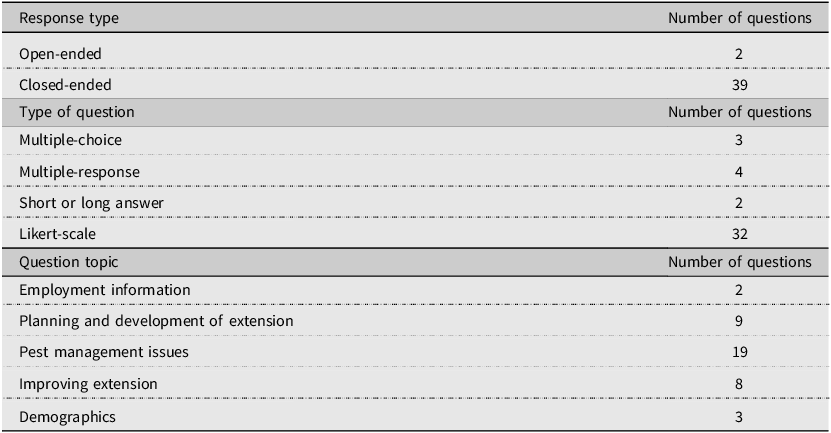
Survey questions were primarily closed-ended, with topics focused on pest management, development of extension activities, and methods to streamline extension in Alberta (Table 1; Supplementary material, File S1). Survey design guidelines outlined by Domnich et al. (Reference Domnich, Bulut, Mori and Evenden2025) were used to increase the likelihood of survey completion. In brief, the survey used measurable data elements, primarily comprised of closed-ended questions (multiple-choice, multiple-response, and Likert-scale) for easier analysis, and only a few open-ended questions to prompt written responses. Both online surveys administered on SurveyMonkey® (https://www.surveymonkey.com/) and paper surveys distributed at in-person agricultural events were used to reduce the chance of sampling bias. A “brand” was developed to create recognition and promote survey participation (Supplementary material, Fig. S1; Illingworth Reference Illingworth2017).
Summary of question types and topics in the extension professional survey questionnaire. The total number of questions was 41. Likert-scale question response options are considered as separate questions in this table and for data analysis.

The minimum sample size required for reliable survey results was calculated using Slovin’s formula for survey research, which adjusts for population size by requiring proportionally fewer responses from larger target populations (Ismail et al. Reference Ismail, Pernadi and Febriyanti2022). The total number of agricultural extension workers in Alberta was obtained from the Province of Alberta’s Alis website (https://alis.alberta.ca): in Alis, the “Agrologist” webpage enumerates agricultural professionals in both the public and private sectors. In 2022, approximately 1500 people in the province were employed in this category (Alis – Alberta 2022). Given a confidence level of 95% (α = 0.05) and a margin of error of 5%, a minimum of 306 survey participants were required to obtain reliable results.
Before survey administration, University of Alberta Research Ethics Board approval was obtained (study ID: Pro00114256). Following approval, the survey was administered between 1 January and 31 May 2023. The survey (Supplementary material, File S1) was distributed widely over social media and directly through email (n = 283) to extension professionals in Alberta who were associated with applied research associations, post-secondary schools with agriculture programmes, agricultural commodity commissions, private agronomists, and private corporations. In addition, the survey was administered at two in-person events – Crossroads (25–26 January 2023; Red Deer, Alberta) and Farming Smarter (14–15 February 2023; Lethbridge, Alberta) – and was promoted at nine other events (Domnich et al. Reference Domnich, Bulut, Mori and Evenden2025).
Statistical analyses
Data were cleaned to remove respondents who worked outside of Alberta or who did not have extension as part of their employment mandate, either officially or unofficially. Ordinal and binary response variables were converted into numerical responses for analysis, and the county locations were assigned to one of the five regions used by Alberta’s Agricultural Service Boards (Agricultural Service Boards no date). The number of answers selected in questions that permitted multiple responses was recorded as count data. Data cleaned in Microsoft Excel (Microsoft, Redmond, Washington, United States of America) were uploaded to survey analysis software Jamovi, version 2.3 (The Jamovi Project, Newcastle and Sydney, Australia; https://www.jamovi.org) for analyses (see Survey evaluation section, below).
A Kruskal–Wallis test was used with α = 0.05 to identify factors that impacted the responses obtained, such as respondent demographics (age, gender, and location), extension mandate status, and extension tools used, in survey analyses (Ostertagová et al. Reference Ostertagová, Oskar and Jozef2014). We used Pearson’s correlation heatmaps to reveal the strength and direction of correlations between different responses and demographics, considering r-values above 0.3 as significant (Supplementary material, Fig. S2). Although smaller r-values may be statistically significant, given the large sample size, they risk overinterpretation of noise: a general benchmark of 0.3 was used for behavioural survey data (Cohen Reference Cohen1977).
Survey evaluation
The survey was evaluated to ensure the questions accurately measured the desired factors and represented the target audience (Gallhofer and Saris Reference Gallhofer and Saris2007; Gideon Reference Gideon2012; Tsang et al. Reference Tsang, Royse and Terkawi2017). Non-response, the proportion of blank responses to a given question, was evaluated through identification of mandatory questions that were skipped by more than 5% of respondents (Cohen Reference Cohen1977). Blank responses were omitted from analyses. Survey reliability was evaluated with Cronbach’s α (Gallhofer and Saris Reference Gallhofer and Saris2007; Gideon Reference Gideon2012), which assesses the shared variance among responses to a group of questions, such as individual sub-questions within a Likert-scale question group. The Cronbach’s α metric should be high (> α = 0.6) if all of the questions in the scale measure the same factor, such as an individual’s perspective on entomological issues (Cohen Reference Cohen1977). Item-rest correlations highlighted sub-questions within a Likert-scale question group that behaved differently in terms of responses, with values less than r = 0.2 flagged for investigation. These analyses reveal potential issues in the survey and can be used to determine credibility of the results (Gideon Reference Gideon2012).
Extension map development
A visual map of resources providing online agricultural entomology extension information in Alberta was created to help users find the information they need in a centralised location (https://www.mindmeister.com/app/map/2753997962?t=UTlaUiaGYK). The map identifies connections among groups working in agriculture to provide a visual representation of agricultural extension efforts within the province and potentially to identify gaps in agricultural entomology extension. The online mind-mapping software MindMeister® (MeisterLabs GmbH, Munich, Germany; https://www.mindmeister.com/) was selected to design the map due to ease of navigation and use for the end user. Extension efforts displayed on the map were collected based on extensive online searches, information provided by extension professionals, and discovery of extension resources at conferences and trade shows.
Results
Survey administration and demographics
A total of 445 surveys were received over the five-month survey period, of which 94 were completed in paper format. Some participants (n = 27) who worked outside of Alberta were removed, as well as 10 individuals who reported that extension was not part of their work mandate in any way. After cleanup, 354 surveys were used, exceeding the required minimum sample size (306). Non-response rates were not higher than 5% for any question. The survey captured a wide range of professionals in the agricultural industry, with each group represented by at least 13% of respondents, except for provincial extension employees (2.60%; Fig. 1). Most respondents considered extension as an official part of their employment mandate (91.80%). Many respondents worked primarily in southern (n = 73), central (n = 80), and northwestern (n = 68) Alberta, with fewer working in the Peace (n = 28) and northeastern (n = 22) regions.
Agricultural organisations or positions that employ extension professional survey respondents (n = 354).

Producer issues and extension needs
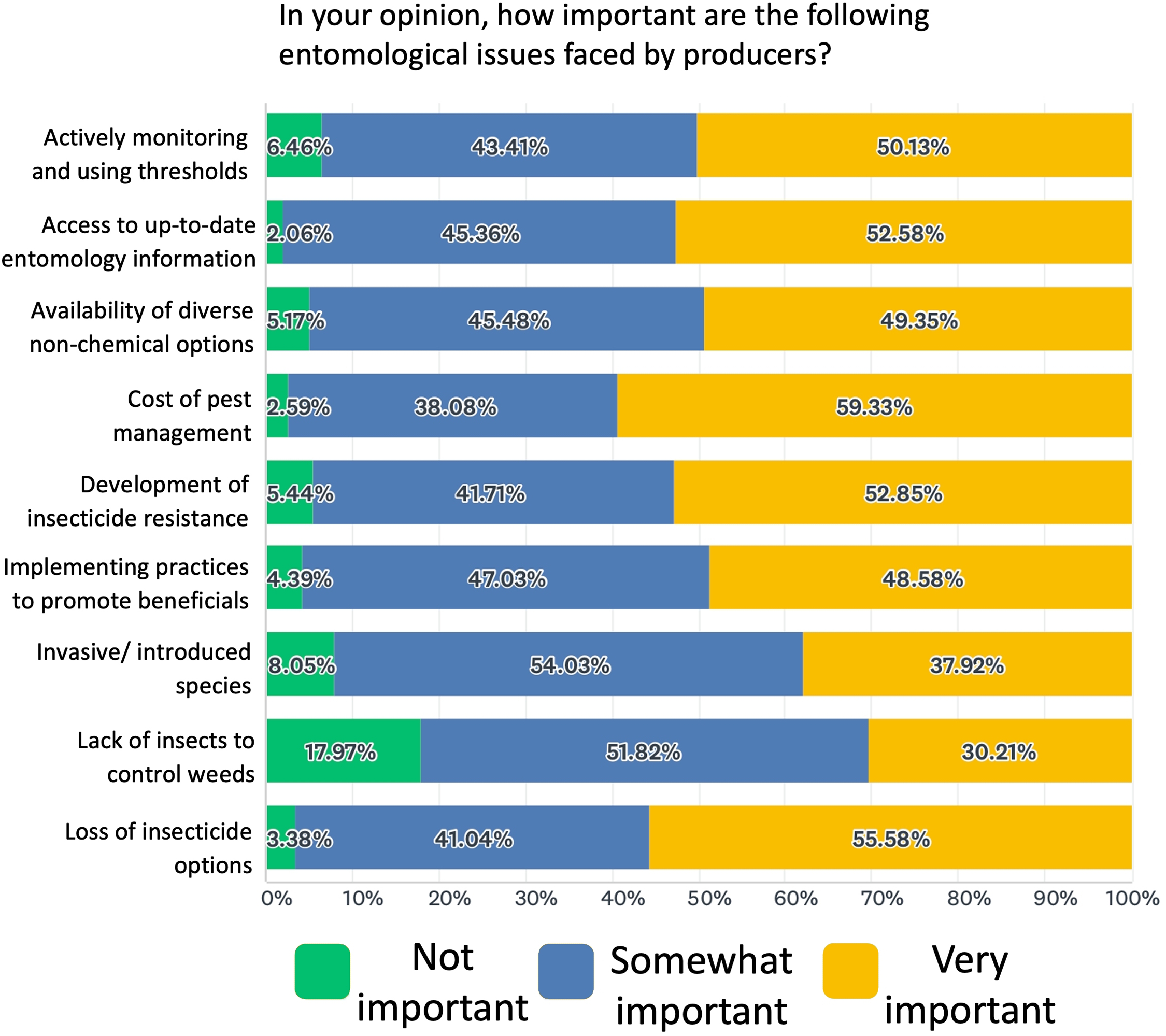
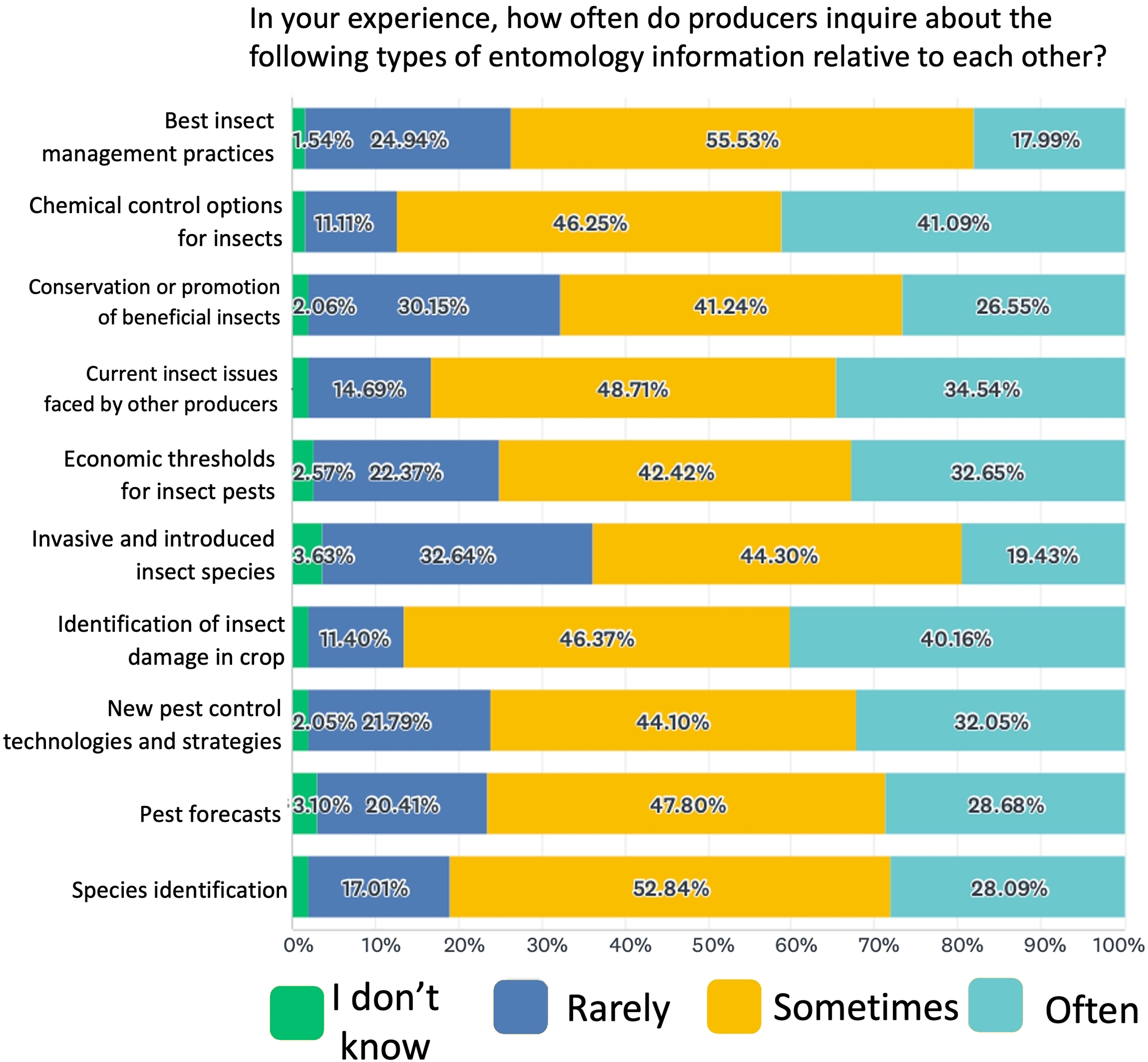
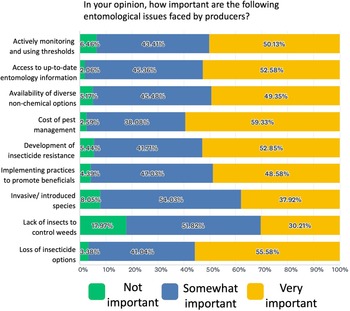
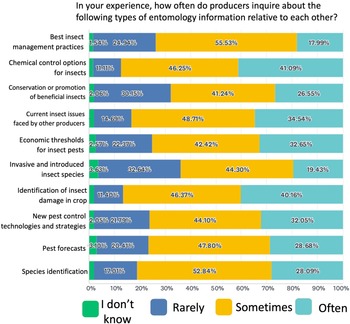
Pest management issues were evaluated with a Likert-scale question (Fig. 2), which identified the most important issues as “cost of pest management” (59.33%) and “the loss of insecticide options” for producers (55.58%). “The lack of insects to control weeds within crops” and “invasive/introduced species” were the response options that respondents deemed least important. The location of respondents within the province influenced responses to questions about resistance to insecticides (Kruskal–Wallis test, H(4) = 19.5, P < 0.001), which was an issue not considered “very important” by more producers in central (67.1%) and northeastern (59.%) Alberta than in the rest of the province (range: 35.6–47.0%). In addition, the loss of chemical control options (Kruskal–Wallis test, H(4) = 12.2, P = 0.016) was not considered to be “very important” to producers in central Alberta (60.2%) compared to producers in the rest of the province (range: 30.5–52.4%). Only the response about the cost of pest management had a low item-rest correlation (Pearson’s correlation matrix, r = 0.15) that indicated that producers likely think about this issue differently than the other questions. Respondents who often received questions from producers about best management practices viewed active pest monitoring and use of economic thresholds as important (Pearson’s correlation matrix, r = 0.33). Respondents who often received questions from producers about invasive species viewed invasive species (Pearson’s correlation matrix, r = 0.31) and the lack of insects to control weeds in agroecosystems (Pearson’s correlation matrix, r = 0.3) as important. Respondents reported that producers most often asked about chemical control options (41.09%) and identification of insect damage (40.16%) and rarely asked about overall best management practices (24.94%), conservation of beneficial insects (30.15%), and invasive species (32.64%; Fig. 3).
Results of Likert-scale question #7, measuring respondents’ perspectives on the severity of entomological issues currently faced by producers in Alberta (Cronbach’s α = 0.62, indicating some interrelatedness among responses to question; n = 354).
Results of Likert-scale question #3, asking respondents about how often producers inquired about different topics related to insect pest management (Cronbach’s α = 0.73, indicating moderate interrelatedness among responses to questions; n = 354).
Respondents categorised funding and support of extension activities (36.48%) as the biggest issue affecting agricultural extension (Fig. 4). The need for clear guidelines for producers to access entomological extension resources was also a highly ranked concern of extension professionals (29.77%). The location of extension professionals throughout the province impacted the opportunities for one-on-one communication during extension activities (Kruskal–Wallis test, H(4) = 9.63, P = 0.047): many extension professionals located in the Peace Region of northwestern Alberta reported that the opportunity for one-on-one communication was a major issue (37.04%), compared to extension professionals working elsewhere in the province (range: 18.1–31.8%). Respondents who used a large number of modes of communication did not view extension issues as severe problems (Kruskal–Wallis test, all P < 0.05).
Results of Likert-scale question #8, asking respondents about perspectives on potential issues around agricultural extension in Alberta (Cronbach’s α = 0.66, indicating some interrelatedness among responses to questions; n = 354).

Most ideas to enhance agricultural extension in Alberta received support from extension professionals (Supplementary material, Fig. S3), with the exception of the development of programme development models (Franz et al. Reference Franz, Garst and Gagnon2015), which received only 33.07% support. Survey respondents most strongly indicated supporting the idea of provincial support for a permanent insect specialist (65.63%). In the section for additional feedback on agricultural entomology extension in Alberta, many respondents (n = 121) took the opportunity to provide comments that addressed 13 different categories (Fig. 5). Most comments focused on challenges associated with availability of entomological information, the need for more monetary support for extension, and the desire for more objective information providers, such as government extension agents.
Number of comments provided by extension professionals on issues affecting the quality of entomological extension in Alberta. A total of n = 121 responses were collected, each of which was then assigned to one of 13 categories that reflect the major needs and perspectives of extension professionals.

Methods of agricultural entomology extension in Alberta
Survey questions assessed ways in which entomological extension is conducted in the province. Most respondents preferred one-on-one extension interactions (67.61%) but frequently used print material (58.87%), electronic newsletters (57.33%), and presentations at agricultural events (53.21%) to exchange extension information with producers. Scientific publications (27.51%) and web-based applications (32.39%) were the least commonly used methods of extension.
Some respondents (26.61%) revealed that their organisations do not evaluate extension activities. For those organisations that evaluate extension, effectiveness was most commonly tracked through direct feedback (49.61%) and the number of visits to extension websites (48.58%). A Likert-scale question on extension priorities revealed that all the options were important (Supplementary material, Fig. S4), although timeliness (66.49%), accessibility of information (63.38%), understandability of extension materials (59.64%), and the formation of lasting relationships (58.44%) were most highly supported by respondents. Only the focus on beneficial insects (Pearson’s correlation matrix, r = 0.06) and the formation of long-lasting professional relationships (Pearson’s correlation matrix, r = 0.19) had poor item-rest correlations, indicating that respondents prioritise these differently from other considerations. Respondents who considered extension as an official part of their work mandate were less likely to consider accuracy (Kruskal–Wallis test, H(1) = 9.9, P = 0.002) and understandability (Kruskal–Wallis test, H(1) = 7.9, P = 0.005) of extension information, and access to information (Kruskal–Wallis test, H(1) = 10.3, P = 0.001), as important. These findings should be interpreted with caution due to the disparity in group sizes: the respondents who considered extension an unofficial part of their work represented only a small portion of the total sample (18.2%).
Map of online entomology extension in Alberta
The map of online entomology extension in Alberta is publicly available (https://www.mindmeister.com/app/map/2753997962?t=UTlaUiaGYK), and the information used for the map can be found in Supplementary material, File S2. A total of 85 extension providers and efforts were included (Fig. 6) and categorised into seven types of agencies, with some extension efforts nested under providers. The nested structure of the map and the green arrows that connect closely associated organisations allow visualisation of extension efforts and the relationships among extension providers and activities. Each provider or activity includes an external link to the source and is tagged with up to 15 categories of information, based on three general groupings: “pest management options and use”, “insect biology and ecology,” and “general entomology communication.” Users can search within the map for the information they need, and a clickable link to each source is included for easy access.
Screenshots of the map of online entomology extension in Alberta that identifies 85 resource providers and extension activities. The map includes: A, 15 searchable categories of information classified by colour into pest management options and use, insects and the environment, or entomology communication (top, left), instructions for general use (top, centre), and seven types of extension agencies (top, right); B, expandable nodes to explore types of extension providers with clickable links to associated websites; and C, relationships between extension providers indicated through green arrows (association) or a nested hierarchy, and expandable categories of information to indicate the type of information provided. The extension map was made with the MindMeister® online platform and can be accessed at https://www.mindmeister.com/app/map/2753997962?t=UTlaUiaGYK.

Discussion
Survey administration, evaluation, and demographics
The results of our survey are robust because the number of respondents in the dataset (n = 354) exceeds the target sample size. This survey received a higher percentage of responses from the target audience than did the companion producer survey (Domnich et al. Reference Domnich, Bulut, Mori and Evenden2025). This can be attributed to direct communication with hundreds of extension providers, the short survey length (∼5 minutes to complete compared to ∼20 minutes to complete the producer survey), or the professional commitment of extension professionals to supporting entomological outreach and information sharing. A high number of responses also suggests that the questions were delivered in a convenient and understandable way (Gideon Reference Gideon2012). However, clearer messaging about the locality of the target audience by including provincial imagery (i.e., flag and crest) in the recruitment information could have helped to reinforce the Alberta-specific nature of the project.
In general, the survey captured responses from all types of professionals in the agriculture industry, with the exception of provincial extension professionals. The low number of provincial extension professionals reflects the Province of Alberta’s retreat from providing agricultural extension over the last few decades (Knapp Reference Knapp2021; Spencer and McConnell Reference Spencer and McConnell2021). This number would likely be higher in the other prairie provinces that are more actively involved in entomological extension (Manitoba Agriculture Food and Rural Initiatives 2012; Agri-Food Innovation Council 2017; Saskatchewan Ministry of Agriculture 2023) and in the United States of America, where land-grant universities work closely with state government entities (Brewin et al. Reference Brewin, Chowdhury and Kittilsen2022). It is difficult to determine whether the high private-sector respondent representation in our study is due to a large number of extension professionals in private industry or because contact information of individuals in private industry was easily available online. Although public data on agrologist demographics are not available for comparison, it is notable that almost half of the respondents in our survey are younger than 35. Positions that require high skill level and training often attract younger professionals (Anderson and Feder Reference Anderson, Feder, Evenson and Pingali2007; Agri-Food Innovation Council 2017), and older individuals may have moved into management roles.
Producer issues and extension needs
Extension professionals may take a more holistic view of producer issues than the farmers themselves do because extension professionals regularly deal with numerous producers. However, in Alberta, the most important pest-related issues reported by extension professionals are similar to those reported by producers (Domnich et al. Reference Domnich, Bulut, Mori and Evenden2025) and include control costs and the loss of insecticide options. Input costs facing Canadian producers have increased over the past two decades and directly impact farm revenue (Laforge et al. Reference Laforge, Corkal and Cosbey2021), while bans of various insecticides have made pest management decisions more difficult for producers (Pest Management Regulatory Agency 2020). Our results suggest that extension professionals use the frequency of inquiries to gauge the level of importance of pest issues to producers. Respondents rate insect identification as a major entomological extension issue, a view echoed by producers in Alberta (Domnich et al. Reference Domnich, Bulut, Mori and Evenden2025).
Key differences between the responses of producers (Domnich et al. Reference Domnich, Bulut, Mori and Evenden2025) and extension professionals also emerged in our analyses. For example, producers did not identify extension funding as a major concern (Domnich et al. Reference Domnich, Bulut, Mori and Evenden2025), whereas extension professionals ranked lack of funding as the primary barrier to effective entomology extension in the province. This may reflect the distance of producers from the administrative and financial side of extension delivery. The importance of pest issues to extension professionals across Alberta is affected by respondent location, with different cropping regions facing distinct challenges (Agriculture and Agri-Food Canada 2022). However, the factors driving regional differences in opinions about insecticide resistance and reduced chemical control options remain uncertain.
The biggest issue regarding the delivery of entomology extension is the need for increased support. Funding for extension is not conventionally covered in research project budgets (Brewin et al. Reference Brewin, Chowdhury and Kittilsen2022; Results Driven Agriculture Research 2022b) and has weak political support due to a perceived lack of measurable economic benefits (Anderson and Feder Reference Anderson, Feder, Evenson and Pingali2007; Giulivi et al. Reference Giulivi, Harou, Gautam and Guereña2023). Although difficult to quantify, benefits of extension efforts can be evaluated through “soft” measurement techniques, such as surveys, interviews, and focus groups, which assess indicators such as decision-making skills and knowledge gained (Knook et al. Reference Knook, Eory, Brander and Moran2018). Evaluation methods must be incorporated into extension programme design because baseline data before programme implementation is needed for meaningful comparison (Knook et al. Reference Knook, Eory, Brander and Moran2018). The surveyed extension professionals also identified a lack of clear guidelines for finding extension information and reinforced the need for improved coordination within Alberta’s agricultural extension system (Knapp Reference Knapp2021; Laforge et al. Reference Laforge, Corkal and Cosbey2021). Currently, no centralised hub exists for producers and extension professionals to access entomological information across commodities (Gosselin Reference Gosselin2009). To this end, the online map of entomological extension activities in Alberta that we developed in this project provides a starting point for producers and extension professionals to access a diverse array of information.
The Cronbach’s α metric was particularly low for our survey questions related to extension issues, suggesting that respondents differ substantially in how they perceive the severity of these challenges facing extension delivery. For example, those working in the Alberta Peace Region express issues with effective one-on-one communication, potentially due to wider spacing between farms in northern areas (Henning‐Smith et al. Reference Henning-Smith, Moscovice and Kozhimannil2019), whereas fewer extension delivery issues are reported by respondents who use multiple modes of communication. Multiple communication modes are generally desired by producers (Anderson and Feder Reference Anderson, Feder, Evenson and Pingali2007; Anastasios et al. Reference Anastasios, Koutsouris and Konstadinos2010; Marantidou et al. Reference Marantidou, Michailidis and Papadaki-Klavdianou2011) and can help increase the adoption of new practices and technologies (Giulivi et al. Reference Giulivi, Harou, Gautam and Guereña2023). Results from both the producer (Domnich et al. Reference Domnich, Bulut, Mori and Evenden2025) and extension professional surveys support the idea that extension communication methods should be diverse and tailored. Producers prefer formats such as one-on-one contact and electronic newsletters, a result that aligns with the assessment of the efficacy of these tools by extension professionals. These findings reinforce the importance of personal relationships and low-barrier communication tools in agricultural extension.
Extension professionals who responded to our survey do not support the use of programme development models (Franz et al. Reference Franz, Garst and Gagnon2015) to enhance extension activities. Although these models are implemented by many organisations in Alberta as a framework that can be used to evaluate and replicate a successful programme, extension professionals trained in science or agriculture may lack understanding of these models. Extension programmes should be evaluated to determine programme effectiveness and success and to highlight areas for potential improvements (Burroughs and Wood Reference Burroughs and Wood2000; Zall Kusek and Rist Reference Zall Kusek and Rist2004; Agri-Food Innovation Council 2017; Davis Reference Davis, Davis, Babu and Ragasa2020; Results Driven Agriculture Research 2022b). Evaluation also provides an opportunity for feedback from producers that can impact the direction of applied research and extension efforts and help tailor it to their needs (Anderson and Feder Reference Anderson, Feder, Evenson and Pingali2007; Results Driven Agriculture Research 2022a). One-quarter of survey respondents report that they do not track or evaluate extension activities, which is a common pattern seen in extension programmes around the world (Knook et al. Reference Knook, Eory, Brander and Moran2018). Extension evaluation is particularly difficult in Alberta due to lack of a convenient and comparable evaluation systems across the sector (Warsame Reference Warsame2015; Yang and Ou Reference Yang and Ou2022). Respondents most favour the idea of a long-term Provincial Insect Specialist position to support agricultural entomology extension in Alberta and desire greater coordination across the system. A survey of Agricultural Fieldmen conducted by the Department of Agriculture and Rural Development (Alberta Agriculture and Irrigation, Edmonton, Alberta) revealed a similar preference for more linkages in the extension system (Gosselin Reference Gosselin2009). Collaboration allows more effective dissemination of information than the pluralistic model currently in place in Alberta does (Agricultural Service Boards 2023).
Three major extension issues are expressed in a large number of open-ended comments in our survey. Easily accessible information is important for both producers and extension professionals (Anderson and Feder Reference Anderson, Feder, Evenson and Pingali2007; Gosselin Reference Gosselin2009; Domnich et al. Reference Domnich, Bulut, Mori and Evenden2025). Producers can become frustrated if too much effort is required to locate relevant and reliable information (Edwards-Jones Reference Edwards-Jones2006). A lack of understanding of pest biology by producers is noted by survey respondents, which can make it difficult to learn about new pest management tactics and approaches. Producers may also have cultural barriers, such as may be experienced by traditional communities with minimal technology use, and physical barriers, such as lack of Internet access, that limit access to online extension materials (Chowdhury and Odame Reference Chowdhury and Odame2013; Agri-Food Innovation Council 2017; Spencer and McConnell Reference Spencer and McConnell2021). Comments by survey respondents reflect the difficulty of reaching producers in rural communities with infrastructural or cultural barriers. Many respondents also noted the need for funding to support dedicated extension personnel. Local extension in the province often relies on volunteers (Gosselin Reference Gosselin2009), a strategy that may not be reliable in the long run (Rollins et al. Reference Rollins, Simpson and Boxall2018). Volunteers include extension workers who volunteer their time and expertise outside of their formal job duties and community members who support local extension initiatives through participation on boards and committees and at community events. Support for extension and improved coordination among players could result in a common analytics platform that standardises metrics across regions to collect, analyse, and report on extension activities and outcomes, making it easier to evaluate effective extension efforts and to identify gaps (Agri-Food Innovation Council 2017; Burroughs and Wood Reference Burroughs and Wood2000; Results Driven Agriculture Research 2022b; Yang and Ou Reference Yang and Ou2022).
Methods of agricultural entomology extension in Alberta
Although all communication modes are used by at least one-quarter of survey respondents, most respondents report one-on-one interactions as an important method of information exchange, a finding that is echoed by Alberta producers (Domnich et al. Reference Domnich, Bulut, Mori and Evenden2025). Print material and electronic newsletters are used frequently both by crop commissions and to disseminate information on policy changes and pest issues or to share news from within the region. Scientific publications are rarely used by extension professionals to communicate research findings directly to producers, even though many respondents work for applied research associations and academia. Digital resources and online tools such as social media are often supported by organisations that provide extension information (Chowdhury and Odame Reference Chowdhury and Odame2013; Agri-Food Innovation Council 2017; Giulivi et al. Reference Giulivi, Harou, Gautam and Guereña2023; Madonna et al. Reference Madonna, Reza and Sovianti2023). In this survey, extension professionals do not report widespread use of mobile applications in their extension efforts, although these tools are favoured by many extension workers in other studies and can be cost-effective at large scales (Giulivi et al. Reference Giulivi, Harou, Gautam and Guereña2023). This may be the result of high startup costs to develop effective mobile applications, high maintenance costs to keep information updated and relevant (Qiang et al. Reference Qiang, Kuek, Dymond and Esselaar2012; Schulz et al. Reference Schulz, Prior, Kahn and Hinch2022), or a lack of knowledge about mobile application development. Traditional modes of knowledge exchange remain important, but a range of communication channels is needed to get information to all stakeholders (Anderson and Feder Reference Anderson, Feder, Evenson and Pingali2007; Marantidou et al. Reference Marantidou, Michailidis and Papadaki-Klavdianou2011; Agri-Food Innovation Council 2017; Kantar et al. Reference Kantar, Wang, Hale, Pratt, Jensen and Lewenstein2023).
Extension professionals who responded to our survey consider all aspects of extension delivery as important to its success. Timeliness and the accessibility of information are of high priority to both extension professionals and Alberta producers (Domnich et al. Reference Domnich, Bulut, Mori and Evenden2025). High value is placed on long-lasting relationships with producers. Face-to-face relationships between extension professionals and producers can have the biggest impact on the perspectives and behaviours of producers (Gosselin Reference Gosselin2009; Agri-Food Innovation Council 2017).
Map of online entomology extension in Alberta
A list of entomology extension efforts in the province is desired by more than half of survey respondents as well as by other extension experts in the province (Gosselin Reference Gosselin2009). The map of online entomology extension options in Alberta created as part of this study partially addresses this need. The searchable map reveals that a large portion and diversity of entomology extension information is provided by crop commissions (18 providers + 5 projects) and private industry (11 providers + 1 project). Sources that provide a narrow scope of extension information include academia, which focuses on research, and news organisations, which focus on general regional updates. The low number of linkages between organisations in the map reveals a disconnect among the existing extension providers in Alberta, as the majority of resources mapped are distinct and unconnected. This suggests a lack of centralised coordination among entomological extension content creators that may contribute to inefficiencies and gaps in knowledge dissemination. Collaboration opportunities include connecting crop commissions and private industry with academia to translate new findings into producer-friendly formats. Regional groups serving different commodities could also co-develop outreach materials and events.
The visualisation of extension information and its providers may help agencies make extension more efficient through identification of opportunities for collaboration, prevention of duplicate resources, and guidance in finding new information. The extension map is hosted online and can be viewed at https://www.mindmeister.com/app/map/2753997962?t=UTlaUiaGYK. To keep the map as a useful tool, it will need future support. As extension changes within the province, the map will require updates to stay relevant and to ensure links are operational. The searchable feature of the map may become a useful tool for users to find relevant entomology information to suit their needs.
Conclusion
This was the first Alberta-wide evaluation of agricultural entomology extension from the perspective of extension workers. The survey captures individuals from different career backgrounds, with a notable lack of provincial government employees due to the province shifting its agricultural efforts to policy and research funding over the last few decades (Knapp Reference Knapp2021; Spencer and McConnell Reference Spencer and McConnell2021). According to extension professionals, the biggest extension issues are sustainable funding, accessibility, and coordination of extension in the province. Funding options need to be refined through funds set aside for extension activities or long-term research and development funding envelopes that allow adequate extension evaluation opportunities (Knapp Reference Knapp2021; Laforge et al. Reference Laforge, Corkal and Cosbey2021; Brewin et al. Reference Brewin, Chowdhury and Kittilsen2022; Results Driven Agriculture Research 2022b). The lack of provincial prioritisation of extension has led to the adoption of a private “fee-for-service” model, which can make producers less willing to share information (Van den Ban Reference Van den Ban2000; Anderson and Feder Reference Anderson, Feder, Evenson and Pingali2007). Subsidies for extension services are justified when the general public benefits from extension, such as from environmental protection and consumer health (Van den Ban Reference Van den Ban2000; Norton and Alwang Reference Norton and Alwang2020), or when the goal is to better reach low-income farmers (Anderson and Feder Reference Anderson, Feder, Evenson and Pingali2007; Norton and Alwang Reference Norton and Alwang2020). The need for accessibility and visibility of extension information is identified by Albertan extension workers and producers alike (Domnich et al. Reference Domnich, Bulut, Mori and Evenden2025). Coordination of extension services could not only improve accessibility but also address the need for standardised evaluation procedures. The extension map created in the present study highlights opportunities to build connections and improve coordination across the system. A favoured approach is a centralised position to oversee entomology extension across the province (Knapp Reference Knapp2021). The role of provincial insect specialist was recently reinstated following the retirement of the long-serving insect specialist in 2020. With a large number of extension activities happening in the province, there is no question that Alberta has the entomology expertise to provide accurate information to producers in the province; the delivery of this extension, however, is variable and may benefit from consistent application and evaluation to allow continued improvements in the future.
Supplementary material
The supplementary material for this article can be found at https://doi.org/10.4039/tce.2026.10054.
Acknowledgements
The authors thank all of the extension workers who completed the survey and the entomologists who helped in its creation. They also appreciate the help from the crop commissions, research organisations, agronomists, and other individuals who helped publicise the survey. Finally, they thank the Alberta Pulse Growers and the Results Driven Agriculture Research Board for funding this work through the Agriculture Funding Consortium (2022N08IR).
Competing interests
Ilan Domnich is employed at the Alberta Native Bee Council. Maya Evenden is employed at the University of Alberta. The authors declare that they have no competing interests.



 Open access

