

1. Introduction
Four years after the start of the COVID-19 pandemic, and contrary to some initial expectations (ECLAC, 2020; UNDP, 2021), we know that the response to the shock did not dramatically alter the status quo of social policy interventions (Béland, Cantillon, Hick, Bent Greve, and Moreira, Reference Béland, Cantillon, Hick, Greve, Moreira, Börner and Seeleib-Kaiser2023; Dorlach, Reference Dorlach2023; Gilbran, Pellissery, and Leyer, Reference Gilbran, Pellissery and Leyer2023; Mäntyneva, Ketonen, and Hiilamo, Reference Mäntyneva, Ketonen and Hiilamo2023). Yet, did the short-term responses to COVID-19 create opportunities for inclusive policy change in the future? This article explores this question, focusing specifically on the impact of the emergency responses to the pandemic.
Even when the short-term responses failed to produce substantial change, they could sow seeds for inclusive social policy in the future. Building on our previous work (Martínez Franzoni and Sánchez-Ancochea Reference Martínez-Franzoni and Sánchez-Ancochea2016) and insights from political economy, we examine whether emergency cash transfer programs redefined narratives, generated new policy tools, and/or built supporting coalitions, and highlight how these opportunities are situated in specific contexts.
Our analytical discussion of opportunities is informed by the emergency cash transfers deployed following the COVID-19 outbreak in Costa Rica and Guatemala. Similar in economic size and geopolitical position but with notable differences in state capacity and social policy regimes, these two countries adopted similar programs. They are also placed in Central America, a sub-region usually downplayed in cross-national analysis within Latin America.
The question of why emergency cash transfers were adopted, or which were its main features has received some attention in the literature (e.g. Blofield, Pribble and Giambruno, Reference Blofield, Pribble and Giambruno2023; Lustig et al, Reference Lustig, Pabon, Sanz and Younger2020; Stampini, Medellín and Ibarrarán, Reference Stampini, Medellín and Ibarrarán2023). Our goal is different from that work: we aim to consider whether the temporary policies adopted contained seeds for future change. In this way, we develop a framework driven by a motivation to bridge “intellectual inquiry and transformative politics” (Hawkesworth, Reference Hawkesworth2012, p. 139).
Below, section 2 discusses the intertwining between policy opportunities, uncertainty, and policy change, including a review of the historical literature on shocks and pandemics to establish what about the aftermath of the pandemic outbreak might favour the formation of inclusive social policies. We also propose categories to mediate between emergency responses and subsequent opportunities. Section 3 presents our methodology, including the justification of the case selection. Section 4 considers the experiences of Costa Rica and Guatemala and whether adopting the emergency cash transfers led to developing new policy tools and narratives and/or strengthened some key actors. The section illustrates the context-specific character of policy opportunities. Section 5 concludes and draws implications.
2. Pandemics, uncertainty and social policy opportunities
‘Covid-19 has created a pivotal moment. Everything hangs in the balance. The pandemic compressed into a year trends that would otherwise have taken decades to emerge. It has brought us to an inflection point in history. By seizing this historic moment, we can turn the tide to shape our individual and collective destiny, and in so doing we would rescue humanity from catastrophe and create a better world’ (Goldin, Reference Goldin2021).
Implementing more ambitious social policies is particularly urgent in large parts of the global South, where powerful economic elites, incomplete democratic institutions, and weak state capacity have contributed to high concentration of income and insufficient human development (Fairfield, Reference Fairfield2015; Sánchez-Ancochea, Reference Sánchez-Ancochea2020; UNDP, 2021). Yet, social policy cannot provide basic protection from exclusionary market forces in many countries.
Central America illustrates some of these negative trends. Although the democratic transition and the peace accords signed in the 1990s following civil wars promised to deliver better social policies, change has been elusive. Despite some exceptions, like the reduction of infant mortality, structural shortcomings remain (Programa Estado de la Nación, 2021). In 2019, 50% of Guatemalans were still below the poverty line, and the country remained one of the most unequal in the world. Costa Rica had a much better social performance during the second half of the 20th century, but income inequality has increased more recently (Martínez Franzoni and Sánchez-Ancochea, Reference Martínez-Franzoni and Sánchez-Ancochea2016, Arias, Sánchez and Rodríguez, Reference Arias, Sánchez and Rodríguez2020).
High levels of social policy inclusion depend on access and generosity – the size of transfers and the quality of services received. When the distribution of access and generosity is similar among men and women, young and old, well-off and poor, and indigenous and non-indigenous, the policy is inclusive and helps build more equal societies. This definition of inclusive social policy is closely linked to recent conceptual understandings of universalism in the global South (Martínez Franzoni and Sánchez-Ancochea, Reference Martínez-Franzoni and Sánchez-Ancochea2016). Social policies (transfers and services) are inclusive when there is at least a moderate level of universalism, with coverage going beyond the poor and including middle-class segments (Pribble, Reference Pribble2013). This way, inclusive social policies help reduce socioeconomic provision gaps in critical areas like food, health, caregiving, or income security.
Change towards more inclusive social policy in scenarios of high-income inequality faces multiple political economy challenges. The power of the economic elite is a case in point and one that the pandemic did not erode (Bull and Robles, Reference Bull and Robles2020). Still, the literature shows that the way countries respond to shocks can create opportunities for change, gradually eroding structural obstacles to promote equity.
2.1. Pandemics and policy change
A shock is a violent occurrence that temporarily questions the preceding status quo. Shocks can upend families, health, income, work organization, education, mobility, and confidence in politics, to name a few of their most significant implications. Wars, natural disasters, and pandemics qualify as shocks because they all disrupt the everyday lives of those involved (Della Porta, Reference Della Porta2021).
A substantial body of research identifies shocks as triggers for expansionary policy change. Adams (Reference Adams1977), in conversation with Titmus, considers the implications of wars on social policy (Adams, Reference Adams1977; Titmus, Reference Titmus2001). Titmus argued that many social programs aimed at improving the living conditions of civilians and non-civilians during wars and after their end.Footnote 1 Military success required the cooperation of the masses and led to universal welfare states (Adams, Reference Adams1977:420). There is also ample literature on the political consequences of natural disasters like earthquakes (see Pelling and Dill, Reference Pelling and Dill2010 for a review).
As ‘crowd diseases’ that spread most easily when people are packed together at high densities, pandemics have often contributed to the growth of the state (McMillen, Reference McMillen2006). Authorities responded to the Bubonic Plague (1340) with social distancing and improved public sanitation, which, in turn, contributed to subsequent improvements in living and working conditions (Routt, Reference Routt2020).Footnote 2 Quarantine was first established for ships in Venice during the second plague, which started in 1346 (Snowden, Reference Snowden2019). The 1918 pandemic flu led to new preventive and socialized medicine concepts. As a result, epidemiology began to (unevenly and slowly) replace eugenics. In all these contexts, pandemics can be seen as “critical junctures”, that is, as triggers of new trajectories. Such junctures “disrupt economic, social or political equilibriums…[and] call into question implicit or explicit agreements, lead to periods of renegotiation of institutions, and allow actors to make “momentous” decisions” (Gil, Reference Gil2022, p. 790).
Statecraft to confront pandemics occurred under very atypical conditions associated with uncertainty (Bjørkdahl and Carlsen, Reference Bjørkdahl and Carlsen2019). Unknown sources of disease, means of contagion, duration of the infections, and fear about potential, unfamiliar effects on the social order led to decision-making based on probabilities, ambiguity, and complexity (Han, Klein, and Arora, Reference Han, Klein and Arora2011). Uncertainty dropped as authorities normalized – not necessarily solved – shocks and their manifold consequences. Rather than an objective feature of the world, uncertainty is here seen as “fundamentally a mental state, a subjective, cognitive experience of human beings … [defined by] the conscious awareness, or subjective experience of ignorance” (Anderson, Carleton, Diefenbach, and Han, Reference Anderson, Carleton, Diefenbach and Han2019, p. 2). Time was, therefore, highly consequential to state action: first, there was a high density of policy efforts following the outbreak, which slowed down as time passed. Secondly, those initial decisions were made in an unusual and short-lived state.
The COVID-19 pandemic nourished optimistic expectations regarding inequality reduction and more inclusive social policies in line with this historical record. The lines from Goldin (Reference Goldin2021) at the beginning of this section provide a clear illustration of perspectives around the notion of “Building Back Better” – first used by the United Nations in 2015 and rapidly embraced as a motto to face COVID-19.Footnote 3 Echoing recent research on the history of inequality reduction (Scheidel, Reference Scheidel2017) and some of the studies reviewed above, observers argued that the COVID-19 pandemic could dramatically alter expectations, policies, and class balance. Oxfam’s Duncan Green, for example, talked about the pandemic as “forks in the road” where “new issues and opportunities for change” emerge, but so do “new threats” for progressive policies (Green, Reference Green2020).
Pandemics can lead to policy change directly—by resulting in new programs maintained over the long run—or indirectly—by creating lessons and expectations for the future. Yet the historical literature on shocks and pandemics tells us little about how immediate responses influence subsequent developments, that is, the second type of opportunity.
These lessons and expectations depend at least partly on the role of ideas – including scientific ideas – and how they shape subsequent narratives. Each narrative is a story about a problem and its solution (Stone, Reference Stone2011). For example, at the beginning of the 20th century and in response to various shocks, epidemiology (the study of patterns, causes, and effects of viruses) was developed. As opposed to eugenics, epidemiology framed crowd diseases as the result of living conditions and thus sought to improve housing, sanitation, and healthcare, making them available for all.Footnote 4 Ideas, thus, bring along policy tools to intervene in the real world. Kingdon (Reference Kingdon1997) proposed a model of policy change that addresses these ingredients as part of “policy windows”. Such windows open when three streams converge: as he puts it, “a problem is recognized, a solution is developed and available in the policy community, a political change makes it the right time for policy change, and the potential constraints are not severe.” (p.93). Policy entrepreneurs bring these streams of change together. Kingdon´s model is helpful in explaining why a policy is implemented in the first place but tells us little about the implications of the new policy in the subsequent trajectory. Something similar occurs with punctuated equilibrium theory (PET), which addresses the temporary disruption of the preceding equilibrium, mainly in the absence of shocks (Baumgartner, Jones, and Mortensen, Reference Baumgartner, Jones, Mortensen, Weible and Sabatier2018).
2.2 Emergency cash transfers and policy opportunities
Governments not only “power” (or whatever the verb form of that approach might be): they also puzzle. Policymaking is a form of collective puzzlement on society’s behalf; it entails both deciding and knowing (Heclo, Reference Heclo1974).
When considering the opportunities created by the COVID-19 pandemic, focusing on specific policy interventions makes sense. New social policies can modify the social policy regime by making it more redistributive or—if they are only temporary—through more indirect channels.
Emergency cash transfers were a popular response to the COVID-19 pandemic in Latin America and have received some attention in the literature. Cash transfers represented 111 of the 199 income-supporting interventions countries implemented (Stampini, Medellín, and Ibarrarán, Reference Stampini, Medellín and Ibarrarán2023). These authors show that these programs had significant coverage and generosity: the new interventions averaged US$175 per capita, reaching 38% of the Latin American population.
Nevertheless, both the design of the programs and their policy outcomes varied significantly depending on policy legacies, the existence of a unified/divided government, and the fiscal space available (Blofield, Prible, and Giambruno, Reference Blofield, Pribble and Giambruno2023). Where policy legacies were more robust, the cash transfer response to COVID-19 was stronger than in countries where policy legacies were limited in scope. While existing research for “normal times” would expect divided government to limit social policy expansion, Blofield, Pribble and Giambruno (Reference Blofield, Pribble and Giambruno2023, p. 58) argue that “in times of crisis, divided government and fiscal space work to facilitate social policy expansion by generating competition between presidents and legislatures, both of whom wish to show evidence that they are responding to the crisis, but without incurring in political costs.”
Policy capacity—understood as “the ability of bureaucratic structures to perform the necessary functions throughout the policy process to address public issues” (Cejudo, Michel, and Cobos, Reference Cejudo, Michel and Cobos2021, p. 316) - also mattered. In particular, countries had diverse capacities to select beneficiaries and distribute resources. In our research, Costa Rica and Guatemala offer contrasting experiences: Costa Rica has a powerful bureaucracy and benefitted from a database that included most potential beneficiaries, while Guatemala has a weak state and did not have any database available (Cejudo, Michel, and Cobos, Reference Cejudo, Michel and Cobos2021, Figure 3).
The programs were generally successful in reducing poverty and inequality. Lustig, Pabon, Sanz, and Younger (Reference Lustig, Pabon, Sanz and Younger2020) explore the impact of the responses to the pandemic in Argentina, Brazil, Colombia, and Mexico with a rigorous simulation methodology. They show that the lockdowns increased poverty and inequality, but that cash transfer programs acted as a compensatory mechanism. The impact of these programs was high in Brazil—where inequality and poverty decreased overall—and medium in Argentina and Colombia. In Mexico, the lack of special measures meant that poverty and inequality increased significantly. There is conclusive evidence that the cash transfer interventions were redistributive, targeting the structurally poor and reaching some segments of the lower middle class (Lustig, Pabon, Sanz, and Younger, Reference Lustig, Pabon, Sanz and Younger2020).
Unfortunately, however, emergency cash transfers were temporary. Did they, nevertheless, create opportunities for future change? Is the response to this question different in highly developed welfare regimes compared to poorly developed ones? These are the questions we aim to address.
We define an opportunity as an innovation introduced by a policy that can trigger further change in the future. Policy entrepreneurs can build on these innovations to introduce policies or improve existing ones. In this way, opportunities can be seen as seeds for potential change that might or might not materialize.
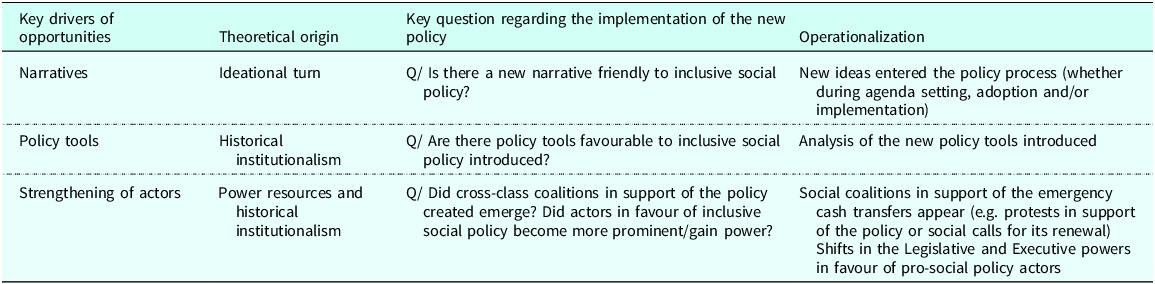
To identify the types of opportunities that a (temporary) policy creates, we rely on the central categories in the political economy of social policy: ideas, actors, and institutions. Table 1 summarizes the theoretical origins of these categories and how they link to our understanding of opportunities.
Policy opportunities created by the response to the pandemic

Source: Own elaboration.
Public policy problems do not exist as objective realities independently of how they are defined. The “interpretive turn” argues that these problems and solutions are mediated by situated meanings (Béland and Cox, Reference Béland and Cox2010; Druckman, Reference Druckman2001; Fischer, Reference Fischer2003; Mehta, Reference Mehta, Béland and Cox2011; Stone, 2012). How a problem is constructed can determine how —and even whether— it is considered an appropriate subject matter for public intervention (Edelman, Reference Edelman1985; Stone, 2012). Such problem definition comes along with “technologies” for policy intervention: for example, the social technology to address alcoholism is not the same as the social technology to address drunkenness (Birkland, Reference Birkland2020). It is, therefore, worth making these ideas “objects of inquiry and meaningful categories” in their own right (Blyth, Reference Blyth2002, p. 17).
In particular, we are interested in whether emergency cash transfer programs changed ideas on what was possible and desirable. Did they modify the framing of eligibility, that is, who should benefit from social policy? Did they change the way key actors saw the role of the state? To answer these questions, we must consider issue framing in policy enactment (e.g. legislation, program announcement) and the views of key actors (e.g. decision-makers; elected officials involved in agenda setting).
Historical institutionalism emphasizes institutional change and regards policies as institutions. For our research on emergency cash transfers, we should focus on the tools that the new policy brought along. The concept of policy architecture is useful for capturing relevant policy tools regarding eligibility, benefits, funding, providers, and the regulation of non-public, outside options (Martínez-Franzoni and Sánchez-Ancochea, Reference Martínez-Franzoni and Sánchez-Ancochea2016). Tools take care of various problems in the short term but also create (dis)incentives for future change (Pierson, Reference Pierson1994; Pribble, Reference Pribble2013). For instance, new information systems to identify recipients and/or new funding sources to ease fiscal constraints can become engines for further policy expansion in the future. In the next section, we pay particular attention to how emergency cash transfers defined beneficiaries and how the programs were funded.
Following power resource theory, we know that power distribution, particularly within the state, matters. If the new measures strengthen pro-equity actors, the opportunities to adopt more inclusive policies will likely increase (Huber and Stephens, Reference Huber and Stephens2012). We must consider two kinds of actors. First, cross-class social coalitions in support of the new policies. Beneficiaries can collectively demand the continuation of the programs through social mobilization or electoral support. Second, we should also analyse whether state actors supporting new policies (e.g. Ministers of Social Development) were strengthened and their capacity to shape policy expanded.
Through the comparative case study, we aim to identify the different opportunities for long-term change in the emergency cash transfers created in Costa Rica and Guatemala. By contrast, we do not consider how these opportunities may evolve over the long run, which will depend on a combination of agency and institutional legacies (Béland, Reference Béland2019) and can only be considered once more time has passed. Future analysis should also study the central role of policy entrepreneurs in drawing on emerging opportunities and maximizing their future political influence (Kingdon, Reference Kingdon1997).
3. Methodology
Because responses to shocks and pandemics are largely state-centric, we must be sensitive to cross-national variations in policy opportunities. Because these responses have been embedded in the uncertainty the pandemic brought along, and because uncertainty drops as time passes, we focus on reactions that occurred right at the onset of the pandemic.
We study two Central American countries: Costa Rica and Guatemala.Footnote 5 The two share some similarities regarding their economic size (in 2021, Costa Rica had a GDP of US$ 64.3 billion compared to US$86.0 billion in Guatemala) and geopolitical position. Yet Costa Rica remains one of the most generous Latin American countries in terms of social spending, while Guatemala is at the bottom of the regional ranking. Comparing them allows us to establish whether the emergency cash transfer programs created more or less opportunities in the case of a developed welfare state versus an underdeveloped one. These opportunities are primarily driven by the social, political, and economic context and should be carefully considered by policymakers when trying to push for new inclusive policies in the future.
We focus on the period of intense statecraft in the context of uncertainty that followed the declaration of emergency in these countries. We chose cash transfers because they were the most important social program implemented as a response to the COVID-19 pandemic (Martínez Franzoni and Sánchez-Ancochea, Reference Martínez Franzoni and Sánchez-Ancochea2021).
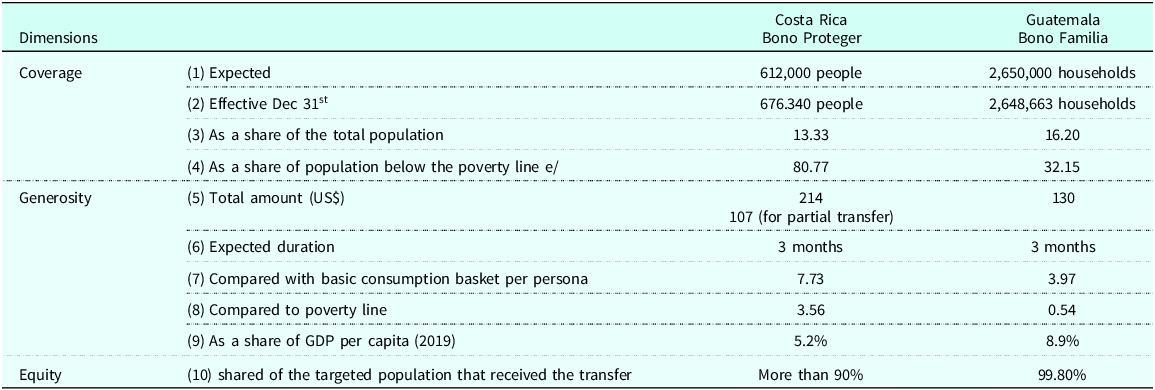
These programs were Bono Proteger in Costa Rica and Bono Familia in Guatemala (see Table 2). In Costa Rica, the program reached 676,340 people (13% of the population) with two to three payments of US$ 214 (or half of it). In Guatemala, the program reached 2.2 million families (16% of the population) with two payments of US$ 130. Regarding poverty lines, the generosity of transfers was higher in Costa Rica than in Guatemala (3.56 and 0.54 times their respective poverty line).
Emergency cash transfers in Costa Rica and Guatemala

Source: Own elaboration based on official reports and demographic data. For further explanation, see Martínez Franzoni and Sánchez-Ancochea (Reference Martínez Franzoni and Sánchez-Ancochea2021).
Cash transfers programs are easy to implement yet may not lead to universal inclusion (Holland and Schneider, Reference Holland and Schneider2017). Still, if sufficiently extended and generous, cash transfers constitute much-needed support for large segments of the population and a key instrument for countries with underdeveloped social policy regimes. Our proposed theory of change goes from the inclusion of cash transfers to incremental opportunities that can affect the character of transfers in the future.
Our data are drawn from official documents and semi-structured interviews with policymakers conducted during 2021. We interviewed twenty-seven academics, social activists, and policymakers (mainly top officials like ministers and vice ministers) from Costa Rica and Guatemala to understand how the programs were implemented, who promoted them, and what narratives justified their views and decisions. We secured informed consent and allowed interviewees to chose whether to be referenced by their name and position, their position only, or to remain fully anonymous.
We started from first-level decision makers close to emergency programs in each country and asked them to recommend up to five key actors with contrasting views. We kept adding actors this way until no new names were recommended. Interviews were recorded and transcripts were analysed with the content analysis software, NVivo.
We triangulated the information from the interviews with official documents and newspaper articles. The latter was part of a database of all relevant official documents published during 2020 and all newspaper articles published by the two main (ideologically contrasting) newspapers.
4. Emergency Responses and Opportunities in Costa Rica and Guatemala
In this section, we draw on the framework summarized in Table 1 to discuss whether and how specific short-term responses created opportunities for inclusive social protection in Costa Rica and Guatemala. We show that the opportunities differed in each country and overall were less significant than we initially expected.
Table 3 summarizes these policy opportunities broken down by each of the three drivers discussed in section 2.2. The table demonstrates that the opportunities were context-specific and were not more or less significant in the more developed welfare regime than in the less developed one.
Emergency cash transfers: Policy opportunities created by short-term responses to COVID-19 across Costa Rica and Guatemala (March-December 2020)

Source: own elaboration.
We start the analysis with the Costa Rican case, where the narrative fell short of creating opportunities as austerity prevailed over the need to expand state intervention.Footnote 6 In the minds of prominent state and non-state actors, the policy effort to confront the pandemic was constrained by the absence of fiscal space (Bermúdez, Reference Bermúdez2021; Cubero, Reference Cubero2021; Dinarte, Reference Dinarte2021; Hernández, Reference Hernández2021). According to the Minister of Planning and Social Development, “the narrative that to respond to the pandemic the government had to cut spending… cut, cut became dominant” (Garrido Gonzalo, Reference Garrido Gonzalo2021). This concern drove the conversation around policy options during the entire period, focusing on spending cutbacks rather than expanding revenues. Temporary progressive taxes were not on the table despite the country having potential space to increase direct and indirect taxes –altogether equivalent to 15.5% of GDP compared to 17.8% in Honduras and 18.2% in El SalvadorFootnote 7 , to mention just two neighbouring countries with much less social spending. Instead, as early in the pandemic as 2020 much of the political debate focused on the weaknesses of the state and the need to reduce its scope (Alvarado Quesada, Reference Alvarado Quesada2020, p. 3).
The implementation of the Bono Proteger was critically assessed by the Comptroller General (CGR). A report argued that authorities had included people who did not meet the eligibility criteria (CGR, 2020). The opposition in Congress and elsewhere repeatedly invoked the idea that the program was improperly implemented. This assessment fed into the austerity narrative based on the state’s inefficiency - even though the proportion of undeserving recipients was considerably lower than in ordinary cash transfer programs—8.5% against 18.0% in non-contributory pensions (Oviedo and Robalino, Reference Oviedo and Robalino2021).
Second, regarding policy tools, the Bono Proteger was funded by reallocating resources from other state programs due to concerns over the country’s fiscal health. As a result, the program’s expansion proceeded slowly since the Executive had to wait for Congressional approval to reallocate resources each time it wanted to add new beneficiaries. Most resources were drawn from funding previously allocated to other public programs, left, as a result, under enormous strain (Martínez Franzoni and Sánchez-Ancochea, Reference Martínez Franzoni and Sánchez-Ancochea2023).
Yet the Bono Proteger did create opportunities for implementing more inclusionary cash transfers in the future, thanks to improvements in policy tools related to eligibility. The law considered beneficiaries to be those workers who had been fired or suffered a reduction in working hours, self-employed workers, and informal workers with no income due to the pandemic (Asamblea Legislativa de la República de Costa Rica, 2020).
To identify the recipients, the Bono Proteger expanded a database (SINIRUBE)Footnote 8 that included beneficiaries and potential beneficiaries of social programs. During the implementation of the Bono, many non-poor informal workers who were neither recipients of social assistance nor part of social insurance were incorporated into the database. As a result, by July 2020, the database contained information on 70% of the Costa Rican households (Programa Estado de la Nación, 2020). Thus, the Bono Proteger expanded the reach of the previous database and highlighted the limits of Costa Rica´s welfare system.
Finally, in terms of actors, no social coalition in support of the program was created. There were no significant demands for its maintenance or social protests to support it. This was for two different reasons. On the one hand, the emergency cash transfer was considered a temporary response from the beginning and lasted for a short period of time. On the other hand, the program was also implemented when the lockdown made protests particularly hard.
By contrast, Costa Rica´s state actors responsible for social policy became more visible. For a few months, the leading authorities at the Mixed Institute of Social Assistance, the Ministry of Inclusion and Human Development, and the Ministry of Labour and Social Security became highly prominent. All of them, however, took for granted the short-term character of the program. Congress played a limited role in framing the program and did not shape the tools used in any way (Martínez Franzoni and Sánchez-Ancochea, Reference Martínez Franzoni and Sánchez-Ancochea2023).
In Guatemala, the narrative that followed the design and the implementation of the Bono Familia built on the recognition that the state had been able to act promptly and adequately. In contrast with the historical record, the crisis demonstrated that the state could perform effectively and with relative transparency. According to the then-executive director of the Central American Institute for Fiscal Studies and former vice-presidential candidate, Jonathan Menkos, “a state that everyone assumed did not have capacities and could not implement basic policies was able to implement a program that reached more than two million families.” In his view, “today we know that more progressive fiscal measures can have positive results for the economy and society…we know that, despite its weakness, the public administration can implement emergency actions through massive programs like Bono Familia.” Indeed, Bono Familia was a massive program that reached over 2.2 million families and 10 million people in a very short period. Even if Bono Familia was just framed as a short-term, emergency response, in theory, progressive policymakers and social activists could build on this success to promote more inclusionary interventions in cash transfers in the future. In fact, Pacto Ciudadano – a group that included more than 100 civil society organizations— “proposed [its continuity] in Reference Menkos2021 with the idea of creating pressures for a permanent program… they even presented it to the economic ministries” (de León, Reference de León2021). This proposal was, however, rejected, and the government soon resumed a more orthodox economic policy approach.
The main opportunities in terms of the policy tools came from funding sources. The Bank of Guatemala lent the resources that funded the Bono Familia (as well as other programs introduced simultaneously). For the first time, policymakers relied on a constitutional provision that, since 1994, allowed using Central Bank resources at times of national calamity (Blanco Valdés, Reference Blanco Valdés2021). This step is even more significant given the influence of orthodox approaches to macro management in the country, including a rigid guarding of low public deficits and debt levels (Fuentes Knight, Reference Fuentes Knight2021). The factor that opened this door was mainly “fear of the collapse of the social order… concern over social outbreak due to the disarticulation of food systems was high…” (Anonimous, 2021).
Contrary to Costa Rica, there were fewer innovations in terms of eligibility and benefits. The country did not have a database of potential beneficiaries. To resolve the problem, the government used the electricity receipts and tried to complement them with other information for people without electricity (CIEN, 2020). Yet, in practice, selecting beneficiaries was a controversial and incomplete process (OXFAM International, Paraíso Desigual y Pacto Ciudadano, 2020). It contributed to the belief by many that the transfer was not benefiting those who needed it most (and may not have access to electricity).
The program did not create a supporting social coalition for the same reasons as in Costa Rica. Bono Familia was framed as a temporary, short-term intervention; there was thus no time or space to build its constituency. Also, similar to Costa Rica, social policy state actors became more visible, as reflected by the prominent role of the Minister of Social Development (MIDES), Saúl Romero. He pushed for the implementation of Bono Familia as the main anti-pandemic social program and enhanced the credibility of MIDES. In various public interventions, Romero suggested that MIDES should become responsible for an inclusive social protection system (Romero, Reference Romero2020). He also proposed creating a “third generation” social program after the pandemic, like in Brazil and Chile. Multilateral agencies like the World Bank worked closely with state actors, granting technical assistance for the rapid deployment of the program. All of this was made possible “because there was a shared enemy… (that) lifted vetoes and made agreements possible” (Anonimous, 2021).
To conclude, the emergency cash transfer lasted for a short period and did not significantly question the previous institutional arrangements. Nevertheless—and this is our second point—we do identify changes that could be helpful openings in the hands of state and non-state actors pushing for progressive reform. Third, the opportunities identified were dependent on country-specific conditions. Progressive actors thus have different leverages for future change in each case.
5. Discussion and conclusion
Unlike previous shocks, from the Spanish flu to the Second World War, which led to dramatic changes in institutional design and increases in public expenditure in health and other welfare areas, social policies following the COVID-19 pandemic remained practically unchanged. This does not mean, however, that the crisis did not create opportunities for future change. In this paper, we developed a framework to understand where these opportunities lie.
We studied these opportunities by focusing on emergency cash transfers as the most popular policy response—and one with positive distributional implications. We analysed specific contexts to honour the situated character of ideas and actors. Costa Rica and Guatemala provided a fruitful contrast given similarities in economic size and geopolitical position, yet notable differences in state capacity and social policy development.
We began our research looking for breaks from the past that opened immediate opportunities for substantive policy change. Yet it soon became evident that these sharp breaks were not present. Emergency cash transfer programs were brief, framed as a short-term response to minimize the effect of lockdown on people’s pockets, and usually delinked from pre-existing policy interventions. Beneficiaries were scattered, under lockdown, and did not demand the extension of the programs. Moreover, programs had to confront a quick return to a pre-pandemic narrative of austerity — pervasive in Central America on two grounds: state inefficiency and corruption and fiscal orthodoxy (Martínez Franzoni and Sánchez-Ancochea, Reference Martínez Franzoni and Sánchez-Ancochea2023).
The limited impact, however, does not mean that the programs did not create any opportunities for future policy change. Here, we proposed a framework rooted in historical institutionalism, power resources, and the role of narratives to identify some of these opportunities. Our objective was, in part, to highlight changes during the pandemic that can be used by progressive policymakers in the future. We suggest that opportunities revolve around the combination of narratives, policy tools, and pro-equity state actors.
The comparative analysis of Costa Rica and Guatemala showed that these opportunities are context-specific. In Costa Rica, the main innovation revolved around the eligibility criteria and the use of a new database to identify beneficiaries. In Guatemala, we highlighted how the program changed narratives on what the state can and cannot do and provided innovations to expand public funding. In both countries, state actors in charge of social policy were strengthened, albeit only momentarily. The analytical framework proposed can travel beyond these cases and be used to study the experience in other countries or by policy entrepreneurs searching for progressive change.
Acknowledgements
Benedicte Bull, Jennifer Pribble, Francisco Robles, Ken Shadler, and colleagues from the Program on “Accumulation, distribution and Inequality” of the Institute of Social Research of the University of Costa Rica provided valuable inputs to an earlier version of this manuscript. Kisha Méndez provided valuable research assistance and the University of Costa Rica institutional support (CIEP project 833-C2-155).
Competing interests
The authors declare no competing interests.


 Open access

