

Introduction
The expansion of China’s global economic reach has sparked debates about Beijing’s use of economic resources to ‘buy’ political influence abroad. It is frequently assumed that China’s outward financial activity is politically motivated, driven less by altruism or market incentives compared to Western counterparts. For instance, China is known for using trade and investment to court Taiwan’s diplomatic allies (Bräutigam Reference Bräutigam2009; Kersting and Kilby Reference Kersting and Kilby2014). These accusations have increased since the announcement of the Belt and Road Initiative (BRI) in 2013. Critics characterize the BRI and China’s overseas development efforts, more generally, as a predatory effort to buy allies in corrupt regimes to counter American dominance.
Though trading money for influence is common in international affairs, we still lack a proper understanding of Chinese economic statecraft compared to that of the USA and other Western powers. For example, past research has studied Western efforts to buy influence in international organizations, which can provide governments with domestic and international legitimacy for their foreign policies. Leveraging the exogenous variation of temporary UN Security Council (UNSC) membership, this body of work finds that Western donors use bilateral and multilateral aid to reward countries elected onto the UNSC and who vote more closely with the USA and its allies (Kuziemko and Werker Reference Kuziemko and Werker2006; Vreeland and Dreher Reference Vreeland and Dreher2014). But, scholars have reached inconclusive results regarding whether Beijing behaves similarly. While some find that temporary UNSC membership is associated with greater aid and investment (Lim and Kim Reference Lim and Kim2023; Stone et al. Reference Stone, Wang and Yu2022), others find that China gives less to countries on the council (Dreher et al. Reference Dreher, Fuchs, Parks, Strange and Tierney2018). This suggests that China may not be using the same strategies as the USA to gain influence on the world stage.
How exactly does China use its economic power to gain political influence? There are two dimensions to this question that need to be explored. First is Beijing’s choice of where to target efforts to gain political capital. This includes considerations about which countries or forums to exert influence over and for what purpose. The second is the choice of which economic instruments to use. Like all countries, Beijing can choose between various economic tools to advance its foreign policy objectives, including debt, foreign aid, sanctions, and trade, as well as variants of each. However, some economic instruments may be better suited for coercion than others due to the nature of the economic engagement and the actors involved.
In this paper, I examine Chinese economic influence in international organizations since competition over global governance is a key feature of the USA-China relationship. I contend that China has incentives to use money to buy influence in regional organizations. Support from regional organizations provides China with the legitimacy it seeks for promoting itself as the leader of developing countries, which are by and large organized in regional blocs. As I elaborate in the next section, regional organizations can shape regional political and economic policies in ways that align with China’s international interests. Thus, I argue that China will use money to push its agenda in regional organizations to exert influence over regional policies. I also argue that countries that hold leadership positions within these organizations, such as the Chair, are especially likely to be targeted due to their agenda-setting power.
When engaging in influence-buying, Beijing will use economic tools that are most easily leveraged for political purposes. Past studies find that whether or not Chinese development finance is politically motivated depends critically on the level of concessionality, with foreign aid being far more political than commercially oriented sources of Chinese financing (Dreher et al. Reference Dreher, Fuchs, Parks, Strange and Tierney2018). In this paper, however, I provide a new way of disaggregating Chinese development finance based on the actors involved. I contend that the actors engaged in a given project help explain the allocation of Chinese finance. Chinese development finance can come from Chinese government agencies, state-owned policy banks, or state-owned commercial banks, and recipient entities can vary between host governments, their state-owned enterprises, or private sector firms in recipient countries. Each of these actors has their own priorities and incentives and varies in the strength of their ties to the state. I argue that flows of Chinese financing most likely to be used to buy influence are those where the funding and recipient entities are closely linked to the Chinese or host governments. Specifically, I hypothesize that financing which flows from Chinese government agencies to recipient governments is most likely to be politicized compared to flows from Chinese banks or to non-government recipient entities.
I focus my analysis on Chinese development finance to two important regional blocs: the Association of Southeast Asian Nations (ASEAN) and the African Union (AU). Southeast Asia and Africa are both regions of high political and economic importance for China and have been targets of many Chinese diplomatic initiatives over the past two decades. Critically, the Chair position of both ASEAN and the AU is exogenously determined, rotating between members annually in the case of ASEAN and among Africa’s five regions for the AU. I leverage this exogenous rotation to estimate the effect of regional leadership on Chinese development finance allocation. I probe differences in allocation patterns depending on the actors involved by disaggregating projects by funding and recipient entities, going beyond existing work that separates Chinese finance between aid and loans. Finally, I compare how these results differ from the effect of temporary UNSC membership, an established predictor of Western aid based on existing work.
I find a significant and robust relationship between regional organizations leadership and Chinese development finance commitments when both the funding and recipient entities are tied to the state. Chinese government agencies are actively giving more money to countries when they assume the Chair position of ASEAN or the AU, consistent with a political effort to increase influence in these organizations. When Chinese government agencies do so, they also give specifically to government agencies in recipient countries rather than local firms. On average, governments that hold leadership positions in regional organizations receive seven times more commitments from Chinese government agencies that year relative to other years, which corresponds to a $90 million increase for the average government-to-government loan. By contrast, financing from China’s policy and commercial banks does not increase when a country becomes Chair regardless of the recipient entity, suggesting that this type of finance is not being manipulated to buy regional influence. These results indicate that the extent to which a Chinese project is influenced by opportunities to increase influence depends critically on the set of actors involved. Moreover, unlike Western donors, I find a null relationship between temporary UNSC membership and Chinese finance, regardless of funding and recipient entities. In other words, the results are not driven by a general desire to funnel money to countries that assume important positions on the world stage.
This paper makes two contributions to the literature. First, the results suggest that China places significant importance on cultivating influence at the regional level, using development finance to target countries in leadership positions within these regions. By funnelling money to Chairs of key regional organizations, who wield considerable agenda-setting power, Beijing can influence the extent to which these organizations and the countries they represent criticize or praise China on the international stage. Additionally, by engaging regional organizations, Beijing can shape regional economic priorities to align with its own outward economic goals. The null UNSC result suggests that Beijing is deliberately targeting regional as opposed to global organizations. This is consistent with the argument that regional organizations offer particularly valuable benefits for China.
Second, this paper follows the extant literature in differentiating forms of Chinese financing but distinguishes Chinese activities by considering the type of funding and recipient entity rather than the level of concessionality. Studies that analyze differences between Chinese aid and loans overlook the fact that this classification is estimated by researchers based on Western practices and does not reflect how Beijing classifies its own development assistance programme. I show that disaggregating development projects by the actors involved explains important variation in the degree of politicization of Chinese development finance. This finding has important implications for how best to evaluate the goals behind different Chinese development efforts abroad and how we think about which Chinese actors and activities ought to be seen as part of Beijing’s foreign policy.
This paper proceeds as follows. First, I discuss why regional organizations are likely targets of China’s influence-seeking efforts. Second, I examine which forms of Chinese development finance are more likely to be used to advance foreign policy objectives. The third section describes the empirical strategy, and the fourth section presents the results. The final section concludes with implications for future research.
Chinese Influence in International Organizations
A large literature has established that Western donors funnel aid for political influence in global international organizations like the UN (Kuziemko and Werker Reference Kuziemko and Werker2006; Vreeland and Dreher Reference Vreeland and Dreher2014; Dreher et al. Reference Dreher, Sturm and Vreeland2009), but efforts to replicable this finding to China have produced conflicting results (Lim and Kim Reference Lim and Kim2023; Stone et al. Reference Stone, Wang and Yu2022; Dreher et al. Reference Dreher, Fuchs, Parks, Strange and Tierney2018).Footnote 1 In this paper, I focus on China’s efforts to buy influence at the regional level by targeting regional organizations. As China expands its global footprint, it has placed a strong emphasis on engaging countries regionally through regional organizations to secure legitimacy from the developing world. Consistent with these diplomatic practices, I argue that Beijing is likely to use money to cultivate political influence in regional organizations. Further, I argue that countries with greater influence in these organizations are more likely to be targeted by China and that one source of this influence comes from assuming the role of Chair.
Regional organizations offer several benefits for Beijing. First, Beijing identifies itself as the leader of developing countries, which are by and large organized around regional organizations. Just as how UNSC decisions can provide domestic and international legitimacy for Western governments (Vreeland and Dreher Reference Vreeland and Dreher2014), support from the developing world gives Beijing the legitimacy it seeks as it attempts to project the image of a responsible great power. China has a lot to gain in its reputation when regional organizations applaud Chinese behaviour or when they do not criticize certain Chinese actions. For instance, when African countries passed a ban on donkey trade during the 2024 African Union Summit, they made sure to de-emphasize how the issue is driven by Chinese demand. Attendants at regional meetings noted how African leaders took great care not to paint the issue as anti-China (Johnston Reference Johnston2024). The absence of public criticism regarding China’s involvement in the donkey trade, despite African representatives raising the issue privately with their Chinese counterparts, keeps this controversial issue out of mainstream news, enabling China to avoid heightened scrutiny.
Beyond the rhetorical support that regional organizations can provide, regional organizations in the developing world also play an important role in shaping regional development priorities, which is especially important during the BRI era. Since many BRI projects are regional in nature and require crossing the territories of multiple states, this increases the importance of regional organizations for China’s foreign policy agenda. For example, the Singapore-Kunming Rail Link (SKRL), which China rebranded into a BRI project, was originally a regional development initiative announced during the fifth ASEAN meeting in 1995. Southeast Asian states co-ordinate through an annual ASEAN working group to monitor progress and align national railway plans with ASEAN’s broader regional connectivity goals. Thus, whether and how ASEAN prioritizes railway development in a given year is critical to the project’s trajectory and progress. To the extent that China aims to shape the SKRL, it would be incentivized to seek influence in ASEAN.
I argue that countries who hold leadership positions in these organizations, such as the Chair, are especially likely to be targeted by China. First, countries who serve as Chair in a given year often speak on behalf of the organization and serve as a representative of the region on the international stage that year. Thus, funnelling money to Chair states can directly influence how that country frames China’s engagement with the continent, responds in the event of a controversy that involves China, and selects which Chinese activities to emphasize or avoid. In addition, the Chair holds important agenda-setting power in these organizations and plays a critical role in shaping policy outputs (Tallberg Reference Tallberg2010). This is especially true in emerging regional organizations, where in an effort to treat members equally, open access to the agenda can easily result in agenda overload, increasing the importance of the Chair in dictating what is discussed (Kufuor Reference Kufuor2007). Chairs can exclude proposals made by non-Chair states and prioritize agenda items that align with their strategic goals. For example, as a landlocked country, Laos often uses its Chairmanship years to prioritize regional connectivity. In 2016, it pushed through the launch of the Lao–Thailand–Malaysia–Singapore (LTMS) Power Integration Project (Lim and Kim Reference Lim and Kim2023). When it became Chair again in 2024, it helped revive stalled negotiations of the China-Thailand railway when it became Chair again in 2024 (Martinus and Lin Reference Martinus and Lin2024). These examples illustrate that the Chair can exercise considerable influence over the policy outputs of the organization in a given year. Thus, by extending more finance to the Chair, Beijing can influence the policy priorities the Chair country sets for the organization that year. In the case of ASEAN, for instance, this can shift the organization’s focus away from territorial disputes in the South China Sea and towards development and trade instead. Though China likely uses economic tools to influence non-Chair states as well, the Chair’s agenda-setting power creates additional incentives for Beijing to strategically use money to influence regional priorities.
There is anecdotal evidence that China actively engages countries economically during the years they serve as Chair. In July 2012, ASEAN failed to issue a joint communiqué for the first time in forty-five years when Cambodia, serving as the Chair, blocked it due to language that Vietnam and the Philippines added to criticize Chinese behaviour in the South China Sea. Two months later, during the Cambodian Prime Minister’s state visit to China, Beijing pledged more than $500 million in new loans/grants as an ‘appreciation for the part played by Cambodia as Chair of ASEAN to maintain good cooperation between China and ASEAN’ (Reuters 2012). Contrary to popular belief, Cambodia has not always had close ties with Beijing. Prime Minister Hun Sen had previously called China the ‘root of everything that is evil’ because of Beijing’s support of the Khmer Rouge regime (Hutt Reference Hutt2016). China spent a good decade courting Cambodia after Hun Sen launched his coup in 1997. It was only after this incident that Cambodia began to serve as China’s client-state in ASEAN, and bilateral relations cemented thereafter.
Relatedly, in January 2018, a French newspaper published allegations that China bugged the AU headquarters it built in Ethiopia, quoting anonymous sources that the organization overhauled its IT system after the hack was discovered a year earlier. When asked about the allegations, the newly assumed Rwandan Chair of the AU said he did not know anything about it, commenting instead that he ‘[doesn’t] think spying is the speciality of the Chinese’ (Maasho Reference Maasho2018). Two days later, Rwanda and China signed a co-operation agreement under which Beijing pledged a $32 million grant (Rwanda 2018). Though this cannot be interpreted as causal, it is consistent with Beijing’s broader efforts to court Rwanda that year, including selecting Rwanda as the first destination for the Chinese Foreign Minister’s annual trip to Africa as well as a personal state visit by Xi. This followed a visit to Beijing by the Rwandan President the previous year. A key motivation for Xi’s visit, similar to Indian Prime Minister Modi’s visit that year, was Rwanda’s goal of pushing the African Continental Free Trade Area through the AU, which aligns with Beijing’s long-standing support for a broad regional free trade agreement in Africa.
Forms of Chinese Development Finance
Beyond which venues Beijing chooses to exert influence over, there is the additional question of which economic instruments Beijing will use to do so. States that engage in economic statecraft can choose between various economic tools to advance their foreign policy priorities, and some instruments may be better suited for coercion than others. Existing studies of Beijing’s strategic use of development finance have studied this question by breaking down Chinese finance by its degree of concessionality, distinguishing China’s official development assistance (ODA) from other official flows (OOF). Scholars argue that aid (that is, ODA) is generally more politically motivated than commercially oriented OOF flows, though recent work has challenged this finding. While Dreher et al. (Reference Dreher, Fuchs, Parks, Strange and Tierney2018) find that Chinese ODA is guided by foreign policy considerations while OOF loans follow economic rationales in Africa, Lim and Kim (Reference Lim and Kim2023) find that both are politically motivated in Southeast Asia, going more to countries during years when they are ASEAN Chair. This suggests that the distinction between ODA and OOF may not be as great in the case of China’s development finance.
In this paper, rather than focusing on the ODA-OOF distinction, I provide a new way of disaggregating Chinese development finance based on which funding and recipient entities are involved in a given financial project. Chinese finance can be funded by Chinese government agencies, policy banks, or commercial banks. These funding entities can also extend finance directly to government agencies in the recipient country or to non-government entities such as state-owned enterprises, joint ventures, or private firms (see Figure 1). I contend that Chinese finance is most likely to reflect influence-buying motivations when the funding and recipient entities are directly tied to the Chinese or recipient state. Specifically, I hypothesize that financing from Chinese government agencies will be the most political since they are closely connected to arms of the Chinese government that are engaged in Chinese foreign policy. Similarly, finance received directly by government agencies in recipient countries is more likely to be used to buy influence than flows to non-government entities, seeing as it is the leadership’s support that Beijing aims to cultivate.

Figure 1. Funding and recipient entities of Chinese development finance.
Disaggregating Chinese finance by the actors involved is important because it is more closely aligned with the ways in which the Chinese state classifies its own development assistance programme. Existing studies that focus on differences between Chinese ODA and OOF overlook the fact that researchers estimate classifications of Chinese commitments as aid or loans based on Western standards since China does not adhere to OECD-DAC standards itself. As such, any of the above-mentioned lending and recipient entities can finance ODA projects in existing datasets, even though Beijing considers only its government ministries as true aid agencies. In other words, the ODA-OOF distinction does not accurately correspond to how Beijing perceives its financial commitments. Focusing on the level of concessionality is therefore likely to mask important insights about how Beijing politicizes its development finance based on the actors involved.
To illustrate this point, a simple explanation reconciling the conflicting findings of Lim and Kim (Reference Lim and Kim2023) and Dreher et al. (Reference Dreher, Fuchs, Parks, Strange and Tierney2018) is that OOF projects feature more prominently in Chinese government agencies’ financing portfolios in Southeast Asia (15 per cent) than in Africa (5 per cent). Because Chinese government agencies finance more on market terms in Southeast Asia than in Africa, this explains why Lim and Kim (Reference Lim and Kim2023) find that both ODA and OOF are strategically used in Southeast Asia, while Dreher et al. (Reference Dreher, Fuchs, Parks, Strange and Tierney2018) find this to be true only for ODA in Africa. As the analysis below shows, their conflicting findings can be reconciled by differentiating Chinese flows based on the actors involved. The following sections consider how the incentives of each set of actors may differ and how this affects the politicization of the given or received financial commitment.
Chinese Funding Entities
Various Chinese entities participate in lending abroad, each with varying degrees of ties to the state and differing lending rationales. The first group of actors consist of government agencies such as the Ministry of Commerce, the Ministry of Foreign Affairs, the People’s Liberation Army, and various subnational governments. Among these, the Ministry of Commerce plays a leading role in administering China’s zero-interest loan and grant programmes for developing countries (Bräutigam Reference Bräutigam2009). Many of these agencies are also directly engaged in China’s diplomatic and trade relations, increasing the likelihood that their financial commitments align with China’s foreign policy objectives. I hypothesize that development finance provided by Chinese government agencies is the most likely used for political purposes, as these agencies are more closely connected to the parts of the Chinese government engaged in foreign policy.
Most of China’s development finance is provided by state-owned policy banks (that is, the China Development Bank (CDB) and the Export-Import Bank of China (China Eximbank)) and state-owned commercial banks, which include the ‘Big Four’ banks in China. These banks are driven more by economic rationales compared to state agencies. However, policy banks are likely to be more strategic in their lending compared to their commercial counterparts. This is because CDB and China Eximbank were established to support China’s ‘Going Out’ strategy, an outward economic strategy designed to address domestic economic challenges like industrial overcapacity and resource dependence (Malik et al. Reference Malik, Parks, Russell, Lin, Walsh, Solomon, Zhang, Elston and Goodman2021). Nonetheless, because these banks are also simultaneously expected to generate financial returns, their loans must also incorporate commercial criteria.
Commercial banks, on the other hand, are more likely to be purely commercially oriented, and their allocation decisions likely reflect traditional sovereign creditor incentives. As China’s government plays a central role in managing the country’s economic growth, it has a vested interest in the return on investments made by its state-owned banks. As Dreher et al. (Reference Dreher, Fuchs, Parks, Strange and Tierney2022) note, many of China’s state-owned banks behave like private sector banks in the USA and Western countries. Although Chinese commercial banks are more willing to lend to countries with poor credit ratings than OECD creditors, they compensate for the higher repayment risk by charging interest rates above market levels (Malik et al. Reference Malik, Parks, Russell, Lin, Walsh, Solomon, Zhang, Elston and Goodman2021).
Table 1 shows the value of Chinese development finance projects by ODA, OOF, and funding entities across the five United Nations regional groups. Importantly, it highlights the value of decomposing Chinese development finance by actor rather than flow class, the latter of which is estimated by researchers. While it is commonly assumed that aid projects are primarily associated with Chinese government actors and OOF projects with commercial actors, Table 1 demonstrates that ODA and OOF cannot be directly equated with government and commercial Chinese lenders (for example, column 1 does not equal column 3). As Beijing’s true aid agencies, Chinese government ministries naturally make up most of the projects classified as ODA, but they only account for 44 per cent of the total ODA value during 2000–2017. Additionally, studies relying solely on ODA-OOF as the main explanatory variable may exclude many projects where concessionality levels cannot be determined, whereas my approach does not. Indeed, columns 3 through 5 of Table 1 add up to more than the total ODA and OOF amounts in columns 1 and 2.
Table 1. Chinese Development Finance by Flow Class and Funding Entity (in Billions of Constant USD 2017)

Source: AidData Global Chinese Development Finance Dataset, V2.0 (Dreher et al., Reference Dreher, Fuchs, Parks, Strange and Tierney2022)
1 Countries in Western Europe receive very little ODA and OOF from China, given that most are developed countries. With the exception of Turkey and Malta, none are eligible for ODA under OECD criteria. China has given some ODA to Turkey, and only Turkey and Israel have been recipients of Chinese OOF loans during the entire 2000–2017 period.
Focusing on ODA and OOF alone, therefore, makes it difficult to understand the extent to which politicization of development finance is driven by heterogeneity in donor incentives. Although ODA is certainly more attractive than OOF for recipient countries, it is not immediately clear whether all Chinese funding entities use either aid or loans to pursue the same objectives. From an influence-buying perspective, it is easiest for Beijing to rely on its government agencies’ own financial commitments to pursue foreign policy objectives, especially since many of these agencies are also directly involved in China’s diplomatic relations. On the other hand, relying on the allocation decisions of lending from China’s policy banks or commercial banks is more costly since this invites more actors to the table that can delay or obstruct the process. Thus, when China is engaging in influence-buying, we should expect flows that originate from Chinese government agencies to react most to Beijing’s strategic needs.
Recipient Entities
Chinese development finance can be directed to several types of recipient entities. In the pre-BRI era, Chinese finance was primarily extended to recipient governments in the form of aid or sovereign loans. However, by 2013, many countries had accumulated substantial debt, forcing Chinese banks to lend to other official sector institutions such as state-owned enterprises (SOEs), project companies known as special purpose vehicles (SPVs) or joint ventures (JVs), or even to private companies (Malik et al. Reference Malik, Parks, Russell, Lin, Walsh, Solomon, Zhang, Elston and Goodman2021). SPVs, in particular, have become common borrowers of Chinese loans. These entities are established on a temporary basis for a specific project and can only engage in activities or incur debt related to that project. Unlike sovereign loans, loans to SPVs can generally be repaid using revenue generated from the project only and not assets of the borrowing government (Malik et al. Reference Malik, Parks, Russell, Lin, Walsh, Solomon, Zhang, Elston and Goodman2021). Setting up SPVs to receive financing can be advantageous for developing countries, as it allows them to borrow more without negatively impacting their balance sheets. However, from an influence-buying perspective, the isolated financial structure of SPVs makes it difficult for politicians to divert funds for personal use.
I argue that financial commitments more easily captured by elites are more likely to be used by donors to extract policy concessions. Thus, I hypothesize that Beijing is more likely to extend financing to recipient government agencies as a tool for influence compared to flows directed to non-government entities. Loans to state agencies are more prone to political capture, as leaders have greater access to funds allocated to agencies within their control. These funds can then be appropriated as private goods or diverted into patronage networks to secure political support. Financing to other official sector borrowers, such as state-owned enterprises (SOEs), may also be at risk of being diverted, but this depends critically on SOE governance structures in host countries. By contrast, SPVs are more difficult to take from, seeing as they are designed to be project-specific. Financing to SPVs can instead be used to reward countries more generally off-balance sheet. Finally, I hypothesize that flows to wholly private firms, which are accountable to non-government stakeholders, are the least likely to be used for political purposes.
Table 2 shows the value of Chinese development finance by recipient entity and region. Governments are the primary recipients of Chinese finance in Africa and Latin America, with Asia following closely behind. Eastern European governments do not receive much financing from China; instead, state-owned enterprises in the region are the largest recipient type. SPVs and private enterprises receive much more Chinese development finance in Asia than in other regions.
Table 2. Chinese Official Financing by Recipient Entity (in Billions of Constant USD 2017)

Source: AidData Global Chinese Development Finance Dataset, V2.0 (Dreher et al., Reference Dreher, Fuchs, Parks, Strange and Tierney2022)
Comparing Tables 1 and 2 further highlights the importance of decomposing by actor. For example, in Africa, the total value of government-received Chinese finance is $142.40 billion, which is much larger than the value of total ODA commitments to Africa during this time period. In other words, most Chinese finance to Africa is received by host governments regardless of concessionality and funding entity. Comparing financing across lender-recipient pairs is therefore likely to provide important insights about which financial transactions reflect strategic motives.
Empirical Strategy
I test my hypotheses in the context of Southeast Asia and Africa. Both regions are of high strategic importance for China’s security and economic policy. Southeast Asia is not only the primary ground for strategic competition between the USA and China, but Beijing itself faces a number of territorial disputes in the South China Sea with its regional neighbours. Economically, Chinese ties to the region are also significant and increasing, with ASEAN states overtaking the USA as China’s largest trading partner for the first time in 2020. Outside of Asia, Chinese engagements with Africa have been the most notable. Beijing has become a major player in closing the continent’s industrialization gap, and continued African resource exports are critical to China’s search for energy security. Beyond economics, China has maintained close political ties to Africa going as far back as the decolonization period. Their long-standing engagement takes the form of mutual support on the international stage, especially on human rights issues. Beijing is also careful to prioritize African states’ preferences on regional issues in international forums and has at times been willing to shift away from its non-interference principle to support the AU’s position, such as on the issue of Sudan.
In both Southeast Asia and Africa, regional organizations – ASEAN and the African Union – have played important roles in shaping the region’s response to China’s rise. In Southeast Asia, the region’s preference for multilateralism has allowed ASEAN to play a central role in regional relations with the world. For these reasons, Beijing has actively engaged ASEAN through a number of initiatives, including an annual China-ASEAN summit that has taken place since 1997. Similarly, China has maintained close relations with the AU since its establishment in 2002. In 2011, the AU was admitted as a full member of the Forum on China-Africa Cooperation, which is the primary institution for co-ordinating cooperation between China and Africa, especially on the issue of development finance. Since the AU plays an important role in shaping the region’s development priorities every year, China holds regular consultations with the AU to discuss how its development finance can best serve the region’s development goals and how the AU can facilitate the implementation of the BRI on the continent.
I leverage the institutional structure of the Chair position in ASEAN and the AU, which rotates annually among the institutions’ members, to study how regional leadership affects Chinese development finance. Within ASEAN, the Chair rotates annually based on the alphabetical order of members’ English names. The AU Chair, on the other hand, rotates annually among the five geographic regions of the continent – East, North, Southern, Central, and West Africa – and from each region, the Chair is selected either by consensus or two-thirds majority if consensus cannot be reached.Footnote 2
Rotating leadership offers both theoretical and empirical benefits for this study. Theoretically, compared to elected chairs, rotating leadership in international institutions creates incentives for logrolling within the organization (Tallberg Reference Tallberg2010; Lim and Kim Reference Lim and Kim2023). The Chair’s annual rotation allows states to take turns in exploiting the Chair’s agenda-setting power for their own interests. This also results in member states trading favours with one another, as each is expected to assume this position in the future.Footnote 3 In addition, the fact that member states cannot be punished electorally for assuming the Chair opens the door for external players like China to exert influence. Methodologically, since the position rotates in a way that is uncorrelated with Chinese financing, it addresses the identification concern that Chairmanship is endogenously determined by China’s strategic interests.
The main dependent variable in this analysis is Chinese development finance commitments. The data comes from AidData’s Global Chinese Development Finance Dataset Version 2.0, which covers 13,427 development projects across 165 countries from 2000–2017 (Dreher et al. Reference Dreher, Fuchs, Parks, Strange and Tierney2022).Footnote 4 Of these, 10,849 projects worth $843 billion are active or completed.Footnote 5 This data critically includes details about the funding and recipient entities for each project. Of the 5,753 projects directed to AU and ASEAN countries, all include information about the funding entity and 4,410 (77 per cent) contain details on the recipient entity. Roughly 600 projects directed to countries that have served as Chair at least once are missing recipient entity information. Nearly all projects missing recipient entity information are financed by Chinese government agencies.Footnote 6
Following convention, I focus on project commitments instead of disbursements. One potential downside of doing so is that this ignores delays in fund disbursements, as projects may be announced but not disbursed until later years. One might argue that if China knows preemptively who will become Chair, like in the case of ASEAN, then it could theoretically commit the year before a country becomes Chair and disburse funds the following year. However, disbursements during the year a country is Chair can be problematic as China loses its leverage over the recipient country once the loan has sunk. Thus, it is more optimal for China to commit projects to a country when they are Chair and wait to disburse until after the country follows through on certain promises. In the case of the African Union, since the country that will assume Chair is not always known beforehand, commitments the year of is the only option. In addition, while project commitment value is collected by AidData, annual disbursement value is not. I would therefore have to impute these values based on the average delay between commitment and completion years among a small fraction of projects where completion date is known. This would require making assumptions about how funds are disbursed over this period (for example, linearly), creating additional noise that would lead to less precisely estimated coefficients.
I estimate the following model:
 $$log({\rm{commitments}}_{it} + 1) = \alpha + \tau \rm{Chair}_{it} + {\boldsymbol X}'{\beta _{i,t - 1}} + {\gamma _t} + {\delta _i} + {\varepsilon _{it}}$$
where $commitments$
is the value of committed projects in constant 2017 USD, indexed by
$commitments$
is the value of committed projects in constant 2017 USD, indexed by $i$
, the recipient country, and
$i$
, the recipient country, and $t$
, the year. The main independent variable of interest is
$t$
, the year. The main independent variable of interest is $Chair$
, a binary variable that takes 1 if country
$Chair$
, a binary variable that takes 1 if country $i$
is Chair of ASEAN or the AU in year
$i$
is Chair of ASEAN or the AU in year $t$
.Footnote
7
The model includes year fixed effects (
$t$
.Footnote
7
The model includes year fixed effects ( ${\gamma _t}$
) to account for common shocks that drive Chinese aid and investment decisions as well as country fixed effects (
${\gamma _t}$
) to account for common shocks that drive Chinese aid and investment decisions as well as country fixed effects ( ${\delta _i}$
) to absorb time-constant country characteristics. For robustness, Table A7 in the Appendix reports results using pooled OLS (without country fixed effects) to exploit variation across recipient countries.
${\delta _i}$
) to absorb time-constant country characteristics. For robustness, Table A7 in the Appendix reports results using pooled OLS (without country fixed effects) to exploit variation across recipient countries.
X is a set of time-varying economic and political control variables that may affect Chinese financial commitments. To control for recipient countries’ need for development finance, I include countries’ level of development (logged GDP per capita), market size (logged population), natural resources rent (per cent of GDP), GDP growth rate, and logged national income.Footnote 8 I also control for the logged value of bilateral trade to capture Chinese economic interests in a country.Footnote 9 All prices are converted to constant 2017 USD. Further, to account for potential lending risks, covariates related to countries’ governance and institutional quality are added. These include: Control of Corruption scores from the World Bank’s Worldwide Governance Indicators project, which captures the extent to which public goods can be funneled for private gains, that is, the risk of elite capture of foreign aid; and level of democracy using the polity2 variable from Polity V.
In addition, several covariates are included to account for political motivations beyond regional organization leadership. I control for geopolitical alignment with Beijing by including host countries’ UNGA ideal point distance from China.Footnote 10 Since UNGA resolutions likely consist of many low-salience issues, I check that results are robust to subsets of votes that may be important to China, including those related to human rights issues, that the US Department of State labels as important, and where China and the USA disagree. Voting more closely with Beijing on these votes is likely to signal greater alignment to China over the USA. I also add a binary indicator variable for temporary membership on the UN Security Council, and another to indicate recognition of the Taiwanese government, which typically makes countries ineligible for Chinese aid (Bräutigam, Reference Bräutigam2011; Kersting and Kilby Reference Kersting and Kilby2014). Lastly, to capture potential competition among donors, the residuals of an ordinary least squares regression (OLS) of logged ODA from DAC donors (in constant 2017 USD) on all explanatory variables are included, following the approach in Dreher et al. (Reference Dreher, Fuchs, Parks, Strange and Tierney2018). All covariates are lagged following previous studies. Descriptive statistics for right hand side variables are in Table A1.
The main coefficient of interest, $\tau $
, is identified by the exogenous rotation of the Chair position in ASEAN and the AU. In the generalized difference-in-differences (TWFE) setup described above, identification relies on the assumption that financing to Chair and non-Chair states follow parallel trends prior to Chair years. Since rotating Chairmanship involves both staggered adoption and treatment reversal, I examine the parallel trends assumption for the main outcome variables of interest using an event study approach, where I interact the regional organization Chair dummy with indicators for years relative to when a country serves as Chair. Given that some countries hold the Chair position more than once during the sample period, I generate the relative period index by assuming a one-year carryover period. In other words, all intermediate periods between Chair years are treated as pre-periods, except for the year immediately following a Chair year, which is treated as a post-period. This assumption reflects concerns that Beijing could theoretically provide increased financing as a reward for pro-China behavior when the country served as Chair, rather than commit more finance during the Chair year itself. This concern is likely most relevant in the
$\tau $
, is identified by the exogenous rotation of the Chair position in ASEAN and the AU. In the generalized difference-in-differences (TWFE) setup described above, identification relies on the assumption that financing to Chair and non-Chair states follow parallel trends prior to Chair years. Since rotating Chairmanship involves both staggered adoption and treatment reversal, I examine the parallel trends assumption for the main outcome variables of interest using an event study approach, where I interact the regional organization Chair dummy with indicators for years relative to when a country serves as Chair. Given that some countries hold the Chair position more than once during the sample period, I generate the relative period index by assuming a one-year carryover period. In other words, all intermediate periods between Chair years are treated as pre-periods, except for the year immediately following a Chair year, which is treated as a post-period. This assumption reflects concerns that Beijing could theoretically provide increased financing as a reward for pro-China behavior when the country served as Chair, rather than commit more finance during the Chair year itself. This concern is likely most relevant in the $t + 1$
period. The
$t + 1$
period. The $t - 1$
period is treated as the baseline year in these models. Figure A2 in the Appendix plots dynamic treatment effects for four periods leading up to the treatment year. These four pre-periods correspond to one full round of AU Chair rotation (since the Chair rotates among the continent’s five regions) and half of ASEAN’s rotation cycle (since there are 10 ASEAN members). None of the coefficients in these pre-periods are statistically significant, either individually or jointly, providing greater confidence that identifying assumptions hold.
$t - 1$
period is treated as the baseline year in these models. Figure A2 in the Appendix plots dynamic treatment effects for four periods leading up to the treatment year. These four pre-periods correspond to one full round of AU Chair rotation (since the Chair rotates among the continent’s five regions) and half of ASEAN’s rotation cycle (since there are 10 ASEAN members). None of the coefficients in these pre-periods are statistically significant, either individually or jointly, providing greater confidence that identifying assumptions hold.
Results
Effect of Regional Organization Chair on Chinese Development Finance
I first show the effect of regional organization leadership on Chinese ODA and OOF in Table 3 to compare results to previous findings. For each outcome, the first column (models 1, 4, 8, and 10) presents the results from the naive model, the second (models 2, 5, 8, and 11) adds economic and governance controls, and the last column (models 3, 6, 9, and 12) includes additional political motivators. For ASEAN models, the indicator variable for Taiwan recognition drops out because no ASEAN country recognizes Taiwan.
Table 3. Effect of ASEAN and AU Chairmanship on Chinese ODA and OOF Commitments, 2000–2017

Notes
: Robust standard errors are clustered at the recipient country level. All models include recipient country and year fixed effects. Pr $ \gt {\chi ^2}$
tests the joint significance of political variables (UNGA, UNSC, Taiwan, DAC official finance). *p<0.1; **p<0.05; ***p<0.01
$ \gt {\chi ^2}$
tests the joint significance of political variables (UNGA, UNSC, Taiwan, DAC official finance). *p<0.1; **p<0.05; ***p<0.01
The results from Table 3 are consistent with findings from past research, which finds that political motivators drive ODA allocation but not OOF in Africa (Dreher et al. Reference Dreher, Fuchs, Parks, Strange and Tierney2018), whereas, in Southeast Asia, both are strategically used for political purposes (Lim and Kim Reference Lim and Kim2023). The fully specified model in column 3 shows that the average African country received three times more ODA from China during the years when they held the Chair position of the African Union. This is equivalent to a $141 million increase from the average concessional package to African states. There is no corresponding effect for OOF loans in Africa (column 6). By contrast, ASEAN Chairmanship has a large and significant effect on both committed ODA (column 9) and OOF (column 12) among Southeast Asian countries, as Lim and Kim (Reference Lim and Kim2023) find. Countries that serve as Chair receive, on average, ODA commitments that are worth 25 times more during leadership years, and the corresponding effect for OOF loans is even greater. These effect sizes are similar to estimates found by Lim and Kim (Reference Lim and Kim2023), who conclude that both Chinese ODA and OOF in Southeast Asia seem to be politically motivated.
As discussed above, one explanation for differences in OOF allocation patterns between Africa and Southeast Asia may be the disproportionate involvement of Chinese government agencies in OOF projects in Southeast Asia compared to other regions. Because Chinese government agencies are more active OOF lenders in Southeast Asia, the effect of regional organization leadership for OOF may be driven by market-rate loans given out by the Chinese government to ASEAN states. I therefore disaggregate Chinese development finance commitments by the actors involved, which better captures the political logic of using finance for influence.
First, I focus on differences depending on whether finance is funded by Chinese government agencies, policy banks, or state-owned commercial banks. Figure 2 plots the estimated effect of regional organization Chairmanship by funding entity in Africa, Southeast Asia, and across both regions pooled together, while Table 4 presents the corresponding results. Consistent with my argument, regional organization Chair has a positive and significant effect only on projects funded by Chinese government agencies.Footnote
11
From Column 1 of Table 4, countries that assume the ASEAN or AU Chair receive commitments from Chinese government agencies that are ten times larger that year relative to other years. This corresponds to a $130 million increase from the sample mean of government-funded finance ($12.9 million). On the other hand, regional organization Chair has no statistically significant effect on development finance commitments from non-government agencies.Footnote
12
These results are robust to using pooled OLS (Table A7) and alternative UNGA alignment measures (Table A8).Footnote
13
When using event-time specifications (Figure A2), the effect of regional organization Chair is statistically different compared to the year prior and to four pre-periods only for government-funded finance ( $p = 0.01$
and
$p = 0.01$
and $p = 0.03$
respectively) and not for policy or commercial bank financing. This is consistent with my argument that Beijing uses development finance provided by its government agencies when exerting influence in regional organizations.
$p = 0.03$
respectively) and not for policy or commercial bank financing. This is consistent with my argument that Beijing uses development finance provided by its government agencies when exerting influence in regional organizations.

Figure 2. Estimated effect of regional organization Chairmanship by funding entity. Bars are 90 per cent confidence intervals based on country-clustered robust standard errors. The corresponding results are in Table 4.
Table 4. Effect of ASEAN and AU Chairmanship by Funding Entity, 2000–2017

Notes: Robust standard errors are clustered at the recipient country level. All models include recipient country and year fixed effects. Pr $ \gt {\chi ^2}$
tests the joint significance of political variables (UNGA, UNSC, Taiwan, DAC official finance). *p
$ \gt {\chi ^2}$
tests the joint significance of political variables (UNGA, UNSC, Taiwan, DAC official finance). *p $ \lt $
0.1; **p
$ \lt $
0.1; **p $ \lt $
0.05; ***p
$ \lt $
0.05; ***p $ \lt $
0.01
$ \lt $
0.01
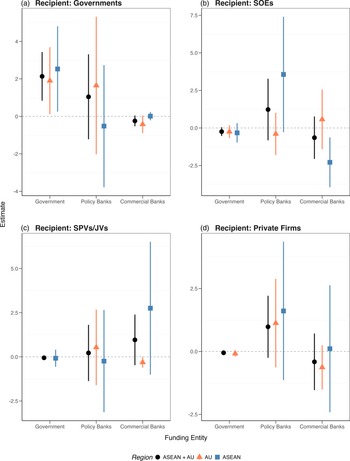
Next, I turn to heterogeneity across recipient entities. In Figure A3 and Table A2, I present the effect of regional organization Chairmanship on all Chinese finance by recipient entities in the host country. The results suggest no significant difference during Chair years. However, important patterns emerge when breaking down financing to each recipient entity by the funding entity. In Figure 3, I plot the estimated effect of regional organization Chair by funding-recipient pairs. For example, Panel (a) shows how the effect of commitments to recipient country governments varies by different funding entities for each region. Regional organization Chair has a consistently positive and significant effect only for projects that are funded by Chinese government agencies and received by governments in recipient countries. In other words, Chinese government agencies reward countries that are Chairs of ASEAN or the AU by giving more to recipient governments directly rather than giving to SOEs, SPVs/JVs, or private firms. The corresponding models, presented in Table 5, indicate that governments that assume the Chair position of their regional organization receive seven times more development finance from Chinese government agencies relative to their non-Chair years. This corresponds to an increase of $90 million for the sample mean of government-to-government loans ($12 million). The effect size for Southeast Asian countries is larger than for African countries when modelled separately. These results are robust to most alternative specifications, including using event time specifications (Figure A2), pooled OLS (Table A7), and alternative UNGA measures (Table A8).Footnote 14 Overall, the results suggest that Beijing is primarily using development finance funded by its government agencies and extended to recipient governments to engage in influence-buying in regional organizations. Chinese banks, on the other hand, do not appear to act as agents of Beijing in seeking regional influence, regardless of recipient entity.

Figure 3. Estimated effect of regional organization Chairmanship by funding-recipient pairs. Bars are 90 per cent confidence intervals based on country-clustered robust standard errors. The corresponding results are in Tables A3–A6. Effects for Government-to-SPVs in Africa and Government-to-Private in ASEAN are missing because no such commitments existed during 2000–2017.
Table 5. Effect of ASEAN and AU Chairmanship on Government-to-Government Commitments, 2000–2017

Notes: Robust standard errors are clustered at the recipient country level. All models include recipient country and year fixed effects. Pr $ \gt {\chi ^2}$
tests the joint significance of political variables (UNGA, UNSC, Taiwan, DAC official finance). *p
$ \gt {\chi ^2}$
tests the joint significance of political variables (UNGA, UNSC, Taiwan, DAC official finance). *p $ \lt $
0.1; **p
$ \lt $
0.1; **p $ \lt $
0.05; ***p
$ \lt $
0.05; ***p $ \lt $
0.01
$ \lt $
0.01
I also evaluate how different actors respond to political factors beyond regional leadership. At the bottom of each table, I present the results of a joint significance test on all political variables included in the model (UNGA alignment, UNSC membership, Taiwan recognition, and DAC financing). The results provide further support for my main hypothesis. In Table 4, political variables are jointly significant for financing that flows from Chinese government agencies in the ASEAN + AU pooled sample and in Africa, though not in ASEAN. The same results hold for flows received by government agencies (Table A2). Further, as Table 5 shows, political factors matter significantly for government-to-government financing in Southeast Asia and Africa, both individually and jointly. They do not predict projects from Chinese government ministries to any other recipient actor, however (Tables A4, A5, A6). This is consistent with the idea that Chinese government agencies are more commercially oriented when lending to ASEAN countries overall, though their financing to Southeast Asian governments is still politically driven. Finally, there is evidence in the ASEAN sample that policy banks are responsive to political factors when combining their financing across all recipient entities (Table 4).
Another noteworthy result emerges with regard to the effect of the One-China Policy when we disaggregate Chinese development finance by funding and recipient entities. Although Taiwan recognition typically makes countries ineligible for Chinese aid, there are also exceptions (see Dreher et al. Reference Dreher, Fuchs, Parks, Strange and Tierney2018; Dreher and Fuchs Reference Dreher and Fuchs2015). For example, in the AidData dataset, Senegal received funding from China for a bridge construction project in 2004, before it ceased diplomatic relations with Taiwan (Dreher et al. Reference Dreher, Fuchs, Parks, Strange and Tierney2018). Consistent with my main hypothesis, Taiwan recognition only negatively affects financing involving Chinese and recipient government agencies (see Tables 4, A2, and A3). Estimates from the TWFE models, which are identified by changes in Taiwan recognition status of four African states (Senegal, Liberia, Gambia, and Chad), suggest that the governments of these countries receive significantly less development finance from Chinese government agencies when they recognize Taiwan relative to the years when they recognized China. Financing from other Chinese entities or received by other recipient entities is not similarly affected. In the pooled OLS models in Table A7, which exploits variation across countries, the effect of Taiwan remains significant only for financing provided by Chinese government agencies to recipient governments. Additionally, Chinese policy banks allocate less financing to countries that recognize Taiwan compared to countries that recognize China when ASEAN and AU countries are pooled together. No such effect is observed for funding from Chinese commercial banks, regardless of the recipient entity.
Effect of Temporary UNSC Membership
To benchmark the above results, I look for evidence of whether temporary UNSC membership similarly predicts more Chinese development finance, as it does with Western foreign aid. This helps ensure that the above results are not driven by a general pattern of extending development finance to countries that assume important positions in international affairs.
First, from the results above, temporary UNSC membership has no significant effect on Chinese development finance to African or ASEAN countries when controlling for leadership in regional organizations (see Tables 4, 5, and A2–A6). Next, I also consider the effect beyond these two regions. Using the model from Eq. 1 but dropping the ‘Chair’ variable, I estimate the effect of UNSC status on Chinese development finance allocation globally, pooling all countries together in Table 6. Column 1 presents the results for Chinese ODA, columns 2 and 3 focus exclusively on development finance funded by Chinese government agencies and those received by host governments, respectively, and column 4 narrows down on commitments from Chinese government agencies to host governments. These are the main outcome variables of interest, given the findings from above. The results in Table 6 indicate a strong and precisely estimated null effect for UNSC status, with 95 per cent confidence intervals contained within an effect size of $ \pm $
2 per cent across all outcome variables. These results are robust to various other model specifications, such as using region fixed effects, dropping all non-ODA eligible countries, or including additional control variables. In some instances, the estimated effect is also negative, as found in Dreher et al. (Reference Dreher, Fuchs, Parks, Strange and Tierney2018).
$ \pm $
2 per cent across all outcome variables. These results are robust to various other model specifications, such as using region fixed effects, dropping all non-ODA eligible countries, or including additional control variables. In some instances, the estimated effect is also negative, as found in Dreher et al. (Reference Dreher, Fuchs, Parks, Strange and Tierney2018).
Table 6. Effect of UNSC Temporary Membership on Chinese Development Finance, 2000–2017

Notes: Robust standard errors are clustered at the recipient country level. All models include recipient country and year fixed effects. *p $ \lt $
0.1; **p
$ \lt $
0.1; **p $ \lt $
0.05; ***p
$ \lt $
0.05; ***p $ \lt $
0.01
$ \lt $
0.01
It is also possible that China only systematically gives more to countries in a particular region. Temporary members are elected on a regional basis for two-year terms, and a specific number of seats is reserved per region, with Africa holding three seats, Latin America, Asia, and Western Europe holding two seats each, and Eastern Europe holding one seat. Thus, China may only need to use economic tools to buy votes from certain regions. I test for this possibility and plot the estimated effect of UNSC status by region in Figure 4. I exclude the ‘Western European and Others’ group since only Turkey and Malta are ODA eligible, and only Turkey has received any ODA from China. Not a single regression finds UNSC status to have a positive and significant effect on Chinese development finance commitments, regardless of funding and recipient type.

Figure 4. Estimated effect of UNSC temporary membership. Bars are 90 per cent confidence intervals based on country-clustered robust standard errors.
Of course, the fact that Beijing is not systematically trading money for votes in the UNSC does not mean that it is not seeking influence in the UN more generally. There is a growing body of work on how China has sought to play a more active role in the UN system in recent years under Xi Jinping’s leadership. However, these results do suggest that China may be using different strategies than the USA and its allies to gain influence on the world stage. When it comes to actual vote-buying in the UNSC, China may simply have less need to do so compared to the USA and its allies, seeing as it is less active in proposing resolutions that it hopes to pass, reducing the need to secure nine affirmative votes. Moreover, as Chinese power rises, Beijing has been more willing to use its veto to counter American initiatives, reducing the need to buy dissenting votes against USA-sponsored resolutions. Overall, there is no evidence that UNSC status predicts greater Chinese development finance commitments regardless of funding and recipient entities. On the other hand, regional organization Chairmanship is an important and consistent predictor of Beijing’s government-to-government financing.
Conclusion
In this study, I have attempted to evaluate the question of whether China is indeed using development finance to ‘buy’ political influence abroad, as is often claimed. The results suggest that Beijing places great emphasis on cultivating influence at the regional level and relies on financing that flows from Chinese government agencies to recipient government agencies to do so.
Regional leadership, in particular ASEAN and African Union Chairmanship, is an important predictor of more development finance from China. However, the effects only pertain to projects where the funding and recipient actors have close ties to the Chinese or host governments. My findings suggest that development finance that is funded by Chinese government agencies to recipient governments are the most politically motivated. Chinese government agencies reward countries with regional leadership roles by giving more to their government agencies directly. By contrast, there is no evidence to suggest that development projects funded by Chinese banks are not being manipulated to pursue Beijing’s foreign policy objectives. China’s policy and commercial banks do not give more to countries when they become Chair, regardless of the recipient entity.
Though past studies distinguish between Chinese ODA and OOF, we still have a limited understanding of how China’s engagement varies depending on the actors involved since Chinese lending entities can extend both aid and loans. By disaggregating Chinese finance according to the entities giving and receiving the funds, this study offers important insights into which financial flows are most likely to serve political purposes. While many assume that all Chinese entities act to advance Beijing’s foreign policy, the findings presented here suggest that certain agencies, particularly China’s commercial banks, do not base their financing decisions on the political importance of recipient countries to Beijing. This has important implications for how we conceptualize which Chinese actors and activities should be viewed as part of Beijing’s foreign policy. Lumping together Chinese development finance across all lenders risks leading policymakers to draw incorrect inferences about the motivations behind China’s development programme, potentially resulting in policies that undermine the benefits this finance has for global development efforts. The results of this study highlight the need for future research to consider the heterogeneity of actors and their motivations when examining China’s economic statecraft.
In addition, I have also examined how China uses economic leverage to gain political influence. By comparing the effect of regional leadership with that of UNSC membership, the results highlight the priority China places on cultivating regional influence. While some Chinese lenders actively use development finance to target regional organizations, there is no evidence that any Chinese creditor is engaging in vote-buying in the UN Security Council. This suggests a departure from the approach pursued by traditional donors. I argue that this is because Beijing is actively seeking to influence the rhetoric and regional agendas of the developing world, which are organized around regional organizations. These results raise questions about extrapolating established findings that focus exclusively on the behaviours of the USA and its allies for explaining Chinese economic engagements with the world.Footnote 15 As China continues to grow, it will likely use new tools and strategies to achieve its political goals. Future research should carefully consider differences in China’s strategic incentives for understanding the goals and nature of China’s economic statecraft.
Supplementary material
For supplementary material accompanying this paper visit https://doi.org/10.1017/S0007123425000031
Data availability statement
Replication data for this paper can be found at https://doi.org/10.7910/DVN/V4AUE7.
Acknowledgements
I am grateful to Kenneth Schultz, Jean Oi, Apoorva Lal, Samuel Brazys, participants at APSA 2022, ISA 2024, and anonymous reviewers for helpful comments and feedback.
Financial support
None.
Competing interests
None.




 Open access

