


1. Introduction
Co-creation has been established lately as a constructive strategy for businesses aiming to implement or enhance innovation, user experience, and stakeholder engagement (Reference Loureiro, Romero and BilroLoureiro et al., 2020). Reference ErtzErtz (2024) reported in his study the usefulness of co-creation in such industries as automotive manufacturing, healthcare technology, and even financial services by incorporating user insights into product design and service development (Reference ErtzErtz, 2024). In automotive manufacturing, firms like BMW and Tesla actively involve customers in the co-development of in-car technology and personalization features, allowing to anticipate and respond to real users’ needs and preferences (Reference HardiantoHardianto, 2023). In healthcare technology, companies such as Philips collaborate with medical professionals and patients to refine diagnostic tools and enhance usability, ensuring that the final product aligns with real expectations (Reference Jansma, Dijkstra and De JongJansma et al., 2022). Also, in financial services, co-creation is used to tailor financial advisory platforms, ensuring personalized and responsive solutions (Reference Følstad and KvaleFølstad & Kvale, 2018).
While co-creation is well-established in business-to-consumer (B2C) industries, its adoption in business-to-business (B2B) industries has been slower (Reference Loureiro, Romero and BilroLoureiro et al., 2020). Traditionally, B2B firms have prioritized efficiency, cost optimization, and technical specifications, rather targeting successful negotiations with their customers, and neglecting the possibility to relate to end-users (Reference ErtzErtz, 2024). However, with the trend toward open innovation and changing customers’ expectations, B2B companies start exploring co-creation as a tool for competitive differentiation (Reference HardiantoHardianto, 2023). By integrating B2C co-creation processes, B2B companies can better align products and services with market demands (Reference Jansma, Dijkstra and De JongJansma et al., 2022).
As B2B industries evolve, understanding end-users becomes more and more essential for developing competitive products and services, particularly in designing product interfaces that enhance usability and functionality (Reference Jansma, Dijkstra and De JongJansma et al., 2022). The integration of user experience (UX) design methods, including focus groups, user journey, scenario writing, and co-creation, enables firms to gain new valuable insights into user requirements and preferences (Reference Følstad and KvaleFølstad & Kvale, 2018). The focus group method serves as a qualitative tool, allowing users to spontaneously express their needs, reactions, and innovative ideas during the design process (Reference MorganMorgan, 2018). User journey provides a holistic representation of the user experience across multiple touchpoints, aiding in the identification of pain points and opportunities for enhancement (Reference Lemon and VerhoefLemon & Verhoef, 2016). Scenario writing supports the exploration of specific use cases and product interactions, and co-creation directly involves users in the design process, fostering innovation and ensuring that final products align with users’ expectations (Reference Sanders and StappersSanders & Stappers, 2008). By integrating some of these UX methods, B2B firms can leverage end-users’ feedback to refine product aesthetics, functionality, and usability, leading to user-centered design and increased customer satisfaction and loyalty (Reference Kujala, Mugge and Miron-ShatzKujala et al., 2017). The present study examines the integration of these methods within the B2B product development process, with the aim to reach a deeper understanding of users’ behaviour and support innovation. To this, our research question is formulated as “How can co-creation be adapted to align B2B manufacturing with professional end-user needs despite industrial constraints?”
2. Related works
The related works are presented in two sections: 2.1) which concerns co-creation and UX design, and 2.2) which focuses on B2B companies and user involvement.
2.1. Co-creation and UX design
Co-creation is based on the idea that business stakeholders and users collaborate to the development of products and services (Reference Permatasari, Dhewanto and DellyanaPermatasari et al., 2021). Unlike traditional product development approaches, co-creation uses user insight, participatory design and iterative feedback loops to refine solutions at an early stage (Reference Boukhris, Fritzsche and MösleinBoukhris et al., 2017). As part of UX design, co-creation tries to develop more intuitive, user-friendly product and interface by incorporating feedback from end users (Reference MoustafaMoustafa, 2023). Studies have shown that user involvement in the design phase significantly improves usability and adoption rates (Reference Sanders and StappersSanders & Stappers, 2008). Reference Prahalad and RamaswamyPrahalad and Ramaswamy (2004) highlight value creation in industrial product development, challenging the traditional boundaries between producer and consumer by arguing that value is co-created through interactive experiences.
However, B2B co-creation remains under-utilized due to intellectual property concerns, slower decision-making processes, and organizational hierarchies (Reference Aras, Xu, Nah and SiauAras & Xu, 2020). Some studies indicate that B2B firms that implement UX methods like those used in B2C settings can achieve better market alignment and long-term customer retention (Reference Middel, Blake, Boelsen-Robinson, Mackenbach, Stuber, Vargas and Forrester-BowlingMiddel et al., 2024), the idea is to involve customers as active participants in the design process to enhance the value proposition.
Unlike B2C firms, B2B industries focused on functional attributes rather than the customer experience, have often resulted in solutions that are technically feasible but do not meet the needs of the end-user (Reference Lemon and VerhoefLemon & Verhoef, 2016). As a matter of fact, B2B companies have traditionally relied on intermediaries like distributors or retailers to provide product specifications. This separation from actual end-users has created a gap between what B2B firms produce and what their customers truly require. Therefore, co-creation has the potential to bridge this gap by redefining the nature of B2B customer relationships. Research has demonstrated that firms that integrate co-creation practices experience improved customer loyalty, reduced innovation risk, and increased adaptability to changing market conditions (Reference JiJi, 2023).
Moreover, the co-creation process enhances innovation and promotes cohesion in product propositions in ensuring the inclusion of all relevant stakeholders (Reference Følstad and KvaleFølstad & Kvale, 2018). Co-creation allows the involvement of diverse stakeholders and improves user acceptance.
2.2. B2B companies and user involvement
B2B manufacturers supplying B2C companies have difficulties accessing direct end-user expectations, as they typically rely on their B2C partners and other intermediaries to gather consumer insights. This indirect access to end-users often results in fragmented and incomplete information, limiting B2B manufacturers to fully understand consumers’ behaviors, real use scenarios, and evolving market demands. The study of Reference Wang, Zhao and GuWang et al. (2021) has indicated that intermediaries control the flow of information to B2B manufacturers, keeping back critical consumer insights in order to maintain their own market position. This lack of access to consumer data makes it difficult for B2B companies to develop user-driven innovation strategies and improve customer(user)-centered design. (Reference Prasetya and NajibPrasetya & Najib, 2023). Also, studies show that the provision of information to B2B manufacturers from intermediaries doesn’t provide objectively accurate end-user insights (Reference Kuster-Boluda, Vila and KusterKuster-Boluda et al., 2020). Additionally, intermediaries selectively communicate feedback to align with their own strategic goals, which creates asymmetry of information about consumer experience and product performance (Reference Cao, Dubey and LuoCao et al., 2024). Therefore, B2B manufacturers encounter considerable challenges in capturing end-user insights due to their reliance on intermediaries.
In face of this gap, the following section presents a case study to explore how end-users’ involvement can be applied in a B2B manufacturing context. Specifically, the study focuses on a shutter remote control interface, a product with simple open/close buttons and a menu configuration. Specially, this research investigates the experiences of end-users in cooperating with B2B stakeholders throughout the co-creation process, highlighting the role of participatory design in shaping the final product.
3. Design process
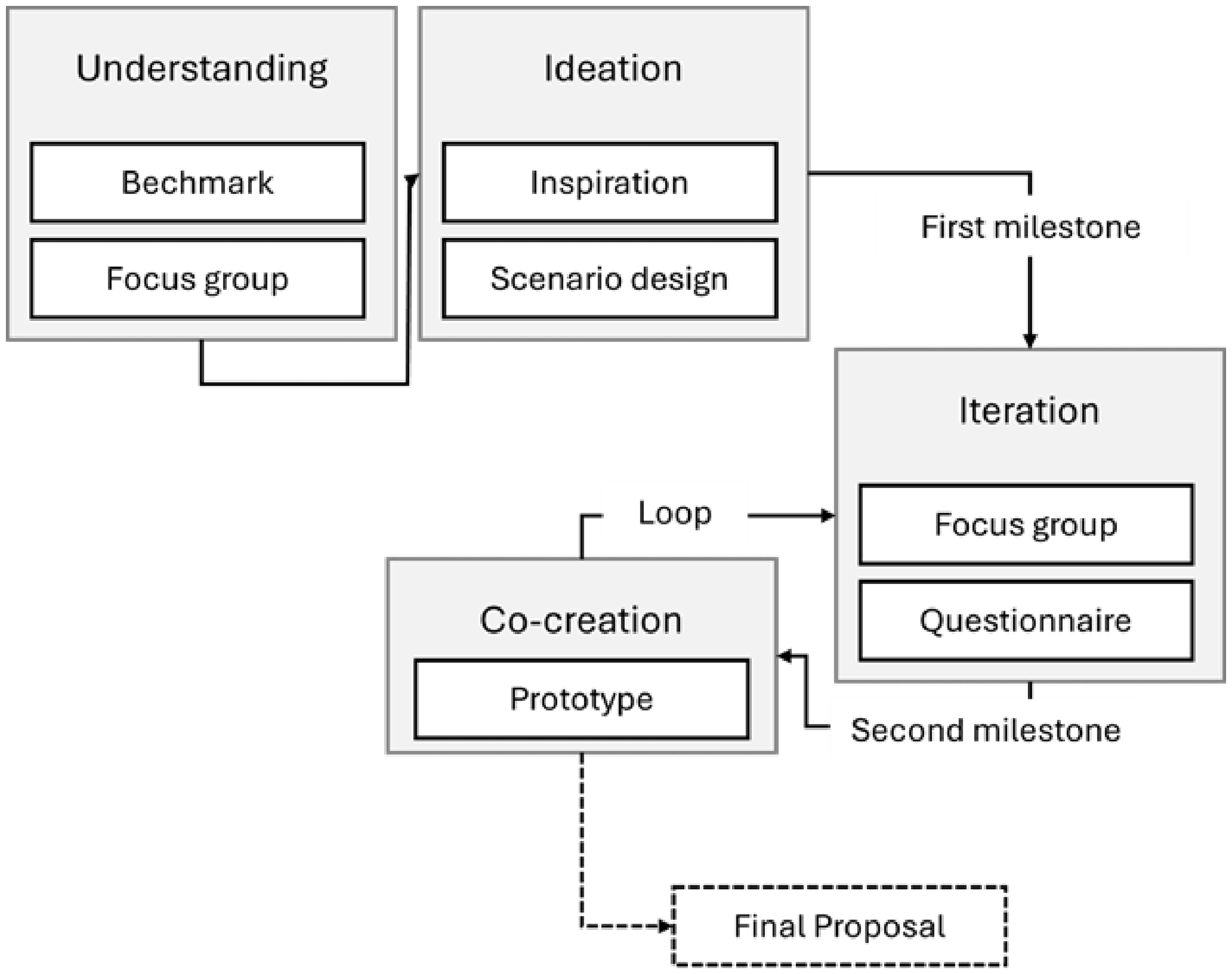
This study is based on two co-creation sessions with end-users to respond to the needs of B2B industries, as a single case study approach to develop an understandable and appealing product interface. The study (Figure 1) is following Design Thinking (Reference BrownBrown, 2019; Design Council, 2026). This started with an understanding of the users’ needs. At this initial phase, benchmarking and focus group were done to assess what users do and what they need, with a specific emphasis on understanding users’ interpretations and preferences regarding icons in remote control interfaces.
Design process

Figure 1 Long description
The flowchart illustrates a design process starting with understanding, moving through ideation, iteration, and co-creation, and culminating in a final proposal. The process begins with the understanding phase, which includes benchmark and focus group activities. This phase flows into the ideation phase, comprising inspiration and scenario design, marking the first milestone. Following ideation, the process enters the iteration phase, involving focus group and questionnaire activities. This phase loops back to co-creation, which includes prototyping. The co-creation phase feeds into the iteration phase again, forming a loop until the second milestone is reached. Finally, the process concludes with the final proposal.
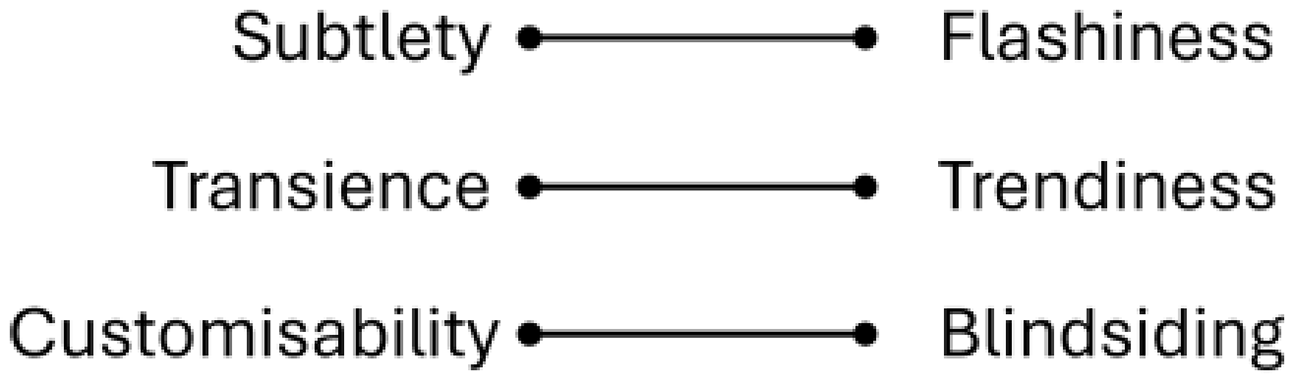
The design process began with the identification of product appearance trends, using benchmarks from the Red Dot Design database and observations from the Maison & Objet Salon (Paris, 2023). Remote control systems were analysed based on criteria such as subtlety vs. flashiness, transience vs. trendiness, and customizability vs. rigidity (Figure 2).
Product style classification categories

A first focus group was conducted to understand real-world usage scenarios. Participants answered targeted questions regarding their habits and challenges in operating window systems and were encouraged to sketch their ideal remote control (Figure 3).
First focus group and users’ sketches

The focus group comprised six participants, aged between 30 and 60 years. These individuals were employees and professionals, primarily living in households as couples with children or pets and residing in houses or flats. In terms of the lodge of remote control, three participants used wall fixation, two relied on hand-held remote controls, and one used a remote control with a wall bracket capable of simultaneous management of all shutters. The use of shutters varied according to seasonal and weather conditions, with an average frequency of twice per day. While their operation was primarily adult-driven, one household reported occasional use by children (like a toy). Participants identified several reasons for opening their shutters. These included waking up to natural light in the morning, ventilating the house during the day, letting pets outside, and ensuring air circulation during summer nights. On the other hand, shutters were commonly closed to ensure darkness for sleeping or watching television, maintain privacy from neighbours, enhance home security, regulate indoor temperatures during summer, and protect against adverse weather conditions, such as hail. When discussing desired intelligent functions, participants expressed interest in features such as automated opening and closing based on sunrise and sunset, simulation of presence during absences, integration with connected thermostats for energy efficiency, and feedback systems to prevent operational errors and confirm shutter position. Participants also identified several challenges in the use of shutters like obstructions in the shutter’s path, incomplete closures, power failures, misplaced remote controls, motor malfunctions, and physical damage to shutter blades.
These insights were synthesized into a scenario titled “One Day Remote Control” (Figure 4), which informed the ideation phase (Figure 5).
Designers then produced concept sketches inspired by curated image maps from design competitions and exhibitions. Four stylistic directions emerged: 1) Minimalist design with floating graphic elements; 2) Origami-inspired elegance; 3) Masculine, functional style akin to automotive controls; 4) Symbolic forms expressing the function of opening and closing. The sketches from this project cannot be shown due to confidentiality restrictions.
The first milestone concluded with the development of interface specifications. A second co-creation session with end-users followed, allowing interaction with low-fidelity prototypes and icon concepts (Figure 6).
The users are tasked with the creation of their own icon, which will serve as the representation of the open/close button. This icon is then positioned within the pre-cut whiteboard, which has been designed to conform to the standard dimensions typically utilized for remote control devices. The creation of remote-control interfaces with collage activities was a manual process. Utilizing standard dimensions comparable to those of industrial remote-control devices, users were permitted to draw themselves with a colored felt-tip pen on pre-cut whiteboard. The design of the iconography of buttons and the creation of layouts were found to be enjoyable activities.
Example of “One Day Remote Control”-user’s journey

Figure 4 Long description
The table is divided into four phases, each detailing actions/tasks, emotions and friction points, opportunities and improvements, and points of contact (touchpoints). Phase 1: Actions/Tasks: A user wakes up early, raises the blind via remote control, and leaves it on its stand. The user is not sure if they will find the remote when needed. Emotions & Friction Points: The morning light is too strong, so the user needs to stop halfway to adjust the blind. The user finds the process slow. Opportunities & Improvements: The user suggests a simple but intuitive interface to control the blind's opening proportion. Points of Contact: An image of a remote control is shown. Phase 2: Actions/Tasks: The user leaves for work but has a teenager who stays home for 1-2 hours. Emotions & Friction Points: The user wonders if the blind should be closed in advance, as the teenager might leave it open when leaving the house. Opportunities & Improvements: The user suggests a smart command to manage and verify the blind's closure. Points of Contact: An image of a smartphone and a house with signals is shown. Phase 3: Actions/Tasks: The user returns home late in the evening and wants to open the blind. Emotions & Friction Points: The user does not find the remote control, causing frustration. Opportunities & Improvements: The user suggests a small nightlight on the remote control for better visibility. Points of Contact: An image of a frustrated face is shown. Phase 4: Actions/Tasks: It is nighttime, and the user is going to bed. The user needs to close the blind everywhere. Emotions & Friction Points: The user thinks about work and finds it tedious to close all the blinds. Opportunities & Improvements: The user wonders if there is a way to close all blinds at once and suggests some sports as a distraction. Points of Contact: An image of a person doing sports is shown.
Example of scenario idea

Co-creation of remote-control interface with end-users

Figure 6 Long description
The collage consists of multiple images showing the co-creation process of a remote-control interface with end-users. Panel A: A close-up view of a white card with various symbols drawn on it, including arrows and geometric shapes. Panel B: A hand holding a white card with symbols and a pen, indicating user interaction. Panel C: A white card with symbols and annotations, showing different states of a remote-control interface. Panel D: A close-up view of a white card with symbols and annotations, indicating user feedback. Panel E: A white card with symbols and annotations, showing the final design of the remote-control interface. Panel F: A close-up view of a white card with symbols and annotations, indicating user feedback. Panel G: A white card with symbols and annotations, showing the final design of the remote-control interface.
The results of the co-creation activity are discussed with the main stakeholders at the second milestone. The stakeholders expressed interest in the co-creation activities, and these activities continued with them. Then, the designers created vectorised versions of the selected interface sets for a survey. This survey involved presenting seven pairs of icons to a large number of potential consumers to reflect their preferences (Figure 7).
Selected interface sets

Due to the confidentiality constraints imposed by the client company, it is not possible to disclose the precise results of the product outcomes and choices. However, in the subsequent section, the design guidelines that accompany the result will be presented.
4. Results and guidelines
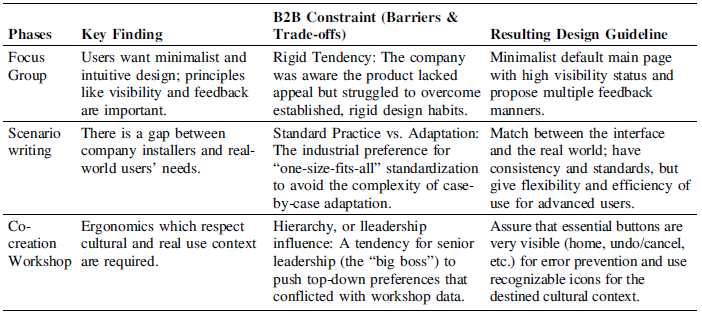
In this case study, the organizational hierarchy significantly impacted the design process, despite receiving intermediary feedback that their product lacked appeal, the company initially struggled to overcome its rigid internal tendencies. During the co-creation phase, the influence of senior leadership (the ‘big boss’) presented a challenge as there was a strong inclination to revert to established top-down preferences rather than user-driven data. We addressed this barrier by using the co-creation outputs to provide objective, evidence-based justification that favored end-user ergonomics over traditional internal directives.
The focus group produced design principles on visibility of status, lack of feedback and security constraints. We used scenario writing to generate ideas based on the user’s journey. The second focus group discussed other design principles, such as material choice, proportion, and dimension. To make the interface more intuitive and interactive, we decided to map the shutter form to the screen and ensure consistency between the smartphone interface and that of other devices. Actually, the up and down buttons do not match the shutter’s reaction, particularly when the shutter is operating in sequence. For example, if the shutter is halfway up and the user presses the up button to open it fully, it goes down instead.
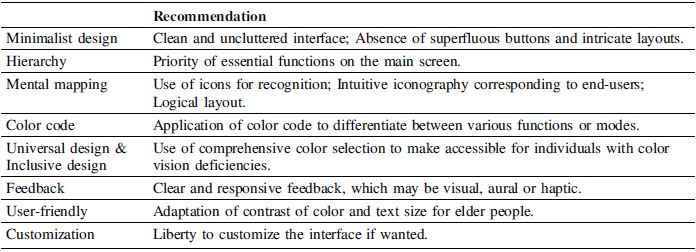
By exchanging with stakeholders and conducting comprehensive secondary data analysis, we were able to establish a set of design principles that ensured user-friendly and intuitive experience for our product interface. These principles emphasize a minimalist approach, advocating for a simple interface with essential functions on the main screen and the use of intuitive icons for key actions like “Open”, “Close” and “Stop”. Use of color code is recommended to distinguish functions, for example, with green for “Open” and red for “Close,” while ensuring accessibility. Tactile differentiation of buttons by shape or size is suggested to enhance usability, especially in low-light conditions. User-friendly labelling with legible, large font text is crucial, as is a logical layout grouping related functions together. The design suggestion also incorporates feedback mechanisms, such as subtle animations or sounds, to confirm button presses. Additionally, the possibility of creating user profiles and customizing button assignments is proposed to cater to diverse user needs in the B2B context. This comprehensive set of guidelines aims to address the challenges of user comprehension and interaction, resulting in an interface that is both intuitive and visually appealing.
In accordance with the established design principles, the recommendation for the remote-control interface design is formulated as shown in Table 1.
The co-creation process with end-users revealed critical insights into the interface design of remote controls for automated systems, highlighting two primary focus areas: general usability needs and automation-specific requirements.
Remote control interface design recommendations

In terms of usability, users emphasized the importance of operating the remote in low-light conditions, suggesting features such as tactile differentiation and backlit buttons. Additionally, they highlighted the need for intuitive orientation (to prevent upside down), which could be achieved through asymmetrical designs or tactile cues, and highlighted the importance of ergonomic considerations, including dimensions, weight distribution, and the shape of the casing and buttons. Another notable need was the ability to stop at intermediate positions of shutters, though its feasibility may depend on technical constraints. Users also expressed a preference for device identification capabilities, proposing designated areas for labeling specific devices, for example, an interface design mapping with the designated space. Furthermore, they requested clear feedback mechanisms for executed commands and low battery indications (visibility), suggesting the integration of a multi-purpose LED for these functions. High contrast is essential for visibility, though they must be balanced with aesthetic considerations. Importantly, users wanted the remote to be distinguishable from standard light switches, even when designed to integrate discreetly into home decor.
For automation-specific requirements, users prioritized centralized control that would enable them to operate multiple openings. They also expressed interest in smart features such as privacy management, thermal regulation, and ventilation controls. Programmable functionality was another key demand, including options for occupancy simulation, gentle wake-up routines, and automation based on environmental inputs such as light sensors, weather data, or thermostats. Weekly scheduling flexibility was identified as particularly important. To address varying levels of technological comfort among users, the findings suggested a differentiated product range, spanning from basic button remotes to advanced smartphone interfaces.
A significant insight concerned iconography design, where users noted that certain pictograms are context-dependent, becoming fully comprehensible only when paired with complementary icons. It is evident that visual elements need to be consciously designed and arranged to enhance user understanding. Overall, these findings demonstrate the complexity of designing remote controls for B2B applications, where functionality, usability, and adaptability must align with diverse user preferences. The co-creation process proved invaluable in uncovering nuanced user needs that might have been overlooked through conventional design approaches. The following mapping table (Table 2) demonstrates the analytical bridge between case study findings and the resulting design guidelines, which were synthesized by adapting Nielsen’s usability heuristics (Reference NielsenNielsen, 1994) to the unique constraints of the B2B industrial environment.
To successfully implement co-creation in a B2B environment and overcome traditional barriers such as organizational hierarchies and slower decision-making, manufacturers should focus on three strategic pillars. First, it is essential to segment professional personas by clearly distinguishing between the “purchaser” at the managerial level and the “end-user” at the technical level, as their usability needs often conflict within B2B structures. Second, manufacturers should establish a “safe zone” for Intellectual Property (IP) by utilizing structured workshops, such as the design-thinking interventions and focus groups used in this shutter remote-control case study, that focus on functional workflows rather than proprietary technology. Finally, creating evidence-based feedback loops through a transparent mapping system allows manufacturers to demonstrate exactly how professional user input influenced final design guidelines. This analytical bridge not only strengthens the research impact but also increases user trust and adoption within the typically slow-moving B2B market.
Mapping B2B end-user insights to design guidelines

5. Limitations
As is well known within the literature on single case studies (Reference YinYin, 2013), subjective interpretations are inevitable, and the findings are not generally applicable. In addition, the choice of design steps within the process is influenced by the main-stakeholder’s decision. Further research could be conducted in other industries and sectors to gain a broader understanding of the challenges associated with co-creation. In addition, the geographical scope of the study was limited to France. It is recommended that future research explores cross-cultural differences in B2B value co-creation practices.
6. Conclusion
This case study shows that collaborating with end users is crucial for the B2B industry to ensure that technical products align with real-world usage scenarios. Although B2B companies have traditionally been slower to adopt these practices due to intellectual property risks and complex decision-making structures, this research provides a roadmap for overcoming these challenges. By utilising a design-thinking intervention, we tried to bridge the gap between rigid ‘standard practices’ of B2B and the real-world users’ needs.
A key contribution of this work is the mapping table (see Table 2), which provides an analytical bridge between raw user data and final design guidelines. Despite institutional resistance, such as senior leadership prioritising top-down directives over user feedback, this process revealed that evidence-based co-creation outputs can justify necessary ergonomic and cultural adaptations.
To remain competitive, B2B manufacturers should adopt three strategic pillars: 1) segmenting professional personas to distinguish between purchasers and end users; 2) establishing ‘safe zones’ for IP through scenario-based workshops; and 3) creating evidence-based feedback loops to bypass rigid internal tendencies. As B2B markets evolve, proactively integrating these participatory innovation practices will enable companies to mitigate risk, achieve a better market fit and cultivate enduring relationships with their professional stakeholders.
Acknowledgement
Thank you to École Supérieure des Technologies et des Affaires (ESTA) and ELLIADD Laboratory (U.R. n°4661). Special thanks go to Maxime Larique and Hugues Baumes for their constructive and collaborative work.




 Open access

