

This article analyzes the emergence of a place-based repertoire of contention known as Puntos de Encuentro (gathering points), which empowered Afro-Colombians to reclaim their right to have rights (Dagnino Reference Dagnino, Sonia, Dagnino and Escobar1998) during the 2017 civic strike in Buenaventura, a crucial seaport in Colombia’s Pacific region. Unlike studies that focus on logistics, dockworker, or truck driver strikes (Alimahomed-Wilson and Ness Reference Alimahomed-Wilson, Ness, Alimahomed-Wilson and Ness2018), this article sheds light on how Afro-Colombians designed and executed Puntos de Encuentro to disrupt the flow of intermodal transportation in the city, blocking the movement of shipping containers across various modes of transport—ships, trucks, aircraft, and trains. They mobilized thousands of organized and unorganized citizens, empowering them to exercise alternative meanings of citizenship during twenty-two days of social protest.
What citizenship did Puntos de Encuentro enable Afro-Colombians to exercise during the protest in Buenaventura? In contrast with previous studies (Alves and Ravindran Reference Alves and Ravindran2020; Jenss and Schuetze Reference Jenss and Schuetze2021; Moreno and Arboleda Reference Moreno and Arboleda2020; Patiño Reference Patiño2017), this article argues that what made the social protest significant was its capacity to mobilize thousands of citizens with different backgrounds, interests, and political ideologies. As Afro-Colombians practiced radical and nonliberal meanings of citizenship centered on values such as life, dignity, and peace, they transformed Puntos de Encuentro into physical and symbolic possibilities of spatial existence (Góes Reference Góes2022) that strengthened the social fabric of the port city (Alvarez Reference Alvarez and Orin1997; Góes Reference Góes2022).
Citizenship rights for people of African descent in Latin America’s era of anti-Blackness
Citizenship implies being a member of a political community (e.g., a nation-state), having collective rights and benefits associated with that membership, and participating in the political community’s democracy by voting, speaking out, campaigning, and standing for public office (Bellamy Reference Bellamy2008). This is a liberal definition of citizenship, which is also a legacy of Western coloniality and modernity in Latin America (Quijano Reference Quijano2000). The idea of citizenship corresponds mostly to the metropolises and their ideals of democracy. Accordingly, it does not apply in the same way in the colonies or some third-world countries. As Mbembe (Reference Mbembe2011) points out, weak forms of democracy predominate in these countries because of their authoritarian gender and racial regimes.
Scholars have argued that the citizenship rights of certain individuals are restricted because of their race, gender, class, sexuality, and immigration status. Indeed, recent multicultural reforms and policies have sought to address some of the racial, social, economic, and political impediments of what has been known as second-class citizenship or quasi-citizenship in Latin America (Agnew and Oslender Reference Agnew, Oslender, Nicholls, Beaumont and Byron2016; Checker Reference Checker and Mullings2009; Escobar Reference Escobar2001; Góes Reference Góes2022; Moreno Reference Moreno2019; Paschel and Sawyer Reference Paschel, Sawyer and Mullings2009). However, despite constitutional reforms prohibiting racial discrimination and recognizing multicultural citizenship and rights for Afro-Colombians—such as the constitutional recognition of black communities, collective land rights, political participation with special seats in the House of Representatives, and the National Advisory Commissions—the social protest in Buenaventura highlights persistent racial and social discrimination that prevents Afro-Colombians from accessing liberal or multicultural citizenship rights.
This case exemplifies the struggles that people of African descent face daily across Latin America. As Alves and Costa (Reference Alves and Costa2018) suggest, a foundational and structural pattern of collective and ubiquitous anti-Blackness prevents people of African descent from exercising their citizenship rights. Scholars like Hale and Leith (Reference Hale and Mullings2020) have referred to this as the project of racial retrenchment. Accordingly, this new racial regime of anti-Blackness relies on processes of racial capitalism, which Alves and Ravindran (Reference Alves and Ravindran2020) have conceptualized as accumulation by evisceration; that is, to make surplus values, capitalists must extract or exploit material, symbolic, and human resources at the expense of Black lives and in combination with a politics of death (Mbembe Reference Mbembe2011).
These ongoing processes of accumulation by evisceration involve the assassination and criminalization of Black leaders and activists, forced displacements and uprootings, processes of gentrification and dispossession, racial discrimination, racism, and precarious access to basic needs such as education, employment, and health services (Checker Reference Checker and Mullings2009; Góes Reference Góes2022; Hale and Leith Reference Hale and Mullings2020; Lozano Reference Lozano2016; Zeiderman Reference Zeiderman2016).
Thus, the ontological status of Afro–Latin Americans is as expendable life, which authorizes their deracination, hyperexploitation, and physical elimination. As Alves and Ravindran (Reference Alves and Ravindran2020) state, places where Black people have lived historically have been biopolitical laboratories for testing development projects by the anti-Black nation. As it has been insistently remarked, this new racial regime is profoundly gendered. As pillars of Black communities, Black women have disproportionately been impacted by the racial dynamics of racial capitalism and evisceration (Góes Reference Góes2022; Lozano Reference Lozano2016).
Claiming or practicing liberal and multicultural citizenship and rights seems insufficient in such circumstances. Thus, this article highlights the creative and dramatic ways people of African descent have engaged in contentious repertoires to assert their right to have rights in geographies and places that have been turned into zones of nonbeing (Alves and Ravindran Reference Alves and Ravindran2020). Once again, citizenship and rights are not given to people of African descent in places like the port city of Buenaventura in Colombia, the favelas in Rio de Janeiro (Vargas and Alves Reference Vargas and Amparo Alves2010), and Esmeraldas in Ecuador (Moreno Reference Moreno2019). They must struggle and fight for them.
The article builds on studies that describe how people get together to perform collective actions and propose alternative meanings of citizenship. This scholarship proves that social groups like Afro-Colombians must be collectively “active” (Dagnino Reference Dagnino, Sonia, Dagnino and Escobar1998), “militant” (Baiocchi Reference Baiocchi2005), “insurgent” (Holston Reference Holston2009), or “uncivic” (Alvarez et al. Reference Alvarez, Rubin, Thayer, Baiocchi, Laó-Montes, Sonia Alvarez, Rubin, Baiocchi and Laó-Montes2017) to secure their right to have rights. By drawing on Dagnino (Reference Dagnino, Sonia, Dagnino and Escobar1998, 50), who states that “new citizenship seeks to implement a strategy of democratic construction, of social transformation, that asserts a constitutive link between culture and politics,” the article approaches the 2017 civic strike as a modern example of “uncivic” protest that utilized local cultural, political, and social resources to disrupt the global supply chain and the massive circulation of containers through Buenaventura while simultaneously redefining the meanings of citizenship.
Contentious repertoires are an articulation of contentious performances that are currently known and available within the field of politics. These contentious performances are relatively familiar and standardized collective strategies through which one collective actor makes claims about other actors (Tilly and Tarrow Reference Tilly and Tarrow2007). Contentious repertoires do not take place in a vacuum (Tilly Reference Tilly2008). They are both shaped by and help shape spatialities and geographic configurations. As Della Porta et al. (Reference Della Porta, Fabbri, Piazza, Nicholls, Beaumont and Byron2016) put it, social protests happen in physical spaces, and activists take advantage of or put up with spatial constraints. In this sense, the 2017 civic strike was a repertoire of contention that resulted from the localized cultural traditions, knowledges, and political and social resources, as well as the geographic configurations of the port city of Buenaventura.
In Colombia, a civic strike involves diverse, multiclass, and nonpartisan actors whose public demonstrations are framed by a commitment to pacifism. It has been an essential form of protest in Colombia as the civic strike has been adopted and adapted across a wide range of conflicts and sites of contention (Giraldo and Camargo Reference Giraldo and Camargo2017). The 2017 civic strike was a multiracial, ethnic, and class public demonstration that included people of African descent, Indigenous communities, women’s organizations, unions, grassroots organizations, religious associations, local businesspeople, and so on. Despite their ideological differences, they recognized that what was at stake was the meaning of place and place-making process, as their fights for the right to have rights implied an alternative reproduction of the port city that allowed them to “live with dignity and in peace.”
The 2017 civic strike was not the first time Afro-Colombians had interrupted the global supply chain and the massive circulation of containers to reclaim their citizenship rights. They previously organized two civic protests in the city, in 1964 and 1998. However, since about 1998, Afro-Colombians have framed their struggles as civic protests to emphasize their pacifist agenda and distance themselves from armed groups. Although it was not a civic protest, Afro-Colombian students staged riots in 1970 and 1971 that shut down the city. These protests marked the first time that the national government militarized the city due to the severity of the protest. The second time that the city was militarized occurred in 2014 due to the presence of armed groups.
In Colombia, strikes are considered a contained contention (Tilly and Tarrow Reference Tilly and Tarrow2007). They are well known and accepted. However, this article considers the 2017 event a transgressive contention. The 2017 civic protest challenged not only standard arrangements imposed by armed groups and economic actors; it also innovated, creating new strategies and tactics as sites of contention. Here, citizen participation was crucial to the formation of a social movement web, a place-based knowledge, a common ethical-political framework and places of social and cultural resistance known as Puntos de Encuentro.
Henri Lefebvre (Reference Lefebvre1991, 39) suggests that space and place are socially produced: “Its productions take place through spatial practices, representation of space and representational spaces that constitute the dialectical relationship which exists within the triad of the perceived, the conceived, and the lived.” Space and place melt into each other (Oslender Reference Oslender2016). Therefore, just as capitalism and violence can structure geographies of poverty and of death (Harvey Reference Harvey2008; Oslender Reference Oslender2016), social movements and protesters can produce territories as places of life, dignity and peace (Gibril Reference Gibril2018; Routledge 1996; Zhao Reference Zhao1998). Thus, the 2017 civic strike was a struggle for the very definition of Buenaventura’s territory. While national and international capitals and armed groups viewed Buenaventura as a port city to make legal or illegal surplus values, Afro-Colombians perceived it as a city port that had the potential to improve their living conditions.Footnote 1
To understand these conflictual dynamics, Escobar (Reference Escobar2008) highlights two overall strategies of localization that, though bounded, overlap and, in many ways, are coproduced with each other in representing and constructing the city space of Buenaventura: the strategy of global localization by capital, the state, and techno-science (as well as the politics of death deployed by armed groups) and the subaltern strategy of localization by communities and, particularly, social movements. Thus, when the 2017 civic strike mobilized resources to reclaim Buenaventura, its actors enacted a counterspace project (Lefebvre Reference Lefebvre1991, 382), an alternative production of Buenaventura that emerged in opposition to the abstract capitalist space of surplus value. In this line, Puntos de Encuentro was a subaltern strategy of localization that Afro-Colombians performed to reclaim Buenaventura as a place to live with dignity and in peace. Puntos de Encuentro involved both a place-based strategy that relied on the attachment to territory and Black culture in the port city of Buenaventura and a politic of scale that crafted a spatialized repertoire of contention to defend Afro-Colombian conceptions of Buenaventura’s territories to “live with dignity and in peace.”
The 2017 civic strike was a struggle to answer the question, “Whose city is it?” (Sassen Reference Sassen1996). It is either a Western city or a Black city (Góes Reference Góes2022), understood as a territory of life, peace, and dignity. If social and cultural struggles for territories are struggles for autonomy and self-determination (Escobar 2008), so are struggles for Afro-Colombian citizenships. Then, citizenship becomes meaningful when defying death to exercise their rights to the territories. As Escobar (Reference Escobar2001, 163) has highlighted, for some Afro-Latin American communities, “the loss of their territories would mean a return to slavery or, worse perhaps, to becoming a common citizen.”
Methodology
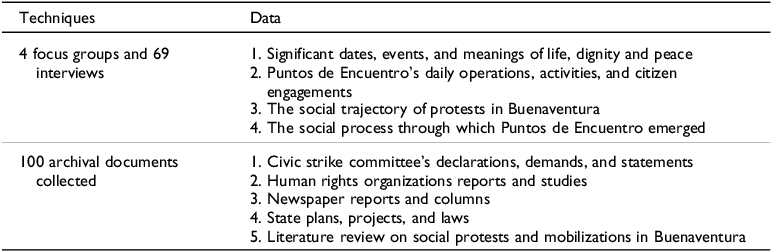
For this article, we employed a qualitative methodology based on a fieldwork-based study conducted in Buenaventura between 2018 and 2020. Table 1 provides information about the type of data that the authors collected to answer their research question. It also shows the primary research techniques used during fieldwork: sixty-nine individual and four group interviews were conducted with former civic strike activists and indigenous and Afro-Colombian communities from rural areas. We recruited interviewees using the snowball technique. We contacted members of the Civic Strike Committee, who then recommended key participants and activists. After completing interviews, we asked for references to new active participants and key actors. Thus, we could interview a diverse group of leaders who participated in the protest from various backgrounds: ethno-racial (Afro-Colombian, White, and Indigenous), gender (women, men, and LGBTQ+ individuals), age (youth, adults, and elderly), and social organizations (local businesspeople, union and Catholic leaders, grassroots and social organization representatives, university students, and youth group members).
Data collection methods

We collected over one hundred documents and files. This included news articles, columns, and reports from national newspapers such as El Espectador and El Tiempo, and regional newspapers like El País, which are available online and in physical archives. For the latter, we visited local libraries in Cali (Departamental and Banco de la República libraries) and Buenaventura (Banco de la República library) to consult newspaper reports and news related to social protests in Buenaventura. Additionally, public documents were gathered from human rights organizations, including Human Rights Watch (Comisión Internacional de Justicia y Paz, and Mundubat 2015), as well as statements, declarations, and public releases from the Civic Strike Committee.
We used Nvivo to select, code, and interpret the data for analysis. In doing so, we acknowledged the challenges and complexities of translating information and data from Spanish into English. We were fully responsible for translating every quote from interviews, newspapers, and official documents originally written in Spanish. To maintain the integrity of the interviewees, they decided to use titles like leader, activist, and participant instead of their names. Finally, the article is divided into two parts. The first part delves into the strategic geography of the port city and how it is produced by armed groups, economic actors, and the Colombian state. Based on secondary resources, it summarizes how these actors have transformed Buenaventura into an anticitizenship geography where any public expression of active citizenship can lead to fatal consequences. Here, Afro-Colombians endured terrors, extreme precarity, and both physical and social death. The second part describes the social, participatory, and cultural dynamics around Puntos de Encuentro and the ways they allowed Afro-Colombians to exercise their citizenships based on values like solidarity, life, dignity, and peace.
The port city of Buenaventura as an anticitizenship territory
Geographically, Buenaventura is in the Pacific region, which connects the port city to Panama in the northeast and to Esmeraldas, Ecuador, in the south. Its aquatic and territorial space extends to 6,297 square kilometers, encompassing urban and rural areas. The city is surrounded by a complex ecosystem of interconnected rivers, estuaries, basins, and the sea, featuring various mangroves and diverse fauna. This ecosystem is rich in biodiversity as well as natural resources, such as gold, platinum, coal, copper, manganese, diatomite, and bauxite. Its estimated population is 424,047: 90 percent are Afro-Colombians, 6 percent are indigenous, and 4 percent are considered white or mestizo. The rural areas comprise over twenty-one small villages, home to 8 percent of the population, while the remaining 92 percent reside in the city. Its urban landscape is a longitudinally flat terrain with depressions and low areas that form waterfront neighborhoods, bordered by the sea, estuaries, mangroves, and natural docks.
The social, economic, and political reality imposed on Buenaventura has led Afro-Colombians to experience the city more as a hub for port terminal-related economic activities, within the global supply chain of massive container shipment, and as a pivotal center for drug and arms trafficking, rather than as a vibrant community. Indeed, Afro-Colombians emphatically have stated that Buenaventura has historically been a port without a community (CNMH 2015), as the presence of armed groups, economic investors, and the Colombian state’s interests have focused primarily on the profits that they can generate out of the port.
Administratively, the city is divided into two districts, a spatial arrangement that works for economic purposes. District 1, the wealthiest area, encompasses Cascajal Bay and serves as an economic hub, with tourist attractions, upscale restaurants and hotels, commercial centers, government offices, and most port terminals for national and international trades. Some Afro-Colombians live in District 1, although they historically have faced various mechanisms of gentrification and land dispossession (CNMH 2015). In contrast, District 2, known as “the Continent,” is primarily a residential area, even though it is also home to the Container Terminal TCBUEN.
Districts are connected by the Piñal Bridge on Simón Bolivar Avenue, which runs longitudinally through the entire city from north to south. Because of the 1998 civic strike, Simón Bolívar Avenue was designated exclusively for local public transportation and small vehicles; however, it is not uncommon to see cargo trucks driving through it. The second most important avenue is the Alterna Interna, primarily designated for cargo trucks. This avenue intersects with Simón Bolivar Avenue just before the Piñal Bridge. Both avenues are crucial for the city’s intermodal transportation, facilitating the movement of shipping containers from the port terminals in District 1 to major cities in Colombia through the national route networks, rail track systems, and the local airport.
Buenaventura’s geostrategic position in the Pacific basin makes it a critical node in the global capitalist supply chain for the movements of food and goods. As a result, Colombian economic and political elites have regarded it as a strategically vital port that could facilitate global trade and capital flows between Colombia and over three hundred ports worldwide. This perception has driven governments to develop the port into a globally competitive regional hub for maritime cargo since the 1980s. According to Jenss (Reference Jenss2020), the World Bank, the private sector, and the Colombian government have invested millions of dollars in enhancing port terminal technologies and connectivity as a multimodal transportation network, by expanding terminal capacities, improving security, and enhancing environmental management—all to elevate the port of Buenaventura to world-class standards. As a result, the port of Buenaventura is one of the nation’s premier ports, running 71 percent of shipments in the Pacific region and 30 percent of the country’s imports. In 2017 alone, this port moved one million containers—equivalent to twenty-two million tons, which positioned it as one of the ten largest ports in Latin America (Alves and Ravindran Reference Alves and Ravindran2020).
For Afro-Colombians, state actions have contributed to fragmenting the city between a well-developed, equipped, and modernized port and its surrounding areas in District 1 and the violent, overcrowded, poorest, and ill-equipped residential areas in District 2. As Alves and Ravindran (Reference Alves and Ravindran2020) suggest, the specific layout of the city has conditioned racially based uses and distributions of urban space. Businesspeople, cruise tourists, visitors, and affluent white people stay in District 1, and mostly poor Afro-Colombians reside in District 2. As Zeiderman (Reference Zeiderman2016) describes it, this urban arrangement reflects a racialized politics of precarity that emphasizes solely improving the port’s economic production while disregarding the social and economic conditions of Afro-Colombians. In fact, the idea of living with dignity in the territory refers to Afro-Colombians’ claims that the port economic productions and benefits should guarantee their basic citizenship rights associated with healthcare, housing, education, security, and employment. Paradoxically, Afro-Colombians have experienced abandonment and precarity in one of the most important ports of Colombia.
Armed violence has been the other face of the problem by shaping Buenaventura as a regional hub for drug and arms trafficking. The waterfront neighborhoods and settlements of Bajamar (meaning “low tide”), where significant portions of the city’s populations reside, have transformed into geographies marked by death and terror due to conflict involving armed groups and criminal bands. Zeiderman (Reference Zeiderman2016, 13) describes it as the “interstitial space between land and sea has become the primary battlefield on which these rivalries are fought out.” In Colombia, this type of violence has been conceptualized as a war against civil society (Comisión Nacional de Reparación y Reconciliación 2013), given the severity of armed groups’ violence on civilians. Activists, scholars, and human rights organizations have argued that the violence in Buenaventura is not simply the by-product of armed conflict but also the central strategy to reproduce Buenaventura’s urban territories for capital accumulation (Alves and Ravindran Reference Alves and Ravindran2020; CNMH 2015; Jenss and Schuetze Reference Jenss and Schuetze2021): “In those places where violence was predominant, right after [any forms of violence that produced forced displacement] emerged port related macro-projects.”Footnote 2
In this context, it is accurate to suggest that Buenaventura has become an anticitizenship territory, which refers to both the state of precariousness and the organized violence and crimes inflicted on Afro-Colombians by drug traffickers, armed groups, paramilitary organizations, and law enforcement. One social leader stated that social protests have become “a real mess” in the city: “Nobody listens and it seems that every political party and perpetrator colluded to get us out of the territory.” This testimony manifests that any public expression of basic or active citizenship may be perceived as a real threat that requires suppression. For example, Afro-Colombians live in social conditions where they may face sudden displacements, extortions, mutilations, or even worse, assassinations. Others are afraid to go out or cross neighborhood boundaries, and still others live in confinement—all imposed by armed groups. If any citizen dares to report a crime to the local authorities, they believe that they may be killed, as those in charge may be affiliated with or subordinate to criminal bands in neighborhoods (Schoening Reference Schoening2014). As Oslender (Reference Oslender and Restrepo2004, 40–44) describes, armed groups have changed “daily routines, imposed restrictions of mobilities; changed the sense of the place from being peaceful to becoming dangerous; des-deterritorialization and loss of security.”
Participating in public manifestations may be dangerous. Social leaders and activists have faced serious death threats and killings when advocating for human and citizenship rights (Schoening Reference Schoening2014). Even liberal ideals of citizenship, such as voting and campaigning, were not freely exercised in Buenaventura in 2017. Armed groups restrained citizens’ rights by forcing them to vote for certain candidates of armed groups’ preferences (CNMH 2015). To survive, some Afro-Colombians have adopted strategies of resistance that project passiveness, fear, and docility.
Exercising citizenship at Puntos de Encuentro
Puntos de Encuentro are a subaltern strategy of localization that established the social and cultural settings for Afro-Colombians to exercise alternative forms of citizenship while also becoming points of social contestation from which citizens campaigned for Buenaventura as a territory where they could “live with dignity and in peace.” Here, four social participation processes were crucial: the crafting of a social movement web, the production of place-based knowledge from past struggles, the construction of a common ethical political framework, and Puntos de Encuentro as places of social and cultural resistance. All these demonstrate citizenship practices that sought to propose alternative democratic social relations that contrast sharply with the exclusionary and violent conditions imposed by both state and nonstate actors in Buenaventura.
Crafting a social movement web
Preexisting organizations are the basis for any new social mobilization (McAdam Reference McAdam1999). Before the 2017 civic strike, no common platform unified all social and political expression in Buenaventura. It took time to create a social movement web known as El Paro Cívico de Buenaventura para Vivir con Dignidad y en Paz en el Territorio—the Buenaventura Civic Strike to Live with Dignity and in Peace in the Territory—to unify all collective actors in the city. Its historical origins trace back to 1964, when the first civic strike took place in Buenaventura (Moreno and Arboleda Reference Moreno and Arboleda2020; Parrado Pardo and Jaramillo Marín Reference Parrado, Paola and Jaramillo Marín2020). However, this social movement web began to take shape around the 2000s with the visible impacts of armed groups and neoliberal state policies on Afro-Colombian lives and territories (CNMH 2015).
The Proceso de Comunidades Negras (PCN) was among the first Afro-Colombian organizations to highlight how capitalist extractivism and violence transformed Buenaventura into a developable entity (Escobar 2008) and a geography of death (Oslender Reference Oslender2016). They also counterproposed concepts such as biodiversity as territory plus culture, region-territory of ethnic groups, and life corridors to articulate their political life projects over the territory. Between the periods known in Buenaventura as One Thousand Deaths (2000–2005) and the “peak of the war against Buenaventura society” (2005–2013) (CNMH 2015, 153), various women’s, youth, and social organizations emerged to demand the end of violence, sexual assault, and murder of Black women.
Focusing on how violence and the precarity of neoliberal policies affected individuals, these organizations started to create collective platforms known as comités. Thus, several committees and other forms of organization emerged, articulating their demands around life and dignity. Their names reflect these intentions: Comité por la Defensa y la Salvación de Buenaventura (Committee for the Defense and Salvation of Buenaventura), Minga por la Memoria (Minga for Memory), and Red de Solidaridad Contra las Violencias Hacia las Mujeres: Mariposas de Alas Nuevas Construyendo Futuro (Solidarity Network Against Women’s Violence: Butterflies of New Wings Constructing the Future).
As violence, criminal activities, and precarity increased, new platforms of articulation appeared with similar social and political agendas. Among others are Comité del Agua y la Defensa de la Vida (Committee for Water and the Defense of Life), Plataforma de Acción Juvenil (Youth Action Platform), Asociación de Comerciantes (Merchants’ Association), and Comunidades de Paz (Peace Communities). To reclaim Buenaventura as a territory of life, dignity, and peace, these forms of articulations performed marches, thematic forums, popular assemblies, sit-ins, encounters, leadership formation and workshops, collective walks on invisible boundaries imposed by violent and criminal bands and acts of civil disobedience. At the time, public forums and workshops were very important for citizens to relieve their emotional pains. Likewise, concerts, folkloric dances and hip-hop events, roundtables, and vigils contributed to increasing social awareness of the city’s racial, economic, and social problems and also to increasing citizens’ involvement (CNMH 2015).
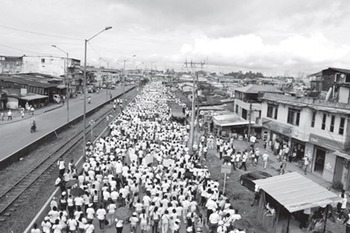
By 2014, the scale of the social organization had shifted from what Zeiderman (Reference Zeiderman2016) describes as “submergent politics,” originating in neighborhoods, to a social movement web that included urban and rural organizations. This social movement web is Comité para Enterrar la Violencia y Vivir en Paz en el Territorio—the Committee to Bury Violence and Live in Peace in the Territory. While the state repeatedly neglected the severity of violence against Afro-Colombian youth, women, local entrepreneurs, and social leaders—especially the “chopping houses” where Black victims were dismembered and disposed beneath the stilts (Alves and Ravindran Reference Alves and Ravindran2020)—more than ninety-eight social, popular, and human rights organizations, led by the committee and supported by over twenty-five thousand citizens wearing white T-shirts, marched through the city carrying an empty casket (Figures 1 and 2). This march challenged the state’s narrative and culminated in the symbolic act of burying the empty casket at city hall as a public demonstration against violence (CNMH 2015, 419).
Afro-Colombians march against violence, carrying an empty casket to city hall.
Source: Courtesy of the Civic Strike Committee. Buenaventura, 2019.

The March to Bury Violence and to Live with Dignity.
Source: Courtesy of the Civic Strike Committee. Buenaventura, 2019.

The Committee to Bury Violence and Live in Peace in the Territory initially was an intermediary between the government and Afro-Colombian citizens. It established a negotiation table for discussing the structural problems affecting the city, highlighting issues such as employment, violence, public services, and collective urban consumption. The government proposed two strategies to address these problems: first, an emergency plan, Plan de Choque, to alleviate socioeconomic precarity in the city, and second, militarization to maintain control and ensure the continuity of port terminal economic operations and activities.
However, the stream of interactions between the government and the committee eventually changed as the government failed to fulfill its part of the agreement. Afro-Colombians believed that when President Juan Manuel Santos inaugurated the Aguadulce port terminal, which had an investment of over $650 million, making it one of the most modern ports in the country (Castro Zawadsky Reference Castro Zawadsky2017), he demonstrated his real interests. Both organized and unorganized citizens felt mistreated, leading to a growing sense of indignation. This sentiment marked the beginning of the 2017 civic strike. As one activist put it: “Then, the president flew over the Cascajal Bay to land in AGUADULCE Port Terminal. [Thus,] the 2017 civic strike was immediately declared.”Footnote 3
Drawing on local knowledge and insights from past struggles
Social movements often draw on local knowledge, cultural practices, and vernacular languages to articulate their struggles (Routledge 1996). In this sense, between 2014 and 2017, the social movement web known as el Paro Cívico de Buenaventura para Vivir con Dignidad y en Paz en el Territorio organized several popular assemblies to recognize valuable lessons, both positive and negative, from past collective struggles. Social movement scholars conceptualize this as consensus mobilization: Activists organize festivals, ceremonies, or informative campaigns to gain social support (Tilly and Tarrow, Reference Tilly and Tarrow2007, 125). On the other hand, these lessons represent what Oslender (Reference Oslender2016, 35) conceptualizes as the sense of place, understood as “the ways human experience and imagination appropriate the physical characteristics and qualities of geographical location.”
Nine lessons were identified as crucial for creating the structure and logic of Puntos de Encuentro as places of social participation and political contestation. Because of space limitations, we summarize the discussions sustained in these popular assemblies as follows:
-
1. Collective discussion was critical to identify one collective strategy. Had anyone pursued an individual path, they would not have achieved their goals. Unity was essential to counteract government efforts to undermine the claims.
-
2. From the 2014 negotiations with the government, they learned that discussing all issues at one table does not work. For the 2017, they created separate tables for each topic.
-
3. These separate tables were crucial, as they made each organization feel included and allowed them to contribute significantly to the protest according to their individual expertise.
-
4. The Executive Committee was created to ensure inclusive representation of every sector of the social movement web, including representatives from transportation, leftist organizations, Catholic and Christian churches, commerce, grassroots organizations, and unions. The goal was to provide a platform where diverse groups could have their interests and concerns addressed.
-
5. Organizers decided to focus their claims on the national government rather than local authorities. This strategy was chosen to avoid internal conflicts among the protesters and leaders of social organizations, as some of these leaders were in favor of the local mayor. By targeting the national government, they could maintain unity and prevent divisions within their ranks.
-
6. Organizers chose May 16 to start the protest specifically to avoid conflicts with religious traditions related to Easter Week, and local business interests related to Mothers’ Day and Fathers’ Day. By choosing this date, they ensured that the protest did not disrupt these significant events.
-
7. Activists and protesters collectively recognized the social injustice of their circumstances. Despite living in a port city that handles 70 percent of Colombia’s economic production, they do not receive any substantial benefits from the economic activity, which highlights a disparity between the economic importance of the port and the lack of advantages or improvements in their own lives.
-
8. Blocking the Piñal Bridge used to be sufficient to disrupt international trade. Today, at least five key sites must be blocked to have a significant impact. Therefore, Puntos de Encuentro were strategically designed to occupy all crucial sites, disrupt trade, and prevent easy removal.
-
9. Activists preferred to avoid discussion about race and racism for the unity of the civic strike.
Popular assemblies were a key strategy for encouraging social participation and involvement. Although the debates were long and tedious, and sometimes led to deadlocked discussions, participants developed common empathy, mutual trust, recognition, and complicity, which helped reinforce a sense of localized solidarity, as reported by Della Porta et al. (Reference Della Porta, Fabbri, Piazza, Nicholls, Beaumont and Byron2016) in their studies on social movements. By assessing past struggles, organizers, activists, and protesters could develop a shared ethical and political framework that guided their collective actions and goals.
A common ethical-political framework
Scholars suggest that framing alignment is a collective process through which activists develop a shared framework for interpreting and defining their demands, strategies, identities, and tactics. This process can also be referred to as a “common ethical-political field of reference and difference” that resonates with activists and citizens (Alvarez Reference Alvarez and Orin1997, 93). It is a master frame (Della Porta and Diani Reference Della Porta and Diani2006). Although a detailed account of the process exceeds the scope of the article, it briefly describes the collective process that led activists and organizers to frame their struggles as fights for Afro-Colombian life, dignity, and peace in the territory of Buenaventura.
The first step to creating a master frame was changing past pessimistic narratives about protesting in Buenaventura. No one, including state representatives, believed Afro-Colombians would organize a social protest in such a manner. One committee member recalled in the focus group: “It was such a surprise for them. They never believed that Buenaventura was going to unite 90 percent of the people.”Footnote 4 This incredulity is linked to Colombian racial stereotypes and racism. As part of the Pacific Region, both the city and its population have historically been depicted as uncivilized, savage, barbaric, and underdeveloped and portrayed as needing intervention from a supposedly superior and more developed race to achieve anything. In the focus group, another member emphasized, “[They] do not believe that [we] can do a civic strike, because Black people are not like other sectors, [for example], the indigenous community.”Footnote 5 “El Pueblo no se rinde, Carajo” and “Black people do not give up, damn it”—was a slogan adopted during the twenty-two days of social protests to encourage citizen participation. This contagious slogan reflects a shift in mentality toward viewing themselves as people who do not give up until they achieve their goals.
Given the context of violence, activists adopted a frame of nonviolence, human rights, and dignity, reflecting their international connections with human rights organizations and national and international social movements (Espinosa Reference Espinosa Bonilla2011). These influences are evident in the 2017 civic strike’s slogan, “To live with dignity and in peace in the territory,” which originated in discourses on human rights, the rights of nature, and others. While “To live with dignity” makes a claim for better socioeconomic conditions, to live in peace demands the end of the armed groups and violence in Buenaventura. Framing Buenaventura as a territory “where everybody could live” with basic human and citizenship rights was an idea deeply shared by both organized and unorganized citizens. This framework transcended the ideological spectrum that often divides people between political left and right. As a result, it helped citizens, regardless their ideologies, to identify themselves with a common cause.
This master frame played a pivotal role in rearticulating the city’s social fabric in favor of the social and political struggles. As Della Porta et al. (Reference Della Porta, Fabbri, Piazza, Nicholls, Beaumont and Byron2016, 108) recognize in their study, the exercise of a framing alignment “increased political awareness and their capability for theoretical elaboration.” Political awareness and the ability to elaborate localized theories permitted activists to create new slogans like “Because our health is at risk,” “We reject all forms of violence against children, women, and youth,” “Because Buenaventura can’t endure violence and precarities any longer, we fight for our territory,” “Because this territory belongs to us,” “Because our education should be of high quality,” and “El pueblo no se rinde, carajo.” This linguistic creativity suggests that the 2017 civic strike was not only about political organization but also about localized cultural resistance. This common ethical-political framework also led the civic committee to reframe what is usually approached as a list of demands into what they defined as a list of solutions.
Popular assemblies were also crucial for identifying strategic locations that could disrupt the city’s economic activities and the generation of surplus value through the movement of containers. Their geographical distributions reflect local knowledge of the city’s space, which the geographer Oslender (Reference Oslender2016, 48) refers to as a “spatial epistemology” and Routledge (1996, 520) conceptualizes as an “alternative knowledge of space.” This spatial epistemology helped activists realize that Buenaventura has a longitudinal layout that resulted in a road network that resembles a bottleneck. Thus, intermodal transportation in the city relies entirely on Piñal Bridge on Simón Bolívar Avenue to connect and move containers across different modes of transport—ships, trucks, trains, and aircraft. In understanding this, activists identified critical places to localize Puntos de Encuentro that could block the city’s entire intermodal transportation system. Figure 1 describes the layout of the Puntos de Encuentro. They are strategically situated on Simón Bolívar Avenue and the Alterna Interna Avenue, which connect to the national route networks, rail systems, and the local airport.
The strategic locations of the Puntos de Encuentro were carefully chosen to address another important issue: the participation of unorganized citizens. Activists aimed to decentralize social protest, moving away from the usual single places of concentration. They understood that choosing a single location, such as Piñal Bridge or the city hall, could discourage those who live far away from participating in the protest.Footnote 6 Thus, the layout of the Puntos de Encuentro provided multiple gathering points to encourage citizens to participate at the nearest one. Likewise, Puntos de Encuentro were designed to represent and include the diversity of the social and political actors involved in the protest. As a young Afro-Colombian leader mentioned, “Militants from various social organizations, including Community Action Councils, Christian groups, student associations, labor unions, political parties, and Community Councils,” had a Punto de Encuentro in which to participate.Footnote 7 This principle of inclusiveness (Della Porta et al. Reference Della Porta, Fabbri, Piazza, Nicholls, Beaumont and Byron2016) led the Civic Strike Committee to distribute Puntos de Encuentro as follows: Punto de Encuentro 11, La Delfina, was designated for the Indigenous communities and rural Afro-Colombians. Punto de Encuentro 10, El Gallinero, was allocated for riverine Black communities. Punto de Encuentro 1, El Boulevard del Centro, was assigned to local merchants. The Casa de la Cultura, Punto de Encuentro 2, was well known as a point of local artists, celebrities, and personalities. Puntos de Encuentro 3 (Puente del Piñal), 4 (Santa Cruz), 5 (El SENA) and 6 (Alterna Interna) were assigned to or taken by Black youth, students, and grassroots organizations. Schoolteachers, university professors, and Black women’s organizations gathered at Punto de Encuentro 7 (Sabrosura) (Figure 3).
Locations of the Puntos de Encuentro.
Designed by Carlos Alberto Valderrama Renteria and Alexander Velasco Diaz.

The tactical approach of this spatial distribution of the Puntos de Encuentro was unprecedented for law enforcement. Typically, state repression works when police forces target a single group that is concentrated in one or two locations. However, riot police faced numerous difficulties in responding to each Punto de Encuentro set up across the city. As a result, during the twenty-two days of protests, marches, and demonstrations, riot police did not exert the same level of power in suppressing social protests and mobilizations as they usually do.
Puntos de Encuentro as places of social and cultural contestation
Activists designed Puntos de Encuentro as their primary strategy to prevent cargo trucks from reaching port terminals in District 1. There were always two or three coordinators for each Punto de Encuentro who maintained close communication with the Civic Strike Committee. They established day and night shifts to ensure that a group of people was always responsible for overseeing and keeping the Puntos de Encuentro active. Initially, these were barricades where citizens could gather to support the strike (Figures 4 and 5). However, social participation showcased a progressive cultural politics of place based on local values, practices, and cultural traditions.
Punto de Encuentro “El Gallinero.”
Source: Courtesy of the Civic Strike Committee. Buenaventura, 2019.

Punto de Encuentro “La Delfina.”
Source: Courtesy of the Civic Strike Committee. Buenaventura, 2019.

Afro-Colombian culture played a crucial role in the social and cultural dynamics of the Puntos de Encuentro, fostering a peaceful environment of solidarity and enjoyment. To bless the protest, the committee began the civic strike with a public Mass at 6 a.m. Afterward, citizens slowly began to show up, exploring the city in ways they had never imagined. They organized communal cookouts; they played local games like yeimi, puerquito, ponchado, hoyito, and soccer; they played Afro-Colombian musical instruments such as bombo, cununo, guasa, marimba, and Drums; they sang traditional songs and recited old Afro-Colombian décimas and poems, and shared traditional stories and legends. The Civic Strike Committee also planned daily actions at the Puntos de Encuentro to encourage citizen participation. They organized several thematic marches related to the lack of education and employment in the territory. They asked citizens to pray for a future without violence in Buenaventura, performed cacerolazos (beating pots and pans) to protest the lack of health-care facilities, and burned utility bills to protest the lack of a 24/7 water supply in the city. Thus, Puntos de Encuentro evolved into places of enjoyment that together turned Buenaventura into a territory of life and peace.
Following Routledge (1996), a contentious performance can take the form of what he refers to as swarming, an assemblage formation that is “contagious, sudden, occurring in numerous places, and were both destructive and creative” (Routledge 1996, 521). The 2017 civic strike experienced a similar phenomenon. As citizens became involved, they transformed Puntos de Encuentro into flexible spaces tailored to their needs. Although not entirely separate, citizens began spontaneously creating their own Puntos de Encuentro away from the main avenues. Organized and unorganized citizens built Puntos de Encuentro in every street, block and neighborhood.Footnote 8 Even the Catholic Church and the Christian Crusades created their own Puntos de Encuentro to pray for and bless the social protest.Footnote 9
The swarming dynamic of the civic strike introduced innovations to the local repertoire of contention. This can be described as the “aquatic sense of place” (Oslender Reference Oslender2016) during the protest. Local boat drivers and owners created their own aquatic Punto de Encuentro. As Figure 6 shows, more than fifty small boats performed aquatic parades to block cargo and tourist ships from reaching Buenaventura’s port terminals. As the protest continued, rage, indignation, and frustration began to drive citizen participation, leading them to program their own activities and dynamics. As Della Porta et al. (Reference Della Porta, Fabbri, Piazza, Nicholls, Beaumont and Byron2016, 96) describe, participation becomes “more intense when faced with a perceived external aggression, described by activists as an act of war against a peaceful community.”
The Cabotage’s aquatic parade.
Source: Courtesy of the Civic Strike Committee. Buenaventura, 2019.

Three factors fueled the emergence of a collective outrage during the twenty-two days of social protests in Buenaventura. First, in an act of public discredit, the mayor stated in local media outlets that Buenaventura’s citizens could not afford a prolonged strike because they live by hustling, implying they could not sustain a long-term protest. Second, state delegates suspended negotiations with the civic committee, claiming the strikers’ demands were unconstitutional. Immediately after, the riot police force, ESMAD, entered the city to suppress the protest and to ensure that cargo trucks could access terminals. Third, the mayor declared dry laws and imposed a nighttime curfew. Overall, there was a sense of injustice regarding each state action. Afro-Colombians felt disrespected, mistreated, and unheard. Consequently, citizens—primarily Black youth, male and female—confronted the police and engaged in actions such as attacking, looting, and destroying local malls, stores, and businesses.
The swarming dynamic of Puntos de Encuentro took another turn during the heavy confrontations from the third day of the social protest. Puntos de Encuentro became places of deliberating citizenship, as citizens were confronted with social realities that compelled them to make decisions in the moment. For instance, participants at Puntos de Encuentro debated how to handle looters if they needed to pass through their Puntos de Encuentro with stolen items. While some advocated asking looters to return the stolen items, others believed it was acceptable to let them pass without interference, as the owners of most local businesses were white or mestizo and considered a crucial part of the problem. Some other formed human barricades around stores and prevented looters from destroying and looting local stores.Footnote 10 In fact, a group of citizens confronted a person who pretended to use a firearm against police officers. Accordingly,
Fifteen days passed already when someone drew a gun [at a newly opened Punto de Encuentro]. When that happened, people reacted and surrendered the guy respectfully. They did not want to beat him up. They just said, my brother, we are here struggling for all of us. We fight for your children to have a hospital; for everybody to have wellbeing. I was surprised because in neighborhoods, [people] do not confront illegal armed actors. People are afraid of them.Footnote 11
These incidents demonstrate the type of democratic dynamics that Afro-Colombian participants created during the twenty-two days of protest in Buenaventura. They suggest that Afro-Colombians asserted democratic practices that linked cultural values such as peace, life, and traditions to politics as some of them distanced themselves from acts of violence and physical confrontation to claim their citizenship rights. At this point, a common ethical-political framework emerged to protect the dignity of the peaceful protest. Organized and unorganized citizens disobeyed the curfew and ignored the executive committee’s order to call off the civic strike to prevent further damage and destruction.
Indeed, activists at Puntos de Encuentro made a different call. They decided to stay at their Puntos de Encuentro and continue the struggle. The next day, some protesters got up early and volunteered to help clean up and minimize the damage caused the night before. Afro-Colombian youth were fundamental in lifting the spirit of the protest. They led a massive march from Punto de Encuentro 7 in District 2 to Punto de Encuentro 1 in District 1. The idea was to express support to the executive committee at the place of negotiation with the government: “People were disappointed. They felt bad about what happened the night before. I say that the march gave life back to the civic strike.”Footnote 12
As confrontations continued, some Black youth attacked and burned cargo trucks. However, others decided to use art, music, and social media to draw national attention to the social reality in Buenaventura. At Puntos de Encuentro 1, 2 and 8, citizens organized concerts, soccer matches, skating, biking, chess, and domino competitions on the empty streets and avenues. As Routledge (1996, 523) states, songs, poems, stories, myths and metaphors “articulate the symbolic creativity enmeshed in everyday life: language, the body, performative rituals, work, ceremonial life, individual and collective identities”. Thus, a collective of Afro-Colombian female and male artists from different genres came together to record the famous song “Buenaventura no se rinde.” Others launched the campaign “We do not have arms, we have dignity” on YouTube, Facebook, and X. This audio video portrays Afro-Colombian females and males raising their hands up in tied fists and screaming at police officers, “We do not have arms, we have dignity.” Ensamble Pacífico, a group of musicians, produced “Oye nuestro canto” (Hear our song). Later, famous salsa singers, artists, and athletes—for example, Jimmy Saa, Willy García, Junior Jein, Freddy Rincón, Marquitos Micolta, Magno, and others—marched through the city and offered a free concert in support of the strike (Patiño Reference Patiño2017).
The use of social media was innovative and resourceful. The committee managed to broadcast the entire negotiation through Facebook, YouTube, X, and WhatsApp. This strategy was crucial, as it allowed all citizens to watch the entire negotiations. Citizens could watch how the civic committee defended the agenda and how state representatives sought to trick and dismiss their cause. Then, broadcasting these negotiations helped build territorial identification. Social media implies a politics of scale (Escobar 2008). To gain national and international support, activists developed a social media campaign that included hashtags like #SOSBuenaventura, #SOSPacifico, #SOYPacifico, #Buenaventuraresiste and #Buenaventuraenparocivico (Patiño Reference Patiño2017).
Final remarks
This article showcases how Afro-Colombians exercised active forms of citizenship. In line with Routledge (1996), they enacted collective actions in which Buenaventura was claimed, used and strategically defended as a territory of life, dignity, and peace over twenty-two days of civic strike against rampant violations of human and citizenship rights. However, the question that remains is whether the 2017 civic strike was merely a reflexive response or a sustainable movement. Despite some advancements, Afro-Colombians still face structural problems related to armed violence, and the economic and social inequalities in Buenaventura. The agreement documented in the Statement of National Government Commitment regarding the Autonomous Patrimony for Buenaventura became Law 1872/2017 a few months later.Footnote 13 The plan, known as PIEDB, was completed in 2022. Three years earlier, in 2019, Victor Hugo Vidal Piedrahita, a former member of the civic strike committee and an Afro-Colombian, was elected as the city’s first nonpartisan mayor (2019–23). Although there have been other blockades in the city, none have matched the level of citizen organization and participation seen during the 2017 civic strike. It would be interesting to examine how the citizen participation continued during the development of PIEDB and the tenure of Vidal Piedrahita.
People of African descent have long struggled for the right to have rights in Latin America (Andrews Reference Andrews2007; Hanchard Reference Hanchard1994; Hooker Reference Hooker2005). The Afro-Colombian case demonstrates that these struggles, in an era of anti-Blackness, have significant implications for the study of contemporary forms of protest and organization among people of African descent in the region. First, how do they create new discourses and repertoires of contention to confront intersectional violence rooted in racism, capitalism, and state abandonment? Second, what strategies are they proposing to increase citizen participation and involvement in collective actions and social protests? Finally, what meanings of citizenship do people of African descent practice in their struggles for the right to have rights?



 Open access

