


Introduction
Each year, large numbers of Arctic and sub-arctic breeding birds migrate to and from wintering grounds in the temperate and tropical zones of eastern Asia and Australia via the East Asian-Australasian Flyway (EAAF). Intertidal habitats and other coastal wetlands provide important staging and wintering areas for shorebirds undertaking migration, but a large proportion of these habitats have been lost to human use and invasive plant species in recent decades. Over the past 50 years, losses of up to half of coastal wetlands have occurred in China (Ma et al. Reference Ma, Melville, Liu, Chen, Yang, Ren, Zhang, Piersma and Li2014, Murray et al. Reference Murray, Clemens, Phinn, Possingham and Fuller2014) and 60% in the Republic of Korea (Yee et al. Reference Yee, Ang, Teo, Liew and Tan2010, MacKinnon et al. Reference MacKinnon, Verkuil and Murray2012). The intertidal areas of Asia are critically important for millions of migratory waterbirds of 155 species comprising 24 globally threatened or near threatened migratory intertidal species (Barter Reference Barter2002, Bamford et al. Reference Bamford, Watkins, Bancroft, Tischler and Wahl2008, MacKinnon et al. Reference MacKinnon, Verkuil and Murray2012). Although the EAAF faces a variety of threats, the fast pace of coastal land claim (land filling in order to create new land from the ocean) is the most pressing. For example, in Saemangeum of South Korea, a land claim project resulted in the loss of 28,000 ha of intertidal flats (Moores Reference Moores2012).
Long-distance and Arctic-breeding shorebirds, such as the ‘Critically Endangered’ Spoon-billed Sandpiper Calidris pygmaea, are the fastest declining migrants of the EAAF (Amano et al. Reference Amano, Székely, Koyama, Amano and Sutherland2010, Zöckler et al. Reference Zöckler, Htin Hla, Clark, Syroechkovskiy, Yakushev, Daengphayon and Robinson2010b). The most recent formal population estimate (2014) is 210–228 breeding pairs, or 661–718 individuals in the post-breeding population (Clark et al. Reference Clark, Anderson, Li, Syroechkovskiy, Tomkovich, Zöckler and Green2016). The species breeds in the Russian Arctic, primarily on the coast of the Chukotsk Peninsula (e.g. Flint and Kondratiev Reference Flint, Kondratiev and Voinstvenski1977, Tomkovich et al. Reference Tomkovich, Syroechkovski, Lappo and Zöckler2002) and winters mainly in the intertidal habitats of Bangladesh, Myanmar, Vietnam, southern China and the inner Gulf of Thailand (Zöckler et al. Reference Zöckler, Htin Hla, Clark, Syroechkovskiy, Yakushev, Daengphayon and Robinson2010b, BirdLife International 2016, Bird et al. Reference Bird, Lees, Chowdhury, Martin and Haque2010, Chowdhury et al. Reference Chowdhury, Foysal, Das, Mohsanin, Diyan and Alam2011, Zöckler et al. Reference Zöckler, Beresford, Bunting, Chowdhury, Clark, Fu, Hla, Morozov, Syroechkovskiy, Kashiwagi, Lappo, Tong, Long, Yu, Huettmann, Akasofu, Tomida and Buchanan2016). Between 2002 and 2009 numbers at monitored breeding sites declined by about 26% per year (Zöckler et al. Reference Zöckler, Syroechkovskiy and Atkinson2010a). The species was projected to be extinct within a few decades without intervention (Pain et al. Reference Pain, Green and Clark2011, Clark et al. Reference Clark, Pain and Green2014).
In order to save the Spoon-billed Sandpiper and numerous other migratory waterbirds of EAAF, actions have been undertaken throughout the flyway by a broad partnership through the Spoon-billed Sandpiper Task Force. There are encouraging signs that some conservation measures are working (e.g. hunting mitigation in Bangladesh and Myanmar), but they need to be continued and expanded (Clark et al. Reference Clark, Pain and Green2014). Better information is needed on the areas used by Spoon-billed Sandpipers in the non-breeding season to target advocacy, ensure long-term habitat protection and reduction of hunting pressure in all stop-over and wintering sites (Zöckler et al. Reference Zöckler, Beresford, Bunting, Chowdhury, Clark, Fu, Hla, Morozov, Syroechkovskiy, Kashiwagi, Lappo, Tong, Long, Yu, Huettmann, Akasofu, Tomida and Buchanan2016).
Recent surveys of Spoon-billed Sandpipers identified the Gulf of Mottama and Nan Thar Island in Myanmar and Sonadia Island in Bangladesh as key wintering sites, with 80% of the total winter count across all known sites (Chowdhury et al. Reference Chowdhury, Foysal, Das, Mohsanin, Diyan and Alam2011, Zöckler et al. Reference Zöckler, Beresford, Bunting, Chowdhury, Clark, Fu, Hla, Morozov, Syroechkovskiy, Kashiwagi, Lappo, Tong, Long, Yu, Huettmann, Akasofu, Tomida and Buchanan2016). However, the species has an extensive and poorly explored non-breeding range, so important wintering sites may still be undiscovered (Zöckler et al. Reference Zöckler, Beresford, Bunting, Chowdhury, Clark, Fu, Hla, Morozov, Syroechkovskiy, Kashiwagi, Lappo, Tong, Long, Yu, Huettmann, Akasofu, Tomida and Buchanan2016). Since 2009, the Bangladesh Spoon-billed Sandpiper Conservation Project (BSCP) has conducted regular searches in previously unsurveyed areas, such as the coastline of the Sundarbans in Bangladesh (Chowdhury et al. Reference Chowdhury, Diyan, Zöckler, Foysal and Lemke2014).
Lack of resources has prevented a comprehensive shorebird survey of the entire coastline of Bangladesh, so survey effort has been focused on areas with remotely-sensed attributes characteristic of sites known to have winter concentrations of Spoon-billed Sandpipers throughout the species’ winter range. A species distribution model reported elsewhere (Zöckler et al. Reference Zöckler, Beresford, Bunting, Chowdhury, Clark, Fu, Hla, Morozov, Syroechkovskiy, Kashiwagi, Lappo, Tong, Long, Yu, Huettmann, Akasofu, Tomida and Buchanan2016) allows potentially suitable habitat for wintering Spoon-billed Sandpipers to be identified prior to expensive and time-consuming ground surveys. We simply used this model focusing on Bangladesh and satellite images from the Landsat Programme and Google Earth to identify previously unsurveyed areas of Bangladesh (especially the Meghna Estuary) likely to hold wintering Spoon-billed Sandpipers.
In this paper, we present the results of shorebird surveys in one of these areas, the Meghna Estuary. We present counts of Spoon-billed Sandpipers and other threatened and near threatened shorebirds and demonstrate the global importance of the newly discovered site by comparing our counts with those made at other sites. We also describe the threats to Spoon-billed Sandpipers and other birds and propose conservation measures for their long-term protection.
Methods
Study area
We used the maximum entropy species distribution model developed by Zöckler et al. (Reference Zöckler, Beresford, Bunting, Chowdhury, Clark, Fu, Hla, Morozov, Syroechkovskiy, Kashiwagi, Lappo, Tong, Long, Yu, Huettmann, Akasofu, Tomida and Buchanan2016) to map potential habitat suitability for wintering Spoon-billed Sandpipers for the entire coastline of Bangladesh. However, in this paper we mainly focused on the previously unsurvey areas of Meghna Estuary (Figure 1) as other suitable sites are either regularly or periodically surveyed. The model uses mapped data on climatic, land cover, ocean chlorophyll, tide height and distance from the coast from November to February to predict Spoon-billed Sandpiper habitat suitability at 1-km resolution (Figure 1).
Count sites and habitat features of the study area in Menghna Estuary, Bangladesh. Inset: The most suitable parts of Bangladesh and neighbouring areas of India and Myanmar for wintering Spoon-billed Sandpipers, according to the species distribution model of Zöckler et al. (Reference Zöckler, Beresford, Bunting, Chowdhury, Clark, Fu, Hla, Morozov, Syroechkovskiy, Kashiwagi, Lappo, Tong, Long, Yu, Huettmann, Akasofu, Tomida and Buchanan2016).

The Meghna Estuary, on the east coast of Bangladesh was included within the top 5% of modelled suitability values within the country described in Zöckler et al. (Reference Zöckler, Beresford, Bunting, Chowdhury, Clark, Fu, Hla, Morozov, Syroechkovskiy, Kashiwagi, Lappo, Tong, Long, Yu, Huettmann, Akasofu, Tomida and Buchanan2016) for all Spoon-billed Sandpiper wintering countries, largely because of high offshore concentrations of chlorophyll. We further refined our search area within Meghna Estuary using recently obtained satellite imagery of unvegetated estuarine mud from the Landsat Programme (http://landsat.gsfc.nasa.gov/), ASTER (http://glovis.usgs.gov/) and Flash Earth (www.flashearth.com/). We used local names (collected during the surveys from local fishermen) of the survey sites as the names vary in different documents by different government agencies and separate sites have the same name (Table 2).
Field methods
We conducted a reconnaissance survey of the Meghna Estuary between 3 and 11 February 2015. Suitable sites were searched carefully and shorebird counts conducted on 5–13 December 2015 and 2–9 February 2016, following methods for counting non-breeding shorebirds outlined in Bibby et al. (Reference Bibby, Burgess, Hill and Mustoe2000). A large wooden fishing trawler was used to travel between sites. Four observers carried out the surveys at each site to minimise errors in counting and identification. Time spent surveying at each site varied depending on the number of birds present, and typically ranged between three and eight hours covering high tide and low tide. Counts were usually repeated for each species twice in close succession, the higher of the two counts was used. Counts were undertaken during high tide and low tide, depending on the habitat type (mudflat or high tide roost). Birds were identified using Grimmett et al. (2001) and Chowdhury (Reference Chowdhury2011). Observations were made using 10x42 binoculars and 25-50x spotting scopes. In addition, photographs were taken (using a DSLR camera with 300 mm lens) during the survey for difficult species and images examined later to identify the species.
Threat assessment
We identified various factors that may have a direct or indirect effect on the Spoon-billed Sandpiper and its habitat. A list of potential threats (Table 1) was developed based upon previous studies (TNC 2007, Zöckler et al. Reference Zöckler, Syroechkovskiy and Bunting2008, Li et al. Reference Li, Bloem, Delany, Martakis and Quintero2009) and discussions amongst the authors about threats that are likely to occur in the future. A similar method was used previously by Aziz et al. (Reference Aziz, Barlow, Greenwood and Islam2013) to prioritise threats to the Sundarbans, a Ramsar wetland in Bangladesh.
Definitions of components and associated ratings used to prioritise each threat (adapted from TNC 2007 and Aziz et al. Reference Aziz, Barlow, Greenwood and Islam2013).
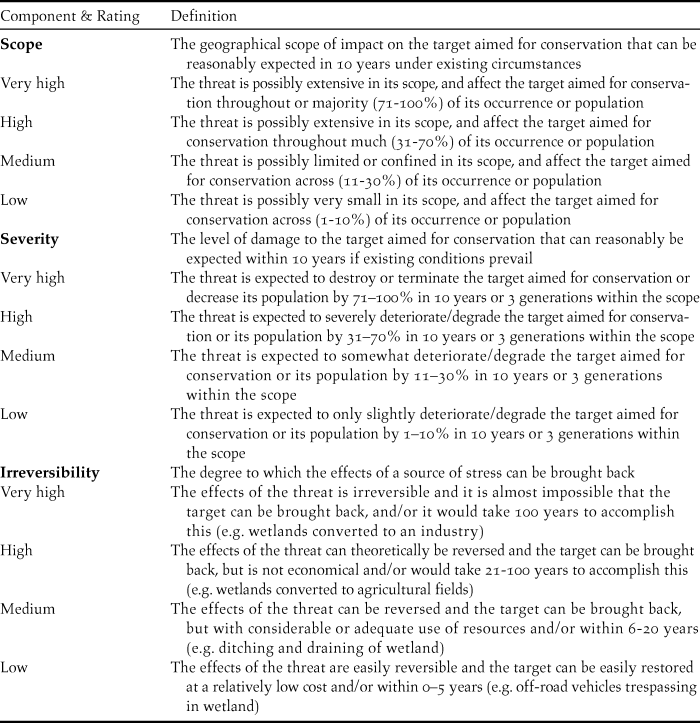
We noted the ecological attributes of each site and conducted semi-structured interviews targeting local natural resource harvesters, using a basic interview guide in order to cover pre-defined topics, following Newing (Reference Newing2010). We encountered a total of 30 fishermen and five cattle ranchers, and conducted semi-structured interviews on hunting, poaching, shooting of birds, grazing and fishing. We then ranked the threats based on three attributes (scope, severity and irreversibility) and scored each as Very High, High, Medium and Low for the current state of each threat (Aziz et al. 2011) using the definitions presented in Table 1. The ratings for scope, severity and irreversibility of each threat component were assigned by the authors based on the results field surveys undertaken 3–11 February 2015, 5–13 December 2015 and 2–9 February 2016, and existing knowledge gathered through literature review, following TNC (2007).
Habitat surveys
We recorded substrate depth (cm) by measuring the depth to which a single observer (SUC) could sink a leg in the mud, using a measuring tape. We assumed the body weight of the observer to be a constant exerting the same pressure on the mud at all sites. We visually assessed substrate type (sand, mud, sand-mud mixed) and numbers of Spoon-billed Sandpipers and all other shorebird species at 15 locations of shorebird flocks that included Spoon-billed Sandpipers and 14 randomly selected locations of shorebird flocks without Spoon-billed Sandpipers, which showed similar habitat characteristics in general, such as open mudflats, away from saltmarsh, dense vegetation and human disturbance (Also see Bird et al. Reference Bird, Lees, Chowdhury, Martin and Haque2010). All observations were recorded during receding tide in order to assess effects of variable mentioned above on the occurrence of Spoon-billed Sandpiper in the study area at Meghna Estuary.
Statistical analysis
We wished to assess whether the presence/absence of Spoon-billed Sandpipers at our habitat survey sites was associated with substrate attributes. We therefore fitted logistic regression models in which the presence/absence of Spoon-billed Sandpipers in a location was the binary dependent variable with binomial error distribution and logit link. The independent variables were mud depth (continuous), substrate type (factor with three levels), the number of all shorebirds in the flock (continuous) and the number of species other than Spoon-billed Sandpiper in the flock. All independent variables were fitted as fixed effects. All analyses were conducted in R (R Core Team 2012).
Results
Shorebird sites and counts
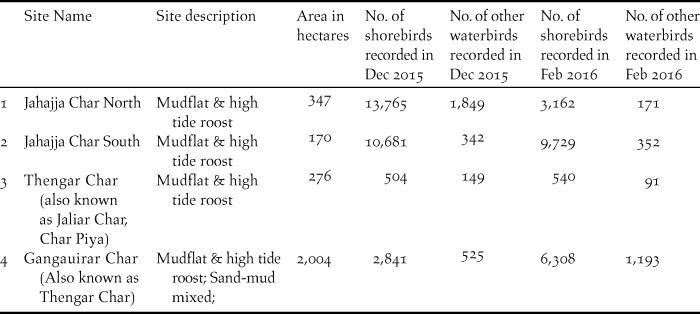
We found shorebird concentrations, which we defined as groups of more than 500 birds, at four sites along the Meghna Estuary (Table 2). Totals of 27,791 shorebirds of 26 species and 2,865 other waterbirds of 16 species were recorded between 5 and 13 December 2015. In a repeat survey of the same sites conducted between 2 and 9 February 2016 (see Table S1 in the online supplementary material for detailed count data) we counted 19,717 shorebirds of 25 species and 1,807 other waterbirds of 15 species. In both count periods combined, a total of 29 shorebird species were recorded. The sum of the peak counts for each shorebird species across the two surveys was 25,993, which we take to be the minimum number of shorebirds that used the sites surveyed during 2015–2016.
Number of shorebirds and other waterbirds recorded at four sites along the eastern part of Meghna Estuary or around Sandwip Island of Bangladesh.
The most abundant species was Lesser Sand Plover Charadrius mongolus (10,335.5 ± 5111.7), followed by Greater Sand Plover Charadrius leschenaultii (2,566 ± 981.5). Other than Spoon-billed Sandpiper, nine globally near threatened and threatened shorebirds were recorded during the surveys and the peak counts include two ‘Endangered’ Spotted Greenshank Tringa guttifer and 40 Great Knot Calidris tenuirostris, 279 ‘Near Threatened’ Eurasian Curlew Numenius arquata, 690 Black-tailed Godwit Limosa limosa, 15 Bar-tailed Godwit Limosa lapponica, 12 Red Knot Calidris canutus, 1,202 Curlew Sandpiper Calidris ferruginea, 1,273 Little/Red-necked Stint Calidris minuta / Calidris ruficollis and 71 Asian Dowitcher Limnodromus semipalmatus (Total counts across all four sites in the Meghna Estuary for each species are presented in Table S1).
Spoon-billed Sandpiper
During the December 2015 survey a minimum of 39 Spoon-billed Sandpipers were counted comprising 29 at Ganguirar Char, 6 at Jahajja Char South and 4 at Jahajja Char North. In February 2016, 48 (7.2–6.6% of the global population described in Clark et al. Reference Clark, Anderson, Li, Syroechkovskiy, Tomkovich, Zöckler and Green2016) Spoon-billed Sandpipers were observed at the three sites with highest count of 45 from Ganguirar Char, indicating that this is the most important site for the species. Among the 48 birds, we recorded seven (14.5%) with engraved leg flags.
The majority of individuals were observed during low tide while they were foraging (66.6%) rather than at high tide roosts (33.3%). Similarly, 85.7% of leg flag sightings were at low tide. This is probably because Spoon-billed Sandpipers are easier to distinguish from other small shorebirds such as Red-necked Stint, Little Stint and Sanderling by their distinctive foraging behaviour.
Logistic regression testing for effects on the presence of foraging Spoon-billed Sandpiper indicate a significant effect of mud depth (Table 3), where Spoon-billed Sandpipers mainly preferred to forage on shallow mud (mean at locations with the species; 8.43 ± SE 1.93 cm) with sand-mud mixed substrate type (n = 16; 80%), compared to deep mud at locations without the species (mean 21.14 ± 5.81 cm). The locations of the foraging sites of the Spoon-billed Sandpiper remained constant between two survey periods where major concentration of birds including individually marked birds were observed at the same patch of foraging area within a mudflat, compared to high tide roost locations that varied based on the height of the tide.
Results of logistic regression models testing for effects of mud depth, substrate type, flock size and flock diversity (no of shorebird species other than Spoon-billed Sandpiper present within a flock) on the presence of foraging Spoon-billed Sandpiper across all sites of the study area. Significant effects are indicated in bold.

Threats
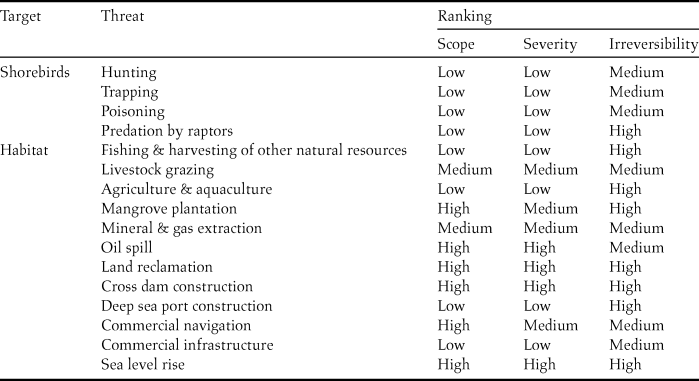
We identified a total of 16 potential threats, comprising four that are likely to impact shorebirds directly and 12 threats to shorebird habitats (Table 4). Land reclamation, causeway construction, oil spill, mangrove plantation and sea level rise were ranked as the most serious threats to habitats. In this area, hunting and trapping of migratory shorebirds appear to be low, compared to other Spoon-billed Sandpiper sites in Bangladesh and other areas across the flyway.
Ranking score for threats to shorebirds including the Spoon-billed Sandpiper and shorebird habitat along the eastern coast at Meghna Estuary (around Sandwip island) of Bangladesh.
Discussion
Results of our surveys reveal the presence of significant numbers of Spoon-billed Sandpipers in the eastern part of Meghna Estuary of Bangladesh in two winter count periods separated by about two months. The minimum numbers counted comprise about 20% of the currently known global winter population (Zöckler et al. Reference Zöckler, Beresford, Bunting, Chowdhury, Clark, Fu, Hla, Morozov, Syroechkovskiy, Kashiwagi, Lappo, Tong, Long, Yu, Huettmann, Akasofu, Tomida and Buchanan2016).
The overall shorebird and Spoon-billed Sandpiper populations counted in the study area were both higher than those at Sonadia Island in the 2015–2016 winter (Chowdhury and Foysal Reference Chowdhury and Foysal2016). Sonadia Island was previously the only known regular wintering site for the Spoon-billed Sandpiper in Bangladesh and up to 23 birds were recorded in March 2010 during migration from Domar Char, c.40 km south-west from this new site (Bird et al. Reference Bird, Lees, Chowdhury, Martin and Haque2010, Chowdhury et al. Reference Chowdhury, Foysal, Das, Mohsanin, Diyan and Alam2011, Chowdhury Reference Chowdhury2012). Co-ordinated winter counts at both sites (Sonadia Island and Meghna Estuary) between January and February 2016 organized by the Spoon-billed Sandpiper Task Force indicate that Bangladesh supports the second largest wintering populations of the Spoon-billed Sandpiper in the world after the Gulf of Mottama, Myanmar. A total of 79 Spoon-billed Sandpipers were counted from several sites of Bangladesh between January and February 2016 (Chowdhury in litt. 2016), providing further evidence that Bangladesh is equally important to Myanmar for the conservation of wintering Spoon-billed Sandpipers.
Conservation implications
The Meghna Estuary is not only important for the Spoon-billed Sandpipers but also critical for numerous globally threatened migratory shorebirds of the EAAF. This previously unexplored area (except for Thengar Char, also known as Jaliar Char, where four Spoon-billed Sandpipers were recorded in March 2011; Thompson et al. Reference Thompson, Chowdhury, Haque, Khan and Halder2014) is not currently recognised as a Wetland of International Importance under the Ramsar Convention, although it fulfils several Ramsar Criteria. It qualifies as a Ramsar site under Criterion 2 (supporting Vulnerable, Endangered, or Critically Endangered species), Criterion 5 (regularly supporting 20,000 or more waterbirds), Criterion 6 (supporting 1% of the flyway population) (Wetlands International 2016) of one species or subspecies of waterbird; these species include Kentish Plover Charadrius alexandrinus, Lesser Sand Plover, Greater Sand Plover, Broad-billed Sandpiper Calidris falcinellus, Spoon-billed Sandpiper and Terek Sandpiper Xenus cinereus (Ramsar Convention Secretariat 2007). Moreover, the channels, offshore and near-shore areas around the island also hold Irrawaddy Dolphin Orcaella brevirostris and Indo-Pacific Humpback Dolphin Sousa chinensis. For example, on 5 February 2016 we attempted to rescue two Irrawaddy Dolphins that were trapped inside a long-shore net by local fishermen at Ganguirar Char. The Ganges-Brahmaputra-Meghna delta (75,000 ha) as a whole is an Important Bird Area but most of it remains unprotected (BirdLife International 2016).
Unlike other important wintering sites of Spoon-billed Sandpiper (e.g. Gulf of Mottama and Sonadia Island), hunting, trapping and poisoning of shorebirds (see Chowdhury Reference Chowdhury2010, Zöckler et al. Reference Zöckler, Htin Hla, Clark, Syroechkovskiy, Yakushev, Daengphayon and Robinson2010b, 2016) were not recorded at our study area. The long-shore nets that are used to trap fish are made from brightly coloured, thick material and are of small mesh, so shorebirds are likely to see these nets and even if they strike the taut nets, it is likely that the birds would bounce out (Schemnitz et al. Reference Schemnitz, Batcheller, Lovallo, White and Fall2009). Therefore, the scope and severity of direct threat to shorebirds have been ranked as ‘Low’ (Table 4). However, these long-shore nets pose a huge threat to the threatened cetaceans of Bangladesh (Smith et al. Reference Smith, Haque, Hossain and Khan1998).
Large cargo ships and oil-tankers were observed navigating c.5 km west of Ganguirar Char during our visits and this regular ship navigation route raises concern over possible oil spill and thus commercial navigation is listed a potential threat with high risk of habitat deterioration (Table 4). In December 2014, an oil spill took place in the Sundarbans that spread over 350 km2 and is believed to be threatening local ecosystems and wildlife (Raha Reference Raha2015).
In 1957 and 1964, Bangladesh reclaimed 1,000 km2 of new land in the Meghna Estuary by building two dams (CCC 2009). We ranked land reclamation (including small scale but gradual reclamation for agricultural land) and cross dam construction along the Meghna Estuary as a critically important and irreversible threat. The government has now approved an ambitious project to build a series of dams in the Meghna Estuary to connect islands and help deposit hundreds of millions of tonnes of sediment, reclaiming 600 km2 of land from the sea over the next five years (MacKinnon et al. Reference MacKinnon, Verkuil and Murray2012). Although the proposed cross dams are outside our study area they are likely to affect other parts of the estuary (MacKinnon et al. Reference MacKinnon, Verkuil and Murray2012). A study by the Dutch-funded Institute of Water Modelling (IWM) claims that the damming process would not affect other parts of the coastline (CCC 2009). Sea level rise could be a major issue for shorebirds along the Meghna Estuary in the future as UN’s Intergovernmental Panel on Climate Change (IPCC) predicts that 17% of Bangladesh’s land could disappear under rising sea levels by 2050 (MacKinnon et al. Reference MacKinnon, Verkuil and Murray2012).
In Bangladesh, newly accreted land is managed by Bangladesh Forest Department for a period of 20 years for afforestation in order to ensure land stabilisation and coast protection (Papry Reference Papry2014). Moreover, mangrove reforestation is a common strategy for coastal rehabilitation (Iftekhar and Islam Reference Iftekhar and Islam2004), Bangladesh Forest Department and other NGOs tend to plant mangrove as soon as new mudflats form (Chowdhury et al. Reference Chowdhury, Foysal, Das, Mohsanin, Diyan and Alam2011). However, evidence suggests that mangrove plantation unintentionally reduces the available feeding grounds of shorebirds (Custodio Reference Custodio, Well and Mundkur1996, Erftemeijer and Lewis Reference Erftemeijer and Lewis2000).
These proposed major developments and management goals of Ganges-Brahmaputra-Meghna Delta will certainly impact the wintering grounds of many globally threatened shorebirds of EAAF, including the ‘Critically Endangered’ Spoon-billed Sandpiper, which is largely dependent on the Ganges-Brahmaputra-Meghna Delta in the non-breeding season (Zöckler and Bunting Reference Zöckler and Bunting2006). Evidence on intertidal habitat destruction from more developed parts of Asia indicates that development projects get approval from the government without proper costing of environmental damages and losses. Hence, national and international parties engaged in nature conservation in Bangladesh may focus on coastal biodiversity conservation, where the habitat is still less damaged compared to other countries in Asia (MacKinnon et al. Reference MacKinnon, Verkuil and Murray2012, Moores Reference Moores2012, Ma et al. Reference Ma, Melville, Liu, Chen, Yang, Ren, Zhang, Piersma and Li2014).
Currently these sites are not recognised under any conservation management scheme (International Resources Group 2012). Ganguirar Char may coincide with the boundary of one of the six Hilsa shad Tenulosa ilisha sanctuaries of the country (Islam et al. Reference Islam, Mohammed and Ali2014), Jahajja Char and Thengar Char were mentioned as possible marine protected areas (MPA) in a framework report prepared by IUCN Bangladesh Country Office under the project Bay of Bengal Large Marine Ecosystem (BOBLME 2013). Comprehensive conservation polices are needed for newly accreted land and estuary management in order to ensure that there is no net loss of intertidal mudflats or their availability to biodiversity as a result of mangrove plantation or development. Immediate protection of these globally important sites within the Ganges-Brahmaputra-Meghna Delta is necessary to ensure long-term conservation of several globally threatened avifauna species, cetaceans, marine turtles, fisheries (Islam et al. Reference Islam, Mohammed and Ali2014) and livelihoods of the local community. We therefore recommend establishing Bangladesh’s second MPA in the lower Meghna Estuary, covering the important intertidal mudflats (mentioned here) and coastal waters. We also recommend regular monitoring of the waterbird community, cetaceans, and fisheries of this area in order to understand the population trend of globally and nationally threatened species.
Supplementary Material
To view supplementary material for this article, please visit https://doi.org/10.1017/S0959270917000247
Acknowledgements
We thank the Royal Society for the Protection of Birds (RSPB) for supporting Bangladesh Spoon-billed Sandpiper Conservation Project’s fieldwork in this area in 2015 and 2016. We are also grateful to Ian Fisher, Alex Hipkiss, Sue Samuel and Paul Insua-Cao of the RSPB; Christoph Zöckler, Evgeny Syroechkovskiy, Nigel Clark and Minoru Kashiwagi of the SBS TF and Baz Hughes of WWT for their support and encouragement. We would like to give our special thanks to Rhys Green and Christoph Zöckler for reviewing a draft of this paper. We are grateful to Nazim Uddin Prince, Tareq Onu and Mohsin Kabir Miron for volunteering during fieldwork. We also thank Bangladesh Forest Department, Enam Ul Haque and Paul Thompson for their support and encouragement.



