



Introduction
In 1978, the Declaration of Alma-Ata defined primary healthcare as ‘essential healthcare based on practical, scientifically sound and socially acceptable methods and technology made universally accessible to individuals and families in the community through their full participation and at a cost that the community and country can afford’ (www.who.int).
The document ‘Health 21,’ published by the WHO Regional Committee for Europe in 1998, emphasizes the critical role of primary care, based on the central figure of ‘a well-trained family health nurse, providing a broad range of lifestyle counseling, family support and homecare services to a limited number of families’ (http://www.euro.who.int_a). Later in 2000, the WHO proposed an educational curriculum to properly train the Family Health Nurse (FHN), involving a competency-based and a research-based curriculum, with the FHN expected to be competent as a care provider, decision-maker, communicator, community leader and manager (http://www.euro.who.int_b).
Despite that, to date in Italy nursing practitioners have to complete a unique three-year-lasting University study curriculum and, at the end of this period, they also have to pass a final exam to obtain the right to work as nursing personnel, both in hospital and out-of-hospital settings. The study curriculum has no distinctions and no educational programs have been implemented, nor specifically requested by nurses intending to practice as primary care providers. Since in Italy there is no clear role definition of nurses working in primary care, for the purpose of this paper the authors decided to use the generic term ‘nurse’ rather than a role specific definition, such as FHN.
In Italy, primary care is part of the National Healthcare System and is provided free of charge to all citizens by general practitioners (GPs), individually managing up to 1500 patients. In recent years, GPs have been encouraged by the National Healthcare System to reorganize their work with the introduction of team-based care models, including collaboration with other professionals, such as nurses. Nevertheless, the presence of a nurse in the office is not mandatory, thus representing a free choice of the single GP.
The traditional physician-centric care model, largely common in Italy, appears to be outdated, due to the well established advantages of interdisciplinary teams in terms of better patient outcomes, higher patients satisfaction, improved professional satisfaction and reduced source utilization (Shaw et al., Reference Shaw, de Lusignan and Rowlands2005; Schadewaldt et al., Reference Schadewaldt, McInnes, Hiller and Gardner2013; Shoemaker et al., Reference Shoemaker, Parchman, Fuda, Schaefer, Levin, Hunt and Ricciardi2016; Pullon et al., Reference Pullon, Morgan, Macdonald, McKinlay and Gray2016). Although integrating nurses in the primary care setting is seen as a promising way to improve access to high quality primary care (Liu et al., Reference Liu, Finkelstein and Poghosyan2014), in Italy the transition to team-based primary care organization is still early in the process. Since successful teamwork implementation appears to need team members’ appraisal of their own role (Lowe and O’Hara, Reference Lowe and O’Hara2000), the aim of the present study was to assess awareness of the potential role of nurses in the primary care setting and to analyse attitudes towards their utilization, on the part of Italian nurses and of GPs.
Methods
The study is a questionnaire-based cross-sectional survey carried out in Piedmont, Italy, between February and September 2015. The study population comprised an opportunistic sample of physicians and nurses working in out-of-hospital care setting in Piedmont in the study period. Piedmont is a northern region of Italy, numbering~4 million inhabitants. Since in Italy each Region can organize primary care on an autonomous basis, participants were enrolled within the geographical limits of Piedmont to avoid any differences due to different conditions of work.
The questionnaires were composed of two sections. In the first section, three closed-ended questions assessed demographic data (gender, age and length of work experience); in the second one, knowledge and attitudes towards the role of the nurses in the primary care were analysed by means of both closed- and open-ended questions. The second section of the questionnaires was slightly different for nurses and physicians; the latter were asked whether their office involved a nurse and why, whereas the nurses were asked if they believed that some peculiar nursing skills could be useful and should be added to the daily activity of a GP. The question that aimed to assess the most important competences of a nurse (question 6) was drafted by Ploeg (Ploeg et al., Reference Ploeg, Kaasalainen, McAiney, Martin-Misener, Donald, Wickson-Griffiths, Carter, Sangster-Gormley, Schindel Martin, Brazil and Taniguchi2013), who proposed two major themes in order to describe the perceptions of the nurses’ role: the offer of patient-centered care and providing enhanced quality of care. We used the same items used by Ploeg et al. to list nurses’ main competences. A pilot study was carried out with eight nurses and GPs before the enrollment of participants, in order to test the clarity and thoroughness of the questionnaire. The questionnaires were distributed by a member of the research team, who described the aim of the study and gave information regarding the anonymity of the data collected to the participants; all questionnaires were then collected anonymously.
Statistical analysis
Qualitative data were reported as absolute and relative frequencies; quantitative variables were expressed as mean and standard deviation (SD). The χ 2 test (with Fisher correction when needed) was used to assess potential differences between the two groups. To investigate the presence of potential predictors of answers to the question ‘The presence of a nurse in a primary medicine office is essential/useful/marginal/unimportant’ (essential versus useful/marginal/unimportant), a logistic regression model was used. Results were expressed as odds ratio (OR) with 95% confidence intervals (95% CI). The significance level was set at 0.05. Statistical analysis was performed with the StataMP13 software (Stata Corp., College Station, TX, USA, 2013).
Results
The study population included 105 participants, 57 nurses and 48 physicians. The participants’ characteristics and the questionnaire answers are summarized in Table 1.
Participants characteristics and differences in questionnaire answers between doctors and nurses
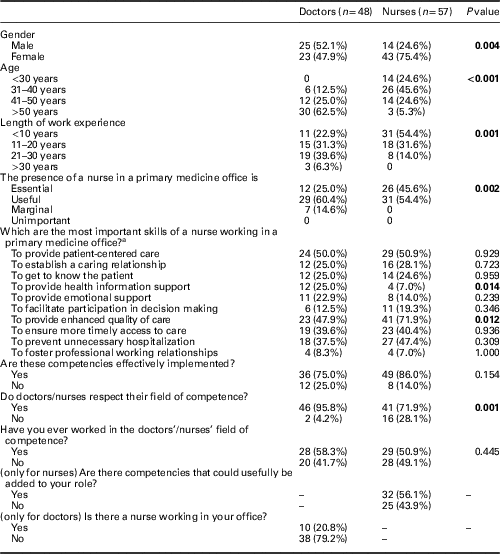
a Maximum three answers allowed. The bold emphasized values are those of statistically significant.
When asked to define the presence of the nurses working along with the GP, 54.4% of nurses answered that it is ‘useful’ and 45.6% ‘essential,’ while none answered ‘marginal’ or ‘unimportant.’ Physicians chose ‘useful’ in 60.4% of cases, ‘essential’ in 25.0% and ‘marginal’ in 14.6%, while none chose ‘unimportant’ (P=0.002).
The open-ended answers relating to motivation were slightly different for physicians and nurses. Physicians who considered essential or useful the presence of a nurse in their activity declared as their reasons the reduction in workload (n=12), the improvement in quality and speed of care (n=11), improvement in teamwork (n=6), the sharing of responsibilities (n=5), the use of nursing skills (n=5) and improvement in the relationship with the patients (n=2). Physicians who considered the nurses’ role as marginal stated as main motivations the fact that they considered physicians able to work alone (n=3), the higher costs needed for a nurse (n=3), or that the nurses’ role is marginal (n=1). On the other hand, all nurses considered the presence of a nurse as essential or useful, for the following reasons: to improve emotional support to the patient (n=16), to perform nursing procedures (n=15), to improve teamwork (n=8), to decrease the workload for physicians (n=7), to improve the quality and speed of care (n=4), to decrease costs (n=3), to improve the relationship with the patient (n=2) and to share responsibilities (n=1).
To the question ‘which do you think are the most important competences of a nurse working with the GP in the primary care setting?’ the most frequent answers were: to provide patient-centered care; to provide enhanced quality of care (47.9% among physicians versus 71.9% among nurses, P=0.012); to ensure more timely access to care and to prevent unnecessary hospitalization. Most participants answered that these nursing competences are effectively utilized in their daily activity in the Italian healthcare context (75% among physicians versus 85.9% among nurses, P=0.154).
The two groups were significantly different in their perception of whether they considered that the other profession abided by their respective field of competence: while 95.8% of physicians answered that nurses did so with theirs, only 71.9% of nurses believed the same about physicians (P=0.001). Furthermore, 29 nurses (50.9%) said they had acted in the field of competences of the physician, while 28 physicians (58.3%) stated the reverse with respect to nurses. We asked nurses if there were any competences they would consider useful to add to their skills; they answered yes in 56.1% of cases. We then asked nurses what kind of competences would be useful to add to their professional skills; only 16 nurses answered, as follows: issuing prescriptions (n=8), improving relationship skills (n=3), increased autonomy (n=2), performing minor diagnoses (n=2), and improving awareness of economic aspects (n=1).
We asked physicians if a nurse was present in their office; only 10 stated yes (20.8%). Those who worked with a nurse in their office gave as their main reason the possibility of offering nursing procedures (n=7), improving the quality and speed of care (n=2) and the potential for teamwork (n=1); physicians who did not work with a nurse gave as their main reasons the higher costs (n=13), limited utility (n=6), their ignorance about the figure of the nurse working in primary care units (n=5), other (n=5) or no reason (n=9). We found no differences of gender, age and length of work experience between doctors working with a nurse and those working without, while they were different in the attitude towards the role of the nurse in the primary care daily activity (Table 2).
Comparison among doctors working or not with a nurse
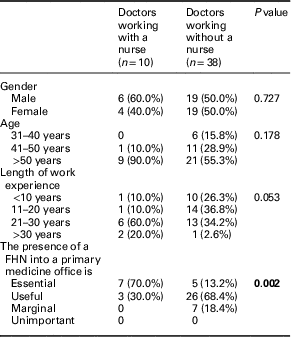
FHN=Family Health Nurse.
The bold emphasized values are those of statistically significant.
To better understand the perception of the role of the nurse in the primary medicine office, potential predictors were investigated, as reported in Table 3. At the multivariate analysis, the age class resulted as a significant predictor of the perception that the presence of a nurse working along with the GP is essential: participants aged between 41 and 50 years had an OR of 0.08 (P=0.020) while those >50 years had an OR of 0.03 (P=0.028).
Perception of the role of the nurse in the primary medicine office, univariate and multivariate analyses

The bold emphasized values are those of statistically significant.
Discussion
Primary care is deeply changing in developed countries. On one hand, the primary care workload is expected to increase due to the epidemic of chronic diseases and the increase in the aging population (Liu et al., Reference Liu, Finkelstein and Poghosyan2014); on the other hand, the benefits of delivering primary care through interdisciplinary teams have been largely described (Shaw et al., Reference Shaw, de Lusignan and Rowlands2005; Walsh et al., Reference Walsh, McDonald, Shojania, Sundaram, Nayak, Lewis and Goldstein2006; Schadewaldt et al., Reference Schadewaldt, McInnes, Hiller and Gardner2013; Shoemaker et al., Reference Shoemaker, Parchman, Fuda, Schaefer, Levin, Hunt and Ricciardi2016; Pullon et al., Reference Pullon, Morgan, Macdonald, McKinlay and Gray2016). Thus, primary care delivery is shifting towards inter-professional team-based organization.
The inter-professional organization of healthcare systems has been studied as an efficient and effective way of providing high quality care (Johnson, Reference Johnson2013) and several studies have highlighted the central role of nurses in the primary care context (Peterson et al., Reference Peterson, Phillips, Puffer, Bazemore and Petterson2013; Fortinsky et al., Reference Fortinsky, Delaney, Harel, Pasquale, Schjavland, Lynch, Kleppinger and Crumb2014) as a link between patients and physicians (Goldman et al., Reference Goldman, Meuser, Rogers, Lawrie and Reeves2010; Stewart et al., Reference Stewart, Sangster, Ryan, Hoch, Cohen, McWilliam, Mitchell, Vingilis, Tyrrell and McWhinney2010; Johnson, Reference Johnson2013).
Indeed, in primary care settings most care is neither complex nor urgent from a medical perspective, making it unnecessary for these patients to be seen by a physician: a randomized study (Dierick-van Daele et al., Reference Dierick-van Daele, Metsemakers, Derckx, Spreeuwenberg and Vrijhoef2009) showed that nurse practitioners can substitute GPs in the management of patients with minor health problems in a cost-effective way and with a quality of care comparable with that provided by the GP (Laurant et al., Reference Laurant, Reeves, Hermens, Braspenning, Grol and Sibbald2005; Dierick-van Daele et al., Reference Dierick-van Daele, Metsemakers, Derckx, Spreeuwenberg and Vrijhoef2009).
Nurse-based care has been studied in different clinical settings. In a Dutch trial (Voogdt-Pruis et al., Reference Voogdt-Pruis, Beusmans, Gorgels, Kester and Van Ree2010), high-risk cardiovascular disease patients were randomized into a nurse or GP groups; at 1-year follow-up, a greater decrease in the mean level of risk factors was observed in the nurse group. Several other studies (Khunti et al., Reference Khunti, Stone, Paul, Baines, Gisborne, Farooqi, Luan and Squire2007; Dierick-van Daele et al., Reference Dierick-van Daele, Metsemakers, Derckx, Spreeuwenberg and Vrijhoef2009; Fortinsky et al., Reference Fortinsky, Delaney, Harel, Pasquale, Schjavland, Lynch, Kleppinger and Crumb2014; Yang et al., Reference Yang, Long, Jackson, Rhee, Tomolo, Olson and Phillips2017) have shown similar results, and a Cochrane review in 2004 reported that trained nurses can achieve equally good health outcomes as GPs for different kinds of diseases (Laurant et al., Reference Laurant, Reeves, Hermens, Braspenning, Grol and Sibbald2005).
It is reasonable to suggest that an inter-professional organization is the model for the primary care practice of the future: health providers have reported beneficial changes from working with other professionals, positive outcomes for student training, and improvements in the quality of care (Pottie et al., Reference Pottie, Farrell, Haydt, Dolovich, Sellors, Kennie, Hogg and Martin2008; Price et al., Reference Price, Howard, Hilts, Dolovich, McCarthy, Walsh and Dykeman2009; Goldman et al., Reference Goldman, Meuser, Rogers, Lawrie and Reeves2010), and multidisciplinary team working may improve appropriateness in medication use (Fletcher et al., Reference Fletcher, Hogg, Farrell, Woodend, Dahrouge, Lemelin and Dalziel2012). On the other hand, the implementation of a multidisciplinary organization of primary care is not a simple process. As described by Rodriguez (Rodríguez and Pozzebon, Reference Rodríguez and Pozzebon2010), the creation of a primary care team is a challenging process ‘that goes beyond the normative policy definitions of who is on the team or what the team has to do.’
In Italy, primary care is based on out-of-hospital offices with a physician specialized in general medicine, which can take care of a number of patients up to 1500. Although in recent years GPs have been encouraged to move towards a team-based care model, the presence of a nurse in the office is still not mandatory, thus representing a free choice on the part of individual GPs. The present study was realized in an attempt to better understand inter-professional collaboration between physicians and nurses in the primary care setting.
One of the main results of our study was that the presence of the nurse in primary care was considered differently by the two groups: while 45% of nurses defined it as essential, only 25% of physicians stated the same, with 15% of them saying it was marginal. In our study, physicians seemed to be less favorable towards fully collaborating and sharing powers with nurses, as recently reported also by Vegesna (Vegesna et al., Reference Vegesna, Coschignano, Hegarty, Karagiannis, Polenzani, Messina, Zoli and Maio2016), who suggested that this might be linked to the historical position of the greater power of authority wielded by physicians. Moreover, a recent meta-analysis showed a more positive attitude towards collaboration among nurses compared with physicians (Sollami et al., Reference Sollami, Caricati and Sarli2014), which might explain our results.
The main motivations reported by GPs and nurses were also different: while physicians considering the presence of the nurse to be important saw them as a team-mate to provide better and faster care and to share the workload with, nurses stressed the importance of their competences in providing emotional support and performing specific nursing procedures.
Interestingly, the perception of the nurse’s role in the primary care setting proved to be strongly associated with the age of participants, with senior participants considering the nurse as essential in lower percentages. Thus, it is reasonable to suppose that younger GPs will be more inclined to welcome the team-based changes in primary care.
For approximately half the participants of our study, the most important competence of the nurse was the ability to provide patient-centered care, both among nurses and physicians. With regard to other competences, the statistically significant differences seen above regarding the provision of health information support, mostly chosen by physicians, and the enhancement of the quality of care, chosen mostly by nurses, underline the different attitudes between the two groups: while physicians tended to recognize a ‘supportive’ role of nurses, nurses highlighted their clinical value. Another interesting result was that nearly half the nurses and nearly 40% of doctors emphasized the importance of the nurse in preventing unnecessary hospitalization, which is extremely important considering the current economic climate. Furthermore, an interesting result was the attitude towards the professional field of competences. Although most nurses and physicians stated that the competences of the nurses are effectively utilized, and that most workers abided by their field of competences, half of them reported having worked at least once in the field of competences of the other group. When asking nurses which competences could be usefully added, the limitations of Italian Law were clearly apparent: nurses considered the inclusion among their competences of drug prescription and minor diagnoses useful, but according to Italian Law only physicians have the right to prescribe drugs or to make diagnoses. In the present situation, these legal limitations are unlikely to change, in contrast with other countries which have introduced the possibility for nurses to prescribe medicines, such as Australia, Canada, Ireland, the United Kingdom and the United States (Kroezen et al., Reference Kroezen, van Dijk, Groenewegen and Francke2011). Finally, a significant finding of our study is the percentage of GPs working with a nurse: in our study population, only 20% of the physicians interviewed stated that they worked with a nurse; for those physicians working without nurses, the most important reasons were represented by the higher costs and the perception of limited utility, but it is important to note that some physicians also admitted to be unaware of the role of the nurses in the primary care setting, or not having been able to find an available nurse. In comparison, in a recent study by the American Board of Family Medicine conducted among almost 6000 family physicians, nearly 60% reported routinely working with nurse practitioners, physician assistants or certified nurse midwives (Peterson et al., Reference Peterson, Phillips, Puffer, Bazemore and Petterson2013). With regard to costs, the available literature is still scanty, but seems to suggest the economic advantage of nurses working in primary care. Early reviews, mainly based on British studies (Laurant et al., Reference Laurant, Reeves, Hermens, Braspenning, Grol and Sibbald2005; Dierick-van Daele et al., Reference Dierick-van Daele, Spreeuwenberg, Derckx, Metsemakers and Vrijhoef2008), found no significant differences in costs between nurse practitioner consultations and GP consultations. In a Dutch study (Dierick-van Daele et al., Reference Dierick-van Daele, Steuten, Metsemakers, Derckx, Spreeuwenberg and Vrijhoef2010), the authors reported a significant difference in direct costs, in favor of nurse consultations. The economic concerns reported by physicians enrolled in our study is symptomatic of the lack of regulation in Italy: since to date the role of the nurses in the primary care setting has not been clearly defined, it is not clear who should pay her/him.
We recognize some limitations to our study. One of these is the heterogeneity between groups: nurses were younger, with lower length of work experience compared with physicians, and female in three quarters of cases. Another limitation to the study is the size of sample, and the fact that it was entirely drawn from Piedmont, thus giving only a regional picture. Moreover, the questionnaire was created for the purpose of the study but it was tested only on eight GPs and nurses before the participants enrollment, and the implicit limitations of survey-based studies, including response bias, should be taken into account. Finally, in our study we did not examine the attitude of patients. Since the wish for a shift in primary care towards improved patient- and person-centered approaches should take into consideration the patient and family perception of the nurse working along with the GPs in the primary care setting, this aspect needs to be analysed in further studies.
Despite these limitations, the present paper is, to the best of our knowledge, the first to analyse the role of the nurse working in primary care units as seen by GPs and nurses employed in out-of-hospital care in Italy.
This paper adds important data to the current process of team-based shifting of primary care in Italy. Unfortunately, it appears to be very early in the process, with only one GP out of five working together with a nurse. More importantly, GPs and nurses showed different attitudes towards the role of nurses in primary care: while nurses highlighted their clinical value, physicians did only fully recognize them a supportive role, while globally they seemed to be less favorable towards the engagement of a full collaboration and power-sharing with nurses. Nevertheless, younger subjects showed a more positive attitude towards a more collaborative model of primary care organization.
Our results highlights the need for a strengthening of the role of the nurses in primary care organization in Italy, and would suggest several ways to overcome the traditional physician-centric care model, such as a specific study curriculum for nurses intending to work in the primary care setting, a reorganization of primary care units on a multidisciplinary-team basis, and a stronger involvement of nurses and physicians in the planning of primary care delivery.
Further researches and studies involving larger samples are needed to better understand the attitude of physicians and nurses towards the inter-professional collaboration and to analyse the perception of primary care delivery by patients and families.
Financial Support
This study was funded by departmental resources (Department of Public Health Sciences, University of Turin, Italy).
Conflicts of Interest
The authors report no conflicts of interest to disclose.
Ethical Standards
None.



