




INTRODUCTION
Perennial grain crops have been proposed as a transformative approach to agriculture, to improve food and environmental security (Glover et al., Reference Glover, Reganold, Bell, Borevitz, Brummer, Buckler, Cox, Cox, Crews, Culman, DeHaan, Eriksson, Gill, Holland, Hu, Hulke, Ibrahim, Jackson, Jones, Murray, Paterson, Ploschuk, Sacks, Snapp, Tao, Van Tassel, Wade, Wyse and Xu2010; Jackson, Reference Jackson1980). Grain crops are overwhelmingly annual in growth habit, and replacement with long-lived growth types, e.g., perennial analogues, could potentially provide new options for sustainable farming. Perennial crops can provide staple food crops that also achieve resource conservation, save labour and seed, provide weather resilience and potentially, multiple products such as grain plus livestock fodder or fuel wood (Cox et al., Reference Cox, Glover, Van Tassel, Cox and DeHaan2006). Benefits to wider society are associated with perennial plant types, such as mitigation of greenhouse gases and water quality gains, and these are directly attributable to the unique soil building properties of perennial life forms (Culman et al., Reference Culman, Snapp, Ollenburger, Basso and DeHaan2013). Once established, perennial crops provide living roots and soil cover that persist over much of the year, which is key to many environmental services (Larkin et al., Reference Larkin, Newell, Hayes, Aktar, Norton, Moroni and Wade2014). However, there are unique risks associated with perennials, such as the potential to act as disease and pest reservoirs, and a growth habit that may constrain yield potential through a slow establishment phase and diversion of resources from reproduction to tissues that ensure survival and regrowth in subsequent years (Jaikumar et al., Reference Jaikumar, Snapp, Flore and Loescher2014).
Agronomy has placed front and centre the goal of achieving substantial gains in grain yield, in an annual crop type. There has been limited research by agronomists on achieving multiple products from a field crop, or other growth types, such as biannual or perennial life forms. In the service of this ‘annual project’, the harvest index of crop varieties has been on a continuous upward trend in recent decades (to as high as 60%; DeHaan and Van Tassel, Reference DeHaan and Van Tassel2014). For most perennials, food production is modest to nil, as forage or fuel wood is often the primary production function. Perennials may be promoted in agricultural development projects, but typically as technologies used to improve annual cropping systems over the long-term, enhancing the sustainability of annual food crop production systems. Agroforestry species grown within or near fields of cereal crops are a widely promoted example of perennial diversification (Garrity et al., Reference Garrity, Akinnifesi, Ajayi, Weldesemayat, Mowo, Kalinganire, Larwanou and Bayala2010).
In this review, we explore how agronomists have placed annual grain crop production at the centre of development efforts and question why there has not been a wider lens, one that includes perennial grain crops as an option. Are there good reasons for this narrow focus on annuals, such as poor performance of perennials in producing food and other ecosystem services? Or, is there evidence of farmer practice and interest in perennial forms of field crops, evidence that has been largely ignored? For instance, there is historical evidence of the use of perennial grain crops in Eastern and Southern Africa, including the once-widely grown indigenous pulse crop, lablab (Lablab purpureus), and a perennial form of sorghum (Buchanan, Reference Buchanan and Rankin1885; Moore and Vaughan, Reference Moore and Vaughan1994). We focus in this paper on two grain crops, sorghum (Sorghum bicolor [L.] Moench) and pigeon pea (Cajanus cajan (L.) Millsp.) that are on occasion grown as perennial ratoons in rain-fed farming systemsFootnote 1. Both crops have the genetic potential to ratoon, which involves cutting back the crop after harvest (near the crown or plant base), and carrying out harvests in subsequent years based on plant regrowth. We find evidence that ratoon management of pigeon pea by smallholders in Africa is a widespread practice – for instance, in Malawi (Rogé et al., Reference Rogé, Snapp, Kakwera, Mungai, Jambo and Peter2016) – which allows the crop to be grown for two or more years of production. A practice that persists despite an overwhelming focus on annual forms of pigeon pea in agronomic and plant breeding research is somewhat surprising. Sorghum ratooning nowadays appears to be less common, although we found one study that suggests widespread use of this system among smallholder farmers in Ethiopia (Mekbib, Reference Mekbib2009).
Perennial grain crops constitute an underexplored and contested area of agricultural research. We approach the topic from a multidisciplinary perspective, bridging scholarship in anthropology, geography and agronomy. First, we introduce the concept of perennial grains as a new type of crop species that integrate perennial properties through plant breeding – and the concept of ratooning, an agronomic practice that uses perennial traits in annual crops. Second, we consider the central role of annual, high-harvest index crops in development-oriented agronomy. Third, we reflect on how this annual worldview may have evolved, and consider the role perennials could play in providing alternatives for sustainable intensification (SI). We then present case studies of pigeon pea and sorghum, crops with ratoon potential, grown on smallholder farms in Africa. Finally, we discuss why development-oriented agronomy has rarely considered perennial grains, and if perennial crop options deserve to be explored.
PERENNIAL GRAINS
What is a perennial grain? Is it similar, or radically different from ‘perennializing’ through ratooning, as is practiced for crops such as sorghum or pigeon pea? Perennial crops can be achieved through the deliberate incorporation of perennial plant traits into annual crops, and this has been attempted by Russian wheat breeders as far back as the 1930s (Kane et al., Reference Kane, Rogé and Snapp2016). Winter hardiness, tolerance to extreme weather and marginal soils were key goals of early breeding efforts to develop a perennial form of wheat (Vavilov, Reference Vavilov1934). And although such efforts have continued in a sporadic manner, few lines with adequate yield potential and strong regrowth have been developed and evaluated in field settings (Cox et al., Reference Cox, Glover, Van Tassel, Cox and DeHaan2006; Culman et al., Reference Culman, Snapp, Ollenburger, Basso and DeHaan2013; Glover et al., Reference Glover, Reganold, Bell, Borevitz, Brummer, Buckler, Cox, Cox, Crews, Culman, DeHaan, Eriksson, Gill, Holland, Hu, Hulke, Ibrahim, Jackson, Jones, Murray, Paterson, Ploschuk, Sacks, Snapp, Tao, Van Tassel, Wade, Wyse and Xu2010). Novel perennial wheat and rye genotypes for dual use as food and fodder are the one exception (Bell et al., Reference Bell, Byrne (nee Flugge), Ewing and Wade2008; Jaikumar et al., Reference Jaikumar, Snapp, Murphy and Jones2012; Larkin et al., Reference Larkin, Newell, Hayes, Aktar, Norton, Moroni and Wade2014). Recently, research has expanded to explore farmer interest in perennial grains and selection criteria to be used in the development of these novel crops (Adebiyi et al., Reference Adebiyi, Olabisi and Snapp2016). Crop simulation models also allow exploration of plant traits in annual crops and perennial analogues, such as high grain yield, and potential trade-offs associated with a large root mass in the latter (Vico and Brunsell, Reference Vico and Brunsell2018). Much remains to be done before perennial grain varieties are available for widespread testing (Adebiyi et al., Reference Adebiyi, Olabisi and Snapp2016; Waldman et al., Reference Waldman, Ortega, Richardson and Snapp2017).
The idea of enhancing and or developing perennial growth in annual cereals and pulses is controversial (DeHaan and Van Tassel, Reference DeHaan and Van Tassel2014; Glover et al., Reference Glover, Reganold, Bell, Borevitz, Brummer, Buckler, Cox, Cox, Crews, Culman, DeHaan, Eriksson, Gill, Holland, Hu, Hulke, Ibrahim, Jackson, Jones, Murray, Paterson, Ploschuk, Sacks, Snapp, Tao, Van Tassel, Wade, Wyse and Xu2010; Vico and Brunsell, Reference Vico and Brunsell2018). There are clearly challenges posed by crops that act as disease and pest reservoirs, and in some farming systems, controlled livestock grazing is necessary for the survival of perennial crops (Cox et al., Reference Cox, Glover, Van Tassel, Cox and DeHaan2006). Opportunity costs associated with the low grain yield relative to the high harvest index of annual crops are one of the most persistent critiques of perennial crops (Smaje, Reference Smaje2015). Agronomic evaluation of perennial analogues of annual wheat and rye suggest a substantial yield penalty. For example, a field study of new perennial wheat lines in Michigan found 20 to 60% reduction in grain yield, relative to annual varieties (Jaikumar et al., Reference Jaikumar, Snapp, Murphy and Jones2012). In Australia, large yield penalties have been observed for perennial wheat lines in high yield potential sites (Hayes et al., Reference Hayes, Newell, DeHann, Murphy, Crane, Norton, Wade, Newberry, Fahim, Jones, Cox and Larkin2012). This is not surprising as, to date, minimal investments have been made in breeding perennial forms of annual crop species (Glover et al., Reference Glover, Reganold, Bell, Borevitz, Brummer, Buckler, Cox, Cox, Crews, Culman, DeHaan, Eriksson, Gill, Holland, Hu, Hulke, Ibrahim, Jackson, Jones, Murray, Paterson, Ploschuk, Sacks, Snapp, Tao, Van Tassel, Wade, Wyse and Xu2010). Further, wheat derivatives are not reliably perennial as yet, with highly variable regrowth, and grain quality being rarely adequate (Hayes et al., Reference Hayes, Newell, DeHann, Murphy, Crane, Norton, Wade, Newberry, Fahim, Jones, Cox and Larkin2012). This comprehensive study in Australia by Hayes and colleagues did however produce evidence that disease resistance to many common wheat pathogens was present in perennial wheat germplasm. Further, eco-physiology experimentation points to a high potential for up-regulation of photosynthesis in perennial genotypes of wheat and rye (Jaikumar et al., Reference Jaikumar, Snapp, Flore and Loescher2014). This enhanced photosynthesis ability suggests that perennials may be able to support high grain yields, although substantial research efforts would be required to translate this potential into improved germplasm and viable agronomic systems (DeHaan and Van Tassel, Reference DeHaan and Van Tassel2014).
Skeptics of perennial grains further raise the point that the domestication of annual grain crops has been highly successful and widespread (Van Tassel et al., Reference Van Tassel, DeHaan and Cox2010). It is possible that during the process of crop domestication, in order to fit annualized migration patterns, annual crop growth patterns were favoured. This historic focus on annual life forms of cereals and pulses is under reconsideration in localized efforts, around the globe. This is evidenced by publications from various locations in North America, Europe, China and Australia (Adebiyi et al., Reference Adebiyi, Olabisi and Snapp2016; Bell et al., Reference Bell, Byrne (nee Flugge), Ewing and Wade2008; Larkin et al., Reference Larkin, Newell, Hayes, Aktar, Norton, Moroni and Wade2014; Zhao et al., Reference Zhao, Zhang, Huang, Wu, Hu, Zhang, Zhu and Fu2012).
RATOON MANAGEMENT
Overall, crop breeding and historic selection processes have favoured annuals, yet there are still vestiges of perennial crop growth habits in annualized crops, as exemplified by ratooned rice, sorghum and pigeon pea (Kane et al., Reference Kane, Rogé and Snapp2016; Van Tassel et al., Reference Van Tassel, DeHaan and Cox2010). These crops have perennial traits, and although widely grown as annuals, they can be grown as ratoon crops (cut back after the first harvest and regrowth of branches or tillering allows production of subsequent harvests). Ratoons are not strong perennials and plants die after two or more harvests, in contrast to the goals stated by perennial grain breeders to produce plants that produce grain reliably over 4 or more years (Cox et al., Reference Cox, Glover, Van Tassel, Cox and DeHaan2006). Yet, ratoons do have some of the features that are associated with bred perennial grains.
As germplasm with strong perennial features is not yet available for tropical grain crops, ratoons are considered as part of this review. This type of management provides an opportunity to consider the extent to which perennial features are valued, or fit within an African farm context. Over the past three decades, there has been sporadic evidence of ratoon use from African rural surveys (Chauhan et al., Reference Chauhan, Venkatratnam and Sheldrake1987; Mekbib, Reference Mekbib2009). One report considers ratoon-compatible pigeon pea landrace selection (Gwata and Silim, Reference Gwata and Silim2009), and dual-purpose sorghum production of forage and grain through ratoon management has been reported in the Americas and Asia (Rao et al., Reference Rao, Rathore and Reddy2013; Vinutha et al., Reference Vinutha, Kumar, Blümmel and Rao2017). Overall, research on ratoon management of grain crops has been modest in scope, as highlighted in a recent bibliographic review (Kane et al., Reference Kane, Rogé and Snapp2016).
ANNUAL CROPS AND SUSTAINABLE INTENSIFICATION
Agronomists involved in development efforts have taken up the cause of SI pathways for African farmers. The goal is not just to move farmers out of poverty, but also to protect the environment for future posterity. SI technologies include a suite of management approaches for annual crops, from conservation agriculture to organic agriculture (Montpellier Panel, 2013; Petersen and Snapp, Reference Petersen and Snapp2015). SI technologies generally exhibit high performance on productive soils, where investments have been made to ensure pest regulation and an adequate supply of water and nutrients. However, in poorly resourced African farm environments, many SI technologies are unreliable in performance. This is a growing problem, as smallholder farmers in Africa rely increasingly on marginal lands.
To ensure sustainable production and agricultural performance on marginal lands more generally, attention must be paid to the natural resource base. For the most part, Africa has experienced increases in production by bringing more land under production, rather than by increasing productivity (Fuglie and Rada, Reference Fuglie and Rada2013). It is not enough to increase farmer access to fertilizers and to annual cereals that respond to fertilizers, such as modern maize varieties. This has been a successful ‘green revolution’ recipe for the water-endowed productive farm-lands of the US Midwest, Central America and Asia, where short-statured rice, wheat and maize genotypes with a harvest index of 50% have been developed. Combined with input intensive agronomy, this allows for swift translation of applied nutrients into grain. Further, these varieties include extra early and short-duration growth types that facilitate agricultural intensification through sequencing of double and triple crops per year. An inadvertent consequence of high harvest index crops is the loss of biomass that could be used for other purposes. Indeed, to support SI, biomass has been highlighted as a key resource that is needed for multiple purposes such as soil building and livestock feed (Valbuena et al., Reference Valbuena, Erenstein, Tui, Abdoulaye, Claessens, Duncan, Gérard, Rufino, Teufel, van Rooyen and van Wijk2012). Perennial grain crops present an opportunity to redress the imbalance caused by highly annualized, grain-centric crops, and could be developed either as options to complement annual crops, or as substitutes. This has been called a ‘weak’ versus ‘strong’ perennial grain vision, where the latter is represented as promoting a future agricultural landscape dominated by perennial grain crops and other perennials, with few annuals to be seen (Jackson, Reference Jackson1980; Smaje, Reference Smaje2015).
The discussion around a ‘weak’ versus a ‘strong’ perennial grain vision may miss the point, as it suggests we need to choose which perennial pathway, whereas all paths to date have been annual ones. Research and extension has almost completely focused on early maturing fast growth traits, combined with allocation of photosynthate and nutrients towards reproductive structures. This has been at the expense of roots, vegetative and supporting tissues. So we currently have a ‘strong’ annual grain vision, and do not consider perennial grain crops – either strong or weak – as part of the picture. This annual focus may neglect environmental goods and services as well as farmer expressed priorities, at least in some incidences. Indeed, participatory variety selection, where farmer views are the basis for the assessment of suitability, shows that attributes associated with community resilience are often preferred along with productivity (Ashby, Reference Ashby, Ceccarelli, Guimarães and Weltzien2009). We will come back to this topic below, through a case study of pigeon pea.
THE VISION OF ‘MODERN’ AGRICULTURE: EQUATING CROP IMPROVEMENT WITH AN INCREASED HARVEST INDEX
Let us consider next how an increase in harvest index has come to be associated with crop improvement (Lawn, Reference Lawn1989). The harvest index of grain crops is determined by grain weight as a proportion of the total aboveground plant biomass. Consider, for example, cowpea, a study conducted in Niger in the early 1990s found that local land races generally had a harvest index in the range of 22–40%, whereas modern varieties had a harvest index in the range of 32–50% (Ntare and Williams, Reference Ntare and Williams1992). A recent study in Nigeria found that local cowpea varieties had harvest index values in the range of 14–20% and improved varieties were in the range of 20–34% (Kamai et al., Reference Kamai, Gworgwor and Wabekwa2014). This study also showed that harvest index is related to crop growth duration and determinacy of the variety, with a lower harvest index consistently found in long duration, indeterminate varieties. However, not all modern crop varieties are short duration and have high harvest indices. In cowpea, there are modern dual-purpose varieties with a moderate harvest index that, in addition to grain, produce copious amounts of leaves that can be harvested for human consumption as a vegetable, for livestock fodder or green manure (Kristjanson et al., Reference Kristjanson, Okike, Tarawali, Singh and Manyong2005). Plant breeding efforts that took into account such dual-purpose traits in cowpea led to one of the most successful examples of small-scale farmer adoption in pulse crops (Pachico, Reference Pachico2014).
There are inadvertent disadvantages associated with breeding modern crop varieties that have a high harvest index and a determinant growth pattern. One consequence is that this minimizes the ability of a crop to bounce back from a pest invasion or extreme weather event. Indeterminate crop species can flower again and again after disturbance, providing a form of insurance and resilience to common challenges associated with rain-fed smallholder agriculture. Another biological property that annual crop types sacrifice is that of growth longevity. This markedly constrains the capture of sunlight, limiting the amount of vegetation that can be produced (Glover et al., Reference Glover, Reganold and Cox2012). There are multiple and competing uses of plant biomass on farms, including livestock feed, as well as fuel wood and soil protection (Baudron et al., Reference Baudron, Jaleta, Okitoi and Tegegn2014; Rogé et al., Reference Rogé, Diarisso, Diallo, Boiré, Goïta, Peter, Macalou, Weltzien and Snapp2017). A key ingredient for sustainable production is becoming widely recognized: that of root biomass, given that it both directly and indirectly influences soil C sequestration (Kell, Reference Kell2012; Rasse et al., Reference Rasse, Rumpel and Dignac2005). Root system architecture and rooting depth are also important determinants of water quality and erosion control. In annuals, root growth is limited by the short duration of growing period, which contributes to shallow penetration of soils. A comparison of a perennial intermediate wheatgrass with wheat, its annual analogue, demonstrated that the perennial grain had root growth that was four-fold higher, and almost no nitrogen loss, under high nitrogen fertilization (Culman et al., Reference Culman, Snapp, Ollenburger, Basso and DeHaan2013).
AN ANNUAL-CENTRIC WORLDVIEW: INADVERTENT CONSEQUENCES
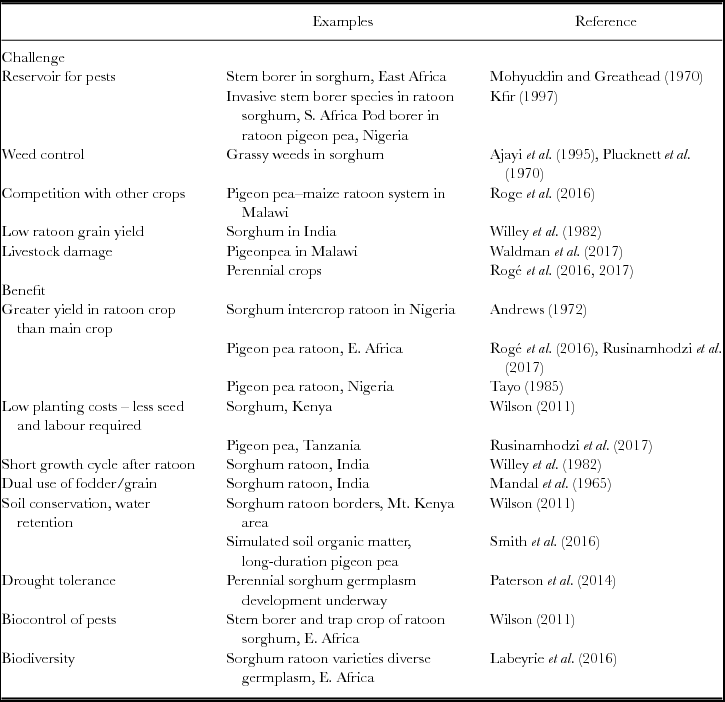
There are challenges associated with perennial life forms, yet at the same time environmental services, forage production and seed-saving benefits have been documented. This is illustrated in Table 1, which presents an overview of literature on ratoon management of pigeon pea and sorghum. The documented benefits raise the question, why have agricultural development efforts to date almost exclusively focused on annual grain production? This could be due to unacceptable risks and challenges associated with ratoons and perennial grains. Or, it could be due to a worldview that focuses tightly on grain yield and increasing the harvest index, as seen in many crop improvement programmes (DeHaan and Van Tassel, Reference DeHaan and Van Tassel2014; Stamp and Visser, Reference Stamp and Visser2012). Similarly, subsidized access to fertilizers and the promotion of cropping systems that transform fertilizer into grain has been widely viewed as successful agricultural development, through the ‘frame’ of grain yield as the key metric (Scoones, Reference Scoones2015). This narrow set of priorities for plant breeding continues with the consolidation of international seed supply chains to the detriment of biodiversity globally (Jacobsen et al., Reference Jacobsen, Sørensen, Pedersen and Weiner2015).
Challenges and benefits reported to be associated with long-duration varieties and ratoon management of pigeon pea and sorghum on smallholder farms in Africa and India.
However, there may be other factors at play, including a worldview that overlooks the possibility of a perennial grain, or indeed the reality of farmers practicing ratoon management. Commodity agriculture dominates across temperate North America and Europe, where grains are grown in simplified sequences of annual crops, with high reliance on fossil fuels and agrochemical inputs (Jackson et al., Reference Jackson, Pulleman, Brussaard, Bawa, Brown, Cardoso, De Ruiter, García-Barrios, Hollander, Lavelle and Ouédraogo2012). Agronomists and crop scientists who obtain advanced degrees in a landscape of annualized, simplified and highly mechanized agriculture may come to view this as what modern agriculture should look like. This is a productivist view that has roots in Malthusian fears that have been recently revived with the spectre of 9 billion mouths to feed (Tomlinson, Reference Tomlinson2013).
Authors of this paper have heard high ranking agricultural officers equate sole crops of hybrid, fertilized maize with developed agriculture and mixed cropping systems and ratoons as legacies of the past. Other evidence of this perspective is the imposition in Rwanda of agricultural policies that incentivize sole cropped commodities. The regulations required uprooting of mixed crops, including perennial food crops such as bananas and cassava, and had inadvertent negative impacts on family diets and ecosystem health (Isaacs et al., Reference Isaacs, Snapp, Chung and Waldman2016). In Ethiopia, subsidized fertilizers and a ‘green revolution’ intensification discourse has promoted broader adoption of annual grain crops, such as maize, and often led to the uprooting of mixed plantings with perennial food crops such as enset (Ensete ventricosum) (Keeley and Scoones, Reference Keeley and Scoones2000). It is difficult to disentangle how much the disadoption of a perennial staple food crop such as enset is the result of perceptions of what modern agriculture should look like, and how much is driven by the comparative ease of production and economic returns to maize, within a policy framework and development projects that guarantee input and output markets for maize (Scoones, Reference Scoones2015).
Agricultural development visions that rely on large doses of agro-chemicals and overly simplified cropping systems have been critiqued on the basis of environmental sustainability (Childers et al., Reference Childers, Corman, Edwards and Elser2011; Snapp et al., Reference Snapp, Blackie, Gilbert, Bezner-Kerr and Kanyama-Phiri2010); however, other overlooked and indirect consequences may include reduced livelihood resilience. This has rarely been grappled with in a narrative dominated by commoditization, and policies that focus on sole crops, with limited engagement with farmers’ cultural values or concerns about a world experiencing rapid change, imperfect market access, and shocks from extreme weather events (Isaacs et al., Reference Isaacs, Snapp, Chung and Waldman2016). Specific case studies have reported on the role that perennial food crops such as cassava, or enset, play in helping farmers and rural communities cope with a changing climate (Jarvis et al., Reference Jarvis, Ramirez-Villegas, Campo and Navarro-Racines2012; Scoones, Reference Scoones2015), but there has been almost no systematic attention to the possible vulnerabilities of a focus on intensification of annual grain crop production. Is this a failure of imagination, or due to intrinsic biological problems associated with perennial grain crops?
Alternative visions on how to feed the world's growing human population have been articulated, despite the productivist and Neo-Malthusian narrative that often dominates discussions on plant breeding. Alternatives often encompass how to increase the productivity of marginal agricultural spaces, adoption of an evolutionary and ecosystem perspective and increasing people's access to food and robust germplasm. Calls to establish institutes dedicated to the breeding of perennial food crops for marginal agricultural environments date back to Smith's (Reference Smith1929) book Tree Crops: A Permanent Agriculture. An evolutionary plant breeding perspective builds on diverse land race populations that are better attuned to local needs and that exhibit greater stability in times of disturbance than conventionally bred crops (Ceccarelli, Reference Ceccarelli2014; Johnson and Goldstein, Reference Johnson and Goldstein2015). This type of outcome is best achieved through ongoing and empowering relationships between plant breeders and farmers to better meet local needs and to promote the exchange of knowledge (Jones et al., Reference Jones, Glenna and Weltzien2014). With this in mind, the next section considers efforts to perennialize agricultural development to date.
PERENNIALIZATION FOR A SUSTAINABLE FUTURE IN AGRICULTURE
Cover crops, green manure and agroforestry systems are all approaches that have been promoted as means to address SI in Africa (Petersen and Snapp, Reference Petersen and Snapp2015). However, these soil-rehabilitating and sustainability-enhancing technologies are generally associated with high opportunity costs for land or labour or both. A large body of research has attempted to integrate soil-rehabilitation species with crop production in a manner that maximizes crop production, while minimizing labour requirements. Diversification with legume crops is one way to enhance biological nitrogen fixation and nutrient recycling, while at the same time produce agricultural products, and thus mitigate potential opportunity costs associated with alternative management. However, annual, short-statured legumes have become common, due to crop improvement efforts described earlier, and an inadvertent consequence is removal of large amounts of nutrients at crop harvest (Giller and Cadisch, Reference Giller and Cadisch1995). Further, a highly annualized legume precludes accessory products such as vegetable use of leaves, fodder, fuel wood, biological nitrogen fixation or soil conservation services.
Traditional pigeon pea cropping systems provide a counter example to highly annualized legume crops (Peter et al., Reference Peter, Mungai, Messina and Snapp2017; Rusinamhodzi et al., Reference Rusinamhodzi, Makoko and Sariah2017). Diversification with this crop addresses the need for soil conservation and fuel wood, while simultaneously providing a grain crop, particularly when grown using local practices such as mixed cropping and ratoon management that produced two crops and large amounts of vegetative material (Orr et al., Reference Orr, Kambombo, Roth, Harris and Doyle2015; Waldman et al., Reference Waldman, Ortega, Richardson and Snapp2017). Lablab is another crop species that can be grown as a short-lived perennial, through ratoon management. This minor crop produces grain, edible leaves, and livestock feed. It was once widespread in Africa (Kimani et al., Reference Kimani, Wachira and Kinyua2012). The growth duration is determined by the environment as well as genetics, as both pigeon pea and lablab have highly plastic responses to day length and temperature as well as rainfall patterns. Generally, growth duration of both is more than six months, and they can be ratooned once or twice to provide 2 or more years of sunlight capture and regeneration of soil nitrogen and phosphorus, along with bioenergy, fodder and food (Snapp et al., Reference Snapp, Blackie, Gilbert, Bezner-Kerr and Kanyama-Phiri2010).
Alternative agricultural practices rely on crop diversification in a broader manner than legumes alone, including growing multiple plant life forms to provide resilience and buffer against risk (Jackson et al., Reference Jackson, Pulleman, Brussaard, Bawa, Brown, Cardoso, De Ruiter, García-Barrios, Hollander, Lavelle and Ouédraogo2012; Jacobsen et al., Reference Jacobsen, Sørensen, Pedersen and Weiner2015). Perennial germplasm for fodder and biofuel production is widely considered as an integral component of SI, yet perennial grain crops have only occasionally been considered. Below, we reflect on two grain crops – pigeon pea and sorghum – that have perennial properties that could be exploited to develop perennial production systems. To this day, they are grown as semi-perennials through ratoon management in some parts of Africa. Thus, they provide examples of existing staple grain crops that have both annual and perennial features. We discuss their current role in African smallholder farming systems, and agronomic and plant breeder efforts to improve them. We explore the extent to which crop science research priorities have – and have not - coincided with farmer priorities for utilization of pigeon pea and sorghum. Finally, we consider the potential contributions, and drawbacks, associated with promotion of perennial properties of pigeon pea and sorghum in Africa.
PIGEON PEA
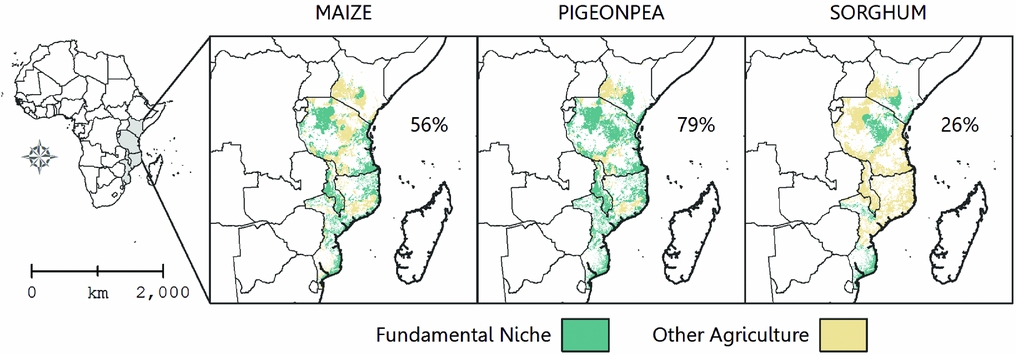
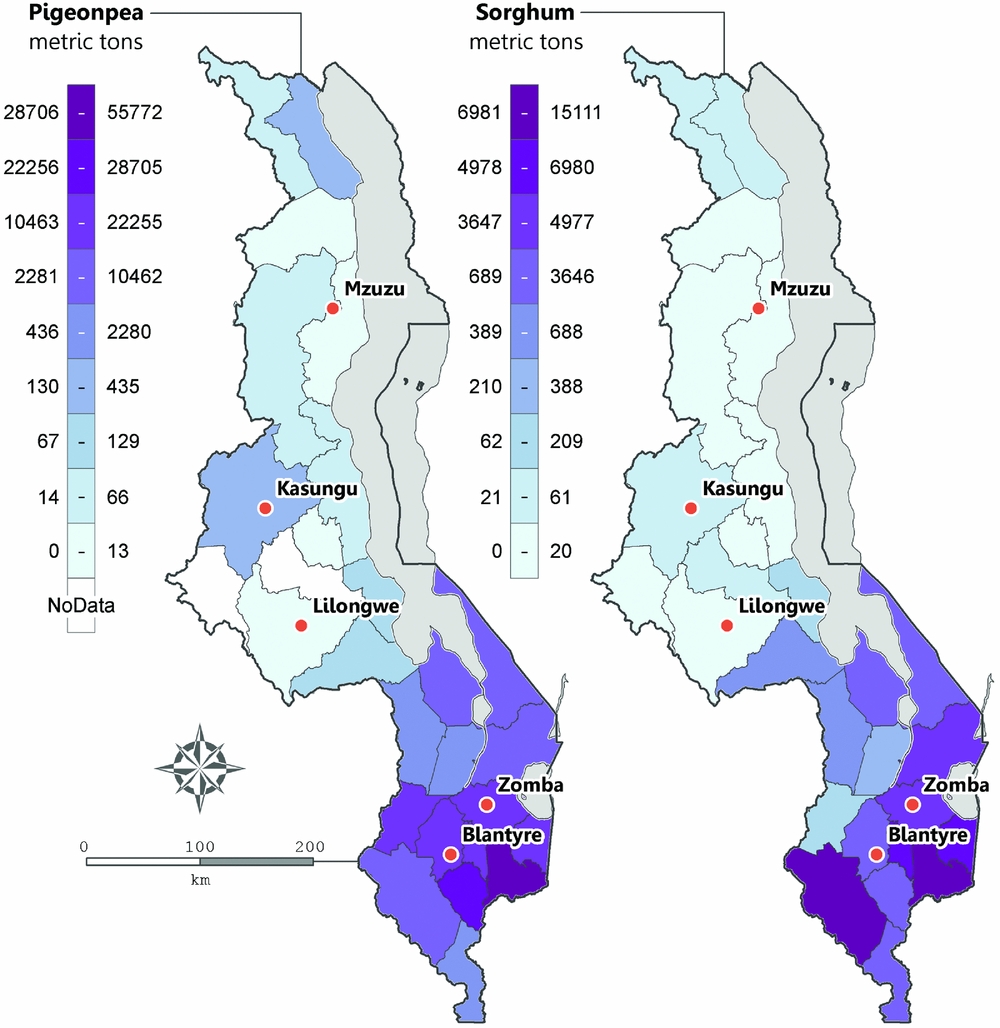
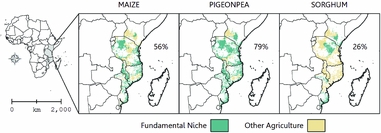
Approximately, 79% of agricultural land across Southern and East Africa is suitable for pigeon pea cultivation (Figure 1), although current production is primarily concentrated in Southern Malawi and North-Central Tanzania (Figure 2). This concurs with earlier findings that the agro-ecosystem niche for pigeon pea is much larger than that for maize, the most widespread crop (Peter et al., Reference Peter, Mungai, Messina and Snapp2017). There is a gap between the biophysical conditions conducive to growing the crop and where it is actually grown, due to the market context and complex cultural and socio-economic factors that govern why farmers grow pigeon pea. Table 1 presents findings from the literature on a wide range of farmer reported benefits, as well as challenges, that were associated with growing traditional varieties (long-duration types) and ratoon management. Local context matters, as found in a semi-qualitative survey conducted in Malawi where ratoon management of pigeon pea was reported in North and Central Malawi, but rarely in the South (Roge et al., Reference Rogé, Snapp, Kakwera, Mungai, Jambo and Peter2016). This may be related to the prioritization of grain production by farmers in the South, whereas conservation and soil fertility purposes were frequently reported as reasons for growing pigeon pea elsewhere (Figure 3). The latter are environmental benefits, which are expected to be high under ratoon management due to the large root systems associated with a long growth cycle (Kell, Reference Kell2012).
Climate niche maps for maize, pigeon pea and sorghum for Southeast Africa (Kenya, Tanzania, Malawi and Mozambique) based on temperature and precipitation. Temperature and precipitation parameters used for maize*: 23.8–32.2 °C and 750–1217 mm, respectively. Temperature and precipitation parameters used for pigeon pea**: 22.7–30.9 °C and 544–1263 mm, respectively. Temperature and precipitation parameters used for sorghum*: 22.1–33.7 °C and 317–833 mm, respectively. Percentages represent the fundamental niche proportion of agriculture. Temperature data collected from NASA Moderate Resolution Imaging Spectroradiometer (MODIS, MYD11B3.006) (NASA LP DAAC, 2015). Precipitation data collected from NASA/JAXA Tropical Rainfall Measuring Mission (TRMM–3B43) (NASA/JAXA TRMM, 2016). Data are annual averaged values between 2003 and 2014. Fritz et al. (Reference Fritz, See, McCallum, You, Bun, Moltchanova, Duerauer, Albrecht, Schill, Perger and Havlik2015) global cropland percentage map used to delineate areas by agriculture. Parameter sources: *FAO (2005), Pingali (Reference Pingali2001), Sánchez et al. (Reference Sánchez, Rasmussen and Porter2014), Wood and Moriniere (Reference Wood and Moriniere2013); **Carberry et al. (Reference Carberry, Ranganathan, Reddy, Chauhan and Robertson2001), FAO (2005), Kimani (Reference Kimani2000), Omanga et al. (Reference Omanga, Summerfield and Qi1995), Sardana et al. (Reference Sardana, Sharma and Sheoran2010), Silim and Omanga (Reference Silim and Omanga2001), Valenzuela and Smith (Reference Valenzuela and Smith2002); ***Chipanshi et al. (Reference Chipanshi, Chanda and Totolo2003), FAO (2005), Mishra et al. (Reference Mishra, Hansen, Dingkuhn, Baron, Traore, Ndiaye and Ward2008), Wood and Moriniere (Reference Wood and Moriniere2013).
Pigeon pea and sorghum production by district in Malawi for 2012. Source: Agricultural Production Estimates Survey (APES), Malawi Ministry of Agriculture and Food Security (MoAFS 2012).
Primary reason given for growing pigeon pea based on 48 farmer interviews conducted in three districts in Malawi, Mzimba (Northern), Kasungu (Central) and Zomba (Southern), adapted from Rogé et al. (Reference Rogé, Snapp, Kakwera, Mungai, Jambo and Peter2016).
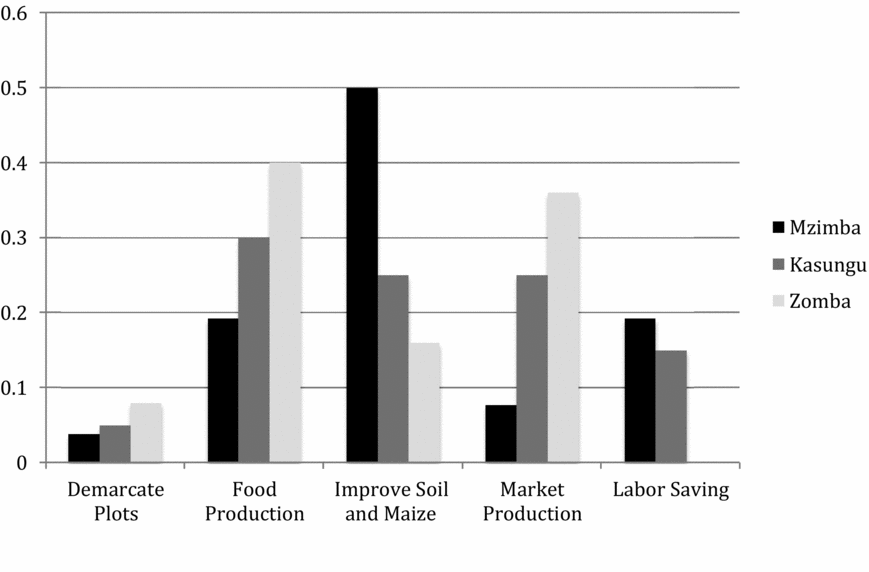
In some cases, there is an apparent mismatch between researcher priorities for pigeon pea, and farmer interests. As shown in Table 2, surveys have documented localized farmer preferences that include multi-use features of pigeon pea (i.e., forage, fuel wood and food production), and indeterminate, long-lived varieties, some of which are grown under ratoon management. A ‘choice experiment’ carried out with Malawian farmers involved presenting information on a hypothetical perennial pigeon pea (Waldman et al., Reference Waldman, Ortega, Richardson and Snapp2017). Interest was highly localized, with some farmers choosing scenarios where a perennial pigeon pea grown as a maize intercrop was associated with a short-term loss in maize yield along with long-term soil productivity gains, whereas other farmers were not willing to accept any short-term losses. Another study in Malawi found that about 40% of interviewed farmers managed pigeon pea as a ratoon crop, over 2 or 3 years (Rogé et al., Reference Rogé, Snapp, Kakwera, Mungai, Jambo and Peter2016). A survey in Tanzania documented a range of pigeon pea management practices, including widespread use of ratoon (Rusinamhodzi et al., Reference Rusinamhodzi, Makoko and Sariah2017). Evidence of farmer interest in multiple services from pigeon pea is the rapid spread from Mozambique to Southern Malawi of a new genotype of pigeon pea with a thick stem, providing a source of fuel wood on top of food, income and soil fertility (Orr et al., Reference Orr, Kambombo, Roth, Harris and Doyle2015). At the same time, Orr and colleagues found that farmers remain primarily interested in food production associated with this novel pigeon pea, and secondarily were interested in income and/or fuel wood. This highlights the importance of dual and triple uses as motivation for growing this crop (Figure 3).
Pigeon pea uses, desirable attributes and management practices from the perspective of farmers and researchers as documented in the literature.

Overall, the evidence is fragmentary, but it does appear that some East African farmers value longer duration pigeon pea and ratooning. At the same time, researcher priorities have almost universally emphasized short-stature, annual forms of pigeon pea (Table 2). This focus may be influenced by priorities of the India based International Crops Research Institute for the Semi-Arid Tropics, which has the world's largest gene bank for pigeon pea and has invested heavily in the development of extra early short-duration varieties with an erect architecture, a high harvest index, and market-preferred grain quality traits, which fit specific Indian cropping system contexts. At the same time, little attention has been paid to producing stems for fuel wood or foliage for other purposes, which are likely important within African contexts (ICRISAT Happenings, 2015; Table 2). Indeed, few plant improvement efforts have considered land races of pigeon pea that include a huge diversity in duration, determinacy. Nor has the ratoon ability of pigeon pea been systematically evaluated by scientists (Gwata and Silim, Reference Gwata and Silim2009).
It is important to note here that perennial growth types have both advantages and disadvantages. As shown in Table 1, these include on the one hand reduced costs associated with seed and labour savings, and extra services (e.g., soil conservation, forage and fuel wood), and on the other hand, challenges such as risk of pest infestation due to extended presence of the crop host (Daniel and Ong, Reference Daniel and Ong1990). Not surprisingly, farmer interest varies, and indeed a range of varieties and growth habits are grown. Medium-duration varieties have been released recently in Malawi and Tanzania, and these have been taken up in some locations, along with traditional, long-duration germplasm (Myaka et al., Reference Myaka, Sakala, Adu-Gyamfi, Kamalongo, Ngwira, Odgaard and Høgh-Jensen2006; Simtowe et al., Reference Simtowe, Shiferaw, Kassie, Abate, Silim, Madzonga, Muricho and Kananji2010).
One research gap is the time-frame and extent of soil improvement to be expected from perennial forms of pigeon pea management, in terms of soil organic matter accrual. Pigeon pea reliably enhances soil nitrogen status and maize yield in rotational and intercrop systems (Myaka et al., Reference Myaka, Sakala, Adu-Gyamfi, Kamalongo, Ngwira, Odgaard and Høgh-Jensen2006; Rusinamhodzi et al., Reference Rusinamhodzi, Makoko and Sariah2017). However, on-farm research has rarely detected gains in soil organic C from pigeon pea-based technologies (Snapp et al., Reference Snapp, Blackie, Gilbert, Bezner-Kerr and Kanyama-Phiri2010). Simulation modelling results are consistent with the potential of pigeon pea to support appreciable soil C gains in degraded soils in Central Malawi (Smith et al., Reference Smith, Snapp, Dimes, Gwenambira and Chikowo2016). Soil organic matter starting conditions and environment conditions matter, but for marginal sites in Central Malawi, a 25-year simulation with the model APSIM demonstrated soil C and N gains of 15–30% associated with pigeon pea mixed cropping, relative to sole maize. There are considerable challenges to detect soil C and N accrual in field experimentation, these include the long-time horizon involved in C sequestration processes, and the highly variable nature of soil C on smallholder fields. Legume shrub–maize intercrops have been shown to be associated with soil C gains in Southern Malawi on an agroforestry research site maintained for more than 15 years (Beedy et al., Reference Beedy, Snapp, Akinnifesi and Sileshi2010). This indicates the value of long-term monitoring and longitudinal studies.
Crop damage by livestock in the dry season is a significant barrier to growing a long-duration pigeon pea or a ratoon crop in many locations (Snapp and Silim, Reference Snapp and Silim2002; Waldman et al., Reference Waldman, Ortega, Richardson and Snapp2017). This is less of an issue in the Southern Region of Malawi, perhaps related to the small landholdings and the existence of markets for pigeon pea, where community norms are in place that control livestock so as to protect perennial, ratooned pigeon pea (Orr et al., Reference Orr, Kambombo, Roth, Harris and Doyle2015; Ortega et al., Reference Ortega, Waldman, Richardson, Clay and Snapp2016).
Pigeon pea research and extension recommendations in Malawi focus almost exclusively on short-duration, large-seeded and modern varieties. Although the practice is widespread, there are no recommendations for ratoon management in the Malawi Guide to Agriculture (2010). Our literature review found an overwhelming focus on annual production of short and medium-duration types of pigeon pea, with few reports on land races, and almost no attention to ratoon traits (Table 2). Interestingly, Gwata and Silim (Reference Gwata and Silim2009) reported on a study of long-duration land races, and then Gwata published an article advocating for short-duration types of pigeon pea for smallholder farmers, despite having documented the predominance of medium- and long-duration types among pigeon pea growers across East Africa, and the widespread use of ratoons (Gwata and Mzezewa, Reference Gwata and Mzezewa2013).
There is evidence of growing interest in pigeon pea as an economic diversification crop in Southern and East Africa (Simtowe et al., Reference Simtowe, Shiferaw, Kassie, Abate, Silim, Madzonga, Muricho and Kananji2010). This, combined with the success of a farmer selected of dual purpose pigeon pea (for grain and fuel wood), indicates that there may be unmet demand for multipurpose types of pigeon pea (Orr et al., Reference Orr, Kambombo, Roth, Harris and Doyle2015). Efforts to develop and promote access to perennial forms of pigeon pea, as well as extension messages about ratoon management, all have been notably lacking to date. Thus, we have limited knowledge of the extent and scope of demand for perennial growth habit types, along with other diverse pigeon pea germplasm.
SORGHUM
The ecological niche suitable for growing sorghum is largely confined to the arid to semi-arid zones with low rainfall and high evapotranspiration (Figure 1). This includes a swath across West Africa from Chad to Senegal, and another swath from the horn of Africa through South Africa, including about one-quarter of arable land in East and Southern Africa. Sorghum production is shown for Malawi and Tanzania, where it is often associated with biophysically marginal areas, including low rainfall and degraded, infertile or saline soils (Figure 2).
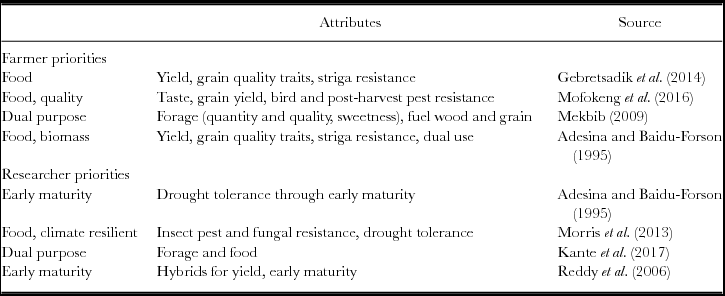
Throughout Africa, smallholder farmers grow sorghum landraces, which are generally tall statured and long duration. Farmer preferences for sorghum germplasm are presented in Table 3, and the contrast with researcher priorities mirrors many of the issues described for pigeon pea. From North to East Africa, and across West Africa, farmers overwhelmingly prefer local sorghum germplasm with traits such as grain quality, tall-stature and high stover to grain ratios for multiple farm uses (e.g., feed, fuel wood and construction) (Kimber et al., Reference Kimber, Dahlberg, Kresovich and Patterson2013; Rogé et al., Reference Rogé, Diarisso, Diallo, Boiré, Goïta, Peter, Macalou, Weltzien and Snapp2017). In Ethiopia, for example, fodder quantity and quality (sweetness) were important adoption criteria and only a small proportion of farmers were interested in planting modern varieties (Gebretsadik et al., Reference Gebretsadik, Shimelis, Laing, Tongoona and Mandefro2014; McGuire, Reference McGuire, Cleveland and Soleri2002). An exception is Southern Africa where modern varieties account for about one-quarter of sorghum production (Alumira and Rusike, Reference Alumira and Rusike2005). This includes adoption of short-statured, high harvest index types with early maturity. In the near future farmer adoption of modern varieties may pick up in West Africa as breeding efforts have started to take into account local preferences for tall-statured, long-duration varieties of Guinea–Race sorghum. Indeed, there are promising signs of farmer interest in improved sorghum varieties that are suited to dual-purpose use (Kante et al., Reference Kante, Rattunde, Leiser, Nebié, Diallo, Diallo, Touré, Weltzien and Haussmann2017). This stands in contrast to earlier sorghum research priorities that did not always correspond with farmer priorities (Table 3).
Sorghum uses, desirable attributes and management practices from the perspective of farmers and researchers as documented in the literature.
Sorghum is the most extensively grown cereal on smallholder farms throughout much of West Africa, and it is highly suited to the dominant environmental conditions of variable rainfall, aridity and infertile soils. Ratoons or perennial forms of sorghum are not grown in the region to any extent that we could ascertain from the literature, with the exception of one publication on Nigeria (Andrews, Reference Andrews1972). However, a recent survey in Mali documented some farmer interest in novel forms of sorghum with perennial properties, this interest was localized and often expressed by women (Rogé et al., Reference Rogé, Diarisso, Diallo, Boiré, Goïta, Peter, Macalou, Weltzien and Snapp2017). Interestingly, in West Africa, farmers have historically relied upon a perennial grain complex, the kreb or kasha grasslands (Harlan, Reference Harlan, Harris and Hillman1989). This grain complex is still harvested to some extent, although it is primarily relegated to marginal lands such as saline or degraded soils from Bornu, Nigeria to Darfar, Sudan.
In contrast to pigeon pea, agronomic research has been conducted on how to improve sorghum ratoon systems. However, investigations have been largely based in Asia or the Americas, with a focus on biofuel or forage production (Rao et al., Reference Rao, Rathore and Reddy2013; Vinutha et al., Reference Vinutha, Kumar, Blümmel and Rao2017). Sorghum is a crop that originated in Africa, so it was somewhat surprising to find very few studies on sorghum ratoons based in Africa (Kane et al., Reference Kane, Rogé and Snapp2016). Exceptions include surveys that mention sorghum ratoons as part of complex cropping systems in Nigeria and in Ethiopia (Andrews, Reference Andrews1972; Kfir, Reference Kfir1997; Mekbib, Reference Mekbib2009). Ratoon sorghum may have been a widespread historical practice, as it was reported to be used decades past in Zambia, and it was an important coping mechanism in drought years in the 1940s in Malawi (Vaughan, Reference Vaughan1987, page 75). This source indicates that ratooning of sorghum was made illegal in Malawi due to concerns about ratoon crops providing a reservoir for disease. This has been a concern expressed frequently in the perennial grain literature (Table 2).
The potential benefits and challenges associated with ratoon sorghum systems are mostly similar to those associated with ratoon pigeon pea (Table 1). In one documented case from South Africa, a new invasive species of stem borer was able to outcompete another species, facilitated by early establishment on ratooned sorghum (Kfir, Reference Kfir1997). One aspect where sorghum apparently differed from pigeon pea was concerns regarding low yields, as a ratoon sorghum crop rarely produces as much, and often 50% less than the first crop – although not in all cases (Table 1). In contrast, ratoon pigeon pea yields are often higher than the first crop. This is presumably due to differences in growth habit (a grass versus a shrub species).
A recent development in sorghum genetic studies and plant breeding is the exploration of perennial sorghum germplasm as a source of drought tolerance, disease resistance and as a new form of grain crop to provide multiple harvests for smallholders on marginal lands in Africa (Paterson et al., Reference Paterson, Cox, Wegian and Navarro2014). True perennial forms of sorghum germplasm were planted on Malian agricultural research stations in 2014 (P. Hayford and E. Weltzien, personal communication). Observations are preliminary as yet, but suggest there is interest among some sorghum plant breeders and agronomists in exploring perennial grain possibilities.
Overall, there are expected trade-offs with managing sorghum or pigeon pea as a perennial. Site-specific analysis could help determine under what circumstances and environmental conditions perennial grain crops are expected to provide valuable ecosystem services in support of sustainable production, and where the risks are too high (Peter et al., Reference Peter, Mungai, Messina and Snapp2017).
CONCLUSIONS
Perennial grain crops have been an overlooked option in agronomic research for development. This is perhaps a surprising finding, given evidence that some African farmers persist in ratooning pigeon pea and sorghum. This observation is made in a context where there is a complete absence of agronomic advice or genetic options tailored towards perennial management. Agronomists have focused almost entirely on grain yields, primarily through intensification of crop production of highly annual crops. This is consistent with a vision of modern agriculture where perennial crops are considered only as candidates for field borders in the service of environmental benefits, and the main field cropping area is dedicated to producing grain (Jackson et al., Reference Jackson, Pulleman, Brussaard, Bawa, Brown, Cardoso, De Ruiter, García-Barrios, Hollander, Lavelle and Ouédraogo2012). In the service of this annual agronomy project, the harvest index of modern crop varieties has been on a continuous upward trend. We raise the question, has this been at the expense of environmental services, resilience, labour-saving or seed-saving benefits? Or is a focus on short-duration crops a necessary one, given that long duration and perennial traits are often associated with less than maximum crop yield.
Agriculture has a colossal footprint, straining the sustainable use of resources and the world's biodiversity. This underlines the need to pay attention to agricultural management that produces ecological services in combination with production. Perennial management of staple food crops offers one way to do this. We suggest that farmers have been pursuing perennial options for years in various corners of the world, including growing mixtures of species with contrasting life-forms, and management through ratoons. Perennial options could open new doors, through the development of long-duration and perennial forms of crops in conjunction with adaptive management. At the same time, we recognize that there are potentially serious risks associated with growing a crop year round, including providing habitat for pests and the opportunity costs associated with modest grain yield levels. Crop scientists could address these challenges. We suggest that agronomists broaden their view beyond an annual-centric one, and consider investing in the perennial grain pipedream.
Acknowledgements
We extend our thanks to the farmers who graciously attended to interviews about perennial crops, and to the Bill and Melinda Gates Foundation who supported this research under Grant OPP1076311. We also appreciate funding from the Global Center for Food Systems Innovation, supported by USAID. Malawi seed systems activities have been supported by Irish Aid and USAID to ICRISAT which are making a difference through increasing access to pigeon pea varieties. No financial interest or benefit has arisen from the direct applications of this research.



 Open access

