

Introduction
Many archaeologists are beginning to accept that the world is and was more-than-human. The last 15 years of theoretical thinking on vibrancy (Bennett Reference Bennett2010), intra-action (Barad Reference Barad2007), emergence (Fowler Reference Fowler2013) and assemblages (DeLanda Reference DeLanda2006; Harris Reference Harris2017) has been productive and often provocative. Perspectives considering the ontological turn (e.g. Alberti & Marshall Reference Alberti and Marshall2009; Alberti et al. Reference Alberti, Fowles, Holbraad, Marshall and Witmore2011; Holbraad & Pedersen Reference Holbraad and Pedersen2017; Viveiros de Castro Reference Viveiros de Castro2004) have been particularly inspiring—and challenging—for us. These heterogenous approaches have grown in full knowledge of, but perhaps with somewhat different commitments than, posthuman feminism in western philosophy (Braidotti Reference Braidotti, Disch and Hawkesworth2016; Ferrando Reference Ferrando, Thomsen and Warmberg2020; Grosz Reference Grosz, Alaimo and Hekman2008; Haraway Reference Haraway2016).
As relative outsiders to posthuman feminist discourse,Footnote 1 our reading is that the threshold of alterity considered therein lies between the present West and its future (cf. Viveiros de Castro & Danowski Reference Viveiros de Castro and Danowski2020). Braidotti, for example, situates her work as a call to action between the fourth industrial revolution and the sixth extinction, i.e. between today's technological transformation and anthropogenic mass extinction. Posthuman feminisms often imagine a world where modern barriers between human and non-human, male and female, active and passive are ruptured or cross-cut by alternative kinds of relational kinship, forging new alliances to change the world (Braidotti Reference Braidotti2019a,Reference Braidottib; Ferrando Reference Ferrando, Thomsen and Warmberg2020; Haraway Reference Haraway2016). In this manner, practising more-than-human kinship is understood as an ethical project. To quote Braidotti (Reference Braidotti2011, 3), ‘each nomadic connection [across false ontological boundaries] offers at least the possibility of an ethical relation of opening out toward an empowering connection to others’. More recent formulations are even stronger: ‘the communal process of composing transversal [i.e. relational] subjects is driven by the ethics of affirmation’ (Braidotti Reference Braidotti2019b, 164): that which happens posthuman-ly is by default ethical. Ferrando (Reference Ferrando, Thomsen and Warmberg2020) promises ‘ontological radical healing’ and ‘a posthuman epiphany’ if posthumanist thinkers were to ‘take an ethical stand based on praxis … embodying the theories that we have publicly announced’. For archaeology, this posthuman feminist ethical claim raises the stakes of ontological debates (Crellin Reference Crellin, Crellin, Cipolla, Harris and Moore2021): perhaps our work gives insight not only into how radically different worlds have worked, but how they could or even should work.
Archaeologists and anthropologists already encounter deeply unfamiliar worlds of kinship through our work. Taking seriously forms of alterity encountered ethnographically, through the voices of indigenous writers, and not least through the richness and complexity of the archaeological record, can expand and challenge assumptions rooted in the contemporary west. For the populations living in what is now Scandinavia in the Iron and Viking Ages (here, c. 400–1050 ce), the world was certainly more-than-human, and we have barely begun to grasp the ramifications of ontological enquiry therein.
In this brief piece we want to explore such ramifications, but also question the notion of relational-ontological stances as more ethical than humanist approaches (Braidotti Reference Braidotti2019a; Ferrando Reference Ferrando, Thomsen and Warmberg2020). We argue that neither relational ontologies more broadly nor posthumanism specifically inherently produce ‘positive difference’—these perspectives can go hand-in-hand with uncomfortably familiar systems of oppression (see also Culp Reference Culp2016, 5–8). A recurrent critique of posthumanism, and particularly of symmetrical and object-oriented ontology, has been that they gloss over hierarchy and inequality. By placing all entities on a flat ontological plane, the responsibility of intentional harm and abuse towards others is diffused (Hodder Reference Hodder2014; Ion Reference Ion2018; Thomas Reference Thomas2015; Van Dyke Reference Van Dyke and Van Dyke2015). While the posthuman feminist authors considered here cannot be credibly accused of eliding power relations (Crellin Reference Crellin, Crellin, Cipolla, Harris and Moore2021; Fredengren Reference Fredengren2021; Pétursdóttir Reference Pétursdóttir2018), in our view there remains an unresolved tension in philosophies claiming that posthuman (or any) ontological exploration can redeem historical and contemporary systems of oppression. Many archaeologists do work with worlds that were not structured around Western modernist categories, but were deeply oppressive nonetheless. This article is also, therefore, an attempt to situate alterity and violence in the ontological turn as we grapple with these questions in our own research (Eriksen Reference Eriksenin prep.).
Through Judith Butler's framework of ‘grievability’, rooted in a humanist-feminist approach, we will explore relational, ethical aspects of the first millennium ce in northern Europe. We aim to develop three points:
(1) The Late Iron Age worlds of Scandinavia reverberated with vibrant matter and embraced transhuman kinship;
(2) The same relational world that allowed ‘making kin’ with steel and wood also cast some humans as vibrant objects, useful in their suffering and ungrievable in their deaths;
(3) This leads to reflections on posthuman feminism, the ontological turn, and archaeology's engagement with them; highlighting the way encounters with alterity sharpens the difference between ontological openness and ethical commitment.
More-than-human commitments: relationality, grievability and ethics
The posthuman feminist ethical claim is important. With climate upheaval, mass trafficking of humans, extinction of plant and animal life and globe-spanning maladies, it has become difficult to uphold traditional Western knowledge and the neocolonial globalism it insists upon as the most constructive way to act in the world. However, Western ethics rest on this foundation: centring the exceptional capacities of unitary individuals (modelled on the upper-class white ‘Man’) to act upon a passive world of objects and resources (Ferrando Reference Ferrando, Thomsen and Warmberg2020). Posthuman feminism builds from the relational philosophies of Deleuze (Deleuze & Guattari [1987] Reference Deleuze and Guattari2013), Barad (Reference Barad, Alaimo and Hekman2008), Bennett (Reference Bennett2010) and Haraway ([1985] Reference Haraway, Weiss, Nolan, Hunsinger and Trifonas2006) to imagine ethical action from a different ontological basis. Posthuman feminists argue that transcending patriarchal hierarchies entails rejecting the broader system of Cartesian dichotomies: human/non-human, active/passive, culture/nature, etc. Rather than creating boundaries and hierarchies, posthumanism is argued to celebrate positive difference, to embrace relational ‘becoming-with’ (Haraway Reference Haraway2016) as ‘non-unitary subject assemblages of human and non-human agents, activated toward the production of possible futures’ (Braidotti Reference Braidotti2019a, 467). By striking alliances among ‘women, feminists, LGBTQ+, animals, illegal unregistered migrants, disabled people … dust, plastic, dying insects’ (Braidotti Reference Braidotti2019a, 478), we increase our capacity to relate to the world affirmatively.
Archaeologists are well placed to engage critically with these conversations. As others have pointed out, relational thinking can echo some of the universalizing tendencies of Enlightenment discourse (Cipolla Reference Cipolla, Crellin, Cipolla, Montgomery, Harris and Moore2021). Insights derived from well-placed male, European philosophers are sometimes argued to characterize both the entire present world and the broader metaphysical possibility for difference (Viveiros de Castro & Danowski Reference Viveiros de Castro and Danowski2020). Posthuman feminists seemingly dwell less on the diversity of relational worlds already existing, past and present, nor on historical and geographic context. The existence of actual worlds beyond the present West that embrace radically other relational possibilities offers an important way to unsettle any ethnocentric tendencies in posthumanism, we argue, and to consider more-than-human alliances not just in principle, but in material practice.
This is where the ontological turn plays a role. Broadly speaking, the ontological turn encompasses diverse approaches that foreground unfamiliar worlds and realities in the past and present; worlds that work in radically different ways from the post-Enlightenment West. It takes seriously phenomena such as a shaman who can turn into a jaguar (Viveiros de Castro Reference Viveiros de Castro2004), powder that is power (Holbraad Reference Holbraad, Henare, Holbraad and Wastell2007) and vessels that are neither bodies nor pots, but body-pots (Alberti & Marshall Reference Alberti and Marshall2009). The ontological turn is not a homogenous school of thought, nor internally consistent. Tension and contradiction are embedded in ideas of ontologies as multiple (Harris & Robb Reference Harris and Robb2012), the difference between ontology and ‘metaontology’ (Crellin et al. Reference Crellin, Cipolla, Harris and Moore2021), and in the role of indigenous ontologies contra a singular, relational metaphysics (Cipolla Reference Cipolla, Crellin, Cipolla, Montgomery, Harris and Moore2021; Todd Reference Todd2016; Watts Reference Watts2013). Scholars who try to untangle different strands of ontological/relational approaches have branded those approaches that investigate ontology in broadly emic and historically specific ways as ‘epistemology’ (Harris Reference Harris, Crellin, Cipolla, Harris and Moore2021) or ‘social’ as opposed to ‘critical’ ontology (Alberti Reference Alberti2016a). The latter defines these as creating ‘taxonomies of past ontologies’ that are uncritical and ‘mundanely ontological’ (Alberti Reference Alberti2016a, 174).
This paper is unapologetically situated and localized, focusing on the specific conditions of relational becoming in a particular past world. We are more optimistic on behalf of ‘social ontologies’ than Alberti, because we doubt whether it is possible to do uncritical social ontology, without confronting our concepts, methods and our own ontological commitments.
We are sympathetic to Holbraad and Pedersen's (Reference Holbraad and Pedersen2017, 8–9) argument that ontological approaches are not paradigm-shifting; they grow out of deep-rooted disciplinary traditions of understanding other worlds and deepen them further. We will not dwell on the question of whether first-millennium ce ontology was truly commensurable with a singular, philosophical metaphysics. These questions are bracketed in order to draw out specific ontological and ethical dynamics of a particular world. We suggest that for the reasons outlined above, dwelling on material specifics is one of the primary ways archaeologists can contribute to broader posthuman conversations: unlike most philosophers, we work every day with existing worlds radically different from the contemporary West—and the specifics of those worlds matter.
Below, we bring thoughts from the ontological turn into dialogue with Judith Butler's (Reference Butler2009) concept of grievability. Butler's concepts of grievability and precarity (Reference Butler2004; Reference Butler2009) relate to the ethics, politics and metaphysics of contemporary warfare in a post-9/11 world. Her central claim is that not all lives are grieved when lost—and a life not considered worth grieving was never really a life at all. The mechanisms of making some lives griveable is not only an epistemological question, Butler argues, but an ontological one: What is a life? The frames through which we apprehend whether others’ lives are grievable are saturated with politics: ‘we must make more precise the specific mechanisms of power through which life is produced’, Butler (Reference Butler2009, 1) writes.
The concept of grievability has been adapted and used in heritage, visual studies and political science, but to our knowledge, not in archaeology to date. While a contemporary concept (much like Braidotti's posthumanism), the central questions of where we place empathy, and whose lives are more precarious, have relevance beyond contemporary construction of precarity in the so-called war on terror. Grievability recognizes ethics as a gradient of commitment—among our precarious interdependencies, which beings are to be preserved (as ‘lives’), and which can be neglected, forfeit or actively destroyed (as ‘not quite lives’) for the benefit of the living (Butler Reference Butler2009, 31)?
Although dismissed by posthuman feminists because it is not an affirmative approach (Braidotti Reference Braidotti2011, 204–5) and because of Butler's reliance on ‘discourse’ as a driving mechanism (Fredengren Reference Fredengren2021, 530), we contend that grievability is in fact a powerful relational and materialist concept. It brings together the interplay of physical growth and well-being, damage and decay; affects including empathy and revulsion; relational and intersectional production of embodied difference; and discourse that works through violent histories. Grievability situates bodies as products of all of these, alongside the many material things (photographs, monuments, stories, funeral rites) that equally give harm its solid geography (e.g. Comer Reference Comer2019).
What grievability gives us is a way to think about where people commit their empathy. Relational study crystallizes that violence and power reverberate not through human beings nor human politics in isolation, but through living and dead bodies, monuments, washed-up dinghies and washed-out photographs. But Butler's work provides a critical next step: a reflection on for which of these elements we will, or will not, grieve. Ontological openness means accepting that other people, in other worlds, may have answered such questions in radically different ways, and in ways that we might find unsettling. We turn to one such example here.
Gender and more-than-human worlds of Iron and Viking Age Scandinavia
It has rightly been pointed out that the Vikings are among the most stereotyped prehistoric populations (Price et al. Reference Price, Hedenstierna-Jonson and Zachrisson2019, 181–2). The conventional understanding of Iron and Viking Age societies as emergent kingdoms based on raiding, trade and competitive individualism have entailed an androcentric preoccupation with warfare and other assumed ‘male’ spheres and activities. The traditional view of some activities as driving history (battles, migrations, state formation) means that other activities and spaces are rendered trivial. The view of e.g. domestic activity as ahistorical and apolitical has rightly been critiqued as ethnocentric, androcentric and capitalist (Souvatzi Reference Souvatzi2008, 15). Entangled in these capitalist projections are assumptions of bounded, rational-economic individuals as subjects, with the warrior-chief as the hegemonic ideal and the primary agent of historical change (cf. Brück & Fontijn Reference Brück, Fontijn, Fokkens and Harding2013).
While these traditional perspectives have been challenged in recent years, their legacy means that Iron–Viking Age discourse sometimes still treats identity as static and essential, with individuals slotted into doxic categories of warriors, traders and housewives. The intense debate over the Birka ‘woman warrior’ burial is a case in point (Price et al. Reference Price, Hedenstierna-Jonson and Zachrisson2019). The legacy of the powerful warrior-chiefs conventionally leaves little room for nuanced, blurry or unfamiliar constructions of bodies and persons (but see crucial work by Back Danielsson Reference Back Danielsson2007; Fahlander Reference Fahlander2018; Price Reference Price2002; Ratican Reference Ratican2020).
Despite, or because of, this legacy, feminist critique has a long history in Scandinavian archaeology (Sørensen Reference Sørensen and Bolger2012), and includes invaluable contributions (e.g. Arwill-Nordbladh Reference Arwill-Nordbladh1998). Yet there are challenges in gender archaeology of the first millennium ce: some studies uphold stereotypical ‘male’ values and activities as hegemonic modes of power. Most readings still entail an essentialist view of personhood, and intersectional perspectives are just emerging. Third, there is a largely unaddressed issue of representativity in the gender archaeology and archaeology as such of the Iron and Viking Ages. More or less all research on gender is based on (1) furnished burial and (2) medieval written sources—meaning that we are building the entire understanding of gender, personhood, and power on a slight fraction of the population—the human elites.
We will argue that Iron and Viking Age worlds were far less familiar than they ever appear on our television screens, or even in much of the scholarship on the period. In part, we argue, this is because first-millennium worlds were not structured along expected, humanistic lines. Approaching the period with ontological openness allows us to recognize a world where bodies and persons could be articulated in rich, complex and decidedly more-than-human ways. In four brief vignettes we sketch varieties of relational kin-making that made up first-millennium worlds. Each of these topics has deep roots in the literature and raises complex questions of evidence and interpretation; moreover these societies saw internal differences and altered over time. It is impossible to extend those discussions fully here, and so we are of necessity painting with a broad brush. Readers are encouraged to follow our citations for a fuller account of the temporal and geographic dynamics of each topic and its fuller research history. Instead, we analyse each discussion using a grievability framework to assess what was, and was not, a grievable life in Iron and Viking Age worlds.
Swords as grievable bodies
‘Living swords’ are arguably the best-recognized more-than-human beings of the Iron and Viking Ages. Early medieval swords—in Scandinavia and Anglo-Saxon England—stand out in both written and archaeological records. In Old English and Old Norse literature, swords may have personal names and personal traits; they can have a ‘reputation’, a crucial form of honour in Norse societies; and they are enchained in relational webs as they are passed on as heirlooms, exchanged as gifts, or retrieved from burial mounds (Aannestad Reference Aannestad, Vedeler, Røstad, Kristoffersen and Glørstad2018; Brunning Reference Brunning2013; Reference Brunning2019; Davidson Reference Davidson1994; Lund Reference Lund2017).
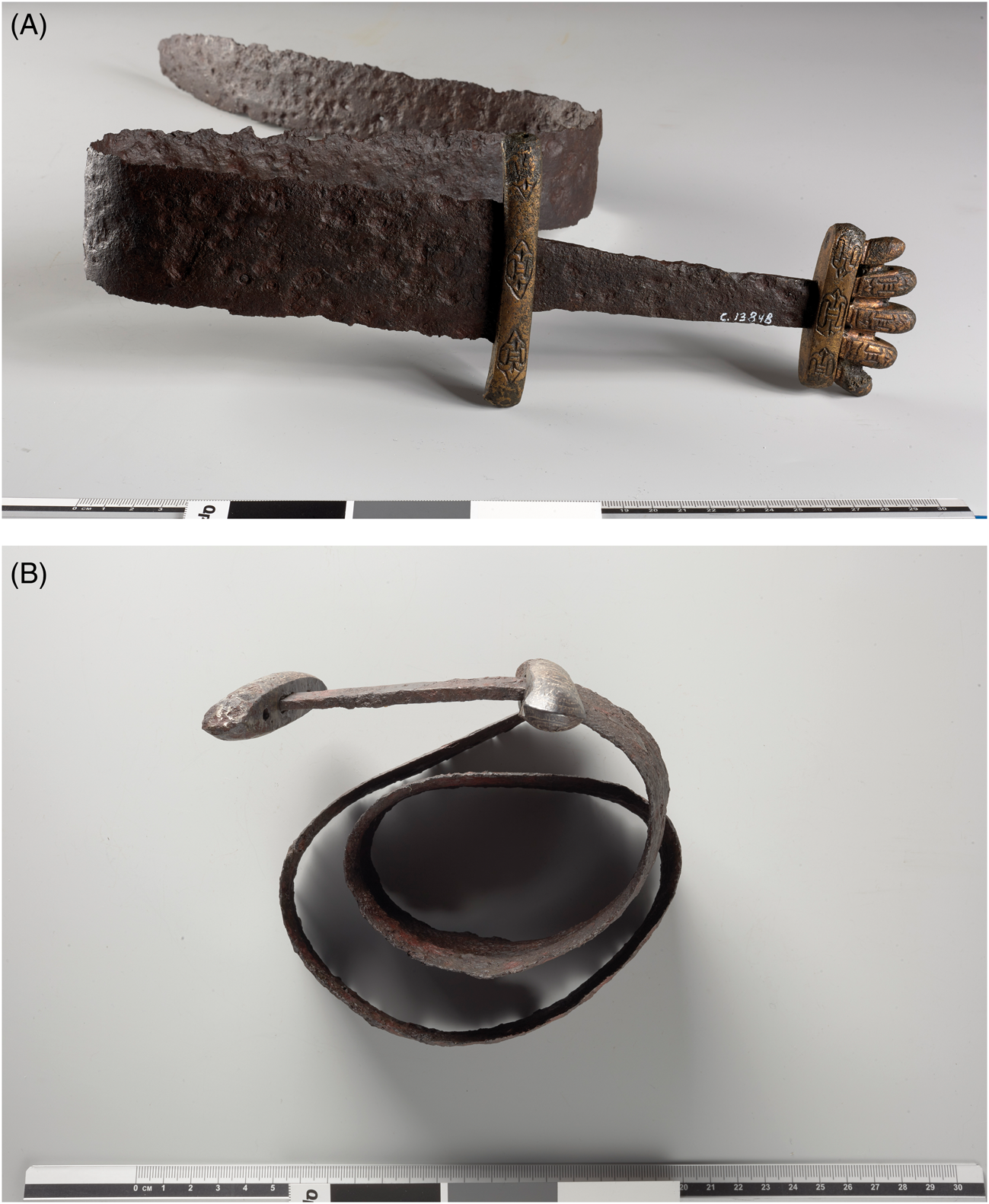
Swords particularly intertwined with elite human bodies: worn on the body, accompanying humans through voyages and violence, perhaps mirroring their very bodily attributes (Brunning Reference Brunning2013, 233–4). Use-wear analyses suggest that swords were worn with plainer ornamentation in towards the body, and with a richly decorated, ‘public face’ directed outward (Brunning Reference Brunning2013, 256). Repairs and modifications would add to their life histories. And when the time came, selected swords were broken, bent, cut and placed in burial assemblages (Fig. 1), most often with cremated human bodies, but also in inhumations (Aannestad Reference Aannestad, Vedeler, Røstad, Kristoffersen and Glørstad2018; Ratican Reference Ratican2020). Spears, axes and shield bosses could also be modified and placed into burials. As the human body could be destroyed or transformed through fire, so could the object-body. Other practices were paralleled among humans and swords too: Ratican (Reference Ratican2020, 262–5) discusses how some weapons were ‘clothed’ much like human bodies were dressed for burial, and in one intriguing burial from Kaupang, southwest Norway, a broken sword was deposited with the pieces stacked on top of one another, just as two human bodies from the same assemblage were found stacked (Blindheim & Heyerdahl-Larsen Reference Blindheim and Heyerdahl-Larsen1995; Ratican Reference Ratican2020, 268).
Two bent swords from southern Norway from the Late Iron/Viking Age, both from mortuary contexts. (Images: Kristin Helgeland/Museum of Cultural History, University of Oslo. CC-BY 4.0.)
Although swords were probably exceptional beings in the Iron-Viking Age, kinship with objects involved other actors we might class as artefacts as well, in different but related ways. Current research suggests that brooches from women's dress, agricultural tools and domestic objects could be treated in similar ways in their ‘death’ (Aannestad Reference Aannestad, Vedeler, Røstad, Kristoffersen and Glørstad2018, 154; Reitan Reference Reitan2011; C. Ratican pers. comm., December 2019); yet this has received significantly less attention than objects typically attributed to men. Some portable objects (and many runestones) literally ‘speak’ in the first person through runic inscriptions: e.g. ‘Þórðr owns me’, ‘Auðmundr made me’, continuing well into the medieval period (Scandinavian Runic-text Database). Domestic objects are the most prolific artefact types chosen for ritual deposition in settlements, at times intentionally bent, broken and destroyed; arguably they embodied relations between houses, bodies, makers and materials criss-crossing time and space, and that these relational bundles could be built into the house-body (Eriksen Reference Eriksen2019, 163–78). Clearly, it is not exclusively exceptional male objects that were animated or required treatment in specific ways. A range of artefacts probably fell outside Western subject-object dichotomies. Indeed, this may have encompassed a spectrum of non-human personhoods, agencies and assemblages, with legendary swords accumulating honour and household objects developing intimate and storied relations through other fields of action.
Crucially, Iron and Viking Age people were at times committed to shepherding artefacts through the end of life in similar ways to humans. They aided objects in speaking through runic inscriptions and evaluated their worth in some of the same ways (reputation, intimate histories). Historied social relations and orchestrated rites de passage were not exclusive to humans, and the care shown to some things mirrored the care shown to the most glorified humans (and exceeded that shown to some other human bodies: see below). Swords, in particular, come across as related, but separate entities from humans. They could have their own life histories, character and social honour—they aged and eventually were transformed at death. In other words, swords were, perhaps, not unlike Haraway's companion species: not quite humans, nor merely extensions of human persons, but grievable companions and kin.
Animals as grievable bodies
Where swords may have acted as companions, other kinships blurred boundaries between what Western eyes would see as separate beings. First-millennium ce practices and imagery, as well as medieval texts, insistently blend human and animal bodies. Some people and gods in Old Norse texts have the capacity to shift into animal shape or send off their hugr [mind, intent] in animal form (Hedeager Reference Hedeager2011, 82–4; Jennbert Reference Jennbert2011, 199–203). A broader range of persons had fylgjur—‘familiars’ or shadow-selves in animal form that followed them through life and in dreams (Eriksen Reference Eriksen, Ilves and Hillerdal2020a; Mundal Reference Mundal1974). This animal aspect or locality of the self may have more broadly informed Norse understandings of the person, and may relate to the tradition of using animals as personal names (e.g. Arn—eagle; Bjorn—bear; Ulfr—wolf).
This blending of personhood through human and animal bodies is equally evident in archaeological evidence (Hedeager Reference Hedeager, Andrén, Jennbert and Raudvere2004; Reference Hedeager, Rebay-Salisbury, Sørensen and Hughes2010; Reference Hedeager2011; Ratican Reference Ratican2020). Northern European material culture was richly decorated in the striking Germanic animal styles. Intricate bodies with both human and animal elements intertwine, dissolve, rearticulate and transform (Kristoffersen Reference Kristoffersen2010). In death, literal bodies of diverse species could be blended. As Ratican (Reference Ratican2020, 175–215) shows, there is an immense diversity in the ways animals and humans, parts and whole, can be configured into the same burial assemblages. Some animals, particularly cattle and horses, were buried independently, perhaps indicating that they were buried as individual, social subjects (Pétursdóttir Reference Pétursdóttir2007, 79). In other burials, like the famous ‘Repton warrior’, other relations may be emergent. This castrated man was buried with a boar tusk between his legs. Ratican rejects the interpretation of the animal tusk as a symbolic substitute of his lost genitalia. Rather, she argues, such cases should be taken seriously as hybrid beings, where man and boar merge, perhaps as a man/boar cyborg (Ratican Reference Ratican2020, 210–11: cf. Haraway [1985] Reference Haraway, Weiss, Nolan, Hunsinger and Trifonas2006).
There is far more to be said about human–animal relations than space allows: about the presence of animals in households (Armstrong Oma Reference Armstrong Oma2010); the display of animal heads and the sacrifice of animals in elite ritual contexts (Lucas & McGovern Reference Lucas and McGovern2007); and the social equation of unfree humans and livestock, who may have slept together in longhouse byres (Eriksen Reference Eriksen2019).
For our purposes, let us note that first-millennium personhood was recognized in its extension through multiple bodies, human and animal. Because of this, northern European people in the past practised cross-species kin-making in ways that are not entirely dissimilar to Haraway's. Rather than domesticating animals as resources or anthropomorphized pets, Norse concepts such as fylgjur embrace the animal traits of animals (cf. Haraway Reference Haraway2003, 36–9), and affirm these even within social spheres where we would expect strictly human concerns to matter. Agency did not emerge from human bodies alone, but from more-than-human blending of capacities. On the other hand, a focus on grievability invites us to notice other, perhaps less ‘affirmative’ outcomes of living as extended subjects in this way. The frequent blending of human and animal bodies in death suggests that, as subjectivity extended through different bodies, it was appropriate to ensure that those bodies died, to be grieved, together. The line between ‘sacrificial lamb’ (or horse, ox, etc.) and ‘companion species’ thus becomes blurred in the ‘ontological choreography’ (Haraway Reference Haraway2003, 100) of Iron and Viking Age grief. More disturbingly, it is not always clear which bodies in a mixed grave shade into ‘sacrificial’ territory, i.e., which lives and deaths were primary, and which lives were ended as an appropriate extension of grief.
Houses as grievable bodies
Iron and Viking Age practice oriented hope and grief around precisely the more-than-human assemblages that posthuman feminism calls us to affirm. Longhouses did not simply frame social life, but arranged diverse actors into broad alliances.
Elite halls were central locations in Iron and Viking Age worlds. They could be homes for dozens of people of varied status; gathering places for feasts; centres for coordination of production; and symbolic echoes of legendary halls (Herschend Reference Herschend1998). The largest halls tend to be rebuilt repeatedly on the same location, stressing continuity in life through centuries (e.g. Christensen Reference Christensen2010; Munch et al. Reference Munch, Johansen and Roesdahl2003). Literary sources recount dreams where the destruction of the hall often portends tragedy for the kin group (the attackers appearing in animal form) (Eriksen Reference Eriksen, Ilves and Hillerdal2020a). In this way, the personhood of elite humans extended not just through animal localities but through generations of human bodies, timber posts, thatched roofs and performances within (cf. Eriksen Reference Eriksen2019).
Further archaeological evidence extends our insights beyond elite, male-dominated spheres of activity. Above, we mentioned that material things, many of them products of long and intimate relationships with humans of various sorts (perhaps especially women: Kristensen Reference Kristensen2010) could be embedded in houses during moments of refurbishing or repair. More-than-human lives that arose in the house could be woven back into its very fabric in this way. The same was true of human bodies. Human remains are occasionally found within architecture—in post-holes, within doorways, or in wells or pits. The circumstances of their deaths may have varied, with some lives taken specifically for deposition, and others woven into the structure of a settlement after a natural death (see below). In some regions, infants seem to be preferred for deposition, suggesting particular ways of enacting the intersection of human life, dwelling places and multigenerational futures (Eriksen Reference Eriksen2017).
Lastly, there are suggestions that buildings, as assemblages of many more-than-human lives, could be especially grieved at their lives’ end. Beyond the written dreams discussed above, where the well-being of the house provokes anxiety, care and sorrow, there is archaeological evidence for the grieving of longhouses (Eriksen Reference Eriksen2016). Some houses are dismantled, burnt, and/or superimposed with burial mounds (Grindkåsa Reference Grindkåsa, Mjærum and Gjerpe2012; Myhre Reference Myhre1980; Ramqvist Reference Ramqvist1992). Some mounds contain no human bodies, a fact that cannot strictly be explained away by acidic soils or poor preservation—the mounds mark houses. Others bundled dead humans and dismantled architecture, emphasizing the intimate relationality between lives. A house may have been a vibrant, emergent body-subject in its own right, ‘a meshwork with an essence or a life force that has now run its course, and deserves commemoration’ (Eriksen Reference Eriksen2019, 200) with forms of care more typically associated with elite men and women. Given the metonymy between humans and houses, it may be no wonder that in moments of sudden change or loss, where large numbers of people participated in a monumentalization of death, sometimes a dead human body centred the activity, sometimes a dismantled house, and sometimes both humans and structures appear to centre communal grief.
In this way, people in the Iron and Viking Ages recognized the multiplicity of being that posthuman thought seeks to embrace: the fact that we are not one, but many. First-millennium personhood could inhere to an artifact, a human, or manifest in human and animal forms simultaneously. But any such beings were—and were known to be—part of larger transversal becomings that could be embodied in houses and mounds. A house was an alliance of flesh and timber, metal and earth; it was cared for, dreamed of, grieved in death. To grieve a house could entail the destruction of other human and material beings, binding together in death lives lived in alliance.
Ungrievable bodies
First-millennium worlds were populated with a wide range of beings and powers—bodies and persons emerged in complex ways among brooches, weapons, houses, animals, elite bodies and everyday objects. Kinship extended across landscapes, monuments, artefacts, animals and humans. And yet, such an explicit more-than-human world did not repel oppression, violence and abuse—they went hand-in-hand. While some objects may have been persons in these worlds, in turn, some people may have been objects.
In a society where agency and honour were in some ways synonymous, and where the most honoured lives (human, sword, house or even possibly horse) formed dramatic turning-points for whole communities in death, commemoration of the human dead is nevertheless remarkably selective. It has been tentatively estimated that as much as half the population in the Viking Age did not receive burial in a way we can recognize archaeologically (Price Reference Price, Brink and Price2008). Where the carefully buried rest at the heart of conventional archaeological narratives of the period (see above), following the ‘others’ sheds light on lives and deaths valued in a very different framework. Here we focus on two: children and unfree people.
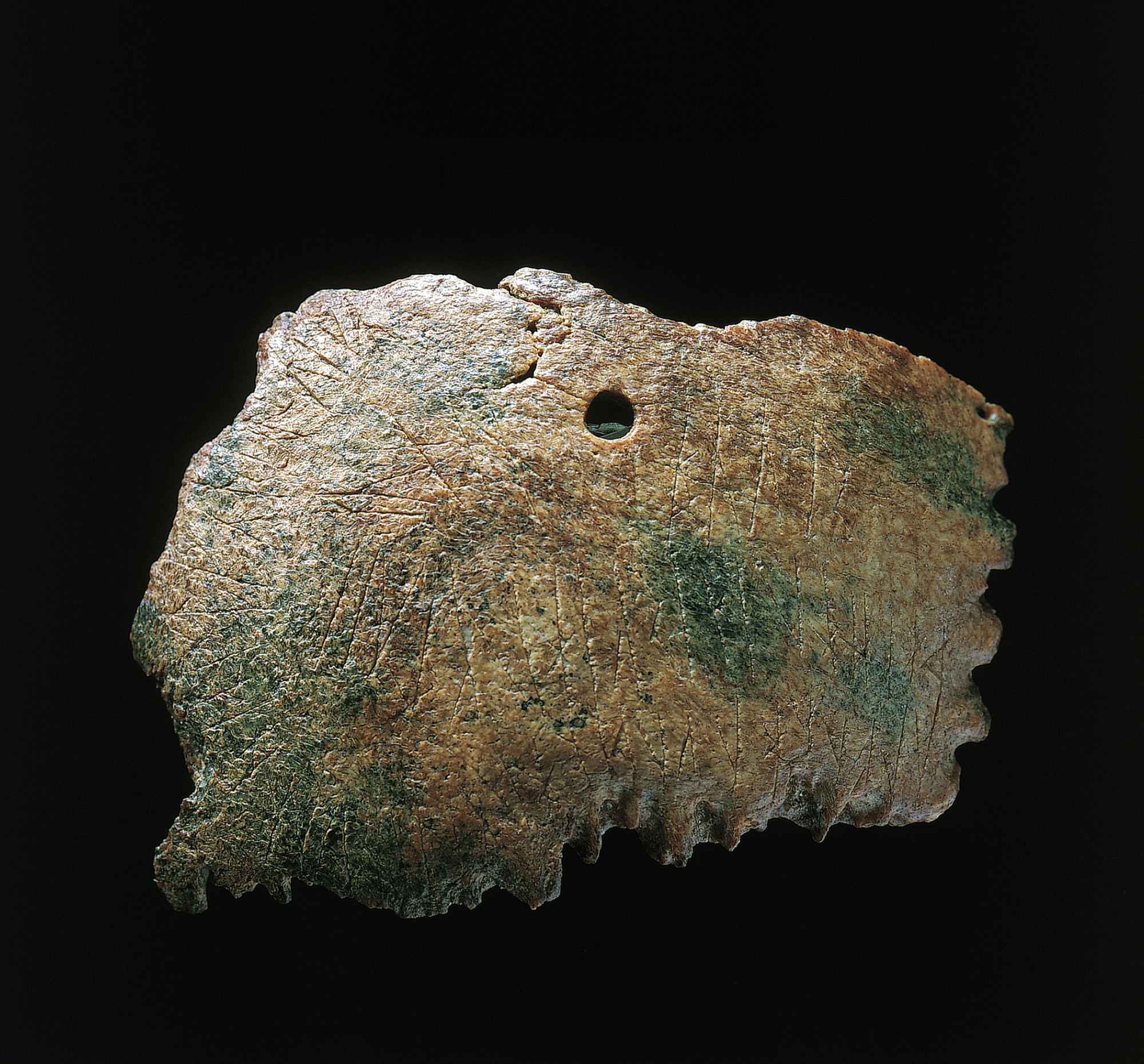
Children are underrepresented in conventional burial contexts (Arcini Reference Arcini2018; Holck Reference Holck2008; Sellevold et al. Reference Sellevold, Lund Hansen and Balslev Jørgensen1984). However, they do turn up in other contexts and assemblages, as mentioned above: infants and children were deposited in wetlands and settlement contexts across pre-Conversion northern Europe (Eriksen Reference Eriksen2017). A small minority of these children display physical indications of violent death; notably, infanticide was legal and socially acceptable in the Iron and Viking Ages, and still legal after the Conversion if the child was disabled (Mejsholm Reference Mejsholm2009; Mundal Reference Mundal1987). While in most cases cause of death is unknown for deposited children, the spatial patterning of the infants mirrors the deposition of selected artefacts in constructional elements —which, we argue, is likely not to be a coincidence. These bodies were perhaps not grievable as persons, but rather valued as powerful artifacts or animate objects, treated in similar ways to other objects chosen for deposition to reinforce the potentially more ‘living’, more grievable house. Along with children, a wide array of ‘body-objects’ appears in depositional contexts: worked human bone (Fig. 2) and other selected body parts, some clearly products of violence (Eriksen Reference Eriksen2020b).
A human parietal bone perforated and inscribed with runes, from the excavations of Ribe, Denmark, dated to the eighth century. The skull fragment was found in a midden layer in the workshop area, as were three other human skull fragments in three further workshop plots. (Image: Museum of Southwest Jutland, CC-BY 4.0.)
Other human lives invite further ontological discomfort, treated similarly in less-than-human ways. It is curiously undercommunicated that Viking Age society (and perhaps its predecessors) was a slave-owning one (e.g. Brink Reference Brink, Brink and Price2008; Raffield Reference Raffield2019a; Zachrisson Reference Zachrisson, Lindqvist and Myrdal2003). The consequences of the presence of humans with no or very limited legal rights—‘thralls’—have arguably not yet been drawn. For instance, to kill a thrall one owned was usually not punishable by the early medieval Norwegian laws. Certain thralls could be appreciated advisors and administrators, while others were ‘socially, economically, and judicially equal to animals’ (Brink Reference Brink, Lindkvist and Myrdal2003, 114). The presence of small hearths in byres among animal pens arguably gives a glimpse of the enactment of this fact (Eriksen Reference Eriksen2019). Contemporary sources document sexual exploitation of unfree bodies, perhaps especially those of enslaved women (Karras Reference Karras1990): a fact that rarely makes it into the gender archaeologies of the first millennium.
These two configurations of human life capture just some of the ways in which human bodies could be disposed of in the service of other beings. We could explore more—young women laid next to corpses and killed as a way to communicate with dead elites (Ibn Faḍlān Reference Ibn Faḍlān, Lunde and Stone2011); decapitated heads fixed to saddles (Gardeła Reference Gardeła, Gardeła and Kajkowski2013), and a wide range of other violences helped to construct first-millennium subjects across Cartesian lines. Grievability, in Butler's (Reference Butler2009) telling, is inextricable from the concept of precarity. Being, or rather becoming, is always a vulnerable thing; yet some beings are affirmed as lives, cared for when possible and grieved when lost, while others, non-lives, can be sacrificed without grief. If many bodies in the Iron and Viking Age were property or animate things, useful in their suffering, imagine the depths of their lives’ precarity. That they were disposable in the construction of nondualistic others is, in so many ways, beside the point.
Discussion: ontological discomfort, ethical commitment
Through the discussions above, a historical period so stereotyped and romanticized, appropriated and exploited by today's dualistic West, radically shifts. Rather than the epitome of machismo, or the Nazis’ holy grail of Aryan perfection, a vibrant, complex and rich world emerges along decidedly ‘other’ relational lines. The ontological turn makes this possible. By asking, not how one sees the Iron and Viking Ages, but rather what there was to be seen (paraphrasing Holbraad & Pedersen Reference Holbraad and Pedersen2017), we have traced the emergence of beings that were more extensive, less strictly human and less categorically bounded than either public stereotypes of the Vikings or conventional archaeological discourse on warrior-chiefs and housewives allow.
Posthuman conversations open this period to deeper ontological exploration. By confronting the reality of Western dichotomies in the present, relational thinking provokes us to explore other worlds and consider them seriously (Harris Reference Harris2018). Metaphysical concepts are invaluable here; terms like ‘subject-assemblages’, ‘companionship’ and ‘precarity’ derived from philosophy help to develop archaeologists’ openness to other possible modes of being. The particularly posthuman feminist emphasis on immanence and futurity encourages more concrete engagement with practices of alliance and subject-formation than other strands of relational philosophy (Braidotti Reference Braidotti2011, 129). Comparing concrete practices in the past with specific modes of affirmative practice suggested by Haraway (Reference Haraway2003; Reference Haraway2016), Braidotti (Reference Braidotti2011; Reference Braidotti2019a) and others has activated the archaeological record to reflect on relational possibilities and their ramifications, here starting from the specifics of a social ontology.
However, the posthuman feminist ethical claim sits uneasily with this analysis of actual non-humanistic worlds. In the Iron and Viking Age, people practised radically relational alliance-making in some ways consonant with posthumanist suggestions. They created subject-assemblages of timber and clay, human and animal bodies, and formed companionships with swords and loomweights. Yet a grounding in grievability invites us to assess the ethical commitments that these alliances entailed—and, more importantly, the ones that they did not. Many human lives were potentially less alive than the subject-assemblages around them; they were not grieved but disposed of in the service of others. Where posthuman feminist ethics address violence as conservative counter-creativity (Braidotti Reference Braidotti2011, 7), side-effects of dichotomous hierarchies (Ferrando Reference Ferrando, Thomsen and Warmberg2020), or as a diminishment of relations and potentials (Braidotti Reference Braidotti2019b, 169)—that is, as the antithesis of posthumanist affirmation—first-millennium posthuman-like positionality entailed violence and affirmation in equal measure. Nor did unravelling human/non-human dichotomies disrupt hegemonic power. Mostly elite, mostly male-gendered subjects retained the power to ‘forfeit’ others in the service of ‘the lives of “the living”’ (Butler Reference Butler2009, 31), no matter how more-than-human ‘the living’ were.
The fact that non-humanistic ontology produced uncomfortable ethics in one place and time is not proof that posthuman commitments cannot foster ethical action. But if, in many actual worlds without Enlightenment dualisms, hegemonic power flourishes, we question whether posthumanism is anything more than ethically neutral—giving us new things to see in the past and perhaps the future too, but of ‘joyful’, ‘dark’ and above all ambiguous varieties alike. Investigating ontology together with grievability has sharpened our sense of a divide between ontological openness and ethical commitment. This runs counter to the posthumanist suggestion that ethics is a matter of ‘living our philosophy’ (e.g. Ferrando Reference Ferrando, Thomsen and Warmberg2020). We agree, at our most Deleuzian, that human trafficking is materially vibrant, intertwining and developing the active capacities of infrastructure, trucks, drugs and weapons technology alongside diverse human bodies. And this understanding can be of high intellectual and real political value. Yet our primary ethical commitment is hopefully to the raped and sold bodies, more so than trampled plants, broken weapons, or burst tyres.
A feminist, post-anthropocentric, ontologically aware archaeology is, for us, about directing research to different kinds of agents, spaces and beings in the past and the relationships they emerge from. It entails a curiosity to understand how those relational worlds have played out at specific times and places. It aligns with second and third-wave feminism in giving a voice to marginalized and invisible populations of our histories—a goal that posthuman thinkers also share (Braidotti Reference Braidotti2019, 161; Cobb & Crellin, this section). For this particular field, that can include to explore the Iron or Viking Ages from the point of view of the house (Eriksen Reference Eriksen2019), the material engagements of childhood (Raffield Reference Raffield2019b), or the commemorative power of soil (Cannell Reference Cannell2021). It includes recognizing that while swords, horses and halls could be grievable, some humans were not.
In this period, as in others, new materialism and the ontological turn can help us understand how some relations allowed the flow of specific forms of power; how some bodies were crafted in precarious constellations. We should recognize that—in this often glorified historical period—someone always paid the price. Alberti (Reference Alberti2016b) argues evocatively and compellingly for doing archaeologies ‘of risk and wonder’. However, to really take past people's ontological commitments seriously, can—and at times, should—not only be wonder-full, but deeply uncomfortable.
Acknowledgements
We warmly thank Hannah Cobb and Rachel Crellin for the opportunity to contribute to this special section, for their comments on the revised text, and for organising the TAG session from which it springs. Marianne also wants to thank everyone who discussed the nascent arguments of this paper at TAG. Claire Ratican provided helpful feedback on a draft version of this article. Many thanks also to John Robb and two anonymous reviewers for constructive and engaging reviews that substantially improved the argument.This publication is part of the ‘BODY-POLITICS’ project, funded by the European Research Council (ERC) under the European Union's Horizon 2020 research and innovation programme (Grant agreement no. 949886).


 Open access

