

Field archaeologists have many responsibilities to consider before, during, and after fieldwork. This includes planning what happens to the collections that are generated through their work. Collections care decisions—both in the field and after collections are held in storage for analysis and, ultimately, curation—are not topics in which most archaeologists are trained. Yet, an understanding of basic conservation techniques, object care, and preservation is imperative for the protection and curation of archaeological materials. This paper introduces basic methods for correctly caring for objects as they are recovered from buried sites. It provides an overview of techniques used to extract delicate objects from in situ provenience, ways to safely transport objects from the field to the lab, and field preservation methods that protect objects and recovered samples. With proper preparation prior to archaeological fieldwork, attention to conditions during excavation, and quality conservation environments in lab and storage facilities, valuable data can be preserved for the future.
THE ROLE OF THE ARCHAEOLOGICAL CONSERVATOR
Archaeological conservators are trained professionals who are focused on the care and preservation of the archaeological record, including sites, features, recovered objects, and associated records (AIC 2019). Many archaeological conservators are specialists. Some work only on underwater or waterlogged sites. Some may focus their expertise on terrestrial sites. Others may be object conservators who work with curated collections, and they may only treat specific kinds of objects (e.g., metals, textiles, ceramics). In short, the work of archaeological conservators is specialized, and in many instances, their expertise is necessary for ensuring long-term preservation of fragile objects and records.
While the role of conservators should not be preempted, there are ongoing problems with museum collections that have been acquired as a result of field excavation. Identifying this as an issue within active archaeological conservation, Rodgers notes:
As long as curators and archaeologists buy into the notion that conservation is too complex and difficult a subject to tackle on their own (on any level), the collections will continue to languish under inaction and neglect. The final irony remains that while many objects could be saved with very simple procedures, they may in fact be doomed while awaiting professional attention [Rodgers Reference Rodgers2004:5].
Gaining experience in proper preparation and care of archaeological objects, as well as knowledge of when to bring in a conservator, should be part of every field archaeologist's background and training (Paterakis and Roby Reference Paterakis and Roby2017). A general rule for most archaeologists is that if they are unsure of the correct procedure to support and preserve the object, then they should seek professional conservation or—at the very least—consultation with a conservator. Consulting with a conservator prior to excavation will help determine how much of their involvement is necessary for the project. One approach to field conservation is to have a conservator “on call” during fieldwork so that they may provide guidance and on-site assistance as needed (Brady et al. Reference Brady, Gleeson, Myers, Peachey, Seifert, Wellman, Williams and Young2006). A conservator can also provide suggestions for basic equipment to have on hand during fieldwork. Both the Society for Historical Archaeology and the American Institute for Conservation have created supply lists for fieldwork (see https://sha.org/conservation-facts/faq/preparing-for-conservation/ and https://www.culturalheritage.org/docs/default-source/resources/adg-checklist.pdf?sfvrsn=4). Generally, the supplies needed for basic conservation in the field include support materials (cardboard, foam, etc.), stabilization materials (gauze, plastic wrap, plaster and bandages, etc.), and basic consolidation materials (adhesives, brushes, etc.). A conservator can also demonstrate stabilization techniques to the archaeologist prior to fieldwork.
Field conservators, with specialized knowledge in object preservation, have an important role in archaeology. On-site, they can provide guidance and oversee the removal of fragile objects that have long been buried. Collections managers, trained in the care, storage, and handling of objects, are also important partners for field archaeologists. They can share critical information for continued and long-term curation of objects and associated records.
Improvements in conservation methods, object stabilization and preservation, and development of materials that aid in stabilizing and transporting objects are available to field and lab managers through conservators and museum curators and collections managers, as well as specialized websites.Footnote 1 Several recently published books and reports address issues of field conservation (Armstrong Reference Armstrong2012; Pedeli and Pulga Reference Pedeli, Pulga and Risser2013; Rodgers Reference Rodgers2004; Sease Reference Sease1987). For example, Pedeli and Pulga (Reference Pedeli, Pulga and Risser2013:43–52) provide specific information about assessing and handling objects of various materials when uncovered in the field. The information available through these and other resources will help the field archaeologist in beginning the process of creating a conservation environment that will give the objects a long “second life” as they become the foci of continuing study and exhibition in museums. Because excavators are the first to handle, transport, and research archaeological collections, curators and collections managers should take an active role as consultants with field archaeologists on collections care and preventative conservation (Childs and Benden Reference Childs and Benden2017; Sullivan and Childs Reference Sullivan and Childs2003).
PRE-FIELD PLANNING FOR OBJECT CARE
Prior to fieldwork, planning for the care of collections (including objects, samples, and associated records) must be included in the project budget (Childs and Benden Reference Childs and Benden2017; Majewski Reference Majewski2010, Reference Majewski, Childs and Warner2019; Pedeli and Pulga Reference Pedeli, Pulga and Risser2013). In reference to Childs and Benden's (Reference Childs and Benden2017) Stage 1 of the cycle, the project director should consider the necessary supplies for care of objects in the field; fees for consulting with or hiring field or objects conservators; the costs associated with lab preparation and curation fees; and the costs identified for collections processing and long-term care.
Most field archaeologists know that soils affect objects. Pre-field planning includes considering the likely conditions of preservation that are typically encountered in the area of the proposed archaeological excavation: for example, whether excavations will be in wet or dry environments, the soil pH and mineral contents of the soil, the types of objects that might be recovered, and the required steps needed to preserve these objects (Pedeli and Pulga Reference Pedeli, Pulga and Risser2013:13–20; Singley Reference Singley1981, Reference Singley1988). If these steps are taken, those unexpected, important, fragile objects will be preserved because needed supplies, knowledge of how to preserve them, and assistance from the conservator “on call” will be available.
Finally, when planning field budgets, planning for object care and stabilization before fieldwork begins ultimately reduces the costs of collections care. Utilizing preventative techniques (including creating conservation environments, which is a passive technique used by most collections care facilities and addressed later in this paper) is the most cost-effective approach to collections care. Budgeting for object care and curation should be in every Phase II and Phase III Cultural Resource Archaeological project (Neumann and Sanford Reference Neumann and Sanford2001).
CARE OF OBJECTS DURING FIELD EXCAVATIONS
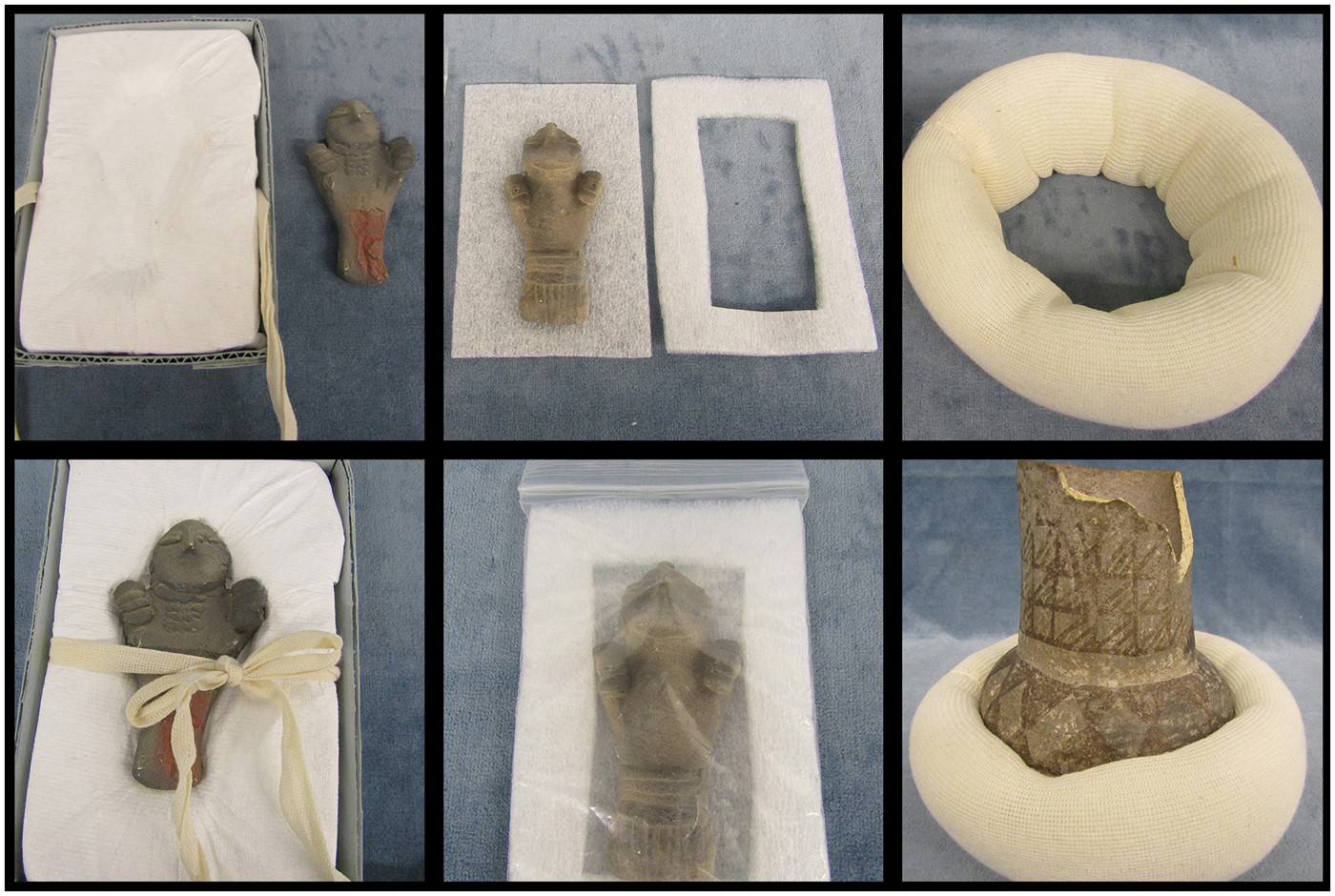
StabilizingFootnote 2 an object at each point of recovery and transportation (as it is uncovered, carried from the site to the lab, processed, and then stored for research) is critical for preserving the integrity of archaeological field collections. What benefit to future use of an object is there when it is carefully recorded in situ but removed and transported in such a way as to destroy the integrity of the object? Creating cavity mounts, using archival support foams, understanding the nature of the object and possible reactions to exposure, and creating good field tags are all aspects of object preservation that must be frequently addressed during excavation (Figure 1).
Packing methods for fragile objects: left, cavity mount created by carving polyfoam (ethafoam) and covering it with a smooth surface layer (Tyvek)—the object is kept in place with twill tape ties; middle, simple support created from thin polyethylene foam (ethafoam)—the back layer supports the entire object, and the front cutout provides additional protection; right, object support made from cotton stockinette filled with polyester batting. (Photographs by Glenna Nielsen-Grimm.)
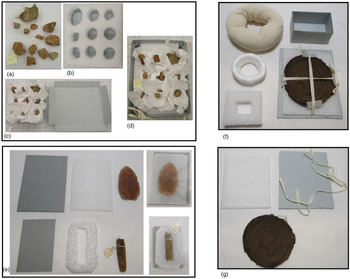
With proper preparation, supplies can be on hand to stabilize fragmented objects as they are uncovered and prepared for transportation (Figure 2). Supplies to appropriately clean objects in the lab, correctly label them, record information about them in an archival field/lab log, and then store them should be considered necessary field expenditures. Soft bristle brushes of all sizes, small dental tools, tweezers, polyfoams, boxes or trays in which to transport and store objects, and acid-free tissue or poly stuffing are just a few items that all field labs should have for cleaning and stabilizing objects (see Balachandran et al. Reference Balachandran, Chemello and Grieve2011 for a checklist of field supplies). Materials and information required for standard methods of object care should be on every field excavation list of supplies and in the field library.
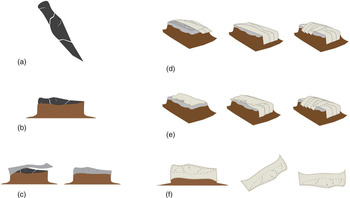
Backing/facing a fragile object in situ using plaster wraps or bandages and plaster of paris to stabilize and strengthen a fragile object (illustration by Claire Davis): (a) fragile object in pieces; (b) object in situ pedestaled (c) then covered with aluminum foil or plastic cling wrap, making sure it is secure; (d) method 1, using gauze bandages soaked in plaster of paris, completely cover the object, covering all areas and down the sides, adding a second alternate layer; (e) method 2, put a thin layer of plaster (about 1 cm) over the covered object, lay down a gauze bandage strip or mesh while plaster is wet, add more plaster if necessary, and repeat with the strips in the opposite direction; (f) when completely dry, the object can be completely excavated, turned over, and stored in a rigid container.

Care of objects should begin the moment an object is discovered. Objects begin to deteriorate as soon as they are removed from the excavated environment where they have had years to reach equilibrium (Swain Reference Swain2007:183–186). Deterioration often manifests in shrinkage of the object as it dries out, reacts with the air, or breaks and crumbles as it loses the support of the surrounding soil (Cronyn Reference Cronyn2001:5; Rodgers Reference Rodgers2004:4). The local site soils and climate affect the stabilization of any uncovered object. Isolation and consolidation of an object as it is uncovered, or cleaned and stabilized in the lab, must be reversible and cannot contaminate or interfere with future treatment or scientific analysis.
If needed supplies (see Balachandran et al. Reference Balachandran, Chemello and Grieve2011) are not on hand, it is better to leave the object in its surroundings until conservation expertise and supplies are available. For example, pottery may need to remain in the soil to dry in situ before being lifted out. Otherwise, the piece may crumble, and the object's integrity may be lost. Painted wood, metal, and glass can all disintegrate within minutes of being exposed to air if efforts are not made to cover and stabilize them immediately. Silver objects will go black when exposed to air because silver reacts with atmospheric sulfur to form Ag2S (or tarnish). Iron will flash rust in a humid and/or salty environment, and it may explode into multiple fragments as it dries out if recovered from acidic or salty soil (Rodgers Reference Rodgers2004:71–104; Walker Reference Walker2001:141–152).
STABILIZATION AND TRANSPORTATION OF OBJECTS
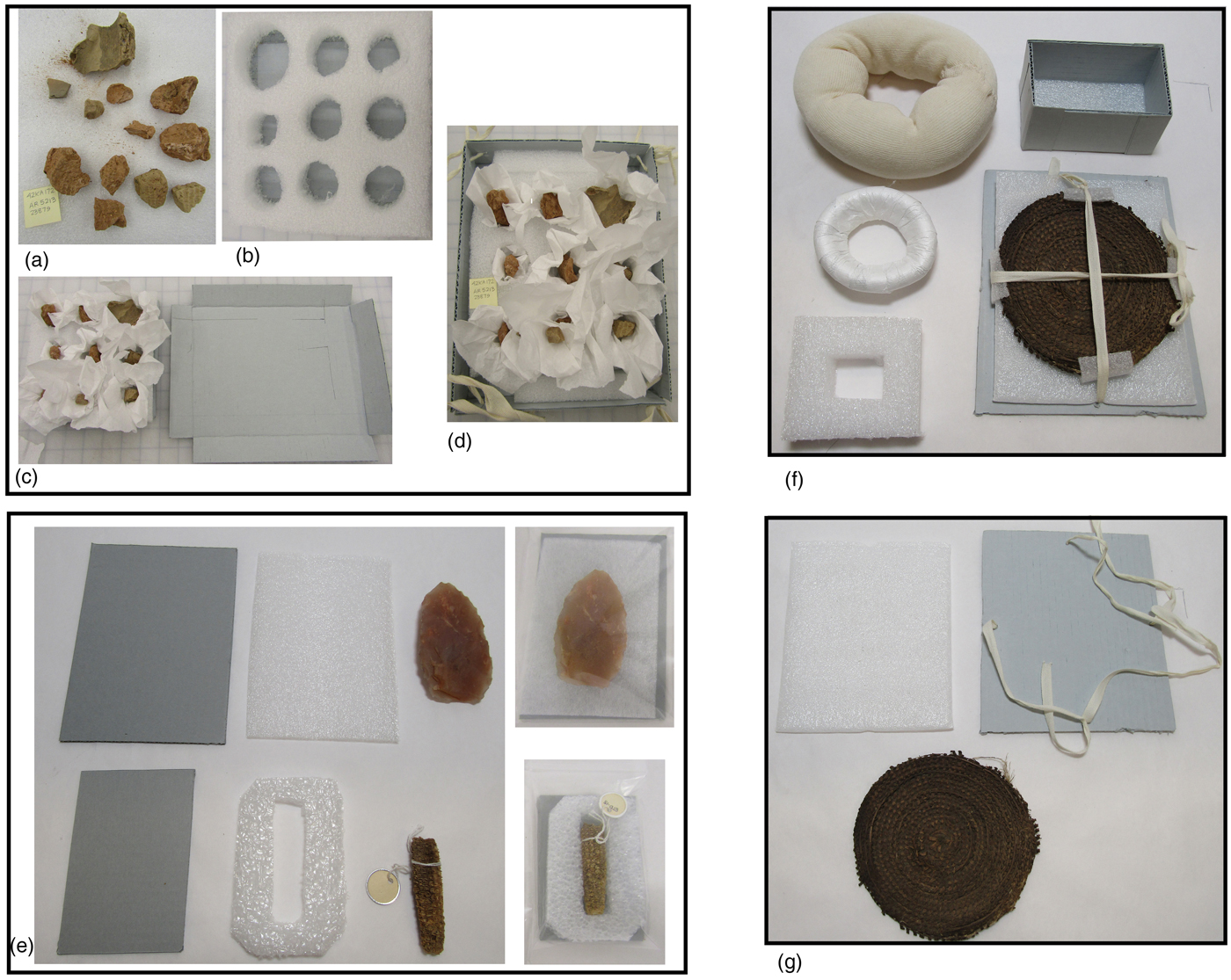
Transporting objects requires thoughtful consideration of possible damage to the object by vibration, accidental dropping, and rough handling. To stabilize and remove an object, it may be necessary to isolate the entire soil matrix within which the object is found, consolidate the object (Figure 2), and then lift the entire block as one piece into a waiting tray. This process, known as block lifting,Footnote 3 allows the object to be safely transported on a tray from the site to the lab. This defers extraction and cleaning of the object until a conservator is able to assess the condition of the object and determine steps needed for its preservation and conservation. The method used for block lifting will depend on available supplies. It generally requires a consolidant and facing material to keep the object intact, as well as support material to keep the block intact during transport. It is important to become familiar with these techniques and materials prior to arriving on site. Several resources are available, including demonstration videos on YouTube. Objects that do not require block lifting still require protection and support during transportation. Having thin polyfoam sheets, polyethylene bags, archival cardboard, acid-free tissue, stockinette and polyester batting enables the excavator to create quick supports that help transport the object safely to the field lab or repository (Figure 3).
Appropriate and quick methods of stabilizing objects using archival materials: (a–d) unfired basket-impressed clay fragments; foam plank with cutouts—objects are nested into the cutouts using acid-free tissue; then placed in a rigid box with tied corners for transporting and handling the objects; and a lid can be made to store the objects, if needed; (e) using archival board and foam, objects can be stabilized and protected by placing them in a reclosable poly bag; (f) possible cavity mounts from foam, backer rod covered with Tyvek, stockinette, archival boxes, or board and foam backing with cotton twill ties to support the object; (g) foam and board used to stabilized a fragile basket fragment. (Photographs by Glenna Nielsen-Grimm.)
OBJECT DETERIORATION
Deterioration or preservation of an object is often determined by the object's material composition, the environment from which it was recovered, and how it was used in the past. An object may have an inherent vulnerability (called “inherent vice”) that will hasten the destruction of the object due to either the way it was made or the type of materials used. For example, baskets will eventually collapse due to weaknesses in the materials from which they are woven. Over time, most baskets continue to lose integrity and shape, especially in archaeological environments. As the basket is buried under years of accumulated debris, it will flatten, bend, break, and eventually fragment. Support for baskets and similar objects is essential to maintain their shape and integrity in the future. Anyone transporting or handling a basket, especially in extremely dry areas, should be aware of the loss of flexibility and inherent brittleness of the basket and support the basket/fragments at all times. Conservation should begin in the field and continue in the lab for most objects by giving them complete support, stabilizing them as needed, and reducing handling as much as possible. A well-constructed object mount will provide a way to handle the mount, not the object.
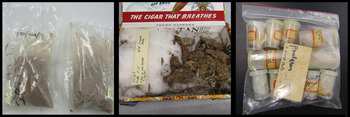
It is sad when an object, once described as a clay figurine, arrives at the laboratory or museum as a pile of clay fragments. A simple stabilizing cavity mount, placed in a small box labeled “Fragile Object” can preserve an unfired clay object—such as this figurine—from a place at the bottom of a box filled with heavy stone tools and lithic fragments. Fragments from a charred basket might have remained intact, and the integrity of a prehistoric basket might have been preserved, if they had been stabilized while isolated in situ at the site from which they came (Figure 4).
Inappropriate packing methods: left, clay figurines bagged with no additional support or protection; middle, basket fragments embedded in cotton wadding, packed in a cigar box; right, vials containing fragile objects left to bump against each other, and vials are off-gassing. (Photographs by Glenna Nielsen-Grimm.)

Objects may be composite artifacts, with both inorganic and organic elements, adding to the need to understand preventative conservation environments for each element. Care should be directed to the most fragile part of the object, and portions may need to be isolated to preserve the integrity of the object. Isolation may just be placing a small piece of acid-free tissue or polyethylene around the most fragile portion. It is important to keep pieces of an object together as much as possible. Botanical organic materials have a cellulosic base, which often requires a different environment from those with a protein base. For example, buffered materials are acceptable for storage and transport of cellulosic-based materials but are not for those with a protein base. Sources of the fibers include cotton, flax, yucca, bark, or other local plants with long fibers. In many objects, these fibers are knotted, spun, twisted, or felted. Identifying these materials within archaeological remains attests to ancient technological behavior. Preservation of even a single fiber is important.
Depending on the environment, monitoring relative humidity and, if possible, maintaining relative humidity at a constant value in the field lab will reduce shrinkage, breakage or delamination, molding, rot, or deterioration of objects. Small humidity chambers can be created using sealable plastic or glass containers, with silica gel packets to control humidity levels.Footnote 4 Wood, seeds, fractions from flotations, pollens, and carbon samples taken from the field need to be appropriately isolated to reduce contamination. Isolation of samples can be accomplished by using large polyethylene bags that are self-sealing or by using glass containers. Most organic, plant-based materials are acidic, which require a buffered or pH-neutral environment. Isolating them from protein-based objects can be an important way to preserve them.
Leather and fur are fragile, and they are often found as composite objects in association with bone and horn. When recovered during excavation, leather and fur may be difficult to recognize as coherent objects and often remain unidentified or even preliminarily identified as feces. Specialists may be needed to identify and prepare the objects for long-term curation. Protein-based objects, if subjected to the wrong conditions, can either become a gelatinous mass or extremely brittle and fragmented. Bone and horn can delaminate to such a degree that they are almost unrecognizable, and they may need specialized attention when uncovered in order to preserve them. Horn will often need consolidation to stabilize and reduce further deterioration either in the field lab or by a conservator. It is highly recommended that, if such an object is uncovered, it be properly stabilized in a plaster wrap or stabilizing cavity mount and then boxed for continuing protection (refer to Figure 2 for procedure). Protein-based objects should never be stored in a “buffered” box or paper because the buffering agent will cause desiccation of the protein-based material.Footnote 5
PREVENTATIVE CONSERVATION ENVIRONMENT IN THE LAB: THOSE AGENTS OF DETERIORATION
Creating a conservation environment is one of the first and most effective means in caring for objects by addressing identified agents of deterioration (Getty Conservation Institute Reference Knell2000; Meister Reference Meister2019; Rose and Hawks Reference Rose, Hawks, Rose, Hawks and Genoways2002). Mitigating against agents of deteriorationFootnote 6 starts in field labs and is as important as it is in museums or repositories. Identifying and correcting for destructive agents can begin with securing the field lab and keeping a log of everyone who enters. As bags or lots come in from the field, they should be immediately tagged and given specific locations. Objects or samples removed from field bags require identifying tags that must be updated as they are analyzed, cleaned, photographed, and placed in containers that will store and stabilize the objects. All bag, box, and lot locations must be entered in a permanent archival notebook, and updates must be made as the locations change during stabilization or analysis of the contents. The object's eventual disposition must be part of the ongoing field and lab record. Bins that can be used to stabilize objects should be part of all field labs, minimizing object handling and loss of provenience data. Putting objects in boxes or bins will help reduce deterioration caused by light, as well as moderate temperature and humidity fluctuations. Keeping objects in waterproof, lidded plastic bins, self-sealing polyethylene bags, or boxes on shelves may also protect against flooding, pests, and damage caused by natural disasters. In high humidity, perforated bags that allow air circulation may be necessary to protect against mold or fungi attacks.
Using shelves to store containers and objects alleviates the need to stack boxes. Most cardboard or fiber boxes cannot withstand the high weight and pressure created through stacking and are not designed to stack more than two high. Ultimately, stacking cardboard boxes will damage, deteriorate, or even destroy excavated objects, field samples, and records. If stacking is required, then large plastic lidded bins constructed for stacking are preferable. Depending on the environment, plastic bins can be sealed or perforated to allow for moisture retention or circulation of air.
PREPARING COLLECTIONS FOR PERMANENT STORAGE AND CURATION
Collections care specialists who manage archaeological field collections in museums are available for consultation. They are ready to give support and help as needed to mitigate against easily avoided destruction or deterioration of fragile, and often unique, prehistoric and historic objects. Active consultation is a highly effective way for collections care specialists to disseminate relevant and timely information about object care to field archaeologists. The collecting institution can also provide information about correct storage and transportation of objects in an easily understood and visual way on its website. This can be a valuable and easily accessed resource for all object care providers. If needed, collections managers and object conservators are often willing to visit field labs or archaeology sites to give specific guidance to lab managers or field archaeologists about specific issues such as appropriate ways of packing objects, proper methods of identifying objects for museum accessioning and cataloging, and correct archival procedures when preparing associated records.
When collections are ready to be transported to field labs (or to permanent storage), it is essential that cultural heritage organization lab managers, university researchers, or cultural resource management firms, as well as the field crews, be familiar with the requirements of museum collections policies and the purpose of those requirements. Frequently asked questions should be addressed on museum collections websites. Common examples include the following: Why do all objects need specific numbers on them? Why are archival materials required? Why do objects need to be in careful isolation from each other?Footnote 7 Websites will assist archaeologists and lab managers as they plan for projects.
CONCLUSION
Research using field collections deposited at museums is one of the main purposes of continued curation. Therefore, the integrity of the objects, records, and all derived data is of utmost importance. All original field notes, photos, lab analysis forms, and research results, as well as final reports, should remain with the collections. Every effort to keep tags and objects associated is critical because it is one of the main procedures to keep objects associated with their excavated proveniences. Ultimately, best practices for object care should be part of all aspects of archaeological collections care and use, from the moment that material is recovered to its eventual home in a museum or repository.
Archaeological collections are important as new forms of analysis of and new questions arise about past cultures and ancient human behavior. Microscopic analyses of residues found on objects are now a fundamental form of analysis. Starch, phytolith, and food residues are becoming vital in understanding past cultural behaviors. Destructive analyses (such as isotope, INAA, AMS, and radiocarbon studies) are increasingly important in the study of samples and objects. Care and control of fractions, samples, slides, and residues derived from such analyses are as significant as the original objects. The integrity of collections is a high priority. Original records, research and analysis data, condition and conservation reports, and derived data must be intact and available for research both today and in the future.
Archaeological collections are extremely valuable for educating diverse audiences about past lifeways and technologies. When appropriate, cleaning and reconstruction of recovered objects can enhance their exhibit and research potential. When initial preservation and long-term preventative conservation environments are not in place, objects may continue to deteriorate, fragment, and fail to fulfill the research and preservation goals for which they were excavated. Preservation at time of excavation and continued storage in conservation environments, as well as appropriate handling and storage protocols will help preserve archaeological collections. The protocols and procedures identified in this paper should be part of every field project's preplanning and continuing project budget. Proper care and stabilization of objects should be a priority for all object users—excavators, lab analysts, museum staff, and researchers. When all have the same goal, it is possible to maintain the integrity and research potential of all archaeological collections. Archaeologists and museum object care specialists, when working together in the field, lab, and museum, can ensure preservation of the archaeological materials for current and future research.
Data Availability Statement
This article contains no original data.