


Imperial transformations
The Roman empire had a complex administration, cities with populations engaged in specialized activities, highly effective military structures, taxation and a legal system, and its long-distance trade links brought commodities from far beyond its borders. It encompassed vastly different ecozones, from the desert steppes of north Africa to the forested regions of north-central Europe. The people who lived beyond its northern and eastern European frontiers—for the most part demarcated by the rivers Rhine and Danube—settled in farms and villages, relied on subsistence farming and craft-working, and their societies were organized with fairly flat hierarchies. They limited writing to basic inscriptions. On the whole, the lives and experiences of people living in the imperial heartlands of the Mediterranean and of those living beyond, in northern, central and eastern Europe, contrasted starkly.
In the fourth and fifth centuries ce, these sedentary populations were joined, violently in some instances, by nomadic pastoralists coming from the steppes north of the Black Sea. Then, from the early fifth century ce onwards, people from beyond the Roman frontiers entered the empire in considerable numbers and, throughout the fifth century, they established kingdoms there. With these kingdoms they fragmented the empire, taking control of North Africa, Spain, southern and later northern France, and even Italy. While the processes of conquest were often violent and also had serious economic consequences, the new rulers did not fundamentally challenge the fabric of empire. New polities emerged within long-established imperial structures. Palaces and churches built by the new rulers, such as those at Ravenna, looked no different from other architecture of the period (Herrin Reference Herrin2020, 98–100). Taxation and monetary systems changed only gradually, though coins now showed the heads of the new kings instead of the emperors; and Latin and Greek were still the languages of politics and religion (Liebeschuetz Reference Liebeschuetz and Liebeschuetz2015; Morrisson Reference Morrisson and Bruce Hitchner2021). The political take-over of the empire left remarkably few archaeological traces of violence and upheaval.
How this process came about and why the transformation was apparently so seamless is of course an age-old question. The historian Alexander Demandt famously listed 210 reasons that historians have come up with to explain ‘the fall of Rome’ (Demandt Reference Demandt1984). In older scholarship and in the popular imagination to this day, the people from beyond the frontiers were seen as barbarians and therefore violent and uncivilized by their nature. This replicates stereotypes of Romans and barbarians that go back to classical antiquity (Heather Reference Heather and Miles1999; Isaac Reference Isaac2004; Kulikowski Reference Kulikowski, Maas and Di Cosmo2018; von Rummel Reference von Rummel, Brather, Heizmann and Patzold2021). Guy Halsall has memorably divided scholars into movers and shakers, those who attribute change to the impact of external agents—the migrations of barbarians—and those who saw the empire as fundamentally weakened internally through political and economic factors (Halsall Reference Halsall1999). Footnote 1 Perspectives on the ‘fall’ or ‘transformation’ of the empire also very much depend on scholarly vantage points. Scholars with a background in classical antiquity have often focused on evidence of destruction or decline, while early medievalists on the other side of the chronological divide have seen patterns of gradual change (Ward-Perkins Reference Ward-Perkins1997). But despite decades of critical scholarship, a sense of the deep otherness of the people from beyond the frontiers remains.
Of course, people’s experience of life in the empire was also varied (Mattingly Reference Mattingly2011, 213–19). The empire was not a monolith and there were regions that were not strongly shaped by imperial power (Millett Reference Millett2012; Reference Millett, Belvedere and Bergemann2021). Equally, life beyond the frontier was variable. In the immediate foreland of the frontier, we can speak of a zone of interaction (Whittaker Reference Whittaker1994, 130) where people traded with the neighbouring Roman provinces and from where the Roman army raised large numbers of recruits. Farther away, the impact of the empire was less strongly felt, though here, too, people valued luxury goods produced in the empire, like bronze and glass vessels, and some commodities, like wine (Magomedov Reference Magomedov, Kassab Tezgör and Inaishvili2010; Petrauskas & Didenko Reference Petrauskas and Didenko2019).
In this paper I propose that a further explanation for the smooth take-over of imperial institutions by the newcomers lies in the long history of such trans-frontier interactions. While there were differences in social complexity and organization, I argue that populations on both sides of the late Roman frontier shared how they understood political authority and how it was legitimized. They developed this shared view of power over centuries of living in the same neighbourhood. And certain objects of great power, worn and displayed during life, then buried in a grave or deposited for safe-keeping or ritual purposes, were at the heart of political relationships across the frontier.
In what follows, I draw together a range of prestige objects from varied geographical and archaeological contexts. Many are antiquarian finds, so their specific context is poorly documented, and their subsequent curation reflects the complex politics of nation states and changing borders in Europe over the last two centuries. Likewise, scholars have interpreted these objects very differently over time. I address these recent object biographies only briefly, but it is important to note that many objects have been ascribed to particular ethnic groups or to ‘Germanic tribes’ more generally. In my discussion, I steer away from such labels which are methodologically problematic and often loaded with political baggage (Harland & Friedrich Reference Harland, Friedrich, Friedrich and Harland2021). Instead, I focus on how people used and interacted with such objects, and in doing so I hope to show that even fairly poorly documented finds can tell interesting stories. Following Chapman and Wylie (Reference Chapman and Wylie2016, 44–5), I attempt to wind cables of inference by considering these objects alongside iconographic and historical evidence, and I set this analysis in the context of ethnographic and comparative anthropological theories. By placing the relationships of people beyond the Roman frontier with the empire in a wider, even to some extent cross-cultural context, I hope to show that how these people at this time interacted with the Roman empire adds to our understanding of the choices that people living in the vicinity of empires make when dealing with their imperial neighbours.
Trans-frontier politics
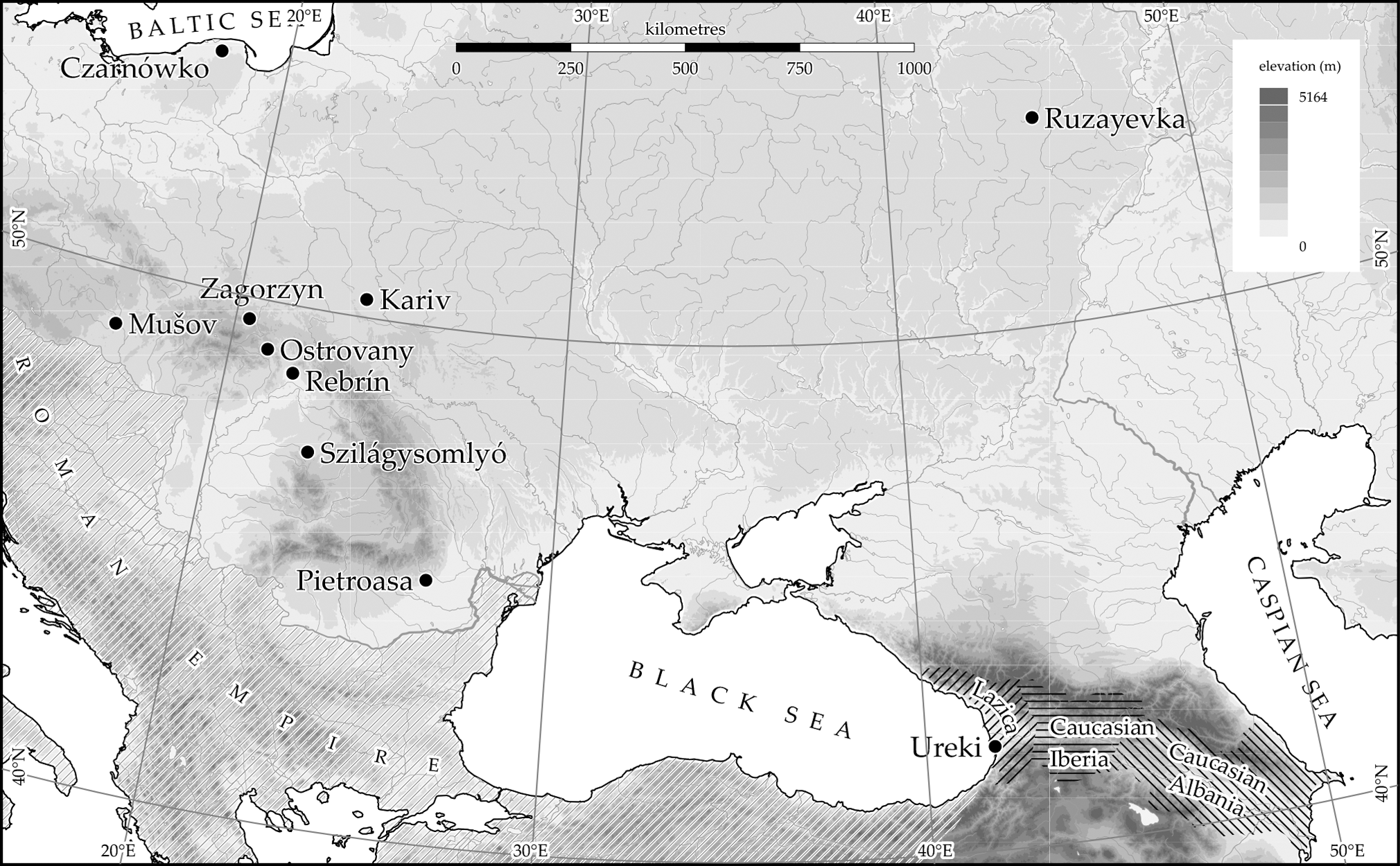
The Roman empire frequently interfered in the politics of populations living beyond the frontiers with the aim of identifying and cultivating elites that would be positively disposed towards the imperial aims. Such local leaders are often described as client kings. The terminology of a rex socius et amicus, a king who is allied and friendly to the Romans, goes back to the time of the republic, though Roman writers never actually described such kings in terms of a patron–client relationship (Braund Reference Braund1984, 24; Kehne Reference Kehne2000, 321–2; Wilker Reference Wilker2022). Most often these kings and, occasionally, queens, ruled along the eastern or southern frontiers of the empire. The first century bce, the time of the late republic, was a high point of such relationships. Well-known examples are Herod of Judea, Archelaus of Cappadocia and Juba of Mauretania (Jacobson Reference Jacobson2001). The Ptolemaic dynasties of Egypt and Cyrenaica were also closely allied and, in the first century bce, their territories became incorporated into the empire. Other neighbouring polities, like Palmyra in Syria and the Bosporan kingdom on Crimea, were also closely associated with the empire, though not always peacefully (Edwell Reference Edwell2008, 31–62; Podossinov Reference Podossinov, Fornasier and Böttger2002). From the third century ce onwards, eastern polities were caught up in the friction between Rome and the newly emerging Sasanian empire in Iran. Both empires coveted the rulers of the Caucasian kingdoms of Iberia and Lazica (in what is now Georgia), Albania and Armenia as allies and occasionally incorporated their territories (Braund Reference Braund1994, 262–314; Greatrex Reference Greatrex1998, 132; Isaac Reference Isaac, Cameron and Garnsey1997, 437–44; Lightfoot Reference Lightfoot, Bowman, Cameron and Garnsey2005). The region along the eastern Black Sea coast—the ancient kingdom of Colchis—was at times part of the Roman administration, overseen by the provincial governor of Cappadocia. Roman interest in the region is evident from a string of forts along the eastern Black Sea coast dating back to the first and second centuries ce, though only the fort of Apsaros has been extensively excavated (Karasiewicz-Szczypiorski Reference Karasiewicz-Szczypiorski2025; Reference Karasiewicz-Szczypiorski2026, 49–57; Vitale Reference Vitale2013).
Along the northern and eastern European frontiers of the empire, emperors and generals also maintained diplomatic relationships with local elites. In the mid-second century ce, the emperor sanctioned the rulers of the Quadi, a group thought to have lived north of the Danube in modern Slovakia. Such an occasion was commemorated with a special coin with the inscription REX QVADIS DATVS [a king given to the Quadi], minted between 140 and 144 ce. It shows the emperor Antoninus Pius offering a diadem to a new king (Birley Reference Birley, Bowman, Rathbone and Garnsey2000, 152). During the 360s ce, an Alamannic king, Macrianus, fell foul of imperial frontier politics. He had been a supporter of the emperor Valentinian, and even supplied him with troops, but shortly afterwards the emperor began to see him as a threat. Valentinian then attempted to install a Rome-friendly puppet king but failed because support for Macrianus was too strong (Drinkwater Reference Drinkwater2007, 304–9).
Scholars have often called such allied local rulers client kings of Rome, in analogy with the conditions along the eastern and African frontiers in the early centuries of the empire. Footnote 2 But the term has also been applied in Late Antiquity. As late as the fourth and fifth centuries ce, trans-frontier relationships in northern and western Europe are described as ‘frontier client kingship’ (e.g. Heather Reference Heather and Miles1999, 238; Kulikowski Reference Kulikowski and Johnson2012, 32).
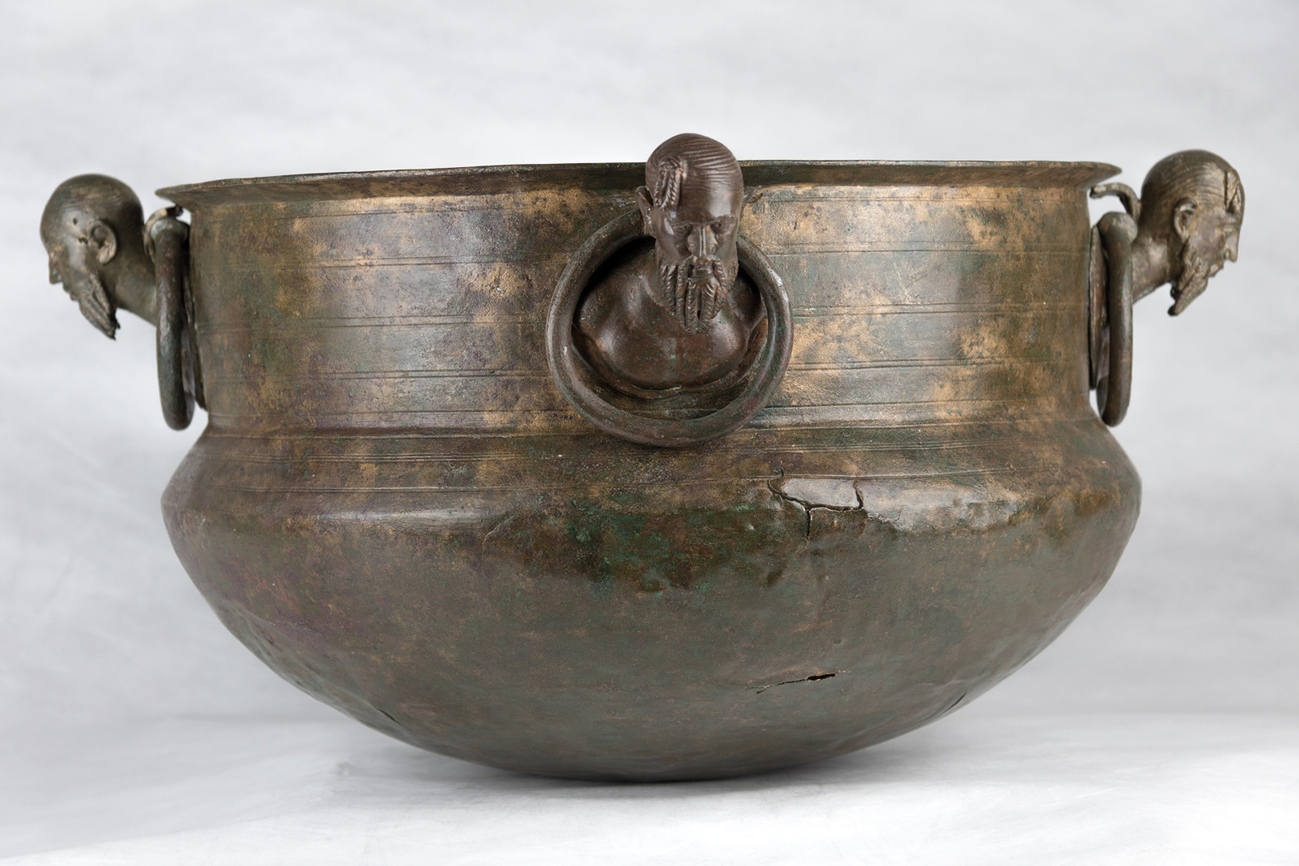
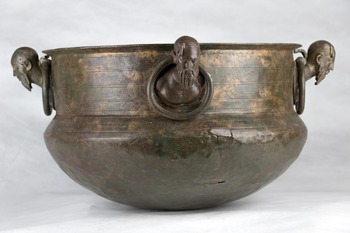
To give an archaeological example: the lavishly furnished chamber grave near Mušov in the eastern Czech Republic has been interpreted as the burial of a client king (Peška & Tejral Reference Peška, Tejral, Peška and Tejral2002). This grave dates from the late second century ce, the time of or just after the Marcomannic wars (166–80 ce). Several objects in this grave, most spectacularly a bronze cauldron with four busts showing a man with Suebian hairstyle, were probably Roman diplomatic gifts (Juhász Reference Juhász2014; Krierer Reference Krierer, Peška and Tejral2002) (Fig. 1). Other objects, such as a bronze lamp and a folding table similar to ones found in Pompeii, had been curated since the second half of the first century bce and show that local elites had a deep and perhaps long-standing interest in artistic products from the Mediterranean (Künzl Reference Künzl, Peška and Tejral2002). Taken together, the assemblage in the grave has been interpreted as that of a client king showered with gifts from within the empire.
The cauldron from the chamber grave at Mušov. Probably made in Pannonia, it is decorated with male busts with ‘Suebian’ hairstyles that were common in central Germany. (© Regional Museum Mikulov.)
The social context in which the elites along the northern frontiers operated was very different from that of the polities along the eastern and north African frontiers. The latter, like the Ptolemaic or Herodian dynasties, had clearly defined multi-generational hierarchies. The polities which they ruled emerged from a Hellenistic context with towns and cities, investment in public buildings, monuments and temples, high levels of craft specialization and control of important trade routes in and out of the empire. Political relationships between the empire and its neighbouring kingdoms could be formalized through titles and marriages, with recognizable benefits for both in terms of trade relations or military support. But the same structures did not exist along the northern frontiers. The varied terminology used by Romans to describe political relations with rulers beyond the frontiers tells us that frontier politics cannot simply be transposed from one region to another (Johne Reference Johne, Baltrusch and Wilker2015; Kehne Reference Kehne2000; Pitts Reference Pitts1989). So, if client kingship is not an appropriate explanatory device, what was the nature of cross-frontier relationships along the northern frontiers?
The gift
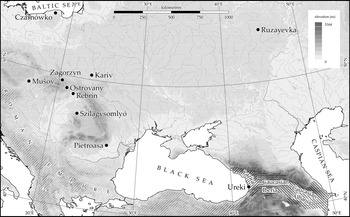
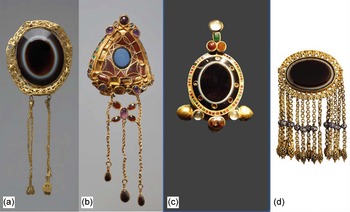
These relationships can be illuminated through prestige objects found in areas sometimes quite far beyond the frontier, from the second to the fifth centuries ce (Fig. 2). Some were placed in graves and others in treasure deposits. Among the most spectacular is a series of gold brooches with a central onyx which have been called imperial brooches (Fig. 3). Three of these brooches from central and eastern Europe have long been known. Here I propose to include a fourth, from Ureki in Georgia.
Map showing the sites mentioned in the text. Map data from ETOPO1 (NOAA National Geophysical Data Center 2009), Cliopatria (Bennett et al. Reference Bennett, Mutch and Tollefson2025), Ancient World Mapping Center (https://github.com/AWMC/geodata) and Natural Earth Data (https://www.naturalearthdata.com).
The imperial brooches from (a) Ostrovany; (b) Rebrín; (c) Szilágysomlyó (d) Ureki. (© Kunsthistorisches Museum Wien; Hungarian National Museum (Photograph: Damian Entwistle); © Georgian National Museum.) Not to scale.
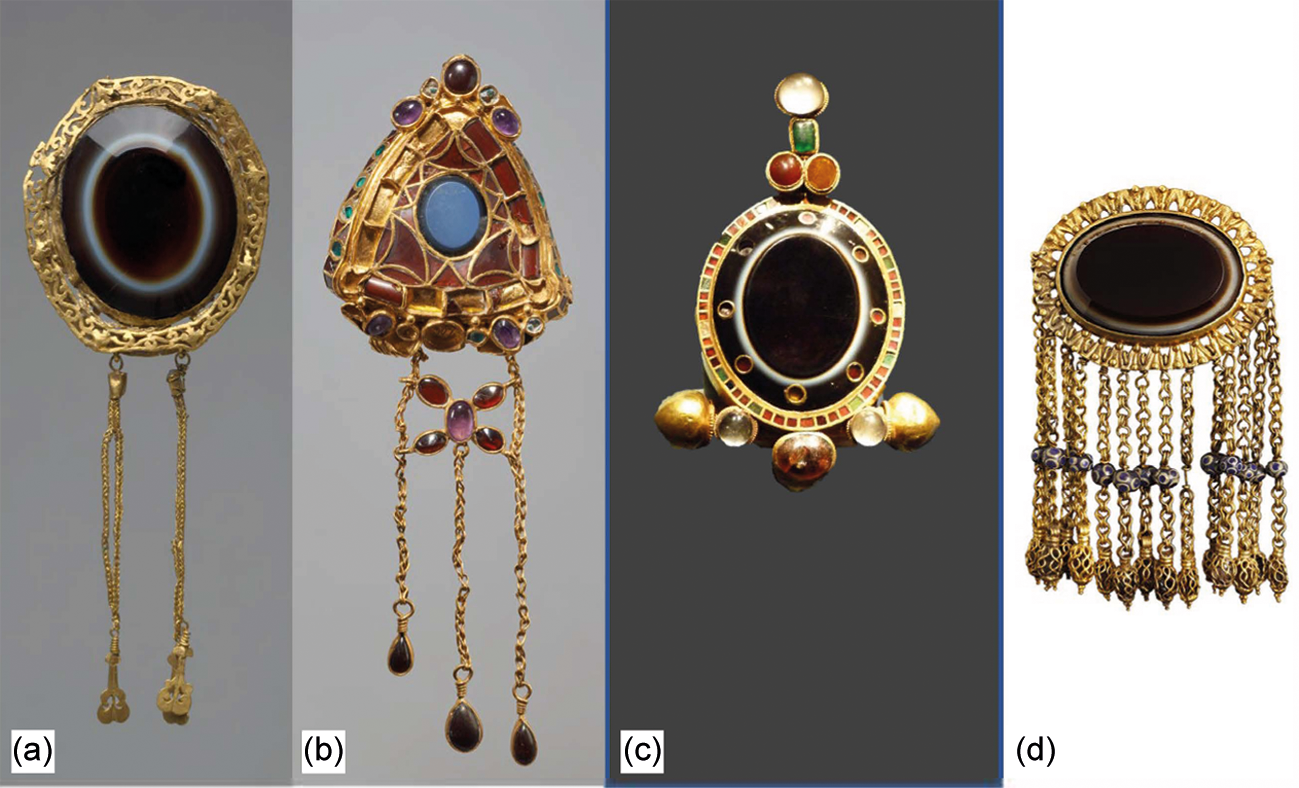
In 1790, an assemblage of gold, silver and bronze objects was found by chance near the village of Ostrovany (now in Slovakia, then known as Osztrópataka and part of the Kingdom of Hungary). Most are now in the Kunstkammer Vienna, though some are missing. More objects were found in the same location in 1865, and these are now in the Hungarian National Museum. The original find context was not recorded in detail, but it very likely was a stone-lined chamber grave, similar to others of the period. It included several brooches, some made of solid gold and one with a large oval onyx in a gold setting with four pendilia, gold neck rings, a golden arm ring and finger rings. There were also vessels made of gold, silver and glass, as well as other items for personal adornment. The finds suggest that the deceased was buried in the second half of the third century (Prohászka Reference Prohászka2006, 13, 27, 37–9, 99; Quast Reference Quast, Abegg-Wigg and Lau2014; Schmauder Reference Schmauder2002b, 57–9).
Another brooch with a central onyx surrounded by garnets and amethysts, also with pendilia, was recovered in 1852 as a stray find near Rebrín (formerly Rebrény near Nagymihály, today Michalovce), also in Slovakia. It is now held in the Kunstkammer Vienna. Stylistically, it probably dates from the mid-fifth century ce (Beninger Reference Beninger1937, 56–7; Schmauder Reference Schmauder, Pohl and Reimitz1998; Reference Schmauder2002b, 66–9).
In 1797 two boys, who were herding goats on a hillside near Szilágysomlyó in Transylvania (now Şimleul Silvaniei, Romania), discovered a spectacular treasure deposit, and in 1889, labourers found more items belonging to the same assemblage. As a consequence, the finds are now split between the Kunstkammer Vienna and the Hungarian National Museum. The deposit included 15 gold medallions, a gold chain with tiny pendants representing tools and weapons, arm rings with ends made to look like animal heads, a pair of golden brooches decorated with lion heads, a pair of disc brooches, 10 pairs of gold-plated silver brooches inlaid with garnets and coloured glass, several decorated golden bowls and other objects made of solid gold. The crowning piece was a brooch with an oval onyx set in an elaborate gold fitting. This treasure was deposited during the second quarter of the fifth century, though some objects are older (Bernhard-Walcher Reference Bernhard-Walcher and Seipel1999; Fettich Reference Fettich1932; Kiss Reference Kiss and Seipel1999; Schmauder Reference Schmauder and Seipel1999; Reference Schmauder2002b, 59–65).
We should now also include another assemblage, found by chance in 1942, at the eastern end of the Black Sea, near the village of Ureki in Georgia. More objects were handed to authorities in 1948. This assemblage included an onyx brooch very similar to that from Ostrovany, with 15 pendilia with tiny eye beads. Further, there were golden arm and finger rings, glass beads, 22 solid gold faceted beads, 50 hexagonal plaques with cloisonné inlay. The finds also included an amphora, a glass vessel and a large silver dish, and an iron folding chair. Several Roman coins and imitation coins date the deposition to after the late third to early fourth century ce, though some objects suggest a later date in the fourth or early fifth century. No context was recorded so there may have been multiple depositions, perhaps in several graves (Apakidze Reference Apakidze1947; Lekvinadze Reference Lekvinadze1975). The objects are now housed in the Georgian National Museum.
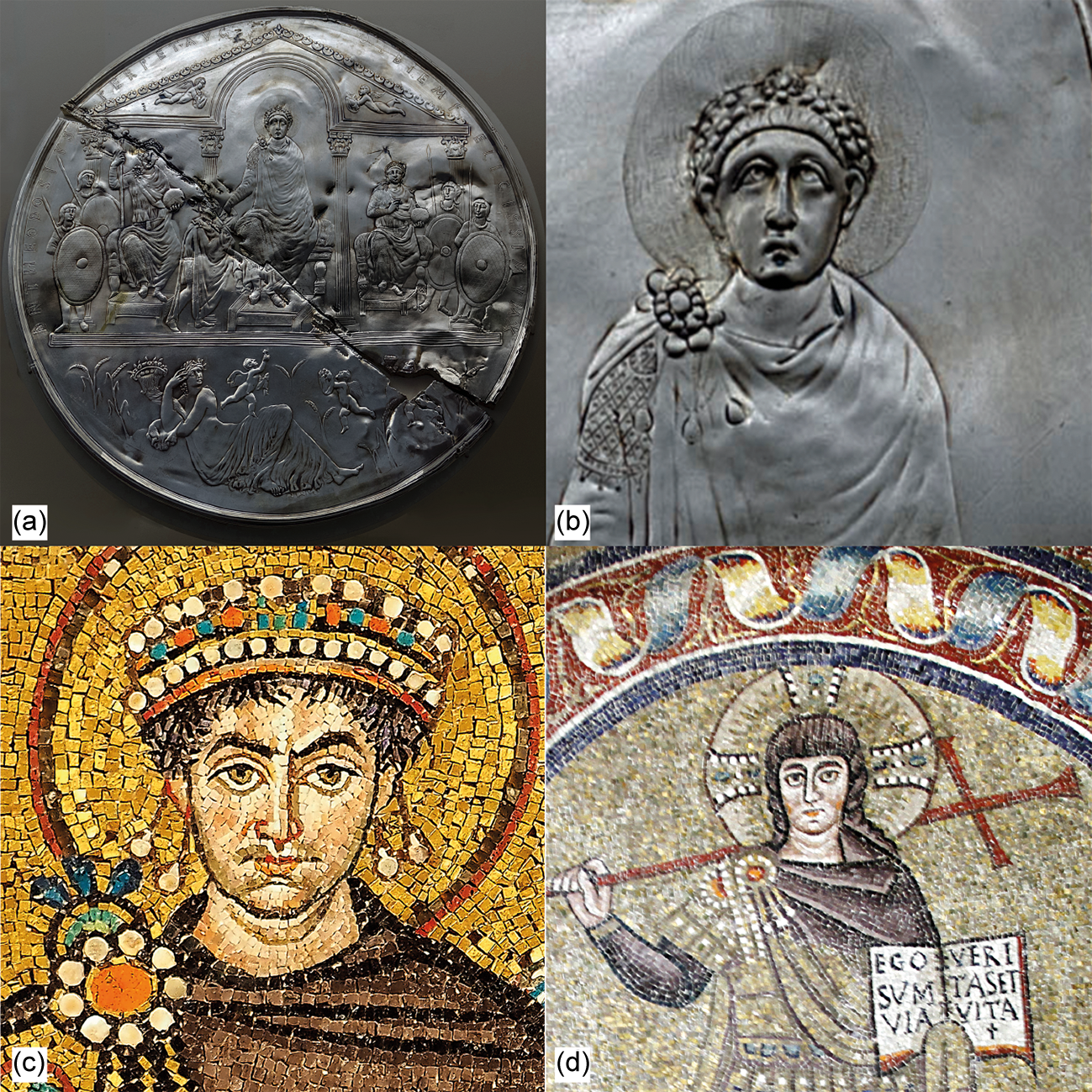
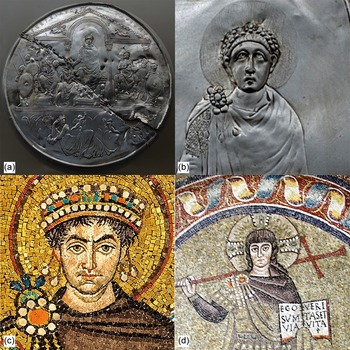
These brooches are called imperial brooches for a good reason, since they were often shown in imperial contexts. On the missorium of Theodosius, a ceremonial silver plate probably made in 388 ce, the emperor is flanked by his co-rulers Valentinian II and Honorius (Fig. 4). All three are wearing imperial vestments held together by a brooch with three pendilia. We then see the brooches again in mosaics in Ravenna. In the archbishop’s chapel, Christ, dressed as a Roman general, wears a brooch with pendilia on his cloak. And in the basilica of San’ Vitale, the emperor Justinian is seen wearing such a brooch, also fastening his cloak. Emperors and generals wore these brooches as insignia of their power.
Representations of imperial brooches in late Roman contexts. (a) The Missorium of Theodosius with (b) a close-up of Theodosius I wearing a brooch with pendilia (Replica, Museo Nacional de Arte Romano, Mérida. Ángel M. Felicísimo, with permission); (c) mosaic showing the emperor Justinian in the church of San Vitale, Ravenna, mid-sixth century (Petar Milošević, with permission): (d) representation of Christ in the Chapel of St Andrew, late fifth century (Archiepiscopal Museum, Ravenna. José Luiz Bernardes Ribeiro, CC-BY-SA).
All existing brooches were found beyond the Roman frontiers. Detailed analyses of their manufacturing techniques suggest that they were made in Mediterranean workshops (Schmauder Reference Schmauder, Pohl and Reimitz1998; Reference Schmauder and Seipel1999). It therefore seems that emperors gave these brooches as high-level diplomatic gifts to elites outside the empire.
We also know of a range of other objects that were probably given as diplomatic gifts. The cauldron from Mušov and others like it are examples of one kind. Then there were gold medallions, like those from Szilágysomlyó (Găzdac Reference Găzdac2007; Opreanu Reference Opreanu, Măgureanu and Gáll2010). Medallions were coins that were minted to commemorate important events like big military victories. They were usually made of solid gold, in multiple weights of standard gold coins. They were fitted with loops and mountings so that they could be worn as a pendant, with the emperor’s portrait facing outwards. About one hundred of these medallions have been found beyond the northern frontiers of the empire, clustering particularly in modern Poland, parts of Ukraine and Transylvania. Most date from the early third to the early fifth century, but medallions minted under Constantine (r. 306–337 ce) and Valentinian (r. 364–375 ce) are particularly common (Bursche Reference Bursche and Magnus2001). The oldest medallions in the Szilágysomlyó treasure were minted during the late third century and the most recent during the third quarter of the fourth century. By the time they were buried with the rest of the treasure deposit, the medallions were heavily worn and in some cases goldsmiths seem to have replaced the loops and mountings more than once (Dembski Reference Dembski and Seipel1999). Several generations had worn and treasured these medallions.
In fact, we have accounts of precious objects being given as part of diplomatic negotiations. Maximinus, who was a member of an ultimately unsuccessful Roman embassy to the Hunnic leader Attila in 449 ce, offered ‘gifts of silk garments and pearls’ to two of Attila’s high-ranking followers, after the Romans had unwittingly insulted them during dinner (Priscus, frag. 11.2, 30–35 (Blockley): Priscus Reference Blockley1983, 246–9). And in 556 ce, Tzathes, king of Lazica (in modern Georgia), travelled to Constantinople to receive his royal insignia from the emperor Justinian.
He had received his ancestral title together with the royal insignia from the hand of the Emperor in accordance with a time-honoured tradition. The insignia consist of a gold crown set with precious stones, a robe of cloth of gold extending to the feet, scarlet shoes and a turban similarly embroidered with gold and precious stones. It is not lawful, however, for the kings of the Lazi to wear a purple cloak, only a white one being permitted. Nevertheless it is not an altogether commonplace garment since it is distinguished by having a brilliant stripe of gold fabric woven across the middle of it. Another feature of the royal insignia is the clasp, resplendent with jewelled pendants and other kinds of ornament, with which the cloak is fastened. (Agathias, Hist. III,15, 2: Agathias 1975, 84).
The five satraps (or kings) of Armenia also received their symbols of office from the emperor. The sixth-century historian Procopius described them in detail:
There is a cloak made of wool, not such as is produced by sheep, but gathered from the sea. […] And the part where the purple should have been, that is, where the insertion of purple cloth is usually made, is overlaid with gold. The cloak was fastened by a golden brooch in the middle of which was a precious stone from which hung three sapphires by loose golden chains. There was a tunic of silk adorned in every part with decorations of gold which they are wont to call plumia. The boots were of red colour and reached to the knee, of the sort which only the Roman Emperor and the Persian King are permitted to wear. (Procop, De Aed. 3, 1, 17: Procopius 1940, 182–5).
Status distinctions between the emperor and king were expressed—and understood by onlookers—through details of their clothing and adornment. Precious objects physically represented the hierarchical relationship between emperor and kings beyond Rome. Medallions were a sign of the emperor’s power and the favour he bestowed on allied rulers beyond the frontier. And by giving a brooch of the kind that he would wear himself, or perhaps had even worn as a mark of his own authority, the emperor gave a part of his essence to these lesser kings. It was in the emperor’s gift to legitimise the authority of friendly kings, and a part of their power derived from him.
Yet we should not see these kings as simply passive recipients of the emperor’s largesse. There is also power in being singled out as worthy of a gift, or in positioning oneself as a king who might persuade the emperor to offer a gift. Whether a precious object was thought of as a gift or as tribute was surely only a matter of perspective.
The brooch from Ureki and the written accounts of emperors giving gifts to the rulers of Lazica and Armenia suggest that the distinction between the gift-giving and client-king models was not absolute. The kingdoms of the Caucasus—Lazica, Armenia, Iberia and Albania—were in an important geographical but also often ambiguous political position, being on the frontiers of both Rome and Persia. Their rulers had considerable scope to use this position to their advantage. The kings of Lazica did so strategically. Earlier kings of Lazica had been allied with Persia, were invested by the Iranian emperors and accordingly had been Zoroastrians. In 522 ce, Tzathes, a king of the Lazi who may have been the grandfather of the Tzathes we met above, assessed that his fortunes aligned better with the Roman empire. And so he travelled to Constantinople where he was baptised, married a high-ranking Roman wife, and then received the insignia of his kingship from the emperor Justin (Mal. 17.9: John Malalas Reference John1986, 233; Greatrex & Lieu Reference Greatrex and Lieu2002, 79–80). This new allegiance with Rome turned into a favourable arrangement: the Lazi were not required to pay tribute or offer military service to the empire; in turn they independently guarded the passes of the Caucasus against incursions by Huns and were able to trade with the Roman world via the Black Sea trade routes. New kings were invested by the Roman emperors as a matter of formality (Procop., Bella II.15.1-4: Prokopios Reference Dewing and Kaldelis2014, 104; Greatrex Reference Greatrex1998, 132–3).
Magical objects
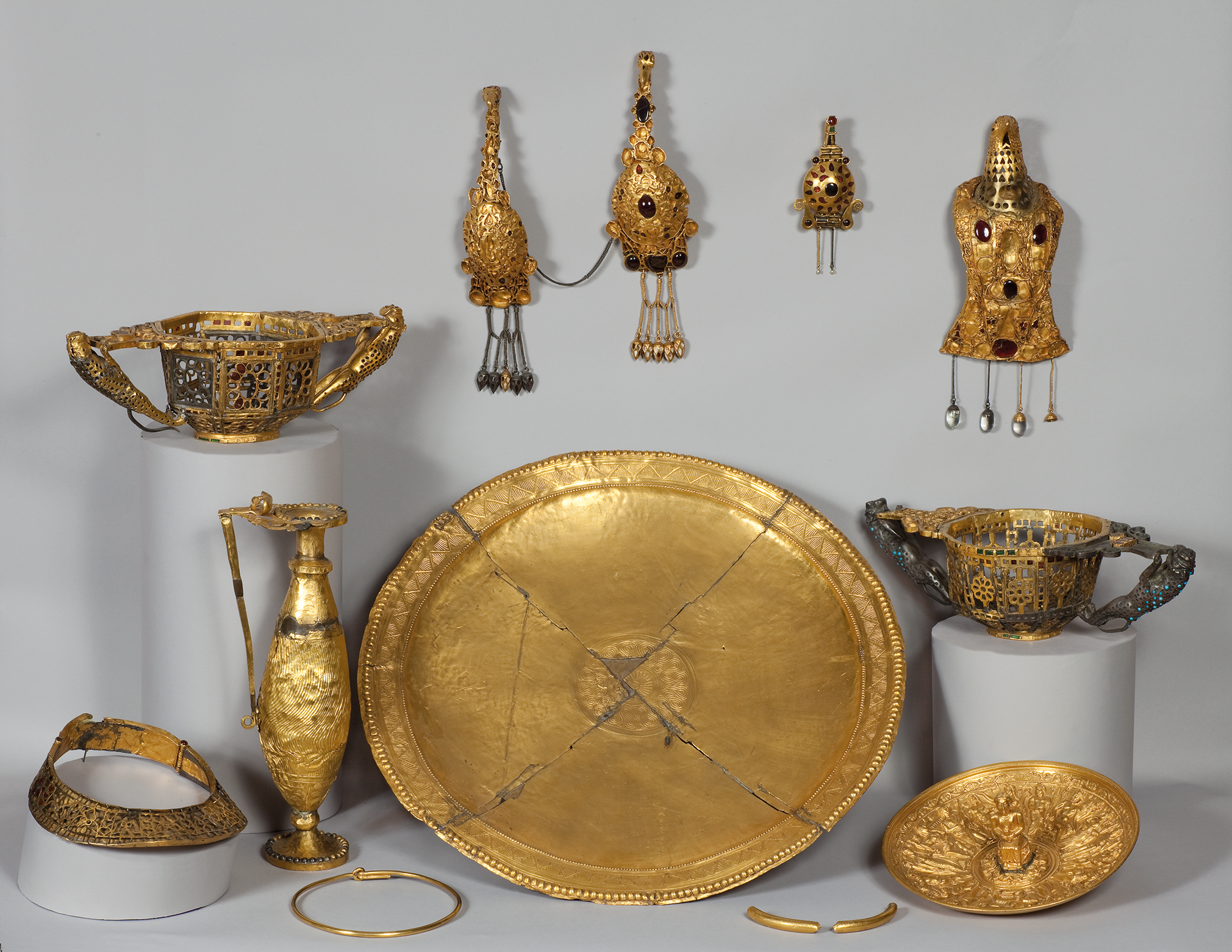
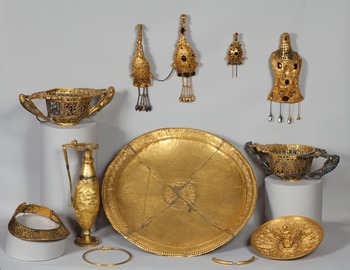
But the story does not end here. A treasure deposit of similar size to that of Szilágysomlyó was found in Pietroasa (now Pietroasele), in Muntenia, Romania, in 1837, though about half the objects have since been lost. It was also buried on a hillside, in the vicinity of a Roman fort in the valley below, probably towards the middle of the fifth century (Harhoiu Reference Harhoiu1977; Odobescu Reference Odobescu1976; Schmauder Reference Schmauder, Corradini, Diesenberger and Reimitz2002a). Like Szilágysomlyó, it included brooches, but also neck rings and a set of golden serving vessels (Fig. 5). Two brooches come in a pair, suggesting that they were used as part of women’s dress. Two further brooches are individual pieces, one smaller and a large one in the shape of an eagle. All are made of gold, are decorated with garnets and they have pendilia. The eagle represented Rome itself, suggesting it too was an imperial brooch. But detailed analysis has shown that it and the other brooches in the Pietroasa assemblage were made by local, rather than Mediterranean, goldsmiths (Schmauder Reference Schmauder, Pohl and Reimitz1998; Reference Schmauder2002b, 65–6, 71–4).
A part of the assemblage from Pietroasa, Romania. The imperial brooch in the shape of an eagle can be seen top right. (National History Museum of Romania © MNIR 2025. Photograph: Marius Amarie.)
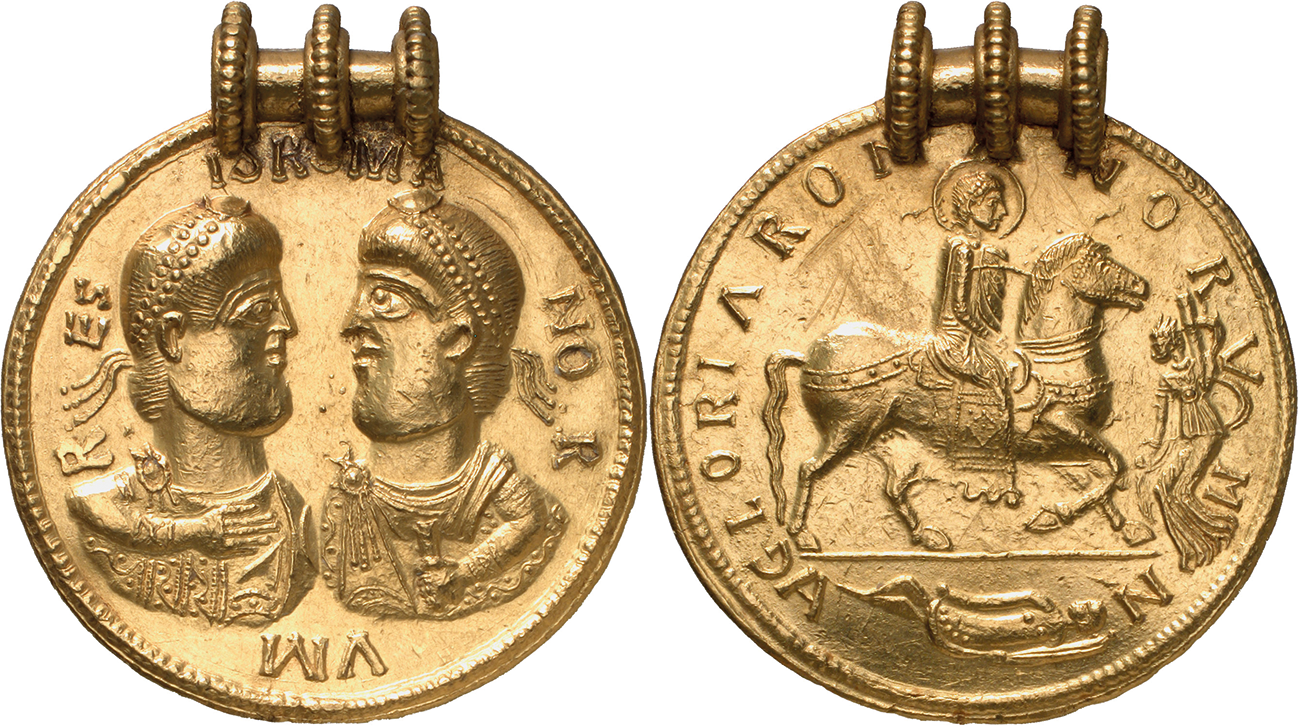
Another treasure deposit, found in Zagorzyn in southern Poland in 1926 or ’27, is now almost completely lost, but it seems to have been vast. It included medallions, two bracteates, as well as 3000 denarii from the first and second centuries. It seems to have been buried at the end of the fifth century (Bursche Reference Bursche1998, 51–61). The medallions and bracteates have been preserved and have been traced to museums in Germany (Bursche Reference Bursche and Wołoszyn2009). One of the medallions shows the busts of the emperors Valens and Valentinian on the obverse, surrounded by the text R-ES ISROMA NO-R-UM (Fig. 6). This is a misspelling of regis romanorum, meaning ‘of the king of the Romans’ (Bursche Reference Bursche and Magnus2001, 89; Seipel Reference Seipel1999, 86–7). The reverse of this medallion, showing an emperor on horseback, is struck with the same die that was used on a medallion from Szilágysomlyó. Both were clearly imitations made by goldsmiths beyond the frontier. The assemblage of Szilágysomlyó included another locally made copy, also showing the emperor Valens (Bursche Reference Bursche and Seipel1999).
The medallion from Zagorzyn, Poland. The obverse (left) shows the busts of the emperors Valens and Valentinian, surrounded by the text R-ES ISROMA NO-R-UM. (Staatliche Museen zu Berlin, Münzkabinett. Photograph: Lutz-Jürgen Lübke (Lübke und Wiedemann), public domain.)
Both the brooches from Pietroasa and the medallions from Szilágysomlyó and Zagorzyn were made outside the Roman world. The authority that these objects symbolized now no longer depended on their role as gifts from the emperor. Instead they were made as powerful objects in their own right.
Here, too, written sources provide additional context. In 507 ce, the king Clovis received honours from the emperor Anastasius. Clovis was ruler of the emerging Frankish kingdom in northern France and Anastasius was now emperor only of the eastern empire. Gregory of Tours tells us how Clovis responded:
Letters reached Clovis from the Emperor Anastasius to confer the consulate on him. In Saint Martin’s church he stood clad in a purple tunic and the military mantle, and he crowned himself with a diadem. He then rode out on his horse and with his own hand showered gold and silver coins among the people present all the way from the doorway of Saint Martin’s church to Tours cathedral. From that day on he was called Consul or Augustus [tamquam consul aut augustus]. (Gregory of Tours, History, II, 38: Gregory of Tours 1974, 154)
The various components of this ceremony are puzzling since they fitted neither fully the existing rites for the investiture of a consul nor that of a client king. The diadem and purple garment were imperial symbols, as was the practice of handing out gold and silver, but emperors did not assume office in a church. Clovis seems to have combined various insignia and rituals very intentionally and in new ways. He presented himself not as a traditional Roman official—a consul—nor as a subordinate king, but as a new kind of ruler who understood imperial logic but was not bound by it (Mathisen Reference Mathisen, Mathisen and Shanzer2012).
The brooches, medallions and other items in the burials and treasure deposits were complex objects, requiring valuable source materials such as gold and precious stones, and the goldsmiths and jewellers had to be highly skilled in a range of techniques. Anthropologists Mary Helms and Alfred Gell have discussed the ways in which highly skilled crafting sets apart both the artisan and the art from everyday craft-working. According to Helms, the process of making creates socio-political order and legitimizes power and authority in a context where a craft-worker produces an object for the king, or perhaps the king himself is a master artisan. Master artisans transform materials with their skill and creativity and create objects that manifest stories people tell about themselves, their society and the world they live in (Helms Reference Helms1993, 19, 87). It is the complex technological processes of creating that cast a spell, making an object that is both enchanted and enchanting. This means that an object has magical powers because of what it stands for—a gift from the emperor which represents friendly relations and confers legitimacy to a local ruler—but also because the magical artistry involved in its making brings such relations into reality (Gell Reference Gell and Hirsch1999).
Networks of obligation
When the emperor offered a brooch or medallion as a gift to a ruler outside the empire, he also gave a part of his imperial essence, the power to rule. With these gifts, he affirmed local rulers in their own right to rule. The coin commemorating the investiture of the king of the Quadi goes even further. Here the king himself was the gift, given by the emperor to the king’s people (Kemp Reference Kemp, Mihajlović and Janković2018, 93).
In his foundational work on gift exchanges, Marcel Mauss (Reference Mauss2002) examined how gift giving is embedded in complex social relationships, with people being acutely aware of the value and meanings of gifts. On the face of it, giving a gift may seem an altruistic gesture, very unlike trade or barter. But gift giving is governed by complex social rules that obligate both the giver and receiver. In many societies, by accepting a gift the recipient also accepts that they are in a reciprocal relationship with the giver and that they are bound to return something of similar value. Over time this may create complex networks of obligation that can be communistic, but may also become competitive or deeply asymmetrical (Graeber Reference Graeber2014a, 105).
Over centuries, the Roman emperors and their eastern neighbours, the Sasanian rulers of Iran, were involved in agonistic exchanges of gifts, most commonly silks and silver plates that displayed noble hunting scenes. These gifts barely sublimated the ongoing conflicts between the two empires into more acceptable forms of violence, and their values were carefully assessed by both courts (Canepa Reference Canepa2009, 154–66). But we have no evidence that the people living beyond the northeastern frontiers of the empire reciprocated with gifts equivalent to an imperial brooch or a medallion. Most of the gold in circulation was mined within the territory of the Roman empire, with important gold mines in the provinces of Hispania (Spain) and Dacia (Romania), and it flowed beyond the frontiers of the empire in the form of gold coins (Fischer Reference Fischer, Fabech and Näsman2017; López Sánchez Reference López Sánchez, Erdkamp, Verboven and Zuiderhoek2015). Craftworkers beyond the frontiers derived many of their complex goldsmithing techniques, like plating or working with gold leaf, from Roman methods (von Carnap-Bornheim Reference von Carnap-Bornheim and Magnus2001). This suggests that the relationship between the empire and local rulers was profoundly asymmetrical. Yet the gifts created obligations.
We cannot be completely sure how such obligations were satisfied, but written evidence offers some plausible scenarios. Military conflicts between Rome and the people beyond the frontiers usually concluded with peace treaties. If the Roman armies were clearly victorious, the resulting arrangements could be highly punitive. For example, in 180 ce the Marcomannic wars ended with a treaty that required the Marcomanni to pay an annual grain levy and restricted where and how often they could trade (Cassius Dio 73.1–2: Dio Cassius Reference Cassius, Cary and Foster1927, 74–5). But at other times conflicts were more balanced, often with lucrative outcomes for the populations beyond the frontiers. During the third century, various groups from beyond the frontiers attacked Roman lands, pressuring the emperors to pay for peace with gold. In a highly effective raid, a group of Iuthungi, who were documented to have lived in southern Germany, crossed the Danube frontier, then the Alps, reaching Italy. On their return north, they were beaten back by a combination of Roman soldiers and a local provincial militia. When they sued for peace in 271 ce, they put on a show of not appearing too defeated, because they wanted to ensure that they would still receive payments from Rome (Dexippus, F28 (Martin): Dexippus Reference Martin2006, 126–7; Bakker Reference Bakker1993). Elsewhere, Gothic warbands also repeatedly attacked the eastern provinces of the empire. Roman emperors offered gold in exchange for peace which, predictably, led to further raids (Petrus Patricius FHG IV, frag. 8 = F170: Peter the Patrician Reference Banchich2015, 111). Such payments were a common, though controversial, practice. Romans perceived emperors who made such payments to barbarians to be weak and approved of ‘strong’ emperors who cancelled such payments (Blockley Reference Blockley1985; Scardigli Reference Scardigli, Kneissl and Losemann1998). While such payments were not the same as gifts given as a mark of respect, leaders from beyond the frontiers may well have received an imperial brooch as part of or following such peace negotiations.
After a decisive Roman victory in 269 ce, large numbers of Gothic survivors were conscripted into the Roman army (Zos., HN 1.46: Zosimus Reference Ridley1982, 14; Hist. Aug. Claudius 9.4–5: Historia Augusta 2022, 170–71). We also find Goths listed as combatants alongside the Roman army on an inscription commissioned by the Sasanian emperor Shapur to commemorate his victory of the Roman emperor Gordian III in 244 ce (Res Gestae Divi Saporis, 3: Hekster Reference Hekster2008, 112). By the fourth century, men from beyond the frontier could achieve high rank in the Roman army (Kulikowski Reference Kulikowski2007, 156–7). The recipient of a gift may have previously served in the Roman army as a general and was now being invested as local ruler, the gift being offered as thanks for services that had already been provided. In any case, imperial gifts represented obligation towards the empire, as well as power to rule.
Such networks of obligation connected not only the emperor and rulers beyond the frontier, but also these rulers and their own followers. Many elite individuals beyond the frontier were buried with elaborate vessels intended for sharing food and drink. The chamber grave at Mušov, for example, included bronze vessels, silver serving dishes, spoons, drinking horns and glass vessels, as well as the well-known cauldron. Mourners also provided meat from numerous animals, ready for a funerary feast (Droberjar Reference Droberjar, Peška and Tejral2002; Follmann-Schulz Reference Follmann-Schulz, Peška and Tejral2002; Künzl & Künzl Reference Künzl, Künzl, Peška and Tejral2002; Peška & Tejral Reference Peška, Tejral, Peška and Tejral2002). Similar assemblages occur in other richly furnished burials from the first to the fourth centuries ce, across a vast region from central Germany to Ukraine (Quast Reference Quast, Egg and Quast2009).
Such vessels suggest that local rulers also had reciprocal relationships with their followers, grounded in feasting and hospitality. Like the Roman emperor, they may also have given gifts or shares in the spoils of military raids, though this is more difficult to identify archaeologically. In return for a big feast followers might have offered loyalty, labour or joined in with military activities. Performative feasting and drinking were an essential aspect of being a ruler in northern and central Europe.
Ethnographic studies of feasts highlight how hospitality can create bonds of reciprocal obligation. Like giving gifts, sharing food and drink can be communistic acts (Graeber Reference Graeber2014b; Mauss Reference Mauss2002). But, equally, feasts can create unfulfilled obligations which can create or reinforce status differences. Rulers can grow or cement their political authority by putting on a magnificent feast, having received tribute or labour from their followers. Once a ruler is in the position of a patron, guests at a feast accept their role as subordinates, but there is great pressure on the patron to continue to offer lavish hospitality, and for a feast to be as great or greater than one put on by a rival ruler. In this way hospitality was a political tool (Dietler Reference Dietler1990; Reference Dietler and Ruby1999; Reference Dietler, Dietler and Hayden2010; Jones Reference Jones2007, 177–92).
Like the cauldron from Mušov, many bronze vessels intended for feasting were made in the Roman provinces. A type called Hemmoor bucket, after a village in northern Germany where it was first identified, was particularly popular in the second and third centuries ce. These buckets were most likely made in the province of Germania inferior near the modern cities of Aachen and Cologne, where they were used to mix wine or display food. They became widely popular beyond the frontier and have been found from Scandinavia to the Black Sea, showing that connections with the Roman world could extend across vast distances (Luik Reference Luik2013; Petrauskas et al. Reference Petrauskas, Nadvirniak and Pogorilets2023). The cauldron with busts from Mušov has close parallels with a cauldron found in Czarnówko, near the Baltic coast of Poland, and another from Kariv in western Ukraine. A further single cauldron bust has been found in the Ruzayevka district, in the modern republic of Mordovia, Russia (Akhmedov Reference Akhmedov2010; Onyshchuk & Schuster Reference Onyshchuk and Schuster2017; Reference Onyshchuk and Schuster2020). Like brooches and medallions, these vessels may also have been gifts, imbuing them with the power to strengthen the status and authority of the rulers who owned them.
These objects were at the heart of political relationships across the late Roman frontier. They established networks of obligation, requiring that something concrete—peace, labour, supplies—was given in return. But they also reflected how the world was ordered. There were clear hierarchies: the emperor was at the centre and other rulers were bound to him, and they in turn had followers who were bound to them. The political organization in northern and eastern Europe was very different from the more firmly established dynastic polities along the empire’s eastern and north African frontiers. Beyond the northern frontiers, hierarchies and political alliances were fluid and there is little evidence that the right to rule was passed on through generations, though there are exceptions, for example the multi-generational burial complexes at Himlingøje on Zealand in Denmark, dating from the second to mid-third century ce (Lund Hansen Reference Lund Hansen1995, 385–8), and near Zohor in Slovakia which spans the first to fourth centuries ce (Elschek Reference Elschek2017). Generally, rulers had to assert their legitimacy on their own merits. They may have had to put on great feasts, lead successful raids and shared out spoils, and they would have had other qualities that made them a trusted leader.
But in the fifth century, these networks began to fray. In previous centuries, rulers had valued the personal touch of receiving a gift from the emperor, but this was now no longer necessary. Brooches stood for imperial power, but they no longer needed to be given as gifts. Instead, rulers commissioned local goldsmiths to make imperial brooches and medallions, copying or elaborating on the original pieces. When goldsmiths in regions far from the Roman frontier made their own versions of medallions or imperial brooches for local rulers, they retained the power of these objects, but cut the ties with the emperor who had previously bestowed such gifts. In a similar vein, Clovis, the new king of the Franks, received the consulate from the emperor Anastasius and then proceeded to invent his own rites of investiture. The insignia retained their power, but the obligations fell away.
Galactic mimesis
We can see from these networks of gift-giving that the Roman world and its neighbours had a shared understanding of the bonds created by gifts and of the power of ‘magical objects’ at the heart of them. The power of the Roman emperor was at the centre of these relationships, and even after the bonds of reciprocity broke down in the fifth century ce, the new rulers modelled their own insignia and rituals of power on those of the emperor. But the ties between the emperor and the elites of northern and eastern Europe were very different from the client kingdoms more common along the eastern borders and in north Africa. Connections were based on relationships between individuals rather than more formal dynastic networks, and they were changeable and unstable, as we can see from bewildering episodes of warfare and peace treaties along the northern and eastern frontiers throughout Late Antiquity.
To help us understand these relationships, we can take inspiration from Stanley Tambiah’s ‘galactic polities’ of Southeast Asia which he described as a ‘central planet surrounded by differentiated satellites, which are more or less “autonomous” entities held in orbit and within the sphere of influence of the center’ (Tambiah Reference Tambiah[1976] 2013, 511). While important aspects of Tambiah’s analysis are specific to medieval Southeast Asia—that there is a unity of cosmology, geography and political organization based on the concept of mandala—we can nevertheless detect similarities. The emperor in the geographical and conceptual Mediterranean heartland was circled by rulers beyond the frontiers who in turn were circled by their own retinue or followers. This galaxy was held in balance through networks of reciprocity, and all understood the power to rule in broadly similar ways. But the satellites, the local rulers or kings, also had ambitions towards the centre. They realized these through what Marshall Sahlins described as ‘galactic mimesis’, ‘whereby outlying rulers assume the political culture of the higher powers with which they are engaged’ (Sahlins Reference Sahlins, Graeber and Sahlins2017, 369). External power—the power of the Roman emperor—could become a source of power for rulers beyond the frontiers, with those who had received a gift quite possibly in competition with those who had not (yet) been favoured. And both the central sovereign and the satellite rulers had ambitions to expand upwards and outwards (Sahlins Reference Sahlins, Graeber and Sahlins2017, 361, 365–6).
In this way the king whom the emperor gave to the Quadi in the second century was transformed into the ‘king of the Romans’ shown on the medallion from Zagorzyn at the end of the fifth century, and then ultimately into the post-imperial kings who ruled Italy, northern France, Spain and north Africa. Over centuries of living in the neighbourhood of the empire, with experiences of diplomacy but also warfare and generations of people recruited into the Roman armies, the people beyond the frontiers became experts at understanding how Roman imperial power worked—because they had modelled their own power on it.
Acknowledgements
Many thanks to David Redhouse for preparing the map in Figure 2.


 Open access

