

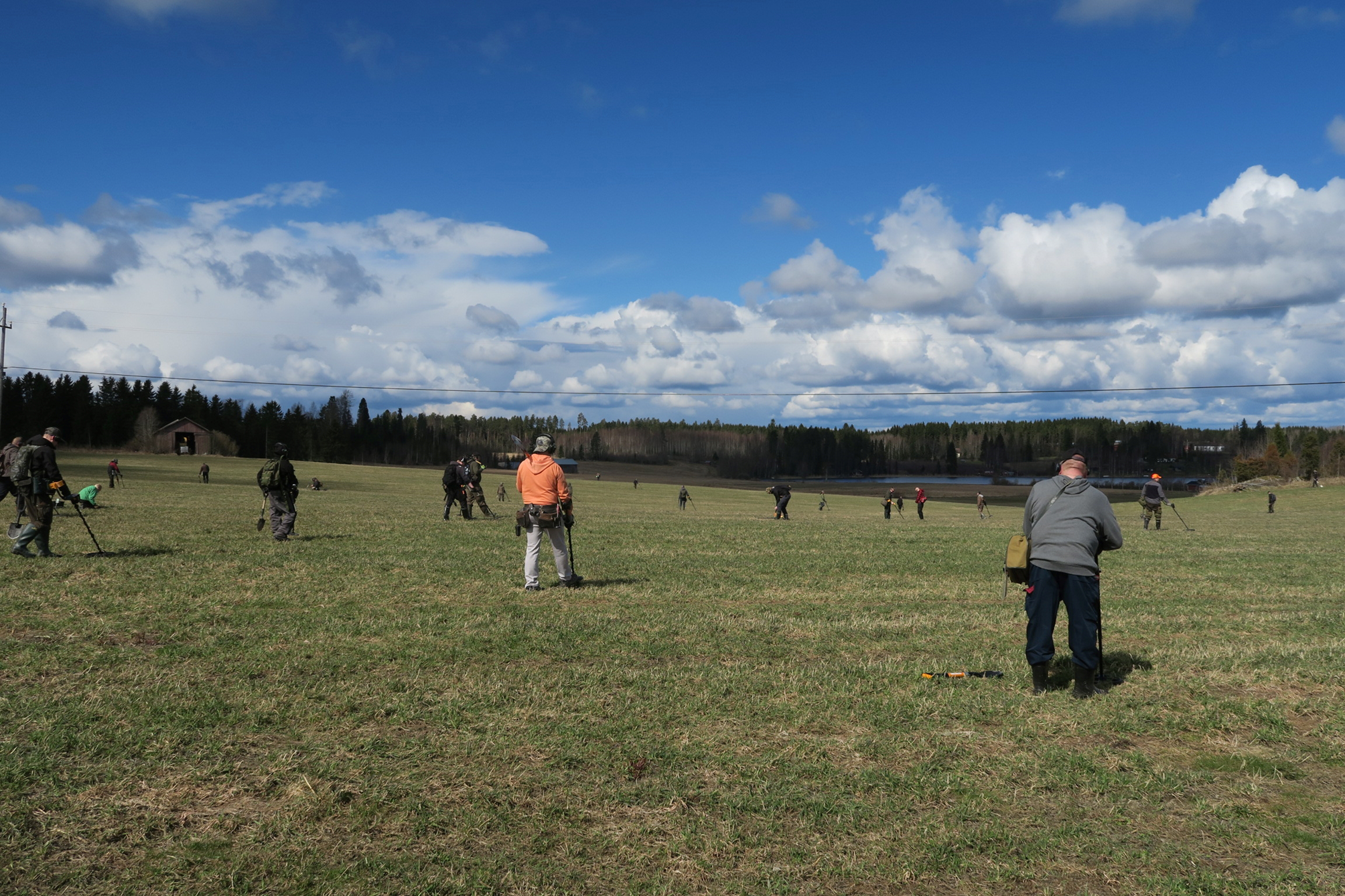
In European countries where hobby metal detecting for archaeological finds is legal, group metal-detecting events have become common. In general, these are organized activities where metal detectorists come together to search an area intensively. At one end of the scale are club events and meetings; at the other, large-scale commercial rallies. Other variables include how they are organized, how many participants are involved, and whether best practices are followed (Figure 1).
Metal detectorists in Finland (photo by Marianna Niukkanen, SuALT project, University of Helsinki).
Archaeologists generally view larger-scale events as particularly problematic because of their impact on the archaeological record, but they have so far not been able to formulate successful strategies to respond (Byard Reference Byard2021; Lewis and Heyworth Reference Lewis and Heyworth2021). The approach of the Portable Antiquities Scheme (PAS) in England, for example, first trying to record finds at these events but then becoming overwhelmed by their frequency and the challenges of making useful records in the field, highlights the quandary facing many archaeologists. Archaeologists are keen to record as many finds as possible to ensure that archaeological information is not lost and to engage with people who attend these events. However, the conditions for doing this are typically suboptimal.
There have been several studies on metal detecting in Europe that discuss appropriate strategies to mitigate its impact on heritage management and improve inclusion of finds and practitioners (e.g., Axelsen Reference Axelsen2021; Deckers et al. Reference Deckers, Dobat, Ferguson, Heerens, Lewis and Thomas2018; Dobat, Deckers, et al. Reference Dobat2020; Hardy Reference Hardy2017). However, metal-detecting group events remain less well researched, and they are mostly understood from a British perspective. For example, Suzie Thomas (Reference Thomas2012) in her doctoral research carried out questionnaire surveys and interviews at selected large-scale events in England, focusing on the motivations of participants rather than on the archaeological impacts of their activities. Natasha Ferguson (Reference Ferguson2016) has detailed the activities at a metal-detecting event in Scotland, demonstrating not only the challenges of protecting important archaeological discoveries at such events from overenthusiastic hobbyists but also “the need for more comprehensive guidance for organizers and metal-detectorists if such situations arise again” (Ferguson Reference Ferguson2016:124).
We lack a full picture of the extent and impact of group metal-detecting events in most European countries, which is not helped by the (sometimes) secretive nature behind the organization of some of them. This failure to properly understand these events and clearly define them is problematic for archaeologists because it means that legislative frameworks—especially in territories with a liberal attitude to detecting—are open to interpretation, so they lack potential for adequate law enforcement. In this article, we aim to present a clearer definition of the phenomenon of group events and the specific challenges they pose to archaeology and heritage management. By reviewing and assessing potential strategies to respond to these challenges, as well as highlighting the potential of these events for inclusivity in archaeology, we contribute to the broader debate on participatory heritage and offer practical recommendations for heritage professionals, along with organizers of and attendees at detecting events.
CASE STUDY AREAS
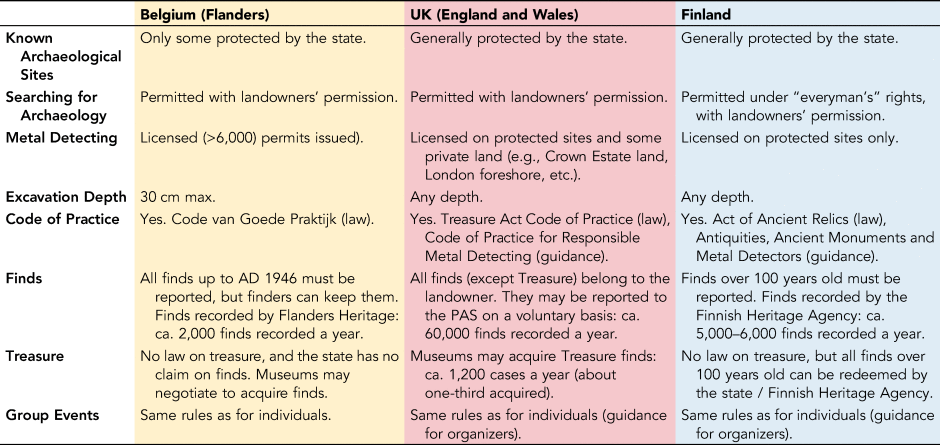
Unsurprisingly, metal-detecting events occur more often in countries where detecting is legal. It is not the purpose of this article to explore this area in depth, but it is almost certainly the case that group events—especially those of larger scale—are catching on in other places in Europe, driven by the perceived rights of finders. In the following section, we briefly summarize the rules for metal detecting in general, and specifically those concerning detecting events (Table 1).
The Rules and Procedures Regarding Metal Detecting in the Three Different Countries.
Belgium (Flanders)
Metal detecting has been permitted in the federal region of Flanders since 2016 (Deckers Reference Deckers, Campbell, White and Thomas2019), although it was essentially tolerated by the authorities before then. Detectorists must acquire a search licence from the Flanders Heritage Agency and report their finds. They also must have the landowner's permission to search, and they must ensure that detecting is allowed on the land to be searched (i.e., the search area is not legally protected). Metal-detecting event organizers typically take care of some of these obligations (e.g., landowner permission), but the legal responsibility remains with the individual participant. There is no requirement to hand finds over to the state.
Metal-detecting group events have occurred at least since 2007, and participant numbers can reach into the low hundreds. In recent years, larger-scale events appear to have become more frequent. This can be explained partly by the legal change and the hobby's growing popularity: between 2016 and early 2021, over 5,000 detecting licences were authorized by Flanders Heritage (Diependaele Reference Diependaele2021). Another factor is the increased connectivity within the detecting community, facilitated by social media. The most successful detecting page on Facebook, the private group Metaaldetectie Vlaanderen, numbers about 2,200 members (as of September 2021). Very few local or regional clubs exist in Flanders, and events are typically organized by the administrators and prominent members of online communities.
The Immovable Heritage Decree (Reference Deckers, Bleumers, Ruelens, Lemmens, Vanderperren, Marchal, Pierson and Tys2016) does not restrict social events involving metal detectorists, apart from the general guidelines for responsible practices. This has proven difficult to enforce in general, but the scale and increasing number of metal-detecting events have further strained resources of heritage management, both locally and nationally. Furthermore, organizers often prefer to retain full control of the event and to avoid restrictions imposed by outsiders, sometimes fueled by a general distrust of “the authorities”—whether this is the heritage agency, the (voluntary) public finds recording scheme (MEDEA; Deckers et al. Reference Deckers, Bleumers, Ruelens, Lemmens, Vanderperren, Marchal, Pierson and Tys2016), or local heritage organizations.
UK (England and Wales)
Laws regarding metal detecting and the reporting of archaeological finds vary across the UK, and they are most permissive in England and Wales. Here, metal detecting (with the landowner's permission) is allowed, although searching is not generally permitted on protected places (such as scheduled monuments and sites of scientific interest). Landowners (not the state) usually have best title to archaeological finds made on their land, unless the finds are classified as “treasure” (although this legislation is limited in scope, compared to Scotland and Northern Ireland).Footnote 1
Both small-scale club searches and large-scale events (known as “rallies”) are common. It is not known exactly how many occur each year, but they happen across the country most weeks. Larger events—which attract several hundred people—tend to be commercial in nature, with landowners paid for access to land, and finders paying a fee to participate. The present policy of the PAS—a project to record archaeological finds made by the public—is not to attend large-scale rallies to record finds, because they “do not provide the ideal circumstances for PAS staff to record finds in the field” (Portable Antiquities Scheme [PAS] 2022), unless the event organizers resource the finds-recording process and other aspects. Invariably, few event organizers are keen to invest in this, but there has been some success: some have established “recording teams” (ostensibly to help facilitate recording with the PAS), deal with in situ finds, and advise on some legal aspects, such as reporting treasure. But still, these resources are often inadequate, in terms of dealing with the numbers of finds made or passing that information on for full recording. Therefore, in general, finders attending such events are asked to ensure they follow the Code of Practice for Responsible Metal Detecting in England and Wales (PAS 2017) and record their finds retrospectively with their local Finds Liaison Officer (FLO).Footnote 2
Smaller-scale events (“digs”) are usually run by metal-detecting clubs as social activities and are considered less damaging by archaeologists because they are easier to manage. These often happen on land where the club has permission to search. Attendees do not normally pay, unless it is to raise money for charity. In general, however, given the relatively low-key nature of these digs, it is hoped that finders will record their finds with the PAS in the usual way.
Finland
According to the Finnish Antiquities Act (295/1963), all movable objects that are at least 100 years old and with no known owner should be immediately reported and/or delivered to the Finnish Heritage Agency. The government has the right to acquire these objects for the national collections. Reporting can become a problem at larger metal-detecting events given that the Finnish Heritage Agency requires finds reports to be compiled in one batch, but often they are created (if at all) by separate individuals, which complicates the cataloging process.
Smaller events have been held in Finland for several years. Metal detectorists organize them without notifying the Finnish Heritage Agency, which means that archaeologists cannot provide advice or support. They usually consist of one or two detectorist clubs meeting up— perhaps as few as 30 people—but processing find reports from these events can become laborious.
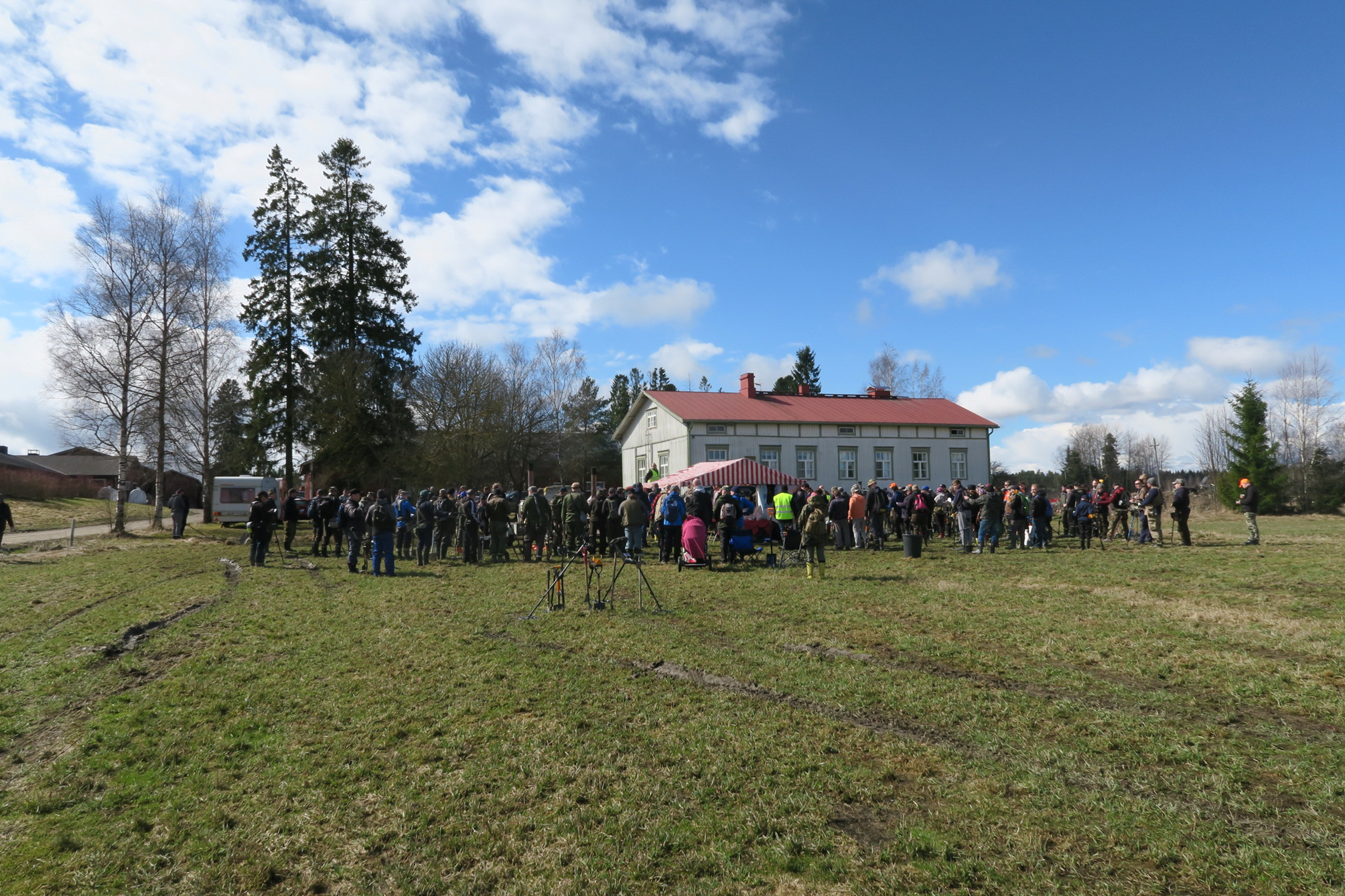
The largest known event in Finland took place at Sastamala in 2018, with 180 detectorists attending, including from Sweden and Poland (Figure 2). Because of the event's scale, the Finnish Heritage Agency gave advice to the organizers beforehand, which was welcomed by the detecting community. Consequently, two archaeologists from the heritage agency and one from the University of Helsinki attended (Wessman Reference Wessman2018). There were strict rules for the detecting, including establishing protected areas of 200 m (where further detecting was prohibited) around findspots of any significant discoveries. Only one find dating to the Late Iron Age (a penannular brooch) was found during the two-day event, which had to be handed over to the Finnish Heritage Agency for recording. The other finds only had to be reported but not handed in.
The Mouhijärvi Rally in Sastamala, Finland, gathered 180 detectorists (photo by Marianna Niukkanen, SuALT project, University of Helsinki).
WHEN IS A RALLY A RALLY?
Metal detectorists might use the term “rally” to describe anything from a weekend large-scale event to a club-organized outing that is a few hours long. In Dutch-speaking countries, they are known as zoekdagen (“search days”), and in Finnish, they are miitti (“meetings”). A plethora of other terms exist, such as “searches,” in some instances in the UK, and artifact “hunts” in the USA. Some organizers in England refer to their events as “digs” or “excavations,” implying a degree of control or organization that is by no means usual. This ambiguity somewhat confuses our understanding of what these events are (Bailie and Ferguson Reference Bailie and Ferguson2016:4) and therefore how archaeologists respond to them.
In this article, we acknowledge a wide variety of events that are organized in some way, but it is the large-scale commercial events that concern archaeologists most. For practical purposes (see further below), these are best defined as rallies. Indeed, there seems to be an obvious difference between large-scale events, for 500 to 1,000 or more who are paying to take part, and “club outings” on “club land,” which consist of 30–40 individuals. Whatever the case, all group events have an impact on heritage preservation that is often distinct from that of individual detecting. A range of factors affect this impact—and applicable mitigation strategies—in various ways. The size of these events, the motivations for running and partaking in them, the relationships between finders and the landscapes they search, the practices in the field, and the extent to which archaeologists are involved, all contribute to how they might be understood and dealt with.
Scale
For the purpose of land management in England, the Department for the Environment Farming & Rural Affairs (DEFRA) once defined “rallies” as events with over 50 people attending. Now current agri-environment scheme agreements are less precise, instead saying that Natural England (2013:154), which manages these schemes, should be informed of any “large-scale metal-detecting events, including metal-detecting rallies” on stewardship land. Both sought to define rallies on an understanding that they could be damaging to the historic environment, and that restricting the numbers of people attending such events would protect it. However, the change from a precise number to a more open definition reflects that defining rallies is more complex. That said, it does seem that larger events are more likely to be “rallies” and are more problematic for archaeologists. In England, in 2009 and 2010, up to 1,200 detectorists attended Weekend Wanderers rallies near Wantage, Oxfordshire, whereas the largest in Flanders and Finland have never attracted more than about 200 people. Rallies, then, cannot easily be defined in terms of numbers of people attending, because this is relative within a national context, but events in England tend to be much larger. The reasons for this seem to be the greater number of detectorists in England, the commercialization of such events, the potential finds productivity, the extent of arable farmland, and the degree to which the law makes rallies attractive—both to organize and attend.
Audiences
People attending metal-detecting rallies in England can include local detectorists, as well as those from farther away, even abroad (Thomas Reference Thomas2012). In Nordic countries, people in neighboring areas tend to attend each other's detecting events (Faurskov Reference Faurskov2021; Thy Detektor Rally 2011). Group events in Flanders are often attended by detectorists from neighboring countries and regions, including other parts of Belgium and the Netherlands. Detectorists are more likely to travel to places where attitudes toward detecting are more liberal. With free-border movement across much of Europe (especially in the Schengen Area), people travel to practice their hobby, experience new places, gain social connections, and make new finds.
“Club digs” or “meetings” are probably less likely to include people from outside the local area, and this localness might be a feature that helps distinguish them from rallies. From the perspective of archaeological engagement and best practice, it is more likely that responsible behavior at these events will be encouraged through social control and peer pressure; indeed, there are instances where the reporting of finds from club land (which is not otherwise mandatory) is encouraged or required.
Some attendees are more focused on metal detecting and others on socializing. Dobat (Reference Dobat2021:54) has claimed that much detecting in Denmark is about “hygge—the special Danish concept of togetherness,” and these well-being benefits of detecting are also recognized elsewhere (Dobat, Wood, et al. Reference Dobat, Deckers, Heeren, Lewis, Thomas and Wessman2020). This is an added attraction of group events, and it has benefits for people who might feel outside of the mainstream detecting scene. Sassy Searchers was established in 2018 “as an online space exclusively for women to connect and share their love of detecting” (Sharpe Reference Sharpe2021). Member Annette Sharpe (Reference Sharpe2021:17) reports that “there's a real sense of camaraderie in the group, and many members meet up online, at organized digs and on private permissions . . . even organizing a Sassy's Camping Area at weekenders (i.e., weekend-long events)” to stay connected.
Organization
The time spent in the field at group events can vary. A “club dig” may last only a few hours, but larger events last a whole day, a weekend, or even longer. Many large-scale metal-detecting events include camping, catering, and entertainment. The Rodney Cook Memorial Rally 2021 in Wiltshire, England, had advertised added attractions of “free camping,” “shower block,” “hot food and drinks,” “licensed bar,” and “stalls providing a range of metal-detecting products” (Rodney Cook Memorial 2021).
Large-scale commercial events are now common in England, most organized by a few individuals as a business. There is an attendance fee, which normally covers the costs of running the rally (including profits for the event organizer) but might also benefit a local charity. Detecting for Veterans, which organizes large-scale metal-detecting events, also has charitable aims—to support veterans of the British armed forces suffering from post-traumatic stress disorder (Dobat, Wood, et al. Reference Dobat, Wood, Jensen, Schmidt and Dobat2020; Massey Reference Massey2021). The group has nearly 6,000 members and has raised over £14,000 for two armed-forces charities since it was formed in 2017, highlighting the contradiction between the social benefits that rallies can provide and the damage rallies might cause to the archaeological record.
Practices
In Europe, most detectorists attend events hoping to find archaeological items, and the assumption made by most people attending them (including archaeologists recording the finds) is that these will be from the place being searched. It is probably correct that many detectorists are most interested in ancient finds, although some organized events target more recent historic sites. For example, in 2021, the Braintree Metal Detecting Club organized a “detecting dig adjacent to the USAAF wartime Ridgewell airbase,” Essex (England), an airbase that was utilized by the Americans from June 1943 until the end of World War II (Evan-Hart Reference Evan-Hart2021:65).
In North America, there is a practice of seeding sites with artifacts, with the knowledge of finders (e.g., Addyman Reference Addyman, Addyman and Brodie2002:182). These might be regarded as “token hunts.” This type of activity seems less common in Europe, although there are examples of it. At the aforementioned Rodney Cook Memorial Rally in 2021, tokens (in this case, common coins sprayed with paint) were deposited for people to find and redeem against raffle tickets (Dave Crisp, personal communication 2022). Similarly, in Flanders, it is not uncommon that the organizers plant numbered metal tokens across the search area, which are to be sought and collected by rally participants as raffle tickets. An advantage of these types of events for the organizers is that people paying to attend are certain to find things.
Although there is a risk that undiscovered tokens might confuse the archaeological record later, this is acutely the case with the practice (albeit not endemic) of planting actual archaeological artifacts—even seeding sites—in advance of group events. Organizers might do this (as with tokens) to ensure that their customers are happy. For instance, in 2017, an event in Flanders was advertised on an online detectorist message board with the announcement that 75 Roman coins had been strewn across the land available to participants (Deckers Reference Deckers, Campbell, White and Thomas2019). Even more problematic are the cases of those attending doing so to obtain a provenance for material illegally found elsewhere.
Despite the largely grass-roots nature of metal-detecting events and the difficulties often encountered by heritage professionals to exert oversight and control over them, collaborations do occur, to a greater or lesser degree. In Denmark, where collaboration between detectorists and professional archaeologists is long established (Dobat Reference Dobat2013), some events have been organized collaboratively, often on land deemed archaeologically interesting by museum archaeologists. This practice is rare elsewhere. In Finland, some detecting events—although most often organized by detectorists’ clubs rather than individuals—can be planned in collaboration with the Finnish Heritage Agency. Some events are also organized by museums or universities. These are usually meant for local, invited detectorists and, as in Denmark, often connected to a scientific agenda. In other places, including England and Flanders, such events would be considered controlled archaeological works, where detecting surveys by a small number of trusted detectorists might take place alongside other surveys, such as fieldwalking or even geophysical surveys. These should not be confused with the grass-roots metal-detecting events described above. In such instances, finds are typically reported in full to the heritage authorities by the organizing institution. In Finland, there is a conservation budget covering all costs (which also affects how many objects can be removed from the ground). Detectorists are not usually paid for their involvement but are often offered refreshments (Thomas et al. Reference Thomas, Wessman, Siltainsuu and Perttola2015). For most archaeologists, this would be a preferred model for groups of detectorists to come together within a social environment, given that it furthers collaboration and adds value to archaeology. According to surveys with detectorists in Finland, this is one of the most popular ways to collaborate with archaeologists (Siltainsuu and Wessman Reference Siltainsuu and Wessman2014).
CHALLENGES FOR HERITAGE MANAGEMENT
Archaeological Impact
Most archaeologists would prefer that large-scale metal-detecting events not happen, especially given the perceived negative archaeological impact. Instead, many would prefer that detectorists have “research aims” and “objectives” for their searching, be motivated by advancing knowledge about the past, develop a more holistic interest in the sites they search, work more closely with archaeologists, and keep a detailed record of their finds and observations. However, this is an archaeological ideal of what detecting should be, not necessarily what detectorists want.
Many of us have previously advocated a middle way that recognizes the contribution hobby metal detecting can make to archaeology if practiced responsibly (Dobat, Deckers, et al. Reference Dobat, Deckers, Heeren, Lewis, Thomas and Wessman2020). However, rallies and some other organized events clearly result in distinct impacts on the archaeological record. Anecdotal evidence aside, measuring these effects is tricky, given their varying natures. It could be argued that these events are no more damaging than everyday detecting, especially if finders are following best practice, including recording archaeological finds. However, the inherent large-scale nature of rallies has the obvious potential to be detrimental to archaeology.
A particular problem with metal detecting is how to deal with in situ finds such as hoards or other undisturbed deposits. In many countries, this work is not resourced and/or heritage authorities or other archaeologists are usually unable to respond immediately. The problem is magnified in the context of group detecting, principally because it is harder to secure the findspot. In England, FLOs have local protocols for dealing with these finds, and some funding to support the “emergency excavation” of in situ or significant detector finds is being offered by the National Council for Metal Detecting for its members, but this excludes finds made on rallies (e.g., nonclub events), where it is expected (although not often realized) that the organizer is responsible.
There have been instances of organizers taking the lead in fencing off an area when a significant discovery has been made and even paying for archaeological works, such as at Marsh Gibbon, Buckinghamshire, in July 2021, where the organizer paid for a local archaeologist to block lift a medieval coin hoard. But these instances are relatively few. In many cases, as with the Lenborough Hoard, also found in Buckinghamshire (in 2014), the FLO had to excavate finds in less-than-ideal circumstances, resulting in a loss of information about the original deposition. Understanding the context of dispersed coin hoards is complex at the best of times, let alone at events where multiple finders might find part of a hoard. In other cases, such as a Roman pitcher found during a Flemish event (see below), finds have not been excavated archaeologically, damaging the context. Indeed, the PAS in England estimates that only 50% of in situ discoveries made by detectorists have been recovered archaeologically (Lewis Reference Lewis2019). This has not only implications for the archaeological understanding of these finds but also impacts on the legislative process.
Due to the high expectations of attendees discovering archaeological items, together with the fact that they pay to attend, detecting events are often organized on locations likely to be particularly productive in archaeological material. Even where there is a good dialogue with local archaeologists, it can be that organizers are unwilling or unable to move the event away from sensitive areas. Although in most cases full legal responsibility lies with individual detectorists, whether best practice is followed really depends on the attitudes (and organizational abilities) of organizers. Most are probably more interested in the practicalities of designing a successful event, in terms of attendee experience, than whether archaeology is protected or recorded. Furthermore, organizers do not necessarily enforce the reporting of certain finds or (for example) support finders from abroad with their export obligations (which must be done retrospectively). Therefore, there is a chance that these finds are not reported and/or that they are exported illegally.
From the perspective of many organizers, interest and support from heritage professionals can be beneficial or inconvenient, depending on the circumstances. In England, when FLOs regularly attended group events, some organizers would highlight professional involvement—such as the presence of FLO to record finds to demonstrate that the event was being organized properly. Even now that FLOs generally no longer attend such events, organizers might still say that this is the case or that they have their own recording team passing on data to archaeologists. Conversely, archaeological interest can be seen as interference. In September 2019, local residents expressed concern about an event organized at All Cannings, Wiltshire, on an nationally important but unprotected Iron Age site first excavated from 1911 to 1921. Following a series of communications between the county archaeologist and the landowner and organizer, the event was canceled on this particular site. Unfortunately, some social media posts from members of the detecting community took a negative view of this, incorrectly thinking the FLO was directly responsible (Melanie Pomeroy-Kellinger, personal communication 2022).
Recording Finds
A challenge for archaeologists following up on finds from metal-detecting events is the strain put on heritage management resources. Aside from the resources needed to record finds in the field, these events can be too frequent, and the numbers of people attending them too great for archaeologists to cope. It is common in England, for example, for more than one event to take place on the same day, and there have even been instances of several taking place simultaneously in one county. These all lead to a significant backlog of paper records.
Although Finnish detectorists have an individual obligation to report all finds over 100 years old, there are problems when it comes to the larger events. The Finnish Heritage Agency likes to have all finds compiled as one batch, but they are often reported individually, which complicates the cataloging process. Particular to Finland (of the countries discussed here) is that detecting events also put an additional financial strain on the system beyond recording finds and excavating, given that the state is responsible for conservation costs for reported finds.
Most archaeologists would rather record finds back in the office (in ideal lighting conditions and with reference books in hand) than in the field. Even if organizers provide the facilities for recording finds in the field (which few do in practice), this is unlikely to be in ideal conditions. This also gives finders an artificial view of the recording process—few can understand why an archaeologist can “record” finds in a matter of minutes at an event but take many weeks if given finds for recording in the office. Finders do not fully appreciate the depth of the recording process—namely, that only a skeleton record is made in the field, which needs a great deal of work to be perfect.
In countries where it is not required that finds be handed over, it is likely that finders will want to take items immediately away with them, so the chance of making a good record is even more limited. In England, finders are encouraged to hand over items to their local FLO so that the find is properly recorded retrospectively, although in reality, only a fraction of finders do that. A similar issue has been observed in Flanders. Although organizers may be willing to accommodate the recording of finds on site during the event, resources for this are typically lacking, and only a fraction of attendees subsequently report their finds to the authorities.
An additional issue related to people traveling to do detection is that they might not properly understand the local laws, or they may presume that they are the same as in their own country. This can be a particular problem with finders from countries with liberal regimes traveling to more restrictive ones. Conversely, incoming detectorists can also prove to be respectful of local laws, especially if they come from places where detecting is more controlled. Sadly, not all organizers help these detecting tourists with legal procedures, such as export requirements. Unless finders from abroad are supported, there is a good chance that finds might go unreported or be exported illegally.
A recent case embodying many of these problems is the discovery of a copper-alloy Roman pitcher found in fragments at an event in Flanders in 2020. About 150 people attended the event, which was organized by one of the main detectorist communities. The heritage authorities were also notified, but by the time a collaborator of the finds-recording scheme MEDEA arrived on the second day of the event, all fragments of the pitcher had been removed from the site and were no longer available for inspection. A subsequent small-scale archaeological excavation suggested that the object was part of a plowed-out cremation burial. In breach of legal requirements, the find was transported abroad for conservation without notification and before the obligatory finds report was filed. The discovery made regional and national news, so it was a pity that best practice had not been followed.
Finder Behaviors
Across Europe, many smaller events happen outside the large-scale detecting scene, but they are not without challenges for archaeologists. These can be easier to manage in terms of the archaeological response, normally because those involved are more connected with local archaeologists, but that will vary depending on the individuals, the archaeological sensitivity of the sites being searched, and the way the events are organized.
In Finland, the smaller events (miitti) are loosely organized and often are by invitation only, meaning that no information about the exact location is shared publicly until the event is over; this can also be the case with larger-scale events. Usually, the finds from these are posted on social media on the same day, which can put archaeology at risk—especially if an in situ find is made, such as a coin hoard, and in particular when it has been disturbed by a plow—because news of their discovery might encourage illegal detecting on the site.
The distinction between large-scale and small events, however, is not always that clear cut, especially with social media being used as a tool to bring together people who live much farther away from one another than before. Many more detectorists are now part of internet groups—for instance, those organized around private Facebook pages (Axelsen Reference Axelsen2018)—some of which arrange places for their members to meet, socialize, and detect. This phenomenon provides challenges for archaeologists, given that these groups are fluid in their membership, are agile in how they meet, and can be harder to reach out to and connect with than traditional metal-detecting clubs, which generally meet at a specific time and location.
The increasing connectivity of the detecting community on social media may furthermore exacerbate some of the issues associated with detecting events, outlined above. These include a (potential) increase in their scale but also in geographic reach, including internationally. The success of large commercial rallies is undoubtedly linked to the broad advertising and “word of mouth” on social media platforms.
There is anecdotal evidence that finders can behave differently on sites for which they have not needed to gain permission personally (such as rallies). Certainly, finders value the relationships they have with landowners, and the closer they are to those individuals, the more likely they are to act in a way that preserves good relations, although that does not necessarily mean following best archaeological practice. More generally speaking, locals may also feel a greater degree of responsibility for their own landscape and heritage than longer-distance visitors to a rally.
STRATEGIES: HOW TO DEAL WITH RALLIES AND OTHER GROUP EVENTS
Group events are clearly important for the people attending, especially because they provide both (new) land to search and a social occasion. But from an archaeological perspective, they are undoubtedly problematic. Indeed, the social aspects of some events (including their prominent publicity through social media and the opportunities they present for forming friendships) are likely to lead to their proliferation. Therefore, any strategies responding to the archaeological impact of detecting events must consider the social aspects as well. Ironically, in this regard, they also provide opportunities for archaeologists to connect with people they would not otherwise see, and (importantly) articulate positive messages about best practice, including both the recording of finds and mitigating damage to archaeology. Such approaches will not necessarily provide immediate results, but over an extended period, they offer the opportunity to encourage more responsible and responsive behavior (Pitblado and Shott Reference Pitblado and Shott2015).
Large-scale commercial events seem to be most common and impactful in England. However, it is possible that this “business model” could be replicated elsewhere, and there are early signs of it in Belgium, the Netherlands, and parts of Scandinavia. This presents additional challenges concerning not only the scale of active detectorists in one place but also (possibly) the extent to which participants are willing to do the extra work associated with carefully recording their discoveries if they feel they have paid for the right to search as a leisure activity. The effect of paying a fee on the attitudes and activities of attendees is an area that could be researched further.
As noted before, legislative responses toward large-scale detecting events—and rallies in particular—are so far nonexistent in the countries discussed here. With the complexity of the phenomenon in mind, solutions and strategies for how archaeologists and other heritage managers respond to the challenges these events present can (in the short term) only be pragmatic and probably need to be able to adapt to different conditions and settings. A priority for professional archaeological interaction with metal-detecting events is retrieving as much archaeological data as possible, but that is easier said than done. It may mean developing streamlined recording processes, especially for rallies, and deploying more efficient mobile recording “apps” in countries where digital recording schemes exist. With this also comes the danger that ease of recording is prioritized over the quality of finds records, and it must be avoided. Therefore, it is crucial that archaeologists engage with organizers to try and get them to improve how these events are organized for the benefit of archaeology. Of course, the individual also has a responsibility to follow best practice, but this can be facilitated (even mandated) by the organizer, and (where relevant) the landowner.
Recommendations for Heritage Professionals
In countries with liberal approaches toward metal detecting, some archaeologists have been proactive about dealing with group events, although with limited success. Most work has involved liaising with organizers to encourage them to facilitate finds recording in the field or to report what has been found retrospectively in a useful way. In Finland and Flanders, where finds reporting is mandatory, archaeologists are best placed to develop protocols and processes to facilitate finds recording, but they should also follow up more closely on retrospective reporting. At least in Finland, it seems that the miitti organizers have failed to send in reports, but it is also unclear if heritage professionals have followed up on this. Certainly, archaeologists could take steps to protect the archaeological record by working with organizers to produce guidelines and training, as has been initiated in Finland and England. This could include advice to help deal with specific scenarios, clarifying responsibilities of all parties. In some areas, there could be better coordination between local/regional and national heritage managers to divide the workload, although in many countries, there is already good local/regional/national cooperation, and the division of work is fairly clear. Although it is resource intensive, it might be possible to have archaeologists on alert (perhaps even funded by organizers or large-scale events) to react to in situ discoveries and to undertake other emergency excavations. There might even be opportunities to create legislative frameworks so that organizers are as accountable for what happens at these events as individuals. Enforcement tools (such as licensing or permits) could be brought in to deal with large-scale events, such as rallies, but this can drive aspects of the hobby underground and further create an environment of “them versus us,” when in reality, most archaeologists and detectorists share a common enjoyment of and interest in the past. Cooperation is more likely to result in success, and whatever support or guidance archaeologists give needs to be embraced—and even reciprocated—by organizers and attendees.
We recommend that heritage professionals
• provide more clarity on organizers’ responsibilities;
• be actively involved in not only the planning stage but also the follow-up process; and
• look to facilitate finds recording on site through digital tools.
Recommendations for Organizers of Group Events
Organizers are key figures in encouraging responsible metal detecting, even if they typically carry no legal obligations with respect to best practice. As a result of the pandemic in England, large-scale event organizers were required to do more things (by law) to ensure public safety, such as restricting numbers of attendees, ensuring social distancing, and providing facilities to effect infection control (such as providing sanitation). This showed that they were able to have more control of the events they organized than they previously suggested. So why could this not also apply to other aspects, such as encouraging the reporting of finds and protecting archaeologically sensitive parts of a landholding? The PAS relies on the organizers to take on more responsibly at group events, but it cannot enforce this. Consequently, it is looking to work with those who are willing to do things better in the hope that these events will be more attractive to responsible detectorists through guidance and training. Similarly, in Finland, the Finnish Heritage Agency is currently working on specific written guidelines for detectorists organizing events at which the rules and regulations concerning these activities are clearly defined.
In essence, we believe that organizers should be strongly encouraged to
• inform the relevant heritage authorities well in advance of such events;
• consider their duty of care to attendees, landowners, and the local community through the use of risk assessments for event preparation;
• employ a specialist to advise on best practice in the field, including finds recording, legislative requirements (including those related to export), and the archaeological assessment of in situ finds;
• employ a suitably qualified and experienced finds team on site to triage finds and identify all items that should be reported; and
• employ appropriately qualified and experienced finds experts to adequately record finds after the event.
Such an approach would mean that organizers take moral and financial responsibility for protecting archaeology on the sites they invite people to search. Recording finds properly is resource intensive and therefore expensive. The information created and compiled by the “recording team” at these events requires considerable follow-up work to meet the required data and image standards for publication and dissemination. Especially in the case of commercial events—or even charity events—this societal cost should ideally be carried at least partially by the organizers. Policy makers should furthermore consider encoding these responsibilities in law.
Individual Responsibility
Metal detectorists also have a responsibility to follow best practice, and this—to a greater or lesser extent—is likely to be regulated, whether finders have to report their finds (as in Belgium or Finland) or some classes of them (as in England), or have other legal requirements (albeit few). Reminding finders of these obligations is key. Consequently, some countries have developed codes of practice aimed at the detecting community, sometimes (such as in England and Wales) developed in partnership with that community. Regardless, whether or not these are enforceable (as they are in Flanders), if adopted by individual detectorists and promoted by metal-detecting representative bodies, they establish common principles. Promoting stewardship among the detecting community in this way is perhaps more powerful than difficult-to-enforce law.
CONCLUSION
Given that metal-detecting group events are diverse, they are hard to define clearly. This adds to the challenge of how to deal with them. However, there is an obvious difference between “club outings” on “club land” and “large-scale events” (probably best defined as “rallies”) for upward of 500–1,000 metal detectorists who are paying to participate. The motivations for running these events, the relationships between finders and the landscapes they search, and the extent to which archaeologists are (or are not) involved contribute to how they might be understood and dealt with. Historical approaches to metal detecting and cultural attitudes toward protecting archaeology differ, impacting how archaeologists have attempted to engage with this phenomenon in different countries. It is clear, however, that the large-scale events witnessed in England have not yet developed elsewhere—but if the general trend of “rallification” continues (which seems inevitable), archaeologists should be concerned. Unless large-scale group events are regulated through legislation, it is essential that archaeologists and policy makers continue to promote stewardship among detecting communities and begin to educate organizers to ensure better practices and to mitigate archaeological damage.
We advocate an approach where archaeologists, working with the detecting community, encourage organizers and individuals to take more responsibility for what happens at these events. If organized well, it is even possible that attendees will get more enjoyment, knowing that they are creating knowledge rather than depriving others (not just archaeologists) of it. This approach is not without challenges, but we hope that detectorists are keener to be acknowledged for the benefits their hobby—if practiced responsibly—can add to knowledge than be ostracized for damaging it.
Acknowledgments
No permits were required for this research.
Data Availability Statement
No original data were used in the preparation of this article.
Competing Interests
The authors declare none.


 Open access

