


1. Introduction: product design in the West African entrepreneurial contexts
In many African countries, new product design unfolds in contexts where resource scarcity, speed, and agility take precedence over formalized design processes (Reference RaoRao, 2024). West African entrepreneurs are particularly characterized by their high level of adaptability and their ability to respond rapidly to changing environments. However, their design practices remain marked by centralized decision-making, weak process formalization, and a lack of tools suited to structuring collaboration and documenting design activities. Four major difficulties can be identified:
-
• difficulty in clearly articulating needs or formulating design problems;
-
• difficulty in communication between technical and non-technical stakeholders;
-
• lack of traceability of design actions and decisions, limiting collective learning;
-
• weak structuring of the transition to industrial scale, often approached intuitively rather than methodically.
In such contexts, design is commonly perceived as an intuitive activity driven by prototyping and empirical experimentation. While this agility is a key asset, it also entails a risk of meaning loss: solutions may progressively drift away from real contexts of use due to the absence of a shared understanding of the initial problem, leading to increasingly complex technical choices. Entrepreneurs often operate alone within both conceptual and knowledge spaces, producing technical solutions whose underlying rationales remain implicit. This tendency is even more pronounced in projects supported by public incubators and involving multi-actor collaborations among entrepreneurs, technicians, and artisans. Although collaborative solution development is expanding through the creation of innovation support structures such as incubators (Reference Wald and KanshebaWald & Kansheba, 2020), stakeholders frequently lack a shared basis for aligning their perspectives on the problem. In particular, shared representations of the design problem capable of guiding technical and organizational decisions are often absent.
This lack of structured design support in African contexts contrasts sharply with dominant theories and practices in engineering design (Reference Papalambros, Gero, Maier, Cagan, Ahmed-Kristensen, Albers, April, Blessing, Boujut, Cantamessa, Cascini, Chakrabarti, Chen, Clarkson, Jiao, Eckert, Feinberg, Gericke, Hanna and YannouPapalambros et al., 2025). Historically, design methods have been developed within highly structured industrial environments, where division of labor, process formalization, and decision documentation were essential to ensuring reproducibility and product quality (Reference Pahl, Beitz and WallacePahl & Beitz, 1996). Within such settings, engineers rely on systematic approaches—such as systems engineering, stage-gate processes (Reference CooperCooper, 1990), or integrated design—to progressively move from need identification to technical solution definition. These rigor-oriented approaches depend on the capacity to capture and formalize design reasoning, making explicit the assumptions and justifications underlying design decisions (Reference Bracewell, Wallace, Moss and KnottBracewell et al., 2009).
By contrast, product design in the West African context does not stem from the same historical trajectory of industrialization and instead resembles artisanal processes based on trial-and-error loops and highly skilled individual efforts. Design activities are exploratory, opportunistic, and adaptive, displaying a high degree of versatility. Approaches rooted in design thinking (Reference BrownBrown, 2008) or participatory design similarly emphasize movement between conceptual and knowledge spaces (Reference Hatchuel and WeilHatchuel & Weil, 2009) to generate novel ideas. From this perspective, design emerges as a process of co-constructing both the problem and the solution—a view that better aligns with the realities of highly versatile West African entrepreneurial contexts.
While existing literature recognizes the value of interactions among diverse stakeholders in collaborative product design within industrial environments, it pays limited attention to the forms that shared problem representations take in other settings, such as innovation incubators in West Africa. This article therefore seeks to examine how specific design tools can contribute to the construction of shared representations of both the problem and its context. More specifically, it investigates the extent to which tools derived from industrial engineering can support collective problem framing, structuring and elaboration of technical solutions, while accounting for the temporal constraints and contextual and cultural specificities of African entrepreneurial practices.
2. Underlying design concepts
2.1. Design activity as a co-construction of needs and problems
Design research converges on a central idea: the design is not just the search for a solution to a given problem, but a dynamic process in which the problem itself is constructed, reformulated, and shared among stakeholders. This assumption marks a break with traditional engineering approaches, where the needs analysis phase logically precedes the generation of solutions. As shown by Reference Dorst and CrossDorst & Cross (2001), design involves the co-evolution of the problem and the solution. Therefore, the understanding of the former becomes clearer as hypotheses about the latter are explored. This iterative process is led by exchanges between different frameworks of thought and representations. These interactions contribute to the construction of a common language for interpreting the design problem (Reference CrossCross, 2006). Reference Rittel and WebberRittel & Webber (1973) pointed out that “wicked problems” can neither be completely defined nor definitively solved. Each new interpretation of the problem transforms its nature, engaging the actors in a process of deliberation and negotiation of meaning. Thus, design is not simply an inventive activity, but rather an argumentative one. Design tools should therefore not only represent solutions but also make visible the collective reasoning that underlies the definition of the problem.
2.2. Object worlds and intermediary objects: design as a translation process
In this perspective, Reference BucciarelliBucciarelli (2002) introduces the notion of object world to describe how designers and engineers interpret and manipulate technical artifacts according to their own vision of the project. Each actor operates in a particular object world, structured by their knowledge, language, values, and professional practices. These object worlds coexist and interact in collective design projects, giving rise to tensions, misunderstandings, or compromises. These interactions take place through artifacts called intermediary object (Reference JeantetJeantet, 1998). These objects, whether sketches, prototypes, diagrams, or digital models, play a crucial role in mediating between object worlds. Additionally, the transformation process of these artifacts can be interpreted as a translation process in the sense of Reference CallonCallon (1984), where the design artefact gets through multiple evaluations and transformation phases that are the result of the confrontation of diverse points of views of the involved actors. This makes it possible to materialize intentions, translate ideas into visible representations, and support negotiation between actors (Reference Boujut and BlancoBoujut & Blanco, 2003). They play a pivotal role in constructing a shared representation of the problem.
The work of Reference Bracewell, Wallace, Moss and KnottBracewell et al. (2009) on design rationale extends this idea by emphasizing the need to capture the design logic by the arguments, choices, and justifications that link representations of problems to proposed solutions. In this sense, documenting reasoning becomes a lever for ensuring cognitive continuity between project stakeholders and product development phases. Thus, intermediary objects can be understood as cognitive and communicational instruments that enable the co-construction of the problem in multi-stakeholder contexts. They ensure the traceability and structuring of collective reasoning on the technical choices of the product or solution.
2.3. Navigating through cognitive worlds and shared representations
Design processes rarely involve a single individual; they unfold in a multi-party space where several actors with different knowledge, objectives, and languages interact. In the reality of entrepreneurial product design, particularly in West Africa, actors often operate in compartmentalized cognitive spaces. Artisans, engineers, entrepreneurs, users, and investors do not share the same frames of reference, nor the same rationales for action. This fragmentation generates gaps in representation that hinder mutual understanding of design issues. In such contexts, the mental models tend to evolve individually, with different levels of maturity, prior knowledge, objectives, and constraints (Reference Badke-Schaub, Neumann, Lauche and MohammedBadke-Schaub et al., 2007). These diverging mental models are rarely made explicit or aligned. As result, the design process lacks a shared representation of the product, its functions, and the underlying problem to be addressed for or mutually with users or other person involved. This absence of shared representations limits and weakens decision-making on design process. As highlighted by Reference Kleinsmann and ValkenburgKleinsmann & Valkenburg (2008), shared understanding does not emerge automatically from interactions; it requires specific boundary objects, explicit negotiation of meanings, and structured exchanges between actors. But by doing that, the problem world emerges from the confrontation of several Object worlds in practice. It is in this collective space, the “problem world,” that the co-construction of shared representations of the problem takes place.
3. Research approach
In the light of these concepts, we have analyzed the situations of two case studies. This research is part of an Action-Research (Reference SwannSwann, 2002) approach in the West African entrepreneurial context which is characterized by strong resource constraints, flexibility, and rapid adaptation. The objective was not only to observe existing design practices, but also to introduce and experiment with engineering tools, their relevance to construct and share representations of the design problems. During seven months, the main author of this article could interact with the entrepreneurs on a regular basis. The primary posture is that of the design engineer accompanying the entrepreneur, acting as a design facilitator positioned between technical and entrepreneurial actors. In the context of this study, the researcher observed and analyzed the interactions that occurred between the design facilitator and the entrepreneurs, focusing on the cognitive and organizational mediation that emerges through this collaboration. The analysis presented in Section 4 is based on these observations.
3.1. Two complementary case studies
We selected two Burkinabè entrepreneurs with new projects engaged in the creation of a new business and hosted by an incubator. This research took place over a seven-month period following different stages of the projects’ development. The choice of these cases is based on a strategic complementarity: one company was in the ideation phase, while the other was engaged in a development and optimization phase. This diversity, as presented below (Table 1), allows the coverage of a wider spectrum of tools at diverse levels of maturity of the engineering process.
Presentation of the two case studies

Company A operates in the field of hydroponics and the construction of agricultural greenhouses. The founder, initially trained in finance, supplemented his education with training in hydroponics. Since 2018, the company has offered greenhouse installation services and operates an experimental production unit of approximately 300 m2, equipped with a hybrid (centralized and decentralized) system for controlling irrigation, temperature, and humidity. Based on this experience, the entrepreneur identified a recurring problem: how to ensure regular irrigation aligned with the specific needs of plants. This reflection led to the initiation of a new project to design an automated irrigation control system for farmers working with or without greenhouses. At the time of the study, the solution had been conceptualized and represented as a digital model generated by artificial intelligence. The project is at an intermediate stage, where the need is identified and the main requirements are elicited, but the ideation phase is not entirely over, and the concept and the technology are not yet stabilized. This project is in the proof-of-concept phase.
Company B is owned by an entrepreneur with a bachelor’s degree in industrial engineering and maintenance. He envisions to designs devices for measuring and monitoring environmental parameters (temperature, humidity, shocks, light) for supply chains requiring continuous monitoring of transport and storage conditions. These devices are linked to a web and mobile application for real-time data monitoring. The project consists of a cold chain monitoring device for vaccines, in compliance with the requirements of the World Health Organization (WHO) and applicable international standards (ISO 13485, EN 12830, WHO PQS). The company already has a functional, but uncertified prototype, and aims to develop a version compliant with certification requirements. At the time of the study, its approach was part of a redesign phase focused on regulatory compliance and the technical reliability of the device.
3.2. Engineering tools selection
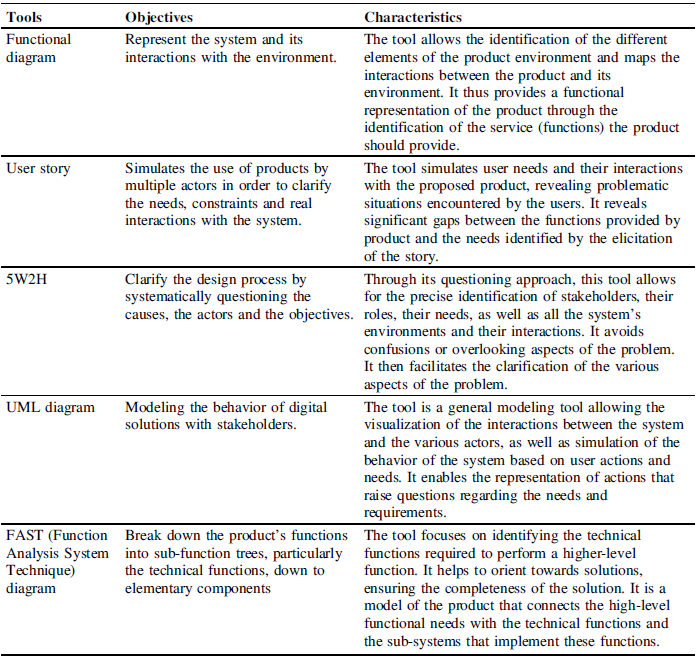
The tools used for this research were selected following a literature review in design science and industrial engineering publications, including handbooks, scientific articles and practitioners’ guidelines (Reference HigginsHiggins, 1994; Reference Clarkson, Coleman, Hosking and WallerClarkson, 2007; Reference DaalhuizenDaalhuizen, 2018; Reference TagueTague, 2023). This review allowed the identification of a set of 20 engineering tools and methods selected for their ability to support the design reasoning structures through adequate conceptual representations as well as for their frequent use in industry. The selection process was based on three main criteria: the ease of use, the flexibility for adapting in non-industrial environments and the cognitive usefulness in supporting design reasoning and process management. In addition, each tool characteristic has been matched with the main functions identified for supporting the development process of incubated entrepreneurs. These functions are : improve the relationship between the entrepreneur and the technology provider, enable collaboration and shared understanding, elaborate technical solutions, Ease of scale-up, support the documentation process. In this paper we have extracted a subset of five tools dedicated to problem representation and function clarification as presented in Table 2.
These tools have been mainly used to elicit the main dimensions of the projects that are largely implicit and sometime hidden into the internal mental representations of the entrepreneurs. The entrepreneurs have very diverse profiles and rarely have knowledge in design methodologies; this is often the first time they are involved in a complete innovative design process. The iterative nature of a design process makes it even more difficult to analyze as the entrepreneur is not aware of this complexity and sometimes underestimates the complexity and the time and effort necessary to fulfill engineering tasks. In the first step we set up a diagnosis of the projects by interviewing the entrepreneurs and by using the engineering tools to clarify the state of the art of the project. This allows us to highlight potential issues, drawbacks, blind spots, etc. to come back to the entrepreneurs with adequate questions to complete the picture. This iterative process including the representations has been analyzed in the following sections.
These tools were systematically tested with the entrepreneurs, during a series of interviews where the representations have been used as mediating objects (Reference Boujut and BlancoBoujut & Blanco, 2003). In total, we carried out six interviews of two hours and four iterative testing on the five tools, as well as two collective workshops to test different functionalities of the tools. We recorded and made the transcriptions of the verbal exchanges. At each step, the analysis of the verbatim and the elaboration of the models allowed to clarify and refine the shared understanding of the project. Each improvement and changes were documented, on the tools and used by the design facilitator as a cognitive mediation with the entrepreneur. The analysis focuses on understanding how these design tools facilitate shared representation and how entrepreneurs and design facilitator build their understanding of enriching their respective object worlds throughout the progress of the design process.
Tools analysis

4. Insights from the analysis of entrepreneurs’ design activities
The seven-month period of interactions with the entrepreneurs, studying their activity and testing engineering tools as analysis and transformation levers, revealed important gaps in the need analysis and the translation of these needs into product functions and technical implementation. This reveals the complexity of product design in the context of entrepreneurs. For the purpose of this article, we will focus on the analysis of two crucial moments: the formation of individual representations and their tension towards a shared representation; and the shared space for problems representation and enrollment.
4.1. Discovering: from individual problem representations to shared problem representations
One of the first key findings from the interviews and workshops is that entrepreneurs often struggle to clearly articulate the problem they are trying to solve. The first interviews revealed a confusion between the definition of the problem and the description of the proposed solution, as if understanding the initial situation could be naturally deduced from the description of the product and the technology adopted. For Company B, the entrepreneur presented his temperature monitoring device by highlighting its expected performance, such as measurement accuracy and battery autonomy. However, he did not establish a link between these parameters and the specific causes of cold chain breaks or the quality or regulatory requirements for monitoring devices: “The solution is a device that monitors the transport and storage conditions of sensitive products. It measures temperature over a wide range, humidity, sunlight exposure, and position. Tests have now been completed with the department of health…” The entrepreneur focused on the product itself rather than the context in which it would be used. For Company A, the implementation of an irrigation automation device was envisaged as a global response to the challenges associated with agricultural activity. This solution was presented as a comprehensive solution to the arduous nature of the work, without being possible to clearly identify the type of agricultural activities and discern the variables to be controlled to address concretely the operational conditions (such as humidity, temperature and installation environment, components and their configurations). The entrepreneur claims: “We take care of all the farmers’ needs. He will no longer have to do all these tasks; we will manage everything with our device. The plant’s technical itinerary is recorded, and the device automatically controls irrigation. He will no longer need to intervene.”. This citation illustrates the confusion between the presentation of the solution and the usage scenario. This confusion calls for clarification to be able to share the problem definition and understand the solution and the reasons of the entrepreneur’s technical choices.
Based on these first observations we needed to go deeper into the entrepreneurs’ definitions of the problem representations the entrepreneurs have built along with their own experience, and the technical definition of the problem. Particularly because the situations analyzed are very complex and the solutions and problem representations are intertwined and remain mainly implicit. Using Bucciarelli’s concept of Object world (Reference BucciarelliBucciarelli, 2022), we assumed that the mental representation of the design problem the entrepreneur aimed to fix is related to his own individual experience and skills. We worked together te the conditions for building a clear definition of the design problem, We could observe a disconnection between their perception of the problem with very empirical and hands-on considerations which contribute to feed their object world with practical and empirical knowledge of the problem to address and, on the other hand, their professional background which provides another type of component of their object world which can vary a lot and which is mostly very specific to a technical domain. In our study, the entrepreneur of company A has been trained in finance with a little training in hydroponic techniques, while company B’s entrepreneur is an IT and electronic specialist. Both have been accompanied to have a rather clear vision of the global business, the two entrepreneurs face difficulties to tackle the global complexity of the engineering and industrialization context to implement their strategic vision. In other words, their object worlds are apparently composed of two distinct components. One is made of their professional and technical background, and one is made of their understanding of the usage situations and implicit understanding of the needs of the target users. It appears that there is a grey zone where the entrepreneurs navigate to bridge the gap between their technical and professional knowledge with their knowledge related to the user’s needs. This is mainly this grey zone that we are addressing in the next section, using tools to elicit the object world’s components and share the mental representation of the problem and the solution.
4.2. Design representations in practice
The second phase of our research-action approach consisted of using these design tools in an operational context with entrepreneurs. Exchanges and modifications of the tools have been captured to analyze how the two entrepreneurs used them to elicit their requirements and to build a common understanding of the design problem. The process involved reformulating technical terms, complementing functional diagrams, and contextualizing and eliciting the realities experienced by the target users. This process can be analyzed using the translation process theory (Reference CallonCallon, 1984). Using this lens, we tried to highlight the interwoven nature of the technical modeling and cognitive processes of creating a shared representation of the design problem. The creation of a functional model is a complex socio-technical process that entails both co-construction and transformation. On the cognitive side this process allows the alignment of the actors by creating shared cognitive representation. While on the technical side, the functional models benefit of the diverse points of view and knowledge of the various actors (including the users in some situations) and capture the essence of the compromises and decisions. In the case of Company A, the creation of the functional timeline (Figure 1) brought to light several weaknesses in the identification of the functions of the envisioned device with respect to the needs and practices of the end user. It also exposes gaps in the technical underpinnings that the system depends on, including digital network availability, material properties, relevant regulatory standards, and the physical and behavioral constraints of users. This has been indicated by the green question marks (Figure 1) which has be discussed further in another round of discussion. Figure 1 represents a photo of the state of the process at a certain point in time, like a snapshot of the translation process.
Company A functional timeline

Likewise, for Company B, the functional diagram was reconstructed by the facilitator after the creation of a usage scenario displaying the temporal sequences of the product use and the interaction with the various users (the driver, the health worker, and the warehouse manager, etc.). The analysis revealed unanticipated usage combinations, leading to the identification of new functions that the entrepreneur did not anticipate. By combining user scenario with the result of the functional diagrams, we obtained a functional timeline that allowed us to clarify and share a representation of the evolution, the actions, and the characteristics of the product according to the temporality and contexts of use (Figure 2). The functional timeline (Figure 2) allowed the identification of missing key actors in the medical cold chain who were not considered during the initial design of the first version of the product. This omission created difficulties for the company, notably the non-anticipation of some regulatory requirements that led to a failure in this market. The company had to reorient its strategy towards another market with less regulatory constraints.
For Company B, an initial analysis of the interview led to the creation of a functional diagram aimed at placing the production context and identifying all its functions. However, this initial functional diagram, developed mainly from the entrepreneur’s feedback, did not provide a satisfactory understanding of the relationship between and scope of the product’s various functions.
Faced with this limitation, we chose to adopt the opposite approach. Rather than gradually enriching the existing functional diagram, we reconstructed the analysis based on an ideal scenario for using the product, considering all the actors likely to interact with it. We systematically associated this scenario with the questions “how, why, who, what, where, and when” in order to represent the behavior of the device in its context of use in a comprehensive and detailed manner.
This representation (Figure 2) in the form of a timeline combining function and use made it possible to highlight gray areas in terms of usage needs, as well as expected functions of the device that are not considered in the current design. It allows for a comparison between the functions explicitly formulated by the entrepreneur and those identified by the analysis of the actual use of the product in an activity situation.
Company B functional timeline

As our research was an ex-ante analysis of the company B project, the functional timeline served as a diagnostic tool that highlighted blind spots in the design process. These blind spots correspond to functions or environmental constraints that the entrepreneur did neither consider nor consciously avoided because they were perceived as unclear or difficult to address. In figure 2, these elements are in the highlighted green boxes. By systematically mapping functions over time, in a timely manner, this process makes us possible to detect inconsistencies, missing elements, or poorly articulated assumptions about how the system operates. It thus prompts entrepreneurs to revisit these weak areas and opens new avenues for expanding, refining, or reframing the design problem with the different actors.
By taking on the role of facilitator, it guided the entrepreneurs through a process of gradually discovering and eliciting the problem. This approach did not consist of providing adequate formulation, but rather of encouraging them to express their own understanding of the situation. The selected and translated design tools were transformed into constantly evolving intermediary objects, serving as support for reflection, a record of the dialogue, and a materialization of cross-learning.
5. Discussion
5.1. Agility vs formalized design tools
The two case studies illustrate the tension between the agile and intuitive logic of entrepreneurs and the formalized, method-driven logic of tools derived from engineering design. In both companies, the actors displayed a high level of adaptability and responsiveness to technical and market constraints, yet a low degree of formalization in their design processes. This observation is not new; it echoes previously identified distinctions among entrepreneurial profiles.
In the case of Company B, for instance, the technical manager was familiar with certain tools, such as functional diagrams and FAST tables (Table 2), but acknowledged that he did not use them in his daily practice: “When you’re really in the thick of things, it’s hard to take a step back and go through all these tools to build your solution.” This statement clearly illustrates the tension between the dynamic co-evolution of problems and solutions, and the rigor imposed by systematic design models, which are often perceived as time-consuming.
Entrepreneurs tend to operate in a reactive mode, characterized by rapid iterations, testing, and continuous adjustment. While this form of agility is essential in a project-based context, it also makes it difficult to anticipate issues, reduce risks, and ensure the overall quality of decision-making. This “restless” relationship with formalized tools further reflects a cultural gap between two distinct object worlds: that of engineering design, where tools support structured reasoning, and that of entrepreneurship, where priority is given to speed of action, cost control, and market timing.
When entrepreneurs perceive engineering tools as restrictive frameworks, they often associate them with a loss of momentum or with an implicit judgment of their design practices. This perceived slowness or complexity helps explain why such tools are effective only when they are understood and shared within a cooperative framework, rather than imposed externally. Consequently, our approach was not to introduce these tools as normative instruments, but rather to integrate and translate them into the language, rhythm, and concerns of entrepreneurs, thereby guiding them toward a more structured approach to design.
5.2. Translation as a tool for eliciting and structuring design thinking in design process
The concept of translation was developed by Reference CallonCallon (1984) as a chain of objects through which heterogeneous actors are able to understand one another, coordinate their actions, and act collectively. At the outset, our approach aligns with what Callon refers to as the observer’s agnosticism, insofar as we temporarily suspended our own analytical framework in order to listen to the actors without presupposing hierarchies of knowledge. This posture made it possible to apprehend entrepreneurs’ specific modes of reasoning, their priorities, and the zones of ambiguity that characterize the problems they confront—or overlook.
The second step draws on the principle of generalized symmetry, which promotes the construction of a translation space in which no form of knowledge is considered superior to another. This space was materialized through the co-construction of functional representations, within which diverse forms of expertise could be expressed on an equal footing. In this context, engineering tools enabled the production of representations that functioned as intermediary objects (Reference Boujut and BlancoBoujut & Blanco, 2003). These initial translations sought to bridge the structured object world of the facilitator and that of the entrepreneur. However, this first attempt did not fully achieve the intended effect: entrepreneurs continued to reason primarily within their own object world, while the tools remained strongly anchored in an engineering logic.
It was ultimately through a third interaction loop—what Callon terms free association—that the translation process became effective. This principle consists in allowing the elements of the problem to circulate freely, enabling actors to reconstruct their own associations between needs, constraints, intentions, and technical choices. At this stage, translation evolved into a more open and flexible process. The tools were no longer applied in a prescriptive manner but were deconstructed, rearranged, and transposed into simple questions, temporal representations, and narrative decompositions of the product. Through this movement, design tools gradually became genuine intermediary objects capable of articulating multiple object worlds.
In this perspective, it is no longer the tools themselves that guide the approach, but the way in which they are translated to support the co-elicitation of the problem as a shared object. Translation thus goes beyond mere reformulation and operates as a reflexive mechanism. It leads entrepreneurs to re-express their intentions, distinguish between needs and solutions, expand their understanding of the problem space, and open new pathways for solution exploration. By rendering ambiguities in reasoning explicit, translation transforms interactions into a learning space for co-creation, in which problems and solutions co-evolve simultaneously.
This perspective raises a critical question: who is capable of effectively fulfilling this translation function? As suggested by research on abstraction handling in engineering design, this role requires a rare combination of competencies: on the one hand, mastery of engineering tools, models, and modes of reasoning; on the other, the ability to re-contextualize them within environments characterized by uncertainty and stakeholder heterogeneity. Without this hybrid skill set, translation risks being reduced to a superficial simplification, insufficient to produce the cognitive transformation necessary for a shared understanding of the problem. Consequently, this function cannot be assumed by an isolated engineer, nor by a business coach operating within innovation support structures such as incubators.
6. Conclusion
This article examined how engineering design tools can support a deeper understanding of design problems and clarify the elicitation of functions and needs, thereby facilitating the construction of shared problem representations within the specific African entrepreneurial context of public incubators. Our findings show that these tools are particularly valuable when mobilized as intermediary objects within a collaborative elicitation process between entrepreneurs and engineers.
Building on this observation, we demonstrate that the relevance of design tools emerges through a progressive translation process, in which researchers and entrepreneurs move between their respective object worlds to co-construct shared representations of the problem. This work contributes to design research in several ways. First, it identifies the conditions under which engineering design tools can effectively function as intermediary objects to reveal new product design challenges within innovation incubators in West Africa. Second, it highlights the critical role of the researcher as a facilitator in this collaborative design approach. Such facilitation requires hybrid competencies that combine structured engineering reasoning with the agility needed to engage with African entrepreneurial contexts.



 Open access

