





Introduction
A two-page, black-and-white photograph depicts a group of nine women standing naked in nature, hugging each other while they pose for the camera together. A couple on the right is kissing, and others look towards a distant point above on their side, laughing. The whole composition is not entirely visible, however, due to an oblique white strip that censors the pubic area of the women’s bodies (Image 1).
Matsumoto Michiko, Ribu Camp, Nagano, August 1971. From the photobook Nobiyakana Onnatachi (1978). Courtesy the artist.

The image was taken by Japanese photographer Matsumoto Michiko (b. 1950) in Summer 1971, at the first camp organized by members of the Ūman Ribu—the Women’s Liberation Movement, also known as Ribu (Shigematsu Reference Shigematsu2012)—near Nagano, and conveys the feelings shared by many of these women to be not just participating in the movement’s activities but, beyond the political acts, to belong to a community with a new kind of intimacy. In time, the picture—and other versions of the same scene, as it will be shown in this article—became an iconic representation of the liberationist groups, also thanks to its reproduction in publications of different kinds throughout the years, from mainstream press to Ribu independently produced materials.
In the pages that follow, the present contribution will show a “visual turn” of Ribu—a transformation that seems to have happened around the end of 1971 and the beginning of 1972—when the positions of the members of the movement started shifting from a total closure against the presence of reporters at their events to a more inclusive approach towards specific photographers, like Matsumoto. This can be evidenced thanks to a plurality of sources, both the mass media’s mainstream channels and Ribu’s own press.
The specific picture of the women at the Ribu camp is symbolically taken as the starting point here because it encourages reflections on the relationship between photography and the feminist groups in the 1970s, which will be the central topic of the present article. In 1978, the image was among the hundreds of photographs gathered in Nobiyakana Onnatachi (also known by the English title Women Come Alive), the first photobook produced by Matsumoto Michiko and published as the author’s testimony of the 1970s feminist movement. For Matsumoto, the publication of Nobiyakana Onnatachi was the culmination of almost a decade lived by following the Ribu women and their actions. Composed of a collection of pictures that were taken throughout the years, the photobook sheds light on how the photographic image can provide a precious visual and historical account of past events in which the feminists were involved.
Matsumoto’s caption that accompanied the photograph points out how crucial the event was for the history of the movement, for the sense of community that it created, and for the future directions of its different groups, which are also moments that her camera recorded (Matsumoto Reference Matsumoto1978). Besides, this particular photograph was an object of debate in the feminist movement concerning the strict editorial regulations controlling the images of bodies in the Japanese press. For instance, a small publication titled The Women’s Movement in Modern Japan, released in 1975 by the Ribu publishing house Femintern Press, reproduced the same picture accompanied by the sarcastic words of Tanaka Kazuko, the author of the booklet:
Feeling free, / everyone suddenly, spontaneously / felt like running naked / through the fields like in primitive days. / Unfortunately, / because of Japanese “obscenity” laws, / they are not allowed / to be liberated / in this pamphlet / (photo by Matsumoto Michiko). (Tanaka [1975] Reference Tanaka1977, n.p.)
Matsumoto herself commented on the question in a later 1985 interview, in which she said that the picture was particularly important as “it was the result of a simple idea, to get naked in the wind, and was a liberating photograph” (Ochiai and Matsumoto Reference Ochiai, Matsumoto, Ochiai and Matsumoto1985: 37).Footnote 1 However, because of the editorial restrictions that forbade the exposition of total nudity, in the end she opted for adding the white strip to cover the women’s pubes—with the result that, due to censorship, “the ridiculousness of not being able to show their pubic hair is even more emphasized” (Ochiai and Matsumoto Reference Ochiai, Matsumoto, Ochiai and Matsumoto1985: 38). Upset by the restrictions on the images of nudity, which compelled the photographer to censor the image, Tanaka and Matsumoto both convey the sense of general disappointment towards the mainstream press that the liberationist women widely shared.
In addition, it is important to point out that, since the images by Matsumoto were published with the approval of the Ribu members themselves (which was obtained not without hesitation, as we will see), her work is exemplary of how photography can help form a group identity—a collectivity that wanted to be captured to let their actions be known to a larger public, and to offer representations in which other women could identify themselves. Considering different dynamics of communication and promotion that will be explored later, therefore, this specific picture can be interpreted as an ideal image of the Ribu members, a depiction that insists on the women’s tight connection with nature and authenticity, and, above all, a representation of life and freedom.
In contrast to what was traditionally believed since the beginnings of the medium, the idea that photographs are made with precise intentions and are thus not just a neutral and exact mirror of the truth has been recurrently debated during the past half-century. Several theorists highlighted how the medium offers a partial view of reality, as the result of intentional choices made by its authors, who visualize the final image with a purpose.Footnote 2 From this perspective, inspecting the reasons and the processes behind the creation of specific photographic images can shed light, for instance, on the different meanings that compose each picture, who commissioned it, for what public it was made, and so on. In particular, if one considers the image production from 20th-century Japan, several photographs of ideological propaganda or promulgation can be found in different forms throughout the whole period, from supporting the actions of the imperialist government at the beginning of the century, to visual accounts of the work of New Left protest groups in the postwar years.Footnote 3 Overall, photography seems to have always been a preferred medium to convey powerful messages to different kinds of audiences.
Previous literature on the Japanese Women’s Liberation Movement focused mainly on the activities carried out by the different groups that composed it or explored the written texts that were published by associations of Ribu women: it is the case of important studies by Shigematsu Setsu (Reference Shigematsu2003, Reference Shigematsu2012, Reference Shigematsu, Bullock, Kano and Welker2018) and James Welker (Reference Welker2012, Reference Welker, Bullock, Kano and Welker2017, Reference Welker2024), to just mention a few. However, its image production is still largely unexplored, and specifically what I would define as Ribu’s visual turn, which occurred a couple of years after the movement’s establishment, has generally been overlooked in previous scholarship. In order to put the photographic practice within Ribu into focus, this article presents pictures of the Women’s Liberation Movement taken and published in Japan across the 1970s by Matsumoto Michiko, with the aim to reflect on the role of the image for the feminists’ (self-)representation and legacy.
Moreover, this piece positions itself within the strand of scholarship that, in recent decades, has aimed to expand awareness of the work of Japanese women photographers, who were historically marginalized or placed in subordinate positions in the world of image-making. Karen Fraser’s (Reference Fraser, Gartan and Wue2017) research, for instance, highlighted the role of early-Meiji bijin (female beauty) photographs—rooted in the previous woodblock print tradition—in establishing a visual trope that positioned women primarily as passive subjects of photography, rather than as its creators, which in many ways have lasted until contemporary times. The unbalanced dynamics that limited women’s access to the photographic practice were explored also in various studies by Kelly McCormick (Reference McCormick2019, Reference McCormick2022), who showed that the years during and after World War II witnessed a growth in women’s contribution to Japanese photography—from the beginnings of the career of the first woman photojournalist Sasamoto Tsuneko (1914–2022) in the late 1930s, to the groundbreaking focus on working women carried out by Tokiwa Toyoko (1930–2019) in the 1950s, an author associated with the so-called VIVO photo agency. Starting from similar premises and looking at the scene of the 1970s–1980s, Russet Lederman (Reference Lederman2017) pointed out that despite being largely excluded by the major exhibitions of those years there were several women photographers working in Japan at the time. In Lederman’s view, this is seen first of all in the photobooks that they published: on this, the thorough bibliography she recently co-created with Marc Feustel (Reference Feustel, Lederman, Vermare and Martin2024)—included in the volume that accompanied the exhibition I’m So Happy You Are Here presented at Arles in Summer 2024Footnote 4 —gives a more tangible sense of the dynamic editorial production that women were engaged with from the second half of the 20th century.
With a similar approach, the present study is, to my knowledge, among the very first attempts to organize and narrate part of the visual and textual materials from the early phase of Matsumoto’s long and ongoing career.Footnote 5 These photographic works can be seen as narrations of that specific moment of the social history of Japan, and a historical documentation of the activities promoted and organized by the feminist groups.
The 1970s and the Women’s Liberation Movement in Japan
Arising from the aftermath of the end of the Asia-Pacific War and the compelled relationship with the United States occupying military forces, the decade of the 1960s witnessed an escalation of protests and strikes in anticipation of the renewal of the Japan–US Security Treaty (Anpo jōyaku), which was set to occur automatically in 1970.Footnote 6 The protests were carried out mainly by leftist students’ organizations such as Zenkyōtō (abbreviation of Zengaku kyōtō kaigi, All-Campus Joint Struggle Committees). Among these, there were also female participants who, however, often played only marginal roles within the groups, thus experiencing a general disillusionment with the leftist organizations’ limited acknowledgment of women’s issues (Mackie Reference Mackie2003: 147).
The numerous female students who were participating in the activities of the 1960s New Left in Japan often did so under the belief that they could contribute to dismantling existing hierarchies of economic and social domination—including expectations placed on them as women—but ended up finding an analogous system of hierarchies replicated within these movements (Schieder Reference Schieder2021: 2–3). Similar contradictions were experienced not only in Japan, but also by women in other countries, who did not feel listened to, appreciated, or even safe within leftist organizations—where sexism and violence were common—despite the fact that it was precisely thanks to women that the limits of activism were pushed to unprecedented levels, pointing to different forms of oppression (Mohandesi et al. Reference Mohandesi, Risager, Cox, Mohandesi, Risager and Cox2018: 16–18). Involvement in the leftist movements contributed to convince women about the importance of using political activities to change society, but also spurred them to bring their issues much further with their own separate movement (Matsui Reference Matsui1990: 438).
One of the most remarkable events for feminism in Japan was the Women’s Liberation Movement, Ūman Ribu, which started around 1970. The Ribu movement introduced some radical changes to the ideas of the first Japanese women-oriented positions that had developed from the beginning of the 20th century. This is commonly considered the “second wave” of feminism in Japan and is distinguished from previous women’s rights movements for its stress on the importance of questions that were almost ignored until then. In other words, the aim of Ribu was, above all, to radically change common ideas about women, whose roles were traditionally supposed to be nothing more than housewives and mothers—which persisted as a legacy of the late-19th-century concept of ryōsai kenbo (good wife, wise mother), considered the best form of female contribution to Japanese society. Ribu, on the contrary, rejected the view that women were predestined to become mothers by their intrinsic nature, while it supported a complete freedom of choice regarding the possibility of motherhood (Ueno Reference Ueno2009: 5–6).
The movement also insisted on the importance of the “liberation of sex” and on the necessity to consider the women’s own desires and sexuality—widely rejected until then—which could be obtained only through a complete transformation of gender roles and the family system. For Ribu, gendered hierarchies in the family could be seen as a smaller-scale reproduction of the patriarchal structure that dominated both the imperialist and capitalist systems at large. Therefore, the movement ultimately criticized the economic, political, and social systems for their male-centrism, an idea that also distinguished it from previous women rights associations in Japan (Shigematsu Reference Shigematsu2012: xvi–xx).
Ribu had no fixed structure, nor leaders, nor hierarchies: instead, it was composed of several groups that operated in different areas of the country, each working in their own way (Akiyama Reference Akiyama1993: 122). Among the most popular was the Tokyo-based Gurūpu Tatakau Onna (Group of Fighting Women), whose prominent members included activist Tanaka Mitsu. The Tatakau Onna were also among the main founders of the Ribu Shinjuku Center in Tokyo, which, besides being the headquarters of various collectives, operated as a space for spreading information on contraception and abortion, as well as providing shelter for rape and violence victims (Shigematsu Reference Shigematsu2012: 85–7; Matsui Reference Matsui1990: 438).
At the beginning of the 1970s, Tanaka Mitsu was regarded as one of the most influential theorists of the movement. Her 1970 texts Erosu kaihō sengen (Liberation of Eros) and Benjo kara no kaihō (Liberation from the Toilet) became manifestos not only for the Tatakau Onna group, but also for the broader movement, due to the crucial points she raised exposing how structures of Japanese family, education, and society at large deny women’s sexuality, as well as in showing how the expectations of masculinity and femininity are oppressive for women (Shigematsu Reference Shigematsu2003: 289–91; Tanaka [1970] Reference Tanaka, Mohandesi, Risager and Cox2018: 120–5). As she argues in Liberation of Eros, the repression of sex “is the primary means to make humans into a slave-like class”, and the “liberation as women must lead towards a liberation of sex” (Shigematsu Reference Shigematsu2003: 290, trans. by S. Shigematsu). Additionally, in Liberation from the Toilet, Tanaka points out the constraints in the institution of marriage, an imperative that, while imposed on women as the only tool at their disposal to reach happiness, has in fact as its sole purpose ensuring ethnic purity of blood and the succession of property (Tanaka [1970] Reference Tanaka, Mohandesi, Risager and Cox2018: 120–1). A woman’s sexual desire is bound to the man/husband, at the same time confining her economic independence: this considered, Tanaka wishes for the liberation of women from the objectification operated by men—who, in her words, see them only as “either Mother, maternal tenderness, or Toilet, the vessel to dispose of sexual urges […]” (Tanaka [1970] Reference Tanaka, Mohandesi, Risager and Cox2018: 121–2, trans. by S. Shigematsu).
Tanaka’s positions, such as those briefly outlined here, together with some of the main points raised by Ribu, were often not taken seriously, or even mocked, by the Japanese press of the period. The media approach to the feminist stances can be seen as part of a broader act of ridiculing the women of the liberation movement that was also later evidenced by theorists, such as Ehara Yumiko (Reference Ehara and Richard2005: 43–55). For this reason, at the time many activists opposed the mainstream media and opted for communications produced from within Ribu.Footnote 7 Tanaka’s courageous statements became among the movement’s most heartfelt instances of self-affirmation and were shared by many women throughout the country.
Ribu and photography: a shifting relationship
In her 1993 publication, former Ribu activist and feminist translator Akiyama Yōko offers a reflection on how the Japanese press reacted to the insurgence of the movement in the country: an article published on the October 4, 1970 on the newspaper Asahi Shinbun, with the headline “Ūman Ribu,” accompanied by the English words “Women’s Liberation” just below, was arguably the first time Ribu was mentioned in the press with its official name (Akiyama Reference Akiyama1993: 35–6). The name chosen as the movement’s formal representation evokes its members’ aspiration to become part of a wider network beyond the national borders; despite other Japanese words existing to indicate the concept (such as josei kaihō), the members opted for the transliteration of the English words “women’s lib” as a sign of their solidarity with other international liberationist groups (Akiyama Reference Akiyama1993: 38). However, the Asahi Shinbun article analyzed by Akiyama presented the movement as a trend that had finally arrived in Japan after the emergence of its counterpart in America, thus offering an example of the media’s common tendency to describe Ribu as a US import, in an attempt to devalue it (Akiyama Reference Akiyama1993: 38). While it is true that influence from overseas shaped some aspects of the movement, the Japanese feminist groups also underwent their own process of formation and growth and were characterized by peculiar elements. The influence of the American liberation movement helped catalyze a resentment that was simmering among Japanese women and encouraged the verbalization of that resentment. Moreover, Ribu did not appear unexpectedly in Japan: its official recognition in the press happened after many months of political demonstrations and rallies organized by feminist groups to publicly affirm their existence (Shigematsu Reference Shigematsu2012: 66–9). On this, Welker adds that both aspects—the imported and the local—coexisted in the movement’s wide body of writing: self-produced pamphlets, booklets, and newsletters were published alongside essays and books translated from English, all of which became part of Ribu’s discourses (Welker Reference Welker2012: 27).Footnote 8
In general, the attitude of the press towards the movement—and vice versa—was ambivalent: in Akiyama’s opinion, the various articles that appeared in the mass press helped Ribu gain an increasing visibility and reach a greater variety of women across the country (Akiyama Reference Akiyama1993: 35–6). Still, a rather teasing language can be noticed in the texts presented by newspapers and magazines to describe the movement. For instance, the subtitle of the same Asahi Shinbun article stated,
Landing in “Men’s Kingdom”: in various parts of the country, group after group of extremely little beauties are being brave. (Akiyama Reference Akiyama1993: 36)
This condescending tone is a fitting example that shows how the media discourses did not take the women of Ribu too seriously. Also, the fact that the statement highlights their physical characteristics—“little beauties”—rather than the questions they raised can be seen as additional evidence of the objectifying gaze that commonly falls on women. This aspect is in line with feminist sociologist Ehara Yumiko’s argument highlighting how the women of Ribu were often diminished or treated with ridicule by the mass press, not dissimilar to the sort of treatment that was reserved for women in society at large (Ehara Reference Ehara and Richard2005: 43–52).
The media’s behavior towards the feminists fomented opposition towards the mass media (masukomi) by the movement members, in particular in the early stages of the group’s formation. The general rejection of the ways the media depicted the liberationist struggle also resulted in the Ribu women’s lack of consent towards admitting journalists and photographers at their rallies.
An example of their refusal of the press can be found in another Asahi Shinbun article, published on October 22, 1970. Reporting on a Ribu demonstration that had taken place the day before in Mizutani Park in Tokyo, the piece aimed to show the activists’ allegedly unwelcoming behavior at their events and gatherings (Asahi Shinbun 1970: 24). It opens with an image at the top of the page showing a confused scene where some protesters are shown with their heads and faces hidden behind helmets, sunglasses, and masks. Just below, on the left side of the piece, another woman is photographed while she hides her face from the camera with her hand. In its first lines, the text mentions the words of a leaflet that was distributed during the demonstration, which stated, “Men are not allowed to enter—including reporters” (Asahi Shinbun 1970: 24). As the piece proceeds, it also quotes the words shouted by the leaders of the protest:
“Men, please leave now! Press, go home! We are not a spectacle! Don’t take pictures of us!”. […] “Do you know what it’s like for a girl to have her picture taken?” […] “You all, as you can see, the media is abusive. The society of men, who has been oppressing women, is now coming down upon us”. […] “We are not a show, we are not a commodity. The men of the mass media will use those flashes to make us become a spectacle to expose.” (Asahi Shinbun 1970: 24)
The last sentence, pointing out the media exploitation of the women’s images, arguably reveals that the liberationists’ refusal to have photographs taken was not due to the photographic image per se, but rather to the perceptions they had of the mass journalists who took those images, whose cameras were seen as an extension of the voyeuristic male gaze. In addition to the ridiculing language that the press used when referring to the movement, thus, the male gaze was trying to use the pictures of women protesters for its own satisfaction. I would suggest that scenarios like the one narrated by the Asahi Shinbun article might have encouraged the need, for Ribu, to appropriate its representations, to present their own photographs in opposition to those spread by the media, and to record their actions from within the movement. Fully aware of how their work was portrayed for mass audiences, activists sought to produce their own representations—images they believed more accurately reflected their experiences and political aims—and to share them within themselves to foster a deeper sense of connection.
An example of the activists’ intent to document their daily activities can be found in the scrapbooks and the many photographs that are included in the vast archive of the Ribu Shinjuku Center, which can be dated approximatively from 1972 to 1973.Footnote 9 One of these, from 1972, is titled Me de miru Ribu Shinjuku Sentā no hiroku (Records of the Ribu Shinjuku Center as seen with our eyes). The title declares the intention of the author (whose name is not credited) to keep a visual record of the events that were happening and involved the group. The way the visual material is collected and organized on its pages is what makes this and other scrapbooks of this archive extremely interesting. The pages alternate between small-format pictures showing the Ribu women in the Center eating together, talking, and preparing for demonstrations, and colored handwritten notes reporting dates and short descriptions. Made as an internal account, these scrapbooks can also be seen as evidence of the importance that was attributed to photography, at that point, to select subjects that were worth documenting, both for archival purposes and for posterity.
In opposition to the mass press, Ribu communication had an important role in shaping the movement’s identity. This was made possible not only thanks to the texts written by the different members of the groups, I would argue, but also by the precious contribution of the visual elements that were integrated in all the press produced by Ribu. Composed of self-published magazines, flyers, posters, and pamphlets, commonly called minikomi (short for mini-communications), it was a way to exchange information that had often been used by activist groups to oppose the narrations of the mainstream media (Schieder Reference Schieder2021: 7). Moreover, the realization of their own pamphlets and volumes, not dissimilar to what had been done in other groups globally, reinforced the collective idea of belonging to a supportive international network.
The different materials that were produced by the liberationist groups in Japan at the beginning of the 1970s interestingly reveal a great amount of graphic content, such as sketches, drawings, and vignettes, which, with their creative and often ironic perspective, accompanied the articles, sometimes further explaining the topics discussed or providing additional comments. Among these visual elements, for its position and the space it was dedicated, I would argue that photography can be considered to be one of the public’s favorite types of content, recurring in almost all Ribu publications, as we will see. The photographs realized at the time were crucial in providing a record of the daily life within these groups and, more than that, they offered a clear portrait of the participants to the viewers. Therefore, in the minikomi the pictures were used on one side as a testimony of the most important Ribu activities and, on the other, as a way to reinforce representations of the women’s brave presence at different gatherings, political rallies, and public demonstrations.
Ribu in mainstream press: Matsumoto Michiko’s photographic and textual reports
Central to the process of image appropriation operated by Ribu was the work of Matsumoto Michiko, a photojournalist herself, who in the early 1970s became the most active photographer in documenting the public activities of Ribu women. Matsumoto followed the movement for nearly a decade, particularly—but not limited to—the members of Gurūpu Tatakau Onna led by Tanaka Mitsu, and, later on, their work at the Ribu Shinjuku Center. During this time, she took some of the most precious photographs of the participants in the various collectives, which, over the years, were published both in the mainstream press and in the self-produced publications of the Ribu collectives. Many of these images were later gathered in the above-mentioned photobook Nobiyakana Onnatachi made by the artist.
An exploration of her presence in Japanese magazines—both general and specifically dedicated to photography—from the early 1970s–1980s suggests that Matsumoto could rightfully be situated among the pioneering women photographers who contributed to initiating changes in the relationship between women and photography during the 20th century. Her work should be inspected alongside the important accounts of other Japanese women producers of images, such as the above-mentioned Tokiwa Toyoko and Watanabe Hitomi (1939–)—the latter being another case of a photographer embedding herself in protest movements in the late 1960s, whose work attracted exceptionally great attention from the photography world.Footnote 10
Matsumoto herself explained that, initially, photography was nothing more than a hobby she had been playing with since a very young age, when her father gave her a small camera (Cavazzuti Reference Cavazzuti2024: 70–1). Later on, while attending university—Matsumoto obtained her BA in Japanese literature at Hōsei University in Tokyo in 1974, not in photography or in visual arts—she was a member of the camera club, whose activities helped refine her knowledge of the photographic techniques, although she was mainly self-taught in the practice.Footnote 11 In time, together with writing, making images became for her an additional mode of expression: therefore, during her university years, she started considering the idea that photography could become a proper profession, despite being aware of the difficulties for a woman to undertake a career in the male-dominated realm of Japanese photography.
When she was in her early twenties and still a university student, Matsumoto began submitting her work to the editors of various magazines specialized in documentary photography, and succeeded in finding different spaces to publish her work. Among the most significant articles, and one of the earliest produced in her career, was the piece included in the issue of Asahi Graph—an important magazine that collected contributions of photojournalism on current events in which the pictures were central—released on October 9, 1971. The piece, titled Yama ni komotta Ūman Ribu (Ūman Ribu hidden away in the mountains), was devoted entirely to the Women’s Liberation Movement in Japan. It was a six-page, black-and-white essay that covered the first Ribu camp of August 1971, the same event of the photograph that opened the present article.
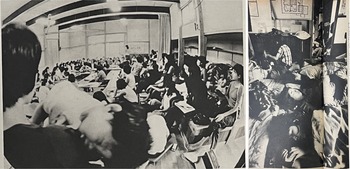
Indeed, the first page of Matsumoto’s piece in Asahi Graph was introduced by a different version of the same scene with the group of women standing in the nature, almost in the same pose as the other picture. Because of their nudity, the image in this case was censored differently, being cropped from the waist down rather than covered with a white strip. Other photographs depicted scenes of collective life at the camp, with women laughing together on the grass, reuniting in assembly, and sleeping on the floor (Image 2). The presence of children at the event, evidenced by several pictures, shows the new conception of family that was promoted by the feminist movement, which aimed to relieve mothers from the sole responsibility of caring for sons and daughters with a collective childrearing.
(left) and (right). Matsumoto Michiko, details of the first Ribu Camp, August 1971. Originally appeared in “Yama ni komotta Ūman Ribu” (Ūman Ribu hidden away in the mountains), Asahi Graph, September 10, 1971. Courtesy the artist.

The photographer herself narrated that she had some difficulties, particularly at the beginning, in carrying on the realization of the visual records of the Ribu events. This was due to the fact that members of the various feminist groups, as we saw, often refused to have people from the mass press at their demonstrations and were therefore unsure about accepting the presence of Matsumoto’s camera. As she recounts, this happened on an exceptional basis only after they reached a collective decision in agreeing that her photos could be useful to the image of the movement. Indeed, I would argue, the purpose of the article was not only limited to presenting Matsumoto’s photographs in the mass press. For this article, indeed, she realized both the photographic part and the text, and her written essay, in addition to the images, provides a brief explanation of Ribu’s main goals. It collects the testimonies of different participants, unsatisfied by the roles they were previously assigned within the students’ protest movements and other leftist groups. For instance, one of them notes,
“Inside the barricades in the school, I was only making onigiri [rice balls].” (Matsumoto Reference Matsumoto1971: 24)
The comment testifies to how their contributions to the cause were usually limited to the traditional roles of caretakers for men. It is in this regard that Matsumoto underlines:
The women’s movement has shed light on the relationships between men and women that were discarded by the New Left so far. (Matsumoto Reference Matsumoto1971: 24)
Examples such as these arguably reveal that the article, combining images and words, aimed to separate Ribu from the other social movements that characterized Japan in the 1960s, to bring the feminist instances to the attention of the wide audience of the magazine, and to provide a valid alternative to the mass press’ common narrations of the movement.
This was particularly important considering that the camp attracted a certain curiosity from the mass press. Shigematsu (Reference Shigematsu2012) relates that the event was covered by mainstream newspapers—for instance, the Mainichi Shinbun and the Asahi Shinbun—and popular magazines that used to feature articles to entertain their audience, often mocking the activities at the camp and focusing on the women’s nudity or on their talks about sexual topics (79). This undermining rhetoric was not dissimilar from the general press attitude that ridiculed the Ribu movement, which was discussed in the previous section. Therefore, the photographic records by Matsumoto can be considered even more precious in providing insights into the daily life at the camp. The press expectations over the event, waiting for something scandalous to report, were also alluded to in the opening remarks of her piece:
“What could happen when a bunch of women got together?”, curious and apprehensive eyes were wondering, but nothing that was “expected” happened—What a shame! (Matsumoto Reference Matsumoto1971: 23)
Besides narrating the activities at the Ribu camp day by day, Matsumoto’s text and images describe the sense of liberation that was uniting all the women taking part in the gathering, and conclude with the collective reflections on the importance, for each participant, of cherishing their encounters from the camp and of bringing the experience back with them, at home, where the real struggle begins (Matsumoto Reference Matsumoto1971: 26–7).
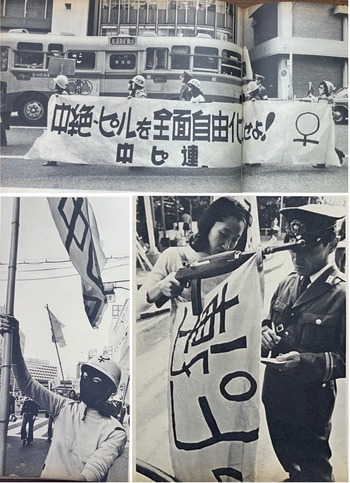
Almost a year later, the same magazine published another piece by Matsumoto. Featured in the Asahi Graph issue of November 3, 1972, the contribution described a Ribu event of a different kind, namely the protests that took place in Tokyo just a few weeks before, on October 14 and 15, by the group opposing the abortion prohibition law—a Ribu faction called Chūpiren, short for Chūzetsu kinshi hō ni hantai shi piru kaikin o yōkyū suru josei kaigō rengō (Women’s Liberation Federation for Opposing the Abortion Prohibition Law and Lifting the Pill Ban). The 1972 article by Matsumoto is titled “Chūzetsu kinshi hō hantai” o sakebu joseitachi (Women screaming: “No abortion prohibition law”) and opens with a large image that shows a group of women marching in a row and holding a large banner with the words “Total liberalization for the abortion pill!” (Matsumoto Reference Matsumoto1972: 26–9) (Image 3).
Not dissimilar from the previous records, the piece mixes photographs and texts by Matsumoto with the aim to offer the magazine’s audience an overview of Ribu’s positions on reproductive matters. Women at the demonstrations, wearing pink helmets with the female symbol on top, protested the proposed amendments to the Eugenic Protection Law, which, if they became effective, would further restrict women’s freedom of choice whether to bear children (Matsumoto Reference Matsumoto1972: 26–7). The Eugenic Protection Law was enacted in 1948 with the intention to guarantee certain genetic qualities of the future lineage: for this reason, even though abortion was still considered a criminal act, it allowed women to terminate their pregnancies in case of fetal disabilities. Moreover, the original law also included the possibility for women to choose abortion for economic reasons. The amendments proposed in 1972, however, demanded the removal of the “economic reasons” clause as the possible causes to have an abortion and allowed it only in case of severe disability of the fetus (Tama and O’Bryan Reference Tama and O’Bryan1994: 20–1). These changes in a law that was already considered problematic by the feminists were at the core of their bitter dissent towards the new amendments.
Matsumoto’s article, therefore, was extremely timely, considering the open debate on reproductive matters, on which various factions of Ribu were expressing their views during those years. As the movement did not consist of one single organization but was composed of a plurality of different groups of women, it was not rare for them to have divergent views on various questions. Therefore, the reproductive issues were among the most divisive topics within the liberationist movement. Various points concerning reproduction were at the center of the debate among feminists: an example can be found in the discourses on the contraceptive pill, which was greatly supported by Chūpiren, while it was considered by others to be nothing but an additional tool to dangerously medicalize and control the female body. In the latter view, the pill placed the responsibility for contraception solely on women, thus increasing the imbalance with men (Lévy Reference Lévy2016: 51–3).
Despite disagreements on some topics, however, the positions of the various Ribu groups were more aligned and generally agreed on the necessity to guarantee the freedom of choice for all women as far as women’s right to access abortion was concerned. At the same time, while supporting this view, they still highlighted different aspects of the issue: for instance, while Chūpiren focused on defending the women’s capacity of self-determination as individuals and not only as potential mothers, the Gurūpu Tatakau Onna placed great stress on the necessity to improve the living conditions of the mother-to-be, in order for her to voluntarily choose to bear children—something that in the current patriarchal society, they evidenced, was not possible (Lévy Reference Lévy2016: 54; Shigematsu Reference Shigematsu2012: 25–7).
The Asahi Graph article by Matsumoto not only summarizes the main points of the Eugenic Protection Law and the amendments that were proposed at the time, but it also reflects the variety of positions on reproductive matters held by various Ribu groups, as it recounts the demonstrations and collects different activists’ statements on these topics. On the first page of the piece, the author reports the words by Enoki Misako, leader of Chūpiren, defining the amendments to the Eugenic Protection Law as unacceptable for the differentiations between superior and inferior they encouraged. She states,
It is a woman’s right to bear or not bear children. Therefore, it is fundamentally wrong for the state to place any conditions on it. (Matsumoto Reference Matsumoto1972: 26–7)
The article carries on with Tanaka Mitsu’s diverging perspective. For her, the core problem was the Law itself and the (false) sense of freedom of choice it gave to the women in Japan, while in fact it promoted abortion as a measure to pursue “the logic of economic productivity that dominates society” (Matsumoto Reference Matsumoto1972: 27). In general, the way Chūpiren was presented in the press seemed to underline a certain separation of the group from the rest of the Ribu movement that was taking place around that time, partly visible also in Matsumoto’s article.Footnote 12 In addition, the two different positions that the piece reports seem to confirm Akiyama’s argument on the tendency of the early 1970s mainstream media to highlight only Chūpiren (around the figure of Enoki) and the Gurūpu Tatakau Onna/Ribu Shinjuku Center (led by Tanaka) as the two major Ribu forces, and generally ignoring the smaller groups (Akiyama Reference Akiyama1993: 125).
Besides the texts, the dynamics involved in the relationships between different Ribu groups, but also between the inside and outside of the movement, come together to find their visual manifestation in the photographic images that accompany the 1972 Asahi Graph contribution. Matsumoto’s ability to document the issues that were at the center of the feminist struggle, and on which the various Ribu collectives were debating at the time, can be found in the article not only through the collection of interviews and opinions, but also and foremost through images.
The photographs included in the essay offer a complementary addition to the written account of these different positions and are a precious testimony of Ribu demonstrations. They show the group of women protesting, marching, raising signs and other messages, but also reuniting in collective debates. One of the activists, wearing a helmet, is the subject of a half-figure portrait. She stands in front of the photographer’s lens, waving a flag; her eyes, the only thing that appears from behind the black stockings that cover her face, look straight into the camera (Image 3). The caption reads,
Masked in pink helmets and black stockings, on a Saturday afternoon their odd troops frightened the passers-by. (Matsumoto Reference Matsumoto1972: 29)
Another woman is portrayed while she is being interrogated by a policeman for holding a fake rifle tied to a Chūpiren banner at the demonstration—which the caption reveals to be a toy—in an image that, I would suggest, might also hint at a certain degree of derision towards the law enforcement officers who occasionally disrupted the Ribu demonstrations (Image 3).
(top), (left), and (right). Matsumoto Michiko, details of Ribu protests on October 14–15, 1972 in Tokyo. Originally appeared in “‘Chūzetsu kinshi hō hantai’ o sakebu joseitachi” (Women screaming: “No abortion prohibition law”), Asahi Graph, of November 3, 1972. Courtesy the artist.

It is not easy to trace what sort of feedback these pictures obtained from the wide public of the magazine. The appearance of contents that wished to reveal the different faces of the liberationist actions on such a platform arguably exposed the Ribu participants to even more mockery and blame—not taking the women seriously, or presenting them as excessively angry and aggressive—that, as we saw, was a common rhetoric used by the mass press towards the movement. At the same time, as Akiyama recounts, in the early years they had reached a common decision to allow only female reporters and photographers to cover Ribu rallies.Footnote 13 This had a twofold purpose:
This was done not only in the hope that women would be less prejudiced, but also to appeal for more women in the media. (Akiyama Reference Akiyama1993: 133)
Thus, the consent to have their images taken was motivated by the hope that they would spread a kind of representation that could be closer to the movement’s intentions, as well as a way to enter into contact with other women in Japan. Both examples of Matsumoto’s articles shown here can therefore be considered a crucial contribution to disseminate the Ribu messages to other women in the country, in which they could recognize themselves. They were also important occasions for the author to have her voice heard on a visible platform, and to start building her own career as a professional photojournalist covering topics that were only superficially inspected until then.
The use of Matsumoto Michiko’s photographs in Ribu minikomi
At the beginning of this study, it was anticipated that Matsumoto’s photographs were frequently included in Ribu’s self-produced communication. This kind of alternative press included informative materials made by different groups, but also periodical publications, all usually referred to as minikomi. This form of resistance on paper aimed to oppose the narrations on Ribu that were spread by the mass media with Ribu’s own accounts from within the movement. That is, liberationists used Matsumoto’s photographs to report on past activities and, I would add, to convey images of the members for other women to identify with in a more unrestricted fashion than what was released in the mass press.
One example of minikomi is the journal Kono michi hito suji: Ribu Nyūsu (Following one’s own path: Ribu News), issued in September 1972 and promoted by the same Ribu Shinjuku Center mentioned above. Its first number opened with a picture by Matsumoto in a leading position. The only picture on the first page, the image is credited to Matsumoto in the caption underneath. It shows two women raising flags and signs during a Ribu demonstration, while other participants can be seen just behind them, pushing their children’s strollers on the streets and taking part in the protests, as evidence of their efforts to combine the liberationist struggle with their status as mothers. The picture introduces an essay opposing revisions to the Eugenic Protection Law that were proposed that year, a similar topic to Matsumoto’s Asahi Graph article of November of that same year. In this case, however, the essay focuses on the sense of guilt that is induced in women by the patriarchal society through the law, which forces them to have babies in order to fulfill their role in society (Ribu Shinjuku Sentā Shiryō Hozon Kaihen 2008: pages not numbered).
The use of this specific photograph as the opening element of the first number of the Shinjuku Center’s then-new publication was not accidental. Instead, I would argue that the picture had the purpose of appealing to the viewers—particularly women readers—and drawing their attention towards the contents of the journal by offering an image that they could instantly recognize as one similar to their own. For the presence of women attending the event along with children and strollers, thus, the photo was instrumental as additional proof of the fact that the issues raised in the pamphlet—and Ribu instances more broadly—were shared by many other Japanese women. As such, those issues needed to be collectively discussed.
As shown, the press produced by Ribu used photography to define and represent itself. Another example of this use can be found in the periodical Onna Erosu (Women’s Eros), which was published from 1973 to 1982. With an all-women editorial staff, the journal was probably among the most successful and fruitful combination of text, graphics, and images among the variety of Ribu publications. Considered the official magazine of Ūman Ribu in Japan, the main aim of Onna Erosu was to encourage discussions on matters regarding women’s bodies and sexuality—as mirrored by its provocative title—as well as, again, counter-balancing the negative views of Ribu that were offered by the general media (Germer Reference Germer, Wöhr, Hamill-Sato and Sadami2000: 111–12).
The magazine was released approximately twice per year and consisted of 17 total issues. Out of these, the very first numbers are of particular interest for the photographic contents. With the sole exception of issue 3, which featured only one image published by photographer Yoshida Ruiko—her 1974 image of the crowd gathered at Hibiya Music Hall in Tokyo for a Ribu concert occupied a whole double-spread page—the very first numbers of the magazine dedicated long sections to photography by Matsumoto.
Issues 1, 2, and 4 of the periodical, released respectively in November 1973, April 1974, and March 1975, featured a section entirely dedicated to photography. Composed of several layouts and printed on coated paper, this part of the magazine was titled Ai.. EYE soshite ai Footnote 14 [sic] (Encounters.. eye and then love): a wordplay built on the alliteration of the Japanese sound ai which, in turn, stands for “encounters,” the English word “eye” (perhaps implying the photographer’s gaze, or the observer’s eye, or even the optics of the camera), and again the Japanese term for “love” (Matsumoto Reference Matsumoto1973: pages not numbered; Matsumoto Reference Matsumoto1974: pages not numbered; Matsumoto Reference Matsumoto1975: pages not numbered).
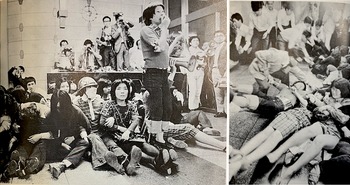
These sections reproduced images taken by Matsumoto Michiko during the first years of the liberationist groups’ activities. The 1973 insert, with the subtitle Ūman Ribu 1971–1973, is a photographic report of some of the public events, which took place mainly in Tokyo, organized by the movement over a period of three years. Demonstrations, gatherings, and conferences are recorded in an eight-page sequence of black-and-white photographs (Matsumoto Reference Matsumoto1973: pages not numbered). All images are accompanied by captions reporting the exact date, the place, and a brief explanation of the event depicted. We can see, for example, some pictures of the first Ribu Congress of May 1972. In another photograph, a group of women are seated on the floor of the entrance hall of the building of the Ministry of Health and Education in Tokyo during a demonstration on May 15, 1973. Tanaka Mitsu is also visible among them, in the first row of women. In an ensuing picture, the same group is portrayed while they hold onto each other, as some men try to remove them from the room (Image 4).
(left) and (right). Matsumoto Michiko, details of Ribu protest on May 15, 1973 at the building of the Ministry of Health and Education, Tokyo. Originally appeared in “Ai. EYE soshite ai: Ūman Ribu 1971–1973,” Onna Erosu, November 28, 1973. Courtesy the artist.

The sequence of the April 1974 issue, instead, included the additional title Ribu komyūn 1974 - Atarashii kazoku: sōzō no ba (Ribu communes 1974—The new family: the place of creation) and focused on scenes of daily life in the several Ribu communes of different areas across Japan. These images were showing a new conception of family and renewed communities in Tokyo, Kyoto, Osaka, Hokkaido, and more (Matsumoto Reference Matsumoto1974: pages not numbered).
In Onna Erosu 4, which is also the last number that featured the Ai.. EYE soshite ai pages, the section is named Nyū Yōku no onnatachi (The women of New York) and is a record of the manifestations organized by the liberationist groups in New York, which the photographer took part in personally. Besides the public demonstrations, in the following pages Matsumoto’s camera depicts not only the women’s gatherings, but also their leisure activities, some club events, and their participation in New York nightlife. Similar to other contributions that we saw previously, the layouts of this issue are composed of both images and texts made by Matsumoto, who narrates her experience in the first person. On the first spread, she writes:
Does space change the consciousness of people? This was truly a time of relaxation. And during these three months in New York, I met so many women. The demonstration lasted two hours with small steps between the buildings, full of colorful balloons. It was declared to be a manifestation of the Lesbian Lib, and the women’s cheerfulness was not due to the blue sky and the orange of the balloons of that day. The women here are very conscious of their independence and have created their own workplace: bookshops, galleries, restaurants, handcraft activities, coffee shops and many other spaces. The magazine “Miss,” with a large public, had a spacious office and a staff of forty-five people, including an editor with an eleven-month-old toddler. Not all women, by any means, are the same, but I am convinced that women who live here on their own are beautiful. The journey of encounters continues endlessly.
Lib Group demonstration, From Greenwich Village to Central Park. (Matsumoto Reference Matsumoto1975: pages not numbered)
In evaluating the photographic contribution for Onna Erosu, some further considerations on the magazine as the wider frame where the images are inserted should be made in order to contextualize the instrumental use of the pictures. Since the very beginning of the first volume, the editorial board of Onna Erosu made its position clear, as the introductory declaration states:
We women want a society free of all power. A free and equal society in the true sense of the word, without discrimination of any kind. A society of mutual support where women can live as women, men can live as men and nature can live as nature. (Onna Erosu henshūiinkai 1973: 8)
In the declaration, the causes of women’s oppression are identified by the editors with the capitalist logic of production, private property, and above all the marriage system, which has the Emperor at its top—and the family institution as a small-scale replica of the relationship Emperor-subjects—and generates all the power structures of the state. In open opposition to these structures, the group behind Onna Erosu openly stated their aim for a society in which each individual is guaranteed freedom and equality to be passed onto the next generations. With this view in mind, they established a magazine that could serve as a space to exchange opinions and thoughts among women, in their words, to “create a culture of women” (Onna Erosu henshūiinkai 1973: 9–10). The declaration ends with the sentence:
We also want to create an opportunity to discover materials on the movements and culture created by women up to now, and to come across important things that we must pass on. (Onna Erosu henshūiinkai 1973: 10)
These words suggest, then, that Onna Erosu was conceived not only as a platform to exchange information among different individuals, but also as a means to keep up to date with the other women’s activities. Seen from this perspective, the inclusion of Matsumoto’s pictures in the first numbers can be interpreted as a way to shed light onto the photographic production around the movement as a crucial activity to represent Ribu daily life. Not dissimilar to the written texts, or the vignettes and the comics featured in the journal, Matsumoto’s photographs became a fundamental part of the plurality of voices that were disseminated through the pages of the magazine. They were presented as important additions to the materials created by women during those years, to be shared and spread through the magazine as a precious testimony of the liberationists’ actions during the years.
Women Come Alive
The years spent with Ribu found an additional space for documentation in Matsumoto’s first photobook, Nobiyakana Onnatachi, alternatively known as Women Come Alive, which was published in 1978 and entirely dedicated to the Women’s Liberation Movement, both in Japan and abroad. The volume not only documents the photographer’s encounters with the participants of the different groups: in the author’s intentions, as it was the last important project made in and for the movement, it serves as a conclusive report of Ribu’s history through images. An approximately 200-page collection of black-and-white pictures, the book can be understood as a visual archive that collects and rearranges the numerous photographs taken by Matsumoto for almost a decade with the Japanese and international liberationists.
The images of Nobiyakana Onnatachi are divided into three main sections. The first is titled Ima, onnatachi wa ikiki to (Now the women are lively) and is dedicated exclusively to the Japanese Ribu and its history. The second, Watashi ga deatta ii onna (Good women I have met), is a series of portraits of creative women—designers, writers, musicians, and so on—whom Matsumoto met during her travels, which include some iconic photographs of artist Yoko OnoFootnote 15 in New York. The third and final section, Umi no mukō gawa de (On the other side of the sea), collects pictures taken by the photographer during her travels in the US and Europe, and focuses in particular on New York, Los Angeles, Paris, and London. It is worth noticing that the English subtitles of these same sections (Japanese Women in Struggle; Encounters; and Sister Across Borders), proposed as the official translations of these different parts in the photobook, do not always semantically match with the Japanese original version. This was done perhaps for mediation purposes, or in order to emphasize specific aspects of the women in the pictures that were believed to be more appealing for the international audience.
The first section, as mentioned, is the part of the photobook that serves as a visual record of the history of the Ribu movement in Japan. Comprising more than 70 pages, it occupies the largest part of the book, and in the context of this article is the one that deserves further consideration. Images that had already been made famous by previous publications, such as pictures of groups of women protesting and occupying governmental buildings in the early 1970s that had appeared in the first issue of Onna Erosu, or even some photographs from the Asahi Graph articles, were also included in the photobook.
Matsumoto’s intent to organize the extensive visual material is also evident in the fact that the images in Nobiyakana Onnatachi are organized by event, location, and date, and include additional information whenever available. Thanks to these notes, for almost all the photographs we can identify the sort of activity that was taking place, where, and when it was happening. The book opens with images from the Ribu camps. In order, these were Nagano in summer 1971, Hokkaido in 1972, and Shikine-jima in 1973. It continues with the National Ribu Congress, held in May 1972, followed by a series of pictures from demonstrations and gatherings that were organized in 1971–77; and finally, it reproduces images of recreational moments shared between the women.
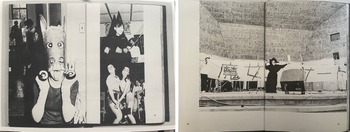
Among the other events, an interesting aspect that should be noticed is indeed the fact that in this section the photographer dedicates several pages to a particular area of the women’s group activities: the live arts. Matsumoto’s pictures document a musical that was performed by members of the Ribu Shinjuku Center in May 1974. Other portraits of the women focus on the handmade masks and various costumes that the actresses wore on that occasion. In addition, several pictures of different music events that were organized in 1974, 1976, and 1977, the so-called Majo konsāto (Witches’ concerts), appear towards the end of this section (Image 5). Ironically taking on the derogatory images that were used to describe the liberationist women, these witches often sang and played instruments in disguise or wore long dresses with dark tones during their performances. These images of theater and musical performances are extremely precious because they show one of the most creative sides of the feminist movement, an aspect that is not often shown when discussing Ribu. Looking today at the photographic work made by Matsumoto can be also useful, then, in opening up new spaces for reflection on the different modes of expression that Ribu activism adopted, of which these visual accounts are evidence and historical memory.
(left) and (right). Matsumoto Michiko, details of Ribu live performances. From the photobook Nobiyakana Onnatachi (1978). Courtesy the artist.

In time, after taking photographs of the women who participated in the movement, Matsumoto realized the importance of the visual materials she had been creating. She narrates this herself: Nobiyakana Onnatachi also includes a text written by the artist, in both Japanese and English, where she narrates how she became close with the movement, her thoughts on its importance, but first and foremost her views on the role of photography in creating historical documents (Matsumoto Reference Matsumoto1978: 193–7; Cavazzuti Reference Cavazzuti2024: 72–5). At the beginning of the text, she writes:
Photographs are a way of commemorating each of life’s many moments on film. […] Some of these pictures gained an almost magical hold over me with the passage of time, which transformed them from ordinary snapshots into important documents. (Matsumoto Reference Matsumoto1978: 197)
This transformation in the properties of the images is remarked on also in another crucial point of her statement, in which Matsumoto writes:
As I put these various pictures together, I was amazed at how they took on new documentary significance. I have a strong feeling that in time these pictures will prove to be much more than my own self-expression—that the pictures will show the histories and personalities of the women portrayed in them even more clearly. (Matsumoto Reference Matsumoto1978: 196)
The photographer’s analysis not only defined her work with the movement, but also foresaw the potentiality of it to become, in time, an official record of Ribu, whose legacy would survive in the future. Additionally, with the same text the author aims to offer a clear position of herself professionally. She states, “In the past, women were usually photographed rather than photographers” (Matsumoto Reference Matsumoto1978: 197). Thus, an image of women “that was created and interpreted by men came to be the standard image of beauty,” while, in opposition, “to photograph free women you yourself have to be a free woman” (Matsumoto Reference Matsumoto1978: 196). With these words, Matsumoto identifies the issue of the male gaze that historically dominated the photographic practice in Japan, from which she aims to emancipate through her photography, as well as her hopes for the creation of alternative views that could give shape to the lessons learnt from the women’s liberationist struggle.
Previously it was mentioned that Nobiyakana Onnatachi also marks the end of the photographer’s work with the Women’s Liberation Movement, which at the same time was gradually winding down its activities. This doesn’t imply, however, that Matsumoto stopped being interested in the issues that were raised during the years of feminist activity.
On the contrary, her fascination with the lives and work of independent women on the international scene was carried on throughout her whole, ongoing career. The choice to focus exclusively on portraiture has characterized Matsumoto’s image production ever since, as is evident in her following photobooks, Shōzō Nyūyōku no onnatachi (Portraits of New York Women) in 1983 and, more than a decade later, Josei ātisuto no shōzō (Portraits: Women Artists) in 1995 (Cavazzuti Reference Cavazzuti2024: 71–3). In the former, Matsumoto included her own series of portraits of those women creatives who, for different reasons, she considered important—all part of the cultural milieu of New York at the time—in a project that was composed of more than 100 black-and-white pictures; not too dissimilar, the latter was a series of 54 portraits of visual artists and performers Matsumoto met during the years (Matsumoto Reference Matsumoto1983, Reference Matsumoto1995). Interestingly, in 1986 she also published the photobook Niki de Saint Phalle entirely dedicated to the work by the famous homonymous French painter and sculptor, who has become a recurring subject in her photographs since the 1980s (Matsumoto Reference Matsumoto1986). Matsumoto also recently directed and filmed a movie dedicated to her, titled Viva Niki – The Spirit of Niki de Saint Phalle (2024).
It can be argued, then, that past connections with the feminist movements are not lost. On the contrary, Ribu’s insistence on the importance for women to express themselves artistically and creatively can be conceived as the foundations that encouraged women artists to build their own career in the arts in the ensuing decades (Matsumoto Reference Matsumoto1995: n.p.). The same can be said for Matsumoto herself, who, starting with the work developed together with the Ribu women at the beginning of the 1970s, was able to later develop her own photographic practice that continues to this date.
Conclusion
Due to the different channels through which they were disseminated, among which some examples were shown in this article, Matsumoto’s images of the women’s movement in Japan echoed across both the mainstream press and Ribu’s inner circles. At the same time, looking at the work carried out by Matsumoto can open new spaces of reflection that may also redefine the figures of the people involved in the struggle for women’s rights. On this, I refer to Elizabeth A. Myers’ (Reference Myers, Bly and Wooten2011) argument, who emphasizes that an expansion of the concept of activist is necessary in order to reconsider the different areas through which activism found its expression in the past: not only on the political stage but also in the artistic field, through theater, music, and the visual arts (150).
I would suggest that Matsumoto’s photography from the early 1970s can be understood as acting in a similar way. This is because, as it was shown, the photographic accounts she realized had two main purposes: first, they presented Ribu’s instances in the mainstream press, echoing the voices of its members; second, they documented the movement’s main events and demonstrations from an insider’s point of view, creating lasting images of its history for future memory. Her image production had the crucial role of letting Ribu be known and seen by a wider public; therefore, the actions of the photographer herself might be considered not too dissimilar from those of the activists spreading the Ribu thoughts. The photographic reports were made with the clear intention to leave a mark on the movement’s instances in the public discourses.
The images that were discussed in this article illustrate the early phase of Matsumoto’s photographic practice of the early 1970s, which can be seen as part of a wider trend of documentary photography that, since the previous decade, had been focusing on protest movements in Japan. Matsumoto’s images/documents reveal the close ties between the photographer and the feminist movement, composed of a series of continuous, mutual exchanges. These resulted, on one side, in the creation of photographs that have entered the collective imagination surrounding the movement; on the other, through Matsumoto’s photographs, Ribu itself was able to reach a wider number of Japanese women and to create a powerful countermeasure to the images disseminated by the mass media. The Ribu women’s own representations, crystalized by Matsumoto’s camera, had the crucial role to disseminate narrations in which they recognized themselves and the feminist matters they struggled for, in a way that affirmed the movement’s identity.
Financial support
This work was supported by the Japan Foundation under the Japanese Studies Fellowship Program for Doctoral Candidates for the year 2023–2024; and by the Department of Historical Studies at the University of Turin, Italy, under the PhD fellowship in Historical, Archaeological, and Historical-artistic Sciences for the years 2021–2024.
Competing interests
The author declares that she has no known competing financial interests or personal relationships that could have influenced the work in this paper.
Author Biography
Federica Cavazzuti recently obtained a PhD in Archaeological, Historical and Historical-Artistic Sciences at the History department, University of Turin, Italy. Her main areas of interest are Asian contemporary visual arts, women’s art, feminist studies and curatorial activism. Her research focusing on the developments of women’s photography in Japan across the 20th and 21st centuries was awarded a Japan Foundation Fellowship in the year 2023–2024, during which she was Visiting Research Fellow at Waseda University, Tokyo. In the past 10 years she worked with art institutions in Italy and UK to organize multidisciplinary exhibitions in private and public spaces.


 Open access

