

Introduction
The lateral epitaxial overgrowth (LEO) technique has recently been explored as a promising approach to reduce the dislocation density in GaN layers grown on a substrate. Various degrees of success using this method have been reported [Reference Nam, Bremser, Zheleva and Davis1-Reference Sakai, Sunakawa and Usui4]. In GaN lateral overgrowth experiments using metalorganic vapor phase epitaxy (MOVPE) at 1000-1100°C, the dislocations originated from the seed layer are confined mostly over the growth windows [Reference Nam, Bremser, Zheleva and Davis1, Reference Marchand, Wu, Ibbetson, Fini, Kozodoy, Keller, Speck, DenBaars and Mishra2]. In a GaN lateral growth over a thin SiO2 mask at 1000°C by hydride vapor-phase epitaxy (HVPE), however, most dislocations bend laterally into the overgrown regions [Reference Sakai, Sunakawa and Usui3, Reference Sakai, Sunakawa and Usui4]. In either case, the defect density in the overgrown layer is reduced, since only the portion of defects in the seed layer not masked by the thin SiO2 layer is able to propagate into the upper layer. During the LEO by either MOVPE or HVPE growth technique, arrays of edge dislocations are introduced at the mask edges, and they collectively tilt the c-axis of the LEO regions away from the [0001] epitaxial direction [Reference Marchand, Wu, Ibbetson, Fini, Kozodoy, Keller, Speck, DenBaars and Mishra2, Reference Sakai, Sunakawa and Usui4]. The observed tilt ranges from less than ∼0.2° [Reference Marchand, Wu, Ibbetson, Fini, Kozodoy, Keller, Speck, DenBaars and Mishra2] to larger than 10°. The correlation of c-axis tilt to growth technique and condition has not been established. In this study, we have carried out a series of LEO experiments and finite element stress simulations aimed at understanding the cause of LEO tilt and the associated dislocation mechanisms.
Experimental
The substrates used for our LEO experiments were 2.7-µm-thick GaN seed layers grown by MOVPE on a sapphire substrate. A 0.2-µm-thick SiO2 mask layer was grown on top by tetraethoxysilane (TEOS)-based chemical vapor deposition at ∼600°C, and growth windows were patterned by standard optical lithography and etching processes. The pattern consisted of 3- or 4-µm-wide stripe openings parallel to the [1100] direction separated by 8-µm-wide mask areas. In one sample (sample no. 3), the stripes (5.5 µm in width) were arranged in a radial pattern, allowing comparisons to be made between the LEO process along different lateral growth directions.
The samples were grown in a vertical HVPE reactor [Reference Zhang and Kuech5]. The samples were introduced into the growth region of the system under flowing NH3 and N2. The growth was initiated by the introduction of HCl to the Ga source region. The sample was kept at a constant temperature and gas phase ambient during growth. The five growth conditions investigated are listed in Table 1. Many factors influence the growth of HVPE GaN. We have altered the growth temperature in this study since it is the primary variable affecting the growth behavior.
Growth conditions, growth rate, and defect structure

Results and Discussion
A. Growth morphology
Triangular-shaped ridge growth was observed at 1050°C over 3-µm-wide stripe openings parallel to the [1100] direction in sample no. 1 [Fig. 1(a)]. The growth facets are curved before coalescing into a continuous film. In sample no. 2, higher NH3 flux (1000 sccm) results in higher growth rate. The lateral/vertical growth rate ratio (= 0.45) and the ridge growth morphology remain the same as in sample no. 1, but coalescing has occurred, and the film has become continuous.
In sample no. 3a, higher (∼2×) lateral and vertical growth rates with a lateral/vertical rate ratio of about 0.6 were observed on stripe windows parallel to the [1100] direction. The increase in growth rate is mostly due to the higher HCl flow rate. In sample no. 3b, the stripe windows are parallel to the [1120] direction, and the lateral growth rate is much smaller (2.4 µm/hr), resulting in a lateral/vertical rate ratio of ∼ 0.1. From the scanning electron microscope images, we learned that on [1120]-oriented windows, the LEO is on (1101) and (1101) facets, while on [1100]-oriented windows, the growth is on (1122) and (1122) facets. Our observations imply a much slower LEO rate on (1101) and (1101) facets. Similarly strong dependencies of growth rate on facet plane have also been reported for the lateral growth of GaN by MOVPE [Reference Nam, Bremser, Zheleva and Davis1]. In samples no. 4 and no. 5, coalesced and smooth films were grown over parallel, [1100]-oriented windows at 1100°C [Fig. 1(b)]. The lateral growth rate at this temperature is estimated to be at least 20 µm/h from the film’s surface curvature directly above the growth window.
Cross-sectional SEM images of GaN grown on windows parallel to the [1100] direction: (a) sample no. 1 grown for one hour. (b) sample no. 5 grown for one hour.

B. Dislocation structure
Some morphological features such as the curved LEO facets observed in Fig. 1(a) can be attributed to the dislocation mechanisms involved during the growth. A cross-sectional TEM image of sample no. 1 in Fig. 2(a) reveals the dislocation structure after the sample is cooled to room temperature. A triangular ridge structure (region A) is grown first before the LEO occurs. This ridge structure contains vertical threading dislocations, mostly edge type with b = 1/3<1120>, propagating from the MOVPE seed layer [Reference Sakai, Sunakawa and Usui3, Reference Qian, Skowronski, De Graef, Doverspike, Rowland and Gaskill6]. This initial structure has two facets extending at 66 degrees from the edges of the growth window, as marked by the dashed lines in Fig. 2(b). Since no low-index atomic planes parallel to [1100] are inclined at 66° from the (0001) plane, the observed angle may be determined by the lateral/vertical growth ratio [Table 1, tan−1 (8/3.6) = 66°]. As LEO proceeds from the two ridge surfaces, all dislocations bend toward the growth surfaces and propagate on horizontal (0001) planes and on inclined lattice planes such as (1122), (1123), and (1124), leaving the region B directly above the growth windows depleted of dislocations. The image force and/or the presence of shear stress close to the ridge surfaces may have caused the dislocation bending at high growth temperatures.
(a) A cross-sectional TEM image of a GaN ridge structure grown at 1050°C (sample no. 1). (b) Schematic of the dislocation glide behavior and final configuration in a GaN ridge structure observed in (a).

Fig. 2 indicates further that in LEO regions close to the mask edge (regions C), extensive dislocation multiplication has occurred, producing arrays of edge dislocations lying parallel to the [1100] ridge direction. These are perfect dislocations since no stacking fault contrast was observed on the slip planes. It is possible that the Frank-Reed type sources [Reference Frank and Read7] are in operation for the generation of parallel dislocations during growth. These arrays of edge dislocations, confined mostly to the region C and constituting a series of tilt-type boundaries, tilt the c-axis of the crystal grown beyond region C away from the [0001] epitaxial orientation. A 7-degree c-axis tilt is measured from the image contrast of dislocations gliding on the tilted (0001) planes in region D in Fig. 2(a). As a result of the 7° tilt, the lower part of the (1122) facets on both sides of the ridge bends from the original 58° to a steeper 65° angle [Fig. 2(b)].
The crystal tilt remains in the rest of LEO films as growth continues, and, at the coalescence of growth facets, formation of a tilt-type grain boundary is unavoidable. The amount of crystal tilt can be measured accurately in a diffraction pattern taken from the bi-crystal at the coalescing boundary. The tilt angles measured for various growth conditions are listed in Table 1. In general, more parallel dislocations are observed in samples with higher tilt angles. Sample no. 3b has the largest c-axis tilt, and in it we find the highest density of edge dislocations in region C, as shown in Fig. 3(a). Fig. 3(b) shows the dislocation arrays observed near the SiO2 mask edge in the sample no. 5. These parallel dislocations line up vertically into a series of about 15 low-angle tilt boundaries. With a measured vertical dislocation spacing D of about 50 nm and b = 0.3 nm, the tilt angle of each boundary is estimated to be θ ∼ b/D ∼0.35°. The total tilt accumulated by the ∼15 boundaries is about 5°, which is in good agreement with the diffraction measurement (Table 1).
C. Shear stress in LEO structures
The dislocation bending and c-axis tilting are most prominent in HVPE growth. The higher growth rates in HVPE result in LEO islands of high aspect ratio and large exposed surface area when compared to MOVPE growth. Since dislocations are observed to glide and multiply during the GaN lateral growth, substantial shear stress must be present in the growth island. A recent in-situ stress measurement [Reference Hearne, Chason, Han, Floro, Figiel, Hunter, Amano and Tsong8] revealed that GaN grows under a constant tensile stress on a sapphire substrate by MOVPE at 1050°C. The tensile stress (0.2 to 0.6 GPa depending on growth conditions) is not relaxed by thermal cycling to room temperature or annealing at the growth temperature. If a growth island is bonded to a highly tensile substrate, a high shear stress is expected adjacent to the film edge [Reference Murakami, Kuan and Blech9]. If this shear stress resolved on the slip plane is higher than the critical stress needed for slip, then dislocation glide can be invoked to relax the stress. As the island grows vertically and laterally, the expanding materials boundary and geometry effect may necessitate the generation of arrays of dislocations and the onset of c-axis tilting. Since the generation and interaction of dislocations in a stressed crystal with moving boundaries are too complicated to simulate, we have set out to simulate just the static stress distribution in the triangular ridge structure at the growth temperature.
TEM images of arrays of edge dislocation pileups parallel to the SiO2 mask edge: (a) sample no. 3b and (b) sample no. 5.

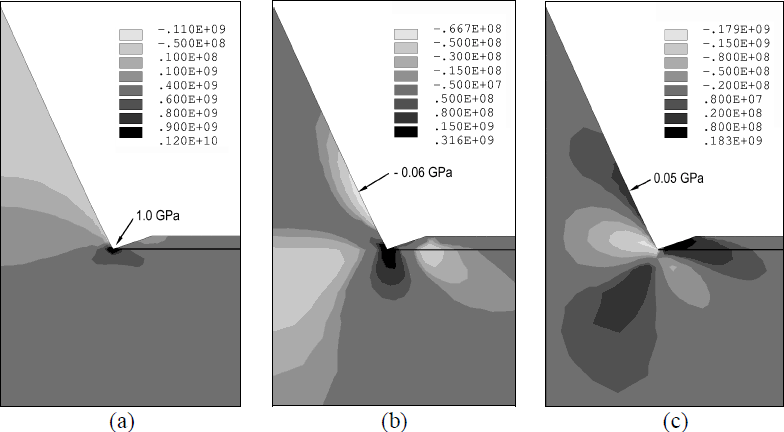
A periodic extension of an 8-µm-wide unit cell with a 3-µm-wide growth window at the center is used for the stress simulations. As the temperature rises from room temperature to 1050°C, a uniform horizontal expansion of the unit cell is imposed beyond thermal expansion so that the GaN seed layer is under a tensile stress at the growth temperature. Added on top of the uniform growth stress are local tensile stress fields due to the smaller thermal expansion of the oxide mask layer relative to GaN. Fig. 4 shows the simulated distribution of σxx, σzz, and σxz stresses in the 66° ridge structure at 1050°C. Here the x-axis is in the horizontal [1120] direction and the z-axis is in the vertical [0001] direction. The uniform growth stress σxx (set at 0.5 GPa) decreases rapidly to zero in the ridge island, and the thermal mismatch with the oxide mask layer contributes an extra 0.5 GPa in small regions at the window edges [Fig. 4(a)]. The vertical stress σzz and shear stress σxz close to the ridge surface [Fig. 4(b) and 4(c)] are linearly proportional to the GaN growth stress. Since the critical stress for dislocation glide, the Peierls stress, in a covalent crystal is typically 0.1% - 1% of the shear modulus and decreases with increasing temperature, our simulations suggest that 0.05 Pa shear stress should be high enough for dislocation motions at 1050°C.
Stress distribution in the ridge structure at 1050°C prior to the onset of lateral growth: (a) σxx along the horizontal x-axis, (b) σzz along the vertical z-axis, and (c) σxz shear stress on the (0001) plane.

It is noted that a high density of edge dislocations (> 2 × 10¹⁰/cm2) is generated locally in the high shear stress regions close to the mask edge, and dislocation pileups with Burgers vector b = 1/3[1120] are observed experimentally. From elasticity considerations, a dislocation with b = 1/3[1120] on the (0001) plane will be bent to the [1100] mask edge direction by the shear stress field. The observed pileups suggest that extensive stress relaxation is accomplished most likely via a Frank-Read type operation during the lateral growth.
Conclusion
We have investigated the dislocation mechanisms involved in the lateral growth of GaN by HVPE on a patterned substrate. The lateral growth rate is highly sensitive to the growth temperature and is dependent on the exposed growth facets. The growth morphology changes drastically from a narrow ridge to a smooth and continuous film as the growth temperature increases from 1050 to 1100°C. Threading dislocations from the seed layer bend into laterally grown regions and multiply into arrays of edge dislocations lying parallel to the growth window. This multiplication and pileup of dislocations lead to a large-angle c-axis tilting in the laterally grown regions. Finite element stress simulations indicate that at a high growth temperature, the tensile growth stress in the GaN seed layer and the thermal stress from the mask layer both contribute to a high shear stress at the growth facets. The relaxation of this shear stress is believed to be the driving force behind the excessive dislocation activities and the c-axis tilting occurring during the lateral growth.
Acknowledgment
This work was funded under the ONR MURI Grant #N00014-96-1-1179 through Dr. Colin Wood.