


Introduction
Incumbency effects are a central topic in political science and political economy, reflecting how electoral outcomes depend on whether candidates or their parties currently hold office (Erikson Reference Erikson1971; Jacobson Reference Jacobson1978; Carey and Shugart Reference Carey and Shugart1995). Scholars distinguish between personalistic (candidate- level) and partisan incumbency effects, as this distinction clarifies the mechanisms driving incumbency advantages and disadvantages (Erikson and Titiunik Reference Erikson and Titiunik2015; Magalhães Reference De Magalhães2015; Novaes and Schiumerini Reference Novaes and Schiumerini2022). Understanding these effects matters for several interconnected reasons. Incumbency is linked to societal preferences for continuity versus change—a question situated at the intersection of political science and economics with rich theoretical traditions on democratic decision-making and preference aggregation (Arrow Reference Arrow1950; Downs Reference Downs1957; Dahl Reference Dahl2008). Elections determine how political power and economic resources are distributed, functioning as mechanisms of accountability for parties and indi- viduals (Acemoglu Reference Acemoglu2003; Klašnja and Titiunik Reference Klašnja and Titiunik2017; Klašnja Reference Klašnja2015). Accurately measuring partisan and candidate incumbency effects helps uncover potential biases or inequities in these decisions, as well as distortions in resource and power distribution. Incumbency has been associated with low levels of development (Uppal Reference Uppal2009), high corruption (Klašnja Reference Klašnja2015), unequal access to information (Macdonald Reference Macdonald2014), electoral system rules (Ariga Reference Ariga2015), and weak institutions (Klašnja and Titiunik Reference Klašnja and Titiunik2017).Footnote 1
Disentangling individual and partisan incumbency effects is valuable both methodologically and substantively. Comparing separately identified effects with those from Regression Discontinuity Design (RDD) estimations using the same context allows for a better understanding of interpretational pitfalls in previous studies. It also sheds light on the complex interplay between candidates, parties, and voters—revealing how voters weigh up individual candidates versus party affiliation when casting their votes. The magnitude of effects matters as well: a large incumbency advantage could indicate that the political system rewards effective public service, or that voters are actively preventing low-quality challengers from gaining office. Moreover, separating incumbency effects is key to understanding the mechanisms behind observed advantages. The literature suggests four main channels: name recognition (Erikson Reference Erikson1971; Jacobson Reference Jacobson1978, Reference Jacobson1990; Krasno and Green Reference Krasno and Green1988; Gelman and King Reference Gelman and King1990), constituency services where incumbents deliver on promises and earn trust through demonstrated performance (Cain et al. Reference Cain, Ferejohn and Fiorina1984; Chasquetti Reference Chasquetti2014), credit claiming for successful public works (Bickers et al. Reference Bickers, Evans, Stein and Wrinkle2007; Grimmer et al. Reference Grimmer, Messing and Westwood2012), and pork barrel politics involving clientelism and vote buying (Samuels Reference Samuels2002; Azar Reference Azar2022). A zero or negative individual incumbency effect would suggest that these mechanisms are absent or ineffective. Conversely, when term limits apply, incumbents may have incentives to misbehave—engaging in corruption or unethical practices—since they face no electoral accountability. A non-significant or negative partisan incumbency effect may suggest the electorate punishes parties for such behavior.
While there is a vast empirical literature on incumbency, most studies employ non-causal methods. The causal turn began with Lee (Reference Lee2008), who introduced RDD to study close elections, sparking a wave of studies on incumbency effects.Footnote 2 However, these causal estimates often conflated individual and partisan effects. Only a few recent studies offer clean, separate estimates of both effects using the same dataset and setting (Kendall and Rekkas Reference Kendall and Rekkas2012; Fowler and Hall Reference Fowler and Hall2014; Lopes da Fonseca Reference Lopes da Fonseca2017; de Benedetto Reference De Benedetto2020). General patterns have emerged: studies in developed countries often find positive effects, whereas those in developing countries report null or negative ones. These latter find- ings challenged prevailing theories and spurred new explanations linking negative incumbency effects to low economic development (Uppal Reference Uppal2009), corruption (Klasnja Reference Klašnja2015), information asymmetries (Macdonald Reference Macdonald2014), electoral rules (Ariga Reference Ariga2015; Ariga et al. Reference Ariga, Horiuchi, Mansilla and Umeda2016; Lee Reference Lee2016), and weak institutions (Klasnja and Titiunik Reference Klašnja and Titiunik2017).
This article contributes to this literature by estimating separate personalistic and partisan in- cumbency effects in Uruguay, a full democracy with mandatory voting, proportional representation, and high-quality institutions, but also persistent Latin American challenges such as inequality and clientelism. We exploit term limits and apply the recently developed Differences-in-Discontinuities (Diff-in-Disc) methodology (Fowler and Hall Reference Fowler and Hall2014; Lopes da Fonseca Reference Lopes da Fonseca2017; de Benedetto Reference De Benedetto2020), which combines regression discontinuity designs at open and closed elections to isolate candidate effects from party effects. Our empirical results show a large, positive personalistic incumbency effect (73.7%) and no significant partisan effect. These findings suggest that in Uruguay, incumbency is primarily a candidate-level phenomenon: new candidates from incumbent parties cannot capitalize solely on the party’s past performance. The results also demonstrate the importance of using Diff- in-Disc to obtain clean estimates, as conventional RDD approaches may conflate personalistic and partisan effects.
Uruguay provides a particularly compelling case study. The country has been characterized as having strong traditions of personalized politics, where individual candidates rely heavily on their personal reputation and connections with constituents rather than on party affiliation (Mainwaring Reference Mainwaring1999; Paredes Reference Paredes2004; Gibson Reference Gibson2006). Uruguay uses a closed and blocked-list system. Preferential voting does not come from open lists but from the simultaneous double-vote mechanism (“doble voto simultaneo”), adopted in 1910, which allows voters to select one list within a party, and that choice determines both intra-party and inter-party votes. This has been shown to increase the importance of personal attributes over party affiliation (Carey and Shugart Reference Carey and Shugart1995; Jones and Mainwaring Reference Jones and Mainwaring2003; Perez-Linan Reference Pérez-Liñán2005). The country’s political system is characterized by party fragmentation, meaning party loyalty is less stable and voters focus more on individual candidates (Benoit Reference Benoit2007; Luna and Altman Reference Luna, Altman, Htun, Power and Boulder2011; Roberts Reference Roberts2003). Personal networks and localism are important factors, with incumbents building strong relationships with constituencies through service provision and responsiveness to local needs (Mainwaring and Scully Reference Mainwaring and Scully1995). Uruguay’s historical experience, including periods of military dictatorship and political polarization, has contributed to a degree of mistrust in political parties and a tendency for voters to focus on individual politicians who can demonstrate credibility and deliver results (Lupu Reference Lupu2016b; Melo and Pereira Reference Melo and Pereira2013). Incumbents tend to emphasize their personal achievements and direct ties to the electorate, strengthening personal appeal and reducing the salience of partisan identity (Melo et al. Reference Melo, Pereira and Figueiredo2014). These contextual factors suggest that the partisan incumbency effect should be smaller than the personal one in Uruguay. Our study provides empirical estimates that test and contribute to this existing literature on the drivers behind one effect being larger than the other.
This article makes several contributions. The results alone are valuable, given the limited availability of empirical studies of this kind, especially for Latin America. We build on but also significantly diverge from the growing Diff-in-Disc literature (Fowler and Hall Reference Fowler and Hall2014; Lopes da Fonseca Reference Lopes da Fonseca2017; de Benedetto Reference De Benedetto2020; Kendall and Rekkas Reference Kendall and Rekkas2012). Most closely, we follow Fowler and Hall (Reference Fowler and Hall2014) and de Benedetto (Reference De Benedetto2020), but we extend their work by analyzing a developing country—Uruguay—rather than a developed one (the United States and Italy, respectively). We also differ methodologically: we study an executive (rather than legislative) position and focus on regional (rather than municipal) levels. Although Uruguay is a developing country, it ranks as a full democracy.Footnote 3 , Footnote 4 While Lopes da Fonseca (Reference Lopes da Fonseca2017) exploits time variation due to the introduction of term limits, we study a context where term limits are consistently in place, allowing us to avoid assumptions about time invariance. Meanwhile, Kendall and Rekkas (Reference Kendall and Rekkas2012) assume no strategic exits from candidacy—a strong assumption that we circumvent by using term limits as a source of exogeneity. In sum, our approach relies on weaker assumptions and provides new evidence from a full democracy in a previously understudied region. To our knowledge, ours is one of the few studies to provide separate causal incumbency estimates for a developing country, alongside Klašnja (Reference Klašnja2015) for Romania and de Magalhaes and Hirvonen (Reference De Magalhães and Hirvonen2015) for Brazil. Moreover, with mandatory voting and turnout around 90%, our study is among the first to estimate incumbency effects without concerns about turnout variability. Finally, Uruguay’s electoral system is based on proportional representation, in contrast with the majoritarian systems of Canada and the United States—adding another distinctive element to our contribution. From a methodological standpoint, this article contributes to the growing literature comparing RDD estimates that exploit close elections with Diff-in-Disc estimates. Our findings show that results differ by methodology (in line with Fowler and Hall Reference Fowler and Hall2014), underscoring the importance of using the Diff-in-Disc approach to obtain clean estimates of incumbency effects.
Our main finding—that incumbency is primarily a personal, individual phenomenon—has important implications. When open elections are held, the new candidate from the incumbent party is not able to capitalize on the party’s past performance. Non-positive partisan effects imply that political parties cannot successfully transfer popular support from an incumbent to their successor based solely on party affiliation. One possible interpretation is that incumbents enjoy greater strength and autonomy in decision-making, as political parties may lack a credible threat of replacing them with another candidate in future elections if disagreements arise (Klašnja and Titiunik Reference Klašnja and Titiunik2017).Footnote 5 If the incumbent chooses to “misbehave” due to the lack of electoral accountability enabled by term limits, the political cost may be transferred to the party’s new candidate—potentially explaining null or negative partisan incumbency effects.Footnote 6 Our contribution is to estimate separate effects for a developing country and, in doing so, find a positive and significant individual incumbency effect of 73.7% with no significant partisan effect. These findings align with the emerging Diff-in-Disc literature but contrast with previous RDD results for developing countries. Uruguay appears to sit midway between developed and developing country patterns—consistent with its strong electoral institutions and favorable socio-economic indicators, but also its persistent Latin American challenges, including poverty, inequality, corruption, and crime.
The remainder of the article is structured as follows. The second section briefly presents the historical and institutional context and compares Uruguay with the region. The third section outlines the data, methodology, identification strategy, key challenges, and estimating equations. The fourth presents the main results. The fifth discusses extensions and robustness checks, and the sixth concludes.
Institutional Setting
Uruguay has a unique electoral system: proportional representation and direct elections are held on the same day and through the same ballot, and voting is secret and mandatory for all citizens. Measures to ensure free and fair elections include the presence of independent monitors and international observers. The Uruguayan electoral system, as described in this article, has been in place since 1924 and has been largely successful in ensuring broad citizen participation in the democratic process. International observers have praised the country for its fairness and transparency, and the manual voting mechanism is considered one of the most advanced and secure electoral systems in Latin America and globally (see, for instance, Freedom House 2022).
Elections at the Departamento Level
The institutional figure of the Intendente (mayor) was created in 1908. It was replaced by the 1918 constitution, which introduced a collegiate executive at the departmental level, and reinstated in 1934. Under this system, elections are decided by simple majority using the double simultaneous vote (DSV) mechanism, whereby both the candidate and the political party are elected jointly. The elected mayor is the most-voted candidate from the most-voted political party, allowing for both intra-party and inter-party competition. Importantly, the 1934 constitution established that mayors could not run for election after two consecutive terms in office. A subsequent constitutional reform in 1952 reinstated collegiate authorities at both regional and national levels, but this was reversed with the approval of a new constitution in 1966 (Breunig and Rocabert Reference Breunig and Rocabert2020).
The 1971 elections are distinctive for several reasons. Prior to this election, the collegiate system prevented the estimation of incumbency effects; the 1971 elections were the first held after the 1966 constitutional reform, and therefore the first suitable for such estimation.Footnote 7 These elections were also the last before the 1973 military coup and the ensuing dictatorship, which lasted until 1984. The coup led to the removal of some mayors elected in 1971, who were replaced by “interveners.”Footnote 8 Once democracy was restored, the electoral system returned to its prior form.Footnote 9
A new constitutional reform in 1997 introduced two important changes to regional elections. First, regional and national elections were separated by time.Footnote 10 Second, a cap was placed on the number of candidates per party per department (maximum of three), and these candidates must be validated by the party’s internal democratic bodies (Convención). As noted, the first clear effect of the reform was to allow voters to split their support between different political parties at the national and departmental levels. The reform also gave mayors greater visibility, enabling voters to better evaluate individual candidates, while also clearly limiting the number of candidates.
We focus on elections held after 1966, because the Frente Amplio entered the political arena after that year and this was due to the complexities of the 1966 election.Footnote 11 Our analysis includes the elections of 1971, 1984, 1989, 1994, 2000, 2005, 2010, 2015, and 2020.Footnote 12
Incumbency Effects in Uruguay and the Latin American Region
The divergence between personal and partisan incumbency effects in Uruguay reflects the particular interaction of institutional, cultural, and electoral factors in the country. However, these dynamics acquire clearer contours when contrasted with patterns observed in other Latin American democracies. First, regarding electoral rules and personalization of politics, Uruguay’s use of the double simultaneous vote (Ley de Lemas) and proportional representation fosters a high level of intra-party competition and candidate-level campaigning, which in turn enhances the salience of individual over partisan brands. This system contrasts with closed-list PR systems in countries like Argentina or Brazil (in Senate elections), where parties exercise stronger control over candidate ranking, often reinforcing the partisan brand over the individual one (Carey and Shugart Reference Carey and Shugart1995).
Nevertheless, Brazil shares some similarities with Uruguay in terms of personalization: its open-list system incentivizes name recognition and direct constituent engagement (Samuels Reference Samuels2001). However, in Brazil, these personal dynamics often coexist with clientelist practices that are less common in Uruguay due to its more institutionalized party system and stronger public administration (Kitschelt and Wilkinson Reference Kitschelt and Wilkinson2007).
Second, regarding candidate selection and internal competition, Uruguay’s open and competitive candidate selection processes—through primaries and multiple internal lists—contrast with more centralized or informal methods in other countries. For example, in Mexico or Argentina, party elites often exert strong control over nominations, limiting internal contestation (Langston Reference Langston2003; de Luca et al. Reference De Luca, Jones and Tula2002). In such contexts, the partisan label often serves as a stronger electoral cue, particularly when voters lack detailed information about individual candidates. By enabling multiple factions to compete within the same party and election, Uruguay allows candidates to build personal followings that transcend the electoral fortunes of the party as a whole. This mechanism is rarer in countries with single-candidate parties or where internal dissent is suppressed.
Third, regarding party system institutionalization and electoral volatility, Uruguay’s highly institutionalized party system—with deep historical roots and stable inter-party competition—sets it apart from much of the region. Countries like Peru and Ecuador have experienced extreme party system volatility and the collapse of traditional party organizations (Levitsky et al. Reference Levitsky, Loxton, Van Dyck and Domínguez2016). In such contexts, both personal and partisan incumbency effects are weakened, but personalization becomes dominant as parties function primarily as electoral vehicles for individual politicians. In contrast, Chile and Costa Rica resemble Uruguay in their degree of institutionalization, yet their electoral rules (especially Chile’s old binominal system) and less factionalized parties tended to reinforce party-level advantages over personal ones until recent reforms (Siavelis Reference Siavelis, Gallagher and Marsh2002; Taylor-Robinson Reference Taylor-Robinson2006).
Fourth, regarding term limits and re-election rules, re-election rules directly shape the space for incumbency effects. In countries with strict term limits—like Mexico, where immediate re-election was only recently allowed—incumbency effects are systematically dampened at both personal and partisan levels (Moreno Reference Moreno2003). By contrast, in countries like Colombia or Brazil, where re-election is permitted, personal incumbency effects tend to be stronger, though they are often accompanied by advantages conferred by partisan control of state resources. Uruguay allows immediate re-election in the legislature and at the subnational level but prohibits presidential re-election. This creates asymmetries in the visibility and accountability of incumbents, with stronger personal effects at lower levels of government where incumbents have more frequent contact with voters and more room for individual political entrepreneurship.
Fifth, regarding political socialization and voter heuristics, Uruguay’s high levels of political information, civic engagement, and democratic culture encourage voters to rely on personal evaluations of candidates, especially in subnational races. This differs markedly from countries where party labels or clientelist networks function as low-information cues for voters. For example, in Honduras or the Dominican Republic, personal ties and patronage remain central to voter decision-making, but in less programmatic and more transactional forms (Desposato Reference Desposato2006; Moreno et al. Reference Moreno, Crisp and Shugart2003). In Chile and Costa Rica, as in Uruguay, voters tend to exhibit higher levels of political sophistication and issue-based voting, but personalization has increased as party identities weaken, particularly among younger voters (Luna Reference Luna2014b; Carlin et al. Reference Carlin, Singer and Zechmeister2015). Sistch, regarding alternation in power and institutional constraints, frequent and peaceful alternation in power is relatively rare in Latin America, where dominant parties or coalitions often maintain long periods of control (e.g., the PRI in Mexico, the MAS in Bolivia, the FSLN in Nicaragua). Uruguay’s recent alternation between the Frente Amplio and the Partido Nacional reflects an equilibrium that promotes electoral accountability and curbs excessive partisan advantage (Altman Reference Altman2019). In contrast, countries with less competitive party systems often see stronger partisan incumbency effects due to control over public resources, media, and the civil service (Mares and Young Reference Mares and Young2016). However, such advantages can backfire under conditions of scandal or crisis, leading to dramatic party collapses—events that Uruguay’s more stable equilibrium has largely avoided.
To sum up, Uruguay’s combination of competitive electoral rules, institutionalized but internally competitive parties, high political engagement, and democratic alternation creates a distinctive environment for incumbency effects. In this context, personal incumbency thrives as a product of voter sophistication, media visibility, and intra-party competition, while partisan incumbency is structurally constrained by democratic norms and institutional checks. Comparatively, Uruguay shares some features with Brazil, Chile, and Costa Rica, particularly in electoral openness and civic culture, but stands out for the degree to which its institutions favor personal over party-level political capital. Conversely, in countries with centralized party systems, dominant coalitions, or weak institutional controls, partisan incumbency remains stronger, often linked to clientelism or asymmetric access to the state. This comparative perspective underscores the need to account for the interaction of rules, culture, and voter behavior in explaining the sources and limits of incumbency advantages across Latin American democracies.
Data and Methodology
Data
We use the dataset from Schmidt et al. (Reference Schmidt, Cardarello and Lujan2020), which contains information at the department, political party, and candidate levels for national and departmental elections from 1918 onward. We focus on elections held after 1966. The first four in this period took place simultaneously with national elections, while the subsequent ones were held separately and subject to a limit of three candidates per party per department, as established by the 1997 constitutional reform.
The data reveal a marked underrepresentation of women: out of 1,273 individual observations, 68 correspond to women and 752 to men.Footnote 13 We restrict the dataset at the political party level to the main parties—Partido Colorado, Partido Nacional (both with liberal and conservative factions), and Frente Amplio, a center-left coalition created in 1971—which had realistic chances of contesting and winning departmental governments.Footnote 14 After data cleaning, the final dataset includes 513 observations at the party level, exclusively involving candidates from these three main parties.
Table 1 presents basic descriptive statistics, complemented by data from Cardarello (Reference Cardarello2011).Footnote 15
Running and Winning Re-elections: Number and Rates for Incumbents

Source: Schmidt et al. (Reference Schmidt, Cardarello and Lujan2020) and Cardarello (Reference Cardarello2011).
The table shows that, with the exception of 1971, more than half of elected mayors sought re-election in the following electoral cycle. Moreover, the victory rate of incumbent mayors exceeds 50% in all but the first three elections considered.Footnote 16
While these figures suggest strong individual incumbency advantages, the unconditional re- election rate does not constitute a causal estimate. To make causal claims, we exploit differences in re-election rates between legally open and closed elections. Table A2 in the Appendix classifies each election as “legally open” (25.2%), “de facto open” (25.7%), or “Closed” (50.9%).
Identification and Estimation Strategies
The main goal is to estimate the change in the probability of re-election for a given candidate and political party due to their current incumbency. The individual incumbent effect can be defined as the difference in votes that two candidates from the same incumbent party would obtain, one being the incumbent and the other not, within the same election, department, and year. Similarly, the party incumbent effect can be defined as the difference in votes between two non-incumbent candidates from the same party, where one runs in a district where the party is the incumbent and the other does not.
The Rubin Causal Model
This is a classic case of causal inference with missing counterfactuals, framed within the Rubin Causal Model (Rubin Reference Rubin1974). Theoretically, the model is clear, but in practice, we can only observe a subset of potential outcomes. To address the selection bias that arises when treatment assignment is not random, researchers turn to natural experiments and causal econometric techniques applied to observational data.
Within the Rubin Causal Model (Rubin, Reference Rubin1974), let ${Y_{i,p,d,t}}(I)$
denote the potential electoral outcome (e.g., probability of re-election or vote share) for candidate
i
from party
p
in department
d
at election t, under incumbency status
${Y_{i,p,d,t}}(I)$
denote the potential electoral outcome (e.g., probability of re-election or vote share) for candidate
i
from party
p
in department
d
at election t, under incumbency status $I \in \{ 0,1\} $
. The overall incumbency effect is defined as
$I \in \{ 0,1\} $
. The overall incumbency effect is defined as
 $${\tau ^{{\rm{overall}}}} = \mathbb{E}\left[ {{Y_{i,p,d,t}}(1) - {Y_{i,p,d,t}}(0)} \right],$$
that is, the expected change in electoral success of a given candidate and party if they currently hold office versus if they do not.
We further distinguish between candidate-level and party-level effects. For a candidate i in party p, let ${Y_{i,p,d,t}}({I^{{\rm{cand}}}})$
be the potential outcome when i is the incumbent (
${Y_{i,p,d,t}}({I^{{\rm{cand}}}})$
be the potential outcome when i is the incumbent ( ${I^{{\rm{cand}}}} = 1$
) and when i is not (
${I^{{\rm{cand}}}} = 1$
) and when i is not ( ${I^{{\rm{cand}}}} = 0$
), holding the party’s status fixed. The individual incumbency effect is
${I^{{\rm{cand}}}} = 0$
), holding the party’s status fixed. The individual incumbency effect is
 $${\tau ^{{\rm{individual}}}} = \mathbb{E}\,\left[ {{Y_{i,p,d,t}}(1) - {Y_{i,p,d,t}}(0)} \right],$$
the expected difference in electoral support for the same candidate running as incumbent versus as non-incumbent.
Similarly, for a non-incumbent candidate j from party p, let ${Y_{j,p,d,t}}({I^{{\rm{party}}}})$
denote the potential outcome when the party is incumbent (
${Y_{j,p,d,t}}({I^{{\rm{party}}}})$
denote the potential outcome when the party is incumbent ( ${I^{{\rm{party}}}} = 1$
) and when it is not (
${I^{{\rm{party}}}} = 1$
) and when it is not ( ${I^{{\rm{party}}}} = 0$
). The party incumbency effect is
${I^{{\rm{party}}}} = 0$
). The party incumbency effect is
 $${\tau ^{{\rm{party}}}} = \mathbb{E}\left[ {{Y_{j,p,d,t}}(1) - {Y_{j,p,d,t}}(0)} \right],$$
the expected difference in votes obtained by a non-incumbent candidate depending on whether her party currently holds the office.
In practice, only one of these potential outcomes can be observed for each candidate-party- election unit (the fundamental problem of causal inference). The identification strategy therefore relies on exploiting quasi-random assignment near electoral thresholds and the variation induced by term limits through the Diff-in-Disc design.
Running a simple Ordinary Least Squares (OLS) regression of the probability of being elected on an incumbent/challenger dummy—even when controlling for a broad set of covariates—produces biased estimates if relevant variables (e.g., candidate quality or motivation) are omitted (see Erikson Reference Erikson1971; Jacobson Reference Jacobson1978, and Gelman and King Reference Gelman and King1990).Footnote 17 Thus, causal identification requires that election to the first term approximates random assignment.
The Regression Discontinuity Design (RDD) Approach
The RDD was the first methodological advance to address endogeneity stemming from candidate selection. In close elections, assignment to treatment (winning) near the margin of victory is quasi-random, resolving the selection issue.Footnote
18
This implies that those who win narrowly in period t can be considered similar to those who narrowly lose, allowing for causal estimation of incumbency effects in $t + 1$
.
$t + 1$
.
RDD can be understood within the framework of the Rubin Causal Model (Rubin Reference Rubin1974). Each candidate i has two potential outcomes in election $t + 1$
:
$t + 1$
: ${Y_i}(1)$
if she was the incumbent (treatment), and
${Y_i}(1)$
if she was the incumbent (treatment), and ${Y_i}(0)$
if she was not (control). The incumbency effect of interest is then defined as the difference
${Y_i}(0)$
if she was not (control). The incumbency effect of interest is then defined as the difference ${Y_i}(1) - {Y_i}(0)$
. The central difficulty is that only one of these outcomes is observed for each candidate. RDD addresses this missing data problem by exploiting the discontinuity induced by the electoral threshold: conditional on the running variable (the margin of victory), candidates just above and just below zero can be viewed as quasi-randomly assigned to treatment and control groups, respectively.
${Y_i}(1) - {Y_i}(0)$
. The central difficulty is that only one of these outcomes is observed for each candidate. RDD addresses this missing data problem by exploiting the discontinuity induced by the electoral threshold: conditional on the running variable (the margin of victory), candidates just above and just below zero can be viewed as quasi-randomly assigned to treatment and control groups, respectively.
Formally, identification relies on two key assumptions. First, continuity: the conditional expectation of potential outcomes must be continuous in the running variable around the cutoff. This implies that in the absence of treatment, outcomes for winners and losers would evolve smoothly with electoral margins. Second, no precise manipulation: candidates or parties should not be able to arrange themselves accurately around the cutoff, as such strategic behavior would break the quasi-random assignment.
Under these assumptions, the difference in observed outcomes at the cutoff identifies the local average treatment effect (LATE) of incumbency.
While RDD provides a credible quasi-experimental framework for estimating incumbency effects, it is important to recognize its inherent limitations. First, RDD offers high internal validity around the cutoff: the quasi-random assignment of narrowly winning or losing candidates allows us to identify the causal effect of incumbency in these marginal cases. However, this local nature of identification implies limited external validity. The estimated effects may not be generalized to candidates far from the cutoff or to elections with very different political dynamics. In other words, RDD captures the effect for a specific subset of contests, and caution is required when extrapolating to broader electoral contexts.
Second, the credibility of RDD relies on the assumption that assignment near the cutoff is effectively random. Potential violations—such as manipulation of the forcing variable, strategic entry or withdrawal of candidates, or context-specific electoral irregularities—can make the estimates biased. These issues underscore the importance of testing for discontinuities in baseline covariates and examining robustness to alternative specifications, as we do later on. By acknowledging these limitations, we situate the methodological approach as a tool for uncovering meaningful causal effects, while remaining attentive to the bounds of inference and the generalizability of our findings.
Third, estimation in RDD requires choices regarding the functional form of the relationship between the outcome and the running variable, as well as the bandwidth used to select observations around the cutoff. We use second-order polynomial functions of the running variable, a standard practice that balances flexibility against the risk of overfitting. Higher-order polynomials may capture nonlinearities but can introduce spurious curvature, unstable estimates, and sensitivity to specification choices (Gelman and Imbens Reference Gelman and Imbens2019). To address this issue further, we complement our main results with local linear specifications.
Equally important is the choice of bandwidth, which determines the neighborhood around the cutoff used for estimation. We follow the Imbens-Kalyanaraman optimal bandwidth procedure, which minimizes the mean squared error of the local estimator, and also report robustness checks using the Calonico-Cattaneo-Titiunik (CCT) bias-corrected estimator (Calonico et al. Reference Calonico, Cattaneo and Titiunik2014b). The stability of our results across these bandwidth choices suggests that our estimates are not artifacts of a particular specification.
Finally, note that RDD estimates still pose challenges for identifying the parameters of true interest from a political economy perspective. Incumbents almost always seek re-election with the same party, and parties always participate in regional elections, whether fielding incumbents or challengers. As a result, individual incumbency effects are confounded by party incumbency effects. Even when applying RDD methods, the resulting estimates (coefficients) may be unbiased, but the parameters of interest (incumbency effects) remain contaminated.
The Differences-in-Differences Approach
While RDD addresses endogeneity concerns by exploiting quasi-random assignment near electoral thresholds, it faces a fundamental limitation in our context: the confusion between individual and party incumbency effects. Since incumbent mayors almost invariably run for re-election under the same party label, standard RDD estimates capture the combined effect of both individual and party incumbency, making it impossible to disentangle these distinct mechanisms.
The Differences-in-Differences (DiD) approach offers a complementary identification strategy that leverages institutional variation in incumbency opportunities. In our setting, this variation arises from Uruguay’s constitutional term limits, which create two distinct electoral contexts: closed elections where incumbent mayors can seek re-election, and legally open elections where term limits prevent incumbents from running again.
Conceptual Framework
The DiD design exploits the fact that in closed elections, the winning party benefits from both individual incumbency (the mayor’s personal advantage) and party incumbency (the party’s institutional advantage), while in legally open elections, only party incumbency operates since no individual can carry forward personal incumbency advantages. By comparing electoral outcomes between these two contexts, DiD can theoretically isolate the individual incumbency component.
Formally, let ${Y_{p,d,t}}$
, denote the electoral outcome for party p in department d at time t. In closed elections, winning parties receive treatment intensity
${Y_{p,d,t}}$
, denote the electoral outcome for party p in department d at time t. In closed elections, winning parties receive treatment intensity ${T_{closed}} = {\tau _{individual}} + {\tau _{party}}$
, while in open elections, they receive
${T_{closed}} = {\tau _{individual}} + {\tau _{party}}$
, while in open elections, they receive ${T_{open}} = {\tau _{party}}$
. The individual incumbency effect can then be identified as:
${T_{open}} = {\tau _{party}}$
. The individual incumbency effect can then be identified as:

Key Assumptions
The validity of DiD identification rests on several critical assumptions:
Parallel trends: In the absence of incumbency advantages, electoral outcomes for winning and losing parties would follow parallel trajectories in both closed and open elections. This assumption requires that unobserved factors affecting electoral performance evolve similarly across the two contexts. Violations could occur if, for example, voter behavior, campaign dynamics, or candidate selection processes differ systematically between closed and open elections.
Common shocks: Time-varying factors that affect electoral outcomes should impact both closed and open elections similarly. This assumption may be challenged if economic conditions, national political trends, or local shocks have differential effects depending on whether incumbents can seek re-election.
Stable unit treatment value assumption (SUTVA): The incumbency advantage received by one party should not spill over to affect other parties’ electoral prospects. While this assumption is generally reasonable at departmental level, it could be violated if strategic interactions between parties vary across closed and open elections.
No composition effects: The types of candidates and parties competing should not differ systematically between closed and open elections in ways that confound the incumbency effect. For instance, if high-quality challengers are more likely to enter open elections, this could bias the estimated individual incumbency advantage downward.
Limitations and Challenges
Despite its conceptual appeal, standalone DiD faces several limitations in our electoral context:
Limited variation: The number of legally open elections in our dataset is relatively small (25.2% of observations), potentially limiting statistical power and the precision of estimates.
Selection bias: Even when comparing winners and losers within each context, unobserved candidate quality or party strength may still confound the estimates if these factors correlate with both treatment assignment and outcomes.
Contextual differences: Open and closed elections may differ along multiple dimensions beyond incumbency constraints. Strategic entry decisions, campaign spending, voter engagement, and media attention could all vary systematically between these contexts, complicating the identification of pure incumbency effects.
Temporal confounding: Since open elections occur at specific time periods due to the staggered implementation of term limits, it becomes difficult to separate incumbency effects from period-specific shocks or trends.
Empirical Implementation
In practice, DiD estimation proceeds by comparing the difference in outcomes between winning and losing parties in closed elections versus the analogous difference in open elections. While this approach provides valuable insights into the relative importance of individual versus party incumbency, it suffers from the same endogeneity concerns that plague simple OLS regressions: winning a close election may be correlated with unobserved party or candidate characteristics that also influence future electoral success.
This limitation motivates the combination of DiD with RDD in the Differences-in-Discontinuities framework, which we turn to next. By restricting the DiD comparison to parties that win or lose by narrow margins—where assignment can be considered quasi-random—the Diff-in-Disc approach addresses both the endogeneity concerns of DiD and the confounding issues of RDD.
The Differences-in-Discontinuities Approach
To overcome the challenge of separating individual and party incumbency effects, we apply the Differences-in-Discontinuities (Diff-in-Disc) methodology proposed by Grembi et al. (Reference Grembi, Nannicini and Troiano2012a). This method combines RDD with DiD techniques. As argued by Lopes da Fonseca (Reference Lopes da Fonseca2017), the Diff-in-Disc design improves upon standard RDD by leveraging a second source of variation and producing estimates that are more robust to omitted variables and potential manipulation of electoral outcomes.
The Diff-in-Disc framework can be formalized within the Rubin Causal Model (Rubin Reference Rubin1974).
Let ${Y_i}(1,1)$
denote the potential outcome for candidate i if both the individual and the party are incumbents,
${Y_i}(1,1)$
denote the potential outcome for candidate i if both the individual and the party are incumbents, ${Y_i}(1,0)$
if only the individual is incumbent,
${Y_i}(1,0)$
if only the individual is incumbent, ${Y_i}(0,1)$
if only the party is incumbent, and
${Y_i}(0,1)$
if only the party is incumbent, and ${Y_i}(0,0)$
if neither is incumbent. The individual and party incumbency effects correspond to contrasts between these potential outcomes. The challenge is that only one of these potential outcomes is observed for each candidate, and standard RDD cannot disentangle the two effects due to confounding between individual and party incumbency.
${Y_i}(0,0)$
if neither is incumbent. The individual and party incumbency effects correspond to contrasts between these potential outcomes. The challenge is that only one of these potential outcomes is observed for each candidate, and standard RDD cannot disentangle the two effects due to confounding between individual and party incumbency.
Intuitively, the RDD component exploits quasi-randomness around the electoral threshold: winners and losers near the cutoff are similar in both observed and unobserved characteristics, making the assignment to treatment conditionally random. The DiD component compares treated and untreated groups across contexts—specifically, between closed elections (where the incumbent runs for re-election) and legally open elections (where incumbents are barred by term limits). By computing the difference between two RDD estimates—one for each treatment status defined in theDiD framework—the Diff-in-Disc design isolates the causal effect of individual incumbency from that of party incumbency.
Identification relies on several key assumptions. First, the standard RDD assumptions hold within each context: continuity of potential outcomes in the running variable around the cutoff, and no precise manipulation of the forcing variable. Second, the DiD assumption of parallel potential outcome evolution across contexts is required: in the absence of incumbency, outcomes in closed and open elections would evolve similarly for marginal candidates. Third, the combination assumes stable unit treatment value: the potential outcome of a candidate depends only on her own treatment status, not on the treatment assignment of others.
Despite its strengths, the Diff-in-Disc approach has limitations. The estimates are local to marginal candidates near the electoral cutoff and may not generalize to the broader population of elections. Additionally, if the assumptions of continuity, no manipulation, or parallel trends are violated, the resulting estimates may be biased. Finally, while the method reduces bias from unobserved candidate attributes, residual confounding may persist if unobserved factors differentially affect closed versus open elections.
In practice, Diff-in-Disc computes the difference between two RDD estimates using a common, optimally chosen bandwidth, which may differ from those used in standalone RDD analyses. This combined approach leverages both quasi-random assignment and cross-context comparisons to provide more credible identification of individual and party incumbency effects.
The Differences-in-Discontinuities Approach: Assumptions, Framework, and Limitations
To separately identify both individual and party incumbency effects, we apply the Differences in Dis- continuities (Diff-in-Disc) methodology proposed by Grembi et al. (Reference Grembi, Nannicini and Troiano2012a). This approach combines RDD with DiD techniques, leveraging two sources of quasi-experimental variation to improve causal identification relative to RDD alone (Lopes da Fonseca Reference Lopes da Fonseca2017).
Formally, in the Rubin potential outcomes framework (Rubin Reference Rubin1974), each candidate i has four potential outcomes in election $t + 1$
:
$t + 1$
: ${Y_i}(1,1)$
if both the individual and the party are incumbents,
${Y_i}(1,1)$
if both the individual and the party are incumbents, ${Y_i}(1,0)$
if only the individual is incumbent,
${Y_i}(1,0)$
if only the individual is incumbent, ${Y_i}(0,1)$
if only the party is incumbent, and
${Y_i}(0,1)$
if only the party is incumbent, and ${Y_i}(0,0)$
if neither is incumbent. Standard RDD estimates only the effect of incumbency around the electoral threshold but cannot disentangle individual from party effects. Diff-in-Disc overcomes this by comparing outcomes in two contexts: closed elections (where incumbents can run again) and legally open elections (where incumbents are barred by term limits). The difference between the RDD estimates in these two contexts identifies the separate causal effects of individual and party incumbency.
${Y_i}(0,0)$
if neither is incumbent. Standard RDD estimates only the effect of incumbency around the electoral threshold but cannot disentangle individual from party effects. Diff-in-Disc overcomes this by comparing outcomes in two contexts: closed elections (where incumbents can run again) and legally open elections (where incumbents are barred by term limits). The difference between the RDD estimates in these two contexts identifies the separate causal effects of individual and party incumbency.
The credibility of Diff-in-Disc rests on a combination of assumptions. First, within each context, the standard RDD assumptions hold: continuity of potential outcomes in the running variable around the cutoff, and no precise manipulation of the forcing variable. Second, the DiD component relies on the parallel trends assumption: in the absence of incumbency, outcomes for marginal candidates would evolve similarly across closed and open elections. Third, the combined framework assumes stable unit treatment value (SUTVA): potential outcomes for a candidate depend only on her own treatment status, not on that of others.
Diff-in-Disc outperforms standalone RDD when the confounding between individual and party incumbency is substantial or when unobserved candidate characteristics vary across contexts. By differencing across elections with different incumbency opportunities, the method removes bias from factors that are constant within contexts but vary across them. Nevertheless, the approach has limitations. Estimates are local to marginal candidates near the cutoff and may not generalize to all elections. Violations of continuity, no manipulation, or parallel trends assumptions can bias estimates. Moreover, residual confounding may persist if unobserved factors affect open and closed elections differently.
Finally, in practice, Diff-in-Disc computes the difference between two RDD estimates using a common, optimally chosen bandwidth, which may differ from those used in standalone RDD analyses. By combining quasi-random assignment around cutoffs with cross-context comparisons, Diff-in-Disc provides a more credible separation of individual and party incumbency effects while explicitly acknowledging the assumptions and limits required for valid inference.
Potential Weaknesses of the Diff-in-Disc Assumptions
The credibility of the Diff-in-Disc methodology relies on three key assumptions: (i) no manipulation of the running variable, (ii) continuity of observables around the cutoff, and (iii) parallel trends across contexts. While these assumptions are standard and well-argued, each carries potential vulnerabilities that warrant careful consideration.
No manipulation of the running variable. This assumption requires that candidates or parties cannot precisely influence the margin of victory around the cutoff. In practice, strategic behaviors such as last-minute withdrawals, vote buying, or differential campaign effort could violate this assumption, introducing bias into the local RDD estimates. Although narrow-margin elections reduce the scope for such manipulation, the possibility of subtle strategic adjustments cannot be entirely ruled out.
Continuity of observables. RDD identification assumes that all covariates and unobserved determinants of outcomes evolve smoothly with the running variable. Discontinuities in candidate quality, party support, or local shocks at the cutoff could compromise this assumption. Even if the RDD window is narrow, discontinuities in key covariates could bias the estimated incumbency effects, particularly if they differ systematically across closed and open elections.
Parallel trends. The DiD component assumes that, absent treatment, marginal candidates in closed and open elections would experience similar outcomes. This assumption may be violated if electoral dynamics differ systematically between contexts, for example due to variations in voter turnout, strategic entry of challengers, or local political shocks that affect open elections differently from closed ones. Violations of parallel trends would confound the separation of individual and party incumbency effects.
Implications. When these assumptions are not fully met, the Diff-in-Disc estimates may be biased or misinterpreted. Recognizing these limitations, we complement our main results with ro- bustness checks: testing for discontinuities in baseline covariates, varying bandwidths, and alternative specifications of the running variable. These exercises provide evidence of the sensitivity of our estimates to potential violations and enhance the transparency and credibility of our findings.
Violations of the key Diff-in-Disc assumptions—no manipulation of the running variable, con- tinuity of observables, and parallel trends—can leave detectable patterns in the data. Understanding these manifestations helps in assessing the credibility of the estimates.
Manipulation of the running variable. If candidates or parties strategically influence electoral margins near the cutoff, the distribution of the running variable may show spikes, gaps, or heaping immediately above or below the threshold. For example, an unusually high number of candidates winning by exactly the minimum margin could signal strategic behavior. Such patterns can be tested using density tests (e.g., McCrary Reference McCrary2008) and may indicate that the quasi-random assignment assumption is compromised.
Discontinuities in covariates. The continuity assumption implies that observable characteris- tics should not change abruptly at the cutoff. Violations would manifest as sudden jumps in candidate attributes (e.g., prior electoral experience, party strength, campaign spending) or district-level vari- ables (e.g., voter composition) when plotted against the running variable. Detecting such jumps suggests that marginal winners and losers are not fully comparable, potentially biasing the RDD component of the Diff-in-Disc design.
Non-parallel trends across contexts. The DiD component assumes similar evolution of outcomes in closed and open elections absent treatment. Violations might appear as systematic differences in pre-treatment trends between these contexts. For instance, if marginal candidates in open elections consistently outperform or underperform their counterparts in closed elections before incumbency treatment occurs, this would indicate a breach of the parallel trends assumption. Placebo tests can help detect such deviations.
Implications for estimation. Recognizing these empirical signatures allows researchers to implement robustness checks and sensitivity analyses. Adjusting bandwidths, including covariates, or restricting the sample to narrower windows around the cutoff can mitigate bias. By explicitly examining the data for these patterns, we improve confidence in the identification strategy and transparently acknowledge the limits of the Diff-in-Disc estimates.
In the next section, we present results from both RDD and Diff-in-Disc estimations, providing estimates of individual and party incumbency effects and enabling a methodological comparison using the same dataset and time period. This contributes to the literature by offering a clearer identification of causal effects under real-world electoral conditions.
Running Variable
The running variable in our design is the Minimum Margin of Victory (MMV), defined as the smallest margin between the winning candidate and their closest competitor, whether intra-party or inter-party. This definition follows the logic of RDD designs in multiparty systems, where both intra- and inter-party competition may determine whether a candidate secures office. By taking the minimum of these two margins, we ensure that the forcing variable captures the most relevant electoral threshold faced by the candidate.
To improve comparability across departments and years, we adjust the MMV by scaling it with voter registration at the district-year level, following the approach suggested by Kendall and Rekkas (Reference Kendall and Rekkas2012). Without this adjustment, margins in large departments would mechanically appear larger than those in smaller ones, even if the electoral competitiveness were equivalent. The adjustment therefore standardizes margins across heterogeneous electoral contexts, allowing us to interpret the forcing variable as a comparable measure of competitiveness rather than a raw vote difference.
We also recognize the potential concern that in highly competitive races, particularly those involving multiple strong intra-party challengers, the use of the minimum margin may risk misidentifying the “true” pivotal margin. To address this, we conduct robustness checks using alternative definitions of the running variable (e.g., only inter-party margins, or excluding cases with multiple strong intra-party challengers). These exercises confirm that our results are not sensitive to the precise definition of MMV. Thus, while the minimum margin definition provides a conservative and inclusive operationalization of competitiveness, we demonstrate that our substantive conclusions remain robust to alternative specifications.
It is worth noting that voting is mandatory in the country, and turnout consistently stands at around 90% in all elections.Footnote 19
The MMV is straightforward to compute for the RDD in the case of political party estimates. For individual candidates, the winner is defined as the most-voted candidate within the most-voted political party. This requires considering both intra-party and inter-party margins of victory. Fol- lowing Luechinger et al. (Reference Luechinger, Schelker and Schmid2020), we define the MMV as the minimum of these two margins. The intuition behind this approach is that, for each candidate, the MMV reflects the minimum number of votes necessary to win or lose the office of mayor’s—accounting for both intra-party and inter-party competition. The cutoff point is set at zero, so the treatment variable is a binary indicator equal to 1 when the MMV is greater than zero, and 0 otherwise.
Outcome Variable
Intuitively, the outcome variable should capture the electoral success or failure of a candidate and/or party when running for re-election. However, at the candidate level, an attrition problem arises: the same individuals do not appear throughout the dataset.Footnote 20 One approach is to exclude from the sample candidates who do not run a second time, as done by some authors (Uppal Reference Uppal2009; Lee Reference Lee2016). However, this may lead to biased estimates, as discussed by de Magalhaes (Reference De Magalhães2015), Lee (Reference Lee2008), Lee (Reference Lee2016), Macdonald (Reference Macdonald2014), Redmond and Regan (Reference Redmond and Regan2015).Footnote 21
Following these authors, we retain the entire sample and estimate the effect of winning one election on the probability of winning the subsequent one, regardless of whether the candidate runs again. In this unconditional RDD, the outcome variable takes the value 1 if the candidate wins re- election and 0 otherwise.Footnote 22 We adopt this approach as it is the most commonly used in the literature, thereby enhancing the comparability of our findings.
Omitted Variables and Potential Bias in Incumbency Estimates
A key challenge in estimating incumbency effects is the potential bias arising from omitted relevant variables, such as candidate quality, motivation, or local political shocks. These factors may simul- taneously influence both the likelihood of being an incumbent and electoral outcomes, leading to endogeneity if left unaccounted for. For instance, highly motivated or particularly skilled candidates are more likely to win narrowly in one election and to perform well in subsequent elections, creating an upward bias in estimated incumbency effects if candidate attributes are unobserved.
While controlling for a wide battery of observable characteristics reduces some of this bias, it may not fully capture all dimensions of candidate quality or motivation. In the context of our empirical strategy, this concern motivates the use of quasi-experimental designs such as Regression Discontinuity (RDD) and Differences-in-Discontinuities (Diff-in-Disc). By focusing on candidates near narrow electoral thresholds, RDD leverages the quasi-random assignment of incumbency in close elections, which plausibly balances unobserved characteristics across treatment and control groups. The Diff-in-Disc design further mitigates bias by differencing across contexts (closed versus open elections), effectively removing confounding factors that are constant within contexts but differ across them.
Despite these design features, residual bias may persist if unobserved factors vary systematically across contexts or interact with incumbency in non-linear ways. To address this, we conduct robustness checks including covariate-adjusted specifications, alternative bandwidths in RDD, and placebo tests, which provide evidence on the sensitivity of our estimates to potential omitted variables. These strategies enhance the credibility of our identification while acknowledging the limitations inherent in observational electoral data.
Validation of the Identification and Estimation Strategy
Note that in our case, spillovers from the treatment group to the control group are not possible, as allocation and participation are equivalent. Moreover, the timing of the reform’s implementation canbe considered quasi-random, and there are no other concurrent treatments beyond those considered. Two additional assumptions are required for the RDD: non-manipulation of the running variable and continuity of observables around the cutoff point. The first must hold at both the candidate and party levels, while the second is tested only at the party level, assessing continuity across departments and parties.
It is worth noting that the identification assumptions required for Diff-in-Disc estimation are a combination of those used in RDD and Diff-in-Diff approaches (Gamalerio Reference Gamalerio2017). Although the literature is still debating the precise assumptions needed for full identification, we follow Gamalerio (Reference Gamalerio2017), who propose three necessary conditions (to be met in both legally and de facto closed and open elections): (i) no manipulation of the running variable around the cutoff; (ii) continuity of observables around the cutoff; and (iii) parallel trends above and below the cutoff. While other authors (de Benedetto Reference De Benedetto2020; Lopes da Fonseca Reference Lopes da Fonseca2017) consider the first two conditions sufficient for unbiased and valid Diff-in-Disc implementation, we test all three.
First, the assumption of no manipulation of the running variable implies that electoral results are not subject to fraud or tampering by candidates or political parties. In Uruguay, where strong insti- tutions have long been responsible for organizing, conducting, and announcing elections—and where there is no history of electoral fraud—it is reasonable to assume this condition holds.Footnote 23 Nonetheless, we conduct McCrary tests (McCrary Reference McCrary2008) for both closed and de facto open elections. As shown in Table A3 and Table A4, the results provide no evidence of manipulation at conventional significance levels.
The second assumption requires that incumbents and challengers do not differ significantly in observable characteristics around the cutoff in both legally open and closed elections. For instance, the number of people eligible to vote (among other variables) should not vary substantially on either side of the cutoff. As shown in Table 2, we observe a small difference in closed elections at the party level. This suggests that some parties tend to fall more frequently to the left or right of the cutoff when the incumbent runs for re-election.Footnote 24 Nevertheless, the preferred specification includes political party dummies to control for these differences.
Test: Continuity of Observables in Closed and Legally Open Elections

Own elaboration based on Boreluy. Robust standard errors.
The third assumption derives from the Diff-in-Diff component of the methodology. It assumes that treated and control groups would have followed similar trends in the absence of treatment—a condition that is inherently untestable. To address this, we assess the presence of non-parallel trends above and below the cutoff in legally open and closed elections using placebo Diff-in-Disc estimations. We create a placebo dummy variable with the same mean and standard deviation as the real treatment indicator but randomly assigned across the sample. We then replicate all estimations from the following section. As shown in Table A10 in the Appendix, results are null.
Estimation
We first estimate two RDD models to identify individual and partisan incumbency effects. Following Gelman and Imbens (Reference Gelman and Imbens2019), we restrict polynomial orders to two or lower, and we employ the optimal bandwidth estimator developed by Calonico et al. (Reference Calonico, Cattaneo and Titiunik2014a, c). For general estimation procedures in RDD, we follow the guidelines set out by Cattaneo et al. (Reference Cattaneo, Idrobo and Titiunik2019).
While the choice of polynomial order balances interpretability and smoothness, it also involves a well-known trade-off: higher-order polynomials increase flexibility but can induce spurious oscil- lations and overfitting near the cutoff, whereas lower-order specifications may fail to capture genuine nonlinearities in the relationship between the forcing variable and the outcome (Gelman and Imbens Reference Gelman and Imbens2019). Regarding bandwidth selection, we employ the mean squared error-optimal bandwidth pro- cedure of Calonico et al. (Reference Calonico, Cattaneo and Titiunik2014b), which minimizes the asymptotic mean squared error of the local polynomial estimator.
Next, we implement a Diff-in-Disc model, as proposed by de Benedetto (Reference De Benedetto2020) and Lopes da Fonseca (Reference Lopes da Fonseca2017). The starting point is equation 2:
 $${y_{p,d,t}} = {\alpha _0} + {\alpha _1}MM{V_{p,d,t - 1}} + {\beta _0}{d_{p,d,t - 1}} + {\beta _1}{d_{p,d,t - 1}} \times MM{V_{p,d,t - 1}} + {\epsilon _{p,d,t}.}$$
The outcome variable ${y_{p,d,t}}$
is a binary indicator equal to 1 if political party p won the election in department d during period t, and 0 otherwise. The running variable
${y_{p,d,t}}$
is a binary indicator equal to 1 if political party p won the election in department d during period t, and 0 otherwise. The running variable $MM{V_{p,d,t - 1}}$
denotes the MMV obtained by party p in department d in the previous election (
$MM{V_{p,d,t - 1}}$
denotes the MMV obtained by party p in department d in the previous election ( $t - 1$
).Footnote
25
$t - 1$
).Footnote
25
The main variable of interest, ${d_{p,d,t - 1}}$
, is a dummy that equals 1 if party p held office in department d in the previous period (
${d_{p,d,t - 1}}$
, is a dummy that equals 1 if party p held office in department d in the previous period ( $t - 1$
), i.e., an indicator for partisan incumbency. An interaction term is also included, and
$t - 1$
), i.e., an indicator for partisan incumbency. An interaction term is also included, and ${\epsilon _{p,d,t}}$
, represents an idiosyncratic error term.
${\epsilon _{p,d,t}}$
, represents an idiosyncratic error term.
In this specification, ${\alpha _0}$
is the intercept of the regression line to the left of the cutoff and captures the unconditional probability that the challenging party wins the election in period t, given that it lost in
${\alpha _0}$
is the intercept of the regression line to the left of the cutoff and captures the unconditional probability that the challenging party wins the election in period t, given that it lost in $t - 1$
by a single vote. The coefficient
$t - 1$
by a single vote. The coefficient ${\alpha _1}$
measures the slope to the left of the cutoff, capturing how the probability of winning in t for the challenger decreases as the margin of loss in
${\alpha _1}$
measures the slope to the left of the cutoff, capturing how the probability of winning in t for the challenger decreases as the margin of loss in $t - 1$
increases.
$t - 1$
increases.
The coefficient ${\beta _0}$
represents the increase in the probability that the incumbent party wins in t, relative to the challenger, given that it won in
${\beta _0}$
represents the increase in the probability that the incumbent party wins in t, relative to the challenger, given that it won in $t - 1$
by one vote. The sum
$t - 1$
by one vote. The sum ${\alpha _0} + {\beta _0}$
corresponds to the intercept of the regression line to the right of the cutoff. Finally,
${\alpha _0} + {\beta _0}$
corresponds to the intercept of the regression line to the right of the cutoff. Finally, ${\beta _1}$
reflects the slope of the regression line to the right of the cutoff.
${\beta _1}$
reflects the slope of the regression line to the right of the cutoff.
The parameter of interest capturing the partisan incumbency effect is ${\beta _0}$
. However, as shown by Fowler and Hall (Reference Fowler and Hall2014) and Erikson et al. (Reference Erikson and Titiunik2015),
${\beta _0}$
. However, as shown by Fowler and Hall (Reference Fowler and Hall2014) and Erikson et al. (Reference Erikson and Titiunik2015), ${\beta _0}$
actually estimates twice the partisan incumbency effect, plus a term that reflects the combined effect of individual and partisan incumbency.Footnote
26
This is made explicit in the mapping between coefficients and parameters:
${\beta _0}$
actually estimates twice the partisan incumbency effect, plus a term that reflects the combined effect of individual and partisan incumbency.Footnote
26
This is made explicit in the mapping between coefficients and parameters:
 $${\beta _0} = 2 \times Incumbenc{y_{Party}} + 2 \times P(Reru{n_{Candidate}}) \times Incumbenc{y_{Candidate}.}$$
Here, $Incumbenc{y_{Party}}$
captures the pure partisan incumbency advantage;
$Incumbenc{y_{Party}}$
captures the pure partisan incumbency advantage; $P(Reru{n_{Candidate}})$
is the probability that the current officeholder runs for re-election; and
$P(Reru{n_{Candidate}})$
is the probability that the current officeholder runs for re-election; and $Incumbenc{y_{Candidate}}$
represents the pure individual incumbency advantage.
$Incumbenc{y_{Candidate}}$
represents the pure individual incumbency advantage.
It is worth emphasizing that the adjustment for double counting is not restricted to two-party systems, even though it was first formalized in that context by Erikson et al. (Reference Erikson and Titiunik2015). The intuition behind the correction applies more generally: at the cutoff, the RDD framework compares a just-barely winner with a just-barely loser. By construction, winning by a single vote mechanically implies that another candidate (or party) loses by that same vote. The raw discontinuity therefore reflects both the advantage conferred on the winner by incumbency and the disadvantage imposed on the loser by the lack of incumbency. This symmetric “winner-loser” contrast does not depend on the number of parties but on the fact that electoral competition at the threshold always produces a marginal winner and a marginal loser. Failing to correct for this double counting implicitly assumes that the loser’s counterfactual outcome is unaffected by the winner’s incumbency status—an assumption that is difficult to defend in competitive multiparty environments where holding office carries direct implications for rivals. For this reason, following Fowler and Hall (Reference Fowler and Hall2014) and Lopes da Fonseca (Reference Lopes da Fonseca2017), we apply the correction to obtain estimates that more closely align with the causal parameter of interest: the pure incumbency advantage of winning office.
In Uruguay, constitutional rules prohibit mayors from serving more than two consecutive terms. This restriction provides a natural source of variation to separate the effects of individual and partisan incumbency, which typically co-occur. The Diff-in-Disc methodology exploits this variation by comparing margins of victory around the cutoff between elections with and without eligible incumbents (i.e., open vs. legally closed races).
Following Lopes da Fonseca (Reference Lopes da Fonseca2017), inference is based on two steps. First, a local linear regression is applied, restricting the sample to intervals $MM{V_{p,d,t - 1}} \in [ - h,h]$
, to estimate the model:
$MM{V_{p,d,t - 1}} \in [ - h,h]$
, to estimate the model:
 $${y_{p,d,t}} = {\gamma _0} + {\gamma _1}M\,\,M{V_{p,d,t - 1}} + {\rho _0}{d_{p,d,t}} + {\rho _1}{d_{p,d,t}} \cdot MM{V_{p,d,t - 1}} + {\epsilon _{p,d,t}.}$$
In a second step, the analysis incorporates the introduction of term limits. As noted by Fowler and Hall (Reference Fowler and Hall2014), partisan and personal incumbency are often jointly and non-randomly assigned. Term limits provide a reliable instrument for disentangling these effects by exogenously breaking the link between the incumbent party and its incumbent candidate. Under term limits, only the party may run again by nominating a different candidate, presumably unknown to the electorate. This setting allows a clean comparison between incumbent parties that re-run elections with the incumbent candidate and those constrained to nominate a new candidate, making it ideal for assessing the partisan incumbency advantage.
For this purpose, inference relies on an extended RDD known as the Diff-in-Disc design (Grembi et al. Reference Grembi, Nannicini and Troiano2012b), which combines elements of difference-in-differences and RDD approaches. It estimates the difference in vote share between incumbent parties that barely won in departaments with and without a binding term limit. Compared to a standard RDD, the Diff-in-Disc design captures a second source of variation and produces coefficient estimates robust to omitted variables, manipulation at the cutoff, and co-treatment effects. As a result, it allows for causal identification of the partisan incumbency advantage.
In the second step, the additional treatment variable ${b_{p,d,t}}$
, bit indicates whether the term limit is binding and
${b_{p,d,t}}$
, bit indicates whether the term limit is binding and ${\beta _0}$
is the Diff-in-Disc estimator and identifies the treatment effect of exogenously opening a seat. The corresponding specification, following Lopes da Fonseca (Reference Lopes da Fonseca2017), is given in equation 5:
${\beta _0}$
is the Diff-in-Disc estimator and identifies the treatment effect of exogenously opening a seat. The corresponding specification, following Lopes da Fonseca (Reference Lopes da Fonseca2017), is given in equation 5:

Equation (5) decomposes electoral outcomes into several components that capture baseline effects, individual incumbency, contextual influences, and interactions between these factors. The dependent variable ${y_{p,d,t}}$
represents the electoral outcome for party p in district d at election t, which could be vote share or the probability of winning. The key explanatory variables include the previous election’s minimum margin of victory (
${y_{p,d,t}}$
represents the electoral outcome for party p in district d at election t, which could be vote share or the probability of winning. The key explanatory variables include the previous election’s minimum margin of victory ( $MM{V_{p,d,t - 1}}$
), an indicator for whether the candidate was an incumbent in
$MM{V_{p,d,t - 1}}$
), an indicator for whether the candidate was an incumbent in $t - 1$
(
$t - 1$
( ${d_{p,d,t - 1}}$
), and an indicator for contextual treatment such as an open election (
${d_{p,d,t - 1}}$
), and an indicator for contextual treatment such as an open election ( ${b_{p,d,t}}$
).
${b_{p,d,t}}$
).
The first term, ${\alpha _0} + {\alpha _1}MM{V_{p,d,t - 1}}$
, represents the baseline outcome for non-incumbent candidates in standard elections. Here,
${\alpha _0} + {\alpha _1}MM{V_{p,d,t - 1}}$
, represents the baseline outcome for non-incumbent candidates in standard elections. Here, ${\alpha _0}$
captures the expected outcome when the previous margin of victory is zero, and
${\alpha _0}$
captures the expected outcome when the previous margin of victory is zero, and ${\alpha _1}$
reflects how prior electoral strength conditions the outcome, allowing for momentum or persistence effects from the previous election.
${\alpha _1}$
reflects how prior electoral strength conditions the outcome, allowing for momentum or persistence effects from the previous election.
The second term, ${d_{p,d,t - 1}}({\beta _0} + {\beta _1}MM{V_{p,d,t - 1}})$
, captures the effect of individual incumbency in standard elections. The coefficient
${d_{p,d,t - 1}}({\beta _0} + {\beta _1}MM{V_{p,d,t - 1}})$
, captures the effect of individual incumbency in standard elections. The coefficient ${\beta _0}$
represents the direct advantage of being an incumbent when the previous margin is zero, while
${\beta _0}$
represents the direct advantage of being an incumbent when the previous margin is zero, while ${\beta _1}$
allows this effect to vary with the prior margin of victory. This specification recognizes that incumbents who barely won the previous election may enjoy a smaller advantage than those who won by larger margins.
${\beta _1}$
allows this effect to vary with the prior margin of victory. This specification recognizes that incumbents who barely won the previous election may enjoy a smaller advantage than those who won by larger margins.
The third component, ${b_{p,d,t}}({\gamma _0} + {\gamma _1}MM{V_{p,d,t - 1}})$
, reflects the impact of contextual factors, such as open elections where incumbents are barred from running. The parameter
${b_{p,d,t}}({\gamma _0} + {\gamma _1}MM{V_{p,d,t - 1}})$
, reflects the impact of contextual factors, such as open elections where incumbents are barred from running. The parameter ${\gamma _0}$
measures the baseline shift in outcomes due to the election context for non-incumbents, and
${\gamma _0}$
measures the baseline shift in outcomes due to the election context for non-incumbents, and ${\gamma _1}$
captures how this shift varies with the previous margin of victory.
${\gamma _1}$
captures how this shift varies with the previous margin of victory.
Finally, the interaction term ${b_{p,d,t}}{d_{p,d,t - 1}}({\delta _0} + {\delta _1}MM{V_{p,d,t - 1}})$
isolates the effect of incumbency within the open election context. The coefficient
${b_{p,d,t}}{d_{p,d,t - 1}}({\delta _0} + {\delta _1}MM{V_{p,d,t - 1}})$
isolates the effect of incumbency within the open election context. The coefficient ${\delta _0}$
represents the additional advantage (or disadvan- tage) of being an incumbent in such elections, and
${\delta _0}$
represents the additional advantage (or disadvan- tage) of being an incumbent in such elections, and ${\delta _1}$
allows this effect to depend on prior electoral strength. Together, these interaction terms enable the Diff-in-Disc design to separate individual incumbency effects from broader party-level incumbency effects.
${\delta _1}$
allows this effect to depend on prior electoral strength. Together, these interaction terms enable the Diff-in-Disc design to separate individual incumbency effects from broader party-level incumbency effects.
The error term ${\varepsilon _{p,d,t}}$
, captures unobserved shocks or idiosyncratic influences on electoral out- comes. Overall, equation (5) provides a flexible framework to disentangle how past performance, individual incumbency, and election context jointly shape electoral success.
${\varepsilon _{p,d,t}}$
, captures unobserved shocks or idiosyncratic influences on electoral out- comes. Overall, equation (5) provides a flexible framework to disentangle how past performance, individual incumbency, and election context jointly shape electoral success.
Note that (5) is a special case of (6). To prove it, we start from equation (4):

If we impose the following assumptions (the conditions under which equation (2) simplifies to the form of equation (1)):
-
1. ${b_{p,d,t}}$
= 1 for the relevant observations (i.e., the personal incumbency term is always active in period t),
${b_{p,d,t}}$
= 1 for the relevant observations (i.e., the personal incumbency term is always active in period t), -
2.
${d_{p,d,t - 1}}$
= d
p,d,t
(the lagged incumbency indicator coincides with the contemporaneous one used in equation (1)).


Then, substituting ${b_{p,d,t}} = 1$
and renaming
${b_{p,d,t}} = 1$
and renaming ${d_{p,d,t - 1}}$
as
${d_{p,d,t - 1}}$
as ${d_{p,d,t}}$
, equation (2) becomes:
${d_{p,d,t}}$
, equation (2) becomes:

We can then define the “reduced-form” parameters:
 $${\tilde \gamma _0} \equiv {\alpha _0} + {\gamma _0},\quad \quad {\tilde \gamma _1} \equiv {\alpha _1} + {\gamma _1},$$
 $${\tilde \rho _0} \equiv {\beta _0} + {\delta _0},\quad \quad {\tilde \rho _1} \equiv {\beta _1} + {\delta _1}.$$
With these definitions, we obtain exactly the form of equation (2):
 $${y_{p,d,t}} = {\tilde \gamma _0} + {\tilde \gamma _1}{\kern 1pt} MM{V_{p,d,t - 1}} + {\tilde \rho _0}{\kern 1pt} {d_{p,d,t}} + {\tilde \rho _1}{\kern 1pt} {d_{p,d,t}} \cdot MM{V_{p,d,t - 1}} + {\epsilon _{p,d,t}}.$$
Remarks
-
The equivalence relies on the assumptions above: if
${b_{p,d,t}} \ne 1$
in general or if
${d_{p,d,t - 1}}$
does not coincide with
${d_{p,d,t}}$
, then equation (6) cannot be reduced to (5) without additional restrictions. -
Intuitively, equation (1) bundles together the baseline intercept/slope (
$\tilde \gamma $
) and the incumbency effect (
$\tilde \rho $
), which in the richer specification (equation (2)) are decomposed into the “structural” effects (
$\alpha, \beta $
) and the “personal” effects activated by
${b_{p,d,t}}$
(
$\gamma, \delta $
). -
If in the data
${b_{p,d,t}}$
varies (is not always equal to one) or if one wants to explicitly separate partisan (β) from personal (δ) incumbency, it is preferable to keep the full specification in equation (6) and report both sets of coefficients rather than relying on the reduced form in equation (5).


According to Fowler and Hall (Reference Fowler and Hall2014), δ 0 can be written as:
 $${\delta _0} = - P(Reru{n_{Candidate}}) \times Incumbenc{y_{Candidate}.}$$
These developments yield a system of equations relating the estimated coefficients to the parameters of interest, which can be derived from standard OLS estimation.Footnote 27

Solving this system provides the following expressions for the separate individual and partisan incumbency effects. A key contribution of this approach is showing that the coefficients from equations 5 and 6 cannot be directly interpreted as pure incumbent effects due to the duplication problem and the role of re-run probability. Importantly, partisan incumbency is the most straightforward to estimate, as it can be obtained directly from the regression coefficients without requiring external estimation of $P(Reru{n_{Candidate}})$
(we address this further in the next section). The final expressions for the parameters of interest are:
$P(Reru{n_{Candidate}})$
(we address this further in the next section). The final expressions for the parameters of interest are:

Results
RDD Estimation
First, we use individual-level data (candidates) to study candidate incumbency effects by applying the RDD methodology. This approach overlooks the fact that incumbents almost always re-run alongside their parties. Following equation 5, we estimate the model using the rdrobust command in STATA Calonico et al. (Reference Calonico, Cattaneo and Titiunik2014a). Second, we use party-level data to study incumbency effects again through the RDD methodology. Results for individual and partisan incumbency effects are presented in Table 3 (polynomial of order one) and Table 4 (polynomial of order two). The first columns show a positive and statistically significant incumbent effect at the 1% level for candidates. Specifically, around the cutoff—where electoral outcomes are quasi-random—an incumbent candidate appears to have a 26.9 percentage point greater probability of winning the next election compared to a challenger. In contrast, the last columns report a negative partisan incumbency effect that is statistically indistinguishable from zero at conventional levels. This suggests a null effect of partisan incumbency.
RDD Estimation: Individual and Partisan Incumbency Effects—Polynomial of Order One

Own elaboration based on Boreluy.
RDD Estimation: Individual and Partisan Incumbency Effects—Polynomial of Order Two

Own elaboration based on Boreluy.
Note that the individual incumbency effect is positive, statistically significant, and has a causal interpretation given the validity of the RDD assumptions. However, the fact that β 0 has a causal interpretation does not imply it captures a purely individual incumbency effect. In nearly all cases, the individual holding office seeks re-election as a member of the same party. Consequently, the estimated effect of individual incumbency is conflated with the party effect (and vice versa). To isolate the independent effects, we proceed to estimate incumbency using the Diff-in-Disc approach in the following subsection.
Diff-in-Disc Estimation
One way to separate the effects of individual and party incumbency is to use party-level data and distinguish between open elections (where the incumbent candidate does not run) and closed elections. In closed elections, both the party and the candidate are repeated, so the estimated incumbency effect captures both components. In contrast, in open elections, where the incumbent candidate does not re-run, any estimated effect is attributable solely to the party. If properly distinguished, this allows for identification of both candidate and party incumbency effects.
As discussed in the previous section, the Diff-in-Disc method performs two RDD estimations with the same running variable and compares them using a difference-in-differences specification, while maintaining a common bandwidth. This difference yields an estimate of the party-specific effect, isolating it from the individual candidate effect.
Table 5 presents the main Diff-in-Disc estimates, where the dependent variable in all specifi- cations is the probability of electoral success in the next election. Estimates (1) and (2) are based on legally open elections, while (3) and (4) include both legally and de facto open elections. Speci- fications (2) and (4), unlike (1) and (3), include party and department fixed effects. The bandwidth considered ranges from−20% to 20%, indicating parties that barely won or lost an election.
Main Results: Difference in Discontinuities Estimations

Robust standard errors in parenthesis. Significance levels: ***p<0.01, **p<0.05, *p<0.1. Source: Own elaboration based on Boreluy. Columns 1 and 2 consider legally open elections, while 3 and 4 consider both legal and de facto open elections.
The coefficient of interest—theDiff-in-Disc interaction between open elections and party in- cumbency—is negative and statistically significant at the 10% level in all specifications. The running variable and the open election indicator are both positively associated with future electoral success. The inclusion of controls does not substantially affect the estimates. When the definition of “open” is broadened to include de facto open elections, the main coefficients become more statistically significant, likely due to increased sample size.
These results suggest that strategic withdrawal (incumbents choosing not to re-run to avoid electoral defeat) does not introduce substantial bias into the estimates. In fact, when the decision not to re-run is exogenous (i.e., due to legal constraints), the Diff-in-Disc coefficient is slightly lower.
To obtain the separate effects of individual and party incumbency, we solve the system of two equations described previously. To estimate standard errors and confidence intervals, we apply a bootstrap method using the Diff-in-Disc coefficient and the coefficient for Incumbent from Table 5, along with the observed probability of re-nomination for incumbent candidates, which is 72.4%.Footnote 28
Table 6 shows the results from solving this system. These confirm the earlier RDD estimates based on pooled candidate- and party-level data.
Main Results: Individual and Partisan Separate Incumbency Effects (System Solution)

Standard errors obtained by bootstrap (300 repetitions, seed 123). Source: own elaboration based on Boreluy. Columns 1 and 2 consider legally open elections, while 3 and 4 consider both legal and de facto open elections.
The individual incumbency effect estimate of 0.737 is substantially higher than the 0.269 found using candidate-level RDD where party effects were still present. This implies that, all else being equal, an incumbent candidate has a 73.7 percentage point advantage over a challenger purely by virtue of incumbency. This effect is significant at the 10% level across specifications. The estimated party effect is negative (−0.262), more than double the estimate obtained from raw party-level RDD (−0.106),but remains statistically insignificant. In summary, incumbency appears to be a personal, rather than partisan, advantage: voters are drawn to individual candidates rather than their parties.
Interpretation and Mechanisms
The results are consistent with those reported in the literature and support a working hypothesis relevant to the Uruguayan case concerning individual and partisan responsibility. As in developed countries, there is a positive incumbency effect at the candidate level in Uruguay. This effect is associated with institutional strength and the ability of incumbents to leverage political and economic resources derived from holding elected office (e.g., constituency service, pork barrel, and the economic advantages of incumbency such as credit claiming). The estimated effect of 73.7% is notably higher than suggested by descriptive statistics and the earlier work by Cardarello (Reference Cardarello2011). Crucially, the separation between open and closed elections enables the disentanglement of individual from partisan responsibility. This, in turn, allows for isolating the individual incumbency effect from the party effect and accounts for the significantly higher value of the former.
Conversely, the effect of incumbency at the party level is either negative or statistically indistin- guishable from zero, in line with findings from other studies (Kendall and Rekkas Reference Kendall and Rekkas2012; Fowler and Hall Reference Fowler and Hall2014; Lopes da Fonseca Reference Lopes da Fonseca2017; Klašnja and Titiunik Reference Klašnja and Titiunik2017). To interpret the results concerning electoral reform, it is important to recall that it introduced three opposing forces that could influence the individual incumbency effect: the separation of national and departmental elections; a constraint on candidacy supply (limiting parties to three candidates per department, selected by convention one year prior to the election); and an increase in the “quality” of candidates (driven by the so-called “appetite for the position of mayor,” as discussed in Chasquetti Reference Chasquetti2014). This suggests that the in- crease in candidate “quality” outweighed the limiting effect of the candidacy restrictions. The results also indicate that the constitutional reform helped moderate the disadvantage previously associated with being an incumbent party: significant negative incumbency effects are no longer statistically distinguishable from zero.
The evidence thus allows us to argue, in broad terms, that the electorate focuses more on the individual candidate than on the political party he or she represents—though this effect is tempered by the constitutional reform. This implies that in open elections, the candidate from the incumbent party cannot effectively capitalize on the party’s performance in office through credit claiming. It also suggests that it is the candidate who brings votes to the party, not the other way around, and that the party exercises limited coercive power over the incumbent candidate, given the candidate’s electoral leverage.
Explaining the Results: Six Key Mechanisms
As reviewed in the introduction, there are many reasons and potential drivers behind our results. We now explore six interconnected mechanisms that help explain why personal incumbency effects are substantially larger than partisan effects in Uruguay.
Personalization of Politics
One of the most compelling explanations for the limited partisan incumbency effect in Uruguay, in contrast to a more robust personal incumbency effect, lies in the personalization of politics. This concept refers to the shift of political attention and loyalty from parties and ideologies to individual politicians and their personal traits, records, and visibility (McAllister Reference McAllister, Hero and Whitten2007). In the Uruguayan context, several political, institutional, and cultural factors converge to encourage this phenomenon, even within a political system historically known for strong, programmatic parties.
Although Uruguay maintains relatively high levels of party institutionalization and identification compared to many of its Latin American peers (Mainwaring and Scully Reference Mainwaring and Scully1995; Lupu Reference Lupu2015), person- alization has emerged as a powerful electoral dynamic, especially in legislative contests. Central to this development is the structure of the electoral system. Uruguay employs a closed and blocked-list system. Preferential voting does not come from open lists but from the simultaneous double-vote mechanism (“doble voto simultáneo”), adopted in 1910, which allows voters to select one list within a party, and that choice determines both intra-party and inter-party votes, which allows voters to select not only a party but also specific slates (listas) and candidates within those parties. These listas are often organized around prominent political figures and factions within larger parties, rather than purely around the party as a unified entity (Buquet et al. Reference Buquet, Chasquetti and Moraes1998; Chasquetti Reference Chasquetti2001). As a result, intra-party competition becomes salient, and individual candidates are incentivized to cultivate a personal vote through name recognition, local ties, and personalized campaigning.
This institutional setting rewards incumbents who are able to demonstrate responsiveness to con- stituents and tangible achievements. Candidates who have previously served in office and established direct channels of communication with voters—whether through constituency service, public works, or local engagement—enjoy a clear advantage over party newcomers, regardless of the performance or popularity of their political party at the national level (González and Queirolo Reference González and Queirolo2013). In legislative elections, voters often bypass broader partisan considerations in favor of candidates they perceive as competent, visible, and attentive to local needs. This preference for individuals over party brands is a defining feature of the Uruguayan electoral landscape.
Another driver of personalization is the internal structure of political parties themselves. Unlike more centralized party systems, Uruguayan parties are internally fragmented into sectors, sub-leaders, and electoral factions, all of which operate with a degree of autonomy (Lanzaro Reference Lanzaro2004). These factions often have their own leaders, agendas, and communication strategies, contributing further to the personalization of politics. Voters may align themselves with a particular candidate or faction within a party, rather than with the party as a whole. In this sense, party affiliation provides a general ideological orientation, but it is the individual candidate—and their capacity to act independently within that framework—that determines electoral success.
The role of the media also contributes to this personalization. Uruguayan media outlets, while generally less polarized than in other Latin American countries, tend to frame political coverage around prominent personalities, leadership contests, and personal conflicts rather than strictly programmatic or policy debates Yaffé (Reference Yaffé and Buquet2014). This media framing reinforces the visibility of individual politicians and amplifies the salience of their personal styles and communication skills. Leaders who are charismatic, accessible, or adept at leveraging media exposure gain an upper hand, not only during election periods but also in shaping public perception over time.
Importantly, this personalization does not signal a complete erosion of party-based politics. Parties in Uruguay still structure political competition and provide ideological cues. However, within that structure, candidates compete based on personal appeal and constituency-level performance. Voters, in turn, engage in what has been described as “intra-party voting” (Chasquetti Reference Chasquetti2001), choosing between slates or factions within a party based on the individual qualities of the candidates leading them.
Comparative literature supports this pattern. Carey and Shugart (Reference Carey and Shugart1995) argue that open-list PR systems generally rank high in their incentives for cultivating a personal vote, due to the dual pressures of inter- and intra-party competition. Uruguay’s experience fits this model well. Further studies have shown that personalization within PR systems tends to flourish in contexts where party brands are relatively stable but internal competition is institutionalized, as is the case in Uruguay (Shugart et al. Reference Shugart, Valdini and Suominen2005). Thus, the institutional design itself fosters the development of personal vote-seeking behavior, reinforcing the advantages of incumbency on a personal, rather than partisan, basis.
In sum, the personalization of politics in Uruguay helps explain why voters are more likely to reward individual politicians than parties. The closed and blocked-list system together with DSV PR system, the internal structure of political parties, the emphasis on localism, and the role of media all interact to elevate the importance of individual candidates. This institutional and cultural environment encourages incumbents to build personal reputations and direct relationships with constituents, leading to a much stronger personal incumbency effect relative to the partisan one.
Party Brands and Partisan Identification
While the personalization of politics has grown in importance in Uruguay, the country’s enduring partisan structure continues to shape electoral behavior in distinctive ways. One of the central paradoxes in the analysis of incumbency effects in Uruguay is that, despite a deeply institutionalized party system, the partisan incumbency advantage appears relatively weak when compared to the personal one. This explores how the strength and stability of party brands influence voter behavior, creating both opportunities and limitations for partisan incumbents.
Uruguay is widely regarded as having one of the most stable and institutionalized party systems in Latin America. Classic studies of party system institutionalization place Uruguay near the top of regional rankings, emphasizing its long-standing political parties, low levels of electoral volatility, and strong partisan attachments among voters (Mainwaring and Scully Reference Mainwaring and Scully1995; Luna Reference Luna2014a). These features contribute to the persistence of three dominant parties—the Partido Colorado, Partido Nacional, and the Frente Amplio—all of which maintain a high degree of organizational continuity.
Partisan identification in Uruguay is not only historically deep but also socially embedded. Gen- erational transmission of partisan loyalties, local partisan traditions, and consistent party performance in subnational elections have all contributed to what scholars have termed a “partisan socialization” process (González and Queirolo Reference González and Queirolo2013; Lupu Reference Lupu2015). This long-term attachment to party brands suggests that many voters do not rely exclusively on short-term policy or performance considerations when choosing candidates, but rather interpret political choices through the lens of party identities.
Nevertheless, this very stability may help explain the limited magnitude of the partisan in- cumbency advantage. Because parties have well-established reputations—often based on ideology, historical legacies, and core constituencies—voters tend to hold fixed expectations about what each party represents. This reduces the marginal electoral benefit that can be derived from simply being the incumbent party, as the “brand” effect is already internalized and stable across election cycles (Lupu Reference Lupu2016a). In contrast, personal incumbents—those who have held office and have directly interacted with constituents—can generate new information for voters and shift perceptions based on recent performance, making personal incumbency a more dynamic advantage.
Research by (Lupu Reference Lupu2016a) on party brands in Latin America shows that brand dilution—where a party’s public image becomes less consistent or more fragmented—weakens partisan loyalty. In Uruguay, however, parties have largely avoided this pattern due to clear ideological profiles and relatively coherent leadership structures (Buquet et al. Reference Buquet, Chasquetti and Moraes1998). The Frente Amplio, for example, has consistently presented itself as a center-left coalition advocating for progressive social policies, while the Partido Nacional and Partido Colorado have maintained center-right and liberal-conservative orientations, respectively. This ideological stability reinforces brand clarity but can also limit the scope of partisan appeal, especially when parties are perceived as either too rigid or too distant from changing voter preferences.
Additionally, the internal structure of Uruguayan parties complicates the measurement of par- tisan incumbency. Parties are subdivided into factions (sectores) and electoral slates (listas), which sometimes compete more intensely with each other than with opposing parties. Voters may remain loyal to a party but shift their support between internal factions, thus weakening the observable effect of partisan continuity in office (Chasquetti Reference Chasquetti2001; Buquet and Chasquetti Reference Buquet, Chasquetti and Chasquetti2008). In this context, a new candidate from the incumbent party might not benefit from their predecessor’s achievements if they represent a different faction or lack the personal visibility that ties them to the party’s successes. Moreover, Uruguay’s proportional representation system and high district magnitude further reduce the incentive for voters to vote strictly along party lines. Since multiple seats are allocated per district, voters can express preferences within parties by supporting specific listas. This facilitates a form of electoral behavior in which party loyalty coexists with candidate-specific evaluation (Carey and Shugart Reference Carey and Shugart1995). Consequently, party incumbents face the challenge of differentiating themselves from their own co-partisans, leading to a situation where personal vote cultivation becomes more electorally effective than merely banking on party affiliation.
Empirical studies support the notion that personal ties and name recognition are more predictive of electoral success than party incumbency alone. González and Queirolo (Reference González and Queirolo2013), using panel data from Uruguayan legislative elections, show that personal incumbency significantly increases re-election probabilities, even when controlling for party identity. This finding underscores the idea that while party brands are stable, they are not necessarily decisive in conferring a competitive advantage to new candidates from incumbent parties.
In summary, Uruguay’s strong party brands and stable patterns of partisan identification con- tribute to a relatively low partisan incumbency effect by creating a saturated informational environment in which party affiliation carries limited marginal value. Voters already possess well-formed opinions about parties, so new partisan incumbents cannot leverage the “halo effect” of incumbency unless it is paired with personal visibility, prior office-holding, or proven constituency service. The strength of party brands thus acts as both a stabilizing force and a constraint, enhancing the overall coherence of the system while simultaneously reducing the electoral leverage of partisan incumbency.
Electoral System Design and Incentives
A crucial institutional factor contributing to the stronger personal incumbency effect relative to the partisan one in Uruguay is the design of its electoral system. While Uruguay has historically featured strong parties and programmatic alignments, the mechanics of its electoral rules—especially the use of closed and blocked-list proportional representation (PR) and the double simultaneous vote—createpowerful incentives for candidate-centered electoral strategies. These institutional arrangements shape how political competition is structured and how voters evaluate their electoral choices, amplifying the electoral advantage of individual incumbents relative to parties.
Uruguay’s Chamber of Deputies is elected through a PR system with large multi-member districts corresponding to each province (departamento). Within each district, parties can present multiple candidate lists (or sublemas) under a single party banner (the lema), and voters cast a single vote for a list that simultaneously counts toward both the party and the specific candidates within it—a system known as the doble voto simultáneo (DSV). This mechanism allows parties to aggregate votes across internal factions while encouraging intra-party competition (Buquet et al. Reference Buquet, Chasquetti and Moraes1998; Chasquetti Reference Chasquetti2001).
This dual-level competition produces a unique electoral environment: parties benefit from vote aggregation, but individual candidates or factions must still distinguish themselves to succeed within the party. Consequently, incumbents—who already have name recognition, organizational resources, and networks—are better positioned to compete both against rivals from other parties and within their own party. The system thus generates strong incentives for legislators to cultivate a personal vote, building electoral support based on their individual visibility and achievements rather than relying solely on party reputation (Carey and Shugart Reference Carey and Shugart1995; Shugart et al. Reference Shugart, Valdini and Suominen2005).
Uruguay’s closed and blocked-list together with DSV system empowers voters to select individual candidates or slates. This increases the salience of personal characteristics such as incumbents’ experience, accessibility, and responsiveness to constituents (González and Queirolo Reference González and Queirolo2013). In this context, personal vote-seeking behavior becomes electorally rational: candidates invest in constituency service, maintain a high public profile, and emphasize individual achievements over partisan narratives.
This institutional structure also affects the behavior of non-incumbent candidates. New aspirants from the incumbent party may face significant disadvantages compared to personal incumbents due to their lower visibility and weaker grassroots networks. Without the ability to directly link themselves to the outgoing incumbent’s accomplishments—especially if they belong to a different faction—they often struggle to benefit from the party’s status as the governing force. As a result, the electoral boost associated with partisan incumbency is diluted by the internal fragmentation of parties and the personalized nature of list formation (Buquet and Chasquetti Reference Buquet, Chasquetti and Chasquetti2008).
Moreover, the permissiveness of Uruguay’s system, which allows multiple internal party lists, leads to a decentralization of campaign efforts. Candidates and factions are primarily responsible for mobilizing resources and constructing their electoral machinery, often independent of the central party organization (Lanzaro Reference Lanzaro2004). This decentralized structure reinforces the autonomy of individual candidates and further reduces the capacity of national parties to transfer incumbency advantages across candidates. In effect, electoral competition becomes not only inter-party but also intra-party, shifting the focus from partisan platforms to individual performance and branding.
Empirical evidence supports this interpretation. González and Queirolo (Reference González and Queirolo2013) find that in- cumbent legislators in Uruguay enjoy significantly higher re-election rates than new candidates from the same party, suggesting that personal exposure and name recognition are more determinative than partisan continuity. Similarly, Chasquetti (Reference Chasquetti2001) shows that legislators who engage more actively in constituency-oriented behavior—such as attending local events, intervening in local disputes, or securing targeted benefits—are more likely to be reelected.
Comparative research also corroborates the broader theoretical expectations. Carey and Shugart’s (Reference Carey and Shugart1995) seminal work classifies electoral systems based on the degree to which they promote personal versus party-centered electoral incentives. Uruguay’s system scores highly on this dimension due to its high district magnitude, preferential voting, and intra-party competition. More recent analyses (Shugart et al. Reference Shugart, Valdini and Suominen2005; André et al. Reference André, Depauw and Shugart2016) confirm that systems with similar features are associated with increased personal vote cultivation and candidate-centered campaigns.
In sum, Uruguay’s electoral system creates a fertile institutional environment for personalized electoral strategies. The closed and blocked-list PR format, combined with the DSV and large district magnitudes, intensifies intra-party competition and reduces party control over candidate selection and campaign messaging. These features strengthen the individual electoral appeal of incumbents and help explain why voters in Uruguay are more likely to reward personal experience and visibility than partisan continuity alone.
Candidate Visibility and Territorial Work
Another salient explanation for the stronger personal incumbency effect relative to the partisan one in Uruguay lies in the central role played by candidate visibility and territorial work. In the context of Uruguay’s electoral system and political culture, elected officials must engage in continuous, localized efforts to maintain electoral support. These practices build direct linkages with constituents, reinforcing a candidate’s personal image and accountability, which in turn enhances their electoral competitiveness regardless of party affiliation.
Visibility in the Uruguayan political context goes beyond media presence or national recognition; it is closely tied to ongoing, face-to-face contact with constituents, responsiveness to local demands, and active participation in territorial politics (González and Queirolo Reference González and Queirolo2013; Chasquetti Reference Chasquetti2001). Legislators and mayors who maintain a strong territorial presence by visiting communities, attending events, solving bureaucratic problems, and acting as intermediaries between citizens and state services tend to cultivate a reputation for effectiveness and accessibility. These personal connec- tions become particularly valuable in an environment where intra-party competition and closed and blocked-list PR incentivize individualized vote-seeking strategies (Carey and Shugart Reference Carey and Shugart1995; Shugart et al. Reference Shugart, Valdini and Suominen2005).
In Uruguay, the cultivation of this “personal vote” is facilitated by several institutional and cultural factors. First, the relatively small size of the country and its departments allows for frequent and sustained contact between politicians and voters. Second, the tradition of constituency service has become a normalized expectation of elected officials, particularly at the legislative and local levels. Deputies, senators, and departmental authorities often build political capital through a mix of policy advocacy and pragmatic problem-solving, such as helping individuals access public services or advocating for local infrastructure projects (Buquet et al. Reference Buquet, Chasquetti and Moraes1998; Lanzaro Reference Lanzaro2004).
This form of territorial work becomes especially important under conditions of fragmented party structures, where candidates from the same party (but different factions or sectores) must differentiate themselves. As noted in previous sections, Uruguay’s DSV allows multiple lists within the same party to compete, meaning that personal relationships and local activism can tip the scales in a competitive internal race. In this setting, the personal incumbency advantage is not just about name recognition but also about the strength and durability of local networks (Buquet and Chasquetti Reference Buquet, Chasquetti and Chasquetti2008).
Empirical studies support the relevance of territorial work in explaining re-election patterns. (González and Queirolo Reference González and Queirolo2013) show that incumbents who were more active in constituency out- reach—measured through public presence, casework, and local project promotion—had significantly higher chances of being reelected. This pattern persists even after controlling for party affiliation and district characteristics, indicating that personal incumbency effects are not simply a proxy for partisan strength. Similarly, (Chasquetti Reference Chasquetti2001) finds that re-nomination and re-election among legislators are closely associated with their level of engagement in subnational politics, suggesting that personal political capital is accumulated through localized action.
In the context of mayoral elections, the importance of visibility and territorial engagement is even more pronounced. Unlike legislators, mayors have a direct mandate from the electorate and are judged largely on their executive performance. Personal visibility in neighborhoods, responsiveness to community needs, and the ability to deliver tangible improvements in services and infrastructure become critical components of re-election strategies (Gómez and Morales Reference Gómez and Morales2012). Even in departments where a party might face national-level unpopularity, a well-regarded incumbent mayor can overcome partisan disadvantages due to a strong personal profile and localized achievements.
Comparative literature on Latin American subnational politics echoes this interpretation. Giraudy (Reference Giraudy2015) and Montero (Reference Montero2017), for instance, document how local executives who develop strong territorial linkages and personalized governance styles often create durable electoral machines, some- times even outlasting the popularity of their national party. Although Uruguay is often cited as an outlier for its institutionalization, similar dynamics operate in its subnational politics, where personal networks, political brokers, and constituency service remain central to electoral success (Luna Reference Luna2014a). In sum, the combination of electoral rules, territorial scale, and cultural expectations around constituent service creates a fertile environment for personal incumbency effects to flourish. Can- didates who have held office can leverage their visibility and established local networks to reinforce their credibility and legitimacy among voters, making them more likely to win re-election regardless of whether their party remains in power. This dynamic helps explain why partisan incumbency in Uruguay yields relatively small electoral returns compared to the advantages enjoyed by individual incumbents with demonstrated territorial work and personal presence.
Political Socialization and Voter Heuristics
A further explanation for the stronger personal incumbency effect relative to the partisan one in Uruguay lies in the interplay between political socialization and the cognitive shortcuts—or heuristics—that voters employ when making electoral decisions. In environments characterized by complex political offerings, fragmented party systems, and individualized electoral competition, voters often rely on readily available and familiar cues to guide their choices. In Uruguay, personal recognition and direct experience with candidates often function as more salient decision-making heuristics than partisan affiliation, particularly in subnational contests and among less politically engaged citizens.
The literature on political behavior suggests that when voters are faced with informational constraints, they turn to cognitive heuristics to simplify their choices (Popkin Reference Popkin1991; Lupia Reference Lupia1994). These heuristics can include party labels, endorsements, ideological signals, and past performance. In systems where parties are cohesive, programmatic, and highly differentiated, party identification may serve as a reliable guide to voter choice (Campbell et al. Reference Campbell, Converse, Miller and Stokes1960). However, in systems like Uruguay’s—where intra-party competition is high, parties present multiple candidate lists, and subnational actors often deviate from national platforms—personal recognition becomes a more reliable and meaningful heuristic (Gonzaález and Queirolo Reference González and Queirolo2013; Chasquetti Reference Chasquetti2001).
This dynamic is particularly evident in Uruguay’s DSV system, where parties field several internal slates, making party labels alone insufficient to distinguish among candidates. Voters must therefore develop familiarity with individual candidates or factions, often relying on name recognition, local visibility, or perceived personal effectiveness. Personal incumbents, having held office, enjoy a structural advantage in this regard: they are more likely to have appeared in the media, engaged in local events, or provided constituent services, all of which reinforce name recall and personal familiarity (Carey and Shugart Reference Carey and Shugart1995; Shugart et al. Reference Shugart, Valdini and Suominen2005).
Moreover, in the context of subnational elections, particularly mayoral races and contests for departmental councils, voters frequently prioritize concrete, localized achievements over partisan programs. As (Luna Reference Luna2014a) notes, even in countries with relatively institutionalized party systems like Uruguay, voters increasingly assess political actors based on their individual trajectories and responsiveness, especially in the context of declining ideological polarization and the technocratization of public management.
Social proximity also plays a crucial role. In smaller districts or rural areas, candidates are often known personally to constituents or are one or two degrees removed through familial or social networks. These relational ties amplify the salience of personal attributes over partisan ones, fostering a type of “relational accountability” that is rooted in face-to-face politics rather than party discipline (Auyero Reference Auyero2001; Szwarcberg Reference Szwarcberg2015). In such settings, voters may be more inclined to support an incumbent they have seen act, even symbolically, on behalf of the community, regardless of their party’s national trajectory.
There is also evidence that political socialization in Uruguay has adapted to these incentives. While Uruguay historically had a strong partisan culture, particularly in the mid-twentieth century, this has weakened over time due to processes of party de-alignment, generational turnover, and increasing political sophistication among voters (Buquet and Chasquetti Reference Buquet, Chasquetti and Chasquetti2008; Lissidini Reference Lissidini2008). Citizens are now more likely to mix partisan cues with evaluations of candidate performance and personality traits. This change is consistent with trends observed elsewhere in Latin America, where democratic consolidation has coincided with more critical and individualized voter attitudes (Carlin et al. Reference Carlin, Singer and Zechmeister2015).
Finally, Uruguay’s relatively high levels of political information and media penetration contribute to the personalization of electoral choices. Candidates with greater media exposure—especially in-cumbents with institutional visibility—are more likely to be evaluated positively due to the availability heuristic (Tversky and Kahneman Reference Tversky and Kahneman1974). That is, the ease with which a candidate comes to mind can influence the perception of competence and trustworthiness, thereby favoring well-known individuals over less recognizable partisan successors.
In short, political socialization processes and cognitive heuristics play a significant role in structuring electoral behavior in Uruguay. In a system that promotes individualized competition and where voters are attuned to local and personal politics, the personal incumbency advantage is amplified. Voters are more likely to reward candidates they know, have seen perform, or associate with concrete benefits, even when they belong to a party that may have lost national-level support. This contributes to the observed asymmetry between personal and partisan incumbency effects in the country’s electoral dynamics.
Political-institutional Equilibrium and Alternation
The comparatively modest partisan incumbency advantage in Uruguay is best understood within the broader framework of the country’s political-institutional equilibrium. Specifically, Uruguay’s combination of institutionalized party competition, robust democratic norms, and frequent alternation in power has created a context in which the systemic benefits traditionally conferred on incumbent parties are constrained. Instead, the political system encourages electoral accountability and openness, limiting the scope for sustained partisan dominance while allowing individual incumbents to cultivate and leverage personal political capital.
Uruguay is often cited as a paradigmatic case of party system institutionalization in Latin America (Mainwaring and Scully Reference Mainwaring and Scully1995; Luna Reference Luna2014a). Its main political parties have long histories, strong organizational structures, and relatively stable linkages with societal groups. This institutionalization generates expectations of alternation in power and constrains the accumulation of partisan advantages over time. Indeed, empirical studies show that countries with high levels of party system institution- alization tend to display lower levels of clientelism and weaker partisan incumbency effects because parties face more organized competition and a well-informed electorate (Mainwaring Reference Mainwaring1999; Kitschelt and Wilkinson Reference Kitschelt and Wilkinson2007).
One of the mechanisms reinforcing this equilibrium is the widespread legitimacy and effective- ness of electoral institutions. Uruguay’s Electoral Court (Corte Electoral) enjoys high levels of trust and autonomy, helping to ensure electoral fairness and transparency (Altman and Pérez-Liñán Reference Altman and Pérez-Liñán2002). As a result, ruling parties cannot easily manipulate rules, access to resources, or the electoral calendar to their advantage—mechanisms that often underlie strong partisan incumbency effects in other Latin American countries (Mares and Young Reference Mares and Young2016). The public administration also maintains a high degree of professionalization, limiting the use of state resources for electoral purposes (Buquet et al. Reference Buquet, Chasquetti and Moraes1998). Alternation in power has become a defining feature of Uruguay’s contemporary political trajectory. Since the return to democracy in 1985, all three major parties have held executive office at the national level, and even more dynamic alternation has occurred at the subnational level. This repeated turnover fosters expectations of competitiveness and further reduces the capacity of incumbent parties to consolidate durable electoral advantages. Unlike in hegemonic-party systems or dominantcoalition regimes, voters in Uruguay do not associate political parties with exclusive control over state resources or policy continuity. Instead, parties operate under conditions of constrained discretion, and their incumbents are subject to close electoral scrutiny (Pérez Reference Pérez2015).
At the same time, Uruguay’s relatively high levels of political efficacy and civic engagement support a culture of alternation and accountability. Citizens expect changes in government when public dissatisfaction arises, as evidenced by the peaceful and democratic transitions between the Frente Amplio and Partido Nacional in 2004 and 2019. These transitions did not stem from elite bargains or institutional breakdowns but from well-functioning electoral competition, suggesting that the electorate is willing to remove parties from office without destabilizing the political system (González and Queirolo Reference González and Queirolo2013; Buquet and Chasquetti Reference Buquet, Chasquetti and Chasquetti2008).
This environment curbs the durability of partisan incumbency advantages in two key ways. First, because alternation is perceived as normal and legitimate, voters are less likely to view the ruling party as the default option, even if economic conditions are favorable. Instead, they evaluate governments on the basis of performance and policy delivery, making sustained partisan re-election more difficult. Second, as alternation becomes an expected feature of democratic life, opposition parties are more likely to remain mobilized, well-resourced, and electorally competitive—conditions that increase the likelihood of turnover and reduce the incumbency bias in party vote shares (Roberts Reference Roberts2015).
In contrast, individual incumbents often operate outside the strict boundaries of this equilibrium. Their ability to cultivate personal support networks, deliver targeted benefits, and build name recognition can generate electoral advantages that persist across party changes. In this way, the institutional setting that limits partisan advantage may paradoxically enhance the space for personal incumbency effects, particularly when politicians are perceived as responsive, visible, and accountable to their local constituencies.
Thus, Uruguay’s equilibrium—a combination of party system institutionalization, independent electoral administration, high political efficacy, and normalized alternation—mitigates the conditions necessary for strong partisan incumbency. Rather than institutionalizing the advantages of officeholding parties, the system reinforces democratic responsiveness and competitive pluralism. This political-institutional configuration not only explains the relatively small partisan incumbency effect but also highlights the broader conditions under which incumbency operates in a rule-bound and electorally competitive environment.
Robustness Checks, Extensions and Limitations
Robustness Checks
The results of the robustness checks are reported in the Appendix, with the discussion reserved for this section. Unless otherwise stated, estimate (2) from Table 3 is taken as the reference specification for all comparisons. The first set of checks, presented in the previous section, involved the inclusion of control variables and the relaxation of the definition of open elections to encompass a broader set. These modifications lead to minor changes in the coefficients’ magnitudes but do not alter their signs or statistical significance.
Second, we replicate the estimations while excluding key elections, as shown in Table A9 in the Appendix. Specifically, we exclude the years 1971, 1984, 1971 and 1984 jointly, and 2005. Dropping 1971 yields coefficients with unchanged signs but reduced significance. A similar pattern is observed when omitting 1984, although the significance of covariates increases. The joint exclusion of 1971 and 1984 results in coefficients with consistent signs but a sharp decline in statistical significance—likely due, at least in part, to the substantial reduction in sample size. The year 2005 marked the first national victory of the left-wing party Frente Amplio, potentially affecting departmental elections through a coat-tail effect (see, for example, Ames Reference Ames1994 for the Brazilian case). Excluding 2005 from the estimation leads to improved significance for the coefficient of interest, Diff-in-Disc, and for the indicator of open elections, relative to the full sample estimates. However, the constant loses statistical significance. This result may reflect the influence of national-level dynamics on departmental outcomes in 2005, when Frente Amplio simultaneously captured the national government and several departmental governments.
Third, we conduct a series of placebo tests. We randomly reassign the values of the variables Open, Margin of Victory, and Incumbency across the sample, preserving their means and standard deviations, and re-estimate the models. The results, presented in Table A10 in the Appendix, are null, providing additional support for the robustness of our findings.
Fourth, we examine the sensitivity of results to bandwidth choices.Footnote 29 Table A11 in the Appendix presents results using narrower bandwidths. Reducing the bandwidth naturally reduces the sample size. Estimates remain statistically significant with a bandwidth of (−15, 15), based on 122 observations. However, when the bandwidth is reduced to (−10, 10), the sample falls to 91 observations, and the running variable loses significance.
Fifth, to test the hypothesis that results may be driven by Montevideo—the capital city, home to half the country’s population—we exclude its observations and re-estimate the model. As shown in Table A12 in the Appendix, the coefficients maintain both their signs and levels of significance.
Finally, we conduct a placebo test on the timing of the constitutional reform. We artificially shift the reform’s implementation year to 1990, 1997, and 2001, and test for equality of pre- and post-reform coefficients in each case. Results are reported in Table A12 in the Appendix. No significant changes are found in pre-post differences—except for the covariate Open. We also separately estimate individual and partisan incumbency effects for each placebo reform year, with results shown in Table A13 in the Appendix. These results suggest that the observed changes occur across all years considered, but a distinction emerges between the pre-post 1990 case and those of 1997 and 2001. Specifically, although individual and party coefficients change in 1990, their signs are preserved—albeit with reduced significance. In contrast, for the 1997 and 2001 cases, significance is lost in the post-period and the signs of the estimated incumbency effects reverse.
In sum, the results indicate that the constitutional reform had an effect on incumbency dynamics. This robustness check, which reveals changes in individual and party-level effects across different pre- post periods (1990, 1997, and 2001), invites us to reconceptualize the reform as a consolidation of political shifts already underway in the Uruguayan system. One such shift is the growing willingness, following the return to democracy, of political actors to pursue departmental executive positions as part of their career trajectories. This emerging “appetite for the position of mayor” (Cardarello Reference Cardarello2011; Chasquetti Reference Chasquetti2014) likely contributed to an increase in candidate “quality,” potentially explaining the changes observed across periods.
Extensions
To evaluate the effect of the constitutional reform on the incumbency advantage, we divide the sample into two periods. The first sub-sample includes the elections of 1971, 1984, 1989, and 1994, while the second comprises the elections of 2000, 2005, 2010, 2015, and 2020. We repeat all estimations for both sub-samples to assess whether the results differ. Specifically, we re-estimate the Difference- in-Discontinuities (Diff-in-Disc) models and present the results for our preferred specification (2) in Table A13 in the Appendix.
When examining the p-values, we observe that all coefficients remain unchanged except those associated with the Incumbent variable and the key coefficient of interest, Diff-in-Disc, which captures personal and partisan incumbency effects. This pattern suggests that both types of incumbency effects may have changed following the reform. The estimated parameters for individual and party incumbency are reported in Table 7 below.
Extension: Diff-in-disc Estimation, |Pre- and Post-1997 Electoral Reform

Standard errors in parenthesis. Significance levels: ***p<0.01, **p<0.05, *p<0.1. The third column presents the t-statistic and p-value associated with test of difference between coefficients in columns 1 and 2. Source: own elaboration based on Boreluy.
Extension: Individual and Partisan Separate Incumbency Effects (System Solution) Before and After Electoral Reform

Standard errors obtained by bootstrap (300 repetitions, seed 123). Source: own elaboration based on Boreluy. All estimates control for party and department fixed effects and consider only legally open elections.
The results show, first, that the estimated effect of incumbency using pre-reform data is statistically significant, in contrast to the post-reform estimates. Second, regardless of the statistical significance of the post-reform coefficients, their point estimates lie outside the confidence intervals of the pre-reform estimates. This indicates that the constitutional reform led to a decrease in the personal incumbency advantage and an increase in the partisan advantage.
Delving deeper into the 1997 reform, note that it had important implications for the dynamics of electoral competition in Uruguay, and it plausibly helps to explain why incumbency effects moderated after its implementation. The reform introduced three major changes: (i) separating national and departmental elections in time, (ii) introducing limits on the number of candidates per party at the departmental level, and (iii) requiring that these candidacies be validated by internal party conventions. While the empirical analysis in this article shows that both individual and partisan incumbency effects shifted after the reform, a closer look at its institutional consequences sheds light on the mechanisms at play.
Campaign financing. Before 1997, departmental elections were held simultaneously with national ones. This allowed local candidates to “ride along” with national campaigns, benefiting indirectly from broader fundraising structures, campaign advertising, and party financing at the national level. After the reform, departmental elections became temporally separate, which forced mayoral candidates to finance and manage their campaigns in a more autonomous fashion. On the one hand, this separation increased the financial and organizational costs of running for office, likely raising the “quality threshold” of candidates willing and able to compete. On the other hand, incumbents could no longer rely as heavily on national party machinery and coat-tail effects, which reduced partisan incumbency. In this sense, the reform rebalanced the playing field, making campaign resources more individualized and contingent on the candidate’s own ability to mobilize local support.
Media access. The reform also altered how candidates gained visibility. When departmental races coincided with national presidential campaigns, media coverage was overwhelmingly concentrated on national politics, limiting the space for mayoral contenders to differentiate themselves. The decoupling of electoral calendars after 1997 gave departmental elections their own media cycle, thereby increasing the exposure and scrutiny of individual mayoral candidates. Incumbents may have benefited from greater visibility during their term in office, but challengers also received enhanced opportunities to compete on a more level informational field. In this sense, separating the elections created conditions under which media attention became less of a zero-sum game dominated by national leaders, but at the same time made individual performance in office more salient to voters.
Competition structures. By capping the number of candidates per party at three and requiring their approval through internal conventions, the reform reshaped intra-party competition. Prior to 1997, the DSV system allowed parties to present a multiplicity of candidates, which diluted competition and facilitated the re-nomination of incumbents by default. The post-reform rules forced parties to pre-select their strongest candidates, limiting ballot fragmentation and increasing intra-party discipline. This reduced the ability of incumbents to exploit party divisions to their advantage, while simultaneously strengthening the incentives for parties to nominate candidates with broader appeal. From the perspective of incumbency effects, this meant that the personal advantages of incumbents were tempered by the higher “quality” of challengers who emerged under the new institutional environment.
In sum, the 1997 reform can be understood as having simultaneously increased the salience of individual performance (through media visibility), raised the costs of candidacy (through more autonomous financing requirements), and enhanced the competitiveness of challengers (through stricter nomination rules). These changes help explain the observed decline in individual incumbency effects and the moderation of partisan effects after the reform. Rather than a sharp rupture, the reform consolidated ongoing trends in the personalization and professionalization of departmental politics, while also introducing institutional safeguards that limited incumbents’ ability to translate their office-holding advantage into secure re-election.
Limitations
First, without detracting from the substantive contribution of the RDD and Diff-in-Disc techniques to the identification of causal effects, it is important to note that the estimates obtained are local in nature. They are valid only in the vicinity of the cutoff point that defines treatment—winning or losing a departmental election. This means that candidates or parties who won or lost by a wide margin are not directly considered in the estimation.
Second, individual incumbency was defined based on whether the incumbent was serving at the time of the election, excluding cases such as candidates who had held office in earlier terms but not in the immediately preceding one—that is, mayors seeking mediate rather than immediate re-election.Similarly, the classification of elections as open or closed was based on the status of the elected mayors, leaving out those who served in an interim or auditing role. A third limitation concerns the possibility that the individual incumbency effect estimated through the “unconditional RDD” may be overstated due to varying application rates. Considering a “conditional RDD” falls beyond the scope of this article and is acknowledged as a limitation.
Along these lines, an important methodological choice concerns how to handle candidate attrition, in other words the fact that not all incumbents seek re-election. A common approach in the literature is to restrict the sample to candidates who run again, thereby conditioning on re-entry. However, this restriction can introduce selection bias: the decision to run for re-election is itself endogenous and may be correlated with candidate quality, perceived competitiveness, or strategic party considerations. Conditioning on re-entry therefore risks distorting the estimated incumbency effect by excluding systematically different subsets of candidates.
For this reason, we adopt an unconditional RDD approach that retains all candidates, regardless of whether they reappear in the following election. This strategy avoids introducing additional selection mechanisms into the estimation, ensuring that the estimated effect reflects the causal impact of incumbency on re-election probabilities without conditioning on a post-treatment variable. While unconditional estimates may understate the incumbency effect relative to a re-candidacy sample—sincesome incumbents choose not to run—they provide a more transparent measure of incumbency as it actually operates in the electoral process.
A fourth limitation relates to the differential effort a mayor may exert when legal restrictions prevent re-election and there is no individual-level accountability. This could influence the performance of municipal governments and, consequently, affect the role of the political party in open elections. The estimates assume identical party responsibility in both open and closed elections.
Finally, and related to the previous point, another limitation of this study is the absence of any consideration of performance or citizens’ evaluations of it. Cases involving corruption, misuse of public funds, or policy failures can significantly influence the re-election prospects of both candidates and parties. Including variables related to economic management and administrative performance could provide a richer understanding of the nature of political responsibility—offering a promising avenue for future research.
Conclusion
As mentioned in the introduction, studying incumbency generally involves examining citizens’ preferences regarding continuity versus change, and their relationship with the political system. The initial analysis of descriptive statistics provides evidence of a positive individual incumbency effect. However, it does not allow for causal inference, as it fails to properly compare incumbents with challengers, nor does it enable us to understand what happens with the incumbent political party.
In the absence of information regarding the “quality” of candidates, estimation using OLS is biased, and estimation through IV is virtually unfeasible. Meanwhile, estimation through RDD captures a combined effect of individual and party-level responsibility. Fortunately, the local institutional context—specifically the prohibition of mayoral re-election after two terms—creates cases of open elections in which the incumbent is exogenously absent and unable to influence succession. By exploiting these situations through the Diff-in-Disc method (a combination of RDD and Difference- in-Differences), it becomes possible to separate individual and party incumbency effects and obtain causal estimates.
The individual incumbency effect estimated in this way indicates that an incumbent candidate has a 73.7% higher probability of winning the next election compared to a challenger near the cutoff point, simply by virtue of being the incumbent. This positive and significant individual effect places Uruguay alongside developed democracies, where access to public office resources gives incumbents an advantage over challengers. At the same time, the party-level effect is negative and statistically insignificant, consistent with studies that effectively disentangle individual and party incumbency effects.
These findings, confirmed through various robustness checks, suggest that in open elections, candidates from the incumbent party are unable to fully capitalize on their party’s prior governance and engage in credit claiming effectively. They also imply that incumbents deliver electoral gains to their parties, while parties themselves exercise weak coercive control over incumbent candidates due to their low electoral dependence. Altogether, this supports the conclusion that incumbency in Uruguay is fundamentally candidate-driven.
These findings connect our study to a literature on Uruguay that attributes larger personal incum- bency effects to a variety of factors; among them: a strong tradition of personalized politics, Uruguay’s closed and blocked-list PR system, a high degree of party fragmentation, the importance of personal networks and localism, its periods of military dictatorship and political polarization, and a tendency of incumbents to emphasize their personal achievements, experience, and direct ties to the electorate.
Furthermore, the results show changes in incumbency effects before and after the constitutional reform. This finding invites us to conceptualize the reform not as a rupture, but as a consolidation of transformations already underway in Uruguay’s political system.
Supplementary material
To view supplementary material for this article, please visit https://doi.org/10.1017/lap.2025.10043
Acknowledgments
We would like to thank Adrian Rodríguez-Miranda for sharing data at the regional level; José Raúl Rodríguez for providing disaggregated data on employment by regional governments, Goodfred Schwendenwein for valuable inputs and literature references about subnational governments; and Daniel Pereira and Elliot Jakubowicz for sharing data on expenditure by regional governments for 2010. We would also like to thank Marcelo Bergolo, Santiago López-Cariboni, Rafael Piñeiro, Juan Pereyra, Álvaro Forteza, and participants at seminars at IECON, DECON, and SEU, for valuable comments, criticism and suggestions. Any remaining errors are our own. Rodrigo would also like to thank the Comisión Sectorial de Investigación Cientifica (CSIC) for funding, which allowed him to focus on this project.
Competing interests
The authors declare none.
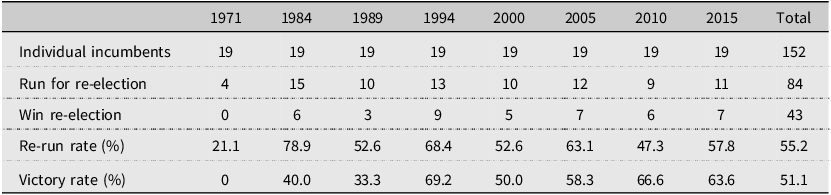
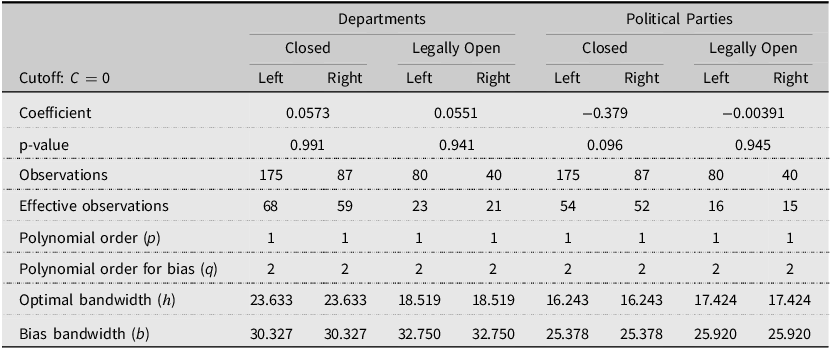
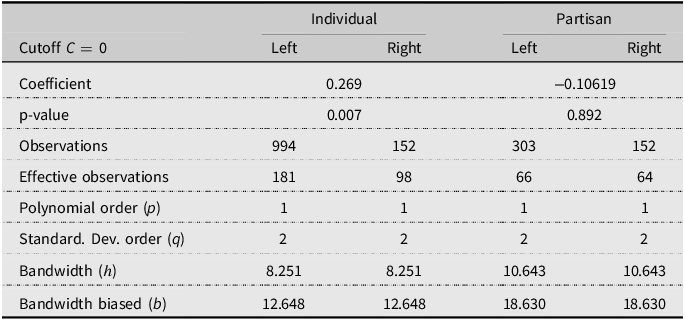
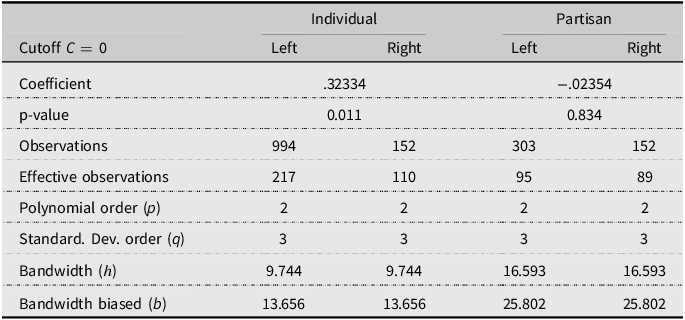
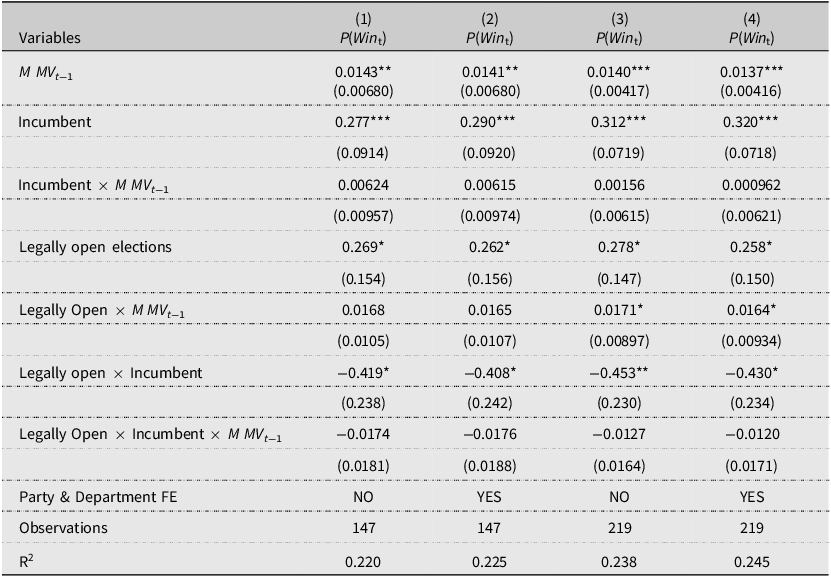
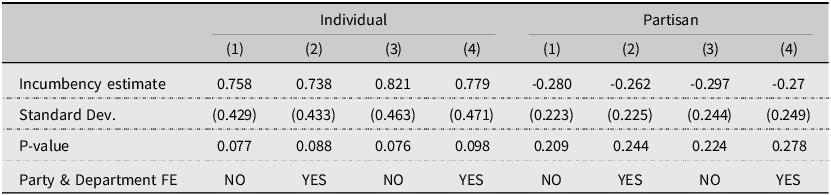
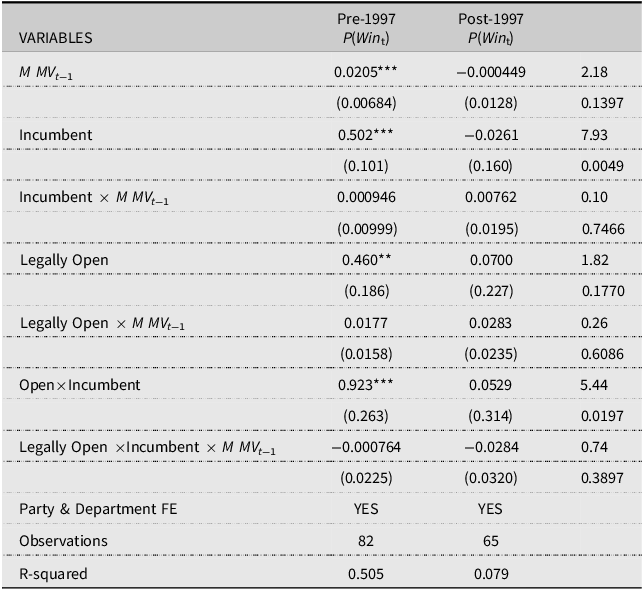
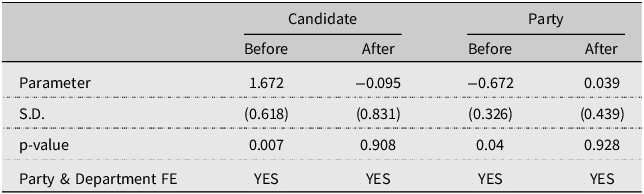


 Open access

