

I Benin
A Defining the Question behind the Institutional Diagnostic
The Republic of Benin (formerly known as Dahomey) is a country in West Africa that is bordered by Togo to the west, Nigeria to the east, Burkina Faso to the northwest, and Niger to the northeast. It is a rather small country, with a population of approximately 11.49 million people (2018 estimate) and it is about the same size as three of its neighbours yet is considerably smaller than one of them, Nigeria, which has a population close to 200 million.
There are several reasons why Benin is an interesting country to study, and some of them have no doubt contributed to making it an aid darling for many donors. First, although it is made up of an extraordinarily varied mosaic of peoples and ethnic groups, this does not seem to have created serious problems as in certain other parts of sub-Saharan Africa. Second, it is a place with a long legacy of all sorts of political entities, running from old kingdoms or empires to principalities and microstates (possibly born of the breaking up of kingdoms or empires), which have also coexisted with stateless areas dominated by non-hierarchised families and clans. Because over the last ten centuries the country has been the locus of numerous waves of migration from neighbouring countries, it is a multinational state with strong links to its neighbours, and has porous and flexible borders considered from the standpoint of human settlement. Relatedly, with its direct access to the sea in its southern part, Benin has long been a nexus of trade networks and routes actively engaged in regional and even external commerce. These seem to be ideal conditions for long-term development based on an open (small) market economy. Third, although it was subject to a long-enduring Marxist-Leninist military regime under Lieutenant-Colonel Mathieu Kérékou (1972–90), Benin has proven able to transition to democracy peacefully and then to enjoy political stability through a long period of regular democratic elections. Fourth, being deprived of mineral and non-mineral resources, the country is apparently in a position to eschew the resource curse that has impaired growth and development in many African countries endowed with abundant such resources.
The picture appears less rosy, however, when completed by a number of hard facts. Ranked among the world’s poorest countries at the time of independence (1960), Benin has barely succeeded in improving its position since then: although quite volatile, the annual growth of its GDP per capita hardly reached 1 per cent, a disappointing performance partly explained by a very high population growth rate of close to 3 per cent. In addition, improvements in the standard of living have been not only slow but also unequally distributed. The coastal cities of Porto Novo and Cotonou, together with their hinterland, constitute the growth pole of Benin’s economy. It is in their tiny departments that poverty is kept under control, unlike in many other parts of the country, where it remains intolerably high. The northern and rather remote part of the country, in particular, suffers from neglect, in the form of a lack of critical public investments, and this is despite the fact that its political representatives have not been consistently deprived of access to the highest levels of state power. Not surprisingly, achievements on the poverty front are also dismal since there does not appear to have been a noticeable reduction in the incidence of poverty during the last decades. Moreover, there is evidence that the severity of poverty has increased significantly, as reflected in the decline of the real expenditures per capita of the bottom 40 per cent of the population. Since the same holds true for income inequality, it can be confidently said that growth in Benin has not been inclusive, to put things mildly: the gains from growth have disproportionately accrued to the top of the living standard distribution.
As could be expected on the basis of the low per capita income growth performance, the economy of Benin is afflicted by low rates of labour productivity growth throughout most sectors. It is striking that capital per capita has contracted over the whole period since 1970. It thus contributed weakly to growth of per capita income, which largely resulted from TFP growth. In addition, the observed change in TFP largely reflects major changes in the sectoral structure of the economy, away from agriculture and towards manufacturing and, above all, services. Here, too, the situation is rather worrying: while most of the limited overall productivity gains can be attributed to labour movements from lower to higher productivity activities, they have come at the cost of decreasing productivity in many of the latter activities. In other words, no sector emerges as a genuine growth engine. A possible exception is perhaps the financial sector, but this has practically no impact on employment. From an examination of the evolution of the structure of output, employment, and productivity, it therefore appears that most TFP growth is due to net labour migration out of agriculture, with no autonomous productivity gains in the destination sectors.
The question that then arises is how Benin came to waste its development potential. Any institutional diagnostic of the country must attempt to provide an answer to that question. This is the task to which we now turn.
B Two Pseudo-Engines of Growth
A valid starting point is the observation that Benin’s economy has rested on two pseudo-engines of growth: the cotton sector and the illegal cross-border trade with Nigeria. Cotton is the backbone of the formal Beninese economy, representing a large share of its export revenues, tax proceeds, manufacturing output, and (formal) employment. As for its contribution to GDP, it is of the order of 10 per cent or more. It is well known that the price of raw cotton is subject to wild world price fluctuations, hence the need to smooth their impact on producers and to diversify the sector by encouraging the production of cotton-based textile products. If the former requirement has been satisfactorily met, the same cannot be said of the latter, which raises the whole issue, to which we shall return, of the reasons underlying the weak performance of the manufacturing sector. Moreover, it appears that over long periods of time Benin’s cotton sector has performed much more poorly than its two main rivals in West Africa, Burkina Faso and Mali. Thus, after substantial growth from 1980 to the mid-1990s, production did not grow for the next twenty years, and it even fell dramatically in the mid-2000s. It is only recently that production has been able to overtake its 1996 record level.
Because Benin did badly compared to its regional competitors during a prolonged period, we cannot account for the erratic performance of its cotton sector by simply referring to depressions in world prices or adverse weather conditions in the country. More structural factors specific to Benin must therefore have been at play. The first thing to note here is that the general organisation of the cotton sector does not essentially differ between the three main West African producer countries, and producer prices are also comparable. Activities ranging from the provision of inputs and credit to producers to the collection of cotton seeds and the purchase and ginning of their harvests are integrated under a monopolistic structure. Whereas in Mali a national company is in command of the whole sector (except production), in Burkina Faso and Benin an Association Interprofessionnelle du Coton (AIC) is in charge, which comprises several private or semi-private companies. In the case of Benin, however, the organisation of the cotton sector has been deeply unstable until recently. After the demise of Kérékou’s Marxist regime, it was subject to periodic stints of privatisation, re-nationalisation, and re-privatisation. Behind all of these destabilising moves there has been cutthroat competition between powerful men eager to control the sector and its juicy rents. And if some stability has eventually returned to the sector, allowing for its recent improved performance, it is only because it has now fallen under the indisputable control of a unique businessman who also happens to be the President of the Republic, Patrice Talon. Talon has been nicknamed the ‘king of cotton’ by the people.
By 2019, when Nigeria decided to close its land borders to goods movements, informal cross-border trade (ICBT) had developed into an important segment of Benin’s economy. First, Benin had huge unofficial re-exports to Nigeria, and second, it fraudulently imported a sizeable share of key imports from its big oil-producing neighbour. The illegal nature of this cross-border trade, favoured by the porosity of the borders and the heavily protectionist policy of the Nigerian government, needs to be stressed: goods re-exported to Nigeria, which were legally imported into Benin, faced stiff tariffs or were banned from import into Nigeria. At the port of entry in Benin (Cotonou), the destination of these goods declared at the customs was either a landlocked neighbouring country, for which import taxes and customs duties are low, or the domestic market. Once customs had been cleared, the goods were diverted to Nigeria via a network of informal intermediaries who organised their transportation and smuggled them over the border. Similarly, the large flow of goods imported by Benin from Nigeria, consisting mainly of products that are heavily subsidised in the latter country (oil, in particular), and of other consumer, intermediate, or capital goods, were smuggled into the former country. They thus escaped tariff duties and were sold on the domestic market through informal channels similar to those operating in the re-export sector. Quite evidently, the illegal character of this trade induced its informal organisation.
Dating back to the first oil shock in the 1970s, it is Nigeria’s oil rent which fed ICBT: Benin’s re-exports were driven by Nigerian demand, itself heavily dependent on oil revenues. On the other hand, Benin’s cross-border imports were partly driven by the share of the oil rent that the Nigerian government decided to allocate to the subsidisation of its domestic oil prices, thus creating a positive income effect for a large mass of the population. In this way, Benin shared the oil rent with Nigeria, including through low prices for fuel, and its institutions and policies were shaped by a sort of ‘entrepôt state’ strategy aimed at transforming the country into a regional trading hub centred on the port of Cotonou. Because there was full knowledge that goods imported into Benin in a fully official and legal way were to be de facto diverted to Nigeria in fraudulent ways (that is, by circumventing Nigeria’s import tariffs), we can safely say that Benin’s strategy was not only to tolerate but also to encourage the informal, fraudulent re-export trade.
That ICBT has been a major sector of activity in Benin can be judged from the following figures: at peak times of the trade, Benin’s estimated gross value of imports of products typically destined to be re-exported to Nigeria represented more than 25 times the gross value of Benin’s official exports to Nigeria (Golub and Mbaye, Reference Golub, Mbaye and Bourguignon2023). Still more strikingly, the contribution of ICBT to Benin’s GDP is estimated to have been in the range of 10–12 per cent, including customs and other tax revenues (6 per cent of GDP). It has also been a major provider of informal jobs, a direct upshot of the labour-intensive character of many activities involved. Seen in this light, ICBT seems to have played an important role in the economic development of Benin. But there are several flip sides of all these achievements, which we mention now.
The first shortcoming of the situation is the presence of effects akin to those of a Dutch disease. Strictly speaking, Dutch disease occurs when a boom in an export sector (for example, natural resources) causes a decline in other sectors (like agriculture or the manufacturing sector) as a result of an appreciation of the country’s currency. The consequence is that the country’s other exports become more expensive while its imports become cheaper. The latter effect causes the domestic production of importables to be less competitive. While Dutch disease is most often sparked by the discovery of new natural resources, it can also be caused by any development that results in large inflows of foreign currency, including a sharp surge in natural resource prices, in foreign assistance, and in foreign direct investment.
In the case of Benin, such Dutch disease-type effects can also be observed but, as seen above, the causes are rather different, consisting of a combination of policies based on trade quotas and tariffs, as well as high oil prices in Nigeria, coupled with the use of the resulting rents to illegally import re-exported goods from Benin. The latter thus benefits from effectively higher export prices in the sector of goods illegally re-exported to Nigeria, and from a stronger Nigerian demand for these goods than would be the case under a free international trade regime. It also enjoys lower prices for the goods which it itself illegally imports from Nigeria and which are subsidised by the Nigerian government (oil products, in particular). Such price and quantity effects discourage domestic production, as epitomised by the fate of formal activities of gas distribution, cement factories, and breweries, which have been partly driven out of business.
A second shortcoming arises from the tax losses caused by the informal nature of trade transactions based on imports from Nigeria, and the taxes foregone as a consequence of the displacement of formal domestic activities sparked by these imports. As a third shortcoming, there is the fact that, because the illegal trade is carried out on a large scale, bribery and corruption are pervasive at each stage of the process. A critical level at which malpractices occur is the customs office at Cotonou port facilities: given that it can provide regular and considerable rents, powerful people strive to capture this key office and, given the high stakes involved, the struggle has been unsurprisingly fierce. It is actually revealing that the same man who succeeded in gaining control of the entire cotton sector also ended up owning the customs office. Here is another facet of the resource curse problem that typically harms countries enjoying abundant and valuable natural resources. In this specific case, the valuable resource consists of imports that can be re-sold at much higher prices to a vast neighbouring country.
Finally, grounding growth in ICBT is highly risky as it requires two parties to play the game of undertaking illegal activities. The risk is especially high when the two parties are of significantly different sizes, so that the distribution of bargaining power between them is very unequal. Thus, when in 2019 the Nigerian government abruptly and unilaterally decided to close its land border with Benin, the Beninese government was taken off guard, and a critical source of the country’s economic prosperity was disrupted overnight. To the extent that ICBT activities are nevertheless pursued, they now involve much higher risk premia, resulting in lower profits, lower employment, and business failures.
There are two immediate lessons to be learned from the above account: (i) Beninese growth has been anchored in two fragile sectors of activity, thereby calling into question the sustainability of the underlying development strategy; and (ii) the concentration of economic power in the hands of a small clique, and even a single businessman, augurs badly for the possibility of a competitive environment. The first problem means that Benin is, and will remain, highly dependent on external financing, and on foreign aid in particular since its attractiveness for foreign direct investors is low. An ominous sign of its excessive external dependence is the rapid growth of its external debt as a percentage of GDP after the major debt write-off that took place in the early 2000s. As for the second problem, it is the more serious because of the close connection between business and politics, which is our next point.
C Political Instability and the Confusion between Business and Politics
Politics in Benin has always been characterised by a deep intrusion of business interests. This was even true under the Marxist-Leninist regime of Kérékou, which was marred by numerous scandals resulting from the lust for private wealth accumulation among Kérékou’s ruling inner circle. After the demise of this pseudo-socialist regime, came the Renouveau Démocratique (Democratic Renewal), with its promise of a more transparent and competitive political game that would put an end to kleptocratic practices and blatant favouritism. Unfortunately, these hopes were soon shattered as the old game continued to be played by new actors. In essence, the political system remained patrimonial, in the sense that wealth and power are narrowly intertwined.
At the root of the problem lies the critical role of private financing of electoral campaigns. As has been substantiated in the companion book on Benin, empirical evidence shows that firm owners tend to provide financial support to local politicians in exchange for policy concessions. The most important of these concessions are public procurement arrangements, policy commitments aligned with the firm’s interests, and direct appointment to the bureaucracy of relatives and other acquaintances of the firm’s owner. Interestingly, it appears that their order of importance varies depending on the degree of political uncertainty: when election results are more uncertain as a result of a higher number of candidates, business firms tend to lay more stress on the second and third types of demands. Moreover, their requests for influence and control over the recruitment of officers in all sections of the public sector increase. Finally, in the absence of what they consider to be a ‘good candidate’, the option of themselves running for elections, which amounts to direct state capture, becomes more attractive.
In such a context of pervasive attempts at direct and indirect state capture, it is not surprising that the number of political parties soared to reach the astronomical figure of 250 by the late 2010s. This number considerably exceeds the number of ethnic groups in the country, although the latter is quite large, testifying that many of these parties represented narrower factions inside ethnic groups or regroupings stretching across clans and based, for example, on local and regional identities. Far from being strong organisations articulated around programmatic and ideological platforms, political parties are patronage machines led by powerful and wealthy men. Because of the large rewards of political power (remember the juicy rents created by the ICBT and the cotton sector, in particular), these oligarchs or faction leaders (often called ‘Big Men’) are involved in nasty fights that cause a lot of political instability in the country. Especially destabilising is the opposition between the three main factions composing the dominant ethnic group (the Adja-Fon). Perhaps paradoxically, the other three main groups, namely the Yoruba, the Bariba, and the Atacora, have continuously played a mediating role which has sought to reduce the resulting tensions, whether in an authoritarian (the Kérékou regime) or a democratic setting. Behind this political instability are the constant manoeuvres and shifting alliances and loyalties (including party switching) in which Big Men indulge, depending on their interests as they perceive them at particular moments.
In addition to encouraging political instability, the Big Men system has had a demoralising effect on the population. People witness a succession of obscure political moves and subsequent institutional changes (think of the back-and-forth movements between the public and private status of the companies or agencies in charge of the cotton sector since 2000), as well as scandals whose most common manifestations are sheer favouritism, abuse of public positions, tax evasion, and the embezzlement of public resources. Accusations of embezzlement and rent capture concern not only prestigious construction projects but also programmes that are critical for the well-being of the population and the long-term development of the country (such as water, electricity, and other vital infrastructure projects). Given that most of the misdeeds and cases of extortion go unpunished or uncorrected, it is understandable that the population nurtures a deep mistrust of public institutions. This is especially true of the tax authorities and the judicial system, for which Benin exhibits worse trust indicators than many other African countries.
It is too early to tell how much the rise of Patrice Talon to the presidency is a game-changer. One thing is certain, however: his chaotic ascent to supreme power, itself a reflection of astute tactical moves based on coalitions and counter-coalitions, has been aimed at suppressing instability and establishing law and order in the country, at the price of sacrificing democratic principles. The difference with the experience of Rwanda, which Talon holds in high esteem, is that while Rwanda’s leader is himself the richest businessman in his country he also has a reputation of being incorruptible. The story of Talon’s rise to the presidency is so revealing of the way politics works in Benin that we cannot resist the temptation of telling it to the reader. In order not to break the continuity of our general argument, however, we have deferred the story to an appendix. Here, we want to stress that, in acceding to the presidency after having gained control of the most important sectors of the Beninese economy, Talon put an end to an era in which political leaders were frontmen acting at the behest of powerful businessmen, rather than these businessmen themselves. In this sense, the democratic façade behind which the latter could previously hide themselves has collapsed to reveal the true nature of Benin’s political system.
D Neglect of Critical Public Goods
We have emphasised above some adverse effects of a political system that is penetrated by business interests: namely, political instability and the diffusion of a culture of corruption and cronyism. We now want to add a number of other, equally important, effects. To begin with, the patronage logic governing politics implies that priority is given to pork-barrel projects: transfers that do not typically benefit the poorest sections of the population, and the delivery of local public goods targeted at specific groups. General public goods, such as health, education, nationwide communication, and power infrastructure, tend to be neglected. It is true that efforts have recently been made to fill some of these gaps, yet they still do not reflect sufficient awareness of the critical role these factors play in sustained growth and development. Thus, while the construction of main roads is essentially financed by external aid (think of the two parallel highways linking the southern and northern parts of the country), the building of rural, farm-to-market roads in remote areas, which should be the responsibility of the national government, has not received the attention it deserves. Also, the costs of electricity and telecommunications services are generally higher in Benin than in other African countries, and their quality is often mediocre. Revealingly, access to electricity is the constraint most often cited by economic operators.
The education picture is dismal, as attested to by the catastrophic record for literacy achievements: on this front, Benin ranks among the worst performers in the world. Increasing enrolment at both primary and secondary levels has been actively pursued during the last decades, yet at the price of stagnation – and perhaps even deterioration – of schooling quality (as measured by learning outcomes). These disappointing results are less of a mystery when we learn that the activities of the teacher training schools in Benin were discontinued during the 1990s, which immediately caused a severe shortage of teachers in many parts of the country, particularly in the north. There, outsized classes (with classes reaching up to 120 pupils in Natitingou), teacher absenteeism, and substitution of poorly trained teachers for the missing qualified staff attained unprecedented levels, thereby increasing the inequality between the north and the south in terms of the quality of basic education. Drastic cuts in the budget of the Education Ministry actually followed a policy of fiscal restraint imposed by the IMF and the World Bank within the framework of three successive Structural Adjustment Programmes (SAP 1989–99). More efficiency in the use of the diminished public resources available was expected by the World Bank, particularly in the form of training and upgrading of government staff, yet this did not come about. However blame is apportioned for the situation, the resulting discontinuation of teacher training schools has been disastrous and in blatant contradiction of the World Bank’s sectoral strategy.Footnote 1
Being deprived of mineral and non-mineral resources, Benin needs to base its long-term growth strategy on the emergence and rapid development of sectors that create substantial added value, whether in the processing of agricultural goods, the production of simple manufactured goods, or the delivery of services. In the absence of serious investment in human capital formation and improvement of physical infrastructure, foreign investors will not be attracted to Benin and the country will remain heavily dependent on foreign aid.
E Low State Capacity and Weak Public Management
A political system captured by private interests can negatively affect state capacity in several ways. It can lead to the understaffing of administrative departments that are not considered a priority by these interests, and may even be seen as antagonistic. This seems to be the case for the tax collection department, whose size is clearly below that required to function effectively. Departments can also be captured through the appointment of ‘yes people’ or the exertion of strong pressure on the decision-making process. In Benin, this applies to the judiciary, whose officers comply with instructions coming from high-level politicians or officers belonging to the executive. It is therefore no wonder that people in Benin have a particularly deep mistrust of the representatives of these two institutions: tax collection officers and judges.
Moreover, under the influence of various lobbies, different parts of the administration and the government may make uncoordinated, divergent decisions that contribute to creating a chaotic and confused legal environment. Land laws and their implementation are an example that comes to mind here. In this matter, indeed, the reform process has been immensely complex, volatile, and non-monotonous. Many changes thus succeeded each other, involving backtracking, not only with respect to the provisions of the successive laws but also with respect to the institutions in charge of their implementation. Regarding the first source of instability, as a result of regular shifts in the relative bargaining power of various interest groups, the law has remained largely unpredictable. Uncertainty exists about (i) whether and to what extent the current law is going to be implemented, and (ii) about whether the current law will be replaced by a different law in the (near) future. Some provisions, such as the authorisations required to buy rural lands, the obligation to officially record rural land transactions, or the possibility of forcing the owner of uncultivated rural land to rent it out, are clearly unenforceable and people do not seem to care about them. Others, however, create a genuine uncertainty that can discourage investment, particularly in urban and peri-urban areas or in areas where migrants coexist with autochthonous populations. To some extent, the issue here is one of misalignment of the law with respect to state capacity: a complex law is enacted for which the state does not have the administrative resources required for effective implementation. Of course, if the provisions of the law are misguided or superfluous, it may turn out that this misalignment is of no direct consequence.Footnote 2
Regarding the second source of instability, the fact is that many institutional choices appear to be the outcome of fierce struggles among rival administrative entities. This is particularly evident at the highest level of the state, where there has been constant wavering about whether to assign the responsibility for land regulation to the Ministry of Agriculture, the Ministry of Town Planning, or the Ministry of Finance. Another example is the strong resistance of rural municipalities to attempts to reduce their prerogatives in land matters. Their resistance paid off, since the right to deliver attestations of customary ownership, which belonged to the Agence Nationale du Domaine et du Foncier (best translated as National Agency for Land Administration) under the 2013 law, was shifted to municipalities under the 2017 law. Rural municipalities also successfully opposed the complete suppression of sale conventions, through the requirement that land transactions must be instantaneously registered by notaries. Finally, the professional bodies that earn incomes from land regulation – notaries, barristers, architects, and land surveyors in particular – played a decisive role in killing the provision of the 2013 law regarding the five-year confirmation period during which property rights must be verified.
F Institutional Diagnostic of Benin: A Compact View
Having expounded the critical elements of the diagnostic, we can now take a comprehensive view in which the institutional weaknesses of Benin are traced back to their deep and proximate causes, and their economic consequences are brought into relief (see Table 4.1).
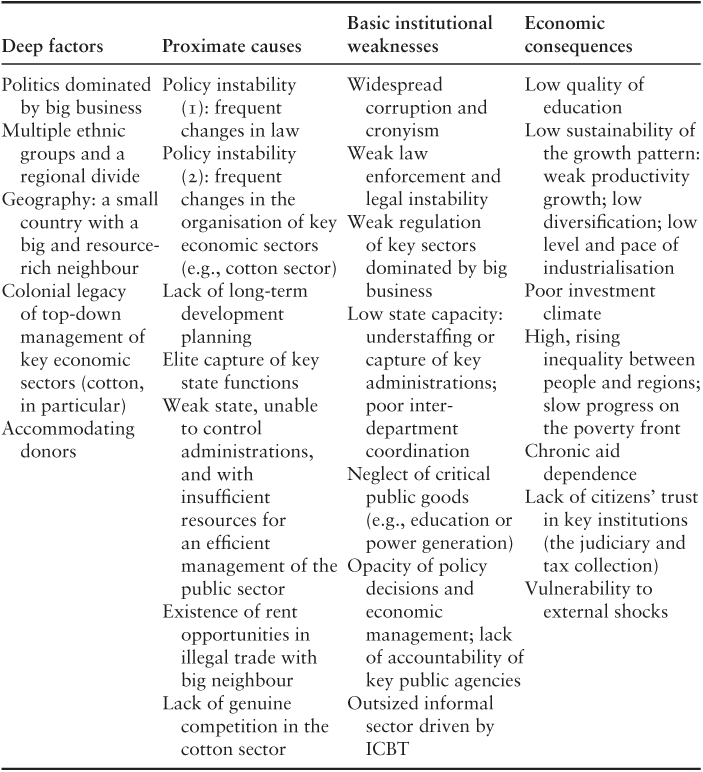
In short, five deep factors ultimately help to account for the key institutional weaknesses detected in Benin: (i) a political system that is characterised by a neo-patrimonial logic and where there are multiple contenders; (ii) a social landscape in which multiple ethnic groups have coexisted for a long time; (iii) a geographical/neighbourhood landscape in which small Benin has a long border with a big neighbour (Nigeria); (iv) a legacy of centralised management of key economic sectors (the cotton export sector, in particular) dating back to the colonial period; and (v) the heavy presence of aid agencies, which tend to shut their eyes to the dysfunctional aspects of the political system.
Political instability and the lack of long-term economic planning are the result of unruly competition and factional bickering between Big Men who are uncertain about their political future. This competition is especially fierce, and uncertainty especially great, because of the division of the Beninese society into multiple ethno-regional groupings. Key state functions are captured by the dominating faction(s), resulting in a weak state that is unable to exert control over all its administrations, a difficulty that is compounded by a lack of administrative resources (skills, staff, and equipment). This situation of low effectiveness in the management of the public sector and unfair distribution of the country’s rents is not adequately mitigated by the pressures emanating from external donor agencies or international (African) institutions. It is not mitigated either by pressures to open up key economic sectors (the cotton sector, in particular) to competition, owing to a long tradition of public monopoly that is easily transformed into private monopoly. As for geography, the presence of Nigeria at the border of Benin gives rise to considerable opportunities for rent that can be earned through illegal trade.
The main economic consequences are as follows: a spatially lopsided development pattern that is, moreover, precarious (subject to external shocks) and unsustainable; chronic dependence on foreign resources resulting from slow productivity growth and pervasive inefficiencies in the running of the state; and a bad investment climate caused by poor governance, widespread corruption, and confusing and loosely enforced laws and regulations. Since foreign direct investment is therefore deterred, foreign aid is the buoy that keeps the country’s finance afloat.
G Policy Implications and Recommendations
Priority attention in any reform process ought to be given to ways of breaking the link between politics and business, which is at the root of many institutional failures and economic problems. Since the financing of electoral campaigns provides oligarchs with a privileged channel for influencing politics, it should be regulated by law. Here we can think of capping the amount of financial contributions to politicians and imposing rules requiring transparency regarding the amount and the source of donations. The problem with such rules is that in weakly governed countries they tend to be ignored whenever they are enacted. This is illustrated by Benin, where they indeed exist but are not strictly enforced. The same restriction probably applies to all rules prescribing rigorous impact evaluations of public sector actions so as to achieve greater accountability of major actors at the state level. And it also applies to many laws, decrees, and regulations that ban day-to-day malpractices, such as the taking of bribes, petty corruption, and money extortion by local officials. Thus, although signboards warning against practices of bribery are displayed in local police offices, nobody really cares.
Clearly, attacking the key issue of the intrusion of business into politics upfront is unlikely to bear much fruit. This is especially true today since the richest businessman in the country holds supreme political authority. More feasible reforms should aim at radically transforming the Beninese economy so as to increase the average income per head of the population and to anchor growth in more sustainable sectors than cotton and the ICBT with Nigeria. Since Nigeria’s borders have now been abruptly closed to flows of goods, the latter sector has ceased to be a reliable source of incomes and employment for Benin. The path forward must therefore be based on a sectoral transformation of the economy and strong measures to improve labour productivity in key sectors.
Regarding the first dimension, a realistic strategy consists of promoting agro-processing industries outside the cotton sector. This involves: (1) the identification of agricultural products for which the country’s natural conditions are appropriate and which can generate enough added value; and (2) the integration of their producers and intermediaries into a value chain that includes input and credit supply; collection of the produce; and its transportation, storage, processing, packaging, and marketing up to the point of the final consumers in rich countries, if needed. In a country like Benin, where there are many experienced traders and middlemen (including those of Indian or Pakistani origin who criss-cross the country) this is best done through a great deal of market activation or facilitation. On the part of the state, the main tasks required are the construction and maintenance of rural feeder roads, which can be branched off into the main grid, and the effective suppression of all of the money-extorting posts on the routes used by producers and traders.
Valuable efforts in this direction have actually started to be made. Thus, for example, schemes for the production and export of pineapples and pineapple products (like juice or jam) have recently been launched under the impulse of the present government and with the financial and logistical support of several aid agencies and development cooperation programmes (French, Belgian, Canadian, etc.). The organisation of the value chain up to a European food distributing company (the Carrefour chain of supermarkets in France), the high quality of the product, and the quick supply response from the farmers in the Allada region are important advantages for the success of this initiative. To the extent that fertiliser use is almost non-existent in the cultivation of pineapples in Benin, and provided that some logistical and other difficulties are overcome, a promising niche is the market for organically produced, fresh pineapples.Footnote 3 When pineapples are processed into juice or jam, expansion is mostly constrained by foreign competition, especially in the European markets, where Chinese and Thai exporters presently enjoy a price advantage. Beninese firms must therefore look for closer foreign markets, such as Burkina Faso and Nigeria, until they improve their competitiveness (through the development of by-products, for example).
Clearly, in the context of a competitive world market dominated by big value chains, the government has a key role to play in the detection of profitable opportunities, the organisation of effective linkages with distant markets, research and development destined to improve the quality of the product and uncover promising by-products, and the like. These are complex tasks requiring appropriate skills, learning by doing, exposure of management staff to foreign experiences, and well-functioning infrastructure (adequate harbour facilities, non-corrupt customs, good roads, reliable internet and mobile phone services, and a regular supply of electricity).
Increasing labour productivity in industrial ventures is another pressing challenge for Benin. This requires not only that more efficient production techniques and capital equipment are used but also that better management systems are put in place. The most effective way to attain this objective is to mobilise foreign direct investment, but that requires, in turn, that governance conditions are improved in the country, so as to reassure potential investors.
Finally, one of the most pressing challenges confronting Benin is education. If significant efforts have been made to increase enrolment, much remains to be done to improve educational quality to reach decent standards, starting with the primary school level. Furthermore, technical and professional schools must be created to help fill the prevailing skills gaps in the labour market. In the absence of significant improvements in educational quality, it is difficult to see how labour productivity can be raised, technical and organisational innovations adopted, and foreign direct investment attracted so as to gradually move Benin to the status of an economy with an intensive degree of skilled labour, as befits a country that is deprived in terms of mineral and non-mineral resources.
Benin is endowed with entrepreneurial people and well-experienced traders and merchants, as well as a good climate and fertile agricultural lands in certain parts of its territory. It has a comparative advantage not only in traditional products such as cotton but also in new agricultural products that can be processed and sold at remunerative prices in the international, regional, and domestic markets. In sum, Benin has a strong potential for development that can be unleashed if only the right institutional and policy environment can be established. Whether this can be done while the link between business and politics remains unbroken is a pivotal question. What needs to be stressed is that Talon’s accession to the presidency has perhaps changed the rules of the game by ending the noxious competition for political leverage between a few oligarchs. It will therefore be especially interesting to see how far his regime will go towards transforming the economy, controlling corruption, and improving the country’s human capital and infrastructure.
It cannot be denied that the main planks of Talon’s reform programme closely match our own recommendations. Think of his reforms of the education system (with an emphasis on the creation of technical schools and training institutions), his plans for infrastructure expansion (including the improvement of the generation and distribution of electricity, considered as a critical constraint on industrialisation), and his measures intended to diversify the economy in the sense of adding value to agricultural and raw material (e.g., cotton) products. However, given the concentration of economic and political powers in his hands, it is legitimate to ask how he will be motivated to bring more competition to key sectors of the economy and fight ‘grand’ corruption, rather than only petty corruption and small-scale bribery. In addition, in a country where freedom of expression is highly valued and where free elections and changes of incumbents became a regular feature of the political scene during the last decades, the question arises as to how sustainable his undemocratic regime will prove to be.
II Mozambique
A Defining the Question behind the Institutional Diagnostic
Mozambique is a large, sparsely populated country with twenty-five main rivers that empty into the Indian Ocean and that physically divide the country. The main river is the Zambezi, which is navigable for 460 km out of a total of 820 km and flows eastwards across the territory. Located on the east coast of southern Africa, Mozambique, whose population is around 30 million, borders six other countries: Tanzania in the north, Malawi, Zimbabwe, Zambia, and Swaziland to the west, and South Africa to the south.
There are several reasons why Mozambique is worth studying, and some of these reasons have no doubt contributed to making it an aid darling, like Benin, for many donors. First, the country attained its independence late in the process of decolonisation, in which respect it is similar to other Portuguese colonies in Africa (Angola, Cape Verde, and Guinea Bissau). Moreover, it started from a very low base in terms of infrastructural development, education, and levels of living of the autochthonous population. Outright chaos broke out at the time of independence (in 1975), following the massive outflow of Portuguese settlers, who had occupied central positions in every layer of the economy. The country was then the poorest in the world and was in blatant need of external assistance. Second, like Angola, Botswana, Namibia, and Zimbabwe, Mozambique has been governed by the same party that took over after white rule ended (Frelimo). This party historically enjoyed huge prestige and legitimacy, and therefore embarked on a nation-building process under auspicious circumstances. At the same time, however, it quickly declared itself a Marxist-Leninist vanguard party, dedicated to central planning and opposed to private sector development. Third, because it has a long coastline and has enjoyed the presence and influence of Arab traders for a long time, Mozambique has potential in terms of developing trade links, while the proximity of South Africa, and its sizeable and more sophisticated economy, offers many attractive opportunities.
To date, however, the hopes placed in Mozambique’s development have largely been disappointed: economic growth has been below potential, social progress has been slow, structural transformation of the economy has barely begun, growth has been unequally distributed across the national territory, and dependence on external financing (development aid in particular) has not abated. Regarding the first point, it is noticeable that until the early 2000s, the donor community generally considered Mozambique a development success story: after the end of the internal war (between the ruling Frelimo and the opposition party, known as Renamo) in 1992, real GDP growth (per capita) was vigorous, easily outstripping the global average and surpassing many other countries in the region. This performance reflected the combination of a return of displaced people to their homes, the rebuilding of private and public infrastructure, supported by foreign aid, and private investment (domestic and foreign).
The trend was not sustained, however: the pace of real aggregate growth peaked at the turn of the new millennium and then slowed moderately during the 2000s (when the rate of real per capita growth was equal to 3.4 per cent per year). As a result, Mozambique is no longer a star growth performer and lags behind its peers in the region (Ethiopia, Ghana, and Tanzania). Similarly, if particularly strong gains were obtained on the poverty front in the immediate post-conflict period, less impressive gains have been recorded since then. Mozambique thus remains a very poor country by any measure. In 2017, it ranked 180 of 186 countries in terms of real GDP per capita, and 180 out of 189 on the United Nations’ Human Development Index.
During the decade starting in the late 1990s and ending in the late 2000s, Mozambique showed a promising trend, characterised by vigorous growth in the manufacturing sector, dominated by large-scale capital-intensive investments (particularly in the Mozal aluminium smelter), and by robust service sector growth. Then a turning point was reached, which was triggered by important foreign direct investments in the natural resources sector, mainly coal extraction and natural gas development, following the discovery of abundant reserves in Cabo Delgado. The same period also witnessed a rapid growth in private services, financial services included, but a declining trend in the contribution of agriculture to growth.
Much of Mozambique’s growth has been fuelled by significant inflows of foreign exchange, both public and private. These inflows have generated spillovers, either directly into consumption – total consumption has consistently equalled about 90 per cent of GDP– or indirectly into income through investment. Moreover, their pattern has shifted increasingly towards capital-intensive natural resource investments, and it seems highly likely that this trend will persist in the foreseeable future. What is worrying is that the economy seems to have become less diversified over time, as revealed by the shifts in the composition of its exports. Thus, manufacturing exports (aluminium) plateaued by the later 2000s, while, starting roughly in 2010, natural resources exports (mainly coal) have quintupled in value and now account for around 50 per cent of all exports. Correspondingly, there is a relative shift towards lower value-added exports.
Finally, the authorities, in spite of the consistent political domination of the Frelimo party, have signally failed to reduce regional disparities and to therefore tame the resentment of people who do not live in the country’s prosperous south. This failure is tragically attested to by the insurgency that broke out in Cabo Delgado in 2018.
B Difficult Initial Conditions
Modern Mozambique was born in especially difficult circumstances, not only because of the sudden departure of 80 per cent of the Portuguese settler population but also due to its geopolitical position in the context of the Cold War. The situation was complicated by the fact that Frelimo, which led the liberation war against the colonial power, came to exert a decisive political influence when the new People’s Republic of Mozambique was founded and proclaimed as a one-party socialist state. This posed immediate threats to Rhodesia and South Africa, which feared a Communist presence on their borders. Furthermore, the decision of the Mozambican government to enforce UN sanctions against Rhodesia in 1976 increased regional tensions, so much so that Rhodesia and South Africa moved to support and finance Renamo, the movement opposed to Frelimo’s socialist orientation and whose leadership came from the centre of the country. After Zimbabwe (formerly Rhodesia) attained independence in 1980, the apartheid regime of South Africa continued to stir ethno-regional differences and grievances in Mozambique, and it turned Renamo into a significant military force capable of disrupting and sabotaging facilities in large parts of the country. The war rapidly escalated and Renamo’s ruthless warfare contributed to undermining Frelimo’s nation-building efforts and to destroying valuable infrastructure.
It was only in 1992, following the demise of apartheid in South Africa, that a peace treaty was eventually signed between the two contending parties, thereby opening the way to less chaotic progress and a more stable security situation. Two years later (1994), the first multi-party elections were organised, which, like all the subsequent ones, confirmed the domination of Mozambican politics by Frelimo. Simultaneously, as an aftermath of the collapse of the Soviet empire, the international environment was dramatically modified, and Frelimo was forced to change course. Suddenly deprived of its main external financial support, the government had no other choice than to turn to Western donors (beyond the Nordic countries of Europe, which had been present much earlier) and to accept the free-market policies which they imposed. This implied the forsaking of the central planning strategy centred on import substitution and the forced mechanisation of agriculture, which Frelimo actively pursued after its transformation into a Marxist-Leninist party in 1977. Aid then flowed to the country which was now widely perceived as a donor darling.
Why is it that the strong growth that ensued, largely as a result of the return of a large number of refugees, did not lead to a significant structural transformation of the economy and to sustainable growth at the same level? And why is it that it did not lead to noticeable social achievements, greater national integration, and deep institutional change? This is the question that we now want to address. In order to answer it, we need to lend special attention to geographical and political factors, which appear to have had a determining impact on policies and institutions.
C Geographical Constraints
A basic fact about Mozambique is its low population density: equal to 40 people per square kilometre of land area, which is perceptibly lower than the average for sub-Saharan Africa (48 people per square kilometre), itself much below that observed for East Asia and South Asia (excluding high-income countries) – respectively, 131 and 389 people per square kilometre (United Nations Food and Agriculture Organisation and World Bank data). An immediate consequence of a low population density is the high per unit cost of providing and maintaining infrastructure (transport, telecommunications, electricity, etc.), and of delivering public services. It is therefore no wonder that sub-Saharan Africa generally has a low density of paved roads, particularly rural roads, and a low density of railways links. Nor is it surprising that in remote areas the communication links that exist are often badly maintained, and, as a result, the operating costs of the vehicles tend to be abnormally high, with adverse effects on the efficiency of transport services (see Platteau, Reference Platteau2000: Chap. 2). Equally serious are the effects of low population density not only on the amount and quality of health and education services but also on the amount and quality of other state-provided services, such as agricultural extension, training, irrigation, and various support services to farmers and small-scale entrepreneurs. Quality is affected insofar as it is difficult to attract skilled labour to isolated places that lack many of the amenities that can be found in areas of higher population concentration.
All of these forces arising from the same fundamental cause, low population density, help explain why distant areas in which the population is highly scattered are backwards and remain so. High transaction costs – transportation and communication costs, in particular – are responsible for low human capital development and slow economic growth, which themselves tend to determine such high costs. Behind the nasty feedback effect that causes low-level trap equilibria in remote areas, two mechanisms (at least) are at work. On the one hand, out-migration resulting from a lack of economic opportunities raises the per unit costs of public goods and services even further and, on the other hand, slow growth implies that business activities are not brisk enough to create a strong demand for transportation and communication, as well as for training, irrigation, and extension services. In rich countries, the vicious circle just described may be broken because income redistribution between different regions is both more affordable and better organised, and public service delivery to isolated areas is often subsidised by taxpayers living in thriving urban environments.
The tendency of poor countries to neglect maintenance of infrastructure, which was pointedly stressed by Alfred Hirschman (Reference Hirshman1958) a long time ago, is certainly verified in the case of Mozambique. Routine maintenance is generally delayed and migrated from the recurrent to the investment budget, where donors are more likely to help finance major rehabilitations once the infrastructure has degraded substantially. This sort of last-minute rehabilitation is a much more costly solution than regular maintenance, both in terms of the civil engineering work itself and in terms of vehicle operation costs (since the infrastructure remains degraded for a longer time). In addition, major rehabilitation work is not easily contractible to small local firms, which thereby miss precious opportunities to earn incomes and accumulate professional experience. The latter argument applies particularly to rural road networks.
In Mozambique, the problem is actually aggravated by two circumstances. First, not only is the country sparsely populated, especially in its central and northern part, but its space is also physically divided by numerous rivers. The resulting fragmentation makes its spatial integration by means of communication infrastructure comparatively costly. Second, the southern, richer, part of Mozambique, in which the capital city (Maputo) is located, is close to a large and economically more dynamic country, namely South Africa. It is no exaggeration to say that Mozambique’s south is much more tightly integrated with South Africa than with the central and southern parts of the national territory. This situation is a historical legacy of the colonial period, during which Mozambique was treated as a transit country. Since its transport infrastructure was built primarily to serve mining and farming activities in the much larger economies of South Africa and Rhodesia, the rail and road networks ran east–west, with little communication infrastructure to support north–south traffic.Footnote 4 Moreover, there were few rural roads linking farms to markets, and those that there were, were quite distant from each other.
The post-independence period did not bring any major change to the unbalanced distribution of communication links. Thus, large trunk roads in the east–west corridors were financed by donors whose priorities rested on estimates of internal rates of return, themselves narrowly dependent on vehicle operation costs. Furthermore, small rural roads and feeder roads received only a small share of the budget for the construction and maintenance of roads. After the first free elections were simultaneously held in Mozambique and South Africa in 1992 – no doubt a consequence of the end of the Cold War and the demise of the apartheid regime – borders and trade flows between the two countries were reopened, leading to increasing economic integration between southern Mozambique and South Africa. An important upshot of this is that Maputo, the capital city of Mozambique, where a modern urban elite and the country’s middle class are concentrated, is much closer to the agricultural heartland of South Africa than to its own rich farmland in the central and northern provinces. Encouraged by low transportation costs (and also massive corruption in the customs services), the demand for agricultural and other consumer goods has been consistently directed towards South Africa.
Geographical factors and the absence of vigorous policies aimed at redressing the ensuing imbalances have therefore created a situation in which the interests of the domestic industrial and service sectors have been continuously disregarded. South African supermarket chains distributing South African and Asian products have thus expanded into all provincial capitals to cater to the needs of city dwellers in Mozambique, and even staple foods are imported in this way. In short, the urban middle class of the country has been de-linked from its own agriculture and this process of distorted integration is deepening over time. As a matter of fact, with infrastructure investments (especially around Maputo) concentrated at the starting point of a new corridor leading to Durban, the connection between southern Mozambique and South Africa will only become closer, at the expense of the central and southern regions. The consequence seems inescapable: inter-regional inequality is bound to grow and national integration to become increasingly difficult.
In this context, the question as to whether the recent discovery of massive reserves of natural gas in the Rovuma Basin off the coast of Cabo Delgado (in 2016) can be a game-changer appears highly critical. This external shock offers a golden opportunity to redistribute income-earning and employment opportunities towards the northern part of the country, and thereby stop the national disintegration just described. At the same time, however, we know too well that golden opportunities of this kind can easily turn into a natural resource curse, as so many African countries in similar situations have experienced. Unfortunately, the omens are not good because escaping the curse requires a government that will take decisions driven by long-term considerations and by the general interests of the population, rather than by the selfish interests of an elite living in the southern part of the country. The recent insurrectionary events in Cabo Delgado suggest that at least part of the local population holds a pessimistic view that sees such a requirement as unlikely to be met. In order to make our own assessment, the next step is naturally to look at the way politics functions in Mozambique and, in particular, how it relates to business interests – and with what consequences.
D Politics and Business
As pointed out earlier, defining features of the post-independence political regime in Mozambique are: (i) the initial merging of the Frelimo party with the state; and (ii) the continuous domination of the same party even after multi-party elections were organised. As a result, an enduring one-party state has so far presided over the destiny of the country. In theory, this could help promote development by prompting the leadership to design and implement a unified long-term strategy of investment, growth, and social advancement. But the same conditions can also have the effect of undermining this capacity if the lack of political contestation prevents the correction of wrong-headed policies, or if they cause political rulers to be more concerned with tightening their grip on power and preserving the accompanying economic privileges than with increasing the well-being of the population. To look into this matter, we need to distinguish between the period when a socialist state was in place and the subsequent period of formal democracy.
When Frelimo acceded to political power at independence, it embarked on a programme of radical change based on Marxist-Leninist principles. Practically, this meant discouraging private initiative, adopting protectionist policies and the import substitution strategy, as well as transforming the agricultural sector into one based on large-scale mechanised farms. This approach rapidly proved to be a failure, which was officially recognised at the Fourth Party Congress in 1984. Because of the situation of war into which the country fell, however, there was no immediate effect of this reckoning. Policies were not re-orientated – in particular, the contemplated shift from socialist agriculture to a strategy centred on the development of small-scale peasant farming.
A more important turning point was reached in the 1990s when liberalisation and privatisation policies came about in the wake of the Structural Adjustment Programmes (SAPs) conceived by the World Bank and the International Monetary Fund (IMF). The separation of economic and political powers, merged by design during the immediate post-independence period, was then on the cards. Yet, instead of being mitigated or suppressed, the interpenetration of business and politics was actually reinforced. Privatised enterprises were taken over by party members, civil servants, and army officers, thereby ensuring de facto continuity with the previous state of affairs. This strategy was justified by the almost total absence of an experienced and independent business class in the country, and by the need to prevent the return of foreign capitalists, foremost among whom were Portuguese and South African business firms or groups. Its effectiveness was nonetheless doubtful inasmuch as a fraction of the new private entrepreneurs went broke or quickly liquidated their assets, and it is revealing that other entrepreneurs who continued their activities struck deals with foreign partners who possess the required skills and capital.
Whichever is the case, it bears emphasis that most new firm owners, some of whom acquired the public assets at very low prices, benefitted from some sort of exclusivity (such as a licence, a quota, or a contract for supplies to the government). When they were not closed down, therefore, public companies were simply transformed into private monopolies that continued to depend on government protection for the preservation of their privileges. Profits were (and remain) especially high in trade in imported consumer goods and exports of primary products, tourism, and construction activities stimulated by land development and privatised real estate. The privatisation process was questionable in terms of efficiency but equally from the standpoint of equity. This is not only because the emerging group of private firm owners was overwhelmingly made up of government officials and public servants, but also because entrepreneurs with ties to the opposition were consistently excluded.
The pattern of business–politics relationships is thus one in which big business is organised by politicians, rather than the other way around (big business exerts a strong influence on politics by financing the campaigns of politicians). As there is no credible alternative political force, Frelimo is in a comfortable position that allows it to continuously lock in the political allegiance of the business community. Being deprived of the possibility of hedging their bets by financing the campaigns of multiple political parties, members of the business elite of Mozambique have their privileges narrowly tied to Frelimo’s continuing in power. The Frelimo machine is oiled by their money, which includes donations by foreign business partners and associates, but that money itself is obtained thanks to egregious advantages dispensed by the party’s top brass.
Why is it that Frelimo has enjoyed, and continues to enjoy, such a strong incumbency advantage? The answer is twofold. For one thing, Renamo, its main rival, has difficulties attracting many voters, especially the young, owing to excessive centralisation of its party machine. And, for another thing, elections tend to be manipulated through fabrication of the list of candidates and voters register, intimidation during campaigns and on the day of the election, as well as through manipulation of the results achieved by stuffing ballot boxes and tinkering with the final tabulations. The tampering with the democratic process is made easier by the limited access of independent (external) observers to the different stages of the elections. The end outcome is that elections in Mozambique are not free and fair, and most observers agree that the situation is not changing for the better.
Does the above account mean that there is no stiff competition in Mozambique’s political arena and that, as a result, its political leadership is able to ensure the continuity of the country’s development strategies? The answer is negative since, inside Frelimo, various factions fiercely fight for access to power positions. Financial strength being a key determinant of the ability to rise within the party’s machine, this elite rivalry creates a fertile ground for the spread of money politics and influence peddling. Thus, if the control of the state allows privileged access to capital accumulation and juicy rents, it is conditioned by the control of Frelimo, as witnessed by the fact that the president of Frelimo almost automatically becomes the president of the republic, and the party’s candidates for parliament are appointed on the basis of blocked party lists. There is no such thing as dynastic power, so that the struggle between different political barons, each with his own support network of business people and other allies, is a play for high stakes.
It is thus at the level of the primaries, which is an internal affair, that economic leaders choose which alliances they wish to enter into, hedging their bets with a view to reducing future risks for their businesses. On the other side of the bargain, those inside the party who want to stay in central party organs and obtain high offices in the government need to raise funds both to finance the party and to capture votes at the primaries. Vote-buying therefore lies at the heart of primary elections in Mozambique, and it has become common practice only because of the complicity of the courts, which shut their eyes to corruption and other illegal acts. A portentous upshot of the internal tensions inside Frelimo provides an answer to a question that was raised earlier: despite the existence of a de facto one-party state, there is no guarantee of policy continuity over time. The possibility of the instability of development strategies is illustrated by the difficult transition from President Guebuza to President Nyusi, who was not Guebuza’s preferred candidate and had a different approach to policy and reform.
Clearly, the most important potential advantage of a regime founded on an overwhelmingly dominant party has not materialised in the case of Mozambique. Changes at the level of the presidency can cause significant shifts in development-related policies, can explain the piecemeal approach to policy formulation, as well as major rotations of personnel in government and leading positions in the public administration. Moreover, in the very logic of political patronage and crony capitalism, members of the government are inclined to view their ministry as their own fief: that is, they see it as a source of rents that should naturally accrue to them for personal appropriation and for redistribution to the network of their supporters, brokers, and financiers. In these conditions, strategic information-sharing and coordination between different parts of the executive tend to be obstructed, with the effect of seriously impairing the effectiveness of development policies. To this shortcoming of political patronage must be added another one, better known among economists: it fosters pork barrel projects, private transfers, and local public goods at the expense of public goods that are in the general interest, such as education and health.
Finally, it must be emphasised that the onset of extractive industries and, subsequently, the awarding to international companies of exclusive rights to explore and exploit oil and gas reserves in Cabo Delgado (in 2006), followed by the confirmation of the existence of plentiful reserves of natural gas (in 2010), have created new rent opportunities, real or anticipated, that have considerably raised the stakes involved in the struggle for political power and influence. It is probably no coincidence that the trend of an improvement in governance indicators was reversed after the occurrence of the aforementioned shocks to the economy. More specifically, it is hard to dissociate from the ‘pre-boom curse syndrome’ scandals such as the hidden debt scandal (2016), which has deeply affected both the economic and political climate in Mozambique and the country’s relations with the international community. Corruption, cronyism, and money politics, which pose a genuine danger to the vitality and sustainability of the economy, are unlikely to recede in the new rent-prone environment. This is especially true because of the weakness of anti-corruption institutions and their lack of independence from political influence.Footnote 5
E Institutional Diagnostic of Mozambique: A Compact View
Having expounded the critical elements of the diagnostic, we can now take a comprehensive view in which Mozambique’s institutional weaknesses are traced back to deep and proximate causes, and their economic consequences are brought into relief (see Table 4.2). Bearing in mind the analysis presented in the three sections above, the factors featured in the table, as well as their chosen location, are almost self-explanatory.
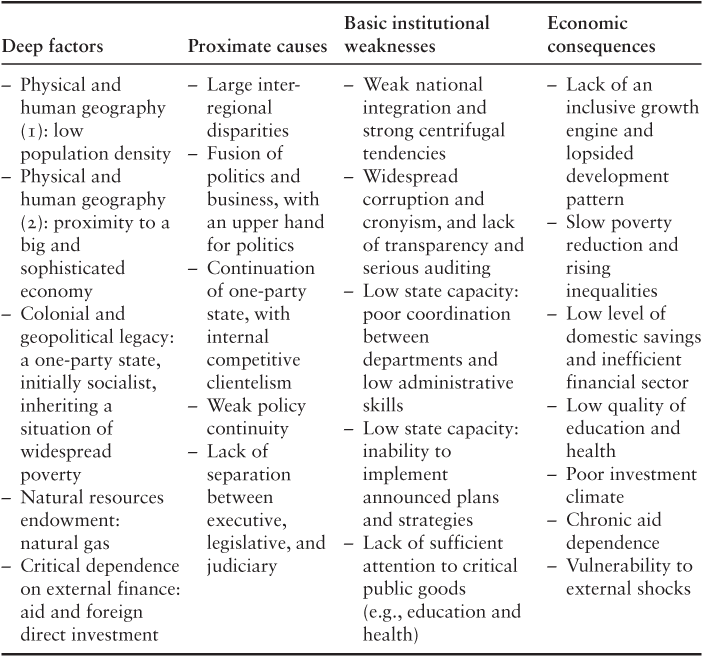
The deep factors, which ultimately account for the key institutional weaknesses detected in Mozambique, can be distilled down to five. The first and second are the binding constraints born of the physical and human geography of the country, consisting of low population density and proximity (on the southern border) to a big and more sophisticated neighbour. The third factor is the legacy coming from the colonial period, and the geopolitical situation of Mozambique. What we have essentially in mind here is the one-party state born of the liberation struggle, the socialist approach to growth and development that it initially took, and the context of Cold War tensions that it had to face. The fourth factor is the presence of rich natural resource endowments, mainly in the form of natural gas reserves, which have been discovered rather recently. And the last factor is the critical dependence of Mozambique on external finance for its continuation and development. Among the sources of external financing, aid occupied pride of place until the discovery of gas resources. From then on, foreign direct investment has assumed growing importance.
The way the chain of causation unfolds from these deep factors to lead to the economic liabilities which we observe today can be seen in the table and directly linked to the preceding discussion. It is nevertheless important to stress that if the proximate causes can be usefully explained in the light of the deep factors, they are not mechanically determined by them. If this were the case, there would be no ground for formulating policy implications as we do in the next and last section. Thus, for example, the adverse effects of low population density on remote areas could have been mitigated if the government had chosen to take steps towards countering them, instead of letting market forces freely operate. This would have allowed the populations inhabiting these areas to benefit from better services like education, health, and agricultural infrastructure and extension. To take another example, the fusion of politics and business in the framework of an overwhelmingly dominant party could have given way to a more genuinely democratic regime if the authorities had chosen to bring more competition into the political arena, instead of confining it to the internal space of Frelimo.
As a last illustration, we can cite the country’s tight dependence on external finance. Here, the government could have decided to be more autonomous vis-à-vis external forces and international organisations and donors if it had chosen to tax its well-to-do people more effectively. Admittedly, such a step would have been difficult to take soon after independence, when Mozambique was in a formation state and in the midst of a nasty war that was not of its own making. At a later stage, however, the emergence of a prosperous group of rich businesspeople, state officials, and middle-class residents of big cities, such as Maputo, opened up the possibility of taxation and income redistribution to the benefit of the rest of the population, and the poor in particular. That this course was not followed can obviously not be blamed on deep factors.
F Policy Implications and Recommendations
An important policy implication of the diagnosis proposed is the need to correct the disequalising effects of market forces in the form of growing inter-regional disparities and increasing income inequality. Two lines of reforms spring to mind. First, infrastructural investments aimed at better connecting the poor central and northern parts of the country to its much more prosperous south should become a major plank of any comprehensive development strategy. There is a strong argument for creating a single Ministry of Infrastructure Development, which would be fully dedicated to a task that is presently split over separate ministries, such as Health, Education, Transport and Communications, Agriculture, Public Works, and Energy and Mineral Resources. Such a step would help bring forth a more coherent and unified approach to infrastructure development.
Second, a core element of any growth strategy should be the active support of small- and medium-scale agriculture and agro-processing activities in areas where land is of a sufficient quality. Moreover, special attention ought to be paid to the central and southern parts of the country, where such lands exist, so that both inter-regional and personal income inequalities, as well as poverty, are simultaneously reduced. To be effective, this strategic orientation requires the reinforcement of the institutions in charge of the delivery of agriculture services, including irrigation, credit, training, supply of modern inputs, and marketing outlets, of the support for the development of appropriate technologies used in the processing of agricultural products, and of the dissemination of more efficient storage and distribution technologies.
In terms of infrastructure, priority should be awarded to the construction and maintenance of farm-to-market and feeder roads, which are presently underdeveloped. Regarding credit to smallholders, the creation of a lower-risk agricultural bank, such as is found in many developing and developed countries, must be seriously contemplated. Loan guarantees are a pivotal issue here, and it is therefore essential to analyse it carefully. In particular, are the possession rights of Mozambican farmers sufficient to enable them to use their land as collateral to obtain credit? If not, is there any conceivable alternative collateral, such as standing crops, that could avoid the costly step of formalised land titles? Regarding agro-processing, focus must be on the transformation of products, such as fruits and vegetables (baby corn, green beans, citrus fruits, bananas, and mangos), cereals (maize and related products, sesame), and cut flowers.
All of the above requirements will not be met unless competent national and regional agencies for project identification and appraisal are put in place and receive the support of local bodies and NGOs with experience of grassroots development elsewhere in Africa. In this regard, two remarks deserve to be made. To begin with, it is important that public resources are not allocated based on a mechanical fixed-rates criterion. In Mozambique, debates about the budget shares to be allocated to different sectors are often reduced to references to various international declarations, such as the 2003 Maputo Declaration and the 2014 Malabo Declaration. According to these declarations, 10 pre cent of the total state budget should be allocated to agriculture (it was 5.7 per cent in 2018). Instead, the allocation of the budget should be based on explicit socioeconomic criteria and the ensuing analysis should demonstrate the ability to achieve targeted outcomes in line with established policy goals. This is a complex exercise since expenditures in education, health, energy, roads, bridges, transportation, communications, rural commercialisation, and many other sectors all interact with, and impact on, agriculture. For instance, the promotion of tourism and agro-tourism, the production of electricity from hydropower and natural gas plants, as well as transportation services, are activities that could easily be expanded in the wake of, or concomitantly with, agricultural growth. Finally, in a longer-term perspective, and given the risks of climate change for agricultural production, it is imperative to develop clear adaptation strategies and technologies that are environmentally friendly and resilient to climate shocks.
The second remark is related to the necessity to avoid a top-down approach. Effective development of smallholder agriculture will not be achieved unless rural communities are involved in more than perfunctory ways. More concretely, they should not only be consulted by specialised agencies in charge of agricultural development, they ought also to be key actors in the establishment and operation of local institutions intended to solve their most pressing problems, such as how to store and dispose of their harvests most profitably, how to ensure proper maintenance of local public goods (e.g., roads, irrigation and draining facilities, collective granaries), how to secure supplies of critical inputs, how to organise training in such a way that it does not disrupt their ordinary activities, and so on. It is at this low but essential level that the contribution of NGOs can prove most useful.
Besides the need to correct for growing inequalities, it is hard to see how the country’s development potential could be better mobilised in the absence of serious measures aimed at combatting the most egregious dysfunction of the prevailing political system. This is the most difficult task and, obviously, it cannot be tackled upfront because any direct reforming attempt is certain to arouse the stubborn resistance of the entrenched ruling elite, whose interests would be unavoidably harmed. This said, even though it will be difficult to break the link between politics and business, the hope of mitigating its worst effects must be actively entertained. Below, we suggest some measures in this direction.
The effective separation of the executive, judicial, and legislative powers is an objective that should not be lost sight of. Limiting our attention to the judiciary, an important first step would be to create an additional post of president of the judiciary. Instead of being appointed by the president of the republic, the president of the judiciary should be elected by all judges, whose votes would have equal weight, so that no one would have special voting powers. He or she would be barred from fulfilling the standard jurisdictional function of the courts, and his or her mandate would be of limited duration (four to five years) and would not coincide with the years of presidential and parliamentary elections. A body for oversight and control could be elected for the same period as the president of the judicial power. Composed of judges acting collectively to approve the way the budget of the justice department is allocated and to manage complaints, its members would represent, in due proportions, different areas or courts, but not different categories of judge. Following this recommendation, the president of the Supreme Court would keep the position of primus inter pares but would not represent the judicial power.
As much as possible, laws should be enacted that prevent the use of public funds or resources for campaigning purposes. The best way to ensure proper law enforcement is to guarantee the freedom of the press and its right to exert pressure on the government and other public agencies for maximum transparency and accountability. This should also apply to other forms of regulation and contracts, in particular those that involve large sums of money. In this respect, it is advisable to establish a public company charged with the task of exploiting and extracting hydrocarbons on a large scale and in the general interest of the population. A competitive and transparent policy in line with best international practices should be developed to hire managers, engineers, and other professionals. Also, the public company should be managed in an autonomous manner, implying that it should be immune to any direct political interference. It should be supervised by an administrative board, which in turn operates under a transparent management system. The participation of new international companies competing in the exploration and production of hydrocarbons should be kept open.
Genuine decentralisation must be pursued on the basis of the approval by the parliament (April 2019) of three bills providing for the election of provincial governments and assemblies, and the creation of a secretary of state for each province. Since the stated goal of these initiatives is to further democratise and empower local levels, it is critical that these reforms do not end up in a situation where the position of provincial state secretary offsets the political power of provincial governors (who are locally elected).
Given the pivotal role of human capital accumulation for long-term development, efforts to improve education quality must not be spared. The present state of affairs is unsatisfactory, in part because pupils and students are too often allowed to graduate at higher levels while they do not actually satisfy the minimum standards officially required. Class and teacher attendance needs to be tightly monitored and mechanisms need to be created to allow for the denunciation of attempts to buy certificates. Mutatis mutandis, the same principles apply to the health sector where, in addition, the Ministry of Health (a normative and regulatory body) ought to be separated from the National Health Service (the implementing agency) to avoid evident conflicts of interest.
Our last point concerns the dependence of Mozambique on foreign aid. What we wish to stress is that the government must be able to assess and address the concerns of donors while taking into account the general interests of the country. This implies that it has the capacity to balance the conflicting interests of different foreign countries (as different as China and the USA) against Mozambique’s long-term goals. The possibility must therefore be accepted that aid offers are rejected when they are not in line with national policy and plans. This has concrete implications. In particular, the Foreign Service should be strengthened so that all aspects of foreign policy can be brought to bear on relations with foreign countries. Furthermore, transparent rules of the game based on clear and objective criteria must be laid down for all foreign investments (public and private), and they should be duly implemented. Such measures will not achieve their purpose if there is no strong interface, chaired by the prime minister, between key coordinating ministries and sector ministries, such as the Ministry of Industry and Trade, the Ministry of Energy and Mineral Resources, and the Ministry of Agriculture and Rural Development.


 Open access