

LEARNING TO SURVIVE IN A PREHISTORIC LANDSCAPE
Released in 2019 for Microsoft Windows, PlayStation 4, and Xbox One, Ancestors: A Humankind Odyssey was developed by Montreal-based Panache Digital Games. The cofounder and creative director of Panache, Patrice Désilets, was inspired to develop a game based in the deeper evolutionary past rather than the popular motif of “10,000 BC” that has “cavemen” running around with torches and killing mammoths in the Ice Age permafrost (Kelly Reference Kelly2019). Désilets and his team started off by researching human evolution and then continued to read up on the topic throughout the development process (Patrice Désilets and Marc-André De Blois, personal communication 2021). The result was a single-player, third-person adventure game set in a generic African landscape (consisting of ecosystems such as tropical rainforest, savanna, and coastline) and beginning around 10 million years ago. At the start, the player takes control of a quadrupedal ape meant to resemble the last common ancestor of humans and chimpanzees.
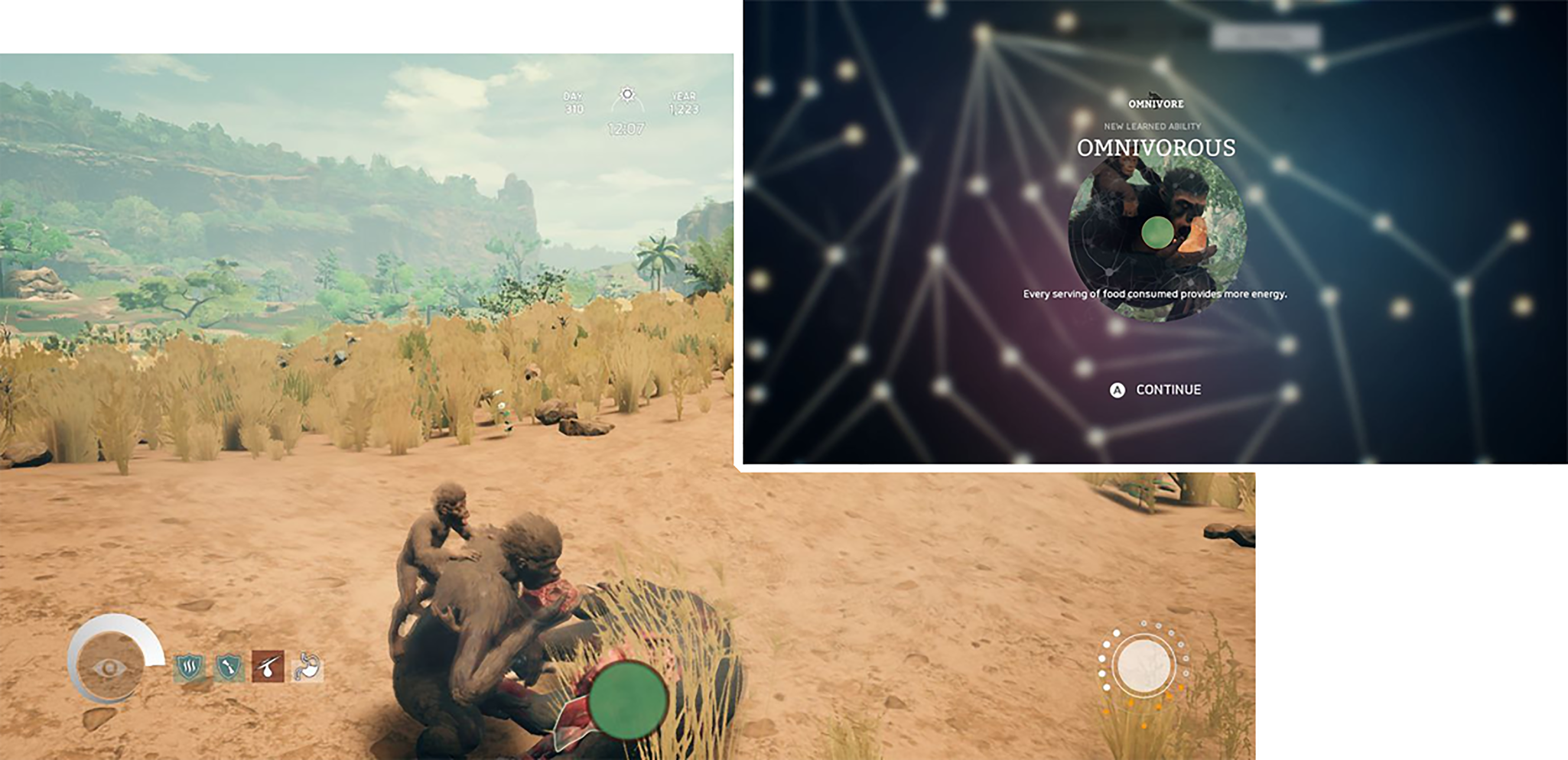
At any one time, the player is in control of an individual “hominid” and can opt to switch to another hominid in the social group or use vocalizations to instruct other clan members (e.g., “follow me” and mimicry commands). As the hominid, the player can engage in behaviors such as walking upright, fashioning tools from different materials, and finding sustenance. Repetition of these behaviors causes the accumulation of “neuronal energy” that the player can use to unlock improved abilities and new behavioral traits (Figure 1). Additional bonuses are gained by completing “Evolution Feats,” which include locating specific landmarks or accomplishing certain evolutionarily significant behaviors, such as killing other animals or those behaviors mentioned above. These Evolution Feats and the production of offspring (especially those with advantageous mutations) allow the player to advance to the next generation or the next stage of evolution. As one advances, the player consequently takes control of the offspring and descendants of the original hominid clan, whereas the previous generations either age past reproductive viability or simply die off. The game ends with a final “Evolution Leap” at around two million years ago with the advent of Homo ergaster—which can be achieved in around 30 or so hours of gameplay.
Unlocking an evolutionarily relevant trait (omnivory). Top right: in the ”Neuronal” menu, the player can use ”neuronal energy” to unlock improved traits related to perception, dexterity, and omnivory, among others. Here, the final ”Omnivorous” trait is unlocked, allowing hominids to eat any food source. Bottom left: the Omnivorous trait enables the digestion of ”mammal protein,” such as from this saber-toothed carcass. (Ancestors: The Humankind Odyssey, 2019. Screenshots by the author.)
All of the player's progress, however, can easily be lost if the members of their clan die—meaning that the principal goal of the game is survival. Among other things, the player is responsible for maintaining the basic needs of hunger, thirst, and sleep of the hominids in their clan. This includes figuring out what resources are nutritious for the hominids, given that certain foods—such as mushrooms—are initially poisonous and require “neuronal” unlocks to be digestible. The biggest struggle that the player confronts in the virtual ecosystem, though, is avoiding predation. There are many creatures that are capable of killing the hominids, including eagles (there is some pretty obvious inspiration from the Taung Child; Berger Reference Berger2006), saber-toothed cats, and elephants. After a while, the hominids are capable of not just dodging attacks but also fighting back. Each hunting sequence is an endeavor that requires hand-eye coordination and the mashing of the right sequence of buttons in a very short, unforgiving time span (and is predicated upon having suitable tools in hand). By denying the player the immediate gratification of being able to kill everything around them, this game avoids being a power fantasy as is the case with other prehistory-themed games (e.g., Far Cry Primal; Ubisoft Montreal Reference Montreal2016).
Normally, video games provide players with instructions on how to make use of the mechanics in the game, but the developers of Ancestors opted against including any sort of tutorial (Patrice Désilets and Marc-André De Blois, personal communication 2021; Klepek Reference Klepek2019). Essentially, players learn how to survive by a trial-and-error approach to the various social interactions, cross-species encounters, and tool use opportunities that are available in the game environment. For example, if the player's hominid has been injured and is bleeding from an attack by a saber-toothed cat, the game does not give instructions on how to heal the wound but instead leaves it to the player to discover that specific plant materials can be applied to stop the bleeding.
Behavioral innovations are restricted to those that the developers determined were attainable by hominins during the indicated time periods (Patrice Désilets and Marc-André De Blois, personal communication 2021; Radford-Burns Reference Radford-Burns2019). This means that new behaviors cannot be invented from scratch, and the utility of objects and social interactions are restricted to a specific set of options (e.g., basalt can only be modified using other chunks of stone). The innovations that can be made and the efficiency of tool use behaviors are also limited by how many “neuronal” traits have already been unlocked. In this way—and as a purely unintentional consequence of the game's design (Patrice Désilets and Marc-André De Blois, personal communication 2021)—players are limited to predetermined solutions afforded by the game engine and mechanics (Figure 2), in the same way that some scholars hypothesize that early hominins might have been restricted in their capacities to learn and innovate by their genetics and environment (Tennie et al. Reference Tennie, Braun, Premo, McPherron, Haidle, Conard and Bolus2016, Reference Tennie, Premo, Braun and McPherron2017). They are limited, that is, unless they take a shortcut and simply consult an online guide that provides all the secrets to accomplishing the in-game goals (e.g., Ancestors: The Humankind Odyssey Wiki 2021).
Stone toolmaking behavior in silico. Only certain combinations of objects can be manipulated to initiate “Alteration” sequences. Here, a granite hammerstone is being used to modify obsidian, the result of which is an “Obsidian scraper.” The scraper can then be used to turn branches into sharpened sticks for hunting or to butcher carcasses (hunted by the player or stolen from other predators). (Ancestors: The Humankind Odyssey, 2019. Screenshot by the author.)

(IN)ACCURACIES
When discussing accuracy and inaccuracy in this video game's portrayal of paleoanthropological content, it is first necessary to point out the following disclaimer: the aim of game developers is to create something entertaining and commercially viable, and not strictly educational (Patrice Désilets and Marc-André De Blois, personal communication 2021). If the game should happen to have educational properties, this is only a secondary benefit that complements but does not detract from that primary goal. The team from Panache explicitly wanted something inspired by the reality of prehistory, but Désilets was very clear in saying their aim was not to teach the facts of human evolution. By necessity, game developers must also work within a set budget, which means that game mechanics and content are also a result of what is affordable to produce. For a game to be tediously accurate in its simulation of human evolution, it would most probably fall short on the fun meter and would also require quite the financial backing.
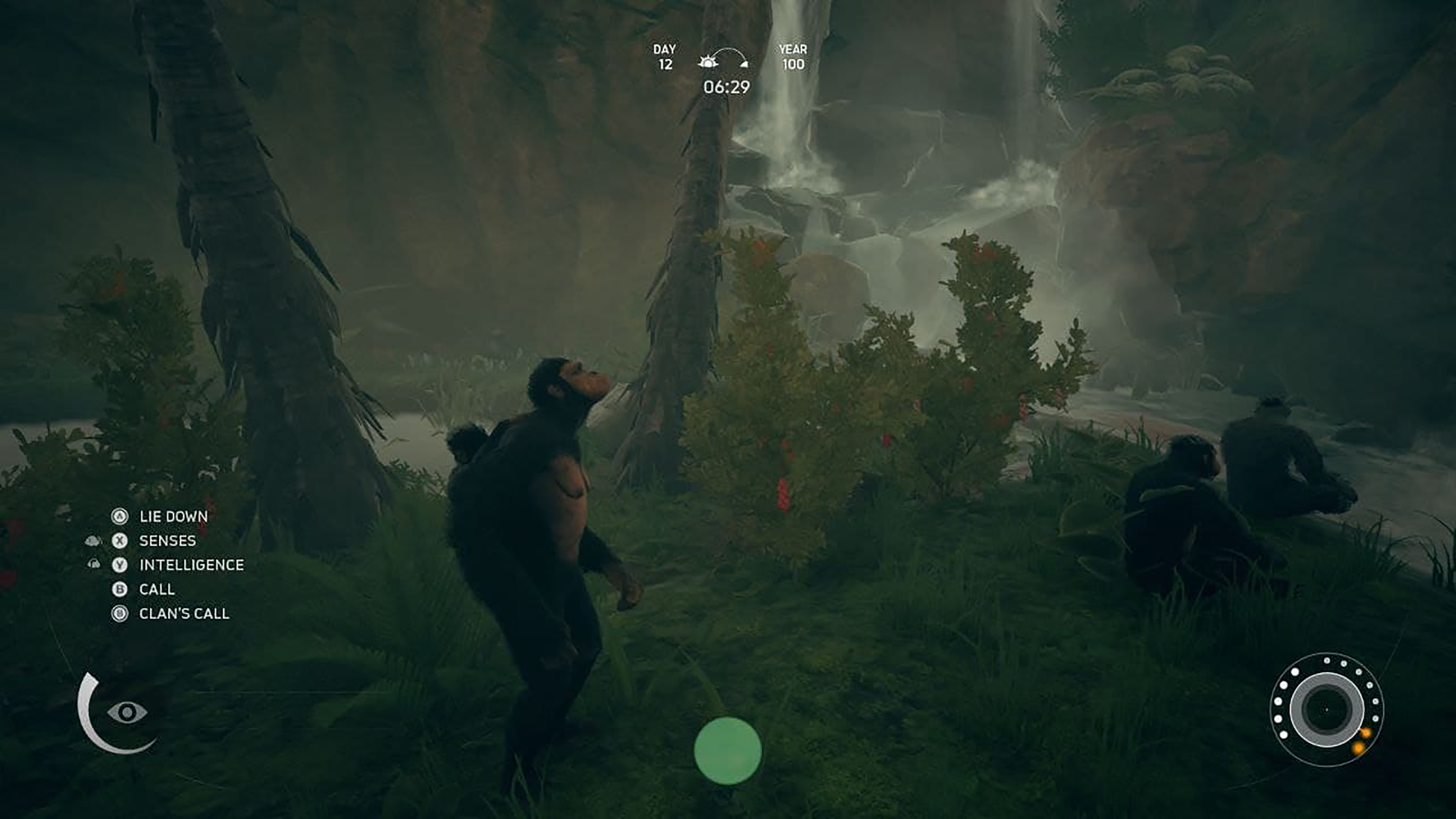
It comes through quite clearly that the developers did indeed do their research and made considerable effort to be faithful to the science (a point that they have been very keen to emphasize and that they also underlined in my interview with them; Patrice Désilets and Marc-André De Blois, personal communication 2021). I—being a researcher as well as a gamer—noticed certain creative liberties and anachronisms over the course of my playthrough (e.g., giant centipedes and the ability to instigate conflict between different species of dangerous animals), but very few of these more questionable features really detracted from my enjoyment of the gameplay and the general atmosphere created therein (Figure 3).
Living among clanmates. At night, the player can rest their hominids at an oasis, where they are generally safe from predation. Then, when dawn comes around, the player can embark on new expeditions, whether alone, with babies riding piggyback (which boosts the rate of neuronal energy accumulation) or with additional clan members following behind the lead hominid. (Ancestors: The Humankind Odyssey, 2019. Screenshot by the author.)
The portrayal of evolution on the macroscale has previously been criticized for including the inheritance of acquired traits (Aron Reference Aron2020), but I would contend that this game effectively represents gene-culture coevolution (in the sense that cultural behaviors and genetics are part of a positive feedback loop; Boyd and Richerson Reference Boyd and Richerson1985; Cavalli-Sforza and Feldman Reference Cavalli-Sforza and Feldman1981). What is more problematic is the rather linear nature of evolutionary development in the game (Figure 4). At first glance, the division of human evolution into successive stages of the “Missing Link,” Sahelanthropus tchadensis, Orrorin tugenensis, Ardipithecus ramidus, Australopithecus afarensis, Australopithecus africanus, and Homo ergaster (all species specifically named in the game and also labeled according to specific discoveries such as “Toumaï” and “Lucy”) would seem to reiterate the long outdated and much maligned “March of Progress” (e.g., Switek Reference Switek2010). Nowadays, we are aware of the coexistence of multiple hominin species throughout prehistory and a branching hominin family tree with several dead-end lineages (e.g., White Reference White, Sepkoski and Ruse2009). Indeed, the developers were also made aware of these facts during their research preparations (Patrice Désilets and Marc-André De Blois, personal communication 2021).
Progressing through human evolution. The in-game “Evolution” menu shows the player what progress they have achieved, including the total player time, births and deaths (in the current clan), and evolution feats. Once a player achieves over 75% of the game's evolution feats, the player can trigger the final “Evolution Leap,” thereby ending the game (unfortunately, Homo ergaster is not playable). (Ancestors: The Humankind Odyssey, 2019. Screenshot by the author.)

They could not, unfortunately, implement cross-species coexistence in Ancestors (at least, for the time being) because the limitations of the game engine meant that the total population of hominins that could inhabit the environment was limited and therefore the number of clans (and by extension, living species) was also restricted to one (Patrice Désilets and Marc-André De Blois, personal communication 2021). Giving the players the choice to branch off and follow different lineages was also left out because this would potentially negatively impact many players’ enjoyment of the game: just imagine you are a nonanthropologist who sits down to play Ancestors; you make a series of gameplay choices that lead you down the path to becoming Paranthropus robustus; and then, at some point, the game decides for you that your lineage goes extinct, and you are not given the satisfaction of completing the game. The alternative would be to have branching lineages that do not die off, but then the game would no longer be a representation of evolution as it happened. Instead, it would go off in the direction of speculative evolution and science fiction. The balance of realism and user enjoyment is therefore an unavoidable series of compromises that the developers are forced to make.
In discussing the game with its developers, I came to realize that the choices I made were a big contributor to my interpretation of it as linear. As a researcher in the field of human origins, I brought with me a certain model for how and when certain traits evolved in our lineage and matched my gameplay behavior to these expectations. In actuality, the game is designed so that the progression along the evolutionary timeline is based on the percentage of feats and not the specific traits that are acquired (e.g., one can even play through the entire game without developing bipedality, as Marc-André De Blois has done; Patrice Désilets and Marc-André De Blois, personal communication 2021). In this sense, the game can be used to simulate competing versions of the hominin story, such as stone tool production before the earliest known Oldowan (Harmand et al. Reference Harmand, Lewis, Feibel, Lepre, Prat, Lenoble and Boës2015; Panger et al. Reference Panger, Brooks, Richmond and Wood2002; Shea Reference Shea2017) or the contentious bipedality of Sahelanthropus (Brunet et al. Reference Brunet, Guy, Pilbeam, Mackaye, Likius, Ahounta and Beauvilain2002; Wolpoff et al. Reference Wolpoff, Senut, Pickford and Hawks2002).
VIDEO GAMES AS COMMUNITY OUTREACH
Few if any of the observations and critiques that I have mentioned above are likely to have made an impression on the average gamer who tried (and predictably struggled) to work their way through this game. The value of the game from the perspective of the developers is not to educate anyone about the very fine details of fossil discoveries and theoretical debates that exist in academic anthropology, nor should it be measured on such a scale by anthropologists. Instead, it would be better to look at the game's value from a different perspective.
At this point in time, Ancestors has sold over one million copies (Panache Digital Games 2021), and chances are, very few ended up in the hands of researchers. In my view, this is where Ancestors is most meaningful for academics: public engagement and community outreach. For someone training to be an archaeologist, a lecture at a university would conceivably be more suitable. But for the average person, such educational opportunities are pretty rare. By capturing their imagination and encouraging at least some gamers to engage more deeply with paleoanthropology (Patrice Désilets and Marc-André De Blois, personal communication 2021), Ancestors has therefore played a positive role in science communication, in the sense of being a gateway to self-directed learning. Some of the remarkable fan reactions to the game, as described by the developers (Patrice Désilets and Marc-André De Blois, personal communication 2021), included players with conservative creationist backgrounds who were drawn in to learning about evolution as a result of their playthroughs, and others who expressed a somehow “spiritual” experience as they became more educated about the origins of our species and therefore their own deeper (pre)history.
In an era where many are decrying the culture of exclusivity both within science and between science and the broader public, it is even more pertinent to encourage efforts such as this that draw people's attention and facilitate the start of their educational journeys. The question is, naturally, What is the role of the average archaeologist in all of this? The first and simplest step is openness to new media, as opposed to an attitude toward popular culture that is lined with contempt or cynicism due to less-than-accurate portrayals of archaeology in the past. Other options include recommending media such as Ancestors by word of mouth or by social media to help build a more positive and flexible relationship between academics and nonacademics (and in both directions). It would be a suitable recommendation, for instance, to schoolchildren or young adults, given that more scientists are participating in outreach programs (e.g., Letters to a Pre-Scientist 2021). Games could be the inspiration for young people to become the next generation of archaeologists and anthropologists that films, television, and books were in the recent past (Emery and Reinhard Reference Emery and Reinhard2016). Providing constructive feedback directly to the developers, whether in reviews such as this or even reaction videos on YouTube (e.g., Gamology 2020), would also serve to encourage the creation of additional entertaining yet educational media products. And finally, expanding existing consulting programs and establishing new programs (or at least, advertising more openly that we archaeologists are open to it) to engage with companies such as developers more directly while they are making games would be the most hands-on way of synergizing the concerns and goals of both parties.
Ultimately, Ancestors informs more than it misinforms, and it has reached an audience of gamers who might have otherwise been uninterested and disconnected from the topic of human evolution. And it is a pretty good diversion for academics as well!
Acknowledgments
I would like to thank Patrick Cuthbertson and Jordy Orellana Figueroa for their assistance. I also want to thank Digital Reviews Editor Peter J. Cobb for giving me the opportunity to write and present this review. And above all, I would like to give my appreciation to the game developers, Patrice Désilets and Marc-André De Blois, for agreeing to meet with me and giving me a window into the making of Ancestors.



