

Introduction
Smallholder farmers in developing economies supply a substantial share of the world’s food and are central to the functioning of agri-food value chains (AFVC), yet many operate with limited access to technology, finance, information, and markets, and face growing pressure to comply with increasingly stringent quality, safety, and sustainability requirements (Bhatti et al., Reference Bhatti, Godfrey, Ip, Kachiwala, Hovdhaugen, Banda and Eik2021; Wang, Huan, Li & Dai, Reference Wang, Huan, Li and Dai2023; Zuza et al., Reference Zuza, Tholo, Chipeta, Emmott, Achi and Zingore2025). These pressures are especially acute in low- and middle-income countries where smallholders’ livelihoods, food security, and environmental resilience are tightly coupled (Aniagyei, Bakang, Tham-Agyekum, Arhin & Asiedu, Reference Aniagyei, Bakang, Tham-Agyekum, Arhin and Asiedu2024; Yitayew, Abdulai, Yigezu, Deneke & Kassie, Reference Yitayew, Abdulai, Yigezu, Deneke and Kassie2021). Meeting such demands requires not only incremental improvements in farming practices, but deliberate efforts to build farmers’ capabilities so that they can act as reliable and resilient suppliers in increasingly demanding supply chains (SC). This resonates with broader debates on sustainable and responsible management in agri-food settings and cooperative organisations, including recent contributions in the Journal of Management & Organization (JMO) (Callagher & Garnevska, Reference Callagher and Garnevska2025).
In response, a wide range of ‘farmer development’ programmes have emerged. Governments, non-governmental organisations (NGOs), donors, and private agri-food firms have all invested in interventions such as farmer field schools, extension services, training programmes, input support, credit schemes, and contract farming arrangements (Imam et al., Reference Imam, Wan, Khan, Raza, Khan and Yaseen2021; Ladele & Kuponiyi, Reference Ladele and Kuponiyi2006; Maffioli, Ubfal, Baré & Cerdán-Infantes, Reference Maffioli, Ubfal, Baré and Cerdán-Infantes2011; Savran, Demiryürek, Özçatalbaş, Akin & Boz, Reference Savran, Demiryürek, Özçatalbaş, Akin and Boz2011; Shibanda, Reference Shibanda1991; Van Niekerk, Stroebel, Van Rooyen, Whitfield & Swanepoel, Reference Van Niekerk, Stroebel, Van Rooyen, Whitfield and Swanepoel2011; Zossou, Van Mele, Wanvoeke & Lebailly, Reference Zossou, Van Mele, Wanvoeke and Lebailly2012). While these initiatives share an underlying logic of strengthening farmers’ ability to participate in markets, they are dispersed across disciplinary silos – agricultural extension, rural development, value chain development, and development economics – and are rarely framed explicitly as a question of SC capability building (Bhatti et al., Reference Bhatti, Godfrey, Ip, Kachiwala, Hovdhaugen, Banda and Eik2021; Zuza et al., Reference Zuza, Tholo, Chipeta, Emmott, Achi and Zingore2025).
In this paper, the term ‘developing economies’ is used pragmatically to refer to low- and middle-income countries in Africa, Asia, and Latin America (e.g., Ghana, Zimbabwe, Malawi, China, Pakistan, Ethiopia, Turkey, Benin, Argentina, South Africa, Nigeria, and Kenya), as reflected in the empirical studies included in this review (Aniagyei et al., Reference Aniagyei, Bakang, Tham-Agyekum, Arhin and Asiedu2024; Bhatti et al., Reference Bhatti, Godfrey, Ip, Kachiwala, Hovdhaugen, Banda and Eik2021; Imam et al., Reference Imam, Wan, Khan, Raza, Khan and Yaseen2021; Maffioli et al., Reference Maffioli, Ubfal, Baré and Cerdán-Infantes2011; Wang et al., Reference Wang, Huan, Li and Dai2023; Yitayew et al., Reference Yitayew, Abdulai, Yigezu, Deneke and Kassie2021; Zuza et al., Reference Zuza, Tholo, Chipeta, Emmott, Achi and Zingore2025). The focus is on smallholder farmers, family-based producers operating on relatively small landholdings with constrained access to capital, technology, and formal markets who supply to AFVCs. Accordingly, we exclude studies centred on large commercial estates or plantations, as well as research conducted in high-income country contexts, where farm structure, institutional support, and SC governance differ substantially from the smallholder, developing economy settings that are the concern of this review.
At the same time, the supply chain management (SCM) and operations literature on supplier development (SD) have traditionally focused on manufacturing suppliers in more industrialised settings, emphasising how buying firms use training, technical support, financial assistance, and closer collaboration to improve supplier performance and capabilities (e.g., Krause, Handfield & Scannell, Reference Krause, Handfield and Scannell1998). More recent work on sustainable SCs stresses the need to integrate triple bottom line (TBL) considerations into supplier management and capability building, highlighting economic, social, and environmental performance as joint objectives rather than trade-offs (Pagell & Wu, Reference Pagell and Wu2009; Seuring & Müller, Reference Seuring and Müller2008). However, smallholder farmers in developing economies seldom feature in this literature, even though they represent a large and vulnerable supplier base and are frequently the target of development interventions by both public and private actors (Aniagyei et al., Reference Aniagyei, Bakang, Tham-Agyekum, Arhin and Asiedu2024; Ladele & Kuponiyi, Reference Ladele and Kuponiyi2006; Yitayew et al., Reference Yitayew, Abdulai, Yigezu, Deneke and Kassie2021). Recent work in JMO has highlighted the importance of understanding how agri-food organisations articulate and pursue sustainable development goals, including in member-owned forms such as co-operatives (Callagher & Garnevska, Reference Callagher and Garnevska2025). JMO’s 30th-year birthday perspective also calls for systematic reviews that consolidate existing knowledge and identify future research directions across management domains, including sustainability and SCs (Ratten, Reference Ratten2025).
Despite these parallel streams of work, there is currently no systematic synthesis that brings together empirical evidence on farmer development programmes through an SD lens. Existing reviews in agricultural extension and rural development tend to focus on particular modalities or commodities, while reviews in SCM and sustainable SD concentrate on manufacturing suppliers and tier-1 relationships in industrialised settings (Seuring & Gold, Reference Seuring and Gold2012; Seuring & Müller, Reference Seuring and Müller2008; Snyder, Reference Snyder2019). This leaves a theoretical and empirical gap at the intersection of farmer development, SD, and sustainable SCM in developing economies. By explicitly conceptualising farmer development as SD at the farm gate and systematically reviewing empirical studies that report implemented initiatives and farmer-level outcomes, this paper addresses that gap and extends SD debates into smallholder agri-food contexts.
This disconnect leaves several important questions unanswered. First, who actually develops smallholder farmers in developing economies: are capabilities primarily built by public extension services and NGOs, or do private buyers (such as processors and exporters) play a systematic role (Imam et al., Reference Imam, Wan, Khan, Raza, Khan and Yaseen2021; Mukucha & Chari, Reference Mukucha and Chari2021, Reference Mukucha and Chari2024)? Second, what types of capability-building initiatives are implemented in practice, and how are they combined into development ‘portfolios’ (Ladele & Kuponiyi, Reference Ladele and Kuponiyi2006; Maffioli et al., Reference Maffioli, Ubfal, Baré and Cerdán-Infantes2011; Zossou et al., Reference Zossou, Van Mele, Wanvoeke and Lebailly2012)? Third, which farmer performance outcomes are targeted and measured, and to what extent do existing programmes explicitly address farmers’ TBL outcomes rather than focusing narrowly on yields or incomes (Bhatti et al., Reference Bhatti, Godfrey, Ip, Kachiwala, Hovdhaugen, Banda and Eik2021; Wang et al., Reference Wang, Huan, Li and Dai2023; Zuza et al., Reference Zuza, Tholo, Chipeta, Emmott, Achi and Zingore2025)?
Overall, this study asks: How are smallholder farmers’ capabilities in developing economy AFVCs built, by whom, through which initiatives, and with what TBL outcomes? To operationalise the overarching question, this review is guided by four research questions (RQ): RQ1: Who are the main providers of farmer development for smallholder farmers in developing economies (e.g., public extension services, NGOs, private buyers, mixed arrangements)?, RQ2: What types of capability-building initiatives do these providers implement, individually, or in combination (e.g., training, extension, input support, credit, contract farming, technology transfer)?, RQ3: What farmer performance outcomes are targeted and measured in these initiatives (e.g., yield, quality, income, productivity, capability, relational outcomes)?, RQ4: To what extent, and in what ways, do existing farmer development initiatives explicitly address farmers’ TBL outcomes? Accordingly, the paper conducts a systematic literature review of empirical studies on farmer development initiatives in developing economy agri-food contexts. Drawing on a structured search, 15 eligible studies were identified. In doing so, the paper conceptualises farmer development as a form of SD and positions smallholder capability building explicitly within the domain of SCM and sustainable operations.
The paper makes three main contributions. First, it provides an integrated map of the actors that build smallholder farmers’ capabilities in developing economies, highlighting the dominance of public and NGO-led programmes and the relative scarcity of buyer-led initiatives (Aniagyei et al., Reference Aniagyei, Bakang, Tham-Agyekum, Arhin and Asiedu2024; Imam et al., Reference Imam, Wan, Khan, Raza, Khan and Yaseen2021; Mukucha & Chari, Reference Mukucha and Chari2021, Reference Mukucha and Chari2024). Second, it synthesises the repertoire of farmer development practices and associated performance outcomes, showing how economic metrics overshadow social and environmental dimensions across a range of AFVC contexts (Bhatti et al., Reference Bhatti, Godfrey, Ip, Kachiwala, Hovdhaugen, Banda and Eik2021; Wang et al., Reference Wang, Huan, Li and Dai2023; Yitayew et al., Reference Yitayew, Abdulai, Yigezu, Deneke and Kassie2021; Zuza et al., Reference Zuza, Tholo, Chipeta, Emmott, Achi and Zingore2025). Third, it develops a research agenda for buyer-led, TBL-oriented capability building in developing economy AFVCs, aligning farmer development more closely with contemporary debates on SC capability building and sustainable performance, and contributing to ongoing conversations in JMO about management and organisation in diverse regional and sectoral contexts (Callagher & Garnevska, Reference Callagher and Garnevska2025; Ratten, Reference Callagher and Garnevska2025).
The remainder of the paper is structured as follows. Methodology describes the systematic review design, including the search strategy, screening criteria, and data extraction and synthesis procedures. Findings present the review findings in terms of providers, initiatives, outcomes, and TBL coverage. Discussion addresses the implications for theory and practice and outlines a research agenda, and Conclusion highlights by emphasising smallholder capability building as both a development imperative and a strategic SC task.
Methodology
Review design
This study follows established guidance on systematic literature reviews in management and organisation studies (Snyder, Reference Snyder2019; Tranfield, Denyer & Smart, Reference Tranfield, Denyer and Smart2003) and uses the Preferred Reporting Items for Systematic Reviews and Meta-Analyses (PRISMA) 2020 framework to structure and report the identification, screening, and inclusion of studies (Page et al., Reference Page, McKenzie, Bossuyt, Boutron, Hoffmann, Mulrow and Moher2021). The review is explicitly guided by the four RQs set out in the introduction, focusing on (1) who develops smallholder farmers, (2) what capability-building initiatives they implement, (3) which farmer performance outcomes are targeted and measured, and (4) how far these initiatives address farmers’ TBL outcomes. A PRISMA-style flow diagram in Fig. 1 summarises the identification and selection of studies for the study.
PRISMA 2020 flow diagram of study identification and selection for the farmer capability building review (adapted from Page et al., Reference Page, McKenzie, Bossuyt, Boutron, Hoffmann, Mulrow and Moher2021).

Data sources and search strategy
In addition to the article database Scopus, the literature search was conducted using a multidisciplinary academic library discovery platform based on the EBSCO Information Service (EBSCO) (branded as ‘Discover’ by the authors’ institution). The latter platform provides a unified search interface that indexes and retrieves bibliographic records from multiple major academic databases, including Web of Science, Scopus, and other subject-specific databases, subject to institutional subscriptions. This approach enabled comprehensive and multidisciplinary coverage while applying a single, transparent search strategy across all indexed sources. The article database Web of Science was not searched separately because preliminary scoping suggested that, for this topic, it indexed fewer developing-economy and agri-food journals than the combination of EBSCO Discovery Service and Scopus. The search aimed to capture empirical work on farmer development in developing countries over approximately the last four decades and covered publications between 1983 and 2025.
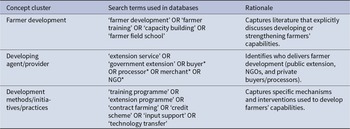
Table 1 summarises the concept clusters, specific search terms, and their rationale. The search strategy combined three clusters of terms: farmer development, developing agent/provider and development methods/initiatives/practices. Within each cluster, conceptually similar terms were linked with the Boolean operator OR. The three clusters were then combined with AND to retrieve studies that simultaneously (a) addressed the development of farmers, (b) identified the actor(s) delivering the development support and (c) described specific farmer development initiatives or practices. The phrases ‘developing countries’ or ‘low-income countries’ were not added as mandatory search terms. However, all records retrieved and retained for this review report empirical work conducted in developing economy contexts. Table 2 outlines the Boolean structure used to combine these terms across databases. The full generic Boolean search string is also reported in Table 2.
Concept clusters, search terms and rationale

Boolean structure of database search

Th literature search was conducted in 2025 and limited to peer-reviewed journal articles published in English between 1983 and 2025, in line with the aim of capturing approximately four decades of farmer development initiatives in developing economy AFVCs. Search results from each database were exported and combined, and duplicate records were removed manually. This process yielded 41 unique records for screening. The subsequent screening and inclusion process is described in Screening and eligibility criteria and summarised in the PRISMA flow diagram (Fig. 1).
Screening and eligibility criteria
In total, 78 potentially relevant articles were found (Scopus = 37 and EBSCO Discovery Service = 41), and after removing the duplicates, 41 were screened in two stages: Stage 1, title and abstract screening; and Stage 2, full text screening. The Stage 1 search returned a relatively focused set of records, and no articles were excluded at the title or abstract stage (n = 0); all 41 records progressed to full text screening. In Stage 2, the following inclusion criteria were applied: (1) Empirical, peer-reviewed journal article, reporting qualitative, quantitative, or mixed-method research; (2) developing economy setting, defined as a low or middle-income country AFVC context; (3) smallholder farmers as the focal suppliers, rather than large commercial estates or plantations; (4) description of an implemented farmer development initiative or programme, where the study provides sufficient detail on at least one deliberate capability-building intervention (e.g., who implemented it, what was done, how farmers were engaged); and (5) reported or inferable farmer-level performance outcome gains in areas such as yield, product quality, income, productivity, capability building, technology adoption, relational outcomes, social, or environmental practices.
Articles were excluded if they offered only conceptual discussions or general recommendations about farmer training or extension without describing an implemented initiative, if they focused solely on the consumer side or downstream issues, if they examined high-income country contexts or large commercial farms, or if they did not provide any indication of changes in farmer-level outcomes. Applying these criteria yielded 15 eligible studies. The remaining 26 articles (63% of the initial 41) were excluded because they provided only high-level recommendations for farmer training and extension services, described extension systems without linking them to either specific implemented programmes or lacked sufficient farmer-level outcome reporting.
Data extraction and coding
A structured data extraction template was used to ensure consistency across the 15 included studies. For each article, the following information was recorded in a spreadsheet-based coding matrix:
Bibliographic and contextual information – author(s), year of publication, country, or countries of the study, and focal commodity or value chain (where applicable).
Farmer development provider (actor type) – each study was coded according to the primary actor(s) responsible for farmer development, using the following categories: private buyer (e.g., agri-food processor, exporter, merchant), government (e.g., public extension services, state agencies), NGO/non-profit (including donor funded programmes), and mixed or partnership arrangements (e.g., public–private or NGO–private initiatives).
Farmer development initiatives (capability-building mechanisms) – the specific mechanisms and activities employed to develop farmers were extracted and coded, such as training and farmer field schools; extension visits and technical advice; demonstration plots or model farms; provision of input materials and equipment; credit, loans or other financial support; contract farming and guaranteed market arrangements; farmer-to-farmer learning and group-based learning platforms; and technology transfer and support for adoption of improved practices.
Developer–farmer interaction modes – where described the modes through which developers interacted with farmers were coded (e.g., group meetings, field days, farm or home visits, mass media, hotline services, formal contracts).
Farmer performance outcomes – outcomes reported in the studies were extracted and grouped into broad categories, including: production outcomes (yield, product quality, productivity, farm income, cost efficiency); capability-related outcomes (knowledge, skills, adoption of improved practices, managerial capabilities); relational outcomes (trust, commitment, cooperation, strength of relationships with buyers, or support agencies).
TBL coverage – based on the outcome data, each study was assessed for whether economic, social, and environmental dimensions of farmer performance were explicitly measured (e.g., specific environmental indicators, social inclusion measures), implicitly addressed (e.g., discussed narratively but not operationalised) or not addressed.
Coding was undertaken manually and iteratively, allowing categories to be refined as familiarity with the set of studies increased. Ambiguous cases were resolved by re-reading the full text and, where relevant, associated tables or figures to ensure consistent interpretation. This coded matrix formed the basis for the qualitative content analysis and cross-case configurational synthesis described in Synthesis approach (Elo & Kyngäs, Reference Elo and Kyngäs2008; Miles, Huberman & Saldaña, Reference Miles, Huberman and Saldaña2014).
Synthesis approach
Given the heterogeneity of contexts, commodities, actors, and methods across the 15 studies, a configurational, qualitative synthesis approach was adopted rather than attempting formal meta-analysis (Seuring & Gold, Reference Seuring and Gold2012). After full text screening, each article was read in full and coded into a structured matrix capturing provider type, farmer development initiatives, interaction modes, farmer-level outcomes, and coverage of TBL dimensions (see Data extraction and coding). Coding was iterative: initial categories were refined as new patterns emerged, and earlier studies were revisited to ensure consistent application of the final coding scheme. Overall, the synthesis combined qualitative content analysis of the included studies with cross-case comparison.
The synthesis proceeded in three steps: Step 1 – descriptive mapping; Step 2 – comparative analysis of initiatives and outcomes; and Step 3 – assessment of TBL coverage. In Step 1, studies were first mapped descriptively to show the distribution of farmer development providers, countries, and commodities across the sample. This mapping addressed RQ1 by identifying who develops farmers and in which contexts.
In Step 2, studies were grouped by provider type (e.g., government-led, NGO-led, buyer-led, mixed). Within each group, farmer development initiatives and combinations of initiatives were compared, along with their reported farmer performance outcomes. This addressed RQ2 and RQ3 by illuminating typical ‘portfolios’ of capability-building practices and their associated outcomes.
In Step 3, the economic, social, and environmental dimensions of outcomes were examined within and across groups to assess how far existing farmer development initiatives explicitly support farmers’ TBL outcomes (RQ4). Particular attention was given to buyer-led cases, which are conceptually closest to SD as understood in SCM, and thus especially relevant for the special issue focus on capability building in developing economies.
This approach allowed the review to identify patterns in who builds smallholder farmers’ capabilities, how they do so and which aspects of sustainable performance are foregrounded or neglected in current practice.
Findings
Descriptive overview of the included studies
The final sample consists of 15 empirical studies on farmer development in developing economies, spanning 11 countries across Africa, Asia, and Latin America (Table 3). These studies were published between 1991 and 2025, including recent online-first articles.
Overview of included studies on farmer development in developing economies

Across these cases, farmers are typically smallholders involved in crop, livestock, or mixed farming systems. While commodities and value chain structures vary, all studies share a common concern with improving the performance and capabilities of smallholder farmers through organised development initiatives led by one or more external actors. Table 3 provides an overview of the 15 included studies, including country, commodity focus, provider type, and study design.
The relatively small number of included studies reflects the narrow intersection targeted by this review: empirical, peer-reviewed research in developing-economy AFVCs that reports implemented farmer development initiatives and farmer-level outcomes, rather than the broader universe of conceptual, policy, or system-level discussions of extension and rural development.
Providers of farmer development initiatives (RQ1)
This subsection addresses RQ1 (Who are the main providers of farmer development for smallholder farmers in developing economies?). Table 4 summarises the providers of farmer development and the countries covered by the 15 studies. These providers were coded into four categories: private buyers, government, NGOs/NPOs, and mixed/other arrangements.
Farmer development providers and countries in 15 selected articles

NGO, non-governmental organisations; NPO, not-for-profit organisations.
Government-led farmer development dominates the sample. In most cases, public extension services or government agencies design and deliver farmer training, advisory services, and support programmes (e.g., Ladele & Kuponiyi, Reference Ladele and Kuponiyi2006; Savran et al., Reference Savran, Demiryürek, Özçatalbaş, Akin and Boz2011; Van Niekerk et al., Reference Van Niekerk, Stroebel, Van Rooyen, Whitfield and Swanepoel2011; Zuza et al., Reference Zuza, Tholo, Chipeta, Emmott, Achi and Zingore2025). NGOs and other non-profit organisations also play a significant role, often implementing donor-funded rural development projects that combine training, input support and group-based activities (e.g., Bhatti et al., Reference Bhatti, Godfrey, Ip, Kachiwala, Hovdhaugen, Banda and Eik2021; Zossou et al., Reference Zossou, Van Mele, Wanvoeke and Lebailly2012). Mixed or partnership arrangements are evident in several studies, including collaborations between government research institutes, cooperatives, farmer-based organisations, multilateral organisations, and other value chain actors. Only three of the 15 cases explicitly feature private buyers (e.g., merchants or processing firms) as the primary farmer development providers; two of these come from the same authors (Mukucha & Chari, Reference Mukucha and Chari2021, Reference Mukucha and Chari2024), and one from Ladele and Kuponiyi (Reference Ladele and Kuponiyi2006). In the remaining cases, private firms sometimes appear as secondary actors (e.g., as part of ‘other extension providers’) but not as the central organisers of farmer development. Overall, the evidence base on farmer capability building remains heavily skewed towards state and NGO-led programmes, with relatively few documented examples of buyer-led farmer development that align closely with the SD logic in SCM.
Farmer development initiatives and portfolios (RQ2)
This subsection addresses RQ2 (What types of capability-building initiatives do these providers implement, individually or in combination?). Across the 15 studies, farmer development programmes typically bundle multiple initiatives rather than relying on single interventions, as shown in Table 5 and detailed in Appendix 1. Drawing on the overview of studies in Table 5 (the summary of three buyer-led cases), and the detailed programme descriptions in Appendix 1, the main initiative types include:
Farmer development initiatives, developer–farmer interaction and TBL outcomes in buyer-led and hybrid arrangements

Notes: The different colours denote the similarity between the development initiatives in the three cases; the → means “through”.
Training and farmer field schools – general agronomic training (e.g., cultivation, pest and disease control, irrigation, harvesting, farm management). ‘Lead and follow’ models where extension officers train leader farmers, who then train follower farmers. Farmer field schools focused on specific technologies or sustainable practices. Demonstration plots and model farms. Demonstration farms or trials where farmers can observe improved techniques in practice. Extension and advisory services: On-farm visits, home visits, and group meetings between extension officers and farmers. Technical advice on production processes and input use (e.g., water and fertiliser management). Input provision – provision of inputs (seeds, fertiliser, equipment) sometimes on credit or at subsidised prices, and financial support – credit schemes, microfinance, interest-free loans, and other forms of financial support.
Contract farming and guaranteed market arrangements – contract farming agreements, often bundled with training, inputs, credit, and guaranteed prices/markets in the buyer-led cases. Some studies also highlight more innovative mechanisms, such as video-mediated farmer-to-farmer learning (Zossou et al., Reference Zossou, Van Mele, Wanvoeke and Lebailly2012) and spatial analyses of farmers’ access to extension services (Zuza et al., Reference Zuza, Tholo, Chipeta, Emmott, Achi and Zingore2025).
Linking farmers to other value chain actors – programmes that explicitly seek to connect farmers with processors, input suppliers, and other value chain participants, improving information flows and coordination. In terms of developer–farmer interaction modes, the studies report a mix of approaches, including intensive, individualised interactions, such as direct visits by extension officers or buyer-employed extension staff to individual farms. Group-based interactions, including field days, farmer meetings, group training sessions, and annual farmer events. Mediated interactions through ‘lead farmers’, new agricultural business entities (NABEs) or farmer-based organisations, who act as intermediaries between government researchers or extension officers and smallholder farmers. Vertically coordinated relationships between buyers and farmers in contract farming schemes often involve close monitoring and performance feedback.
A comparison between provider types suggests that government and NGO programmes rely heavily on training, extension, and demonstration activities, while buyer-led initiatives tend to bundle these with market-based instruments such as guaranteed purchasing, price guarantees, input credit, and performance benchmarking.
Farmer performance outcomes (RQ3)
This subsection addresses RQ3 (What farmer performance outcomes are targeted and measured in these initiatives?). The studies report a variety of farmer performance outcomes, which can be grouped into production, capability-related, relational, and broader livelihood outcomes.
Farmer production outcomes
Production metrics are reported in almost all studies (e.g., Aniagyei et al., Reference Aniagyei, Bakang, Tham-Agyekum, Arhin and Asiedu2024; Imam et al., Reference Imam, Wan, Khan, Raza, Khan and Yaseen2021; Maffioli et al., Reference Maffioli, Ubfal, Baré and Cerdán-Infantes2011; Wang et al., Reference Wang, Huan, Li and Dai2023). Across both public/NGO and buyer-led programmes, reported outcomes include yield improvements and increased productivity. Product quality enhancements are often linked to the adoption of improved practices or technologies. Improved delivery performance and reliability of supply, particularly in the buyer-led contract farming cases, where uninterrupted supply to the buyer is an explicit performance target. Profitability and income effects, such as higher farm profitability for farmers engaged with buyer in-house extension systems. In the two contract farming studies (e.g., Mukucha & Chari, Reference Mukucha and Chari2024, Reference Mukucha and Chari2021), contract farmers supported by merchants through additional extension services, inputs, and funding were found to outperform non-contract farmers on yield, quality, and delivery indicators.
Capability-related outcomes
Several studies explicitly discuss improvements in farmers’ knowledge, skills, and adoption of improved practices, sometimes phrased as ‘capacity building’ or ‘empowerment’ (Bhatti et al., Reference Bhatti, Godfrey, Ip, Kachiwala, Hovdhaugen, Banda and Eik2021; Yitayew et al., Reference Yitayew, Abdulai, Yigezu, Deneke and Kassie2021; Zossou et al., Reference Zossou, Van Mele, Wanvoeke and Lebailly2012). Enhanced knowledge and skills related to cultivation, input use, and farm management, often through training and field schools. Development of relational and communication skills, such as improved communication between farmers and extension officers, and a stronger ability to interact with other value chain actors. These capability-oriented outcomes are sometimes framed as ‘innovation’, ‘farmer mobilisation’, or ‘capacity building’ and are important intermediate outcomes linking development initiatives to longer-term performance.
Relational and livelihood outcomes
Some studies report broader relational and livelihood outcomes, such as Improved farmer networking and mutual support within farmer groups and associations. Contributions to rural smallholder development, health, and improved livelihoods, and early childhood development through integrated NGO programmes. However, these relational outcomes, such as trust, commitment, and perceived quality of support relationships, are discussed less frequently but are present in a subset of the studies, particularly those examining contract farming or closer buyer–farmer engagement (Ladele & Kuponiyi, Reference Ladele and Kuponiyi2006; Mukucha & Chari, Reference Mukucha and Chari2021, Reference Mukucha and Chari2024). Where livelihood outcomes such as food security and wellbeing are discussed, they are often described narratively rather than operationalised as specific indicators (Bhatti et al., Reference Bhatti, Godfrey, Ip, Kachiwala, Hovdhaugen, Banda and Eik2021; Yitayew et al., Reference Yitayew, Abdulai, Yigezu, Deneke and Kassie2021).
Coverage of TBL outcomes (RQ4)
This subsection addresses RQ4 (To what extent, and in what ways, do existing farmer development initiatives explicitly address farmers’ TBL outcomes?). A central interest of this review is the extent to which farmer development initiatives explicitly address farmers’ TBL sustainability. The synthesis reveals three key patterns, as shown in Table 5 and Appendix 1.
Economic outcomes dominate
Economic outcomes are dominant across the sample. Most studies explicitly measure or discuss economic benefits such as yield, product quality, income, or profitability. Even where broader social or environmental goals are mentioned, economic performance tends to be the primary reported outcome. In the buyer-led cases, the TBL assessment column in Table 5 highlights economic outcomes as ‘implied’ or explicitly foregrounded, while social and environmental dimensions are not separately measured.
Social outcomes are often implicit
Social outcomes – such as improved livelihoods, empowerment, and inclusion – are more often implied than directly measured (Bhatti et al., Reference Bhatti, Godfrey, Ip, Kachiwala, Hovdhaugen, Banda and Eik2021; Yitayew et al., Reference Yitayew, Abdulai, Yigezu, Deneke and Kassie2021). Many programmes refer to ‘rural smallholder development’, ‘improved livelihoods’, or ‘capacity building and sustainable development’, and some classify their outcomes as both economic and social (often with social marked as ‘implied’). Only a subset of the government and NGO-led studies explicitly link farmer development to social sustainability or social wellbeing, and even then, the measures tend to be broad rather than fine-grained.
Environmental outcomes receive sporadic attention
Environmental outcomes are the least systematically captured, appearing explicitly in only a few studies that track adoption of environmentally friendly practices or resource use efficiency measures (Wang et al., Reference Wang, Huan, Li and Dai2023; Yitayew et al., Reference Yitayew, Abdulai, Yigezu, Deneke and Kassie2021). A limited number of studies explicitly mention environmental sustainability or environmentally friendly practices as part of their objectives or outcomes – for example, programmes promoting climate change adaptation, agroforestry, and sustainable intensification, or those that describe results as ‘improvement in farmer social, economic, and environmental performance’. In many other cases, environmental aspects are either absent or only implicitly referenced (e.g., generic references to ‘sustainability’ without specific environmental indicators). This synthesis indicates that ‘the long-term impact of these programmes on farmers’ TBL outcomes remains underexplored in many regions; articles indirectly addressed TBL outcomes, but only a few explicitly targeted implementing sustainable practices’.
Comparison between buyer-led and non-buyer-led cases
Comparing buyer-led and non-buyer-led cases suggests that buyer-led programmes offer relatively sophisticated bundles of initiatives (training, inputs, credit, guaranteed markets, contract farming, performance benchmarking), and they clearly target production performance for both farmers and buyers (Maffioli et al., Reference Maffioli, Ubfal, Baré and Cerdán-Infantes2011; Mukucha & Chari, Reference Mukucha and Chari2021, Reference Mukucha and Chari2024). However, their TBL framing is narrow, with social and environmental outcomes typically implied rather than explicitly measured.
Government and NGO-led programmes are more likely to mention social and environmental dimensions explicitly (e.g., ‘economic, social, and environmental sustainability’), but often in a broad way that does not translate into detailed, farmer-level performance indicators.
Taken together, these findings indicate that while the language of sustainability is increasingly visible in farmer development programmes, rigorous, TBL-based performance measurement at the farmer level remains rare. This gap is particularly pronounced for buyer-led initiatives, which are conceptually closest to sustainable SD but empirically underdeveloped in the existing literature.
Taken together, the findings reveal four cross-cutting configurational patterns, and these patterns provide the foundation for the analysis in Discussion, where we interpret their implications for SD theory, SC capability building in developing economies, and future research.
Discussion
Overall findings
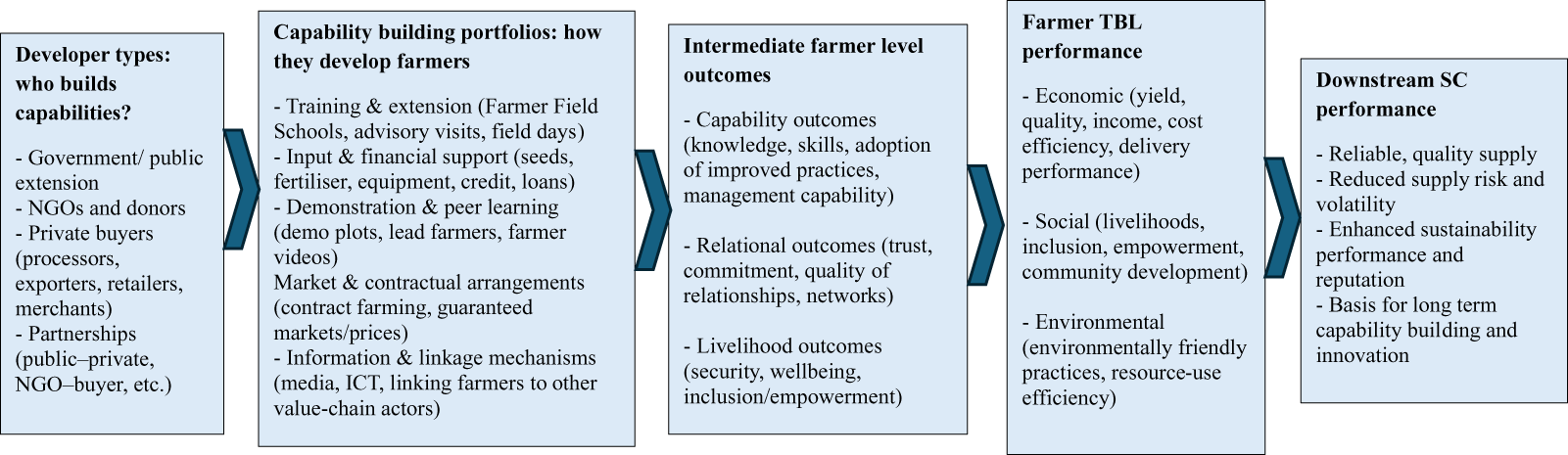
This review reveals four cross-cutting patterns in how farmer development is organised and what it achieves in developing economies’ AFVCs. First, developer roles cluster into distinct models, with public and NGO-led programmes dominating the landscape, a small number of clearly buyer-led initiatives, and some multi-actor partnerships that combine public, non-profit, and private roles (e.g., Bhatti et al., Reference Bhatti, Godfrey, Ip, Kachiwala, Hovdhaugen, Banda and Eik2021; Ladele & Kuponiyi, Reference Ladele and Kuponiyi2006; Mukucha & Chari, Reference Mukucha and Chari2021, Reference Mukucha and Chari2024; Zuza et al., Reference Zuza, Tholo, Chipeta, Emmott, Achi and Zingore2025). Second, farmer development is typically delivered as multi-practice portfolios rather than single interventions, bundling training, input support, financial schemes and, in some cases, contractual arrangements such as contract farming (Aniagyei et al., Reference Aniagyei, Bakang, Tham-Agyekum, Arhin and Asiedu2024; Imam et al., Reference Imam, Wan, Khan, Raza, Khan and Yaseen2021; Maffioli et al., Reference Maffioli, Ubfal, Baré and Cerdán-Infantes2011; Zossou et al., Reference Zossou, Van Mele, Wanvoeke and Lebailly2012). Third, economic and production metrics dominate performance reporting: yields, quality, income, and delivery performance are consistently foregrounded, while social and environmental outcomes are more often implied than explicitly measured (Bhatti et al., Reference Bhatti, Godfrey, Ip, Kachiwala, Hovdhaugen, Banda and Eik2021; Wang et al., Reference Wang, Huan, Li and Dai2023; Yitayew et al., Reference Yitayew, Abdulai, Yigezu, Deneke and Kassie2021). Fourth, capability and relational outcomes are recognised but under-measured. Studies frequently refer to improved knowledge, practice adoption, and stronger relationships with support providers and buyers, yet these changes are rarely operationalised as formal performance indicators (Bhatti et al., Reference Bhatti, Godfrey, Ip, Kachiwala, Hovdhaugen, Banda and Eik2021; Mukucha & Chari, Reference Mukucha and Chari2021, Reference Mukucha and Chari2024). These overall patterns provide the basis for interpreting farmer development as SD and for assessing its implications for SC capability building in developing economies. These four cross-cutting patterns are brought together in an integrative conceptual framework (Fig. 2), which summarises how different provider types shape the capability-building portfolios, farmer-level outcomes and, ultimately, sustainable SC performance in developing economies.
Conceptual framework linking farmer development providers, capability-building portfolios, farmer-level outcomes, and sustainable SC performance.

Who builds capabilities? Reframing farmer development as SD
This subsection interprets the review findings on who develops smallholder farmers and reframes farmer development as a form of SD located ‘at the farm gate’. A first contribution of this review is to reframe farmer development as a form of SD located at the upstream end of AFVCs. The initiatives documented across the 15 studies – training, input provision, credit schemes, contract farming and performance monitoring – mirror well known SD mechanisms such as supplier training, technical assistance, financial support, and closer buyer–supplier collaboration (Krause et al., Reference Krause, Handfield and Scannell1998; Imam et al., Reference Imam, Wan, Khan, Raza, Khan and Yaseen2021; Maffioli et al., Reference Maffioli, Ubfal, Baré and Cerdán-Infantes2011; Mukucha & Chari, Reference Mukucha and Chari2021, Reference Mukucha and Chari2024).
However, whereas mainstream SD research has focused primarily on manufacturing suppliers in more formalised industrial contexts (Krause et al., Reference Krause, Handfield and Scannell1998; Pagell & Wu, Reference Pagell and Wu2009; Seuring & Müller, Reference Seuring and Müller2008), the studies reviewed here highlight the distinct realities of smallholder farmers in developing economies. These suppliers are typically characterised by small scale, limited assets, high exposure to climatic and market risk, and weaker contractual protections (Bhatti et al., Reference Bhatti, Godfrey, Ip, Kachiwala, Hovdhaugen, Banda and Eik2021; Yitayew et al., Reference Yitayew, Abdulai, Yigezu, Deneke and Kassie2021; Zuza et al., Reference Zuza, Tholo, Chipeta, Emmott, Achi and Zingore2025). Capability building in this context often needs to start from more basic foundations (e.g., agronomic practices, literacy, basic record keeping) and must deal with fragmented landholding, seasonal labour constraints, and complex household dynamics.
By conceptualising farmer development explicitly as SD, the review helps connect two previously fragmented scholarly conversations: (1) agricultural extension and rural development, and (2) SCM and SD. This connection underscores that building smallholder capabilities is not only a development issue but also a strategic SC capability building challenge: downstream buyers, donors, and states all have a stake in whether farmers can consistently meet quality, reliability, and sustainability requirements (Pagell & Wu, Reference Pagell and Wu2009; Seuring & Müller, Reference Seuring and Müller2008).
Designing capability-building portfolios in developing economy SCs
The descriptive mapping shows that governments and NGOs dominate the farmer development landscape, while buyer-led initiatives are rare and sparsely documented (Bhatti et al., Reference Bhatti, Godfrey, Ip, Kachiwala, Hovdhaugen, Banda and Eik2021; Ladele & Kuponiyi, Reference Ladele and Kuponiyi2006; Zuza et al., Reference Zuza, Tholo, Chipeta, Emmott, Achi and Zingore2025). This pattern is noteworthy in light of the special issue’s focus on SC capability building in developing economies.
On the one hand, the dominance of public and non-profit actors is understandable. Many smallholder farmers operate in regions where markets are thin, infrastructure is weak, and the transaction costs of direct buyer engagement are high. Public extension services and donor-funded programmes have historically been tasked with filling capability gaps and addressing market failures (Bhatti et al., Reference Bhatti, Godfrey, Ip, Kachiwala, Hovdhaugen, Banda and Eik2021; Savran et al., Reference Savran, Demiryürek, Özçatalbaş, Akin and Boz2011; Van Niekerk et al., Reference Van Niekerk, Stroebel, Van Rooyen, Whitfield and Swanepoel2011). The review shows these actors using a broad toolkit of training, extension, demonstration, and input support to improve adoption of improved practices and, in some cases, to foster social and environmental goals (Aniagyei et al., Reference Aniagyei, Bakang, Tham-Agyekum, Arhin and Asiedu2024; Zossou et al., Reference Zossou, Van Mele, Wanvoeke and Lebailly2012).
On the other hand, the limited presence of private buyers as farmer developers suggests an important underexplored space for SC capability building. The few buyer-led cases in the sample – where merchants or processors combine contract farming with extension, input credit, and guaranteed markets – indicate that when buyers do invest in farmer capabilities, they can generate tangible improvements in yield, quality, delivery performance, and farmer profitability (Maffioli et al., Reference Maffioli, Ubfal, Baré and Cerdán-Infantes2011; Mukucha & Chari, Reference Mukucha and Chari2021, Reference Mukucha and Chari2024). Yet these cases are not only rare; they also lack systematic TBL measurement and clear theorisation.
For SC scholars and practitioners, this raises a critical question: why are buyer-led capability building arrangements not more prominent in the empirical record, given their potential to align farmers’ incentives with downstream quality, reliability, and sustainability (TBL) requirements? Possible explanations include structural features of certain commodities and markets that limit the feasibility of close buyer–farmer relationships, historical legacies where capability building has been seen as a public sector responsibility rather than a core SC activity, and a lack of measurement frameworks that allow buyers to justify capability-building investments internally by linking them to performance and sustainability outcomes (Pagell & Wu, Reference Pagell and Wu2009; Seuring & Müller, Reference Seuring and Müller2008). The review thus points to the need to rethink and broaden the role of private buyers – including processors, exporters, and retailers – as active co-developers of smallholder capabilities, in partnership with public and non-profit actors rather than as substitutes for them.
A second insight is that effective farmer development is rarely about a single intervention. Across the reviewed studies, initiatives are typically organised as portfolios of capability-building practices: training plus demonstration plots; extension visits plus input support; credit schemes tied to contract farming; farmer field schools combined with group-based learning platforms and media-based reinforcement (Aniagyei et al., Reference Aniagyei, Bakang, Tham-Agyekum, Arhin and Asiedu2024; Imam et al., Reference Imam, Wan, Khan, Raza, Khan and Yaseen2021; Zossou et al., Reference Zossou, Van Mele, Wanvoeke and Lebailly2012). This portfolio logic resonates with capability and resource-based perspectives. Farmer capabilities – whether agronomic, managerial, or relational – are unlikely to change through one-off interventions. Instead, they develop over time through repeated interactions, layered support mechanisms, and access to complementary resources (such as finance, technology, and market access) (Barney, Reference Barney1991; Krause et al., Reference Krause, Handfield and Scannell1998). Programmes that combine multiple mechanisms can create synergies: training becomes more impactful when farmers can access inputs and credit; contract farming becomes more robust when embedded in strong advisory and monitoring systems; peer learning is amplified when linked to demonstration plots and field days.
For SC capability building in developing economies, this suggests that buyers, governments, and NGOs should design integrated capability-building portfolios aligned with value chain requirements, rather than relying on atomised training events or short-term projects. It also supports the idea of moving from a ‘training as an event’ mindset to a continuous capability-building process, embedded in long-term relationships, and governance structures (Seuring & Gold, Reference Seuring and Gold2012).
Comparing the three development models identified in the review also highlights distinct strengths and limitations. State-led programmes typically have a broad public mandate and geographic reach but are often constrained by limited resources and weaker direct linkages to specific value chain buyers (Savran et al., Reference Savran, Demiryürek, Özçatalbaş, Akin and Boz2011; Van Niekerk et al., Reference Van Niekerk, Stroebel, Van Rooyen, Whitfield and Swanepoel2011). NGO-led initiatives frequently foreground livelihood, empowerment, and inclusion goals and adopt participatory, group-based approaches, yet they can be project-based and time-bound, raising questions about long-term sustainability and integration into market channels (Bhatti et al., Reference Bhatti, Godfrey, Ip, Kachiwala, Hovdhaugen, Banda and Eik2021; Zossou et al., Reference Zossou, Van Mele, Wanvoeke and Lebailly2012). Buyer-led arrangements, by contrast, are tightly coupled to market requirements and can deliver clear gains in yield, quality, and delivery performance for both farmers and firms, but they remain relatively rare and, in the existing evidence base, pay limited attention to social and environmental outcomes (Maffioli et al., Reference Maffioli, Ubfal, Baré and Cerdán-Infantes2011; Mukucha & Chari, Reference Mukucha and Chari2021, Reference Mukucha and Chari2024). These divergences underline the potential complementarity between public, NGO, and buyer roles and the need for multi-actor governance arrangements that combine their respective strengths.
The missing pieces in TBL measurement
A third major finding is the imbalance in how farmer performance is conceptualised and measured. Economic and production outcomes – yields, quality, income, delivery performance – are consistently tracked and reported (Aniagyei et al., Reference Aniagyei, Bakang, Tham-Agyekum, Arhin and Asiedu2024; Imam et al., Reference Imam, Wan, Khan, Raza, Khan and Yaseen2021; Maffioli et al., Reference Maffioli, Ubfal, Baré and Cerdán-Infantes2011; Wang et al., Reference Wang, Huan, Li and Dai2023). Social and environmental outcomes, by contrast, are often treated as implicit or secondary (Bhatti et al., Reference Bhatti, Godfrey, Ip, Kachiwala, Hovdhaugen, Banda and Eik2021; Yitayew et al., Reference Yitayew, Abdulai, Yigezu, Deneke and Kassie2021; Zuza et al., Reference Zuza, Tholo, Chipeta, Emmott, Achi and Zingore2025).
In many studies, social effects appear in narrative form (‘improved livelihoods’, ‘rural smallholder development’, ‘empowerment’) without accompanying indicators or robust measurement strategies (Bhatti et al., Reference Bhatti, Godfrey, Ip, Kachiwala, Hovdhaugen, Banda and Eik2021; Yitayew et al., Reference Yitayew, Abdulai, Yigezu, Deneke and Kassie2021). Environmental outcomes are either absent or limited to generic references to sustainable or climate-smart practices, with little evidence of farmer-level environmental performance metrics (Wang et al., Reference Wang, Huan, Li and Dai2023; Yitayew et al., Reference Yitayew, Abdulai, Yigezu, Deneke and Kassie2021). Even in buyer-led initiatives where the language of sustainability is used, TBL framing tends to be narrow, with economic benefits for farmers and buyers foregrounded while social and environmental aspects are not operationalised (Maffioli et al., Reference Maffioli, Ubfal, Baré and Cerdán-Infantes2011; Mukucha & Chari, Reference Mukucha and Chari2021, Reference Mukucha and Chari2024).
From a sustainable SC perspective, this measurement gap is problematic (Pagell & Wu, Reference Pagell and Wu2009; Seuring & Müller, Reference Seuring and Müller2008). If farmer development is intended to support sustainable SCs and contribute to broader sustainability goals and sustainable development goals, then economic, social, and environmental dimensions of farmer performance need to be measured more consistently at the farmer-level (Callagher & Garnevska, Reference Callagher and Garnevska2025). Without such measurement, it is difficult to assess trade-offs, identify win–win configurations, or evaluate whether capability-building investments are delivering on their sustainable development promises.
The review therefore reinforces the need for multi-dimensional, farmer-level performance frameworks that capture TBL outcomes. For smallholder contexts, such frameworks will need to be sensitive to data constraints and avoid excessive burdens on farmers, while still capturing changes in livelihoods, inclusion (e.g., gender, youth, marginalised groups), and environmental practices (e.g., input use efficiency, soil health, biodiversity-friendly practices).
Theoretical implications for SC capability building
Theoretically, this review suggests that SD theory needs to be extended and adapted to better account for smallholder farmers and developing economy AFVCs. First, the findings emphasise the presence of multiple developer roles. SD in these contexts involves not only buyers but also governments, NGOs, and hybrid partnerships, which means that the classic dyadic ‘buyer–supplier’ model is insufficient (Krause et al., Reference Krause, Handfield and Scannell1998; Mena, Humphries & Choi, Reference Mena, Humphries and Choi2013). Multi-actor governance and coordination are central to how farmer capabilities are actually built in practice. Second, the evidence indicates that capability building is a shared responsibility. Responsibility for developing supplier capabilities is distributed across public and private actors, challenging the idea that SD is purely a private, firm-level strategic decision (Pagell & Wu, Reference Pagell and Wu2009; Seuring & Müller, Reference Seuring and Müller2008). Third, the review shows that TBL outcomes need to be treated as core rather than peripheral. In developing economies, where poverty reduction, food security, and environmental resilience are key societal goals, social and environmental outcomes cannot be relegated to secondary status (Aniagyei et al., Reference Aniagyei, Bakang, Tham-Agyekum, Arhin and Asiedu2024; Bhatti et al., Reference Bhatti, Godfrey, Ip, Kachiwala, Hovdhaugen, Banda and Eik2021). Integrating TBL performance explicitly into SD theory would make it better suited to these contexts (Elkington, Reference Elkington1997; Pagell & Wu, Reference Pagell and Wu2009).
By foregrounding farmer capability building within an SD frame, the review opens space for integrating resource-based, stakeholder, and service-dominant perspectives that emphasise co-creation of value, shared responsibility, and relational processes (Barney, Reference Barney1991; Freeman, Reference Freeman1984; Vargo & Lusch, Reference Vargo and Lusch2004). This points towards a more relational and multi-actor view of SD, in which building smallholder capabilities is integral to SC capability building, rather than an adjunct to it. As illustrated in Fig. 2, we conceptualise farmer development as a multi-actor SD process in which public, non-profit, and private providers configure capability-building portfolios that feed into farmer-level economic, social and environmental outcomes, and downstream SC performance.
Practical and policy implications
For practitioners and policymakers, the review highlights several actionable implications. For private buyers such as processors, exporters, and retailers, there is clear scope to move beyond narrow compliance-oriented sourcing towards more strategic capability-building partnerships with farmers (Maffioli et al., Reference Maffioli, Ubfal, Baré and Cerdán-Infantes2011; Mukucha & Chari, Reference Mukucha and Chari2021, Reference Mukucha and Chari2024). Buyer-led programmes that bundle technical support, input access, credit, and reliable market outlets can improve both farmer performance and overall SC reliability. However, to align with contemporary sustainability expectations, these programmes should be designed with explicit TBL objectives and indicators, rather than focusing solely on economic outcomes (Pagell & Wu, Reference Pagell and Wu2009; Seuring & Müller, Reference Seuring and Müller2008).
For governments and NGOs, the findings confirm that public and non-profit actors remain central providers of farmer development but also suggest ways to enhance their impact (Bhatti et al., Reference Bhatti, Godfrey, Ip, Kachiwala, Hovdhaugen, Banda and Eik2021; Ladele & Kuponiyi, Reference Ladele and Kuponiyi2006). Co-designing interventions with downstream buyers can help ensure that capability-building efforts are aligned with evolving market requirements while still safeguarding equity and environmental goals. This includes supporting and strengthening farmer organisations that can aggregate supply, negotiate with buyers, and act as platforms for collective learning (Callagher & Garnevska, Reference Callagher and Garnevska2025; Zossou et al., Reference Zossou, Van Mele, Wanvoeke and Lebailly2012). In addition, multi-stakeholder platforms have an important coordinating role in commodity chains involving many smallholders and fragmented markets (Mena et al., Reference Mena, Humphries and Choi2013). Such platforms can help align incentives across actors and share the costs and benefits of capability-building investments among buyers, government agencies and donors.
Across all these settings, the design of farmer development interventions should be informed by a portfolio logic (Designing capability building portfolios in developing economy SCs), recognising that combinations of practices are more effective than isolated activities, and should be supported by transparent TBL measurement (The missing pieces in triple bottom line measurement) that makes economic, social, and environmental outcomes visible at the farmer-level.
Research agenda
Finally, the review points to several promising directions for future research on buyer-led, TBL-oriented capability building in developing economies.
Expanding the empirical base on buyer-led farmer development
The small number of documented buyer-led cases suggests a need for more qualitative and quantitative studies that examine how different types of buyers (e.g., processors, supermarkets, exporters) structure, govern and justify farmer capability-building investments, and how these affect both farmers and SC performance (Maffioli et al., Reference Maffioli, Ubfal, Baré and Cerdán-Infantes2011; Mukucha & Chari, Reference Mukucha and Chari2021, Reference Mukucha and Chari2024).
Longitudinal and causal designs
Most existing studies take cross-sectional or short-term perspectives (Aniagyei et al., Reference Aniagyei, Bakang, Tham-Agyekum, Arhin and Asiedu2024; Bhatti et al., Reference Bhatti, Godfrey, Ip, Kachiwala, Hovdhaugen, Banda and Eik2021; Wang et al., Reference Wang, Huan, Li and Dai2023). Longitudinal designs, field experiments, and quasi-experimental approaches could help unpack causal pathways from capability-building initiatives to economic, social, and environmental outcomes at the farmer level, and to downstream SC performance (e.g., service levels, risk, resilience).
Farmer segmentation and differentiated development pathways
Smallholders are heterogeneous. Future work could explore farmer segmentation/clustering (e.g., by capability, asset base, gender, geography) and examine how tailored capability-building portfolios and buyer engagement models can support different segments in ways that are both effective and inclusive (Bhatti et al., Reference Bhatti, Godfrey, Ip, Kachiwala, Hovdhaugen, Banda and Eik2021; Yitayew et al., Reference Yitayew, Abdulai, Yigezu, Deneke and Kassie2021).
TBL performance measurement and index development
There is a clear opportunity to develop operational TBL performance frameworks and indices that are suitable for smallholder farmers, allowing researchers, and practitioners to systematically track economic, social, and environmental outcomes of capability-building initiatives (Pagell & Wu, Reference Pagell and Wu2009; Seuring & Müller, Reference Seuring and Müller2008). Such frameworks could also link to global sustainability reporting standards and the sustainable development goals (Callagher & Garnevska, Reference Callagher and Garnevska2025).
Multi-actor governance and relational dynamics
Given the multiple developer roles identified, future studies should pay more attention to governance arrangements and relational dynamics among governments, NGOs, buyers, and farmer organisations (Mena et al., Reference Mena, Humphries and Choi2013; Vargo & Lusch, Reference Vargo and Lusch2004). This includes examining power asymmetries, trust, alignment of goals and the conditions under which partnerships sustain or unravel over time.
By addressing these gaps, future research can help advance a more complete understanding of SC capability building in developing economies, one that recognises smallholder farmers as vital suppliers, acknowledges the shared responsibility for building their capabilities, and treats TBL sustainability as central.
Conclusion
This paper set out to examine who builds smallholder farmers’ capabilities in developing economies, how they do so, and with what sustainability (TBL) outcomes, by systematically reviewing 15 empirical studies of farmer development initiatives. Framing farmer development as a form of SD at the farm gate, the review responds to calls to better understand SC capability building in developing economy contexts.
The findings show that governments and NGOs remain the dominant providers of farmer development, with a smaller but important role for partnership arrangements and only a limited number of buyer-led initiatives. Across the sample, farmer development is typically delivered through portfolios of initiatives combining training, input support, financial schemes and, in some cases, contract farming and guaranteed markets. These initiatives generate a range of outcomes, but economic and production metrics (yields, quality, income, delivery performance) are consistently foregrounded, while social and environmental dimensions of performance are often implicit or under-measured. Taken together, the evidence suggests that the language of sustainability has travelled faster than robust TBL measurement at the farmer level.
This paper offers three main contributions. First, it integrates fragmented literatures in agricultural extension, rural development, and SCM by conceptualising farmer development as SD in AFVCs, thereby positioning smallholder capability building squarely within SC capability building debates rather than solely within development studies. Second, it provides an empirically grounded map of who develops smallholder farmers and how, highlighting the strong role of public and non-profit actors and the relative scarcity – but clear potential – of buyer-led arrangements. Third, it shows that existing farmer development efforts remain economically skewed in their performance focus, and it sets out a research agenda for buyer-led, TBL-oriented capability building, including the need for multi-actor governance perspectives, farmer segmentation, and farmer-level TBL performance frameworks.
Like most systematic reviews, this study has limitations that create opportunities for future work. The review is constrained by the published empirical record and by the search terms and databases used; relevant studies in other languages, grey literature, or non-indexed outlets may have been missed. The heterogeneity of methods and contexts across the 15 studies also precluded formal meta-analysis, and the coding of TBL coverage depended on what authors chose to report. These limitations reinforce the need for richer, methodologically diverse primary studies – including longitudinal, experimental, and mixed-method designs – that can trace causal pathways from capability-building initiatives to farmer-level TBL performance and downstream SC outcomes. Despite these constraints, the review underscores a simple but important message: building smallholder farmers’ capabilities is both a development imperative and a strategic SC task.
Supplementary material
The supplementary material for this article can be found at https://doi.org/10.1017/jmo.2026.10088.
Leeza DeSilva is a Teaching Fellow at the University of Waikato, New Zealand. She received her BBA (Marketing Special) from the University of Colombo, Sri Lanka, her MSc in Operations Management from the University of Sri Jayewardenepura, Sri Lanka, and her PhD in Logistics and Supply Chain Management from the School of Food and Advanced Technology, Massey University, New Zealand. Her current teaching and research interests include supply chain management, procurement, sustainability, and agri-food supply chains.
Nihal Jayamaha is a Senior lecturer attached to Massey University, New Zealand. He received his PhD in 2008 from the same university, with an endorsement in Technology Management. His teaching and research interests cover quality improvement, performance measurement, sustainability, and multivariate modelling. He has published over 30 articles in prestigious academic journals and edited books.
Elena Garnevska is a Senior Lecturer and a Subject Lead of Agribusiness programmes (undergraduate and postgraduate) at Massey University. She is an expert in international agribusiness and the organisation of agri-food value chains with special attention to the role of cooperatives and producer organisations in developed and developing countries. Research leadership and experience in developing countries have been achieved in the area of sustainable agri-food value chain transformation.





 Open access

