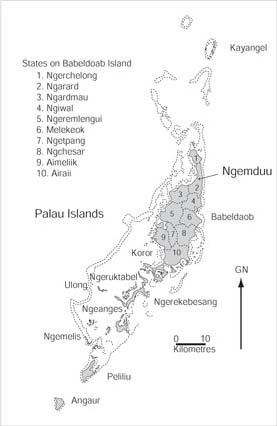


Map of the Palau Archipelago indicating the locations of painted pottery sites referred to in the text.

Painted pottery has been a rare find in the archaeology of Palau, Micronesia (Fig. 1). A large collection of painted sherds recovered in a recent excavation of a constructed terrace complex in northern Babeldaob raises issues about the chronology and role of painted pottery in Palauan prehistory.
Ten painted sherds from Ulong Island, the previous largest collection, exhibited solid red pigment on interior and exterior surfaces, or a mixture of solid pigment and diagonal or diamond shapes (Reference OsborneOsborne 1979). Only four intact painted vessels have been recovered archaeologically, from a burial cave in Sengall Ridge, Koror (Beardsley and Basilius 2002). They had parallel and linear geometric designs and two were painted in solid red on the interior. A few shallow plates of unknown provenence in the Koror Museum also have painted red geometric designs.
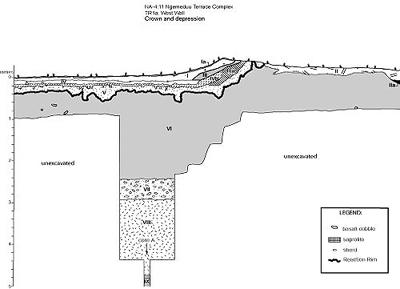
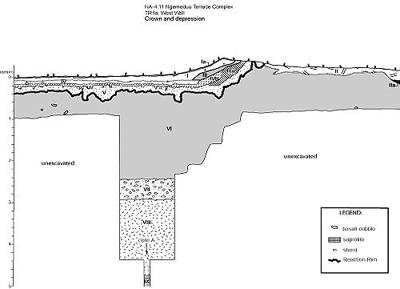
In 2002 I excavated the terrace complex at Ngemeduu (B:NA-4:11) (Fig. 1) as part of a PhD project on the monumental earthworks of Palau. The Ngemeduu crown consisted of soil heaped upon the original hilltop to a depth of up to 4m. (Fig. 2). Fifty-five painted sherds were recovered during excavation (45% rim sherds, and one lid fragment), the majority of them (83%) from Layer VIII located immediately above the C horizon. This layer consists of sediment from the original hill surface.
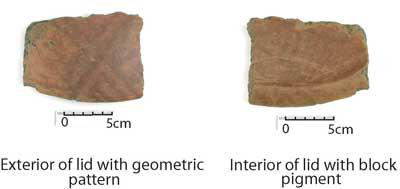
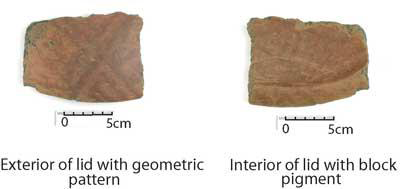
Two vessel shapes dominate the assemblage - shallow plates or bowls with parallel rims and deep bowls with interior coiling and rounded lips. As with the earlier examples, red pigment has been applied to the vessels in block colour as well as patterns using simple stripes, triangular geometric designs, and ‘leaf-like’ patterns (Fig. 3). The most frequent combination (53%) combines linear elements or patterns on the exterior surface, with solid red pigment on the interior.
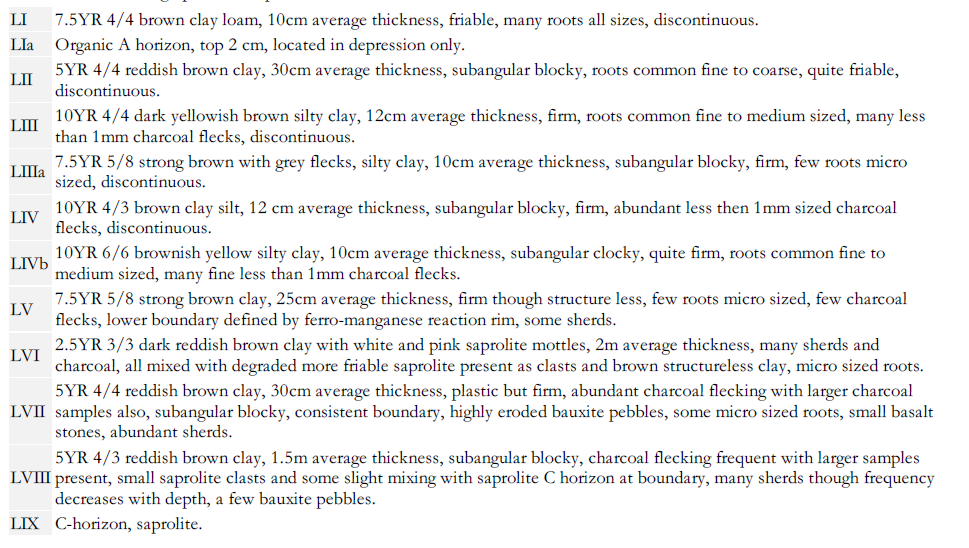
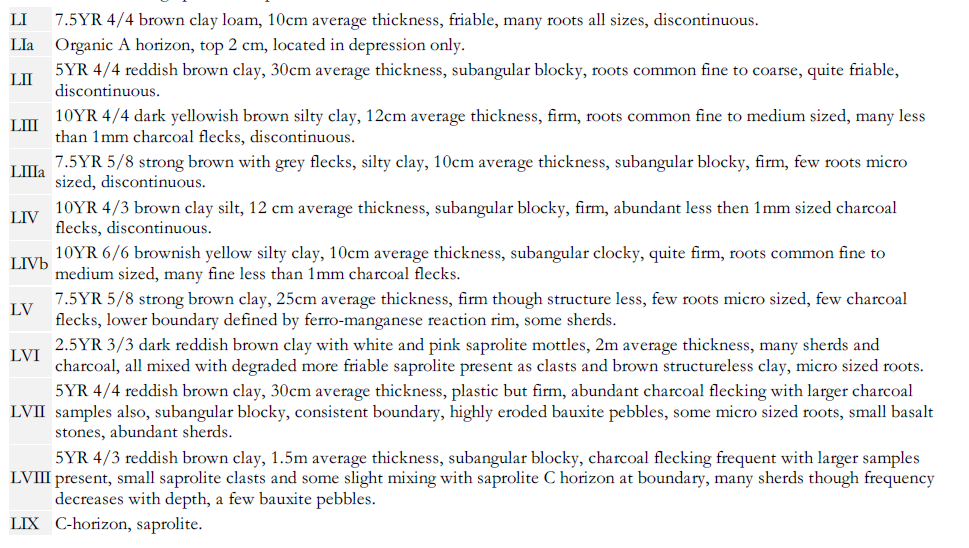
Profile drawing of TR1a on the crown of Ngemeduu, which extends from the northern edge into a large rectangular depression. See Table 1 for key.
Illustrates a selection of painted sherds and the variability in colour and pattern.
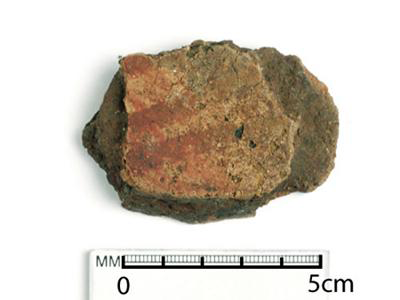
The right side of this painted sherd has undergone a post-depositional colour change.
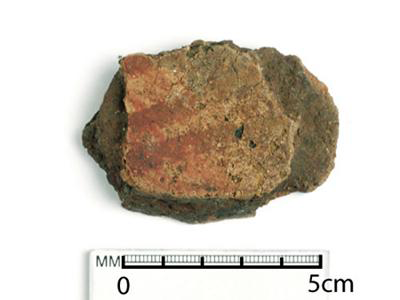
The red pigment varies from deep red to brownish-red to orange. Microscopic examination indicates some colour differences are the result of post-depositional changes (see Fig 4). The soil used to construct Ngemeduu is acidic (pH 5) and often waterlogged, so the pottery surfaces were soft and friable whilst buried but cracked and crumbled upon drying. This makes some aspects of the painting difficult to identify, but red pigment was applied to buff, yellow and brown vessels, in many cases following the application of an orange pigment. Initial analysis using X-ray diffraction indicates that differences in the red pigment are due to varying hematite and quartz quantities.
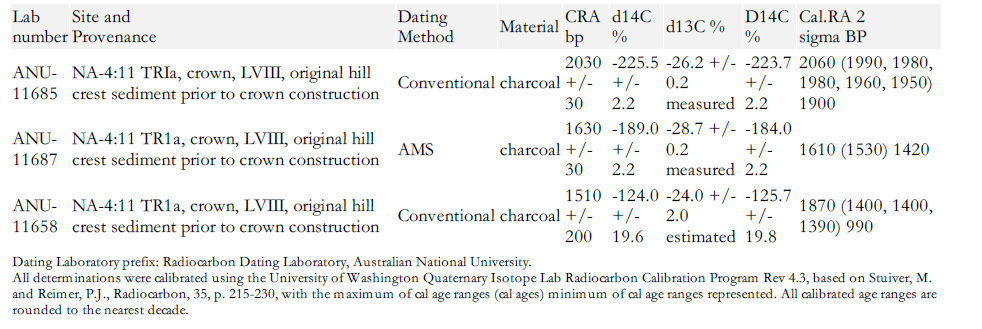
Three radiocarbon dates on midden charcoal from the Ngemeduu excavation (Table 2) place painted pottery in the interval 1400 - 2000 cal BP, similar to a dated midden deposit at Uchularois Cave which places slipped 'redware' and painted pottery (based on one painted sherd) between A.D. 1- 900 (Reference MasseMasse 1990). A direct date of 2630 ± 60 BP (Beadsley et al 2002) was obtained on charcoal embedded in the temper of a painted sherd. In Palau, however, charcoal can be produced from long-preserved plant material in clays obtained from swamp or slump deposits which produces a very wide range of results (Phear, Clark and Anderson, in press).
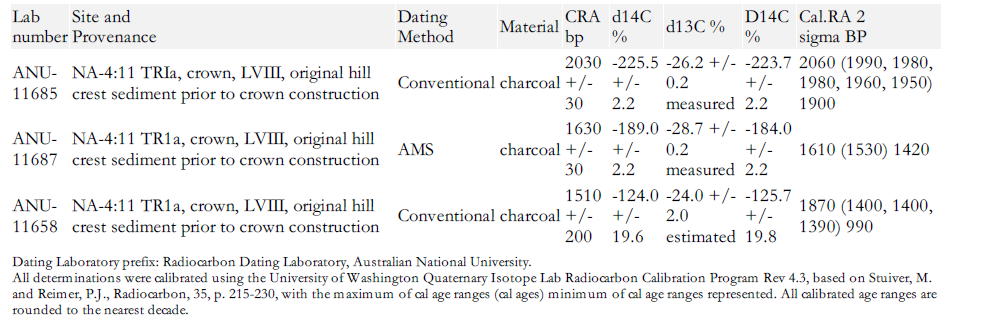
Dating Laboratory prefix: Radiocarbon Dating Laboratory, Australian National University. All determinations were calibrated using the University of Washington Quaternary Isotope Lab Radiocarbon Calibration Program Rev 4.3, based on Stuiver, M. and Reimer, P.J., Radiocarbon, 35, p. 215-230, with the maximum of cal age ranges (cal ages) minimum of cal age ranges represented. All calibrated age ranges are rounded to the nearest decade.
The painted ceramics found within Ngemeduu support the proposition that painted vessels were connected to status (Reference OsborneOsborne 1966; 1979; Beardsley et al 2002). Microscopic analysis shows in 87% of the sample the paint was applied to vessels after firing, indicating the ceramics were probably luxury items rather than utilitarian vessels (as the paint would be impacted by heat if placed on a fire for cooking). A high status connection is also indicated by the location of the painted sherds on the original hilltop of Ngemeduu, a prominent point in the Rael Kedam ridgeline. Settlements on high points in Palau and across the Pacific are linked with hierarchy and status.
Currently, only a few earthwork sites on Babeldaob have undergone large-scale excavation. As more than 5% of the land surface of Babeldaob has been modified by earthworks it is likely that future excavation programs targeting terraces and crowns would recover many more remains of painted vessels, a pottery type that now seems to have been more common in the Palauan ceramic tradition and Palauan prehistory, than previously thought.