


1 Introduction
Harry and Sally are happily married.Footnote 1 For many years now, Harry has argued that Sally behaves irrationally when she continues to search for alternatives after a decision has already been made. For example, after just filling gas in her car, Sally still continues to search for lower gas prices at other stations, and after she already bought a product, she continues to check for better deals. Harry could understand her conducting such post-decision search if the decision can be reversed so that she can switch to a better alternative (e.g., buying the better deal and returning the previous product with minimal cost). He could also understand her looking at gas prices when her gas tank is full, because if she finds a cheaper gas station, she can use this information next time she is out of gas. However, after they just paid for an expensive and non-refundable vacation in distant Australia, Harry could not find any rational justification to explain why Sally continued to search for alternative vacation deals. In this case, reversing the decision is too costly and they are not likely to visit Australia again so information about alternative deals will not help in future decisions.
Existing literature from marketing and social psychology provides some ideas why Sally might conduct such unfounded post-decision search: post-decision information reduces uncertainty (e.g., Reference Shani and ZeelenbergShani & Zeelenberg, 2007; Reference Shani, Tykocinski and ZeelenbergShani, Tykocinski & Zeelenberg, 2008) and can provide supportive evidence for the decision just made (if one finds that forgone alternatives are worse than the one selected), which in turn helps to reduce regret (e.g., Reference Cooke, Meyvis and SchwartzCooke, Meyvis & Schwartz, 2001; Reference SummervilleSummerville, 2011) and to resolve cognitive dissonance (Reference Ehrlich, Guttman, Schönbach and MillsEhrlich, Guttman, Schönbach & Mills, 1957; Reference AdamsAdams, 1961, Reference Donnelly and IvancevichDonnely & Ivancevich, 1970). Thus, one general motivation to conduct post-decision search is to lessen undesirable emotions. This motivation is of particular importance since post-decision information was found to influence satisfaction and regret even more than pre-decision information (Reference Cooke, Meyvis and SchwartzCooke, Meyvis & Schwartz, 2001). The problem, however, is that post-decision information search can also produce negative feedback (if one finds out that forgone alternatives are better than the one selected), which in this case will cause increased regret and larger dissonance. While one might want to avoid such negative emotions, as noted by Reference ZeelenbergZeelenberg (1999), experiencing regret can be functional when it leads to increased learning from mistakes. Accordingly, a question arises: Can post-decision information support generalizable learning that improves further decision making? If so, then such potential improvement of future choices can serve as a functional motivation to engage in post-decision search even in non-repeating environments.
1.1 Two types of useful post-decision information
Post-decision search provides information about the value of unchosen alternatives (e.g., what would have happened if one had searched longer). These values can be useful in two ways: externally, by updating one’s knowledge about the distribution of options in a given environment (are there better alternatives out there?), and internally, by giving feedback about one’s search strategy (did I stop searching at an appropriate point?).Footnote 2 Such information can improve performance when future decisions are expected in the same unknown environment. For example, imagine that Sally just bought a birthday present for Harry, and her post-decision search then showed she could have gotten a nicer present for the same price. Sally learned about new possible presents for a given budget constraint (external distributional knowledge) but she also learned that she terminated her search too early (internal strategy feedback). While both types of information can help her buy a better present next year, the latter can also help her to modify her general search behavior, assuming she uses similar strategies in other search tasks. The assumption of consistent search strategies across tasks fits with the idea of a generalized cognitive search mechanism raised by Reference Hills, Todd and GoldstoneHills, Todd & Goldstone (2008), who found similar search patterns in spatial and mental tasks (see also Reference Todd, Hills, Robbins and LuppTodd, Hills & Robbins, 2012, for more on search across tasks). In the present example, if related search strategies are used in various environments (e.g., Sally searches only a little in all her purchasing choices), internal information has the potential to improve future decisions in scenarios other than buying Harry a birthday present (e.g., by extending Sally’s search when looking for other products).
Returning to Sally’s search for travel options: Since Sally does not expect to encounter the same search environment (travel deals to Australia) in the future, Harry’s argument that her post-decision search is useless is true with respect to distributional knowledge. There is no point in collecting information about alternatives in order to better understand an environment that you do not expect to visit again. However, even if one is searching in such a unique environment (which will not be repeated in the future), post-decision search can still be helpful in acquiring strategy feedback, which can be used in other environments. Therefore, knowing that the current environment will not be repeated again should eliminate the motivation to engage in post-decision search for the purpose of obtaining (external) distributional knowledge but not for the purpose of obtaining (internal) strategy feedback.
While the usefulness of external distributional knowledge is commonly referred to in the experimental literature, the possible usefulness of internal strategy feedback is frequently overlooked (but see Reference Reb and ConnollyReb & Connolly, 2009 for studies of self-blamed regret). For example, the finding that people tend to consider post-purchase information when complete distributional knowledge is given in advance and future prices are not obtainable was suggested to result from an automatic counter-productive process, and to contradict functional explanations (Reference Cooke, Meyvis and SchwartzCooke et al., 2001). In the current paper we further explore the potential of functional post-decision search, focusing on the possible usefulness of internal strategy feedback.
Another reason that previous post-decision studies have not systematically explored the possible benefits of post-decision search is that they are usually done in one-shot settings (only one search problem), where post-decision information cannot be used in later choices. That type of experimental setting therefore emphasizes the irrational aspects of the decision to engage in post-decision search. In most real life situations, however, people make numerous search decisions, and what might be seen as irrational choice in a one-shot decision might actually represent smart generalization in more natural repeated settings (see also table 4.1 in Reference Gigerenzer, Koehler and HarveyGigerenzer, 2004 describing examples of phenomena that were first interpreted as “cognitive illusions” but later revalued as reasonable judgments given the environmental context). Although not common in the post-decision literature, repeated search tasks are broadly used in economic, consumer search and learning studies. And a particularly appropriate type of task (which is easily repeated) for examining possible benefits for post-decision search, consists of optimal stopping problems, where the main decision is whether to choose the current option or to continue searching for a better one.
1.2 Pre-decision search and the Secretary Problem (SP)
Perhaps the most famous optimal stopping problem is the secretary problem (Reference FergusonFerguson, 1989): An employer is looking to hire the best secretary in town, and invites a random sequence of candidates for interviews. The employer can hire a candidate only immediately after interviewing him/her (previous candidates become unavailable), so the challenge is when to stop the search and select the current candidate. The reason this problem became famous is that under a few assumptions (including that the total number of candidates is known, and the value of each candidate is described as a relative rank rather than an objective value) the problem has a very elegant solution: The employer should reject the first n/e applicants (where n is the total number of applicants), and then hire the next applicant who is better than all applicants interviewed so far.
Most papers on the secretary problem focus on calculations of the optimal stopping rule for different variations of the problem (see Reference FreemanFreeman, 1983, for a review), but a few experimental studies have examined how people actually behave in such settings. The main experimental finding is that overall, compared with the optimal stopping rule, people terminate their search too early (e.g., Reference Rapoport and TverskyRapoport & Tversky, 1970; Reference Seale and RapoportSeale & Rapoport, 1997; Reference Seale and RapoportSeale & Rapoport, 2000; Reference Schotter and BraunsteinSchotter & Braunstein 1981; Reference HeyHey 1987; Reference Bearden, Rapoport and MurphyBearden, Rapoport & Murphy, 2006). However, other studies show that when the optimal amount of search is very low, the opposite result of over-searching can occur (e.g., Reference Baron, Badgio and RitovBaron, Badgio & Ritov, 1991; Reference Zwick, Rapoport, Lo and MuthukrishnanZwick, Rapoport, Lo & Muthukrishnan, 2003). Can post-decision search in these settings lead people to improve their performance by understanding better when to search more and when to search less?
The main purpose of the current paper is to investigate the possible benefits of post-decision information resulting from strategy feedback. To this end, we examined the possibility of learning in a repeated modified version of the secretary problem, with exact rather than relative values of options, and payment corresponding to these values. Using exact values was done for three main reasons: (1) Ecological validity: In many real-life situations, both the relative difference in value between options and the exact values of each option are the factors that drive the decision (Teodorescu, Moran & Usher, 2015). Importantly, such information is unavailable in an experiment when only relative ranks are used. In addition, in natural environments, decision makers are rewarded with the value of the chosen alternative even if it is not the best one (Reference Pirrone, Stafford and MarshallPirrone et al., 2014). (2) Increased chances to find evidence for improvements: learning to choose better options (not just the best option) may not be evident in studies with payoff for only the highest relative rank but can be observed when using varying rewards reflecting exact option values. (3) Examination of different value environments: Using exact values of options enables us to examine whether people employ the same search strategies in environments with different distributions of values (which relative ranks are specifically intended to hide). Here for instance we will look at environments with a low range of values versus environments with a high range of values, to explore the possible generalizability of learning across environments with different value distributions.
In a preliminary study, we manipulated two factors that are expected to influence the proposed motivations for useful post-decision search, namely repetition of environments and prior information about each environment. As expected, participants conducted more post-decision search when no prior information was provided. More importantly, the results of the preliminary study also show that people conduct voluntary post-decision search, even in unique environments, where distributional knowledge is useless. To examine the potential usefulness of post-decision search in unique environments in the two main studies here, post-decision search was manipulated directly. Exposure to post-decision information was found to lead to improved performance, suggesting a role for post-decision information in acquiring strategy feedback. Finally, to explore the cognitive mechanisms used, in the third experiment we apply an explicit strategy elicitation methodology, to directly observe the type of strategy modifications which follow post-decision search. We find that following exposure to post-decision information, people learn to collect more data before generating their initial decision thresholds. This result suggests a more general rather than a specific change to the strategy used to search in different environments.
2 A preliminary study: examining voluntary post-decision search
2.1 Method
Participants.
42 students from Indiana University participated in this study (30 men and 12 women, average age=20.1, std=2.8). The experiment lasted 30–60 minutes, for which all participants received 1 course experiment credit. In addition, the top five performers (who accumulated the highest number of points during the experiment) received a bonus of $20. To increase motivation, participants were told in advance that they would get this bonus if their performance was in the top 10%. The experiment was anonymous, but participants were asked to provide an email address so they could be contacted if they earned the bonus.
The basic task.
We used a simple search task consisting of multiple rounds of several turns each. In each round, a deck of cards is presented on the computer screen, and every turn the value of one card from this deck is revealed or chosen by the participant (see Figure 1). In each turn, participants can choose whether to search further and see (“flip over”) the next card in the deck, or to stop the search and select the current card. The reward for each round (in points) is the value of the selected cardFootnote 3. In addition, a fixed search cost of 5 points is deducted from the round’s payoff every time a new card is flipped over. Accordingly, the total round’s payoff P is the value of the reward R minus the aggregated cost, P=R−5T, where T is the number of turns until a final decision was made.
Experiment round timeline. At the beginning of each round, participants are presented with a deck of cards and then on each turn they flip a card over with a cost of 5 points per card, until they decide to select the current card and receive its point value (in the example shown the 4th card is selected). They are then given the option to continue to see more cards without cost — in the example shown the participant sees two additional cards after making his choice, and only then moves to the next round.
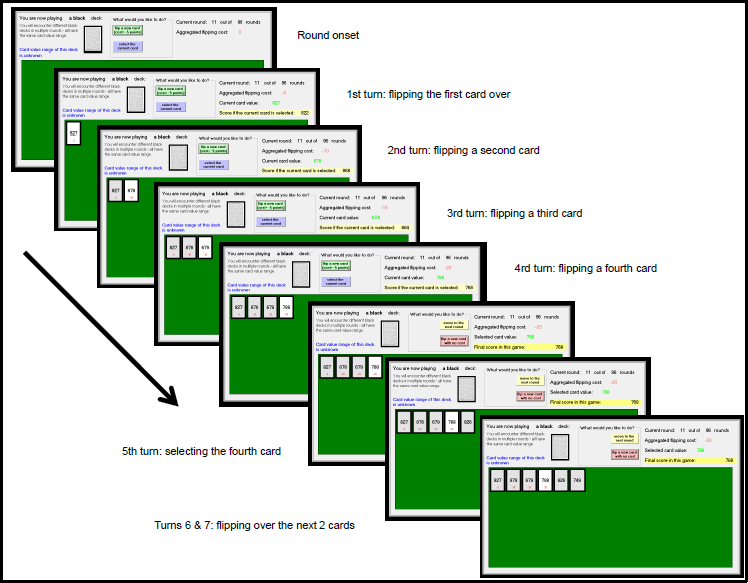
After making a final decision, participants are given the option to continue searching through more cards for free (without losing points)Footnote 4 and so see what further cards were available, had they continued to search. They are allowed to flip over as many cards as they wish before moving to the next round.
Manipulations and experimental design.
Two factors were manipulated across all the rounds that each participant saw – whether the deck of cards used in the current round would be repeated in later rounds (yes/no) and whether descriptive information was given about the distribution of values in the current deck (yes/no), resulting in a 2×2 within-subject experimental design. In addition, the decks varied in their value ranges (high, medium, and low ranges) to explore the effect of motivation for participants to learn search strategies that could generalize across such differing environments.
Repetition.
There were two types of cards decks – black/white decks and colored decks. The black deck and the white deck were multiple-occurrence decks and were repeated 24 times in different rounds during the experiment. In contrast, each colored deck appeared only once throughout the experiment and consisted of cards from a unique range of values. There were 24 colored decks in each of the information conditions below.
Information.
Bright decks (white and light colors) were presented with a full description of their card value distribution (for example: “card value range: 1000–1500, all values in this range are equally likely on every flip”) while for dark decks (black and dark colors) no information about the distribution of values was given (“Card value range of this deck is unknown”) and participants could learn about those decks only by flipping cards over.
Accordingly, the 4 conditions were: black deck – 24 repetitions, no information; white deck – 24 repetitions, full information; 24 dark colored decks – no repetition, no information; 24 light colored decks – no repetition, full information. Overall, the card game included 96 rounds, randomly intermixed. Card values in each deck were drawn from a uniform distribution [X i, X i, +D i].Footnote 5 The distribution parameters, X i ∼ [0, 1300] and D i ∼ [60, 480], were drawn independently for each deck i without replacement and separately for each participant at the beginning of the experiment. That is, every participant played different distributions, randomly generated from the same space of values and ranges and according to the same algorithm. The exact algorithm is detailed in Appendix 1. The way card values were generated across decks was unknown to participants — they were told only that white and black decks will be repeated while colored decks will not, and that for some decks they will be given the range of card values while for other decks they will not be given any such information. Importantly, every round included a full description of the type of deck (whether this deck will be repeated or not, and what its range of card values is or that the range is unknown). Thus, participants were not required to remember what color belongs to which condition, and the colors only served as additional cues.
Individual difference measures.
After playing all 96 rounds of the card game, participants filled out two personality scales: Maximization and Need For Cognition (NFC). Maximizers were previously found to search longer than satisficers (e.g., Dar-Nimrod, Rawn, Lehman & Schwartz, 2009). People high in NFC have been shown to seek more information (e.g., Reference Verplanken, Hazenberg and PalenewenVerplanken, Hazenberg & Palenewen, 1992; Curşeu, 2011), to be more successful at adaptive decision making (Levin, Huneke & Jasper, 2000) and to solve complex problems more effectively (e.g. Nair & Ramnarayan, 2000). Post-decision studies emphasize the role of regret in seeking post-decision information (e.g., Reference Shani and ZeelenbergShani & Zeelenberg, 2007; Reference Cooke, Meyvis and SchwartzCooke, Meyvis & Schwartz, 2001; Reference SummervilleSummerville, 2011), so we added the 5 item regret scale to the 13 item maximization scale, both taken from Reference Schwartz, Ward, Monterosso, Lyubomirsky, White and LehmanSchwartz et al. (2002). For assessing Need For Cognition, the 15 item scale from Reference Roets and Van HielRoets & Van Hiel (2011) was used.
Questions.
The preliminary study was designed to explore voluntary post-decision search behaviors under varying conditions. Will participants engage in post-decision search? Will the amount of post-decision search vary across the different deck types? Post-decision distributional knowledge is most relevant when there is no prior information about the values and such information is important in future rounds (i.e., in repeated decks, where it can be used later on). However, if post-decision search is motivated by the desire to obtain feedback about one’s search strategy, engagement in post-decision search is expected to occur even when prior distributional knowledge is provided and/or such distributional information cannot be used in future decisions.
Individual consistency and differences.
An underlying assumption of the argument that participants can benefit from feedback about their search is that similar search strategies are used consistently in different value-range environments. This implies that people who search relatively little (or relatively more) before choosing a card in a given environment will also tend to search relatively little (or more) in other environments with different value ranges. Similarly, people who tend to engage in relatively little (more) post-decision search in one environment will also tend to conduct relatively little (more) post-decision search in other environments. Notice that consistency of search strategies across different value-range environments does not predict anything with respect to the relationship between the amount of pre-decision and post-decision searches (i.e., a participant can search a lot before selecting a card and very little after, but stay consistent with such search patterns across different value-range environments).
2.2 Results
2.2.1 Post-decision search: repetition and information
We conducted a 2X2 repeated measures ANOVA with 2 within-subject factors: repetition (yes/no) and distribution information (with/without). The results showed significantly less post-decision search when information was available compared with the no information condition (main effect for information: F(1,41)=30.75, p<0.001, ηp2 = 0.43). However, the main effect for repetition and the interaction were not significant. These results are clearly evident in Figure 2. Most importantly, even in unique decks, where participants knew they will not encounter the same deck twice, the amount of post-decision search is substantially above zero. Because distributional knowledge motivation to engage in post-decision search does not hold in unique environments, this result supports the argument that participants sometimes engage in post-decision search to obtain some form of feedback about their search.
Mean amount of post-decision search (number of cards participants chose to see after making their choice) in the four conditions; error bars show 1 SE.

2.2.2 Individual consistency and differences
Recall that, to exploit any benefit from feedback about one’s strategy in unique environments, search strategies across different environments should be related. To measure search consistency across different value-range environments, we categorized all unique decks (where distributions are varied) into 3 types: low-, medium-, and high-value ranges, separately for each participant. Each participant played 48 unique decks (which were different for each participant, randomly generated according to the algorithm described in Appendix 1): The decks with the lowest 16 distribution means were categorized as low-value decks, the highest 16 distribution means were defined as high-value decks, and the 16 decks in between as medium-value decks. Across all participants, each category included 672 decks (16 decks per participant * 42 participants), and the average means of card values were 305.5 for low-value decks, 751.3 for medium-value decks, and 1211.1 for high-value decks.
Next, we calculated the correlations between the amount of pre- and post-decision search done by each participant in these different value-range environments. All correlations across environment types for pre-decision search had r>0.55 and all correlations for post-decision search had r>0.8 (p-values<0.0001 for all). In contrast, all correlations between pre-decision search and post-decision search within and across environment types had |r|<.06 (p-values>0.7 for all), indicating strong differences between pre- and post-decision search among individual participants. In other words, the more one is likely to search before selection in low-value environments, the more he/she is likely to search before selection in medium- and high-value environments; similarly for post-decision search. Yet, how long participants searched before selecting a card seems to have nothing to do with how long they searched after the decision.
These results suggest that individuals use similar search strategies in different environments in this task. Further, the absence of correlations between the amount of pre- and post-decision search provides evidence for independent strategies when searching before and after making a final decision.
To examine whether voluntary engagement in post-decision search is related to personality traits, we examined the correlations between amount of post-decision search in the current task and scores on the personality questionnaires (Regret, Maximization and NFC). All correlations were weak and insignificant (|r| < .15 for all correlations), suggesting that voluntary engagement in post-decision search in the current task is not related to traits captured in the particular personality scales we used.
3 Main studies
To examine the potential role of post-decision information in improving performance, in the two main studies we manipulated post-decision information directly (based on the observed amount of voluntary post-decision search in the preliminary study). Half of the participants could not engage in post-decision search at all, while the other half were forced to see post-decision information. To focus on the effect of the internal post-decision information (feedback about one’s search) we used unique decks only, where information about the alternatives themselves cannot be used in future decisions (thus eliminating the benefits of external post-decision information about the search environment). Furthermore, the main studies employed only no-information decks (where, according to the results of the preliminary study, people are more likely to initiate post-decision search by themselves) — hence, the unique/no-information condition from the preliminary study was used throughout this new task. Using only one condition simplifies the instructions and was intended both to reduce confusion and enable more improvement (via more rounds).
4 Study 1: Manipulating exposure to post-decision information
4.1 Method
Participants.
50 students from Indiana University participated in Study 1 (28 men and 22 women, mean age=22.32, std=4.41). They were recruited through advertisements on campus and were given $9 as a basic show-up fee (rather than credit). As in the preliminary study, a $20 bonus was given to the top 10% performers, and the experiment lasted around 30–60 minutes.
Procedure.
After reading the instructions, participants played 100 rounds of the card game.Footnote 6 All decks were unique, and participants knew that they would not encounter the same deck twice. As noted, during the whole game in this study, no a-priori information was mentioned or provided. Half of the participants did not have the option to engage in post-decision search (No-Post group) and the other half were forced to see 5 post-decision cards (With-Post group). After completion of the card game, participants were asked to answer the same personality questionnaires as in the preliminary study: maximization, regret and NFC scales.
Hypothesis.
If post-decision information indeed provide useful feedback about one’s search, participants in the With-Post group who receive post-decision information should perform better than those in the No-Post group without such information. This prediction rests on the assumption that there will be strong correlations between the amount of pre-decision search across different value environments as was observed in the preliminary study.
4.2 Results and discussion
An unpaired t-test was performed on the average number of points participants earned in a round (as the most objective and explicit measure of performance). The results reveal better performance in the With-Post group compared with the No-Post group (2869 compared with 2823, t=2.34, p=0.02). Participants who were forced to see 5 post-decision cards earned on average 46 more points in a round compared with participants who did not have any post-decision information (that is, about 4600 more points in the whole experiment).
Similarly to the preliminary study, we calculated the correlations of the amount of pre-decision search across different value environments (low-, medium- and high-value decks were determined according to three quantiles, per participant). All correlations were highly significant (r>0.55 and p<0.0001 for all), implying that participants who searched relatively little before selecting an option in low-value environments also searched relatively little in medium- and high- value environments. In other words, search strategies as reflected in the amount of pre-decision search were consistent across different value environments. In addition, there was a significant positive correlation between the amount of pre-decision search and number of points earned (r=0.35, p=0.01), suggesting more under-search than over-search.
With respect to the personality questionnaires, the correlations between amount of pre-decision search and scores on the Maximization and Regret scales were close to zero (except for Maximization subscale “choice difficulty”, r=0.29, p=0.04, uncorrected for multiple tests). Finally, only weak positive correlation was found between the amount of pre-decision search and the NFC scale (r=0.19, p=0.09).
Taken together, given that people seem to search in a consistent manner across different value environments (as shown in the preliminary study and in the current study), post-decision information in one environment can help to modify one’s search strategy and improve performance in other future environments.
5 Study 2: Explicit elicitation of search strategies
The results of Study 1 show that post-decision information can be beneficial even when future decision are not expected in the same environment. This result supports the assertion that post-decision information provides a beneficial internal feedback about one’s search strategy. But we do not yet know what search strategy people use and how it is affected by post-decision information. Most optimal solutions to search tasks similar to the secretary problem involve looking at a few candidates, after which a threshold is generated and the next candidate satisficing this threshold is chosen (Reference Gilbert and MostellerGilbert & Mosteller, 2006). In the specific case of exact values (rather than relative ranking) taken from an unknown distribution, the first stage can represent a data collection (exploration) period during which one is gathering external information about the distribution of values in the environment (Reference Kahan, Rapoport and JonesKahan, Rapoport & Jones, 1967; Reference Teodorescu and ErevTeodorescu & Erev, 2014). The second stage involves generation and updating of thresholds, which in turn determine conditional acceptance of the next candidate (exploitation). While optimal solutions take into account the position of alternatives in the sequence (i.e., turn number), it is possible that people use simple heuristics such as using the same threshold in both early and late turns without updating according to the position in the sequence and/or to other variables such as search cost (Reference Lee, O’Connor, Welsh, Forbus, Gentner and RegierLee, O’Connor & Welsh, 2004). Alternatively, people may reduce their thresholds over time but do so too much by over-weighting the role of position in the sequence. In Study 2, we aim to uncover more evidence for the form of the strategy that people are using, and to understand whether and how those strategies are changed following exposure to post-decision information.
We assume that people use search strategies in this task with the following general structure: some initial amount of exploratory data collection, then generation of the first threshold and consideration of the first option, followed by possible updating of the threshold and consideration of the next option until one is chosen. Employing a direct approach under which different elements of participants’ search strategies can be observed explicitly, we asked participants on every turn to either collect data by looking at a card or to specify a threshold that would be used to stop search if the current card had a higher value (see Reference Busemeyer and MyungBusemeyer & Myung, 1992 for a similar methodology), and examined how post-decision information affected the explicit strategy used. Since we make participants explicitly specify thresholds, which requires time and effort on all those turns, we removed the other explicit search cost of 5 points each time a new card is flipped over. In other words, the cost of search was now the cost of thinking whether and how to specify thresholds (and the effort/time it takes to type it in), rather than reduction of the payoff by a fixed amount of points. Moreover, we gave participants the option to use their previous threshold without typing it in by pressing on a button. Thus, the cost of typing in and thinking about new thresholds was gradually decreasing already during the pre-decision search.
It is important to note that even though a large variety of specific search strategies are possible in the current framework, some people may actually be using other strategies in this problem that do not fit with the way we are measuring their data collection and threshold generation behavior (e.g., in the setting of this study, it was impossible to use the data collection option after thresholds were specified). In addition, it is possible that eliciting thresholds explicitly changes the way people search. For example, in a similar task, Reference Sang, Todd and GoldstoneSang, Todd & Goldstone (2011; see also Reference Sang, Todd, Goldstone and HillsSang et al., 2018) found that some participants reported using thresholds that were constant or increased over turns, while their actual behavior showed decreasing thresholds overall.Footnote 7 Therefore, the advantage of obtaining more details about a participant’s possible search strategy is accompanied by the disadvantage of potential misrepresentation of the real search strategy being used when no specification of thresholds was required. However, as will be described below, the qualitative results of the current study were similar to the results obtained in the first study (where search strategies were implicit and unlimited), supporting the assumption that most participants’ search strategies can be usefully observed with the current experimental constraints.
An additional change from Study 1 was that here we adopted a test-training-retest design with post-decision information being unavailable during test and retest phases, so that the only difference between the With-Post and No-Post groups occurred in the training phase. This design was used to increase power by enabling comparison of the test-retest gap within each participant. Accordingly, in the design of Study 2, all participants first completed a test phase consisting of 15 rounds without post-decision information. To further eliminate noisy search in the first few rounds resulting from misunderstanding of the task, another change was the addition of 3 practice rounds before the beginning of the initial test phase (see Figure 4, below).
Last, to be more comparable with previous post-decision search studies, we also added a satisfaction measure: At the end of every round, we asked participants to rate their degree of satisfaction with the outcome they received. Following previous studies, we expected to find lower satisfaction when post-decision information is provided. The current design also enables us to examine changes in satisfaction over time and when no post-decision information is available.
5.1 Method
Participants.
100 students from Indiana University participated in Study 2 at the end of a semester (48 men and 52 women, mean age=19.15, std=1.4). Recruitment and payment was the same as in Study 1 (one credit point as a basic show-up fee plus a bonus of $20 given to the top 10% performers), and the experiment lasted around 30–60 minutes.
Procedure.
Participants read the instructions and then played 3 practice rounds during which they were encouraged to ask questions, before starting the real game. The basic task was the same card game in Study 1, with unique decks and without a-priori information. Here too, participants were explicitly told in advance that all decks are unique. The game included three blocks of rounds: Test1 (15 rounds), Training (45 rounds) and Test2 (15 rounds). The experimental design is presented in Figure 4 and detailed below. The algorithm used to select the decks’ values is fully described in Appendix 1.
Figure 3 describes the timeline for each round: On the first turn in the round, participants could choose between collecting data and specifying a threshold, after which the next card value was revealed. Data collection meant seeing the next card without typing any threshold and without the ability to choose that card. The data collection action was available only in the initial turns of each round (for as long as data collection was the only action that had been chosen so far), and was disabled after the first threshold was specified. Specifying a threshold was done by typing a number, above which the next revealed card would be chosen for the participant. If the value of the next card was below the threshold typed, then in the next turn the participant could continue to use the same threshold (clicking a button that had their previous threshold shown on it) or typing in a new threshold. For example, if a participant typed “800” (threshold=800) and then the card value revealed was “900” then this card was chosen and determined the points earned for this round (round payoff=900). Alternatively, if the next card value was “600”, then that card was not selected and the participant continued playing with this deck (by using the same “800” threshold or by typing in a new threshold value) until a card was selected. If a card was not selected before the 60th turn, the 60th (last) card was automatically chosen. This was explained to the participants and a reminder was shown for the 58th and 59th cards if the participant reached them. Only 2 participants consistently reached the 60th card.Footnote 8 As will be explained below, those two participants were excluded from the analysis, because they did not specify thresholds in the majority of rounds during the first test. After a card was selected, participants were asked to rate their degree of satisfaction with the outcome they received in the current round on a 4 point scale: very dissatisfied, slightly dissatisfied, slightly satisfied or very satisfied. After this, the next round began.
Structure of each round in Study 2, showing the organization of turns over time. When starting a new round, participants could see cards without choosing (data collection). Once they specify a threshold, the next card is chosen if its value is above their threshold. If not, they can use the same threshold or type in a new threshold, until a card is selected.

Experimental design for Study 2; the internal structure of each round is shown in Figure 3.

Once the first 15 rounds were completed, participants in the With-Post group were notified that in the next 45 rounds they would play the game with an additional 5 post-decision cards in each round right after a card was selected (as shown in Figure 3). Participants in the No-Post group were simply told that in the next 45 rounds they would play the same game as before. Importantly, this means that there was no difference between the groups up until this point, and the only difference after was the availability of post-decision information during the 45 “training” rounds. Finally, all participants played another 15 rounds without post-decision information. After completion of the game (75 rounds total), participants completed the maximization, regret, and NFC scales. See Figure 4 for the complete experiment structure across rounds.
Analysis.
The design used in this study (test-training-retest) enables a close look at individual differences. Descriptive statistics of absolute measures are presented, but the main analysis was done using test-retest differences.
Analysis notes.
Two participants who did not specify any thresholds in more than 45% of the rounds during Test1 were excluded from the analysis.Footnote 9 Accordingly, the analysis included 98 participants (47 men and 51 women). In addition, sometimes participants chose to type extreme and unrealistic thresholds instead of using the data collection option (e.g., typing in a threshold of 50,000 where the highest value participants could see was below 4,000), and then updated these extreme thresholds later on until a card was selected. Under the assumption that such extreme/ unrealistic thresholds at the beginning of a round represent data collection behaviors, we coded thresholds above 5,000Footnote 10 at the beginning of the round as representing data collection and analyzed it accordingly (graphs of the data without coding extreme thresholds as data collection behaviors are shown in Appendix 2, along with further discussion on participants’ use of such extreme thresholds).
5.2 Results and discussion
The total amount of pre-decision search and points earned were measured as before, however, the current study also includes three additional measurements, which represent different components of the search strategy: data collection (average number of cards seen before typing in the real first threshold), first thresholds (average initial threshold) and mean threshold updating (the average amount of changes in thresholds over a roundFootnote 11). All measurements were averaged at the individual level for every round, then for every block (test/training), and last for each group.
The left side of Figure 5 provides absolute measurements of participants’ search and performance for each group. A first look reveals that With-Post participants earned more points, collected more data, and updated their thresholds less compared with No-Post participants. The former two changes (performance, data collection) occurred during training, and remained also after post-decision information was removed. In contrast, the difference between the groups in threshold updating occurred already in Test 1, although Test 1 was identical to both groups. That is, despite random allocation to groups, participants in the With-Post group updated their thresholds much less to begin with (and collected slightly more data), compared with No-Post participants. Since the aim of the current study was to characterize changes in search due to post-decision information, we analyze the test-retest changes, which controls for these differences.
Left side: Absolute means with SEs of performance (average points earned per round), data collection search (average number of cards seen before typing a realistic threshold), average first thresholds, and the average amount of threshold changes. Right side: test-retest changes (Test2−Test1) in all the measurements above. Positive values indicate higher values in Test2 than in Test1 and negative values indicate higher values in Test1 than in Test 2.

To statistically examine how post-decision information, provided during training, influenced participants’ search strategy and performance, we calculated for each participant individual changes between the first and the second tests (Test2 − Test1). The average test-retest gaps are presented in the right side of Figure 5. To statistically examine differences between the groups, we conducted one-way MANOVA of all four gap measurements (performance gap, data collection gap, first threshold gap and threshold updating gap). The results suggest that With-Post participants on average improved their performance more (F(1,97)=11.05, p<0.01) and increased their data collection more (F(1,97)=3.92, P=0.05),compared with No-Post participants. There were no significant differences in first thresholds and threshold updating gaps.
5.2.1 Satisfaction
The average satisfaction ratings in Test1, training and Test2 were just above three (“slightly satisfied”) in all groups. However, the ratings seem to be a bit lower during post-decision manipulation (the average rating of theWith-Post group during training was 3.05, while all other average ratings were in the range 3.1–3.21). Indeed, when a simple t-test is performed on the training blocks comparing the two groups, a marginal effect can be found (3.05 for the WithPost group compared with 3.21 for the NoPost group; T(96)=1.75, p=0.08). Thus, even if satisfaction is slightly reduced during exposure to post-decision information (a very weak result in the current data), it goes up again after removal of the post-decision information. In contrast, the performance measurement (as well as the data collection component) maintained the improvements of post-decision training even after training was over, and post-decision information was removed.
5.2.2 Correlations and individual differences
To examine consistency of search strategies across different value environments, correlations between low-, medium-, and high-value environments were calculated for the following variables: the total amount of pre-decision search, data collection, first thresholds and mean updating. All correlations were above 0.4 with p-values <0.001, suggesting once again that search strategies in the current task are quite consistent across different environments. In addition, there was again a strong positive correlation between the amount of pre-decision search and number of points earned (r=0.87, p<0.001), suggesting under- rather than over-search.
With respect to the personality scales examined, in this study Need For Cognition was positively correlated with average pre-decision search (r=0.26, p=0.01). Maximization and regret scores (including the 4 maximization subscales) had no such correlation.
6 General discussion
Search behavior is an integral part of our everyday life. We search for where to shop, which website to surf, the lowest price for a specific car, a new cell phone or laptop. In many cases, we sample few alternatives before selecting our preferred option. Sometimes people also sample forgone options after they have already terminated their initial search and made a choice, even in cases where further distributional knowledge (about the environment) is useless for further choice. While such post-decision search might appear redundant, here we have explored conditions under which it could still be beneficial. Specifically, if similar search strategies are used in a range of environments, then post-decision information in a particular environment can provide feedback about one’s search strategy that could help to improve one’s search in other environments in the future.
In the preliminary study we explored how environment information and repetition influence voluntary post-decision search. People searched less when descriptive information about the environment was given in advance, in line with previous studies showing reduced search with more information (e.g., Palley & Kremer, 2009). However, they searched about the same in repeated and unique environments, possibly because the external distributional knowledge provided by post-decision search, which can be used only in repeated environments, did not strongly motivate post-decision search in the current task.
In the two main studies, we examined causality by directly manipulating post-decision information in unique environment settings. Although external, distributional, knowledge about the environment is useless in such settings, post-decision information nonetheless improved participants’ performance. This points to a beneficial role of post-decision search that is driven by the internal information about the effectiveness of one’s search strategy.
In the second main study, search strategies were elicited explicitly, enabling us to examine the effect of post-decision information on different components of the search strategy. The results suggest that, within a variety of search strategies one can use, post-decision information leads to increased pre-choice data collection behaviors, which might underlie the observed performance improvements. But why did the main change occur in data collection behaviors and not in other components of a search strategy such as generating and adjusting choice thresholds? One functional explanation for this result can be that data collection modifications are more easily implemented, because one can simply learn to look for more options before generating any threshold without any consideration of the exact values observed in a specific environment. In contrast, generation of initial thresholds and later threshold updating both require some consideration of the values observed, which in turn, might demand more cognitive resources.
The unique experimental design of the last study (Study 2) demonstrates that explicit elicitation of threshold strategies can shed light on the process underlying search behaviors. This methodology is different from the common computational modeling approach, in which search strategies or heuristics are inferred indirectly (e.g., Reference Zwick, Rapoport, Lo and MuthukrishnanZwick et al., 2003). The main potential disadvantage of using explicit threshold reports is that it might change the way people search. While this remains an important consideration, we did find similar improvements and correlations between the amount of search in different value environments, with and without the addition of a requirement to specify thresholds explicitly. Thus, it seems that the way participants were required to specify thresholds was flexible enough to capture a large range of possible search strategies and heuristics.
An additional potential methodological advantage of the current studies is the employment of exact values (rather than relative ranks) for options and corresponding rewards based on chosen values rather than only rewarding the selection of the best option. These methodological modifications increase the ecological validity and most importantly, enable higher-resolution examination of learning and improved performance. Moreover, using exact values, we were able to examine generalization across different value-range environments (which is impossible when only relative ranks are used). In all three studies, participants exhibit consistency in the way they search across different environments: The amount of pre-decision search was highly correlated across low-, medium-, and high-value environments in all experiments. Moreover, in the third study, strong correlations across environments were observed in all of the three strategy components examined (data collection, initial thresholds, and threshold updating), suggesting that participants were using the same or similar search strategies when they encountered different value environments. In the first study, where post-decision search was voluntary, the amount of post-decision search was also highly correlated across environments. However, it is important to note that we did not find correlations between the amount of pre- and post-decision search (examined in the preliminary study), which may mean there are independent search strategies before and after selection of options, even if both are consistent across environments. Consistent search strategies are in line with the idea of a generalized cognitive search mechanisms (Reference Hills, Todd and GoldstoneHills, Todd & Goldstone, 2008). The consistency observed in the current studies suggests transfer of learning from one environment to another, which is appropriate only if the same or very similar strategies are used in the different environments. In other words, one can learn that she did not search enough in one environment, but this information will not be very important if the current search strategy is only used in rare environments.
Our main argument is that post-decision information can be useful in repeated search tasks, because people can learn to modify their search strategy to make better choices in future search tasks. This internal information provided by post-decision search can be helpful even when external feedback about the environment is useless. For example, when finding out about performances one just missed in a unique music festival, information about the performances themselves is not likely to be of any use, but finding out that you missed a great band gives negative feedback for the search strategy used, which can lead to strategy modification and longer search the next time you are searching. Using similar search strategies in different environments means that this negative feedback is likely to help you improve your search not only next time you go to a music festival, but also in your future searches of a car, a cell phone or a vacation deal.
The view of post-decision search as reflecting irrational over-search is closely related to early research about counterfactuals in psychology (e.g., Reference Lee, O’Connor, Welsh, Forbus, Gentner and RegierKahneman & Tversky, 1982; Reference Sherman, McConnell, Roese and OlsonSherman & McConnell, 1995, but see also later papers such as Reference Petrocelli, Seta and SetaPetrocelli, Seta & Seta, 2013), which focused on dysfunctional thoughts about alternative scenarios to reality (what could have been if…). The current view of post-decision search as beneficial in the long term is analogous to ideas in other papers about counterfactuals (e.g., Reference Epstude and RoeseEpstude & Roese, 2008), in which a beneficial role of counterfactual thinking includes adjusting future behavior to improve performance. In line with this functional perspective, Reference ZeelenbergZeelenberg (1999) suggested that regret can increase learning (though in our current work we did not measure the causal relationship between feeling of regret and improved performance). Similarly to the transition in the literature on counterfactuals, the current paper points to the dangers lying in interpretation of “one-shot” behavioral phenomena as representing behavioral biases, deviation from rationality and/or evidence for maladaptive behavior. Our findings show that, when the experimental setting enables learning, post-decision information can help people to learn from their mistakes and improve their search. Our findings thus may provide functional justifications for post-decision search behaviors, even in cases where one is not expected to encounter the same environment in future decisions.
Appendix 1- generation of card values:
Preliminary study
Stimuli (deck cards’ values) :
During the task, for each deck, card values were sampled with replacement from a uniform distribution [X, X+D]. The distribution’s parameters were determined for each participant at the beginning of the experiment: X was drawn from [0,50,100, 150, …., 1300], and D was drawn from [60, 480]. The distribution’s parameters, X and D were drawn independently for each deck (except of dark colored decks, see below) and without replacement. However, black and white decks were set at the middle of possible range both for X and D. This was done to make sure that differences between the repeat and no-repeat conditions, if any, will not be a result of extreme parameters values for the repeated decks. For dark colored decks, the values of X and D were independently matched to the ones selected for the light color decks, again, to rule out differences between the two information conditions driven by the distribution parameters. Accordingly, there were 2 distributions at the middle range of possible values (the black and white decks), 24 other unique distributions for colored decks with information (light colored decks) and another 24 distributions for colored decks without information (dark colored decks) which overall included the same X and D values as for colored decks with information but were not exactly the same distributions (X and D were matched independently).
Study 1
Stimuli (deck cards’ values).
During the task, for each deck, card values were sampled with replacement from a uniform distribution [X, X+D]. The distribution’s parameters were determined for each participant at the beginning of the experiment: Every round was given a random number between 1 to Nrounds without replacement (Nrounds=96 for 15 participants and Nrounds=100 for all other participants). This number was multiplied by 50 to determine X (the starting point of the distribution). Accordingly, X was drawn from [50,100, 150, …. Nrounds*50]. D was drawn from [60, Nrounds*10]. The distribution’s parameters, X and D were drawn independently for each deck without replacement.
Study 2
Stimuli (deck cards’ values).
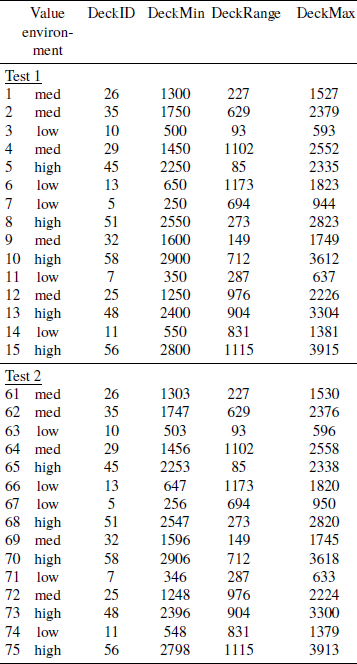
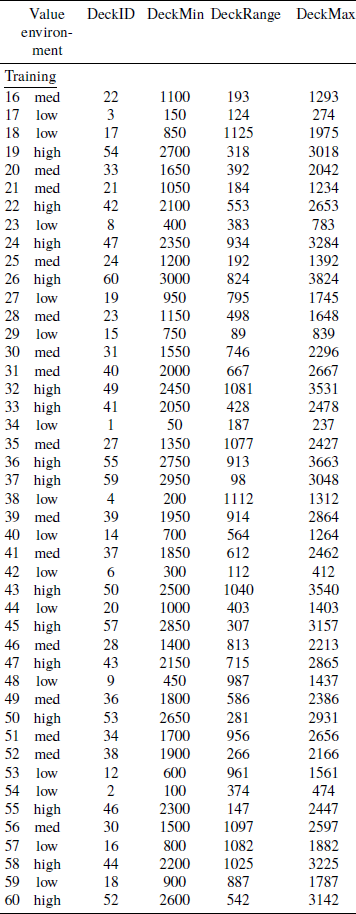
the distributions’ parameters were determined before the beginning of the experiment, and were the same for all participants in this study (randomly ordered, within each block). There were 60 unique decks (DeckID 1–60) with minimal values 50, 100, 150…, 3000 (DeckID*50). Each block (Test 1 / Training) was designed to include one third low decks (DeckID 1–20), one third medium decks (DeckID 21–40) and one third high decks (DeckID 41–60). The range (maximal value-minimal value) was randomly and independently (with replacement) selected from U[60,1200]. Test 2 decks were given the same DeckIDs as Test 1, but to make Test 2’s decks unique (in the sense that they are not exactly the same decks as in Test1), we added to or subtracted from the decks minimal values 2–6 points (randomly allocated to the 15 decks with the constrain that all additions/subtractions will sum up to zero). Ranges were kept the same.
The results of the above algorithm are presented in the table below (with the training on the next page). Notice that all participants experienced the same 75 decks, but the order within each block (Test1 / Training / Test 2) was randomly determined at the beginning of the task for each participant separately.
Appendix 2 – the distribution of thresholds and original results in Study 2 (before modification of extreme thresholds)
The table below provides descriptive statistics of the distribution of thresholds:

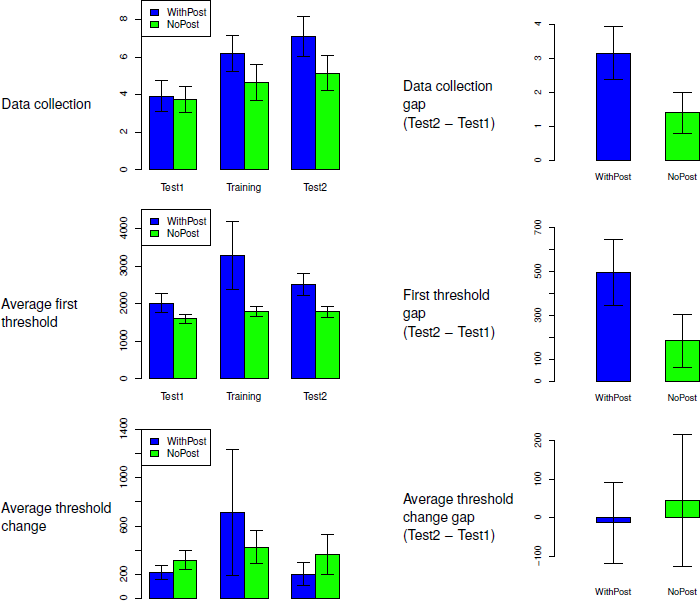
The graphs below present the means and SEs before coding extreme thresholds at the beginning of the round as data collection. Using extreme thresholds instead of the data collection option distort three main variables: data collection, first threshold and thresholds updating. As can be seen here (compared with Figure 5 in text), participants in the With-Post group apparently used this strategy more: while the green bars (No-Post group) remain relatively the same, inclusion of extreme thresholds in the With-Post group (blue bars) reveal less data collection (1 card less on average), higher first thresholds (more 500–1500 on average) and quicker updating rate of thresholds (evident especially during the training).
The main reason for the last result (extremely quicker updating during the training of the With-Post group) seems to be one participant, who typed during training extremely extreme thresholds (above 700,000) instead of using the data collection option. Figure 5 in text, presents the means after recoding extreme thresholds as data collection.
Notably, the strategy of typing in extreme threshold instead of using the data collection option was not a strategy only used by a very few participants. In fact, 34 participants (about 35%) used this strategy at least once, out of which 6 participants (about 5%) used this strategy quite frequently (more than 200 extreme thresholds). Looking at those extreme thresholds as representing data collection behaviors solved the problems above and the data makes more sense after this change. However, it is important to note that using extreme thresholds is not necessarily a bad strategy. Although typing in a large number demands more effort than pressing the “data collection” key, it enables the (unlikely) event of a huge gain, that will otherwise be missed. Such an event was not possible in the current task, but it is not very difficult to find examples in real life: for example, a huge discount for the first buyers of a product, as a way to promote sales is relatively common.


 Open access

