


Introduction
What factors are key for women’s parliamentary electoral success: institutional, country-level factors or party characteristics? This article offers a new contribution to the scholarly work on women in politics in several dimensions. Firstly, with respect to the conceptual contribution, we focus on the European Parliament (EP) and introduce a new unit of analysis to the study of women’s descriptive representation in the EP: a national political party. Previous comparative scholarly work on women’s political representation in the EP focused on the level of the 28 Member States (MSs) or on the 7 EP political groups (Aldrich, Reference Aldrich2020; Fortin-Rittberger & Rittberger, Reference Fortin-Rittberger and Rittberger2015; Stockemer, Reference Stockemer2007; Sundström & Stockemer, Reference Sundström and Stockemer2022). Yet, it is up to national political parties to decide whom to recruit, nominate and promote and how much support they give to candidates to enhance their electoral chances; internal party organization is vital in shaping the party-candidate relationship with respect to gender (Aldrich, Reference Aldrich2020; Childs, Reference Childs2013; Kelbel, Reference Kelbel2020; Kenny & Verge, Reference Kenny and Verge2016; Lühiste, Reference Lühiste2015; Sundström & Stockemer, Reference Sundström and Stockemer2022). Voters’ preferences and their potential gender bias play a role in explaining the impact of party’s ideology on the share of women elected (e.g. Erzeel & Caluwaerts, Reference Erzeel and Caluwaerts2015; Helimäki et al., 2024). This paper presents a novel model that simultaneously incorporates trends in political party characteristics, institutional factors, and cross-country trends in women’s representation, and robustly analyses the relationships between party- and MS-level factors and the election of women to the EP.
The second conceptual contribution of this study is a comparison of national parties from Central and Eastern Europe (CEE) Member States and the rest of the EU in terms of the impact of ideological factors on the share of women Members of the European Parliament (MEPs). While women’s political representation in advanced industrialized countries of Western Europe have gained extensive study, the new democracies that emerged after the fall of the communist regimes and joined the EU in 2004 (Czechia, Estonia, Latvia, Lithuania, Hungary, Poland, Slovenia and Slovakia), 2007 (Bulgaria and Romania) and 2013 (Croatia) provided a new and different setting for women’s rise to political power. According to Matland and Montgomery (2003), “the communist experiment with directive emancipation created a cultural and developmental legacy that differs in key respects from the Western democracies and countries in the developing world” (p. 19). Indeed, the average share of women MEPs from Central and Eastern European Countries (the CEECs) remains considerably lower than the average for the rest of the EU (34% for CEECs compared to 43% for non-CEE MSs after the 2019 elections). Interactions included in the model allow us to see different trends in CEE and non-CEE countries.
The paper furthermore provides a novel methodological approach, examining the characteristics of national political parties (ideology, attitude towards European integration, party size, incumbency rates) jointly with country-level variables (electoral systems, quotas, placement mandates) and socio-economic controls, assessing their relative impact on women’s election to the EP. The unit of analysis in the study is a national political party and the dependent variable is the percentage of women elected from a national political party. We perform a quantitative analysis using the within estimator at the country level, ensuring that any constant, unobserved country-level confounders (whether systemic, cultural or historical) are controlled for. Moreover, by exploiting within-country variation over the analyzed period, we ensure that a party’s ideological profile and other characteristics (e.g. party size) are assessed against the average country-level background. This approach permits extensive cross-country analysis while remaining grounded in the country-specific context. Finally, we include election year fixed effects to control for overall time-trend characterizing women’s EP representation across countries.
As for the empirical contribution, the article benefits from a novel, original database created for this study (Polak, Reference Polak2024) and a higher (compared to previous studies on women’s descriptive representation in the EP) number of observations. We analysed 197 national political parties that had their representatives in the EP during its 6th (2004-2009), 7th (2009-2014), 8th (2014-2019) and 9th (2019-2024) terms, resulting in 450 observations of the share of women MEPs and of various party characteristics over the four European elections, as well as 110 observations of country-specific electoral system features for each Member State in the 2004, 2009, 2014 and 2019 elections (see the data section and the online Appendix for more details). This data allowed us to employ an exhaustive multilevel design and separately investigate the impact of ideological factors on the share of women elected in CEE and non-CEE countries.
Our findings reveal that party characteristics, such as incumbency rates, party size, and ideological orientations, play a key role in shaping women’s representation. For ideological variables, we find different patterns for national parties in the CEECs and non-CEE member states. In Western MSs, the more Green-Alternative-Liberal a party is, the more women are elected from the party. However, in the case of the CEECs, such a relationship is lacking. What is more, a party’s position on European integration is a much more important factor in the CEECs than in the remaining Member States, where it is non-significant. In contrast to party-level characteristics, our findings reveal that few country-level institutional regulations are robustly significant across all model specifications. Most notably, legislated quotas are completely unrelated to women’s representation in any of the models. Other institutional factors, such as the electoral formula and zipper systems, are significant only in some model specifications. The results align with feminist institutionalist theories, emphasizing the importance of party arrangements, intra-party power struggles and party gatekeepers’ and voters’ attitudes towards female politicians over formal institutions.
The remainder of this article is structured as follows: the following section presents the theoretical background to the research and research questions. We then discuss the literature, dentify research gaps and state our hypotheses. Next, we explain data and methods and present results of the empirical analysis. The conclusions summarize the key takeaways and suggest directions for future research.
Women’s political representation
Political representation can be understood as a mediation between citizens and political decision-making through a representative or an assembly of representatives. Scholars who work on women’s representation mostly focus on dimensions of political representation that are descriptive (the number of women elected to legislative bodies) and substantive (attention to women’s political concerns and representation of their interests) and on the interplay between those two forms of representation (Celis et al., Reference Celis2008; Pitkin, Reference Pitkin1967). This paper deals with political representation in the sense of descriptive representation. While women’s presence in parliamentary assemblies is not always enough to guarantee full representation of their experiences, interests and priorities in the political agenda, it certainly is one of the prerequisites and conditio sine qua non of the accurate and balanced substantive representation (Celis & Childs, Reference Celis and Childs2008; Lovenduski, Reference Lovenduski and Lovenduski2005; Mackay, Reference Mackay2008; Wängnerud, Reference Wängnerud2009).
The EP elections offer a particularly suitable set-up for a cross-national study of women’s descriptive representation. MEPs are elected every five years from all the EU MSs; they represent almost 450 million EU citizens. The elections take place during the same week in all MSs and candidates across the EU compete for the same type of position. Electoral rules everywhere are similar, and all MSs are obliged to employ a proportional representation system (Fortin-Rittberger & Rittberger, Reference Fortin-Rittberger and Rittberger2015). There are substantial variations in the gender balances characterizing national delegations to the EP across MSs. In 2019, the range extended from no female MEPs in the case of Cyprus to 55% of women in the Finnish delegation. An even-wider range is observed when we take account of gender balance in national political parties’ delegations to the EP.
Scholars have identified country-level factors facilitating women’s descriptive representation in politics, including proportional representation electoral systems, the use of election quotas in tandem with placement mandates, the presence of certain cultural values within the broader system and a generally high level of socio-economic status (Aldrich & Daniel, Reference Aldrich and Daniel2020; Fortin-Rittberger & Rittberger, Reference Fortin-Rittberger and Rittberger2014; Inglehart & Norris, Reference Inglehart and Norris2003; McAllister & Studlar, Reference McAllister and Studlar2002; Rule, Reference Rule1987; Salmond, Reference Salmond2006; Tremblay, Reference Tremblay and Tremblay2012). At the same time, increasing attention has been paid to the central role of political parties, party gatekeepers and intra-party power struggles in women’s rise in politics. Voters’ ideological stances might also manifest in intentional and purposeful voting for female candidates. Erzeel and Caluwaerts (Reference Erzeel and Caluwaerts2015) found that Belgian Green party voters are the least likely, and right-wing liberal voters are the most likely, to vote for men only. According to Helimäki et al. (Reference Helimäki2024), in Finland, the left–right position appears to best predict women’s propensity to vote for a woman candidate.
This article addresses questions as follows: (1) To what extent do ideological orientations of national political parties (left-right, GAL-TAN, attitude to European integration) and a size of a party influence the electoral opportunities of women candidates to the EP? (2) Which factors – from the institutional, national level (quotas, electoral formula) or intra-party level, are more significant for the descriptive representation of women in the EP? (3) Are there different patterns of electoral success for women candidates from CEE-based political parties compared to the rest of the EU?
At the theoretical level, the study draws inspiration from the literature on women’s representation in legislatures discussed in subsequent sections and from feminist institutionalism. Feminist institutionalism assumes that constructions of masculinity and femininity are intertwined in the daily culture and ‘logic’ of political institutions, and that gendered practices influence institutional power relations, institutional dynamics, mechanisms of institutional reproduction, sources of institutional change and power inequalities in public and political life (Acker, Reference Acker1992; Lowndes, Reference Lowndes2014; Mackay et al., Reference Mackay, Kenny and Chappell2010). Feminist institutionalism is conducive to an understanding as to why certain formal, legislated gender-equality reforms, such as electoral quotas, fail to be effective. It highlights the impact of political parties and informal practices within parties on women’s political representation and political opportunities (Bjarnegård & Kenny, Reference Bjarnegård and Kenny2015; Franceschet & Piscopo, Reference Franceschet and Piscopo2014). According to feminist institutionalists, “investigating the gendered and institutional dimensions of opportunity structures within political parties is essential in order to explain women’s chronic minority status in politics, as well as the persistence of male dominance” (Bjarnegård & Kenny, Reference Bjarnegård and Kenny2016, p. 370).
In the work underpinning this article, following feminist institutionalists, we analysed data on the level of political parties. We suspect that they might be more important than country-level variables. Our large-N quantitative study has allowed for the testing of hypotheses, theories and insights developed by the vast body of feminist institutional qualitative, in-depth research.
Factors & hypotheses: Political parties’ level
Parties’ political orientation and views on social and cultural issues
It has been customary to presume that left-wing parties are more supportive of women’s political representation, as compared with right-leaning parties, given the former’s strong attachment to the values of social justice and equality, their greater sensitivity to the interests of groups historically excluded from power, and their closer links to the women’s movements (Rule, Reference Rule1987). However, some studies (Caul, Reference Caul1999; Erzeel & Celis, Reference Erzeel and Celis2016; Keith & Verge, Reference Keith and Verge2018; Stockemer, Reference Stockemer2007) suggest that, despite right-wing parties’ more conservative views on the traditional roles of women and men, they have made successful efforts to increase the number of women in their ranks in recent decades, leaving only a more-nuanced role of the left–right axis as an indicator of women’s political representation. The work detailed here has tested a hypothesis that the position of the party on the left-right spectrum does still matter when it comes to the election of women MEPs.
H1: The more left leaning the party is, the greater the ratio of women MEPs elected from that party.
Researchers argue that the traditional division between the ‘old left’ parties, which focus on the concerns of the working class, and the ‘old right’ parties, which focus on the interests of business, is no longer sufficient to describe the political scene accurately. Rather, the ‘new politics’ is deemed to be centred on post-materialist issues such as the environment, quality of life, self-expression, self-realization, feminism and minority rights. Post-materialist left parties (e.g. the Greens) are assumed to be more feminist than the ‘Old Left’ (Caul, Reference Caul1999; Erzeel & Celis, Reference Erzeel and Celis2016; Tranter & Western, Reference Tranter and Western2009). For their part, Sundström & Stockemer (Reference Sundström and Stockemer2022) analysed the reasons for variance in the proportion of elected women between political groups in the EP. The variable with the most predictive power was the group’s ideology (a higher proportion of women MEPs in Green, Liberal and Left groups). The study will verify the hypothesis that the more Green-Alternative-Liberal domestic party’s views on social and cultural issues are (as compared to Traditional-Authoritarian-Nationalist on the other side of the spectrum), the more female MEPs are elected from that party.
H2: The more post-materialist party’s views on social and cultural issues are, the more women MEPs are elected from that party.
Attitude toward European integration
Chiva (Reference Chiva2014) found that the stance of national political parties towards European integration was the most important determinant of the selection of female candidates for the EP in six post-communist MSs. She suggested that pro-European parties sought to gain credibility at the EU level, and therefore “tailor[ed] their candidate recruitment to the norms of equality they perceive[d] as dominant in the EP and in the other EU Member States” (Chiva, Reference Chiva2014, p. 472). The position of national parties on European integration has also been identified as the variable of greatest explanatory power in the case of EP elections in Czechia and Slovakia (Kovář & Kovář, Reference Kovář and Kovář2014). Kovář and Kovář’s research further shows that parties’ positions on European integration prove to be a source of variation between Czechia and Slovakia in terms of women’s representation in second-order elections. The findings of Chiva (Reference Chiva2014) confine themselves to six of the CEEC-MSs, while Kovář and Kovář (Reference Kovář and Kovář2014) studied Czechia and Slovakia alone. In contrast, by including all such MSs, this study can be deemed to explore the subject matter further.
H3: The more pro-European integration the party, the more women MEP candidates will be elected from that party.
Party size
It has been hypothesized that women’s electoral opportunities are greater in larger political parties. Large parties expect to win more mandates and therefore have a pool of “safe seats” that they can diversify and in which they can place women candidates (Reynolds, Reference Reynolds1999). What is more, large parties strive to appeal to as many voters as possible, and to achieve that they must present a diverse list of candidates, including a comparatively high share of women candidates (Sundström & Stockemer, Reference Sundström and Stockemer2022).
However, there is also an opposite line of reasoning, i.e. that larger, established parties are more risk averse. According to Kunovich & Paxton (Reference Kunovich and Paxton2005), parties that expect to win a large share of seats may be unwilling to go against the status quo and disrupt the historical male dominance on their electoral lists. On the other hand, smaller, marginal parties are more likely to take risks in choosing and supporting women as candidates.
Both these approaches are based on national political parties’ expectations of how many seats in the next EP they are going to win. We assume that party selectorates anticipate the number of winnable mandates not based on their results in previous elections (as Sundström & Stockemer did in their 2022 article) but based on the abundance of election polls conducted before the elections. Election polls, especially when aggregated, can provide relatively accurate estimates of how many mandates a party will win. POLITICO Poll of Polls informs that the average polling miss in their database is around 2.3 percentage points for individual polls, and 1.8 percentage point for the aggregated results (Hirsch, Reference Hirsch2021). A study of vote intention polls from more than 300 elections in 45 countries over a period of more than 70 years showed that the average historic polling error was around 2 percentage points (Jennings & Wlezien, Reference Jennings and Wlezien2018). Against that background, we use the actual number of MEPs elected in a given election as a proxy for how many seats party gatekeepers anticipated to win when creating electoral lists.
Since elections to the EP are second-order elections (Reif & Schmitt, Reference Reif and Schmitt1980) in which even large, well-established parties are more likely to take risks compared to national elections, our hypothesis states as follows:
H4: The more MEPs are elected from a party, the larger is the percentage of women MEPs in this party.
Idiosyncratic features of Central and Eastern European parties
Women’s political representation and the models of political recruitment found in advanced industrialized countries of Western Europe have gained extensive study. In turn, the new democracies that emerged after the fall of the communist regimes and joined the EU in 2004 (Czechia, Estonia, Latvia, Lithuania, Hungary, Poland, Slovenia and Slovakia), 2007 (Bulgaria and Romania) and 2013 (Croatia) provided a new and different setting for women’s rise to political power. Communist governments embraced gender equality, promoted women’s education, employment and economic independence, as well as supported abortion rights. However, party leaderships were in fact heavily male-dominated, leaving a legacy of facade-like gender equality and a common belief that politics is “a man’s business” (Gwiazda, Reference Gwiazda2015; Paxton & Kunovich, Reference Paxton and Kunovich2003). Although the eleven CEEC-MSs belong to three distinct groups, i.e. six former Soviet ‘satellite’ states, three Baltic republics once part of the Soviet Union and two former Yugoslav Republics, they all share common features in terms of women’s political representation: the descriptive under-representation of women in national legislatures, the marginalization of women’s voices in political debate and policy-making and perpetuation in political debate of gender stereotypes concerning women’s roles within the traditional family unit (Chiva Reference Chiva2018, p.178). The share of women elected to the EP from parties in the CEECs remains on average lower than from the rest of the EU. Against that background, it was our expectation that different patterns and factors might be found to support or hamper the election of female candidates to the EP in this region, as compared with Western Europe, with its known mechanisms.
H5: Central and Eastern European post-communist Member States follow different patterns in women’s elections to the European Parliament compared to the rest of the EU.
Country-level, institutional variables
Electoral formula
It has long been established that electoral systems have a significant impact on women’s representation. Proportional representation (PR) has been found to be more favourable to women candidates than single member district systems (cf. Stockemer, Reference Stockemer2007; (McAllister & Studlar, Reference McAllister and Studlar2002; Thames & Williams, Reference Thames and Williams2010; Valdini, Reference Valdini2012). Under the amended 1976 Electoral Act (Act concerning the election of the members of the European Parliament by direct universal suffrage, Art. 1), elections to the EP must be based on the PR system in all MSs. Within PR, MSs use an open-list system, a closed-list system or a single transferable vote system.
It has been argued that open-list PR (OLPR) systems are beneficial for women and other underrepresented groups because they allow candidates to appeal to voters on the basis of their personal or group experiences and to differentiate themselves from men. Golder et al. (Reference Golder2017) demonstrated that open electoral systems are associated with more votes for women. On the other hand, due to the nature of the OLPR, party leaders may feel less pressure to include women at higher positions on the list (Aldrich, Reference Aldrich2020). Chiva (Reference Chiva2018) found that, despite the rather conservative views of CEEC voters on gender roles, open-list systems in CEEC-MSs can challenge male dominance, rather than reproduce it.
In closed-list PR systems (CLPR), party leaders are expected to retain responsibility for promoting women into office and to balance the representativeness of their lists to attract a broad range of voters and manage the demands of different party factions. According to Aldrich, CLPR has been shown to include more women in ‘viable’ list positions because party leaders feel more obliged to nominate women higher up the list (Aldrich, Reference Aldrich2020, p. 677). Closed-list systems are suggested as bringing more gender-balanced results in MSs with higher levels of voter bias against women (McCracken et al., Reference McCracken2019).
The least popular electoral formula amongst the EU countries is a single transferable vote (STV) system, only applied in Malta and Ireland. In this formula, voters rank-order their preferred candidates on the ballot. The surplus votes for candidates who obtain office by quota are transferred to second-rank candidates, continuing until all the seats are filled. The impact of STV on women’s political representation has been debatable. Schwindt-Bayer et al. (Reference Schwindt-Bayer, Malecki and Crisp2010) argue that it is inappropriate to attribute a universal effect to STV rules as they merely translate voters’ sincere preferences (p. 694).
Since there are not enough observations to test STV separately, we use a dichotomized variable of OLPR and STV grouped together versus CLPR. This categorization is based on the rank ordering of electoral formulas by Carey and Shugart (1995). OLPR and STV are closer together in terms of providing voters a possibility to cast a personal vote (based on candidate’s reputation), while CLPR gives voters an incentive to cast a vote rather based on the party’s reputation.
Fortin-Rittberger & Rittberger (Reference Fortin-Rittberger and Rittberger2014) found that electoral formulas are non-significant statistically for the share of female MEPs elected. As studies prove inconclusive on which type of system is associated with greater gender balance, we have tested the effect of national electoral structure on the proportion of female MEPs.
H6: The proportion of elected women MEPs is higher in Member States using an open-list or single transferable vote proportional representation system compared to closed-list electoral formula.
National legislated quotas
Aldrich (Reference Aldrich2020) and Fortin-Rittberger and Rittberger (Reference Fortin-Rittberger and Rittberger2014) showed that the presence of quotas at the national level was associated with higher proportions of women on electoral lists in EP elections. However, they examined the share of female candidates on lists, not the share of elected MEPs. Stockemer (Reference Stockemer2007) found that quotas were not statistically significant for women’s representation in the 27 MSs’ national parliaments. Neither national legislative quotas nor voluntary party quotas were found to be statistically significant in explaining the gender variation among MEPs, by Lühiste & Kenny (Reference Lühiste and Kenny2016) and by Xydias (Reference Xydias2016). Górecki & Pierzgalski (Reference Górecki and Pierzgalski2021) suggest that the impact of gender quotas is limited unless combined with other favourable factors, such as political culture, elite commitment to the idea of quotas, post-quota elite commitment and the nuances of campaign spending. These findings are in line with the feminist institutionalist account that underlines informal party practices of quota subversions, such as giving women the opportunity to contest “no-hope” seats (Bjarnegård & Kenny, Reference Bjarnegård and Kenny2015, p. 752).
Our seventh hypothesis has been as follows:
H7: National legislative quotas have no effect on the proportion of women elected to the European Parliament.
Placement mandates
In seeking to put a stop to this process of placing women as candidates for no-hope seats, some countries adopt placement mandates. These are rules requiring the nomination of women to winnable constituencies or list positions (Aldrich & Daniel, Reference Aldrich and Daniel2019). One of the forms of placement mandates is the zipper system, under which parties are obliged to alternate men and women on the lists (usually at the top, for example within the first three or five positions). We thus control for the presence of legislated placement mandates as a factor supporting the election of women to the EP (Dahlerup, Reference Dahlerup2007; Delgado-Márquez et al., Reference Delgado-Márquez, Ramírez-González and López-Carmona2014; Freidenvall, Reference Freidenvall2019).
H8: More women are elected to the European Parliament in Member States where parties are obliged to alternate between men and women on electoral lists (i.e. where the zipper system is applied).
Control variables
Incumbency
Incumbents are more likely than political newcomers to secure the most electable candidate spots (Smrek, Reference Smrek2020). Incumbency advantage generally hinders women’s entry into politics, yet it can also work for their advantage once they secured political office. The set-up of our study does not allow for testing the incumbency advantage, but we control for men’s and women’s incumbency rates as an important factor influencing the percentage of women MEPs, allowing us to isolate the effects of other party-level variables from the incumbency factor. We define the male incumbency rate as the proportion of male incumbents among total party MEPs. Similarly, the female incumbency rate is the proportion of female incumbents among total party MEPs. The male and female incumbency rates sum to the total incumbency rate, which is the proportion of incumbents among total party MEPs.
Meserve, Pemstein and Bernhard’s research demonstrated the crucial role incumbency plays in parties’ candidate nomination strategies to the EP (Meserve et al., Reference Meserve, Pemstein and Bernhard2020). High incumbency rates limit the entry of new individuals to the political arena. Since in most of the world’s parliamentary assemblies, the lion’s share of incumbents are men, incumbent advantage is perceived as a vastly male privilege that hinders women’s electoral opportunities. Due to incumbency advantage, it is particularly challenging for women to contest and defeat predominantly male incumbents to win office. What follows, is that a decrease in the proportion of advantaged incumbents is expected to provide more room for female candidates to run for and win legislative seats (Schwindt-Bayer, Reference Schwindt-Bayer2005).
There is growing scholarly evidence that women parliamentarians also benefit from incumbency advantage (Smrek, Reference Smrek2020). While party gatekeepers may perceive female candidates as a riskier choice than men, a candidate that already holds office and has built a position in the EP is a much safer bet. Previous experience in the EP allows to develop name recognition, venue-specific policy expertise, personal networks, influence and seniority within the EP’s committee structures, as well as an understanding of how to navigate and manipulate the policy process (Meserve et al., Reference Meserve, Pemstein and Bernhard2020; Pemstein et al., Reference Pemstein, Meserve and Bernhard2015). Hermansen (Reference Hermansen2018) found that previous legislative performance and leadership positions in the EP has a consistently positive effect on re-selection by the national party. Gherghina & Chiru (Reference Gherghina and Chiru2010) also showed that previous experience in the EP has a positive impact on the ballot position of the candidate in the European elections.
GDP per capita
Our analysis controls for the wealth of an MS (as measured by GDP per capita), as more affluent countries tend to have higher percentages of women in parliaments than poorer ones (Inglehart et al., Reference Inglehart, Norris and Welzel2002). Existing scholarly work suggests that the wealth of a country is linked to women’s financial emancipation and the resources needed for campaigning (Kostadinova & Mikulska, Reference Kostadinova and Mikulska2017). Development leads to an increase in the pool of qualified women with political aspirations (Matland & Montgomery, Reference Matland, Kathleen A, Matland and Kathleen2003).
Cultural values
We furthermore control for cultural values that influence political culture and women’s opportunities. “Societal culture, especially in terms of the proper public role for women, will influence women’s success at each stage of the recruitment process” (Matland & Montgomery, Reference Matland, Kathleen A, Matland and Kathleen2003, p. 34). We use two dimensions of cross-cultural variation as conceptualized by Inglehart (Reference Inglehart1997). These encompass prevailing societal values in domains across a wide range from politics to economic life to sexual behaviour. One axis of cross-cultural value variation is “traditional vs. secular-rational values”, which measures how important a role religious doctrine plays in societies, with secular values indicating a largely reduced role for organized religion. The second dimension is “survival vs. self-expression values”, which indicates how autonomous individuals in a society are from kinship obligations in their life planning, with self-expression values emphasizing a high degree of individual autonomy (World Values Survey, 2023).
Drawing on evidence from the World Values Surveys/European Values Surveys for 1995–2001, Inglehart and Norris (Reference Inglehart and Norris2003) found a strong and significant correlation (r = 0.408, p = 0.004) between the proportion of women in parliaments across the world and the traditional-rational values axis. In another study, Ingelhart, Norris and Wenzel (Reference Inglehart, Norris and Welzel2002) found that gender equality is central to the set of beliefs and values captured by the survival vs. self-expression dimension. Gender issues constitute “a central component — arguably, the most central component — of value change in post-industrial societies” (Inglehart et al., Reference Inglehart, Norris and Welzel2002, pp. 105–106).
Data and methods
This study is based on data from the European elections of 2004, 2009, 2014 and 2019. The four consecutive elections were chosen to ensure consistency in terms of the number of MSs analysed and of socio-economic and cultural factors. The 2004 elections were the first European elections to include the ten new MSs that joined the EU in 2004 (i.e. Cyprus, Czechia, Estonia, Hungary, Latvia, Lithuania, Malta, Poland, Slovakia and Slovenia), eight of which were post-communist CEECs. The analysis also includes Bulgaria and Romania which joined in 2007 and held their supplementary elections to the EP the same year. Croatia joined the EU in 2013 and is included in regard to the 2014 and 2019 data.
For the purpose of the study, we created a novel database (Polak, Reference Polak2024) containing data on national political parties from the EP elections in 2004, 2009, 2014 and 2019. The database also compiles information on characteristics of national electoral systems. Data on MEPs and their national party allegiances have been sourced from the EP’s website. Parties’ positions on the left-right and GAL-TAN spectrum, and their stances on European integration were coded in line with the Chapel Hill Expert Survey (Bakker et al., Reference Bakker, Liesbet Hooghe, Gary Marks, Rovny, Steenbergen and Vachudova2020), and previous waves from 2006, 2010, and 2014).
Incumbency ratio has been calculated based on the aforementioned database for MEPs elected in 2004, 2009, 2014 and 2019, combined with data from COMEPELDA (Däubler et al., Reference Däubler, Chiru and Hermansen2022) for MEPs elected in 2000.
The electoral formula (OLPR/CLPR/STV) for the 2004 and 2009 elections was coded on the basis of the COMEPELDA database – comprehensive EP election data forming an aggregated dataset with country-level information and party-level results (Däubler et al., Reference Däubler, Chiru and Hermansen2022; Däubler & Hix, Reference Däubler and Hix2018). For the 2014 and 2019 elections, we used information provided by the European Parliamentary Research Service (Prpic et al., Reference Prpic, Sabbati and Chahri2020; Prpic & Chahri, Reference Prpic and Chahri2017). Nationally legislated electoral gender quotas and placement mandates were also as coded using materials from the European Parliamentary Research Service (Zamfir, Reference Zamfir2023).
GDP per capita was sourced from Eurostat (2024). Scores for the Inglehart-Welzel Cultural Maps 2022 and 2023 were used to operationalize cultural values. Scores were downloaded from the World Values Survey website (World Values Survey, 2022, 2023). In cases where a score for 2004, 2009, 2014 or 2019 was not available, a score from the closest available year was coded for that election.
The data was analysed using STATA statistical software. Due to missing data on GAL-TAN, left-right and European integration variables in 2004 and 2009, no party from Cyprus, Malta and Luxembourg was included in the final sample (those MSs were added for the 2014 and 2019 elections once the data became available). To gain a more comprehensive understanding of the dynamics at party level, we excluded 200 political parties with only one MEP elected. We consider full descriptive representation (100%) or non-representation (0%) of women in parties with only one MEP as governed by a qualitatively different process than full or no representation in parties with more elected MEPs. Full representation in parties with only one MEP is likely less representative of a party’s internal political environment, but more likely driven by non-generalizable and non-structural causes. To avoid confounding, we excluded parties with one MEP elected, resulting in a final number of observations equal to 450 (see Figure 1).
Distribution of national political parties included in the final dataset (N=450) by the percentage of women MEPs.
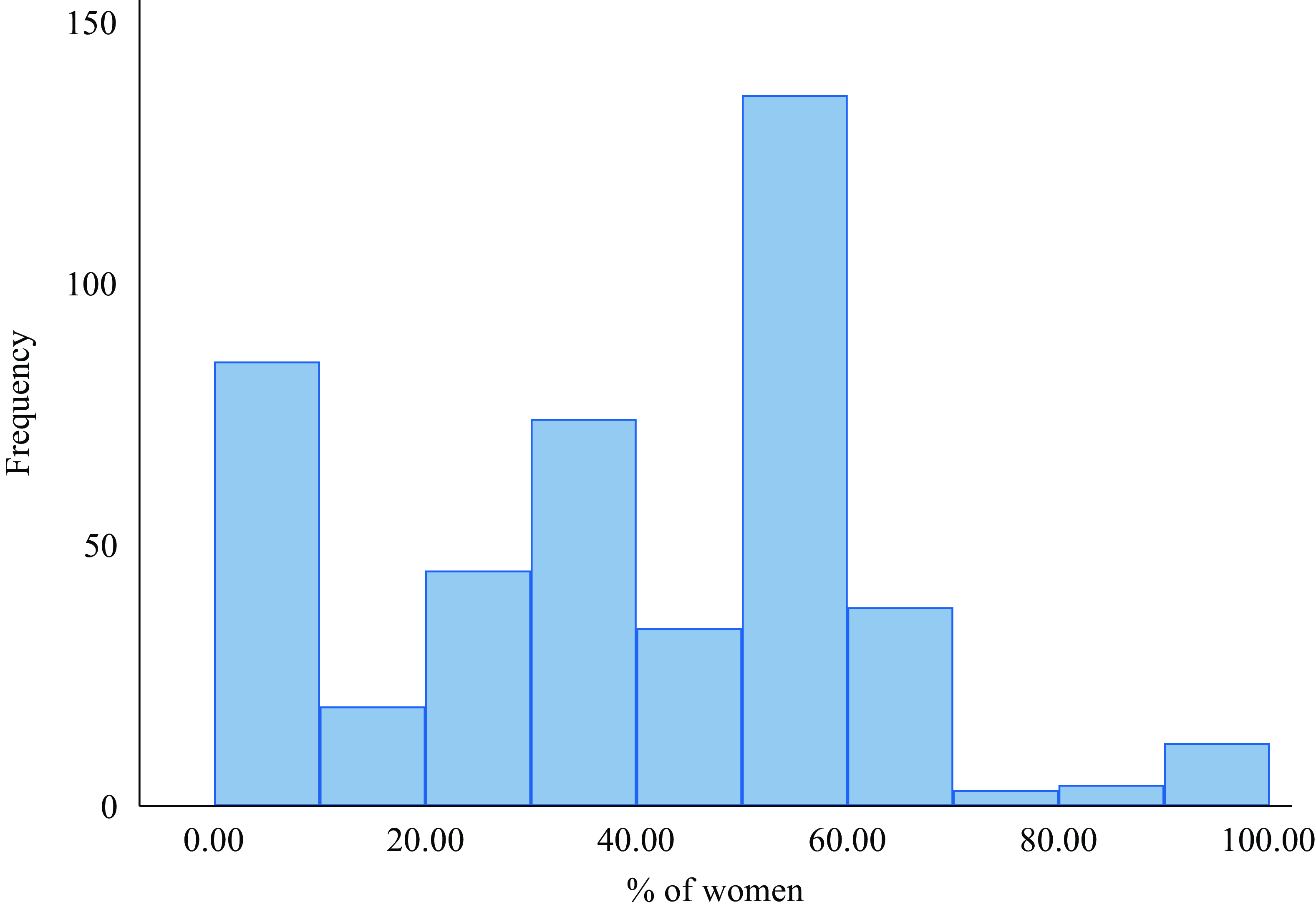
The analysis takes the proportion of women elected from a particular party in a particular year as a dependent variable. Independent variables are of two types. The first type is measured at the country level, such as a country’s score on the traditional vs. secular-rational cultural axis. These variables are the same for all parties within a specific member state in a given year. The second type of independent variable is measured at the party level. These variables vary for each party each year. Examples of these include a particular party’s stance on European integration in particular election-year.
In our regression analysis we include country-level fixed effects, which is equivalent to using “within” or “demeaning” estimators at a country level. In practice, for independent variables measured at a country level, we analyse the effects of its temporal variation on the proportion of women elected from a particular party. For independent variables attributable at a party level, we inspect the within-country effect, which quantifies the deviation of a specific party’s ideological stance from the overall MS political background (i.e. the country’s mean). Furthermore, we assume that each party i is characterized by its individual, unobservable characteristics, which we model as a random effect $part{y_{i\;}}\sim \;N\left( {0,\sigma _i^2} \right)$
. We interpret within effects for categorical predictors (e.g. the zipper system) following recommendations made by Yaremych et al. (Reference Yaremych, Preacher and Hedeker2023).
$part{y_{i\;}}\sim \;N\left( {0,\sigma _i^2} \right)$
. We interpret within effects for categorical predictors (e.g. the zipper system) following recommendations made by Yaremych et al. (Reference Yaremych, Preacher and Hedeker2023).
The following equation illustrates our analytical framework for a simple model with one variable measured at the party level $({X_{jit}}$
) and one variable measured at the country level (
$({X_{jit}}$
) and one variable measured at the country level ( ${Z_{tj}})$
:
${Z_{tj}})$
:
 $${Y_{itj}} = \;{\beta _0} + {\beta _1}\;\left( {{X_{itj}} - \overline {{X_j}} } \right) + {\beta _2}\left( {{Z_{tj}} - {{\overline Z}_j}} \right) + yea{r_t} + part{y_i} + {\varepsilon _{itj}}$$
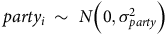 $$part{y_{i{\rm{\;}}}}\sim {\rm{\;}}N\left( {0,\sigma _{party}^2} \right)$$
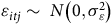 $${\varepsilon _{itj}}\sim {\rm{\;}}N\left( {0,\sigma _\varepsilon ^2} \right)$$
Where ${Y_{itj}}\;$
is the dependent variable, i.e., the proportion of women elected from party i in year t in country j.
${Y_{itj}}\;$
is the dependent variable, i.e., the proportion of women elected from party i in year t in country j. ${X_{itj}}$
denotes an independent variable measured at the party level (e.g., the party’s position on the GAL-TAN scale), while
${X_{itj}}$
denotes an independent variable measured at the party level (e.g., the party’s position on the GAL-TAN scale), while $\overline {{X_j}} $
represents the country-level context, i.e., the average of
$\overline {{X_j}} $
represents the country-level context, i.e., the average of ${X_{itj}}$
across parties and election years in country j. Similarly,
${X_{itj}}$
across parties and election years in country j. Similarly, ${Z_{tj}}$
denotes an independent variable measured at the country level (e.g., presence of the zipper system), and
${Z_{tj}}$
denotes an independent variable measured at the country level (e.g., presence of the zipper system), and ${\overline Z_j}$
is its average across election years. Finally,
${\overline Z_j}$
is its average across election years. Finally, $yea{r_t}$
denotes election-year fixed effects.
$yea{r_t}$
denotes election-year fixed effects.
In the context of cross-country analysis, focusing on within-country variation offers two major benefits. Firstly, it automatically controls for unobserved country-level confounders that could be correlated with both the independent variables and the percentage of women MEPs, potentially biasing the model estimates. Secondly, for party-level covariates, the estimate ${\beta _1}\;$
allows us to capture the significance of a particular political party’s ideological stance, accounting for its contextual political environment
${\beta _1}\;$
allows us to capture the significance of a particular political party’s ideological stance, accounting for its contextual political environment $\;\left( {{X_{itj}} - \overline {{X_j}} } \right).$
This approach naturally encapsulates the divergent influences of being a nominally centrist party in a traditionally left- or right-wing dominated political landscape, thereby permitting cross-country analysis grounded in a country-specific context.
$\;\left( {{X_{itj}} - \overline {{X_j}} } \right).$
This approach naturally encapsulates the divergent influences of being a nominally centrist party in a traditionally left- or right-wing dominated political landscape, thereby permitting cross-country analysis grounded in a country-specific context.
Finally, turning to institutional factors $\left( {{Z_{tj}} - {{\overline Z}_j}} \right)$
, we note that our focus on within-country variation means we do not assess the importance of a particular institutional factor unless it changes over time. Indeed, such institutional features are controlled for (as are any constant country-level confounders), but their impact cannot be statistically disentangled from a multitude of other country-specific systemic or background characteristics. Despite the considerable advantages of this approach, it naturally reduces the number of countries that can test relevant institutional hypotheses. During the analysed period, eight member states changed legislated quotas, three introduced the zipper system and two changed their electoral formula. While our unit of analysis is at the party level, and there are many parties operating within countries affected by these changes, it can be argued that these specific countries may not be representative of the broader impact of relevant institutional changes. Acknowledging the limitations of our design, we do not claim to provide definitive causal implications of the institutional shifts. Nevertheless, we offer a model that simultaneously incorporates trends in political party characteristics, country-level socioeconomic factors and cross-country trends in women’s representation. This two-level quantitative framework provides a unique context to test hypotheses regarding institutional changes, offering a new statistical background which in the future can be extended through dedicated quantitative analyses and individual case studies.
$\left( {{Z_{tj}} - {{\overline Z}_j}} \right)$
, we note that our focus on within-country variation means we do not assess the importance of a particular institutional factor unless it changes over time. Indeed, such institutional features are controlled for (as are any constant country-level confounders), but their impact cannot be statistically disentangled from a multitude of other country-specific systemic or background characteristics. Despite the considerable advantages of this approach, it naturally reduces the number of countries that can test relevant institutional hypotheses. During the analysed period, eight member states changed legislated quotas, three introduced the zipper system and two changed their electoral formula. While our unit of analysis is at the party level, and there are many parties operating within countries affected by these changes, it can be argued that these specific countries may not be representative of the broader impact of relevant institutional changes. Acknowledging the limitations of our design, we do not claim to provide definitive causal implications of the institutional shifts. Nevertheless, we offer a model that simultaneously incorporates trends in political party characteristics, country-level socioeconomic factors and cross-country trends in women’s representation. This two-level quantitative framework provides a unique context to test hypotheses regarding institutional changes, offering a new statistical background which in the future can be extended through dedicated quantitative analyses and individual case studies.
Results and discussion
Table 1 presents results of the three models estimated using the within estimator at the country level. Note that for variables measured at a party level (e.g. GAL-TAN scale), a ${\beta _1}\;$
estimate implies that, for a given country, a party with a one-unit higher score on GAL-TAN scale (compared to what is typical for this country), is characterized by a proportion of women representation decreased by
${\beta _1}\;$
estimate implies that, for a given country, a party with a one-unit higher score on GAL-TAN scale (compared to what is typical for this country), is characterized by a proportion of women representation decreased by ${\beta _1}$
, compared to what is typical for this country. For country-level variables (e.g. zipper system), the estimate of
${\beta _1}$
, compared to what is typical for this country. For country-level variables (e.g. zipper system), the estimate of ${\beta _2}\;$
implies that, within a given country, parties’ proportion of women representation increases in periods with the zipper system was introduced, on average, by
${\beta _2}\;$
implies that, within a given country, parties’ proportion of women representation increases in periods with the zipper system was introduced, on average, by ${\beta _2}$
.
${\beta _2}$
.
Estimation results of three models
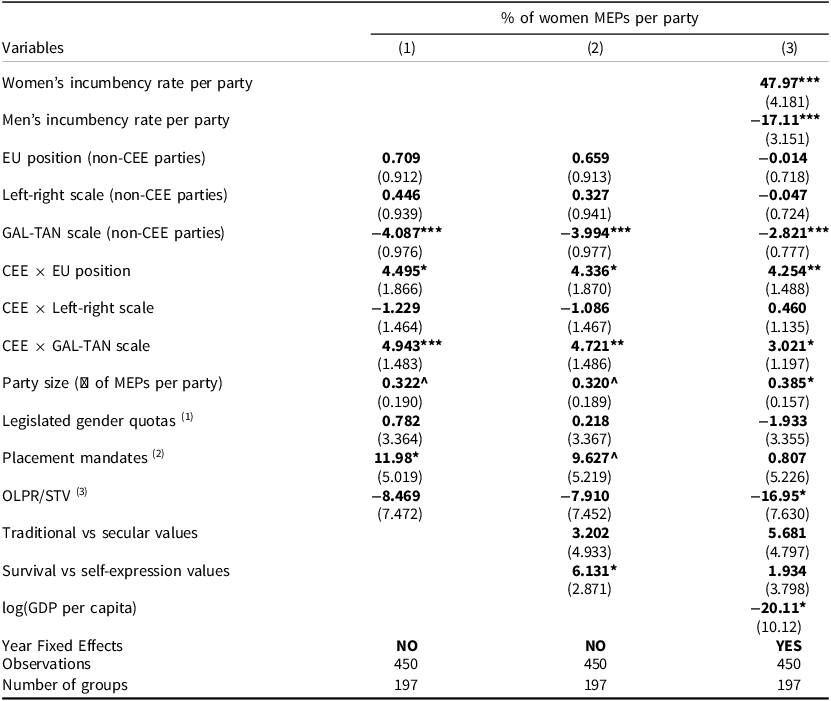
Standard errors in parentheses.
*** p < 0.001, ** p < 0.01, * p < 0.05, ^ p < 0.1.
Baseline category for dichotomous variables: (1) No quotas; (2) No zipper system; (3) CLPR electoral formula.
To elucidate the contribution of relevant variables to the final results, we provide three separate models, each expanding on the number of included variables. Model 1 includes all independent variables related to hypotheses H1-H8. Model 2 is extended by incorporating variables accounting for simultaneous shifts in cultural values. Our primary and most comprehensive Model 3 includes controls for incumbency rates, wealth and cultural values characterizing a particular country in a given year, as well as year fixed effects, which account for the overall time trend in women’s representation across countries. While the discussion in this section primarily focuses on the results of the most robust Model 3 (it explains approximately 43% of the within-country varianceFootnote 1 ), we also examine all models in detail when the significance of certain variables is affected by the inclusion of additional controls.
Model 1 includes all independent variables related to hypotheses H1-H8. Model 2 is extended by incorporating variables accounting for simultaneous shifts in cultural values. Model 3 includes controls for incumbency rates, wealth and cultural values characterizing a particular country in a given year, as well as year fixed effects, which account for the overall time trend in women’s representation across countries. Note that country-level fixed effects and party-level random effects are incorporated into all three models. For alternative specifications of standard errors, which yield results very similar to those discussed here, see online Appendix A.
Firstly, our results confirm a strong significance of women’s incumbency rate and male incumbency rate per party for the percentage of elected female MEPs. Note that these results are almost mechanical as, for example, a high women’s incumbency rate necessary implies a higher percentage of elected female MEPs. However, in the data there are many parties that have an equal women’s incumbency rate yet vary in the percentage of elected female MEPs. As Table 1 indicates, part of this variation can be accounted for by other significant factors considered in the model. Nevertheless, significant estimates of women’s incumbency rates and male incumbency rate are in line with Meserve et al. (Reference Meserve, Pemstein and Bernhard2020), whose “strongest results point towards incumbency bias as the main driver of variation in descriptive representation across genders” (p. 13).
With the incumbency rates controlled, the analysis of within-country effects consistently reveals heterogeneity in the relationship between ideological variables and the percentage of elected female MEPs in CEECs as opposed to non-CEECs. The estimates of the relationship between political parties’ stances on European integration and the percentage of women MEPs elected is significant in the case of the CEECs, yet virtually absent in the non-CEE MSs (see Figure 2a). Such results are in line with the conclusions of Chiva (Reference Chiva2014), who implies that, in the new EU MSs, pro-European parties (be they left- or right-leaning) are more likely to adopt the EU’s normative discourse on gender equality in their strategies and to promote more female candidates to the EP. They aspire to fit into a parliamentary assembly in which gender equality is a well-established norm, even though this may remain a fiercely contested issue in their respective domestic political arenas. Eurosceptical parties, on the other hand, tend to question such a discourse as incompatible with national traditions and a reflection of the dominant liberal European ideology (Chiva, Reference Chiva2014, p. 484, 2019).
(a, b and c) Divergent marginal effects from Model 2 in CEECs and non-CEECs. Notes: Figure 2a displays slopes of association between a party’s European Integration stance and the percentage of women elected. Figure 2b displays slopes of association between party position on GAL-TAN scale and percentage of women elected. Figure 2c displays slopes of association between party position on left-right scale and percentage of women elected. All variables are relative to country-level average. Histograms present a frequency of deviations from country-level averages with respect to particular variables. Example interpretation: a non-CEE party with a one-unit higher score on the GAL-TAN scale (relative to what is typical for that country) is expected to have women’s representation that is 2.821 percentage points lower than the average women’s representation in that country.
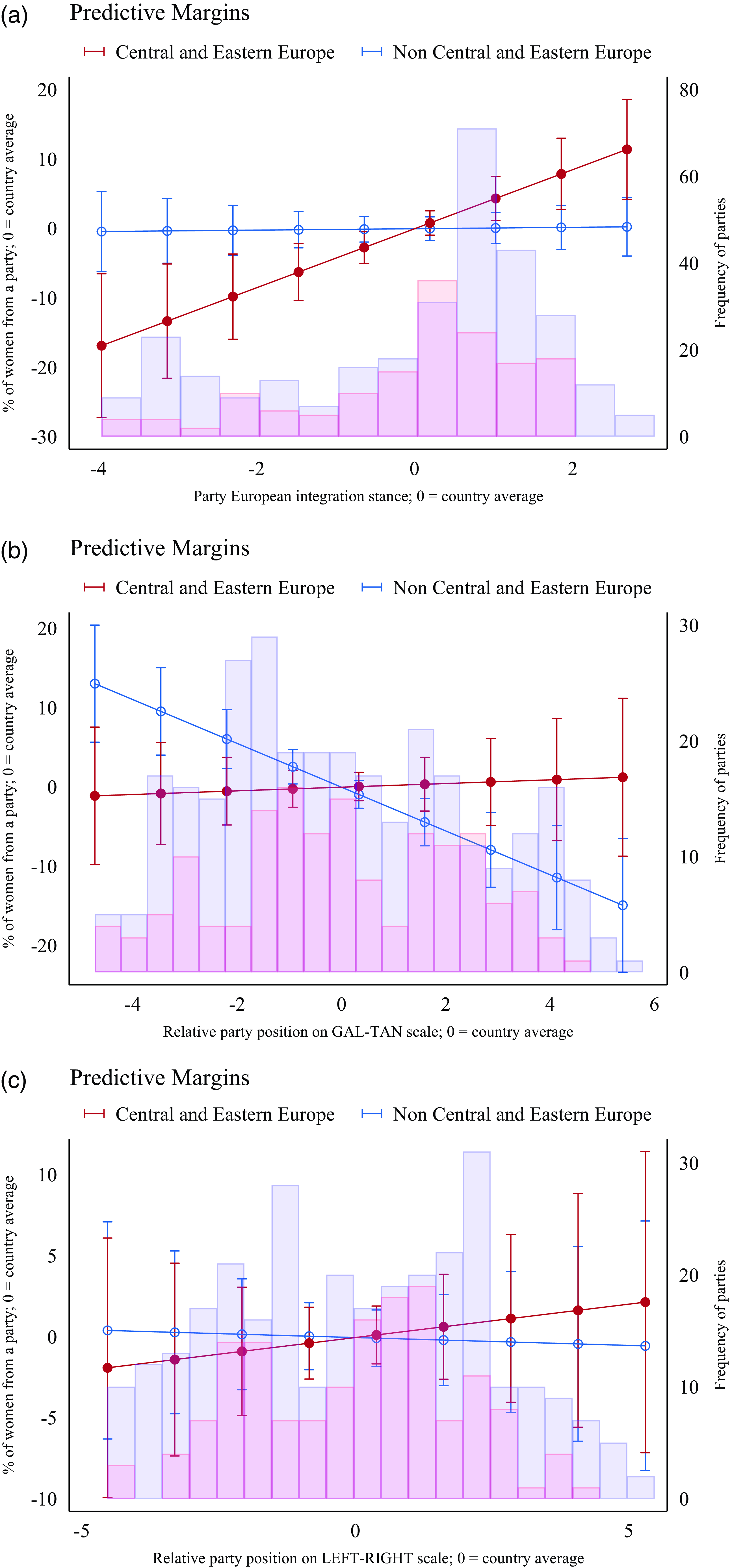
The models also reveal a heterogeneity with respect to the estimates of a relationship between a given party’s ideological position on the GAL-TAN scale and proportion of women MEPs. Indeed, when we examine the predictive margins for the GAL-TAN index with the interaction term included, we observe distinct slopes for CEEC and non-CEEC MSs (see Figure 2b). Our evidence suggests that, in Western Europe, there is a clear linear prediction indicating that the more traditional, authoritarian and nationalist a party is (compared to country-level background), the smaller the number of women elected from that party. In contrast, across the CEECs, this relationship does not exist. Taking these patterns into account, Hypothesis 2 is confirmed for the non-CEE MSs, but rejected for Central and Eastern Europe.
These intriguing results could be somehow explained by Enyedi and Deegan-Krause (Reference Enyedi and Deegan-Krause2017), who note that since the 1990s, party politics in CEE has drifted closer to the “Western standard model” of political cleavages in consolidated democracies. Yet, they also remark that “in many ways, however, the East has remained quite different from the Western standard model: the issues and issue combinations are often different than in Western Europe” (Enyedi & Deegan-Krause, Reference Enyedi and Deegan-Krause2017, pp. 169–170). While the main dimensions and axis of political competition are similar, CEE is characterized by more emphasis on conflict over nation or authoritarian traditional practices and less on post-materialist issues such as gender (Enyedi & Deegan-Krause, Reference Enyedi and Deegan-Krause2017, p. 172). Our results offer a new background against which to extend investigation of this matter through dedicated quantitative analysis and individual case studies.
A party’s position on the left-right scale, on the other hand, does not have a statistically significant effect on the percentage of women MEPs elected in our model; hypothesis 3 is therefore rejected. Additionally, there is not much difference between CEE and non-CEE countries (see Figure 2c).
Finally, we note that parties larger in size than the average party in a given country tend to have significantly greater women’s representation (p < 0.1 in Model 1 and Model 2; p < 0.05 in Model 3). The significance of party size increases upon controlling for incumbency rate in Model 3, due to a positive relationship between party size and male incumbency rate in our dataset. If this relationship is not controlled for, it confounds the slope estimate (for a model that includes only incumbency rate controls and a more detailed discussion of this effect, see Appendix B).
Overall, with incumbency rate controlled for, the finding that larger parties tend to have significantly greater women’s representation supports the reasoning that bigger parties have a pool of “safe seats” that they can diversify by placing women candidates (Reynolds, Reference Reynolds1999). Additionally, larger parties often seek to attract a broader electorate by promoting a diverse slate of candidates (Sundström & Stockemer, Reference Sundström and Stockemer2022), which implies that party size disproportionately benefits female candidates.
Turning to institutional factors, we first investigate the role of legislated quotas, noting that as much as eight countries changed legislation regarding gender quotas during the analysed period. Nevertheless, in none of the models we find significant statistical increase in the representation of women in parties within MS that adopted legislated quotas.
Conversely, we find that the introduction of a zipper system and changes in electoral formulas yield significant results in certain model specifications. Specifically, Model 1 reveals that, on average within a given member state, the introduction of a zipper system increased the proportion of women MEPs elected from parties (p < 0.05). However, this effect becomes significant only at p < 0.1 if we control for simultaneous shifts in societal values and non-significant in Model 3, which controls for simultaneous shifts in societal values as well as cross-country trends of women’s representation (election-year fixed effects).
This pattern of results may be driven by the fact that placement mandates are an additional reinforcement of gender quotas and can be seen as a more radical form of affirmative action towards gender equality, which would require and coincide with shifts in the societal values in the first place. Indeed, placement mandates require strong societal support for the equality-of-outcomes principle (as opposed to the equality of opportunity, see Dahlerup Reference Dahlerup2007) and consequently societal pressure on politicians to introduce such strong measures (see: Inglehart & Norris Reference Inglehart and Norris2003, p. 149). Thus, controlling for the sifts in societal values jointly with the cross-country trend of women’s representation (year fixed effects which partially account for the estimates of zipper system introduction), yields the placement mandates non-significant in the final specification.
Next, Model 3 provides statistical evidence suggesting that changes in electoral formulas away from CLPR significantly decrease the proportion of women elected from parties within the countries affected by the change (p < 0.05). Taking model estimates at face value, ceteris paribus, changes away from CLPR are, on average, related to a 16.95 percentage point’s decrease of the percentage of women elected from parties within the countries affected by the change. The magnitude of this effect is roughly 60% that of ideological variables. Indeed, the final model estimates suggest that ceteris paribus, a CEE party shifting from the most negative stance on European integration to the most positive (by 6 points) is expected to see a 25.4-percentage-point increase in women’s representation. Similarly, a non-CEE party with the lowest score on the GAL-TAN scale (0.16) is expected to have a 27.8-percentage point higher women’s representation compared to a party with the highest score on the GAL-TAN scale (10.0). Overall, the significance of shifts in electoral formula suggests that in the MSs with CLPR party leaders, there is a feeling of more responsibility to nominate women higher up on the list (Aldrich, Reference Aldrich2020) or it is rather voters than party gatekeepers that are biased against women candidates (McCracken et al., Reference McCracken2019). Interestingly, this relationship is not significant in the Models 1 and 2, which indicates that the effects of transitioning from CLPR to OLPR are particularly pronounced relative to what would be expected given specific country trends in cultural values, GDP per capita and the cross-country trend of women’s representation (captured by year fixed effects).
Finally, Model 2 suggests that (controlling for all ideological and institutional variables) the traditional vs. secular axis is not significantly related to the percentage of elected female MEPs. In contrast, the survival versus self-expression emerges as significant. The importance of the survival versus self-expression spectrum for the election of women MEPs is linked to the findings of Inglehart, Norris, and Welzel (Reference Inglehart, Norris and Welzel2002), which showed a strong correlation (r = 0.86) between adherence to survival values and the belief that “Men make better political leaders than women” (Inglehart et al., Reference Inglehart, Norris and Welzel2002, p. 104). This aligns with the results of Paxton and Kunovich (Reference Paxton and Kunovich2003), who found that societal ideological beliefs influence both women’s decisions to run for office (the supply side) and the likelihood that voters will vote for women, as well as the support female candidates receive from party elites (the demand side).
Note, however, that in Model 3, which critically controls for simultaneous trends of (logged) GDP per capita, the survival versus self-expression axis ceases to be significant. This is likely due to the strong correlation between these two variables (r = 0.86, p < 0.001). Such a strong association is consistent with the finding that self-expression values are connected with the transition from an industrial society to a service or knowledge society (Inglehart & Welzel, Reference Inglehart and Welzel2005). In our case, this correlation makes the separate interpretation of these two variables very difficult. Therefore, in Model 3, we treat them purely as control variables.
Conclusions
The work underpinning this paper saw us investigate cross-party and cross-national differences in the descriptive representation of women in the EP. We examined data from four European elections: 2004 (2007 for Bulgaria and Romania), 2009, 2014 and 2019, with a total of 450 observations. Our study confirmed the key role of party characteristics such as incumbency, party size and party ideology in the electoral success of both men and women candidates. On the other hand, few institutional arrangements are significantly related to women’s representation in the EP. We find no significant increase in the representation of women in parties within member states that adopted legislated quotas. The introduction of a zipper system, which obliges parties to alternate men and women on electoral lists, becomes insignificant once we jointly control for shifts in societal values and the cross-country trend of women’s representation. The only institutional arrangement significantly related to women’s increased representation in the final model specification is the electoral formula, with changes from OLPR or STV to CLPR reducing the proportion of women elected from parties within the countries affected by the change (p < 0.05). The comparison of three models reveals that the significant decrease in women’s representation following the shift from CLPR to OLPR goes against what would be expected based on a country’s trends in other socioeconomic factors affecting women’s representation. This finding requires further investigation into countries that changed their electoral formula to understand the context and consequences, preferably through case studies.
Importantly, the paper identified divergent patterns for the CEECs on the one hand and the rest of the EU on the other. In the old MSs, we observed a clear trend that: the more green-alternative-liberal a party is, the more women are elected from that party. We find no such relationship in the CEEC-MSs. On the other hand, a party’s attitude towards European integration has a considerably greater influence on the share of women MEPs elected in CEEC-MSs compared with the rest of the EU. The relationship between party attitudes towards European integration and the proportion of women elected to the EP from the CEECs can be accounted for by reference to the undertakings of party selectorates. As suggested by Chiva (Reference Chiva2014), pro-European parties from the different CEECs are likely to “tailor their candidate recruitment to the norms of equality they perceive as dominant in the EP and in the other EU member states” (Chiva, Reference Chiva2014, p. 472) to gain credibility at the EU level. Our analysis supports that hypothesis, especially that we find no comparable effect for the non-CEE Member States.
The results are consistent with the feminist-institutionalist account. When studying factors that support or impede women’s election to parliamentary assemblies, we should indeed ‘stress the concept of rules-in-use rather than focusing on rules-in-form’ – where the former are understood as ‘the dos and don’ts that one learns on the ground that may not exist in any written document’ (Ostrom, Reference Ostrom, Sabatier and Press2017, p. 23). The existence of legislated quotas at the national level – an example of formal, institutionalized affirmative action for gender equality – did not prove statistically significant for the election of women to the EP. Informal practices and informal forms of power, such as political capital possessed by incumbents, turn out to be much more important. Different patterns identified in CEE and Western Member States are also likely due to Ostrom’s rules-in-use rather than rules-in-form.
This study certainly has several limitations. Firstly, we do not analyse electoral lists with all the candidates for MEPs; the dataset contains only candidates that have been successfully elected to the EP. Secondly, we are not able to distinguish between the effects of voters’ preferences expressed through voting choices and the influence of preferences of party gatekeepers. For instance, we are not able to separate effects of progressive voters’ preference for female candidates from progressive party gatekeepers’ support for women running for office from their lists manifested in supporting and providing resources for their campaigns, giving women viable positions on electoral lists etc. One potential avenue of examining such effects could be to test the interactions between the electoral formula (preferential voting/closed lists systems) and party-level ideological variables. However, as demonstrated in Appendix C, such interactions turn out to be insignificant and therefore do not help in solving this puzzle.
Thirdly, while our focus on within-country variation offers significant statistical advantages, it also implies that the estimates of institutional factors’ impact on party-level women’s representation are based on countries that changed relevant institutional features during the analysed period. Thus, while our findings provide a comparable cross-country, quantitative background, more dedicated analysis is needed to study in detail institutional arrangements that vary relatively rarely and affect relatively a smaller number of parties (such as the zipper system and electoral formula). Finally, despite including a rich set of control variables as well as country- and election-year fixed effects, we do not claim to provide definitive causal impacts of the analysed factors on women’s representation. Instead, we offer a novel, descriptive statistical model that robustly analyses the relationships between party- and country-level factors and the election of women to the EP. Finally, we do not address the impact of electoral viability of a party on the percentage of women MEPs.
Looking ahead, our findings raise new research questions. In the Western political parties, we see a clear correlation: the more “GAL” the party is, the higher share of women MEPs elected from this party. Why is this correlation non-existent in Central and Eastern Europe? Does the positive correlation between a pro-EU party attitude and the share of women MEPs elected from these political parties stem only from aspirations to fit into the EU’s established normative discourse on gender equality, or are there some other contributing factors? Are the mechanisms observed in the EP elections also present in the case of elections to national parliaments or local elections? These questions require further in-depth analysis.
Supplementary material
Appendixes for this article can be found at https://doi.org/10.1017/S1755773924000286. Replication codes and data can be found at https://doi.org/10.5281/zenodo.13860982.
Acknowledgments
This article originated in a course taken by Aleksandra Polak and taught by Professor Wojciech Gagatek, whom she would like to thank for his guidance. The authors would also like to thank the anonymous reviewers, as well as Professor Adam Gendźwiłł, Dr. Michał Gulczyński and the participants of conferences and workshops where the article was presented at various stages of its development, for their helpful comments and invaluable suggestions on how to improve the study.
Funding statement
Research funding for this study was provided by the National Science Centre, Poland [Grant number 2021/41/N/HS5/02539, awarded to Aleksandra Polak].
Competing interests
The authors declare no competing financial or other interests.


 Open access

