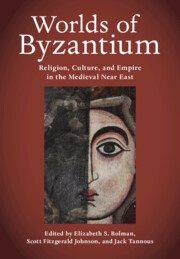
One - Worlds of Byzantium
Problems, Frameworks, and Opportunity in the Byzantine Near East
Published online by Cambridge University Press: 18 October 2024

Summary
This chapter sets the scene for a reorientation of thinking about the scope of Byzantium and Byzantine Studies for a new generation of scholarship. It charts the changes in the field since the seminal *East of Byzantium* volume of 1982 and argues for the inclusion of the broader Christian East under the umbrella of Byzantine Studies. To what degree is “East Rome” too limiting a concept for the vibrant fields of Eastern Christian Studies that find themselves often adjacent to Byzantium in modern scholarship? At the same time, real connections and disconnections must be explored across political and imperial lines, and the value of Global History is assessed as a tool for understanding the field holistically. The Byzantine Near East is a burgeoning field that brings many new questions and a host of literary, artistic, and material evidence to bear on what “Byzantium” meant in the early Middle Ages.
Information
- Type
- Chapter
- Information
- Worlds of ByzantiumReligion, Culture, and Empire in the Medieval Near East, pp. 1 - 36Publisher: Cambridge University PressPrint publication year: 2024
References
Abulafia, David. “Mediterraneans.” In Rethinking the Mediterranean, edited by Harris, William V., pp. 64–93. Oxford: Oxford University Press, 2005.CrossRefGoogle Scholar
Agapitos, Panagiotis. “Contesting Conceptual Boundaries: Byzantine Literature and Its History.” Interfaces: A Journal of Medieval European Literatures 1 (2015): 62–91.Google Scholar
Agapitos, Panagiotis “Late Antique or Early Byzantine? The Shifting Beginnings of Byzantine Literature.” Istituto Lombardo, Accademia di scienze e lettere, Rendiconti di Lettere 146 (2012): 1–36.Google Scholar
Ahrweiler, Hélène. L’idéologie politique de l’Empire byzantin. Paris: Presses universitaires de France, 1975.Google Scholar
Ahrweiler, Hélène, and Laiou, Angeliki, eds. Studies on the Internal Diaspora of the Byzantine Empire. Washington, DC: Dumbarton Oaks, 1998.Google Scholar
Aschenbrenner, Nathanael. “Reframing Empire: Byzantium and the Transformation of European Identity, c. 1400–1520.” Ph.D. dissertation. Harvard University, Cambridge, MA, 2019.Google Scholar
Aschenbrenner, Nathanael, and Ransohoff, Jake, eds. The Invention of Byzantium in Early Modern Europe. Extravagantes. Washington, DC: Dumbarton Oaks Research Library and Collection, 2022.Google Scholar
Belich, James, Darwin, John, Frenz, Margret, and Wickham, Chris, eds. The Prospect of Global History. Oxford: Oxford University Press, 2016.CrossRefGoogle Scholar
Bell, David A. “This Is What Happens When Historians Overuse the Idea of the Network.” New Republic, October 26, 2013.Google Scholar
Berzock, Kathleen Bickford, ed. Caravans of Gold, Fragments in Time: Art, Culture, and Exchange across Medieval Saharan Africa. Evanston, IL: Block Museum of Art, Northwestern University, 2019.Google Scholar
Bolman, Elizabeth S., ed. The Red Monastery Church: Beauty and Asceticism in Upper Egypt. New Haven: Yale University Press, 2016.Google Scholar
Bonine, Michael E., Amanat, Abbas, and Gasper, Michael Ezekiel, eds. Is There a Middle East? The Evolution of a Geopolitical Concept. Stanford: Stanford University Press, 2012.Google Scholar
Brown, Peter. The World of Late Antiquity: From Marcus Aurelius to Muhammad. London: Thames and Hudson, 1971.Google Scholar
Brubaker, Leslie, Darley, Rebecca, and Reynolds, Daniel, eds. Global Byzantium: Papers from the Fiftieth Spring Symposium of Byzantine Studies. Publications, Society for the Promotion of Byzantine Studies 24. London: Routledge, 2023.Google Scholar
Burke, Peter. Languages and Communities in Early Modern Europe. Wiles Lectures.Cambridge: Cambridge University Press, 2004.CrossRefGoogle Scholar
Cameron, Averil “Bitter Furies of Complexity.” Times Literary Supplement, September 29, 2019. [Review of Kaldellis, Romanland.]Google Scholar
Cameron, Averil Byzantine Matters. Princeton: Princeton University Press, 2014.CrossRefGoogle Scholar
Cameron, Averil “Byzantinists and Others.” In Byzantium in Dialogue with the Mediterranean: History and Heritage, edited by Slootjes, Daniëlle and Verhoeven, Mariëtte, pp. 6–23. Leiden: Brill, 2019.CrossRefGoogle Scholar
Cameron, Averil “Byzantium’s Place in the Debate over Orientalism.” In Languages and Cultures of Eastern Christianity: Greek, edited by Johnson, Scott Fitzgerald, pp. 533–46. The Worlds of Eastern Christianity, 300–1500, vol. 6. Farnham: Ashgate, 2015.Google Scholar
Cameron, Averil “The Empire of Byzantium.” In The Medieval World, edited by Linehan, Peter, Nelson, Janet L., and Costambeys, Marios, pp. 106–25. 2nd edition. London: Routledge, 2017.Google Scholar
Cameron, Averil “Enforcing Orthodoxy in Byzantium.” Studies in Church History 43 (2007): 1–24.CrossRefGoogle Scholar
Cameron, Averil “Late Antiquity and Byzantium: An Identity Problem.” Byzantine and Modern Greek Studies 40 (2016): 27–37.CrossRefGoogle Scholar
Cameron, Averil “Patristics and Late Antiquity: Partners or Rivals?” Journal of Early Christian Studies 28 (2020): 283–302.CrossRefGoogle Scholar
Cameron, Averil “Review of Motions of Late Antiquity: Essays on Religion, Politics, and Society in Honor of Peter Brown, edited by Kreiner, Jamie and Reimitz, Helmut (Turnhout: Brepols, 2016).” Medieval Review, 17.01.17, https://scholarworks.iu.edu/journals/index.php/tmr/article/view/23305.Google Scholar
Cameron, Averil “Thinking with Byzantium.” Transactions of the Royal Historical Society 21 (2011): 39–57.CrossRefGoogle Scholar
Carlson, Thomas. “Contours of Conversion: The Geography of Islamization in Syria, 600–1500.” Journal of the American Oriental Society 135, no. 4 (2015): 791–816.Google Scholar
Conrad, Sebastian. What Is Global History? Princeton: Princeton University Press, 2016.CrossRefGoogle Scholar
Dell’Acqua, Francesca. “Byzantium beyond Byzantium: What about Greek(s) in Eighth-Century Italy?”. In Brubaker, Darley, and Reynolds, Global Byzantium, pp. 39–58.CrossRefGoogle Scholar
Di Cosmo, Nicola, and Maas, Michael, eds. Empires and Exchanges in Eurasian Late Antiquity: Rome, China, Iran, and the Steppe, ca. 250–750. Cambridge: Cambridge University Press, 2018.CrossRefGoogle Scholar
Eastmond, Antony, ed. Eastern Approaches to Byzantium: Papers from the Thirty-Third Spring Symposium of Byzantine Studies, University of Warwick, Coventry, March 1999. Publications of the Society for the Promotion of Byzantine Studies 9. Aldershot: Ashgate, 2001.Google Scholar
El-Leithy, Tamer. “Coptic Culture and Conversion in Medieval Cairo, 1293–1524 ad.” Ph.D. dissertation. Princeton University, 2004. [Forthcoming as Coptic Muslims: Religious Difference and Conversion in Medieval Egypt.]Google Scholar
Fahmy, Khaled. “For Cavafy, with Love and Squalor: Some Critical Notes on the History and Historiography of Modern Alexandria.” In Alexandria, Real and Imagined, edited by Hirst, Anthony and Silk, Michael, pp. 263–80. Farnham: Ashgate, 2004.Google Scholar
Fahmy, Khaled “Towards a Social History of Modern Alexandria.” In Alexandria, Real and Imagined, edited by Hirst, Anthony and Silk, Michael, pp. 281–306. Farnham: Ashgate, 2004.Google Scholar
Fauvelle-Aymar, François-Xavier. The Golden Rhinoceros: Histories of the African Middle Ages. Translated by Tice, Troy. Princeton: Princeton University Press, 2018.CrossRefGoogle Scholar
Formisano, Marco. “Towards an Aesthetic Paradigm of Late Antiquity.” Antiquité tardive 15 (2007): 277–84.CrossRefGoogle Scholar
Fowden, Garth. Before and after Muḥammad: The First Millennium Refocused. Princeton: Princeton University Press, 2014.Google Scholar
Fowden, Garth “Contextualizing Late Antiquity: The First Millennium.” In The Roman Empire in Context, edited by Arnason, Johann P. and Raaflaub, Kurt A., pp. 148–76. Chichester: Wiley-Blackwell, 2011.Google Scholar
Fowden, Garth Empire to Commonwealth: Consequences of Monotheism in Late Antiquity. Princeton: Princeton University Press, 1993.CrossRefGoogle Scholar
Garsoïan, Nina, Mathews, Thomas, and Thomson, Robert, eds. East of Byzantium: Syria and Armenia in the Formative Period. Washington, DC: Dumbarton Oaks, 1982.Google Scholar
Gaul, Niels, Menze, Volker, and Bálint, Csanád, eds. Center, Province, and Periphery in the Age of Constantine VII Porphyrogennetos: From De ceremoniis to De administrando imperio. Mainzer Veröffentlichungen zur Byzantinistik 15. Wiesbaden: Harrassowitz, 2018.Google Scholar
Ghobrial, John-Paul. “Introduction: Seeing the World Like a Microhistorian.” Past and Present 242 (2019): 1–22. [= Global History and Microhistory, edited by John-Paul Ghobrial, Past and Present Supplement 14.]CrossRefGoogle Scholar
Ghobrial, John-Paul “The Secret Life of Elias of Babylon and the Uses of Global Microhistory.” Past and Present 222 (2014): 51–93.CrossRefGoogle Scholar
Gomez, Michael. African Dominion: A New History of Empire in Early and Medieval West Africa. Princeton: Princeton University Press, 2018.Google Scholar
Haldon, John. “Res publica Byzantina? State Formation and Issues of Identity in Medieval East Rome.” Byzantine and Modern Greek Studies 40 (2016): 4–16.CrossRefGoogle Scholar
Hermans, Erik. A Companion to the Global Early Middle Ages. Leeds: Arc Humanities Press, 2020.Google Scholar
Hodos, Tamar. “Global, Local, and In Between: Connectivity and the Mediterranean.” In Pitts and Versluys, Globalisation and the Roman World, pp. 240–53.CrossRefGoogle Scholar
Holmes, Catherine, and Standen, Naomi. “Introduction: Towards a Global Middle Ages.” Past and Present 238 (2018): 1–44. [= The Global Middle Ages, edited by Catherine Holmes and Naomi Standen, Past and Present Supplement 13.]CrossRefGoogle Scholar
Iorga, Nicolae. Byzance après Byzance: Continuation de l’“Histoire de la vie byzantine.” Bucharest: L’Institut d’études byzantines, 1935.Google Scholar
Johnson, Scott Fitzgerald, ed. Greek Literature in Late Antiquity: Dynamism, Didacticism, Classicism. Aldershot: Ashgate, 2006.Google Scholar
Johnson, Scott Fitzgerald Literary Territories: Cartographical Thinking in Late Antiquity. Oxford: Oxford University Press, 2016.CrossRefGoogle Scholar
Johnson, Scott Fitzgerald “The Social Presence of Greek, 200–1200 ce.” In Languages and Cultures of Eastern Christianity: Greek, ed. Johnson, Scott Fitzgerald, pp. 1–122. The Worlds of Eastern Christianity, 300–1500, vol. 6. Farnham: Ashgate, 2015.Google Scholar
Kaldellis, Anthony. The Byzantine Republic: People and Power in New Rome. Cambridge, MA: Harvard University Press, 2015.CrossRefGoogle Scholar
Kaldellis, Anthony “Late Antiquity Dissolves.” Marginalia, LA Review of Books, September 18, 2015, https://marginalia.lareviewofbooks.org/late-antiquity-dissolves-by-anthony-kaldellis/.Google Scholar
Kaldellis, Anthony “Review of Mark Humphries, Cities and the Meanings of Late Antiquity.” Bryn Mawr Classical Review 2020.04.45.Google Scholar
Kaldellis, Anthony Romanland: Ethnicity and Empire in Byzantium. Cambridge, MA: Harvard University Press, 2019.Google Scholar
Kedar, B. Z., and Wiesner, Merry E., eds. The Cambridge World History, vol. 5: Expanding Webs of Exchange and Conflict, 500 ce–1500 ce. Cambridge: Cambridge University Press, 2015.CrossRefGoogle Scholar
Krakowski, Eve. Coming of Age in Medieval Egypt: Female Adolescence, Jewish Law, and Ordinary Culture. Princeton: Princeton University Press, 2018.CrossRefGoogle Scholar
Kuhrt, Amélie. The Ancient Near East, c. 3000–330 bc. 2 vols. Routledge History of the Ancient World. London: Routledge, 1995.Google Scholar
Lamoreaux, John. “Early Eastern Christian Responses to Islam.” In Medieval Christian Perceptions of Islam: A Book of Essays, ed. Tolan, John, pp. 3–31. New York: Garland Press, 1996.Google Scholar
Magdalino, Paul. “Forty Years On: The Political Ideology of the Byzantine Empire.” Byzantine and Modern Greek Studies 40 (2016): 17–26.CrossRefGoogle Scholar
McGill, Scott, and Watts, Edward Jay, eds. A Companion to Late Antique Literature. Blackwell Companions to the Ancient World. London: Wiley, 2018.CrossRefGoogle Scholar
Morony, Michael. “The Age of Conversions: A Reassessment.” In Conversion and Continuity: Indigenous Christian Communities in Islamic Lands, Eighth to Eighteenth Centuries, edited by Gervers, Michael and Bikhazi, Ramzi Jibran, pp. 135–50. Toronto: Pontifical Institute of Medieval Studies, 1990.Google Scholar
Obolensky, Dimitri. The Byzantine Commonwealth: Eastern Europe, 500–1453. London: Weidenfeld and Nicolson, 1971.Google Scholar
Odorico, Paolo, ed. Byzantina–Metabyzantina: La périphérie dans le temps et l’espace. Dossiers byzantins 2. Paris: Centre d’études byzantines, néo-helléniques et sud-est européennes, École des hautes études en sciences sociales, 2003.Google Scholar
Page, Gillian. Being Byzantine: Greek Identity before the Ottomans. Cambridge: Cambridge University Press, 2008.CrossRefGoogle Scholar
Pieterse, Jan Nederveen. “Ancient Rome and Globalization: Decentering Rome.” In Pitts and Versluys, Globalisation and the Roman World, pp. 225–39.CrossRefGoogle Scholar
Pitts, Martin, and Versluys, Miguel John. “Globalisation and the Roman World: Perspectives and Opportunities.” In Pitts and Versluys, Globalization and the Roman World, pp. 3–31.CrossRefGoogle Scholar
Pitts, Martin, and Versluys, Miguel John, eds. Globalisation and the Roman World: World History, Connectivity and Material Culture. Cambridge: Cambridge University Press, 2015.Google Scholar
Pohl, Walter, Gantner, Clemens, Grifoni, Cinzia, and Pollheimer-Mohaupt, Marianne, eds. Transformations of Romanness: Early Medieval Regions and Identities. Millennium-Studien 71. Berlin: De Gruyter, 2018.CrossRefGoogle Scholar
Raffensperger, Christian. “Revisiting the Idea of the Byzantine Commonwealth.” Byzantinische Forschungen 28 (2004): 159–74.Google Scholar
Rapp, Claudia. “Hellenic Identity, Romanitas, and Christianity in Byzantium.” In Hellenisms: Culture, Identity, and Ethnicity from Antiquity to Modernity, ed. Zacharia, Katerina, pp. 127–47. Aldershot: Ashgate, 2008.Google Scholar
Samir, Khalil. “Quelques notes sur les termes rūm et rūmī dans la tradition arabe.” In La nozione di “Romano” tra cittadinanza e universalità, pp. 461–78. Naples: Edizioni scientifiche italiane, 1984.Google Scholar
Shepard, Jonathan. “Networks.” In Holmes and Standen, Global Middle Ages, pp.117–57. 2008.Google Scholar
Subrahmanyam, Sanjay. Empires between Islam and Christianity, 1500–1800. Albany, NY: State University of New York Press, 2019.Google Scholar
Tannous, Jack. The Making of the Medieval Middle East: Religion, Society, and Simple Believers. Princeton: Princeton University Press, 2018.Google Scholar
Tannous, Jack “Romanness in the Syriac East.” InTransformations of Romanness: Early Medieval Regions and Identities, edited by Pohl, Walter, Gantner, Clemens, Grifoni, Cinzia, and Pollheimer-Mohaupt, Marianne, pp. 457–80. Berlin: De Gruyter, 2018.Google Scholar
Versluys, Miguel John. “Roman Visual Culture as Globalizing Koine.” In Pitts and Versluys, Globalisation and the Roman World, pp. 141–74.CrossRefGoogle Scholar
Weitz, Lev. Between Christ and Caliph: Law, Marriage, and Christian Community in Early Islam. Divinations. Philadelphia: University of Pennsylvania Press, 2018.CrossRefGoogle Scholar
Whittow, Mark. “Sources of Knowledge; Cultures of Recording.” In Holmes and Standen, Global Middle Ages, pp. 45–87.CrossRefGoogle Scholar
Wickham, Chris. Framing the Early Middle Ages: Europe and the Mediterranean, 400–800. Oxford: Oxford University Press, 2005.CrossRefGoogle Scholar
Wilson, Peter. Heart of Europe: A History of the Holy Roman Empire. Cambridge, MA: Belknap Press of Harvard University Press, 2006.Google Scholar
Witcher, Robert. “Globalization and Roman Cultural Heritage.” In Pitts and Versluys, Globalisation and the Roman World, pp. 198–222.CrossRefGoogle Scholar
Accessibility standard: Unknown
Why this information is here
This section outlines the accessibility features of this content - including support for screen readers, full keyboard navigation and high-contrast display options. This may not be relevant for you.Accessibility Information
Accessibility compliance for the HTML of this chapter is currently unknown
and may be updated in the future.