

Introduction
Today, science diplomacy (SD) is more important than ever before. The timeliness and need for multilateral SD are set, among other things, by growing concerns about global risks. The Arctic region is found at the epicentre of these risks, particularly given the ongoing geopolitical dynamics associated with the end of the Cold War, global power transitions and climate change (Goodsite et al., Reference Goodsite, Bertelsen, Pertoldi-Bianchi, Ren, van der Watt and Johannsson2016). At the same time, the region can be seen as a laboratory of cooperation, especially due to the inability of individual states to fight or mitigate the risks and challenges on their own, and SD plays an important role. In its broadest sense, SD is the development and maintenance of formal international relations through scientific activities (Kaltofen & Acuto, Reference Kaltofen and Acuto2018; Turekian, Reference Turekian2018). More specifically, it “seeks to marry two imperatives: advancing a country’s national interest and addressing common challenges” (Ruffini, Reference Ruffini2020, p. 372), and these practices can contribute to stability (Berkman, Kellerud, Vylegzhanin & Young, Reference Berkman, Kellerud, Vylegzhanin and Young2017; The Royal Society, 2010).
SD was a useful mechanism for maintaining peace in the Arctic during the Cold War, and these practices carry on today (Bertelsen, Reference Bertelsen, Gjørv, Lanteigne and Sam-Aggrey2020) through different organisations. Most notable is the Arctic Council (AC), which was formed in 1996 as an effort to collaboratively address environmental challenges and sustainable development. The AC continues to be a venue for SD through the working groups and their studies and initiatives, as well as binding agreements like the 2017 Agreement on Enhancing International Arctic Scientific Cooperation (for example, see Berkman et al., Reference Berkman, Kellerud, Vylegzhanin and Young2017; Binder, Reference Binder, Heininen, Exner-Pirot and Plouffe2016; Graczyk & Koivurova, Reference Graczyk, Koivurova, Hønneland and Jensen2015; Smieszek, Reference Smieszek, Heininen, Exner-Pirot and Plouffe2017). Other organisations, such as the International Arctic Science Committee (IASC) and the University of the Arctic (UArctic), also support international research cooperation (Bertelsen, Reference Bertelsen, Finger and Heininen2019; Hesseln, Silven & Sieminska, Reference Hesseln, Silven and Sieminska2013; IASC, 1990; Machowski, Reference Machowski1993). Cooperation between states also occurs through formal large-scale research programmes, such as the International Geophysical Year and International Polar Year initiatives (see Bertelsen, Reference Bertelsen, Gjørv, Lanteigne and Sam-Aggrey2020; Smieszek, Reference Smieszek, Heininen, Exner-Pirot and Plouffe2017).
Science cooperation also exists outside of formal structures and initiatives. For instance, infrastructure like research stations can be shared, thus “minimizing conflict potential in the Arctic under conditions of a triad of climate change, globalization and geopolitics” (Goodsite et al., Reference Goodsite, Bertelsen, Pertoldi-Bianchi, Ren, van der Watt and Johannsson2016, p. 647). As well, Su and Mayer (Reference Su and Mayer2018) argue that China’s regional scientific activities are a trust-building exercise. Bertelsen (2019, Reference Bertelsen, Gjørv, Lanteigne and Sam-Aggrey2020) further explains that despite larger geopolitical discourses of distrust, China actively participates in multiple facets of the international Arctic science community. The 2014 Ukraine crisis also put a strain on relations between Russia and the other Arctic states. However, scientific and educational cooperation has largely been unaffected by these larger geopolitical challenges (Bertelsen, Reference Bertelsen, Finger and Heininen2019, Reference Bertelsen, Gjørv, Lanteigne and Sam-Aggrey2020).
The Arctic strategies focus on “mapping future uncertainties and preparing both guidelines and instruments to deal with them” (Bailes & Heininen, Reference Bailes and Heininen2012, p. 21). In other words, they identify the big picture when it comes to each state’s regional engagement, both domestically and internationally. Previous studies on the Arctic strategies of the Arctic states have discussed science and international relations priorities, which often include international scientific cooperation (Bailes & Heininen, Reference Bailes and Heininen2012; Heininen, Everett, Padrtova & Reissell, Reference Heininen, Everett, Padrtova and Reissell2020; Schulze, Reference Schulze2017). However, these discussions are only starting to be framed in the context of SD (for example Łuszczuk, Padrtova & Szczerbowicz, Reference Łuszczuk, Padrtova and Szczerbowicz2020). Therefore, there is a notable insufficiency in the published literature regarding SD in Arctic policy documents. We set out to fill this gap and explore how the Arctic states identify SD within their Arctic strategies. We identify different forms of SD found in the Arctic strategies in three areas: i) scientific infrastructure; ii) membership in intergovernmental/interparliamentary, and scientific/education organisations and networks and iii) scientific cooperation in specific areas. Next, we determine whether the strategies adhere to science in diplomacy, diplomacy for science, science for diplomacy or a combination of approaches. Finally, we place SD in larger Arctic narratives and provide a better understanding of how the Arctic states use science to achieve certain foreign policy goals and what this means for ongoing regional cooperation in the Arctic.
Conceptualisation and methods
The Royal Society explains that SD “seeks to strengthen the symbiosis between the interests and motivations of the scientific and foreign policy communities” (The Royal Society, 2010, p. v) and can occur in three ways. The first is science in diplomacy whereby science is used to inform decision making. The second is diplomacy for science where international cooperation takes place through science. Finally, there is science for diplomacy where science is used to “improve international relations between countries” (The Royal Society, 2010, p. vi). In other words, SD is positioned as a noble practice that serves the larger good. This understanding, however, can take a singular view of science and “promote liberal values and democratization in a rather unreflected, almost neo-imperialistic manner” (Rungius & Flink, Reference Rungius and Flink2020, p. 7), while further assuming that scientists themselves are unbiased and apolitical (Flink, Reference Flink2020; Rungius & Flink, Reference Rungius and Flink2020). Nevertheless, states can and do work together to solve shared problems. Yet, their motivations can be underpinned by other national agendas that rely on or result in competition, thereby calling into question the altruistic nature of SD (Ruffini, Reference Ruffini2020; see also Rungius & Flink, Reference Rungius and Flink2020).
However, as our study takes the first look at the Arctic states’ Arctic strategies as a collective, we draw on the Royal Society’s three types of SD as they were originally defined to systematically identify, compare and contrast if and how SD is discussed in these important governance documents. The role of competition is addressed in the discussion. In this way, our approach does not limit our analysis, especially as more than one type of SD may intersect with another, as illustrated by our results below. We also take a broad definition of what constitutes science and agree with Bertelsen (Reference Bertelsen, Gjørv, Lanteigne and Sam-Aggrey2020) that “science includes all fields of academic research, health, humanities, natural sciences, social sciences, and technology” (p. 235), particularly because all types of research occur in the Arctic.
Furthermore, we refer to Ruffini (Reference Ruffini2020), who explains the difference between SD and scientific cooperation more broadly. He argues that “scientific co-operation may be devoid of any diplomatic dimension: public or private research institutions from different countries can co-operate without the direct interests of states being at stake” (p. 374). This raises questions about what is considered diplomacy and who can perform it. While agreements between states can only be made by state actors, acts of diplomacy can be performed by a host of non-state actors (Wang & Soler, n.d.). Along these lines, Turekian (Reference Turekian2018) explains that SD can be organised by “governments, universities, private sector and civil society” as long as the interactions are deliberate in their goal of diplomacy and “feed back into the broader objectives of the institutional set-up that support it in the first place” (p. 5). Yet, the individual state’s approach is diverse and none of the Arctic strategies contextualise their scientific activities as SD even. This could be seen as a limitation to studying how the Arctic states perform SD as other sources may provide more details on these activities, such as documents from the national science ministries or other specific policy documents. The Arctic strategies, however, provide official statements that identify the priorities of each states’ actions and vision in the region. Therefore, given the nature of the strategies and considering the scope of this paper, we see the strategies as comparable documents with the potential to transform regular scientific cooperation into SD, if and when necessitated by larger geopolitical contexts.
This study builds on our previous work, Arctic Policies and Strategies – Analysis, Synthesis, and Trends (Heininen et al., Reference Heininen, Everett, Padrtova and Reissell2020), that analysed 56 Arctic policy documents, including the Arctic states’ strategies, to better understand the regional governance landscape. We looked at science and education as part of our analysis and generally found that the strategies prioritise research on climate change and the environment, and that research cooperation is important to these efforts. However, the analysis did not explore the documents in terms of SD. For this study, we analysed the most current Arctic strategies, as shown in Table 1. In early 2021, Finland released a draft of their new Arctic strategy for consultation with the expectation the final strategy would be released later in 2021 (Finnish Government, 2021). The strategy was not finalised at the time of writing and could not be formally included in this study. Therefore, the 2013 strategy is used as the most current strategy. Similarly, Iceland released a new stragtegy in 2021 after the submission of this article, thus, the 2011 strategy is used as the most current. Some states, such as the USA, have recently released other strategies, such as the US Department of Homeland Security’s Strategic Approach for Arctic Homeland Security. However, they are not considered in our analysis as they are not actual and complex Arctic strategies like those of the other states.
Arctic strategies.

Note: Analysis of the Canadian strategy was focused on the federal chapters, which consists of three websites containing the main, international and security chapters.
To identify how Arctic SD may be operationalised in the context of the Royal Society’s framework, we read the strategies and literature on Arctic science cooperation, as discussed in the introduction. Our initial reading identified multiple approaches to scientific cooperation that were categorised into three main indicators: scientific infrastructure, scientific organisations and networks, and areas of international research cooperation. To analyse the strategies, we created a coding sheet for each strategy that organised the quotes by these themes and by type of SD: science in diplomacy, diplomacy for science and science for diplomacy. Complex quotes that discussed multiple topics were coded to more than one indicator if necessary, and the quotes were further coded into sub-themes based on the textual analysis of the strategies and initial coding to the three themes. We discussed the assignment of the quotes twice to cross-check the coding, ensure consistency and avoid researchers’ bias. The total number of quotes provided the basis for the quantitative analysis, from which the most explicit quotes are used for our qualitative analysis.
For the Finnish strategy, only statements from the first two (of three) sections were coded as they provide the details and goals of the strategy. Similarly, section three of the Swedish document was not coded because it provides information on different Arctic organisations, and the details of Sweden’s engagement with them are for events that happened prior to the release of the strategy rather than what is to come. Additionally, Russia’s strategy is not available in English; therefore, we used an unofficial translation and paraphrased the quotes in our analysis rather than directly quoting the strategy.
Results and analysis
The analysis is organised by three indicators: scientific infrastructure, scientific organisations and networks, and different areas of international research cooperation. Here, we use statements from the strategies to discuss if and how they identify them as areas of cooperation and also whether they provide examples of SD in action. We also identify which types of SD can be connected to the indicators and how individual strategies refer to SD.
Scientific infrastructure
The strategies discuss different types of scientific infrastructure that can contribute to SD in the Arctic. Table 2 provides details on the types of infrastructure discussed in the strategies. Three main categories emerged – i) research stations and icebreakers, ii) university and other scientific facilities and iii) monitoring and observation infrastructure.
Scientific infrastructure.

Note: The table illustrates how international cooperation is expressed in a specific type of scientific infrastructure by individual states in their strategies. Dark green represents the presence of explicit statements of international cooperation, medium green shows the expression of statements with the potential for cooperation and light green demonstrates the absence of statements about international science cooperation in these areas.
Research stations and icebreakers
The first type of infrastructure is research stations and icebreakers which allow scientists to study in the field. In terms of research stations, Goodsite et al. (Reference Goodsite, Bertelsen, Pertoldi-Bianchi, Ren, van der Watt and Johannsson2016) argue that they can “[minimize] conflict potential in the Arctic under conditions of a triad of climate change, globalization and geopolitics” (p. 647). Indeed, this seems to be relevant in the context of maintaining good relations between Russia and the West. Yet, research stations are mentioned only in four strategies and it is not always clear to what extent international cooperation takes place.
The Canadian and Finnish strategies are explicit about the use of research stations for international research. For example, the Canadian strategy explains that the Canadian High Arctic Research Station is “the newest addition to the pan-northern and Arctic network of research infrastructure welcoming scientists from all over the world” (Crown-Indigenous Relations and Northern Affairs Canada [CIRNAC], 2019a). The Finnish strategy mentions their research stations in Sodankylä and Pallas. However, the connection to international cooperation is through research performed in Russia. In particular, the strategy explains that “in Tiksi, Siberia, research projects are carried out in collaboration with Russia and the United States” (Prime Minister’s Office [PMO] (Finland), 2013, p. 24), which is likely in reference to the Tiksi Hydrometeorological Observatory (see National Oceanic and Atmospheric Administration, n.d.). Both examples from Canada and Finland align with diplomacy for science as this is about facilitating international research cooperation. However, the Finnish example could also contribute to science for diplomacy in terms of improving relations with Russia. The Danish and Swedish strategies also mention their research stations, although there is no explicit mention of international scientific cooperation at these locations. Surprisingly, the Norwegian strategy does not mention research stations given their sovereignty over and strong scientific presence in Svalbard.
Icebreakers play a key role in the complex infrastructure that supports scientific research in polar regions. They provide “scientists access to polar waters, but also allow equipment and supplies to reach on-shore research stations” (Hammitt, Reference Hammitt2017). Similar to the research stations, some strategies are explicit in linking their activities to international research cooperation, while others are not. Both the Danish and Swedish strategies comment on the use of Swedish icebreaker Oden for research purposes, although in different contexts. For instance, the Danish strategy focuses on cooperation that took place between Canada, Denmark, Sweden and Russia as part of the continental shelf delimitation process, which “was for a period supported by a Russian nuclear icebreaker” (Ministry of Foreign Affairs [MFA] (Denmark), 2011, p. 15). This is an example of science in diplomacy, as science is used to inform the delimitation process. The Swedish strategy mentions Oden in a different way and explains that “joint research expeditions using Oden have been conducted with Canada, Germany and the US” (Government Offices of Sweden, 2020, p. 40). Although these research expeditions can advance Sweden’s own interests, this is also an example of diplomacy for science as it is about international cooperation. In contrast to this, the Canadian, Finnish and Russian strategies mention the importance of icebreakers, but in the contexts of the economy (Canada, Finland), safety (Finland, Russia) and security (Russia). That said, the Finnish strategy expresses that “the ice-breakers operated by Arctia Shipping are also suitable for research use” and that “the vessels have carried researchers studying the ice conditions in the North-East Passage and on the Beaufort and Chukchi Seas” (PMO (Finland), 2013, p. 24). However, it is not clear if they carried only Finnish or international research teams on these voyages.
Universities and other scientific facilities
The second type of infrastructure is universities and other physical scientific facilities where research can take place. University facilities are mentioned in all but the American strategy, yet not all the strategies are explicit in the connection to international research cooperation. The Danish strategy mentions “the ‘Arctic Science Partnership’, with the participation of Greenland’s Climate Research Centre, the University of Manitoba and the University of Aarhus” (MFA (Denmark), 2011, p. 38). Iceland’s strategy notes the creation of new infrastructure as “an international Arctic centre is being developed in connection with the University of Akureyri” (Althingi, 2011, p. 11), while Norway’s strategy explains “a number of universities and research institutions in Norway have long-term, dynamic collaborative projects with US research institutions and administrative agencies” (Norwegian Ministries, 2020, p. 18). Certainly, these universities have the capacity to not only perform research within their respective countries but also contribute to larger international research projects. As such, these examples from Denmark, Iceland and Norway can be attributed to diplomacy for science. In contrast to this, the Canadian, Finnish and Swedish strategies identify universities conducting northern research, while the Canadian and Russian strategies comment on the need to support them but do not mention whether they take part in international research (CIRNAC, 2019a; Government Offices of Sweden, 2020; PMO (Finland), 2013; Putin, Reference Putin2020).
Other scientific facilities can include research centres that are stand-alone centres or centres that are directly connected to universities or government agencies. The Icelandic strategy makes a general statement about research institutes but is explicit about international cooperation: “institutions, research centres and educational establishments in Iceland working on Arctic issues should be promoted and strengthened in cooperation with other States and international organisations” (Althingi, 2011, pp. 2–3). This could be an example of diplomacy for science as it is about cooperation. The Danish strategy, however, is more explicit about cooperation as it explains that “in 2009, the Ministry of Science and the Government of Greenland set up an interdisciplinary climate research centre in Nuuk” which regularly hosts international scientists (MFA (Denmark), 2011, p. 35). Considering the government’s involvement and the international collaboration at the centre, this is an example of diplomacy for science. Unlike Iceland and Denmark, the Finnish, Norwegian, Russian and Swedish strategies make either general reference to research institutes or name them, but the strategies are not clear if international collaboration takes place.
Monitoring and observation infrastructure
The third type of infrastructure is for monitoring and/or observation, which often includes satellites. In the case of monitoring, the Canadian, Danish, Icelandic, Russian and American strategies make explicit comments about monitoring and/or observation within an international context. For example, Canada’s strategy explains that in terms of international cooperation, “Canada is well placed to play a central role, given our world-class monitoring and research infrastructure assets and our international reputation for high-quality Arctic knowledge and research” (Crown-Indigenous Relations and Northern Affairs Canada [CIRNAC], 2019b). Similarly, the Icelandic strategy views “observation capabilities” (Althingi, 2011, p. 3) as a mechanism for international cooperation. As for the Danish, Russian and American strategies, they explain they will participate in international monitoring activities (MFA (Denmark), 2011; Putin, Reference Putin2020; The White House, 2013). The examples from Canada, Denmark, Iceland, Russia and the USA are about international collaboration and can be attributed to diplomacy for science. The Norwegian and Swedish strategies, however, discuss monitoring and/or observation, but the international connection is not clear.
As for satellites and the space domain more broadly, the Canadian and Norwegian strategies are explicit about using this infrastructure in an international capacity. In particular, the Canadian strategy explains that Canada will use its “space assets (e.g. satellites and associated infrastructure) and Earth observation data” (CIRNAC, 2019b) in the context of international climate cooperation. The Norwegian strategy identifies their space capabilities with reference to Andøya Space, which includes developing the capabilities to launch satellites. Much of this seems to be about meeting domestic needs, although there is an international connection: the strategy has a policy measure to “maintain Norway’s participation in the EU Space Programme for the coming 2021–2027 period” (Norwegian Ministries, 2020, p. 34). These examples of international cooperation by Canada and Norway can be attributed to diplomacy for science.
The Danish, Finnish, Russian, Swedish and American strategies discuss satellites, although the connection to science or international cooperation is not always clear. For example, the Danish strategy speaks to the importance of mapping the region, the Finnish strategy refers to the use of satellites for economic benefit, the Russian and American strategies remark that satellites will be used for safety purposes and the Swedish strategy comments on using satellites for environmental monitoring (Government Offices of Sweden, 2020; MFA (Denmark), 2011; PMO (Finland), 2013; Putin, Reference Putin2020; The White House, 2013). There was no international connection, and other than in the Swedish strategy, it is also not clear if the satellites will be used for scientific purposes.
The strategies identify a range of scientific infrastructure that, in some cases, is used for non-scientific purposes. There are also some surprising findings, such as the omission of research stations from the Norwegian strategy considering the intensive international research activity on Svalbard. Moreover, not all the strategies are explicit about the use of their infrastructure for international scientific cooperation, let alone the potential for SD. Nevertheless, for the strategies that do make an international connection, the potential for SD primarily seems to be with diplomacy for science, although there can be science for diplomacy in some cases.
Scientific organisations and networks
The second indicator includes scientific organisations and networks mentioned in the strategies. These organisations and networks are important for regional developments and international cooperation as they pursue scientific/educational goals. At the same time, their role is to inform policy makers and public officials about results in a wide range of research areas. These entities also contribute to the promotion of science in society and the general public. We focus on both intergovernmental/interparliamentary organisations (members are governments/parliaments of the states) and non-governmental scientific and educational organisations (members are individual scientists and educators). Table 3 illustrates which organisations are the most relevant to the individual Arctic states.
Scientific organisations and networks.

Note 1: The table illustrates how international cooperation is expressed in specific type of scientific organisations and networks by individual states in their strategies. Dark green represents the presence of explicit statements of international cooperation, medium green shows the expression of statements with the potential for cooperation and light green demonstrates the absence of statements about international science cooperation in these areas.Note 2: AC = Arctic Council; Arctic5 = Arctic five; BEAC = Barents Euro-Arctic Council; BRC = Barents regional council; CBSS = Council of Baltic Sea States; EU = European Union; IASC = International Arctic Science Committee; IPCC = Intergovernmental Panel on Climate Change; IPBES = Intergovernmental Science Policy Platform on Biodiversity and Ecosystem Services; NORA = Nordic Atlantic cooperation; NC = Nordic Council; NCM = Nordic Council of Ministers; ND = Northern Dimension; NAMMCO = North Atlantic Marine Mammal Commission; WNC = West Nordic Cooperation; WMO = World Meteorological Organization; UArctic = University of the Arctic; UN = United Nations.
Intergovernmental/interparliamentary research cooperation
As our analysis illustrates, the AC is the only organisation mentioned by all eight Arctic states in their strategies out of the different regional cooperation frameworks. The majority of the Arctic states talk about the importance of the AC as the most relevant intergovernmental organisation for international cooperation in the region and the strategies broadly describe how the AC functions. Importantly, there is also evidence of SD. The Canadian strategy emphasises the importance of “increasing the participation of northerners in Arctic Council and Arctic research activities” (CIRNAC, 2019a) and this is an example of diplomacy for science. The Danish strategy explains that within the AC they will “contribute with knowledge and information inputs on Arctic climate change to the relevant international forums in which a global climate agreement under the UNFCCC is to be promoted” (MFAs (Denmark), 2011, p. 50). We can see here the linkage to science in diplomacy with the reference to the creation of an agreement. In addition, the Icelandic strategy explains they are “among the countries that want to increase the Arctic Council’s weight and relevance in decisions on the region” (Althingi, 2011, p. 5). The strategy also highlights that “there is particular need to promote the involvement of Icelandic scholars and institutions in international cooperation on Arctic science” (Althingi, 2011, p. 11). This last reference illustrates that Iceland strives to facilitate cooperation, thus diplomacy for science.
The output of the AC’s working groups is highly valued by Norway, whose strategy emphasises their findings that “climate change and pollutants […] have gained broad recognition and have been an important contribution to the efforts to develop international environmental conventions” (Norwegian Ministries, 2020, p. 21). Norway, similarly to the example from Denmark above, illustrates that policy is based on science, thus referring to science in diplomacy. The Swedish strategy commends the good level of diplomatic relations between the Arctic states within the AC, especially given the changed environment “between western countries and Russia at global level in recent years” (Government Offices of Sweden, 2020, p. 14). This is a clear example of the AC contributing to science for diplomacy. Sweden also specifically highlights their chairmanships of AC working groups CAFF, AMAP and PAME as an example of “Sweden’s engagement in the Arctic Council” (Government Offices of Sweden, 2020, p. 15). Highlighting this engagement could be an illustration of diplomacy for science. Furthermore, together with Russia and Canada, Sweden refers to the relevance of research agreements developed under the auspices of the AC, namely highlighting the Agreement on Enhancing International Arctic Scientific Cooperation (CIRNAC, 2019b; Government Offices of Sweden, 2020; Putin, Reference Putin2020). The agreement is an example of all three types of SD.
The AC is also highlighted in Russia’s newest Arctic strategy as part of their international cooperation goals (Putin, Reference Putin2020). This goes hand in hand with Russia’s Chairmanship that includes international collaboration on sustainable development and Indigenous cultural projects (Putin, Reference Putin2020). This could refer to diplomacy for science as it will require international cooperation. Finally, in the case of the USA, their strategy promotes international cooperation via “bilateral relationships and multilateral bodies, including the Arctic Council” (The White House, 2013, p. 2). The reference to diplomacy for science could indirectly be seen in the effort of “the United States [to] continue to emphasize the Arctic Council as a forum for facilitating Arctic states’ cooperation on myriad issues of mutual interest within its current mandate” (The White House, 2013, p. 9). Research could surely be one of the areas from the range of issues the AC supports, as it is also highlighted by the USA.
Besides the AC, most of the European Arctic states also highlight the importance of other frameworks for intergovernmental research cooperation like the Barents Euro-Arctic Council, the Barents Regional Council, the Council of Baltic Sea States, the European Union (EU), the Nordic Council, the Nordic Council of Ministers, the Northern Dimension, the United Nations and many of its sub-organisations, whereas Canada is the only state to discuss their commitment to enhance the work of the Intergovernmental Panel on Climate Change (IPCC) and the World Meteorological Organization. Here, the expression of the Arctic states to support and participate in international research is a clear reference to diplomacy for science. Interestingly, three countries stand out – Iceland, Russia and the USA – as they do not mention intergovernmental research cooperation in their strategies.
Cooperation within the EU is often highlighted in the European states’ strategies. For example, a goal of Finland is to “further develop the EU’s policy towards the Arctic, [where] proposals are made” in order to “support research and channel knowledge to address the challenges of environmental and climate changes in the Arctic” (PMO (Finland), 2013, p. 47). This example refers to facilitating and supporting international cooperation and clearly fits as diplomacy for science.
In the case of Denmark, the strategy highlights successful work via research cooperative frameworks, such as “through NORA, the Nordic Atlantic Cooperation […], West Nordic Cooperation […] and in sector organizations, such as NAMMCO (North Atlantic Marine Mammal Commission). To this must be added organizations that cover fishery, environmental or scientific interests” (MFA (Denmark), 2011, p. 53). Denmark is also the only Arctic state that talks about the Intergovernmental Science Policy Platform on Biodiversity and Ecosystem Services in its strategy. As for Norway, it highlights the importance of “bilateral, regional and multilateral cooperation with neighbours and partners in the Arctic” which “provide a solid architecture for dialogue and practical cooperation” (Norwegian Ministries, 2020, p. 3). Similarly, Sweden promises to continue supporting “international cooperation on Arctic research and education being conducted within various platforms and networks” (Government Offices of Sweden, 2020, p. 38). All three examples from Denmark, Norway and Sweden are a reference to the promotion of research, thus aligning with diplomacy for science.
Scientific and education cooperation
Scientific and education cooperation is the second category of the scientific networks and organisations indicator. In contrast to intergovernmental cooperation, here cooperation is initiated by the scientific community and by the researchers themselves. One of the well-known educational cooperation networks is the UArctic which “builds and strengthens collective resources and infrastructures that enable member institutions to better serve their constituents and their regions” (UArctic, n.d.). This is mentioned in the strategies from Denmark, Finland and Iceland that support the UArctic as a “cooperation network”, thus clearly focusing on the international connection and using diplomacy for science (MFA (Denmark), 2011; Althingi, 2011; PMO (Finland), 2013). Finally, Sweden highlights their international engagement in the UArctic. For example, “Sweden, the other Nordic countries, Canada and Russia participate in the North2north exchange programme” (Government Offices of Sweden, 2020, p. 38). Here again, these examples from Denmark, Finland, Iceland and Sweden could be attributed to diplomacy for science. The Canadian document refers to the UArctic as work that resulted from the AC. However, it does not further discuss how Canada (or any other state) contributes to or benefits from it (CIRNAC, 2019b).
Besides the UArctic, IASC is an important organisation, yet it is only mentioned by two states – Canada and Iceland. In the Canadian document, IASC is part of the list of relevant organisations of which the country promises to “strengthen [their] participation” (CIRNAC, 2019b). In the case of Iceland, the role of IASC is further highlighted as they emphasise the “need to promote the involvement of Icelandic scholars and institutions in international cooperation on Arctic science, such as the International Arctic Science Committee” (Althingi, 2011, p. 11). This Icelandic example could refer to both diplomacy for science as it supports cooperation and science in diplomacy because the organisation tries to inform policy through its work in individual IASC working groups. In addition to UArctic and IASC, individual Arctic states promote research cooperation through several instruments, such as the Sustaining Arctic Observing Networks, which is mentioned in the Canadian strategy (CIRNAC, 2019b). This is another example of diplomacy for science. The third example of scientific and education network is the Arctic Five (Arctic5) network, which has intensive cooperation between “five Arctic universities (Luleå, Rovaniemi, Tromsø, Oulu and Umeå) and whose purpose is to develop knowledge, education and innovations for sustainable development in the Arctic. Globally, the Arctic Five is the largest knowledge node concerning Arctic research and development” (Government Offices of Sweden, 2020, p. 38).
The Arctic states talk about their engagement in international research cooperation through two types of networks – intergovernmental/interparliamentary and scientific/education. In the first type, we can observe all three types of SD, especially associated with the work of the AC. As illustrated in the specific examples above, diplomacy for science is the most frequently used by all the states, followed by science in diplomacy, and lastly science for diplomacy as a tool to improve relations between countries. In the second type, examples from the strategies mainly refer to diplomacy for science with one illustration of science in diplomacy.
Areas of international research cooperation
At the broadest level, the importance of international scientific cooperation is mentioned in most of the strategies. They also identify more specific areas of cooperation as shown in Table 4. Our research indicates that education is the most frequently coded area by most of the Arctic states, followed by the economic sector. Indigenous/Traditional Knowledge together with sharing research costs are also at the top of the Arctic states’ cooperation activities. Other areas like the environment/climate sector and cooperation with non-Arctic states are the third most frequently coded areas of cooperation. From this perspective, the areas with the least attention by the Arctic states’ strategies include health, maritime governance and gender equality.
Areas of international research cooperation.
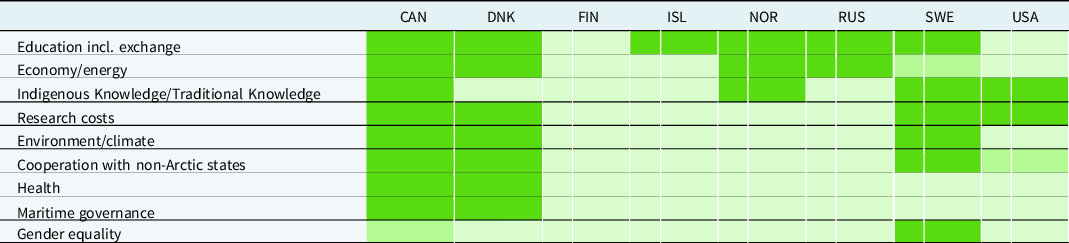
Note: The table illustrates how individual states express specific areas of international research cooperation in their strategies. Dark green represents the presence of explicit statements of international cooperation, medium green shows the expression of statements with the potential for cooperation and light green demonstrates the absence of statements about international science cooperation in these areas.
Education
International cooperation in education outside of formal networks is among the most discussed areas in the strategies. Only Finland and the USA stand out as they do not mention educational cooperation and/or exchange. The Canadian document briefly explains that Canada will “support circumpolar exchange of information and best practices on early learning as well as post-secondary and early career skills development in remote Arctic and Northern communities” (CIRNAC, 2019b). The Danish strategy mentions education outside of the context of the UArctic, in connection to the importance of educational exchange and cooperation (MFA (Denmark), 2011), while the Icelandic document briefly comments on the importance of “international Arctic cooperation” and Icelandic research (Althingi, 2011, p. 11). Norway emphasises support of “closer cooperation between the business community and the higher education sector”, while seeking to “expand cooperation with the other Nordic countries, which rank high internationally in research and innovation-based business development” (Norwegian Ministries, 2020, p. 9). Furthermore, the document highlights positive long-term research and education cooperation with the USA and Russia (Norwegian Ministries, 2020). In addition, the strategy talks about Norway’s participation in the Erasmus+ programme: “the EU programme for education, training, youth and sport provides a framework for much of the cooperation in the field of education in the Arctic” (Norwegian Ministries, 2020, p. 21). All of the above-mentioned examples refer to the facilitation of research cooperation, thus indicating diplomacy for science.
The Russian strategy, as part of its endeavour to further develop international cooperation, is promoting support for interactions among Indigenous youth across borders. Russia also relies on support from international partners to improve educational opportunities geared towards economic development (Putin, Reference Putin2020). Reference to educational exchange could be an example of diplomacy for science. The Swedish strategy refers to the importance of “the vigorous cooperation that has developed between the indigenous peoples in the Arctic, as well as the extensive and long-established academic research cooperation between universities”, including the above-mentioned Arctic Five university network (Government Offices of Sweden, 2020, p. 17, 38). Besides the clear illustration of diplomacy for science, Sweden also refers to creating knowledge and innovating, which attributes to science in diplomacy.
Economy/energy
Four of the strategies discuss international cooperation in the economic sector which is often related to energy, innovation, new technologies, or research and development. In the case of Canada, the document comments on the importance of energy innovation through knowledge exchange, stating that “we will champion a number of circumpolar initiatives that support the development and deployment of green energy in Arctic and Northern communities” (CIRNAC, 2019b). The reference to innovation and development based on scientific knowledge illustrates science in diplomacy and diplomacy for science. Similarly, the Danish strategy talks about energy and research and development in a discussion about international research cooperation: “for example, Danish and Greenland researchers are participating in the top Nordic research initiative on climate, environment and energy” (MFA (Denmark), 2011, p. 36). Additionally, the document mentions research and development in the context of international interest in energy: “the Kingdom will strengthen the dialogue with new stakeholders in the Arctic and benefit from the resources and expertise that they bring along through cooperation in commerce and R&D” (MFA (Denmark), 2011, p. 55). These two examples from Denmark could be referred to as diplomacy for science. In the area of international cooperation, Norway values good relations with Russia, including in the areas of energy and the economy (Norwegian Ministries, 2020). Here we see both examples of diplomacy for science and also science for diplomacy, as cooperation improves relations between the two countries. Russia’s strategy also explicitly states that in the coming years, development in the Russian Arctic will include international economic and humanitarian cooperation, as well as cooperation in the areas of science and social development (Putin, Reference Putin2020). Since this reference is mainly about cooperation, this is an example of diplomacy for science. Sweden mentions innovation for energy in its strategy; however, the international component is missing.
Indigenous Knowledge
Indigenous Knowledge is included in the discussion on SD and science cooperation because it “gives indigenous populations the opportunity to assume more influential roles particularly in issues which concern their safety and quality of lives” and because it “could serve as a base for more research on the role of indigenous knowledge in science diplomacy” (Binder, Reference Binder, Heininen, Exner-Pirot and Plouffe2016, p. 167). All strategies with the exception of Iceland and Russia discuss the importance of Indigenous Knowledge in scientific activity, although to varying extents. Yet, the connection to international scientific cooperation is not always made clear.
The Norwegian and Swedish strategies provide examples of the inclusion of Indigenous Knowledge in international science cooperation. To be sure, the Norwegian strategy explains that “the Sámediggi is consulted as part of the Norwegian preparations for the international climate negotiations, and is often represented on the Norwegian delegation” such as at the UNFCCC (Norwegian Ministries, 2020, p. 22). The Swedish strategy stresses that “representatives of the indigenous peoples should be involved in concrete cooperation drawing on traditional and local knowledge, including in the work of the Arctic Council” (Government Offices of Sweden, 2020, pp. 30–31). Both cases from Norway and Sweden are examples of science in diplomacy as this work can contribute to international policy development.
The Canadian and American strategies make general statements about the importance of Indigenous Knowledge in scientific cooperation. The Canadian strategy explains that “given our experience in incorporating Indigenous knowledge in domestic decision making, Canada will champion the meaningful inclusion of Indigenous knowledge in international forums that make decisions affecting the Arctic” (CIRNAC, 2019b). The opening statement in the American strategy by then President Obama speaks broadly about the Arctic and expresses that by “working together, we will continue to increase our understanding of the region through scientific research and traditional knowledge” (The White House, 2013, p. i). Although both statements from Canada and the USA do not identify specific venues for cooperation, the inclusion of Indigenous Knowledge in international scientific collaboration is also an example of science in diplomacy as the goal is to inform decision making.
Research costs
The Arctic region is one of the most expensive areas for conducting scientific research. Indeed, scholars have examined the cost of conducting research on seabirds in the Arctic and found that “it is approximately 8× more expensive to conduct a project in the Arctic (up to 19× more, depending on location) than to conduct the same project in southern, temperate regions” (Mallory et al., Reference Mallory, Gilchrist, Janssen, Major, Merkel, Provencher and Strøm2018, p. 630). It is no surprise, therefore, that some strategies suggest international cooperation to offset these costs.
To make the best use of resources, the Canadian, Danish, Swedish and American strategies make similar comments about cost sharing. For instance, the Canadian strategy suggests that “international cooperation can help us eliminate gaps in our knowledge of the Arctic and North, particularly given the complexities, interconnectedness and costs related to polar science and research” (CIRNAC, 2019b). The Danish strategy also explains that “research and monitoring in the Arctic puts a strain on resources and logistics and therefore international cooperation on such projects must continue to be encouraged” (MFA (Denmark), 2011, p. 36). Similarly, the Swedish strategy explains that “field research in the polar areas is very expensive [….] International cooperation enables world-leading researchers to participate in research cooperation and expeditions in the Arctic” (Government Offices of Sweden, 2020, p. 38). Finally, the American strategy says “we can make faster progress through a well-coordinated and transparent national and international exploration and research agenda that reduces the potential for duplication of effort and leads to better leveraging of resources” (The White House, 2013, p. 8). Cost sharing is certainly an act of international cooperation, although it is not clear if the governments or scientists are the ones expected to determine if and how costs will be shared. Nevertheless, this is an act of diplomacy for science, as written in these four strategies.
Overall funding to support international scientific activities is only mentioned in two strategies. First, the Canadian strategy explains that they will “[increase] international polar science and research collaboration by providing support for Canadian researchers, including Indigenous knowledge holders conducting international science and research collaboration projects in the circumpolar Arctic” (CIRNAC, 2019b). Second, the Norwegian strategy mentions the Norwegian-American AlaskaNor project which received government funding (Norwegian Ministries, 2020). In contrast to this, the Danish strategy mentions that funding is provided for the continental shelf delimitation, although it is not clear if this includes work done in conjunction with other states (MFA (Denmark), 2011). Some strategies also express the importance of external research funding. In particular, the Danish, Finnish, Norwegian and Swedish strategies explain that funding is available from sources, such as the Nordic Council of Ministers and the EU (MFA (Denmark), 2011; PMO (Finland), 2013; Norwegian Ministries, 2020; Government Offices of Sweden, 2020). Yet, there is no guarantee that Arctic specific projects will be funded, especially through EU programmes. Despite the costs associated with Arctic research, the strategies do not provide much detail on how research activities, let alone SD, will be financially supported by the government.
Environment/climate
Environmental cooperation is discussed by the majority of the Arctic strategies, although Finland, Iceland and Russia are left out of the debate as they do not mention international cooperation in this area. The Canadian document explicitly comments on building a relationship with Russia through science and environmental protection, among others (CIRNAC, 2019b). There is clear reference to improving relations, which is an example of science for diplomacy. Furthermore, it talks about knowledge exchange and explains that “we will also exchange knowledge and best practices on climate change adaptation through the Arctic Council and other forums, with the goal of increasing local and Indigenous capacity to understand and respond to the impacts of climate change” (CIRNAC, 2019b). Knowledge exchange is part of the way Canada facilitates research, so here we see reference to diplomacy for science once again. The Danish strategy highlights international cooperation for environmental research. In general, “the Arctic nature and environment must be managed based on the best possible scientific knowledge and standards for protection, and international cooperation in this endeavour must be promoted” (MFA (Denmark), 2011, p. 43). Environmental management is connected to policy making, which is an example of science in diplomacy. For Sweden, climate change is one of the key areas for international research cooperation. As stated in the strategy, “Sweden will support and further develop international cooperation on polar research, including climate research” (Government Offices of Sweden, 2020, p. 37). The document further highlights the “extensive international cooperation in polar research and logistics” with the majority of the Arctic states, together with the non-Arctic states like Germany and the UK (Government Offices of Sweden, 2020, pp. 38–39). Both Swedish examples illustrate reference to diplomacy for science.
Scientific cooperation with non-Arctic states
As shown above, the strategies discuss international scientific cooperation in a number of areas, presumably with the other Arctic states. Some of the strategies also comment on scientific cooperation with non-Arctic states, which is important as science is often the non-Arctic states’ connection to the Arctic (Heininen et al., Reference Heininen, Everett, Padrtova and Reissell2020). The Canadian and Swedish strategies are explicit about scientific cooperation with these actors. For example, the Canadian strategy says that “we will prioritize cooperation with non-Arctic states and actors whose values and scientific, environmental and/or economic interests align with the priorities of Canada’s Arctic and Northern peoples as well as Canada’s national security interests” (CIRNAC, 2019b). This sounds like Canada will use science cooperation to further build ties with like-minded actors rather than find a way to build relationships with those with different viewpoints. As for Sweden, a subsection on cooperation with non-Arctic states explains that “climate and environmental issues will, like science and research, be a central part of this kind of cooperation” (Government Offices of Sweden, 2020, p. 19). Both these examples could be attributed to science for diplomacy, as they are about Canadian and Swedish relations with other states. The Danish strategy takes a different approach to non-Arctic states, as it focuses on collaboration between universities: “special collaborative projects have been set up, for example between the University of Copenhagen and a number of Chinese universities within natural science, and a budding collaboration between the Danish Technical University and Harbin Institute of Technology on Arctic technology” (MFA (Denmark), 2011, p. 54). As such, this could be attributed to diplomacy for science as it is about cooperation.
The American strategy also comments on non-Arctic states, although the connection to science cooperation is not clear. For example, it explains that “as many nations across the world aspire to expand their role in the Arctic, we encourage Arctic and non-Arctic states to work collaboratively through appropriate fora to address the emerging challenges and opportunities in the Arctic region” (The White House, 2013, p. 6). Yet, it is not clear if this includes scientific cooperation. Interestingly, both the Canadian and American strategies comment that cooperation will only take place if there are no security considerations, implying a possible mistrust with non-Arctic states that does not exist with Arctic states. It also suggests that science for diplomacy is not possible or relevant in all cases.
Health
Health is only mentioned in the Canadian and Danish strategies. Interestingly, Canada links health to the role of the UArctic in providing opportunities for youth. The strategy states that “as a significant demographic in the Canadian Arctic and North, youth are an asset in developing resilient and healthy communities. Canada is committed to providing our Arctic and Northern youth with increased opportunities to participate in, and benefit from, Canada’s international Arctic agenda” (CIRNAC, 2019b). Moreover, the strategy says that in order “to support this objective, Canada commits to the following actions: strategically increasing the University of the Arctic’s activities and programming in Canada’s Arctic and North” (CIRNAC, 2019b) among others. This would be an example of diplomacy for science. Health research that will benefit Greenland is of interest to Denmark. To this end, the strategy states that “cooperation between Arctic partners on common challenges should be further developed, especially based on a Greenland context. Enhanced Arctic cooperation could include research, evaluation and also exchange of ‘good/best practices’ regarding infectious diseases, public health, telemedicine, a culturally attuned health service and environmental medicine” (MFA (Denmark), 2011, p. 40). Additionally, “in cooperation with the international research and scientific communities, the Kingdom will continue to focus on monitoring the state of public health, as well as the effect of climate change and global pollution on public health and social conditions in Greenland” (MFA (Denmark), 2011, p. 40). With a clear reference to the use of science for policy purposes, these are all examples of science in diplomacy.
Maritime governance
The strategies identify various forms of international scientific cooperation in the maritime domain, although to varying extents. For example, the Finnish strategy suggests that international research cooperation can improve maritime navigation (PMO (Finland), 2013), which is an example of diplomacy for science. Other areas for cooperation include the delimitation of the continental shelf and fish stock management. The delimitation of the continental shelf is a form of science in diplomacy as the coastal states have followed the UNCLOS procedures. It is also science for diplomacy, as some of the states worked together on their claims, even if they overlap (for example, see George, Reference George2019). Moreover, this process can also be diplomacy for science, as cooperation can help maintain relationships, especially considering the economic benefit of successful claims. The strategies generally mention the importance of the UNCLOS for governing delimitation, though only the Danish strategy comments on cooperation within the process. More specifically, it mentions cooperation between Denmark and Canada: “in mid-2010 it was decided to intensify the bilateral technical cooperation via the establishment of a joint task force which among other things must explore ways to coordinate submissions of claims to the Commission for Continental Shelf Limits” (MFA (Denmark), 2011, p. 55). Yet, the Canadian strategy mentions their claim has been submitted to the Commission and they hope this will help resolve their boundary disputes with the USA and Denmark (CIRNAC, 2019b), although there was no mention of international cooperation within the process.
Most of the strategies discuss the importance of fish stock management, especially through various international agreements. Yet, only the Canadian and Danish strategies make clear reference to scientific cooperation with this regard. The Canadian strategy explains that within the context of the International Agreement to Prevent Unregulated High Seas Fisheries in the Central Arctic Ocean, Canada is “committed to actively contributing to the joint program of scientific research and monitoring, under which Arctic fisheries-related research and monitoring are expected to increase” (CIRNAC, 2019b). The Danish strategy also discusses the role of science in sustainable fisheries management, but more so for the role of science in decision making. In particular, the strategy explains that “the parts of the Danish Realm will work to strengthen international cooperation on scientifically based management of shared fish stocks and fishery in international waters” (MFA (Denmark), 2011, p. 32). These examples from Canada and Denmark can be considered science in diplomacy as they inform policy.
Gender equality
Although the Canadian strategy briefly talks about gender equality, there is no clear research component to it. Research cooperation related to gender equality is therefore explicitly addressed by Sweden only. The strategy mentions research in this area with a link to the AC: “a gender equality project, partly financed by the Nordic Council of Ministers, has been under way in the Arctic Council’s Sustainable Development Working Group since 2013” and its purpose “is to conduct studies and foster the dialogue on gender equality in the Arctic and to build networks between experts and stakeholders in the region, including from Sweden” (Government Offices of Sweden, 2020, p. 55). As the statement includes elements of cooperation and policy, this would be an example of both science in diplomacy and diplomacy for science.
International scientific cooperation spans several areas. In the majority of the strategies, the use of diplomacy for science is observed through references to facilitating cooperation. The second most used is the science in diplomacy approach. Some areas are well described as fields with a possibility to inform policy and decision makers, hence the science in diplomacy connection. In a few cases, science for diplomacy is also applied, although this type of SD is the least used, mainly with reference to good bilateral relations with Russia by both Canada and Norway.
Summary
In the sections above, we identified physical and human elements of SD found in the Arctic strategies in three indicators: i) scientific infrastructure; ii) membership in intergovernmental and scientific organisations and networks and iii) scientific cooperation in specific areas. At the same time, we provided a broad range of examples of SD types in the strategies. Although each of the three SD types appears alone, we observed the combination of two or all three approaches in some cases, such as with Denmark and the continental shelf delimitation. Another observation is the multifunctionality of universities in SD. On the one hand, they can serve as physical infrastructure where science takes place, and on the other hand, universities can belong to research networks that bring scientists together. In other words, they provide both a physical/technical and human element to SD and contribute in different ways to various SD initiatives.
Figure 1 shows the total number of coded statements per indicator for individual Arctic states. From all three indicators, scientific cooperation in specific areas is the most coded. This result is not surprising given the nature of the indicator itself, which is based on cooperation. The second most coded indicator is organisations and networks, leaving infrastructure as the least-coded indicator. This illustrates the fact that international cooperation between the Arctic states in the scientific infrastructure sector is rather limited. Although there are some cooperative efforts, the states prefer to focus on specific areas of cooperation rather than sharing the facilities, at least as described by the strategies. This is unexpected, given the cost of scientific research in the Arctic. In addition, this research sheds light on other surprising findings, such as the omission of research stations from the Norwegian strategy, especially in the context of Svalbard.
Number of coded indicator statements.

The overall depiction of SD is illustrated in Fig. 2. Denmark is by far the most frequent user of SD, followed by Sweden, Canada and Iceland. Considering the length (word count) of the strategies (see Appendix A), the Danish document is comparable to the Finnish, yet Denmark applies SD nearly five times more than Finland. Another striking observation is the Icelandic document when compared to the Finnish document: the Icelandic strategy is six times shorter, yet it applies SD almost three times more.
Number of coded science diplomacy statements.

When it comes to the proportion of a specific type of SD, the most frequently used is diplomacy for science, which is observed in all Arctic states’ strategic documents. Science in diplomacy is the second most identified type of SD and it is mostly used by Denmark but also by Norway, Sweden and Canada. It is also briefly applied by the USA, Iceland and Russia. Only Finland did not apply it at all. Interestingly, science in diplomacy is often connected to specific areas of cooperation. In particular, SD is used to inform decision making, for example in connection to delimitation of the continental shelf, management of the environment, and innovation and development based on scientific knowledge. Moreover, the strategies refer to the relevance of science agreements developed under the auspices of the AC. Indigenous Peoples and Indigenous Knowledge also play a role in important international processes, hence contributing to international policy development. The least applied type of SD is science for diplomacy, which could be considered as an ideal tool to improve relations between countries. This type was observed a few times in all strategies, with the exception of the USA.
Discussion
Dominant discourses on the Arctic tend to follow one of two perspectives. On the one hand, the Arctic is edging closer to conflict. Indeed, the idea of a “race for resources” or “scramble for the Arctic” has been around since 2007, even if reality has been misconstrued by the news media (for example, see Koivurova, Reference Koivurova, Evengård, Larsen and Paasche2015; Pincus & Ali, Reference Pincus and Ali2016). Moreover, some argue that activities in the Arctic are not removed from broader state politics and interactions between states at a global level, and there are particular concerns about Russia and China (see Bertelsen, Reference Bertelsen, Gjørv, Lanteigne and Sam-Aggrey2020; Goodsite et al., Reference Goodsite, Bertelsen, Pertoldi-Bianchi, Ren, van der Watt and Johannsson2016; Käpylä & Mikkola, Reference Käpylä and Mikkola2015, Reference Käpylä, Mikkola, Finger and Heininen2019). On the other hand, some argue that stability is maintained through collective decisions to respect international law and purposeful acts of collaboration (Exner-Pirot & Murray, Reference Exner-Pirot and Murray2017). Each strategy has a section on security and discusses regional geopolitical concerns; however, this second narrative is dominant. To be sure, all strategies make statements about the importance of maintaining peace and stability in the Arctic, and most suggest this is possible through various international rules and law. Therefore, we argue that despite disagreements and concerns about a possible shift in power dynamics, peace and stability is the primary foreign policy goal for the region and the Arctic states actively seek to keep the region “exceptional” (see Exner-Pirot & Murray, Reference Exner-Pirot and Murray2017). Certainly, “through scientific research, states are able to overcome their disagreements and create strong international science cooperation” (Kavan & Halašková, Reference Kavan and Halašková2022). What is more, we agree here with Łuszczuk et al. (Reference Łuszczuk, Padrtova and Szczerbowicz2020) that “scientific cooperation stimulates cooperation also in other areas” (p. 618), and this is particularly important for the Arctic.
To advance those narratives, our research demonstrates the breadth of mechanisms that contribute to SD and are supported in the Arctic states’ strategies. We argue that SD could be used to maintain stability, as the strategies do not adhere to the “scramble for the Arctic” narrative. Apart from this, we see other narratives emerge from the strategies. For example, the strategies’ discussions around science also make the states attractive for investments and scientific exchange (see Ruffini, Reference Ruffini2020). This could be illustrated in the aim of the Arctic states to position themselves as scientific leaders and technological experts (for example, see Binder, Reference Binder, Heininen, Exner-Pirot and Plouffe2016). Besides, this is perhaps the reason why in our analysis, from all three indicators, states give priority to international scientific cooperation in specific research areas, instead of scientific infrastructure.
Considering scientific research is a part of the state’s soft power and image abroad, we also argue that the Arctic states use science to advance their own foreign policy goals by increasing research activity and drawing on research networks to advance other priorities (see The Royal Society, 2010). Moreover, soft power in relation to science for diplomacy rests on its ability to serve a state’s domestic and international interests (The Royal Society, 2010, p. 11). Indeed, as Epping (Reference Epping2020) argues, science can be a very effective “tool of soft power, given its neutral and non-political character”. Therefore, when SD is used alongside other foreign policy mechanisms, it can help maintain existing relationships and foster new ones, while keeping open lines of communication (Epping, Reference Epping2020; The Royal Society, 2010), such as those that have been developed through scientific and intergovernmental networks.
In contrast to this, some scholars argue the use of soft power to advance national interest can be manipulative (see Rungius & Flink, Reference Rungius and Flink2020) and that “triggered by the will to defend and promote the national interests, [states] engage in unilateral and competitive actions” (Ruffini, Reference Ruffini2020, p. 379). Therefore, SD can have a negative impact on cooperation, especially in the Arctic. This could be true in the case of the continental shelf delimitation process (Ruffini, Reference Ruffini2017), despite cooperation during the mapping stage. Although there might be potential for such negative tendencies, our research findings speak more to the positive side of SD. In fact, there is little evidence in the Arctic states’ strategies that would support the argument of SD negatively influencing relations in the Arctic. The Arctic strategies “are designed not just to inform, but to mobilize, steer and coordinate the national or multi-state communities that they cover” (Bailes & Heininen, Reference Bailes and Heininen2012, p. 21) and it is unlikely they would position scientific competition with their neighbours as a positive way to mobilise. Rather, competitive messaging would likely send the wrong signals about the states’ regional intentions and potentially contribute to the “scramble for the Arctic” narrative rather than the “exceptional” narrative.
Conclusion
In this paper, we provide insight into the potential influence of SD on three concrete indicators in Arctic strategies: i) scientific infrastructure; ii) membership in intergovernmental/interparliamentary and scientific/education organisations and networks and iii) specific areas of scientific cooperation. To answer the key question – “Is science diplomacy real?” – we argue that given the high number of statements devoted to certain areas of international scientific cooperation, the Arctic states apply the SD concept in their strategies although they do not always give examples of actual SD or even mention it by name. In fact, the statements or actions themselves are not always explicit acts of diplomacy as the documents are not necessarily clear what role the government will take in making these actions happen. Nevertheless, despite sometimes vague expressions in the documents, political will is demonstrated as the official government strategies are policy documents by their nature, hence having a diplomatic character. Furthermore, clear references to international scientific cooperation, regardless of its form, contribute to the cooperative nature and stability of the region. This itself, demonstrated by the specific examples, is proof of the existence of a positive connection between science and diplomacy.
Our study focuses on the Arctic strategies, allowing for a straightforward comparison of official documents that are publicly available and of a similar nature. Since the states are dependent on scientific research and international science cooperation to solve global problems, the question is why they do not talk about it that much in their strategies? One explanation could be the slow process of writing these strategic documents. Assuming that states could react to a given problem rather promptly, transforming action into a policy document might take a while. Apart from this, our observations show that there is no best way to perform SD, either domestically or internationally. While this may afford the states some flexibility to pursue different options to address a given problem, they may also run the risk of missing opportunities to engage in meaningful SD without a set plan. Thus, the lack of strategic coherence highlights the complex nature of Arctic SD and the challenges in Arctic governance when each Arctic state applies its own strategy to the region.
Our future research, therefore, could examine how individual Arctic states formulate their Arctic strategies and what is holding them back when it comes to more direct communication of SD. In particular, understanding why some states are more vocal about SD while others are not is an important question. Also, we are interested in researching if the states’ communication changes across documents or whether they maintain consistent messaging. As we observed in our current research, the states are involved in collaborative efforts because it is highly beneficial for them. Therefore, there is a high probability that international cooperation in science and other areas will increase, despite the lack of official communication of it.
Acknowledgements
As this research was inspired by a previous project, the authors would like to acknowledge their Arctic Policies and Strategies – Analysis, Synthesis, and Trends co-authors, Lassi Heininen and Anni Reissell. The authors would also like to thank the editors of this special edition, the anonymous reviewers for their invaluable comments and Kathy Tidy for her assistance illustrating Figs. 1 and 2.
Financial support
Barbora Halašková is supported by the project “ARCTIC Centre for Human-to-Environment Oriented Studies: Impact of Climate Change and Human Activities in the Arctic (ARCTOS MU)”, funded by the Grant Agency of Masaryk University (MUNI/G/1540/2019).
Conflict of interest
None.
Appendix A:
The Arctic strategies are different lengths, meaning it can be difficult to determine how much of the document speaks to international science cooperation. To help account for this, Table 5 presents the approximate word count of each strategy to contextualise the number of statements provided in Fig. 1 and 2.
Arctic strategies approximate word count.


 Open access

