


One of the most noteworthy qualities of asylum periodicals, in addition to and because of their authorship, is the dearth of sensationalism. Asylum periodicals surprised contemporary reviewers with their ‘sane and sensible lucubrations’, as the Chambers’s Journal put it.1 An article in the Leisure Hour claimed that the Morningside Mirror’s contributors ‘are wanting neither in logic nor in fancy’.2 Humble poetry, discussions of current political and social issues, and essays on philosophical and scientific questions, including madness, dominate the pages. Reflections on insanity and the general state of asylums and moral treatment tend to be wrapped up in distanced, medical language.3 Internal news about the institutions that issued the periodicals are frequently delivered in a light-hearted, even humorous tone. Special attention is paid to the entertainments available to the patients and events such as picnics, excursions, and celebrations. For instance, the issue of the Morningside Mirror for 15 July 1847 contains a reflection on ‘artistical taste’, a biography of Caliph Haroun al-Rashid, an article about amusements in the Royal Edinburgh Asylum, and a poem. In its more densely covered three-column pages, the Asylum Gazette offered readers of its number for 20 February 1846: a few editorial notices about the newspaper, its reception, and the publications received in exchange for it; four longer articles, about human nature, national character, women, and the state of American literature; seven short poems; several briefer pieces and anecdotes; and reprints from Socrates, the New York Sunday Times, the Geauga Republican, and the Providence Gazette. Some titles occasionally admitted open expressions of delusions or less coherent writing. According to Reiss, the Opal did so to maintain its authenticity, but as Chapter 7 shows, such pieces could also serve as specimens of madness presented to the medical community.4 For the most part, however, asylum periodicals disappointed readers’ expectations of facing raw, raving madness on their pages.
Who speaks from the pages of asylum periodicals? This question is central to the history of these publications and their future use as historical sources. To address it, this section of the book delves into the internal workings of asylums and the complex relationships that publishing involved. My exploration of the voices in asylum periodicals begins with a reflection on the function of the editor. I will suggest that periodical production in asylums was not incomparable with arrangements in other printing offices. The main difference was that the performance of editorial duties for asylum periodicals was embedded in additional, institutional hierarchies and pressures that inevitably affected the publications. To explore the role of conflict and collaboration in leading these publishing ventures, I will briefly discuss the unpublished Moon of the New York City Asylum on Wards Island and then trace the history of the Gartnavel Gazette (1853–1854; 1855) of the Glasgow Royal Asylum. The archival records associated with these titles offer a closer inspection of the interactions that periodical publishing involved: the Moon is an example of a failed collaboration between doctor and patient, while the Gartnavel Gazette persevered despite tensions, which are palpable in the remarkably well-preserved institutional archive.5 Though the Gazette was circulated only internally, the stories of its printers and editors are illustrative of the emergence of asylum periodicals out of conflict, negotiation, and collaboration – not unlike other similar publications at the time. This case study reveals that forces other than institutional staff’s supervision were at work. The editors’ class-based aesthetics and individual preferences in selecting material for publication, as well as conflicts among patients impacted asylum periodicals. In the case of the Gartnavel Gazette, the outcome was the discontinuation of the publication. This title also challenges previous representations of asylum periodicals as polished accounts characterised by docile reiteration of institutional discourses or, at most, by barely discernible protest under strict institutional control. It shows that interpersonal tensions and patients’ grievances found their way into the pages of asylum periodicals.
Doctors, Patients, and Editorial Control
Defining publishing and editing is key for understanding how asylum periodicals operated. Publishing of any kind involves a degree of supervision. As Pierre Bourdieu puts it, each expression is a ‘product of a compromise between an expressive interest and a censorship constituted by the very structure of the field in which the discourse is produced and circulates [emphases in original]’.6 Without considering the restraints on nineteenth-century publishing in general, commentators on the history of asylum periodicals have naturally focused on the inequality between staff and patients. This approach, with its over-reliance on the explanatory power of the term ‘censorship’, exaggerates the imbalance, willingly or not, and oversimplifies the mechanisms and pressures that governed expression in asylum periodicals. The claim that asylum periodicals were defined by infringement on patients’ freedom of speech also implies that outside asylums the press lived up to the ideal of liberty. This was hardly the case.7 Individuals striving for expression through publishing had to please those whose positions in the book trade gave them the power to monitor, judge, and select what got released to readers. Themselves dependent on readerships’ tastes and expectations, editors and publishers often occupied their positions of power because they had internalised or agreed to pay lip service to existing dominant discourses about respectability, morality, and aesthetic taste. Their positions were therefore as provisional as that of authors, depending on their ability to fit in the professional and market structures they inhabited. Nineteenth-century publishing was thus governed by a complex feedback loop, as producers and recipients of print influenced each other, negotiated the boundaries of what could be published and where, and shaped the discourses that governed these exchanges.8 In this context, editing is a position that is especially difficult to define since, as Robert L. Patten and David Finkelstein put it, ‘by “editing” one could mean almost anything’.9 Analysing the nature and degree of editing in any periodical is challenging, as the main piece of evidence are the finished products themselves.
Asylum periodicals are in some ways exceptional, as they and their institutions’ records occasionally lift the veil obscuring the mysterious editor figure. For instance, the collection of papers related to the Moon of the New York City Asylum on Wards Island, held at the archives of the University of California, Los Angeles, offers a unique insight into the editorial dynamics of the publication. Likely collected by the physician-superintendent, Dr Alexander E. MacDonald, the bundle reveals the complex relationship between the doctor and a patient with whom he planned to launch the newspaper.10 The collection features letters from subscribers keen to receive the first issue, clippings from the press, manuscript contributions, incomplete proofs of the publication with editorial notes and comments, and, most importantly, two letters from a patient, Thomas D. Maitland, to Dr MacDonald, which discuss the way the publication should be run. Maitland is known to have been a stenographer, reporter, and editor based in New York. His correspondence suggests that he was willing, if not keen, to apply his skills and experience to support the project.
The first letter, dated 12 April 1882, represents the patient less as an editor and more as a secretary. He proposed to take dictation from the physician or otherwise relinquish all control over the final contents:
If you don’t wish to dictate the article verbatim, I can work your ideas out from the leading or pivotal points which you can furnish in a few minutes. In writing out, I would leave ample space for interlining so that you could easily correct, add, amend, strike out, recast, or make suggestions for doing so if you did.11
The method of dictation was offered ‘so that the journal should not encroach upon the time of your [Dr MacDonald’s] professional demands’.12 The letter hints at Maitland’s excitement for the project. The aim of his subjection to the physician’s will was to persuade MacDonald to turn the newspaper idea into reality. The patient’s submission to the physician’s control was not complete, however. The rest of the letter exposed Maitland’s own ideas for the publication and its contents and reinstated him as a collaborator: ‘we should select subjects for editorials, and aim at making the paper newsy, interesting and thoroughly up to the times, journalistically and scientifically’.13 The ‘we’ in this sentence put the doctor and the patient on an equal footing, as each would contribute their relevant expertise to the project.
Apparently, Dr MacDonald did not respond to Maitland’s suggestions. Seventeen days later, Maitland wrote again, demanding a response to his propositions and asking the doctor for ‘an intelligent idea of what you wish me to do in relation to the selection of the matter, and the method of treating the subjects’.14 There are no more mentions of dictation, as the patient now assumed the role of an assistant editor and direct contributor, reassuring MacDonald that:
you will naturally occupy the position of Editor-in-Chief and general manager, the more accurately your views are anticipated and expressed, the less onerous will be your duties; and I shall have no feelings or prejudices to air that will clash with your notions. If you should wish to have in print that the moon is made of green cheese, I should write it down with as little compunction as I would the latest astronomical discovery of Proctor, with this reservation that I should prefer to write it over a nom de plume [underlining in original]. An editor when dealing with his chief must have no conscientious scruples. It’s non-professional.15
While negotiating editorial responsibilities and line of command, Maitland subtly reasserted his sanity and agency. By imposing regular publishing trade hierarchies onto the project and referring to a code of professionalism, he sought to adopt the rules of the outside world where he, a journalist and a reporter, had authority and expertise. His submission to the physician’s will also involved subtle subversion and mockery. Under the proposed arrangement, the only possible madman would be the physician. As a true professional, the patient-editor would replicate the doctor’s words but only after hiding behind a pseudonym – as a sane person recognising irrationality and wishing to distance himself from it.
Yet, Maitland thought it would be a good idea to present the project as entirely produced by insane people, to pursue a subversive agenda. In his first letter, where he offered his quick pen to the physician’s service, he wrote:
In consonance with an idea which you are represented as having expressed to some of the reporters of the large dailies it will be a good feature of the paper to keep up the notion of editorial insanity. This will afford an immense leverage on our side when criticizing the outside world through lunatic glasses, and under this cover of the editorial sanctum very sharp double-entendres [underlining in original] can be perpetuated with impunity and laughed at, which if uttered from a sane and solemn standpoint would be offensive, and for which you could not afford to be responsible, surrounded as you are by sensitive people; and seeing that the Commissioners themselves live in glass houses, you will be obliged as their representative to remember the maxim addressed to the inhabitants of these fragile structures.16
In advertising the new project, Dr MacDonald had falsely claimed that the publication would be produced entirely by lunatics. Maitland used the physician’s lie to his advantage, recognising the freedom of speech that the cover of insanity would offer. He was also aware of the physicians’ position in larger administrative bodies, such as the Commissioners of Public Charities and Correction, which monitored his work and limited his own freedom of expression and action. By recasting the physician’s lie to the public as a secret weapon and representing the physician in a position of submission, not unlike his own, the patient reframed their relationship as truly collaborative. Together they, sane and clear-sighted about the flaws of the world, would be able to reveal its true colours using the guise of insanity. MacDonald’s response to these proposals has not been found, but the preserved incomplete proofs (Figure 4.1) and annotated contributions featuring both Maitland’s and MacDonald’s hands suggest that, for a while, doctor and patient worked together on preparing the newspaper for publication.17 In August, Maitland earned his physical freedom and launched a campaign in the press against the asylum. He claimed that he had been wrongfully confined after a bromide overdose and kept in isolation from the outside world in the ‘chronic ward’ after submitting a few articles for publication in the New York Star, written prior to his admission.18 In December and early January, several notices in the press announced the upcoming publication of the Moon, suggesting that after all the investigations and court hearings, Dr MacDonald made another effort to launch the periodical.19 The silence that followed and the absence of discoverable copies of the newspaper indicate that the Moon was never published – yet another sign of the importance of patients with free time and expertise in these projects.
Proofs of the front page of the first issue of the Moon, dated 22 April 1883 and never published.
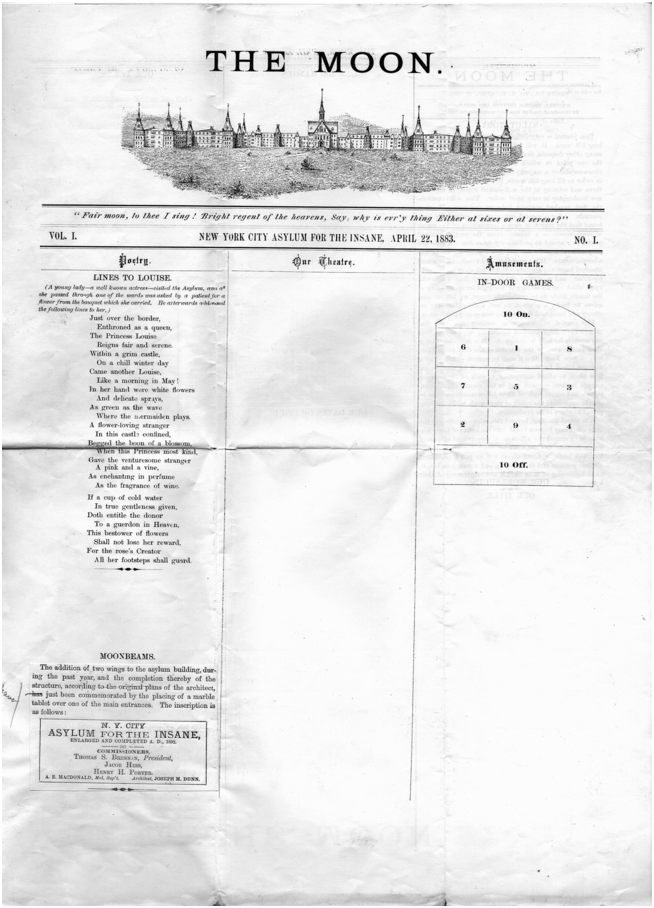
Portraying asylum periodicals as dependent on collaboration that was often ridden with tensions, the case of the Moon invites further reflection on the logistics of publishing within and beyond asylums. Maitland’s letters allow the asylum to be reimagined as a kind of publishing firm, in which the managers (or Commissioners) and the superintending physician often acted as what Robert Patten and David Finkelstein have termed ‘publishers-proprietors’. They had to be convinced of the benefits of the endeavour to spend their usually limited funding on a press, type, and, at the very least, paper and to dedicate space in the asylum for the printing office. They were invested in the publishing projects they managed and employed the wider resources at their disposal to maintain them. They occasionally sought to attract new contributors or, in cases like the Morningside Mirror and the Opal, initiated the periodicals by encouraging patients to write and edit them.20
An objection might be raised that these situations were too different from Patten and Finkelstein’s examples of the type, William Blackwood III and George Murray Smith, who produced a wider array of publications in addition to their magazines. However, asylum publishing was versatile too. The presses were regularly employed in producing administrative documentation, annual reports, and medical publications, and they sometimes printed other types of patients’ writing. Alexander Smart’s Scenes from the Life of a Sufferer, at first serialised in Hogg’s Instructor, was issued as a whole volume from the Royal Edinburgh Asylum in 1855. The same press published John Reid Adam’s Poetical Log-book; or, Journal of a Voyage from Malta to Liverpool (1855) and the two editions of his poetry collection All Sorts (1856; 1859). Though there is no information about the circulation of these complementary publications, they were likely to attract more attention to the institution and its Morningside Mirror. Asylums thus operated in a very similar way to regular publishing houses.
The editorial function was naturally complex. Though the editorial signature, if present, was usually of a single individual, most asylum periodicals had at least two editors – a patient and a physician.21 The two confirmed exceptions are Excelsior of the Murray Royal Asylum in Perth and the York Star of the York Lunatic Asylum.22 These are the only identified cases of single individuals editing an asylum periodical, a circumstance made possible only by their positions as physician superintendents: Dr William Lauder Lindsay and Dr Frederick Needham, respectively. At least a minimal degree of physicians’ involvement should be assumed for all other publications, since even an internally circulated publication like Chronicles of the Monastery was monitored by staff. However, Maitland’s letters reveal that editorial control was fundamentally tied with another factor – time. The physician’s availability to engage and monitor these projects was limited by the demands of his primary duties, which were not only medical but also administrative. With authority to establish the general direction of the periodical but limited capacity to produce fresh copy, the physician-editor was indeed an ‘Editor-in-Chief’, as Maitland refers to Dr MacDonald. The patient-editor, on the other hand, could afford to be more ‘hands-on’, to refer to Patten and Finkelstein’s terminology again. They had the advantage of plentiful time to spend on the publication, producing copy, corresponding with contributors, selecting and arranging content, and supervising or executing the printing process. Even as an assistant editor working under another’s guidance, they had greater opportunity to stir the publication and shape it from issue to issue.
A crucial difference between asylum and other periodicals was the fact that patients were on a metaphorical trial prior to the point of submission. Their writing could be used as evidence of their sanity or insanity.23 Patients’ behaviour and obedience to staff could be major considerations in whether they would be given access to expression in the first place.24 While the risks of detainment and silencing were not exclusive to the asylum setting, the impropriety or irrationality of patients’ writing could have consequences for their lives beyond dealing with the editor’s rejection. Patients were often aware that their writing could result in prolonged confinement or withdrawal of their privileges in the institution, including that of writing for the periodical.
Under these circumstances, one would expect asylum periodicals to be perfectly uniform celebrations of the achievements of psychiatry. That is not the case. It is tempting to argue that expressions of criticism or negative sentiments towards the institutions and their staff were simply failures of censorship. Insisting that patients used codespeak to refer to less pleasant aspects of their experience, Emily Clark has thus argued that ‘the institutional censors would overlook these harmless phrases, which would have been recognized as subversive by other patients’.25 Identifying instances of criticism in the Opal, she suggests that ‘perhaps the sarcastic tone was missed by the censors’.26 Failure to detect censorable content is a valid explanation, especially since monitoring the periodical was far from physicians’ primary duties. However, it is highly doubtful that physicians would have missed the ironic tone that permeates a significant portion of the contributions or the critical references to cold showers, anti-masturbation mittens, and other unpleasant asylum treatments. These references could just as well be interpreted as signs of permissiveness – of the physicians’ perception of them as non-threatening, general laxness about such subversive utterances, or even lack of interest in the publications.
The overemphasis on censorship also obscures the consequences of unfiltered speech, as well as patients’ own desire to protect themselves from overexposure. While editing could be driven by institutions’ reputational interests, selectiveness served patients’ interests too. The consequences of publishing indiscriminately could be devastating for large public institutions that relied on benefactors’ donations. This was likely the source of concern for the editors of the Asylum Journal when they delayed the publication of a satirical piece by ‘X. Y. Z.’, which proposed the candidacy of a madman for the presidential elections of 1844:
The following communication was (last week) presented for admission into the Journal, but the editor declined publishing it. An appeal was then made to the ‘board of Censors,’ who decided that it might be admitted on condition that the writer would present no more political pieces [emphasis in original].27
The ‘board of censors’ mentioned here was ‘chosen by the inmates of the Asylum’.28 While references to ‘The Crazy Man’s Ticket’ continued to appear in the Journal, this example shows that patients themselves regulated the contents of the periodicals guided by concerns that were not necessarily related to their institutionalised status. In this case, patient-editors were hesitant to admit a political article that could risk alienating some of their readers.29
Imagining asylum periodicals without censorship, McMillan has raised a reasonable question: ‘would [patient-readers] truly benefit in reading about a fellow inmate’s ongoing struggle with delusions?’30 One of the issues of the Morningside Mirror shows unambiguously that the contents of asylum periodicals were shaped by concerns for patients’ well-being. Containing a description of a violent murder that the author allegedly witnessed, the issue appeared in two different editions. Only one of them seems to have survived and has been preserved at the Lothian Health Services Archives. An editorial note in it reads: ‘This article has been considerably altered in the copies circulated within the Asylum, in order to suit it to the state of mind of the inmates; but it is thought proper to present so spirited a sketch entire to the extra-mural subscribers.’31
Though the author might not have been pleased that his fellow inmates were not given direct access to his writing in full, the editorial decision seems to have been driven by concerns about upsetting other patients. Finally, the Meteor, discussed in detail in Chapter 5, suggested that the public exposure of the secrets of deranged minds in periodicals would not necessarily be a step towards liberty.32 It could aggravate the ostracisation of the insane, just like former patients’ exposés, which in condemning the institutions, also denounced everyone else in them to highlight the authors’ own sanity.33
In addition to concerns connected to the peculiarities of asylum periodicals’ origins and their producers’ status, individual patients’ aesthetic ideas also governed the editing process. The therapeutic aims of asylum periodicals did not make the literary worth of contributions irrelevant. In his autobiographical account, Alexander Smart remarks that, apart from him:
Other writers there were, chiefly of the poetical class; but their tuneful effusions not being sufficiently touched with ‘the vision and faculty divine,’ to warrant their insertion in the ‘Mirror,’ they were ‘born to blush unseen,’ and never reached the dignity of print.34
This statement suggests that the quality of writing was important to patient-editors, especially when they were members of the publishing trade, which was often the case. For any editor, the periodical demonstrated the editor’s skills to attract, select, and curate content according to their own ideas of what was aesthetically pleasing to them and their readerships.35 Given the chance to impress their fellow patients, institutional staff, and the general public, patient-editors were equally driven to showcase the best writing that came within their reach, even if their subjective ideas about acceptable literature meant limiting the number of contributors.
Editing asylum periodicals thus involved collaborative work and constant negotiation between contributors and patient- and physician-editors. That a physician (usually the superintendent) had the final say does not mean that his control over the periodicals was total, neither that he wanted it to be so. Patients’ own aspirations and views shaped their editorial approaches which had an equally important role. Despite the complex position in which they found themselves, patients made asylum periodicals work for them, navigating institutional hierarchies and rules and using the resources they were offered, however limited they were.
The Gentlemanly Beginnings of the Gartnavel Gazette (1853–1854)
The patchy history of the Gartnavel Gazette, or the Monthly Journal of the Glasgow Royal Lunatic Asylum offers further insight into the publishing arrangements within institutions and the relationships between different representatives of the asylum populations. Its first series ran monthly from 1 June 1853 to 1 March 1854. After a year of hiatus, it was renewed as a weekly on 8 March 1855, under a new subtitle, A Word from the Glasgow Royal Lunatic Asylum. It also acquired an engraving of the royal coat of arms on its front page and a Shakespearean quote as its motto: ‘Though this be madness, yet there’s method in‘t.’ The date of the last surviving number is 28 June 1855.36 Both series appeared in four-page quarto double-column format.37 A sixteen-page Christmas Number was also published in 1882, before the Gazette was restored in 1903 as a quarterly.38 Here, I will focus on the first two series, which had different editors and tone but were both published under the superintendency of Dr Alexander Mackintosh, who headed the institution in 1849 and like his predecessor (Dr William Hutcheson) advocated the curative potential of work and recreation.39
At the time of the newspaper’s launch, the Glasgow Royal Asylum housed over 420 patients, with the two sexes equally represented and accordingly separated. In 1843, the asylum had changed location to a site in Gartnavel and consisted of two main buildings. The West House contained individual bedrooms or suites for private patients that were comfortably furnished. The physician resided there too. The East House housed the pauper patients and was less accommodating. The asylum had a garden, a farm, a pigsty, and workshops, where patients engaged with work suitable to their abilities and social background. Dr Mackintosh argued that ‘employment, both mental and physical, is of the greatest advantage’ and recognised ‘the importance of devising every means of occupation calculated to amuse and instruct’.40 Due to the gender and class divisions of labour, finding suitable employment for the paying patients, especially the men, was a challenge: the women could at least be occupied with sewing, knitting, and embroidery.41 Excursions, walks, amusements, and recreations such as sports and games were offered to address this gap and keep all patients busy. The asylum had a library too.
Initiated by patients, the Gartnavel Gazette was seen as a suitable addition to the recreational activities in the asylum. The first issue is quick to highlight the institutional support it received and outlines the negotiations behind the inception of the journal. The opening piece is a description of the superintendent himself (Figure 4.2). Titled ‘The Governor’, it evokes the image of a marshal ceremoniously introducing a nobleman, in this case: ‘His Excellency, the Governor of Gartnavel Castle [all caps in original]’.42 While serving the same purpose as a dedication to a patron, it is humorous, playful, almost tongue-in-cheek, though remaining respectful. It starts off with a description of the physician’s physical appearance, portraying him as a healthy, active, and intelligent man of science. The author then comments on the physician’s professional qualities. All in all, Dr Mackintosh is judged to be ‘a good commander’ who is strict but sensible and inspires respect in his subjects:
In the discharge of his important duties, [he] displays very considerable capacity, energy, and skill. With very few exceptions, he visits each individual under his care at least once every day; and while firm in refusing all improper demands, he pays prompt attention to every reasonable request.43
The next piece in the issue reveals that the Gartnavel Gazette was a result of one such reasonable request. It contains a letter from the editor that was originally sent to the superintendent with an enclosed memorial, ‘signed by sixteen gentlemen’ and dated 26 April 1853. The memorial states that:
whereas, we have been informed that a Printing Press and Types are, somewhere, to be found within the precincts of the Castle, which we are given to understand were originally designed for this very purpose; we now, with all respect for your judgement, and submission to your authority, would most earnestly beseech you to grant us the privilege of establishing the aforesaid newspaper or journal, with the use of the printing-press and types, as aforesaid, together with the use of a suitable apartment, as a Printing Office.44
The press in question was the same press that John Reid Adam had operated more than ten years earlier to produce the Chronicles of the Monastery. The first issue also indicates that a manuscript version of the Gazette was circulated a few days earlier with success and that the patients were willing ‘to share any expenses that may be incurred in the way of printing’.45 The memorial assures that the publication was ‘for the special benefit, instruction and amusement of the inmates’.46 The petitioners go as far as to suggest that their project would aid the physician in his mission of ‘improvement of the mind’ and might lead to ‘the development of talents that would otherwise have remained dormant’.47 The superintendent agreed that the periodical was ‘of sufficient importance to be put in print’.48 Highlighting the benefits of the project, the availability of resources for its implementation, and the absence of expenses it would generate, the petitioners persuaded Dr Mackintosh of the usefulness of their project.
Front page of the first issue of the Gartnavel Gazette, Or Monthly Journal of the Glasgow Royal Lunatic Asylum, dated 1 June 1853.
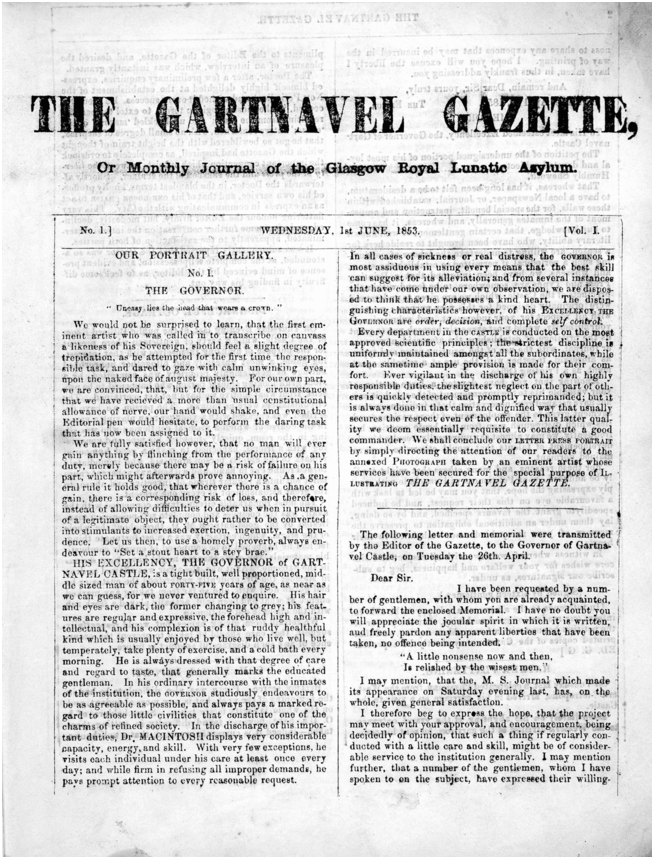
Patients’ employment in the printing office was recorded in the annual reports, indicating that the press served patients’ literary pursuits beyond the weekly periodical, as well as the institution. The Gartnavel Gazette, Dr Mackintosh observes, had ‘no pretensions to anything but the benefit of the Patients’.49 In the first year of setting up the publishing operations, he states that patients ‘also printed a Catalogue of the Library of the Asylum, a large and amended edition of the Rules, other papers, and the forms necessary in the admission of Patients’.50 The next report reveals that beyond the production of the newspaper, ‘a great many schedules, &c. have been printed, also part of Shakspere [sic], with original introductory notes’.51 As the building of residence and the type of work in the asylum were determined by patients’ social class, publishing at the Glasgow Royal Asylum also stimulated social mingling that would not have occurred naturally otherwise. Describing patients’ labour in 1854, the report states that: ‘The Male Pauper Patients have been employed as Printers, Joiners, Blacksmiths, Tailors, Shoemakers, Gardeners, Oakum-pickers, Farm Servants, and Servants of all work. Some of the Gentlemen … have composed articles, put them into type, and completed the whole by also working at the press.’52 The gentlemanly founders of the newspaper living in the West House of the asylum thus worked alongside the working-class inmates.
Like the earlier periodical of the Glasgow Royal Asylum, the Gartnavel Gazette was circulated only internally. When an unknown physician visited the institution and, impressed with the project, offered his own chaise to transport copies to the city, the editor ‘firmly, but modestly, declined’.53 The reasons are not stated, but it is possible to think of several. The Gazette’s gentlemanly founders claimed to have ‘a total want of professional experience’, representing the publication as an amateur stunt – more of a hobby to fill the time of patients unsuitable for other work in the asylum than a commercial venture.54 This stance had practical implications. As the periodical was distributed for free and only internally, it had a limited circulation that was enough to satisfy the small readership of literate patients who probably shared copies. External circulation would have also meant that the editor would have had to please both the readers in the Gartnavel and those outside, while potentially being more cautious of the information shared about the institution, the contributors, and himself. If the printing costs were indeed covered by the gentlemanly patients who founded the periodical and treated it as a leisurely activity, then it is not surprising that they refused to take on the responsibility of running a public periodical with a larger circulation.
At the head of the founding collective was the editor, who also printed the publication, received the correspondence, and wrote many of the contents.55 Hiding behind the pseudonym ‘Jacobus Amicus veritatis’ (‘James a Friend of Truth’) was James Buchanan (b. 1822).56 By trade, Buchanan was a provision merchant in Glasgow, working for his father’s company, Joshua Buchanan and Sons. He was brought to the asylum by his brother, having become
considerably changed in character and disposition since the death of his wife before which he is reported to have led a quiet and temperate life. Since that time he is said to have been much addicted to the use of strong drinks and illicit intercourse with the other sex. It is only within a month however that he has manifested maniacal symptoms accompanied with delusions.57
After an adventurous trip to northern England in the company of dubious characters, Buchanan was left alone, penniless, and delirious. Convinced that he was ‘placed under the influence of powerful galvanic batteries and exciting gases and made to speak and sing for the purpose of amusing the onlookers’, he was apprehended by the police in York ‘with a knife in his hand’ and jailed until his father came to take him back to Glasgow.58 He was admitted to the asylum soon after, on 5 April 1853.59
At first, Buchanan felt ‘quite at home with his fellow patients’ and enjoyed playing billiards with them.60 However, he spent his time writing, in addition to content for the first issue of the Gartnavel Gazette, a narrative of the events leading up to his institutionalisation and letters to medical and legal advisors urging them to investigate his case.61 About a week following the publication of the first issue, he ‘stated to Dr Mackintosh that he had the belief that his delusions were real, but that he wished to be convinced that they were not real, if they were not so. But the delusions he says have less hold upon his mind now than they had before.’62 Three days later, his legal advisor sent a petition to the Sheriff, demanding that Buchanan’s case be investigated and insisting that Buchanan was not insane and had never been. Over the month following the failure of the document to earn him back his freedom, Buchanan was ‘forward and overbearing in the highest degree’ and ‘disposed to indulge in scurrilous writing and insolence towards others’.63 By the end of July, however, he had ‘completely changed his tone’. He discontinued his claims to sanity and retrieved all his papers from his legal advisers.64 On 1 September, he was discharged relieved, as the surgeon observed that his delusions were ‘latent’ and his excitement had subsided.65
None of these developments were discussed on the pages of the Gartnavel Gazette, which Buchanan conducted while fighting to establish his sanity and regain his freedom. The tension between him and the institution is nevertheless palpable. Even the first issue, produced at a time when Buchanan was enjoying his time in the institution according to the notes, contains remarks that range from teasing to biting. The same piece that describes the unidentified physician’s visit, reports the following exchange:
[The physician] then proceeded, in the most eulogistic terms, to extol the benefits resulting from the ‘free’ and unshackled ‘liberty’ of the ‘press;’ but we remarked, with no small degree of surprise, that he got so bewildered with the bright train of thought which the Gazette had inspired, as completely to overlook the important connection which subsists between the liberty of the press and the freedom of the subject [emphases in original; underlined phrases are in all caps in the original].66
The daring publication of such commentary demonstrates that asylum periodicals were not always obedient, nor subtle in their criticism. The conversation depicts the physician as overly idealistic and impressionable, to the point of naiveté, while the editor emerges as superior in his awareness of the true limits of liberty. The concluding sentence of the account reinforces this idea: ‘the Doctor was so astounded, at the complete selfpossession [sic], and evident presence of mind evinced by the Editor, as to feel some difficulty in finding his way out’.67 The roles here are reversed: the patient embodies composure and rational thought, while the stupefied physician literally cannot leave the institution.
Several other complaints were audibly voiced. A ‘Commercial Report’ noted the scarcity of bullion, tobacco, and paper in the asylum.68 A humorous advertisement hinted at the building’s rat infestation: it sought a ‘rat terrier of genuine Scotch breed, and a good one to kill. Also a few Cats, who thoroughly understand their business’.69 The second number contained a notice that ‘certain letters and documents of importance have … been wickedly, and feloniously intercepted either before or after they have been lodged in the post office here’.70 Finally, the editorial piece of the third issue bemoans the monotony of life in the institution and the lack of events to discuss. Resigned to the fact, the editor imagines he could go out for a long walk beyond the walls of the institution. The daydream ends abruptly:
Tis vain – the familiar sound of the Castle bell reminds us that our season for romantic walks among woods and streams and highland glens has not yet arrived – that, in short, we are still in the editorial sanctum, and must in some way or another finish the leader for the ‘Gartnavel Gazette’.71
These rants ran in parallel with Buchanan’s campaign to be freed. While the expressions of criticism were delivered with humour and irony, they were nonetheless vocal, challenging the idea of asylum periodicals as ‘sanitised’. Furthermore, they undermine the totality of institutional control. It is impossible that Dr Mackintosh and the staff of the Gartnavel did not pick them up, but they did not intervene.
Buchanan’s writings reveal that the quality of writing was a major factor in filling the Gazette. In the first issue, he reflected on his editorial power:
as the Editor is always held responsible for the general character of his paper, he, of necessity, must possess the power of rejecting any article, or expunging any sentence or expression, he may think objectionable …. We would, however, earnestly hope that the usual rules of propriety, good taste and charity, will be so well observed by all who may favour us with their contributions, as to render the exercise of this privilege quite unnecessary. Let our contributors write frequently, plainly, and always to the point, and there need not be the slightest fear entertained for the success, or utility of the Gartnavel Gazette.72
The ‘usual rules of propriety, good taste and charity’ emerge as the leading principles of the editorial process. These terms are heavily loaded. While they embody the medical and institutional ideal of moral behaviour, they also and even more explicitly represent upper- and middle-class ideals. With this statement, Buchanan embraced the standards of respectability that ruled society at large and urged contributors to do the same. Madness could not be an excuse and would not be allowed. To be published in the Gazette, sounding sane was hardly sufficient. Demonstrating ‘good taste’, a capacity determined by class, was crucial.
These rules were not readily accepted by the Gartnavel Gazette’s audience. A notice in the third number addresses ‘several complaints’ accusing the editor of being ‘not sufficiently liberal in giving a place in our [his] columns to the various contributions’.73 To pacify the frustrated contributors, Buchanan offered further guidance:
1st, No stale ‘news’, or articles having no conceivable connection with passing events, can be inserted on any terms.
2nd, All Poetry which is utterly destitute of rhyme and reason, or one or other of these important requisites, is equally inadmissible.
3rd, Every contribution which is in any way calculated to afford either instruction or amusement to the general reader, will be received with gratitude.74
Apart from the mention of ‘reason’ in the poetic submissions, these requirements hardly differ from those governing the selection process for other periodicals. They show Buchanan’s determination to run a publication of quality and value, regardless of the unusual setting in which he operated.
After a farewell celebration thrown at the request of his fellow patients, Buchanan was discharged on 1 September 1853, though he appears as the editor of the Gazette’s issue for 7 September too.75 It is unclear who took over his position, under the pseudonym ‘Phoenix Redivivus’.76 The major change that the new editor introduced was the introduction of correspondence with readers. Correspondents’ initials can be matched with actual patients residing in the institution. However, the authenticity of the correspondence is hard to ascertain, because it was a common practice for editors to fill their own columns. Whether genuine or not, the new column made the Gazette seem more conversational and transparent of its collaborative and communal character. It allowed the editor to manage the expectations of contributors and at the same time opened possibilities for voicing the opinions of patients as a community. A published letter from ‘Viator’ praises the amusements offered in the asylum but raises concerns about the availability of indoor exercise. Billiards, he argues, does not require sufficient exertion, so the correspondent ‘suggest[s] to the Physician Superintendent and Directors the expediency of forming a covered racket-ground, ball-alley, or similar place of amusement’.77 Even if the column was full of made-up letters, it enabled communication with the institution’s administration that was not possible without the Gazette. Though the signature of ‘Phoenix Redivivus’ is not present in later issues, the Gazette’s first series ran smoothly, likely under his editorship, until 1 March 1854.
George Black’s Reinstalment of the Gartnavel Gazette (1855)
The newspaper was revived under new editorship a year later, on 8 March 1855, though the first issue has not survived (Figure 4.3). The new series was led by George Black, a Dundee-born printer who had previously been associated with the local press there and had spent three months in the Murray Royal Asylum in Perth.78 Under Black, the Gazette had a significantly shorter and more unstable existence, reflecting its editor’s turbulent residence in the institution. Like Buchanan, Black was frustrated with his confinement and used the Gazette to vocalise his discontent. However, his different social status as a printer and a working-class man affected not only his experience as a patient but also as an editor, causing unsustainable strain on the publication.
Second issue of the new series of the Gartnavel Gazette, or a Word from the Glasgow Royal Lunatic Asylum, dated 15 March 1855.
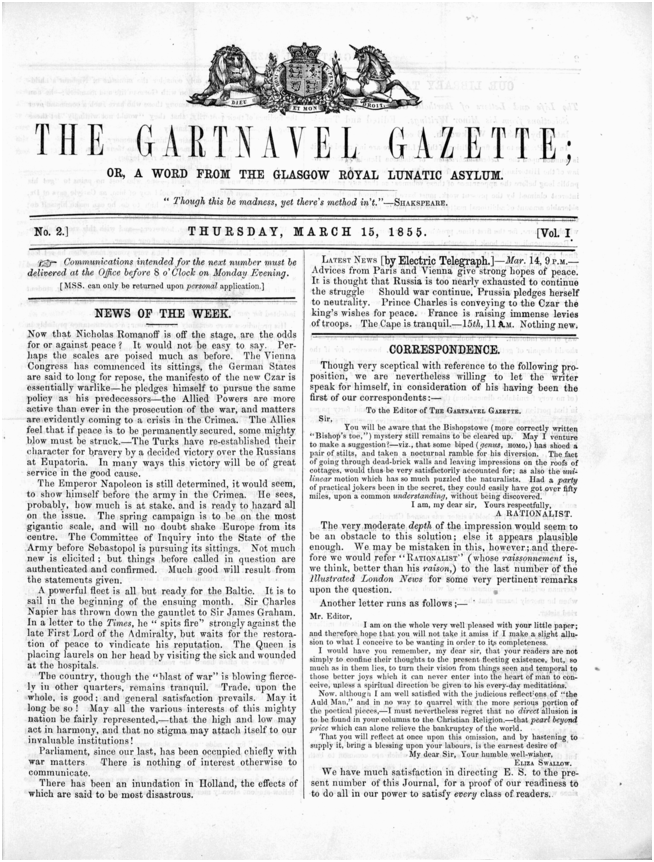
Black had likely been involved in the publication from its early days: within a month of his admission on 24 June 1853, he was busy composing type in the printing office, and his initials appear under poetic contributions from September onwards, occasionally dominating the poetry column.79 The surgeon’s notes from the Gartnavel describe him as: ‘restless and sleepless – talks and sings – good natured – he broke some glass – not suicidal – naturally of a religious turn, sober and well-doing’.80 He was ‘troubled with life usually’ and soon after admission, he was ‘restless[,] confused and incoherent’.81 He repeatedly expressed the wish to leave. Two more notes, from the end of August and the end of September that year, indicate that he remained stable and healthy, ‘rational in conversation’.82 A blank half page follows, interrupted by a note dated 1 February 1854: ‘By order to the Inspector of [the] poor … was this day handed over to his brother in law. Relieved.’83 What occurred during these four months is unclear, but the involvement of the Inspector of the Poor in his release suggests that it took place under external pressure from Black’s family and potentially against the physicians’ complete approval. The silence of the case notes corresponds to the disappearance of Black’s initials from the Gartnavel Gazette.
Black returned to the Gartnavel on 28 March 1854.84 He entered in a similar state of agitation and incoherence but in a few weeks restored his clarity of mind. With that came the realisation that he was confined once again. Wishing to leave, he expressed suspicions that he was ‘kept here so to work in the Printing Office’.85 Black’s fears might not have been unfounded, given the absence of other qualified printers in the institution at the time and a concern of Dr Mackintosh’s that the institution’s ‘great want is compositors and pressmen’.86 Either way, he had all the reasons to feel anxious about getting out. A father of seven children, the youngest of whom was a few months old, he was deprived of opportunities to provide for his family.87 Working in the asylum’s printing office, he spared the institution from outsourcing the task and training other patients to do the job. Throughout this stay of over two years, Black repeatedly expressed the wish to go home and wrote letters to his wife weekly, asking her to take him out, as he was ‘able enough to work for his family’.88 It is unclear whether she received them.
Soon after his readmission, he started working in the printing office once again, and after a year, on 8 March 1855, he and another patient reinstated the Gartnavel Gazette as a weekly.89 It is likely that his work earned him a privileged position in the asylum: from April 1855, his case notes repeatedly refer to his removals to the East House as punishment, indicating that he lived in the West House, despite being a pauper patient. His behaviour fluctuated: from quiet, content, and busy printing medical certificates and forms, he became rebellious, disruptive, and verbally abusive not only to staff but also to his fellow patients. The spells of anger and agitation resulted in him getting repeatedly placed in seclusion. Eventually, he was transferred to the East House permanently, marking the end of his printing career in the Gartnavel and of the second series of the Gartnavel Gazette.90 Between July and November, his medical notes convey a deterioration in his mental health, growing unrest, and tensions with his fellow inmates. The last seven months of his residence are unaccounted for, but the Patients Index indicates that he was discharged ‘relieved’ on 24 June 1856.91 Half a year later, he was in the Dundee Royal Asylum.92 He remained there for about four more years, continuing to write poetry and letters to his wife. Some of that correspondence has survived, suggesting that Black’s home life was ridden with tensions too.93
Black’s circumstance motivated the revival of the Gartnavel Gazette: his medical notes reveal that the first impression of the journal featured the following statement at the end: ‘Price two pence. For the benefit of George Blacks [sic] wife and family’.94 This notice is absent from the surviving copies of the Gazette. There is no evidence that the Gazette was reinstated as a paid publication, or that it reached readers outside the asylum. As the first number is missing, however, it is possible that it alone was sold either internally or externally to support Black’s family.
Apart from this lost call to charity, Black’s situation is not directly discussed in the Gazette, but it inevitably affected the fate of the periodical. While Black is explicitly acknowledged as the printer at the end of each issue, the identity and responsibilities of the other patient co-founder of the periodical remain unknown. It is likely that he was an invisible editor or co-editor, but the 17 May issue of the Gazette contains a statement that denies him any credit:
Having been informed that sundry reports are now current, to the effect that one of the mere contributors to the Gartnavel Gazette has caused it to be made known in public that he – and not other – is the Editor thereof, – thus appropriating to himself all the credit of my office, without a share of its responsibility, – this is to give notice, that I, George Black, Printer of the said Journal, presently residing at Gartnavel, believe such reports to be contrary to truth. Be it known, moreover, that I, George Black, as aforesaid, now am, and from the 8th day of March last have been, both Printer and Editor of the said Gartnavel Gazette [emphases in original].95
Even if the impostor in question was not the collaborator mentioned in the medical notes, Black’s statement is a refusal to acknowledge anyone else’s involvement in running the newspaper. But there must have been another party involved, as the publication carried on even while Black was in seclusion in the East House and when he was not allowed access to the printing office between 22 April and 4 May 1855.96 After the publication of Black’s hostile statement on 17 May, it is reasonable to think that Black took complete charge over the publication.
Evidence of backstage conflicts can also be found in the correspondence columns. Insistence on literary value intensified in the new series, and the editor(s) did not hesitate to express their opinion about both the successful and the unsuccessful submissions, as the following examples show:
T. Miller. – We should like to have gone hand in hand with you over your own ground, enlarging upon its beauties, and at the same time pointing out its defects.
J. J. B.: The ‘Lay’ lacks variety. It is certainly not up to your work.
‘Kilmarnock’. – Should you ever be a prisoner ‘in a strange land,’ you may comfort yourself with the assurance that your enemies will never seek songs from you.
‘Junius Secundus’. – We are not at a loss for selections in the poetical line. Your Prose sketch is quite a morsel to our liking, and will probably appear in our next.97
In addition to demonstrating the role of aesthetics in the selection process that governed periodical publication in asylums, these examples highlight the aspirational nature of asylum periodicals. While the editor had the final say about what would be admitted, he could also offer guidance to contributors to make their writing publishable – not unlike other editors that left room for correspondents’ poetry in their papers. Such feedback was becoming more common in the general press at the time, especially in newspapers and periodicals that targeted the working classes. As Kirstie Blair observes, ‘editors recognized that many of their correspondents had had limited access to education and consequently offered basic suggestions for self-help when they discovered genuine talent in need of cultivation’.98
The correspondents from the asylum, however, were not necessarily working-class readers. In fact, the story of the Gazette’s origins suggests that a significant portion of those who submitted were paying patients, residing in the West House alongside George Black. In fact, a piece of correspondence in the issue for 14 June 1855 voiced a complaint on behalf of the readers from the East House:
Now if you would hae pity upon us east house chaps, and try and transmografy awe they lang nebed wourds into engliesh, or a mixture o english and scotch, the thing would tak a great deal better here, and we would a be better satisfied with it. It does very well for you gentlemen in the west house to read and discuss, and may be you understand it among your cells; but us pare sort a simple sort a pauper sould cana understand it at aw [sic].99
The letter’s self-derogatory tone raises doubts about its authenticity: towards the end, the author calls himself ‘a daft man’.100 It still suggests that the periodical was not accessible to the residents of the East House, and that its primary audience were the more affluent and better educated inhabitants of Gartnavel. This peculiarity of the publication setting invested Black with the power to disrupt social hierarchies, by criticising higher-class patients’ writing. Consequently, the editor often became the target of correspondents’ complaints of extreme selectivity and unfair judgement and was forced to publicly answer angry letters.101 ‘A Little Bit of Secret History’ takes up most of the issue for 12 April, narrating a dispute between the editor and an author about the inclusion of a poem. The article ends with the original poem in full, published ‘“without so much pruning” as we should consider essential to the writer’s reputation.’102 This example illustrates the backstage tensions, arising from the renegotiation of class division in the asylum, and the limits of editorial power, as the editor could be pressured by contributors to publish previously rejected pieces.
The last surviving number, dated 28 June 1855, contains an article in which the editor is haunted by all the rejected pieces, or ‘the Spectres of the Rag-basket [emphasis in original]’.103 Only seemingly making amends, he tries to justify his judgements and consolidate his editorial authority. He quotes and comments on several of the unsuccessful contributions, including ‘[t]hree foolscap pages upon “Love”, – sexual, sensual, and other – [which] are, the state of the thermometer considered, “something too much of this”’.104 Another commentary is about a poem whose author seems to have refused the corrections that the editor suggested: ‘A “Serenade” from the pen of J. J. B. would seems light enough to defy criticism. It contains two faulty stanzas, however, – and we dare not mend them, for J. J. B. is as jealous in these matters as “a Barbary cock-pigeon over his hen.”’105 Adopting the mockingly exasperated editorial tone typical of contemporary correspondence columns, Black tried to settle his disputes with authors unwilling to accept his criticism. He also sought to draw his readers on his side by appealing to their sensibility and literary taste and exposing the lowly character and poor quality of the rejected submissions.106
While a regular newspaper would usually have a larger pool of readers who did not know the editor personally, Black inhabited the same space as his readers and was acquainted with at least some of the rejected contributors. It is possible that some of the criticisms were taken to heart or caused tensions within the asylum community, further fuelled by the class differences between the editor and the aspiring contributors of the West House. As the weeks went by, less and less original writing appeared in the Gartnavel Gazette, and it contained mostly the editor’s own writing (book reviews, news, and responses to correspondents) and reprinted poetry.107 It is likely that Black struggled to fill the pages of the Gazette because the ‘rag basket’ kept filling with what he considered talentless submissions. Considering his deteriorating relations with the rest of the patients, it is also possible that over time the number of contributors decreased.108 While Black’s harsh editorial voice was not unusual by the standards of general periodical culture, it can be seen as an extension of his verbal abuse and bullying of other patients. For instance, his removal to the East House ‘on account of his anoyance [sic] to the gentlemen in the West House’ took place within ten days of the publication of the last surviving issue.109 His intention to turn the criticism of rejected submission into a regular column titled ‘Our Failures’ never materialised.110
Black’s editorial experience was therefore significantly different from that of James Buchanan and ‘Phoenix Redivivus’, distinguishing the two series of the Gartnavel Gazette from each other. While Buchanan treated running and printing the newspaper as a recreational activity to fill his days in the asylum, Black’s lower social status required him to work. His medical notes clearly show that he was anxious to keep providing for his family, including by reviving the Gazette. These class differences could be responsible for the different outcomes for the two patients and the newspaper. Buchanan had access to legal advice, even if its usefulness was questionable in earning him freedom. In Black’s case, the additional financial pressure to get out of the asylum might have aggravated his condition, leading him to further frustration, anger, and violence over time. Finally, Black’s editorial authority was more easily contested by the contributors from the West House of the Gartnavel. Buchanan’s editorial decisions and aesthetic preferences, on the other hand, were reinforced by his gentlemanly status. Although similar to their ‘sane’ counterparts, asylum periodicals were hence shaped by unique tensions, arising from patients’ plea to liberty as well as interpersonal conflicts among inmates. Social class was one of the major factors that defined patients’ experience in nineteenth-century asylums. While subject to renegotiation, depending on the needs of the asylum, editors’ social status could play an important role in the launching and development of the publications and the selection of their contents.
In addition to class, race had a key role in the construction of madness and literary value and thus in periodical production in asylums. Benjamin Reiss calls the asylum ‘a happy twin of slavery’, since ‘lunatics, like slaves, were deprived of the right to vote, to sign contracts, to make wills, and to hold property’.1 Analysing the treatment of Black patients at the Alabama Insane Hospital, John S. Hughes observes a correlation between the experience of racial oppression and mental illness:
An unexplored irony of the formal policy of moral treatment and the insistence on occupational productivity was that, wherever possible, all patients, black and white, pursued a daily routine that most southerners would have considered appropriate for blacks: patients lived their days according to a rhythm not of their choosing; whenever possible they worked at physically tiring jobs out-of-doors; everyone deferred to authority; and individuals had few substantive choices to make. Model patients assumed their assigned roles, cooperated, and deferred to authority.2
The suggested parallels between white mental patients and the Black community offer an interesting perspective on asylum publishing, especially in institutions that housed non-white patients. How did the patients involved in publishing (mostly if not exclusively white) experience and navigate these social hierarchies and ideologies? Eannace’s study of the Opal of the New York State Asylum has already started answering the question, by showing that one of the major tools of oppression was ‘popular culture’s re-figuring of “others” as lacking the language skills necessary to make sense’.3 Asylum periodicals’ sane and eloquent writings were thus in themselves a form of resistance and challenge to the ruling ideologies. Empathising with other marginalised groups, Eannace argues, the producers of the Opal used their platform to fight against all inequality and hypocrisy in society: ‘preponderance of opinion [expressed in the periodical] leaned toward the rights of anyone denied full access to the American promise’.4
The history of the Meteor of the Alabama Insane Hospital (Figure 5.1) demonstrates a contrasting response to institutionalisation and the loss of rights that accompanied it. In comparison with other tasks, running and writing for a periodical was a form of work of an especially high order. It enabled educated white patients to not only express their creativity, enlightenment, and agency, but to distinguish themselves and reclaim their citizenship, at least figuratively. The launch of the Meteor on 4 July 1872 by a former plantation owner, Joseph Alexander Goree (1825–1896), was an act of rebellion against the irony of losing his own liberty and rights once he was certified as insane. The periodical was part of a larger campaign of literary activity which he led to demonstrate his erudition, high taste, and reason. His Meteor openly declared its aims of communicating updates to the patrons of the asylum. Unlike other asylum periodicals, it also openly discussed the involvement of the physician-superintendent, Dr Peter Bryce (1832–1892), in the publication. This was a strategic move rather than an act of submission, as it recast the patient-editor and the physician as allies and collaborators. Goree found empowerment in his editorial position and was set on proving his reason by maintaining the high literary quality of his publication and keeping madness out of its pages. Though run almost entirely by a single individual and unashamedly catering to the interests of the institution, the message of the Meteor was far from straightforward and homogeneous.5 During the decade of irregular publication, the newspaper accommodated different viewpoints and sought to represent the wider patient community. It also embodied Goree’s declining enthusiasm and growing discontent, as he realised that his project of self-empowerment would fail to earn him his freedom and rights.
Front page of the first issue of the Meteor.
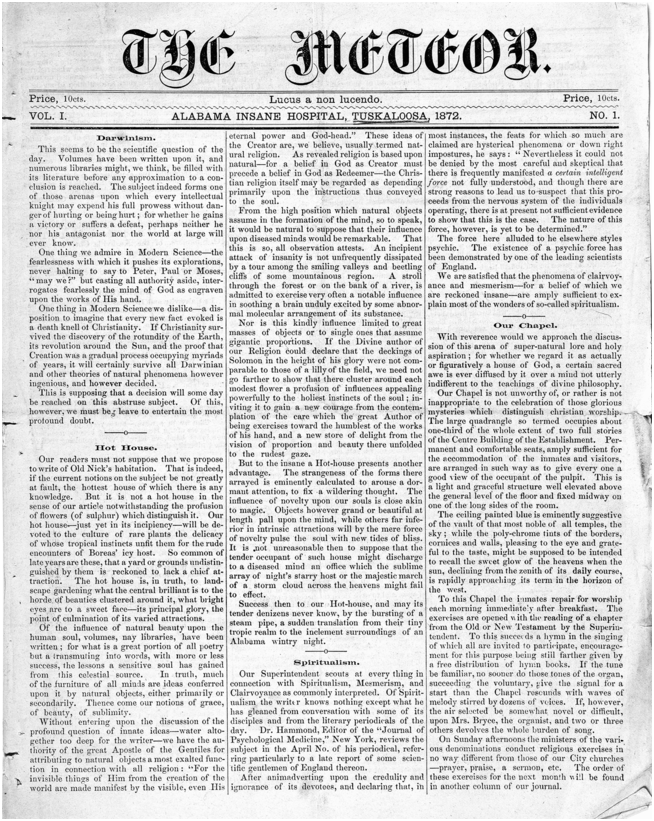
The Alabama Insane Hospital and Joseph Alexander Goree
Established in the outskirts of Tuscaloosa, the Alabama Insane Hospital opened its doors in 1861 and was one of the many public institutions embodying the moral treatment movement in America. Constructed according to the model established by Dr Thomas Kirkbride of the Pennsylvania Hospital for the Insane, the asylum featured a central building with two extending separate wings for men and women and over 300 acres of surrounding land.6 The institution admitted Black patients too, who, for the most part, were segregated from the rest and tended mostly by Black nurses.7 At first, they were placed in the basements of the wards, but in the late 1870s, separate lodges were built behind the main building for the purpose.8 Recommended to the trustees of the asylum by mental health reformer Dorothea Dix, Dr Peter Bryce of Columbia, South Carolina, was the first superintendent and held the position for thirty-one years. After graduating from the New York’s Medical College, he visited several European asylums. In Bill Weaver’s account of Bryce’s superintendency, the alienist emerges as a capable administrator and manager who fought for the good name and the survival of his institution during and after the Civil War.9 Bryce’s application of the moral treatment was intertwined with the institution’s economic dependency on patient labour.10 He claimed that: ‘As a remedial agent judicious employment is of the very first importance.’11 Hughes has shown that Bryce succeeded in engaging an impressive 80 per cent of the patients in some kind of labour over the first fifty years of his superintendency.12
At the end of 1867, the year in which the Meteor’s editor-to-be entered the Alabama Insane Hospital, the asylum housed 150 patients, though the number was rising steeply, while funding was perpetually insufficient.13 Bryce lamented that ‘in the line of amusement for the patients … the Hospital is badly equipped’.14 This clearly changed in the following years, as the physician’s report for 1871 reveals a range of amusements and recreational activities offered to patients: ‘An evening every week is given to diversions of different kinds in the large amusement hall appropriated for these purposes. Creditable theatrical performances, Ethiopian minstrelsy, tableaux-vivants, and games of all kinds, continue to enliven those occasions [italics in original].’15 Billiards, croquet, musical entertainments, walks, and carriage rides were also provided. Though the nature of these entertainments suggests that they were intended primarily for the white patient population, at least some of the theatrical events were attended by Black patients as well. The publishers of forty newspapers sent their titles to the asylum for free, and further donations of books, magazines, and other items from the local community were received.16 The launch of the Meteor in 1872 was part of this expanding recreational programme, but its purposes extended beyond institutional promotion and providing entertainment: to its editor, it was a means to sustain his social status and sense of self.
The known facts of Joseph Alexander Goree’s life offer some insight into who he was, his experience in the institution, and the role of the Meteor in it. He was born in the family of James Lyles Goree (1783–1841), a cotton planter in Perry County, Alabama.17 His father passed away when Joseph was sixteen, leaving behind an estate of nearly 1,800 acres and ninety-four enslaved people to be divided between his wife Martha and six children. Joseph inherited 285.71 acres at the value of $4,508.37 and seventeen enslaved people.18 He studied at the University of Alabama (1841–1842) and Brown University (1843–1845).19 Records from the 1850s indicate that he sold off the people he had enslaved but continued to accrue land in Missouri as well as Arkansas, where his older brother, Dr James Langston Goree, resided. He married Emma Maria Robinson in Indianapolis, Indiana in 1853.20 His wife passed away in the summer of 1854, within two weeks of giving birth to their only daughter, Emma E. Goree.21 By 1860, Emma was staying with her uncle in Arkansas, and she spent most of her life in Indiana.
Restricted access to patients’ records of the Alabama Insane Hospital obscures the particulars of Joseph’s admission to the Alabama Insane Hospital in 1867 and his experience in the institution until his death in 1896. However, census records suggest that he suffered from ‘melancholia’ and ‘monomania’, a kind of partial insanity that involved unhealthy obsession with a particular topic.22 At the time of his admission, only his thirteen-year-old daughter and his sister Lucy, who had moved to Texas, seem to have been alive and in good health. Having struggled with mental distress since at least 1850, his other sister, Mary Ann, was in the South Carolina Lunatic Asylum. In 1858, his brother Robert, also a cotton farmer, had mortally stabbed himself in the chest after a period of ‘depression of spirits’.23 His brother John Rabb had died of lung and liver disease in the early 1850s too, and Dr James Langston Goree had passed away in December 1866 of pneumonia. The whereabouts and death date of his mother have not been confirmed, but if alive, at that time she would have been quite elderly, at 79. The asylum’s financial records from the 1870s mention the receipt of fees for the boarding of a private patient by a ‘Miss Goree’, suggesting that his daughter eventually took charge of his maintenance.24 The Gorees’ history suggests that, even if Joseph’s distress leading to his admission was not directly related to the suffering of his relatives, he had lost most of his closest family and was likely in mourning.
This is not to say that he was alone and forgotten. The prosperity of his family secured him connections with other influential figures in the region, some of whom were directly involved in the establishment of the Alabama Insane Hospital. The Gorees were neighbours to the family of lawyer Andrew Barry Moore, who married Joseph’s sister Mary Ann in 1832 and became Governor of Alabama in 1857. He was an executor of James Lyle Goree’s will. Leah Rawls Atkins has suggested that it was in fact Mary Ann’s suffering that motivated Moore’s support for the construction of the Alabama Insane Hospital, begun in 1852 and completed in 1859.25 On 10 October 1867, sometime after Joseph Alexander Goree’s admission, Moore submitted a petition to the Probate Court of Perry County. In it, he declared Goree ‘a lunatic and incapable of governance of himself, or of conducting or managing his affairs’ and requesting a trial to determine ‘whether or not the said Joseph A. Goree is Lunatic, an idiot or non compos mentis’.26 On 24 February 1868, a jury of twelve declared Goree ‘non compos mentis’, and Moore became his official guardian.27
It is not clear what happened with Goree’s estate after Moore passed away in 1873, but in 1884 the Probate Court at Tuscaloosa County received a similar petition. This time, it was submitted by Dr James Thomas Searcy (1839–1920), a local physician and son of Dr Reuben Searcy – the president of the asylum’s board of trustees. In his petition, James Searcy disclosed that Joseph Alexander Goree had ‘an estate worth about three thousand dollars ($3000.00) and that it is necessary for him to have a guardian to take charge and manage the same’.28 He introduced himself as ‘a personal friend’ and claimed that his proposed appointment as guardian was ‘the wish of the aforesaid Joseph Alexander Goree and of his friends’.29 Three years later, James Searcy succeeded his father as the head of the trustees. After the death of Dr Peter Bryce in 1892, he took over the management of the asylum as a superintendent and held the position until 1919. It is not known whether he retained his guardianship until Goree’s death in the hospital in 1896 and what became of the estate after that. Searcy’s petition cannot be considered entirely malicious, because it contains at least a bit of truth: the physician and his future patient had a long-running relationship. They were close enough for Searcy to name one of his sons Joseph Alexander in 1879. No matter how friendly Goree and Searcy were, however, the guardianship constitutes a conflict of interests. If not blatant examples of abuse of power, Moore’s and Searcy’s guardianship over Goree reveal that his life was intimately intertwined with the Alabama Insane Hospital in ways that exceeded the fact of his admission as a patient. These circumstances contributed to Goree’s complex positioning in his social environment within and beyond the asylum. The son of a cotton planter and a slave owner himself, he ended up confined and legally stripped of his citizen rights, while the responsibility for his person and property were handed first to his brother-in-law and later to his alleged friend.
The Meteor as an Emancipatory Project
In this situation, his education and good taste became significant assets. In the years following his admission, Goree engaged in various literary activities. He ran the asylum library and printed both the Meteor and annual reports of the asylum. In his printing office, he welcomed visitors of the asylum, and, consequently, he was often mentioned in the local press as ‘Dr Goree’, despite never having qualified for the title.30 He wrote poetry and articles for the press, some of which he collected in a scrapbook.31 A reporter visiting the hospital in 1878 described Goree’s writing as ‘replete with lively fancy, sound judgment, good taste, and occasional sparks of genuine wit, all of which show how very sane an insane man can be’.32 This comment’s alignment of fancy, judgement, taste, wit, and sanity is key to understanding Goree’s activity in the asylum. It perfectly illustrates what Simon Gikandi has termed ‘the culture of taste’ established in the Enlightenment and ruled by ‘the ideology of the aesthetic [which] was predicated on the capacity of the aesthetic or the sensual to be posited as analogical to reason’.33 In this system, good manners, education, and discernment of valuable art and literature were linked with the highest ideal of rationality – an ideal reserved for the white middle- and upper-class Europeans and Americans.34 The review of Goree’s work thus suggests that his literary endeavours in the Alabama Insane Hospital were more than a means to pass the time. They were avenues for him to counteract the disempowerment of mental illness and sectioning, to retain his image as a learned, cultured citizen, and, potentially, to prove his sanity through aesthetic judgement.
The launch of the Meteor was a central component in Goree’s campaign to retain his sense of self and reputation as a respectable citizen through literary activity. Through the newspaper, he did not only continue participating in public life and showcase his skill and erudition, but he attempted to reposition himself as a collaborator in the asylum’s therapeutic project and thus an equal to the physician. The first issues featured essays on geology, music, agriculture, local intelligence, and content related to its mission – ‘to keep the Press and the people of Alabama, especially the patrons of the Hospital, en rapport with the doings of the institution, and well abreast with the most advanced views in the care and treatment of the insane’ [italics in original].35 In line with this statement, each of its four three- and four-column pages were filled with updates about the hospital, notices of donations, and musings on topics such as the use of physical restraint in asylums and the plea of insanity in court.36 The periodical also assured readers that its production cost nothing, ‘the whole labor of type-setting and putting it to press being performed by the patients, or by employees of the Hospital in intervals of leisure from their regular duties’.37 It was printed on a small, cheap Quarto Novelty Press, which cost $209.78 and was purchased via a New York–based agent, W. Y. Edwards.38 The newspaper sought to encourage exchanges with other titles, but it was also sold to offset the costs of production.39 Putting an emphasis on its novelty and cost-effectiveness, the Meteor promised to benefit the local community at no cost. This was crucial for an institution which, like many other asylums towards the end of the nineteenth century, depended on public funding and had to justify its existence by proving its usefulness in an economical way.
Despite its humble origins, the Meteor did not lack ambition and expressed aspirations to contribute to the restoration of the country after the Civil War. To convince readers of the value of the publication further, the first issue elaborated on the publication’s title:
We call our paper The Meteor. Meteors are always a surprise. So doubtless will be our little sheet. They appear at irregular intervals. So will it. Their career though short is brilliant, and we intend that our paper, if it do not coruscate with wit, shall glow with a kindly and generous sentiment for all mankind, whatever be their nationality, political principles or religious creed.40
Through this declaration, the Meteor joined other periodicals in seeking to reunite a society torn by political and religious divisions by appealing to a national readership.41 The choice of its launch date, 4 July, reinforced this intention.
This project of reconciliation, however, excluded the Black community within and beyond the institution. In his writing for the press, Goree repeatedly expressed his belief in Black people’s intellectual deficiency, their lack of aesthetic refinement, and the cultural degradation resulting from the abolition of slavery. In 1875, he was allowed to attend a lecture by Dr Middleton Michel at the Druid City Literary Club and subsequently published a commentary in the Tuscaloosa Blade. In his review, he objected to Dr Michel’s attribution ‘to the institution of slavery an influence detrimental to aesthetic culture’.42 He argued that, during the antebellum period, ‘to the highest literary and artistic culture there was not only no indifference, but enthusiastic devotion’.43 In another piece for the Blade, he connected the economic struggles of the South after the Civil War to ‘the anarchy resulting from the long contest for political supremacy between the intelligent whites and the ignorant negroes’.44 Despite the Meteor’s attempts at reconciliation, Goree repeatedly expressed resentment towards the outcomes of the war and scepticism towards the future political and cultural development of the country.
His contempt is also palpable in the Meteor, though expressed mostly through silence. In the surviving copies of the Alabama newspaper, Black patients appear only once, as a target for scorn and mockery. An article in the first number described the amusement hall and the regular entertainments that took place there and reflected on their quality as follows:
If we admit the common run of negroes to be reliable connoiseurs [sic], we should unhesitatingly pronounce as our verdict, ‘sublime! excellent! pretty good!!!’ – as a Frenchman would climax it; for with laughter loud and prolonged does the colored portion of the audience salute most of the attempts at the comical. If however we were to consult our own impressions we should say that excellence was not always attained – that there was some room, however small, for improvement ….
It must be remembered, however, that the performers are conscious of the fact that a large portion of the audience have had little opportunity for attaining to any considerable degree of perspicacity on histrionic subjects, and it is possible that points, incidents and act which impress the writer as absurd exaggeration may seem to others the acme of laughable drollery.45
Goree’s attitude stands in stark contrast to that expressed in the Opal (1851–1860) of the New York State Lunatic Asylum, whose contributors recognised the parallels between their oppression and slavery and used enslaved people as ‘a literary substitute for themselves’.46 The above-mentioned statement indicates that Goree would not have seen Black patients, who at the time constituted about 16 per cent of the patients in the hospital, as fit to contribute or even appreciate the Meteor as readers.47 In the context of the asylum, however, the exclusion of Black patients from his project and his claims on superior taste were more than the effects of normalised prejudice. In the public imagination, all patients, Black and white, were lumped together physically in the space of the institution and symbolically under the label of ‘lunatics’. Highlighting his superior intellectual attainments was part of Goree’s strategy to stand out and retain his membership in what he saw as ‘civilised’ white society.
The Meteor’s open and unashamed commitment to serve the interests of the institution by keeping the public informed of its operations is another strategy that Goree adopted in the pursuit of his self-empowerment. By promising to support Dr Bryce’s work, Goree positioned himself as an ally in the medical project of alleviating insanity and educating the public about its nature and treatment. As the publication relied on its claims to being produced by inmates, the first issue rushed to reassure readers that its authenticity was not compromised:
The Superintendent must not be held responsible for all opinions expressed through it, for while exercising a general supervision, he has thought proper to give its contributors a large discretion in the drift of their articles. Nothing but original matter by patients of the Hospital will be admitted to the honor of a place in its columns.48
This statement clearly establishes the superintendent, Dr Bryce, as the authority determining the contents of the newspaper. However, the supervision that the physician would exercise would be only ‘general’, suggesting that views not fully aligned with his were going to be allowed in the newspaper. His tolerance and permissiveness, the Meteor reassured its readers, would guarantee that the patients’ voices would not be silenced.
Indeed, the Meteor resists reductive interpretations along the doctor–patient dichotomy and adopts an ambiguously pluralistic voice. The newspaper traced closely developments in the management of the hospital and the treatment of insanity more widely. Its ability to do so was largely due to Dr Bryce’s involvement in the project. For instance, the eighth issue notes: ‘the Superintendent has handed us a number of the Middletown, Ct. Daily Constitution, which contains the obituary of Elizabeth Palmer, wife of Dr. A. Marvin Shew, Sup’t of the General Hospital for the Insane’.49 Phrases such as ‘we learn from Dr. Bryce’, ‘in behalf of the Superintendent’, and ‘the Superintendent has requested us to acknowledge’ further indicate that Bryce was frequently in touch with the newspaper office, providing information, opinions, and subjects to be discussed in the publication.50
Although the superintendent’s views were never expressed directly but were paraphrased or potentially appeared anonymously or pseudonymously, the visible involvement of Dr Bryce made it hard for the newspaper to sustain the readers’ trust in its authenticity. Potentially attempting to dispel the doubts, the editorial column was always headed by a reminder that the Meteor was ‘edited by a patient’. Suspicions were eventually voiced in the January 1874 issue of Excelsior, for a time regularly received from the Murray Royal Asylum in Scotland.51 Excelsior’s claim about the Meteor that, ‘though it purports to be “edited by a Patient,” it is obvious the Physician-Superintendent is the responsible or real Editor’, inspired a lengthy response by Goree.52 In the issue of 30 March that year, he questioned the basis of the accusation, refuted it, and counterattacked:
Does not the conductor of Excelsior know that any Superintendent who should suffer a paper to be published from his establishment without his supervision, would deserve a place in one of his own wards? …
He manifestly thinks that The Meteor wires are worked by some one [sic] who is not insane. With this we find no fault. It is our own conviction. But unfortunately we can’t get the Superintendent to see it …
But the editor of Excelsior still thinks that a hospital journal should contain the ‘insane’ contributions of the inmates. If Dr. Lindsay [the Physician-Superintendent of the Murray and editor of Excelsior] thinks thus, why not act accordingly?53
Declaring the involvement of physicians in asylum publications unproblematic and in fact advisable, this statement subverts the doctor–patient dichotomy in its apparent tolerance of medical supervision. At the same time, it presents a case in which a patient openly confronted the authority of two physicians. In these lines, Goree publicly questioned Dr Bryce’s judgement of his sanity and exposed the hypocrisy of another respected physician. At the same time, he disputed the very nature and proper management of asylum periodicals and defended a stance that seems unusual given his position.
The patient-editor’s conviction that medical supervision of periodicals was necessary did not simply pay lip service to the authority on which the publication depended (Dr Bryce’s) but was rooted in Goree’s genuine concerns. This is shown by his reflections on the sanity of contributors to asylum periodicals, including himself. He argues that, while allowing some madness in the periodicals might be entertaining,
to devote any considerable space to such matter would be as absurd as to have occasional dinners at the hospital, to which the public were invited, served up by very insane cooks, to show the guests what repulsive messes a diseased brain can concoct. From partaking at such entertainment we should beg to be excused.54
The parallel drawn between including ‘mad writing’ in the Meteor and inviting outsiders for dinner is curious, since at the time asylum tourism was in fact frequently practised, including in the Alabama Insane Hospital.55 Visits were usually carefully orchestrated, seeking to dispel doubts about the conditions in asylums and impress outsiders with the success of the moral treatment. Opposed to the idea that guests should be given access to patients’ minds, Goree suggests that his newspaper should protect inmates’ privacy. This is further supported by praise of the students at the University of Alabama, who ‘proved excellent neighbors. They [were] never seen prowling around the Hospital’ or annoying the inhabitants.56 Through that position, Goree justified not only the involvement of the supervising physician but his own function as editor and highlighted his own responsibility for representing and protecting the patient community.
Emily Clark has observed that ‘periodicals and tours helped to expose the inside of the asylum to the public, so that there would be no suspicion of internal corruption’.57 This claim implies that these practices were serving the asylum’s interests only, and that those were entirely separate from the interests of the patient community. The Meteor shows that the patient-editor, rather than the physician, could be the curator of the illusion of sanity. A piece, likely written by another patient, objects to Excelsior’s stance ‘that all such journals [asylum periodicals] err in publishing only the choice articles’ and argues that:
with nonsense, come whence it might, no class of readers would be long entertained. Hence, while he [the Meteor’s editor] has … excluded everything but contributions by the inmates, he has not, to use his own expression, ‘hesitated to apply the garote [sic] to any communication that had not other claims to attention than the circumstance of origin in the brain of an insane person.’58
At a time when discussions of madness were imbued either with medical slang or scandalous gossip, this policy of representation cannot be reduced to a ‘false positivity’, as Clark terms it.59 It was driven by a sense of asylum periodicals’ value beyond the ephemeral appeal of the sensation of madness. It also constituted a self-protection mechanism of the patient community against unhealthy and often ill-meaning curiosity. Finally, the image of the editorial ‘garrote’ once again highlights asylum periodicals’ potential to create a hierarchy of their own. The publications empowered at least some of the oppressed and marginalised individuals, turning them into harsh judges of others’ literary taste and sanity.
The Meteor as a Space of Disagreement
Goree’s position on keeping the newspaper focused on the institution and madness-free does not mean, however, that the Meteor did not include writing that departed from these principles and opinions that diverged from the superintendent’s. An article in the first issue arguing in favour of supernatural phenomena begins by stating that: ‘Our superintendent scouts at every thing in connection with Spiritualism, Mesmerism, and Clairvoyance as commonly interpreted.’60 The author defends spiritualism from the physician’s scorn by insisting that ‘the existence of a psychic force has been demonstrated by one of the leading scientists in England’.61 They then conclude: ‘we are satisfied that the phenomena of clairvoyance and mesmerism – for a belief in which we are reckoned insane – are amply sufficient to explain most of the wonders of so-called spiritualism’.62 It is noteworthy that the author’s convictions in spiritual experiences are presented not merely as a source of disagreement with the superintendent but as the reason for the author’s institutionalisation. Given the popularity of various spiritual beliefs at the time, it is unlikely that the author ended up in the asylum only for such opinions. This article shows the physician’s willingness to allow not only public defiance of his views but also, more implicitly, distortion of the circumstances surrounding patients’ admission and disputation of his judgement.
The Meteor is indeed a space in which the physician’s and the patient’s views could coexist, even when diverging. A front-page article in the April 1876 issue, for instance, answers complaints in the press about false pleas to insanity in courtrooms by arguing that any transgression can be explained with some degree of mental disorder. Thus, rather than restricting the use of the plea, the author claims, it should be used more often.63 Another article in the same issue reads thus:
On our first page will be found an article on the responsibility of the insane, in which are some good thoughts. But believing that an exhibit of the views of our Superintendent on the point would be specially interesting, we determined to supplement that article by another, setting forth his views as he has, from time to time, expressed them in our presence. The subject is difficult; for while it is indisputably barbarous to hold persons of diseased minds to a strict accountability, society has a right to demand protection from dangerous characters, whether they be made so by the devil or disease.64
The second article proceeds by offering a middle ground of ‘moderate responsibility’, suggesting that the defendant’s sanity should always be assessed by a commission of experts (alienists), and concluding that ‘the insane are rightly esteemed responsible in a degree’.65 The juxtaposition of these opinions suggests two possibilities. Dr Bryce might have been aware of the former article in advance of publication and, perhaps too busy to respond himself, arranged the insertion of the latter piece. Alternatively, the editor himself decided to balance the boldness of the first article with a more moderate opinion piece. Despite its subduing through the latter article, the former appeared on the front page of the newspaper: the patient’s opinion occupied a respectable place in the Meteor.
This is not the only instance in which the Meteor facilitated the vocalisation of discontent and criticism. In fact, alleged instances of censorship were made public knowledge by the inclusion of ‘intercepted’ correspondence sent by other patients. For example, the first issue contains the following notice: ‘The editor learns with deep sorrow that the handsome widow of the east wing [Ladies’ Wing], had prepared an article for this number of The Meteor but that it was condemned before reaching him.’66 Once again employing a metaphorical language referring to the death sentence, the editor implies that the article did not reach the printing office because of institutional interference. There are other mentions of obstruction of communication: ‘Three very interesting communications from the ladies were by the Superintendent … so carefully laid away that they cannot be found.’67 The editor nevertheless offered brief summaries of the accounts. One was a personal narrative of recurring illness and sectioning, the second was a report on the events in the ladies’ wing over the past week, and the last was a love letter, potentially addressed to someone outside the Hospital. There is evidence that female patients did write for the Meteor, so the censorship was not necessarily aiming to keep the genders separated.68 However, the inclusion of these mentions of intervention might have been driven by Goree’s yearning (similar to John Reid Adam’s) to communicate with the ladies’ ward. His wish eventually got gratified, as he was allowed to move more freely around the institution and to enjoy accompanied visits to the ladies’ ward.69 Either way, paraphrasing intercepted correspondence shows rebellion against regulation, as well as the editor’s commitment to include patients’ stories in his paper.
Finally, the Meteor published ‘the conclusion of the intercepted letter written by a patient of this Hospital for a New York journal’.70 The letter reviews the five newspapers in Tuscaloosa at the time and their editors. The Meteor’s editor, it says, ‘writes articles laudatory of the Hospital, and then avails himself of every opportunity to impose leg-bail upon the officers, in order to make room for any patient decoyed there by his pen’.71 This description resonates with the ambivalence of the Meteor’s attitude towards the institution, reflecting both endorsement of the institution and the patients’ (including the editor’s) plight for freedom. In the restrained platform of the newspaper, the latter was expressed by inserting, retelling, or mentioning patients’ writings that were meant to be left out.
Another way in which the Meteor departed from the ‘laudatory’ narrative about the hospital was by occasionally referring to alternative discourses among the patient population. An article titled ‘The Bright Side’ presents a disruptive image of asylum life. Claiming to report a conversation between inmates, it states:
One of the patients … was bewailing his condition; lamenting his confinement, his lack of profitable employment and variety in his associates, and the general monotonousness of life in a hospital. Another convalescent patient declared, in response, that hospital life was altogether the most pleasant that had fallen to his lot …. It cannot be denied however that by far the most general feeling, among the patients, is one of dissatisfaction; impatience of detention, a desire to return to their homes, and to be making money.72
This article highlights the diversity of patients’ experiences without downplaying the suffering caused by institutionalisation itself. It also yet again highlights patients’ frustration with the financial uncertainty they faced in the asylum, especially if they had families to support. The Meteor invited correspondents to give voice to these negative feelings. The July 1876 number contained a notice from the editor that invited other patients’ contributions and declared that ‘sly cuts at the officers, nurses and employees will not necessarily cause the rejection of an article’.73 This announcement did not cause a detectable change in the character of the newspaper. However, the encouragement of complaints shows the Meteor’s aspiration to become a platform for criticism, as well as praise of the asylum. In fact, the straightforward discussion of patients’ dissatisfaction becomes all the more striking and powerful when embedded in the overarching celebratory narrative that defines the newspaper. At the same time, Goree’s initial commitment to collaborate with the institutional authorities likely helped in earning the trust of the physician, building editorial authority, and gradually pushing the boundaries of what could be said in the newspaper.
The openly critical writing, however, could also be linked to changes in the Meteor’s circulation: the same number from 1876 announced that the newspaper would be ‘printed in the future solely for the use of the patients of the Hospital’.74 The report of the superintendent, issued in the autumn of that year, indicates that the publication ceased altogether at that point: ‘We published in the Hospital until quite recently a little paper called The Meteor, which was edited and printed exclusively by patients …. It was discontinued a few months ago from the lack of interest on the part of the patients who conducted it.’75 The newspaper made a surprising return a year and a half later, in December 1877, stating that, ‘Meteor-like our paper suddenly disappeared …. We purpose, as before, to issue it quarterly, but the quarter may be prolonged to six months or contracted to two or even one.’76 The next issue appeared two years later, and was followed by at least two more on an annual basis, as the periodical transformed ‘from a quarterly … to a semi-occasionally’.77
In that period, the Meteor often reflected its editor’s loss of spirit and faith in the therapeutic effects of the institution whose patient population had nearly tripled since Goree’s admission, reaching 379 at the end of 1877.78 In the December 1879 number, Goree publicly discusses the reasons for his sectioning. Though infused with his usual wit, the list hints at underlying bitterness and frustration. The first reason he mentions is his ‘ideas about animal magnetism and mind-reading which the savants deem unauthorized by any well-attested facts’.79 He also expresses suspicions of exploitation, similar to those of George Black, the printer of the Gartnavel Gazette: ‘Some say that he is kept here for the convenience of the Hospital, to print the poetry of the ladies of the establishment, etc.’80 The ninth and last one in the list simply reads: ‘Ask the Superintendent.’81 This final item hints at resignation, even anger, which would grow over time. Two years later, the twenty-first issue included the following reflection on the reduced frequency of the publication: ‘The editor, who was also the printer, disgusted with the long succession of years that still found him at the Hospital, determined to strike halt in the regular issue, and to print a number only when inclined to do so.’82 This is the last number of the Meteor that has survived in the Alabama Department of History and Archives, though there is evidence that it continued irregularly, at least until late 1883.83
It is hard to tell what happened in the office of the Meteor from 1876 onwards. The reliance of the publication on a single individual was likely a determining factor for its discontinuance. A notice in the last surviving number suggests that his time might have been taken up by his duties as the main printer of the institution: ‘All of the Hospital printing – and it is not a little – is done in The Meteor office.’84 The institution kept growing in size over the years: it housed around 325 patients in 1874 and 545 in 1881. Even though Goree was not working in the printing office alone, the staggering increase in jobs meant less time to dedicate to the newspaper.85 Throughout the run of the newspaper, he seems to have been not only the editor and printer but also the main contributor to the publication. The length of the editorial columns, the predominance of the editorial mode of expression, and the consistency of style throughout the run of the newspaper suggest that a significant portion of the writing was produced by him. Among the few notable communications by other inmates were a notice of a new plant being introduced to the hothouse of the hospital, articles on the nervous temperament and the devaluation of the title LL. D., and a female patient’s defence against the editor’s ‘characteristic “flings” at the weakness of oar [sic] sex’ with a sketch of the daily life in the ladies’ wards.86 Overall, others’ contributions were few, until the decline in the circulation and frequency of the Meteor forced the editor to actively seek the assistance of other patients.
The aforementioned notice from the editor encouraging critical writing by patients in the number for July 1876 also stated that:
Anecdotes and narratives of hospital experience, here or elsewhere, are preferred …. Prose and poetical contributions are solicited ….
The object of this change in the character of our paper – the substitution of many short articles for a few long ones – is to reflect more perfectly the animus [italics in original] of the inmates of the Hospital, or at least of a much larger number than have heretofore contributed to The Meteor.87
This statement marked the introduction of a new editorial strategy. Potentially struggling to fill the pages himself or to keep the attention of his readership, the editor resorted to making the newspaper more inclusive. The same number has a column ‘Personals: Contributed’ and a poem, which, as the the Meteor itself states, was unusual.88 Subsequent numbers contain relatively more ‘communicated’ articles bearing various signatures. A column titled ‘Answers to Correspondents’ offers witty responses to the questions submitted under ten different pseudonyms (though it is uncertain if they represented ten individuals other than Goree).89 The last surviving issue seems keen to underline that: ‘The articles in this number, though not signed, have been written by quite a number of persons connected with the Hospital.’90 This statement, however, does not make it clear whether these contributors were patients (current or former) at all. Despite the editor’s attempt to persuade readers that the newspaper accommodated more diverse perspectives, the change was not too palpable. Most of the writing still consisted of institution-related reports and musings.
The failure of the implementation of Goree’s new editorial strategy is somewhat ironically rooted in his high aspirations for the newspaper and his understanding of aesthetic taste as a marker of civilisation, respectability, and sanity. As most of the Meteor was the editor’s creation, commentary on others’ attempts at writing and on the decision-making involved in editing a newspaper are rare. The scarcity of other patient’s contributions, as well as the reference to the editorial ‘garrote’ mentioned earlier can nevertheless be interpreted as indicators of the editor’s high standards.91 Perhaps, despite all the compromises Goree was willing to make, there simply was no writing he found fit to be published.
This was almost certainly the case when it came to the inclusion of poetry in the newspaper. The issue of July 1876 contained the following reflection:
We used to think that few persons have the art of compressing it [life] into a literary form. Since reading Mr. Sydney Lanier’s Centennial Poem, we have changed our mind. Anyone can manufacture it. We therefore beg pardon of the Hospital bards, and entreat them all to send us their every effusion.92
Goree was clearly sceptical of the value of amateur poetry. Further evidence for it is found in the editorial commentary appended to the only patient’s poem that appears in the surviving issues of the Meteor:
Contrary to our usual custom we introduce a poem into the columns of The Meteor. The writer, we understand, came near landing into one of the back wards while the cacoethes poeticum [italics in original] was full upon him, and for this reason, even if the verses were devoid of real literary merit, he deserves to be rewarded. We like the lines however. They jingle well, and we think have the true ring. That idea about pinning with the evening star, we think we have heard before. B[u]t no matter; it’s good, and will bear repetition.93
This friendly but unenthusiastic comment mimics the attitude of other newspaper editorial commentary on amateur poetry. It shows that Goree, like George Black at the Glasgow Royal Asylum, stuck to the conventional strict editorial tone even at times when he was struggling to keep his newspaper running. He expressed no remorse at rejecting even acceptable writing for surprising reasons such as anonymity: ‘The communication signed “Zoe” is good poetry but being anonymous goes to the fire-kindling box.’94 Though publishing female patients’ poetry separately from the Meteor, Goree was reluctant to admit verse to his paper, even after the newspaper stopped its external circulation.95 It is possible that more poetry was published in issues that have not been located or survived at all. But the fact that the only poem that I have had access to was followed by an apologetic explanation of its publication suggests that the editor’s ‘garrote’ was applied mercilessly to maintain the Meteor up to the standards of its founder.
As the newspaper was part of Goree’s larger campaign to maintain his social status in the community and sense of citizenship, there was more at stake than the reputation of the publication. In Goree’s own worldview, refined aesthetic and literary taste were the highest marks of civilisation, humanity, and sanity. If the Meteor was to serve as evidence of his attainment, education, and well-developed tastes and by association, his reason, he could make no compromises. He had to maintain his image. As the editor of the newspaper, he found various opportunities to seek empowerment. He positioned himself as an equal ally and collaborator to the physician, joined the local literary circles, exercised editorial authority, represented the patient community, and gave voice to his fellow inmates’ discontent, as well as his own.
And yet, after four years of running his paper, he failed to earn back his liberty and autonomy. Without more information about the last twenty years he spent in the Alabama Insane Hospital before his death, it is impossible to say with certainty what caused the discontinuation of the Meteor in 1876, followed by its more sporadic appearances in the following years. These could be signs of Goree’s loss of faith and resignation to his condition, indicators of his deteriorating health, lack of interest, or something else. Whatever the reason, the testimonies of former patients and visitors to the asylum show that his project of proving his worth as a refined citizen was at least partly successful. In his memoir, Rev Joseph Camp recalls his time in the asylum and says that Goree ‘is as compos mentis as he ever was, and is one of the most polished gentlemen I have ever seen’.96 The reporter for the press who visited the asylum in 1878 provides the following description of Goree’s printing office: ‘In this sanctum we found a small but select library, his own property, bought with money furnished by his daughter, an only child, who resides in another state [Indiana].’97 Out of everything that Goree had owned and lost, his sense of self as a man of education and taste remained intact, embodied by what seems to have been his only property – his books.
Whatever conflicts seeped through in the pages of asylum periodicals were counteracted by the publications’ attempts to represent the institution as a unified community of current, as well as former, patients and staff. This tendency has been evident in all titles studied to date.1 Even internally circulated periodicals such as Chronicles of the Monastery and the Gartnavel Gazette participated in such exchanges. Though launched over ten years after John Reid Adam’s Chronicles, the Gazette was started with the knowledge of the previously existing periodical. Asylum periodicals thus allowed patients to connect across both physical and temporal distances. This was especially important, as asylums were structurally divided along the lines of class, gender, and race, and as their populations grew exponentially, making it harder for the inhabitants to know each other.2 Benedict Anderson has famously argued that to read a newspaper was to participate in an ‘extraordinary mass ceremony: the almost precisely simultaneous consumption (“imagining”) of the newspaper-as-fiction’.3 Even when reading silently on their own, readers of periodicals participated in a regular, repetitive act of information sharing within an imagined community of other readers.4 Asylum periodicals had a similar unifying function. They often refer to connections between patients, their relatives, staff, and former residents of the institution. These mentions brought members of the asylum population closer together and often blurred the lines set by the hierarchical structures of institutions.5 In fact, as Sarah Chaney observes, asylum periodicals bear witness to a ‘type of familiarity [that] was rarely, if ever, recorded in casebooks and other clinical records’.6 While offering a unique glimpse into asylum reality, asylum periodicals also exaggerated or idealised connections in order to construct and maintain these imagined communities.
This chapter brings together insights from the accumulated case studies to date and offers new evidence from unstudied titles to outline general patterns of community building. This function of asylum periodicals has been explored mostly in relation to generating copy and reading, but the first part of this chapter will focus on printing.7 Publishing is usually a collaborative project that involves multiple actors, so the work in the printing office brought inhabitants of asylums together and potentially encouraged them to bond. However limited, the evidence about the operations of asylum printing offices reveals continuous collaboration between different groups of people, which coexisted with and subverted institutional and social divisions and tensions. Though patients’ motivation to participate in publishing could be related to improving their position in the asylum and self-expression, patients and physicians could form genuine friendships in the process and pursue mutual benefits. As a result, producing periodicals cultivated a sense of belonging to a literary and institutional community of producers and readers within and beyond the asylum. In doing so, they supplanted medical models that envisioned the asylum as a domestic space under the paternalistic governance of the superintendent and matron. However, these publications did not merely replicate medical discourses. They also subverted, contested, and modified the therapeutic family model. A significant revision was the expansion of the metaphor into an ‘extended family’: asylum periodicals embody former patients’ continuous engagement with asylum life. Truly, patients’ desire to stay, return, or continue interacting with the institution could indicate that they were unable to adapt to the world outside. However, for many the asylum became a home, a place for forming important and dear relationships, and a source of support in their lives beyond discharge.8 Asylum periodicals are therefore the products of successfully construed imagined families.
Publishing as a Collaboration
The publication of asylum periodicals promoted cohesion within the patient population, which tended to be physically divided by class and gender within the institution. In his reflections on the therapeutic potential of recreation, John Minson Galt claimed that:
for several reasons, there is a disposition in the insane to have their attention withdrawn to their own mental operations, rather than to enter into any intimate fellowship with each other. Amusements tend to break down this wall of separation, and by arousing social feelings, they wean the morbid spirit from so hurtful an introspection.9
The healing effects of entertainments in nineteenth-century asylums were not stemming only from the distraction they offered, but from their social function – from their capacity to unite people and to counteract patients’ isolation and loneliness.10 Amusements’ potential to encourage healthy socialising was powerful enough to bridge existing social divisions. Dr Lauder Lindsay of the Murray Royal Asylum stated that:
An indirect effect [of recreations] has been … to throw more together the various classes of our community – to produce a greater degree of social, friendly, and harmonious feeling among them – and to give them more the characters of a happy family group, than of a miscellaneous assemblage of unruly natures.11
Asylum periodicals, especially those produced entirely in-house, were powerful instruments for uniting the disparate and divided inhabitants of asylums. Their publication involved both skilled manual tasks (composing, operating the press, and, more rarely, engraving) and the intellectual labour of writing and editing. This aspect of their production is reflected in Dr Rockwell’s report about the Vermont Asylum, which describes the Asylum Journal as the work of patients with various professions: ‘Those of our patients who have been students, we employ to write and select for the Journal, and those who have been merchants and business men we employ to fold and direct the papers.’12 Though allowing for some social mingling, this depiction still suggests a rather rigid distribution of work and an exclusively masculine space. Arrangements in other institutions, however, tended to be more flexible, as patients from different backgrounds performed both the artisanal and the intellectual tasks. Composition and printing were usually performed by working-class patients who had been printers by occupation, though people of higher social standing occasionally took charge of the printing office. Two examples were merchants James Buchanan of the Gartnavel Gazette and John Reid Adam of Chronicles of the Monastery, both of whom have been referred to as ‘gentlemen’.13 In terms of gender, however, the printing office in the asylum remained a predominantly male space. At this stage, there is no evidence that female patients were employed there. This is hardly surprising, considering that the printing trade at the time was particularly resistant to admitting women.
While composing type and operating the press demanded both technical skills and sufficient literacy, writing for the periodicals required only the latter, which enabled greater transgression of class and gender divisions. As Christopher Holligan argues in his study of the Morningside Mirror, the average asylum periodical contributor was a middle- or upper-class man.14 However, exceptions were far from rare and were not restricted to printer-patients. An unnamed carpenter-patient in the Royal Edinburgh Asylum, for instance, became ‘one of the poetical contributors to the [Morningside] Mirror’.15 Writing was also considered a suitable occupation for the women in the asylum, making periodical production a rather unique type of work, defying the usual gender-based division of labour in mental institutions. Most asylum periodicals originated in the male wards of asylums, likely due to the understanding of printing as an ‘unwomanly’ type of occupation. But there is evidence that the launching and editing of some periodicals was partly or entirely undertaken by female patients. Eannace has suggested that the ‘fair issue’ of the Opal of the New York State Asylum (which appeared a few months prior to the official launch of the periodical) had an ‘Editress’. Later numbers also explicitly credit the ladies in the asylum as the originators of the publication.16 Another American periodical, the Friend (1872–1874) of the Pennsylvania State Asylum at Harrisburg, was ‘conducted by an Association of Ladies’, though its printing was likely outsourced, and its contents allegedly consisted solely of reprints.17 While social divisions within institutions inevitably affected access to participation in publishing, asylum periodicals demonstrate that these boundaries could be fluid.
In fact, since male and female patients lived mostly separately in the asylum, periodicals were an exciting opportunity for communication. Even when run by men, they warmly welcomed contributions from the women’s ward. Earlier I have discussed John Reid Adam’s urgent call for ladies’ writing in the introductory poem of the Chronicles of the Monastery and Joseph Goree’s inclusion of communications from the women’s wards in the Meteor, even when the original letters had been lost or hidden away by staff. ‘Olivia’, one of the ladies whose original writing made it to the pages of the Meteor, stated: ‘You request the ladies of the Hospital, through our Matron, to contribute original articles … and just to prove to you that we ladies can write as well as talk, I intend to gratify you, or rather myself, by making the attempt [emphases in original].’18 This excerpt confirms that the editor of the Alabama newspaper actively sought contributions by female patients. Likewise, the second issue of the Gartnavel Gazette included ‘selections taken almost at random, from a goodly number of contributions, kindly furnished us, by the Ladies’.19 Responses to calls to the women’s wards highlight asylum periodicals’ ability to facilitate connection across institutional divisions. The statement of ‘Olivia’ also hints at the key role that staff had in these exchanges: the matrons, physicians, attendants, and nurses carried the messages across the different wards of the institutions.
The inclusivity of periodical publishing in asylums, however, was largely driven by necessity. Though editors’ class-rooted aesthetic views filtered the contents, the limited pool of contributors potentially pushed demanding editors to be less strict in their selection. Similarly, invitations addressed to female patients could be seen as a strategy to secure enough content. Admission of women’s writing was also driven by the male editors’ yearning to communicate more with the female inhabitants of the institutions. In fact, one of the motivations that Goree listed for continuing the Meteor was flirtation, or, as he put it, a ‘desire to curry favor with the females of the establishment by printing their effusions’.20 Asylum periodicals’ inclusivity was therefore likely driven by the needs of the publications or of their male editors.
The transgression of institutional boundaries that asylum periodicals enabled was circumscribed by various factors. Printers, editors, and contributors had to be educated enough to participate in literary production, which left out a significant number of the patients in nineteenth-century asylums. With the exception of a single Jamaican patient whom I have recently identified as a contributor to the Morningside Mirror, writings by non-white residents appear to be absent from asylum periodicals, even in institutions like the Alabama Insane Hospital, which certainly housed such patients.21 This absence is reflective of the general ‘invisibility’ of patients of colour in contemporary mental healthcare: ‘staff doctors wrote few detailed case histories for blacks’.22 In America, Black patients were often physically hidden out of view, kept in basements or in separate buildings. Beyond race, patients’ position in the asylum depended on their mental state and behaviour, the privilege of contributing could be earned with convalescence and obedience and lost with relapse and confrontation. This correlation should not be overemphasised, however. Most of the patient-contributors and editors I discuss in this book were unhappy with their confinement and rebelled against the institution in various ways, so misbehaviour and hostility towards staff did not automatically result in patients’ silencing. While the unique settings of asylum publishing encouraged some inclusiveness and diversity, the line was pushed only as much as was necessary to satisfy the publication’s needs and the editor’s desires. Exclusion ran in parallel with the processes of collaboration and inclusion.
Even when a publication was driven by a single individual, its production involved complex interpersonal interactions and some collaboration. Indeed, as publishing involved various types of labour and resources, asylum periodicals demanded the involvement of multiple agents with different skill sets. Asylum periodicals embodied both individual and communal interests, as their production had benefits for single patients, physicians, and the whole institution. Their multipurpose nature further encouraged collaboration, the overcoming of conflicts, and the trespassing of social and institutional boundaries.
Though the organisation of production unquestionably varied across time and between different institutions, it is important to recognise that the publication of each asylum periodical required the joint work of patients and staff. In some titles, there is evidence that staff members contributed their writing. As Turner observes, this practice ‘could serve to validate and support patients’ contributions, and could also, – in a more practical sense – ensure the survival of the magazine’.23 The superintendent of the Murray Royal Asylum was a major contributor to Excelsior, while signatures such as ‘Medicus’ in the Meteor could belong with equal certainty to physicians, as well as patients with medical training.24 As the preserved papers related to the publication of the Moon show, physicians and patients could work together closely in the preparation of issues. The anonymity of most contributions prevents us from ascertaining the ratios between staff and patient contributions in each title.
Even if physicians did not contribute copy for the periodicals, they acted as facilitators, providing the equipment and materials necessary for publishing. They could be motivated by their desire to add a novel type of therapeutic activity, to reduce the administrative printing costs, or to promote themselves and their institutions. I have also discussed their complex role as regulators of content, suggesting that censorship over ‘unsuitable’ content could be enacted not only in the interests of the institution but to protect patients from stigma, overexposure, and humiliation. Staff’s involvement did not end there. In the Alabama Insane Hospital, ‘employees of the Hospital’ worked in the printing office, ‘in intervals of leisure from their regular duties’.25 The printing office is represented in the Meteor as a space for social mingling and joviality, as this recollection published in 1873 shows: ‘On a day in December last we were busily engaged in our printing office. Several other persons, patients and employees, happening in, a lively conversation was for a time maintained.’26 At a point when the editor was struggling to fulfil all his duties, a nurse temporarily took charge over printing: ‘One of the nurses of the Hospital being a good printer, the Editor has secured his services in getting out this edition.’27 While the distribution of work among patients and staff varied between institutions and over time, asylum periodicals should be treated as products of the joint efforts of differently positioned actors.
The Family Model and Representations of Closeness
Though the asylum population remained mostly divided, nineteenth-century asylums were determined to represent themselves as united, harmonious, and well-ordered communities. This vision was embodied in what Michel Foucault termed ‘the half-real, half-imaginary dialectic of the Family’, which structured institutional relationships between patients and staff.28 In that framework, Shawn Phillips observes that the superintendent and the matron acted as ‘symbolic parents … who guided the inmates, symbolically viewed as children, to the plane of the sound mind through moral care and labour therapy’.29 Asylum architecture, furnishing, and interior decoration reinforced this notion by replicating of middle-class domesticity.30 The two recent discussions of Under the Dome conducted by Turner and Curlic have argued independently of each other that the periodical was another powerful instrument that promoted a sense of home life and familial closeness within Bethlem Hospital.31 Asylum periodicals presented their readers with opportunities to participate in a close-knit type of imagined community (an imagined family) and to engage with the family metaphor and symbols of domesticity. They also offered patients opportunities to interrogate their role as unruly children in need of care, discipline, and comfort.
The metaphor of the family was far from an artificially imposed construct, sustained by physicians to control patients. Neither was it always successfully implemented. As Chaney has argued, the image of the discipline-imposing father/physician could be disrupted by factors such as social class and age. Sometimes ‘patients considered themselves to be the superiors of their alienists’, and alienists accepted their own inferior position without an objection.32 Nevertheless, several characteristics of asylum life promoted the emulation of family-like relationships. As the length of patients’ stay in asylums ranged between a few months to dozens of years, mental institutions served as secondary, if not primary, homes. This is especially evident from recorded instances of patients returning as voluntary boarders.33 In addition, as Phillips observes, the superintendents and matrons, especially in the early years of asylums, were usually a married couple without medical expertise. Their role in looking after the residents and the moral dimensions of the new system of treatment naturally inspired their representation as symbolic parents.
The depiction of the asylum population as a family was not necessarily negative. In fact, the metaphor was used mostly positively by patients and their relatives. For example, an 1836 letter from a patient’s relative to the superintendent and matron of the Royal Edinburgh Asylum stated that:
it was most gratifying to all her [the patient’s] friends who saw her towards the close of her life, to hear her express herself so warmly sensible and grateful, for the great and parental [my emphasis] tenderness with which she had been treated while under your charge.34
A mother sent a grateful letter and a dress ‘as a small token of [her] respect and esteem for [the matron’s] truly motherly attention to [her] dear departed son’.35 These examples show that the metaphor of the family could also signify patience, tenderness, and support during times of adversity and distress. Dismissing these possibilities as insincere or exceptional neglects the asylum’s potential to become a home away from home.
The closeness that the continuous coexistence of patients and staff promoted is also expressed through direct references to the family metaphor in asylum periodicals. In its fourth issue, the Gartnavel Gazette hailed the ‘motherly care’ of the matron, Mrs Mapleson. It referred to her as ‘Lady Superintendent’, further emphasising familial relations even though her connection to the physician superintendent, Dr Alexander Mackintosh, was purely professional. Amidst the exalted praise of her role in ‘dispensing comfort and happiness to all around’, the article did not miss to hint at the annoyance her excessive scrutiny and ‘care’ inspired among the ‘domestics’ who could ‘not generally [be] blamed for speaking in too flattering terms of their Mistress’.36 Emily Clark has observed another use of the family metaphor. A contributor to the New York State Asylum’s Opal addressed readers as ‘brothers and sisters of Asylumia’, emphasising the solidarity emerging from their shared fate in the institution.37 This employment of the metaphor is also subversive: it excluded the staff of the asylum, either as readers of the periodical, or altogether as members of the symbolic family, as the implied condition of affiliation was the experience of mental suffering and institutionalisation. Discussing patient Henry Francis Harding’s writing for Under the Dome, Chaney observes that ‘although keen to describe Bethlem as a “happy family,” he was something of a patient advocate, responding in his writings to popular stereotypes of asylum patients and stressing the importance of patient representation at official functions’.38 Such complex nuances of meaning tend to accompany every reference to the family-like community of the institution in asylum periodicals, no matter how subservient to institutional authorities they seem.
Another example of such subversion is the Meteor of the Alabama Insane Hospital. As shown in Chapter 5, the editor’s views expressed in the newspaper tended to align with the institutional discourses on treatment. Accordingly, the publication contains the following reflection: ‘As regards the patients, the discipline best adopted to Insane Hospitals is unquestionably the paternal, for to no class do the insane bear so close a resemblance as to children.’39 Another article reveals that the editor and another patient named the asylum’s corridor with workshops ‘Innocent Row’, as ‘the term innocent, used in some countries to denominate idiots, was in all employed to characterise children’.40 Goree explains further that ‘between insane persons and children there are many points of resemblance. Both are not unfrequently whimsical, passionate, having little self-control, and while but little amenable to pure reason, wonderfully susceptible to the influences of kindness and a mild, firm discipline’.41 While this self-representation could be entirely ironic, it does not negate my argument about the editor’s confidence in the benefits of the family model. The Meteor’s stance was that, as long as the physicians’ authority was exercised gently, the approach could reap benefits. Goree, however, recognised the role of patients in treatment. Referring to Innocent Row as ‘a fountain of Health’ providing therapeutic employment, the editor concludes that: ‘while it is easy to lead a horse to water, his own volition must determine the act of drinking’.42 Despite patients’ vulnerability and susceptibility to the physician’s influence, their agency and choice remained a key aspect of treatment. The physician’s role was that of a parent who should only offer guidance, provide opportunities, and encourage patients on their way to recovery. Asylum periodicals therefore indicate patients’ recognition of power imbalances within the institution and their attempts to renegotiate them. Though employing the metaphor of the family in positive terms, patient-contributors could simultaneously adapt it to reflect their own views on treatment.
The use of the family metaphor in discourses related to mental institutions hints at a more general aspect of asylum life: the line between staff’s professional and personal lives was often blurred.43 Staff tended to live in the asylum, and the superintendent usually lived on the grounds of the institution with his family – arrangements that created opportunities for non-professional interactions with patients. Friendships and familial relationships could form between staff and patients, as well as between members of staff. For instance, after his discharge from the Glasgow Royal Asylum, John Reid Adam self-published his Gartnavel Minstrel, where he expresses appreciation of the physicians who treated and those who certified him.44 Usually, such praise should be treated with caution. However, as I have already discussed in Chapter 3, Adam was not eager to leave the institution when he was discharged and seems to have been on mostly good terms with the physicians during his stay. Adam’s special position as an entertainer in the asylum and largely positive experience suggest that his gesture and words were indeed sincere.
While descriptions of such connections tend to be absent from medical records, asylum periodicals bear witness to these peculiarities of institutional life. Upon the untimely death of an eighteen-year-old nurse ‘at the home of her parents on the grounds of the Hospital’, the Meteor published an announcement that a grateful lady patient had written a poem dedicated to the deceased, which was printed as a supplement due to the lack of space in the newspaper itself. It also remarks that the nurse ‘loved to make them [patients] happy, and was in consequence beloved by them all’.45 Chaney has shown that Under the Dome recorded patients’ acquaintance with the superintendent’s family.46 There is also evidence that informal interactions between patients and staff were regular, as the superintendent’s relatives could be actively involved in the cultural and religious aspects of the community’s life. The Meteor, for instance, reveals that Nellie Bryce, the superintendent’s wife, was the institution’s organist, and that she would often be found sewing alongside patients.47 Her vital importance to the asylum community is demonstrated by the naming of the water spring that supplied the asylum Nellie Falls, ‘in honor of the beautiful, accomplished and universally beloved wife of our Superintendent’.48 The periodical mentions another relative of Dr Bryce’s, who entertained patients with a performance:49
Miss Julia Bryce, during her visit to friends at the Hospital, gained quite a reputation in amateur histrionics, by her presentation of the character of Magaret [sic] in ‘Love’s Sacrifice’ …. Some weeks later, when the time came to bid the Hospital world adieu, a veritable sacrifice of love was enacted. We sympathised deeply with the profound grief which her adieu to the Hospital brought her. May all the happiness be her’s that would seem the right portion of a blooming young woman with so noble an intellect and so generous a heart.50
While the overly flattering epithets could be interpreted as a mark of servility rather than genuine affection, these examples show that the superintendent’s family could be characters of the asylum community, actively involved in patients’ lives.
Asylum periodicals also demonstrate patients’ awareness of and interest in staff’s personal lives. The Meteor mentions the marriage of nurses Mr Webster Smith and Miss Julia Fike, who resigned from their jobs to go on a honeymoon.51 Even more interesting is a notice in Excelsior, stating that ‘two young married couples, – or four persons, – three of whom were at one time on the staff of this Institution, and the fourth an inmate thereof, now hold office in the Provincial Lunatic Asylum of Otago, at Dunedin’.52 These pieces of news add a gossipy quality to asylum periodicals, which Curlic sees as ‘a way to formalise the limits of an institutional community through collective knowledge’.53 This type of information was unlikely to be preserved in the official documentation of institutions. Its publication in periodicals transformed it into an important record of asylums’ social life, reinforcing the sense of imagined community united by familial closeness. Furthermore, the sharing of gossip about staff offered brief moments of reversal of power. By reproducing information about staff in print, consuming it, and talking about it among themselves, patients were in the position of knowing and discussing those who usually examined, interrogated, and studied them. The evidence of romantic relationships between patients and staff in Excelsior further shows that in the asylum family, the lines between the personal and the professional realms, between patients and staff, and symbolic parents and children could be blurry, changing, and negotiable.
This fluidity of boundaries evident from and reinforced by asylum periodicals also manifested itself in the very distinction between the sane (staff) and the insane (patients). The prolonged existence in close proximity within mental institutions meant that, from society’s point of view, the positions of patients and those employed in asylums were not that different: ‘psychiatrists were trapped in their custodial institutions every bit as much as their patients, and they also shared in the stigma heaped upon the mentally ill’.54 And while physicians could still aspire to social recognition and could receive encouragement at least within their own medical circles, non-medically trained attendants and maintenance staff of institutions were at more disadvantaged positions, all the more since, as Jennifer Laws states, ‘conceptions of work in moral therapy did not draw a harsh distinction between the therapeutic work of patients and the (paid-for) work of staff. Patients and staff worked alongside one another in the farm and kitchens and … recovered patients were not only permitted to stay on as employees in the retreats, but were actively selected for such positions due to their perceived sensibilities in dealing with newer admissions.’55 The perceived isolation of the asylum from the rest of society therefore affected staff members too, naturally bringing all inhabitants of institutions, regardless of their sanity, together.
Asylum periodicals also demonstrate the obscuring of boundaries between staff and patients. Turner has shown that the literary work for Under the Dome was divided between Bethlem Hospital’s officials and inmates, and in Chapter 7, I will show this to be the case of Excelsior too. I have also shown that in the office of the Meteor, nurses helped out Goree with the printing of the newspaper. Another striking example of this erosion of the line between patients and staff is offered in Excelsior. The January 1870 issue contains an obituary for Adam Smith, ‘the Asylum Postman’. The article reveals that, as a reward for his diligent work throughout the years, Smith had been sent to the International Exhibition of 1862 ‘at the expense of the Institution’ and had soon after been
superannuated, on full pay, in consequence of the growing infirmities of age, (he being then upwards of 70). Permission was likewise granted to reside and board in the Institution, as before; a privilege he valued above all others. The Institution had been so long to him an Asylum, in the truest sense of the word, that to have separated him from it, would have been a rupture of his affections that might have proved fatal, both to his peace of mind, and health of body. He lived to the last in the room to which he had been so long accustomed; ever fearful that medical or sanitary reasons would lead to his transfer to some airier, larger, healthier dormitory, in the upper part of the building; a change that, to his simple conservative nature, seemed worse than death itself [emphases in original]!56
Smith’s obituary brings up several parallels between the postman’s experience as an employee of the institution and some of the patients’ stories I have discussed so far. Like John Reid Adam and Alexander Smart, the postman too seems to have valued the sense of appreciation of his labour in the institution, to the point of not wanting to depart from it after his retirement. However, the key moment in this excerpt is its engagement with the term ‘asylum’. By describing a sane employee’s perception of the Murray Royal as ‘an Asylum, in the truest sense of the word’, the article attempts to counteract existing prejudice against mental institutions. It emphasises their function as shelters and promotes their idealisation as safe, harmonious, beautiful places that no patient or staff would ever want to leave. Without a doubt, this message should be taken with a pinch of salt – especially the claim that Smith lived in fear of being moved to a better room. However, in its attempt to portray the institution as a desirable and healthy accommodation and shelter even for those not suffering from madness, the statement unambiguously erodes the line between the asylum’s sane and insane inhabitants.
The very nature of the asylum as an institution and its structure and operation encouraged patients and staff to interact in various capacities, form different types of relationships, and feel as part of one symbolic family. Asylum periodicals reflect these connections, but they also potentially amplified them to cultivate a feeling of belonging. It is possible that the representation of connection was hyperbolised, construing an image of the asylum as a unified community in the eyes of both its inhabitants and outsiders.57 However, regardless of the actual degrees of familiarity among the inhabitants of the asylum, the representation of closeness itself shaped the reality of institutional life. By informing readers about the participation of the superintendent’s family in events and activities and the personal matters of staff and patients, asylum periodicals shortened the distance, whatever it was, between the different groups, making them more involved in each other’s lives.
Beyond Discharge: The Role of Former Patients
The ‘family’ that asylum periodicals constructed and maintained extended beyond the institutional grounds, and asylum periodicals diligently recorded exchanges involving former patients. That patients often stayed in touch with their institutions after they regained their liberty has been observed in most existing studies of these publications. Eannace observes that the Opal ‘sometimes carried news or correspondence from former patients and often sent greetings to those who had departed the confines of the asylum’.58 For instance, a letter of a former resident of the New York State Asylum was quoted in the editorial column: ‘I am very much obliged to my brother and sister Lunatics, for the words of wisdom which drop from their lips (through the Opal,) … No. 1, North, was my home. How pleasant the memory of those months, embittered as they were by my own waywardness.’59 The letter shows that belonging to the ‘brotherhood’/‘sisterhood’ of patients continued beyond discharge and that the asylum wards could be perceived as spaces of domestic comfort, marred by the malady of mental illness. Eannace mentions another patient who tried to reconnect with the asylum by requesting a copy of the Opal eleven years after his discharge, further supporting the notion that asylum periodicals produced lasting relationships between patients and institutions.60 In the Crichton Royal Asylum too, ‘all Crichtonians past and present were actively solicited [to contribute to the New Moon]; kept in contact with doctors and staff, evident in letters written to Dr. Browne and published in the New Moon; and were welcomed as visitors’.61 All recent work on Under the Dome has highlighted former patients’ involvement in the magazine of Bethlem Hospital.62 These studies suggest that asylum periodicals did not only reflect durable connections across the institutional wall. They motivated patients to stay in touch through contributing to the periodicals directly, reading them, or sending letters and gifts. Examining a broader range of titles, I will show that former patients were crucial to the history of periodical publishing in asylums. Some of the titles owe their existence to patients who chose to remain or stay involved in the life of the institutions. Moreover, asylum periodicals attracted former patients’ involvement by offering not only a welcoming community but also publicity that could potentially aid patients’ reintegration into society.
As previously discussed, former patients were often directly involved in the production of asylum periodicals, and a few of the titles depended on people who had formerly resided in the institutions. John Reid Adam was at least partly responsible for the acquisition of a press in the Glasgow Royal Asylum. The purchase enabled the publication not only of his own Chronicles of the Monastery but also of the Gartnavel Gazette nearly ten years after he left the institution. William S. George, the original printer of the Asylum Journal at the Vermont Asylum, and a printer of the New Moon at the Crichton Royal Asylum, William Shields, were also former patients who found employment in their respective asylums after discharge. Shield’s last case note of 19 May 1852 states that ‘he has solicited permission to remain & to be installed in the office of Printer of the New Moon on condition that he is regarded as a voluntary boarder who does not pay his board’.63 He was discharged as a patient and continued producing the periodical in a solely professional capacity. His name appears in the imprint of the New Moon, with some interruptions, until 1860, though by then he had been readmitted as a patient and stayed as such until 1869.64
Former patients could also be loyal contributors. Loose Leaves explicitly stated that its contents were the work of current patients and ‘gentlemen who at one time resided in Church Stretton House’.65 In the first months of running the Morningside Mirror of the Royal Edinburgh Asylum, the editor received ‘articles written by one, who, although, no longer an inmate of the Institution, has thus shown that he has not ceased to feel an interest in its welfare’.66 Alexander Smart’s ‘Reminiscences’ were serialised in the same publication for a few months after he was officially discharged.67 Similar continuity can be observed in Excelsior of the Murray Royal Asylum. Dr Lindsay wrote in a report: ‘A patient, who recently left us, expressed an anxious desire that his contributions should appear in future numbers, though he is no longer an inmate’.68 A few years later, Excelsior published a detailed account of the Christmas celebrations at the asylum, by a former patient who had been invited to join in.69 At Bethlem, Sarah Chaney shows, Under the Dome continued to feature the writings of ‘Kentish Scribbler’ after she left the institution, until her death.70 The persistent interest in asylum periodicals of people who had already recovered reveals that these publications produced long-lasting relationships that sustained a therapeutic community extending beyond the institutions.
Indeed, asylum periodicals could operate as forums where people with shared experience created lasting connection and supported each other. Current patients could exchange advice for their ailments, as was the case of ‘Jacob Somnium’ who wrote to the editor of the Gartnavel Gazette, complaining of insomnia caused by troublesome, embarrassing dreams (likely of a sexual nature). The letter ends with a plea for help to understand whether he himself ‘must be considered responsible for their continuance’:
If you can do nothing more for me yourself, will you at least have the goodness to give publicity to my letter, as I may have a fair chance of getting a useful hint from one or other of your readers? ‘In the multitude of counsellors, there is wisdom.’71
This letter indicates that patients generally shared their experiences and exchanged advice, offering each other care supplementing the one provided by default in the institution. It also shows that asylum periodicals could serve as the platform for such mutual support.
Former patients also participated in this process. For them, reading and writing for asylum periodicals was, as Eannace argues about the Opal, a ‘way of “catching up” on the news of the place’.72 The publications also offered opportunities for current patients to learn about their fellows who had departed and communicate with them, extending the mutual support system beyond the institutions. The Asylum Gazette contains an obituary of the wife of a former patient, reprinted from another newspaper and introduced it thus: ‘As a mark therefore of our respect and affection we republish the notice alluded to, and should these few lines meet his eye, we beg leave to tender unto him our heartfelt condolence in his sad bereavement.’73 This expression of grief and care shows that current patients could be as interested in former residents’ lives as the latter were in theirs. It confirms McMillan’s claim that ‘attachments made within the asylum could endure outside of it’.74
Inserting the writings of those who had recovered, however, could hide risks, such as eroding the publications’ claims on authenticity. When the editor of the Asylum Journal included a letter from ‘A Friend of the Insane’, he found it necessary to explain his decision:
The following communication, tho’ coming from one whom the ‘majority of mankind do not consider insane,’ still as she has formerly been an inmate of this institution, the ‘board of Censors’ have unanimously decided that it is worthy a place in our Journal.75
As communication from discharged patients served to demonstrate the efficacy of the psychiatric project, most periodicals, however, welcomed contributions and intelligence from former residents of the institution. Dr Lindsay, the unnamed editor of Excelsior, wrote that:
one of the most delightful, and withal profitable, of our editorial privileges is the receipt, from time to time of friendly letters from those who, once members of our quiet community, are now again mixing with the busy, bustling, struggling throng called ‘the world.’ Our halls and galleries, – ‘Excelsior’ and its editor, – would appear to be – ‘Though lost to sight, to memory dear.’76
The physician-editor’s joy at the reception of grateful letters reminds us that, after all, the publication of former patients’ correspondence in asylum periodicals served as proof of the institution’s humane and, more importantly, successful means of treating insanity. While the humanity and success of asylums were contestable, asylum periodicals encouraged other sufferers, gave hope to their friends and relatives, and inspired donations and future admissions.
In fact, asylum periodicals occasionally mention former patients as benefactors of the institution. Dr Lindsay’s article continues thus:
But such correspondence, gratifying though it be, does not consist of mere narrative letters, of simple good wishes, of the empty ‘compliments of the season’: it is accompanied, in many cases, by more substantial tokens of friendship and gratitude. Two very chaste and beautifully executed groups of wax flowers ornament our sideboard; a handsome cushion, brilliant with roses and lillies [sic], lies on the sofa; anti-macassars [sic] cover our chairs, and d’Oyleys [sic] are scattered over our tables, while pen-wipers and other sundries bring up the rear of the et ceteras we are constantly receiving at the hands of our lady-correspondents alone. To each and all of our kind benefactors we take this public opportunity of expressing our heartfelt gratitude, and of assuring them of our unchanged, and unchanging, interest in their present and future welfare.77
The description of donations from happy former patients is purposefully detailed, representing benefactors as generous and the institution and its physician-superintendent as effective in the treatment of insanity. The success of the psychiatric project is suggested not only by the discharge of the patients and their evident positive sentiments towards the asylum but also in their capacity to perform their gender roles embodied by former female patients’ handcrafted gifts. A significantly more concise notice of ‘a grateful ex-patient’ sending gifts to patients and staff appeared in the Meteor:
We will not undertake to enumerate them. There were some of everything that men or women wear, from stockings to dress-combs. Special and valuable presents were sent to the officers of the Hospital. Every patient will get a handsome and useful gift.78
These acts of generosity were not only gestures of gratitude but also performances of Victorian charity culture.79 McMillan has observed that some patients in Crichton Royal Asylum often engaged in philanthropic work themselves, enacting conventional behaviour of the middle and the upper classes they came from.80 I have also noticed the initials of Excelsior’s patient-contributors, such as William Gilbert Christie (discussed in Chapter 7), in the lists of benefactors to the Murray Royal Asylum usually included on the last pages of the issues. Donating to asylums after discharge was a similar practice through which those who had recovered aided their less fortunate fellows.
Some donations had additional functions. In 1848, John Carfrae, a former patient of the Royal Edinburgh Asylum who had written for and edited the Morningside Mirror under the signatures of ‘J. C.’ and ‘Mr Punch’, sent his poetry collection, The Pilgrim of Sorrow, to the institution.81 At least seven of the poems included in the volume had previously appeared in the press: Carfrae’s initials are present under over a dozen pieces published in between July and November 1841 in the Weekly True Sun.82 In July 1853, the periodical also acknowledged, ‘with many thanks, the receipt of a volume of poems, entitled Rambling Rhymes, as a donation from the author, Mr Alex. Smart, Printer, Edinburgh’.83 This happened three months after Smart, who had formerly fulfilled the duties of editing and printing the Mirror, had left the asylum. It is tempting to see these gestures as purely philanthropic. Aware of the importance of having something to read in the asylum but likely unable to afford donating much, Carfrae and Smart gave the fruits of their own literary efforts back to the community. Smart’s and Carfrae’s gifts were at least partly motivated by gratitude. In the preface to his volume, Carfrae writes that
he must not for one moment be thought capable of ingratitude towards those among whom his lot was cast, who did everything in their power to alleviate the painfulness of his situation, and with all of whom he hopes that he has formed the ties of firm and abiding friendship.84
Smart’s autobiography describes him leaving the asylum with ‘the concurrence of [his] medical friends’ and ‘a large debt of gratitude’.85
However, these gifts were likely driven by an additional motivation. The Morningside Mirror did not simply note the reception of Carfrae’s volume but also reviewed it: ‘We recommend “The Pilgrim” earnestly to our readers …. We cannot more strongly recommend this work than by saying that some portions of it formed the brightest gems of our own little periodical during the past year’.86 This brief review suggests that the mentions of Smart’s and Carfrae’s works in the Mirror achieved several tasks simultaneously. They advertised the authors to the periodical’s readers within and beyond Morningside, cultivated pride in their achievements as representatives of the asylum community, and highlighted the role of the institution in their recovery and literary success. Therefore, these donations were also opportunities for the former patients to use the asylum as a source of support during their transition back to the world. Both Carfrae and Smart had demonstrated poetical aspirations prior to their admission to the asylum. Reaching readers in Edinburgh, Scotland, and beyond, these advertisements offered the authors publicity that they needed for their successful reintegration in society and the advancement of their literary careers.
The continuous involvement of former patients evident from asylum periodicals can also signify their struggle to return to their regular lives. Some patients found reintegration difficult, either due to their experience of stigma and discrimination in the outside world or as a result of getting used to the asylum and finding it preferable to their regular lives.87 John Reid Adam’s refusal to leave the Glasgow Royal Asylum in order to avoid dealing with his financial difficulties is a case in point. Eannace has detected a general change of tone in the later volumes of the Opal, a growing sense of ‘bitterness that is fuelled by the newly-expressed futility of ever being allowed to be “normal” again’.88 If former patients’ keenness to participate in the cultural activities of institutions is interpreted as a manifestation of this experience of ostracisation and failure of reintegration, asylum periodicals’ role was all the more significant. The publications were a source of security, validation, and encouragement much needed by those who had left the institutions to re-enter a potentially hostile world.
The institutional community is therefore not merely an illusion perpetuated by selective representations of the asylum as a happy family. Asylum periodicals embody the joint efforts of different actors with different skill sets and institutional roles, as well as the lasting connections formed between patients and staff. While there was a degree of artifice in their portrayal of the asylum as a family, they nevertheless promoted social cohesion within their respective establishments. Their complex production and the limited resources of the institutions (including the pool of potential contributors) demanded the occasional transgression of the class and gender divisions that were otherwise enforced. Asylum periodicals also reveal that institutional hierarchies were not rigid, and in their pages the voices of staff and patients could be nearly equalised. Finally, former inmates’ continuous interest in the institutions demonstrated in the publications challenges negative representations of the asylum. It suggests that it could also be an invaluable resource, offering a sense of belonging, appreciation, and support during patients’ transition back to society.
Asylum periodicals’ external circulation gave patients a chance to communicate with the outside world, advocate for themselves, and resist their marginalisation in public discussions on madness. Through the publications, those labelled as insane constructed a unique identity in the margins that was shaped by two equally powerful forces. On the one hand, patients’ self-representation across titles resisted and counteracted prejudiced cultural discourses, emphasising patients’ humanity, reason, and similarity to those not living in asylums. On the other, it was a source of empowerment, as patients also expressed a sense of pride in their resilience in the face of adversity and ability to form a supportive, compassionate community. Asylum periodicals gave them opportunities to exclude the ‘sane’ as morally inferior due to their prejudice and lack of understanding, criticising, or mocking society in turn. As Vicky Long argues in her discussion of the Morningside Mirror of the Royal Edinburgh Asylum: ‘Contributors frequently held up the Mirror as a mirror on sanity and insanity, reflecting commonly held beliefs about madness, only in reverse.’1
The dual process of resisting and reciprocating exclusion was complicated, especially since asylum periodicals accommodated a multiplicity of voices of patients and staff whose agendas diverged and occasionally clashed. Excelsior, the publication of the James Murray Royal Asylum in Perth, Scotland, perfectly conveys the complex and often inconsistent process of identification of ‘us’ and ‘them’, accompanied by the equally ambiguous construction of a cross-institutional and international ‘we’. Despite the editorial control of the physician superintendent, Dr William Lauder Lindsay, the periodical openly fought against the marginalisation and misrepresentation of mental patients. Its campaign against prejudice was at times inconsistent and contradictory, but it was nevertheless the publication where an idea of patients’ consciousness as a distinct community with a distinct literary culture was first crystallised. Despite tensions and antagonism behind the scenes, Excelsior was a space where the clashing voices of different actors could be reconciled and united around the common goal of representing the asylum and its inhabitants before the outside world. Demonstrating a keen interest in patients’ writing, the periodical emphasised the existence of a distinct tradition of ‘lunatic literature’ and sought to forge a group identity of mental patients as valuable members of society who were unjustly rejected, scorned, and pitied.
Insider/Outsider: Resisting Exclusion and Excluding the Sane
The permeability of asylum walls, which my discussion has highlighted so far, had significant implications for patients’ sense of identity. As asylum periodicals joined the flow of print across institutional walls, they offered not only insight into asylum life but also opportunities for patients to speak back to society. They allowed the mad to challenge ideas of madness by employing a complex rhetoric, occasionally leveraging their disadvantaged situation to regain their voice. As Reiss has pointed out, patients were ‘in some senses rhetorically liberated by their own civil death’, which ‘allowed on occasion for a more dangerous, even perverse, play of ideas’.2 While I have repeatedly shown that the stay in an asylum could be a temporary phase or a stepping stone in some patients’ lives, rather than a final ‘civil death’, institutionalisation could indeed serve as a rhetorical tool for social and political criticism. Contributors often treated their status as ‘lunatics’ as a source of expertise that allowed them to suggest social reform and to question the sanity of prominent figures entangled in public scandals and disputes of the day.
Asylum periodicals occasionally represent the experience of institutionalisation as a source of expertise and authority, reserved for those who had suffered from mental illness or had direct observations on asylum operations. John Reid Adam’s first article for the Morningside Mirror, after entering the Royal Edinburgh Asylum, was a reflection on the benefits of amusements in asylums. In it, he drew on ‘the ample experience which the writer has had as a patient in lunatic asylums, (having been nearly five years in the Glasgow, and more than one in the Hanwell Institution)’.3 While refraining from ‘advanc[ing] opinions, on any subject, unless he has some personal experience of the matter’, he referred to his long career as a patient in different mental institutions as a source of invaluable knowledge that allowed him to make proposals about the future development of asylums.4 A similar remark appears in an article in the Meteor about the literary clubs in the Alabama Insane Hospital, which ends with the author’s advice to asylum superintendents: ‘Our experience with these modest literary ventures justifies us, we think, in recommending similar essays to the officers of other institutions for the insane.’5 Asylum periodicals were therefore platforms where patients could present their first-hand observations to the wider world and even to the medical community. In this way, the insane could claim authority on matters of their treatment and demand to be perceived as collaborators with valuable insight into their condition.
Similar attempts to earn approval and demonstrate worthiness can be detected in asylum periodicals’ communication with the literary world and employment of literary conventions. For instance, an editorial piece in the fifth issue of the Morningside Mirror states that:
while utterly disclaiming all vain-glorious feelings founded on any humble merit of its own, we do not altogether deny a feeling of complacency combined with a moderate degree of inward gratification on observing the interest with which the revolving period of publication was generally expected, and the welcome with which its appearance was hailed within the walls of our territory. We may also have some reason to be proud of the manner in which the work has been noticed by a few more august and serious friends out of doors who, free from the influences of partiality that may exist among ourselves, have kindly recognized and encouraged our feeble attempts.6
In this statement, the humility topos is not only put into its conventional use of earning the reader’s sympathy. It also seeks to emphasise the author’s moral uprightness and sanity, and consequently, the literary value of the Mirror. It is a performance of self-moderation, displaying exaggerated composure and resistance to extreme emotions despite the success of the publication, which is simultaneously underlined.7 As publications such as the Athenaeum, Tait’s Edinburgh Magazine, and Chambers’s Journal saluted the publication, the article expresses satisfaction with the validation coming from established, respected titles. It shows the Mirror’s aspiration to be admitted to the literary clique of ‘serious’ periodicals and be treated as an equal, a ‘friend’.8
However, the article is far from servile in its tone. A footnote in its beginning draws attention to the employment of the editorial ‘we’ throughout the piece:
Although it must be a matter of indifference to our readers, yet from the circumstances under which our little periodical is published, and in order to prevent any misapprehension on the subject, we think it proper to mention that in here adopting the style editorial we must be understood as speaking in a manifold character [emphasis in original], and also to intimate the probability that if not more numerous, we may at least be composed of ‘two single gentlemen roll’d into one’.9
The first editorial article in the Mirror bears two signatures, ‘J. F. R.’ and ‘G. P.’, indicating that it was run by two patients, with the encouragement of the physicians.10 The editors’ engagement with the trope of the editorial ‘we’ in this footnote demonstrates both their acknowledgement of their disadvantaged position and their attempt to subvert prejudice. The clarification that they use the plural purposefully, not only following literary convention but also reflecting the reality of there being two editors, does not only mock readers’ doubts about the authors’ sanity. It also ridicules the literary convention of the editorial ‘we’ itself, drawing attention to the ‘madness’ of the single editor who speaks of themself in plural. The editorial duo of the Mirror is thus represented as saner than the sane.
Furthermore, the image of the ‘two single gentlemen roll’d into one’ is a reference to a satirical verse by George Colman, the Younger. In the original piece, a man takes lodgings in London, suffers horrible fevers at night, and finds out that his bed is over the oven of his host, who happens to also be a baker.11 The poem concludes: ‘For one man may die where another makes bread.’12 It is possible to read the reference to this piece as a hidden attack on the asylum, where patients could be confined until their death, while physicians made money. The bitterness in the remark about readers’ lack of interest in what the editors had to say in the footnote suggests that the authors’ scorn could also be directed to society’s general neglect and interest in profit over the well-being of its members. The footnote’s resentful mockery towards the sane readers within and beyond the institution makes the fake modesty in the main text seem more forced. Humility itself was thus a weapon. Through an exaggerated performance of self-annihilation, the patients defended their value as producers of literature and challenged the world of the sane.
Instead of proving patients’ worth or feigning humility to hide their frustration, other contributors to asylum periodicals employed a less diplomatic tone and attacked the injustice and hypocrisy they perceived. A piece in the Asylum Journal of the Vermont Asylum expressed indignation with the dismissive attitudes patients faced: ‘Some people imagine that every idea, opinion and expression of an Inmate of an Insane Hospital is necessarily devoid of reason or sense, and therefore unworthy the serious consideration of the sane world.’13 The author then narrates an anecdote about a well-prepared, eloquent reform advocate who presented his report to a city council:
[The report] was read, listened to attentively, and seriously for some time, until some one [sic] hinted that the author was a patient in the Lunatic Asylum. This announcement immediately changed the opinions of the venerable members, and they discovered false premises, followed by erroneous inferences, verbose pomposity and extravagance of style, where, before, all was simple, unaffected, true and important …. [It] is quite probable that with all his deficiencies, he was better qualified to sit in an alderman’s chair, than many of his learned and sane judges.14
The dramatic change of the listeners’ opinion caused by the disclosure of the speaker’s status as a mental patient exposes the society of the sane as foolish, superficial, and swayed by prejudice. The insane speaker, on the other hand, is portrayed as a victim of injustice, who is not only equally but more capable to bear the responsibilities of power.
Similar sentiments and challenges to authority are expressed in other titles. James Buchanan’s Gartnavel Gazette also used insanity as a weapon against the supposedly sane world. Discussing an account of the growing political tensions prior to the Crimean War published in the Times, the editor proposed that
the whole of this war panic might have been prevented, by quietly sending his Supreme Highness [Emperor Nicholas I] to rusticate during the Summer months in our Establishment at Gartnavel; besides, we then might have enjoyed the extreme felicity of having a truly illustrious contributor to the pages of the Gazette [emphasis in original].15
Despite the humorously teasing tone, the author’s frustration with his own condition and the obscurity that accompanied it can be detected in the emphasised phrase. In its issue for July 1876, the Meteor remarks that figures of authority often exchanged accusations of each other’s moral corruption and mental or intellectual deficiency: ‘We are continually hearing Congressmen, editors and others, calling each other thieves, idiots and imbeciles. Funny, isn’t it?’16 In the nineteenth-century ‘mixed economy of welfare’, as Stef Eastoe terms it, people labelled as lunatics, idiots, or imbeciles often found themselves living together in asylums.17 Thus, the origin of the periodical invests this innocently ironic question with a lot of power. The statement that precedes it becomes a satirical comment on a world run by insane and immoral people. Implied in this excerpt is another question: if the whole world was mad, why did some lose their liberty and rights, while others kept them?
This question was repeatedly echoed in the pages of asylum periodicals, and the absence of a clear answer inspired new creative strategies for seeking satisfaction. An article by ‘Ralph Remmington’ titled ‘A Crazy Man’s Common Sense’ and published in the Opal of the New York State Lunatic Asylum begins thus:
Out in the world you cannot understand us. It is no use. Our sphere is not in the world. It does no good to blow our trumpets, display our colors, and harangue outside people. … We are an isolated class; what we say is for ourselves, not for you, to toss about as a pretext of bigoted fight.18
Eannace interprets the article as an indicator of ‘a creeping despair that underlies [most] of these [patients’] writings’ towards the end of the Opal’s run.19 However, defiance and even a hint of pride are also detectable in this seeming acceptance of marginalisation and become clearer, as the article unfolds:
If you are sane people, then be led by sane leaders; those who will lead you to think and act things rational. If any of us presume to chatter uncouth craziness in the world, your duty demands you, for the sake of Commonweal, to prevent us talking thus injuriously to society, by placing us in some fitting enclosure of lunacy; your bounden duty behoves you to isolate us, to place us as a class by ourselves …. The crazy have no right of public freedom of speech; and the sane ought not even to listen and much less in the least be actuated by the harangues of insanity …. What rectitude of sentiment or action is that which allows the mad man Orr, the Angel Gabriel, to run his random career of injury?
Here ‘Ralph Remmington’ cleverly uses his unprivileged position as a madman to launch an attack against John Sayers Orr, an anti-Catholic street preacher who inspired several near riots in America in the mid-1850s.20 Reiss’s interpretation of the article as ‘a bitter kind of defence against having one’s ideas pathologised’ also threatens to push the main point of his writing to the side, by arguing that the subtext is the real message.21
In the article, ‘Ralph Remmington’ performs an impossible, yet effective, argument. While risking to undermine his own message, he publicly embraces his marginalised position and renounces his and his fellow sufferers’ right to speak in order to advocate the silencing of an influential political figure. At the same time, his opening words constitute a symbolic gesture of enclosure, accentuating patients’ bonding over their exclusion by the ‘inappreciative [sic] world’ of the sane.22 As the accusation contained in this quote suggests, however, both gestures, of self-annihilation and of exclusion, are performative. The author proclaims exclusivity of his discourse to attract the attention and sympathy precisely of external readers. His apparent humility is barely hiding his conviction that he, the crazy man, speaks common sense to the sane who are failing to perform their ‘duty’ – an idea introduced in the very title of the article. An aspiration to extract himself from the world of the insane can be seen in this gesture. It is also possible to interpret his argument against Orr as a rebellion against the perceived injustice of being locked away, while individuals that truly endangered social order are allowed to walk freely and cause disruption. The argument is thus torn by a two-way pull between denial of access and invitation to conversation. Ultimately, ‘Ralph Remmington’ was bound to be heard, even if not listened to: enclosed in the Opal, his message reached hundreds of readers.
Even when circulation was restricted, as was the case of the Gartnavel Gazette, there is no reason to believe that contributors and editors did not have a ‘sane’ implied reader in mind. This duality of purpose subjected patients’ identity to the influence of two diametrically opposed forces: resisting exclusion and excluding in turn. The argument of the article by ‘Ralph Remmington’ is a perfect example of how these conflicting pulls were manifested in patients’ writing, but they operated in more pervasive ways too. The use of anonymity, for instance, was also a way to restrict outsiders’ access to the asylum community. While contributors’ identity was likely known within the institution, anonymity aimed to keep external readers at a distance. Obscure references to members of the institutional population, referred to only with their initial(s) or pseudonyms, also made the publications impenetrable to people outside the asylum. At the same time, addresses to internal readers such as ‘brothers and sisters of Asylumia’ and references to ‘our community’ reinforced patients’ sense of belonging to a group sharing the same physical, social, and, with the establishment of asylum periodicals, literary space.23
While forging ‘a community separate from that of the “sane” world beyond the confines of the hospital’, as Turner puts it, asylum periodicals also challenged and rejected that separation.24 They tried to bridge the gap between the ‘sane’ and the ‘insane’ by emphasising patients’ humanity and literary ability and interrogating the sanity of the world at large. They challenged prejudices by displaying, as the Scotsman judged of the Morningside Mirror, ‘more sense and less silliness than many a periodical presumed to be the product of “sane” contributors’.25 Though cast outside society in the cultural imagination, the insane repeatedly sought their way back into public discourse through asylum periodicals, renegotiating their powerlessness and finding rhetorical force in their voicelessness.
Excelsior’s Physician-Editor and Mission
Excelsior, or the Literary Gazette of the Murray Royal Asylum (1857–1878) was an asylum periodical dedicated to fighting misconceptions about madness ‘by making the sane and insane better acquainted with each other, for … their mutual benefit’ (see Figure 7.1).26 The publication was committed to fighting prejudice and representing the insane more accurately. Though it received regular contributions from patients, however, the periodical was edited single-handedly by the superintendent, Dr William Lauder Lindsay, and was thus shaped by his views and aims. Despite evidence of the physician’s best intentions, this asylum periodical too was defined by tensions and contradictions, and its approach to achieving its goals was far from consistent.
Front page of the first issue of Excelsior: or, Murray’s Royal Asylum Literary Gazette, dated January 1857.
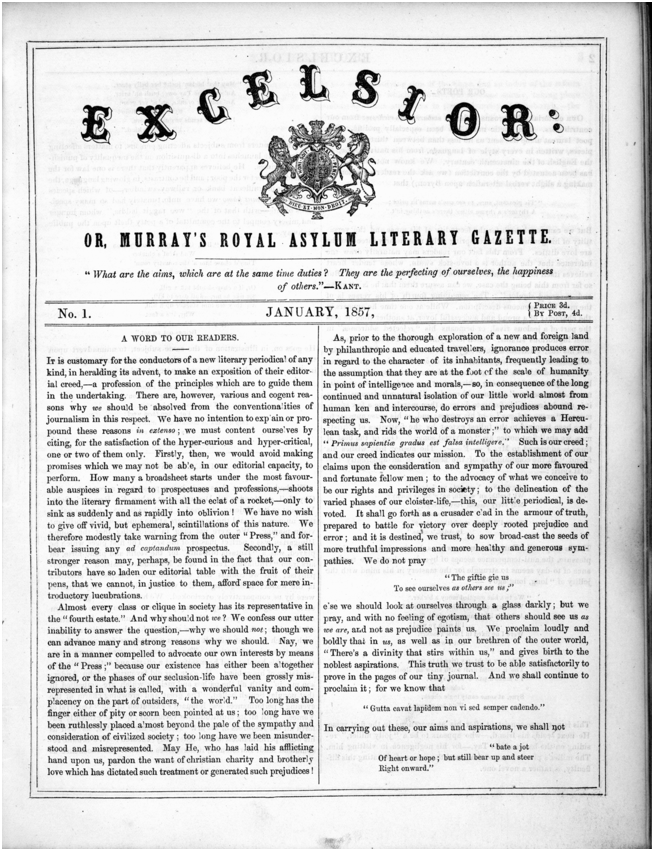
The James Murray Royal Institution for the Insane opened its doors on the outskirts of Perth on 1 July 1827. The founder, whose name it bears, was a local philanthropist whose family had various connections to the trade of treating insanity. The directors of the institution strove to keep it reserved for paying patients.27 The policy was likely at least partly motivated by concerns about the financial state of the institution, as well as the threat of overcrowding. A statement by Dr Lindsay suggests that the decision to admit only paying patients, was driven by an aspiration to offer better, more individualised care: ‘[the asylum,] from its limited size, is compelled to select its cases, and treat them very much en famille [italics in original]’.28 The Murray Royal was therefore a rather special institution whose population consisted predominantly of middle- and upper-class patients.
Having begun his medical career as an assistant physician to William A. F. Browne at the Crichton Royal Asylum in Dumfries in 1853–1854, Dr Lindsay was keen to develop the recreational programme of the Murray Royal to that level. From the start of his superintendency in 1854, he advocated the therapeutic value of occupation and amusement. In the first annual report, he declared that: ‘The introduction of Recreations among the insane can no longer be regarded as an experiment; their success has been fully established by the experience of the best asylums in this country, on the continent, and in America.’29 Having specialised in botany and especially lichens during his medical studies, Lindsay advocated especially the therapeutic effects of studying natural history and applied his views in practice by establishing a museum in the Murray Royal Asylum in 1855, a year after his appointment. He later reflected on the project, arguing that engaging with natural history ‘conduce[s] directly to the recovery or maintenance of Health, both of mind and body [emphasis in original], by leading to a large amount of open-air exercise with a specific and worthy object in view’.30 The healing process involved ‘the substitution of new and healthy grooves of thought [emphasis in original] for those which are old and morbid; and the revivification of both mind and body, which are the acknowledged result of such substitution when it has been accomplished’.31 Lindsay’s convictions in the health-restoring potential of recreation informed his practice not only as an alienist but also as a naturalist. In the introduction to his Popular History of British Lichens (1856), he portrayed a democratic vision of scientific practice, motivated by potential health benefits. He advocated the utility of natural history for ‘the educated of all classes of our community’ by emphasising the health benefits of the scientific study of the natural world.32 First in his list of social groups that would benefit most from such activity is ‘the invalid from our large towns, whose delicate mental and physical organization have suffered wreck in the too eager or engrossing pursuit of wealth or fame’.33 The author further advocates ‘the well-acknowledged influence over the human mind of gently-exciting studies as moral medicines of the most soothing, and intellectual food of the most nourishing, kind’. He assures his readers that ‘were he [the patient] to subject himself to such a course of mental and physical hygiene, we place his physician and all the potency of the materia medica [italics in original] at defiance’.34 As a form of recreation, the work of the naturalist was thus a superior instrument of recovery and general well-being.
Dr Lindsay’s motivations for launching a periodical, therapeutic or otherwise, are less well-documented, though writing could be seen as similar recreational activity that could stimulate ‘new and healthy grooves of thought’. Having witnessed the operation of the New Moon in the Crichton Royal Asylum, Lindsay was eager to launch a periodical in his own institution. In his report for the year 1854–1855, he lamented that ‘our limited community cannot vie with the larger sister Asylums of Scotland by supporting an Asylum periodical, otherwise the lucubrations of the inmates might occasionally fill a goodly broad sheet’.35 His idea lay dormant for a year, likely due to the limited number of potential contributors but also potentially due to a lack of support from the directors, with whom he had frequent disagreements.36
An event in October 1856, however, pushed the physician to mobilise his resources and carry out his plans for a publication. An article in Chambers’s Journal, titled ‘What Lunatic Asylums Really Are’, reviewed Lindsay’s latest report and showcased the various recreational activities offered in the Perth institution in order to ‘dispel the remnants of prejudice on [the subject of treatment in asylums]’.37 In the pursuit of that goal, however, the author of the review downplayed the uniqueness of the Murray, arguing that the entertainments mentioned were ‘a specimen of the practice at the first-class institutions everywhere’.38 On top of that, the last paragraph shifted the readers’ attention to another establishment: ‘In the Edinburgh Lunatic Asylum, one additional amusement strikes us as worthy of special notice – this is the preparation among the patients themselves of a monthly sheet of light literature, under the name of Morningside Mirror’.39 The article likely motivated Dr Lindsay to keep up with the other Royal Asylums of Scotland by overcoming whatever resistance he faced from the directors and launching his own publication. The first issue of Excelsior appeared in January 1857, only two months after this review.
Originally printed by Robert Whittet, a local printer in Perth, Excelsior was published irregularly between 1857 and 1878 under the editorship of the physician superintendent himself.40 In the first year, three issues of four pages each appeared. The price was 3d or 4d by post, and the periodical assured its readers that: ‘The profits are devoted to multiply the means of instructing and amusing the inmates of the Asylum.’41 In the second and third years, issues were published only in January and July, and from 1860 to 1864 publication became more irregular: two or three issues were occasionally merged into a single, larger number, with the price adjusted accordingly. Afterwards, it became an annual publication that appeared in January and consisted of one to three issues published together.
Excelsior itself reveals that the irregular publication was purposeful:
We prefer this [mode of publication] to any deviation from the original plan of ‘Excelsior’, which plan was that it should be an occasional or irregular publication …. The result of similar efforts elsewhere has shown that too much may be promised (in the form of too frequent an issue, and too ambitious a literary style,) and too little performed, inasmuch as the grand finale may be a sudden and total stoppage of publication [emphases in original]!42
Here and elsewhere, Dr Lindsay demonstrated great care in how he managed his periodical. Aware of his own limited resources and the challenges that other similar projects faced, he tried to manage readers’ expectations and reduce the time pressure on the publication. This approach resonated with Dr Lindsay’s views that the use of work in asylums should be driven predominantly by therapeutic and not economic interests.43 As profit was a secondary motivation, Excelsior was run at a more leisurely pace.
These circumstances could explain the superintendent’s function in the project not only as the official editor of Excelsior but as a major contributor. Exploring staff involvement in Under the Dome, Turner argues that it was ‘a pragmatic response to the transitory nature of most inmates’ hospitalisations’.44 Likewise, Lindsay’s concerns that the relatively small population of the Murray made it hard to gather enough contributions suggest that necessity was one of the reasons for his substantial participation. He fulfilled his duties willingly, though: nowhere in Excelsior is there a complaint of not having enough material or an urgent call for contributions. On the contrary, Lindsay explained that the practice of publishing multiple numbers all at once was necessitated precisely due to the abundance of submissions.45 The irregular mode of publication could have thus been chosen to offer Lindsay sufficient time to write and edit the magazine.
Excelsior was a publication heavily invested in pursuing the interests of the institution and the physician superintendent. Indeed, at least half of each issue was dedicated to news about the asylum, accounts of concerts, lectures, and other events, and reflections on the treatment of insanity. The last two issues, published in January 1877 and January 1878, were entirely written by the superintendent, and in 1878 they appeared as a separate publication under his name and the title General History of the Murray Royal Institution for the Insane.46 Beyond narrating the history of the institution and its recreational therapeutics, the volume serves as an index of the Excelsior numbers that reported on different entertainments. The final article, tellingly titled ‘Farewell’, reveals Dr Lindsay’s intentions to discontinue the periodical, declaring that it ‘has fulfilled the Mission with which it charged itself 21 years ago’.47 Bound together, the two issues constitute not only the official completion of Dr Lindsay’s literary project but a pamphlet promoting the institution and highlighting, for the last time, his contributions to the management of the institution. Excelsior can thus be read as a testimony to Lindsay’s work as an alienist.48
But what was his legacy and what was the mission that Excelsior managed to achieve? In ‘Farewell’ Dr Lindsay offers a list of eight completed objectives accompanied by references to articles from earlier issues of Excelsior to serve as evidence of the successful completion of each goal. The first two points relate to promoting the Murray Royal Asylum by providing an account of its history and the therapeutic recreations offered to its patients. Another goal of Excelsior is to keep track of ‘current events illustrative of the Natural History of Insanity or of the condition of the Insane in other countries’. Articles mentioned here relate to famous mad people in history and fiction, as well as the development of ‘lunatic literature’ (especially periodical publishing) in other institutions. The third and the fourth indicate an interest in the inmates as subjects of medical enquiry: ‘to supply samples of the peculiar (morbid) views of individual residents of a literary turn of mind – of their Delusions, as described by themselves – in ipsissimis verbis’ and ‘to submit characteristic illustrations of some of the peculiarities of Habit – some of the Eccentricities of behaviour – of members of our community’. Numbers five, six, and eight, however, show that Excelsior also aimed to represent patients as subjects who could gaze back at the world and express valuable opinions: ‘to offer to Inmates with the requisite ability and inclination a medium for the publication of their criticisms on men and things – local or general’; ‘to place our columns at the command of “correspondents” – invalids in other Hospitals – sometimes far distant – for the publication of their valued communications’; and ‘to give short accounts of the literary (published) contributions of mental Invalids in other places’.49 The easy flow of the list does not create a sense of a rift between these and the previous goals, suggesting that through Excelsior patients were both examined and listened to. It is likely that the privilege of being heard was reserved for convalescing and more highly functioning patients, while the writings of those in greater mental distress were more suitable for medical enquiry. Either way, the list of objectives is reflective of the plurality of perspectives Excelsior represented. The summary of its purposes shows that the periodical was more than a single physician’s attempt to record his own achievements and promote his institution. It manifests Dr Lindsay’s interest in what his patients and the inmates in other institutions had to say. It also suggests that his curiosity was not merely professional but driven by his desire to offer patients a platform for self-expression.
What makes Excelsior exceptional among other asylum periodicals is its militant activism against the misrepresentation and stigma of mental illness. The cause that the publication set to fight for was forcefully outlined in the opening article of the first issue:
Almost every class or clique in society has its representative in the ‘fourth estate.’ And why should not we [emphasis in original]? … We are in a manner compelled to advocate our own interests by means of the ‘Press;’ because our existence has either been altogether ignored, or the phases of our secluded life have been grossly misrepresented in what is called, with a wonderful vanity and complacency on the part of outsiders, ‘the world.’ Too long has the finger either of pity or scorn been pointed at us; too long have we been misunderstood and misrepresented.50
Compared to the sincere or feigned humility with which other asylum periodicals addressed their readers, Excelsior stands out with its boldly phrased charge against prevailing prejudice. Surely, the confident rhetoric was due to the position of the editor, who, unlike patient-founders of other asylum periodicals, was the most powerful person in the institution. Together, Dr Lindsay and the patient-contributors could speak freely of society’s unjust portrayal and treatment of the mad.
The intentions expressed in the first issue were pursued in various ways throughout the publication’s run. Like other asylum periodicals, Excelsior also sought to represent the Murray Royal Asylum as a busy hub of cultural and social activity. For that purpose, it included a ‘Chronicle’ (or ‘Events’) rubric at the back of every issue that recorded the events that had taken place between its numbers. It also frequently featured more detailed accounts of the celebrations, theatrical and musical performances, and lectures organised in the institution. Excelsior also engaged with public discussions about madness and discussed instances of misrepresentation. One article from 1868, for example, scorned Perth’s local community’s tendency to believe depictions of the insane in the press, under titles such as ‘Horrors of Private Asylums’, ‘Shocking Treatment of a Lunatic’, and ‘Vagaries of the Insane’.51 ‘Instead of making themselves personally acquainted with us’, the author says, ‘they prefer to feed their imaginations with ideas derived from such sensational articles; which, when not the grossest exaggerations, or pure fictions, represent exceptional features of social life’.52 In this account, the sensationalism of the 1860s was a major obstacle to Excelsior’s mission of correcting misconceptions about insanity. Though the article refers to the sane in third-person plural, the anonymous author, likely a patient, spoke to external readers too. This is hence yet another example of the simultaneous reciprocation of exclusion and longing for connection. Drawing a clear line between ‘us’ and ‘them’, the article nevertheless urged ‘outsiders’ to overcome their fears and prejudice and get to know their neighbours.
However, Excelsior’s treatment of sensationalism is not uniform. The opening article of the same issue, bearing the title ‘Insanity in Fiction and in Fact’, offers a different take on the cultural representations of madness. Reflecting on the proliferation of sensation fiction at the time, the author enumerates some of the most recent additions to the genre, among which Charles Reade’s Hard Cash (1863), Mary Elizabeth Braddon’s Lady Audley’s Secret (1863), and William Gilbert’s Dr Austin’s Guests (1866), and argues that:
The uninitiated reader may naturally suppose the pictures contained in these Novels … to be the terrible exaggerations of a poet’s or novelist’s license …. In certain respects some of them are undoubtedly exaggerations; but in certain others – in their limning, for instance, of the protean hues of delusion, or the infinitude of bizarreries of conduct and speech in the Insane, – they cannot be stranger than the truth itself.53
From the tone of speaking and the reference to ‘the Insane’ here, it can be inferred that the author of the article was a physician (potentially Dr Lindsay). The argument here allows the neutralisation of the harsh attacks on mental institutions, by dismissing it as a sensation-driven exaggeration. At the same time, the editor praises the more positive depictions of asylums. He commends their authors’ knowledge of ‘Psychological Medicine’ and ‘Lunacy practice’, while finding the depictions of patients and their suffering across all literature to be unproblematic.54
The development of the article, however, complicates its interpretation as a physician’s attempt to defend the project of psychiatry at the expense of patients. In his discussion of insanity ‘in fact’, Lindsay turns to travel writing that refers to mental institutions in Turkey and Greece. He argues that British asylums ‘have reached a comparative perfection [emphasis in original]’, though ‘much remains to be done – especially in educating the public in sounder, more liberal, and more enlightened views on Insanity and its proper treatment’.55 The article ends with a lengthy list of famous insane people throughout history and a recommendation for the New Moon, where curious readers could find ‘several contributions to the list of eminent individuals, who have been insane or eccentric at some period in their lives’.56 Though neglecting the errors in the depictions of the insane, Lindsay thus perceived the proliferation of sensation literature in the 1860s as a positive trend. He saw it as an opportunity to promote public engagement with insanity as a widespread social problem and advertise well-governed mental institutions as its best solution. Consequently, he continued to keep track of accounts in the press and fictional works dealing with madness, as well as autobiographies of sufferers, for the rest of Excelsior’s run.57 The recommendation of the New Moon also demonstrates the physician’s faith in asylum periodicals’ potential to enlighten and educate the public.
In addition to the lists of works addressing madness, Excelsior also reviewed or reprinted the literary works of current or former patients in the Murray Royal and other institutions. For instance, a notice of Alexander Smart’s poetry collection Songs of Labour and Domestic Life and a reprint of one of his poems appeared in the issue of January 1861.58 Informing readers that ‘the Library Committee ordered a copy of the [collection] for our Institution Library’, the author urged them to ‘Go and do thou likewise!’59 Excelsior was interested in the writing of mental patients abroad too. When one of the assistant physicians visited the Bicêtre Hospital in Paris, he heard the patients sing a song the lyrics of which had been written by one of the inmates there. He sent the text to be printed in Excelsior.60 These instances suggest that Dr Lindsay’s intentions for the periodical cannot be reduced to self-promotion and advertisement of his own institution. Excelsior displays his keen interest in what patients across institutions had to say.
One of Excelsior’s main rhetorical strategies of advocating the value of patients’ voices consisted of reminding readers that insanity could befall anyone. Reviewing a book by a former patient at the Glasgow Royal Asylum (James Frame), an article addressed the condescension and pity that tainted the public reception of biographies and autobiographies of insane people. The reviewer observed that:
Some value has also been attached by the sane to biographies of certain of the insane. Who can read the history of the lives of Robert Hall or Edward Irving, of Cowper or Swift, or Chatterton, without an absorbing interest. But it is an interest of a peculiar kind; there is a pity mingled with a certain amount of loathing and condesension [sic]. … We look at mad divines and mad poets, somewhat as schoolboys gazing through the bars of a menagerie.
We are not sure, however, that autobiographies of the insane have in the public mind any value at all, though they may here and there excite a small amount of compassionate interest …. Such an estimate of this class of autobiographies we regard as a most unfortunate, unjust, and mistaken one.61
Sensitive to society’s judgmental gaze directed at insanity, even when its victims were prominent social figures, the author launched a defence of the writing of current and former patients. To the insane, it argued, it could offer hope and guidance how to persevere through their illness, and it could prepare the sane for a potential unexpected onset of insanity in the future. The author cautioned his readers that no one was immune to mental illness, so genuine care, understanding, and solidarity should displace pity and contempt. This warning to the sane was expressed often in Excelsior. As one of the regular patient-contributors, put it, ‘there are none [emphasis in original] who do not, at some time, or in some respects, come short of the standard of perfect sanity’.62 Eroding the division between the sane and the insane, Excelsior sought to change public perceptions of the mad and encourage compassionate interest in their writing and lives.
Though Dr Lindsay’s writing dominated the periodical, he left room in Excelsior for the voices of those whom he tried to represent, though sometimes the motivations of that inclusion did not align with patients’ interests. The periodical seems to have been open to works that would have been rejected by other asylum periodicals. While the Asylum Journal accepted patients’ writing ‘on all subjects except those of their hallucinations’, Excelsior included such writing, though the purposes and effects of this editorial permissiveness were not unproblematic.63 An example of such a contribution is ‘Nature Delineated’, a front-page article written by patient Thomas Lindsay and signed with his initials. The piece narrates the author’s discovery of ‘eternal life’ and the subsequent salvation of the world from destruction, including the following reflection: ‘All nature is war. It is fighting for food. It lives by mutual trespasses. It lives by perspirations from “eternal nature,” the source of good and evil; and by its safety valve, eternal life, every moment a breath – both these my own discoveries.’64 Thomas Lindsay’s case notes indicate that the article was a selection of ‘his long dissertations on the “all pervading principles of nature”’ and that he was ‘proud of his literary abilities, & [thought] he can write for his bread’.65 However, his published work is introduced with an editorial remark emphasising that the patient’s writing was not chosen for its literary merits:
There is talent in every stage of cultivation or sterility, eccentricity or errancy …. To possess a substantial Psychological value, ‘Excelsior’ must therefore record, so far as possible, every phase of our conceptions and actions – thoughts, words, and deeds. Provided a contribution offered us is with propriety printable, we do not refuse insertion on the score of the novel or heterodox character of the views which it may contain …. Be it observed, however, that though literary merit and psychological interest may combine to give value to one class of articles, in other cases, the contributions of least literary power will be found of greatest psychological value. To the paper on ‘Nature Delineated’ we not only give place – and a prominent place – with pleasure; but we would draw attention to its great interest as a contribution to psychology and psychopathy.66
Considering this comment and the patient’s literary aspirations, the Meteor’s criticism of Dr Lindsay’s policy of exposing patients’ minds before the public gaze (discussed in Chapter 5) seems justified. It is difficult to reconcile the attitude expressed here with the aforementioned concerns with the public’s condescension towards the insane. By highlighting the psychological over the literary value of the patient’s writing, the editor’s introduction perpetuates the Othering of madness, encouraging readers to continue examining mad writing ‘as schoolboys gazing through the bars of a menagerie’.67
It is hardly surprising that in the following year, Thomas Lindsay refused to write more. The reason mentioned in the case notes is, however, not obviously connected to indignation with the way his writing was framed: ‘He will not put his cogitations in writing upon any considerations, [answering?] that Dr L. Lindsay cheated him out of the profits of his contributions to Excelsior.’68 Though there is no evidence that any of the contributors to Excelsior were monetarily rewarded, his insistence on being treated as a professional writer worthy of payment for his efforts asserted the importance of his writing and demanded that he was treated as a full-fledged literary producer. Thomas Lindsay’s refusal to write restored the full value of his writing, though only symbolically. The whole episode suggests that Excelsior’s campaign for better representation of the insane was occasionally inconsistent, as different voices and perspectives clashed or subverted each other. Like other titles I have discussed, the Murray publication was thus characterised by tensions that could disrupt the collaborative process of its production, as well as by conflict, contradiction, and ambiguity in its pages.
The Patient-Contributors of Excelsior and ‘Lunatic Literature’
Despite its inconsistencies, Excelsior did not fail to represent patients’ views, as some patient-contributors were potentially emboldened to speak up about discrimination, stigma, and marginalisation by the superintendent’s outspokenness about these matters. The stories of some of the periodical’s regular contributors show that Excelsior was a joint attempt of patients and staff to overcome interpersonal tensions and represent themselves as individuals and a collective. Through the publication, patients could find empowerment and opportunity to publicly assert their worth as literary producers and valuable members of the asylum community. Finally, Excelsior’s engagement with the term ‘lunatic literature’ and its encyclopaedic interest in the writings of the insane made it the first manifestation of a cross-institutional community united not only by the shared experiences but also by a literary tradition.
A key figure in the history of Excelsior was William Gilbert Christie (‘W. G. C.’), admitted in 1838 at the age of twenty-nine and remaining there until his death in 1885.69 Between 1859 and 1876, he was responsible for maintaining the ‘Chronicle’ column, but his initials also appear regularly under reports on trips and recreational activities in the asylum and acknowledgements of donations of money and additions to the museum and the library of the institution.70 His initials are found among the names of the benefactors too.71 The reprints of theatrical programmes in Excelsior show that he was involved in most productions, and in the 1860s he was the stage manager of the asylum.72 His detailed case notes reveal that, beyond his involvement in the cultural activities, his good mathematical skills earned him the position of bookkeeper.73 He also served as general assistant to the Housekeeper, Miss Shearer, helping her run the evening classes for other patients.74 His participation in the management of the institution suggests that even the unsigned accounts and lists of events and classes in the first issues of Excelsior were likely his production. His responsible role in the periodical and the life of the asylum is reflected in the incorporation of the title ‘Registrar’ in his signature from 1864 onwards.
The case notes strongly suggest that, despite Christie’s prominent place in the operation of the institution, he was far from the staff’s or the patients’ favourite. According to his records, ‘his predominant & characteristic feature is vanity & he presumes on his usefulness & the liberty & indulgence he is in consequence thereof allowed by becoming very officious & frequently impertinent & overbearing. He is much given to mendacity, prevarication & exaggeration’.75 Christie enjoyed being the centre of attention and had a demonstrable ‘penchant’ for Miss Shearer, which was accordingly pointed out as the sole reason for his interest in helping her out.76 The case notes also mention that, ‘when his vanity is in any way wounded or when his plans or wishes are thwarted[,] he feigns serious illness’.77 As a result, he often caused trouble for the staff, and his fellow inmates grew ‘quite worn of his practices & look[ed] on with the utmost indifference’.78 Christie is thus represented as manipulative, abusive of the privileges he was granted, and irritating to most of the inhabitants.
None of these sentiments were articulated in Excelsior, where Christie’s importance to institutional life is repeatedly displayed, both through the continuous inclusion of his contributions and through open expressions of appreciation. In 1873, the periodical included a piece dedicated to his achievements and valuable work for the Murray, and in the article titled ‘Farewell’, Dr Lindsay expressed his ‘lasting gratitude’ to ‘W. G. C.’, referring to him as ‘our staunchest of all good friends’ and mentioning him first in the acknowledgements.79 It is hard to tell how the physician truly felt about his patient. Perhaps prioritising Excelsior over interpersonal frictions, Dr Lindsay nevertheless had to rely on Christie’s involvement and allowed his voice and presence to assume an honourable space in the periodical.
The case of Rev Mark Wilks William James is another example of the compromise that drove Excelsior. James was transferred to the Murray Royal from a private asylum in September 1862. Upon arrival, he expressed ‘a wish to obey all the rules of the institution, even in small matters’ and seemed happy to socialise with other inmates.80 However, he soon appeared paranoid and started assaulting both fellow patients and attendants. His notes state that he did not participate in the dances often, ‘partly on account of his aversion to certain patients’.81 Christie is named as a source of annoyance and a target of James’s animosity and eventually suffered an attack by the Reverend.82 Subsequently, on 4 May 1864, James was moved to Elmhill House Asylum (an addition to the Aberdeen Royal Asylum), ‘much to his own gratification & equally so to our [the institution’s] own’.83
James was nevertheless involved in the communal and literary activities of the institution, with Dr Lindsay’s encouragement and support. Within a few months of his admission, he served as chaplain, taught the Bible Class, compiled the library catalogue of the asylum, and was engaged in writing.84 His first piece appeared in Excelsior in January 1863. It was an account of a zoological exhibition at the asylum museum that had taken place in November and had attracted not only inmates and staff but local families from Perth.85 In the case notes, Dr Lindsay described the piece as ‘very good’, noting, however, that such ‘mental work does not always improve his excitability – if too severe’.86 James’s description was prefaced by Dr Lindsay’s own general reflections on the museum and its ‘conversazione’, which introduced the patient-contributor ‘to tell his tale in his own way’.87 Admitting his own lack of in-depth knowledge of zoology and natural history, the Reverend disclosed that: ‘it is at the request of those whom he would not willingly disoblige [emphasis in original], that he has been bold enough to supply an article, relating to a department of science which is nearly, if not quite, new to him’.88 Despite the author’s humility, the article filled five columns of Excelsior with detailed description of the specimens, their origins, and classifications. It demonstrates knowledge acquired through engagement with natural history, as prescribed by Dr Lindsay. And while writing his impressions down was not consistently soothing to the patient, the article shows the physician’s role in encouraging patients to contribute both as fellow naturalists and as joint authors.
James’s signature appeared after the leading pieces in all three issues of Excelsior that were published during his stay, and his writings continued to be published in the periodical years after his transfer to Elmhill House.89 For instance, his account of an excursion to the farm providing milk to the asylum that took place in July 1863 appeared in the issue for January 1865.90 The inclusion of such an out-of-date piece indicates a lack of fresh patients’ writing deemed suitable for publication. However, the prioritisation of James’s works during his stay and the preservation and later publication of his pieces show that patients’ disruptive behaviour did not necessarily limit expression. The articles also show that potentially troublesome patients like James, whom another physician described as ‘the most dangerous man in Britain’, were given comparatively unusual liberty of leaving the Murray and engaging with recreational and educational activities.91
James’s significance to Excelsior, however, lies in his contribution to one of the periodical’s objectives, namely, to provide a platform for patients’ ‘criticisms on men and things – local or general’.92 The physician himself pointed out the articles produced by ‘M. W. J.’ as examples of this function of the gazette.93 James’s ‘Motley’s Reflections on the Magazines’ was published nearly two years after his transfer. Dated ‘Elmhill, February, 1865’, the contribution reveals that, despite the antagonism between the patient and the staff evident from the case books, he continued to write for Excelsior from his new residence. The article occupied the first two pages of the issue of January 1866 and was intended as a preface to a series of reviews ‘of the professedly sane Magazines of the period’.94 James’s justification of his future project carves out a space for discussion and criticism of ‘sane’ culture in the periodical that both draws a clear line between the asylum and the world and subverts the distinction between madness and sanity:
People in the outer world … might be amused by seeing what sort of opinions are formed of those humbugs, who pretend to be in their right minds, by us, who of course make no pretension of the kind: – those at least of a psychological turn might be curious to observe in what respects our ideas and opinions correspond with, or differ from theirs, on the same subjects …; and readers within Institutions of this sort [emphasis in original], having a literature of their own, might be pleased to see among its contents some kind of review attempted by one of themselves, of those well-known Magazines, which are continually circulating through their sitting-rooms, halls, and galleries.95
This statement demonstrates much more than patients’ active and continuous engagement with contemporary periodicals – a fact already evident from the catalogue of the asylum library, which included both local and national titles such as the Perth Courier, the Scotsman, Chambers’s Journal, Good Words, Athenaeum, and London Illustrated News.96 Like the contention that there is no perfect sanity, James’s suggestion that the periodical press in general was dominated by the writing of ‘humbugs, who pretend to be in their right minds’ seeks to shorten the distance between the worlds of the mad and the sane. At the same time, the notion of patients ‘having a literature of their own’ sets the writings of the mad apart, demonstrating the formation of a community conscious of its own literary tradition.
The simultaneous seeking of distinction and reunion is observable throughout the article, as the author adopts a purposefully ambiguous, ironic tone to deliver his message. At one point he asks:
‘What is the chaff to the wheat?’ Some of our readers perhaps may feel disposed to invert the proverb, and ask, ‘What is the wheat to the chaff?’ [emphasis in original] in a sense analogous to the mad prince’s remark upon Falstaff’s tavern-bill, ‘But one poor half-penny worth of bread to all this monstrous quantity of sack!’ But one poor half-penny worth of sense, – they might say, – to all this monstrous quantity of chaff! Such a charge, we confess, we may not disavow; but … we would just venture, with submission, to hint the possibility, that in all this ‘monstrous quantity’ of chaff, a grain or two of good wheat may be found, to reward the kindly reader’s patience; and that even in our most nonsensical rigmarole, some faint traces of meaning, and glimmerings of sense may be discernible by the diligent and astute investigator.97
Here, the distinction between the chaff and the wheat, a biblical metaphor for God’s judgement, is employed in a commentary on the assessment of literary value and its relation to sanity.98 Through the initial question, its inversion, and then its answer through the slightly misquoted words of Prince Hal in Shakespeare’s Henry IV, Part One, the article defends mad writing from neglect, arguing that among the vast quantities of rambling, there is some sense, wisdom, and potential literary merit.99 Towards the end of the passage, James adopts a meek and humble tone to advocate the value of patients’ literary contributions and attempt to win sane readers by flattering their kindness and enticing them to give his own and other insane literary productions a chance.
Similarly to other instances of patients’ writing already discussed, the humility of this article is carefully performed and ironic. The ‘submission’ with which the author begs the reader for tolerance and patience is subverted by James’s demonstration of wit, learnedness, and fluent engagement with literary culture. The reference to Henry IV is accompanied by the following footnote: ‘As we quote from memory, not having Shakspeare [sic] with us to refer to, it is possible the quotation may not be verbally accurate; we believe the sense [emphasis in original] of the great Dramatist is correctly given.’100 The presence of this footnote indicates a degree of perfectionism, of aspiration to show that any errors in the text are a result of limited resources rather than ignorance or carelessness. The emphasis on capturing the ‘sense’ of the words furthers the author’s argument that his writing, the production of an alleged madman and the material expression of his mind, is nevertheless capable of capturing and conveying valid views.
The boundaries of sanity are further challenged through the reference to Prince Hal as ‘the mad prince’ in the main text.101 Equating the character’s youthful unruliness to madness subverts the very meaning of insanity. In the play, his behaviour undergoes a dramatic change: he is a rowdy young man who eventually redeems himself. The prince explains his debauchery as intended to make his eventual transformation more impressive:
Whether James took Prince Hal’s words at face value, or considered his change genuine, is difficult to establish, but either way the reference to the character’s behaviour as madness has implications for the reading of the article.103 At the very least, it suggests that madness is transitory and can be suddenly reversed. If Hal’s transformation is interpreted as staged, however, the author recasts his madness as a performance too, suggesting that in fact he is sane and capable of producing meaningful and valuable work. He himself is a kernel of wheat in the chaff of madness in the asylum. And just like Prince Hal’s ‘madness’ is an instrument of manipulation, in the process of performing madness, the author of the article gains an advantage through his deceit, finding empowerment in his status as an alleged madman.
The critique James intends to produce in the proposed series of articles is laboriously described as:
literary and scientific, of words and ideas, perhaps too prolific, erudite, explanatory, and exegetical, prosy and pious, … quizzical, rather than metaphysical, by no means empirical, slightly satirical …, befittingly national, lucidly rational, for progressive improvement and pro-educational, but not upon any account sensational [emphasis in original].104
The playfully indulgent demonstration of the author’s wit, knowledge, and eloquence here turns a mocking eye to the seriousness and gravity that society attributes to the judgement of texts. However, references to science, empiricism, self-improvement, and rationality make James’s article a critique of the very activity of judgment – of texts, the world and other human beings. The emphasis on sensationalism or rather on the pledge to refrain from it constitutes an ironic promise of compassion. The madman’s criticism of the sane and their periodicals will be morally superior to the prejudiced distortions of judgement he himself has experienced. Or, perhaps, it will not. Towards the close of the article, the author states that ‘it is our wish to be sportive and if possible, amusing, without being cynical or unreasonably severe; while, as a sort of compensation for the want of personal liberty, we claim the fool’s privilege of a pretty extensive latitude of animadversion and freedom of expression’.105 While morally superior in his aspirations for compassion in judgement, the reviewer will attempt to avenge himself and his fellow sufferers, transforming his madness and loss of freedom into licence to speak critically of the sane world.
By launching a series of reviews of ‘sane’ titles, the author reverses the direction of the gaze, just like he reverses his question about the wheat and the chaff. He aims his criticism at society and its press, while advocating the value of his and his fellow patients’ writing. A sequel to these reflections was never published, and it is unclear what happened with James in and beyond Elmhill House. Even as a stand-alone piece, however, the article is a bold attack on the unfair judgement of the mad and their writing. Through the literary allusions, the footnote, and the complex play with language and different texts, the author adopts a strategy similar to Joseph Alexander Goree’s in the Meteor, discussed earlier in the book: he presents himself as a man of culture and high education, hoping to prove his sanity by enacting Enlightenment ideals that connected taste with reason. His article also shows the formation of a cross-institutional insane community conscious of its own distinguishable and valuable literary culture – at the very least, it demonstrates Excelsior’s attempt to construct it.
One of the most notable aspects of the periodical of the Murray Royal is its engagement with the term ‘lunatic literature’.106 In the press at the time, similarly phrased references to the writings of the insane (such as ‘literature of madness’) were in wide circulation.107 However, Excelsior treated ‘lunatic literature’ as a distinct genre that deserved to be explored and engaged with. The inclusion of delusional writing and reprints and reviews of current or former patients’ poetry and published books were all part of this project, but its most significant manifestation were the lists and reviews of other asylum publications. Excelsior was by no means unique in its interest in other publications. Turner has shown that the ‘New Moon actively engage[d] with similar patient publications, reporting on titles as the editorial team is made aware of them, and attempting to construct a network of journal exchange’.108 Indeed, the New Moon warmly welcomed Excelsior with a poem written for its launch.109 In Chapter 2, I have shown that asylum periodicals were interested in each other, and editors were eager to welcome new titles like their own whenever they were aware of such. While Turner interprets that phenomenon on the pages of the New Moon as a way of ‘promoting the literary culture of Crichton and furthering the reach of its journal’, the case of Excelsior suggests that these exchanges and the practice of mutual reviewing achieved more than that.110 They cultivated a sense of an existing ‘mad’ literary subculture with its own history and tradition.
While mentions of other periodicals in the New Moon tended to be rather brief, in the 1860s–1870s, Excelsior pursued an encyclopaedic project which comprised of producing lengthy reviews and lists of other titles that belonged to what the periodical explicitly called ‘lunatic literature’.111 In January 1866, it offered a general overview of treatment in asylums, paying special attention to the spread of periodical publishing in mental institutions.112 Another article, published seven years later, enumerated asylum periodicals published in other British asylums, including the New Moon, the Morningside Mirror, the York Star, and the relatively recently launched Loose Leaves of the private asylum in Church Stretton in Shropshire, England.113 The following number offered a much more comprehensive discussion of asylum periodicals. The opening article, titled ‘Lunatic Literature in America’, discussed in detail in the Meteor of the Alabama Insane Hospital and the Friend of the Pennsylvania State Hospital for the Insane in Harrisburg. It also mentioned titles that had ceased publication: after contacting Dr Mackintosh of the Glasgow Royal Asylum, the author had found out about its internally circulated newspapers, the Chronicles of the Monastery and the Gartnavel Gazette.114 The ease of access to information demonstrated in these articles suggests that their author was none other than the superintendent. Excelsior’s bibliographic project culminated in Lindsay’s ‘Farewell’ article in the last issue, which presented an annotated list of all titles known to date.115 By keeping track of asylum periodicals, Excelsior reinforced a sense of an existing literary tradition to which it itself belonged.
The physician’s agenda or means of achieving the goals that Excelsior set out to pursue did not always match the patient’s desires or even interests, but the periodical of the Murray Royal Institution nevertheless stands out with its active engagement with the representation of the insane. The superintendent’s seemingly permissive policy of inclusion of disruptive inmates’ contributions, even after their departure shows his dedication to Excelsior and the compromises he had to make as an editor. Perhaps it even indicates the physician’s genuine recognition of the importance of showcasing patients’ work to promote reform in the cultural perceptions of madness and the institutions that contained it. His consistent interest in ‘lunatic literature’ demonstrated in the reviews of publications by current and former patients of his and other asylums aligns with patients’ own approach to addressing their marginalisation. Excelsior’s embracing of the term ‘lunatic literature’ is yet another manifestation of the distinction of mad writing as unique and exclusive and the simultaneous reconciliatory emphasis on its value, importance, and equality to the productions of the sane.
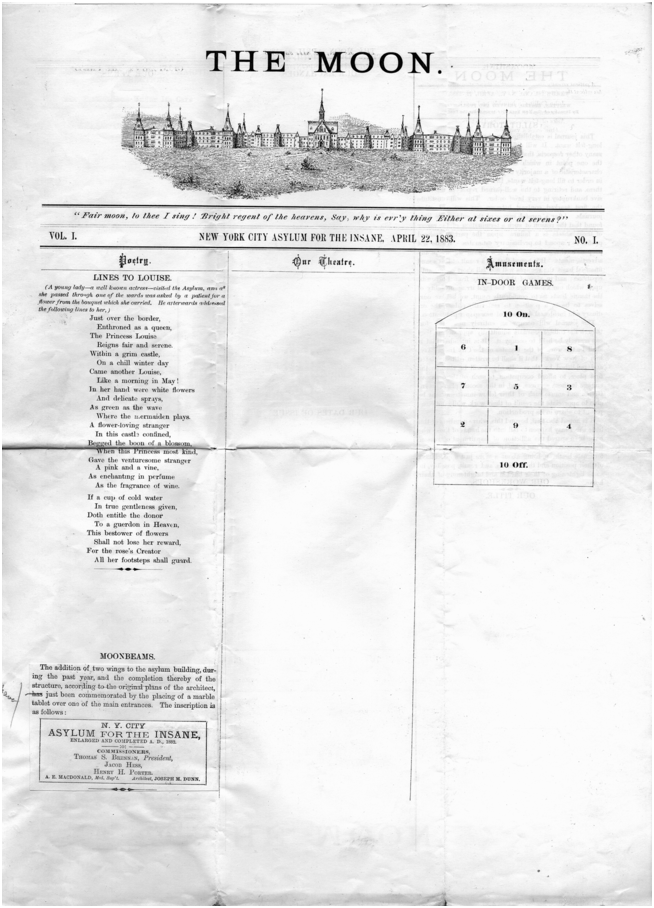
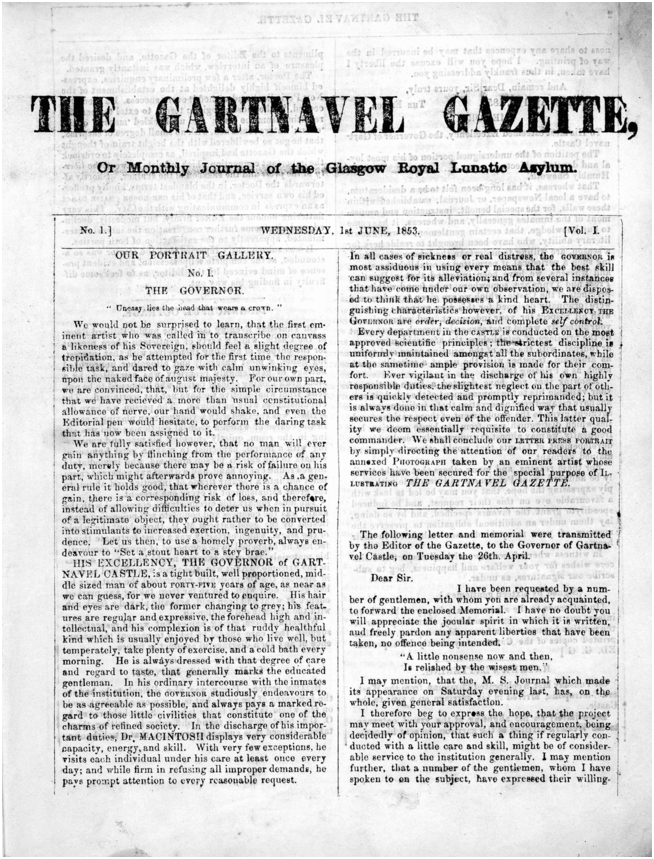
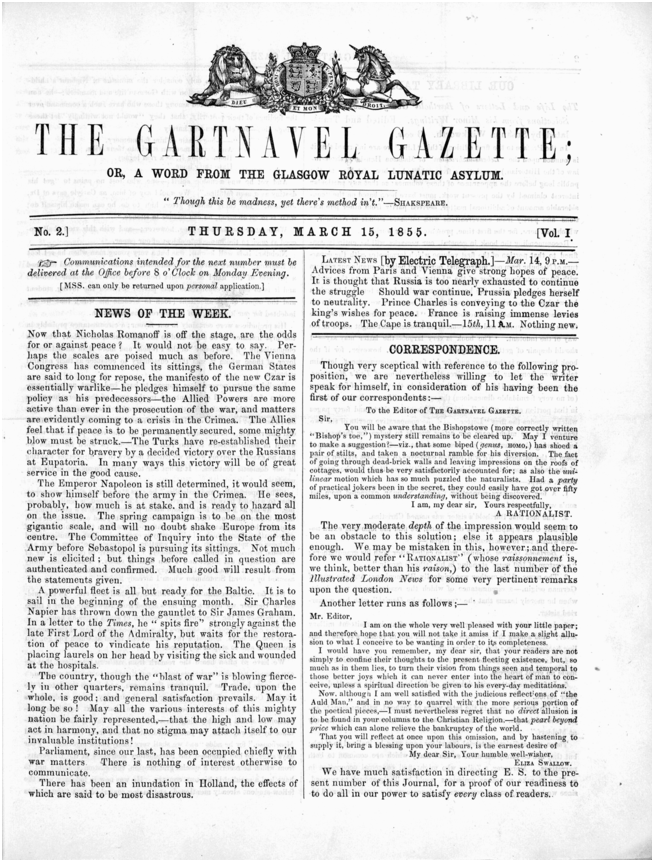
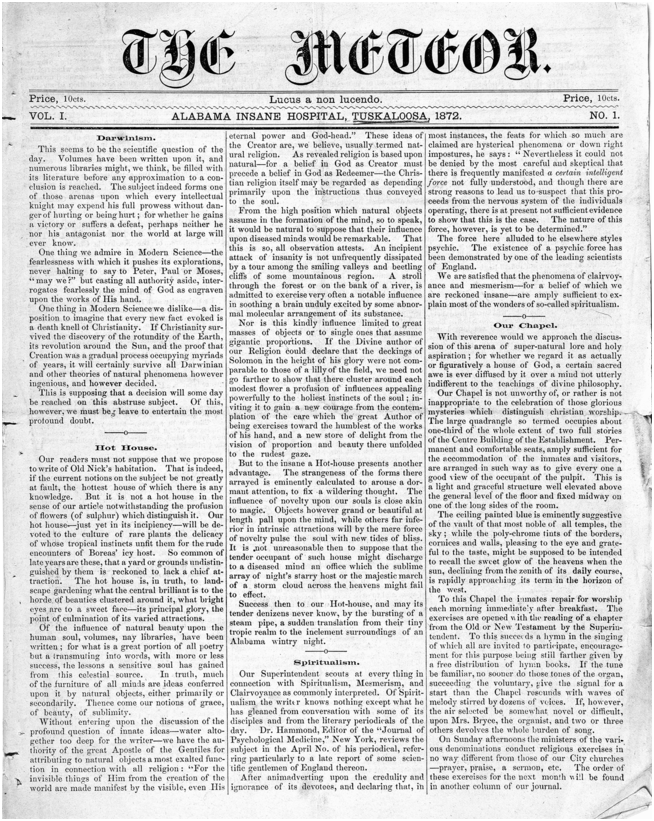
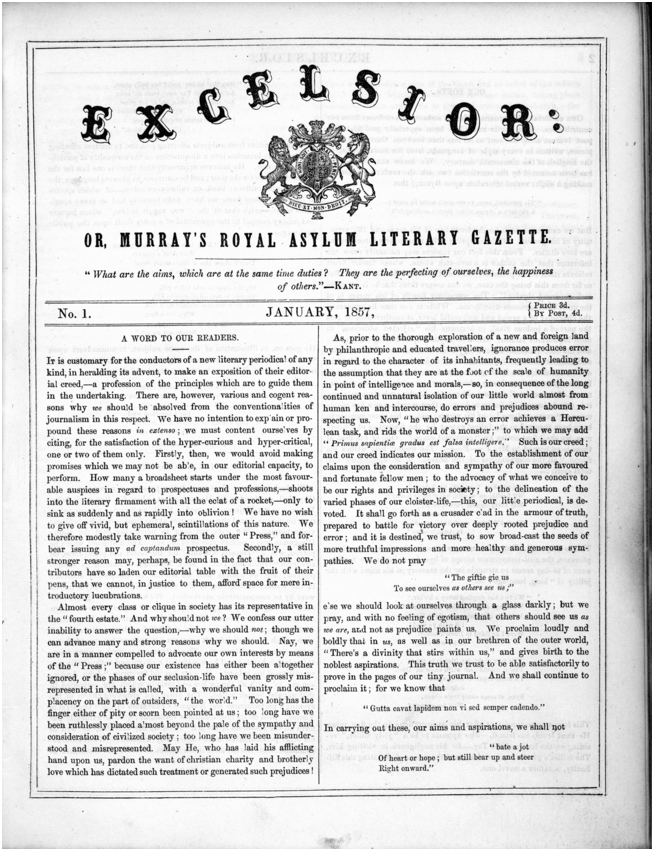

 Open access