


1. Introduction
In supply chain (SC) management, the transition toward a circular economy (CE) necessitates the implementation of circular principles—referred to as R-imperatives (de Lima, Seuring, & Genovese, 2023; Reike, Vermeulen, & Witjes, 2018)—throughout the product lifecycle, from development to end-of-life (Reference Burke, Zhang and WangBurke, Zhang, & Wang, 2021). This underscores the critical importance of implementing R-imperatives in product development (PD) processes and SC design. This implementation can be enhanced when PD processes and SC design decisions are integrated (Burke et al., 2021; König, Mathieu, & Vielhaber, Reference König, Mathieu and Vielhaber2024; Reitsma, Hilletofth, & Johansson, Reference Reitsma, Hilletofth and Johansson2023). However, it is challenging for SC managers to integrate PD and SC design in a way that is appropriate for all types of R-imperatives, ranging from Recycling and Repurposing to Rethinking and Refusing (Reference Potting, Hekkert, Worrell and HanemaaijerPotting, Hekkert, Worrell, & Hanemaaijer, 2017). One solution is to align the PD and SC design integration with a preselected set of R-imperatives. However, this preselection may hinder SC efficiency from perspectives of sustainability, resilience, and adaptability. Therefore, a more practical approach is to assess the alignment of integrated PD and SC design decisions with each R-imperative. Thus, SC managers may be able to provide strategies for prioritizing initiatives, allocating resources and designing interventions that fully exploit the potential of circularity.
This study aims to develop a systematic method based on a graph-theoretic approach to assess the alignment of various R-imperatives with integrated PD and SC design decisions. This quantitative approach provides companies with a tool to assess their current alignment level, identify critical gaps, and design targeted strategies to enhance the circularity of their products and SCs. Therefore, the central research question of this study is:
RQ: How can companies assess the alignment of R-imperatives with integrated PD and SC design decisions?
Our proposed approach models the interdependencies between different R-imperatives and integrated PD and SC design decisions as a multi-layer graph. The first layer’s nodes represent the R-imperatives in this graph, while the edges denote their dependencies. For example, in the case of implementing reusing influences recycling, a directed arrow would connect these nodes, illustrating their dependency. The second layer illustrates the integrated PD and SC design decisions as nodes and their interdependency as edges. This graph assesses the level of aligning different R-imperatives with a set of integrated PD and SC design decisions. The integrated decisions are made according to each R-imperative.
The remainder of the paper is structured as follows. Section 2 discusses the related theoretical background and highlights the current research gaps. Section 3 introduces the proposed graph-theoretic framework, detailing out the methodology, metrics, and steps for constructing and analyzing the integration graph. Section 4 demonstrates the practical application of the framework, showcasing how the method can be used to identify integration gaps and guide improvement strategies. Section 5 discusses the key findings, emphasizing the implications for theory and practice and the potential benefits of adopting this approach for circularity transitions. Finally, Section 6 concludes the paper by summarizing the main contributions, addressing its limitations, and suggesting directions for future research.
2. Theoretical background
The R-imperatives provide actionable strategies to achieve circularity through PD and SC design, where each imperative aligns with specific design and operational practices (Reference Triguero, Moreno-Mondéjar and Sáez-MartínezBurke et al., 2021; Triguero, Moreno-Mondéjar, & Sáez-Martínez, 2023). For example, refuse and reduce focus on eliminating unnecessary elements and minimizing resource use through minimalist designs and efficient logistics (Reference MorselettoMorseletto, 2020; Reference Potting, Hekkert, Worrell and HanemaaijerPotting et al., 2017). Reuse extends product life with durable, modular designs supported by reverse logistics (Reference Cooper and GutowskiAmasawa, Shibata, Sugiyama, & Hirao, 2020; Cooper & Gutowski, 2017). Repairability ensures product longevity with modular PD and repair networks in SC (Mashhadi, Esmaeilian, Cade, Wiens, & Behdad, Reference Mashhadi, Esmaeilian, Cade, Wiens and Behdad2016; Rezapour, Allen, & Mistree, Reference Rezapour, Allen and Mistree2016). Refurbishment restores products for reuse via replaceable components and specialized facilities (Reference Chen, Hong, Ji, Shi and WuChen, Hong, Ji, Shi, & Wu, 2022). Remanufacturing transforms end-of-life items into high-quality products through disassembly-friendly designs and reverse logistics (Reference Östlin, Sundin and BjörkmanÖstlin, Sundin, & Björkman, 2008). Repurposing reimagines materials for new uses through adaptable designs and cross-industry collaboration (Aguirre, 2010). Finally, recycling closes the loop with recyclable materials and robust recovery systems. These integrated efforts collectively minimize waste, conserve resources and enhance sustainability (Reference Pagell, Wu and MurthyPagell, Wu, & Murthy, 2007).
However, implementing R-imperatives introduces additional complexity layers, which make effective decision-making more challenging. For SC managers, understanding the current state of this integration is vital to overcoming many of these challenges (Reference Amiri, Hashemi-Tabatabaei, Ghahremanloo, Keshavarz-Ghorabaee, Zavadskas and Salimi-ZaviehAguiar, Mesa, Jugend, Pinheiro, & Fiorini, 2021; Amiri et al., 2022). Achieving such awareness requires a systematic approach that equips companies with appropriate tools to assess their level of alignment.
The assessment aims to enhance the organizational capability and drive the transition to a more sustainable economy by identifying gaps, prioritizing improvements and leveraging the full potential of circularity (Reference Oliveira, Miguel, van Langen, Ncube, Zucaro, Fiorentino and GenoveseOliveira et al., 2021; Reference Yang, Ma, Liu and YuanYang, Ma, Liu, & Yuan, 2023). For example, a company producing consumer electronics may learn through the assessment that its PD processes need to adequately consider modular designs, which could limit opportunities for repair or reuse in addition to other PD and production aspects. Moreover, since the European Union has implemented several key regulations related to integrating CE principles into PD and SC management, such as Ecodesign for Sustainable Products Regulation (ESPR), the Circular Economy Action Plan (CEAP), the Corporate Sustainability Reporting Directive (CSRD) and Digital Product Passports (DPPs) (Reference BeckerBecker, 2022; Reference ChaloffChaloff, 2024), assessing the level of alignment is essential to ensure these regulations’ objectives are effectively met. Moreover, by assessing alignment levels, organizations can build trust with stakeholders, foster adaptability and resilience, and align their practices with broader sustainability goals. These real-world examples indicate how systematic assessments can help organizations pinpoint specific barriers to circularity and design targeted interventions, as well as align their operations with sustainability goals.
Despite the widespread recognition of integrating R-imperatives, PD, and SC design as pivotal to advancing CE goals, a noticeable void exists in developing systematic, practical tools to assess this integration. Existing research often delves into theoretical frameworks or it showcases specific case applications, leaving practitioners needing actionable methods to evaluate and enhance their efforts. Furthermore, the intricate dependencies between PD characteristics and SC decisions—such as the relationship between product modularity and reverse logistics—are largely underexplored in a cohesive and quantitative manner. This lack of robust assessment frameworks hinders organizations in identifying critical integration gaps, prioritizing key initiatives and aligning their operations with regulatory demands like ESPR. Consequently, decision-makers struggle to unlock the full potential of circularity, leaving valuable opportunities for sustainability, resilience and adaptability untapped. Bridging this gap demands innovative methodologies that transcend theory, offering organizations tangible pathways to achieve and measure meaningful progress toward a circular future.
3. Methodology
This section outlines the method used to assess alignment levels, employing a graph-theoretic approach to enhance calculation efficiency alongside a scenario-based analysis.
3.1. Graph-theoretic approach
This study utilizes a mathematical framework based on the graph-theoretic approach to model and analyze the level of alignment. The integration dimensions are represented as a graph, where nodes correspond to key components or factors, and edges capture relationships or interactions among them. The proposed approach, based on (Reference Belhadi, Kamble, Jabbour, Mani, Khan and TourikiBelhadi et al., 2022), can quantify the alignment level, identify interdependencies and evaluate performance under various scenarios.
3.1.1. Graph representation
A system is represented as a directed or undirected graph G = (V,E), where V = {v 1,v 2, …vn } is the set of nodes representing dimensions, factors, or entities in the system. is the set of edges representing dependencies or interactions between nodes.
The system graph is encoded into a variable permanent matrix (VPM), A, defined as i) diagonal elements (aii ) represent the importance or weight of each node vi , and ii) off-diagonal elements (aii ) represent the interaction or dependency between nodes vi and vj . For example, the matrix A for a graph with 3 nodes is defined as follows:
 $$A = \left[\matrix{{a_{11} } \hfill & {a_{12} } \hfill & {a_{13} } \hfill \cr {a_{21} } \hfill & {a_{22} } \hfill & {a_{23} } \hfill \cr {a_{31} } \hfill & {a_{32} } \hfill & {a_{33} } \hfill } \right] $$
3.1.2. Performance index calculation
The performance of the integration is quantified using the permanent of the VPM (Reference Kumar, Singh and KumarKumar, Singh, & Kumar, 2017):
 $$perm(A) = \mathop \sum \limits_{\sigma = S_n } \mathop \prod \limits_{i = i}^n a_{i,\sigma (i)} $$
Where, Sn
is the set of all permutations of {1,2, …, n}, and a
i,σ(i) is the element of A at row i and column σ(i). The summation iterates over all n! permutations σ, and for each permutation, $\mathop \prod \nolimits_{i = i}^n a_{i,\sigma (i)} $
multiplies one element from each row and each column according to σ.
$\mathop \prod \nolimits_{i = i}^n a_{i,\sigma (i)} $
multiplies one element from each row and each column according to σ.
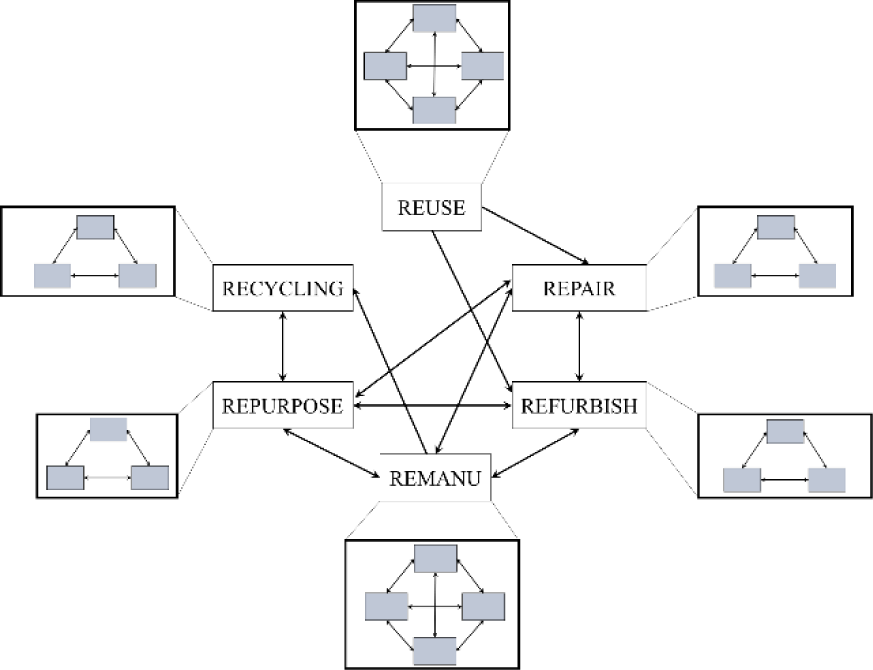
We use a hierarchical matrix to assess the level of alignment of R-imperatives with the integrated PD and SC design decisions. Each node in the primary matrix shows one R-imperative in the proposed hierarchical matrix. For each R-imperative, there is another matrix, in which its nodes represent the integrated PD and SC design decisions. Figure 1 shows the structure of the proposed hierarchical matrix.
The proposed hierarchical structure

The equation Eq. (2) can be expanded into equation Eq. (3).

3.2. Enhancing the calculation efficiency
Calculating the permanent of a matrix is a computationally intensive problem as it requires evaluating all permutations of row-column combinations. This makes the direct computation of the permanent infeasible for larger matrices due to its factorial growth in complexity (O(n!)). To address these challenges, an exact calculation method called Glynn’s formula can be applied to small-to-moderate-sized problems. Unlike the naive summation over n! permutations, Glynn’s formula reformulates the permanent as:
 $$perm(A) = 2^{n - 1} \mathop \sum \limits_{\sigma \in \{ - 1,1\} ^n } \mathop \prod \limits_{i = 1}^n \left({{{1 + \sigma _i }}\over {2}}\mathop \sum \limits_{j = 1}^n \sigma _j a_{ij} \right)$$
This approach reduces the computational time by leveraging algebraic transformations to sum over 2 n terms instead of n!. Glynn’s formula exploits symmetries and linearity in matrix operations, making it particularly effective for matrices that are not excessively large.
3.3. Scenario-based analysis
Three scenarios are considered to evaluate integration performance under varying conditions and showing the level of alignment in different situations. First, the worst-case scenario represents the least favorable conditions, where node contributions and interaction strengths are minimized based on expert judgment or historical data. Examples include low modularity in product design or poor coordination between stakeholders. In the second scenario, the best case represents the optimal conditions where node contributions and interaction strengths are maximized. Finally, the normal case scenario represents typical or average conditions. For each scenario, the VPM is adjusted to reflect the specific conditions, and PI (matrix permanent) is computed as follows:
 Alignment Index_{scenario} = perm(A_{scenario} )
To compare the performance across scenarios, a performance index (PI), developed based on (Reference Belhadi, Kamble, Jabbour, Mani, Khan and TourikiBelhadi et al., 2022), is calculated as follows:
 $$PI = {{{Alignment Index_{Normal} - AlignmentIndex_{worst} }}\over {{AlignmentIndex_{best} - AlignmentIndex_{worst} }}}$$
4. Results
This section presents the main results of implementing the proposed approach. Section 4.1 discusses the relationships between R-imperatives, product characteristics and SC design decisions, illustrating these connections through main and sub-graphs. Section 4.2 explains the numerical results obtained from solving the mathematical formulation as basis for assessing the level of alignment.
4.1. Framework development
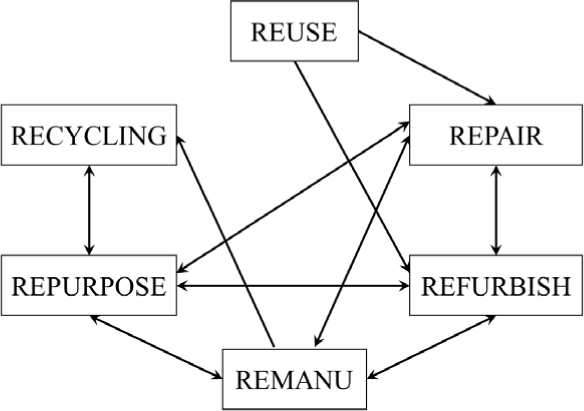
As explained in Section 1, the R-imperatives are interconnected strategies that form the foundation of CE. Each imperative influences and supports others (see Figure 2). For instance, Reuse increases the likelihood of wear, necessitating Repair. Repair feeds into Refurbish by restoring components that may undergo further aesthetic or functional upgrades. If Refurbishment is insufficient, for example, products can transition to Remanufacture, where they are disassembled and rebuilt. This network of interdependencies emphasizes the systemic nature of the R-imperatives and explains the interconnections between R-imperatives, PD and SC design decisions.
The structure of the digraph of R-imperatives dimensions

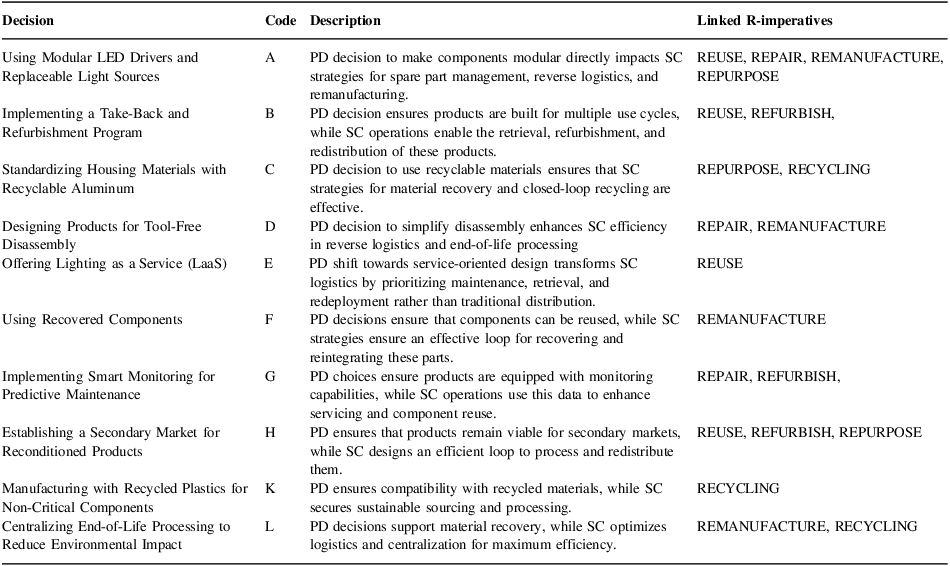
The next step is considering the interconnections between the dimensions. Table 1 shows the set of decisions the company made to integrate PD and SC design decisions and their interconnection with each R-imperative.
Dimensions of PD and SC decision integration for each R-imperatives

Using the proposed graph-theoretic approach, the interconnections between R-imperatives, PD, and SC design decisions can be modelled with the R-imperatives as nodes and the interconnections as edges (see Figure 3). This framework analyzes how R-imperatives influence one another and are interrelated to product characteristics and SC design decisions.
The structure of the digraph of PD and SC decision integration for each R imperatives

4.2. Data collection
The data for this study are collected through insights from interviews and factory visits conducted from a lighting-systems manufacturer, which is part of the Circular Manufacturing project in Norway. The first author designed two matrices to ensure it accurately reflected the company’s integration of circular strategies. 1) the main matrix, structured according to Figure 2, is mapping interconnections between different R-imperatives, and 2) sub-matrices, structured based on Figure 3, are detailing the interdependencies between integrated PD and SC design decisions. Since direct (quantitative) data from the company was unavailable, insights from the interviews were used to populate the data. This expert-driven approach ensured that the collected data captured real-world industry insights, while maintaining consistency and accuracy in the analysis. Due to space limitations, only a portion of the data is presented below. This data corresponds to normal scenarios. The matrix values range from 0 to 1, with 1 indicating the highest level of importance. For example, A→A = 1 means that implementing integrated decision A is very important for the manager. Repair↔Repurpose=0.2 means that by implementing the design for repairing, we can satisfy around 20% of the requirements for design for repurposing.
Interconnections between R-imperatives and (a-f) interconnections between integrated PD and SC design decisions

4.3. Numerical results
The numerical results presented in this section demonstrate the application of the proposed graph-theoretic approach to assessing the level of alignment of each R-imperatives with integrated PD and SC design decisions. The results analyze the alignment level by three distinct scenarios—‘worst,’ ‘normal’, and ‘best’ case—and compute PI to assess the relative effectiveness of integration strategies. Each scenario shows the expectation of aligning each R-imperative with each PD and SC design decision. For example, the normal scenario describes a situation with no unexpected disruption or uncertainty in SC. However, the worst scenario explains a situation where there may be unforeseen disruptions such as material shortage, pandemics, etc., affecting the SC negatively.
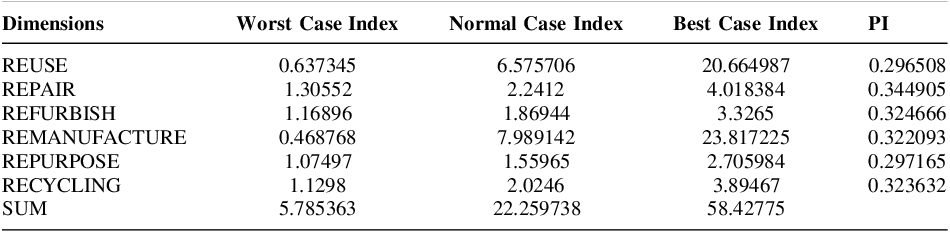
After solving the model, the numerical results in Table 2, show the PI for each sub-matrix corresponding to the dimensions of the hierarchical model. This enables a granular evaluation of the contributions of individual dimensions under the worst-case, normal, and best-case scenarios.
Calculated the alignment index and PI for each R-imperatives

As presented in Table 2, the alignment index and PI values indicate the relative effectiveness of different R-imperatives in CE implementation. Among the imperatives, Repair (0.344905) exhibits the highest PI, closely followed by Refurbish (0.324666), Recycling (0.323632), and Remanufacture (0.322093). These values suggest that these strategies are more aligned with the integrated decisions and sustainable practices under varying conditions.
The Best-Case Index values indicate the maximum potential impact of each strategy under ideal conditions. Remanufacture (23.817225) and Reuse (20.664987) exhibit the highest values, highlighting their significant contributions when conditions are favourable. Repair and Recycling, with Best Case Index values of 4.018384 and 3.89467, respectively, also demonstrate notable effectiveness. In contrast, Repurpose (2.705984) has the lowest Best Case Index and PI (0.297165), indicating that it may be less viable compared to other strategies. The total sum of indices across different scenarios shows a clear trend of increasing effectiveness, moving from 5.785363 in the worst case to 58.42775 in the best case. This highlights the significant improvements achievable by providing ideal conditions for implementing R-imperatives. These findings offer insights for prioritizing R-imperatives based on their performance potential and help decision-makers develop more effective and adaptable sustainability frameworks.
The results illustrated in Figure 5 highlight essential managerial implications for effectively implementing R-imperatives within SC and product lifecycle management. The findings suggest that Repair is the most impactful strategy, achieving the highest performance index (PI = 0.344905). This implies that this R-imperative is a consistently effective strategy across all scenarios. Its relatively strong performance suggests that businesses should prioritize repair-friendly designs, spare part availability, and service infrastructure to extend product lifespans and reduce waste.
The level of alignment with R-imperatives in each scenario (right) and PI index (left)

Remanufacturing (PI = 0.322093) and Refurbishing (PI = 0.324666) offer moderate performance, with remanufacturing showing significant potential under ideal conditions (Best Case Index = 23.817225). This suggests that while remanufacturing can be highly effective, it requires a well-structured SC and favorable operational conditions. Companies should invest in efficient reverse logistics and automation to enhance remanufacturing viability. Recycling (PI = 0.323632) also exhibits stable performance, making it a reliable fallback option, but its resource-intensive nature suggests it should be considered only after higher-value recovery strategies.
Reuse and Repurpose have the lowest PI values (0.296508 and 0.297165, respectively), indicating that their effectiveness is more limited. While reuse shows strong potential in best-case conditions (20.664987), its lower worst-case performance suggests challenges such as product availability and consumer acceptance. Similarly, repurposing has the lowest best-case index (2.705984), making it the least viable option for large-scale CE applications unless specific market demand exists.
These findings emphasize the need for a multi-strategy approach to ensure the effective implementation of CE initiatives. Businesses should prioritize repair and remanufacturing, integrate refurbishing and recycling where feasible, and evaluate the practicality of reuse and repurposing based on product characteristics and market demand. A well-structured framework that aligns PD and SC decisions is essential to maximize the benefits of circularity.
The total sum of indices highlights the transformative impact of R-imperatives when correctly managed, with the best-case scenario reaching 58.42 compared to 5.79 in the worst case. This significant variation suggests that well-structured CE initiatives can vastly improve resource utilization. To leverage these benefits, businesses should adopt an integrated CE model that dynamically transitions products through different recovery strategies based on their condition and market viability. A tiered approach, prioritizing reuse and repair first, followed by refurbishing and remanufacturing, and considering recycling as the final option, can maximize resource efficiency while minimizing waste.
For successful implementation, managers must adopt a systemic approach integrating SC processes, consumer engagement, and regulatory compliance with CE objectives. Regulatory frameworks, tax incentives, and extended producer responsibility policies can further support these efforts, encouraging companies to take full ownership of product lifecycles. Collaborating with third-party refurbishers, remanufacturers, and recycling facilities can enhance reverse logistics efficiency while reducing operational costs. Effective CE implementation requires a strategic balance among reuse, repair, refurbishing, remanufacturing, and recycling. Companies that proactively design products for longevity, develop robust reverse logistics networks, and leverage technological advancements will gain a competitive advantage in both sustainability and cost reduction. By transitioning toward a holistic circular SC model, businesses can strengthen their resilience, reduce environmental impact, and create long-term economic value.
5. Conclusion
The findings of this study underscore the importance of strategically selecting and implementing R-imperatives to maximize resource efficiency, sustainability, and economic viability. Within the constraints of the assumptions made in this study, the analysis shows that Repair is the most effective approach, offering the highest performance under different conditions. Companies should prioritize repair and remanufacturing by designing products that support easy maintenance, modularity, and extended usability. While recycling remains a viable strategy, it should be considered a last resort due to its resource-intensive nature. Instead, businesses should focus on expanding product lifespans through repair, refurbishment, and remanufacturing before resorting to material recovery. This approach not only reduces waste but also optimizes resource efficiency and cost-effectiveness.
Furthermore, Refurbishing and remanufacturing offer significant opportunities for circularity, but their success depends on efficient reverse logistics, rigorous quality control, and standardization of product components. To enhance the viability of these strategies, companies should invest in automation, AI-driven inspections, and streamlined take-back systems to improve cost efficiency and scalability. Repurposing, on the other hand, demonstrates limited effectiveness, suggesting that it should only be pursued when there is clear market demand and technological feasibility to support alternative applications of used products.
The results indicate that a tiered approach yields the most significant sustainability benefits. Businesses integrating these strategies into their SCs can significantly reduce waste, lower costs, and improve resilience against material shortages and regulatory pressures. To fully unlock the potential of R-imperatives, companies must align their PD, SC design, and business models with circularity principles.
A key limitation of this study is the need for industry-specific customization to account for sector-specific challenges and opportunities. Additionally, the applied method models static relationships, overlooking temporal dynamics and real-time feedback loops in circular systems. Future research should validate the framework through industry-specific case studies and explore dynamic modelling techniques to capture feedback-driven processes.




 Open access

