Berlin, the 1900s.
The crowd leans forward, breath held. Children sit perched on their fathers’ shoulders. Women clutch gloved hands to their mouths. Somewhere in the throng, a man strikes a match and lights a cigarette, his eyes never leaving the magician they’re all watching.
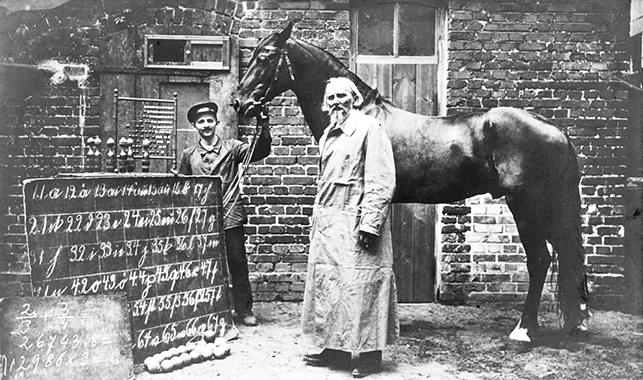
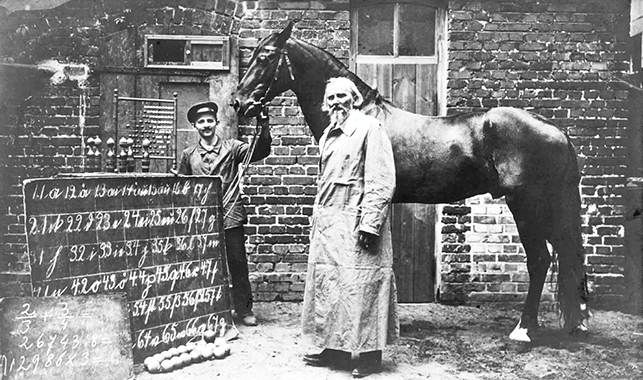
On a low wooden platform, the star of the show waits. He’s not a politician, professor, or performer – but a horse named Hans (Figure 1.1). But he’s no ordinary stallion. Tall, dark, and lean, with intelligent eyes and a knowing stillness. A chalkboard stands behind him, scrawled with a question: 7 + 5 = ?
Wilhelm von Osten, the retired schoolmaster turned showman, steps forward, cane tucked under one arm. Von Osten, who is also Hans’s trainer, nods once, and the horse begins to tap.
One – two – three. Hoof against board. Four – five – six. A murmur spreads. Seven – eight – nine – ten. Someone gasps. Eleven. Twelve.
The hoof stills. The crowd erupts. “Genius!” someone cries. “A miracle!”
Numbers are one thing, but how does Hans handle words? Next, von Osten asks Hans, “what day follows Tuesday?” Hans pauses, lifts a hoof, then gently taps on the word Wednesday, scrawled on the board. The street erupts again.
Month after month, the crowd grows, and so does Hans’s fame. His trainer claims no trickery, no sleight of hand. Hans is simply gifted. And as scientists and skeptics arrive in Berlin to debunk the spectacle, Hans aces every test. Newspapers dub him “Clever Hans,” a four-legged genius who threatens to blur the line between human and animal intelligence.
The performances continue, and so does the wonder, until one day, when behind the crowd, a young psychologist, Oskar Pfungst, was watching – not in awe, but in suspicion. Pfungst was studying the trainer as much as the horse. What he saw wasn’t magic. Pfungst made one pivotal change that turned poor Clever Hans on his head: he asked the questions without allowing the horse to see the trainer. The trick collapsed.
Clever Hans could only amaze his audience with the help of his trainer. The revelation was stunning.
While calculus wasn’t Hans’s strength, he still possessed a kind of superpower: Hans wasn’t doing math – he was engaging in stimulus–response learning. He picked up on subtle human cues and translated them into behavior that looked intelligent. In a way, Hans was an example of pattern recognition, the same strength that modern AI systems excel at.
New York City, 1997.
Thirty-five floors above Midtown Manhattan, in a specially constructed studio within the Equitable Center on Seventh Avenue, Garry Kasparov sits across from his silent opponent.
Kasparov, the greatest human chess player in the world, has won the first game of the match. Deep Blue, IBM’s supercomputer, won the next. The following three games ended in draws. This is the deciding game, and Kasparov is perplexed by his opponent’s latest move.
Around him the room is stark, designed for focus, with only essential personnel present: Kasparov and his team, and the operators relaying moves to and from IBM’s supercomputer, Deep Blue, housed in an adjacent room – a cabinet of circuits and wires, indifferent to tension, immune to nerves. Inside, it hums through 200 million positions per second. There’s no bluff, no instinct, no awareness. Just cold computation.
The move – knight sacrifice on the e6 square – it’s strange, puzzling. Not optimal. Not human. But there’s value in the strategic sacrifice – Kasparov just hasn’t expected a machine to see that.
Far below, in a ground-floor auditorium, approximately 500 spectators are watching the deciding match unfold on large video screens. A year earlier, Kasparov had defeated Deep Blue in a match in Philadelphia four games to two. Now chess enthusiasts, computer scientists, and curious onlookers all listen intently to live commentary and watch as Kasparov, after the computer’s nineteenth move in this deciding match, resigns game six, giving Deep Blue the victory.
At the time, the victory shocked the world. It was the first time a computer had defeated a reigning world champion under standard tournament conditions. Deep Blue didn’t win through experience or insight – it won through brute force. It didn’t learn or adapt. It simply calculated, following preprogrammed rules and expert-crafted databases with astonishing speed. And yet, for many, it felt like something more: a turning point. A moment when the boundary between human cognition and machine cognition began to blur.
Although Deep Blue was a powerful calculator, it lacked anything approximating what we would consider to be intelligence. Yet, chess was only the beginning. In contrast, modern AI like AlphaZero learns through self-play, honing its strategies by playing millions of games against itself without the use of prior human data. Instead of following human-crafted rules, it discovers the best moves through deep learning and reinforcement, resulting in more dynamic and creative play.
Jump forward to 2016, and we see AI again shatter cognitive abilities once thought to be only human. Go is an ancient Chinese game with more possible board configurations than atoms in the universe. This level of complexity makes brute-force methods useless. Success in Go requires intuition and long-term planning. These are the abilities once thought to be uniquely human.
In 2016, Google DeepMind’s AlphaGo defeated world Go champion Lee Sedol, another turning point in artificial intelligence. AlphaGo’s secret weapon? Deep neural networks trained on millions of games, combined with Monte Carlo tree search to evaluate positions and predict winning moves based on a type of artificial memory learned from experience. The result was a system that played both strategically and creatively, often surprising even the best human players. This victory demonstrated the true power of deep learning and reinforcement learning, proving AI could excel in domains that required more than raw calculation.
What You’ll Learn in This Chapter
Although AI can process massive amounts of stimulus–response data with speed and precision, it lacks what Hans had, an embodied sensitivity to context. Humans take this one step further: our stimulus–response learning becomes intuition – the ability to act quickly and accurately in complex, uncertain situations. That’s something AI still struggles to replicate. This is why the real breakthrough isn’t choosing between humans or AI but combining the two: AI’s strength in large-scale pattern recognition with our human gift for intuitive, emotionally grounded decision-making.
Below all these stories runs the question of how we define cognition. For something as ever-present as “thinking,” it’s funny how little attention we often pay to it. That’s by design. If all we did was get caught up in our thoughts, we’d have little time for anything else. Although there’s a word for purposefully thinking about thinking (mindfulness), we’re not about to start asking you to meditate! Our goal in this chapter is to leave you with an understanding of how the mind and the process of thinking works, how research in this area is used by AI builders to create products, and what you can do from a practical standpoint with this knowledge.
In this chapter, you’ll:
Understand the foundational neuroscience concepts of perception, memory, attention, reasoning, and executive function that help explain the inner workings of your own cognition.
See how AI products themselves have taken inspiration from the way your human mind works, and what this means for the design and use of those products.
Be able to compare how the process of learning works differently across humans and AI, and to see why this is important for the future of cognition and AI.
Foundations of Cognitive Intelligence: Bridging Human Thought and AI
Cambridge Cognition (2015) defines cognition as “the mental action or process of acquiring knowledge and understanding through thought, experience, and the senses.” In simple terms, it’s the ability to perceive and react, process and understand, store and retrieve information, make decisions, and respond appropriately. This chain of organic processes – perception, attention, learning, and memory – converges to produce decision-making.
Hans excelled at one kind of intelligence: stimulus–response conditioning. Humans take it much further. The human brain is a web of more than 100 billion neurons, each forming up to 10,000 connections. Together they make up a network powering thought, perception, and behavior.
Cognition emerges from the synchronized activity of specialized brain circuits, regulated by neurotransmitters. Yet only a fraction of these processes ever reach our conscious awareness. Some executive functions even feel intuitive – thanks in large part to emotion, which we’ll explore later – where things become even more interesting.
Today’s advanced generative AI systems are built on artificial neural networks like transformer architectures for text and diffusion models for images. Inspired by the human brain but different in both structure and function, deep learning models mimic certain aspects of cognition – pattern recognition, prediction, even “learning” from experience. But they lack organic flexibility, subconscious intuition, and self-awareness.
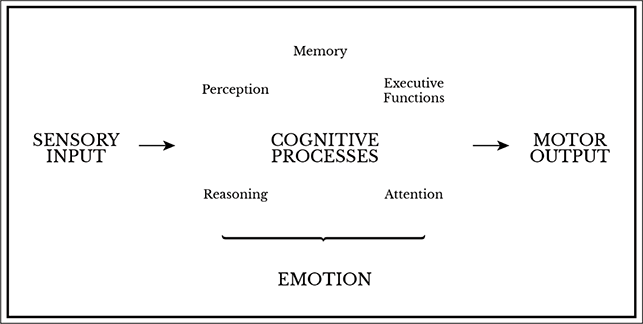
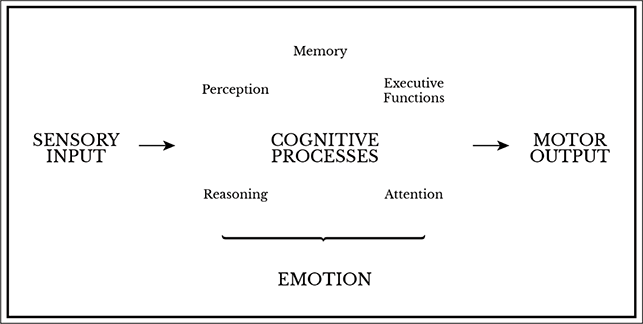
Cognition itself isn’t a uniform concept. Multiple processes shape how we perceive reality, process information, and respond. Visual–spatial perception, attention, learning, memory, and executive functioning all integrate to let us perceive, process, store, and act on information adaptively (Figure 1.2). Together they let humans navigate complex environments, resolve conflicting choices, and learn from both experience and reflection.
Domain specificity of cognition and examples of component cognitive processes underlying these mechanisms.
In the following sections, we’ll explore these cognitive pillars and compare how the human mind performs these functions to how current AI systems approach similar challenges. What we’ll find is a story of the remarkable flexibility and efficiency of human cognition and of the gaps that remain between biological intelligence and today’s most advanced artificial systems. By learning more about these cognitive foundations, we can start to envision how future AI might complement human strengths, help us make decisions, manage uncertainty, and ultimately work more effectively together.
Visuospatial Perception: Beyond Seeing to Understanding
Picture walking into a busy café and spotting your friend waving to you from the bar across the room. You scan for obstacles, look for empty chairs, and make your way through the crowd without colliding with anyone. That simple trip to the bar depends on visuospatial perception. Your brain processes shapes, distances, and context in an instant so you can move smoothly.
Visuospatial perception lets us process and interpret visual information. It allows us to understand where objects are in space – relative to us and to each other – their shapes, sizes, and orientations.
When you reach to grab a pan off the stove, it’s visuospatial perception that guides your hand to the handle, not the pot. It tells you whether you need an oven mitt.
These skills underpin everyday life. They depend on complex neural processes that integrate visual input with spatial awareness so we can move and act effectively in our surroundings.
In AI, computer vision tries to replicate this. Using machine learning, usually deep neural networks, it identifies and classifies objects, detects patterns, and predicts movement in visual scenes. Computer vision can now power facial recognition, autonomous driving, and image-based search by processing vast amounts of visual data to learn features.
Yet there are key differences. Human perception is deeply contextual and grounded in experience. We infer meaning and adapt fluidly. Consider the hot pan again. If you’ve burned yourself before by reaching without an oven mitt, you’ll hopefully adapt next time.
Computer vision, even when highly accurate in specific tasks, lacks this level of context and generalization. A child knows a tipped-over chair is still a chair, or that a dog partly hidden under a blanket is still a dog, because they use context, memory, and intuition. A system trained only on upright chairs might fail entirely. Humans flexibly interpret scenes. AI may struggle when conditions shift beyond what it has explicitly learned to do.
Current debates in AI research ask whether achieving human-like visual perception requires mimicking the brain’s architecture directly, or whether alternative approaches – such as combining vision with higher-order reasoning – will prove more effective. Multimodal models already integrate visual, sound, and textual data. These models are able to recognize what they are seeing and why it matters. This marks a shift from pure recognition to contextual reasoning. To be useful in the complexity of daily life AI needs to be able to reason about relationships, predict outcomes, and adapt to unseen environments.
Attention
The psychiatrist and famed American author William James defined attention in a very sticky way – and this was way back in 1890: “Everyone knows what attention is,” he wrote in his book Principles of Psychology. “It is the taking possession by the mind, in clear and vivid form, of one out of what seem several simultaneously possible objects or trains of thought. Focalization, concentration, and consciousness are of its essence.”
Then James proceeded to define distraction: “It implies withdrawal from some things in order to deal effectively with others and is a condition which has a real opposite in the confused, dazed, scatterbrained state which in French is called distraction, and Zerstreutheit in German” (James, Reference James1890, volume I, chapter XI).
James nailed it, and not much has changed since then. Attention, we can say, is our focus on some things at the expense of others. He also touched on what was then controversial: our inability to truly focus on multiple things at once.
Attention helps us allocate mental resources to particular aspects of our environment, which informs how we interact and respond. Sometimes it’s self-directed – your interest keeps you absorbed in a book. Other times it’s hijacked by the environment – a siren wails outside, pulling you away from the page.
Those ideas capture the two primary types of attention: top-down and bottom-up.
Top-down attention is driven by an individual’s intentions and prior knowledge. It involves consciously directing focus based on current goals or expectations. For example, searching for a friend in a crowded cafe requires top-down attention, as you intentionally focus on identifying specific features.
Bottom-up attention is automatically captured by salient external stimuli, regardless of one’s current goals. For instance, a sudden loud noise or a bright flash of light can involuntarily draw your attention.
AI uses “attention” in a different way. For example, large language models (LLMs) rely on attention mechanisms to understand and generate text. They calculate which words or phrases matter most in a sentence, weighting how each word relates to the others, even across long distances.
Self-attention allows AI to track those relationships; multihead attention lets it examine multiple patterns at once – like scanning a gallery and quickly cataloguing the paintings you love most. This attention-based architecture is why LLMs excel at answering questions, summarizing text, and holding coherent conversations. It helps them make sense of complex patterns (Vaswani et al., Reference Vaswani, Shazeer, Parmar, Uszkoreit, Jones, Gomez, Kaiser and Polosukhin2017).
However, unlike humans, LLMs have no innate goals. When “looking around the gallery,” the system isn’t asking itself, Which painting is my favorite? Humans direct attention with goals, emotions, and expectations. Large language model attention optimizes prediction from training data.
In both brains and machines, attention determines what gets prioritized. In humans, it’s a spotlight – filtering distractions, guiding learning, and helping us decide what matters. In AI, it’s a statistical weighting that improves accuracy and coherence.
Executive Function
Welcome to the brain’s boardroom. Here, executive functioning helps us make plans and adapt when life throws us curveballs. These are the mental skills that let us focus our attention, remember what we need to do, and smoothly switch between different tasks. These functions include inhibitory control (holding back impulses), working memory (keeping information handy while we use it), and cognitive flexibility (adjusting our thinking when the situation changes) (Miyake et al., Reference Miyake, Friedman, Emerson, Witzki and Howerter2000).
These skills help us spot conflicts, such as when our desire for something sweet clashes with our goal to eat healthy or when navigating a tricky work problem, and guide us in making thoughtful choices instead of acting on impulse. People are increasingly making decisions alongside AI systems. Understanding the role of executive function in cognition holds the secret to designing smarter AI that can work with us, not just for us.
Since the publication of Daniel Kahneman’s Thinking, Fast and Slow in Reference Kahneman2011, dual-process theories have dominated discussions of decision-making. Conventional wisdom suggests that most decisions are driven by a fast, automatic system (System 1), with a slower, more deliberative system (System 2) intervening when necessary.
But newer insights suggest it’s not so binary. Cognitive processing exists along a continuum, where multiple processes run at once – sometimes even in conflict. Executive functions help manage that dynamic interplay. They modulate when to rely on rapid, intuitive responses and when to shift toward slower, reasoned analysis.
This nuanced perspective is essential across domains, from consumer behavior to policymaking. It also raises new questions: How could we design AI to harness similar adaptive, context-sensitive controls to better complement humans?
We’re already seeing early steps. OpenAI introduced a model series designed for System 2–style reasoning, solving high school math problems methodically with near-perfect accuracy (de Winter et al., Reference de Winter, Dodou and Eisma2024). Other labs are moving in the same direction with models that all attempt to replicate – at least in part – human-like reasoning.
Cognitive control is especially important in decision-making when conflicts arise between options. Imagine choosing between a trusted brand and a competitor running a promotion. In those moments, cognitive control ramps up, shifting processing from automatic to more deliberate. That shift can change purchasing behavior in ways that either help or hurt a company.
Looking at cognitive control through this perspective can help us understand – and even influence – behavior in business (brand choice, advertising), public policy (vaccination decisions), and politics (voter choice).
These insights into cognitive conflict and control offer valuable principles for designing AI systems that truly assist human decision-making. By mimicking the brain’s ability to detect and resolve conflicts, AI can be engineered to support users when they face tough choices in those complicated domains like business, healthcare, or politics. For example, an AI that adapts its recommendations based on the level of uncertainty or conflict a user experiences could help streamline decision-making processes, ensuring that the system aligns with our natural, context-sensitive cognitive strategies, instead of just delivering a data-centric path. We’ll go deeper into these concepts in the decision-making chapter and bring them to life in Part II, where we explore real-world applications in products.
Learning
Human learning relies on two complementary processes: fast, automatic routines developed through repetition, and slower, deliberate reasoning that helps us solve novel problems and think abstractly. Jonathan Evans and Keith Stanovich (Reference Evans and Stanovich2013) described how the reflective mind – responsible for careful, logical analysis – works alongside more intuitive, automatic processes. Through experience, the brain builds efficient, implicit routines while still retaining the ability to use controlled, flexible processing when faced with something new.
Ashby et al. (Reference Ashby, Turner and Horvitz2010) explain this beautifully: repetitive experience frees cognitive resources, but deliberate reasoning stays available for situations that require novel problem-solving. Together, these processes form the backbone of human flexibility.
AI is catching up in surprising ways. Once reliant on massive labeled datasets, newer systems can perform few-shot learning (working with just a single or a handful of examples) and even zero-shot learning (generalizing without explicit examples). Like humans recalling past experiences – or checking references when memory fails – AI can now retrieve stored knowledge and even “look things up” to fill gaps.
Driving is a perfect example of how these two learning modes work together. When you first learn, every move – checking mirrors, adjusting speed – requires conscious effort. Over time, these actions become automatic. Yet when something unexpected happens – traffic, bad weather – you can reengage deliberate reasoning.
AI learns driving differently. It doesn’t use embodied practice like humans. Instead AI driving systems analyze huge volumes of data to detect patterns and predict what to do next. A teenager typically learns to drive in a few months with thirty to fifty hours of practice, costing anywhere from $500 to $3,000. By contrast, self-driving cars require years of training, millions of miles of driving data, and hundreds of millions of dollars in development. Humans adapt after a single close call; AI needs thousands of examples to reach a similar adjustment. But once trained, AI can scale instantly, deploying knowledge globally without additional “practice.”
AI is also getting better at explaining its reasoning and decisions in human terms, increasing transparency and trust – areas we’re going to look at in more depth later. Yet emotions still shape how humans drive in ways AI doesn’t. You might instinctively swerve to avoid a squirrel – not because it’s logical, but because it feels wrong not to. AI, operating on pure optimization, won’t take that risk if it increases the chance of harm.
So, can we design AI that learns more like the human brain – efficient, context-aware, and sensitive to social cues? Could integrating principles of human cognitive development, like reinforcement through feedback and adaptive memory, create AI that’s better suited for collaboration? These questions open the next frontier of cognition and AI, where interdisciplinary insights may help machines learn in ways that feel more natural and human-like.
Memory
Memory is the set of cognitive processes that let us store and retrieve information so past experience can guide future behavior. You hear a catchy song, and its chorus sticks. Days later, when the same song plays at a party, the lyrics surface effortlessly. That’s memory at work.
Under the memory umbrella are several different types:
➔ Short-term memory refers to holding small pieces of information for a very short time (seconds), like a phone number or temporary security codes that you are trying to re-enter on a different screen or device.
➔ Long-term memory refers to storing a vast amount of information for extended time periods (ranging from hours to decades). Long-term memory can be further classified into:
Procedural or implicit memory, often what we call intuition, plays a key role in automatic decision-making and the formation of habits. Once a behavior is repeated a few times with positive outcomes, it becomes second nature, freeing up cognitive resources for other tasks. Think of your go-to brand of ice cream: you grab it without thought because you’ve chosen it in the past and enjoyed it.
Implicit memory shapes the small, everyday choices we make, often without us even realizing it, acting as a hidden influence that steers our behavior. In turn, the human brain has evolved to become the most efficient “machine” in the world because it’s capable of making many decisions utilizing minimal cognitive resources and thus minimal energy.
Language reveals just how deeply memory is tied to culture. Joint research from Northwestern, Harvard, and the University of Toronto analyzed data from 100,000 people alongside written texts spanning centuries (Charlesworth et al., Reference Charlesworth, Morehouse, Rouduri and Cunningham2024). They found that implicit attitudes – unconscious associations we have formed during our lives as part of our implicit memory – consistently show up in language across many languages, not just English. At the same time, explicit attitudes, the ones we voice consciously, tend to reflect personal beliefs and social norms. The study highlights how cultural information is embedded in everyday expression – and how AI models, which train on this very language, absorb those same patterns.
AI systems incorporate memory mechanisms that, while differing from human memory, aim to emulate certain cognitive functions. In AI, memory is typically accomplished with storage and retrieval processes, enabling machines to learn from data, and make decisions based on accumulated knowledge. For instance, neural networks adjust their parameters during training to encode learned information, facilitating tasks such as pattern recognition and language processing. Unlike human memory, which is influenced by context, emotion, and experience, AI memory operates on logical data processing without emotional context.
Still, some parallels are emerging. A study from the Institute for Basic Science in Korea (Kim et al., Reference Kim, Kwon, Cha, Lee, Oh, Naumann, Globerson, Saenko, Hardt and Levine2023) found that certain AI models show memory-forming processes similar to those in the human hippocampus, a region in our brains that is used to create long-lasting memories.
Transformer models use self-attention mechanisms, which determine how much weight to give different pieces of input context, rather than explicit gating as in earlier recurrent networks. This mirrors how N-methyl-d-aspartate (NMDA) receptors in the brain regulate the flow of signals between neurons. Both systems, human and artificial, rely on these gates to manage complex information flexibly and efficiently. These similarities suggest that AI systems might be developed to mirror human memory processes more closely, potentially leading to more efficient and adaptable models.
Reasoning
Reasoning is how we solve problems, draw conclusions, and justify decisions – sometimes even poor ones. It’s the process behind everything from choosing dinner to working through a jigsaw puzzle. Humans approach reasoning in two main ways:
➔ Deductive reasoning applies general rules to specific situations. If you know all birds have feathers, you know a sparrow must have them, too.
➔ Inductive reasoning works in the opposite direction, drawing patterns from examples. A child learns most dogs bark after meeting just a few.
Over time, children gradually develop these reasoning skills, becoming more logical and systematic (Gopnik et al., Reference Gopnik, Sobel, Schulz and Glymour2001).
AI tackles reasoning differently. It excels at induction, identifying patterns across enormous datasets – like spotting spam emails. Modern LLMs can also perform rule-following deductive tasks, not through explicit programming, but through statistical deduction.
What AI doesn’t naturally do is causal reasoning in the way humans do. We’re wired to seek “why,” inferring cause and effect even through play. Machines, unless designed with tools like Bayesian networks, can often confuse correlation with causation.
Moral reasoning shows an even wider gap. Humans consider things like fairness and intent, and this is often informed by our cultures. We care not only about what happened, but why. AI doesn’t have the same embodied experience of morality. It reflects the data it’s trained on and the objectives we set – like minimizing harm or avoiding bias – but it doesn’t understand those values. This is one of the reasons that aligning AI with human ethics remains an ongoing challenge. Machines don’t care why an action matters; they optimize toward the goals we give them. Researchers are experimenting with ways to embed ethical frameworks into AI, but for now, moral reasoning remains uniquely human.
Still, reasoning in AI has advanced rapidly. A 2025 MIT Technology Review article described the shift from pattern recognition toward deeper problem-solving. Early language models produced quick, statistical outputs but lacked multistep reasoning. Newer models now explore hypotheses, and perform adaptive reasoning for complex applications like autonomous exploration, healthcare, and finance (MIT Technology Review Insights, 2025).
Even so, debate continues. Research from Apple questioned whether AI truly reasons or merely simulates it through pattern-matching. They used classic logic puzzles to test advanced models and found systematic failures on more complex tasks (Shojaee et al., Reference Shojaee, Mirzadeh, Alizadeh, Horton, Bengio and Farajtabar2025). Critics argue this exposes limits to AI’s “simulated reasoning,” while others say the failures reflect current engineering trade-offs, not fundamental flaws.
While many fear that the future of AI is one of replacement – machines taking over tasks, roles, or even reasoning itself – we believe a more valuable path lies in partnership. The promise of AI is in augmenting human thought: helping us reason more clearly, identify blind spots, and support for sound decision-making. In this vision, we don’t become obsolete – we become smarter together.
Collaborative Efforts: The Lines Between Human and AI Cognition
Research on AI strives to simulate advanced human cognitive functions – memory, attention, perception, reasoning, and learning – within machines (Zhao et al., Reference Zhao, Li and Wang2022). But achieving truly human-like cognition is one of the field’s greatest challenges. And many in the field are asking: should AI really emulate the human brain at all?
Some researchers argue that mimicking the brain’s “dual-process” – fast, intuitive processing (System 1), paired with the slower, deliberate reasoning of System 2 – is needed to achieve general intelligence. Others contend that AI’s greatest successes, from LLMs to game-playing systems, have emerged from architectures fundamentally different from the brain’s. This tension raises a broader question: should AI aim to think like humans, or surpass us by following entirely different cognitive paths?
Brain-inspired AI approaches have struggled to capture the intuitive and emotional layers that define human thought. In response, researchers are increasingly integrating insights from cognitive science and psychology, creating AI systems designed to understand emotions and engage in more empathetic dialogue. A key bridge between human cognition and affective intelligence lies in the ability to experience, or at least model, emotional states. We’ll examine these challenges in more depth in Chapter 2 on Emotion. Some researchers envision an AI capable not only of rational “brain-like” thinking but also the perceptual and emotional intuition of the “heart,” enabling natural, human-like communication, as seen in Project Rumi (Microsoft Research, n.d.).
Neuroscientists are also researching overlaps between AI models and the human brain. Recent work shows that the brain’s learning mechanisms resemble the self-supervised learning strategies used by AI, constantly predicting and correcting sensory inputs (Raman et al., 2025). Still, human and artificial intelligence is very different: AI systems can replicate attentional focus but lack emotions and embodied social cognition – core elements of human intelligence (Raman et al., Reference Raman, Kowalski, Achuthan, Iyer and Nedungadi2025). Unlike the modular, evolution-shaped brain, architectures like transformers generalize across tasks without distinct cognitive “regions.” Even so, research is increasingly focused on building AI with memory systems and brain-inspired modules.
These teams are experimenting with a few approaches to mimic – or approximate – cognitive functions in AI:
Symbolic AI and Cognitive Architectures: These systems try to “think” like humans by following rules and logic, using structured knowledge – step-by-step instructions for reasoning or decision-making (Kotseruba & Tsotsos, Reference Kotseruba and Tsotsos2020). Classic systems often divide thinking into modules (memory, vision, decision-making) that work together, echoing how different parts of the brain handle different tasks. For example, a symbolic AI might coordinate a complex schedule by checking calendar availability, meeting priorities, and preferences – much like a human assistant using logic to organize a busy day.
Neural Networks and Learning Systems: These models learn through experience, rewiring connections much like the brain as it acquires new skills. By processing massive amounts of data and adjusting their internal weights, they learn to recognize patterns – like identifying faces in photos or parsing spoken language (LeCun, Bengio, & Hinton, Reference LeCun, Bengio and Hinton2015). For instance, a neural network can learn to recognize cats simply by analyzing millions of cat photos, without being explicitly told what “cat features” to look for.
Neurosymbolic AI: Because neither strict rules nor pure learning alone can replicate human cognition, hybrid systems combine the two. They use rules for reasoning and planning, while neural networks handle inputs like images or sounds (Marra et al., Reference Marra, Giannini, Diligenti, Gori and Maggini2024). Imagine a self-driving car: it uses rules to follow traffic laws, but its neural networks process live camera feeds to detect pedestrians, cyclists, or unexpected obstacles.
Human-Inspired Cognitive AI: This approach builds AI systems directly from what we know about the mind, drawing on psychology and neuroscience. For example, AI memory systems are sometimes designed to mirror human memory types – episodic (personal events) and semantic (general facts). Other systems detect and respond to emotional cues, enabling more empathetic interactions (Hassabis et al., Reference Hassabis, Kumaran, Summerfield and Botvinick2017). A chatbot trained to sense stress in your voice could respond more comfortingly, much like a good friend would.
By combining these approaches, AI is increasingly able to replicate specific facets of cognition needed for advanced decision-making, learning, perception, and problem-solving.
But there are still limits – active areas of research include:
Generalization: Humans excel at applying knowledge flexibly to new situations, using prior experience and intuition to handle the unexpected. AI has long struggled here, but large foundation models now show surprising abilities to generalize – solving novel problems in fields like law, medicine, or strategy games they weren’t explicitly trained on. Advances in meta-learning, in-context learning, and scalable alignment are narrowing this gap. For example, models have reached near or above human-level performance on professional exams (like the Surgical Knowledge Assessment) without specialized training for those domains (Beaulieu-Jones et al., Reference Beaulieu-Jones, Berrigan, Shah, Marwaha, Lai and Brat2024).
Emotional Understanding: AI can recognize patterns of emotion in voices or faces, but it doesn’t feel anything. As humans, our emotions develop from our personal experiences and cultures, making them notoriously hard to model in code. Some researchers are developing AI with mental models that better predict human feelings and needs, but handling life’s messy, nuanced emotional states remains a monumental challenge.
Transparency and Trust: For people to trust AI in critical roles – medical treatment, legal decisions – they need to understand how the AI thinks. Risks of unpredictability and biased outputs linger. To prevent harm, designers can embed ethical principles like fairness and transparency from the start. We’ll revisit this in depth in Chapter 3 on Trust and later bring it to life in the Product section.
Learning Efficiency: Humans can learn from just a few examples and adapt when circumstances change. Most AI models still require enormous datasets and struggle with new challenges. Researchers are now developing AI that can monitor its own performance, learn from mistakes, and adjust strategies dynamically – more like humans.
Researchers are developing a wide range of approaches since much of the field is grounded in the ethos of scientific discovery. Some teams aim to reverse-engineer cognition; others pursue entirely novel architectures. This brain-inspired AI versus engineered intelligence debate will continue to drive which kind of AI becomes the most robust, trustworthy, and aligned with human values.
Smarter Together: Augmented Cognition
Beyond the debate about how to build foundational models, another one exists in how AI systems are designed to either augment or replace human skills. A growing body of work emphasizes that collaborative intelligence (human intelligence + AI) yields the best outcomes. Rather than AI simply replicating or replacing human cognition, the focus of this camp is on complementarity: how humans and AI systems can cooperate to solve problems more effectively together. Several studies demonstrate the potential and nuances of this partnership.
One key finding is that human–AI teams can outperform either alone, if they collaborate effectively. In decision-making tasks like image classification, researchers found that a combined human–AI approach outperformed even highly capable AI working solo (Fügener et al., Reference Fügener, Grahl, Gupta and Ketter2019). Interestingly, the benefit emerged when the AI took the lead in delegating subtasks to humans, asking for help on cases it was uncertain about. When the roles were reversed and humans decided what to delegate to AI, performance gains were minimal. Why? Because humans tend to be poor judges of their own competence and when to trust the machine. This study suggests a better approach is designing workflows where AI can evaluate its own confidence and actively seek human input at the right moments – rather than expecting people to perfectly know when to rely on AI.
AI can also enhance human cognition. Consider our earlier section about the game Go. After the rise of superhuman Go AIs like AlphaGo, professional players began adopting novel, creative moves inspired by the AI, which in turn improved their own decision-making over time (Shin et al., Reference Shin, Kim, van Opheusden and Griffiths2023). AlphaGo revealed patterns and strategies that humans had never considered, extending human thinking in new directions. This shows cognitive stimulation is a two-way street – AI learning from humans and humans learning from AI.
Researchers are building frameworks to maximize this partnership. Human-centered AI advocates for more transparency, control, and user involvement in AI’s decision processes (Puerta-Beldarrain et al., Reference Puerta-Beldarrain, Gómez-Carmona, Sánchez-Corcuera, Casado-Mansilla, López-de-Ipiña and Chen2025). In practice, this means designing AI that can explain its reasoning, accept feedback, and adapt in real time – enabling true teamwork. By incorporating human input not just during training but in ongoing decision-making and learning, such systems achieve higher flexibility and trust. The emphasis is on flexibility and mutual learning: AI gains from human guidance and context, while humans gain from AI’s speed, precision, and ability to process vast amounts of information.
A leading institution in this field is Stanford University’s Institute for Human-Centered AI (HAI), which focuses on advancing AI research and education aligned with human values. Its mission is to guide AI development toward equity, transparency, and human flourishing across disciplines.
At HAI, researchers propose a framework to transform AI from a mere tool into a thought partner. They argue for a specific direction in AI design – prioritizing collaborative cognition and borrowing from computational cognitive science. For example, LLMs can act as a “thought partner” for teachers, codesigning high-quality curriculum scaffolds that adapt materials while preserving teacher judgment (Malik et al., Reference Malik, Abdi, Wang and Demszky2025).
This echoes a broader evolution in how we think about computing. Steve Jobs once called computers “bicycles for the mind” – tools that dramatically amplified human efficiency, productivity, and joy of thinking. But thirty years later, the metaphor is changing. Increasingly, computer systems are described less as tools and more as agents. We’ve moved from building tools for thought to building actual partners in thought.
Consider programming – a cognitively demanding task that requires translating human intentions into precise machine-readable code. This complexity has driven decades of improvements in programming tools. Aids like coding agents have gained rapid attention, yet they can misinterpret user intentions or introduce bugs, creating challenges especially for novices, who have shown overreliance on the generated code (Prather et al., Reference Prather, Reeves, Denny, Becker, Leinonen, Luxton-Reilly, Powell, Finnie-Ansley and Santos2024). Programming isn’t just about writing code; it demands abstract planning and adaptive collaboration. An effective programming partner needs to interpret not only syntax but also the programmer’s intent, adapting seamlessly to both known and unknown elements.
Storytelling is another domain that is rich with nuance and one that is ideal for collaborative partners. AI can help brainstorm, cocreate storylines, and refine style. But productive storytelling collaboration requires more than understanding authorial intent; it must also grasp the social world, audience expectations, and cultural interpretations.
The future of human–AI collaboration requires that humans and AI can work together as true cognitive partners. AI’s speed and data-processing power can amplify human intuition, creativity, and emotional intelligence, leading to better decisions and more innovative solutions than either could achieve alone.
The real test for advanced AI is not how independently it can perform, but how effectively it can understand human intentions, communicate clearly, and adapt to human needs – hallmarks of genuinely collaborative intelligence. Achieving that future will require progress at the intersection of AI technology, cognitive psychology, neuroscience, and social science research. In the chapters ahead, we’ll explore augmented cognition in action through real-world examples.
Final Thoughts
A century ago, Clever Hans astonished crowds – not because he could compute, but because he could learn – reading subtle cues, responding to context, and moving in tune with human signals. From the brute-force calculations of Deep Blue to the “intuition” of AlphaGo, AI has come a long way in emulating core aspects of human cognition: perception, attention, memory, learning, and executive function.
Looking through this comparative lens shows us both the marvel of human cognition and the current limitations – and opportunities – of its machine analogs. This chapter also introduced the emerging promise of human–AI collaboration. The most exciting future isn’t machines that think like us, but systems that think with us.
Yet something is still missing. Cognition never operates in isolation; it’s guided by feeling, shaped by mood, and filtered through relationships. That’s where we’re headed next as we explore emotion.
Key Takeaways
Human cognition is composed of multiple interacting systems – visual–spatial perception, attention control, memory, and executive function – that enable flexible, adaptive behavior in complex environments.
AI mimics many cognitive functions through deep neural networks and attention mechanisms, but still struggles with context, intuitive judgment, and nuance.
Advances in reinforcement learning and meta-learning are enabling more flexible, data-efficient AI models, but these systems still demand vast resources compared to the efficiency of human learning through experience and reflection.
Understanding implicit versus explicit memory – and their behavioral consequences – can help in designing AI meant to simulate habits, preferences, or decision patterns.
Executive function, especially cognitive control, is fundamental to how humans make choices. AI designed to support rather than override this process can lead to better outcomes.
Augmented cognition emphasizes partnership, not replacement. By combining AI’s speed, precision, and pattern recognition with human intuition and emotional intelligence, collaborative systems can expand human thinking, and improve decision-making beyond what either could achieve alone.