

Introduction
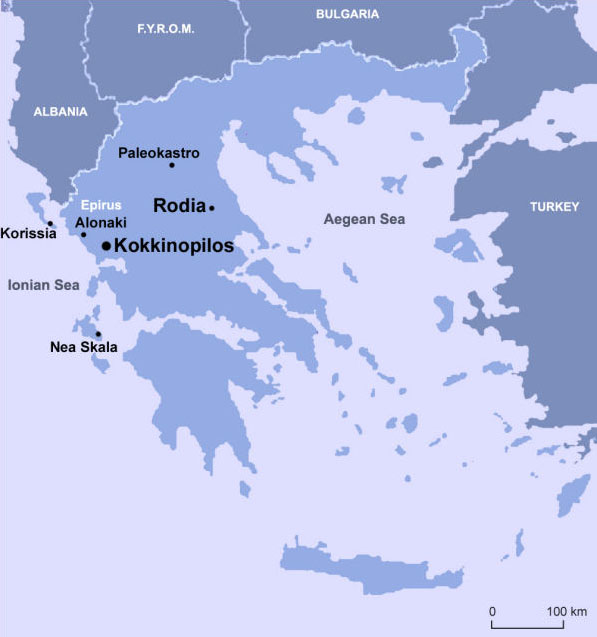
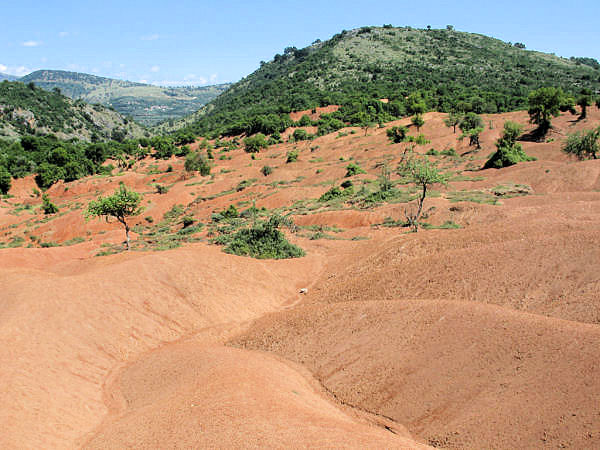
Lower Palaeolithic lithic evidence in Greece, in contrast to the rich evidence from the rest of the Mediterranean, is scarce and mostly consists of surface finds, with relative dates based on inferred archaic morphology and without adequate stratigraphic correlations. For Greece, documentation of stratified lithics is essentially restricted to the sites of Kokkinopilos and Rodia (Figure 1). Kokkinopilos is a site of terra rossa deposits (Figure 2) which have yielded thousands of Middle and Upper Palaeolithic artefacts. Since its discovery by E. Higgs in the 1960s, the site has played a central role in the discussion of the chronological and depositional relationship between artefacts and sediments at all red-bed sites of Epirus (Reference PapagianniPapagianni 2000).
Map of Greece showing published open-air findspots with material assigned to the Lower/Early Palaeolithic.

General view of Kokkinopilos.

Background
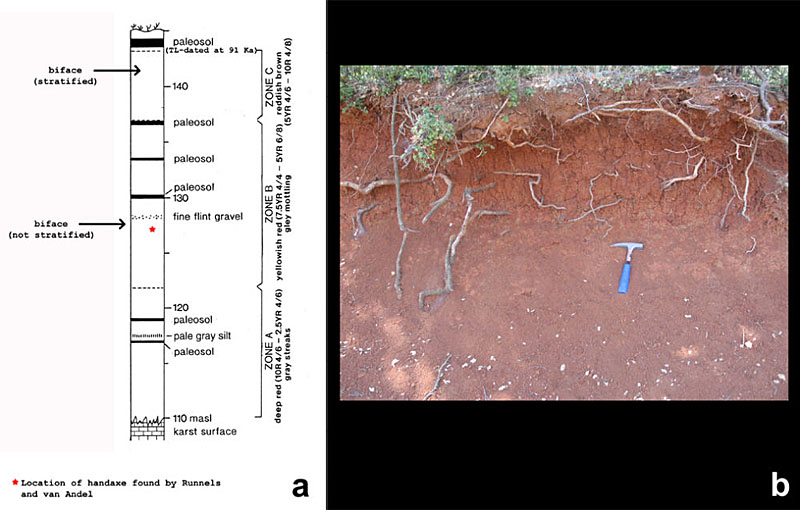
The original division of the stratigraphy into three main zones, A, B and C from bottom to top (Reference DakarisDakaris et al. 1964) has been retained in all subsequent studies (Figure 3a). Higgs and his team argued first for an aeolian (Reference DakarisDakaris et al. 1964) and later for an alluvial origin of the sediments (Reference HiggsHiggs & Vita-Finzi 1966), where in both cases deposition was thought to have taken place within the Last Glacial. They opened two test-trenches in which they identified the presence of 'chipping floors', and similar concentrations of artefacts were observed in thirteen other areas at the site (Reference DakarisDakaris et al. 1964). Bailey and colleagues, however, have argued that sedimentation had ceased by the Middle Pleistocene, thereby deducing that 'none of the flint artefacts recovered from Kokkinopilos can be demonstrated to be geologically in situ' and that 'essentially the same point could be made about the other open-air sites in Epirus' (1992: 142). They claimed that Higgs' team excavated in disturbed sediments, concluding that artefact-discard 'post-dates the accumulation of the sediments by an unknown interval' (ibid).
a) Geological section of Kokkinopilos (modified after Runnels & van Andel 2003: Fig. 3.17). b) Paleosol, TL-dated to c. 91 000 years ago.

In 1991, Runnels and van Andel (1993) discovered a patinated, Micoquian-type Acheulean handaxe, stratified in a horizontal position within non-reworked deposits of zone B (Figure 3a). A paleosol (Figure 3b) that caps the entire sequence was TL-dated to c. 91 000 years (Reference ZhouZhou, van Andel & Lang 2000) and the researchers suggested an age of 150 000-200 000 years for the handaxe. Lithic artefacts 'were noted in the same layer that contained the handaxe' (Reference RunnelsRunnels & van Andel 1993: 192) and at other localities of the site 'perhaps similar to the chipping floors described by Higgs' (Reference RunnelsRunnels & van Andel 2003: 99).
The second biface upon discovery.

New finds from Kokkinopilos
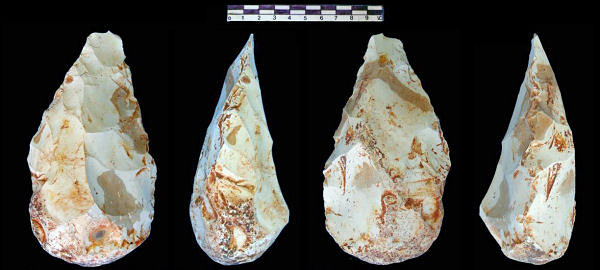
The author visited the site of Kokkinopilos in 2007 in order to evaluate the argumentation of the previous investigators and assess the prospects of finding material in situ. Two bifaces were discovered during these visits. The first was found on the surface of reworked deposits that are assigned to zone B, a few metres from where Runnels and van Andel discovered the Micoquian handaxe. The artefact was lying on sediments that belong to the fill of an erosional gully. The specimen (Figure 5) is a patinated 'amygdaloid à talon' with a cortical base, made on bluish-grey, fine-grained flint.
Biface found on the surface of reworked deposits.

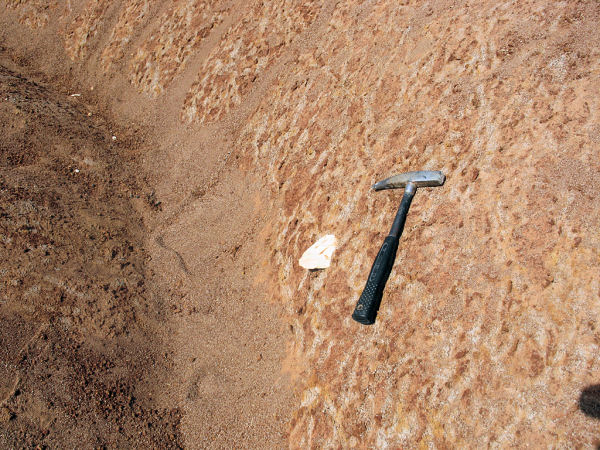
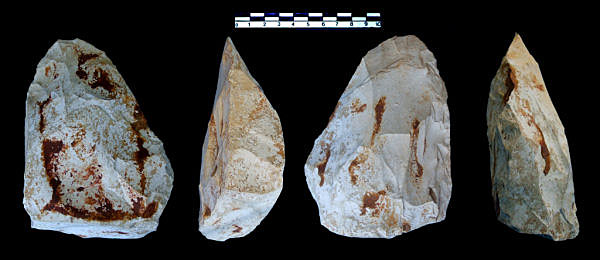
The second biface (Figure 6) was discovered during another visit to the site with the geologist P. Karkanas. The artefact was found lying horizontally, embedded within non-reworked deposits of zone C (Figure 4). It is a thick biface with a cordiform aspect and a partial, flat bifacial retouch. It is patinated but in a fresh condition, with the edges and ridges of flake scars still sharp. Red stains on both surfaces are due to contact with Fe- and Mg-oxides.
Biface found inside undisturbed sediments of zone C.

Discussion
How do these new bifaces contribute to the discussion on the reworked vs. in situ finds from red-bed sites in general and Kokkinopilos in particular? The first biface, associated with reworked sediments, will detain us first. Indeed, the site is a treeless badland dissected by numerous rills and gullies. There are many parts at the site where modern in-fills of reworked deposits are clearly discernible through the loose texture of the sediments, the darker brownish colour and the overall structure of the deposit (e.g. channel and scour fills following the present topography). Considering too that the redbeds are virtually stone-free (apart from the flints), it is important to note that, wherever limestone fragments occur, they are almost always associated with reworked deposits.
Is it then true that none of the artefacts from Kokkinopilos are geologically in situ, as Reference BaileyBailey et al. (1992) argue? The recovery of the second biface from what macroscopically are undisturbed deposits seems to prove otherwise. Preliminary results from the latest survey suggest that undisturbed sediments are present over large - if not most - parts of the site. In accordance with Reference RunnelsRunnels and van Andel (2003), there is ample stratigraphic and sedimentological data pointing to the low-energy depositional environment of an ephemeral lake, which was formed in a tectonic basin (a polje) and was at times drying out entirely. Signs of gleying and mottling attest to sedimentation under wet conditions, whilst paleosols and desiccation surfaces mark depositional breaks and indicate subaerially exposed surfaces upon which artefacts (could) have been discarded. In other words, there are depositional units in stratigraphic order bounded by unconformities and marked by paleosols that may contain geologically in situ archaeological finds.
Conclusions
Preliminary results of recent research at Kokkinopilos suggest that there is a great potential for the recovery of geologically in situ artefacts from undisturbed deposits, such as the biface found embedded in zone C sediments. The dating of the engulfing sediments could furnish an age-estimate for the artefact, and, in extent, constrain the dating of the Micoquian handaxe from zone B uncovered in 1991. A small-scale dating program at the site is planned in collaboration with the Netherlands Center for Luminescence (Dr. J. Wallinga, Delft). Any refinement of the Kokkinopilos chronostratigraphy would have major implications for the interpretation of the red-bed sites in north-western Greece.
Acknowledgements
I am indebted to my PhD supervisors Prof. W. Roebroeks, Dr P. Karkanas, Dr E. Panagopoulou and Prof. C. Runnels for their constant support in my research. Thanks are extended to the director and archaeologists of the 33rd EPCA (Greece) and to my colleagues from the Leiden Human Origins group.