



1 INTRODUCTION
It has long been widely accepted that active galactic nuclei are powered by gravitationally liberated energy from accretion disks around massive black holes (Lynden-Bell Reference Lynden-Bell1969). While the study of accretion is an interesting prospect in itself, the feedback it ensues is significantly consequential for the evolution of galaxies as well (e.g. Di Matteo, Springel, & Hernquist Reference Di Matteo, Springel and Hernquist2005). To truly gauge the effect of feedback requires highly detailed cosmological hydrodynamic simulations that self-consistently track the growth of black holes and the emission from their accretion disks. However, even the most state-of-the-art simulations presently (e.g. Vogelsberger et al. Reference Vogelsberger2014; Schaye et al. Reference Schaye2015) are unable to resolve accretion disks, and must use subresolution models to describe their physics (e.g. Springel, Di Matteo, & Hernquist Reference Springel, Di Matteo and Hernquist2005; Booth & Schaye Reference Booth and Schaye2009), in a similar vein to semi-analytic models (e.g. Croton et al. Reference Croton2006; Benson Reference Benson2012). An analytic understanding of the functioning of accretion disks is hence key for this cause.
In the simple picture of a thin accretion disk, particles quasi-statically shrink on equatorial, circular orbits, where pressure forces are assumed negligible, until they reach the orbit of lowest energy, after which they are assumed to be captured by the black hole (Lynden-Bell Reference Lynden-Bell1969; Bardeen Reference Bardeen1970). In doing so, those particles must be liberated of their angular momentum. Either angular momentum is lost through the disk out to higher radii, or it is emitted vertically and removed from the disk entirely. The latter occurs naturally through thermal emission of the disk and through scattering of photons if the disk is subject to irradiation from an external source. It is of interest then to assess the contribution of angular-momentum liberation that photons provide in order to better understand the process of accretion itself. This paper aims to calculate exactly this, using purely general relativistic arguments.
In Section 2 of this paper, relevant mathematical formulae for studying accretion disks are outlined. General relativistic calculations are performed based on these formulae in Section 3, where limiting cases for the liberation of angular momentum via photons, as well as from the standard Novikov & Thorne (Reference Novikov, Thorne, DeWitt and DeWitt1973) disk, are considered. Concluding remarks are provided in Section 4.
2 MATHEMATICAL FORMALISMS AND BACKGROUND
The unique metric for space-time around a (non-charged) rotating source mass (e.g. a black hole) was first discovered by Kerr (Reference Kerr1963), usually now written in Boyer–Linquist coordinates (Boyer & Lindquist Reference Boyer and Lindquist1967), for which the invariant interval is
 \begin{eqnarray}
-c^2 \mathrm{d} \tau ^2 &=& -\left( 1 - \frac{r_s r}{\rho } \right) c^2 \mathrm{d} t^2 + \frac{\rho }{\Delta } \mathrm{d} r^2 + \rho \ \mathrm{d} \theta ^2 \nonumber\\
&& +\left( r^2 + a^2 + \frac{r_s r a^2 \sin ^2(\theta )}{\rho } \right) \sin ^2(\theta )\ \mathrm{d} \phi ^2 \nonumber\\
&& - \frac{2 r_s r a^2 \sin ^2(\theta )}{\rho }\ c\ \mathrm{d} t\ \mathrm{d}\phi ;
\end{eqnarray}
\begin{eqnarray}
-c^2 \mathrm{d} \tau ^2 &=& -\left( 1 - \frac{r_s r}{\rho } \right) c^2 \mathrm{d} t^2 + \frac{\rho }{\Delta } \mathrm{d} r^2 + \rho \ \mathrm{d} \theta ^2 \nonumber\\
&& +\left( r^2 + a^2 + \frac{r_s r a^2 \sin ^2(\theta )}{\rho } \right) \sin ^2(\theta )\ \mathrm{d} \phi ^2 \nonumber\\
&& - \frac{2 r_s r a^2 \sin ^2(\theta )}{\rho }\ c\ \mathrm{d} t\ \mathrm{d}\phi ;
\end{eqnarray}
 \begin{equation}
\rho \equiv r^2 + a^2 \cos ^2(\theta ),\ \ \ \Delta \equiv r^2 - r_s r + a^2,
\end{equation}
\begin{equation}
\rho \equiv r^2 + a^2 \cos ^2(\theta ),\ \ \ \Delta \equiv r^2 - r_s r + a^2,
\end{equation}
where c is the speed of light, rs ≡ 2GM/c 2 is the Schwarzschild radius, and a ≡ J/Mc is the spin parameter (specific angular momentum) of the source of mass M and angular momentum J. The metric is stationary, axisymmetric, and, as Carter (Reference Carter1968) showed (but see also Misner, Thorne, & Wheeler Reference Misner, Thorne and Wheeler1973, Section 33.5), exhibits four constants of motion.Footnote 1 Two of these constants are the azimuthal and time components of covariant four-momentum. Taking the limit r → ∞, one finds these to be relativistic analogues of energy and azimuthal angular momentum, usually referred to as the energy and angular momentum ‘at infinity’. Often the ‘at infinity’ is dropped for brevity, and the usual symbols for these quantities are used, i.e.
 \begin{equation}
E \equiv -p_t,\ \ \ L_z \equiv p_{\phi } \ .
\end{equation}
\begin{equation}
E \equiv -p_t,\ \ \ L_z \equiv p_{\phi } \ .
\end{equation}
When discussing the emission or transport of energy or angular momentum in accretion disks (or Kerr geometry in general), these are the quantities that are meant.
Throughout the rest of this paper, most quantities will be expressed in a dimensionless form, represented by a bar placed on the quantity of interest. For quantities with dimensions of distance, this means normalising to half the Schwarzschild radius, e.g.  $\bar{r} \equiv 2r/r_s$, $\bar{a} \equiv 2a/r_s$, in line with literature convention. Equation (3) covers quantities with other dimensions.
By analysing equations of motion for particles in a Kerr space-time, Bardeen, Press, & Teukolsky (Reference Bardeen, Press and Teukolsky1972) obtained expressions for the energy and specific angular momentum for circular (i.e. pr = 0), equatorial (i.e. θ = π/2 and p θ = 0), Keplerian (i.e. gravity is entirely centrifugally balanced) orbits:
 \begin{equation}
\bar{E} \equiv \frac{E}{mc^2} = \frac{\bar{r}^{3/2} - 2\bar{r}^{1/2} \pm \bar{a}}{\bar{r}^{3/4} \left( \bar{r}^{3/2} - 3 \bar{r}^{1/2} \pm 2\bar{a} \right)^{1/2}},
\end{equation}
\begin{equation}
\bar{E} \equiv \frac{E}{mc^2} = \frac{\bar{r}^{3/2} - 2\bar{r}^{1/2} \pm \bar{a}}{\bar{r}^{3/4} \left( \bar{r}^{3/2} - 3 \bar{r}^{1/2} \pm 2\bar{a} \right)^{1/2}},
\end{equation}
 \begin{equation}
\bar{L}_z \equiv \frac{L_z}{mcr_s} = \frac{\pm \bar{r}^2 - 2\bar{a}\bar{r}^{1/2} \pm \bar{a}^2}{2\bar{r}^{3/4} \left( \bar{r}^{3/2} - 3\bar{r}^{1/2} \pm 2\bar{a} \right)^{1/2}},
\end{equation}
\begin{equation}
\bar{L}_z \equiv \frac{L_z}{mcr_s} = \frac{\pm \bar{r}^2 - 2\bar{a}\bar{r}^{1/2} \pm \bar{a}^2}{2\bar{r}^{3/4} \left( \bar{r}^{3/2} - 3\bar{r}^{1/2} \pm 2\bar{a} \right)^{1/2}},
\end{equation}
where upper signs are for prograde orbits and lower signs retrograde. Note that m represents the rest mass of a particle (at infinity), not its inertial mass. By checking the derivatives of these quantities,
 \begin{equation}
\frac{\mathrm{d} \bar{E}}{\mathrm{d} \bar{r}} = \frac{8\bar{a} \bar{r}^{1/2} - 3\bar{a}^2 + \bar{r}(\bar{r}-6)}{W},
\end{equation}
\begin{equation}
\frac{\mathrm{d} \bar{E}}{\mathrm{d} \bar{r}} = \frac{8\bar{a} \bar{r}^{1/2} - 3\bar{a}^2 + \bar{r}(\bar{r}-6)}{W},
\end{equation}
 \begin{eqnarray}
\frac{\mathrm{d} \bar{L}_z}{\mathrm{d} \bar{r}} &=& W^{-1} \Bigg \lbrace \bar{a}^2 \bar{r}^{1/2} \left(4-\frac{3}{2}\bar{r}\right) + \bar{r}^{5/2}\left(\frac{1}{2}\bar{r}-3\right)\nonumber \\
&& - 3\left[\frac{1}{2}\bar{a}^3 - \bar{a}\bar{r}\left(\frac{3}{2}\bar{r}-1\right)\right] \Bigg \rbrace ;
\end{eqnarray}
\begin{eqnarray}
\frac{\mathrm{d} \bar{L}_z}{\mathrm{d} \bar{r}} &=& W^{-1} \Bigg \lbrace \bar{a}^2 \bar{r}^{1/2} \left(4-\frac{3}{2}\bar{r}\right) + \bar{r}^{5/2}\left(\frac{1}{2}\bar{r}-3\right)\nonumber \\
&& - 3\left[\frac{1}{2}\bar{a}^3 - \bar{a}\bar{r}\left(\frac{3}{2}\bar{r}-1\right)\right] \Bigg \rbrace ;
\end{eqnarray}
 \begin{equation}
W \equiv 2 \bar{r}^{7/4} \left[2\bar{a} + \bar{r}^{1/2} (\bar{r}-3) \right]^{3/2},
\end{equation}
\begin{equation}
W \equiv 2 \bar{r}^{7/4} \left[2\bar{a} + \bar{r}^{1/2} (\bar{r}-3) \right]^{3/2},
\end{equation}
one finds these two relations share a common minimum, referred to in the literature as the innermost stable circular orbit (ISCO), where  $\bar{r}_{\rm ISCO}$ is given by Equation (2.21) of Bardeen et al. (Reference Bardeen, Press and Teukolsky1972).Footnote 2
Under the picture where particles transit between infinitesimally adjacent orbits in the process of accretion (until they reach the ISCO), the above equations provide the starting point for calculating how much specific angular momentum can be lost from photon emission and/or scattering. Hereafter, the use of E and Lz (with or without bars, but without further subscripts) refers to the orbiting states for which Equations (3)–(4) apply.
3 RADIATING AND SCATTERING AWAY ANGULAR MOMENTUM
In each of the following subsections, the relative specific-angular-momentum loss to photons in an accretion disk,  $-\mathrm{d} \bar{L}_{z, \gamma } / \mathrm{d} \bar{L}_z$ (where subscript γ is for photons), as a function of radius, is calculated for a different idealised situation, where each builds on the last. Each result is plotted in Figure 1 for r ⩾ r ISCO, allowing for comparisons between each individual case. The models considered here are all of thin, relativistic accretion disks, whereby the mathematics of Section 2 is applicable.
(Specific) angular momentum lost to photons relative to the (specific-)angular-momentum gap between adjacent, equatorial, circular orbits in a relativistic accretion disk as a function of radius. Thick curves apply for an accretion disk around a non-spinning black hole, while thin curves are for a hole spinning with  $\bar{a} = 0.998$ (the maximum of Thorne Reference Thorne1974). The dot-dashed curves assume photons are emitted with energy equal to the difference of the orbits and are angled to the accretion disk plane such that the ϕ-velocity of the photons matches that of the disk itself (see Section 3.1). The solid curves follow the solution of Novikov & Thorne (Reference Novikov, Thorne, DeWitt and DeWitt1973), which include effects of internal torques (outlined further in Section 3.2). The dashed curves also account for internal torques, and show the upper limit of scattering, where the momentum imparted on photons is parallel to the ϕ-direction (Section 3.3).

3.1 Pure, relatively isotropic emission
Before considering consequences for other forms of energy transport, the energy carried away by a photon supplied by a particle moving to an adjacent lower-energy circular orbit should, at most, be the energy difference between the orbits. This can be written in terms of differentials as
 \begin{equation}
\mathrm{d} E_{\gamma } = -\mathrm{d} E\ .
\end{equation}
\begin{equation}
\mathrm{d} E_{\gamma } = -\mathrm{d} E\ .
\end{equation}
If this energy is lost primarily through radiation, one expects each photon to be emitted with statistical isotropy from the frame of the emitting particle. For a non-rotating disk, this would make the average direction of emission from each face of the disk vertical (i.e. initially completely in the ± θ-direction). For a rotating disk perceived from an external frame (i.e. one static with the Boyer–Lindquist coordinates), this can then be modelled by stating that photons are emitted in the ϕ–θ ‘plane’ with a three-velocity in the ϕ-direction equivalent to that of the disk, naturally a function of radius. This (angular) velocity is found as 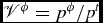 $\mathscr {V}^{\phi } = p^{\phi } / p^t$. Recognising pt = −gttE + g tϕLz and p ϕ = −g tϕE + g ϕϕLz (cf. Equations (1) and (2)), obtaining the contravariant metric components by taking the matrix inverse of Equation (1), and expanding and simplifying with Equation (3), one concludes consistently with Bardeen et al. (Reference Bardeen, Press and Teukolsky1972) that
 \begin{equation}
\frac{p^{\phi }}{p^t} = \frac{\pm (2r_s)^{1/2}c}{2r^{3/2} \pm (2r_s)^{1/2} a}\ .
\end{equation}
\begin{equation}
\frac{p^{\phi }}{p^t} = \frac{\pm (2r_s)^{1/2}c}{2r^{3/2} \pm (2r_s)^{1/2} a}\ .
\end{equation}
Let us write the (contravariant) four-momentum components of an emitted photon as dp μ. One can then simultaneously solve
 \begin{equation}
g_{tt} \mathrm{d} p^t + g_{t\phi } \mathrm{d} p^{\phi } = -\mathrm{d} E_{\gamma }
\end{equation}
\begin{equation}
g_{tt} \mathrm{d} p^t + g_{t\phi } \mathrm{d} p^{\phi } = -\mathrm{d} E_{\gamma }
\end{equation}
and Equation (6) (for the latter, the left-hand side now reads dp ϕ/dpt) to obtain explicit functions for dpt and dp ϕ. Further calculating dp ϕ = dL z, γ, one obtains
 \begin{equation}
\frac{\mathrm{d} \bar{L}_{z, \gamma }}{\mathrm{d} \bar{E}_{\gamma }} = \frac{\bar{L}_z}{\bar{E}} = \frac{\pm \bar{r}^2 - 2\bar{a}\bar{r}^{1/2} \pm \bar{a}^2 }{2\left(\bar{r}^{3/2} - 2\bar{r}^{1/2} \pm \bar{a}\right)},
\end{equation}
\begin{equation}
\frac{\mathrm{d} \bar{L}_{z, \gamma }}{\mathrm{d} \bar{E}_{\gamma }} = \frac{\bar{L}_z}{\bar{E}} = \frac{\pm \bar{r}^2 - 2\bar{a}\bar{r}^{1/2} \pm \bar{a}^2 }{2\left(\bar{r}^{3/2} - 2\bar{r}^{1/2} \pm \bar{a}\right)},
\end{equation}
consistent with the report of Lynden-Bell (Reference Lynden-Bell, Carter and Hartle1986, Section 3.10). Now through Equation (5), combined with use of Equation (4), one finds an explicit form of  $-\mathrm{d} \bar{L}_{z, \gamma } / \mathrm{d} \bar{L}_z$, as presented by the dot-dashed lines in Figure 1. For non-spinning black holes, the analytic relation simplifies to
 \begin{equation}
\frac{\mathrm{d} \bar{L}_{z, \gamma }}{\mathrm{d} \bar{L}_z} (\bar{a}=0) = \frac{1}{\bar{r}-2},
\end{equation}
\begin{equation}
\frac{\mathrm{d} \bar{L}_{z, \gamma }}{\mathrm{d} \bar{L}_z} (\bar{a}=0) = \frac{1}{\bar{r}-2},
\end{equation}
which further reduces to the Newtonian case presented by Johnson (Reference Johnson2011) for r ≫ rs.
Under this picture, one finds that specific-angular-momentum removal by photons is important beyond the percent level out to ~ 50rs. For non-spinning holes, as particles approach the ISCO, the radiative efficiency of angular momentum approaches 25%, while the efficiency approaches 87% for maximally spinning black holes. Already from this analysis, it is clear, and perhaps unsurprising, that radiation is insufficient by itself to liberate an accretion disk of its necessary specific angular momentum.
3.2 Relatively isotropic emission with internal angular-momentum transport
The previous subsection considered a limiting role of photons without any additional form of angular-momentum transport. Because photons are unable to remove all the necessary angular momentum if they remove all the necessary energy, some other mechanism must remove angular momentum, which consequently must alter the energy liberated by photons too.
The standard model of thin accretion disks proposed by Shakura & Sunyaev (Reference Shakura and Sunyaev1973), and extended to be relativistic by Novikov & Thorne (Reference Novikov, Thorne, DeWitt and DeWitt1973), considers angular momentum to be transported radially through internal torques (generated by magnetically induced ‘viscosity’ – see Lynden-Bell Reference Lynden-Bell1969; Shakura & Sunyaev Reference Shakura and Sunyaev1973; Lin, Liu, & Xiaoqing Reference Lin, Liu and Xiaoqing2013), in addition to removal from photons, in an accretion disk whose structure is completely stable (i.e. not a function of time). If  $\mathrm{d} \bar{L}_{z, \mathrm{int}} / \mathrm{d} \bar{r}$ represents the radial net removal of specific angular momentum from internal torques during a particle transition to an infinitesimally adjacent orbit, then it must hold that
 \begin{equation}
\frac{\mathrm{d} \bar{L}_z}{\mathrm{d} \bar{r}} + \frac{\mathrm{d} \bar{L}_{z, \mathrm{int}}}{\mathrm{d} \bar{r}} + \frac{\mathrm{d} \bar{L}_{z, \gamma }}{\mathrm{d} \bar{r}} = 0\ .
\end{equation}
\begin{equation}
\frac{\mathrm{d} \bar{L}_z}{\mathrm{d} \bar{r}} + \frac{\mathrm{d} \bar{L}_{z, \mathrm{int}}}{\mathrm{d} \bar{r}} + \frac{\mathrm{d} \bar{L}_{z, \gamma }}{\mathrm{d} \bar{r}} = 0\ .
\end{equation}
With some small rearranging, the solution derived purely from the continuity equations of rest mass, angular momentum, and energy by Novikov & Thorne (Reference Novikov, Thorne, DeWitt and DeWitt1973) provides
 \begin{equation}
\frac{\mathrm{d} \bar{L}_{z, \mathrm{int}}}{\mathrm{d} \bar{r}} = - \frac{1}{2} \frac{\mathrm{d}}{\mathrm{d} \bar{r}} \left( \sqrt{\bar{r}} {\mathscr Q} \right),
\end{equation}
\begin{equation}
\frac{\mathrm{d} \bar{L}_{z, \mathrm{int}}}{\mathrm{d} \bar{r}} = - \frac{1}{2} \frac{\mathrm{d}}{\mathrm{d} \bar{r}} \left( \sqrt{\bar{r}} {\mathscr Q} \right),
\end{equation}
 \begin{equation}
\frac{\mathrm{d} \bar{L}_{z, \gamma }}{\mathrm{d} \bar{r}} = - \frac{3}{2} \frac{\bar{L}_z}{\bar{r}^2} \frac{{\mathscr Q}}{{\mathscr B}\sqrt{{\mathscr C}}},
\end{equation}
\begin{equation}
\frac{\mathrm{d} \bar{L}_{z, \gamma }}{\mathrm{d} \bar{r}} = - \frac{3}{2} \frac{\bar{L}_z}{\bar{r}^2} \frac{{\mathscr Q}}{{\mathscr B}\sqrt{{\mathscr C}}},
\end{equation}
where  ${\mathscr Q}$, ${\mathscr B}$, and ${\mathscr C}$ are dimensionless quantities that approach unity for increasing r: the reader is referred to Equation (5.4.1) of Novikov & Thorne (Reference Novikov, Thorne, DeWitt and DeWitt1973) for their formal definitions.Footnote 3
As for the previous subsection,  $-\mathrm{d} \bar{L}_{z, \gamma } / \mathrm{d} \bar{L}_z$ is presented for the Novikov & Thorne (Reference Novikov, Thorne, DeWitt and DeWitt1973) model in Figure 1 as solid lines. For non-spinning black holes, the liberation of angular momentum from photons at low radii is noticeably less effective than the previous limiting case. Faster spinning holes reach a peak efficiency of radiative angular-momentum removal of nearly 40%.
Naïvely, one may have expected the solid lines in Figure 1 to lie underneath the dot-dashed lines (i.e. the result of Section 3.1), because a new mode of angular-momentum transport has been introduced since Section 3.1. However, as noted by Shakura & Sunyaev (Reference Shakura and Sunyaev1973), internal angular-momentum transport provides a net energy source for r ≫ r ISCO, meaning more angular momentum must be liberated by photons, specifically by a factor of 3. This is reconcilable by considering an energy outflow balance equation (i.e. an energy version of Equation (10)),
 \begin{equation}
\frac{\mathrm{d} \bar{E}}{\mathrm{d} \bar{r}} + \frac{\mathrm{d} \bar{E}_{\mathrm{int}}}{\mathrm{d} \bar{r}} + \frac{\mathrm{d} \bar{E}_{\gamma }}{\mathrm{d} \bar{r}} = 0\ .
\end{equation}
\begin{equation}
\frac{\mathrm{d} \bar{E}}{\mathrm{d} \bar{r}} + \frac{\mathrm{d} \bar{E}_{\mathrm{int}}}{\mathrm{d} \bar{r}} + \frac{\mathrm{d} \bar{E}_{\gamma }}{\mathrm{d} \bar{r}} = 0\ .
\end{equation}
Using a combination of Equations (4a), (8), and (11b), one can determine  $-\mathrm{d} \bar{E}_{\gamma } / \mathrm{d} \bar{E}$ to show that indeed this asymptotes to a value of 3. This is plotted in Figure 2 (solid curves). When interpreting Figure 2, one should appreciate that the absolute energy gap between adjacent orbits tends to zero as $\bar{r} \rightarrow \infty$, and that thin disks have higher densities toward their centres.
Relative energy scattered away or emitted through photons between infinitesimally adjacent orbits for a Novikov & Thorne (Reference Novikov, Thorne, DeWitt and DeWitt1973) accretion disk (solid curves, Section 3.2) and a maximally scattering-dominant disk with internal angular-momentum transport (dashed curves, Section 3.3) around non-spinning (thick curves) and maximally spinning (thin curves) black holes. Where the curves pass above a value of 1 (dot-dashed line), extra energy is radiated away, transferred internally within the disk. The dotted line indicates an asymptote; at large radii, a massive particle in the disk emits a photon with thrice the necessary energy to reach its adjacent lower orbit to account for energy supplied by internal transport.
3.3 Scattering with internal angular-momentum transport
If an accretion disk is irradiated by an external source, incoming photons can be absorbed or scattered, causing particles in the disk to lose angular momentum, à la the Poynting–Robertson effect (Poynting Reference Poynting1904; Robertson Reference Robertson1937; Burns, Lamy, & Soter Reference Burns, Lamy and Soter1979). In the absorption case, where the motive absorbing particles re-emit the radiation, the analysis of Section 3.2 remains sound. However, it could also transpire that charged particles in the disk anisotropically transfer their energy to the incoming photons via inverse Compton scattering.
An external irradiative source is observationally motivated by X-ray reflection spectra generated by an accretion disk’s corona, which provide a means for measuring black holes’ spins (for a review, see Reynolds Reference Reynolds2014). At very high redshift, the cosmic background radiation could also provide an irradiative source (e.g. Fukue & Umemura Reference Fukue and Umemura1994; Mineshige, Tsuribe, & Umemura Reference Mineshige, Tsuribe and Umemura1998), although far more modest in temperature. For fast-spinning holes, a notable portion of emitted radiation from accretion disks is expected to fall back on the disks as well (Cunningham Reference Cunningham1976). So long as the Thomson regime is applicable in the scattering particle’s reference frame, the scattered photon can have its energy significantly multiplied and be beamed in the direction of the scatterer’s motion as perceived by an external observer (see Rybicki & Lightman Reference Rybicki and Lightman1979, Section 7.1). While the precise direction of the photon’s change of momentum would depend on its initial energy relative to the scattering particle, one can consider the extreme upper limit where this is the ϕ-direction, as shown immediately below.
Let us now write the four-momentum components of that imparted on the scattered photon as dp μ [it is very important to note that this is the change in photon’s momentum from scattering; when considering radiation, this was the momentum of the (average) photon itself, as it did not exist prior (i.e. it had no initial momentum)]. Because photons have no rest mass, it must hold that g μνdp μdp ν = 0, where the g μν terms are the metric components obtainable from Equation (1), hence
 \begin{equation}
g_{tt}(\mathrm{d} p^t)^2 + 2g_{t\phi } \mathrm{d} p^t \mathrm{d} p^{\phi } + g_{\phi \phi }(\mathrm{d} p^{\phi })^2 = 0\ .
\end{equation}
\begin{equation}
g_{tt}(\mathrm{d} p^t)^2 + 2g_{t\phi } \mathrm{d} p^t \mathrm{d} p^{\phi } + g_{\phi \phi }(\mathrm{d} p^{\phi })^2 = 0\ .
\end{equation}
Simultaneously solving Equations (7) and (13), recognising dL z, γ = dp ϕ = g tϕdpt + g ϕϕdp ϕ in this maximal limit (cf. Equation (2)), and using Equation (5), one obtains
 \begin{equation}
\frac{\mathrm{d} \bar{L}_{z, \gamma }}{\mathrm{d} \bar{E}_{\gamma }} = -\frac{\mathrm{d} \bar{L}_{z, \gamma }}{\mathrm{d} \bar{E}} = \frac{\pm \bar{r} \sqrt{\bar{a}^2 + \bar{r}^2 - 2\bar{r}} - 2\bar{a}}{2\bar{r} - 4}\ .
\end{equation}
\begin{equation}
\frac{\mathrm{d} \bar{L}_{z, \gamma }}{\mathrm{d} \bar{E}_{\gamma }} = -\frac{\mathrm{d} \bar{L}_{z, \gamma }}{\mathrm{d} \bar{E}} = \frac{\pm \bar{r} \sqrt{\bar{a}^2 + \bar{r}^2 - 2\bar{r}} - 2\bar{a}}{2\bar{r} - 4}\ .
\end{equation}
One can consider taking the same energy lost to photons from Section 3.2 but instead using it to kick (scatter) photons in the ϕ-direction. The relative increase in specific-angular-momentum loss can then be found by taking the ratio of Equations (14)–(8). However, by increasing  $\mathrm{d} \bar{L}_{z, \gamma }/ \mathrm{d} \bar{r}$, it must be true that $\mathrm{d} \bar{L}_{z, \mathrm{int}} / \mathrm{d} \bar{r}$ decreases, in order to satisfy conservation of angular momentum (Equation (10)). If $\mathrm{d} \bar{L}_{z, \mathrm{int}} / \mathrm{d} \bar{r}$ decreases, then so must $\mathrm{d} \bar{E}_{\mathrm{int}} / \mathrm{d} \bar{r}$ by an amount found by taking the ratio of Equations (10)–(12) after making the internal-torque terms the arguments for each
 \begin{equation}
\frac{\mathrm{d} \bar{L}_{z, \mathrm{int}}}{\mathrm{d} \bar{E}_{\mathrm{int}}} = \frac{\mathrm{d} \bar{L}_z / \mathrm{d} \bar{r} + (\mathrm{d} \bar{L}_{z, \gamma } / \mathrm{d} \bar{r})_{3.2}}{\mathrm{d} \bar{E} / \mathrm{d} \bar{r} + (\mathrm{d} \bar{E}_{\gamma } / \mathrm{d} \bar{r})_{3.2}},
\end{equation}
\begin{equation}
\frac{\mathrm{d} \bar{L}_{z, \mathrm{int}}}{\mathrm{d} \bar{E}_{\mathrm{int}}} = \frac{\mathrm{d} \bar{L}_z / \mathrm{d} \bar{r} + (\mathrm{d} \bar{L}_{z, \gamma } / \mathrm{d} \bar{r})_{3.2}}{\mathrm{d} \bar{E} / \mathrm{d} \bar{r} + (\mathrm{d} \bar{E}_{\gamma } / \mathrm{d} \bar{r})_{3.2}},
\end{equation}
where subscript 3.2 implies the quantities as determined from Section 3.2. Consequently,  $\mathrm{d} \bar{E}_{\gamma } / \mathrm{d} \bar{r}$ must increase from energy conservation (Equation (12)), and therefore $\mathrm{d} \bar{L}_{z, \gamma }/ \mathrm{d} \bar{r}$ must be higher than initially calculated. One can iteratively work through these calculations until finding a converged result.Footnote 4
Using the above method, one can calculate the maximum  $-\mathrm{d} \bar{L}_{z, \gamma } / \mathrm{d} \bar{L}_z$ for photon scattering with the effects of internal transport included. This is shown by the dashed lines in Figure 1. Consistent with the above results, under this maximal regime, accretion disks can remain efficient above the percent level for $-\mathrm{d} \bar{L}_{z, \gamma } / \mathrm{d} \bar{L}_z$ beyond 104rs.
As was the case for the standard Novikov & Thorne (Reference Novikov, Thorne, DeWitt and DeWitt1973) disk,  $-\mathrm{d} \bar{E}_{\gamma } / \mathrm{d} \bar{E}$ asymptotically approaches a value of 3 for increasing radii, but does so more slowly. It also exceeds a value of 1 at the same radius, as displayed by the dashed curves in Figure 2.
It should again be stressed that the calculations in this subsection are an upper limit. In truth, one should expect the relevant curve on Figure 1 to lie between the solid and dashed ones presented, with a bias towards the former.
4 CONCLUSION
As material accretes onto massive black holes, there must be a process by which specific angular momentum is removed from the system. As accretion disks are known to be bright sources of radiation, the emission of photons provides one channel for this angular-momentum loss. If a disk is irradiated, inverse Compton scattering provides another channel. This paper has provided calculations of the contribution of angular-momentum liberation through photons in thin, relativistic accretion disks. In addtion to situations where transport by internal torques was included, such that the usual conservation laws of physics were satisfied, these calculations included limiting situations where photon emission was responsible for all the necessary energy removal and where photon scattering was angled to remove maximal angular momentum.
On scales up to the order of a hundred Schwarzschild radii, photons remove a small ( > 1) percentage of angular momentum in accretion disks that emit in an expected fashion, but beyond this contribute negligibly. At the absolute most, disks subject to strong irradiation are potentially capable of scattering away angular momentum as efficiently out two orders of magntiude farther from the black hole. The contribution in both cases becomes stronger near the horizon of a fast rotating black hole, especially in the latter case ( ≲ 60%, cf. thin dashed line, Figure 1). By and large though, angular momentum is transported far more efficiently through the disk internally, rather than liberated from the disk electromagnetically.
ACKNOWLEDGEMENTS
Thanks must go to Donald Lynden-Bell, Mitch Begelman, and especially the anonymous referee for their constructive thoughts on this manuscript, which inevitably lead to improvement of its content. Thanks also to Darren Croton for his continued academic support during the publishing of this paper.



