

Introduction
A recently revised chronology for the Upper Danube region confirms previous suggestions that the Danube corridor played an important role as one of the main axis for the dispersal of Homo sapiens (henceforth Anatomically Modern Humans or AMH) and their assumed association with material remains of Protoaurignacian and Aurignacian provenance (Reference ConardConard & Bolus 2003), pushing its start in central Europe to c. 42 500 cal BP (Reference HighamHigham et al. 2012).
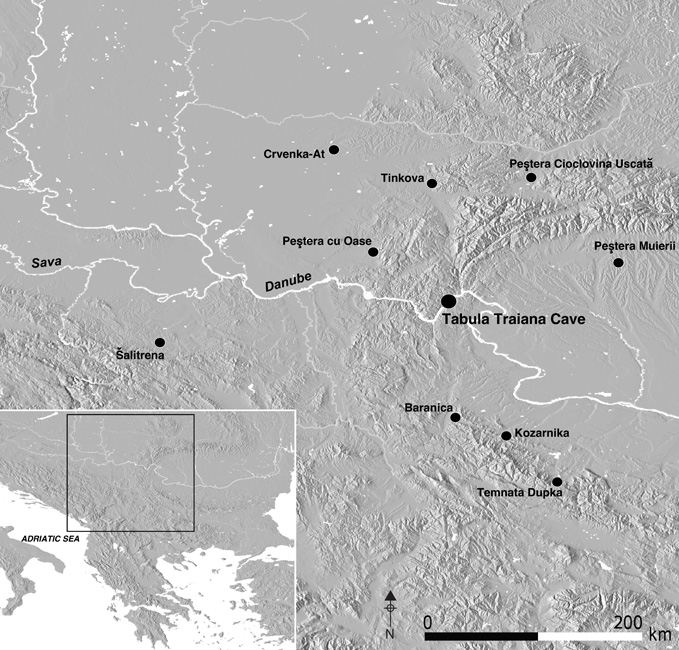
The picture of the Palaeolithic in the Balkan peninsula still remains coarse-grained. And yet this part of Europe must have represented a key land route for the spread of hominin populations from northern Africa and southwest Asia at different periods in the course of early prehistory. In recent years, this assumption was most directly confirmed by the discovery of AMH cranio-dental remains representing two individuals found in the cave of Peştera cu Oase on the Romanian (left) side of the Danube, in the hinterland of the Danube Gorges in the Carpathian Mountains (Figure 1). A direct AMS date on the Oase 1 mandible indicates a range of 42 49038 410 cal BP at 95 per cent confidence (Zilhão et al. 2007). These remains can still be considered as the earliest directly-dated AMH fossils in Europe. Yet they were not associated with occupation deposits and their cultural attribution is not possible.
Location map of Tabula Traiana Cave and other sites AMS-dated to or attributed to the Aurignacian in the Middle Danube region.

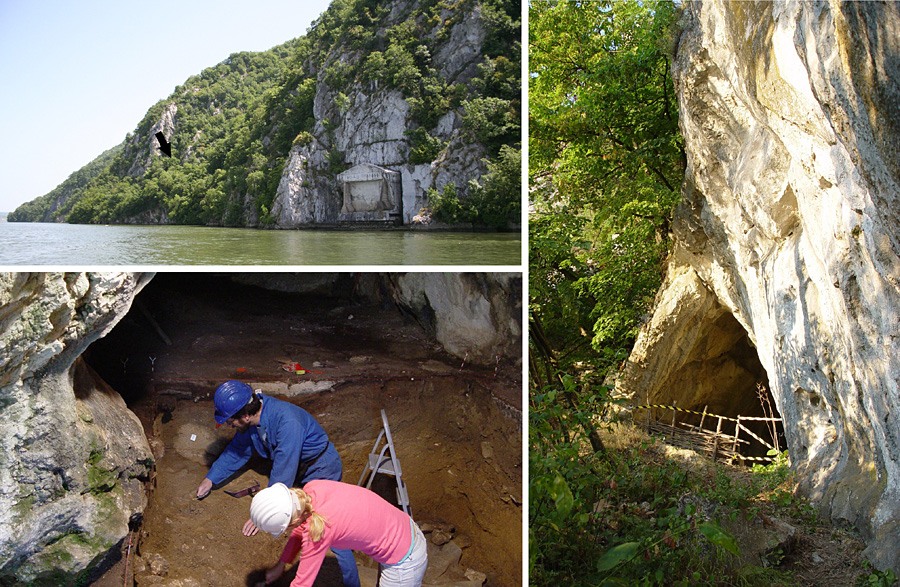
Location of Tabula Traiana Cave on the steep side of the river valley karst in the vicinity of the Roman plaque Tabula Traiana; Lower left: excavations in 2008.

Tabula Traiana Cave and its stratigraphy
Until recently, Initial/Early Upper Palaeolithic occupation of the Danube Gorges region remained unknown (cf. Reference BalteanBaltean 2011; Mihailović et al. 2011). The new discoveries from Tabula Traiana Cave (Figure 1) change the picture and provide the first well-dated occupation deposits in this region that can be associated with the broadly contemporaneous AMH fossils of Peştera cu Oase (the distance between the two sites is 55km as the crow flies).
The Danube Gorges area of the north-central Balkans is characterised by karstic features, with numerous caves and rockshelters. Here the Danube cuts through the southern fringes of the Carpathian Mountains creating a dramatic landscape with cataracts and rapids, and exposing strata of different geological ages. Due to the significant contribution of limestone rocks in the geological formation of the region's landscape and dense hydrographic network, the wider region of the Danube Gorges hinterlands is characterised by numerous surface and subterranean karstic phenomena (cf. Reference ConstantinConstantin et al. 2001), such as sinkholes and caves with horizontal and/or vertical orientations of their channels.
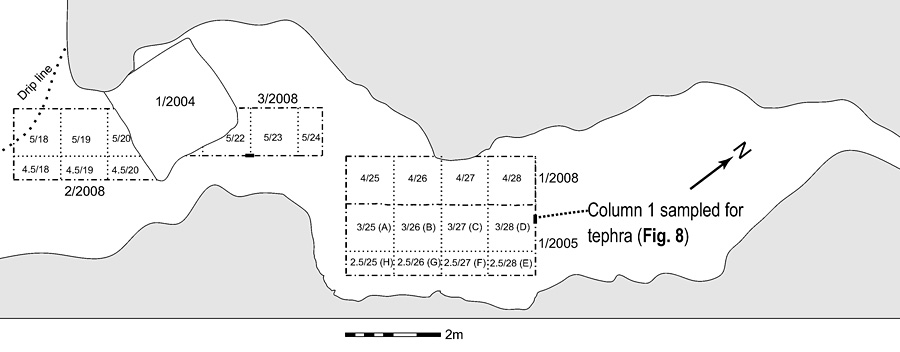
Tabula Traiana Cave was discovered in 2004 in the course of a survey within the Prehistory of north-east Serbia collaborative British-Serbian project. This rather small cave, around 25m long, with one upper gallery, is oriented south-west and located at 9091m asl on the side of the Golo Brdo karst facing the Danube, on its right bank. It is only some 20m above the present level of the Danube and the Tabula Traiana (Roman memorial plaque of AD 101) is nearby (Figure 2). Excavations conducted in the cave in 20042005 and 20082009 (Figure 3) revealed Late Pleistocene deposits beneath a 10cm-thick layer associated with Iron Age pottery. To-date excavated Pleistocene deposits consist of two discernable geological horizons:
-
1. a younger Layer 207/217 at the entrance and in the interior of the cave consisting of a 2063cm thick greyish brown calcareous silt with fine (<2cm), sub-rounded to sub-angular karst fragments
-
2. an older Layer 206/209 beneath the humus on the cave terrace and beneath Layer 207/217 in the cave interior. This is yellowish brown calcareous silt with fine rock fragments (<2cm), covering large stone blocks from a roof fall.
Excavated areas in Tabula Traiana Cave.

Material culture and dating
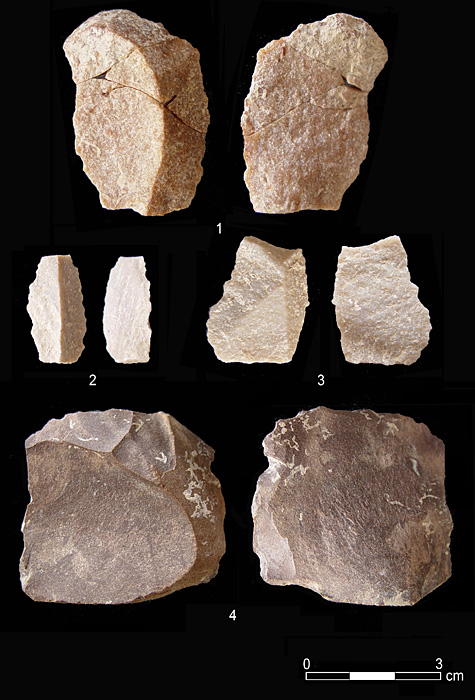
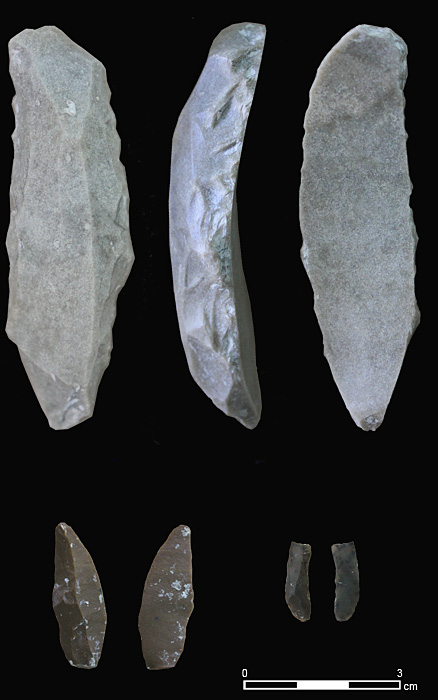
A modest assemblage of chipped stone artefacts found in the older Layer 206 at the cave entrance and terrace suggests a Late Middle Palaeolithic occupation based on the presence of Levallois flakes (rejuvenation flakes of the éclat débordant type) and the predominant use of locally available, poor quality litho-types, such as quartzite and quartz (Figure 4). By contrast, artefacts associated with Layer 207 in the interior of the cave include a large blade with bilateral continuous retouch, an unretouched bladelet and a smaller bladelet, which bears marginal retouch (Figure 5), suggesting extraction from prismatic rather than carinated cores within the framework of a continuous reduction sequence characteristic of the Protoaurignacian. Yet, the precise cultural attribution of this layer must remain open due to the scarcity of diagnostic elements.
Levallois flakes on quartzite from Layer 206.

A large blade with bilateral continuous retouch, an unretouched bladelet and a smaller bladelet with marginal retouch from Layer 207.

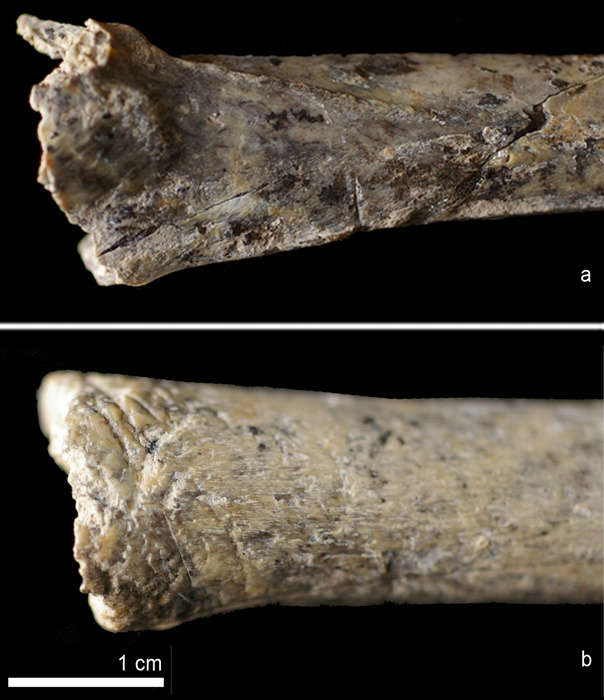
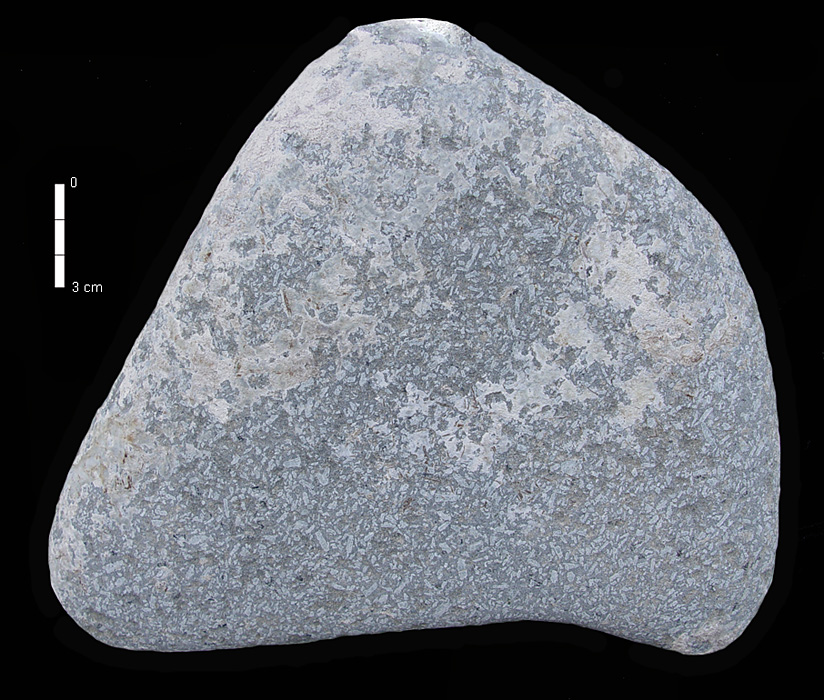
At present only Layer 207 is AMS-dated with five dates in the range 41 300 to 34 500 cal BP at 1 standard deviation (CalPal calibration). Two of these dates were on animal bones with anthropic cut marks (Figure 6). Faunal remains are dominated by ibex but, based on the presence in the assemblage of several predatory carnivore species such as cave lion, cave hyena, cave bear, brown bear, wolf, lynx and fox, it is likely that animal bone accumulation was due to both hominins and carnivores. One used stone anvil (Figure 7) was found associated with the Early Upper Palaeolithic Layer 207 in the vicinity of a fireplace.
AMS-dated animal bones with cut marks from Layer 207. A: fox (Vulpes vulpes) femur: 34 200±550 uncal BP (OxA-23651). B: ibex (Capra ibex) metapodial with cut marks and traces of gnawing: 33 450±500 uncal BP (OxA-24818).

Used stone anvil found associated with Layer 207.

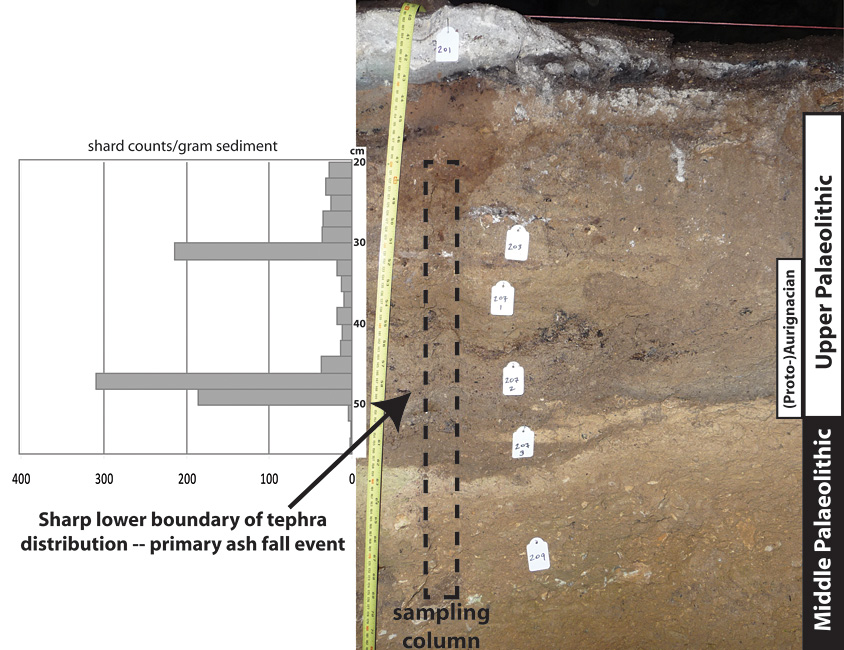
South-west facing section in Trench 1/2005 and cryptotephra scan counts (absolute shard counts/gram sediment) for sampled Column 1 in Tabula Traiana Cave.

Traces of volcanic tephra are also documented in varying proportions throughout Layer 207 (Figure 8). On the basis of chemical analyses, tephra from the Campanian Ignimbrite (CI) eruption event dated to the time of the Middle to Upper Palaeolithic transition around 40 000 cal BP (Lowe et al. 2012) as well as another presently unidentified eruption event are preserved in the stratigraphic sequence at Tabula Traiana Cave.
Perspectives
This first promising evidence for the Early Upper Palaeolithic in the Danube Gorges suggests that the karstic features of the area, along one of the main dispersal axes for the spread of Anatomically Modern Humans in Europe, offer important opportunities for new discoveries, significantly contributing to the story of human origins.
Acknowledgements
Fieldwork at Tabula Traiana Cave was partly supported through the High Risk Research in Archaeology National Science Foundation grant BCS-0442096 for 2004, British Academy Small Grant 40967 for 2005, and grants in 2005, 2008 and 2009 from the McDonald Institute for Archaeological Research in Cambridge.