

Introduction
Within the global futures literature there is a very small subset examining developments in the polar regions. Rapid change in the Arctic has prompted the establishment of the Arctic Futures Initiative by the International Institute for Applied Systems Analysis, and numerous publications debate the implications of potential environmental, political and socio-cultural developments in the Arctic (Arbo, Iversen, Knol, Ringholm, & Sander, Reference Arbo, Iversen, Knol, Ringholm and Sander2013; Avango, Nilsson, & Roberts, Reference Avango, Nilsson and Roberts2013; Young, Reference Young, Berkman and Vylegzhanin2013). However, so far only very few publications have explored Antarctic futures, despite the political and environmental changes and the increase in human activity in the region (Chown et al., Reference Chown, Lee, Hughes, Barnes, Barrett, Bergstrom and Wall2012). Tin, Liggett, Maher, & Lamers's (Reference Tin, Liggett, Maher and Lamers2014) volume on environmental futures of Antarctica is a first step in the direction of offering scenarios for possible future developments in Antarctica, but this is a long way from advancing the investigation of Antarctic futures to the level that research into Arctic futures – or climate change futures more generally – currently occupies. This paper details work by a small group of researchers (three Antarctic experts in ecological and social sciences, environmental management and policy, and one futures researcher) to further Antarctic futures research. This paper presents the results of an intense period of research involving individual work in our respective areas of expertise, and a facilitated workshop to share the results of individual preparatory work and come to a consensus about the most important factors in the development of human activities in Antarctica and the structure and content of the resulting scenarios.
To undertake an initial assessment of Antarctic futures we have looked across multiple sources of information and have attempted to see how they could unfold in certain situations. We know that the future is uncertain, but it is important to explore the potential bounds in which an uncertain future could stretch so that future investments and programmes have the highest utility possible. These bounds can be tested in an examination of alternative futures, which necessarily involves identifying the key drivers that will shape these futures. Identifying drivers that will influence the character and scope of human engagement with Antarctica over the next few decades and exploring alternative Antarctic futures require an intimate understanding of the various aspects of human engagement with Antarctica. Many strategies use alternative futures as part of their risk management strategy for horizon scanning and emerging issues analysis, and to identify wild cards – low-probability, potentially high-impact risks that move us towards or away from a particular future state. A careful examination of the literature on current Antarctic developments and challenges (including a historical timeline of key events in the Antarctic, possible Antarctic futures and ‘futuring’ in general), helped identify probable drivers of change in the overall Antarctic landscape. It has also informed discussions on a set of Antarctic futures through a workshop process by the authors. From this we derived the key drivers for global developments of significance for Antarctica to be:
-
• global environmental and socio-economic trends that are likely to have an impact on Antarctica
-
• potential shifts in the Antarctic Treaty System (ATS) governance
-
• Antarctic research, including national Antarctic programme operations
-
• tourism in Antarctica.
For each of these, we reviewed the political, economic, social, technological, legal and environmental (PESTLE) dimensions of change (Sridhar, Sachithanandam, & Mageswaran, Reference Sridhar, Sachithanandam and Mageswaran2016) to develop a set of four alternative scenarios (Slaughter, Reference Slaughter2008). The paper addresses each driver in turn, then synthesises the results by developing four possible coherent scenarios, which we then examine as a set as has been used in other domains (Peterson, Cummings, & Carpenter, Reference Peterson, Cumming and Carpenter2003; Reed et al., Reference Reed, Kenter, Bonn, Broad, Burt, Fazey and Raverak2013). Finally, we draw some conclusions on the challenges facing Antarctica in the future. This paper is intended to stimulate thinking and conversations on some very complex issues. By looking across multiple scenarios we attempt to open up the possibility for foresight on possible implications of strategic decisions about Antarctica in the near future. It should be stressed that these can never be absolutes but are constructs, or experiments, within which options can be explored and assessed.
Global environmental and socio-economic trends
In our brief assessment of future global trends we have drawn on the large body of scholarly literature on foresight research and futures studies. The majority of these focus on the 20- to 100-year range, including, among others, Adam & Groves, Reference Adam and Groves2007; Bell, Reference Bell1986; Center for Health and the Global Environment, 2006; Ebi et al., Reference Ebi, Kram, van Vuuren, O'Neill and Kriegler2014; Frame, Reference Frame2008; Johansen, Reference Johansen2012; Kriegler et al., Reference Kriegler, Edmonds, Hallegatte, Ebi, Kram, Riahi and van Vuuren2014; Moriarty & Honnery, Reference Moriarty and Honnery2014; Nelson, Reference Nelson2010; Randers, Reference Randers2012; Slaughter, Reference Slaughter2008; and Weeks, Malone, & Welling, Reference Weeks, Malone and Welling2011. Taken together these comprise a wide range of sectors and contemporary phenomena, such as climate change, environmental limits, demographics, economic development, access to resources, education and health, as well as assumptions about global governance and a continuation of current political models.
These studies have assumed no major global disruptions to the status quo and have also used widely accepted reports (for example, as found at www.oecd.org) as source material. We have not considered shifts that may occur as a result of changes in the political landscape, such as ‘Brexit’ or the election of Donald Trump as President of the USA. We see these, in a short-term context, as perturbations within the system, while our interest lies in long-term systemic change to which, of course, these short-term events may or may not lead.
In the global context Antarctic issues do not currently feature high on a list of critical priorities for many states or multinational corporations. Although Antarctica is considered to be of strategic importance to some countries (see for example, Fogarty, Reference Fogarty2011), it is modest in comparison to matters such as health, food security, and access to education and water for much of the world's population. However, national and international priorities, along with global developments, have repercussions for how Antarctica's future unfolds. Consequently, any exploration of Antarctic futures requires an assessment of the global context within which human engagement with Antarctica will be positioned. However, this is not the main focus of this paper and is considered in much greater detail elsewhere, so we do not dwell further on these complex issues.
Key issues that are likely to define the global political, environmental and socio-economic order in the future have been drawn from the global outlooks listed above and are summarised in Table 1 (Adam & Groves, Reference Adam and Groves2007; Bell, Reference Bell1986; Center for Health and the Global Environment, 2006; Ebi et al., Reference Ebi, Kram, van Vuuren, O'Neill and Kriegler2014; Frame, Reference Frame2008; Johansen, Reference Johansen2012; Kriegler et al., Reference Kriegler, Edmonds, Hallegatte, Ebi, Kram, Riahi and van Vuuren2014; Moriarty & Honnery, Reference Moriarty and Honnery2014; Nelson, Reference Nelson2010; Randers, Reference Randers2012; Slaughter, Reference Slaughter2008; Weeks et al., Reference Weeks, Malone and Welling2011). We acknowledge that they are generalisations of an anthropocentric world wrestling with how best to manage Antarctica and its assets in the face of multiple pressures elsewhere. The global context in Table 1 is neither judgemental nor authoritative, and merely intends to frame plausible, possible futures. These are placed in the middle of future options to provide the global context within which possible futures can be situated and in which investigations can be made about the future of Antarctica. More radical or unexpected events can be layered on top of this architecture, though that is not considered in depth here.
The global context for Antarctic futures to 2040.

Potential shifts in the Antarctic Treaty System
For the seven Antarctic claimant states (Argentina, Australia, Chile, France, New Zealand, Norway and the UK) there is a significant benefit in maintaining a strong and effective ATS (see Appendix for tables of Antarctic Treaty Parties). The tentative political and legal nature of Antarctic territorial claims is far easier to manage within the framework of international cooperation provided by the Antarctic Treaty and its associated agreements (Conforti, Reference Conforti1986; Hemmings, Reference Hemmings, Powell and Dodds2014; Watts, Reference Watts1992). The Antarctic Treaty (signed in 1959) is often regarded as one of the most successful international agreements ever made. For nearly 60 years it has provided the framework for peaceful international cooperation in the region. Under the auspices of the Antarctic Treaty several additional agreements have been signed to regulate human activities on the continent and in the Southern Ocean. Collectively this suite of international agreements is referred to as the ATS (Beck, Reference Beck2014).
The ATS has been successful in terms of:
-
• maintaining peace in the region for nearly 60 years
-
• fostering international cooperation on logistics and scientific research
-
• facilitating research that is of global benefit
-
• demonstrating international leadership on the sustainable management of marine resources
-
• continued emphasis on high standards of environmental management
-
• attracting new countries to become signatory states to the Antarctic Treaty and the Protocol on Environmental Protection (hereafter, the ‘Protocol’).
However, the ATS is facing a host of emerging challenges that will need to be recognised and responded to if the system is to retain its effectiveness and international credibility (Chown, Reference Chown2013; Chown et al., Reference Chown, Lee, Hughes, Barnes, Barrett, Bergstrom and Wall2012; Reference Chown, Brooks, Terauds, Le Bohec, van Klaveren-Impagliazzo, Whittington and McGeoch2017). First, membership in the ATS continues to grow, with Kazakhstan (27 January 2015), Mongolia (23 March 2015) and Iceland (13 October 2015) having most recently acceded to the system. This means that the original 12 signatory states (including the seven claimant states) are now outnumbered by more recent signatories (Fig. 1) (Davis, Reference Davis2014). Associated with this growing membership is a subtle shift in the Antarctic Treaty Parties’ motivations to participate in the ATS. The original 12 signatories and states acceding in the first two decades after the birth of the regime were largely driven by a perceived geopolitical need to prevent others from gaining strategic advantages from the Antarctic (Bulkeley, Reference Bulkeley2010) and managed the Antarctic through cooperation on scientific research, while states joining the ATS over the last three decades have been more focused on the resource potential the Antarctic holds (Dodds, Reference Dodds2006; Dodds & Collis, Reference Dodds, Collis, Dodds, Hemmings and Roberts2017). This can be seen in the significant growth, for example, in membership of the Antarctic Treaty during the 1970s and 1980s, when resource management discussions (fishing and minerals) were a priority issue (Fig. 1).
Growth in membership of the Antarctic Treaty since 1959 (based on information retrieved from the Antarctic Treaty System database)

Second, a challenge is posed by the increasing pace of climatic and environmental change in the region, which has implications for native biodiversity and the increasing establishment of non-native species. Changing environmental conditions also have logistical consequences for accessing and operating in the region, as well as for the perceived value of Antarctica for scientific research (Turner et al., Reference Turner, Barrand, Bracegirdle, Convey, Hodgson, Jarvis and Klepikov2014).
Third, investment in the political system is not high with treaty parties having a preference for a low-cost system, with shorter meetings (the meeting length was reduced from ten to eight days in 2012), increasing intersessional e-groups and low investment in the Antarctic Treaty Secretariat due to the legal issues limiting its role. Investment by parties in Antarctic governance is relatively modest compared to other international arrangements. Members’ contributions to the annual budget of the Buenos-Aires-based Antarctic Treaty Secretariat, which supports the Antarctic Treaty Consultative Meetings (ATCM) and the Committee on Environmental Protection (CEP), is less than US$1.4 million (ATCM, 2016), a rather limited budget when compared to members’ contributions to the Commission on the Conservation of Antarctic Marine Living Resources (CCAMLR) general fund of approximately US$3.2 million (CCAMLR, 2015) and to the general fund of the Convention on Biological Diversity of approximately US$13.2 million (UNEP, 2015). This, along with the growing number of member states, may be linked to, and culminate in, a slowing political process, which is manifested by ATCM decisions taking an increasingly long time to enter into force. For instance, the sixth Annex to the Protocol on Environmental Protection to the Antarctic Treaty, which focuses on liability for environmental damage, was concluded in 2005 but as at 23 April 2017 only 13 of 28 treaty parties have taken the action necessary to bring the Liability Annex into force (ATS, 2017). Likewise, despite years of discussion, CCAMLR has struggled to designate Marine Protected Areas in the Southern Ocean, risking its conservation credentials (Brooks, Reference Brooks2013). The 2017 triumph of reaching consensus in support of the creation of a Marine Protected Area in the Ross Sea represents some progress in CCAMLR's struggle to balance conservation interests and resource exploitation, but it does not resolve the tensions between environmental protection and fishing.
Fourth, while the parties readily address straightforward policy matters, they have not yet made progress on difficult issues such as the regulation and management of biological prospecting in Antarctica - mainly because of divided opinions among Antarctic Treaty Parties as to the need for more specific rules on access and benefit sharing other than that already resulting from the obligation to give prior notification and share scientific results (Jabour, Reference Jabour, Warner and Kaye2015b; Puig-Marco, Reference Puig-Marco2014). The low-hanging fruit are readily grasped, while tough questions around sovereignty, presence in Antarctica or even climate change may only be touched on during ATCMs without consensus being reached.
Fifthly, and finally, tourism activities continue to attract significant discussion time at ATCMs, but with few management or policy outcomes, while the industry itself continues to expand and become more influential (Jabour, Reference Jabour, Tin, Liggett, Maher and Lamers2014). Tourism matters are explored in their own section later in this paper.
If the above challenges cannot be addressed by the parties, the system is at risk of becoming increasingly ineffective (Liggett & Stewart, Reference Liggett, Stewart, Weeden and Dowling2017a), with parties and industry groups acting increasingly independently of each other and the ATS (Table 2).
The future of the Antarctic Treaty System to 2040.

At the upper end of the timescale, there is merit in examining potential attitudes of the treaty parties and parties to the Protocol in the late 2040s. First, it is noted that misunderstandings sometimes arise on the significance of 2048, which is variously referred to as the date that the Antarctic Treaty expires, the date the Protocol expires, the date the mining ban expires or the date when the Antarctic Treaty has to be renegotiated. Not one of these interpretations is correct. The reality is that the Protocol, like the Antarctic Treaty itself, has no end date. However, the Protocol does provide for any Antarctic Treaty Consultative Party (ATCP) to call for a conference to ‘review the operation of the Protocol’ after the expiration of 50 years from the date of the Protocol's entry into force, that is, after 14 January 2048 (Article 25 of the Protocol). The Protocol mandates that the prohibition on mineral resource activities can only be overturned if there is in place a binding legal regime to manage such activity (for more detail see Jabour, Reference Jabour and Loukacheva2015a; Scott, Reference Scott, Liggett, Storey, Cook and Meduna2015). Partly as a result of this persistent confusion, the ATCPs reaffirmed their commitment to the Protocol's prohibition on mining at their 2016 meeting (ATCM Resolution 6, 2016). Nonetheless, it is quite feasible that some parties, either individually or as a group, may wish in the future to implement the review procedures set out in the Protocol and seek to modify aspects of it, including the mineral resources prohibition.
Because of the opportunity for any party to call for a review conference after January 2048, that year has the potential to be a milestone in terms of testing the resilience of the Antarctic governance regime. The extent to which the Protocol's review mechanism is utilised – as well as the issues that are raised at any such review and the persistence of parties in pursuing their particular agendas – could either be unifying or divisive. Either way, the 2040s are likely to see increased political attention being paid to Antarctic matters in anticipation, and it will be important for like-minded states to prepare for a potentially significant test of the system. If the ATS is to remain an effective governance regime for the region and retain its international standing, then the parties will need to take concerted action to address these challenges, including through increased resourcing, innovative policymaking and collective determination. The next few years will be a crucial indicator of the most probable outcomes for the ATS in the longer term.
Antarctic research in the future
Significant changes are expected to the current approaches to undertaking science in Antarctica and to the topics of interest. A changing climate and its effects on Antarctica and the life found within Antarctica will continue to be a key focus (Hodgman, Reference Hodgman2016; Kennicutt et al., Reference Kennicutt, Chown, Cassano, Liggett, Peck, Massom and Sutherland2014b). There is a move to a longer science season, which we expect will extend to year-round science activities, with large field events occurring throughout the winter in the next 10–15 years (COMNAP, 2016). Alongside an extended field season, there is a move towards greater support (that is, temporary bases) at sites of key scientific interest (COMNAP, 2016; Kennicutt et al., Reference Kennicutt, Kim, Finnemore-Rogan, Anandakrishnan, Chown, Colwell and Yang2016). This is likely to continue alongside the expected slow growth in new permanent bases on the continent from existing or new treaty parties.
Technology will continue its rapid advance. Technologies and approaches currently used were unthinkable a few decades ago. An example is the increasing use, and sophistication, of automated aquatic and aerial sensor platforms (drones/submersibles) (Augustine et al., Reference Augustine, Allen, Dorman, Ducklow, Gordon, Harrison and Wall2012; COMNAP, 2016; Kennicutt et al., Reference Kennicutt, Kim, Finnemore-Rogan, Anandakrishnan, Chown, Colwell and Yang2016; National Academy of Sciences, 2011), which enable increased spatial and temporal resolution. In the short term the rise of these technologies will increase the number of scientists visiting the continent, but this may well plateau as the sharing of the platforms on which the scientific instruments are attached increases. The use of these technologies will also increase throughout the winter months (COMNAP, 2016; Kennicutt et al., Reference Kennicutt, Kim, Finnemore-Rogan, Anandakrishnan, Chown, Colwell and Yang2016).
Networks of fixed monitoring stations will develop over the next ten years, which will aim to provide a context for the changes occurring in Antarctica (COMNAP, 2016; Kennicutt et al., Reference Kennicutt, Kim, Finnemore-Rogan, Anandakrishnan, Chown, Colwell and Yang2016). These stations will rely on significant advancements in telecommunications, and on battery and power technologies, which will need to be developed over the next decade. The advances made to remove current constraints with regard to telecommunications, batteries and power will have significant impacts for the operational realities of Antarctic science and the level of human activity in Antarctica (COMNAP, 2016; Kennicutt et al., Reference Kennicutt, Kim, Finnemore-Rogan, Anandakrishnan, Chown, Colwell and Yang2016).
Telecommunication networks within Antarctica and out of Antarctica are currently inadequate for the types of science questions and information requirements that need to be addressed over the next two decades (COMNAP, 2016; Kennicutt et al., Reference Kennicutt, Kim, Finnemore-Rogan, Anandakrishnan, Chown, Colwell and Yang2016). In order for the types of technological support requirements laid out in the COMNAP Roadmap Challenges to eventuate, significant changes to and investments in the ability to source, store and move data around the continent, and then transmit it to and store it in, say, New Zealand, will be required. Fortunately, it appears that emerging technologies are likely to be available within the next few years to achieve a relatively high-bandwidth, low-earth-orbit constellation of satellites that ensure constant Antarctic and Southern Ocean coverage. This is also expected to be achieved via significant reductions in the cost of satellite technology and in the logistical costs of getting the technology into space in the first place.
If technological solutions can be found to the three other primary constraints on Antarctic research, namely telecommunications, power storage and power generation, we will see a rise in more remote and autonomous science being undertaken in Antarctica, which may lead to fewer scientific personnel. This would be balanced by an increase in technical staff needed to support the increase in the use of aquatic/aerial drones, long-term monitoring stations or mobile terrestrial science platforms. Such technological solutions to current challenges facing Antarctic researchers are likely to emerge from the technology sector outside the Antarctic realm and are likely to draw on initiatives by private enterprises and private–public partnerships, think tanks and research/tertiary institutes.
Large-scale ‘keystone’ projects such as ANDRILL (the Antarctic Geological Drilling project) and IceCube (the South Pole Neutrino Observatory) are expected to continue for two decades (COMNAP, 2016; Kennicutt et al., Reference Kennicutt, Kim, Finnemore-Rogan, Anandakrishnan, Chown, Colwell and Yang2016). These types of projects may continue past this point, but their scope and structure will depend on funding, collaboration and logistical support. The strength of a country's support for such ambitious projects will depend on the wider science context, as outlined in Table 3. Simple economics will continue to have a significant impact on the science projects that can be undertaken in Antarctica, and while remote science will become more prominent, on-site research will continue to depend largely on energy prices (that is, the cost of access and presence).
The future of Antarctic science to 2040.

With more activities occurring in Antarctica and the Southern Ocean, the need for a greater understanding of the scale of human activity will become more pressing (COMNAP, 2016; Pertierra, Hughes, Vega, & Olalla-Tárraga, Reference Pertierra, Hughes, Vega and Olalla-Tárraga2017; Tin et al., Reference Tin, Liggett, Maher and Lamers2014; Woehler, Ainley, & Jabour, Reference Woehler, Ainley, Jabour, Tin, Liggett, Maher and Lamers2014). Similarly, a greater focus on health and safety in Antarctica will be inevitable as a result of more stringent domestic health and safety legislation (COMNAP, 2016). Geo-fencing of activities to permitted geographical coordinates, automated warnings of potential Antarctic Specially Protected Area (ASPA) and Antarctic Specially Managed Area (ASMA) incursions, and one-touch coordinates being sent to emergency responders may be direct results of these changes. Over the long term (40-plus years), and depending on technological advances, we expect to see the use of zero-emission electrical drones for the movement of people and their equipment to reduce the level of human impact occurring in Antarctica, as reported by King (Reference King2016). The continued interest of Antarctic players to engage in Antarctic science will depend on science funding, public and political will, and strong scientific/logistical collaboration with international partners (COMNAP, 2016; Kennicutt et al., Reference Kennicutt, Chown, Cassano, Liggett, Massom, Peck and Sutherland2014a, Reference Puig-Marco2014b; National Academy of Sciences, 2011). If any of these aspects are diminished, we expect a reduction in the scale and scope of scientific activities on the continent.
To date, Antarctic research has been largely carried by the state – from Antarctic research funding to logistics support through national Antarctic programmes. In the near future, we may be faced with a shift from government-funded research to private funding, either through philanthropic funding (in several countries this is already happening) or through funding made available by businesses with an interest in returns on their investment. While such a shift is likely to be an incremental, insidious change over time, it would be very influential in that it might rewrite research priorities and reset the underlying structures and processes that enable Antarctic research to take place. It might also shift the balance of power with regard to Antarctic research as well as Antarctic governance. If private research funding from businesses, for example tourism operators, pharmaceutical companies or even oil companies, is to supplement governmental funding for Antarctic research, research priorities might change. Governments will need to be making firm decisions on what they want Antarctic research to be about, especially if future research funding is to be an amalgamate of public and private funding – or whether it continues to matter.
Antarctic tourism futures
Although episodic tourism preceded the signing of the Antarctic Treaty in 1959, regular organised commercial travel there began in the mid-1960s (Headland, Reference Headland1992; Mason & Legg, Reference Mason and Legg1999, Reference Mason and Legg2000; Murray & Jabour, Reference Murray and Jabour2004; Reich, Reference Reich1980; Tracey, Reference Tracey2001). Consequently, tourism is not mentioned in the Antarctic Treaty. Tourism regulation developed organically, but slowly, alongside tourism activities, although regulation generally lagged behind tourism development (Liggett & Stewart, Reference Liggett, Stewart, Dodds, Hemmings and Roberts2017b). The most important regulatory mechanism within the framework of the ATS addressing Antarctic tourism activities is the 1991 Protocol, which entered into force in 1998 and regulates all human activities undertaken by citizens of, or organisations based in, the Protocol's signatory states. Operationally, however, the treaty parties left the management of Antarctic tourism activities largely in the hands of the tour operators and the International Association of Antarctica Tour Operators (IAATO). IAATO was formed in 1991 by seven Antarctic tour operators and has now grown to a membership of 116, including 49 member operators (Splettstoesser, Reference Splettstoesser2000).
Over the last two decades Antarctic tourism has diversified substantially and grown in intensity (Liggett & Stewart, Reference Liggett, Stewart, Weeden and Dowling2017a). The most significant tourism activity, both in terms of tourist numbers and operators involved, remains expedition-style cruise tourism, followed by cruise-only tourism (Fig. 2). Overflights in Antarctica completely ceased for a number of years after a DC-10 operated by Air New Zealand crashed into the flanks of Mount Erebus in 1979, killing all passengers and crew on board. In 1994, Qantas recommenced operating overflights but they never regained the popularity they enjoyed before the crash in 1979. Over the last decade, overflights have virtually faded into insignificance, if not non-existence, a development that, like all tourism developments, is demand-driven and may reflect a general unwillingness to spend money on flights if a more intimate touristic experience can be had for a slightly higher price.
Tourism development since the beginning of regular commercial tourism to Antarctica (based on IAATO data)

The demand for Antarctic tourism is responsive to global economic and political developments, as evidenced by the significant drop in demand following the global economic crisis in 2008 (Figs 2 and 3). Due to the high investment required to operate tourism to Antarctica, supply is less elastic, especially among the smaller owner-operators who specialise in tourism to the polar regions. Nonetheless, significant regulatory changes in the operating environment have impacts on supply, as we have seen from the International Maritime Organization's ban on the use and carriage of heavy fuel oil in Antarctica, which came into effect on 1 August 2011 and resulted in a number of the larger multinational tourism companies that operate cruise-only vessels leaving the Antarctic tourism market (Fig. 3) (Liggett & Stewart, Reference Liggett, Stewart, Weeden and Dowling2017a).
Tourism development, including the number of vessels used, since the turn of the millennium (based on IAATO data)

Analysis of tourism trends over the last five decades suggests further growth in tourism numbers over the next decade, accompanied by further diversification of the tourism product (Bastmeijer & Roura, Reference Bastmeijer and Roura2004; Bertram & Stonehouse, Reference Bertram, Stonehouse, Snyder and Stonehouse2007) and a greater volume of yacht-based tourism and individual (non-commercial) adventure tourism activities. Challenges arising from the growth and diversification of tourism include:
-
• an increased potential for devastating incidents and accidents (see for example, Republic of Liberia, 2009 and the Berserk 2011 expedition), resulting in the pressing need for closer collaboration between the different national Search and Rescue Coordination Centres responsible for operations in the Southern Ocean (Jabour, Reference Jabour, Dodds, Hemmings and Roberts2017)
-
• a greater probability of the introduction of non-native species or diseases (Hofman & Jatko, Reference Hofman and Jatko2000; Pfeiffer & Peter, Reference Pfeiffer and Peter2003)
-
• difficulties for ATCPs to regulate an increasingly diverse spectrum of tourist activities (Antarctic and Southern Ocean Coalition, 2005; ATCM, 2012)
-
• difficulties for IAATO to manage an increasingly diverse spectrum of tourist activities (ATCM, 2012; Haase, Lamers, & Amelung, Reference Haase, Lamers and Amelung2009)
-
• gateway cities (that is, a coastal or island port able by its proximity to the Antarctic to benefit from and control access to Antarctic and Southern Ocean resources, including fishing, tourism and scientific support [Chua, Shah, Husin, & Rahman, Reference Chua, Shah, Husin and Rahman2015]) having to deal with waste brought back from Antarctica by tour operators (Bertram, Reference Bertram2005)
-
• gateway cities providing sufficient tourism infrastructure (including accommodation and other tourism services) during the peak tourism season (Swanson, Liggett, & Roldan, Reference Swanson, Liggett and Roldan2015)
-
• legal implications and duties imposed on port states (under UNCLOS, the United Nations Convention on the Law of the Sea) and their consequences for gateway cities, particularly if memoranda of understanding on Port State Jurisdiction put more responsibility on the shoulders of gateway ports (Bertram, Muir and Stonehouse, Reference Bertram, Gunn and Stonehouse2007; Swanson et al., Reference Swanson, Liggett and Roldan2015).
Wild cards in the development of tourism over the next decade include the possibility of a devastating accident involving a cruise vessel, resulting in a loss of lives, which would undoubtedly provoke a more significant regulatory response and possibly a loss of faith in the management of Antarctic tourism by IAATO; or a significant environmental disaster resulting from Antarctic tourism operations (for example, a large fuel spill, the demise of one or several large penguin rookeries due to diseases introduced by tourism, rogue operators or individuals undertaking sport fishing/hunting in Antarctica), which would also propel policymakers into action.
Disregarding such wild cards, we expect the Antarctic tourism market to mature in the next decade and numbers to stabilise. We might then see a decline in tourist numbers around, or after, 2030. The expectation that Antarctic tourism numbers will plateau is based on research by Reference ButlerButler (1980), who studied tourism development at many destinations around the world and concluded that tourism development follows a destination life cycle of initial discovery and development (with a rapid increase in visitor numbers), followed by market consolidation and stagnation, after which a decline in visitor numbers is seen unless a destination is reinvented or rejuvenated. We hypothesise that this reinvention or rejuvenation is only possible to a very limited extent, considering the biophysical realities of Antarctica, and that it will most probably involve some environmental sacrifice (Table 4). While we have seen significant diversification of the Antarctic tourism product in the past (Liggett & Stewart, Reference Liggett, Stewart, Weeden and Dowling2017a), the changes we have seen have been tweaks in what types of adventures at land (for example, overnight camping, marathon running) or at sea (for example, kayaking) were offered and do not represent product reinventions. Antarctic tourism continues to be dominated by cruise tourism, which is increasingly supplemented with fly–cruise tourism. Considering the remoteness of the Antarctic continent and the necessity to access the continent by sea or air, ships are likely to remain key players in the Antarctic tourism market. Any dramatic change of the Antarctic tourism product is likely to involve shifting the main base for tourism operations from the ship to land, which will increase the environmental impact on the Antarctic continent. Due to the cost involved, and the absence of great fluctuations in the numbers of land-based tourists over the last three decades, we do not expect to see a significant future increase in land-based tourism activities. However, Antarctica will continue to attract adventurous and pioneering spirits, who will push the boundaries of what were considered humanly impossible feats of endurance, perseverance or daring in the past. These individual ‘explorers’ will challenge the political, legal, moral and economic boundaries within which national Antarctic programmes and commercial tour operators operate. If things do go awry, as was, for instance, the case with the 2011 Berserk expedition that had been spearheaded by Jarle Andhøy from Norway and resulted in the loss of three lives, the respective case is likely to be discussed at an ATCM. In Andhøy's case, New Zealand argued that he did not heed any warnings from the authorities regarding his planned expedition (New Zealand, 2012). In addition, his expedition to Antarctica had proceeded without a permit or without preparing the required environmental impact assessment (Norway, 2012). The Norwegian authorities consequently fined Andhøy NOK25,000 for failure to follow procedure and obtain a permit before travelling to Antarctica (Norway, 2012), which is a small victory for the ATS showcasing that there will be consequences for non-compliance, although NOK25,000 is arguably a rather small fine to pay for such gross negligence. The latter point has been raised by New Zealand in a working paper (New Zealand, 2012), after Andhøy visited Antarctica again in 2012 with the yacht Nilaya, once again without filing an environmental impact assessment or the required authorisation. New Zealand (2012) called for parties to agree the required action preventing Andhøy from ever again organising an unauthorised Antarctic expedition. Further, that any unauthorised expeditions should be treated as serious threats to the integrity of the ATS and should be prosecuted. Resolution 10 (2012) specifically focused on yachting expeditions and recommends to parties to ensure that all yacht operators consult and utilise an agreed-upon checklist for safe yacht voyages to the Antarctic in their planning.
The future of Antarctic tourism to 2040.

Multiple factors determine the future development of tourism in Antarctica. The increasing pace of climate and environmental change in the region has significant implications for native biodiversity and the increasing establishment of non-native species. Changing environmental conditions also have logistical implications for accessing and operating in the region, as well as for the perceived value of Antarctica for scientific research and tourism operations (Bertram, Muir, & Stonehouse, Reference Bertram, Muir, Stonehouse, Snyder and Stonehouse2007; Liggett, Reference Liggett2011). A similarly important role is played by the availability of infrastructure, such as tourist landing sites or multi-use runways, which could facilitate an increase in fly–cruise tourism operations, not only in the Antarctic Peninsula but potentially also in the Ross Sea in light of the new hard-rock runway near the Italian station.
Demand for Antarctic tourism is influenced by the disposable income available to those who have the time and/or opportunity and inclination to visit Antarctica (Kriwoken & Rootes, Reference Kriwoken and Rootes2000), and also by awareness of Antarctic tourism products, which is mediated by national Antarctic programmes, the media, scientists, other tourists, etc. (Powell, Reference Powell2006). Changes in awareness and disposable income will have cascading effects on tourism demand.
On the supply side, the price and availability of fossil fuel (which is a significant component of operational costs), as well as the availability and continued seaworthiness of cruise ships (which needs to be considered, given that the fleet of vessels dominating the market at the moment is ageing; Bertram, Reference Bertram, Snyder and Stonehouse2007) are significant factors affecting the future development of Antarctic tourism. Supply might also be affected if overcrowding in certain parts of the Antarctic Peninsula causes a greater geographical dispersion of tourism operations. Overcrowding in the Antarctic Peninsula Region might also result in operators pushing further south or taking tourists into the Ross Sea region.
The regulatory environment for Antarctic tourism (including regulation by the ATCPs and through other international organisations and agreements, such as the International Maritime Organization, UNCLOS, the International Convention for the Prevention of Pollution from Ships [MARPOL], and the Convention on Biological Diversity [Antarctic and Southern Ocean Coalition, 2005; ATCM, 2012]) can either be a driving or a dampening force in Antarctic tourism development. The effectiveness of the current management framework for Antarctic tourism, which primarily consists of industry self-regulation, plays an important role in this regard. Future accidents or incidents, irrespective of whether they are a result of mismanagement or not, will have considerable consequences for discussions on how Antarctic tourism is managed and regulated in the future, especially if such incidents result in significant environmental or humanitarian consequences (Haase et al., Reference Haase, Lamers and Amelung2009). Overall, the propensity of commercial operators to be(come) IAATO members and follow IAATO procedures and codes of conduct (Haase et al., Reference Haase, Lamers and Amelung2009; Lamers, Haase, & Amelung, Reference Lamers, Haase and Amelung2008) is likely to play a moderating role in Antarctic tourism regulation and management.
Finally, it should not be forgotten that the degree to which national Antarctic programmes support tourism operations (for example, by offering use of their infrastructure or facilities, or by actively welcoming/inviting tourists) (Lamers et al., Reference Lamers, Haase and Amelung2008; Mercopress, 2016) will also affect tourism development in Antarctica.
Four scenarios for Antarctica
From the above context we developed a set of key drivers for change in Antarctica over the next 25 years (Table 5). These were based on the sweep of futures literature which has been cited earlier plus our extensive experience in developing scenarios of this type and against which we superimposed a sensitivity analysis to determine what, at least currently, would be seen as the dominant patterns. Each driver will affect human engagement with the continent and its surrounding ocean in multiple ways. The impact of the drivers will vary significantly, with some (such as global power shifts or a global economic crisis) having wide-ranging top-down as well as bottom-up impacts that can considerably change what happens in Antarctica. The drivers themselves are interdependent, with a shift in one driver affecting changes in another. The scenarios that have been developed result from a specific mix of individual drivers, their intensities and interactions. Consequently, the scenarios have to be considered as dynamic, evolving possibility spaces that can be tweaked depending on the growing or diminishing importance of individual drivers.
Key drivers of change in the Antarctic realm to 2040.
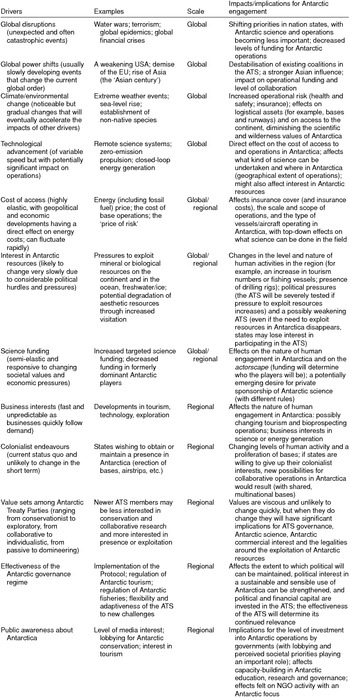
On the basis of these main influencing factors four possible alternative futures or scenarios for Antarctica for the next two to three decades were developed by a process of postulating a series of possibilities arising across each of the main domains (global context, governance, tourism and research) to determine a series of four plausible and logically coherent scenarios with coherent narratives as described in detail below. In doing so, we sought to examine the possibility that the international community's engagement with Antarctica could be approaching – or may already have reached – a crossroads moment and how that might manifest itself. After several decades of negotiating and agreeing a series of international instruments to regulate activities in Antarctica (the regime development phase), the parties to those agreements have been going through a phase of regime implementation. And yet the region and the governance system face a series of challenges so serious that simple regime implementation may not be an adequate response.
A changing Antarctic climate is already driving changes in the abundance and distribution of native wildlife. Non-native species have established in the region and pose a risk to native biota. Human activity is increasing in the region through tourism and national Antarctic programmes, and the governance system is struggling to make progress on policy setting and decision-making in a number of key areas. For example, the Antarctic Treaty Parties have yet to bring into force the Liability Annex to the Protocol, which was adopted in 2005. Progress within CCAMLR was very slow in addressing marine protection (though with some recent achievements), and the ongoing differences of views among the Antarctic Treaty Parties as to whether or not regulation of biological prospecting is required, not least as a result of increasingly divergent political interests in the region, stifles further action on that matter. Consequently, the future is uncertain for Antarctica, and any one of a number of future scenarios for the region may emerge. Currently the treaty parties place emphasis on the importance of Antarctic scientific research as the primary activity in the region for all the global knowledge and international diplomacy benefits that such efforts provide. Other activities (with economic benefits) are regarded as secondary.
Polar science may not remain the priority of governments in perpetuity. A shift in the balance of priorities may emerge through subtle but significant shifts in the perceived benefits that can be derived from a country's involvement in Antarctica. For example, we may see a ‘peak science’ that shifts the balance towards tourism as the primary activity in the region, which in turn may reach its own peak and open the way for much more commercially oriented resource exploitation and other uses of the region (such as bioprospecting, geo-engineering, military use and communications activities).
The four scenarios that emerged were consistent with similar approaches in other domains (for example, Ebi et al., Reference Ebi, Kram, van Vuuren, O'Neill and Kriegler2014) and were based on a fairly orthodox pair of axes, the x-axis is based on a dominant global social perspective, ranging from individualistic to collaborative, and the y-axis expresses a global response to resources, ranging from conservationist to exploitative. In each quadrant the scenario reflects the combination of the main drivers combined into a coherent narrative. These can be summarised as:
-
• a collaborative–conservationist scenario that emerges from the various Antarctic actors extending and enhancing current governance arrangements, with environmental management and scientific research remaining the highest priorities for governmental engagement
-
• a collaborative–exploitative scenario that arises from continuing faith in the ATS, though with parties shifting their interests to a more utilitarian perspective
-
• an individualistic–conservationist scenario that results from the demise of the ATS, stemming from a slowdown in political and financial investment – research and environmental conservation remain, though with less interest from governments – resulting in less collaboration; this may be a transition state to more exploitative-oriented futures
-
• an individualistic–exploitative scenario emerging from a failing ATS – lack of political and financial investment sees parties having increasingly divergent views over Antarctica and governance becoming increasingly irrelevant, and parties act increasingly independently of the rules and with a focus on their own, more commercial, interests.
The scenarios
Detailed scenarios were derived from combining elements that arose in each of the main domains (Tables 1–5). Of the myriad of possibilities, we have developed those most plausible in relation to the future trends. The scenarios are not intended to be predictive but to illustrate potential future possibilities. As understanding of trends develops the scenarios will change. This will also happen if there are significant events outside the current relatively limited scope. However to be fully inclusive of all possibilities is well outside the scope of this paper though such exercises can take place such as under the Intergovernmental Panel on Climate Change (IPCC) climate change scenarios (Ebi et al., Reference Ebi, Kram, van Vuuren, O'Neill and Kriegler2014; IPCC, 2014). These are outlined below to a common format with each having a narrative that summarises the main findings. Against this context we identified a series of interdependent drivers that will probably influence Antarctica's future (global context, governance, tourism and research) and developed four possible future scenarios based on variable application of the drivers, their intensities and potential interactions. The source material for these are the various citations given above and these have been excluded from Tables 1–4 for ease of reading. The resulting scenarios have to be considered as dynamic and evolving possibility spaces that can be adjusted, depending on the growing or diminishing importance of individual drivers.
Scenario 1: Clean, white Antarctica – conservation's poster-child
Overview
Antarctic actors continue to support and extend the current governance arrangements, with environmental management and scientific research remaining as the highest priorities for governments. Marine resource exploitation continues in a sustainable manner, with krill and finfish fisheries maintained within CCAMLR targets and a series of Marine Protected Areas are established throughout the Southern Ocean.
Antarctic Treaty System
There is increased investment in the ATS through increased resourcing of the Antarctic Treaty Secretariat and the development and implementation of a strategic programme of work for the Antarctic Treaty Parties, supported by enhanced internal cooperation among the ATCM, CEP and CCAMLR. Partners fulfil their global responsibilities through a more concerted programme of public outreach as well as efforts to engage with, and be represented at, other global bodies such as the IPCC, the Intergovernmental Science-Policy Platform on Biodiversity and Ecosystem Services (IPBES), the Convention on Biological Diversity and the World Meteorological Organization (WMO), and so on.
Antarctic research
Based on increased public acknowledgement of the global importance of Antarctic science, there is renewed investment in Antarctic science at national and international levels, with a strong emphasis on addressing The Scientific Committee on Antarctic Research's (SCAR) Horizon Scan questions and internationally established science challenges, as well as developing technologies and logistics to address those questions. Conservation science increases, through introduction of a tax on Antarctic tourism which supports more informed policy development, leading to more timely and deliberate Antarctic conservation planning and decision-making.
Antarctic tourism
A mature relationship is developed with the tourism industry, which results in enhanced research opportunities, including coordinated citizen science and a programme of sustainable growth in the industry, but with a peak in activity in about 2030 followed by a gradual decline.
Scenario 2: Back to the future – something for everyone
Overview
The ATS is supported as a regime for the collaborative management of resource exploitation. Marine exploitation has expanded on broadly sustainable terms, with diversification into marine bioprospecting and aquaculture. The CEP has a stronger role in regulating the activities of commercial operators. Such changes are vociferously resisted by environmental non-governmental organisations (NGOs), which are given a seat at the table to contribute to regulation through a partnership approach.
Antarctic Treaty System
This is strengthened through increased membership and the negotiation of additional resource management agreements, including rebirth of the Antarctic mineral resource convention and negotiation of a convention to regulate bioprospecting – both of which require new secretariats to be resourced. ATCM and CCAMLR are more aligned with their parallel interests in resource management. Through active, collaborative decision-making, the interest and attitudes of parties have shifted to a utilitarian perspective. Arguably this is where the parties were in the 1980s, with CCAMLR coming into force and the treaty parties spending six years negotiating the Antarctic mineral resources convention. Minimum environmental impact and sustainable exploitation remain key principles of the treaty parties.
Antarctic research
This is still important, but with a much stronger focus on technology development and testing to support responsible exploitation. SCAR has expanded its scientific objectives to include research into sustainable technologies for high-latitude resource exploration and exploitation. COMNAP has reassessed its role and changed its focus to providing education and training of new, more commercially oriented, operators and coordinating safety management and search and rescue.
Antarctic tourism
This continues to grow and diversify for a while, but reduces quickly with the reduction in wilderness values across the continent. Some niche and extreme tourism remains. IAATO is given more teeth by the Antarctic Treaty Parties, with genuine collaboration between tour operators and policymakers.
Scenario 3: Gold rush Antarctica – buy now while stocks last
Overview
There is a lack of political and financial investment in Antarctica, with increasingly divergent views over its future. Governance is increasingly stultified and irrelevant, resulting in a failing ATS. Governments have bilateral arrangements to exploit mutually beneficial commercial interests, including supporting private ventures and privately owned facilities. Environmental standards in the region are of secondary interest to companies and governments active in the region, and although environmental NGOs continue to protest against Antarctic exploitation, their voice is increasingly dismissed and unheeded.
Antarctic Treaty System
Parties are acting independently of the ATS rules, with a focus on their own interests. International collaboration has reduced, with a swift move to competition for resources. ATS and CCAMLR membership has become less attractive, and non-party states seek opportunities to establish activities in the region outside of the system.
Antarctic research
Science is a secondary interest, with SCAR weaker and becoming irrelevant. Research in technology to support exploration for, and exploitation of, Antarctic resources has emerged, based on a nationalist, competitive model. Public interest in Antarctica's intrinsic values has decreased, with public awareness focused on the commercial benefits being realised from individual states’ activities in the region. A range of new entrepreneurial ventures has emerged, such as niche high-end bottled water industries or 1,000-year-old Antarctic ice collected and sold for the high-end cocktail market, and freshwater harvesting on a grander scale is being explored.
Antarctic tourism
Reduced cooperation among states has reduced the need for cooperation among tour operators and has resulted in a less regulated, more competitive industry. Rapid diversification of the industry results, with land-based facilities (for example, hotels) established and a wide range of visitor experiences on offer, such as golfing and theme parks.
Scenario 4: My Antarctica – eat, sleep, freeze
Overview
Despite good intentions and generally conservation-oriented values, the lack of political and financial investment in the system sees Antarctica and Antarctic science becoming an increasingly irrelevant interest for governments globally. The ATS is in steady decline as a result of decreased political and financial investment in the system. Environmental NGOs continue to advocate for conservation of the last great wilderness but gain little traction with governments.
Antarctic Treaty System
There is a reduction in governments’ investment in increasingly expensive Antarctic science, coupled with the parties’ increasing inability to reach consensus on key policy matters (such as the establishment of Marine Protected Areas) and the failure of parties to bring into effect key decisions (for example, the Liability Annex to the Protocol). The parties hold meetings on a biennial rather than annual basis. The increasingly weak ATS means that other international bodies (for example, UNCLOS and Convention on Biological Diversity) more proactively and deliberately cover legal and policy issues related to Antarctica in their own agreements, further weakening the role of the ATS. Reduced public awareness of Antarctic issues results as the media lose interest in Antarctic matters and political commitment to the region becomes largely symbolic.
Antarctic research
Although scientific research and environmental management remain as the stated primary interests of most governments, reduced funding means international collaboration is harder to achieve. Science projects are small-scale, short-term and disparate, with many governments encouraging national Antarctic programmes to seek private investment to support their research. SCAR is weakened, with no traction to facilitate international research. State-owned research bases struggle to justify their existence, reduce their focus on environmental management and are complemented – or possibly taken over – by a growing number of privately owned facilities exploring alternative uses of Antarctica's resources. Harvesting of Southern Ocean resources continues, initially at stable levels, but the lack of cooperation in monitoring and policing means that the rate of illegal, unreported and unregulated (IUU) fishing significantly increases.
Antarctic tourism
Land-based facilities have emerged (for example, hotels) to support niche tourism, such as escapes to spiritual havens that focus on ‘last chance’ wilderness experiences the region has to offer. IAATO loses traction and self-regulation through IAATO does not mean much anymore.
Concluding comments
The four scenarios presented above are intended to stimulate further discussion rather than provide predictions. It is assumed that change in the short term will be modest compared to the longer term (beyond 2050), and change, be it biophysical or in terms of governance in Antarctica, will generally be slow. Decisions over participating in Antarctic operations are not made lightly as Antarctica is likely to remain, at least for a decade, a challenging place to get to and work. Changes in existing national Antarctic programmes take time to have an effect, and the impacts arising from the scenarios we have developed are unlikely to be automatic or immediate. A changing global climate and its consequences for Antarctica's natural environment will have significant ramifications for the character and intensity of human engagement with Antarctica in the long term, and alternative futures that take account of these longer term global effects are useful indicators of potential paths in the future. Similarly, the impact of broader geopolitical dynamics is likely to fully play out only in the longer term (such as changes linked to a potential radicalisation of foreign policies with changes in elected governments), and would need to be considered further through more detailed Antarctic futures analysis.
Although there may be a fine line between different scenarios, certain drivers (for example, political will and investment) may tip the balance towards a particular possibility space. Scenarios 1 and 2 require investment and determined effort to move towards (a push), while scenarios 3 and 4 are somewhat inevitable if the parties do nothing and the status quo remains (a pull). Even if some of the developments in the scenarios appear tenuous, and may not play out in the way suggested, they offer an opportunity to test underlying assumptions. Currently many national Antarctic programmes assume an ongoing interest in Antarctic science. However, when faced with future pressures (for example, long-term droughts, epidemics, an influx of climate refugees, political tensions and increased flood events), will Antarctic science retain its urgency and importance? Will Antarctic science continue to be appealing to invest in, or will the slow rate of return/benefits arising from Antarctic operations eventually result in them becoming unappealing to governments? When will researchers cross a threshold into ‘routine’, less appealing research?
For scientists, and politicians, Antarctic research is still considered frontier science. It is unclear how long this possibly idealistic view of the world will be retained. Change is inevitable. It is unwise to continue to plan on major investments and research programmes that have been based on a model that could be irrelevant in the not-too-distant future. At a simple level, both the access to and cost of technology will mean that the way research is undertaken in Antarctica will change. Commercial pressures and a perceived need for ‘unique visitor experiences’ suggest that increases in Antarctic tourism, especially in the Ross Sea region, are inevitable. The growing world population and the need to feed it create greater pressures to fish where protected species currently exist, and potentially there might be debates about resource exploitation. It is foreseeable that governments will increasingly question the value of their investment in some Antarctic research programmes with some increasingly questioning how they can shape their future in Antarctica and influence other players. These are hard questions that challenge current Antarctic relationships and activities.
These hard questions suggest that researchers need to be more deliberate and rigorous in the development of polar futures, where both Arctic and Antarctic futures are based on complementary structures that draw on formal quantitative models such as that developed for climate change (Ebi et al., Reference Ebi, Kram, van Vuuren, O'Neill and Kriegler2014) through the shared socio-economic pathways (SSPs) database (Riahi et al., Reference Riahi, van Vuuren, Kriegler, Edmonds, O'Neill, Fujimori and Tavoni2017), and with qualitative assessments through global literature. We emphasise again that the scenarios presented in this paper are not intended to be predictive but to provide a longer term integrated perspective on plausible developments in order to stimulate meaningful dialogue. As researchers, we have a responsibility to provide insights into future possibilities, irrespective of whether these align with our individual hopes and aspirations.
Acknowledgements
The work presented in this paper builds on earlier work commissioned and funded by the Antarctic Office, Christchurch, New Zealand, and would not have been possible without the Antarctic Office's support. This research was also supported by the Ross Sea Region Terrestrial Data Analysis research programme, funded by the Ministry of Business and Innovation, New Zealand, with contract number C09X1413. The authors also wish to thank Jana Newman for her comments when developing the scenarios in 2016 and Ray Prebble for his support in editing the manuscript.
Appendix

List of non-consultative parties to the Antarctic Treaty (Source: Antarctic Treaty Secretariat http://www.ats.aq)


 Open access

