
Skip to main content Accessibility help
×
  • Cited by 7
    • The digital format of this book is currently unavailable for purchase. Other formats may be available.
    • An alternative record for this book is available here.
    • Show more authors
    • You may already have access via personal or institutional login
    • Select format
    • Publisher:
      Liverpool University Press
      Publication date:
      05 November 2011
      08 February 2011
      ISBN:
      9781846316289
      9781846314728
      Dimensions:
      Weight & Pages:
      00kg,
      Dimensions:
      Weight & Pages:
    You may already have access via personal or institutional login
    Selected: Digital
    Add to cart View cart Buy from Cambridge.org

    Book description

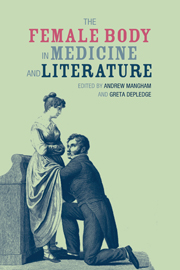
    The Female Body in Medicine and Literature features essays that explore literary texts in relation to the history of gynaecology and women’s surgery. Gender studies and feminist approaches to literature have become busy and enlightening fields of enquiry in recent times, yet there remains no single work that fully analyses the impact of women’s surgery on literary production or, conversely, ways in which literary trends have shaped the course of gynaecology and other branches of women’s medicine. This book will demonstrate how fiction and medicine have a long-established tradition of looking towards each other for inspiration and elucidation in questions of gender. Medical textbooks and pamphlets have consistently cited fictional plots and characterisations as a way of communicating complex or ‘sensitive’ ideas. Essays explore historical accounts of clinical procedures, the relationship between gynaecology and psychology, and cultural conceptions of motherhood, fertility, and the female organisation through a broad range of texts including Henry More’s Pre-Existency of the Soul (1659), Charlotte Brontë’s Villette (1855), and Eve Ensler’s Vagina Monologues (1998). The Female Body in Medicine and Literature raises important theoretical questions on the relationship between popular culture, literature, and the growth of women’s medicine and will be required reading for scholars in gender studies, literary studies and the history of medicine. This collection explores the complex intersections between literature and the medical treatment of women between 1600 and 2000. Employing a range of methodologies, it furthers our understanding of the development of women’s medicine and comments on its wider cultural ramifications. Although there has been an increase in critical studies of women’s medicine in recent years, this collection is a key contributor to that field because it draws together essays on a wide range of new topics from varying disciplines. It features, for instance, studies of motherhood, fertility, clinical procedure, and the relationship between gynaecology and psychology. Besides offering essays on subjects that have received a lack of critical attention, the essays presented here are truly interdisciplinary; they explore the complex links between gynaecology, art, language, and philosophy, and underscore how popular art forms have served an important function in the formation of ‘women’s science’ prior to the twenty-first century. This book also demonstrates how a number of high-profile controversies were taken up and reworked by novelists, philosophers, and historians. Focusing on the vexed and convoluted story of women’s medicine, this volume offers new ways of thinking about gender, science, and the Western imagination.

    Reviews

    An engaging and important book.

    Holly Furneaux Source: University of Leicester

    Refine List

    Actions for selected content:

    Select all | Deselect all
    • View selected items
    • Export citations
    • Download PDF (zip)
    • Save to Kindle
    • Save to Dropbox
    • Save to Google Drive

    Save Search

    You can save your searches here and later view and run them again in "My saved searches".

    Please provide a title, maximum of 40 characters.
    ×

    Contents

    Metrics

    Full text views

    Total number of HTML views: 0
    Total number of PDF views: 0 *
    Loading metrics...

    Book summary page views

    Total views: 0 *
    Loading metrics...

    * Views captured on Cambridge Core between #date#. This data will be updated every 24 hours.

    Usage data cannot currently be displayed.

    Accessibility standard: Unknown

    Why this information is here

    This section outlines the accessibility features of this content - including support for screen readers, full keyboard navigation and high-contrast display options. This may not be relevant for you.

    Accessibility Information

    Accessibility compliance for the PDF of this book is currently unknown and may be updated in the future.
