

Introduction
Movement is an integral part of the interpretation of the archaeological record. Things move, people move, and ideas move within and across land and seas, and we take this movement for granted when interpreting the past (Aldred Reference Aldred2020, 1). This is nowhere truer than for the long-distance movement of objects and materials. It has long been recorded that materials and objects moved over vast distances. Spondylus shell bangles spread across Europe in the Neolithic (Séfériadès Reference Séfériadès, Anthony and Chi2009), while jade moved over thousands of kilometres in Southeast Asia (Hung et al. Reference Hung, Iizuka and Bellwood2007) and obsidian travelled long distances in preclassic and classic Mesoamerica (Aoyama Reference Aoyama2017). Archaeologists are fond of tracing these movements, which has only been amplified with the advancement of biomolecular, isotopic and trace elemental techniques that can provenance where objects and materials originated (Boschetti et al. Reference Barfod, Feveile and Sindbæk2022; Coutu et al. Reference Coutu, Whitelaw, le Roux and Sealy2016; de Kock et al. Reference de Kock, van den Hurk and Dreshaj2024; Demarchi et al. Reference Demarchi, O’Connor and de Lima Ponzoni2014; Drauschke & Banergee Reference Drauschke and Banergee2007; Pion & Gratuze Reference Pion and Gratuze2016). These advancements came in the early twenty-first century, at the same time as globalization that was actually happening, and the zeitgeist surrounding it as a framework proliferated in the humanities (Keohane & Nye Reference Keohane, Nye, Budd, Charlesworth and Paton2006). This may have been a factor in the over-complexity of theorising about past connectivity in this period.
How useful is this mapping of objects if we do not consider their meaning in a nuanced way? As things move across contexts and between people, ideas and perceptions of materials and objects can change in surprising ways that might not meet our expected (modern) perceptions. I propose we can conceptualize these changes in meaning using the transcontextual process as a theoretical tool, while also considering it as a process that took place in the past. The idea of the transcontextual process is that the meaning of long-distance goods is not by default transferred or accumulated, but it is possible to suffer ontological disjuncture in each change of context. This may radically change the meaning and value of materials and objects. The change or difference in meaning in the transcontextual process does not necessarily have to be positive, ‘value’ does not have to increase, meaning does not have to be enriched. This is a conscious move away from ideas of object biography, where the assumption is that meaning is accumulated in an object’s ‘life’ (Gosden & Marshall Reference Gosden and Marshall1999, 169; Joy Reference Joy2009, 541; Kopytoff Reference Kopytoff and Appadurai1986; Peers Reference Peers1999; Whitley Reference Whitley2002), and ideas of a prestige goods economy, where goods are procured, displayed and gifted to increase social rank due to an inherent exoticism (Barrett Reference Barrett, Jones, Pollard, Allen and Gardiner2012, 10; Renfrew Reference Renfrew and Appadurai1986). The case study below illustrates both a loss of prestige and biography.
In the first part of this paper, I will explain the transcontextual process in more detail and some directions for its successful use. I introduce the analogy of a chain as an explanatory tool for the transcontextual process and the use of assemblage theory as a helpful framework for this approach. I will then illustrate the transcontextual process in action. To do this I will discuss the case study of the glass mosaic tesserae found in archaeological excavations in the eight-century emporium at Ribe (Denmark).
Defining the transcontextual process
The transcontextual process is a theoretical tool that can be aligned with new materialist thinking, and more specifically assemblage theory (Crellin Reference Crellin2017; Harris 2017; Reference Harris, Crellin, Cipolla, Montgomery, Harris and Moore2020). Assemblage thinking creates a foundation, allowing the meaning of objects and materials to be deduced across contexts. The premise is that in any context a material or object can be thought of as its own assemblage. These assemblages have diverse agents that include the material or object under consideration, the person who is experiencing it, along with any other agent that helps form meaning in each specific context.
It is the assemblage as a whole that creates the specific contextual meaning; it is possible to equate this to the idea of assemblages being ‘historically constituted’ (Harris Reference Harris, Crellin, Cipolla, Montgomery, Harris and Moore2020, 22–3). Assemblage theory often considers the affects of the assemblage rather than meanings that arise from them (Hamilakis & Jones Reference Hamilakis and Jones2017, 83). When looking for the meaning of objects in context, considering the smaller-scale relations within an assemblage can be productive. If we think of the assemblage as the sum of its relations, then the meaning of such an assemblage must arise directly from these relations. For example, if we consider a person being gifted a shell, the gifting of the shell makes it part of their assemblage. If we are looking for the meaning of the shell, it is the relationship between the shell and the human that is important. The meaning that arises from the relationship between the person and the shell is qualified by other parts of the assemblage, for example, the knowledge of the person. Does the recipient know the shell species, origin and name of the shell? If they do, this will mean the relationship and thus the meaning is different. The person who gifts the shell is also part of this assemblage; if they are friend or foe may affect the meaning that is constructed. This meaning is contextually constituted, highlighting why detailed contextual thinking is important.
Assemblages are always in process (Harris Reference Harris, Crellin, Cipolla, Montgomery, Harris and Moore2020, 20). This process means that the assemblages are all always forming and reforming with different constellations of things (Crellin Reference Crellin2017). This idea of process captures the movement through contexts that objects make and aids the thinking about changing meaning. These assemblages, in which transcontextual materials take part, form and reform as the objects or materials move through contexts (assemblages) or indeed remain static and the other parts of the assemblage change.
The meaning of a material or object can either be a sharp disjuncture from the previous context, or indeed a continuity or enrichment from the meaning that builds up over contexts, or a meaning that was created in the immediately preceding context. Objects and materials must move to do this, and these movements are facilitated by different agents in the contexts they move through (assemblages they take part in). They are constantly going through the transcontextual process, forming and reforming assemblages and relations with different things and people. In essence we are returning the archaeology to the local scale and to materials (cf. Conneller Reference Conneller2011; Haughton Reference Haughton2018; Lucy Reference Lucy, Lucy and Reynolds2002). This grounds modern ‘surprise’ at seeing goods in contexts far away from their source contexts and considers them in their relationship to their context of deposition, rather than knowledge of where they came from (that might not be known). This moves us closer to their contextually constructed past meaning, while keeping the knowledge in mind as a key part of the assemblage.
What is important to remember here is the human agent’s primacy in the creation of meaning. This moves away from the flat ontology that is part of the bundle of assemblage thinking (Harris Reference Harris2017, 129). This links back to the idea that the relationship within the assemblage where meaning is created is that between the material and the human agent with reliance on their knowledge. It is to some degree the human agency that shapes the meaning across and between contexts. This shaping of meaning does not have to mean an increase in significance, just a meaning that is suitable for the moment of exchange. It is this human agency that links together the different contexts (assemblages) within the transcontextual process.
The transcontextual process lends itself to long-distance materials and objects, particularly those that have a single source or a couple of geographically discrete sources. It is goods that have moved long distances that archaeologists enrich with the most meaning and value, hence why the transcontextual process is needed to challenge this. Cowrie shells that appear in graves in early medieval northwest Europe may be a good object for transcontextual consideration (Drauschke Reference Drauschke, Esders, Fox, Hen and Sarti2019; Meaney Reference Meaney1981). The cowries that appear in these graves, predominantly dating from the sixth and seventh centuries, are of specific species that come from the Indian Ocean, Cypraea pantherina and Cypraea tigris (Campbell Pedersen Reference Campbell Pedersen2004, 171–2; Evison Reference Evison1987, 122; Meaney Reference Meaney1981, 123–30). These species are only native to the Indian Ocean but appear in graves thousands of kilometres away. Thinking about them transcontextually within their local assemblage could help to deduce the meaning of these shells, and if their long-distance nature contributed to this.
Materials that have multiple sources also have meanings that are contextually constituted and specific; a good example of this is gold. The material-derived meaning of gold is very different in differing contexts (Conneller Reference Conneller2011, 4–7), but gold has many different exploited sources across the globe (Hirt Reference Hirt and Butcher2020; Ruvalcaba Sil et al. Reference Ruvalcaba Sil, Peñuelas Guerrero, Contreras Vargas, Ortiz Díaz and Hernández Vázquez2009). This means that the meaning developed in a way that is contextually constructed in a particular period, with a known source in mind, rather than a meaning that is constructed when the source is unknown, and thus not involved in meaning creation. Materials like gold do not move across contexts in the same way as materials where the source is not known.
It must also be noted that because the transcontextual process relies on context it is also temporally sensitive, i.e an object could be considered transcontextually in one temporal context, but then not a hundred years later when the temporal context is different. An example of this could be the trade and use of garnets in the early medieval world. In the fifth and early sixth centuries we could think about garnets using the transcontextual process, as the source of garnets in India and Sri Lanka is far from the contexts of deposition (Boschetti, Gratuze & Schibille Reference Boschetti, Gratuze and Schibille2022a; Calligro & Perin Reference Calligro and Perin2019). At the end of the sixth century and into the seventh, the primary source used shifted to somewhere in Bohemia (Boschetti, Gratuze & Schibille Reference Boschetti, Gratuze and Schibille2022a; Calligro & Perin Reference Calligro and Perin2019). This will no doubt have shifted material knowledge as the source moved into some of its main areas of use. The shift likely also had some effect on the meaning of re-used garnets and where they were considered to be from (see English Reference English, Bavuso, Furlan, Intagliata and Steding2024 for other considerations of why garnets may have been reused in early medieval England). This shift probably means we cannot think about garnet transcontextually in the seventh century, but can in the fifth.
Anthropogenic interaction must also be considered in the transcontextual process. Are the things being considered objects, materials, or something between these? Has a piece of material culture that has had anthropogenic interaction been moved for its object value, its material value, or both? The circulation of hacksilver provides a good example of this. Footnote 1 While hacksilver is still recognizable as parts of an object, it is thought to have been moved because of its bullion value; however, it had had meaning beyond its materiality in its object form (Graham-Campbell Reference Graham-Campbell, Graham-Campbell, Sindbæk and Williams2007; Johns Reference Johns1996, 228–9; Kershaw Reference Kershaw2017).
The transcontextual process deals with materials and objects where there is a radical shift in meaning; this does not have to mean an enrichment or accruement in meaning, or indeed an increase in ‘value’. It is often argued in archaeological literature that just because something has travelled far it is speculated to be a ‘prestige good’, supposed to be ‘valuable’, ‘exotic’ or in some way ‘sought after’ (Pydyn Reference Pydyn, Bailey and Mills1998, 99). This is not to say this is not true; some objects in the past do seem to have gained value and meaning due to their long-distance origin. A good example of this may be furs traded to the Islamic caliphate in the eighth century, where the wearers were aware of their origin (Kovalev Reference Kovalev2000, 25–31; Martin Reference Martin1986, 7–8). The transcontextual process does not assume all cases are like this—this would be unwise—but considers meaning to shift or change rather than increase or accumulate by default. There is no direct relationship between distance moved and ‘value’ or meaning (contra Pydyn Reference Pydyn, Bailey and Mills1998, 99).
Using the transcontextual process as an interpretive tool requires us to think about materials, not from our ‘bird’s-eye’ view of the past, Footnote 2 but as materials and objects used by the people living in the past. The use of this bird’s-eye view of the past is common in popular narratives about past ‘globalizations’ and the ‘global middle ages’ that assume just because we can see connections across the globe existed in the past, they were indeed perceived as such in the past (Frankopan Reference Frankopan2018; Hodos Reference Hodos2017; Knappett Reference Knappett and Hodos2017).
These materially specific ideas, of course, vary due to the context in which we are considering. For example, for us, animal bone is a waste product of food preparation rather than the rich source of raw material it was in the past. With regard to material geographies, our knowledge about, for example, coral (Corallium rubrum, commonly known as ‘gemmological coral’) tells us that it comes from shores around the Mediterranean (Bruckner Reference Bruckner, Goffredo and Dubinsky2016, 749; Price & Narchi Reference Price, Narchi, Price and Narchi2015, 73). However, our counterparts in the past could not go to a library, conduct a Google search, or learn in school where the coral for their bead in early medieval Lindsey (Lincolnshire, UK) came from (Leahy Reference Leahy2007). That is not to say that they do not know what coral is. The point is that we cannot make any assumption about shared knowledge, opinions or perception between us and our counterparts in the past, but we often do this with long-distance goods. We construct coral as ‘exotic’ in certain contexts because we know it travelled long distances, but if the origin was not known, how can we say that people in the past considered it as exotic? This highlights the importance of the highly contextual consideration.
The consideration of mobile objects and materials here did not develop in isolation. It comes from the author’s explorations of global approaches to the past (Reference EnglishEnglish forthcoming), but perhaps more importantly this work comes from an inextricable lineage of work considering objects and their relationships with human agents. Object biographical approaches capture the idea that meaning fluctuates in some way. This is framed from its beginnings by Kopytoff (Reference Kopytoff and Appadurai1986) as the commoditization of things. In the approach, things can move in and out of the state of being a commodity and always have the potential to become a commodity unless there is a process of decommodification (Kopytoff Reference Kopytoff and Appadurai1986, 76). Perhaps most pertinent for the transcontextual process is the ‘the fact an object is bought or exchanged says nothing about its subsequent status and whether it will remain a commodity or not’ (Kopytoff Reference Kopytoff and Appadurai1986, 76); this is akin to the idea that meaning changes when it moves from one context to another (when it is exchanged).
Other material culture considerations have dealt unexpected changes in meaning, as the transcontextual process does. Gosden, in ‘What do objects want?’ (Reference Gosden2005), also talks of the need for caution when assuming what people thought of objects in the past. The example used here is the ‘Roman’ identity we ascribe to material culture entering the province of Britannia, and that a Roman-origin specific identity may have not held significance for local users (Gosden Reference Gosden2005, 198–9). An example where this holds true, using another intrusive product, is discussed in Miller’s consideration of Coca-Cola consumption on the island of Trinidad. The popularity of Coca-Cola has little to do with its globalized success and everything to do with the plethora of localisms that Coca-Cola has taken on in this context. These include being made with local sugar and bottled locally by local bottlers, to its place among other ‘black’ sweet drinks on the island (Miller Reference Miller and Miller1998).
Hodder (Reference Hodder2012, ch. 10) equates Gosden’s (Reference Gosden2005) and others’ work on the cultural variability of agents and individuals (what I would describe here as contexts) and what this means for meaning construction to ‘constraining dependencies’ within human–object entanglements. This is a marked difference from the relationship between materials/objects in transcontextual assemblages; knowledge of materials is a much larger constrainer than any effect a material or object has a on a human agent. Gosden’s notion of source has resonance here. Source in Gosden’s context invites the idea that overseas products would have quickly become local, arguing that the effects of material culture should be considered, not the origin (Gosden Reference Gosden2005, 207–9). This is where the ideas perhaps diverge from those presented here, when our present origin of the knowledge must be acknowledged to discover meaning in the past. Gosden also foregrounds the ‘promiscuity’ of plastic materials to be formed into many shapes (Reference Gosden2005, 199). In the context of this, promiscuity invites the disjuncture of knowledge when plastic materials are reformed; the case study below explores a plastic material, glass.
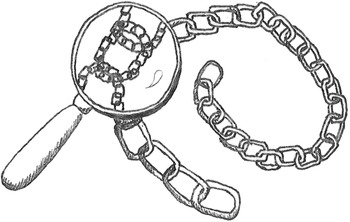
The analogy of a chain can be used helpfully to explain the transcontextual process. We can think of single chain links as the individual assemblages that materials take part in. Each chain link can be thought of as one unit of analysis. This unit of analysis can be used to think of a transcontextual material at any scale, for example, a single object in a grave, a grave as an assemblage, a cemetery, or indeed a distribution of cemeteries across an area. To help think about scale productively, the chain can be thought of as having links that are themselves made up of chain links. A chain is made up of links and can be folded fluidly, akin to the way assemblages fold in and out of each other (Harris Reference Harris, Crellin, Cipolla, Montgomery, Harris and Moore2020, 28).
We can think of the chain itself as the assemblage made up of all the contexts an object or material takes part in. We can think of sections of chain as assemblages, sets of contexts that objects travelled through and formed relations in. The link made of links also reminds us that things take part in multiple assemblages at once, and things in assemblages are in fact their own assemblages (Harris Reference Harris2017). The chain allows us to isolate particular assemblages and see the meaning of transcontextual materials in them, as well as in relation to the links (contexts) that precede and follow them. It is the relationships within each assemblage (chain link) that can provide us with clues to past meaning. The metaphor of a chain also allows us to see the role of human agency within this process. The human agents can be thought of as the agency welding the links of the chain together. The process allows for meaning enrichment, disjuncture, or new meaning creation when the object forms new relations in a new context (assemblage). Figure 1 visualizes the chain analogy for the transcontextual process.
A chain to represent the transcontextual process (the transcontextual chain). Each link represents a context. This is the scale that transcontextual analyses is carried out. This link can be thought of as an assemblage. Each link is made up of its own chain of links, indicating it is made up of its own assemblages. (Drawing: G. Furlan.)

Doing the transcontextual process: transforming glass tesserae in Viking Age Ribe
Now the transcontextual process has been introduced, it is important to show how it might be used. Glass presents an interesting material to consider transcontextually. It is manufactured across the globe, but has different chemical characteristics depending on where it was made (Barfod et al. Reference Barfod, Freestone, Lichtenberger, Raja and Schwarzer2018; Francis Reference Francis2002). This, coupled with the huge array of distinct forms of differing ‘luxury’ along with a high level of mobility, means the transcontextual process is an interesting way to interpret it. Below, the movement of glass mosaic tesserae in the early Middle Ages is considered using the transcontextual process, to illustrate that the ‘bird’s-eye view’ of archaeologists has clouded meaning when considering these objects, assigning them a luxury status they may not have been afforded in the past.
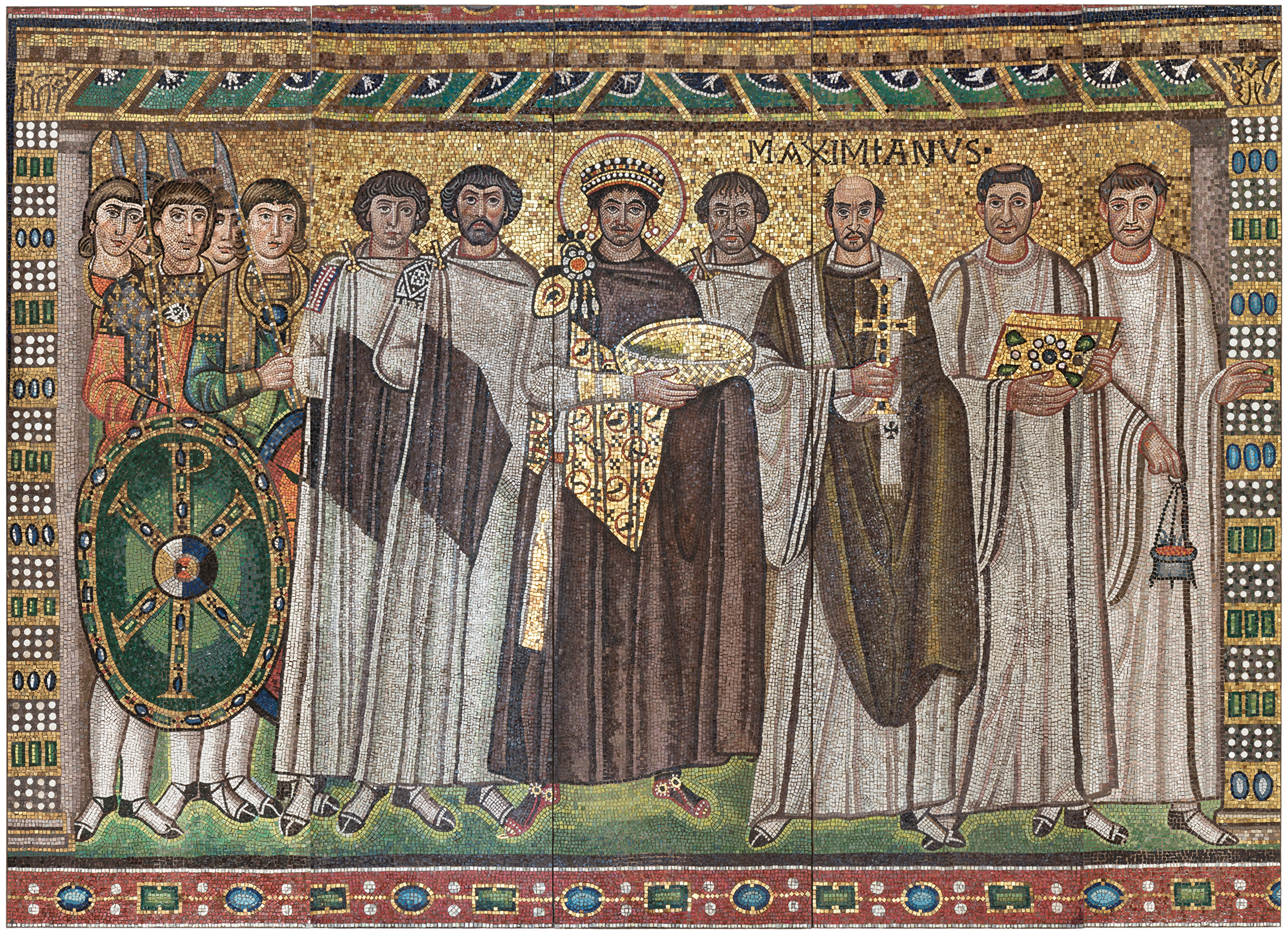
Seldom can an object so small form such beauty as the glass tesserae used for wall and vault mosaics in the Roman and Byzantine worlds. These small rectilinear fragments of glass, usually less than 1 cm square, are the material of the mosaicists who created the wall art, stretching from the Levant to northwest Europe (James Reference James2017; Van Wersch et al. Reference Van Wersch, Versklype, Degryse, Van Wersch, Vesrlype, Strivay and Theuws2019a). Figure 2 shows part of one of these pieces: Justinian and some of his courtiers, in the Basilica of Sant’Apollinare Nuovo, Ravenna, Italy, sixth century ce.
Part of a mosaic from Basilica of Sant’Apollinare Nuovo, Ravenna, depicting the emperor Justinian and members of his court, from the sixth century. The mosaic in this image is a twentieth-century reproduction of the original, accessioned in The Metropolitan Museum of Art, New York City, USA. (Image reproduced using the CC0 licence, accession number 25.100.1a-e.)
‘Due to their use in the decoration of buildings, tesserae can be considered to be luxury goods and their material, glass, is among the “rare things that travelled” and left material traces’ (Van Wersch et al. Reference Van Wersch, Versklype, Degryse, Van Wersch, Vesrlype, Strivay and Theuws2019a, 9). This quotation can be found on the introductory page of Early Medieval Tesserae in Northwestern Europe, leaving the reader in no doubt of how they should consider these objects when they are found in northern Europe, outside their more expected Mediterranean location (Van Wersch et al. Reference Van Wersch, Vesrlype, Strivay and Theuws2019b). This view that recycled architectural glass is a prestige good is also proliferated elsewhere (Van Wersch & Wilkin Reference Van Wersch, Wilkin, Bavuso, Furlan, Intagliata and Steding2024, 47–8). However, can something that has moved so far and is divorced from its original context still draw the idea of luxury from this original context, as this volume suggests? The transcontextual process is perfectly placed to challenge this, thinking about glass tesserae after they have moved far from their original context to see if they have retained their suggested ‘luxury’ meaning.
It is argued here that three discrete contexts are identifiable in the transcontextual chain of glass mosaic tesserae to show how their meaning and value is greatly different once they leave their original context. The first is their context on a wall forming a mosaic; next, their context as a commodity being trade; and finally their context in the process of transformation into a new piece of material culture. Scandinavia’s earliest town, the ‘emporium’ at Ribe, provides the case study of transcontextualized tesserae, with in excess of 8200 excavated examples (Barfod et al. Reference Barfod, Feveile and Sindbæk2022). The quantification here is important for their perception. While c. 8200 were found at Ribe, this number represents two things; first, it represents only a fraction of those that would have gone into an actual mosaic. Footnote 3 Second, it represents only a fraction of those that would have travelled to Ribe; many would already have been remade into new material culture. There are examples of tesserae being used in both vessel and window glass production (Henderson et al. Reference Henderson, Sode, Sablerolles, Van Wersch, Verslype, Strivay and Theuws2019), but their use as the material for beads made in Ribe is what will be considered here (Sindbæk Reference Sindbæk and Sindbæk2023).
The first transcontextual assemblage (link in the chain) under consideration is tesserae on view as part of a wall mosaic. In this consideration, the author has used wall mosaics from late antiquity rather than the ‘Roman’ mosaics that the tesserae used at Ribe were taken from, because the former are the contemporary reference point for glass tesserae at Ribe. Footnote 4 Figure 3 shows an imagined assemblage of glass tesserae when used in a wall mosaic in late antiquity.
A visualization of the transcontextual assemblage, the assemblage from which meaning arises, for a glass wall mosaic in late antiquity. The colours and shapes represent the diversity of the elements that come together to form this assemblage. The red arrow represents the relationship between the viewer and the mosaic scheme, the relationship in which the meaning arises. The other elements of the assemblage work to ‘qualify’ this relationship. (Figure: author.)
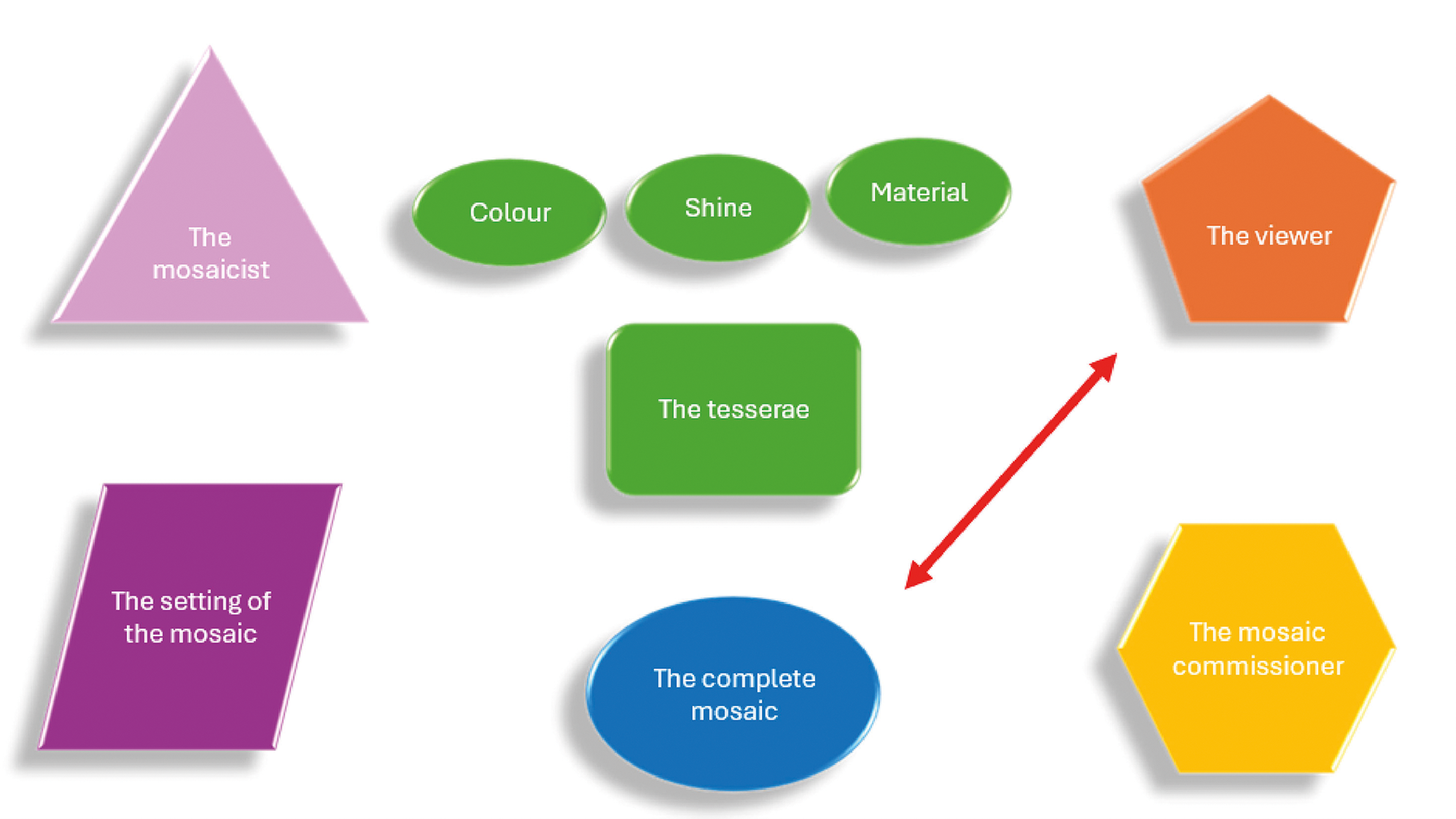
The assemblage shown in Figure 3 is by no means exhaustive, but is enough to help show where meaning arises; it does not come from the glass alone. It is the relationship between the physical mosaic (an assemblage itself) and the viewer that provide its meaning, not a direct relationship between a single tessera and the viewer. This relationship is qualified by the viewer’s knowledge along with the rest of the assemblage. This is evidenced by James’s (Reference James2017, 127) statement that the fact the mosaics were made from glass is seldom mentioned in texts, as glass was not considered a particularly ’precious’ material. This is also reinforced when we think consider James’s (Reference James, Hamarneh and Bianchi2021) consideration of the practicalities of mosaic construction and how much raw material was needed. Tesserae would not have created meaning alone; the meaning is formed when they are viewed on the wall as part of the mosaic.
James (Reference James2017) discusses numerous ideas around the meaning and value of mosaics. One such example is the dazzling visual effects of the mosaic; the colours of tesserae remain secondary to their ability to shine, glitter and be brilliant (James Reference James2017, 127). Their schemes also acted to constitute the buildings that contained them as sacred spaces: these images materialized the ‘holy truth of the Christian message’ (James Reference James2017, 135–6). They also mean something for their patrons, to allow them to be prayed for, with their piety illustrated by these acts of (expensive) patronage (James Reference James2017, 136).
The analysis of James (Reference James2017, ch. 4) suggests that mosaics should be considered in their context, within a building with numerous visual stimuli and discrete spaces. This adds depth to the idea of the setting of the mosaic as part of the transcontextual assemblage. Other spatial factors may also have been at play around the mosaic setting, such as the physical space of the church and how this mediates the relationship, and therefore meaning, between the viewed and the viewer (James Reference James, Veikou and Nilsson2022). In the mosaic on the wall, the meaning of the tesserae is drawn from the art which it constitutes and the context it both helps to form and exists within. In the subsequent parts of the transcontextual chain, it will be illustrated that this meaning was lost, and meaning came from other contextually specific elements, with its ‘value’ diminished from being on a wall in a mosaic.
The second link in the chain is when the mosaic was in decline, and the tesserae become a trade good to be moved. This is a drastic change from the walls of a high-status or sacred building. For this to happen, the tesserae somehow become detached from the wall. This realistically could have happened two ways: the removal of tesserae from deserted structures with decaying mosaics, or indeed the purposeful removal of tesserae from standing structures e.g. for renovation (Boschetti et al. Reference Boschetti, Lichtenberger, Raja, Wootton and Schibille2021, Reference Boschetti, Kindberg Jacobsen, Parisi Presicce, Raja, Schibille and Vitti2022b; James Reference James, Hamarneh and Bianchi2021, 40–41).
There have been some suggestions that glass tesserae may have been made specifically for export for use as ‘raw’ glass, and never made it into a mosaic. The analysis from Ribe works to disprove this, with only one tessera being of a contemporary ‘Byzantine’ type; the rest are Roman period natron glass (Sindbæk Reference Sindbæk and Sindbæk2023, 248). Footnote 5 White glass beads are made from gold in glass tesserae; a product with a complex manufacturing process (Henderson et al. Reference Henderson, Sode, Sablerolles, Van Wersch, Verslype, Strivay and Theuws2019, 70–71; Van Wersch & Wilkin Reference Van Wersch, Wilkin, Bavuso, Furlan, Intagliata and Steding2024, 45–7). These objects, more expensive to produce, would surely not bypass a wall mosaic and go straight onto the market as an export for secondary processing. There may also be the possibility that ‘overstock’ mosaic tesserae may have been commodified for other uses (Barfod et al. Reference Barfod, Feveile and Sindbæk2022), but there is little archaeological evidence that could be used to test this theory. The movement of tesserae did not always mean they were all recycled, as with the case of the transport of tesserae from Ravenna to Aachen, which show a transfer of power rather than economic sensibility (Van Wersch & Wilkin Reference Van Wersch, Wilkin, Bavuso, Furlan, Intagliata and Steding2024, 46).
This transcontextual assemblage is a little harder to pin down as tesserae are ‘on the move’, but there are some things that can be said about them in this context. Henderson et al. (Reference Henderson, Sode, Sablerolles, Van Wersch, Verslype, Strivay and Theuws2019, 90) suggest that the Frisian networks in the early eighth century are the reason that tesserae make it to Ribe so easily and that trans-shipment in Dorestad with the involvement of Lombardic traders, who had been recycling glass tesserae since the fifth and sixth centuries, is a likely reconstruction of the situation. There is no direct evidence for Lombardic traders being at Dorestad; however, there is record of them travelling into the interior of Europe to sell goods, as has been recorded with their attendance at the famous fair at Saint-Denis as early as 629 (Hutchinson Reference Hutchinson1902, 416). There is, however, textual attestation in the letters of Saint Boniface of multiple pilgrims would have travelled this route between Frankia and the Italian peninsula (Rome). This is clear in the letter of abbess Eangyth and her daughter Heaburg to Boniface, c. 719–722, asking for his advice on a pilgrimage to Rome ‘as many of our friends, both relatives and strangers, have done’ (Saint Boniface, letter VI, 38). Thus, this route was seemingly one well travelled in the eighth century.
In this transcontextual link, it could be argued that there are two different constellations of assemblage that form meaning. For the Lombardic traders who would have known more about the original context, they likely had an idea of the splendour that the tesserae once held, which no doubt was held in mind when selling these goods. They may have taken them from mosaics themselves or obtained them from those decommissioning mosaics. This is in comparison to the Frisian traders, who knew of the tesserae in terms of their demand from the glass workers within their networks. They did not see them as the building blocks of art, but as a commodity with a value further north. These different agents in broadly similar assemblages show us how meaning was likely constructed in two different ways.
The final transcontextual link in which to consider these tesserae is in the manufacturing process in Ribe, and thus the transformation of tesserae to glass bead. Beadmaking at Ribe was on a huge scale, with Ribe-type beads found all over southern Scandinavia (Henderson et al. Reference Henderson, Sode, Sablerolles, Van Wersch, Verslype, Strivay and Theuws2019; Sindbæk Reference Sindbæk and Sindbæk2023). Recent excavations at Ribe, as part of the Northern Emporium Project, provide the evidence on which this case study is built (Croix et al. Reference Croix, Deckers, Feveile and Sindbæk2022; Sindbæk Reference Sindbæk and Sindbæk2022). The project excavated at least two glass working workshops, that were part of a series for changing single and multi-craft contexts in the same house over fifteen phases and two centuries (Croix et al. Reference Croix, Deckers, Feveile and Sindbæk2022; Sindbæk Reference Sindbæk and Sindbæk2023, 239). Phases F5, F7, and F9 all have evidence of beadmaking at Ribe, and all contain the evidence of glass tessera (Croix et al. Reference Croix, Deckers, Feveile and Sindbæk2022; Sindbæk Reference Sindbæk and Sindbæk2023, table 13.2). Excavations of the Northern Emporium Project at Posthustorvet produced 3610 tesserae and 3843 glass beads (Sindbæk Reference Sindbæk and Sindbæk2023, table 13.1), out of a corpus of c. 8200 tesserae and 9500 beads from contexts across Ribe (Barfod et al. Reference Barfod, Feveile and Sindbæk2022, 2–3). The glass craftspeople in Ribe were only secondary workers of glass, predominantly recycling tesserae and vessel glass; no raw glass production took place on the site (Barfod et al. Reference Barfod, Feveile and Sindbæk2022).
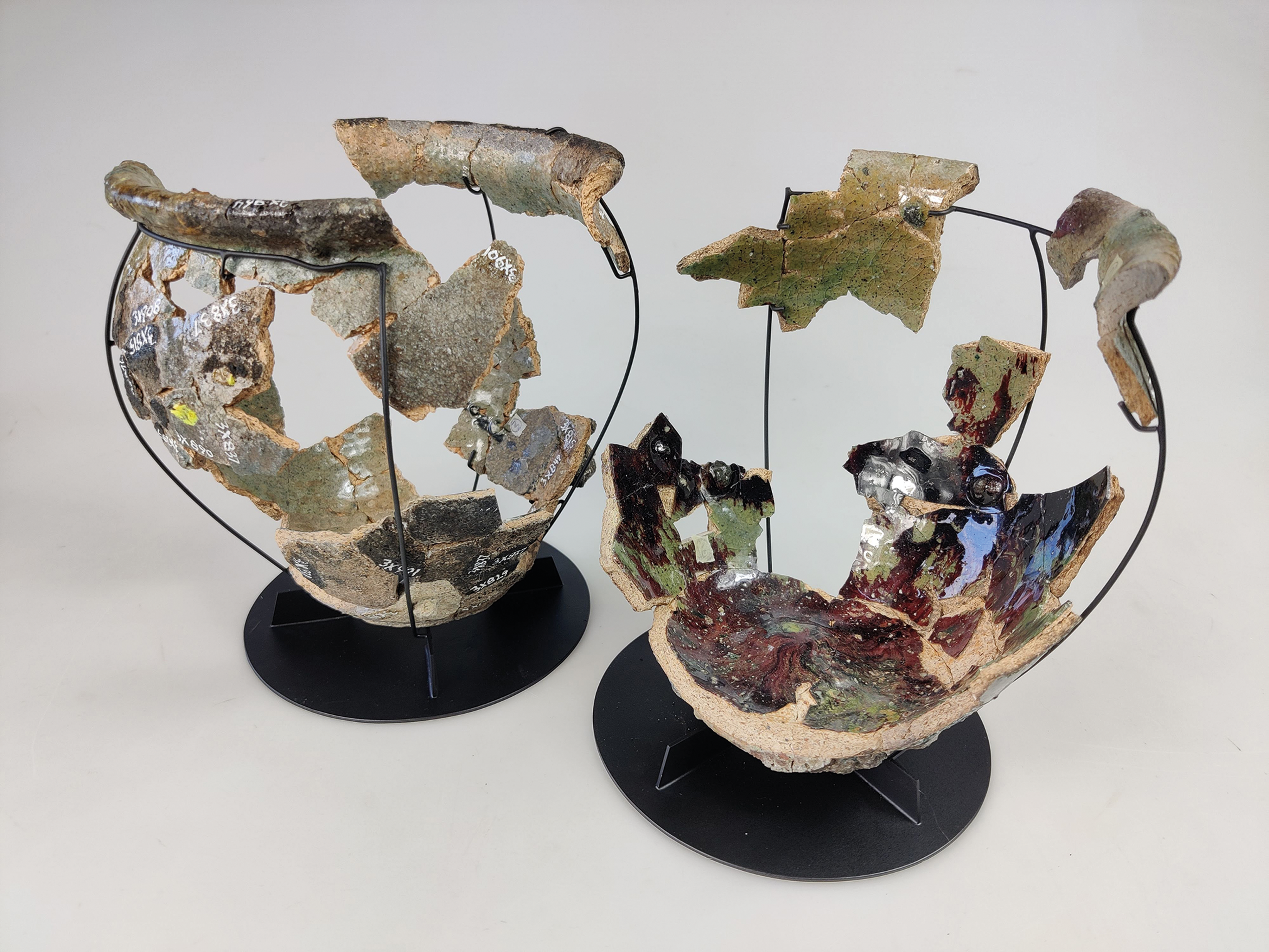
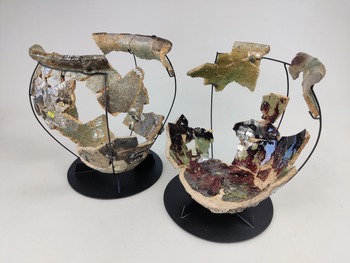
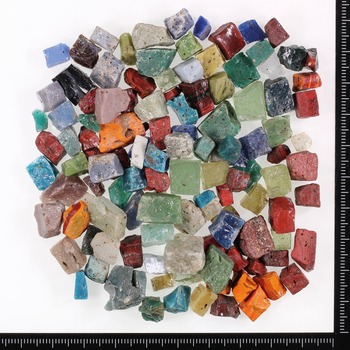
Figure 4 shows the most compelling evidence for the melting of glass at Ribe: two crucibles with the remains of glass flux. These crucibles would have been used to melt the tesserae for their transformation into beads (Barfod et al. Reference Barfod, Feveile and Sindbæk2022; Sindbæk Reference Sindbæk and Sindbæk2023, 243). Figure 5 shows glass tesserae excavated at Posthustorvet, Ribe. The tesserae in this link get their meaning in Ribe not from what they were, a commodity or part of a mosaic, but what they will become, glass beads that are in high demand. The transcontextual process can capture this time of transition well as it uses the constantly-in-process of assemblage theory.
The pair of glass-making crucibles excavated from Posthustorvet, Ribe, Denmark. These crucibles have a dense fabric, indicating that they were likely imported for the purpose of glass bead making at Ribe. (Image from Sindbæk Reference Sindbæk and Sindbæk2023, credit Museum Vest.)
A collection of tesserae that were excavated from Posthustorvet, Ribe, Denmark. (Image from Sindbæk Reference Sindbæk and Sindbæk2023, credit Museum Vest.)

Figure 6 shows a visualization of the transcontinental assemblage of glass tesserae as they would have existed in a workshop in eighth-century Ribe (Croix et al. Reference Croix, Deckers, Feveile and Sindbæk2022, 100–101). There is a huge disjuncture of meaning here from the tesserae that formed the divine art on walls across the Mediterranean. The tesserae in Ribe are far from any mosaic, glass or otherwise. There was no local cultural reference point for these mosaic pieces in Ribe. This likely would have been different in a different context, England for example. Footnote 6
A visualization of the transcontextual assemblage of glass tesserae in a workshop in Ribe, Denmark. The colours and shapes represent the diversity of the elements that come together to form this assemblage. The red arrow represents the relationship in which meaning is formed, with the other elements working to ‘qualify’ this relationship. (Figure: author.)

However, the community at Ribe was likely a cosmopolitan one, made up of travellers from both land and sea (Sindbæk Reference Sindbæk and Sindbæk2022). Some among this well-travelled and ever-changing constellation of people may have moved through Rome, Ravenna, or Milan and observed such mosaics; or, on the other hand, they may not. The unanswerable question remains; was the cross-contextual ontological leap made between the spectacular wall mosaics and the disassociated cubes destined for the glass maker’s furnace? The remains of mortar on some tesserae from Ribe may have been helpful to make this ontological connection (Henderson et al. Reference Henderson, Sode, Sablerolles, Van Wersch, Verslype, Strivay and Theuws2019), but it is still argued here that this was highly unlikely, especially considering the above arguments that they had already taken on a different meaning in their removal from the mosaic, and their change in meaning from artist’s tool to ‘raw material’ commodity. There is, however, the possibility that these objects could have had some sort of ‘Roman-ness’ attached to them, passed by human agents in the chain. This has been argued to be the case for some of the motifs with classical elements from casting moulds of two-dimensional figures, also excavated at Posthustorvet (Deckers et al. Reference Deckers, Croix and Sindbæk2021).
Returning to Figure 6, the assemblage is very different from that illustrated in Figure 3. The physical material nature of the glass is all that has stayed the same. The relationship between the craftsperson and the tesserae is where the meaning and value form in this transcontextual assemblage, with all of the other parts being the qualifiers of this meaning. The skill of the craftsperson is also very important in this assemblage, otherwise the bead could not be formed; and thus the tesserae would have no meaning in this context.
The evidence from Ribe suggests that different batches of tesserae arrived at the site with differing amounts of each colour of tesserae (Sindbæk Reference Sindbæk and Sindbæk2023, 246–7); the demand for particular colours was likely not communicated to traders back down the line, but the craftspeople got what they were given. This creates a further reliance on the skill of the craftspeople: they had to create colours that were needed for the beads that the consumers demanded, from the tesserae they were given (Barfod et al. Reference Barfod, Feveile and Sindbæk2022; Sindbæk Reference Sindbæk and Sindbæk2023). This is further reflected in the use of the ‘luxury’ gold in glass tesserae, with their complex manufacturing process, being used to make white glass beads, showing further disregard for the ‘luxury’ of these objects (Barfod et al. Reference Barfod, Feveile and Sindbæk2022).
The tesserae, then, are totally devoid of their original meaning in this final context. Not even their colour, that was important in the forming of the scheme of the mosaic, withstood the transcontextual process. It is their glassy nature that makes them important in Ribe, a material nature which saw little bearing on meaning creation in their original context on the wall of a building.
The transformation of ‘raw material’ tesserae in Ribe to glass beads invites new possibilities for transcontextualization and deduction of meaning. The tesserae are transformed into so-called ‘Ribe beads’ with a huge range of chronologically changing types encompassed in this group (Barfod et al. Reference Barfod, Feveile and Sindbæk2022). These beads can be associated with several of Callmer’s (Reference Callmer1977) bead types (Groups Bf & Bk) (Barfod et al. Reference Barfod, Feveile and Sindbæk2022). These beads were moved across southern Scandinavia (Callmer Reference Callmer, Glover, Brock and Henderson2003), to be predominantly placed in female graves in different constellations, combining beads of different materials and origins (long-distance imported, Scandinavian, glass, stone) (Sindbæk Reference Sindbæk and Donnellan2020). While there is not space here to complete a full transcontextual consideration of a furnished grave assemblage, these graves contain a multitude of materials and objects that work together to construct each other’s meaning within the grave. I would argue this type of assemblage is one where the transcontextual process could be used well.
These beads are far abstracted from their previous form as tesserae on the wall of a church in the Mediterranean basin in multiple ways. It is unthinkable that in their own onward circulation across southern Scandinavia these beads would have carried their origin with them; they had so much more to offer than that. Colour may be one interesting point of departure to consider as an alternative to their origin for a reference point in meaning construction. Colour in the beads of the Viking Age has been recently explored by Delvaux (Reference Delvaux2018), using the corpus from the emporium in Hedeby (Schleswig-Holstein, Germany). The bead corpus from Hedeby can be explored further with the transcontextual process. There is a difference in bead assemblages from different areas at Hedeby. There wasa greater colour range of beads in the cemetery than in the trader’s bag of beads from the harbour (Delvaux Reference Delvaux2018). This perhaps tells us something about how funerary bead assemblages come together (Sindbæk Reference Sindbæk and Donnellan2020), and thus how meaning may be formed within them. This allows for ideas of various sources and heirloom objects to be considered in these assemblages, allowing for contextual meaning creation at this small level. The later import of beads to Ribe (after 800 ce) (Sindbæk Reference Sindbæk and Sindbæk2022) would have removed some of this colour control that artisans had when making beads from imported tesserae, and would likely have had an effect on the meanings of colours to their consumers.
Above, the transcontextual process has been used as a theoretical tool to interpret early medieval glass mosaic tesserae as they made their journey from splendorous mosaics on the walls of buildings on the shores of the Mediterranean to the shores of the North Sea, at the Emporia of Ribe where they are used as the ‘raw’ material for the glass manufacture of the eponymous Ribe-type beads.
Although it has previously argued that these tesserae represent rare objects that took part in luxury trade in this period (Van Wersch et al. Reference Van Wersch, Vesrlype, Strivay and Theuws2019b), it is argued here that, using the transcontextual process, we can see that tesserae did not retain the status that their original context afforded them. There is a huge disjuncture in meaning as they returned to a ‘raw’ material that was enriched again with meaning by being transformed into glass beads. These glass beads were a totally different piece of material culture to a wall mosaic, and were interacted with in a completely different way. Different aspects of the tesserae’s material nature were picked out a different points. For example, their material nature as pieces of glass has little bearing on the meaning created by mosaics in this period, but is integral to their meaning in Ribe, where they are use as a ‘raw material’ in glass bead production. Looking at tesserae in these differing contexts has also illustrated the role of the human agent and their knowledge in the transcontextual process. The viewers of the mosaic, the traders and the craftspeople at Ribe are all key parts of the assemblage that influence and create meaning.
Conclusion
The transcontextual process is both something that happened in the past and something we can do as archaeologists. As archaeologists, we can think transcontextually to help get closer to what people thought of materials at different contextual levels, using assemblage theory as a helpful framework. In the past, things moved across contexts and their meaning and associated value changed. What I have proposed in this work is a new way to consider the movement of material and objects where others have fallen short. The transcontextual process allows us to consider hyper-mobile materials that, to our modern eyes, look out of place or ‘exotic’. The simple conception of meaning related to distance travelled that is common in archaeological literature is discarded, along with our modern knowledge and bird’s-eye view of the past. This is in favour of thinking about objects in context. Above all, the transcontextual process illustrates that meaning is highly contextually constituted, where origin and our supposed value do not matter.
The example of the movement of glass mosaic tesserae in the early medieval period was used to illustrate the utility of the transcontextual process. The tesserae show us that just because something is of high value in its original context, it does not mean it retains its value in the context it ends up in, and that its value is far more entangled with its contextual perceptions of its use, value and meaning. Materials and objects do not have to have value or meaning just because they have travelled long distances; these skewed interpretations come from our modern reading of the past and the lack of hyper-contextual consideration. If we look closely at the links of the transcontextual chain, we can move closer to the real meaning of long-distance trade goods in the past.
Acknowledgements
I would like to thank Liv Nilsson Stutz and the rest of the participants of the DIALPAST ‘writing a successful journal article’ course for their suggestions that helped clarify my articulation of this theoretical approach. Christopher Loveluck and Søren Sindbæk are also thanked for comments on the theoretical approach as well as for helpful guidance on contextual aspects of the case study. I would also like to thank the rest of my UrbNet colleagues who have listened to me present this theoretical approach and discussed it with me, particularly, Guido Furlan for helping me visualize the transcontextual process. I also thank Søren Sindbæk for providing Figures 4 and 5. This work was funded by the Danish National Research Foundation under grant DNRF-119 Centre for Urban Network Evolutions (UrbNet), a grant held by Rubina Raja. The author completed revisions of this text while employed on the Carlsberg Foundation project Milestone, a grant held by Sarah Croix (CF24-2023).




 Open access

