

Introduction
Environmental sustainability is a challenge in modern times. Different factors are disturbing the environment, but climate-harming factors such as manufacturing units and bad environmental practices are key factors that are disturbing the sustainability of the environment (Peschl et al. Reference Peschl, Deng and Larson2021). Different initiatives are taken every year to protect the environment by different countries, but the implementation of these policies is important (Al-Rahmi et al. Reference Al-Rahmi, Yahaya, Alamri, Alyoussef, Al-Rahmi and Kamin2021). The success rate of implementation of environmental policies is less than 10%, which is a big challenge in terms of environmental growth (Chien et al. Reference Chien, Kamran, Nawaz, Thach, Long and Baloch2022). Those countries that pay little attention to improving the sustainability of the environment are required to develop better approaches to environmental advancement. The relationship between sustainability factors and environmental sustainability can be improved when the public has a positive approach to achieving environmental sustainability (Hameed and Irfan, Reference Hameed and Irfan2019).
Environmental education and entrepreneurial education are keenly required for Chinese students to improve their environmental behaviour (Lv et al. Reference Lv, Chen, Sha, Wang, An, Chen and Huang2021). Those students who have an entrepreneurial education go into business to support the community and society. However, a limited number of students are highly motivated by green entrepreneurial activities to advance environmental sustainability (Naz et al. Reference Naz, Oláh, Vasile and Magda2020). This is due to a lack of awareness among the students regarding the environmental issues that are harming their behaviour for the sustainability of the environment. When the students are motivated to achieve the goals of sustainability, they also require the necessary information that helps them achieve the goals (Bahmani et al. Reference Bahmani, Farmanesh and Khademolomoom2023).
Despite increasing global emphasis on sustainability, achieving environmental sustainability and generating business opportunities through green entrepreneurship remains a critical challenge (Martínez-Falcó et al. Reference Martínez-Falcó, Sánchez-García, Marco-Lajara and Zaragoza-Sáez2025; Yasir et al. Reference Yasir, Babar, Mehmood, Xie and Guo2023). Many entrepreneurs lack the motivation or awareness to align their behaviour with green principles (Prabowo et al. Reference Prabowo, Ikhsan and Yuniarty2022). The integration of Sustainable Development Goals (SDGs) into entrepreneurial activities is often limited or poorly understood (Benavides-Sánchez et al. Reference Benavides-Sánchez, Moya-Clemente and Ribes-Giner2025). As a result, green entrepreneurship is not fully leveraged as a driver of sustainable outcomes. This gap restricts progress toward environmental sustainability and the creation of innovative green business ventures. Furthermore, there is insufficient empirical evidence on how entrepreneurial behaviour, influenced by SDGs, can promote green entrepreneurship. Addressing this issue is essential to unlock its potential for both ecological preservation and economic growth. However, the implementation of sustainability goals can help people achieve environmental sustainability.
Although the link between entrepreneurship and sustainability is gaining attention (Asad et al. Reference Asad, Fryan and Shomo2025; Benavides-Sánchez et al. Reference Benavides-Sánchez, Moya-Clemente and Ribes-Giner2025; Gerasimov et al. Reference Gerasimov, Sharafutdinov, Kolmakov, Erzinkyan, Adamenko and Vasilyeva2019; W.U. Hameed et al. 2020; Mawardi et al. Reference Mawardi, Noor, Edityastono, Atikah Zulkiffli and Mashahadi2025), limited research explores how entrepreneurial behaviour directly influences green entrepreneurship. Existing studies often overlook the moderating role of SDGs in this relationship (Al-Mamary Reference Al-Mamary2025; Soonsan et al. Reference Soonsan, Prasankarn, Tanticharatwarodom, Prasankarn and Jumani2025). Likewise, the influence of green entrepreneurship on achieving environmental sustainability and creating business opportunities remains underexplored. There is a lack of empirical evidence connecting these variables with an integrated framework. Few studies focus on how SDGs can strengthen the entrepreneurial drive toward environmentally responsible ventures (Krara et al. Reference Krara, Alzubi, Khadem and Iyiola2025; Yoruk et al. Reference Yoruk, Johnston, Maas and Jones2022). This gap highlights the need for comprehensive research to understand and enhance green entrepreneurial practices.
This study focused on Beijing, as a rapidly developing urban centre which faces intense environmental pressures (Han et al. Reference Han, Guo, Zhang, Zhang and Cui2021) alongside strong policy support for green innovation. Its unique position as China’s political and economic hub makes it a prime location to study the influence of SDGs on green entrepreneurship. The extensive industrialization in Beijing means environmental issues are increasing, a fact that motivated this study to address environmental issues (Cui Reference Cui2022). Unlike many other regions, Beijing offers a mature entrepreneurial ecosystem with targeted sustainability initiatives. This context provides distinct insights that may not be generalized to less developed or differently governed regions. Therefore, this study selected Beijing owing to rising concern regarding environmental pressures and increasing economic activities.
Existing studies in the literature explored the importance of entrepreneurial behaviour for Chinese students. The study by I. Hameed et al. (Reference Hameed, Zaman, Waris and Shafique2021) reported that entrepreneurial behaviour can be a significant factor in encouraging students to start businesses. Furthermore, research by Munawar et al. (Reference Munawar, Yousaf, Ahmed and Rehman2023) showed that the entrepreneurial behaviour of students helps them achieve sustainability in their work. Meanwhile, Alvarez-Risco et al. (Reference Alvarez-Risco, Mlodzianowska, García-Ibarra, Rosen and Del-Aguila-Arcentales2021) reported that when students receive entrepreneurial education (Makuya and Changalima Reference Makuya and Changalima2024; Mambali et al. Reference Mambali, Kapipi and Changalima2024; Wang et al. Reference Wang, Liu and Zhang2024), it is necessary to influence their entrepreneurial behaviour so that it can advance their work for sustainability in the market. On the other hand, Yi (Reference Yi2021) highlighted that a good success rate of entrepreneurial behaviour for students is possible when they have appropriate resources to advance their work. Those students who want success and financial independence should improve their entrepreneurial skills to achieve their goals. These studies have explored the different dimensions of Chinese students’ entrepreneurial behaviour, but the problem of green entrepreneurship in students’ entrepreneurial behaviour has not been addressed.
This study offers a clear theoretical contribution by integrating entrepreneurial behaviour, SDGs, and green entrepreneurship into a unified framework, highlighting their combined effect on environmental sustainability and business opportunities. It fills a gap in the literature by empirically examining the mediating role of SDGs, which has been largely overlooked. Practically, the study provides actionable insights for policymakers and entrepreneurs to design strategies that foster sustainable ventures. It also informs regional planning by illustrating how urban centres such as Beijing can lead green innovation. Overall, the research contributes to both theory and practice by linking sustainability with entrepreneurship-driven growth. To contribute to the literature for theoretical knowledge advancement and practical policy implementation, this study has the purpose of determining the direct impact of the entrepreneurial behaviour of the students on green entrepreneurship. Meanwhile, this research also tests the moderating role of sustainable development goals in students’ entrepreneurial behaviour and green entrepreneurship. On the other hand, the study has examined the direct impact of green entrepreneurship on environmental sustainability and on creating business opportunities. This research is addressing a novel gap in the literature, and the model of this research is itself a noteworthy contribution to the body of knowledge. Smart PLS 3.0 is used as a statistical analysis tool for this research, based on data collected with a random sampling technique. The results of this research are critical for theoretical and practical implications, but some limitations of this research are also highlighted in future directions. This research is divided into different sections, including an introduction, literature review, methodology, data analysis, discussion, implications, and future directions.
While this study is empirically grounded in the context of China, its implications extend well beyond national boundaries and hold strong global relevance. Environmental degradation, climate change, and resource depletion are universal challenges faced by both developed and developing economies. Universities worldwide are increasingly recognizing the importance of embedding sustainability and entrepreneurial education within their curricula to encourage students to create environmentally responsible innovations.
According to the United Nations Environment Programme (UNEP) and the Global Entrepreneurship Monitor (GEM), green entrepreneurship has emerged as a vital pathway for achieving the Sustainable Development Goals (SDGs), particularly SDG 8 (Decent Work and Economic Growth), SDG 9 (Industry, Innovation, and Infrastructure), and SDG 13 (Climate Action). By examining how students’ entrepreneurial behaviour influences green entrepreneurship, this study contributes to a broader understanding of how young individuals can drive sustainability transitions in diverse socio-economic contexts.
Review of Literature
In the context of our conceptual model, entrepreneurial behaviour represents an intangible resource, reflecting individual knowledge, skills, and an innovative mindset that contribute to firm capabilities. Green entrepreneurship functions as a dynamic capability (Hällerstrand et al. Reference Hällerstrand, Reim and Malmström2023), enabling entrepreneurs to reconfigure their resources in response to sustainability demands (Adam et al. Reference Adam, Abdullah, Maruhun, Anwar and Salin2022). The SDGs act as an external framework that guides the strategic alignment of these internal resources toward sustainable outcomes. The outcomes, such as environmental sustainability and business opportunities, are viewed as performance advantages gained through the effective deployment of these resources and capabilities. Thus, the model aligns well with RBV by illustrating how intangible resources and dynamic capabilities drive sustainable competitive advantage. Furthermore, the theory of planned behaviour (TPB) is another important theory (Jain et al. Reference Jain, Singhal, Jain and Bhaskar2020; La Barbera and Ajzen Reference La Barbera and Ajzen2020) which supports the framework of the current study. The TPB explains that entrepreneurial behaviour is driven by intention, which is shaped by attitudes, subjective norms, and perceived behavioural control (Lihua Reference Lihua2022; Lortie and Castogiovanni Reference Lortie and Castogiovanni2015). Positive attitudes toward environmental sustainability motivate entrepreneurs to adopt green practices. Supportive social norms encourage eco-innovative ventures that align with sustainability goals. High perceived control empowers entrepreneurs to seize sustainable business opportunities, fostering both environmental and economic benefits.
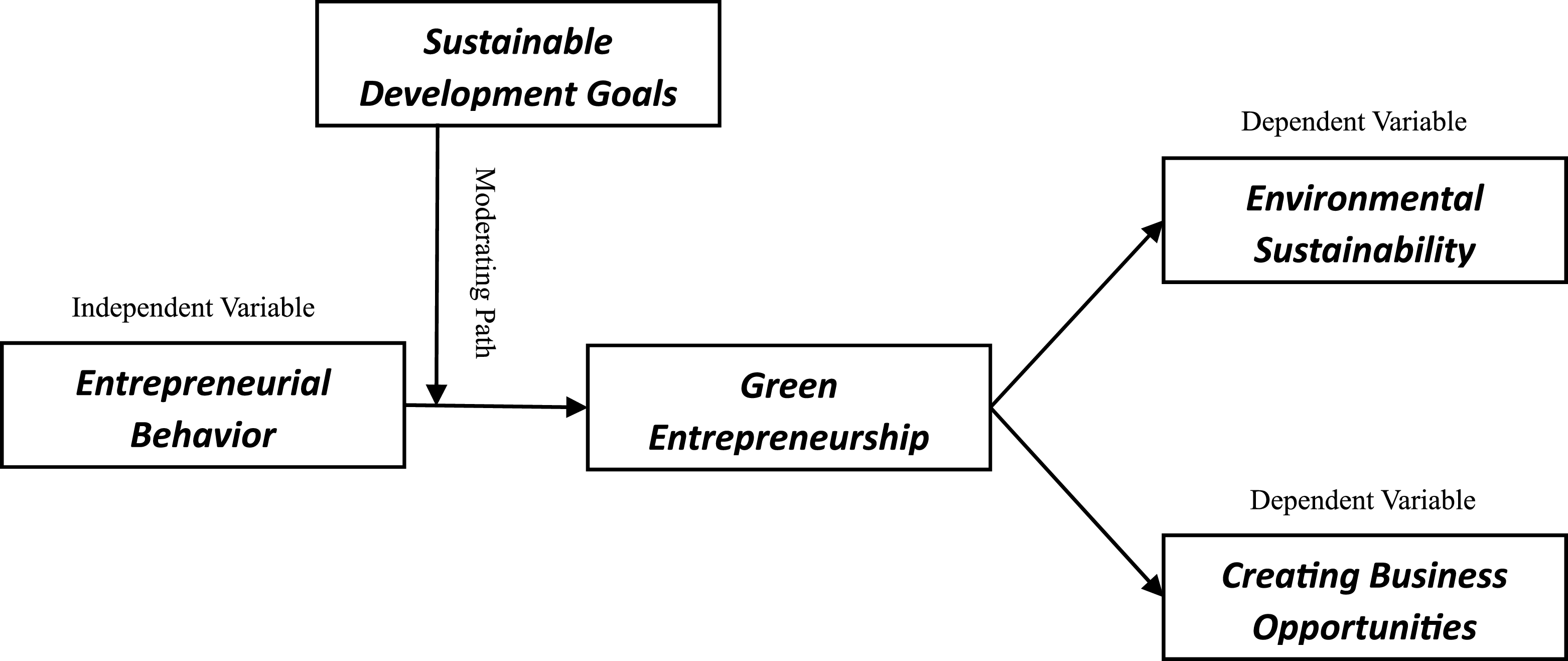
Resource-based view theory highlights that change is based on available resources. Indeed, the appropriate resources are required to conduct any change in the organization and human behaviour. Organizational practices and employees’ motivation are also influenced by resources. The available resources are appropriate to influence human behaviour with significant resources. In this way, the organizations are achieving sustainability for the environment based on the available resources. When there is no resource for any organization, the organizational practices are disturbed. This research model shown in Figure 1 is also based on a resource-based view. This study has considered environmental sustainability and how creating business opportunities can be possible with green entrepreneurship. This study conceptualized these relationships as being tested with statistical data. Furthermore, this study has considered environmental behaviour as an antecedent for green entrepreneurship. This relationship is also required to be tested with empirical data. However, the study has introduced sustainable development goals as the moderating variable between entrepreneurial behaviour and green entrepreneurship to advance the literature on green entrepreneurship.
Research model.

Green entrepreneurship has become a necessity in modern times. The purpose of green entrepreneurship is to achieve sustainability in the environment (B.A. Soomro et al. Reference Soomro, Mirani, Sajid Ali and Marvi2020). The requirements are changed when people have innovative behaviour to start their business in the market. The innovative approach of the students is leading them to start entrepreneurial businesses that can help them to achieve sustainability in the environment (Ye et al. Reference Ye, Zhou, Anwar, Siddiquei and Asmi2020). Green agendas are required to be followed accordingly because the sustainability of the environment is necessary to improve working opportunities. Many people who are motivated to achieve their goals for the sustainability of the environment are required to follow the standard and establish policies (Habib et al. Reference Habib, Bao and Ilmudeen2020). The modern entrepreneurial firms of the students should be for entrepreneurial advancement, as the advancement in business can provide a way to serve society. The training of students in entrepreneurial workshops can provide them with an opportunity to improve their entrepreneurial behaviour (Muangmee et al. Reference Muangmee, Dacko-Pikiewicz, Meekaewkunchorn, Kassakorn and Khalid2021). The access of students to green training for entrepreneurship can motivate them to start their entrepreneurial businesses in the market. The stability of any business is possible when the right management is working to achieve entrepreneurial goals (Huang et al. Reference Huang, An, Wang, Chen, Wang and Wang2021). Access to green information and green behaviour helps entrepreneurs to achieve entrepreneurial stability. Awareness related to the environment is necessary for entrepreneurs to make sure they are working to achieve sustainability in the environment (S.-H. Chang et al. Reference Chang, Shu, Wang, Chen and Ho2020). The access of students to entrepreneurial information can provide them with a way forward to achieve sustainability in the market. The success of an entrepreneurial business can be achieved when strategic planning is appropriate to achieve sustainability in the business (Barba-Sánchez et al. Reference Barba-Sánchez, Mitre-Aranda and del Brío-González2022). The green working behaviour helps entrepreneurs to develop a productive approach to get sustainably and improve their work. Access to entrepreneurial opportunities for the students can be a way forward to working on green sustainability.
Moreover, entrepreneurial behaviour, characterized by innovation, proactiveness, and risk-taking, plays a vital role in shaping green entrepreneurship (Alkahtani and Nordin Reference Alkahtani and Nordin2020; Corrêa et al. Reference Corrêa, Queiroz, Cruz and Shigaki2022). According to the RBV, such behaviours are intangible resources that foster unique as well as sustainable business strategies. Entrepreneurs who exhibit environmentally conscious behaviour are more likely to identify and exploit the green opportunities (C.H. Chang et al. Reference Chang, Shih and Peng2022). These individuals tend to integrate ecological considerations into their decision-making procedures, leading to ventures that align with sustainable goals. The literature supports that proactive and innovative entrepreneurs are more inclined to develop environmentally friendly solutions (Kickul and Gundry, Reference Kickul and Gundry2002; Liu et al. Reference Liu, Ko, Ngugi and Takeda2017), thereby establishing a direct link between entrepreneurial behaviour and the practice of green entrepreneurship. Consequently, the following hypothesis is proposed:
H1: There is a relationship between entrepreneurial behaviour and green entrepreneurship.
Environmental sustainability can be achieved when the goals of entrepreneurial firms are to improve business performance with green directions (I. Hameed et al. Reference Hameed, Zaman, Waris and Shafique2021). The reliability of business management and performance is possible when strategic actions are taken to improve entrepreneurial business. The reliability of business advancement in the market is possible when people have a suitable working behaviour (Qazi et al. Reference Qazi, Qureshi, Raza, Khan and Qureshi2020). Many people who are involved in entrepreneurial businesses have taken strategic actions to contribute to the environment. The establishment of a business in a green way can be a possible strategy to advance business practices in the market (Alvarez-Risco et al. Reference Alvarez-Risco, Mlodzianowska, García-Ibarra, Rosen and Del-Aguila-Arcentales2021). Entrepreneurial ventures are required to be motivated for the development of entrepreneurial businesses. Working with students in entrepreneurial firms can provide them with a sense of understanding to achieve the goals of sustainability (R.B. Soomro et al. Reference Soomro, Ghumro and Shah2020). Indeed, sustainability in the business is an opportunity that helps to advance business practices. The students who are motivated by their teachers or family to start entrepreneurial businesses are required to have an entrepreneurial approach to advance their practices (Potluri and Phani Reference Potluri and Phani2020). Many business firms are changing their practices to achieve sustainability in the environment, and entrepreneurial businesses are also required to get this sustainability. The approach of entrepreneurs should be to achieve sustainability in the environment and policies should be implemented for it (Dou et al. Reference Dou, Zhu, Zhang and Wang2019). The strategic business decisions for entrepreneurial ventures are required to be improved for the advancement of entrepreneurial businesses. Many entrepreneurial course students start their businesses, but they should have a productive approach to green entrepreneurial ventures (Sargani et al. Reference Sargani, Zhou, Raza and Wei2020). The reliability of a business in the market and its growth are possible when the goals of sustainability are achieved. The access of students to environmental information can advance their entrepreneurial business opportunities (Sher et al. Reference Sher, Abbas, Mazhar, Azadi and Lin2020).
Green entrepreneurship directly contributes to environmental sustainability by promoting products, services, and processes that reduce environmental harm (Yasir et al. Reference Yasir, Babar, Mehmood, Xie and Guo2023). Rooted in sustainability theory, green entrepreneurship emphasizes innovation that balances economic growth with ecological protection. By adopting clean technologies, reducing waste, and using sustainable materials, green entrepreneurs address critical environmental issues (Mondal et al. Reference Mondal, Singh and Gupta2023) such as pollution, resource depletion, and climate change. The opportunities for business development are increased over time, but students are required to work in a green way to advance their entrepreneurial practices. Furthermore, these ventures often influence the broader industry activities by setting new standards for environmental responsibility. As such, green entrepreneurship acts as a strategic approach to achieving environmental sustainability, ensuring long-term ecological balance alongside economic development, as emphasized in both policy and academic discourse. Hence, the aforementioned discussion leads to the following hypothesis.
H2: There is a relationship between green entrepreneurship and environmental sustainability.
Entrepreneurial businesses are helping different countries to expand their job market. Green entrepreneurial businesses provide employment opportunities and support sustainable business development by creating new business opportunities for local communities (Guo et al. Reference Guo, Wang and Chen2020). Sustainable businesses are providing long-term opportunities to the people. The access of people to reliable information for business development can be a significant factor to advance their practices (Pahlevi and Suhartanto Reference Pahlevi and Suhartanto2020). When the opportunities are available to the people, they can develop their businesses to create more jobs in the market. The students who are motivated to serve the community are required to advance their entrepreneurial businesses because they have a significant understanding of business development (Al-Rahmi et al. Reference Al-Rahmi, Yahaya, Alamri, Alyoussef, Al-Rahmi and Kamin2021). The relationship between the job market in the public and private sectors depends on business development. Opportunities for job creation are necessary in developing countries where public sector institutes failed to work for the welfare of the people (Chien et al. Reference Chien, Kamran, Nawaz, Thach, Long and Baloch2022). Green business development creates additional opportunities for businesses to grow and compete in the market. The successful development of business is possible when large sector businesses are working in the geographical region (I. Hameed and Irfan Reference Hameed and Irfan2019). In this way, more opportunities are available to the people when it comes to the development of business in developing countries. The job market becomes stable when green entrepreneurial businesses are established in any country, and more opportunities are available to them to get better business practices (Rashid Reference Rashid2019). The stability of business development in any market is possible with a green working approach that helps to grow the business accordingly. However, the emphasis on green business is necessary to advance the business practices that can help to improve entrepreneurial ventures (Naz et al. Reference Naz, Oláh, Vasile and Magda2020). Business development is critical for creating job opportunities for people, but this development should be supported by reliable entrepreneurial strategies.
Additionally, green entrepreneurship not only serves environmental goals but also opens up new business opportunities through the creation of eco-innovative products and services (Golsefid-Alavi et al. Reference Golsefid-Alavi, Sakhdari and Alirezaei2021). It can help the person or organization to identify a need or demand in the market that can be met through a new business venture. Drawing from opportunity recognition theory (Kreuzer et al. Reference Kreuzer, Lindenthal, Oberländer and Röglinger2022), entrepreneurs who prioritize sustainability are well-positioned to identify emerging market demands related to green technologies, renewable energy, and eco-friendly consumer products. These opportunities often arise from shifting the regulatory frameworks, consumer preferences, and global sustainability trends. By differentiating their offerings, green entrepreneurs gain competitive advantages in both domestic as well as international markets. Therefore, green entrepreneurship acts as a catalyst for discovering along with exploiting sustainable business opportunities, linking environmental innovation with economic performance and growth. Hence, the following hypothesis.
H3: There is a relationship between green entrepreneurship and creating business opportunities.
The goals of sustainability are fair for any business because, based on these goals, people are taking different kinds of decisions (Su et al. Reference Su, Xu, Lin, Chen, Liu and Xu2020). Access to environmental information and sustainability-related knowledge enhances individuals’ understanding of sustainability and strengthens their entrepreneurial competencies. When people have the opportunity to start their businesses, they must take care of the goals of sustainability (Islam et al. Reference Islam, Huda, Baumber, Shumon, Zaman, Ali and Sahajwalla2021). The advancement of the environment is possible when sustainable businesses are working in the market. The market of modern times is mature and people have different kinds of strategic approaches to developing business communities (Gasparin et al. Reference Gasparin, Green, Lilley, Quinn, Saren and Schinckus2021). Significant business decisions are supporting the businesses, but the strategic actions of these businesses should be in line with the goals of sustainability. A more productive approach to get sustainability-related goals can be a way forward to get better practices for sustainable development (Peschl et al. Reference Peschl, Deng and Larson2021). The modern customers are also mature and they support businesses that have sustainability in their work. The approach of people has changed over time, and sustainable working opportunities have been developed for people to advance their businesses (Lv et al. Reference Lv, Chen, Sha, Wang, An, Chen and Huang2021). The productive approach can support environmental sustainability and entrepreneurial improvement to enhance the business culture. Meanwhile, entrepreneurial businesses that are established to support the environment with sustainability have a high reputation in the market (Rashid Reference Rashid2019). Business development opportunities are increased when the idea for business development is available and motivating people to improve entrepreneurial sustainability. Business development practices are required to improve the performance of the business, but environmental goals should be prioritized for achieving sustainability in the development of business practices (Bahmani et al. Reference Bahmani, Farmanesh and Khademolomoom2023).
Furthermore, the SDGs provide a comprehensive global framework that can influence how entrepreneurial behaviour translates into green entrepreneurship (Dhahri et al. Reference Dhahri, Slimani and Omri2021). As a moderator, the SDGs enhance the alignment between personal entrepreneurial intent and broader sustainability objectives. Entrepreneurs exposed to the principles and metrics of the SDGs are more likely to integrate these goals into their business models (Lejealle et al. Reference Lejealle, Ruaud and Delecolle2025; Venáncio and Pinto Reference Venáncio and Pinto2020), thereby reinforcing green practices. Therefore, the goals of sustainability should be improved, and people must have a productive approach to improve their behaviour in a green direction for entrepreneurial startups. Theoretically, institutional theory supports this role (de Oliveira Vieira and Guarnieri Reference de Oliveira Vieira and Guarnieri2025), suggesting that external frameworks such as the SDGs shape organizational behaviour as well as decision-making. Therefore, when SDGs are prioritized, the effect of entrepreneurial behaviour on green entrepreneurship becomes stronger along with more purpose-driven, aligning with global sustainability imperatives. Finally, the discussion above leads to the following hypothesis:
H4: There is a moderating role of sustainable development goals between entrepreneurial behaviour and green entrepreneurship.
Methodology
Measurement Items
This research has considered a Likert scale questionnaire for data collection. The measurement items for this research were based on five points. The Likert scale questionnaire is significant to use in studies where the perception, opinion, and behaviour of the respondents are meant to be measured. For this research, the scale items were adapted from existing studies in the body of knowledge. The pilot study was carried out and a questionnaire was sent to three experts from various universities. Additionally, a small sample of 100 respondents was used to examine the reliability and validity of the questionnaire. Translation of the questionnaire was not required in this study because all the respondents had sufficient educational background to understand the questions. The validity and reliability of the items were confirmed during the process of adoption with a significant threshold >0.60, composite reliability >0.70, and Cronbach alpha >0.70. The scale items for entrepreneurial behaviour were adapted from the research work of I. Hameed et al. (Reference Hameed, Zaman, Waris and Shafique2021), and these items were taken to measure the impact on green entrepreneurship. Second, the scale items for green entrepreneurship were adapted from the research work of Ebrahimi and Mirbargkar (Reference Ebrahimi and Mirbargkar2017), and these items were taken to measure the impact on environmental sustainability and creating business opportunities. Furthermore, the items for sustainable development goals were adapted from the study of Ovharhe and Okolo (Reference Ovharhe and Okolo2022) to determine its moderating influence on entrepreneurial behaviour and green entrepreneurship. The scale items for environmental sustainability were adapted from the research work of Lee et al. (Reference Lee, Birkey and Patten2017), and the items for creating business opportunities were developed by the current study to determine the correlations between green entrepreneurship, environmental sustainability, and creating business opportunities. The scale items were revised by the experts to confirm their face validity after adaptation. The experts approved the questionnaire to be used for the data collection for this research. All the scale items are provided in the Appendix.
Population and Sample Size
The population of any research study is the stakeholders that provide data. This research is based on the students’ entrepreneurial behaviour and collects data from the students. Furthermore, the population of this research was comprised of students who were enrolled in different bachelor and master’s entrepreneurial programmes in Beijing, China. These students were enrolled in different universities. Beijing hosts many universities and colleges, making it the city with the highest concentration of higher education institutions in China. This study collected data from 20 universities by using self-administered questionnaires. Universities were visited and lists of students were obtained for selection of respondents. This research has used a cluster-based sampling method after distributing students into different clusters. The students were divided into different clusters based on their semesters. The students of entrepreneurial programmes in the fourth semester were categorized into cluster D; the students of the third semester were placed in cluster C; the students of the second semester were placed in cluster B; and the students in the first semester were placed in cluster A. The students of clusters D and C were considered randomly in this research to collect the data. There is a large number of students enrolled in entrepreneurial programmes at Chinese universities. In this way, these students were targeted by the researcher to collect the data – 2500 questionnaires were printed and distributed to the respondents to collect the data. The large number of respondents makes it reliable to collect the data because the large sample size explains the variance between the data, and the findings can be generalized. The respondents to this research provided the data because cross-sectional data were collected. The cross-sectional data were collected from 10 January 2023 to 27 January 2023. The questionnaire got an 87% response rate. However, the preliminary analysis was conducted before the data analysis, and biased responses were eliminated. Therefore, the final sample size of this research is based on the 1967 respondents who contributed to its empirical findings. It was observed that out of all respondents, 28% were female students and 72% were male students. Furthermore, 65% of bachelor students and 35% of master’s students related to the entrepreneurship programmes participated in this study. Most of the students, approximately 61%, were between 20 and 24 years old, while 39% were aged between 25 and 28.
Data Analysis Tools
This research has used Smart PLS 3.0 for data analysis, and the findings of the measurement model assessment and structural model assessment were used to finalize the data. The empirical tests are conducted, and the findings of the measurement model assessment are used to check convergent validity and discriminant validity. On the other hand, the findings of the structural model assessment are used to test the path findings. This research has significantly considered data analysis, and data normality is tested at the first stage.
Common Method Bias (CMB)
Kock (Reference Kock2015) suggests the use of common method bias (CMB) in the field of structural equation modelling (SEM) with the application of PLS-SEM. Furthermore, Kock (Reference Kock2015) suggests that full collinearity might be employed for measuring the common method when employing SEM. As suggested by Kock (Reference Kock2015), this research detected common method bias with the assistance of variance inflation factors (VIFs) triggered by a full collinearity test. The VIF with values greater than 3.30 confirms that the model is CMB-free. The findings of the study showed that all the values of VIFs for all constructs were below 3.30, which means that there was no CMB contamination in this study.
Data Analysis and Results
Data Normality
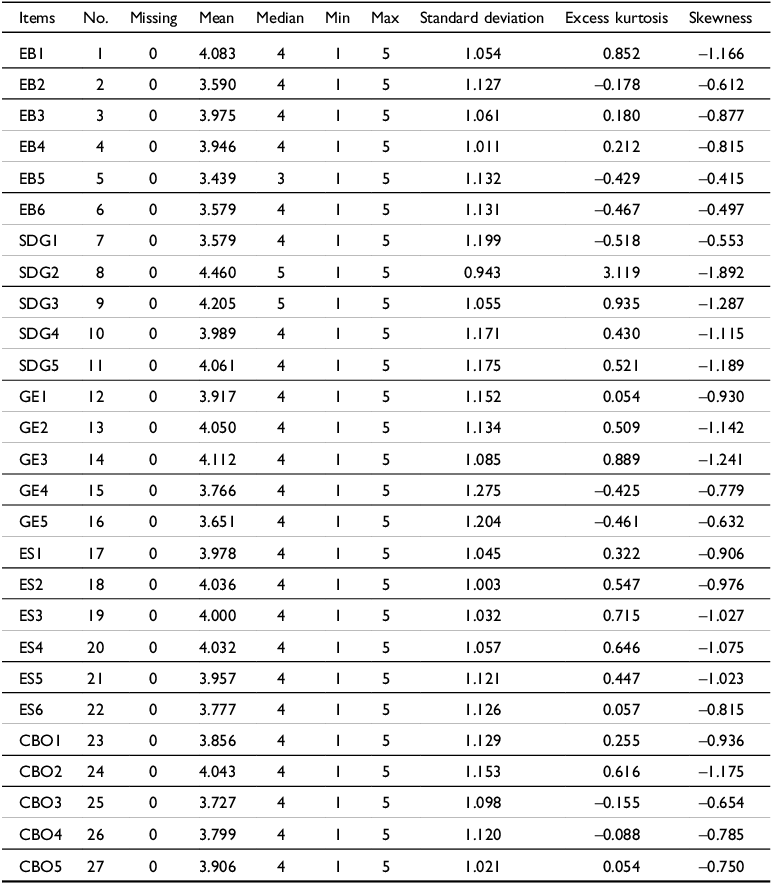
First of all, the normality of this research is tested with the findings of skewness and kurtosis. These findings are examined to determine whether the data have normality in the distribution or not. The threshold for skewness and kurtosis was recommended by Royston (Reference Royston1992). The findings of skewness and kurtosis between –1 and +1 are considered significant for the normality of research data. Results highlighted minor issues in data normality. PLS-SEM was used in this study because there was a minor problem of data normality. According to the literature, the issue of data normality can be managed by using PLS-SEM. As reported by several previous studies (Hair et al. Reference Hair, Black, Babin and Anderson2010; Hair Jr et al. Reference Hair, Hult, Ringle and Sarstedt2016), PLS-SEM does not require data normality. Furthermore, the research data missing values are tested in this process. The data reported in Table 1 highlight that this research has no missing values. Therefore, the data for this research are appropriate and have normality. Furthermore, the data also highlight that the threshold for skewness and kurtosis is achieved. In this way, the findings of this research have appropriate normality and data can be used for further tests.
Skewness and kurtosis

EB = Entrepreneurial Behaviour, GE = Green Entrepreneurship, SDG = Sustainable Development Goals, ES = Environmental Sustainability, and CBO = Creating Business Opportunities
Measurement Model Assessment
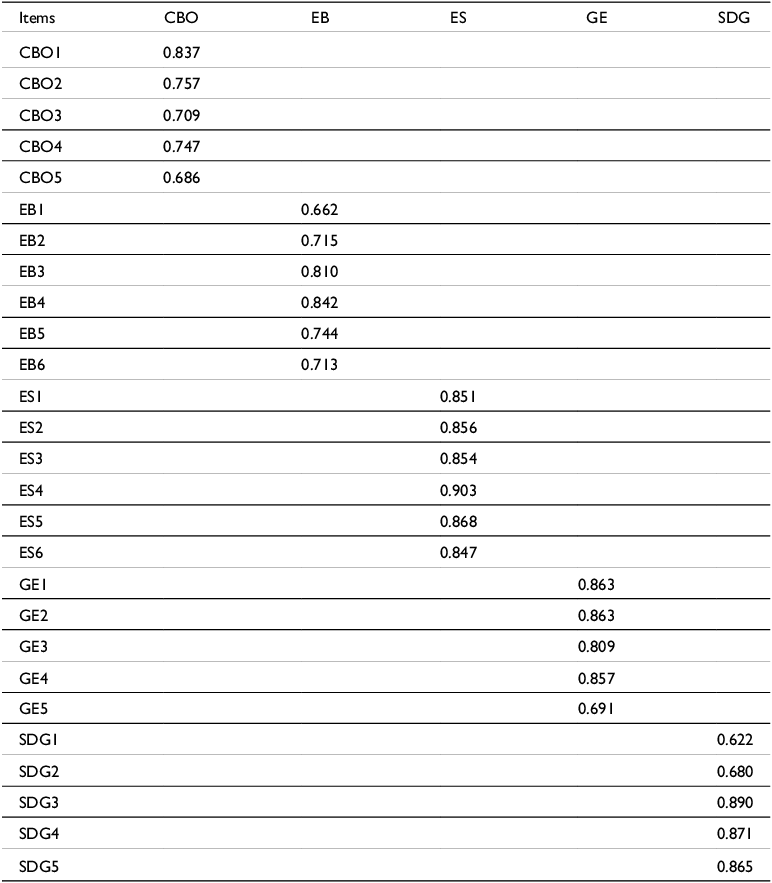
The findings of the measurement model assessment for this research are tested with Smart PLS 3.0. However, the PLS Algorithm tool was used to determine the findings of factor loadings. The findings of factor loadings are tested to determine the validity and reliability of research data at the individual level. The findings of factor loadings more than 0.60 are acceptable (Shevlin and Miles Reference Shevlin and Miles1998). The items of any variables that have factor loadings less than 0.60 are eliminated. However, the items of different variables for this research achieved significant thresholds for factor loadings. It shows that all the scale items can proceed further for hypotheses testing. The results of factor loadings are reported in Table 2.
Factor loadings

EB = Entrepreneurial Behaviour, GE = Green Entrepreneurship, SDG = Sustainable Development Goals, ES = Environmental Sustainability, and CBO = Creating Business Opportunities
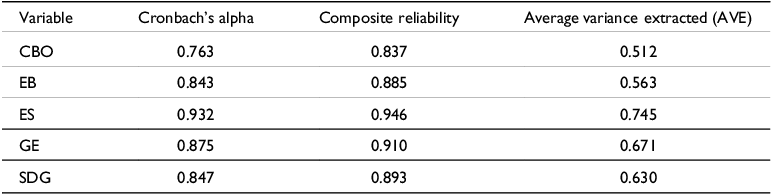
Furthermore, the findings taken by the PLS Algorithm tool were used to test the outcomes of Cronbach’s alpha, composite reliability, and average variance extracted. The findings of Cronbach alpha were tested with a threshold >0.70 (Imran et al Reference Imran, Ślusarczyk and Haque2019; Khan et al. Reference Khan, Hameed, Ahmed, Iqbal, Aplin and Leahy2024; Tavakol and Dennick Reference Tavakol and Dennick2011), and these findings were determined to measure the validity of research data. The findings highlighted that the research variables achieved Cronbach’s alpha at a significant level. Second, the findings of composite reliability were tested with a threshold >0.70 (Raykov Reference Raykov1997), and these findings were determined to measure the reliability of research data. In the same way, the findings highlighted that the research variables achieved composite reliability at a significant level. Finally, the findings of average variance extracted were tested with a threshold >0.50 (Alarcón et al. Reference Alarcón, Sánchez and De Olavide2015), and these findings were determined to measure the variance between research data. The findings highlighted that the research variables achieved average variance extracted at a significant level. The confirmation of Cronbach alpha, composite reliability, and average variance extracted confirmed the convergent validity, which shows that the scale items of same variables are correlated. These factors confirmed that the research data has appropriate validity and reliability, and the results are highlighted in Table 3.
Cronbach’s alpha, composite reliability, and average variance extracted

EB = Entrepreneurial Behaviour, GE = Green Entrepreneurship, SDG = Sustainable Development Goals, ES = Environmental Sustainability, and CBO = Creating Business Opportunities
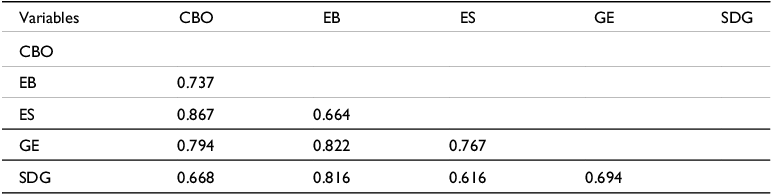
The findings of the PLS Algorithm were also used to determine the discriminant validity of research data. The findings of discriminant validity are used to test the differences between research data to determine the distinction. The findings of discriminant validity were tested with the Heteritrait-Monotrait (HTMT) method. The findings of discriminant validity with the HTMT matrix are significant when no value is more than 0.90 (Ab Hamid et al Reference Ab Hamid, Sami and Sidek2017; Hua et al. Reference Hua, Rasool, Ansari, Khan, Hanif and Ul Hameed2023; Yousaf Reference Yousaf2023). Therefore, the data reported in Table 4 confirmed that HTMT is significantly achieved. It can be observed that all the values are less than 0.9, which confirms the discriminant validity and shows that the scale items of different variables are not similar. The data highlight that the research has significant discriminant validity, and these data can be used for further tests.
Discriminant validity (HTMT)

EB = Entrepreneurial Behaviour, GE = Green Entrepreneurship, SDG = Sustainable Development Goals, ES = Environmental Sustainability, and CBO = Creating Business Opportunities
Structural Model Assessment
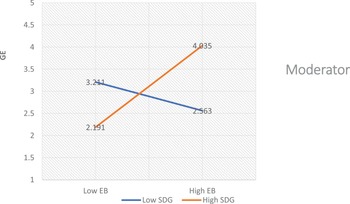
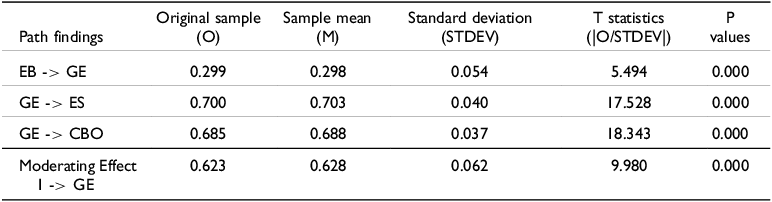
The structural model was assessed using PLS-SEM with the bootstrapping procedure. The findings of direct and moderate paths were tested. The results of paths were tested with t > 1.96 and p < 0.05 (Ramayah et al. Reference Ramayah, Cheah, Chuah, Ting and Memon2018) because the hypotheses of this research were non-directional. H1 outcomes ‘t = 5.494 and p = 0’ confirm that there is a relationship between entrepreneurial behaviour and green entrepreneurship. Second, H2 ‘t = 17.528 and p = 0’ outcomes confirm that there is a relationship between green entrepreneurship and environmental sustainability. Third, H3 findings ‘t = 18.343 and p = 0’ confirm that there is a relationship between green entrepreneurship and creating business opportunities. Finally, H4 findings ‘t = 9.980 and p = 0’ confirm that there is a moderating role of sustainable development goals between environmental behaviour and green entrepreneurship. The findings highlight that the moderation of sustainable development goals is positive between entrepreneurial behaviour and green entrepreneurship. Furthermore, it is highlighted in Figure 2 that the sustainable development goal is strengthening the relationship between entrepreneurial behaviour and green entrepreneurship. The SDGs play a crucial role in reinforcing the link between entrepreneurial behaviour and green entrepreneurship. By providing a structured framework for addressing environmental and social challenges, SDGs inspire entrepreneurs to align their behaviours with sustainable practices. They act as a guiding force that motivates entrepreneurs to pursue eco-friendly innovations and responsible business models. As awareness of global sustainability targets grows, entrepreneurs are increasingly integrating these goals into their strategic decision-making. This alignment not only strengthens the connection between individual entrepreneurial initiatives and green ventures but also enhances their long-term impact on environmental and economic sustainability. The path findings are tested, and the hypotheses of this research are significantly confirmed. The results are reported in Table 5.
Moderating effect 1.
EB = Entrepreneurial Behaviour, GE = Green Entrepreneurship, and SDG = Sustainable Development Goals

Path findings

EB = Entrepreneurial Behaviour, GE = Green Entrepreneurship, SDG = Sustainable Development Goals, ES = Environmental Sustainability, and CBO = Creating Business Opportunities
Moreover, this study examined f-square (f 2) values to check the effect of independent variables on dependent variables. Cohen (Reference Cohen1988) described that an f 2 value of 0.02 is small, 0.15 is moderate and 0.35 is strong. Entrepreneurial behaviour has 0.16 f 2 value in the case of green entrepreneurship. Therefore, entrepreneurial behaviour has a moderate effect on green entrepreneurship. Furthermore, green entrepreneurship has a small and moderate effect on environmental sustainability and green entrepreneurship, values of 0.03 and 0.187, respectively. Furthermore, R-square (R 2) values are 0.52 and 0.55, which is moderate in the case of environmental sustainability and creating business opportunities. Therefore, it is expected to bring a 52% and 55% change in environmental sustainability and creating business opportunities.
Discussion and Conclusion
The empirical findings of this research confirmed that the data for this research achieved a significant threshold, and it is confirmed that all four hypotheses of this research are accepted. The empirical findings of H1 highlighted that there is a relationship between entrepreneurial behaviour and green entrepreneurship. The findings of this research are significant as the path is confirmed. This study highlights that entrepreneurial behaviour fosters green entrepreneurship through the internalization of pro-environmental values, often shaped by educational exposure and institutional emphasis on sustainability. In the Chinese context, particularly in Beijing, educational reforms have increasingly embedded environmental responsibility, reinforcing entrepreneurial intent toward green ventures. The RBV suggests that such behaviour functions as an intangible asset, but cultural collectivism may further enhance the drive to pursue socially responsible business. Unlike studies in Western settings, where individual gain dominates entrepreneurial motives, here societal benefit emerges as a central motivator. This supports our objective of contextualizing green entrepreneurship in urban China.
These findings are in line with the findings of existing studies in the literature. According to Qazi et al. (Reference Qazi, Qureshi, Raza, Khan and Qureshi2020), the twenty-first century now recognizes the need for green entrepreneurship. Gaining environmental sustainability is the goal of green entrepreneurship. When people act creatively to launch their businesses in the market, the requirements vary. According to Yi (Reference Yi2021), the students’ creative thinking is inspiring them to launch entrepreneurial ventures that will enable them to attain environmental sustainability. Since improving employment prospects depends on environmental sustainability, green agendas must be followed accordingly. According to Potluri and Phani (Reference Potluri and Phani2020), many individuals who are determined to attain their environmental sustainability goals must abide by the rules and established standards. People who have access to ecological knowledge and sustainability objectives have the chance to perform better in their academic studies. According to Ye et al. (Reference Ye, Zhou, Anwar, Siddiquei and Asmi2020), people must consider sustainability goals when given the chance to launch their own company. When environmentally friendly companies are operating in the market, environmental advancement is achievable. According to Habib et al. (Reference Habib, Bao and Ilmudeen2020), the market today is developed, and individuals are using all types of strategic approaches to build their communities of commerce. While the enterprises are supported by important business decisions, these businesses should align their strategic actions with sustainability objectives. According to Guo et al. (Reference Guo, Wang and Chen2020), better strategies for achieving sustainability-related goals can pave the way for more effective sustainable development practices. Being able to acquire green knowledge as well as adopt green behaviours aids business owners in achieving stability in their operations. According to Barba-Sánchez et al. (Reference Barba-Sánchez, Mitre-Aranda and del Brío-González2022), for business owners to ensure that they are acting appropriately to achieve environmental sustainability, they need to be aware of environmental issues. Students’ access to entrepreneurial information may offer them a path to achieving market sustainability. According to Fayolle (Reference Fayolle2000), when strategic planning is appropriate to create business sustainability, entrepreneurial ventures can succeed. The green working methodology aids business owners in creating effective strategies for achieving sustainability and enhancing their operations.
The results of H2 highlighted that there is a relationship between green entrepreneurship and environmental sustainability. This relationship is a significant addition to the body of knowledge and literature. The link between green entrepreneurship and environmental sustainability reflects a proactive reconfiguration of entrepreneurial goals to meet ecological challenges. In Beijing, regulatory pressure and urban environmental degradation may intensify the perceived responsibility among entrepreneurs to act sustainably. This differs from contexts where environmental impact is less visible or urgent. Theoretically, green entrepreneurship acts as a dynamic capability to address complex socio-ecological systems. Our findings reinforce the study’s contribution in positioning green entrepreneurship as a viable strategy to achieve local environmental goals within global sustainability frameworks.
The results of existing studies supported the results of the current study. According to Dou et al. (Reference Dou, Zhu, Zhang and Wang2019), the availability of entrepreneurial opportunities to students may be a step towards advancing efforts to promote environmental sustainability. A potential technique to promote market business practices is the establishment of businesses in an environmentally friendly manner. According to Islam et al. (Reference Islam, Huda, Baumber, Shumon, Zaman, Ali and Sahajwalla2021), for the growth of entrepreneurial firms, innovative initiatives must be followed. Students working in creative enterprises may gain valuable insights into how to achieve sustainability goals. According to Muangmee et al. (Reference Muangmee, Dacko-Pikiewicz, Meekaewkunchorn, Kassakorn and Khalid2021), the potential to improve business practices is provided by the sustainability of the enterprise. Students who are inspired to launch their enterprises by their parents or teachers must have an entrepreneurial mindset to advance their practices. According to Grandi and Grimaldi (Reference Grandi and Grimaldi2005), entrepreneurial businesses are needed to accomplish this sustainability, and many commercial organizations are adjusting their practices to achieve environmental sustainability. Since business development can offer a chance to benefit society, students’ modern entrepreneurial ventures should be for innovative progress. According to Su et al. (Reference Su, Xu, Lin, Chen, Liu and Xu2020), students may have the chance to develop their entrepreneurial behaviour through training in workshops for entrepreneurs. Students who have access to green entrepreneurship training may be more inclined to launch their enterprises. According to Huang et al. (Reference Huang, An, Wang, Chen, Wang and Wang2021), when the proper management is operating properly to accomplish the entrepreneurial goals, any business can be stable. When entrepreneurial organizations aim to boost company success while following environmentally friendly guidelines, environmental sustainability can be attained. According to Sargani et al. (Reference Sargani, Zhou, Raza and Wei2020), when deliberate steps are done to advance entrepreneurial enterprise, the management and performance of businesses can be trusted. Owing to their extensive knowledge of company development, students who are driven to assist the community are required to advance their entrepreneurial ventures. According to Peschl et al. (Reference Peschl, Deng and Larson2021), the link between the public and private employment markets is dependent on corporate growth. In emerging nations where public sector institutions have failed to function for the welfare of the populace, opportunities for employment creation are essential. According to Chien et al. (Reference Chien, Kamran, Nawaz, Thach, Long and Baloch2022), the expansion of green business prospects may offer additional chances for individuals to succeed in the marketplace. When major sector businesses are active in all countries and regions, successful company development is achievable.
The outcomes of H3 reported that there is a relationship between green entrepreneurship and creating business opportunities. The findings of this research are significantly considered by the empirical evidence, and are new to the body of knowledge. Green entrepreneurship in this study is not merely a moral stance but a strategic response to evolving market expectations in urban China. With increasing consumer awareness and government incentives, entrepreneurs perceive sustainability as a competitive advantage. Unlike traditional views that frame green initiatives as costly, this study finds they can drive innovation and market differentiation. This aligns with opportunity recognition theory but also shows how local policies and cultural narratives around harmony with nature shape entrepreneurial opportunity perception. Thus, our findings expand the contribution by situating business potential within a socio-political context that rewards ecological consciousness.
The findings of existing studies in the literature also support the relationship developed by this research. According to Anjum et al. (2020), business growth is essential for generating employment opportunities for people, but this growth should be backed by trustworthy entrepreneurial tactics. The targets for sustainability are reasonable for any firm because they serve as the basis for many decisions that people make. According to Murad et al. (Reference Murad, Ali and Akhtar2022), modern consumers are mature as well, and they support companies that practice sustainability in their operations. Over time, people’s perspectives evolve, and viable employment options are created to help people grow their enterprises. According to S.-H. Chang et al. (Reference Chang, Shu, Wang, Chen and Ho2020), to strengthen business culture, the productive strategy can assist environmental sustainability and entrepreneurship development. A good reputation in their market is enjoyed by entrepreneurial companies that were founded to help the environment through sustainability. According to Lv et al. (Reference Lv, Chen, Sha, Wang, An, Chen and Huang2021), independent enterprises are assisting various nations in expanding their labour markets. The business environment provides individuals with opportunities to establish and grow their own businesses. According to I. Hameed et al. (Reference Hameed, Zaman, Waris and Shafique2021), long-term possibilities are given to people by sustainable enterprises. People’s ability to get trustworthy information for business growth can significantly progress their practices. When people have possibilities, they can grow their firms and fill the market with more jobs. According to Pahlevi and Suhartanto (Reference Pahlevi and Suhartanto2020), there are more opportunities for people to participate in the business growth in developing nations. As employees have a dependable functioning style, business progress is reliable. According to Rashid (Reference Rashid2019), many people who own their enterprises have taken thoughtful measures to protect the environment. Entrepreneurs should approach sustainability in the environment with the same mindset that policies should be put in place for it.
Finally, the statistical data obtained for H4 confirmed that there is a moderating role of sustainable development goals between entrepreneurial behaviour and green entrepreneurship. This study highlighted that the moderating role of sustainable development goals directly strengthens the relationship between entrepreneurial behaviour and green entrepreneurship. SDGs serve as a cognitive and normative framework that strengthens the pathway from entrepreneurial behaviour to green entrepreneurship. Students who are aware of SDGs are more likely to internalize global sustainability values, which shape their entrepreneurial aspirations beyond profit. In Beijing’s academic environment, where SDGs are increasingly included in curricula, such awareness is not incidental but cultivated. This reflects institutional theory, as formal education structures legitimize and guide entrepreneurial direction. Our study thus contributes to understanding how global policy frameworks such as the SDGs are locally interpreted and operationalized through education and cultural alignment. Indeed, this relationship is newly developed in the body of literature. Yet, the findings of existing studies have the appropriate support for this novel relationship. According to I. Hameed and Irfan (Reference Hameed and Irfan2019), for the success of entrepreneurial firms, it is necessary to strengthen the strategic business decisions made for such operations. Many students in entrepreneurial courses launch their enterprises, but they should have a successful strategy for green entrepreneurial endeavours. According to Gasparin et al. (Reference Gasparin, Green, Lilley, Quinn, Saren and Schinckus2021), when the objectives of sustainability are met, company dependability and growth are achievable. Students’ prospects for starting their businesses can grow as a result of their access to environmental information. According to B.A. Soomro et al. (Reference Soomro, Ghumro and Shah2020), using a sustainable functioning strategy that supports business growth appropriately, business development can be stable in any market. Nevertheless, emphasizing green business is essential to advance commercial practices that can enhance entrepreneurial endeavours. According to Sher et al. (Reference Sher, Abbas, Mazhar, Azadi and Lin2020), when a business development idea is offered and encourages individuals to enhance entrepreneurship sustainability, the prospects for company development are improved. Business development practices are necessary to increase business performance; however, to achieve sustainability in business development practices, ecological targets must have precedence. According to Noordin and Sulaiman (Reference Noordin and Sulaiman2010), for entrepreneurial businesses, sustainability goals should be improved, and people should adopt a useful strategy to change their behaviour in favour of the environment. The possibilities for business growth grow over time, but students must work sustainably to advance their entrepreneurial practices. According to R.B. Soomro et al. (Reference Soomro, Ghumro and Shah2020), when green entrepreneurial enterprises are founded in any nation, the job market becomes solid and there are more prospects for people to acquire superior business practices.
Implications
These findings of this research are novel, as the relationship tested by the statistical data is new and adds to the literature. This research shows that green entrepreneurship is possible when students are trained to achieve entrepreneurial goals through positive behaviour toward entrepreneurship. This study also confirmed that the ‘green entrepreneurship’ approach is appropriate to improve entrepreneurial behaviour. No doubt, existing studies have discussed different dimensions and outcomes of green entrepreneurship, but this research confirmed that green entrepreneurship is significantly influencing environmental sustainability and creating business opportunities. Business opportunities are significantly increased when green initiatives are created for entrepreneurial advancement. Furthermore, this research highlighted that entrepreneurial initiatives with green initiatives are reliable to advance entrepreneurial facilities. The literature related to entrepreneurial behaviour is extended by this research. This research also introduced the moderating role of sustainable development goals for green entrepreneurship.
This research has noteworthy practical implications, as the findings highlighted that green entrepreneurship can be established by students when they have positive entrepreneurial behaviour. Educational institutions should embed the Sustainable Development Goals (SDGs) directly into entrepreneurship courses through case studies, experiential learning, and project-based assessments. By aligning course content with real-world sustainability challenges, educators can encourage students to develop green business models. Furthermore, students with a reasonable approach to improving their entrepreneurial behaviour are required to have significant motivation. The behaviour of students matters a lot for their success in entrepreneurial ventures. When there is reliability in the entrepreneurial approach of the students, they get the motivation to achieve better entrepreneurial goals. Policymakers should design and support incubation programmes that specifically target green entrepreneurship, offering funding, mentorship, and resources to students and early-stage entrepreneurs focused on environmental sustainability. These programmes can be tailored to align with national SDG targets, incentivizing ventures that address pressing ecological issues. In addition, students should be motivated to pursue green entrepreneurial goals because their positive entrepreneurial mindset can contribute to environmental sustainability while creating business opportunities for others. In the same way, the importance of sustainable development goals can’t be neglected, as these goals are a source of information sharing and the achievement of sustainability in the market. When the students have information about the goals of sustainability, their performance will improve. Nevertheless, universities should partner with government agencies, NGOs, and industry leaders to co-develop workshops, hackathons, and innovation labs focused on SDG-related challenges. These initiatives provide students with opportunities to apply entrepreneurial behaviour in real-world contexts, fostering deeper awareness and commitment to sustainability. Such collaborations ensure that students not only learn about SDGs but are empowered to act on them through entrepreneurial solutions.
Furthermore, this study offers several actionable policy implications. Policymakers should integrate sustainability-focused entrepreneurship education into national curricula to nurture environmentally responsible business mindsets among students. Universities are encouraged to collaborate with industries and government agencies to provide incubation support and funding for student-led green startups. Moreover, creating incentive programmes and sustainability awards can motivate young entrepreneurs to pursue eco-friendly ventures. These measures can collectively promote sustainable economic growth and strengthen the green innovation ecosystem.
Therefore, findings provide valuable insights for global policymakers, educators, and entrepreneurial ecosystems by highlighting the pivotal role of educational institutions in nurturing sustainability-oriented mindsets among future business leaders. Although data for this study were collected from Chinese universities, the model and implications are transferable to other regions where youth entrepreneurship and environmental consciousness are seen as engines of sustainable economic growth, including emerging economies in Asia, Africa, and Latin America, as well as developed nations seeking to align innovation with ecological responsibility.
Limitations and Future Directions
The purpose of the current study is achieved as the findings of the current research are significant. The relationship developed by this research is an advancement in the literature. No doubt, the statistical analysis showed that green entrepreneurship is significantly and positively influenced by the entrepreneurial behaviour of students. Moreover, the study also confirmed that green entrepreneurship is influencing environmental sustainability and creating business opportunities. Accordingly, the results of this research are critical for theoretical and practical implications, but some limitations of this research are also highlighted. First, the sample size of this study is based on 1967 respondents who were students enrolled in different entrepreneurial programmes at universities located in Beijing, China. This sample is a limitation because only one region in China is considered for data collection, and the perception of people may be different. Therefore, scholars are advised to collect data from a different set of respondents. Furthermore, this research has considered the entrepreneurial behaviour of the students, but it has not tested the antecedents of their entrepreneurial behaviour. Future studies are required to determine the factors that can influence the entrepreneurial behaviour of the students in a significant way, and any specific theory used for these relationships. Thus, the findings of such studies would be a significant addition to the body of knowledge and literature. Furthermore, this study is limited by its focus on a single location, Beijing, which may restrict the generalizability of the findings to other regions with differing socio-economic or educational contexts. Therefore, future studies should consider various other regions of China. Additionally, the reliance on self-reported data may introduce social desirability bias, potentially inflating pro-environmental responses. The cross-sectional design also limits causal interpretations between variables. Future research should consider longitudinal approaches to examine changes over time and establish causality. Comparative studies across different regions or qualitative methods could also uncover deeper motivations behind green entrepreneurial behaviour.
Data Availability
The datasets used and/or analysed during the current study are available from the corresponding author on reasonable request.
Author Contributions
Writing – Original Draft, Methodology, Investigation, Conceptualization. Formal Analysis, Data Curation; Writing – Review; Editing. All done by Shuaiqing Zhang, Haocheng Li, Chen Yang, Xinwei Zhu.
Funding
-
(1) The 2024 Annual Anhui Province New Era Education Quality Project (Postgraduate Education) ‘Special Project on Innovation and Entrepreneurship Education in the New Era’ (Project No. 2024shsjsfkc026).
-
(2) The 2024 School-Local Collaborative Basic Education Research Achievement Cultivation Project: ‘Research on the Career Development Predicament and Solution Path of Physical Education Teachers in Primary and Secondary Schools in the New Era – Taking Bengbu City as an Example’ (Project No. 2024BBXTJY24).
Competing interests
The authors have no relevant financial or non-financial interests to disclose.
Appendix: Scale Items
Entrepreneurial Behaviour (EB)
EB 1: I am learning to develop a business plan.
EB 2: I am learning to start product/service development.
EB 3: I attempted to obtain external funding.
EB 4: I focused on purchasing material, equipment or machinery for business.
EB 5: I try to learn registered the company.
EB 6: I try to enhance business activities with different strategies.
Green Entrepreneurship (GE)
GE 1: In our university, we learn green business uncertainty is dealt with as a challenge.
GE 2: We are encouraged to engage in activities in new green industries.
GE 3: University management recognizes specific proposals in the field of green attitudes.
GE 4: Our university places more emphasis on opportunities to succeed than opportunities to fail.
GE 5: In university, the new (green-based approach) activity that has failed is viewed as a learning experience.
Social Development Goals (SDGs)
SDG 1: Good health and wellbeing are deterministic factor for livelihood.
SDG 2: A healthy environmental is needed for survival.
SDG 3: Welfare decreasing as threat to human existence and life expectancy.
SDG 4: Education is the bedrock of knowledge, information and meaningful sustainable development.
SDG 5: Industrial innovation and infrastructure are pivotal strengths of human development and scientific discovery.
Environmental Sustainability
ES 1: I have control over matters regarding the environment.
ES 2: I have the ability to take actions that will help the environment.
ES 3: I intend to recycle in the near future.
ES 4: I intend to participate in conservation/sustainability practices in the near future.
ES 5: I currently recycle instead of throwing things away.
ES 6: I currently participate in conservation/sustainability practices.
Creating Business Opportunities
CBO 1: I actively identify new business opportunities that address environmental challenges.
CBO 2: My interest in sustainability has helped me discover innovative market needs.
CBO 3: I am confident in my ability to turn green ideas into profitable business ventures.
CBO 4: Environmental concerns inspire me to explore untapped business possibilities.
CBO 5: I frequently recognize potential opportunities where green entrepreneurship can create value.
Shuaiqing Zhang was born in Anhui, China, in 1990. From 2018 to 2022, he studied at Joongbu University, and he received his doctor’s degree in 2022. Since August 2022, he has been working at the College of Education, Fuyang Normal University. Jiangxi University of Finance and Economics postdoctoral station. His main research directions are innovation and entrepreneurship education, vocational education, and youth education. He has published two papers on the Social Sciences Citation Index and one paper on the Chinese Social Sciences Citation Index.
Haocheng Li was born in Anhui in 2004, China. From 2021 to 2025, he studied at the School of Education of Fuyang Normal University. He achieved his bachelor’s degree in 2025. In 2025, Li began studying for a master’s degree at Fuyang Normal University.
Chen Yang was born in 1994 in Anhui, China. Yang Chen attended Fuyang Normal College from 2011 to 2015 and graduated with a bachelor’s degree in July 2015, Jiangxi University of Finance and Economics from 2020 to 2023 and graduated in June 2023 with a master’s degree. From September 2023 he has been working in the Internet College of Jiaxing Vocational and Technical College (College of Cyberspace Security), and his main research interests are student mental health and development, art education.
Xinwei Zhu was born in 1994 in Anhui, China. Zhu Xinwei studied at Jianghuai College of Anhui University from 2014 to 2018 and obtained a bachelor’s degree in economics in 2018. She pursued a master’s degree from Jiangxi University of Finance and Economics from 2018 to 2020, and obtained a master’s degree in social work in 2020. Since September 2021, she has been working at the School of Education Management, Bozhou Vocational and Technical College.

 Open access

